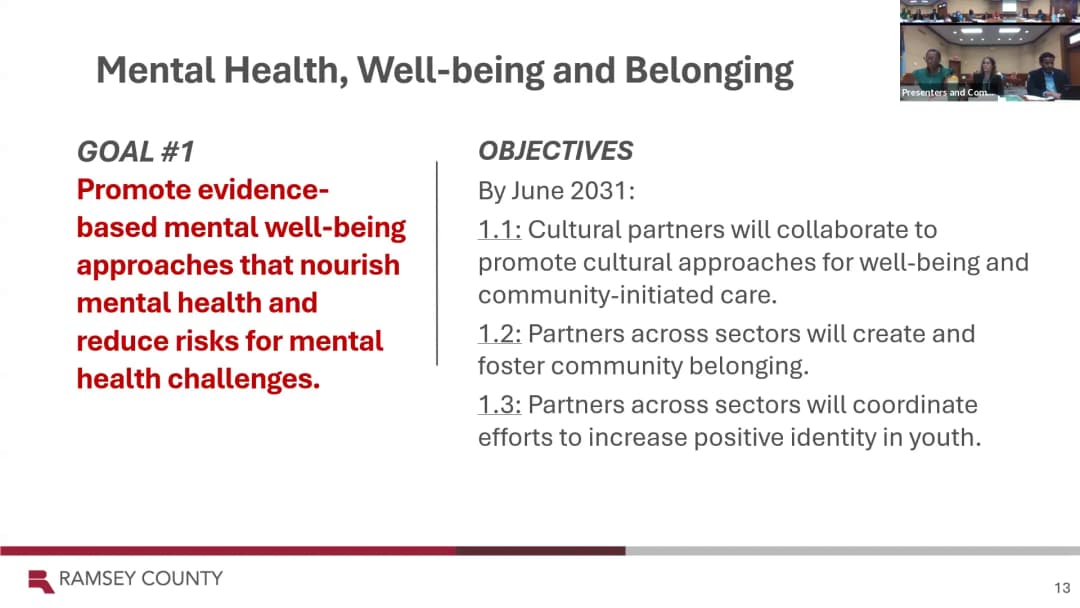
This workshop, held on July 28, 2026 (10:15 UTC), featured a presentation by St. Paul-Ramsey County Public Health on the Community Health Assessment (CHA) and Community Health Improvement Plan (CHIP). No votes were taken. The CHIP identifies four community health priorities: mental health and well-being, health care access, healthy living and chronic conditions, and basic needs (including economic conditions, food access, and housing stability). These were derived from extensive community engagement conducted in September–October 2025. Discussion Items - Presentation Overview: Public Health Director Amy Karen, Planning Manager Patrice Small, Planning Specialist Bella Green, and others presented the CHA and CHIP process. The CHA is a data compendium covering 13 health topics. The CHIP is a five-year plan developed using the MAP framework (Mobilizing for Action through Planning and Partnerships). Community engagement included a survey (656 respondents; 179 in-person, 47 online – note: these numbers are inconsistent in the transcript) and 9 community conversations (341 attendees). The top concerns were mental health, healthcare access, basic needs, and healthy living. - Priorities and Strategies: The four priorities are divided into two groups: mental health/well-being and healthcare access will have coordinated action teams; healthy living/chronic conditions and basic needs will focus on relationship building and information sharing with existing collaboratives. - Commissioner Questions and Discussion: - Commissioners inquired about the department's name (St. Paul-Ramsey County Public Health) and the possibility of rebranding to reflect countywide service. County Manager noted this could be revisited when the Joint Powers Agreement is updated. - Discussion about mandate vs. discretion: Commissioners asked which activities are prescribed by state statute and which are locally determined. Public Health explained the foundational public health responsibilities framework from MDH. - Concerns about community engagement geography: Commissioners noted that most engagement took place in St. Paul; suggested using suburban libraries and collaboratives for future engagement to capture suburban voices. - Impact of external events (government shutdown, Operation Metro Surge) on the process: acknowledged that these events influenced community concerns, especially around food access and basic needs. - Commissioners emphasized the need for internal coordination across county departments and sharing of data to avoid duplication and to leverage the CHA/CHIP as a countywide resource. - Commissioners questioned the five-year timeline for some objectives; some felt certain actions could be started sooner. Public Health staff clarified that the timeline is a planning horizon but work can begin immediately. - Internal Alignment: County Manager suggested mapping existing county work (e.g., Project Bridge, ADC mental health support) to the CHIP objectives to show alignment and prioritize budget decisions. - Asset Mapping and Data Sharing: Public Health conducted asset mapping with partners. Commissioners encouraged making data accessible internally (e.g., via LMS) and externally to community partners and funders. Key Outcomes - No votes taken (workshop only). - Next Steps: - Launch of Community Health Improvement Collaborative on August 17, 2026 (hybrid meeting at the Environmental Center). - Public Health to share the CHA and CHIP widely, including with city councils, collaboratives, and community organizations. - County Manager to work with Public Health on a broad roll-out strategy, possibly with a cover letter from county leadership. - Update the QR code for the collaborative sign-up (current QR code leads to a different form). - Commissioners requested a follow-up to see how existing county programs align with CHIP objectives.
Public Meetings - Ramsey County, Minnesota
Public Meetings - Ramsey County, MinnesotaThe Ramsey County Board convened a workshop on July 28, 2026, originally scheduled for 10:30 a.m. but called to order just after 11:00 a.m. The session focused on the evolution of the county's workforce strategy from the Talent Attraction, Retention, and Promotion (TARP) initiative to a new phase called "Workforce Forward." The presentation was led by Human Resources leadership, including CHRO Patience, COO Alex, and new Deputy Director Abby Redea. No votes were taken during this workshop; it was a discussion and informational session. Presentation Overview Patience, CHRO, opened by explaining that TARP had been the county's workforce strategy since 2019 and had made significant progress, including increased workforce diversity to 42% (first increase in four years) and reduced average time-to-hire from 160 days to 76 days. However, the county now aims to focus beyond attraction to include onboarding, leadership development, and performance management. Abby outlined the three strategic pillars for the next 18 months: 1. Enhanced Onboarding: A comprehensive 12-month onboarding experience for new hires, including structured check-ins at 30, 60, 90 days and one year, to improve retention and set employees up for success. 2. Leadership Development: Creation of a people-leader orientation and a leadership essentials training series for all supervisors, with emphasis on supporting new supervisors and existing leaders. 3. Performance Management: A new focus on probation-period management, providing tools for coaching and feedback to foster continuous improvement and reduce early turnover. Key Metrics and Goals The HR team presented initial performance measures: - 80% retention of new hires (current baseline approximately 70%) - 95% participation of people leaders in orientation sessions - 85% participation in leadership essentials training - 90% of employees passing probation These goals were based on research and benchmarking with Hennepin County and other organizations. The strategy is internally developed with no additional costs outside existing resources, though future leadership development may incur costs within budget. Commissioner Discussion Commissioners raised several questions: - Commissioner Moran asked why targets were not 100%, and noted that success depends on department partnership, not just HR. - Commissioner Sean asked about implementation with departments like corrections (e.g., correctional officers) and how HR will collaborate with supervisors. Patience emphasized a collaborative, not top-down, approach, piloting micro-learnings and tailoring to different "lines of business." - Commissioner McGuire inquired about existing metrics and praised the presentation's key takeaways. County Manager confirmed that workforce metrics will be integrated into departmental performance measures beginning in the fall. - Commissioner Brand asked about disaggregating data by race, disability, and department. Patience agreed this is important and will be addressed. He also asked if the goals were based on employee feedback; the team responded they relied on research and best practices rather than pre-existing surveys. - Commissioner McMurtry emphasized the need to include long-tenured leaders in training, not just new supervisors, and asked about support for leaders during high-pressure periods. Patience acknowledged the challenge and stressed building trusting relationships and creating safe spaces for leaders. Key Outcomes - The "Workforce Forward" strategy was formally introduced as Ramsey County's new long-term workforce framework, building on TARP. - Implementation will occur over 18 months with phased collaboration, including piloting and evaluation every two years. - The HR team will work with departments to align initiatives and will provide data to track progress. - No formal votes or decisions were taken; the workshop served to inform the Board and gather feedback for further development. - The county manager noted that performance indicators related to workforce forward will be included in the 2027 supplemental budget process.
The Ramsey County Board of Commissioners met in regular session on July 14, 2026 at 9:01 a.m. in Council Chambers. All seven commissioners were present: Jebens-Singh, McGuire, McMurtrey, Miller, Moran, Xiong, and Chair Ortega. The meeting included a proclamation, approval of consent items, discussion of the Twin Cities Army Ammunition Plant Master Plan amendment and two community crime prevention grants, and reports from the County Manager and commissioners. The open session adjourned at 10:03 a.m., followed by a closed meeting regarding elections. Consent Calendar - Agenda of July 14, 2026 – Approved unanimously (7-0). - Minutes from July 7, 2026 – Approved unanimously (7-0). - Grant Agreement with MN Department of Health for Medical Examiner’s Illicit Drug Toxicology Testing and Surveillance – Accepted a $125,000 grant (July 14, 2026 – August 31, 2028) and authorized execution. (Resolution B2026-087, unanimous). - Proposed Changes and Additions to Public Health Fees – Approved additions/change for telehealth and vaccine fees. (Resolution B2026-088, unanimous). - Joint Powers Agreement with MN Bureau of Criminal Apprehension for Criminal Justice Data Network – Approved $261,600 agreement for five years and court data subscriber amendment. (Resolution B2026-089, unanimous). - Proposed Ramsey County Sheriff’s Office Fee Schedule Update – Approved updated fees for security and civil process services. (Resolution B2026-090, unanimous). Proclamation: Pretrial, Probation and Parole Supervision Week - Commissioner McMurtrey presented a proclamation declaring July 19–25, 2026 as Pretrial, Probation and Parole Supervision Week in Ramsey County, honoring the 450+ community corrections professionals. Liz Reitz, Deputy Director of Field Services, and several staff members spoke about the department’s work, particularly during Operation Metro Surge, and their commitment to evidence-based practices, reducing recidivism, and supporting clients. Multiple commissioners expressed strong support and gratitude for the department’s role in justice transformation and public safety. Discussion Items - Amendment to Twin Cities Army Ammunition Plant Master Plan (Item 5) – Commissioner Xiong moved approval, noting the modifications were vetted at Joint Development Authority meetings and approved by the City of Arden Hills. The amendment supports continued design, site preparation, and construction. The motion passed unanimously (7-0, Resolution B2026-091). - Grant Agreements with MN Department of Public Safety for Community Crime Intervention and Prevention Programs (Item 7) – Undersheriff Kyle Mestad and Inspector Daryl Gullette presented two grants: $250,000 for community-based programming for communities most impacted by violence, and $425,000 for community outreach (both through December 31, 2027). The grants are new revenue, funding two existing FTE positions that remain vacant until grant funds are available. Commissioners asked about outcomes, community partnerships (e.g., KOM, Urban Village), cultural responsiveness, and evaluation. Staff confirmed that evaluation is conducted in-house and through state oversight. The grants will support youth programming, including fishing, school supplies, and relationship-building. The motion passed unanimously (7-0, Resolution B2026-092). County Connections - County Manager Ling Becker reported on the city’s decision to close encampments, stating Ramsey County is fully engaged in supporting residents through the Community Wellness and Response Initiative, providing outreach, wound care, food, water, and connections to housing and services. She also noted the activation of the heat team ahead of a heat wave (heat index 101°F on July 14, 97°F on July 17) and cooling spaces available at county facilities and community locations. Commissioners expressed support and asked about coordination with the city for future closures and cooling locations. - Commissioner Reports – Commissioners highlighted events: Lauderdale Day in the Park (celebration of Eustace Street development), Little Canada 35E groundbreaking, a poverty simulation event, Beacon Interfaith supportive housing updates, NAMI Ramsey County strategy session, District 1 picnic, Art from the Inside meeting, MESB board meeting, Battle Creek Waterworks grand reopening (over 1,400 visitors on opening day), and a 3-on-3 basketball tournament promoting mental health. Commissioner Moran reminded about the Disability Pride Festival on July 16 at the Capitol. Key Outcomes - All votes on agenda items were unanimous (7-0). - Resolutions adopted: B2026-087 (Medical Examiner grant), B2026-088 (Public Health fees), B2026-089 (Criminal Justice Data Network), B2026-090 (Sheriff fee schedule), B2026-091 (TCAAP Master Plan amendment), B2026-092 (Community Crime Intervention grants). - The closed meeting (10:25–11:58 a.m.) under Minnesota Statutes 13D.05, subd. 3(b) regarding elections resulted in a motion (McMurtrey, seconded by Miller) to authorize staff to proceed as discussed, passed 7-0 (Resolution B2026-093). - The County Manager will continue to provide updates on encampment closures and heat response.
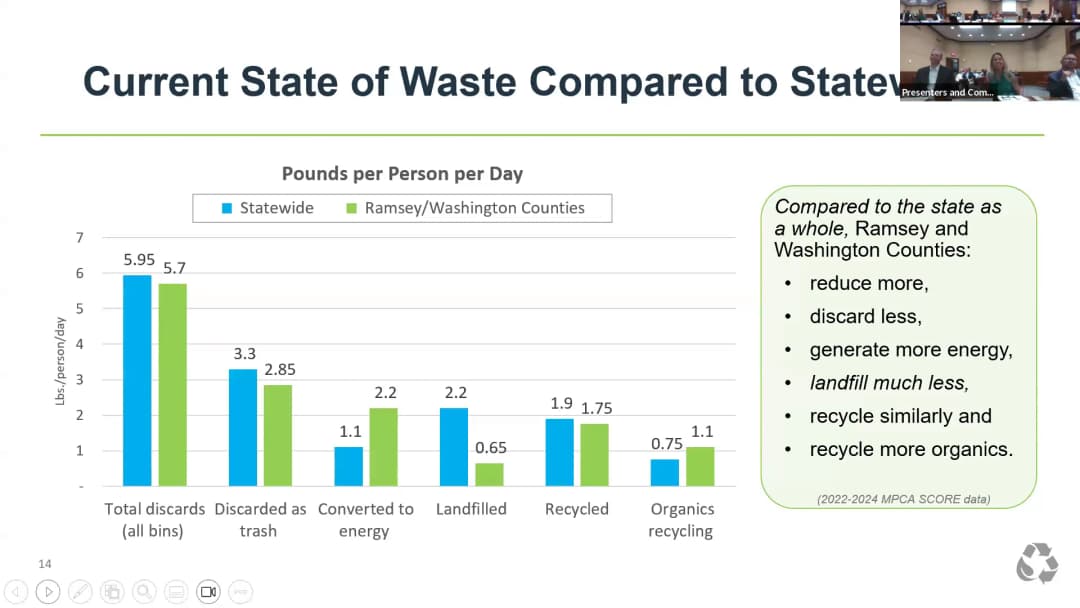
On July 7, 2026, the Ramsey County Board held a workshop (no formal votes, recorded and live-streamed) to review the Minnesota Pollution Control Agency's (MPCA) Draft Resource Management Report. Ramsey Washington Recycling & Energy (RE) staff presented the report's context, their concerns, and recommended revisions. The report was directed by the 2023 Minnesota Legislature to assess resource management and analyze opportunities to reach 90% waste diversion by 2045, sometimes called zero waste. The MPCA released the draft in April 2026 for public comment; the comment period was extended to August 10, 2026. Discussion Items - Budget Update: RE Executive Director Tristan Martinson reminded the board that the two-year RE programs budget (2026–27) was already approved with no changes for 2027. Tip fees for garbage haulers will increase from $142 to $159 per ton in 2027 to cover the food scrap program expansion and transfer stations. RE facility budget does not require board approval. Staff noted the counties already meet the MPCA's 2030 pre-processing requirement. - Report Overview & Staff Concerns: Martinson and staff expressed several concerns: the report omits regional collaboration and public-private partnerships as solutions; underestimates capital and programmatic investments (e.g., $50 million already invested in RE's facility); does not distinguish waste-to-energy from landfilling; and lacks realistic timelines, funding, and governance structures. Staff argued the report's premise is flawed because it treats a 90% reduction in landfilling and waste-to-energy as simultaneous goals without alternative processing capacity. They cited state recycling goals (75%) versus current state recycling rate (42%) and low participation (13%) in existing food scrap collection as evidence that the 90% goal is unrealistic without additional tools. - Waste-to-Energy Defense: Martinson and Commissioner Moran defended waste-to-energy as a preferred alternative to landfilling, emphasizing its role in capturing energy and preventing waste from being buried. They noted RE diverts about 85% of the 450,000 tons of trash processed annually from landfills. Staff highlighted that Ramsey and Washington Counties produce 14% of the state's waste, and each resident generates about 5.7 pounds of waste per day (2.85 pounds garbage, 1.75 pounds recycled, 1.1 pounds composted). - Commissioner Discussion: Multiple commissioners expressed support for the RE position and discussed strategies. Commissioner Moran asked about education and outreach, noting community members may be misinformed. Commissioner McGuire reported that counties are coordinating to send comment letters through AMC. Commissioner Xiong asked about engaging with legislators. Staff and commissioners agreed on the need to counter misinformation with facts and to provide clear messaging. Some commissioners noted the League of Women Voters supports protecting waste-to-energy, while some environmental groups oppose it. A board member requested RE to provide talking points or a call-to-action that commissioners could share with constituents. - Discrepancy Note: The transcript refers to the report page count inconsistently: it is described as a "358-page draft report" at the start, later as a "385-page report," and staff say "we've reviewed all 285 pages." Key Outcomes - The MPCA extended the public comment period to August 10, 2026. - RE staff will submit a detailed comment letter (10 pages) to the MPCA, plus a one-page executive summary for the legislature. - RE recommended the MPCA create a stakeholder task force to provide additional input before finalizing the report. - Staff, county staff, and commissioners will continue coordinated advocacy to ensure the final report accurately reflects county investments, waste-to-energy's role, and feasible funding/timelines. - No formal board action was taken; the workshop was informational and for discussion.
The Ramsey County Housing and Redevelopment Authority (HRA) met in regular session on July 7, 2026, at 10:35 a.m. in Council Chambers (Courthouse Room 300). All seven members present (Jebens-Singh, McGuire, McMurtrey, Miller, Moran, Ortega, and Chair Xiong) along with County Manager Ling Becker and Assistant County Attorney Scott Schwahn. The meeting was adjourned at 10:46 a.m. The primary action was the approval of $1,300,000 in Pathways to Reducing Obstacles to Housing (PRO) funding for a 24-unit supportive housing project for youth experiencing homelessness. Consent Calendar - Agenda of July 7, 2026 – Approved unanimously (motion by Ortega, seconded by Miller). - Minutes from June 23, 2026 – Approved unanimously (motion by Jebens-Singh, seconded by Miller). Discussion Items Item 3: Obligation of Pathways to Reducing Obstacles to Housing (PRO) Funding for Housing Development Projects Max Holdhusen, Deputy Director of Community & Economic Development, presented the second of five board actions from the 2026 housing development solicitation. The recommended project is face-to-face at arcade – a city of Saint Paul HRA-owned lot on Arcade Street to be transformed into a 24-unit supportive housing building for youth (ages 16–24) transitioning out of homelessness. All units will be housing support units, developed in partnership with the Housing Stability Department. The project also received an award from the 2024 Emerging Diverse Developers solicitation. The PRO funds ($1.3 million) represent about 13% of construction costs. Commissioner McMurtrey asked about the selection process and whether this was the only applicant meeting criteria. Holdhusen explained that the PRO funds are a new federal grant source (jointly applied with the Metropolitan Council in 2024) and that the project was selected because it scored highly and could stack other federal funds efficiently. Commissioner Moran asked for clarification on the meaning of "Pathways to Reducing Obstacles to Housing" – noting the name sounds like a code to be removed. Holdhusen clarified that it is the name of the federal grant (PRO) and cannot be changed. Commissioner Miller asked about the grant’s continuation and the role of Hennepin County. Holdhusen stated that this is likely a one-time grant for Ramsey County; Hennepin County opted out and their portion will be used for planning and policy in local cities. Miller also noted appreciation for the 30-year affordability covenant recorded against the property title and the county’s ongoing monitoring. Commissioner Jebens-Singh expressed support for the project, emphasizing the importance of investing in supportive housing for an underserved population of young people experiencing housing instability. Board Chair Update Chair Xiong provided an update on federal housing legislation: a major housing bill (the largest overhaul in decades) has passed Congress and sits on the President’s desk. The bill includes streamlining CDBG disaster recovery funding, expanding HOME program uses, and language restricting institutional investors from purchasing more than 350 single-family homes. Chair Xiong noted the President has indicated he will not sign it unless the SAVE Act (an election bill) is also passed. Commissioner McGuire added that the SAVE Act would restrict elections and that the linkage is a “horrible way to govern.” Key Outcomes - Approved (unanimous, 7–0) the obligation of $1,300,000 in PRO funding for the face-to-face at arcade supportive housing project (motion by McMurtrey, seconded by Ortega). - Authorized the County Manager to enter into loan or other agreements and execute amendments consistent with local regulations, subject to County Attorney approval (Resolution H2026-012). - No further action or referrals were made.
The Ramsey County Board of Commissioners convened on July 7, 2026, at 9:00 a.m. in Council Chambers (Room 300) at 15 West Kellogg Blvd., Saint Paul. All commissioners were present: Jebens-Singh, McGuire, McMurtrey, Miller, Moran, Xiong, and Chair Ortega. County Manager Ling Becker and Civil Division Director Jada Lewis also attended. The meeting included approval of consent items, a discussion on the County Manager's performance evaluation and salary increase, a presentation on the expansion of food scrap collection, and updates from commissioners. Key votes were unanimous. Consent Calendar - Agenda Approval (2026-236): Approved unanimously. - Minutes Approval (2026-237): Minutes from June 23, 2026, approved unanimously. - Release of Storm Sewer Easement (2026-242): Approved the release of an easement at 1644 Larpenteur Avenue West, Falcon Heights. Resolution B2026-083. - First Amendment to Joint Powers Agreement (2026-244): Approved an amendment with the City of Saint Paul for administration of the Byrne Grant for the Familiar Faces Program through May 31, 2027. Resolution B2026-084. - Gift Acceptance from Minnesota State Fair (2026-241): Accepted a $28,000 gift (1,400 tickets) to the Social Services Department. Resolution B2026-085. Discussion Items - County Manager Performance Evaluation and Second Amendment to Employment Agreement (2026-260): Commissioners spoke in support of County Manager Ling Becker, citing her leadership through challenges, strategic vision, operational excellence, and community engagement. The approved amendment increases her annual salary to $283,550 effective August 1, 2026, reflecting a standard cost-of-living adjustment plus 3% performance pay, and is benchmarked to comparable counties. Resolution B2026-086 passed unanimously. - Presentation: Recycling & Energy – Food Scrap Collection Rollout: Trista Martinson, Executive Director of Ramsey/Washington Recycling & Energy, presented the next phase of food scrap collection. The program uses green bags that residents place in their regular trash. New communities include Arden Hills, Gem Lake, Little Canada, Moundsview, New Brighton, North Oaks, Shoreview, Vadnais Heights, White Bear Lake, and White Bear Township. To date, 347 tons of food waste have been diverted from landfill. Participation has risen from 10% to 13% in active areas. Roseville and Falcon Heights are expected to join by December 2026 (construction dependent), with Saint Paul following in early 2027 (February/March). Over 500 residents have already ordered bags. The program includes multi-unit coordination and multilingual education. - County Manager’s Update (County Connections): County Manager Ling Becker thanked the board for their trust, acknowledged staff, and highlighted upcoming events, including a mental health basketball tournament at Jimmy Lee Rec Center. She also introduced Jolie Wood as the new Director of Government Relations, along with new specialists Betelehem Ibrahim, Matt Freeman, and Rick Varco (starting August 4). - Outside Board and Committee Reports & Board Chair Update: Commissioners reported on community events, meetings, and committee work. Highlights included: Commissioner Jebens-Singh reported on progress at Rice Creek Commons (site prep in late September 2026) and the upcoming district picnic. Commissioner Xiong noted the 10th anniversary of Philando Castile’s death and related community events. Commissioner Moran discussed the Black Men Healing Conference and meetings with Heading Home Ramsey County. Commissioner Zhang reported on the impact of federal HR1 legislation and a letter to Congress urging a two-year delay, estimating a $13.6 million annual fiscal impact on Ramsey County if implemented. Chair Ortega reported a productive meeting with the Sheriff on overtime costs and the detention report, with plans to establish a baseline and bring an RFP. Key Outcomes - Unanimous approval of all consent items and Resolution B2026-086 for County Manager salary increase. - County Manager salary set at $283,550 effective August 1, 2026. - Food scrap program expansion: 347 tons diverted; new communities added; Saint Paul rollout expected early 2027. - HR1/SNAP fiscal impact analysis: $13.6 million annual impact on Ramsey County (3.5% levy) if no state or federal action; board directed government relations to seek a two-year delay. - Detention overtime: Chair Ortega and County Manager Becker will share a draft report with the board within two weeks; Sheriff agreed to bring an RFP to address overtime costs. - Future meetings: Board workshop on Minnesota Resource Management following adjournment; afternoon workshop on Opioid Response Initiative. Next regular board meeting July 14, 2026.
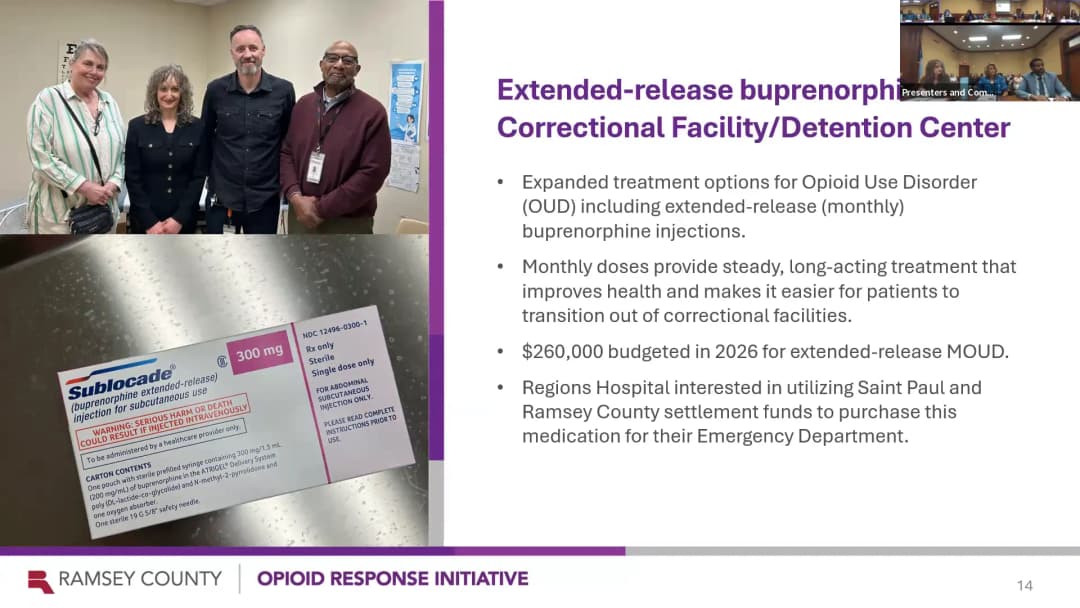
This workshop, held on July 7, 2026, at 1:30 p.m. in Courthouse Room 220, provided an update on Ramsey County’s Opioid Response Initiative. The meeting included a presentation by public health officials, a firsthand testimony from a health educator in recovery, and discussion on the use of opioid settlement funds, current programming, governance structure, and future priorities. No votes were taken. Personal Testimony - Ryan Rasmussen, Health Educator for St. Paul–Ramsey County Public Health, shared his personal story of 13 years of recovery from opioid addiction. He emphasized the need for upstream prevention, low-barrier services, and coordinated county systems that meet individuals at their moment of clarity with appropriate resources rather than stigma or bureaucratic barriers. He urged the board to invest in compassion and infrastructure that turns moments of crisis into pathways to recovery. Discussion Items - Opioid Crisis Data: The opioid epidemic was declared a public health emergency in 2017. Opioid-involved deaths among Ramsey County residents peaked at over 150 in 2022, declining to approximately 115 in 2023–2024. Preliminary 2025 data shows stability. Disparities persist: Black/African American and American Indian residents experience overdoses at disproportionately higher rates. - Settlement Funding: Ramsey County is expected to receive over $26 million in opioid settlement funds through annual payments from 2022 to 2038. To date, $11.1 million has been received; $2.1 million has been spent. By end of 2027, the county expects to have $9.1 million in uncommitted funds. Additional settlements (Purdue Pharma, Sackler family, eight manufacturers) are pending approval and could bring more funds. - Current Investments and Programs: Highlights included naloxone distribution partnerships (e.g., with Steve Rumbler Holt Foundation), harm reduction supply cabinets at community centers, a solicitation for a vending machine for harm reduction supplies, funding for St. Paul Fire Department first responders ($20,000), the syringe services program (state funding lost June 2026; bridge funding from settlement for one year), extended-release buprenorphine (Sublocade/Brixadi) in correctional facilities (two initial doses given in 2025), and partnerships with Second Judicial Court and Justice Points for treatment courts (serving up to 55 participants). - Governance Structure: A new county-wide governance model was created in October 2025, with an executive sponsor team (three Deputy County Managers: Nadir Adu, Gloria Reyes, Karen Francois), an Internal Advisory Committee chaired by the Public Health Director with representatives from nine departments, and a planned future Community Advisory Group to incorporate lived experience and community voices. - Challenges and Coordination: Discussion highlighted the need for better coordination with cities receiving direct settlement funds (St. Paul, Maplewood, etc.), avoiding duplication, leveraging partnerships with Regions Hospital for high-cost extended-release buprenorphine, and ensuring sustainability for community grantees. Commissioners emphasized aligning opioid investments with existing mandated county work (e.g., African American Preservation Act, alternative response initiatives) and avoiding dilution of settlement funds as a budget stopgap. Key Outcomes - No votes were taken during the workshop. - The board provided feedback: prioritize upstream prevention, require evaluation and impact tracking, ensure community advisory group includes lived experience and community-based organizations, align opioid work with other county initiatives, and use these flexible funds to offset gaps that cannot be placed on property taxes. - Staff will incorporate board feedback into future funding priorities and continue refining the governance structure. A follow-up memo with links to data sources and reports will be provided to commissioners.
The Ramsey County Housing and Redevelopment Authority (HRA) met in regular session on June 23, 2026. The meeting was scheduled for 10:00 a.m. (per agenda) but convened at 10:18 a.m. (per minutes) in Council Chambers. Chair Xiong presided, with Commissioners Jebens-Singh, McGuire, McMurtrey, Miller, Moran, and Ortega present. The meeting adjourned at 10:41 a.m. Two administrative items were discussed and approved unanimously: an Environmental Response Fund grant award and the obligation of the 2026 HRA levy for housing development projects. Consent Calendar (Items 1 & 2) - Agenda Approval (2026-234): The agenda for June 23, 2026, was approved unanimously via roll call (7 ayes). Motion by Miller, seconded by Jebens-Singh. - Minutes Approval (2026-235): The minutes from April 28, 2026, were approved unanimously (7 ayes). Motion by Miller, seconded by Moran. Environmental Response Fund Grant Awards (Item 3) Ella Mitchell, Redevelopment Program Manager, presented the recommendation to award $250,000 in Environmental Response Funds to JB Vang for the Hamm’s West End Development. The funding supports asbestos remediation at the historic Hamm’s Brewery site on Lower Payne Avenue, which will be redeveloped into 70 units of affordable housing. Commissioner McMurtry expressed strong support for the fund, noting its importance for redevelopment and highlighting the extension of the mortgage and deed tax from the legislative session as a win. Commissioner Miller asked about total remediation costs (upwards of $1.6 million) and whether further applications were anticipated; Mitchell replied that the developer is seeking other funders (Met Council, DEED) and no further applications are expected. Commissioner McGuire praised the program and suggested notifying city managers of awards to increase local awareness; Mitchell confirmed that awardees are posted on the program webpage and included in the newsletter, and agreed to share information via email to the board. The motion passed unanimously (7 ayes, Resolution H2026-010). Obligation of 2026 HRA Levy for Housing Development Projects (Item 4) Max Holdhusen, Deputy Director of Community & Economic Development, presented the recommendation to obligate $6,400,000 in 2026 HRA levy funds for affordable housing. This is the first of five board actions from the annual consolidated solicitation, which received 45 applications requesting over $72 million. The five recommended projects (one in Roseville, one in Falcon Heights, three in St. Paul) are all new construction, creating 305 units total, with over 20% affordable at 30% Area Median Income (AMI). The funding represents approximately 45% of the $11 million levied. Holdhusen explained that these early awards help leverage state dollars from Minnesota Housing (application due mid-July). He also noted that funds from prior years are being reallocated from projects that stalled due to financing or construction cost issues. Commissioners discussed deeply affordable housing. Commissioner Moran asked how the county incentivizes developers to include more units at 30% AMI; Holdhusen replied that the scoring criteria (in place since 2022) award points for at least 10% of units at 30% AMI, with bonuses for exceeding that or doing so without other subsidies. Commissioner Jebens-Singh inquired about stalled projects; Holdhusen explained that developers sometimes pull out due to costs, and funds are reallocated to other projects. Commissioner McGuire again emphasized communicating awards to cities; Holdhusen noted that prioritization conversations occur with cities, especially St. Paul. The motion passed unanimously (7 ayes, Resolution H2026-011). Key Outcomes - Environmental Response Fund Grant: Approved $250,000 to JB Vang for Hamm’s West End Development (asbestos remediation, 70 affordable housing units). - 2026 HRA Levy Obligation: Approved $6,400,000 for five new construction affordable housing projects (305 units, 20% at 30% AMI) to leverage state funds. - Next Steps: Staff will share award information with cities and commissioners; additional board actions will follow for other funding sources. - Meeting Adjourned: At 10:41 a.m.
The Ramsey County Board of Commissioners met in regular session on June 23, 2026, at 9:01 a.m. in Council Chambers at the Courthouse, with all seven commissioners present: Chair Ortega, Commissioners Jebens-Singh, McGuire, McMurtrey, Miller, Moran, and Xiong. Also present were County Manager Ling Becker and Civil Division Director Jada Lewis. The meeting adjourned at 10:10 a.m. following a unanimous vote on all items, including approval of the agenda, minutes, administrative items, and an ordinance. Consent Calendar - Agenda of June 23, 2026 (Item 2026-230): Approved unanimously by roll call vote (7 ayes). - Minutes of June 16, 2026 (Item 2026-231): Approved unanimously by roll call vote (7 ayes). Discussion Items - Lease Agreement with Meridian Behavioral Health, LLC dba EOSIS (Item 2026-184): Approved via Resolution B2026-080. The lease covers 17,300 usable square feet at 402 University Avenue East, St. Paul, for the period July 1, 2026 through December 31, 2028. Commissioner Moran questioned the continuity of services, self-referral options, and financial accessibility. County Manager Becker and Dr. Thompson confirmed that the provider will operate with a sliding scale fee starting at zero, ensuring no one is turned away due to lack of insurance or inability to pay, and that self-referral (walk-in, phone) will be available. Commissioner Moran expressed support for the continuity of service to the community. Motion by Moran, seconded by Miller; passed 7-0. - Minnesota Council on Local Results and Innovation’s Performance Measurement Program (Item 2026-226): Approved via Resolution B2026-081. The board ratified the county’s continued participation and the submission of an annual report to the Office of the State Auditor, due July 1, 2026. The report includes 10 measures selected from 27 state-offered options, with a $25,000 incentive for participation. Deputy Chief of Staff Andrew Greenley presented the report, noting that data are drawn from internal and state sources, not new surveys. Commissioners discussed the value of consistent measures for year-to-year comparison (Commissioner McGuire), the data’s role in informing county strategic priorities (Commissioner Jebens-Singh), and the need to avoid extracting data from communities (Commissioner Miller). County Manager Becker highlighted alignment with the county’s biennial budget performance metrics and community indicators, such as low birth weight rates and WIC access. Motion by Moran, seconded by Xiong; passed 7-0. - Salary Schedule and Grade for New Job Classifications (Item 2026-232): Approved via Resolution B2026-079. The board approved salary schedules for two new unrepresented classifications: Occupational Safety and Compliance Administrator (Grade 102A, Schedule 37, annual salary range $77,262.62–$115,893.94) and Safety Officer (Grade 102A, Schedule 35, annual salary range $74,290.99–$111,436.48). Motion by Miller, seconded by Xiong; passed 7-0. - Adopt Proposed Ramsey County Commissioner’s Salary Ordinance for 2027 (Item 2026-212): Approved via Resolution B2026-082. Motion by Xiong, seconded by Miller; passed 7-0. County Connections County Manager Ling Becker provided updates: - The sixth annual Midway Job Fair will be held on June 30, 2026, at Allianz Field, in partnership with Workforce Solutions, the Workforce Board, and Minnesota United. Last year’s fair drew 700 attendees; this year 40 employers will be on site. - The Heading Home Ramsey youth advisory board will participate in the Twin Cities Pride Festival on June 27–28 at Loring Park, focusing on youth homelessness and housing stability. - Ramsey County is hosting 31 Right Track interns this summer, including Right Track Scholars (second year). The interns introduced themselves, sharing their departments (e.g., property management, parks and rec, library, public works, county attorney, public health) and career interests. A group photo was taken. Outside Board and Committee Reports Commissioners reported on recent activities: - Commissioner Moran attended numerous Juneteenth celebrations, including the Black Excellence event with staff, Rondo Center, and the Anika Foundation at the Capitol. She received the Community Jiro Award. She also noted meetings with the YWCA and highlighted the importance of community engagement in county work. - Commissioner Miller hosted in-district hours, attended the NYFS annual board meeting, walked in the White Bear Lake Maniotos Days Parade, and completed workforce board training (MOB). She also attended the Twins Native American Heritage Night. - Commissioner McMurtrey attended Juneteenth events (Black Excellence, 30,000 Feet, Black Mnificent), met with Beacon Interfaith housing advocates, and participated in the JIP Tech (Joint Property Tax Advisory Committee) meeting with St. Paul and school district representatives. He previewed the Hmong International Freedom Festival (June 27–28, expected 50,000 attendees) and Como Como Pride event. - Commissioner Jebens-Singh attended the Twin Cities North Chamber of Commerce update on Arden Hills/Shoreview economic development, toured Tubman East (domestic abuse services), had a compliance/ethics check-in, and spoke at the Special Olympics torch run. He also noted the quashing of federal subpoenas against local elected officials and called for independent investigations into the killings of Renee Good and Alex Pready. - Commissioner McGuire reported on the MELSA (Metropolitan Library Service Agency) meeting, where a preliminary budget was approved and e-book pricing legislation discussed. He highlighted Rosefest events (Roseville) and the importance of advisory board appointments. - Commissioner Xiong attended Juneteenth events, the Boys Totem Town tour, and the TAB (Transportation Advisory Board) meeting, which approved the 2050 transportation policy plan amendment (including Bronze Line and J Line) and discussed EV charging needs. She also thanked the county manager for JIP Tech leadership. Key Outcomes - All six agenda items (Items 1–6) were approved unanimously by roll call votes, with resolutions B2026-079 through B2026-082 recorded. - The lease with Meridian Behavioral Health/EOSIS was approved, ensuring continued detox and withdrawal management services with a sliding-scale fee and self-referral options. - The performance measurement program participation and report submission were ratified, with a commitment to post the report on the county’s open data portal. - New salary schedules were established for two safety-related job classifications. - The 2027 commissioner salary ordinance was adopted. - County Connections highlighted upcoming community events and the 2026 Right Track intern cohort. - No board chair update was provided.
The Ramsey County Economic Development Authority (EDA) met on June 16, 2026, at 10 a.m. in Council Chambers - Courthouse Room 300. The board approved the agenda, elected officers for 2026, and unanimously approved the EDA's area of operation after an amendment clarifying that all 18 HRA cities have opted in. Consent Calendar - The agenda of June 16, 2026 was approved unanimously by roll call vote (all ayes). Discussion Items - Election of Chair (2026): Commissioner Jabin Singh nominated My Chong for chair. Seconded. No other nominations. Chong accepted. Unanimous roll call vote. - Election of Vice-Chair (2026): A commissioner nominated Garrison McMurtry for vice-chair. Seconded. No other nominations. McMurtry accepted. Unanimous roll call vote. - Election of Secretary (2026): A commissioner nominated Mary Jo McGuire for secretary. Seconded. No other nominations. McGuire accepted. Unanimous roll call vote. - EDA Area of Operation (Agenda Item 5): Director Olson reported that all 18 cities in the county's Housing and Redevelopment Authority (HRA) had opted into the EDA's enhanced business programming. Commissioner Zhang noted that the original document stated North Oaks had not acted as of May 2026, but later confirmed a June resolution. Director Olson confirmed all cities opted in, achieving 100% participation. Commissioner Zhang moved to amend the item to strike the reference to North Oaks's inaction and to replace "17 of the 18 cities" with "18 of the 18 cities." The motion was seconded and passed unanimously. Key Outcomes - Officers Elected: Chair – My Chong; Vice-Chair – Garrison McMurtry; Secretary – Mary Jo McGuire (all for 2026). - Area of Operation Approved: The board approved the amended area of operation, affirming that all 18 HRA cities have opted in. The EDA, created by state legislation and county action in December 2025, will begin programming in January 2027, focusing on business support, technical assistance, learning cohorts, data resources, and direct business support, while remaining funded through the county's HRA levy and continuing to prioritize affordable housing.