The Redmond City Council held a study session on Tuesday, October 13, 2026, beginning at 7:07 PM. All council members were present; Mayor Angela Birney was not in attendance. Council President Melissa Stuart presided. The council discussed five agenda items: preparation for the 2027 legislative session, fire impact fee updates, the creation of a new development services department, 2027 regional board appointments, and council talk time items. Discussion Items 1. Preparation for the 2027 Legislative Session Amy Sai, Chief Policy Advisor, along with lobbyists Kyle Schroeder and Brianna Murray from Gordon Thomas Honeywell, presented the latest draft of the 2027 State Legislative Agenda. The draft incorporated feedback from the council's September study session, focusing on streamlining the document and adjusting policy language. Key changes included the removal of a standalone MFTE item (deemed addressable during the session), the inclusion of specific language on condominium liability reform (Councilmember Forsythe), the reframing of "excessive administrative fees" to "unpredictable fees" (Council President Stuart), and the addition of a section on immigrant, refugee, and asylum seeker support. Council supported adding youth crisis response and counseling language to the public safety section, as well as incorporating references to the legislative agendas of the Eastside Transportation Partnership and the RIA 8 Salmon Recovery Council. The agenda is scheduled for adoption on the November 2nd consent calendar. 2. Redmond Fire Impact Fee Update Deputy Fire Chief Ami Varrrell and consultant Nicole Kissum (NBS) presented a comprehensive update to the fire impact fee schedule, the first since 1999. The update was mandated by the new Fire Functional Plan (2025-2050) and state law requiring proportionally lower fees for smaller residential units. The proposal was based on a system plan approach analyzing $131 million in capital costs and a projected 54% increase in call volume by 2050, resulting in a cost of $6,882.15 per call. The staff recommended schedule included a significantly reduced fee for assisted living/nursing care facilities ($3,000/licensed bed) to mitigate potential negative impacts on development, lowering projected total revenue from $37.3 million to $33.5 million over 25 years. Councilmember Parsi expressed comfort with the full staff recommendation. Councilmembers Kritzer, Forsythe, Soni, and Stewart advocated for a phased implementation to avoid a sudden cost increase for developers. Finance Director Cochran advised against a 10-year phase-in, recommending a maximum of 4 years. The council agreed to have staff bring back linear projection models for 2, 3, and 4-year phase-in scenarios for discussion at an upcoming committee meeting. 3. Creation of a New Department to Support Improved Development Services Acting Director Jason Lynch, alongside Director Cochran, Chief Shepherd, and Acting Director Stinger, presented a proposal to consolidate multiple city functions into a new department aimed at streamlining permitting, plan review, and inspections. The proposed structure merges the Capital Division from Public Works into this new department. Multiple councilmembers (Parsi, Vice President, Soni) worried the department was "too big, too soon," noting the six-level deep organizational chart and the inclusion of the Capital Division. Councilmember Prakriya requested a clear workflow comparison for a specific project (e.g., a duplex permit) and questioned the direct inclusion of IT/TIS given the focus on AI tools. Council President Stuart expressed the council was "kept in the dark" during the process and requested robust quarterly reporting. Councilmember Soni emphasized the need for a detailed change management plan. Councilmember Kritzer noted the significant commitment of adding 8 new FTEs and sought clarification on cost recovery models. The council decided to hold a special meeting the following week to continue deliberations, with the goal of informing the upcoming budget process. 4. 2027 Regional Boards and Committees Council President Stuart reviewed the Sound Cities Association (SCA) call for nominations for regional boards. Council President Stuart indicated she would re-apply for the Growth Management Planning Council and apply for the Regional Policy Committee. Mayor Birney expressed interest in the Puget Sound Regional Council Transportation Policy Board. Councilmember Kritzer recommended the Regional Transit Committee and the Affordable Housing Committee as high-impact opportunities. The application deadline for SCA appointments is November 6th. 5. Council Talk Time The Tenant Protection Subcommittee (Councilmembers Prakriya, Kritzer, and Forsythe) proposed a full-time Housing Navigator/Administrator position focused on tenant stability policy and programs, and a pilot program with the Eviction Legal Advocacy Project (ELAP) for renters above current income limits. Councilmember Forsythe proposed bringing forward a resolution in opposition to Washington State Initiatives 001 and 638, which she stated overwhelmingly harm the 2SLGBTQIA+ community. Council President Stuart noted the logistical challenges of noticing a public hearing within the tight timeline but committed to working with leadership to explore feasibility. Councilmember Soni requested a regular quarterly report on development activity blending city permit data with qualitative developer feedback. Key Outcomes Legislative Agenda: Staff was directed to integrate agreed-upon amendments (condominium language, youth crisis counseling, unpredictable fees, CHIP support, regional partner references). Final adoption is scheduled for November 2nd. Fire Impact Fees: Staff was directed to prepare linear phase-in scenarios (2, 3, and 4-year options) for further council evaluation. Full adoption is expected in November. New Department: The council decided to continue the discussion at a special meeting next week to address outstanding questions on structure, staffing, and implementation. Regional Boards: Councilmembers submitted initial expressions of interest for regional boards. Formal SCA applications are due November 6th. Council Talk Time: The Tenant Protection subcommittee will refine the FTE proposal for budget deliberations. Council leadership will investigate the feasibility of holding a public hearing on a resolution regarding the statewide ballot initiatives. Staff was asked to plan for a quarterly development activity report.
Public Meetings - Redmond, Washington
Public Meetings - Redmond, WashingtonThe Redmond City Council met in a joint session with the Parks, Trails, and Recreation Commission (PTRC) on October 13, 2026, at 6:20 PM. The PTRC presented a recap of the past year's work, three priority projects, and engaged in discussion with council members. No formal votes were taken, but several budget recommendations and next steps were outlined. Discussion Items - Commission Recap: Clint Smith reported on the commission’s retreat, which focused on meeting process improvements and creating an active topics list (20 topics). He noted National Trails Day at Conrad Olson Park, Derby Days tabling (200+ visitors in the morning alone), and the onboarding of seven new commissioners over the past year and a half. - Park Signage and Wayfinding: Jodi Pena presented the commission’s recommendations, including prioritizing high-use intersections lacking clear wayfinding, refreshing signage at Watershed Preserve and Farrel-McWhirter, installing citywide maps with “you are here” indicators, collaborating with Arts and Culture Commission and Historical Society, and partnering with King County and neighboring cities. The commission asked for additional funding beyond the $500,000 budgeted, council support for implementing the new wayfinding guidelines, and facilitation of cross-jurisdictional collaboration. - East Redmond Corridor (ERC): Jim Cleppy outlined the ERC’s history (vision announced in 1999, master plan in 2009, park plan priority in 2023, implementation plan in 2025). Only three of seven parks are developed; the spine trail is partially built near Perigo Park. The implementation plan estimated 20 years and $95 million to complete. The original budget ask of $2.7 million was reduced to $1.4 million, and the current CIP offers $680,000, not available until 2032. The commission requested support for the budget request, a multi-year strategy to avoid planning stalls, and city partnership with King County for trail segments crossing county land. - Toddler-Focused Play Infrastructure: Eugenia Vidalis (reading for Commissioner Kimberly Marcelino) highlighted that children under five make up nearly half of all playground users but receive a fraction of dedicated amenities. Needs include appropriate surfaces for crawlers and early walkers, fencing, clear sight lines, and proximity to neighborhoods. The commission has already submitted a letter supporting toddler-focused design at Southeast Redmond Park and provided feedback on Hartman Park designs. - Council Questions and Feedback: Councilmembers expressed support for the projects. Jessica Forsythe praised the wayfinding work and flagged the ERC budget reduction. Vivek Prakriya asked about community feedback from Derby Days; responses included interest in camping, hiking, and maintenance concerns (e.g., Idlewood Park duck waste). Sayna Parsi supported ERC and volunteer activities, and asked about the commission’s role in the future teen center. The commission indicated they had a member on a stakeholder group but would like more involvement. Youth advocates Henry Weston and Cindy Jane suggested the teen center should not focus solely on music and that outreach should be broadened through schools. Vanessa Kritzer supported toddler infrastructure and proposed smaller pop-up play equipment. Menka Soni asked about health and fitness programming; commissioners noted existing offerings but acknowledged a need for better communication. Angie Nuevacamina expressed support for ERC as a legacy project and for inclusive play. Key Outcomes - Budget Recommendations: The commission asked council to increase the ERC budget and pull funding forward, support the wayfinding budget, and prioritize toddler equipment in park designs. Councilmembers indicated they would consider these requests during the upcoming budget hearings (October 20, 22, and 27). - Next Steps: Council will continue budget deliberations; the public can submit comments via budget@redmond.gov or council@redmond.gov. The council invited the commission to send a representative to future meetings and to join neighborhood park tours. The commission’s input will inform the refresh of the park plan. - Teen Center Engagement: The commission expressed interest in being more involved in teen center planning; council will provide updates and seek broader youth outreach.
The Redmond City Council's Committee of the Whole for Finance, Administration, and Communications convened on Tuesday, October 13, 2026, at 4:30 PM. All nine council members were present. The agenda comprised seven discussion items and two read-only informational reports. The committee directed four action items to future consent agendas, received updates on equity initiatives and budget preparations, and began a review of the Business Technology Investment Program (BTIP). Consent Calendar - On-Call & Continuing Legal Services Contract with Foster & Garvey (CM 26-608): The committee directed this item to the November 2, 2026, consent agenda. City Attorney Rebecca Mueller presented the contract for continued representation in two Superior Court matters and on-call services. Councilmember Forsythe requested a budget impact memo with a cap before final approval. - Lucity Enterprise Asset Management Cloud Contract (CM 26-607): Approved for the October 20, 2026, consent agenda. The $390,816 five-year contract migrates the city's asset management system to the cloud, saving approximately $10,300 over annual agreements and freeing 240 staff hours annually. Councilmembers questioned future-proofing, asset types (roads, bridges, etc.), and AI features; staff will provide written examples of system use. - Washington Cities Insurance Authority (WCIA) Membership Resolution (CM 26-610): Directed to the October 20, 2026, consent agenda. Finance Director Kelly Cochran reported positive pre-membership experiences and projected cost savings. Councilmember Forsythe asked about downsides; staff saw none. - Surplus Real Estate Sale Resolution – Pacer Propane Property (CM 26-593): Directed to the October 20, 2026, consent agenda. The city will sell the 18459 NE 76th Street parcel for at least $3.6 million plus transaction costs. Council President Stewart indicated she would pull this item from consent at the October 20 meeting to place the property narrative on the public record. Discussion Items - Respect, Equity, Diversity, and Inclusion (REDI) Program Update (CM 26-605): Teresa Lee, REDI Program Administrator, reported that as of September 28, 2026, 17 training sessions had been held with 66% of the workforce having participated or registered. Fire department participation was 9% due to scheduling; evening sessions were planned. Upcoming events include United Against Hate Week (October 18–24) and a film screening of "The R-Word." Councilmembers discussed participation disparities and the need for top-down leadership training; the director's training was rescheduled to November due to facilitator availability. The city is exploring "Welcoming City" certification. - Budget Process Update: Preparations for Budget Deliberations & Community Engagement (CM26-521): Director Cochran outlined resources for council, including an interactive line-item database and detailed FTE information. The budget deliberation schedule begins October 20, 2026, with committee meetings on Tuesdays and Thursdays. Council President Stewart emphasized that community comments received via the engagement form are valued. Staff will provide updates on revenues, CIP, and BTIP at the start of deliberations. - 2027–2032 Business Technology Investment Program (BTIP) Review (CM 26-582): Due to time constraints, staff presented a high-level overview. The BTIP now centralizes all technology investments, mirroring the CIP structure. Completed projects include a credit card fee pass-through, a public-facing dashboard, and fire station tone upgrades. Continuing projects include Dynamics 365 Phase 2, UKG workforce management, and police drone program. New additions for 2027–2028 include a cashiering system upgrade, enterprise content management system, fire timekeeping evaluation, city building security updates, utility billing payment system replacement, and council chambers broadcast software. Councilmembers requested future reporting formatted like the CIP (on-time/on-budget), clarification on in-house vs. contracted work, quantification of redundant investment savings, and careful framing of the broadcast software transition. The discussion will continue during budget deliberations. Key Outcomes - Four action items were directed to consent agendas: one to November 2, 2026 (Foster & Garvey legal services), and three to October 20, 2026 (Lucity contract, WCIA membership, surplus property sale). Council President Stewart will pull the surplus property item from consent at the October 20 business meeting. - The committee requested additional information: - Budget impact and cap for the Foster & Garvey contract (Forsythe). - Examples of Lucity system use by city employees (Prakria) and AI policy considerations (Parsi). - Clarification on foreign-made equipment in the police drone program (Parsi); Chief Lowe stated the drones are NDAA-compliant and American-made, and staff will correct the budget document. - Future BTIP updates formatted like CIP reports (Forsythe), with project-level detail on internal vs. contracted work (Prakria) and quantification of savings (Sony). - The REDI Program update was received as information; staff will continue addressing low participation in operational departments. - Budget deliberations will begin October 20, 2026, with a special meeting at 6:00 PM; BTIP discussion will continue during those sessions. Note: Two read-only items were included in the agenda packet: Grants Management Update – Q1 & Q2 2026 (CM 26-604) and 2024 Impact Fee Collection and Distribution Report (CM 26-609). No verbal presentation was given.
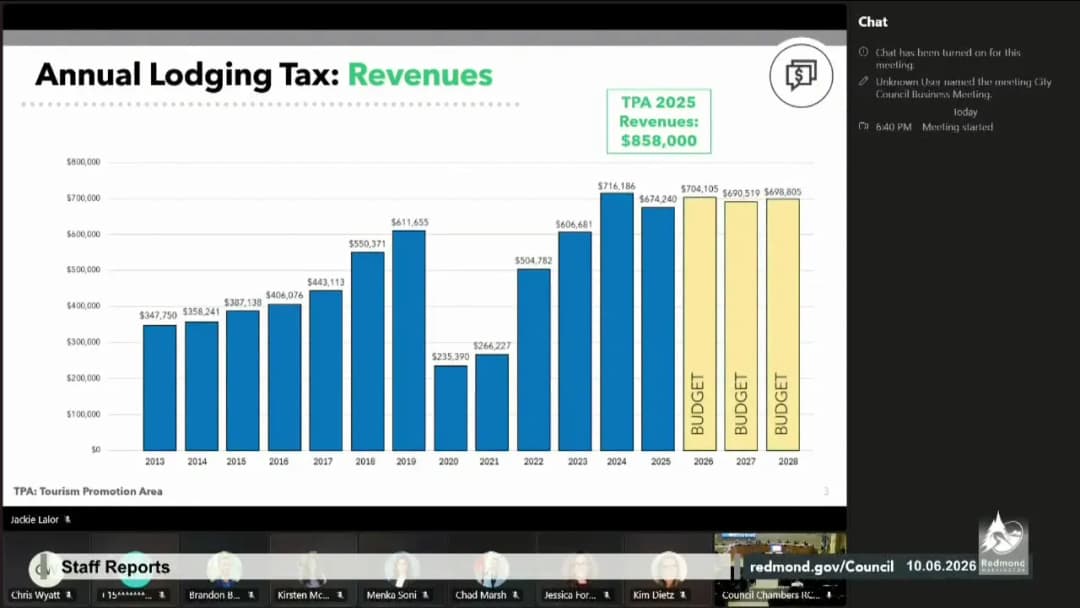
The Redmond City Council met on Tuesday, October 6, 2026, at 7:00 PM at City Hall. The meeting included a presentation from Habitat for Humanity, the delivery of the Mayor's Preliminary 2027-2028 Biennial Budget, public comments on various topics, a public hearing on the budget and revenue sources, a staff report on tourism progress, and approval of the consent agenda with one item pulled for discussion. Consent Calendar - Approved unanimously (7-0): Items 1, 2, 3, and 5: Approval of minutes (September 10 and 15, 2026), payroll/claims, a $99,225 grant extension for the Veterans, Seniors, and Human Services Levy (VSHSL), and a second addendum to the FD 34 Emergency Services Operating Agreement (2026-2029 extension). - Item 4 pulled for discussion: The Consultant Services Agreement Supplement 1 with Progressive Design Build Consulting LLC ($268,958 for the Teen Center project) was initially removed from the consent agenda for council discussion. Following questions and answers from Parks and Recreation Director Hamilton, the council voted to approve the item (7-0). Public Comments & Testimony Items from the Audience: - Aaron Hamilton: Expressed strong support for the city's co-responder program (mental health professional) and urged the city to move forward with recruiting a second MHP to prevent burnout of the current one. He emphasized that the work requires sustained case management, not just crisis response. - Wolf Adriatico: Criticized the Parks Department's outreach for the Teen Center, stating that informing teens only via the PeachJar website was inadequate and that the department misled the council and public about the cost difference between renovation and rebuild. - Ryan McKinster (Master Builders of King and Snohomish Counties): Expressed full support for creating a new single Permitting and Development Department with a leader with authority, noting that current delays cost money and that the proposed reorganization would help reduce permitting times. - David Morton: Identified a timing problem in the budget deliberation rules: community testimony given at the October 20th and November 2nd hearings would not be delivered to council before the October 22nd and 27th review meetings. He asked for testimony to be delivered within days, a public comment matrix to be posted online, and final changes to be made on November 5th rather than October 29th. - Todd Levitt (Murray Franklin Homes): Expressed full support for a single development services department to provide one accountable director, one timeline, and one place to go when issues stall. - Jonathan Kurth (land developer): Described challenges working with separated departments and advocated for consolidation, noting that making smaller lots work requires coordinated solutions. - John Hanson (Mauenbauer Group): Urged the city to benchmark against Bellevue and Raleigh, NC for middle housing processes, and expressed support for the consolidated planning department. - Paul Quinn (remote, Sammamish): Advocated for switching Redmond's solid waste disposal charging from container-size-based to weight-based (a 'Smart Disposal' program) to improve diversion rates and fairness, highlighting that the current system disincentivizes recycling. Public Hearing on 2027-2028 Budget and Revenue Sources: - Sierra Madden (Plymouth Housing): Urged the council to increase human services and housing investments in the biennial budget, noting that nearly a third of Redmond households are cost-burdened and that the city is not scaling capacity fast enough. - Hank Myers: Criticized the city's low pavement quality index and asked that the budget restore it to at least 70 within two years. He also urged the council to adopt budgeting practices that assign responsibility and deadlines. - David Morton: Requested three funding priorities: (1) PFAS testing at Evans Creek and All Wood Recycling site, (2) a city arborist to independently verify tree reports, and (3) maintaining current environmental sustainability funding. He also asked for plain-language summaries of tax and fee increases with household impact. Discussion Items Presentation: Habitat for Humanity Alicia Ruiz, Advocacy and Policy Manager, presented Habitat's community land trust model. She noted that 56.8% of Redmond households are renters, the median home price is $1.45 million, and median gross rent is over $2,400. Habitat serves families earning up to 80% of AMI (e.g., $116,650 for a family of four). She cited Liberty Commons (58 condo units in Seattle, $30M budget, prices from $160s-$285k) and Orchard Gardens (25 homes in Bellevue, expected list price around $360k) as examples. She asked Redmond to consider increasing affordable housing funding, dedicating funds to homeownership, offering surplus land, passing faith-based land legislation, granting density bonuses, and reducing permitting delays. Council expressed interest in partnering. Presentation: Mayor's Preliminary 2027-2028 Biennial Budget Mayor Angela Birney presented the $1.4 billion budget (5% increase from last biennium). Key highlights include: $6 million for housing and human services; three additional police officers; $250 million for the Maintenance and Operations Center redevelopment; $35 million for the Teen Center; $20 million to rebuild Fire Station 11; $1.3 million for environmental sustainability and climate resilience; $1.4 million for Red Link, safe routes to school, and wayfinding; and $52.3 million for a new department focused on permit approval and customer service. The budget is aligned with four priorities: a healthy and sustainable environment, a safe and resilient community, a strategic and responsive government, and a vibrant and connected community. Staff Report: 2025 Annual Report and Tourism Strategic Plan Progress Jackie Lawler (Tourism Program Administrator) reported that tourism generates nearly $24 billion annually statewide. Redmond's 2025 domestic visitor spending was $92 million, up 19%, though visit nights and trips decreased slightly. The city has made progress on 56% of the 64 initiatives in the five-year Tourism Strategic Plan. Key successes include launching the Red Link shuttle (15% of hotel guests use it), securing an annual ECNL soccer tournament (80,000 attendees), and generating 143 million media impressions. The report noted the need to increase shoulder-season occupancy and explore a Destination Management Organization (DMO). Council members expressed strong support for moving forward with a DMO. Consent Item Discussion: Teen Center Consultant Agreement Councilmember Parsi requested clarification on the selection process for Progressive Design Build Consulting LLC. Director Hamilton explained that three candidates were solicited from a state roster and interviewed; the firm was chosen for its expertise in community centers and progressive design build. Councilmember Kritzer asked about expediency; Hamilton described how the progressive design build approach allows concurrent processes and early procurement to speed the project. Councilmembers sought a clear timeline for decisions; Hamilton indicated a design-build contract would come to council by the end of 2026 or early 2027. Councilmember Stewart requested a more user-friendly visual timeline, which was provided. Discussion also touched on the potential to explore both a like-for-like and expanded facility option during validation. Key Outcomes - Consent Agenda approved (7-0): All items except Item 4, which was later approved separately (7-0). - Public hearing on the 2027-2028 budget opened and closed; no action taken. - Council discussion indicated a desire to explore both a like-for-like and expanded option for the Teen Center during the validation phase. - Council expressed strong support for establishing a Destination Management Organization (DMO) in the upcoming biennium. - Ombudsperson reports and committee reports were received as information.
The Committee of the Whole for Planning and Public Works met on Tuesday, October 6, 2026, at 4:30 PM at City Hall. The committee reviewed several action items, staff reports, and informational updates, including municipal code updates, tourism grant funding, planning commission rules, development impact fees, adaptive signal control, and capital project status. The meeting adjourned after a full agenda. Consent Calendar - Adoption of Ordinances to Formalize Updates to Redmond Municipal Code Titles 1–6 and 9: Staff requested placement on the October 20 business meeting consent agenda. Council members raised concerns about noxious weed removal language and potential conflicts with a pending reorganization of development services. After discussion, council directed staff to return with additional information before consent; the item was not placed on consent for October 20. - Approval of 2027 Tourism Grant Funding – Lodging Tax Advisory Committee (LTAC) Recommendations: LTAC recommended $321,500 in total grants ($171,500 for 19 external applicants and $150,000 for three city-funded events). One late application was not recommended. Council accepted the recommendation and placed the item on the October 20 consent agenda. - Update to Planning Commission Rules of Procedure: The Planning Commission proposed removing the distinction between excused and unexcused absences and adopting a standardized framework. Council had questions about the removal process and consistency with other commissions. The item was placed on the October 20 consent agenda with the understanding that individual council members could pull it for further discussion. Discussion Items - Amending RMC 3.10 – Development Impact Fees and Amending Contract 5251 (Lake Washington School District Fee Schedule): The 2027 transportation impact fee would increase by 0.41% (three-year average of construction cost indices). The Lake Washington School District proposed switching to bedroom counts for school impact fees, resulting in zero fees for apartments/condos and middle housing, and a fee only for single-family units. The city’s administrative fee would also increase. Council will send questions by October 16 and review a final ordinance on November 2. - Status Update on Downtown Adaptive Signal Control Project: The project installed adaptive signal technology on Redmond Way between 160th Ave NE and East Lake Sammamish Parkway. Before-and-after study results: weekday PM peak average delay reduced by 7 seconds per trip eastbound and 3 seconds per trip westbound. CO2 emissions reduced by an estimated 2.5 metric tons per average weekday (equivalent to taking one vehicle off the road for half a year). Staff time savings from reduced manual retiming were also noted. Council was asked to submit additional questions by the end of the week. - Capital Investment Program (CIP) Project Updates for Q3 2026: The city reported 35 active projects with a 60% completion rate. Completed projects included 154th Avenue paving, EV charging phase two (30 ports), and Reservoir Park sports courts (completed October 5). Notable delays: 95th Street Bridge replacement – staff recommended a bike/pedestrian-only bridge and will bring a study session early 2027. Willows Road Water Main extension slipped into 2027. ADA curb ramp project (three sites) encountered contractor performance issues but is near completion. Council requested better data storytelling on ADA progress to support future funding requests. Key Outcomes - Deferred to Future Meetings: - Municipal code updates (Titles 1–6, 9) – council wants further staff input on noxious weeds and reorg alignment before consent (next possible date not set). - Development impact fee amendments – will return as an omnibus ordinance on November 2. - 95th Street Bridge replacement – study session scheduled for early 2027. - Approved for Consent (October 20 Business Meeting): - 2027 Tourism Grant Funding ($321,500 total). - Planning Commission Rules of Procedure (can be pulled if needed). - Informational Items: - Downtown Adaptive Signal Control project – staff will incorporate council questions into a future staff report. - CIP Q3 2026 update – noted; council asked for improved program-level reporting on ADA improvements. Public Comments & Testimony No public comments were received during the meeting. Staff noted that public outreach on the municipal code updates generated no comments or appeals.
The Redmond Planning Commission met on September 23, 2026, in a study-session-focused meeting. It approved an amended agenda and the September 9, 2026 meeting summary, heard two public comments, and took up three items: the Tree Code Update, the proposed repeal of outdated Neighborhood Connections Maps, and Transportation Facilities Plan (TFP) Projects. Commissioners Aparna, Coleman, Ganyer, Gong, Woodyer, and Weston were present; Commissioner Van Eyman was absent. Chair Weston announced that Commissioner Copley had resigned due to professional and family obligations and thanked him for his service. Opening and Routine Approvals - Roll call was completed; Commissioner Van Eyman was absent and Commissioner Copley's resignation was noted. - The agenda was amended so that items 6 and 7 were changed from 15-minute briefings to 45-minute study sessions; the amended agenda was approved by voice vote. - The meeting summary from September 9, 2026, was approved by voice vote. Public Comments and Testimony - David Morton spoke on the Tree Code Update and Neighborhood Connections Map. He expressed concern that nearly every discretionary tree finding still rests on a qualified tree professional hired by the applicant, including hazard determinations, tree condition, tree protection zone reductions, and retention feasibility. He noted that third-party review of exceptions is optional, applicant-paid, and chosen by agreement with the applicant, and that hazardous removals do not count against a property's removal allowance, while hazardous trees under 30 inches require no replacement. He asked the commission to recommend independent city verification at these decision points, starting with hazard and retention findings, and to urge City Council to fund a city arborist in the 2027-2028 budget. He also identified drafting conflicts in the tree code, including the exact 30-inch diameter gap in the hazardous tree replacement table and the impervious-surface waiver of the 35% retention requirement. On the map repeal, he asked staff to reconcile policy text still referencing the map slated for repeal and to identify infeasible connections removed from the Transportation Master Plan map. - David Haynes raised a stormwater concern about a specific parcel, asking the city to consider connecting to the city stormwater drain instead of allowing front-yard infiltration to flow into wetlands. He also argued for removing restrictions on building height to allow for higher-quality, less car-centric housing near Marymoor Village, including rooftop views, and for pedestrian-friendly, resident-friendly, walkable neighborhoods. He said he supported robust housing development but did not want the tree ordinance weaponized. Tree Code Update - Study Session - Senior Planner Lauren Anderson presented, joined online by Kim Frappier from Facet. The update primarily revises RZC 21.72. The timeline runs from drafting and research in February-April 2026, through community engagement in May-July, introduction to the Planning Commission and City Council in July, and a Technical Committee recommendation of approval on September 16, 2026. Planning Commission review continues through December, with Council adoption expected January-March 2027 and a delayed effective date of about three months after adoption. - Key proposed changes include new and updated definitions; adjusted non-development tree removal limits by lot size, including reducing the maximum on lots 30,001 square feet and greater from 8 to 5 and adding a maximum removal number to prevent clear-cutting; replacement requirements scaled by diameter at breast height; a one-to-one replacement requirement for hazardous landmark and heritage trees; and a new tree-credit system for development projects replacing the current 35% significant-tree retention standard. The credit formula uses tree canopy site area multiplied by a credit multiplier based on zoning district and development type. The 35% retention credit is exempted for lots under 3,000 square feet and where development reduces allowable impervious surface below 85% of the zoning maximum. - The code also adds a hazardous tree declaration process, a fee-in-lieu of $450 per credit, no development permits for 12 months after tree removal and 24 months after landmark tree removal, and changes to enforcement and penalties, including moving fees into a fee schedule. Staff reported current city tree canopy coverage at 37% as of 2023. - Staff responded to prior Planning Commission questions: conifers are prioritized because they provide year-round ecosystem benefits and are longer-lived; red alders and cottonwoods receive less credit due to infrastructure conflicts; and off-site replacement locations are managed by Public Works, with staff exploring a public GIS layer. Staff recommend against a parcel viewer with automatic tree-credit multipliers and instead favor a calculator using survey-based data. The $450 fee-in-lieu is consistent with regional practice, including Kirkland. - Commissioners expressed concerns about the code's complexity and readability, noting it is about 97 pages and may be difficult for homeowners and smaller applicants. They also raised questions about enforcement, applicant-hired arborist independence, stronger penalties for contractors and tree companies, the need for a city arborist, the magnitude of tree loss relative to the 40% canopy target, drainage and stormwater impacts from large tree removals, and whether penalty revenue would support tree planting and enforcement. Commissioner Coleman asked whether the city is considering AI-based tools to help the public navigate complex code; Commissioner Aparna cautioned that AI can produce wrong answers and create liability. - One commissioner asked that language describing tree diameters be changed from less than 30 inches and greater than 30 inches to up to 30 inches and greater than 30 inches so an exactly 30-inch hazardous tree is covered. The comment was added to the issues matrix. - Next steps: public hearing on October 14, November 4 available as an additional study session, and November 18 scheduled for study session and recommendation. The commission continues compiling an issues matrix. Neighborhood Connections Map Repeal - Study Session - Staff introduced a docket item to repeal five outdated neighborhood connection maps in the Neighborhoods Element of the Comprehensive Plan: Bear Creek, Education Hill, North Redmond, Southeast Redmond, and Northeast Rose Hill. Staff stated the connections were consolidated into maps in the Transportation Master Plan adopted February 2026, so the older maps and text references should be removed. - Chair Weston objected to making this edit through the old Neighborhoods Element, which she said was mostly written between 2004 and 2008 and had not been meaningfully updated. She proposed instead placing replacement maps in the comprehensive plan appendix or combining the repeal with the broader neighborhood planning update. Staff responded that the old element was included in the 2024 Redmond 2050 omnibus adoption as an intentionally old placeholder, that the former appendix H no longer exists after the TMP update, and that options included approving the repeal, recommending denial, or deferring the item. - Other commissioners agreed that piecemeal edits to an outdated chapter were confusing. Commissioner Aparna suggested the whole Neighborhoods Element should be updated together when the neighborhood planning project is ready. No decision was made. Chair Weston asked staff to determine a path forward and stated she did not see how the October 14 public hearing could be held without published materials. Staff said they would follow up. TFP Projects Update - Study Session - Senior Transportation Planner Francesca Liberti presented a docket item to add two new shared-use path projects to the Transportation Facilities Plan: - NE 40th Street between 158th Avenue NE and 156th Avenue NE, related to the Eve's Avalon apartments. - NE 70th Street between 188th Avenue NE and the Evans Creek Trail, related to the Heidelberg site. - The projects would provide low-stress bicycle and pedestrian infrastructure and are tied to adjacent redevelopment. Because the developers requested transportation impact fee credits for frontage improvements, and Planning and Community Development Director Carol Helland determined the improvements qualify as system improvements and help reduce development costs, the improvements need to be listed in the TFP. An existing TFP project on NE 72nd Street east of 188th Avenue NE would also be modified to include a shared-use path. - A commissioner asked whether these projects carry prioritization weight in the TFP. Staff answered that they do not; they are included in anticipation of future development and will be built by that development. - No decision was made. Staff anticipated an October 14 public hearing and an October 28 Planning Commission recommendation. Key Outcomes - The amended agenda and September 9, 2026 meeting summary were approved. - No formal votes were taken on the three substantive items, all of which were study sessions. - Tree Code Update: issues matrix continues; public hearing October 14; possible additional study session November 4; recommendation scheduled November 18. - Neighborhood Connections Map repeal: deferred for staff to propose a path forward; the October 14 hearing was called into question and may be moved or continued. - TFP Projects Update: no decision; October 14 public hearing and October 28 recommendation are the anticipated next steps.
The Redmond City Council met in study session on Tuesday, September 22, 2026, beginning at 7:00 p.m. at City Hall. All councilmembers were present, with Councilmember Prakriya attending online. The agenda listed Mayor Angela Birney, though the transcript referred to her as Mayor Burney; she was not in attendance. The agenda included five items: the Municipal Operations Center (MOC) project update, the 2027–2028 biennial financial forecast, the 2027–2032 Capital Investment Program (CIP) review, the Housing and Human Services Action Plan, and council talk time. The meeting was extended twice by unanimous consent and adjourned after council talk time. Public Comments & Testimony - No formal public comment period was held. - During the housing discussion, staff referenced public input from earlier community engagement, including a Let's Connect survey with mixed views on homelessness services—about half of respondents said the city should do more in the homeless space, while some residents opposed additional permanent supportive housing in their community. - Staff also noted a prior public commenter who requested inclusive early learning and child care strategies in the housing and human services plan. Municipal Operations Center (MOC) Project Update - Interim Public Works Director Chris Stanger, Parks Director Lorreen Hamilton, project staff, and the progressive design-build team presented the completed validation phase for the MOC campus redevelopment. - The project will replace outdated facilities with a resilient, multi-generational campus. The new site was purchased from Heidelberg. The existing site will continue to host decant, fuel island, mineral bins, and salt storage; staff are studying whether fuel, mineral, and salt facilities can later be consolidated to allow surplus of part of the existing property. - The new campus will include a two-story mass timber operations/office building, a one-story operations building with shops, labs, warehouse, and storage, and a one-story fleet maintenance building with two pull-through heavy-duty bays and eight tandem pull-through medium-duty bays. Public works, parks, citywide fleet maintenance, and fire fleet maintenance staff will be consolidated at the new site. - Sustainability targets include LEED v5 Gold for the administrative building, with equivalent certifications such as Envision or zero-carbon certifications under study for maintenance and site facilities. - Schedule: validation is complete; phase one design and pre-construction is beginning; substantial completion is expected by May 2030, about six months earlier than previously forecast. Future council approval points include the guaranteed maximum price and phase two contract, expected around Q1–Q2 2028. - Budget: the project target is $268.5 million, including an additional $18.5 million covered within the project budget for the new site purchase and full site outfitting. - Several councilmembers, including Councilmembers Soni, Parsi, and Vice President Nuevacamina, said they had previously understood that the existing site would be sold and that the decant facility could relocate. Staff acknowledged a shift from prior understanding and committed to more transparent communication. Staff explained that relocating all remaining functions would require an underground stormwater vault and parking garage costing roughly $40–50 million, so that option was not selected. - Councilmember Forsythe emphasized the MOC's connection to community values and the opportunity to advance the city's emission-reduction goals. 2027–2028 Biennial Financial Forecast - Finance Director Kelly Cochrane and Deputy Director Nara presented the general fund and utility revenue forecasts for the 2027–2028 biennium. - Sales tax: Redmond receives 32% of sales tax collected in the city. Ongoing sales tax is sensitive to economic conditions and policy decisions; one-time sales tax has been largely driven by Sound Transit and Microsoft Refresh projects. Revenue from Senate Bill 5814, which expanded taxable services, is being treated as one-time and is set to sunset in 2029. Construction sales tax is expected to normalize by 2027–28. Retail trade has grown following light rail opening, and wholesale revenue spikes in 2024 and early 2025 were partly attributed to tariff-driven purchases and treated as one-time. - Property tax: the city receives 11% of property taxes paid on Redmond property. Property tax growth is forecast at just over 3%, using conservative assumptions for new construction and no annexations. The first official 2027 assessment notification is expected in early October. - Business license revenue: an audit found that 30–40% of businesses in the city may be non-compliant, though staff later said that estimate may be high and that not all non-compliant businesses will become compliant immediately. Compliance revenue is projected gradually over several years, and a business license fee study is proposed after 2025–26. - Development revenue: fees are set on a full cost-of-service basis and adjusted annually with CPI. The city saw a 2025 surge from mixed-use and multifamily development. The forecast assumes about 1% growth in 2027–28 and more moderate growth later; a development fee study is scheduled next year. - Utility rates: staff updated the preliminary July utility rate forecast, reducing most recommended increases by roughly 2–5%. City water, wastewater, stormwater, and Novelty Hill utility rates were discussed. Multifamily growth helped lower projected rate increases; medical cost increases were phased in; King County and Cascade Water Alliance pass-through costs and depreciation are expenditure pressures. Novelty Hill rates remain higher because of a small customer base and new infrastructure. - Budget schedule: the preliminary budget will be delivered October 6; the first council discussion is scheduled for October 22; House Bill 2015 is scheduled for October 27 with a possible continuation on October 29. - Councilmembers asked for clear public communication on utility rate drivers, confirmed the return of the budget executive summary, and asked about how 2025–26 savings were used to balance the preliminary 2027–28 budget. 2027–2032 Capital Investment Program (CIP) Review - Staff reviewed the utility portions of the 2027–2032 CIP across water, wastewater, and stormwater. - Financial highlights: combined utility beginning fund balance is forecast at $124 million; capital facility charges assume 5% annual growth, plus $500,000 per year from Southeast Marrymore beginning in 2029 and $917,000 per year from Redmond Town Center development beginning in 2027; depreciation transfers total $55.2 million; grants total just under $9 million, including EPA and Washington Department of Commerce grants; and placeholder debt proceeds of $35.5 million begin in 2029. Utility CIP expenditures for the 2027–28 biennium are about $72.5 million, with a large spending increase in 2029–30 driven by MOC construction. - Water portfolio: the system includes five supply wells, about 333 miles of water pipe, 33 million gallons of storage, about 7 million gallons of average daily use, and about 4,328 fire hydrants. Projects include the 51st Street water main replacement, roughly 6,200 feet of asbestos-cement water main replacement at Viewpoint, booster pump station assessment, telemetry and control system upgrades, a regional storage tank partnership with Bellevue and Kirkland, pressure-reducing valve replacement, the Willows Road water main extension, and well No. 3 rehabilitation. - Wastewater portfolio: the system includes about 233 miles of pipe, 22 lift stations, about 7,200 manholes, and about 16,000 sanitary sewer connections. Projects include the Avondale Road connection to King County, lift station equipment upgrades, about 7,585 feet of cured-in-place pipe rehabilitation, NE 51st Street sewer upgrades of about 1,800 feet, Redmond Town Center sewer upgrades, and West Lake Sammamish Parkway and Education Hill pipe rehabilitation. - Stormwater portfolio: the system includes about 202 miles of stormwater pipe, 400 stormwater treatment facilities, about 50 miles of streams, and manages about 11 billion gallons of rainfall annually. Projects include the Evans Creek relocation of about 4,500 feet, the 9200 ravine stormwater bypass, Willows Road culvert replacement, a landslide-area outfall repair, detention improvements, and NE 95th and 98th Street stormwater trunk lines. - In Q&A, staff said the King County operations and maintenance agreement for Evans Creek is anticipated for review in October, with construction possibly starting in the 2028 season. Staff confirmed that one project's '2033 and beyond' cost extends to 2036. Councilmember Parsi asked that Bear Creek habitat restoration also consider extending the East Redmond Corridor; staff agreed to take it into consideration. Councilmember Prakriya raised sewer issues on NE 148th Street, and staff said they would follow up. Council Vice President Nuevacamina asked about well capacity and PFAS; staff said well No. 4 is being researched and well No. 3 rehabilitation is scheduled outside peak production season to minimize impact. Housing and Human Services Action Plan - Staff presented the proposed five-year Housing and Human Services Action Plan, which combines the expiring Housing Action Plan and Human Services Strategic Plan. The plan centers on serving residents at 0–50% of area median income. - Prior plan results highlighted by staff: mandatory inclusionary zoning was recalibrated to 50% AMI; $1 million was invested in Overlook Village Station TOD to buy down family-sized units; human services funding increased from $1.3 million to $2.6 million; 31 new programs were funded; about 66% of prior plan actions were accomplished; about one-fifth are partially underway or perpetual. - Engagement included outreach to 50 community partners, responses from community partner organizations, 33 responses to the Let's Connect questionnaire, and input from the Human Services Commission, Planning Commission, and city departments. Most community partners agreed the draft was on the right track. - The plan is organized around three focus areas: get and keep people housed; build more housing faster; and connect and strengthen communities. It intentionally does not add new metrics for every action and instead relies on existing budget performance measures, King County countywide planning policies, and annual reporting to council. - Councilmembers raised several areas for strengthened or new language: tenant protections and renter stability, immigrant and refugee community callouts, early learning and child care accessibility, healthy communities including food access and youth mental health, healthy aging, and domestic violence legal support. - Staff committed to drafting revised language and circulating it before the planned consent adoption, working directly with councilmembers on specific wording. The action plan was not adopted at this meeting; it had been planned for the October 6 business meeting consent calendar, but staff agreed to adjust the path if council needs more time. Council Talk Time - Councilmember Forsythe reported on a council-funded housing study tour in Vancouver, BC, with the Housing Development Consortium. She highlighted TransLink's land-use and housing mandate, station-area planning, Vancouver's strong transit ridership, the strata property act that allows pre-buying into condo properties, and potential 2029 legislative ideas. Four work groups were formed on topics including condos, off-site building, and transit-oriented development. - Council leadership announced that the new legislative coordinator is expected to start October 7, with candidate materials to be shared in council inboxes. - Councilmembers were reminded to send questions on the Office of Airspace Management proposal to Chief Lowe by October 1; a study session is scheduled for November. - Council leadership reported that Mayor Birney proposed keeping the HR and payroll assessments separate but using the same RFP committee for both. Councilmembers commented on timing and on involving the future HR director in consultant selection. - A development services reorganization issue matrix is expected midweek; the council study session on that topic is scheduled for October 13. Councilmembers were asked to send examples of permitting delays. - There will be no council meeting next week because it is a fifth Tuesday. - Councilmember Soni announced housing tours on September 30 and October 17. Key Outcomes - No ordinances, resolutions, or formal policy adoptions were approved; the meeting was a study session. - Motions to extend the meeting by 15 minutes and then by 10 minutes both passed unanimously. - MOC project: council received the validation summary; staff will proceed into phase one design and pre-construction, with guaranteed maximum price and phase two contract approvals expected around Q1–Q2 2028. - Financial forecast and CIP: received as informational. Staff will incorporate council questions; the preliminary budget will be delivered October 6, budget deliberations begin October 22, and House Bill 2015 will be discussed October 27 with possible continuation October 29. - Housing and Human Services Action Plan: staff will prepare revised language on tenant protections, immigrant and refugee community needs, early learning and child care, healthy communities, food access, youth mental health, and healthy aging, then return to committee before the consent adoption. No adoption occurred tonight. - Council talk time included updates on the legislative coordinator, the Office of Airspace Management study session, the development services reorganization, and upcoming housing tours.
On September 22, 2026, the Redmond City Council held a special joint meeting with the Redmond Arts & Culture Commission at 6:18 PM. All council members were present (Councilmember Prakriya online), with Mayor Birney absent. The meeting featured a presentation by the commission on its recent work, priorities, and the nearing completion of the 2026 Public Art Master Plan, followed by a Q&A and discussion with council members. Discussion Items - Commission Presentation: Chair Pamela Waters and members outlined the commission's mission, vision, and successes over the past year. Key achievements included: - Grant awards totaling $26,500 to 9 organizations (up from $15,000 the previous year) for unrestricted support of Redmond-based arts and cultural organizations with annual budgets under $500,000. - New integrated sculptures installed on 152nd Avenue in Overlake in January 2026. - Poet Laureate Nancy Mburu's inaugural storytelling project, culminating in a presentation this winter. - Community rotating art exhibits at the Redmond Senior & Community Center featuring nearly 100 two-dimensional artists. - Support for signature events (Derby Days, Redmond Lights) and the 4th annual Downtown Redmond Art Walk. - Training programs for local artists and input on private development public artworks in Marymoor Village and Overlake. - Four Priorities: 1. Cultural inclusion and outreach to reflect the city's diverse population. 2. Public art funding: Updating the 1991 Public Art Ordinance to increase and stabilize funding, supporting the goals of the 2026 Public Art Master Plan. 3. Artist pipeline: Efforts to retain, attract, and provide opportunities for artists from underrepresented communities, including the Eastside Workshop and low-barrier temporary art calls. 4. Public Art Master Plan: Near completion, focusing on three goals—citywide public art, arts ecosystem nurturing, and streamlined city systems. - Council Questions: Councilmembers inquired about grant criteria (two applicants not selected—one not Redmond-based, one with too large a budget) and heard commissioners' enthusiasm for the master plan, including asphalt art at Idlewood Park, art in everyday places, and community interaction. Commissioner Joyce Paul emphasized art's role in combating loneliness and mental health issues. Councilmember Parsi asked about focusing on a specific art type (e.g., visual art vs. dance/music), with commissioners expressing support for diversity over a single focus. Councilmember Prakriya asked about underappreciated art pieces (e.g., the water feature outside City Hall needing repair) and upcoming works like a video installation at Redmond Lights. Key Outcomes - No formal votes were taken; the session was informational and discussion-based. - Council members expressed strong support for increasing and stabilizing public art funding through the ordinance update and for the master plan's implementation. - Council President Stuart noted the success of the downtown art walk and the need to activate growing neighborhoods (e.g., Overlake intercultural district) with art. The Busker program remains active with two downtown performance locations. - Upcoming major event: Redmond Lights kicks off Saturday, December 5, 2026 at 4:00 PM. - Commission and council agreed to continue collaboration, including input on the future of the Old Firehouse Teen Center and ensuring art is integrated into community development.
The Committee of the Whole for Parks and Environmental Sustainability met on September 22, 2026, at 4:30 PM (remote and in-person) to discuss six agenda items, including a grant extension, a consultant services agreement for the Teen Center, an environmental sustainability action plan update, park impact fee schedule updates, a Teen Center project update, and a budget community engagement summary. Council members present included President Stewart, Vice President Yokamina, and members Forsythe, Kritzer, Parsi, Prakriya, and Presiding Officer Soni. Consent Calendar - Acceptance of Extension of the Veterans, Seniors, and Human Services Levy (VSHSL) Grant for 2027 (CM 26-576): Council members expressed strong support for the popular senior lunch program. The grant extension provides $99,225 to continue three days of senior lunch (Tuesdays, Wednesdays, and Thursdays) through 2027. Staff noted the program serves about 70 seniors per day and that additional funding sources are being pursued. The item was moved to the consent agenda for the October 6, 2026 business meeting. - Approve Consultant Services Agreement Supplement 1 with Progressive Design Build Consulting LLC for the Teen Center Project (CM 26-571): After discussion about the increase from under $50,000 to over $300,000 (reflecting expanded scope through validation), the timeline, and the need for ongoing community engagement, council members agreed to move the item to the consent agenda for October 6, 2026, with direction to include a plan for continuous community feedback mechanisms in the scope of work. Public Comments & Testimony - No public comments were recorded. Discussion Items - Environmental Sustainability Action Plan Implementation Update – September 2026 (CM 26-573): Jenny Labach and Valeria Cosgrove presented highlights: a zero-waste reuse festival (Thrift and Threads) in August, a community preparedness fair in September, and 23 proposals received for the Youth Climate Action Fund requesting a total of $79,000. The annual ESAP report is due in November. Council questions addressed zero-waste certification for City Hall, completion of electric fire truck charging infrastructure at Station 12, and water conservation programs. Staff noted that detailed updates will be provided in the annual report and future committee meetings. - Park Impact Fee Schedule Update (CM 26-466): Cameron Zapata presented draft amendments to RMC 3.10 to update park impact fees based on a new study. Councilmember Parsi requested written answers to technical fee calculation questions. Councilmember Forsythe requested a clear comparison of old and new rates. Staff agreed to provide a one-pager with the requested information and return to the committee in October for further discussion before the ordinance is brought forward with other impact fees. - Teen Center Project Update (CM 26-570): Director Hamilton and Project Manager Jen provided an update: 9 statements of qualifications were received, 3 firms shortlisted, and proposals due October 13, 2026. Community visioning sessions are scheduled for September 30 (Redmond High School), October 1 (Mary Moore Village), and October 8 (Senior Center). Council members emphasized the importance of reaching a broad spectrum of youth and encouraged colleagues to help spread the word. Staff anticipates selecting a design-build team by early November and bringing a first-phase contract for council approval by end of year. - 2027-2028 Budget Community Engagement Summary (CM 26-521): Harita Nara presented a brief overview of expanded outreach efforts, including budget questionnaires and flyers. Common community themes included affordability, transportation investments (Redmond Link, Light Rail), safety, and neighborhood development. Staff will include a “What We Heard” page in the preliminary budget. Due to materials being received late, council members agreed to move detailed discussion to the Finance, Administration and Communications (FAC) committee. Key Outcomes - VSHSL Grant Extension: Moved to consent agenda for October 6, 2026 business meeting. - Consultant Agreement for Teen Center: Moved to consent agenda for October 6, 2026, with direction to incorporate ongoing community engagement in the scope. - Park Impact Fee Update: Staff to provide additional analysis and return to committee in October. - Budget Engagement Summary: Referred to FAC committee for further discussion. - All other items were informational; no formal votes were taken.
The Redmond City Council met in regular session on Tuesday, September 15, 2026, beginning at 7:00 PM at Redmond City Hall (15670 NE 85th St), with remote participation by broadcast and phone. Mayor Angela Birney presided, with Council President Melissa Stuart, Council Vice President Angie Nuevacamina, and councilmembers Jessica Forsythe, Vanessa Kritzer, Sayna Parsi, Vivek Prakriya, and Menka Soni. The agenda included a Hispanic Heritage Month proclamation, the One Redmond 2025 annual contract report, the consent agenda, items from the audience, a public hearing on the 2027–2032 Capital Investment Program (CIP), the second quarter 2026 financial report, and new business on a sole-source HR organizational assessment contract. (Source transcript spells the mayor’s surname variously as “Bernie,” “Burney,” and “Birney,” and one councilmember as “Sony”; the official roster spellings are used here.) Proclamation and Tribute - Councilmembers remembered former councilmember Arnie, who served 12 years on the Redmond City Council. - Mayor Birney proclaimed September 15 through October 15, 2026, as National Hispanic Heritage Month in Redmond. One Redmond 2025 Annual Contract Report - One Redmond presented its 2025 annual contract report and 2026 highlights, including the One East Side Small Business Advising Services program, which provides fee-free advising to businesses and nonprofits in Redmond and East King County. - Council asked One Redmond to share learnings from two new Space District programs scheduled for September and October 2026, particularly what the city can do to support small businesses and the creative economy. Consent Calendar - Council approved a motion to reorder the agenda so that the consent agenda would be taken up before items from the audience. - Item 5, the 2026 Community Stability Funding recommendation (Part Two), was removed from the consent agenda at a councilmember’s request. - The remaining consent agenda was approved, including: the minutes of the September 1, 2026 regular and special meetings and the September 8, 2026 special meeting; the September 15, 2026 check register; and Ordinance 3269, amending Title 21 of the Redmond Municipal Code (the Redmond Zoning Code). Five “yes” votes were recorded; no “no” votes appear in the transcript. Public Comments & Testimony Speakers are limited to three minutes; the sign-up sheet closed at 7:00 PM. - A Redmond native who now lives in Sammamish’s Inglewood community, referencing their past work on “last year’s public roads debacle,” asked why more families with young children choose North Sammamish over Redmond or Kirkland when the larger cities offer more housing and transportation, and whether that status will be resolved before the city commits to nearby development decisions. - A speaker described difficulty recovering from ankle surgery without access to a quiet environment. - A speaker said they usually handle conflict “in a rather diplomatic and reasonable way” but feel “not commonly respected,” and drew inspiration from LGBTQ community members who had spoken. - A speaker criticized the city’s listening sessions as framed “exactly like last year’s listening sessions,” which peers criticized as “one way rather than conversational.” - A speaker said the city has made a “strategic and concerted effort to prioritize focus to those who do fit their mold, and especially those who have the ability to pay,” urged councilmembers to talk with and visit seniors and adaptive recreation participants, and said, “Do not repeat your mistakes and be clear about your goals.” - Members were reminded that state law prohibits public comment in support of or opposition to ballot propositions, measures, or candidates. Public Hearing: 2027–2032 CIP - A public hearing was held on the proposed 2027–2032 Capital Investment Program. - One speaker stated that the city’s own testing shows PFAS levels in supply wells 1 and 2 that will require treatment before the 2029 federal deadline. - Councilmembers said they heard substantial community discussion about the CIP and related topics both during the hearing and in items from the audience. Staff Report: Second Quarter 2026 Financial Report - Staff presented the second quarter 2026 financial report. - Staff reported that inflation is projected to remain above normal ranges. - The report referenced crisis response positions the council had wanted to fund, which a public speaker had also referenced earlier in the meeting. New Business: HR Organizational Assessment - Council considered authorizing an HR organizational assessment. Staff introduced Shelley Gatty, CEO of Project Core, and senior staff were present to answer follow-up questions, including from a question matrix provided to council the prior day. - Staff stated the mayor exercised her right to sole-source the contract to expedite the assessment and avoid other HR risks. Staff said the city had not done this level of analysis in HR before and were not aware of it being done in any other city department. - The proposed scope includes a senior consultant working full time (40 hours per week for 20 weeks) and a principal consultant working 25 hours per week for 20 weeks, plus additional support. - Staff cited Project Core’s claimed 100% success rate over 20 years and similar prior engagements, including work with the Seattle Police Department not found through public disclosure due to the nature of the work, and referenced the Workday enterprise resource planning rollout about two years earlier that staff said “didn't have things properly categorized.” - Staff said the approach would pair baseline diagnostics with “as much execution as we can in the time we have,” giving an incoming HR director a foundation that identifies strengths, gaps, red flags, and risks. - Councilmembers raised questions, including: who has final say if the consultant recommends something a new HR director is not on board with (staff acknowledged this was “a very good question”); why the assessment was not deferred until after an HR director was hired, given employees may be reluctant to share gap information with someone who will become their supervisor; how similar projects in other cities compared; and whether the work was scoped to include classification and compensation issues (staff said that was not in scope for this contract). - Councilmember Parsi asked for clarity on sequencing the consultant hire before the HR director is hired. Staff responded that the HR director would implement the recommendations and that the assessment would help ensure the HR department functions as highly as possible. - No final vote or formal direction on the HR assessment contract appears in the available transcript excerpt. Committee Reports and Ombuds Items - A councilmember reported that the Association of Washington Cities legislative priorities committee has concluded its draft agenda and transmitted it to the board. - The “Breaking the Cycle” revenue work group was discussed; Mayor Birney is one of two Sound Cities Association representatives on the group. - Councilmembers noted the council had received broad community input, particularly through items from the audience and the CIP discussion, and noted a related project will be taken up in Councilmember Soni’s committee the following week. Key Outcomes - Adopted the National Hispanic Heritage Month proclamation for September 15 – October 15, 2026. - Approved a motion to reorder the agenda so the consent agenda preceded items from the audience. - Removed item 5 (2026 Community Stability Funding, Part Two) from the consent agenda. - Approved the consent agenda, including meeting minutes, the September 15, 2026 check register, and Ordinance 3269. Vote: five yeses, zero noes indicated. - Held the public hearing on the 2027–2032 CIP. No action required or shown. - Received the second quarter 2026 financial report. No action required or shown. - Discussed, but did not show a final vote on, the proposed sole-source HR organizational assessment with Project Core.