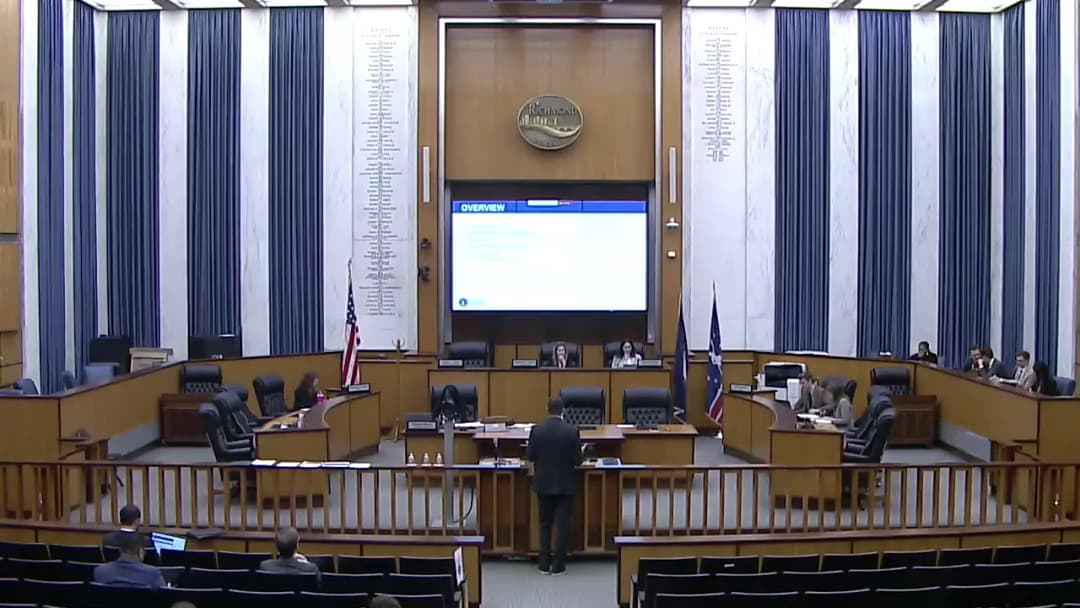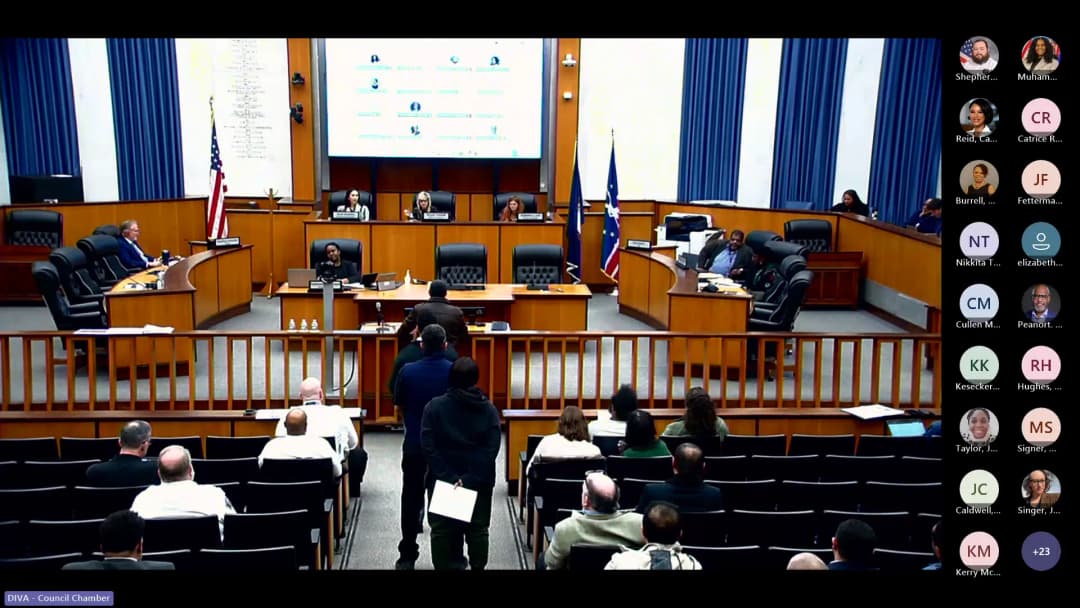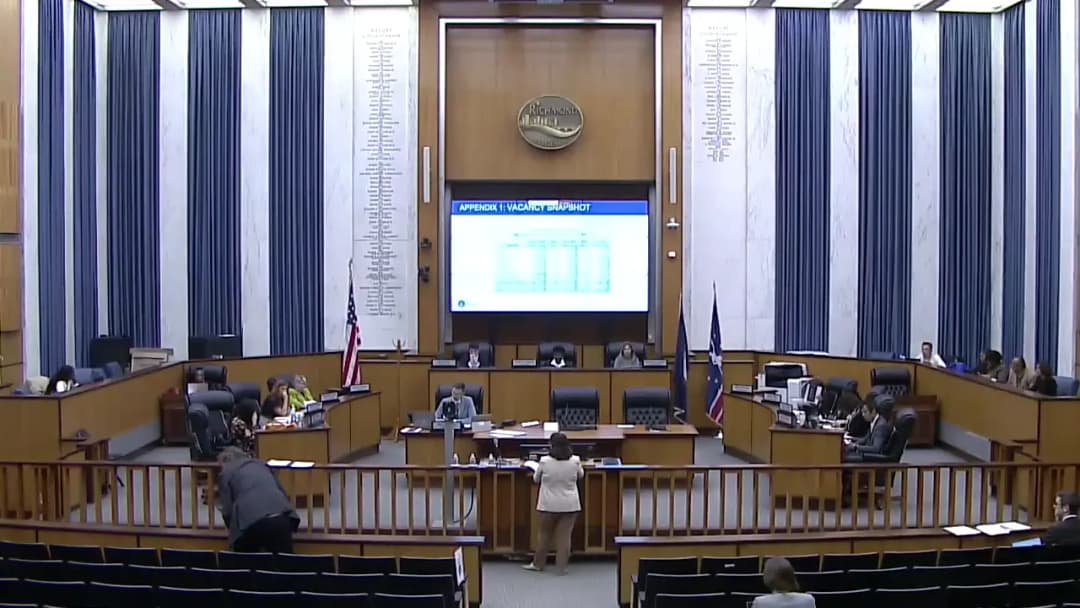
On March 2, 2026, the Richmond City Council's Organizational Development Standing Committee convened to hear two major presentations: an update from Richmond Public Schools (RPS) Superintendent Jason Kamras on the FY27 budget and student performance, and a workforce stability report from HR Senior Deputy Director Ms. Redman on city-wide vacancy and turnover trends. The meeting lasted approximately one hour and forty-five minutes. RPS Budget and Performance Presentation - Student Achievement Highlights: Superintendent Kamras reported that RPS economically disadvantaged students are growing five times faster than their peers statewide in reading SOL scores. Multilingual learners (English language learners) in RPS slightly exceed the state average proficiency of 33.1% and also surpass neighboring counties. The graduation rate reached 88%, the highest in approximately 20 years. - FY27 Budget Proposal: Kamras presented a revised budget proposal ("hot off the presses") based on a more favorable House budget, which projects a $20 million increase in state funding for RPS (Senate budget proposed $16 million). Key changes from earlier iterations include: - Shifting the proposed 50-50 split on health insurance cost increases to a 75-25 split (RPS taking the larger share) - Full funding of mental health and wraparound support contracts - Full funding of summer school - Elimination of a proposed furlough for directors and chiefs (saving $68,000, restored for morale) - The requested city funding increase dropped from $21 million to $9 million, acknowledging the city's fiscal constraints - Still included: closure of Richmond Virtual Academy and reduction of 46 central office FTEs (list on page 37) - One-Time Funding Risk: Approximately $7 million of the new state funding is one-time money unless replaced. Using it for recurring costs (like raises and collective bargaining commitments) creates a projected shortfall in FY28. Kamras recommended using the funds anyway to meet collective bargaining agreements, rather than asking the city for $16 million. - Administrative Efficiency: Kamras noted that RPS ranks 120th out of 131 school divisions in administrators per 1,000 students, calling it "one of the leanest school divisions in the Commonwealth." - CIP Request: A $10.3 million capital improvement program request includes electrical, fire safety, HVAC, plumbing, roofs, and structural projects, plus $1 million for Westover Hills Elementary parking lot and student drop-off area improvements in conjunction with city work on Jank Road. - Auditor Hiring: School Board Vice President Percival stated the board has been actively recruiting an internal auditor for over a year. Challenges include a tight labor market for auditors and the need for a highly credentialed person familiar with Richmond's unique context. The new Chief Talent Officer is now engaged in the search, and a candidate may be in place within weeks. City Workforce Stability Report - Turnover and Vacancy Trends: Ms. Redman reported that city-wide turnover has dropped by more than 40% since FY22, reaching a record low of 9.4%. Vacancies are also declining; the estimated vacancy rate through eight months is 12.3%, down from 14% in June 2025 (a reduction of 123 vacant positions since June). - Remaining Challenges: Despite improvement, 457 of 536 vacant positions (85%) are concentrated in 10 departments. The average time to fill a position is currently 194 days; the goal is to reduce to 120 days and eventually lower through process improvements and modern technology. - Departmental Priorities: Councilmember Lynch flagged the Finance Department's 39% vacancy rate as a critical risk, given an upcoming budget presentation, a late audit, and a CAFR/ASPR item removed from the agenda. Ms. Redman noted that Finance turnover has stabilized at 10% but hiring remains necessary. She also acknowledged that Public Utilities uses outsourcing, overtime, acting pay, and special pay to cover vacancies. - Outsourcing and Temporary Staff: In response to Councilmember Gibson, Ms. Redman confirmed that contractors sometimes transition to permanent roles, but some prefer the flexibility of contracting. - Budget Implications: Councilmember Breton raised the question of whether the city budgets as if all positions will be filled, or uses a realistic vacancy assumption. Ms. Redman agreed to coordinate with budget staff to prepare a realistic estimate. Councilmember Gibson noted the cost of turnover (lost expertise, overtime, outsourcing) and suggested collective bargaining has contributed to improved retention. Public Comments & Testimony No public comments or testimony were presented during this meeting. Key Outcomes - Superintendent Kamras will present the final proposed budget to the School Board on the evening of March 2, with a School Board vote scheduled for March 3. The budget will then go to the Mayor for consideration before returning to the City Council. - The Committee agreed to forward several detailed questions to city administration, particularly regarding: - The feasibility of using CIP funds for one-time operational costs (Councilmember Lynch) - Realistic vacancy assumptions for budgeting purposes (Councilmember Breton) - The cost of outsourced labor and temporary staffing in high-vacancy departments (Councilmember Gibson) - Overview of the FY27 budget timeline, potential 2% departmental cuts, and how to proceed without full financial clarity (Councilmember Trammell) - Councilmember Robertson will submit written questions on RPS academic performance and demographic trends directly to staff via Council Chief of Staff RJ Warren. - The Committee accepted the standing committee reports on the desk without additional comment. - The meeting adjourned without further business.
Public Meetings - Richmond, Virginia
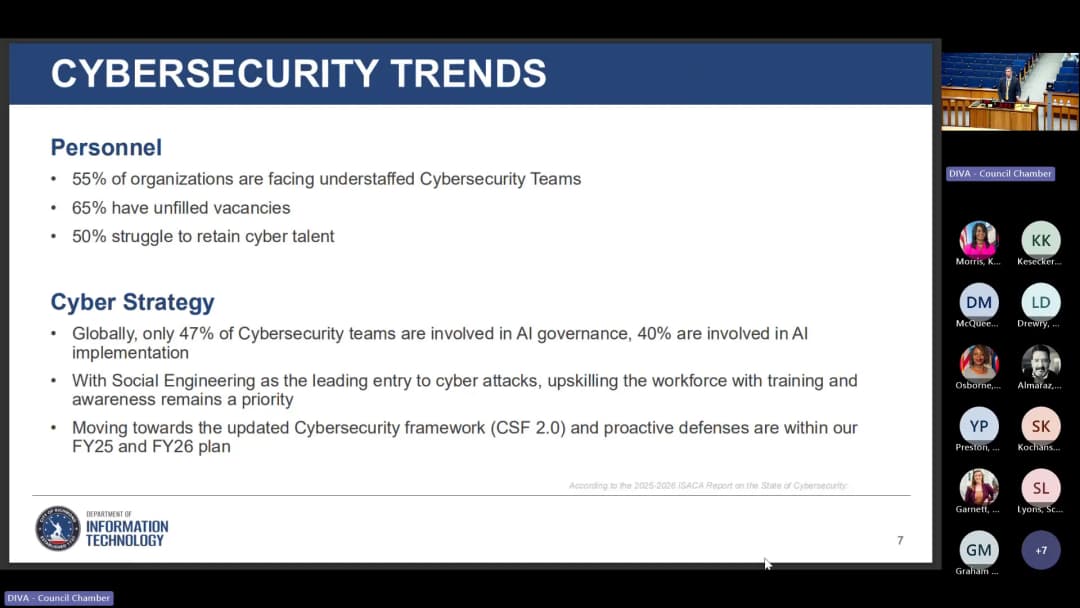
Public Meetings - Richmond, VirginiaThe Government Operations Standing Committee met on February 25, 2026, to receive presentations on the Clean City Commission annual report, cybersecurity threats and the city's posture, and the capital maintenance program for city facilities. The committee also approved a slate of board and commission appointments and discussed follow-up items for future meetings. Clean City Commission Annual Report - The Commission chair presented the annual report, emphasizing a shift from direct cleanup activities back to advising on policy changes for recycling and beautification. - 2026 priorities include: combating illegal dumping (citing incidents like 249 tires dumped at United Nations Church), expanding recycling in schools (currently inconsistent, often done informally by staff), developing a sustainable solution for wood debris (noting 75,000 street trees and climate-change losses), and expanding recycling/composting to small businesses (e.g., Gramophone winery facing barriers) and multifamily housing. - The Commission proposes a "Richmond Shines Month" in April in partnership with the Richmond Tool Bank for citywide cleanups. - Public awareness efforts include tabling at farmers markets, distributing reusable bags/water bottles, and educating residents on requesting recycling bins via 311. - Annual recycling events at Robin Hood Road may be affected by the Diamond District development. - The "Adopt a Spot" program currently has two active communities; the Commission seeks to onboard more. - One vacancy remains for the 9th district; the chair is working to fill it. Cybersecurity Update - Douglas Granat, Deputy Director for Strategy and Cybersecurity, delivered an overview of the evolving threat landscape. - Key threats include nation-state actors (Iran, Russia, China, North Korea), ransomware, phishing, and AI-enhanced attacks such as deepfake campaigns targeting public comment. - The city uses AI and machine learning defensively and has established an AI Governance Board (Administrative Regulation 2.13) to embed security in emerging technology adoption. - The city’s cybersecurity team has grown from 3 to 7 members; one vacancy is being filled. A shared operations model involves all city employees during incidents. - Partnerships include the FBI Cybercrime Division, and the city meets weekly with critical infrastructure leaders. - There is one outstanding audit item (recently transferred to DIT), currently in progress. - Councilmembers inquired about a communication plan for deepfake incidents and the resilience of critical infrastructure. Granat confirmed annual continuity plan updates and weekly critical infrastructure coordination. Capital Maintenance Program Update - Gail Johnson, Director of General Services, along with Kenny Hill and Lacey Solomon, presented on the state of city facilities. - Deferred maintenance costs total $251 million; an investment of $50–$60 million per year over five years would bring facilities to a fair-to-good condition. - Three buildings—City Hall, John Washer Courts Building, and Main Library—account for 60% of deferred maintenance costs and are in poor or worse condition. - The FY26 Generalized Capital Maintenance Fund is $16.1 million, of which DGS receives $9.4 million for all facility capital needs (parks receives $5 million; $1.5 million for Animal Care and Control). - Johnson explained funding sources: parking is an enterprise fund, fleet is an internal service fund, and Main Street Station has a dedicated special fund. - Nine properties are currently unused (e.g., Arthur Ashe, Coliseum) and require maintenance; proceeds from sales would go to finance. - The city-center project with a BAP grant is evaluating the future of City Hall and the John Marshall Courts Building. - A space needs study from after COVID exists; the committee requested an updated version for a future presentation. - Nine audit recommendations are scheduled for review on March 3, 2026. Board Vacancies and Appointments - Pamela Nichols presented recommendations for various boards and commissions. - The committee approved (motion carried with all votes in favor): - Central Virginia Waste Management Authority: Zachary Pauly (alternate) - City Personnel Board: Lacey Hancher - Clean City Commission: Al Misa (reappointment, 4th District); Margie Langston and Alex Martin (community representatives); one vacancy deferred to April. - Public Utilities and Services Commission: Andrew Grisby, Tracy Thayer (reappointments); Kirk Johnson (new) - Sister Cities Commission: continued to April 22, 2026. - Sustainability and Resilience Commission: Sophia Dizell - Urban Forestry Commission: Wood Clements, Mary Elfner, Janine Lester (reappointments) Key Outcomes - The committee approved the slate of board and commission appointments as described above, with the exception of Sister Cities Commission (continued). - Staff was directed to follow up on the space needs study and the fleet utilization report for future presentations. - The next two regularly scheduled meetings (March and April) will be budget work sessions; no additional presentations are currently planned.
The Sandy Committee and Government Operations met on February 25, 2026, to receive presentations on the Clean City Commission annual report, cybersecurity posture, and capital maintenance program. The committee also addressed board vacancies and forwarded a slate of appointments to the full council. Discussion Items Clean City Commission Annual Report Steve Marzoff, Chair of the Clean City Commission, presented the annual report. He highlighted four priorities for calendar 2026: reducing illegal dumping (citing 15 tire dumps in Swansboro West and 249 tires dumped at United Nations Church), expanding recycling in schools, developing a sustainable solution for wood debris at the East End landfill and Maury Street, and expanding composting and recycling programs (including small business and multifamily). Marzoff noted that the commission is refocusing from direct cleanups to policy recommendations. He mentioned a proposal from the Richmond Tool Bank to declare April as "Richmond Shines Month" with citywide cleanups. Councilmembers expressed appreciation and discussed collaboration with the Sustainability Commission and the bag tax funding. Cybersecurity Update Douglas Granat, Deputy Director for Strategy and Cybersecurity, presented an overview of the city's cybersecurity landscape. He discussed threats from nation-state actors (Iran, Russia, China, North Korea), ransomware, AI-enhanced attacks (deepfakes, bots), and supply chain dependencies. Granat reported that since 2022, the cybersecurity team grew from 3 to 7 members, with one current vacancy being re-advertised. He outlined the city's shared operational model, partnership with the FBI, and AI governance through Administrative Regulation 2.13. Councilmembers asked about coordination with communications for reputational harm response and resilience of critical infrastructure. Granat stated that resiliency plans for critical systems are reviewed at least annually and weekly meetings occur with infrastructure leadership. Capital Maintenance Program Update Gail Johnson, Director of General Services, provided an update on deferred maintenance. Total deferred maintenance costs are $251.5 million for construction alone, with an estimated $357 million needed for full replacement. The top three buildings (City Hall, John Marshall Courts Building, and another) account for 60% of deferred costs. The FY26 generalized capital maintenance fund is $16.1 million, of which $9.4 million goes to general services facilities. Johnson noted that moving to a fair-to-good condition would require $50–60 million per year for 5–6 years. Councilmembers discussed vacant properties, the future of City Hall, and space utilization studies. Johnson confirmed a space study was done in 2023 and that the city center project is evaluating City Hall’s location. One audit item remains open for DGS, with nine recommendations to be reviewed on March 3, 2026. Board Vacancies Pamela Nichols, Council Management Analyst, presented current and projected board vacancies. The committee heard recommendations for appointments and reappointments to the Central Virginia Waste Management Authority, City Personnel Board, Clean City Commission, Public Utilities and Services Commission, Sustainability and Resilience Commission, and Urban Forestry Commission. The Sister Cities Commission appointment was continued to the April 22, 2026 meeting. Key Outcomes - Motion approved (unanimous): The committee forwarded the following appointments and reappointments to full council for approval: Zachary Pauly (CVWMA alternate), Lacey Hancher (City Personnel Board), Al Misa (Clean City Commission, reappointment), Margie Langston and Alex Martin (Clean City Commission at-large), Andrew Grisby and Tracy Thayer (reappointments to Public Utilities and Services Commission), Kirk Johnson (new appointee to Public Utilities and Services Commission), Sophia Disell (Sustainability and Resilience Commission), and Wood Clements, Mary Efner, and Janine Lester (reappointments to Urban Forestry Commission). One Clean City Commission vacancy (9th district) was continued to April. - Staff direction: The committee requested a follow-up presentation on the city's recent space needs study and a fleet utilization report, to be scheduled for fall 2026. - Next meetings: The next two regularly scheduled committee meetings will be budget work sessions in March and April 2026.
The Public Safety Standing Committee of the Richmond City Council met on February 25, 2026, at approximately 2:45 PM. The meeting included approval of prior minutes, public comment on numerous topics, discussion of the Flock Safety camera contract, a crime statistics presentation, and an update on emergency management improvements following the January 2025 water crisis. No formal votes were taken on the Flock contract or Shockoe Bottom safety measures, but the committee forwarded a red light camera ordinance to full council and approved board vacancy recommendations. Consent Calendar - Approval of Minutes: The minutes from the October 28, 2025, Public Safety Standing Committee meeting were approved as presented without amendment. Public Comments & Testimony - Penny Page (Richmond resident) opposed the city's contract with Flock Security, citing nationwide misuse of data (e.g., stalking, unauthorized immigration enforcement) and the lack of evidence that the technology reduces crime. She argued that new state laws will not deter habitual offenders and urged cancellation. - Morgan Haifer (former bike courier) criticized the city's bicycle and pedestrian infrastructure, claiming high deaths and ineffective planning despite high spending. He called for better traffic enforcement and coordination with police. - Mike Weish (5th district) opposed Flock cameras, arguing that crime has been declining before their installation and that the technology is prone to abuse (e.g., immigration enforcement searches). He noted nearly 3,000 searches from Virginia's Flock network for immigration purposes. - Amante Goncello (6th district) opposed Flock, stating it constitutes mass surveillance, does not prevent crime, and has been abused (e.g., in Evanston, IL, and for abortion-related searches). He argued the city cannot guarantee data security. - Juan Braxton (5th district, NAACP criminal justice chair) supported keeping the Flock contract, saying it helps solve crimes and that privacy concerns are similar to cell phone tracking. He acknowledged imperfections but emphasized its value for families seeking justice. - Jackie Bishop Wells (6th district, business owner in Shockoe Bottom) requested moving the police enforcement window back to 11 PM–4 AM, defining Shockoe Bottom as an entertainment district, and focusing enforcement on non-alcoholic gathering spaces after 2 AM. She reported nine shootings and two fatalities the prior weekend and noted increasing empty storefronts. - Ezadina Lassad (Yemeni American Association of Virginia) opposed the city's Operation Vaporize, which has shut down over 60 small businesses (mostly immigrant-owned) for minor violations. He requested a pause on non-emergency closures and a collaborative framework. He and others noted that many closures occurred without warning or clear reasons. - Salah Al Assad (son of Dean Al Assad) echoed concerns about business closures, requesting a temporary halt, defined cure periods, and a meeting with city council and mayor's office within 14 days. - Other speakers (including a representative of the Arab community, a business owner whose store was closed that day, and a 65-year-old owner of three businesses) described devastating financial impacts and alleged systematic targeting of minority communities. - Christine Gibson (5th/8th districts) supported Flock cameras, arguing they aid investigations, and criticized high property taxes. - Mike Byrne (4th district, former restaurant owner) argued that Shockoe Bottom issues stem from non-enforcement of ABC laws, not just police presence. He called for license enforcement and criticized the ambassador program. - Charles Willis (United Communities Against Crime) supported Flock cameras, citing their role in solving homicides and hit-and-runs. He also announced a Walk for Peace on February 27, 2026. Discussion Items - Crime Statistics Review (Chief Rick Edwards): Chief Edwards presented 2026 crime data: overall major crimes down 12%, violent crime flat (murders flat, non-fatal shootings down 15%), property crime up 2% (driven by shoplifting and vape shop robberies). He noted that Flock technology contributed to solving the murder of Tanasia Humphreys (2022) and the rapid arrest of suspects in the murders of Marvin Ramos Hernandez and Darnell Christian. He also addressed privacy concerns, stating that new state law (HB 2724, effective July 1, 2025) criminalizes misuse, limits data retention to 21 days, and prohibits sharing with federal agencies. Chief Edwards emphasized that 99 fixed ALPRs in Richmond (4.2 per 10,000 residents) are not comprehensive tracking, and federal courts have upheld their use. He also noted that the department has seen a 40% reduction in murders since 2021 (90 to 54) and 30% reduction in non-fatal shootings since Flock deployment. - Shockoe Bottom Safety: Council members discussed short-term and long-term solutions, including additional cameras, officers, exploring a police substation, and an ambassador program. The chief noted that the outdoor refreshment area (ORA) approach may not be legally viable for creating a permanent gun-free zone. He highlighted that all guns in the recent mass shooting were retrieved from cars, and that 82 gun arrests were made in Shockoe Bottom in 2025. Council President Newbill confirmed a meeting with businesses scheduled for February 26, 2026, to discuss immediate actions. - Emergency Management Update (Director Stephen Willoughby): Willoughby reported on progress implementing 74 recommendations from the Haggerty incident response assessment following the January 2025 water crisis. Key improvements include: formalized EOC activation and staffing, a new multi-agency coordination center, adoption of the Everbridge mass notification system (now with over 10,000 Richmond Ready subscribers), enhanced public information procedures, and development of an integrated preparedness plan. He noted ongoing challenges, such as software gaps and the need for pre-identified drivers for winter weather. The updated Emergency Operations Plan will be presented to council in June 2026. The Office of Emergency Management currently has five staff, with a recommendation for seven to ten. Key Outcomes - Minutes Approved: The October 28, 2025, meeting minutes were approved. - Board Vacancy Recommendations: The committee voted (3-0) to recommend Nicole Raleigh for the Richmond MLK Authority and reappoint Crystal Fitzgerald to the Community Criminal Justice Board. The motion was approved. - Ordinance 2025-287 (Traffic Signal Enforcement Program): The committee voted (3-0) to forward the ordinance to the full council with a recommendation to approve. The ordinance establishes how civil penalties from red light cameras will be allocated, with funding directed to Vision Zero initiatives and staffing for the program. - No Formal Votes on Flock or Shockoe Bottom: The committee heard public testimony and discussed the Flock contract and Shockoe Bottom safety, but no motions were made to change existing policies. The chief affirmed that the contract is annual and could be ended if the vendor fails to meet standards. - Continued Oversight: Council members indicated they will follow up with the administration on business closures and emergency management staffing. A meeting with Shockoe Bottom stakeholders is scheduled for February 26, 2026.