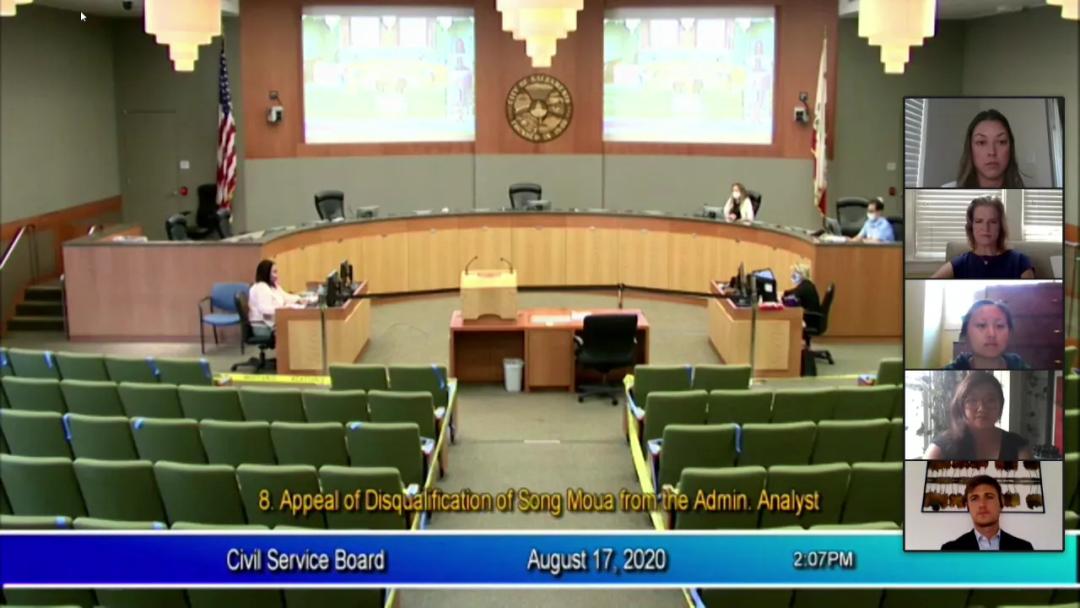
The Sacramento Civil Service Board held a special teleconference meeting on August 17, 2020, at 1:00 PM to address routine consent items, hear appeals of candidate disqualifications, and convene a closed session. Board members present: Edwin Perez (Chair), Gwyneth Bird, Emmanuel Amandford, and Robin Moore. A quorum was established. Consent Calendar - Approved the minutes of the March 3, 2020, meeting. - Approved the adoption of classification specifications for: Pick-up Driver (Fire Department), Junior Plant Operator (Utilities Department), Property Assistant (Police Department), and Senior Property Assistant (Police Department). All items passed unanimously. Public Comments & Testimony - No public comments were received during the meeting. The board noted that the public comment period was open via phone and email, but no members of the public requested to speak. Discussion Items - Appeal of David Agusto – Disqualification from Assistant Planner recruitment (Community Development). The board heard staff presentation and the appellant's argument. Motion to affirm the Director's disqualification passed unanimously. - Appeal of Christopher Hamblin-Agosto – Disqualification from Assistant Planner recruitment (Community Development). Similar process; motion to affirm passed unanimously. - Appeal of Song Moua – Disqualification from Administrative Analyst recruitment (Citywide). Motion to affirm passed unanimously. - Appeal of Shanice Shillings – Disqualification from 311 Customer Service Agent recruitment (Information Technology). Motion to affirm passed unanimously. - Appeal of Sarah Armanino – Disqualification from Forensic Investigator I recruitment (Police Department). Motion to affirm passed unanimously. - Additional appeals (items 11-12) were also discussed and affirmed unanimously. Key Outcomes - All consent calendar items approved unanimously. - All six appeals of candidate disqualifications were affirmed by unanimous vote, upholding the Director's decisions. - The board adjourned to closed session at approximately [time] to discuss items 14-16: public employee discipline/dismissal/release pursuant to Government Code Section 54957. No action was reported from closed session. Note: The meeting was conducted via teleconference due to the COVID-19 emergency, with public participation available by phone and email.
Public Meetings - Sacramento, California
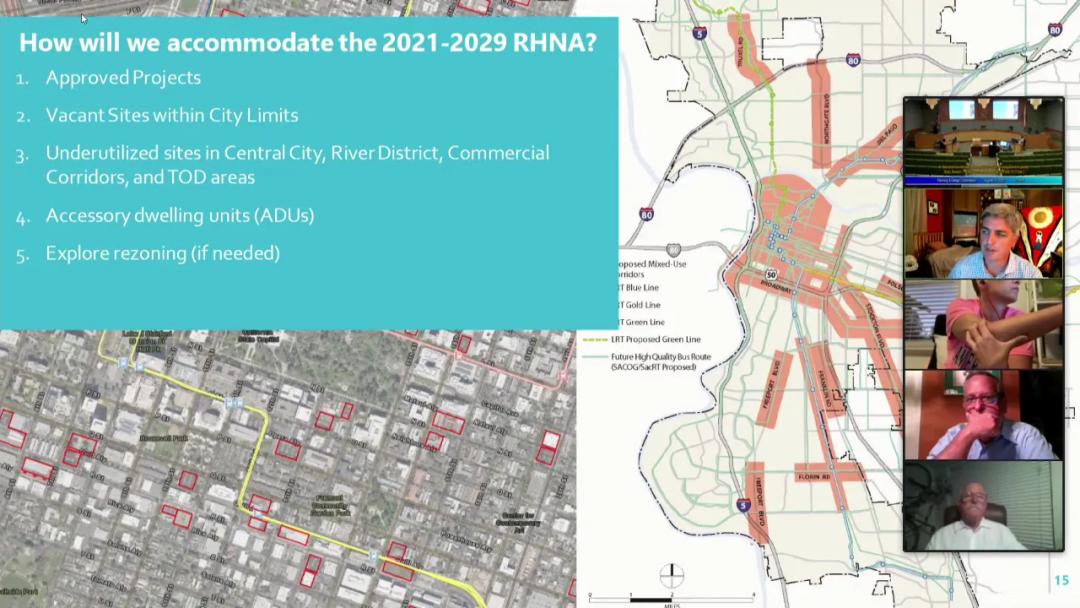
Public Meetings - Sacramento, CaliforniaThe Sacramento Planning and Design Commission met remotely by teleconference on Thursday, August 13, 2020, at 5:30 p.m. because of the COVID-19 local emergency. Commissioners Burke and Hernandez were absent; Commissioner Farrell joined later in the meeting. The Commission approved the consent calendar, received staff reports on the Climate Action Plan and Housing Element update, and approved a motion forwarding the Ad Hoc Committee’s recommendations on the Commission’s purpose, composition, and policy prioritization to the City Council. Consent Calendar - Moved, seconded, and approved the July 23, 2020 meeting minutes (Pluckebaum/Macias Reed); vote 8:0:2; Burke, Hernandez, and Farrell were absent. - Received and filed the Director’s Report. The report noted that the City Council approved a ministerial infill housing ordinance on July 28 and previewed upcoming agenda items, including a Folsom Boulevard special planning district and General Plan workshops. Public Comments & Testimony - Ansel Lundberg (co-chair, Health Sacramento) supported the CAP’s land-use measure E4 focusing growth in transit-priority/infill areas, investment in active transportation and transit, and environmental justice; he suggested using SACOG’s GHG modeling. - Erica De York (Sacramento Metropolitan Chamber of Commerce) said the Chamber’s input to the Mayor’s Climate Commission was not reflected in the CAP staff report. She opposed an unrestricted all-electric new construction ordinance by 2023, citing grid capacity, technology gaps (especially electric hot water heating), and costs that could make infill housing unaffordable, push development outside the city, and increase emissions through longer commutes. She asked for cost-benefit analysis, feasibility protections, and fair warning for projects already in the pipeline. - EComments received before and during the meeting included concerns that the Mayor’s Climate Commission report and its business/community input were not clearly incorporated into the CAP materials. - Anthony Lundberg (Housing Sacramento) spoke on the Ad Hoc item, supporting the streamlining reform direction and the policy priorities outlined by the Ad Hoc Committee, including eliminating R1 zoning and parking minimums. Discussion Items Sacramento Climate Action Plan Update Staff presented preliminary draft measures to reduce community greenhouse gas (GHG) emissions to 40% below 1990 levels by 2030 and achieve carbon neutrality by 2045. Sacramento’s 2016 emissions were about 3.5 million metric tons of carbon dioxide equivalent; transportation accounts for 57%, buildings 37%, waste 5%, and water/wastewater 1%. Sacramento is already below its 2020 target. Staff proposed a linear per-capita path to carbon neutrality, requiring an additional reduction of 683,271 metric tons of CO2e by 2030. Key measures include all-electric new construction (E1), phased electrification of existing buildings (E2), transit and active transportation improvements (TR1/TR2), electric vehicle transition (TR3), food-waste diversion, and increasing the urban tree canopy from 19% to 30%. Staff reported TR3 would provide 42% of GHG reductions, TR2 18%, E1 8%, food-waste diversion 8%, and tree canopy 6%. Commissioners raised the need for cost estimates and transparent prioritization; staff said Bay Area Economics is preparing a funding/financing plan and cost estimates will accompany each measure in future drafts. Commissioner Pluckebaum asked about water heater and EV technology; consultant Matt Maddox said commercial electric water heaters are developing and expected to be standard by 2026, with efficient operating costs. Commissioner Ogilvie requested a summary “crosswalk” between the CAP and the Mayor’s Climate Commission report; staff said one could be brought back after the Mayor’s Climate Commission report goes to City Council on August 25. She also raised equity concerns about point-of-sale enforcement, SMUD retrofit programs, youth engagement, tree canopy targets, bicycle mode share, and barriers to biking. Commissioner Wang Connelly questioned the CAP’s emphasis on EVs (30% of vehicles) over active transportation and transit; staff and consultants explained the CAP must be legally defensible and cannot separately quantify land-use changes due to double counting, and that the EV target is consistent with the Mayor’s Commission’s 75% new-registration goal when measured the same way. Commissioner Kaufman said the pandemic may reduce public support for transit and density, calling for an education campaign and transparent cost/priority criteria. Commissioner Macias Reed asked for side-by-side CAP/MCC comparisons, cost and feasibility data, commercial corridor tree incentives, and consumer EV costs. Commissioner Lindsay described North Natomas as a “transportation desert” and urged stronger coordination with RT and regional growth decisions. Several commissioners opposed mandatory point-of-sale permit inspections, calling them costly and inequitable; staff said enforcement would be at least 10 years out and open to alternatives. The item was received and filed. Sacramento’s Housing Strategy (2021-2029 Housing Element Update) Staff presented a study session on the eight-year Housing Element, which is state-mandated and due May 15, 2021, with a 120-day grace period. The City of Sacramento’s share of the regional housing needs allocation (RHNA) is 45,580 units, 29% of the regional total and an 89% increase over the previous cycle’s approximately 24,000 units. Staff plan to accommodate the allocation through pipeline projects, vacant and underutilized sites, commercial corridors and transit-oriented development areas, higher ADU projections, and potential rezoning; they will also complete a fair housing assessment under AB 686, analyze governmental and non-governmental constraints, and review current programs. Outreach includes internal and external housing working groups, focus groups on anti-displacement and affordable housing requirements, and upcoming community plan area workshops. Commissioner Kaufman urged building-department streamlining or self-certification, manufactured and 3D-printed housing, and Portland-style residential infill rules allowing up to four homes per lot (six for price-regulated projects). Commissioner Ogilvie asked for housing opportunity maps that include historically redlined neighborhoods, workforce development to reduce ADU costs, and more diverse site locations. Commissioner Macias Reed highlighted building department inconsistencies and called for rethinking R1 zoning near commercial corridors. Commissioner Wang Connelly recommended corridor rezoning, density and affordable housing bonuses, and removing minimum parking requirements. Commissioner Pluckebaum noted the potential conflict between inclusionary housing/anti-displacement goals and housing production/affordability. Greg Sandlund reported ADU permits are coming in at about five to six per week. The item was received and filed. Ad Hoc Committee Recommendations on Commission Purpose, Composition, and Policy Prioritization Staff reported on the Ad Hoc Committee (Commissioners Ogilvie, Macias Reed, Kaufman, Farrell, Hernandez, and Yee; seven meetings from April 3 to June 23, 2020). The committee’s recommendations included: (1) keep the Design Advisory Group informal for one year so design professionals can provide early, candid comments before Brown Act requirements would apply; (2) amend City Code Title 2 to require new council/mayor-nominated commissioners to have “formal training or demonstrated experience” in at least one of a list of qualifications; and (3) establish an annual policy-prioritization work plan process informing City Council adoption of the planning work program. Commissioners discussed the trade-offs of three commission composition options (13 members, 9 district-based members, or 5–7 expert members). Commissioner Farrell worried about exclusivity; Commissioner Kaufman responded that the qualifications do not require degrees or licenses and could include community experience. Vice Chair Pluckebaum suggested retaining 13 members but allowing action by a majority of those present rather than a majority of the full commission. Chair Covill, speaking from experience as a realtor, opposed mandatory point-of-sale permit inspections. Public commenter Anthony Lundberg supported the reform direction. The Commission approved a motion (Kaufman/Yee), 9:0:2, with Burke and Hernandez absent, forwarding the Ad Hoc Committee recommendations to City Council with amendments: add “neighborhood development, economics, and social equity issues” to the commissioner qualification list; retain the 13-member commission structure; and recommend that commission actions require a majority of members present rather than seven votes. Key Outcomes - Consent calendar approved: minutes of July 23, 2020 (8:0:2) and Director’s Report received and filed. - Climate Action Plan update received and filed; staff will return with a crosswalk to the Mayor’s Climate Commission report, cost/financing details, and further refinements. - Housing Element study session received and filed; no formal action. - Ad Hoc Committee recommendation approved 9:0:2 and referred to City Council with amendments on qualifications, commission size, and vote threshold. - No public comments were received for matters not on the agenda; the meeting adjourned after member comments.
The Water Committee of the City of Sacramento met via teleconference on Tuesday, August 11, 2020, from 1:00 p.m. to 1:40 p.m. The meeting consisted of four informational presentations on water rights, water transfers, sustainability and efficiency efforts, and an update on the Water Forum Agreement. All items were received and filed without public comment or action votes. Discussion Items 1. Water Rights and Water Supply Regulatory Processes - Outside Water Counsel Wes Miller-Band provided an update on the State Water Resources Control Board’s water quality control plan update and voluntary agreements (VAs). Voluntary agreements have stalled due to litigation between federal and state governments over biological opinions adopted in October 2019. The state sued in February 2020, alleging the biological opinions insufficiently protect endangered fish species. The city’s potential contribution to flow measures would be groundwater substitution, leaving water in the lower American River. Non-flow measures include local projects for fish spawning and rearing. No public timeline exists for the formal regulatory process. COVID-19 has not directly impacted the process. The presentation was received and filed. 2. 2020 Water Transfer Update - Senior Engineer Brett Ewart presented on the city’s groundwater substitution transfer, approved by City Council on June 16, 2020, by the State Water Board on July 6, and by the Department of Water Resources on July 8. The transfer involves six partner agencies; the city contributes the majority of the regional total of about 18,000 acre-feet. The water market price settled at $350 per acre-foot for the first three months, down from $400 in 2018. In the first month, 2,400 acre-feet were transferred. The city increases groundwater production by 10 million gallons per day (MGD) from its northern wells, receives 15 MGD through interties with Sacramento Suburban Water District, and 6 MGD from Sacramento County Water Agency. Revenue from the 2018 transfer ($1.8 million) was reinvested in groundwater infrastructure and leveraged a $1 million DWR grant. 2020 revenue will also be reinvested. The transfer is authorized through November 2020, with optional extension. Chair Harris noted benefits are monetary but also ecological (leaving water in the river). He raised concerns about dry-year triggers for scaling back, but Ewart noted off-ramps exist and the city has years of stored groundwater credits. No public callers. Received and filed. 3. 2020 Update on Sustainability and Water Efficiency Efforts - Sustainability Program Manager Roshni Das reported that the Sierra snowpack final survey recorded 1.5 inches (3% of May average). The Sacramento Valley Index stands at 63% of average, similar to 2018. New state legislation (AB 1668 and SB 606) mandates indoor water use standards of 55 gallons per capita per day (GPCD) by 2025 and 50 GPCD by 2030, with enforcement starting in 2026. The city is participating in two pilot studies to inform rulemaking. The water conservation ordinance update was delayed pending state direction. Despite COVID-19, online workshops saw unprecedented attendance. Rebate applications dropped only 10% in FY2020, still the second highest ever. The smart meter program sends automatic leak notifications for continuous 24-hour use (five days/week). The Leak Free Sacramento no-cost direct install repair program completed 20 projects in FY20. The city’s overall water demand is now around 160 GPCD, down from 300 GPCD pre-drought. Sustainability efforts include a climate risk assessment using EPA’s CREATE tool and a draft DOU Sustainability Policy focusing on carbon neutrality, climate resiliency, and equity. Chair Harris suggested more proactive leak alerts for commercial customers; staff noted existing notifications but will review. Councilmember Guerra thanked staff for outreach in disadvantaged communities. No public callers. Received and filed. 4. 2020 Water Forum Agreement Update - Utilities Director Bill Busath provided a status update. The Water Forum Agreement (WFA), signed about 20 years ago, is being renegotiated early due to the upcoming retirement of Executive Officer Tom Gording. The process is expected to take 18–24 months. The three caucuses (water, public, environmental) have held educational meetings and will begin working groups. The city seeks continued support from the environmental caucus, which has backed most city activities over the past 20 years. Staff will report back at milestones and bring a draft agreement to the Committee before City Council approval. Committee members expressed appreciation for Gording’s work. Received and filed, with authorization for staff to engage in discussions. Key Outcomes - All four oral reports were received and filed by unanimous consent of the committee members present (Jeff Harris, Eric Guerra, Angelique Ashby). - Staff was authorized to continue engagement in Water Forum Agreement negotiations and return to Council at key decision points. - No public comments were received on any agenda item or on matters not on the agenda. - The meeting adjourned at 1:40 p.m.
The Sacramento Community Police Review Commission held a teleconference meeting on August 10, 2020, starting at 6:01 p.m. and adjourning at 7:46 p.m. Commissioners discussed the formation and scope of ad hoc committees, reviewed the complaint activity report, and updated the follow-up log. Key decisions included expanding the Rules of Procedure Ad Hoc to examine the commission's structure and keeping the Mental Health Ad Hoc name while broadening its scope. Public comment was received via phone and eComment. Consent Calendar - Meeting Minutes (March 9, 2020): Approved unanimously, with an amendment to reflect Chair Guerrero's self-appointment to the Mental Health Ad Hoc. - January-March 2020 Police Complaint Activity Report: Received and filed. The motion passed with 7 yes votes, 2 abstentions (Commissioners Falcon and Savage-Sangwan), and 2 absences (Commissioners King and Carter). - Commissioner Savage-Sangwan requested a future conversation with OPSA to provide more robust complaint data, noting the need for more meaningful information. Public Comments & Testimony - Norman Nelson (public comment on Item 3): Supported Commissioner Savage-Sangwan's request for a more robust complaint report and suggested moving it to a discussion item. He also recommended including district, ethnicity, gender, and reason for police contact in the report, and emphasized the need for community outreach. Discussion Items - Item 3: Discuss Formation of Additional Ad Hoc Committees: Chair Guerrero initiated a discussion on whether to create new ad hoc committees or change the scope of existing ones. Commissioners agreed to keep the Mental Health Ad Hoc name but expand its scope to include broader issues like substance abuse and homelessness, reflecting the mayor's reimagining of SPD. They also agreed to expand the Rules of Procedure Ad Hoc to include reviewing the commission's own structure and responsibilities, integrating a suggestion from Commissioner Zamora and supported by Commissioners Falcon, Marion, Savage-Sangwan, and others. No new committees were formed. - Item 4: Follow-Up Log: The log was received and filed. Commissioners discussed outstanding data requests, including mental health data from SPD, and the need for a response from the city attorney on waiving attorney-client privilege for a use-of-force memo. The city attorney's office clarified that only the mayor and council can waive privilege, and recommended submitting it as part of the commission's regular recommendations. Commissioner Savage-Sangwan suggested inviting the ACLU to present on compliance with state law, which was added to the log. Ad Hoc Committee Updates - Mental Health Ad Hoc: Co-Chair Richard Falcon and Commissioner Savage-Sangwan presented preliminary recommendations, including redirecting $5 million annually from SPD budget to community-based mental health programs, creating grant programs, integrating services into 911 dispatch, and establishing a serious incident review board for mental health-related use of force cases. - Discipline and Accountability Ad Hoc: Chair Carter presented recommendations on eliminating qualified immunity, rejecting applicants with histories of excessive force, zero tolerance for lying, and strengthening the inspector general's independence. Commissioner Savage-Sangwan raised concerns about the Lexipol contract ($150,000/year) and recommended termination. Chair Guerrero added a recommendation for SPD to bring future policies to the commission before adoption. - Rules of Procedure Ad Hoc: Co-Chairs Castillo-Krings and Sabeniano reported progress on a procedural document, with legal review by the city attorney's office, and expanded scope to include commission structure. Key Outcomes - Approved consent calendar items. - Expanded scope of Mental Health Ad Hoc (no name change) and Rules of Procedure Ad Hoc to include commission self-review. - Appointed Commissioner Marion to the Mental Health Ad Hoc; Chair Guerrero stepped down. - Added follow-up log items: request for SPD to provide written responses to commission recommendations (and consider public forum), request for a presentation on SAC PD budget (possibly by the city or Measure U Chair Lo John Cooper), request for a report on lawsuits and payouts, and request to invite ACLU to present on compliance. - Commissioner Marion requested side-by-side quarterly complaint data for comparison; this was noted.
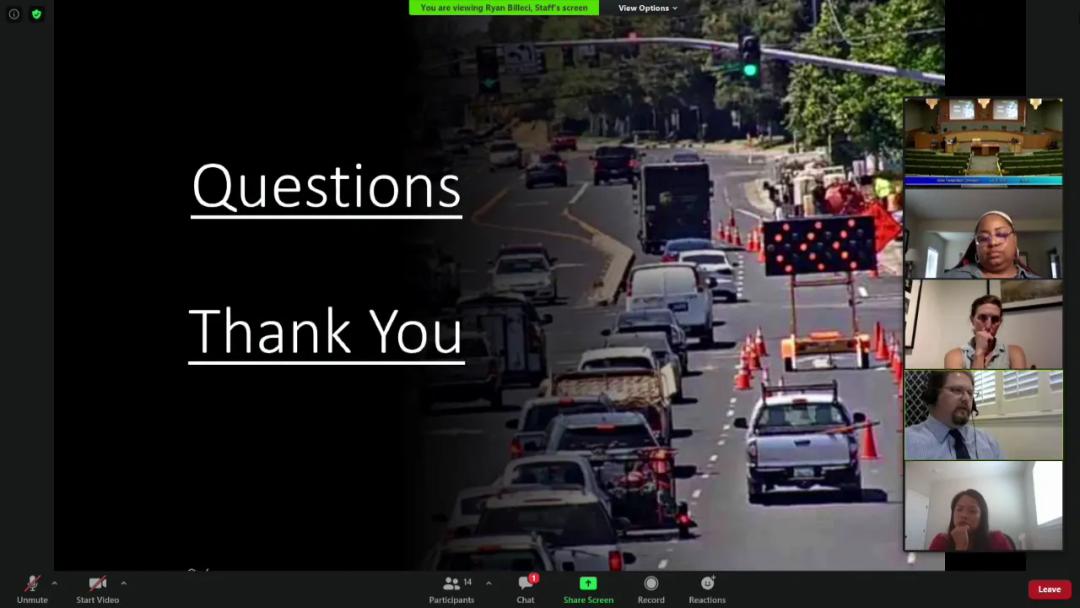
The Active Transportation Commission held a special meeting via Zoom on July 30, 2020, starting at 6:00 p.m. The commission considered several action items, including a revision to the Bicycle Master Plan for Broadway, the Vision Zero School Safety Study, and adoption of an equity definition. The meeting also featured a staff presentation on traffic signals and active transportation, updates on grant programs, and public comments on slow streets and the Del Rio Trail. Consent Calendar - Approved the meeting minutes of June 18, 2020, by a unanimous vote. - Received and filed the Active Transportation Commission Log. Public Comments & Testimony - Deb Banks, Executive Director of Sacramento Area Bicycle Advocates (SABA), urged the commission to recommend a slow and resilient streets program using CARES Act funds, citing examples from New York and Los Angeles. - Bo Chaitman (former docent at California State Railroad Museum) stated that his termination was forced by the city due to his criticism of the Del Rio Trail Project, and that a climate of fear prevents other state workers from speaking out. - Craig Siegel (District 4) urged immediate implementation of slow streets in Sacramento, especially in underserved areas. - Dan Allison commented on slow streets, stating the city has not addressed bag buttons (only 5 of 800 changed) and that Sacramento is the last major city in the state to act on slow streets. He also noted low-income programs are hard to find. - Joe Wolf (Davis) called attention to unsafe bike lane designs in the I Street Bridge replacement renderings, which show unbuffered bike lanes next to car traffic and a wall separating pedestrians from cyclists. - A caller (anonymous) criticized the Del Rio Trail as the opposite of equity, noting a pending lawsuit and asking the commission to recommend an easement for maintenance. Discussion Items - Commission Staff Report (Jennifer Donlon Wyant): Provided updates on Caltrans planning grants – the city won a grant for a combined inclusive economic development and traffic safety study on Northgate and Freeport corridors, but lost a grant for Vision Zero Corridors 6–10. Shared rideables updates: Bird and Spin have relaunched with COVID-19 cleaning protocols; Lime (Jump) contract is held by SACOG and negotiations are ongoing. - Traffic Signals and Active Transportation (Ryan Billeci, Senior Engineer): Presented an overview of the city's traffic signal system (786 signals), bicycle detection standards (video detection since 2005, meeting AB 1581 and California MUTCD), minimum green times (bicycle min green calculated at 10 mph with 6 seconds startup), pedestrian recalls and countdown heads, and pedestrian timing (3.5 ft/s walking speed). Q&A covered leading pedestrian intervals, detection technology (video vs. loop), education gaps, and the possibility of touchless buttons during COVID-19. - Envision Broadway in Oak Park Bicycle Master Plan Revision (Leslie Mancebo): Proposed amendment to add a buffered bike lane on Broadway from Alhambra Boulevard to Martin Luther King Jr. Boulevard (correcting a boundary error in the staff report). The recommendation was forwarded to City Council to allow grant eligibility. Motion passed unanimously. - Vision Zero School Safety Study (Leslie Mancebo): Reviewed 20 school sites (ranked by collisions within 0.25 miles, one per council district, excluding schools on Vision Zero top-five corridors). Observations included driver speeding, failure to yield, and inadequate bike/ped infrastructure. Recommendations include curb ramps, enhanced crossings, sidewalk improvements, and road diets. Equity consideration: included Mustard Seed School (private, serves unhoused children). Motion to forward the final report to City Council passed unanimously. - Discussion on Equity, Part 3 (Commissioner Garrow): Presented a final working definition of equity for the commission. Definition: "The City of Sacramento's Active Transportation Commission acknowledges the challenges the city faces in providing equitable access to safe and adequate modes of active transportation as a result of prior historically sanctioned discriminatory policies... The Active Transportation Commission is working to achieve equitable access for all our residents..." Motion to adopt the definition passed unanimously. The commission agreed to discuss implementation (e.g., an equity action plan) at the next meeting. Key Outcomes - Consent Calendar approved unanimously. - Envision Broadway BMP Revision – Motion to recommend City Council amend the Bicycle Master Plan (including buffered bike lane from Alhambra to MLK Jr. Blvd.) passed unanimously. - Vision Zero School Safety Study – Motion to forward the final report to City Council passed unanimously. - Equity Definition – Motion to adopt the working definition of equity passed unanimously, making the Active Transportation Commission the first city commission to do so. The commission will schedule a discussion on implementation (e.g., equity action plan, equity impact analysis) for the next meeting. - Committee Comments: Requested an update on the Del Rio Trail progress (impacted by COVID) and reiterated interest in having the Sacramento Police Department present on issues affecting bicyclists and pedestrians. Staff will follow up. - Next meeting scheduled for August 20, 2020, also via Zoom.
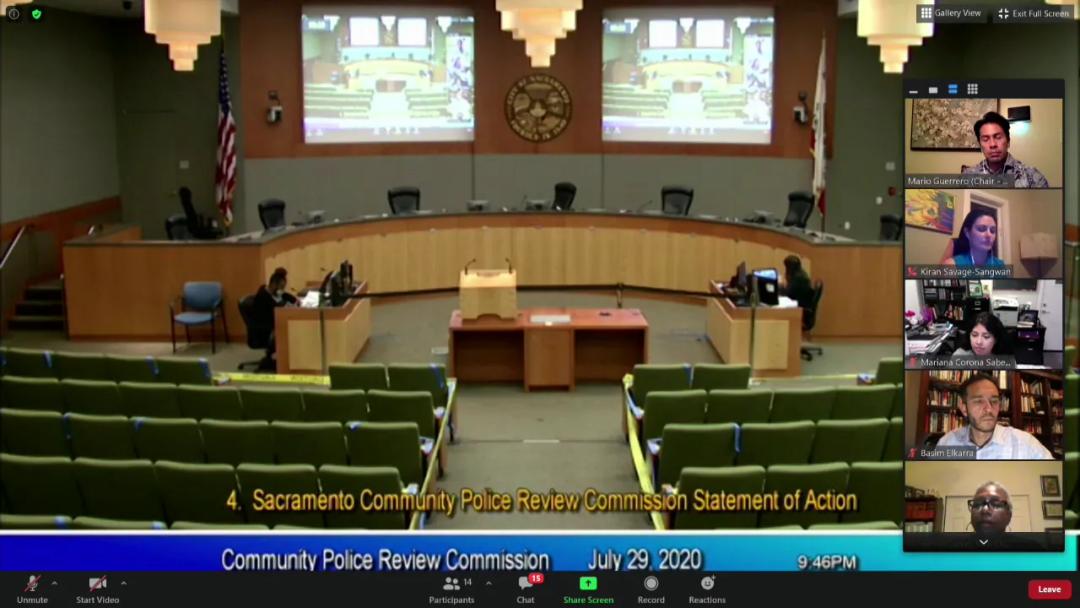
The Sacramento Community Police Review Commission held a special teleconference meeting on July 29, 2020, at 6:00 p.m. due to the COVID-19 pandemic. The meeting focused on introducing the new Director of the Office of Public Safety Accountability, Dr. LaTesha Watson; receiving updates on the proposed Inspector General position and 911 Alternative Response Model; hearing a presentation from MH First and the Anti Police-Terror Project; and discussing a Commission Statement of Action in response to the killings of George Floyd and Congressman John Lewis. Public comments were taken on each agenda item. Public Comments & Testimony - Multiple callers expressed opposition to Dr. Watson's appointment, citing her law enforcement background and questioning her ability to provide independent oversight. One caller stated they did not believe the city manager or mayor have the community's best interest in mind. - Several speakers called for defunding the Sacramento Police Department and redirecting funds to community-based alternatives like MH First. One resident of District 8 urged the commission to join the movement to defund SAC PD and invest in prevention and intervention. - Many commenters voiced strong support for MH First, describing it as a needed alternative to police response for mental health crises. One caller noted that MH First has been operating since January 2020 and should be fully funded. - A speaker from Momentum United proposed that the commission be given authority to investigate all misconduct complaints, direct discipline, and be the sole entity to direct the Inspector General. - Dr. Flojaune Cofer, chair of the Measure U Community Advisory Committee, offered collaboration to review police department data and effectiveness. Discussion Items - Item 1: Introduction of the New Director of the Office of Public Safety Accountability, Dr. LaTesha Watson – Dr. Watson introduced herself, noting her 26-year law enforcement career including as a police chief. Commissioners questioned her about gaining community trust, her independence from police, and her plans for outreach. Dr. Watson stated her track record includes being terminated for holding officers accountable, and emphasized community engagement as a priority. Commissioner Savage-Sangwan asked how she would respond to concerns about her background; Dr. Watson replied that experience is necessary to know what to look for in investigations. - Item 2: Update on Inspector General Position and 911 Alternative Response Model – Kelly Fong Rivas, Chief of Staff to the Mayor, presented an update. The Inspector General position will report to the OPSA director, conduct independent investigations, and publicly present findings. Commissioners questioned the independence of the IG since it reports to a former police chief. Vice Chair Carter argued the IG should report directly to mayor and council, not to Dr. Watson. Rivas explained the IG's independence means separate investigations from Internal Affairs. Commissioners also raised concerns about lack of community feedback and requested the commission be involved in the process. Bridget Dean, Interim Director of the Office of Community Response, presented on the alternative 911 model, describing plans for a first response team led by social workers for calls involving mental health, homelessness, substance abuse, and community disputes. She emphasized a commitment to racial equity and community collaboration. - Item 3: MH First and the Anti Police-Terror Project Presentation – Asantewaa and Nikki from MH First described their volunteer-run mobile crisis response team, launched January 3, 2020, that provides de-escalation and support without police involvement. They highlighted the gap in services and the need to fund community-based alternatives. Commissioners expressed support and asked about language capacity and data collection. The presenters called for funding to be shifted from the police budget to expand their services. - Item 4: Sacramento Community Police Review Commission Statement of Action – Chair Guerrero introduced a moment of silence for George Floyd and Congressman John Lewis. He then read his statement recommitting to the work, ensuring community voice, and being a nuisance to city council to get recommendations voted on. Other commissioners shared personal statements. Commissioner Carter read a letter linking policing to the history of slavery and systemic racism, and urged council to use its municipal police power to enact reforms. Commissioner Savage-Sangwan committed to reimagining safety beyond policing. Key Outcomes - The commission discussed plans to hold a meeting with SAC PD to find agreement on the commission’s recommendations (as requested by city council on July 1). - Chair Guerrero noted that work group reports and potential votes on recommendations are expected at the next regular meeting on August 10, 2020. - Commissioner Elkarra requested an update to the ACLU report on use of force; Chair Guerrero indicated it may not be ready for August but possibly September. - Commissioner Savage-Sangwan requested that the city attorney present their opinion on the police department’s compliance with state law regarding use of force, and asked that a confidential memo on the topic be made public. The deputy city attorney stated the memo is confidential. - Vice Chair Carter suggested the commission explore having its own independent legal counsel, citing potential conflicts of interest with the city attorney’s office. - No formal votes were taken during this special meeting.
The Utilities Rate Advisory Commission (URAC) met on Wednesday, July 22, 2020, at 5:30 p.m. in the Council Chambers at 915 I Street, Sacramento. The meeting was streamed live and archived. The commission addressed consent items and a discussion item regarding the Department of Utilities accountability plan. No public comments were received. Consent Calendar - Approval of Minutes for December 11, 2019: Commissioners voted unanimously to approve the minutes. The motion was made and seconded, with all members voting in favor. Public Comments & Testimony - No public comments were made during the meeting. Discussion Items - Department of Utilities Accountability Plan Update – Fourth Quarter 2019: The commission received the Quarterly Accountability Plan Update for the fourth quarter of 2019. The report was not formally presented, but commissioners were asked to review it in advance. No questions or discussion were recorded from the transcript. Key Outcomes - Minutes Approved: The December 11, 2019, meeting minutes were approved unanimously. - Accountability Plan Update Received and Filed: The Department of Utilities Accountability Plan Update for Q4 2019 was received and filed, as recommended. No vote was required on this item. - Meeting Adjourned: The meeting was adjourned without further action. Note: The agenda item for the selection of a new Chair and Vice Chair was not addressed during the meeting based on the available transcript.
The Law and Legislation Committee meeting originally scheduled for July 21, 2020 was cancelled. The agenda indicates that a special meeting was held at 12:30 p.m. instead. No transcript, minutes, or public testimony are available for this cancelled meeting. Discussion Items - No items were discussed due to cancellation. Key Outcomes - The meeting was cancelled; no votes or decisions were taken.
According to the official agenda, this meeting was cancelled. However, the agenda provided is dated September 21, 2021, which conflicts with the user-specified meeting date of July 21, 2020. No minutes or transcript are available. The agenda contains only a notice of cancellation. Consequently, there are no public comments, discussion items, or key outcomes to report.
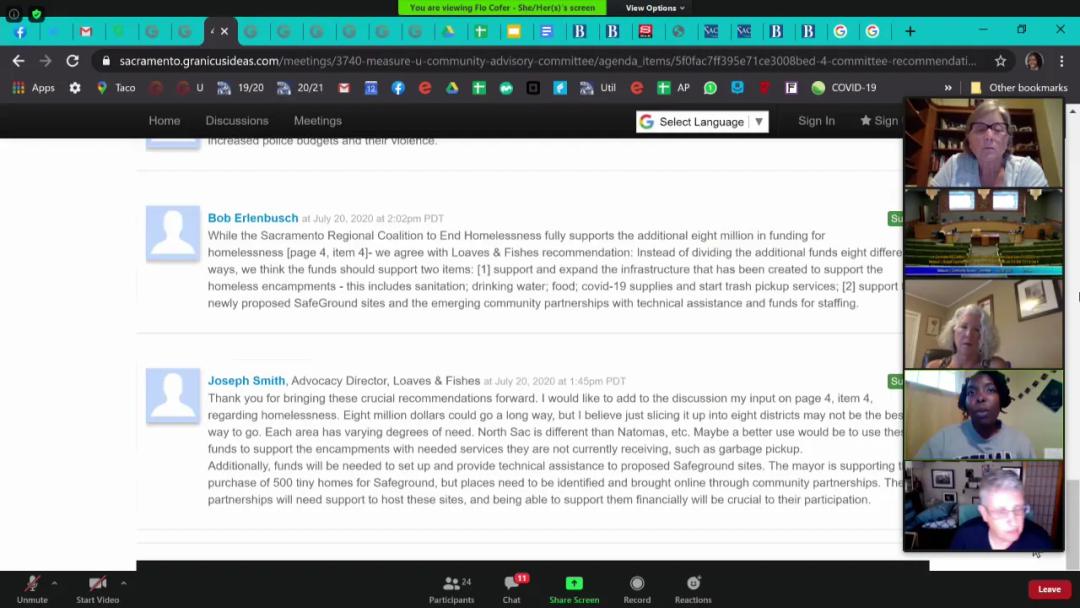
The Measure U Community Advisory Committee met on July 20, 2020, starting at 6:00 p.m. and lasting approximately five hours. The agenda included a Police Department budget update, development of recommendations on participatory budgeting, proposed changes to the adopted FY2020/21 Measure U budget, a public opinion poll, discussion of the committee's role, and reorganization of ad hoc committees. The committee forwarded several non-binding recommendations to the City Council. Consent Calendar - Approved the minutes of the June 15, 2020 meeting by unanimous voice vote. Public Comments & Testimony - No public callers were present, but 17 online comments were submitted. Two comments on Item 4 came from Joseph Smith (Loaves & Fishes) and Bob Erlenbush (Sacramento Regional Coalition to End Homelessness), recommending that homelessness funds be spent on encampment infrastructure (sanitation, water, food, trash pickup) and support for safe ground sites rather than equal district allocations. Discussion Items - Police Department FY2019/20 and FY2020/21 Measure U Budget Update: Brenda Delgadillo presented the budget, totaling $45.7 million for FY2020/21 with 261 FTEs. Key items included $14.3 million for 115 police officer grant positions, $2.3 million for community service officers, $3 million in overtime, and $1.165 million for body-worn cameras. Members questioned overtime budgeting (actual $12.8M vs budget $3.3M in 2019, but department within bottom line) and requested performance metrics for each program. The committee expressed frustration at the lack of outcome data and requested that the police department provide goals and metrics for the September 2020 meeting. - Committee Recommendations to City Council on Participatory Budgeting: The committee discussed a letter requesting $15 million be reallocated from existing Measure U line items for a participatory budgeting process, with binding recommendations and a charter amendment to codify the commitment. Mayor Steinberg's July 16 letter proposed $5 million for participatory budgeting in the current year. After amendments (adding examples of cities, acknowledging the mayor's letter, clarifying process costs, and specifying annual increases until 50% of second half-cent sales tax), the motion passed 11-2 (Blackwood and Perez opposed). - Committee Recommendations on FY2020/21 Measure U Budget Expenditures: The committee debated a letter recommending reallocations: $15 million for participatory budgeting (from economic development), $8 million for homeless support services, $12 million for affordable housing, and $14.2 million for other economic development and youth programs, offset by reductions from police and fire overspend (based on a three-year $40 million police overspend vs. campaign promises). Members argued over specific dollar amounts and the need for measurable outcomes. The motion passed 11-2 (Blackwood and Perez opposed) after amendments to include principles of racial equity, targeting most at-risk populations, consulting community experts, and involving SHRA for vacant properties. - Public Opinion Poll on Measure U Expenditures: The committee approved forwarding a recommendation to council for a citywide poll (up to $25,000) to be completed by October 31, 2020, to inform mid-year and future budget recommendations. The poll would be annual and include oversampling for underrepresented communities. - Open Discussion on Committee Role and Function: Members discussed the need for a defined process to engage with council, quarterly revenue and expenditure reports, a calendar aligning with council budget decisions, and a formal joint meeting with council. No action was taken, but the discussion informed the new ad hoc committees. - Dissolution of Four Ad Hoc Committees: The four ad hoc committees formed in July 2019 were dissolved by unanimous voice vote. - Formation of New Ad Hoc Committees: Three new committees were created: Process and Efficiency, Civic and Community Engagement (including participatory budgeting and polling), and Budget Oversight and Transparency. Members were appointed as follows: Process and Efficiency: Perez, Blackwood, Dickinson, Murakami; Civic and Community Engagement: Cresswell, Kivell, Williams, Oto-Kent, Ryan; Budget Oversight and Transparency: Ferguson, Pray, Blackwood, Lucas. The motion passed by voice vote. Key Outcomes - Motion passed (11-2) to forward participatory budgeting recommendations to council with amendments. - Motion passed (11-2) to forward budget expenditure recommendations to council with amendments. - Motion passed (voice vote) to recommend a public opinion poll (up to $25,000, due Oct 31, 2020). - Motion passed (voice vote) to dissolve four ad hoc committees. - Motion passed (voice vote) to form three new ad hoc committees and appoint members. - The committee requested the police department provide program goals and performance metrics for the September 2020 meeting. - Staff committed to providing a calendar of council budget decision points and quarterly revenue/expenditure reports.