The Sacramento Preservation Commission met on September 21, 2016, at 5:30 PM in City Hall Council Chambers. The meeting included approval of prior minutes, a continuance of an appeal, a major discussion and vote on the Sacramento Railyards Project, and director's reports. All votes were unanimous. The meeting adjourned at 8:05 PM. Consent Calendar - Approval of August 17, 2016 Meeting Minutes – Moved by Commissioner Marshack, seconded by Commissioner Huck. Approved 7:0:0. Public Comments & Testimony - No public comments were received on matters not on the agenda. - On Agenda Item 2 (2218 Capitol Avenue Appeal), no public comment was presented. - On Agenda Item 3 (Sacramento Railyards Project), no public comment was offered. Discussion Items - Agenda Item 2: Z16-026 Appeal of 2218 Capitol Avenue Tentative Map & Preservation Submittal – Staff recommended continuance to October 19, 2016. Commissioner Piner disclosed he is an appellant and recused himself from the vote. Commissioner Whitelam moved to continue, seconded by Commissioner Huck. Motion carried 7:0:0 (Commissioner Piner not voting). - Agenda Item 3: P15-040 Sacramento Railyards Project – The commission reviewed the draft Subsequent Environmental Impact Report and considered forwarding a recommendation of approval for multiple entitlements related to historic and cultural resources. Staff and the applicant presented updates, including a 3D massing model. Key discussion points included: - A proposed 30-foot separation between new construction and historic buildings (changed from 20 feet) in the Central Shops Historic District. - Preservation of the water tower landmark and its visual relationship to the Central Shops. - Language in the Special Planning District regarding preservation director review of facades on lot 4D (adjacent to the water tower) – commissioners recommended broadening “facades” to “structures.” - Landscaping and tree placement in the industrial historic district – commissioners suggested guidelines respecting industrial character. - Commissioner Marshack proposed adding a guideline for bronze landmark signs on historic structures. - Several commissioners provided detailed suggestions for refining design guidelines, transition zone language, and signage. - Director’s Reports – Staff noted preliminary eligibility for three properties on 21st Street to be folded into the Winn Park Historic District; an update on an appealed decision regarding 8th Street development; and receipt of plaques for historic resources. Key Outcomes - 2218 Capitol Avenue Appeal: Continued to October 19, 2016, by unanimous vote (7:0). - Sacramento Railyards Project: Motion to forward a recommendation of approval to the Planning and Design Commission, with amendments, carried 7:0:0. Amendments included: 1. Adding a guideline to ensure each historic structure in the Central Shops is fitted with a bronze landmark sign noting year of construction and original use. 2. Broadening the review language for lot 4D from “building facades” to “structures” for preservation director review. - Staff indicated that additional commissioner suggestions (e.g., 30-foot separation, landscaping, signage clarifications) would be noted as recommendations for the Planning and Design Commission and City Council. - Commissioner Whitelam requested that the Certified Local Government (CLG) annual report process be agendized for a future meeting.
Public Meetings - Sacramento, California
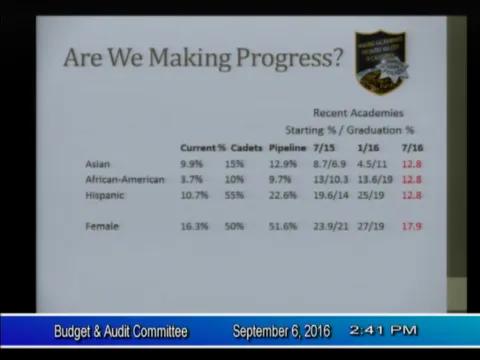
Public Meetings - Sacramento, CaliforniaThe Budget and Audit Committee of Sacramento, chaired by Mayor Kevin Johnson, met on September 6, 2016, at 2:00 p.m. in City Hall Council Chamber. The committee discussed workforce diversity, police department recruitment and retention, and received financial reports from the Sacramento Housing and Redevelopment Agency (SHRA). The meeting adjourned at 3:23 p.m. Consent Calendar - Approval of Minutes (July 19, 2016): Passed unanimously (4-0). Public Comments & Testimony - None. Discussion Items - Item 2: Diverse and Inclusive City Workforce – HR Director Melissa Chaney presented the staff report, highlighting the need to mirror the city's population and addressing audit findings on employment gaps, lack of management diversity, and pay equity. Proposed actions included hiring a Diversity Manager ($180,000 from General Fund balance), developing a Diversity Inclusion Plan, and using the Budget and Audit Committee to monitor progress. Councilmember Jennings moved to amend the recommendation to house the Diversity Manager in the City Manager's office for greater authority. Councilmember Warren requested tracking of advertising spending for outreach to diverse communities. Mayor Johnson suggested involving current employees as recruiters. Councilmember Schenirer emphasized long-term partnerships with schools. The motion passed (4-0) to forward to City Council with the amendment. - Item 3: Update on Police Department Gender and Ethnic Diversity Efforts – Chief Sam Somers reported that 1 in 3 applicants appear for the written test, with a 57% overall pass rate, but lower for diverse groups (approximately 40%). It takes 50 applicants to hire one officer. The pipeline program has 53 participants (71% diverse), with 3 in the current academy. Challenges include competition from higher-paying agencies, retention issues, and a stringent background process. Councilmembers discussed incentivizing officers to live in the city, conducting employee surveys on workplace environment, and diversifying command staff. Mayor Johnson motioned to establish an annual report during the budget process and reports after each academy (July and December). The motion passed (4-0). - Item 4: SHRA Audit Follow-up Recommendation 13 – Midyear Budget Report – Finance Director Tina McKenney presented the 2016 mid-year budget update. The original budget was $179.6 million, with 87% from federal sources. Operating expenses were projected to be 12% under budget, and revenues 1.2% above budget. The report was received and filed (unanimous). - Item 5: Review of SHRA Comprehensive Annual Financial Report (CAFR) – Tina McKenney presented the 2015 CAFR, noting an unmodified (clean) audit opinion and the 23rd consecutive Certificate of Achievement for Excellence in Financial Reporting. The agency's net position was $553.8 million, a 3% increase from 2014. The report was received and filed (unanimous). Key Outcomes - Item 2: Motion passed (4-0) to forward to City Council, including adding a Diversity Manager in the City Manager's office, developing a Diversity Inclusion Plan, and quarterly monitoring by the Budget and Audit Committee. - Item 3: Motion passed (4-0) to establish annual reporting on police diversity efforts as part of the budget process, plus reports after each academy (July and December) to the Budget and Audit Committee. - Items 4 & 5: Both reports received and filed (unanimous).
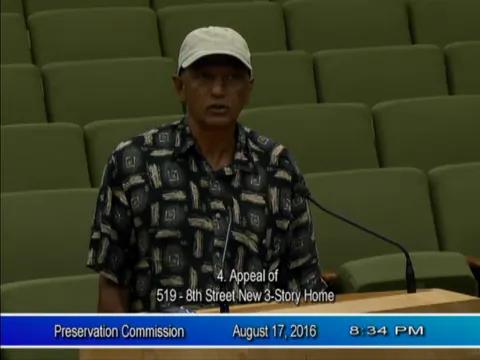
The Sacramento Preservation Commission met on Wednesday, August 17, 2016, from 5:33 p.m. to 9:26 p.m. at City Hall Council Chambers. The agenda included amendments to the Railyards Central Shops Historic District, nomination of the Railyards Water Tower as a landmark, an appeal of a new three-story home in the Alkali Flat West Historic District, a new dwelling in the Winn Park Historic District, director's reports, and recognition of retiring Preservation Director Roberta Deering. All commissioners were present except Commissioner Bowns (arrived at 5:48 p.m.). Consent Calendar - Approval of Minutes (June 15, 2016): Motion carried 6-0-1 (Commissioner Bowns absent) to approve the minutes. Public Comments & Testimony - Item 2 – Central Shops Historic District: William Burg, speaking as a central city resident, expressed support for the boundary changes and the separate landmark nomination of the water tower, hoping the project team would pursue a National Register listing for tax credits. - Item 4 – Appeal of 519 8th Street: Appellant Ms. Camacho argued that the new home would negatively impact her historic landmark home (Mansard Second Empire), citing concerns over CEQA compliance, tree removal, lack of scenic easement protection, building code compliance, and loss of light and air. She requested a continuance, which was denied 6-1 (Commissioner Huck in favor). Public commenters Dan Frankfield and Laura Lough, representing the Alkali Flat Action Committee, echoed concerns about aesthetic impact and historic preservation. - Public Comments (Matters Not on Agenda): William Burg (Preservation Sacramento board member) submitted a letter requesting that three buildings at 1616-1624 21st Street be evaluated as a potential historic district and argued that demolition would require an EIR under CEQA. A.J. Dellaringa and Christine Broker spoke about the cultural and historical significance of the 21st Street properties and urged preservation over dense development. Discussion Items - Item 2 – M16-010 Amendments to Sacramento Railyards Central Shops Historic District: Staff presented proposed boundary modifications and removal of the water tower as a contributing resource. Commissioners discussed the transition zone, lot configurations, and inclusion of transfer tables. Commissioner Marshack moved to approve staff recommendations with an amendment to add the two transfer tables (identified in the draft Subsequent EIR) to the district's list of features. Motion seconded by Commissioner Fuller and carried 7-0. - Item 3 – M16-012 Nomination of Sacramento Railyards Water Tower as a Landmark: Staff and consultant Charles Chase presented the nomination. Commissioners discussed paint color (to be changed from international orange to red lead), corrections to the ordinance (e.g., “Fifth Avenue” to “Fifth Street”), and inclusion of the specific parcel (Lot 4E). Commissioner Marshack moved to approve staff recommendations with amendments; motion seconded by Commissioner Fuller and carried 7-0. - Item 5 – PB16-020 2612 Q Street New Dwelling/Garage: Staff presented plans for a new unit and garage in the Winn Park Historic District, including a requested side setback deviation. Commissioner Piner suggested extending eaves for shading and fire access considerations. Motion to approve with conditions (including oversight on eaves and materials) carried 7-0. - Item 4 – PB16-006 Appeal of 519 8th Street New 3-Story Home: The commission heard the appeal de novo. After denying a continuance, commissioners discussed design modifications to mitigate impacts on the adjacent landmark. Commissioner Marshack moved to approve the project with conditions (simplify siding, remove north third-floor bay window, use permeable driveway material, add lattice to stair base). Motion seconded by Commissioner Piner and carried 7-0. - Item 6 – Director's Reports: Planning Director Kathryn Gillespie introduced Carson Anderson as the incoming Preservation Director. Preservation Director Roberta Deering reported on the non-approval of the Mannox Barn nomination, an award for the Mortuary Chapel restoration, and a forthcoming mid-century modern survey using a new digital app. - Item 7 – Recognition of Roberta Deering: The commission read a resolution honoring Deering’s service from 1996–1999 and 2003–2016, highlighting accomplishments such as the updated preservation ordinance, the Historic and Cultural Resources Element, and numerous register listings. Deering thanked the commission and staff. Key Outcomes - Item 2 (Amendments to Central Shops Historic District): Approved 7-0 with amendment to include transfer tables. - Item 3 (Water Tower Landmark Nomination): Approved 7-0 with corrections to paint color, street name, and parcel reference. - Item 4 (Appeal of 519 8th Street): Denial of appeal and approval of the project 7-0 with design conditions. - Item 5 (2612 Q Street Project): Approved 7-0 with conditions (eaves, materials, and additional SB5 flood finding). - Item 6 (Director's Reports): Received and filed. - Item 7 (Recognition of Roberta Deering): Received and filed. - Public Comments: Noted for future action on 21st Street properties; preservation director has not yet made a determination on eligibility.
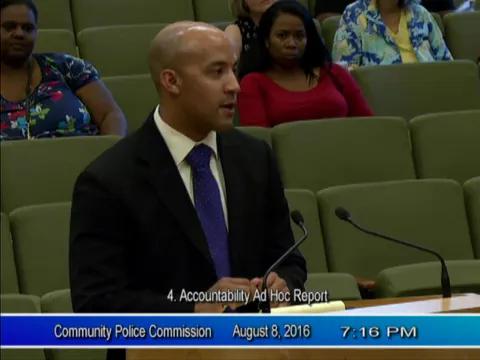
The Sacramento Community Police Commission met on Monday, August 8, 2016, at 6:00 PM in the Council Chamber at 915 I Street. The meeting included community remarks, an accountability ad hoc report, and public comment on matters not on the agenda. The commission heard from three invited speakers and several members of the public, all addressing issues of police accountability, transparency, diversity, and the criminalization of homelessness. The diversity ad hoc report was tabled to the next meeting. Consent Calendar - Approval of Minutes (May 9, 2016): The commission approved the minutes from the May 9, 2016 meeting via a motion by Vice Chair Clif Roberts and seconded by Dr. Ernest Uwazie, with no abstentions or objections. The motion passed. Public Comments & Testimony - Tanya Faison (Black Lives Matter Sacramento): Urged the commission to fight for ultimate oversight powers, including investigative authority with civilian investigators, subpoena power, and the ability to compel police records. She cited models from Albuquerque, Cambridge, San Francisco, San Diego, Portland, Los Angeles, and Berkeley. She stated that the Sacramento Police Department has killed two unarmed black men (Dejaon Flaneau and Joseph Mann) in 2016, and that the department lacks transparency and accountability. She expressed full support for a civilian-led investigative model and demanded the commission take a stand. - Trina Allen (Sacramento Citizen): Presented a detailed critique of the Sacramento Police Department, describing systemic violence, lack of transparency, and disproportionate impact on Black, Brown, and Indigenous communities. She called for zero police killings, demilitarization, and the release of body camera footage. She emphasized that the commission should adopt an investigative model with subpoena power and independent civilian investigators, and that the community needs harm reduction, not symbolic reform. - Bob Erlenbusch (Executive Director, Sacramento Regional Coalition to End Homelessness): Provided data on homelessness: 2,600 homeless people per night, 5,000 annually, with African Americans overrepresented. He reported 138 homeless murders (23% of 600 deaths) over 12 years, with unknown investigation outcomes. He criticized the city’s criminalization of homelessness, citing 11 municipal codes and $2.8 million spent on police enforcement. He recommended expanding the police department’s Impact Team (currently one team) to one per council district, creating a re-entry center, declaring a shelter emergency, and implementing a moratorium on anti-camping ordinance enforcement. He expressed support for the Albuquerque model of homeless training for police. - Public Comments on Matters Not on the Agenda: - Efren: Urged a return to community policing as practiced under former chiefs Venegas and Najara, and called for the white community to acknowledge systemic problems. - Damien Harris: Shared personal experience of being tased and tranquilized during a mental health crisis, and demanded an end to police abuse and killings. - Erin: Argued that oversight and accountability must come first before any police-community bridge-building, and that the commission should stop police abuse before seeking positive actions. - Kim Church: Described negative experiences with the Impact Team, including harassment and confiscation of belongings, and called on the commission to adopt best practices rather than having the community bring them forward. - Jermaine Erby: Cautioned against excluding police from meetings, suggested an app for critical incident updates, and urged clear definitions of when force is acceptable. Discussion Items - Accountability Ad Hoc Report (Presented by Vice Chair Clif Roberts): The ad hoc committee on transparency and information sharing met with the police department’s Public Information Office and held two community meetings (first with 30 attendees, second with 80). The report recommended that the City of Sacramento host a public website listing all critical incidents (with links to reports, video, and DA analysis), managed by the Office of Public Safety Accountability, with support staff if needed. The committee also noted community suggestions: the commission should have investigative powers, police should not be present at monthly meetings, officers’ names should be released immediately, personnel records should be disclosed, and the Impact Team should be expanded. The report was received and filed. - Diversity Ad Hoc Report: This item was tabled to the next meeting to allow more time for community engagement and research. Key Outcomes - Votes and Decisions: - The consent calendar (May 9, 2016 minutes) was approved unanimously. - Community remarks from Tanya Faison, Trina Allen, and Bob Erlenbusch were received and filed. - The Accountability Ad Hoc Report was received and filed. - The Diversity Ad Hoc Report was tabled for the next meeting. - Next Steps: The commission planned to engage with Bob Erlenbusch and Sacramento Steps Forward on homelessness issues, and to finalize the diversity presentation for the September meeting. The commission aimed to produce recommendations to city council within three months, after the remaining ad hoc reports are presented.
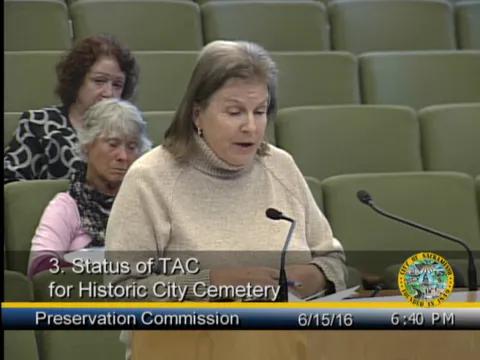
The Sacramento Preservation Commission met on June 15, 2016, at 5:30 PM in the New City Hall Council Chambers. All commissioners were present except for Commissioner Eric Fuller. The meeting included approval of previous minutes, a public hearing on temporary bracing for the Sacramento Zoo's historic Discovery Building, and a staff report on the proposed Technical Advisory Committee (TAC) for the Historic City Cemetery. The meeting adjourned at 6:59 PM. Consent Calendar - Approval of Minutes (May 18, 2016): Moved, seconded, and carried (Huck/Marshack) 6:0:1 to approve the minutes. Commissioner Whitelam requested a clarification on wording regarding concept review and final action, which was noted. Public Hearing: PB16-038 Sacramento Zoo Discovery Building Entry Complex - Location: 3930 W Land Park Drive. - Proposal: Temporary bracing to stabilize the Discovery Room roof, part of the zoo entry structures (eligible for the Sacramento Register of Historic Resources). The structures are rare mid-century modern hyperbolic paraboloid roofs (circa 1961, designed by Ricky and Brooks). - Staff Presentation: Preservation Director Roberta Deering explained that the work was elevated to the commission due to the significant and unusual nature of the roofs. The temporary bracing is needed to stabilize the roof for a 3–5 year period while a long-term master plan is developed. - Applicant Presentation: Kyle Burks, Executive Director of the Sacramento Zoological Society, described the need for indoor air-conditioned space for summer camps and events. The bracing, designed by structural engineer Todd Thorpe, will allow safe reuse of the building. The zoo plans to begin a master planning process to address the structures' long-term future. - Commission Questions: - Commissioner Marshak asked about listing the structures on the Sacramento Register. The applicant noted ongoing discussions with the city. - Commissioner Huck questioned why the roof could not be repaired immediately; the applicant explained cost and contractual responsibilities between the zoo and city. - Commissioner Bowns raised pedestrian safety concerns about the 18-inch-high footings; the applicant proposed adding temporary planters to prevent tripping and improve aesthetics. - Commissioner Whitelam asked about the relationship between the master plan and historic resource review; staff noted that if the buildings are removed, it would trigger CEQA review. - Commissioner Piner asked about water intrusion; the applicant confirmed leaks have been repaired. - Public Comments: None. - Action: Moved, seconded, and carried (Marshack/Piner) 6:0:1 to approve the staff recommendation with conditions. Discussion Items: Report Back – Status of TAC for Historic City Cemetery - Location: 1000 Broadway. - Staff Presentation: Parks and Recreation Director Christopher Conlin presented a draft concept for a Technical Advisory Committee (TAC) to provide expert advice on landscape management of the Historic City Cemetery. The TAC would include experts in archaeology, cemetery management, historic preservation, ornamental horticulture, cultural landscapes, arboriculture, conservation, and volunteer organizations. It would meet at least biannually, be open to the public, and provide recommendations on maintenance, planting, and master plan amendments. - Public Comments: Nine speakers addressed the commission: - Anita Clevevyn expressed support for the TAC and emphasized the need for heritage rose expertise. - William Burg clarified that National Register listing does not impose additional management requirements; the city's choice of restoration versus rehabilitation standards has caused concerns. - Judy Eitzen, a longtime volunteer, urged inclusion of pioneer cemetery management expertise and equal treatment of all elements. - Margaret Buss praised the transparency but requested wording to recognize that historic rose gardens are intrinsic features, not merely complementary. - Kathryn Tobias (Capitol City Preservation Trust) supported the concept and suggested a kick-off charette to gather input. - Jennifer Holden asked if there is a larger plan for the cemetery and about the status of pruning guidelines. - Jan Wooley (former California State Parks historian) recommended a cemetery management plan as a technical document and suggested seeking Certified Local Government (CLG) funding. - Vicki Contente (descendant of 13 family members) emphasized including descendant groups and improving communication (e.g., email lists). - Ann Mansker asked who the TAC would report to. - Commission Discussion: Commissioners thanked Mr. Conlin and noted the public's passion. Commissioner Piner suggested adding descendant representatives and a cemetery management plan. Commissioner Whitelam asked about CLG funding cycles (applications due in March/April). The item was received and filed. Key Outcomes - Consent Calendar: Approved minutes 6:0:1. - Zoo Temporary Bracing: Approved 6:0:1. The applicant was encouraged to consider listing the structures on the Sacramento Register during the master planning process. - Cemetery TAC: Received and filed. Staff will finalize the concept with the city manager and aim to present a council vote by late summer 2016. The commission will appoint a liaison to the TAC. - Member Comments: Commissioner Whitelam noted the public comment period for the rail yards Subsequent EIR (June 10–July 27) and a joint workshop with the Planning Commission is pending. Commissioner Marshak requested copies of commission recommendations forwarded to other bodies.
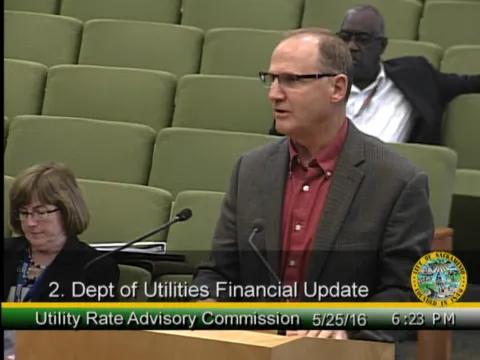
The Sacramento Utilities Rate Advisory Commission (URAC) met on Wednesday, May 25, 2016, at 5:30 p.m. in the City Hall Council Chambers. The meeting focused on the Department of Utilities' financial update for fiscal years 2015-16 and 2016-17, including projections for the water, wastewater, and storm drainage funds. Commissioners also discussed the structural deficit in the drainage fund, the planned expansion of the utility rate assistance program, and the need for future rate adjustments for storm drainage. No public comments were made. Consent Calendar - Approval of Minutes for April 27, 2016: The commission approved the minutes unanimously. (Motion by April Butcher, second by Brian Biering; all commissioners present voted yes.) Discussion Items - Department of Utilities Financial Update: Susan Goodison, Business Services Manager, presented a high-level update on the department's financial position. Key points included: - FY16 Projections: Based on actual revenues and expenditures through March 31, 2016, the department expects revenues to exceed budgeted amounts across all three funds (water, wastewater, drainage) and expenditures to be lower than budgeted. - For the water fund, budgeted revenues assumed a 20% conservation level, but the state mandated 28% conservation. A mid-year adjustment reduced budgeted user fees by $1.3 million. However, total revenues are now projected to be $1.7 million over budget, driven by increased development activity (e.g., tap fees, water flow test fees) and one-time items (sale of McAuliffe Field, a settlement with a manufacturing firm). - For the drainage fund, a restructuring of non-residential vacant lot fees (retroactive to January 1, 2015) is expected to reduce revenues by $771,000, but overall revenues are projected to be $800,000 over budget due to ongoing efforts to bill previously unentered parcels. Expenditures are tracking $1.4 million under budget, allowing the fund to avoid drawing on its balance for operating expenses in FY16. - FY17 Budget Preview: The proposed budget incorporates the rate adjustments for water and wastewater approved by City Council (effective July 1, 2016), which will add $9.1 million in water revenues and $2.7 million in wastewater revenues. The budget assumes a 25% conservation level for water. For storm drainage, the department has set a guideline to align operating expenditures with projected revenues, resulting in significant cuts to operating budgets (mostly in services and supplies). The proposed FY17 drainages capital appropriation is $525,000. - Drainage Fund Structural Deficit: Bill Busath, Director of the Department of Utilities, noted that there has been no rate increase for storm drainage since 1996, leading to a structural deficit where operating costs exceed revenues. The department previously proposed four 16% rate adjustments but deferred them to avoid conflict with the SAFCA ballot initiative. A new schedule for a rate adjustment proposal is being developed, with a robust public outreach campaign planned to educate residents about the drainage system's needs. Busath warned that failure to address the deficit could lead to street flooding during a significant storm event, as the system is underfunded and has aging infrastructure (e.g., 130 pump stations, failed corrugated metal pipes). - Utility Rate Assistance Program: The program currently serves about 1,600 customers. The department is preparing to transfer approximately 10,000 eligible customers from SMUD's rate assistance database into the program, with an anticipated total of about 8,200 new participants. The FY17 budget includes a $1.3 million increase to fund the expanded program. Outreach will continue to enroll additional eligible customers. Key Outcomes - Receive and File: The commission received and filed the Department of Utilities Financial Update. - Future Actions: The department will provide a more detailed budget update in August or September 2016, after the FY16 books are closed and the FY17 budget is adopted by City Council. The commission will also receive updates on the drainage rate adjustment schedule and outreach efforts. - Commissioner Comments: Commissioners asked clarifying questions about fund balance calculations, the impact of new parcels on drainage revenues, and the need for public education on storm drainage funding. They commended the department for its conservative budgeting and early attention to the drainage fund challenges.
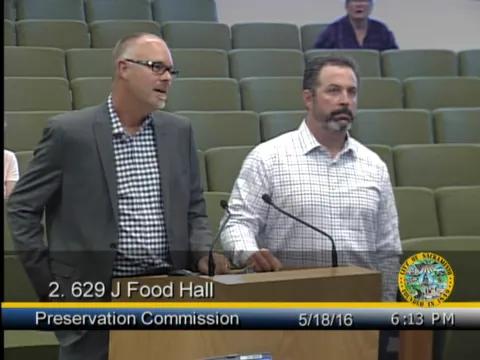
The Sacramento Preservation Commission met on Wednesday, May 18, 2016, at 5:31 p.m. in the Council Chambers of New City Hall, 915 I Street. All seven commissioners were present. The meeting was adjourned at 9:50 p.m. The agenda included a consent calendar, two public hearings, three staff report items, and public comments both on and off the agenda. Consent Calendar - Approval of Minutes (April 13, 2016): Passed unanimously (7:0:0) on a motion by Commissioner Whitelam, seconded by Commissioner Huck. Public Comments & Testimony - Item 2 – 629 J Food Hall: No public testimony received. - Item 3 – Matsui Alley Barn/Garage Nomination: William Burg spoke in support of nomination, citing the barn’s history as a workplace for plasterer Mannix and its rarity as a surviving accessory structure. Property owner’s attorney, Michael Cook, argued against listing, stating the barn is not unique, that similar structures exist in the neighborhood, and that demolition would allow a carriage house to reactivate the alley and provide parking. - Item 5 – Discretionary Project Noticing: Three speakers addressed deficiencies in the current noticing system: - William Burg noted that mailed notices often arrive too late for community organizations, and that developers frequently fail to conduct meaningful outreach. - Margaret Buss, a 26-year resident of Boulevard Park, emphasized that neighborhood associations are voluntary and cannot substitute for city notification to property owners. - Deborah Condon urged that property owners within 500 feet be notified by mail early in the process, not just at the 10-day legal notice stage. - Item 7 – Public Comments (Matters Not on the Agenda): Six speakers addressed the future of the City Cemetery gardens, particularly the rose garden. They requested transparency, inclusion of volunteer garden coordinators and external experts (e.g., old-rose specialist Greg Lowry), and creation of a Cemetery Treatment Plan or Cultural Landscape Plan before forming a Technical Advisory Committee. Discussion Items - Item 2 – PB16-016 629 J Food Hall: Staff presented a removable glass stair enclosure on the 7th Street side and a mezzanine on the north end of the banking hall. The applicant (Jeff Stoll, Silver Still Architects) requested flexibility on mezzanine notches, stating that deep recesses per staff’s recommendation would “kill the project” due to business and health-department concerns. Commissioner questions focused on the stair enclosure height, mezzanine structural connections, and bicycle parking. The commission debated whether the project was ready for final approval. - Item 3 – M16-055 Nomination of Matsui Alley Barn/Garage: Preservation Director Roberta Deering presented the nomination, citing the barn (built with the house ca. 1900) as a rare surviving horse stable in the Capitol Mansions Historic District, meeting eligibility criteria for a landmark. The property owner’s attorney opposed, arguing it has low utility and is not the best or last example. Commissioners discussed the structure’s integrity and the demolition review process if listed. - Item 4 – P15-040 Sacramento Railyards: Staff (Teresa Haenggi) reviewed proposed amendments to the Railyards Specific Plan, Special Planning District, and Design Guidelines to accommodate a soccer stadium and Kaiser hospital. Key elements: creating a transition zone north of the central shops, with building heights of 85 to 100 feet; requiring new buildings to be 20 feet from historic structures; and relocating but retaining the water tower. Commissioners questioned the transfer table preservation, the lack of massing studies, the impact of tall buildings on views of the historic shops, and the appropriate height for Lot 40 near the depot. Public comment was not taken on this item. - Item 5 – Report Back on Discretionary Project Noticing: Urban Design Manager Bruce Monighan outlined current early outreach practices (routing lists to neighborhood associations, website project lists) and described a planned computer system for electronic notification. Commissioners supported the automated system and suggested using tools like Nextdoor. The report was received and filed. - Item 6 – Director Report: Roberta Deering announced her retirement at the end of August 2016 and that the senior planner preservation position is open. She also noted that Chairman Chad Moffet had been nominated for reappointment, and the Bellevue Apartments were formally listed on the National Register. - Item 8 – Member Comments: Commissioner Piner requested a report back on the City Cemetery Technical Advisory Committee. Commissioner Huck highlighted the 40th Anniversary of Preservation in Sacramento (banners, exhibit, May 21 reception) and read a City Council resolution recognizing 40 years of preservation and 50 years of the National Historic Preservation Act. Commissioner Marshak requested 3-minute public comment limits and expressed a preference for review-and-comment meetings before final actions on complex projects. Key Outcomes - Item 2 – 629 J Food Hall: Approved with amended conditions (motion by Whitelam, second by Piner; vote 6:0:1, Commissioner Fuller recused). Conditions included: the mezzanine may extend to the third bay on the north end, with work to continue with staff; the stair enclosure shall be no higher than the base of the columns and made of a non-glass transparent material; the dining area enclosure to apply only to the 7th Street entry; and bicycle parking details to be resolved with staff. - Item 3 – Matsui Alley Barn/Garage Nomination: The commission voted unanimously (6:0:1, Commissioner Piner recused) to forward a recommendation of approval to the City Council for listing the barn and garage as a Landmark and Contributing Resource in the Capitol Mansions Historic District. - Item 4 – Sacramento Railyards: No action taken; the commission provided review and comment for staff and applicant to consider. Commissioners requested further detail on massing, transition zone heights, transfer table protection, and lot 40 height restrictions. - Item 5 – Discretionary Project Noticing: Received and filed. The commission supported development of an automated electronic notification system. - Item 6 – Director Report: Received and filed. - Item 7 – Public Comments: Heard; no action. - Item 8 – Member Comments: Commissioner Piner’s request for a report back on the City Cemetery Technical Advisory Committee will be placed on a future agenda.
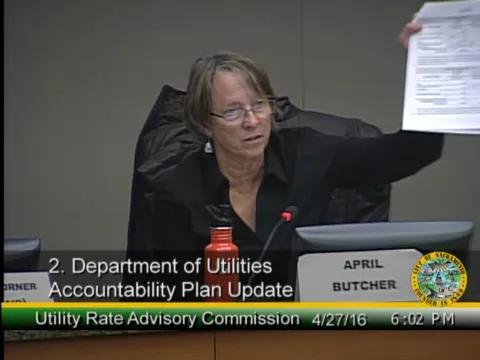
The Sacramento Utilities Rate Advisory Commission (URAC) met on Wednesday, April 27, 2016, at 5:30 p.m. in the Council Chambers at 915 I Street. The meeting covered approval of the February 10, 2016 minutes and a detailed update from the Department of Utilities on its quarterly accountability plan, including community engagement, bond expenditures, capital improvement programs, rate proposal updates, and drought/water conservation efforts. The commission also discussed the Rate Assistance Program, the meter acceleration program, and future stewardship initiatives. The meeting adjourned at 6:10 p.m. Consent Calendar - The commission unanimously approved the minutes from the February 10, 2016 meeting (motion by April Butcher, seconded by Brian Biering; all six present members voted yes). Discussion Items - Department of Utilities Accountability Plan Update (Receive and file) - Director Bill Busath presented the quarterly update. Key elements included: - Community Engagement: The department focused outreach on neighborhood association meetings, which were deemed more effective than previous council-member-led meetings. The department intends to make annual visits to neighborhood associations moving forward. Outreach also included a website hub, non-English speaking communities via radio and publications, and a Prop 218 notification mailer. - Bond Expenditures: For water bonds, the department met the 85% spending threshold within the required three-year period; all water bond funds are expected to be spent by the end of calendar year 2016. The wastewater program must meet the 85% threshold by the end of June 2016, and staff expressed confidence in meeting that goal. - Rate Proposal Update: On March 29, 2016, the City Council approved the URAC recommendation for 10% water and 9% wastewater rate increases. The council also approved including nonprofits that provide housing in the rate assistance program, but did not move forward with a recommendation regarding tenants because tenants are not typically direct customers; the city could not verify that assistance to landlords would benefit tenants. - Rate Assistance Program: The department entered into an agreement with SMUD and cross-referenced its rate assistance database. Approximately 10,000 additional customers have been identified as potentially eligible, compared to the current 1,700 enrolled. The draft strategy is to automatically enroll these customers with an option to opt out. Staff confirmed adequate funding is available within the existing 1% set-aside for the estimated 10,000 new participants; cost estimates and funding for the nonprofit housing component are still being developed. - Meter Acceleration Program: The department aims to be 100% metered by the end of 2020. Key guiding principles include timely delivery, minimizing resident impacts, and cost efficiency. To reduce gas line hits (currently occurring at a rate of about 0.1% of excavation opportunities), staff are working on specification changes, contractor training, and a "gold shovel" certification program with PG&E. - Stewardship Initiative (FY17-20): Staff described an initiative to deliver the capital program at or under budget, reduce debt costs, and improve asset management, with the goal of reducing the need for future rate increases. Public Comments & Testimony - No public comments were made during the meeting. Member Comments & Questions - Commissioner McManus asked for future dashboard reports to include subtotals and totals for project categories, and to clearly state the time frame (e.g., fiscal year or calendar year) in the dashboard titles. He also encouraged tracking and publicly reporting gas line hits to show progress over time. - Commissioner Butcher praised the SMUD cross-referencing effort as a major step and asked for clarification on why actual meter project spending exceeded estimates by more than 10%; staff explained that cost savings from the water treatment plant allowed them to accelerate the meter program, delivering more meters (21,000 vs. 18,000 anticipated) and more miles of pipe, while also achieving some efficiencies. She also asked about funding for the expanded rate assistance program—staff confirmed current funding is adequate. Key Outcomes - The commission unanimously approved the Consent Calendar. - The commission received and filed the Department of Utilities Accountability Plan update. - The commission directed staff to improve dashboard reporting by adding subtotals/totals and including time frames in titles. - Staff committed to tracking and publicly reporting gas line hit metrics, and to continue developing the stewardship initiative and rate assistance expansion.
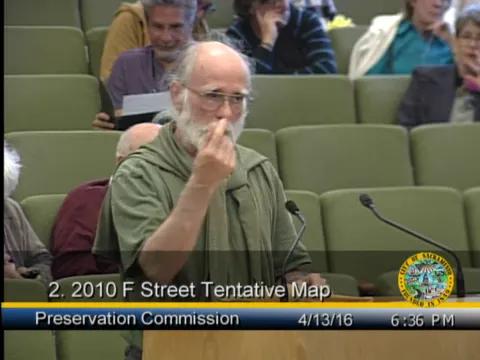
The Sacramento Preservation Commission met on April 13, 2016, at 5:30 p.m. in New City Hall. The meeting featured a public hearing on a proposed five-unit infill development at 2010 F Street in the Boulevard Park Historic District, and a staff report on the Historic City Cemetery’s pruning guidelines. The Commission voted 6:0:1 to forward a recommendation of approval for the F Street project with amended conditions, and heard extensive public testimony on the cemetery guidelines (no action taken). Consent Calendar - Approval of Minutes (March 16, 2016): Moved, seconded, and carried (Marshack/Whitelam) on a 6:0:1 vote (Commissioner Fuller absent). Public Hearing: P15-055 2010 F Street Tentative Map - Staff Presentation: Associate Planner Elise Gumm presented a proposal to subdivide two parcels (0.245 acres) into five parcels for single-family homes – one facing F Street (traditional design) and four facing Fat Alley (contemporary, three-story townhouses). The project required deviations for lot size, width, and rear-yard setback. Staff recommended approval, citing infill density goals and compatibility with the historic district. - Applicant Presentation: Architect Craig Houseman described three design iterations, including meetings with the neighborhood association, to address concerns about massing and compatibility. He emphasized the units are single-family homes, not duplexes, and that the project meets or exceeds zoning requirements. - Public Testimony: 15 speakers (including William Burg, Whitney Leeman, Deborah Gondon, David Phillips, and others) raised concerns about: - Environmental contamination: Whitney Leeman (PhD, environmental engineering) argued the site’s history as an auto repair garage warranted a full Phase II environmental assessment, not the limited Phase I provided. She cited potential lead, PAHs, and solvents. - Design incompatibility: Speakers called the alley units “industrial,” “too tall” (38.5 feet), and argued they did not respect the unique character of Boulevard Park (a National Register Historic District). They urged the Commission to reject the current design. - Privacy and massing: Neighbors worried about balconies overlooking yards and the overall bulk of the three-story units. - Applicant Response: Environmental consultant James Grigsby defended the Phase I findings, noting lead levels were within background ranges and that the concrete slab minimized contamination risk. - Commission Discussion: Commissioners agreed the context of Boulevard Park differed from previously approved alley projects. They focused on reducing massing (e.g., removing the “bonus room” on the ground floor, lowering ceiling heights, making the party wall less dominant) and improving material compatibility. Commissioner Marshack also lamented the lack of early neighborhood notification. - Motion and Vote: Commissioner Marshack moved, seconded by Commissioner Whitelam, to forward a recommendation of approval of Items A and B to the Planning and Design Commission with amended conditions directing the applicant to: - Reduce overall massing (including ceiling heights and programming). - Remove the ground-floor bonus room (to address unit-count concerns). - De-emphasize the party wall. - Use materials and details more compatible with the historic district. The motion passed 6:0:1 (Fuller absent). Item C (tentative map) was received and filed. Staff Report: M16-004 Historic City Cemetery Pruning Guidelines - Presentation: Preservation Director Roberta Deering outlined the context: the cemetery is listed on the National Register (period of significance 1849–1962). The master plan calls for managing vegetation to protect grave markers. Draft pruning guidelines (February 2016) aimed to address plant growth damaging monuments, but volunteers and rose experts raised strong objections. - Public Testimony: Over 30 speakers (including Rick Roberts, Anita Clevenger, Ann Garaghty, and representatives from the Heritage Rose Foundation) urged the Commission to reject the draft guidelines. Key points: - The historic rose garden is a world-renowned collection; many roses are unique and irreplaceable. - Guidelines requiring removal of trellises and pruning of climbing roses would destroy the garden. - No evidence was presented that roses damage stones; irrigation system problems are a larger issue. - Volunteers feel excluded from the process; they called for a collaborative, science-based approach. - Several letters from national and international experts (e.g., Stephen Scaniello, Kelvin Trimper) were read, praising the garden and urging preservation. - Commission Comments: Commissioners thanked the public for their expertise and passion. They acknowledged the need for balanced guidelines and supported the formation of a Technical Advisory Committee (TAC) to review the guidelines with input from volunteers, horticulturists, and preservation experts. Commissioner Bowns suggested a cultural landscape study. No formal action was taken; the item was only for review and comment. Public Comments – Matters Not on the Agenda - No speakers. Director’s Report - Preservation Director Roberta Deering recognized Nancy Bennett and updated the Commission on the 40th Anniversary of Preservation celebrations (reception scheduled for May 21, 2016). Member Comments - Commissioner Whitelam requested a report back on the city’s early notification process for development projects. - Commissioner Marshack asked about resurrecting the effort to update preservation guidelines for individual historic districts. - Commissioner Huck reported on the 40th Anniversary banners and available tickets. Key Outcomes - 2010 F Street: The Commission voted 6:0:1 to forward a recommendation of approval to the Planning and Design Commission with specific conditions aimed at reducing massing and improving compatibility. The early notification process was flagged for improvement. - Historic City Cemetery: The Commission endorsed formation of a Technical Advisory Committee to revise the pruning guidelines with broad stakeholder input; no formal action was taken. - The meeting adjourned at 10:35 p.m.
This meeting of the Sacramento Community Police Commission was held on March 29, 2016, at the Hagginwood Community Center. Commissioners reviewed an overview of the commission ordinance and procedures, formed three new ad hoc committees, and heard public comments. Chair Les Simmons was absent; Vice-Chair Clif Roberts presided. Consent Calendar - Approval of Meeting Minutes (April 21, 2016): A motion to approve the minutes passed with 9 votes in favor (Vice-Chair Clif Roberts, Basim Elkarra, Betty Williams, Bill Knowlton, Cathy Thao, Mariana Sabeniano, Rosalyn Van Buren, Dr. Ernest Uwazie, Rick Jones) and one abstention (Tim Davis). Chair Les Simmons was absent. Discussion Items - Commission Ordinance Overview and Ad Hoc Procedures: Senior Deputy City Attorney Jeff Massey presented an overview. The Commission received and filed the report. - Formation of Ad Hoc – Traffic Stop Data and Policy Advisory Committee: A motion to form and appoint members to this committee passed unanimously (10 yes votes, including SPOA representative Tim Davis; Chair absent). - Formation of Ad Hoc – Information Sharing and Policy Advisory Committee: A motion to form and appoint members passed unanimously (10 yes). Public comment was heard from Muriel Strand on this item; her specific position was not recorded in the minutes. - Formation of Ad Hoc – Diversity and Policy Advisory Committee: A motion to form and appoint members passed unanimously (10 yes). Public Comments & Testimony - On Agenda Item (Information Sharing Ad Hoc): Muriel Strand spoke during the discussion of the Information Sharing and Policy Advisory Committee. No further details on her remarks are available in the minutes. - Matters Not on the Agenda: Three speakers addressed the Commission: Trina Allen, Ross Hendrickx, and Muriel Strand. Their specific comments were not recorded in the minutes. Key Outcomes - Approved the April 21, 2016 meeting minutes (9 yes, 1 abstention). - Received and filed the ordinance overview and procedures report. - Formed three ad hoc committees (Traffic Stop Data and Policy, Information Sharing and Policy, Diversity and Policy) with members appointed; all motions passed unanimously. - Adjourned at 6:39 p.m. Note on Date Discrepancy: The agenda and minutes list the meeting date as Monday, May 9, 2016, but the user-provided timestamp indicates March 29, 2016. This summary uses the user-specified date.