Browse by city
Date range
Search help

Search titles, summaries, topics and stored transcripts together. Keywords may match separately; put the whole query in double quotes for a phrase. Matching follows word analysis, so punctuation is not exact. Both dates are included. Documents are not searched.

SHOWING 1571–1580 ENTRIES
1571
JAN 25, 2012 · SACRAMENTO, CALIFORNIA · UTILITIES RATE ADVISORY COMMISSION
Utilities Rate Advisory Commission Public Hearing on Proposed Water and Sewer Rates - January 25, 2012

The Utilities Rate Advisory Commission (RAC) convened at 5:30 p.m. on January 25, 2012, to hold a public hearing on the Department of Utilities' proposed water and sewer rate increases for fiscal years 2013-2016. The proposal included 10% annual water rate increases and 16%, 15%, and 14% annual sewer rate increases over three years. The commission also reviewed report-back items from the December 15, 2011 meeting. After staff presentations, public testimony, and deliberation, the commission voted down the department's unconditional proposal and discussed alternative recommendations, ultimately continuing the discussion to February 2, 2012. Consent Calendar - Item 1: Approved the December 15, 2011, meeting minutes. (Motion passed unanimously.) Public Comments & Testimony - Joshua Foster: Asked for alternatives, questioned utility tax increases, and expressed concern about bureaucracy versus frontline staffing. - Craig Powell (Ion Sacramento): Urged the commission to slow down the process, bring in outside financial and engineering experts, and avoid rushing. Handed out a preliminary analysis showing likely cumulative rate hikes exceeding $200/month within four years. - Julie Berry (written): Expressed support for the proposed rate increases, citing aging infrastructure and the need for investment. - Martha Ronaldi: Opposed the magnitude of the increases, calculating a $229.02 increase over three years on her water/sewer bill. Proposed smaller, incremental increases of $2/month. - Mac Worthy: Fully supported the rate increases, emphasizing job creation and the importance of infrastructure investment. Stated, "this is real jobs." - Mr. Fratz: Criticized the process, low-income impact, and forced services. Argued the city should consider privatization and noted that the utility tax is regressive. - Don Dunavan: Concerned about affordability for low-income residents, especially given no COLA for Social Security. - Vicky Davis: Questioned the timing of the notice (holiday season) and the decision-making process, suggesting the decision was predetermined. Expressed distrust and urged more community input. - Dr. Lee Turner-Muki (Community Housing Opportunities Corporation): Explained that affordable housing providers cannot pass on rate increases to tenants due to regulatory caps, making the proposed increases unsustainable for low-income housing properties. - Valerie Marlowe Bailey: Opposed the increases due to accountability concerns and questioned how infrastructure got into its current state. - Alma Watson: Raised accountability issues, questioned why pipes deteriorated, and suggested that wastewater billing should be based on water usage rather than house size for metered customers. Discussion Items - Staff Report-Back (Dave Brent): Addressed items from December 15: reserved February 2 for continuation if needed; provided revenue split (80-20 residential/commercial for both water and sewer); presented a commercial water rate comparison showing Sacramento's rates are currently lower than Folsom, San Juan Water District, and Sac Suburban; shared national examples of infrastructure investment (Washington D.C., Los Angeles, Kansas City, Portland, Seattle); and discussed low-income assistance using the utility tax (estimated $1.1M in first year rising to about $7M over three years, potentially covering 16% of low-income households). - Staff Presentations: Bill B. Safe outlined the capital improvement program (CIP) – $235M for water (including $152M for water treatment plant rehab, $57M for meter retrofit) and $25.5M for sewer. He proposed a conceptual accountability plan involving a report card and annual report-backs. Dan Sherry discussed the condition assessment of cast iron water mains (60% loss of carrying capacity) and the water treatment plant rehab (30% design, $150M). Jamil Moons detailed the financing plan: 75% of rate increases go to capital/reserves; use of debt financing and capitalized interest to smooth rates; comparisons of current path (8%/7%/6% increases) vs. proposed path. Russ Fair (City Treasurer) expressed support, noting the general fund can no longer back utilities. Sanjay Varshney (CSUS) presented an economic impact study: five-year CIP of $469.6M could generate $857.6M in total output and 6,446 jobs; 30-year plan could yield $3.5B output and 26,620 jobs. Jessica Hess summarized community engagement: 26 presentations, four workshops, over 1,100 surveys, 170,000 notifications, and 235 written protests. - Commission Deliberation: Commissioners discussed accountability, low-income assistance, labor cost assumptions, debt levels, and the need for conditions. A motion to approve the department's unconditional proposal failed 6-1 (only Karen McBride in favor). Chair Archibald introduced an alternative framework: either one-year increases (8% water, 7% sewer) with no conditions, or three-year increases (10%/10%/10% water; 16%/15%/14% sewer) subject to conditions including an accountability plan, independent audit, and allocation of utility tax revenue for low-income assistance. Commissioners proposed modifications: Scott Brown suggested 9% water and 14%/13%/12% sewer reductions; Doug Brown favored semi-annual reporting and alternative low-income assistance design. The commission agreed to continue the discussion on February 2, 2012. Key Outcomes - The commission voted down the Department of Utilities' unconditional three-year rate proposal (10% water, 16%/15%/14% sewer). - No alternative proposal was adopted. The commission will continue deliberations on February 2, 2012, with staff to provide additional analysis on different rate scenarios (e.g., Commissioner Brown's proposed reductions, pay-go vs. debt financing options). - The formal Proposition 218 protest period closed at this hearing; 235 written protests were received out of 171,000 notices sent. The council will consider the commission's recommendation at its February 21 and February 28, 2012 meetings. - The commission intends to develop a conditional recommendation addressing accountability, capital expenditure tracking, and low-income financial assistance using a portion of the utility tax revenue generated by any rate increases.

BUDGET AND FINANCE 20% · UTILITIES 18% · PUBLIC COMMENTS 15% · CAPITAL IMPROVEMENT PLANNING 8%
1572
DEC 15, 2011 · SACRAMENTO, CALIFORNIA · UTILITIES RATE ADVISORY COMMISSION
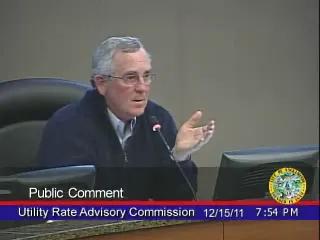
Utilities Rate Advisory Commission Meeting - December 15, 2011

The Utilities Rate Advisory Commission met on December 15, 2011, at 6:33 p.m. to discuss proposed rate adjustments and alternative rate scenarios for water and wastewater services. The commission heard a detailed presentation from Department of Utilities staff and consultants, received public comments from residents and business representatives, and deliberated on next steps ahead of a public hearing scheduled for January 25, 2012. Consent Calendar - Approval of Minutes for November 14, 2011: The commission unanimously approved the minutes from the previous meeting. Public Comments & Testimony - Joan Barden (lifelong Sacramento resident): Expressed concern about the impact of rate increases on elderly, disabled, and low-income homeowners, noting that her entire Social Security goes to her mortgage. She urged the commission to consider a sliding scale or assistance program and invited commissioners to the Oak Park Neighborhood Association meetings. - Michael Fowles (Sacramento Business Coalition): Representing 27 business organizations, he requested that the commission slow down the process to allow for more detailed analysis. He called for an independent review of infrastructure deficiencies, a comprehensive financing plan with limited use of debt, and a clear project timeline. He also noted the city's general fund is approaching its debt capacity and expressed concern about shifting debt to the utility enterprise fund. - Kevin Green (Downtown Sacramento Partnership): Asked for more information on commercial rate impacts and strongly recommended that the city council redirect the 11% general fund tax on utility rates back to infrastructure projects. - Greg Hatfield (IN Sacramento): Warned the commission not to be a rubber stamp and urged listening to the community. He expressed concern that the three-year rate proposal is a “foot in the door” for long-term bond debt, and questioned the necessity of some capital projects given the relatively low leak rates shown in utility maps. Discussion Items - Proposed Rate Adjustments and Alternative Rate Scenarios: Staff presented a three-year rate proposal (water: 10% per year; wastewater: 16%, 15%, 14%) along with alternative scenarios (delaying best practices, delaying the water treatment plant, and a “do nothing” path). Consultants explained the trade-offs between pay-as-you-go and debt financing, emphasizing that debt allows for intergenerational equity. The commission discussed the potential for future rate increases beyond the three-year period, the possibility of a balloon payment (which staff said does not exist), and the impact of labor contract assumptions. A key concern was the 11% general fund tax on utility revenues, which some suggested should be redirected to capital projects. The city attorney clarified that the commission can recommend such a change but that the tax is voter-approved and subject to council discretion. - Request for Additional Information: Commissioners asked for more detailed data on the impact of rate increases on different business types (top five categories) and a comparison of Sacramento’s replacement schedules to those of similar older cities (e.g., Kansas City, St. Louis, Boston). Staff agreed to provide this information at a future meeting. Key Outcomes - The commission will hold an additional meeting before the January 25 public hearing to review requested data and continue deliberation. (Staff will work to schedule a date.) - Chair Archibald announced his intention to step down as chair at the next meeting, asking commissioners to consider a new chair. - The commission’s final recommendation to the city council is expected after the January 25 hearing, with the council vote likely in February 2012 and rates effective July 1, 2012.

PUBLIC COMMENTS 24% · UTILITIES 16% · BUDGET AND FINANCE 12% · WASTEWATER PROGRAM 12%
1573
NOV 14, 2011 · SACRAMENTO, CALIFORNIA · UTILITIES RATE ADVISORY COMMISSION
Utilities Rate Advisory Commission Meeting - November 14, 2011

The City of Sacramento Utilities Rate Advisory Commission met on November 14, 2011, at New City Hall Council Chambers. The meeting was called to order at 5:34 p.m. and adjourned at 8:12 p.m. All seven commissioners were present, with Carolyn Veal-Hunter arriving at 5:36 p.m. The commission approved minutes, received staff reports, and reviewed the proposed Water and Wastewater Program Finance Plan, including a 30-year infrastructure program, a five-year capital improvement plan, and proposed three-year rate increases. Consent Calendar - Approved the minutes from the October 26, 2011 meeting unanimously. Motion by Douglas Brown, second by Scott Brown. Staff Report Back from October 26, 2011 Meeting - Received and filed. Dave Brent, Interim Director of Utilities, reported on follow-up items. Staff presented preliminary data linking sanitary sewer overflows and water main leaks to pipe age, and C-value testing of cast iron water pipes in the downtown/midtown area. Some pipes in red-rated areas showed capacities of about 30 percent of design. Staff is still completing the requested pipe-age correlation and will report back. Lists of water and sewer projects completed since 2001 were provided. Grant information remains incomplete and will be provided later. Water and Wastewater Program Finance Plan - Received and filed. Staff and consultants from FCS presented the plan previously shown to City Council on November 8. The plan includes a 30-year program, a five-year capital improvement program (CIP), and a recommended three-year rate adjustment. The five-year water CIP totals approximately $350 million; the wastewater CIP totals approximately $64 million. Proposed monthly increases for the average single-family residential bill are $3.44 for water and $2.36 for wastewater, representing about a 6 percent overall utility bill increase over three years. - Jamille Moens reviewed preliminary FY11 water fund results: revenues were budgeted at $82.8 million but actuals were $80.8 million; expenditures were budgeted at $83.8 million but came in at $74 million, producing net positive activity of about $7.5 million ($6.9 million after fleet adjustment). Wastewater fund results also came in under budget. - The wastewater fund shifted $2 million of capital costs to the drainage fund to avoid a structural deficit. Cost escalators in the model include about 4 percent first-year labor increases from closed contracts, then zero in years two and three, plus assumptions for electricity, fuel, chemicals, CPI, ENR, and the voter-approved 11 percent general fund tax on utility revenues. - Commissioners asked about rate smoothing, debt financing, reserve targets, bond ratings, long-term rate increases, and accountability. Staff discussed moving up to $30 million from existing capital appropriations into reserve to improve bond coverage and then refunding those projects with new debt. - Commissioner Veal-Hunter asked about low-income assistance. Staff stated Proposition 218 prohibits using rate revenue to subsidize low-income customers; any program would need non-enterprise funding, and options are being explored with the City Council. Public Comments & Testimony - Greg Hatfield, identified as policy director/vice president of I in Sacramento, commented during the Finance Plan discussion. He described the plan as a 30-year commitment with unknowns, raised concerns about moving $30 million from capital projects into reserves, and called for stronger tracking and oversight to ensure ratepayer money is used for infrastructure. He stated support for maintaining infrastructure but emphasized the need for accountability. - There were no public comments on matters not on the agenda. Commission Ideas, Questions and Announcements - Commissioner S. Brown requested the presentation in PDF format; staff said materials are available on the website. - Commissioner Veal-Hunter shared that she attended a utility facility tour and found it helpful. - Staff is considering rescheduling the next commission meeting from November 30 due to a conference and will notify commissioners. - Staff clarified that the commission may meet during the Proposition 218 notification/protest period, but the public hearing must be held at the close of the 45-day period, and approved rates cannot exceed those in the notice. Key Outcomes - Minutes approved; staff reports received and filed. - Staff will provide the following in future reports: completed grant information, the pipe-age correlation, alternative program and rate scenarios requested by City Council, long-term rate projections, a breakdown of rate increases between capital and operating uses, and a one-step rate scenario. - Upcoming schedule: Proposition 218 notice around early December; continued community outreach; commission public hearing tentatively January 25, 2012; City Council hearing in February; rates effective July 1, 2012 if adopted.

BUDGET AND FINANCE 39% · WATER MANAGEMENT 15% · WASTEWATER PROGRAM 11% · UTILITIES 8%
1574
OCT 26, 2011 · SACRAMENTO, CALIFORNIA · UTILITIES RATE ADVISORY COMMISSION
Utilities Rate Advisory Commission Meeting on October 26, 2011

The Utilities Rate Advisory Commission met on October 26, 2011, at 5:33 p.m. at New City Hall. The meeting featured extensive informational workshops on the City's water and wastewater systems, infrastructure challenges, a community engagement program, and a proposed long-term capital improvement and rate plan. Commissioners also elected a new Vice Chair and heard public testimony. Consent Calendar - Approval of Minutes (March 9, 2011): Approved unanimously. Discussion Items - Selection of Commission Vice Chair: Karen McBride nominated Douglas Brown; seconded by Scott Brown. Douglas Brown was elected Vice Chair unanimously. (Commission Chair Steven Archibald left after the vote.) - Water Workshop: Staff presented a water system overview, including water rights (senior pre-1914 rights, 326,000 acre-feet), two treatment plants (Sacramento River and Fairbairn), 27 groundwater wells, and 1,750 miles of pipe. Aging infrastructure was highlighted: the treatment plant is over 80 years old, 22% of distribution pipes exceed 70 years, and replacement values total billions. Per capita water use has dropped to 204 gallons/day (from a baseline of 278), attributed to conservation, metering, and the recession. Current average monthly bill is about $34, among the lowest in the region. Wholesale water potential could generate up to $20 million annually. - Wastewater Workshop: The City operates two systems: a combined sewer system (7,000 acres, built early 1900s) and a separated system. The combined system handles sewage and stormwater together; thanks to $150 million in upgrades, combined sewer overflows occur only about 3-5 times per year and have occurred once in the last five years. Aging infrastructure is severe: nearly 80% of combined sewer pipes exceed 70 years old. The City faces a lawsuit from the California Sportfishing Protection Alliance over sanitary sewer overflows. Regulatory mandates (SSMP, NPDES) drive capital needs. Replacement value for the combined system is $1.4 billion; separated system $1 billion. - Community Engagement Program: Jessica Hess presented the "Your Utilities. Your Voice." campaign. Phase 1 included a survey of over 1,144 residents, 19 community meetings, and a new website. Customer satisfaction averaged 7 out of 10. Guiding principles (e.g., competitive rates, infrastructure investment, efficiency) scored an average importance of 8.48 out of 10. Phase 2 will feature facility tours (e.g., Sump 2 on Nov. 5), Prop 218 notice, and rate workshops. - Water and Wastewater Program (Financial/CIP): Dave Brent and Bill B. presented a 5-year Capital Improvement Program (CIP) and a 3-year rate proposal. Current replacement cycles are unsustainable (water: 400 years; wastewater: 650 years); the goal is a 100-year cycle. The 5-year CIP totals $350 million for water (including $125M for meters, $170M for treatment plant rehab, and $53M for best-practice pipe replacement) and $64 million for wastewater ($43M for combined system mandates, $10.5M for separated system, $10M for best-practice rehab). The plan emphasizes proactive investment, efficiency gains (50 positions eliminated, $3M in operational cuts), and maintaining local control over rates. Debt financing and grant seeking are key. Next steps: Council workshop Nov. 8, Commission meeting Nov. 14, Prop 218 notice Dec. 1, rate hearing Jan. 18, 2012 council adoption. Public Comments & Testimony - Greg Hatfield (Executive Vice President, IN Sacramento) raised several questions and requests: 1) Whether the 12th Street pipe removal was related to RT realignment (staff: it was not). 2) Requested an explanation of property tax payments by a utility. 3) Confirmed the City receives $550,000 in one-time First Five funding for fluoridation. 4) Requested a chart overlaying pipe failure rates by age category over the last five years. 5) Questioned the $14 million well rehabilitation cost, noting that groundwater is less used now. 6) Requested the total outreach program cost excluding staff salaries. 7) Contended that past rate increases intended for capital were not used for that purpose, as evidenced by aging pipes still in place. Staff responded to several points and committed to follow up on others. Key Outcomes - Vice Chair Elected: Douglas Brown unanimously selected as Vice Chair. - Information Received and Filed: The Water Workshop, Wastewater Workshop, Community Engagement Program, and Water and Wastewater Program were all received and filed. - Commissioner Requests: Staff will provide granular data on pipe age breakdowns, failure rate comparisons, and details on well rehabilitation needs. Commissioners requested facility tours and inclusion of commission meetings in the City's email blasts; staff confirmed these will be arranged. - Follow-up Actions: Staff to report back on public comment questions regarding property tax, outreach costs, and historical capital spending. The next commission meeting is scheduled for November 14, 2011.

WATER MANAGEMENT 31% · WASTEWATER PROGRAM 13% · CAPITAL IMPROVEMENT PLANNING 12% · INFRASTRUCTURE 11%
1575
JUL 6, 2011 · SACRAMENTO, CALIFORNIA · DISABILITIES ADVISORY COMMISSION
Sacramento Redistricting Citizens Advisory Committee Meeting – July 6, 2011

The Sacramento Redistricting Citizens Advisory Committee held its final meeting on July 6, 2011, at 6:07 p.m. in the Council Chambers of New City Hall, 915 I Street. The committee finalized its report to the City Council recommending four redistricting maps (A, B, C, D) after months of analysis and public input. The meeting lasted approximately 78 minutes, adjourning at 7:25 p.m. Consent Calendar - Approval of June 27, 2011 Committee Minutes – Approved unanimously by a voice vote. - Weekly Report Out of Redistricting Activities – Received and filed. Staff noted media coverage and thanked the committee. Public Comments & Testimony - Mike Barnbaum – Commented on district numbering, urging numerical order based on geography rather than colors. Noted confusion between two “River Oaks” neighborhoods and advised against splitting River Park and East Sacramento. - Rosanna Herber (Chair, LGBT Redistricting Committee representing Sacramento LGBT Community Center, Stonewall Democratic Club, and Rainbow Chamber of Commerce) – Expressed support for the maps but requested corrections to the staff report: (1) replace “extended LGBT” with “core LGBT” defined as central city (river to river, freeway to freeway) linked with Curtis Park, Land Park, or East Sacramento; (2) update the matrix and committee comments to reflect that three of the four maps meet the core LGBT objective. She emphasized that the extended LGBT area from Equality California data was only informational, not a community-of-interest request. Discussion Items - Review and Approval of the Committee’s Final Report to the City Council – Staff (Maria MacGunigal and Scot Mende) presented the four modified maps (A–D), their deviations (ranging from 4.74% to 8.22%), strengths, and weaknesses. Key issues debated: - River Oaks Community Association (ROCA) request: Staff proposed moving 991 people from District 1 to District 4 to keep River Oaks intact, raising deviations in maps B, C, and D. Some members (e.g., Porter, Hansen) opposed changes at this late stage; others (e.g., Camp) favored noting the request without altering maps. - River Park / East Sacramento split: On map B (originally Plan 24), staff inadvertently split the area. Members Pluckebaum and Shaw noted this was not the committee’s intent. Hansen explained the modification was necessary to keep deviation under 10% while meeting other goals. - District numbering: Several members (Maviglio, Porter, Perry) raised inconsistencies in numbering across maps (some numbered left-to-right, others not). Debate over whether to remove numbers, standardize, or keep as submitted. The majority favored retaining original submitter numbers with a clear statement that the committee takes no position on numbering. - LGBT community of interest: Members discussed staff’s proposed changes—adding “central city/LGBT core” to the community-of-interest map, updating matrix to mark “yes” for mostly intact core areas, and adjusting map comments. The motion’s maker (Camp) accepted these as friendly amendments. - Other tweaks: Change “downtown” to “central city”; in map B trade-offs, correct references from District 6 to District 3; add a note in Chapter 1 that the committee takes no position on district numbers. Key Outcomes - Motion to approve staff recommendation with amendments – Moved by Camp, seconded by Bowler. Passed unanimously (14-0). - Amendments incorporated: 1. Various administrative and consistency changes throughout the report. 2. On the matrix, change “mostly intact” entries to “yes” where applicable. 3. Maintain district numbering as submitted by map creators, with a statement that the committee takes no position on the numbering. 4. Add a comment to maps in Chapter 5 regarding River Oaks (ROCA concerns). 5. Add a comment to Map B in Chapter 5 regarding the division of River Park / East Sacramento. 6. Incorporate modifications in Chapters 4 and 5 regarding the LGBT community of interest (e.g., “core LGBT” designation, updated matrix, revised map comments). - Next steps: Staff will finalize the report by July 7 for inclusion in the July 12 City Council agenda. Committee members were encouraged to attend the council meeting. - Adjournment: 7:25 p.m.

REDISTRICTING 24% · PLANNING AND ZONING 22% · COMMUNITY PARTICIPATION 18% · LGBTQ INCLUSION 17%
1576
JUN 27, 2011 · SACRAMENTO, CALIFORNIA · DISABILITIES ADVISORY COMMISSION
Sacramento Redistricting Citizens Advisory Committee Meeting - June 27, 2011

The Sacramento Redistricting Citizens Advisory Committee met on June 27, 2011, from 6:04 p.m. to 10:44 p.m. at New City Hall, 915 I Street, Council Chambers. The committee reviewed and discussed redistricting maps for the City of Sacramento, heard public testimony, and made recommendations to the City Council. Key actions included eliminating Map SR030 from consideration and advancing four maps (SR017, SR024, SR031, SR035) to the City Council with modifications and comments. Consent Calendar - Approval of June 20, 2011 Committee Minutes: Moved by Camp, seconded by Pluckebaum. Approved unanimously (13-0, with Maviglio absent). Public Comments & Testimony - Joany Titherington (Oak Park resident): Supported maps SR031 and SR035, urging that Oak Park remain part of District 5 with Curtis Park to preserve partnerships and momentum. - Kevin Greene (Downtown Sacramento Partnership): Supported maps that reunite the central city into a single council district, opposing Map SR031 for slicing the river district and rail yards from the central city. - Dustin Littrell (Oak Park resident): Supported maps SR031 and SR035, emphasizing the importance of keeping Oak Park and Curtis Park together. - Michael Boyd (Oak Park Neighbors Association): Opposed Map SR024 for splitting Oak Park and separating it from District 5; supported maps that keep Oak Park intact with Curtis Park. - David DeLuz (Greater Sacramento Urban League, African American Leadership Coalition): Supported Map SR031, arguing for including the rail yards in District 2 to provide an economic engine for the district and to ensure development projects receive attention. - Derrell Roberts (African American Leadership Coalition): Supported Map SR031, highlighting the goal of creating a black-brown coalition and the importance of keeping Del Paso Heights, Meadow View, and Oak Park intact. - Betty Williams (NAACP Sacramento): Endorsed Map SR031, noting the coalition's outreach to other communities and willingness to accept modifications. - Rosanna Herber (LGBT community): Noted that all four maps pair the central city with LGBT-supportive areas, thanked the committee for considering the LGBT community of interest, and supported keeping the central city together. - Cortez Quinn (Twin Rivers Unified School District Board): Opposed maps SR017 and SR035 for splitting Del Paso Heights; supported Map SR031. - Erin Domingo: Raised concerns about centralizing the central city into one district, arguing that having multiple districts with a portion of the central city ensures broader attention to issues like homelessness and small businesses. - Eireann Flannery: Suggested using population breakdown data to provide additional guidance for map evaluation. - Briza Trujillo-Cadero: Requested that Map SR017 not be considered, as it splits South Natomas. Discussion Items - Item 3: Discussion and Consideration of Map SR030 - Committee member Bill Camp presented a modified version of Map SR030, explaining his rationale for adjustments to districts. Discussion included concerns about contiguity, neighborhood splits, and the butterfly shape of districts. A substitute motion to include Map SR030 with the other four maps for consideration failed (4-9). The original motion to eliminate Map SR030 from advancement passed (9-4). - Item 4: Review of Top Four Maps (SR017, SR024, SR031, SR035) - Staff presented analyses of the four maps, including population deviations, community of interest intactness, and trade-offs. Scot Mende noted that Map SR024 had a 10.83% total deviation, above the 10% rule of thumb, which could require stronger justification. Committee members discussed each map, noting strengths and weaknesses. - After public comments, the committee moved to Item 5 for modifications. - Item 5: Review and Discuss Map Modifications for Recommendation to Council - The committee discussed modifications to each of the four maps. Member Steve Hansen presented proposed modifications for Maps SR017, SR024, and SR035. Member Phil Pluckebaum presented a modified version of Map SR035. - Key areas of consensus included: - Keeping Valley View Acres with District 1. - Not splitting Meadow View in District 8 (preferred to split Greenhaven instead). - Keeping Oak Park with Curtis Park and intact within District 5 (although not all maps achieved this). - Not splitting South Natomas, if possible, to preserve the Latino community of interest. - Addressing population deviations to stay below 10%. - The committee ultimately voted to move all four maps (SR017, SR024, SR031, SR035) forward to the City Council for consideration, with the inclusion of the discussed comments and modifications. The motion passed unanimously (13-0, with Maviglio absent). Key Outcomes - Motion to Eliminate Map SR030: Passed 9-4 (Porter, Shah, Hansen, Motmans, Frye-Lucas, Perry, Wallace, Leal-Carrillo, Rubalcava in favor; Camp, Bowler, Pluckebaum, Cherry opposed). - Motion to Advance All Four Maps (SR017, SR024, SR031, SR035) to Council: Passed unanimously (13-0). Staff will incorporate modifications and comments and present revised maps at the next meeting on July 6, 2011. - No Ranking: The committee decided not to rank the four maps, instead presenting them all with comments to the City Council for final decision. - Next Steps: Staff will produce modified maps and a report summarizing committee comments and trade-offs. The committee will reconvene on July 6, 2011, to finalize recommendations. The final report is due to the City Council on July 12, 2011.

REDISTRICTING 53% · COMMUNITY ENGAGEMENT 14% · PLANNING AND ZONING 14% · LAND USE PLANNING 6%
1577
JUN 20, 2011 · SACRAMENTO, CALIFORNIA · DISABILITIES ADVISORY COMMISSION
Sacramento Redistricting Citizens Advisory Committee Meeting - June 20, 2011: Map Selection Advances to Five Finalists

The Sacramento Redistricting Citizens Advisory Committee (SRCAC) met on June 20, 2011, at 6:00 p.m. in the City Hall Council Chambers. The committee continued its charge of reviewing and recommending redistricting maps to the City Council. After hearing public testimony and extensive debate, the committee narrowed the field from 15 maps to five that will be further refined and considered for final recommendation. Consent Calendar - Approval of June 13, 2011 Minutes: Moved by Hansen, seconded by Bowler, to approve the minutes as amended to include map numbers of advancing maps. Unanimously approved. - Staff Presentations (Items 2 & 3): The weekly report on redistricting activities and the staff-suggested work program were received and filed without objection. Public Comments & Testimony Ten speakers provided testimony during the Selection of Maps agenda item. - Mike Barnbaum (District 2, Woodlake neighborhood): Expressed support for map SR014, citing its low population deviation and natural boundaries (Broadway). Asked about incumbency implications. - Vanessa Cajina (President, Latino Democratic Club): Stated that four of their seven submitted maps (SR035, SR001, SR024, SR014) remain in play. Emphasized keeping South Natomas and the "finger area" together as top priorities. Encouraged collaboration. - Eric Guerra (Latino community representative): Used an overlay of Latino census tracts to explain differences between maps SR014 and SR031. Argued that both maps capture significant Latino business corridors and density, but no single map can encompass the entire community of interest (70,000 people). Supported keeping business corridors intact. - Devin Lavelle: Opposed map SR014, calling its District 7 a "monstrosity" that connects Valley High and Pocket neighborhoods through an unpopulated meadow. Urged committee members to share their own thinking on maps. - Patty Kleinknecht (Executive Director, River District Business Association): Endorsed all remaining maps except SR031, which splits the River District geographically and removes it from the urban core. Preferred keeping central city and River District together. - Terrence Johnson (Oak Park Business Association, Stockton Boulevard Partnership): Supported map SR017, arguing that Oak Park should stay together and be linked with Tahoe Park and commercial corridors (Stockton Boulevard). Disagreed with Oak Park Neighborhood Association's preference to join with Curtis Park, citing economic development and community vitality. - Rosanna Herber (Chair, LGBT Redistricting Committee, Rainbow Chamber of Commerce): Expressed satisfaction with the committee’s top picks (SR035, SR001, SR024). Stated the LGBT community wants the central city kept intact and joined with either East Sacramento, Land Park, or Curtis Park. - Darrell Roberts (African American Leadership Coalition): Thanked the committee. Noted ongoing dialogue with the Latino community to reconcile differences and emphasized that map SR031 was designed to integrate multiple community interests. - Madelyn Kalstein (Tahoe Park Neighborhood Association): Supported map SR017, stating that Oak Park and Tahoe Park share working-class characteristics and common interests along the Stockton Boulevard corridor. Opposed a split at 53rd Street. - Nick Avdis (Valley View Acres Community Association): Requested that the small neighborhood of 475 people remain in District 1 in any final map. Discussion Items - Staff Work Program (Scot Mende): Presented a roadmap for completing the committee’s charge. Proposed narrowing maps to three to five, then refining through public and member input, and producing final recommendations by July 12. Committee members discussed the need for consensus on modifications and managing staff workload. The program was received and filed. - Selection of Maps to Advance (Maria MacGunigal): Staff presented a composite ranking of the 15 maps under consideration, highlighting top five (green) and bottom five (yellow). The committee proceeded to eliminate maps through a series of motions. Key Outcomes - Motions Passed Unanimously: 1. Eliminate bottom five maps: SR003, SR002, SR032, SR015, and SR009 (moved by Camp, seconded by Hansen). 2. Substitute motion to eliminate only SR008 (moved by Camp, seconded by Bowler; original motion to eliminate SR008 and SR030 withdrawn). 3. Eliminate SR027 and SR022 (moved by Rubalcava, seconded by Shah). 4. Eliminate SR001 (moved by Motmans, seconded by Hansen). 5. Eliminate SR014 (moved by Porter? Actually moved by Hansen/Camp? Minutes show: Main Motion 5 by Hansen/Camp to eliminate SR014) – confirmed in transcript: motion by Hansen, seconded by Camp. - Motion Failed: A motion to eliminate SR030 (moved by Porter) failed for lack of a second. - Final Five Maps Advancing: SR035, SR024, SR031, SR017, and SR030. - Next Steps: The committee will meet on June 27 and July 6 to refine these maps. Staff will prepare analysis of requested modifications. The committee will identify consensus and majority recommendations to present to the City Council on July 12. - Adjournment: 8:40 p.m.

REDISTRICTING 42% · PLANNING AND ZONING 24% · COMMUNITY ENGAGEMENT 15% · PROCEDURAL 8%
1578
JUN 13, 2011 · SACRAMENTO, CALIFORNIA · DISABILITIES ADVISORY COMMISSION
Sacramento Redistricting Citizens Advisory Committee Meeting - June 13, 2011

The Sacramento Redistricting Citizens Advisory Committee met on Monday, June 13, 2011 at 6:00 p.m. in the City Council Chambers at New City Hall (915 I Street) to continue the process of selecting City Council district maps to recommend to the City Council. The meeting focused on reviewing public testimony on redistricting themes, a revised plan matrix, and advancing maps for further committee consideration. After extensive debate and multiple votes, the committee agreed on a new process: each member will submit their top 5 and bottom 5 maps from the remaining 15 maps by noon on Monday, June 20, 2011. The meeting adjourned at 9:04 p.m. Consent Calendar - Approval of June 6, 2011 Committee Minutes: Approved unanimously (13-0, with Member Maviglio absent). Public Comments & Testimony - Paul Noble (President, East Sacramento Improvement Association): Stated the association's top priority is keeping East Sacramento intact (bounded by Business 80, UP tracks, R Street Light Rail). He supported map SR024 and opposed maps SR003, SR006, SR011, SR012, SR030, and SR031 for splitting the neighborhood. - Daniel Lepham (Board Member, East Sacramento Improvement Association): Emphasized the primary goal of keeping East Sacramento intact; other considerations are secondary. - Derrell Roberts (Chair, African American Leadership Coalition): Addressed concerns about map SR031, arguing it does not divide Meadowview (as it keeps the populated area intact) but acknowledged it divides Laguna. He urged the committee to continue considering the integrity of Oak Park, Meadowview, and Del Paso Heights as traditional African American communities, and to consider a potential District 2 coalition of African American, Latino, and Southeast Asian communities. - Vanessa Cajina (President, Latino Democratic Club): Expressed support for the maps in the 'orange' category (those with more than 50% of committee votes for elimination) to be removed, as they did not adequately maintain Latino communities of interest, particularly South Natomas and Oak Park. She noted that maps SR027 and others could be starting points. - Raquel Simental (Resident, District 3): Endorsed the motion to remove the orange-ranked maps, echoing the Latino community's concerns. - David Diepenbrock (East Sacramento Improvement Association): Supported removing the orange-ranked maps and reiterated that East Sacramento should remain whole, again listing maps SR003, SR006, SR011, SR012, SR030, and SR031 as problematic. - Brian Rivas (County Board of Education Member, District 1 Resident): Supported the motion to remove orange-ranked maps and urged continued consideration of Latino communities of interest. - Benjamin Phillips-Lesenana (Map Author, SR012): Formally withdrew his map (SR012) after hearing East Sacramento concerns about splitting the neighborhood. Discussion Items - Weekly Report of Redistricting Activities (Oral): Staff reported on media coverage, e‑comments (8 received directly by members, to be redistributed via staff), and the upcoming progress report to the City Council. Member Shaw noted the state redistricting commission's draft maps divide Sacramento into three Assembly districts. - Redistricting Themes (Item 3): Staff presented a written compilation of themes from public testimony; received and filed. - Revised Redistricting Plan Matrix (Item 4): The matrix was updated with additional columns and minor corrections. Members discussed the binary (yes/no) nature of the LGBT community-of-interest column and agreed the matrix is helpful but not definitive. - Selection of Maps to Advance for Further Consideration (Item 5): This was the main agenda item, consuming about 140 minutes. The committee debated which maps to eliminate, with several motions and substitute motions: - Main Motion 1: Unanimously eliminated the 10 maps receiving the most votes for removal (SR004, SR013, SR018, SR019, SR029, SR025, SR028, SR007, SR021) – passed 13-0. - Main Motion 2: Eliminated maps SR011, SR012, SR034 – passed 13-0. (Note: SR012 was also formally withdrawn by its author.) - Substitute Motion 3 (Camp/Bowler): Each member to bring their single favorite map for discussion at the June 20 meeting – failed 6-7 (8 votes needed). - Main Motion 3 (Hansen/Frye-Lucas): Eliminate SR006, SR016, SR030 – failed 7-6 (8 needed). - Main Motion 4 (Rubalcava/Hansen): Eliminate SR006 and SR016 – passed 13-0. - Main Motion 5 (Pluckebaum/Porter): Each member to submit their top 5 and bottom 5 maps (of the remaining 15: SR001, SR002, SR003, SR008, SR009, SR014, SR015, SR017, SR022, SR024, SR027, SR030, SR031, SR032, SR035) to staff by noon on Monday, June 20 – approved 13-0. - Committee Ideas, Questions, Announcements: Member Frye-Lucas asked staff to review the top maps submitted by members for trends and commonalities at the June 20 meeting. Key Outcomes - Approved Minutes of June 6, 2011. - Eliminated Maps (from committee consideration): SR004, SR006, SR007, SR011, SR012, SR013, SR016, SR018, SR019, SR021, SR025, SR028, SR029, SR034 (14 maps removed during the meeting). - Remaining Maps (15): SR001, SR002, SR003, SR008, SR009, SR014, SR015, SR017, SR022, SR024, SR027, SR030, SR031, SR032, SR035. - New Assignment: Each committee member must email staff their top 5 and bottom 5 maps from the 15 remaining by noon on Monday, June 20, 2011. Staff will compile results for discussion at the June 20 meeting. - Public Communication: The public is reminded to direct comments to staff to avoid Brown Act issues. Members may receive communications from the public but should not deliberate via email reply-all.

REDISTRICTING 38% · LEGISLATIVE PROCESS 13% · PLANNING AND ZONING 12% · PUBLIC ENGAGEMENT 11%
1579
JUN 6, 2011 · SACRAMENTO, CALIFORNIA · DISABILITIES ADVISORY COMMISSION
Sacramento Redistricting Citizens Advisory Committee Meeting - June 6, 2011

The Sacramento Redistricting Citizens Advisory Committee met on Monday, June 6, 2011, at 6:06 p.m. in the Council Chamber of New City Hall (915 I Street) to continue its review of 29 submitted redistricting plans and discuss evaluation criteria. The meeting adjourned at 8:55 p.m. with 11 of 14 members present. Consent Calendar - Approval of May 23, 2011 Minutes: Moved by Hansen, seconded by Bowler. Passed unanimously (11-0). - Confirmation of Vice-Chair: Moved by Shah, seconded by Perry. Michelle Rubalcava confirmed as vice-chair (11-0). Public Comments & Testimony - May Lee (representing Capitol – Coalition of Asian Pacific Islanders Together for Leadership and Advocacy): Described the diverse Asian and Pacific Islander communities in Sacramento, emphasizing geographic concentrations along Stockton Boulevard (Little Saigon), the Broadway corridor, and South Sacramento. Urged the committee to consider these areas as communities of interest. - Nick Avdis (Valley View Acres Community Association): Thanked the committee for discussion on contiguity and urged that Valley View Acres be kept with North Natomas (District 1) despite discontiguity. - John Shields (River Oaks Community Association): Defined River Oaks as the triangle bounded by I-5, I-80, and Garden Highway; requested the area remain intact and strongly preferred to stay with North Natomas due to shared issues. Discussion Items - Weekly Report Out (Item 3): Staff reported on media articles regarding redistricting and ongoing outreach to the Asian community. - Recap of Lessons from the Primers / Redistricting Trivia (Item 4): Staff attorney Matthew Ruyak provided a refresher on the Brown Act, specifically serial meeting prohibitions. Staff then conducted a quiz on redistricting criteria (e.g., equal population, contiguity, compactness, communities of interest) and Voting Rights Act principles. - Report Back: Linguistic Data for Asian Community (Item 5): Staff presented 2010 census data showing the Asian population is linguistically diverse and geographically dispersed. Member Shah cautioned against assuming language alone defines community of interest; public testimony stressed that Asian communities share common policy needs despite language differences. - Summary Matrix for Redistricting Plans (Item 6): This was the primary discussion item, lasting 79 minutes (actual time 129 minutes per minutes). Staff presented a matrix evaluating 29 plans on criteria including population deviation, contiguity, compactness (using the Polsby-Popper method), population stability, neighborhood splits, and communities of interest (Valley View Acres, Latino North and South, Central City, Meadowview, Del Paso Heights, Oak Park). Staff identified major themes: downtown/midtown unification, District 1 shrinkage options, East Sacramento configurations, and South Area splits (Pocket/Greenhaven vs. Meadowview). Key Outcomes - Removed Population Stability Criterion: Committee consensus that this criterion is not useful because District 1 must shed 50,000 residents, making stability measures misleading. - Added Communities of Interest: Staff directed to add East Sacramento (as defined by boundaries from Business 80, the levee, and the railroad) and College Greens to the matrix. - LGBT Community of Interest: Staff will provide two separate metrics in the matrix: one using the broader Equality California map and one using the Rainbow Chamber (Central City) map, pending further committee direction. - Elimination Process: Committee members to submit their bottom ten maps (the maps they would most like to eliminate) to staff by Monday, June 13, 2011 at 9:00 a.m.. Staff will tally the results and present them at the June 13 meeting for discussion and possible elimination. No maps were eliminated during this meeting. - Further Direction: Staff will provide an updated matrix by Thursday/Friday with additional communities of interest and clearer notation on contiguity issues (e.g., distinguishing Valley View Acres discontiguity from other errors). Committee members will use the themes presentation (to be distributed electronically) to inform their individual selections. - Follow-Up: Chair reminded members of the required progress report to City Council on Tuesday, June 14, 2011. Members were invited to attend and provide input.

REDISTRICTING 51% · PLANNING AND ZONING 14% · LAND USE PLANNING 11% · COMMUNITY ENGAGEMENT 10%
1580
MAY 23, 2011 · SACRAMENTO, CALIFORNIA · DISABILITIES ADVISORY COMMISSION
Sacramento Redistricting Citizens Advisory Committee Meeting - May 23, 2011

On May 23, 2011, the Sacramento Redistricting Citizens Advisory Committee met from 6:02 p.m. to 8:22 p.m. in the City Council Chambers to review 37 submitted redistricting plans, hear public testimony, and take initial steps toward narrowing the field. The committee addressed procedural matters, including the resignation of Member Linn Hom, and voted to recognize the LGBT community as a community of interest without specifying boundaries. Consent Calendar - No consent calendar items were listed. Public Comments & Testimony - Greg Hatfield (South Pocket Homeowners Association) expressed support for a north-south linear district configuration, favoring map SR032 or similar plans that align with natural boundaries and avoid splitting the Delta Shores area. - David DeLuz (Greater Sacramento Urban League / African American Leadership Coalition) urged the committee to publish its criteria and methodology for evaluating maps well in advance of final recommendations, to allow community feedback. - Erin Flannery (LGBT community advocate) thanked the committee and encouraged members to use all available information, including incumbent data, to make well-informed decisions for the city. - Darrell Roberts (African American Leadership Coalition) clarified that some map submitters may not have known they could speak tonight, and reiterated the coalition's intent to create a new District 2 that unites South Natomas, Gardenland, and Del Paso Heights as a community of interest. - Rosanna Herber (LGBT community advocate) apologized for misquoting the city attorney at a prior meeting, and later spoke in favor of recognizing the LGBT community as a community of interest, noting support from multiple organizations. Discussion Items 1. Weekly Report Out of Redistricting Activities (Oral Report) - Staff reported media coverage, outreach to the Robla Park Community Association, and that 37 plans had been submitted by the May 16 deadline. - Action: Received and filed. 2. Summary of Submitted Redistricting Maps (90 minutes allocated) - Staff presented each of the 37 submitted maps (SR001–SR037), reading plan justifications and inviting submitters to speak. Many submitters were not present, but comments were read into the record. - The committee debated criteria for evaluating maps. Members agreed to initially exclude maps with population deviations exceeding 10% or those that were incomplete community-of-interest statements. Eight maps were removed: - SR005 (74% deviation), SR010 (294% deviation), SR020 (Latino community statement, no full map), SR023 (65% deviation), SR026 (77% deviation), SR033 (superseded by SR034), SR036 (54% deviation), SR037 (114% deviation). - SR015 (10.70%) and SR024 (10.83%) were retained as borderline. - The committee directed staff to produce a matrix for the next meeting (two weeks later) that evaluates the remaining 29 maps against the charter criteria (population equality, contiguity, compactness, communities of interest, etc.) and incorporates public testimony. - A lengthy discussion occurred regarding whether to include incumbent residence information in the matrix. Members were divided: some argued incumbency protection is a traditional redistricting criterion and important for political stability; others argued it is not in the city charter and could undermine public trust. The committee decided not to include incumbency data in the staff matrix, though individual members could research it independently. - Action: Received and filed; eight maps removed; staff to prepare matrix. 3. Community Participation After Formal Plan Submission - Staff outlined continuing opportunities for public input through committee and council meetings (through August/September). The committee's role is to review, organize, analyze, and refine proposals, then recommend preferred plans to the City Council. - Action: Received and filed. 4. Approval of May 16, 2011 Committee Minutes - Motion: Steve Hansen/Steve Maviglio to approve. Passed unanimously (14-0). 5. LGBT as a Community of Interest (Oral Report) - Staff noted that multiple speakers had testified that the LGBT community should be recognized as a community of interest. Debate centered on whether to also define geographic boundaries (e.g., river-to-river, freeway-to-freeway). - Motion: Phil Pluckebaum moved, seconded by Roman Porter, to direct staff to recommend to the City Council that the LGBT community be considered a community of interest, with no reference to specific boundaries. This was intended to allow staff to analyze the community's geographic concentration based on data and testimony, similar to other communities. - After additional public comments, the motion passed unanimously (14-0). Key Outcomes - The committee accepted the resignation of Member Linn Hom and expressed intent to install Michelle Rubalcava as Vice-Chair (formal vote to be agendized for next meeting). - Eight submitted maps were removed from consideration due to excessive population deviation or incompleteness, reducing the pool from 37 to 29 (including two borderline maps retained for now). - Staff was directed to create a matrix evaluating the remaining maps against the charter criteria (population equality, contiguity, compactness, communities of interest, etc.) and to exclude incumbent residence information from the matrix. - The committee voted to recommend that the City Council recognize the LGBT community as a community of interest, without specifying geographic boundaries, allowing staff to incorporate relevant data and testimony into the analysis. - The next meeting was scheduled for two weeks later (June 6, 2011, as the committee skipped the following week).

REDISTRICTING 54% · PUBLIC PARTICIPATION 9% · PUBLIC COMMENTS 8% · LGBTQ INCLUSION 8%
OPENPUBLICA · PUBLIC MEETING INDEXUPDATED DAILY · openpublica.com