Browse by city
Date range
Search help

Search titles, summaries, topics and stored transcripts together. Keywords may match separately; put the whole query in double quotes for a phrase. Matching follows word analysis, so punctuation is not exact. Both dates are included. Documents are not searched.

SHOWING 261–270 ENTRIES
261
JAN 21, 2026 · SACRAMENTO, CALIFORNIA · PRESERVATION COMMISSION
Sacramento Preservation Commission Meeting - January 21, 2026

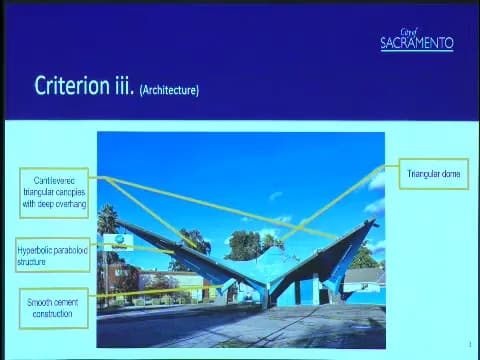
The Sacramento Preservation Commission convened on January 21, 2026, at 5:34 p.m. at City Hall Complex, 915 I Street, Sacramento, CA 95814. The meeting was called to order by Vice Chair Ian Merker and adjourned at 6:14 p.m., lasting approximately 40 minutes. Meeting Overview This meeting featured critical discussions on preserving Sacramento's mid-century modern architecture and historic mansions, including the landmark nomination of the iconic Orbit Station and the Briggs Mansion's National Register nomination. The commission also elected new leadership for 2026, with Patricia Ambacher becoming Chair and Ian Merker continuing as Vice Chair. Attendance and Opening Present: Commissioners Patricia Ambacher, Ella Cross, Max McSlavkin, and Vice Chair Ian Merker established a quorum. Absent: Commissioner Salvatore Ricca. The meeting opened with a land acknowledgement honoring Sacramento's indigenous peoples, including the Nisenan, Southern Maidu, Valley and Plains Miwok, Patwin-Wintun peoples, and the Wilton Rancheria, followed by the Pledge of Allegiance. Consent Calendar The commission unanimously approved the consent calendar in a single motion, including: - Approval of October 22, 2025 Meeting Minutes (File ID: 2025-00101) - Motion: Commissioner Cross - Second: Commissioner McSlavkin - Vote: Unanimous approval (4-0, with Commissioner Ricca absent) Public Hearings Orbit Station Landmark Designation (2240 Northgate Boulevard) File ID: 2026-00377 | Location: 2240 Northgate Boulevard, District 3 Hazel Bess, Preservation Intern, presented the landmark nomination for the former Orbit Station, a distinctive mid-century Googie-style gas station. Background: - Identified through a 2016-2017 certified local government grant-funded citywide reconnaissance survey of mid-century historic resources - Proposed for listing under Criterion 3 of Sacramento City Code section 17.604.210 as an excellent example of Googie architectural style - Features four upward-sloping cantilevered canopies with hyperbolic paraboloid shapes and a central triangular dome constructed of poured cement - Minimal exterior alterations since construction, with only gas pumps removed, repainting, and sign replacement - One of only three known Googie gas stations in Sacramento County (including one on Greenback Lane) Public Support: Three speakers provided testimony: 1. William Berg (Preservation Sacramento President): Emphasized the importance of recognizing mid-century and Googie resources, particularly in District 3 north of the American River. Noted the architectural style's distinctive attention-grabbing design and the building's potential for adaptive reuse. 2. Maddie Parfit (Preservation Sacramento): Highlighted the building's representation of 1960s optimism and forward-thinking design. Described it as a "bright spot" in a community dominated by simple, functional commercial buildings and ranch houses. Emphasized Sacramento's limited surviving Googie structures. 3. Marbella Sala (President, Gardenland Northgate Neighborhood Association): Spoke passionately about the building's 40+ year community impact. Residents remember it fondly, with many associating it with "The Jetsons" due to its futuristic design. Stressed the importance of preserving this integral community landmark to avoid future regret, referencing the demolished Alhambra theater as a cautionary tale. Notifications: - Property owner objected to the listing - Letters of support received from Sacramento Modern, Preservation Sacramento, and several community members - Multiple neighborhood associations notified, including South Natomas United, Natomas Community Association, and Garden Land/Northgate Neighborhood Association Commission Discussion: - Commissioner McSlavkin: Noted a minor editorial issue on page 4 where a phrase about "significant historic or architectural worth" was repeated twice in the same paragraph - Commissioner Cross: Expressed enthusiasm for community support and the building's role in creating neighborhood identity and sense of place. Emphasized its natural function as a landmark for wayfinding - Commissioner Ambacher: Supported the nomination but recommended cleaning up the DPR (Department of Parks and Recreation) form formatting before submission to City Council for improved readability - Vice Chair Merker: Highlighted the structural uniqueness of hyperbolic paraboloids, noting that modern computational requirements and plan review processes would make such structures economically unfeasible today, making this a irreplaceable example of its era Action Taken: - Motion: Commissioner McSlavkin moved to recommend City Council: (1) determine the listing exempt from CEQA review pursuant to Guidelines section 15308, and (2) adopt an ordinance listing 2240 Northgate Boulevard as a landmark on the Sacramento Register of Historic and Cultural Resources - Second: Commissioner Ambacher - Vote: Unanimous approval (4-0, with Commissioner Ricca absent) Discussion Items Briggs Mansion National Register Nomination (2015 21st Street) File ID: 2026-00165 | Location: 2015 21st Street, District 4 Hannah Tauby, Preservation Intern, presented the National Register nomination for the Briggs Mansion. Background: - Designated as a local landmark in 1977 - Prominent contributing resource within the Poverty Ridge Historic District - Severely damaged by fire and vacant for many years - Nomination prepared by Karen Benoit with research by Allison Esham in support of a federal rehabilitation tax credit application - Property owners support the nomination - One of the most distinctive and well-crafted residences within Poverty Ridge - Reflects progressive era themes tied to public health, civic reform, and early 20th century residential development Public Comments: William Berg: Speaking as the reviewer for California Office of Historic Preservation (unofficial capacity), reported that the original draft's reference to the "City Beautiful" movement was removed following comments from a city intern noting the building predated that period. Praised the city's CLG (Certified Local Government) commitment to providing meaningful review comments. Commission Discussion: A significant debate emerged regarding the nomination's research quality: Commissioner Cross: Provided extensive criticism of the historical research: - Praised the architectural description but found historical research severely lacking - The Briggs family, a prominent pioneer medical family from Ohio, received insufficient coverage - Dr. Briggs was a tuberculosis specialist; his brother was an ophthalmology pioneer - No mention that both Dr. and Mrs. Briggs died before the house was sold (mother in 1924, father in 1927), not that the family simply sold it in 1927-28 - Community involvement described as merely "cribbage fundraisers" when the Briggs actually established a significant endowment fund at Stanford University in memory of their daughter Evelyn, who died of a heart attack while living in the house - The Stanford scholarship fund (1927-1941) promoted education for orphans and goodwill between the U.S. and Latin American republics, with preference for Sacramento High School students - Multiple Briggs-associated landmark houses exist but aren't mentioned for context - The enclosed steel balcony addition lacks context regarding Dr. Briggs' tuberculosis specialty (outdoor sleeping was the primary treatment until the late 1930s) - Original argument relied on the "Better Homes Movement," which was inappropriate as it focused on working-class small homes, not elite mansions - Expressed concern that incomplete research could weaken the nomination's chances Commissioner Ambacher: Strongly disagreed with the need for additional historical detail: - Argued the nomination appropriately addresses Criterion C (architectural significance) at the local level - National Register acknowledges local, state, and national levels of significance; national context not required for local listing - Only one criterion must be met for listing - Believed the nomination complete for its purpose and likely to receive State Historical Resources Commission support - The additional Briggs family history, while interesting to Sacramento, is not necessary for a Criterion C architectural argument Commissioner McSlavkin: Raised concerns about the contextual discussion of "elites" and "affluent" residents moving to "orderly and park-like environments," finding it tone-deaf given the era's racial covenants and exclusionary practices. Suggested either providing more comprehensive racial and social context or focusing solely on the architecture. Staff Clarification (Sean de Courcy, Preservation Director): - Commission is under no obligation to participate in the State Historical Resources Commission hearing - Participation would involve oral testimony at the February 6th hearing, not a written letter - Commission could: (1) direct staff to speak in support, (2) remain silent, or (3) direct staff to make critical comments - No CLG requirement to participate Resolution of Better Homes Movement Issue: Commissioner Cross acknowledged that removal of the Better Homes Movement argument was significant, as it had been the primary justification for architectural significance. With that removed, she could support the nomination under Criterion C. Action Taken: - Motion: Commissioner Cross moved to direct staff to participate in the February 6th State Historical Resources Commission meeting and speak in support of the Briggs Mansion National Register nomination - Second: Commissioner McSlavkin - Vote: Unanimous approval (4-0, with Commissioner Ricca absent) Leadership Selection for 2026 File ID: 2026-00315 Melanie Haage, Senior Deputy City Clerk, facilitated the election process. Election Rules: - Commissioners may serve no more than two calendar years in either position - Commissioner McSlavkin ineligible to serve as Chair (term limit) - All members eligible for Vice Chair - Newly elected officers begin terms at the next regular meeting Chair Election: - Nomination: Commissioner Cross nominated Patricia Ambacher - Second: Vice Chair Merker - Commissioner Ambacher expressed surprise but accepted - Vote: Unanimous approval (4-0, with Commissioner Ricca absent) - Result: Patricia Ambacher elected Chair for 2026 Vice Chair Election: - Nomination: Commissioner McSlavkin re-nominated Ian Merker for Vice Chair - Second: Commissioner Cross - Vote: Unanimous approval (4-0, with Commissioner Ricca absent) - Result: Ian Merker continues as Vice Chair for 2026 Director's Report Sean de Courcy reported no items for the current meeting but confirmed a February meeting is scheduled with items forthcoming. Commissioner Comments No commissioners provided additional comments. Public Comments (Non-Agenda Items) No members of the public spoke on non-agenda matters. Key Outcomes - Orbit Station landmark designation advanced to City Council with unanimous support and strong community backing, representing one of Sacramento's few surviving Googie architectural examples - Briggs Mansion National Register nomination supported despite concerns about historical research completeness, with staff directed to provide oral testimony at the February 6th State Historical Resources Commission hearing - New leadership elected: Patricia Ambacher as Chair and Ian Merker continuing as Vice Chair for 2026 - Meeting duration: Approximately 40 minutes (5:34 p.m. - 6:14 p.m.) The meeting demonstrated the commission's commitment to preserving Sacramento's diverse architectural heritage, from mid-century Googie structures to progressive-era mansions, while balancing property owner concerns, community advocacy, and rigorous historical documentation standards.
HISTORIC PRESERVATION 70% · COMMUNITY ENGAGEMENT 15% · PERSONNEL MATTERS 8% · INDIGENOUS ACKNOWLEDGMENT 7%
262
JAN 20, 2026 · SACRAMENTO, CALIFORNIA · RACIAL EQUITY COMMITTEE
Sacramento Racial Equity Committee Special Meeting - January 20, 2026

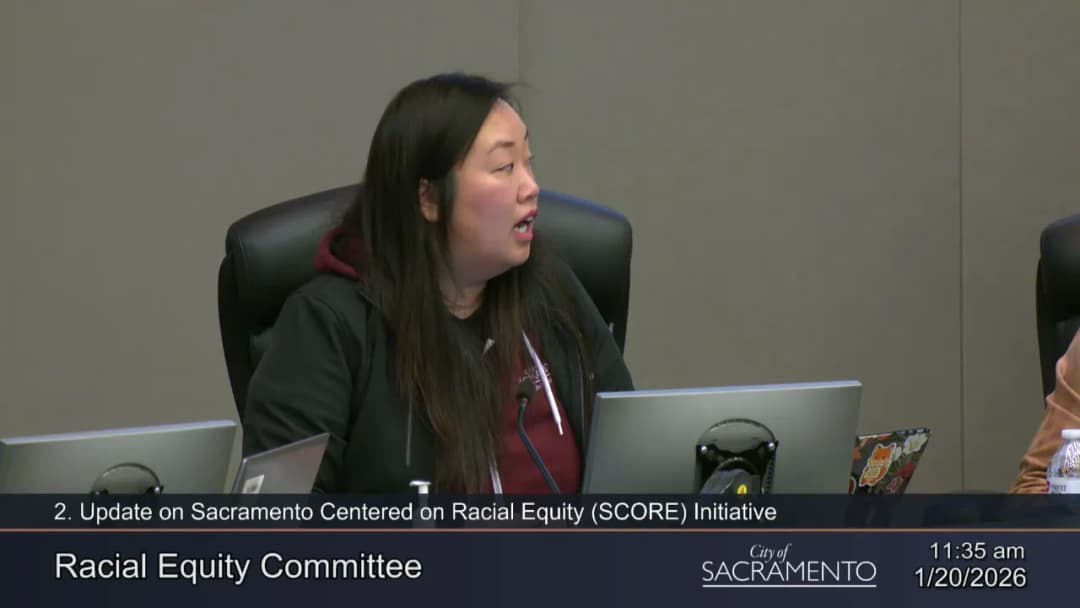
The Racial Equity Committee convened on January 20, 2026, at 11:00 a.m. at Sacramento City Hall to discuss critical updates on the Sacramento Centered on Racial Equity (SCORE) Initiative and select a new Vice Chair for 2026. Opening and Introductions Chair Mai Vang called the meeting to order at 11:00 a.m. with a quorum established. Members present included Vice Mayor Karina Talamantes, Councilmember Rick Jennings, and Chair Mai Vang, with Councilmember Eric Guerra arriving at 11:07 a.m. Vice Mayor Talamantes led the land acknowledgement honoring Sacramento's Indigenous peoples including the Nisenan, Southern Maidu, Valley and Plains Miwok, Patwin-Wintun peoples, and Wilton Rancheria. Councilmember Jennings led the Pledge of Allegiance. Consent Calendar The committee unanimously approved the October 21, 2025 meeting minutes with members Talamantes, Jennings, and Chair Vang voting in favor (Guerra was absent for this vote). SCORE Initiative Update Timeline and Progress: Nia Moreweathers from the Sacramento Racial Equity Alliance presented a comprehensive update on the SCORE work plan implementation. Key milestones achieved include: - October 9, 2025: The Racial Equity Alliance submitted recommended changes and questions for the SCORE work plan to the city - November 17, 2025: Alliance met with the Office of Diversity and Equity (ODE) to align on the work plan's purpose and function - December 2025: Additional meeting to walk through recommended edits and provide guidance - Current Status: Alliance is reviewing updated versions and providing additional edits to strengthen clarity, accountability, and alignment Upcoming Key Dates: - February 5, 2026: Working meeting scheduled to revise and review the SCORE work plan - February 24, 2026, 10:00 a.m. - 11:30 a.m.: Community leaders convening to review and provide feedback on the SCORE work plan - March 3, 2026: Target date for presenting a solid shared SCORE work plan to the committee with clear goals, defined action items, and implementation roadmap Important Clarification: Aimée Zenzele Barnes, Diversity & Equity Manager, clarified a critical distinction that the SCORE work plan is not the citywide racial equity action plan itself. The SCORE work plan serves as a roadmap and project management tool to guide the development of the comprehensive citywide racial equity action plan. The original resolution called for the action plan to be presented in 2026, but the revised timeline now projects completion by the end of 2027. This represents a shift to accommodate realistic capacity, community engagement, and sustainable implementation. Three-Phase Implementation Strategy: - Phase 1 (2026-2027): Foundational partnership structures, equity framework, and draft citywide racial equity plan development - Phase 2 (2028): Institutionalization through department equity plans, dashboards, and training - Phase 3 (2029 and beyond): Sustainability and embedding equity into planning, budgeting, and city operations Key Themes from Consultations: - Shifting language from urgency to sustained commitment - Embedding accountability and transparency through equity strategies and community reports - Breaking down organizational silos and centering human experience - Aligning timelines with capacity and resources - Reframing levels of inequities to prioritize achievable and meaningful goals - Integrating resolution language more explicitly into implementation strategies Outstanding Questions: Staff and Alliance partners identified several critical questions requiring resolution: - Whether supporting this work requires a formal ordinance at the outset - How the racial equity study fits into the implementation timeline - Defining the representative implementation team and co-governance structure - Designing sustainable meeting structures for internal and external communication - Integrating recommendations from the community partnership strategy report Public Comments Mr. Lambert expressed concerns about resistance to DEI initiatives at City Hall and referenced the federal administration's actions against DEI programs. He emphasized the need for action rather than endless meetings and called for a federal audit to address the city's structural deficit. He also raised concerns about accessibility, noting the absence of a "matters not on the agenda" public comment period. Committee Discussion and Direction Chair Vang provided several key directives: - Requested that when the SCORE work plan returns to the committee on March 3, 2026, the original racial equity resolution should also be presented to discuss potential amendments ensuring alignment between the resolution's timeline and the realistic implementation schedule - Recommended that staff reports include detailed documentation of TRIO meeting dates, consultation sessions with the Alliance, and outcomes from those meetings to provide transparency and accountability - Emphasized the importance of "sustained commitment" over urgency while maintaining accountability to the community-written resolution Councilmember Guerra highlighted the need to reduce delays caused by back-and-forth internal consultations and community engagement cycles, suggesting more efficient collaborative processes. Both Alliance representatives and city staff acknowledged that capacity constraints remain a significant challenge affecting the pace of work. Assistant City Manager Leyne Milstein cautioned that the committee should remain flexible regarding the March 3rd deadline, as the February 24th community input may require additional time for reconciliation and integration of feedback. Councilmember Jennings requested a public-facing work plan with clear timelines and dates so community members can track progress. Staff committed to posting this information on the ODE website, including it in staff reports, and making the finalized work plan a central public document. Selection of Vice Chair for 2026 Councilmember Jennings, the outgoing Vice Chair, nominated Mayor Pro Tem Eric Guerra for the position. Guerra declined and instead nominated Vice Mayor Karina Talamantes. Vice Mayor Talamantes accepted the nomination and was unanimously elected as Vice Chair for calendar year 2026 with all members voting in favor (Guerra, Jennings, Talamantes, and Chair Vang). Chair Vang encouraged committee members to send staff representatives to TRIO meetings to deepen understanding and provide additional support for the intensive implementation work ahead. Key Outcomes - Committee received comprehensive update on SCORE Initiative implementation progress - Clarified that SCORE work plan is a roadmap tool, not the final citywide racial equity action plan - Established timeline with community engagement on February 24, 2026, and committee update on March 3, 2026 - Directed staff to bring both the SCORE work plan and the original resolution back for alignment discussion - Elected Vice Mayor Karina Talamantes as Vice Chair for 2026 - Acknowledged capacity challenges facing both Alliance and city staff - Committed to enhanced transparency through detailed staff reports and public-facing timelines Closing Remarks Chair Vang closed the meeting with reflections on Dr. Martin Luther King Jr.'s legacy (the meeting occurred the day after MLK Day observance). She acknowledged the "heaviness" many community residents are feeling amid federal policy changes and reaffirmed the committee's and city's commitment to protecting residents and advancing racial equity work. The meeting adjourned at 11:55 a.m.

RACIAL EQUITY 68% · COMMUNITY ENGAGEMENT 18% · PERFORMANCE METRICS 8% · PERSONNEL MATTERS 6%
263
JAN 15, 2026 · SACRAMENTO, CALIFORNIA · ACTIVE TRANSPORTATION COMMISSION
Active Transportation Commission Meeting - January 15, 2026

The Active Transportation Commission convened on January 15, 2026, at 5:33 p.m. at Sacramento City Hall Complex to discuss critical mobility and safety plans, elect new leadership, and review climate adaptation strategies for the city's transportation infrastructure. Opening and Introductions Chair Arlete Hodel called the meeting to order with nine of ten commissioners present (Commissioner Tong Thao was absent). The meeting began with a Land Acknowledgement honoring Sacramento's indigenous peoples including the Nisenan, Southern Maidu, Valley and Plains Miwok, Patwin-Winton peoples, and the Wilton Rancheria, followed by the Pledge of Allegiance. Commission Staff Report Principal Planner Christopher Dougherty provided updates on city operations: - Street Sweeping Program: Two sweepers currently operate throughout the city, sweeping protected bike lanes every two weeks. A new narrower sweeper is being procured for narrower protected bike lanes. - Staffing Updates: The Mobility and Sustainability Division announced new hires including Sustainability Analyst Ariana Hernandez, Senior Transportation Planner Nicole Zeeling Porter, and two associate planners expected to join in February or March 2026, bringing the division to full staffing. Consent Calendar The commission unanimously approved the consent calendar, including the November 20, 2025 meeting minutes, in a single motion (Commissioner Houpt/Commissioner Harris). Leadership Selection for 2026 The commission unanimously elected new leadership for calendar year 2026: - Chair: Isaac Gonzalez (currently Vice Chair) - Vice Chair: Donald Gibson The motion passed 9-0 with all present commissioners voting in favor. Connecting Howe Avenue Safety and Mobility Plan Associate Planner Charisse Padilla presented the final draft of the Connecting Howe Avenue Safety and Mobility Plan, a data-driven initiative funded through a Caltrans Sustainable Transportation Planning Grant. The corridor is identified as one of Sacramento's Vision Zero Top 10 corridors with the highest number of fatal and severe injury crashes. Key Plan Features: - Addition of shared-use path on the east side of Howe Avenue - Landscape buffer with shade trees and lighting - Lowering of posted speed limits - Filling sidewalk gaps - Shared-use path through University Park with enhanced crossing on University Avenue - Signalized crosswalks at US 50 ramp crossings - Lane reduction: Removal of one travel lane in each direction between American River Drive and the American River Bridge - Cantilever structure on east side of American River Bridge and US 50 overpass - Speed diverters north of University Avenue - Optical speed bars throughout the corridor - Further analysis on additional lane reductions and intersection improvements Community Engagement: The project conducted three phases of engagement including online surveys, interactive web maps, community workshops, pop-ins at community events, and multiple presentations to the Active Transportation Commission. Cost Estimate: Approximately $40 million Public Comment: Michael Bevins expressed concerns about the plan's approach to lane management, advocating for an alternative design that would separate through traffic from local traffic while maintaining capacity. Commissioner Discussion: Commissioner Moore commended staff for achieving the lane reduction despite engineering challenges. Vice Chair Gonzalez inquired about implementation timeline and costs. Commissioner Banks asked about controlled crossings at on-ramps and off-ramps, which staff confirmed would be signalized. The commission unanimously approved (9-0) recommending City Council adopt the Connecting Howe Avenue Safety and Mobility Plan Final Draft. The Norwood Mobility Plan Charisse Padilla also presented the Norwood Mobility Plan Final Draft, addressing another high-priority corridor in the city's Transportation Priorities Plan and Vision Zero high-injury network. Key Plan Features: - Removal of one travel lane in each direction north of Jesse Avenue and south of Harris Avenue - Addition of sidewalks north of Berthoud Street - Sidewalk lighting and landscape buffers with shade trees on the east side - Removal of on-street parking south of Bell Avenue - Addition of separated bikeway in each direction - Roundabouts at Bell Avenue and Silver Eagle Road for traffic calming, with future evaluation for additional roundabout at Moray Avenue - Signalized crosswalks at high-demand locations and I-80 ramp crossings - Cantilever structure on both sides of I-80 overpass - Future evaluation of median trees where feasible Cost Estimate: Approximately $92 million Community Engagement: Similar to Howe Avenue, the project included three distinct phases of engagement with multiple workshops, pop-ins at community events including Man's Harvest Festival and trunk-or-treat events, and ATC presentations. Public Comment: Michael Bevins provided similar feedback as for the Howe Avenue plan, suggesting alternative lane configurations and questioning the need for extra right-turn lanes at roundabouts. Commissioner Discussion: - Commissioner Banks inquired about sidewalk maintenance responsibility, learning that adjacent property owners are responsible for maintenance, though the city installs new sidewalks after notifying property owners. - Vice Chair Gonzalez commended the use of roundabouts for traffic calming and the similarity to the Franklin Boulevard project, while suggesting careful selection of vegetation in roundabouts to avoid visual barriers. He also asked about "quick build" opportunities. - Jennifer Donlon Wyant, Mobility and Sustainability Division Manager, explained that the city has two types of quick build programs: spot improvements (crosswalks, curb extensions implemented within months) and accelerated corridor projects (like Marysville Boulevard Vision Zero project). However, Norwood is not prioritized for quick build as it's not in the Vision Zero Top 10. - Chair Hodel requested clarification on sidewalk improvements and ADA compliance, which staff confirmed would be evaluated and implemented. The commission unanimously approved (9-0) recommending City Council adopt the Norwood Mobility Plan Final Draft. Both plans are scheduled to go before City Council in February 2026. SacAdapt Transportation Infrastructure Adaptation Plan Sustainability Program Specialist Sarah Kolarik presented an update on Sacramento's Transportation Infrastructure Adaptation Plan, funded by a Caltrans Adaptation Planning Grant. The city leads this effort in partnership with Sacramento Regional Transit (SacRT). Project Overview: SacAdapt analyzes impacts of extreme weather on the transportation system and identifies resilience strategies. The plan considers all transportation aspects including roadways, bicycle and pedestrian facilities, public transit infrastructure (bus and light rail), and supporting assets like pump stations and fueling stations. Extreme Weather Risks Addressed: - Extreme heat (the most significant increasing risk) - Extreme storms (flooding and high winds) - Fire and smoke Project Timeline: - Kickoff: August 2024 - Phase 1 Engagement: Early 2025 (understanding how extreme weather impacts transportation) - Vulnerability and Risk Assessments: Completed - Phase 2 Engagement: Completed (prioritizing risks and adaptation strategies) - Phase 3 Engagement: Launched January 15, 2026 (public draft plan review) - Public comment period: Through February 12, 2026 - Final plan to City Council: April 2026 Adaptation Strategies: The plan includes 10 overarching strategies with 59 implementing actions for the city (SacRT has 12 strategies with 23 actions). Strategies are organized into four hazard types: 1. Extreme Heat: - Create built environments that reduce exposure to extreme heat and mitigate urban heat island effect (implement Urban Forest Plan, heat reduction in public realm, expand drinking water access, create wayfinding program, improve noticing for bicycle and pedestrian facility closures) - Build environments resilient to extreme heat impacts (pavement infrastructure, traffic control devices) 2. Flooding: - Increase stormwater drainage capacity - Integrate stormwater mitigation strategies into city infrastructure - Invest in infrastructure maintenance (particularly bicycle facility maintenance for safety during and after storm events) 3. All Hazard: - Increase community resilience to prepare for climate impacts - Reduce risk of power outages (tree trimming, debris removal) - Strengthen city government capacity for climate resilience (includes recommended review of climate scoring in Transportation Priorities Plan) - Support resilience of transit facilities 4. Disaster Preparedness: - Strengthen city government disaster preparedness and emergency response capacity (incorporating resilience into traffic equipment replacement, emergency exercises) - Consider evacuation needs and planning (align roadway safety improvements with emergency response functions) Phase 3 Engagement Approach: - Public draft available online through Conveo platform (sacramento.conveo.com) - Project website: cityofsacramento.gov/sacadapt - Two online workshops: February 3 and February 5, 2026 - In-person presentations to various commissions (including Disabilities Advisory Commission) - Social media engagement and targeted emails to community partners - Public comments accepted until February 12, 2026 Commissioner Discussion: - Commissioner Gibson raised concerns about balancing roadway safety improvements with emergency response needs, citing controversies in other cities like Los Angeles. Staff clarified that emergency services are already engaged in corridor planning and the goal is joint learning, not compromising safety improvements. - Commissioner Wadhwani asked about the city's role in supporting transit facility resilience. Staff explained this involves partnerships with RT aligned with Climate Action and Adaptation Plan goals, such as identifying needs for bus shelters in high-heat areas. - Commissioner Recio-Patel inquired about wayfinding programs under heat mitigation. Staff explained this helps people navigate efficiently to reduce time exposed to extreme heat. - Commissioner Harris asked about evacuation routes during floods, particularly in North Sacramento areas lacking sidewalks and infrastructure outside the central city. Staff acknowledged many roads serve as evacuation routes depending on incident location and noted the risk assessment considers roadways connecting critical facilities. Harris recommended adding this as criteria for prioritizing infrastructure development in underserved areas. - Commissioner Banks asked about alignment with the Transportation Priorities Plan (TPP) climate rubric and Vision Zero plan. Staff confirmed coordination to avoid conflicts and complement efforts, with TPP updates to come before ATC in the future. - Commissioner Moore asked about prioritization for clearing bike, pedestrian, and transit facilities during disasters. Staff noted general prioritization exists but detailed procedures aren't specified in the plan. Moore also asked about funding mechanisms for drivers to support plan implementation; staff explained the city has limited regulatory authority to charge drivers (primarily a state function) but could pursue options requiring voter approval. - Vice Chair Gonzalez connected the presentation to current events including spare-the-air days and Sacramento Bee articles about threats to water supply by 2041. He emphasized the urgency of climate action and deferred maintenance issues, particularly in car-dependent suburban neighborhoods. He also noted website loading issues and requested mobile-friendly functionality for underserved communities. This item was review and comment only; no vote was required. Public Comments - Matters Not on Agenda Michael Bevins presented his concept for a "traffic lobotomy" - separating road functions (through traffic in left lanes) from street functions (local traffic, turns, and bicycles in right lanes) with independent signal timing. He proposed eliminating left turns from through lanes except at major intersections to reduce conflicts and create safer conditions for bicycles sharing slower right lanes with local traffic. Commissioner Comments and Updates Commissioner Banks asked about scheduling for the Active Transportation Commission annual report (going to P&PE Committee on January 27 at 11 a.m., then to Council) and the Howe and Norwood plans (both scheduled for Council in February 2026). Commissioner Gibson thanked commissioners for electing him Vice Chair and provided a somber update on pedestrian fatalities: - December 15, 2025: 52-year-old man struck and killed at Elise Avenue and Stockton Boulevard - January 6, 2026: 50-year-old man struck and killed at 7:45 p.m. at 49th and Fruit Ridge Road - Since the start of calendar year 2026: At least six total traffic fatalities across all roadways in the city and county, including three fatalities from a drunk driving collision on Del Paso and Northgate Boulevard Vice Chair Gonzalez thanked commissioners for the vote of confidence and commended technical staff for providing foam microphone covers as requested. He shared that Slow Down Sacramento held their second annual Sacramento Remembers vigil at Fremont Park earlier in January 2026, reading the names of 32 people killed on Sacramento roadways in calendar year 2025. He emphasized the gravity and urgency of the commission's work and reminded commissioners about upcoming Vision Zero community meetings. He also noted the March 2026 meeting is scheduled for March 12 (second Thursday) instead of the usual third Thursday due to a holiday conflict, which now conflicts with Sacramento County Bicycle Advisory Committee meetings. Commissioner Recio-Patel followed up on 24th Street projects in South Sacramento. Staff reported a planned lane reduction project for 24th Street from Sutterville to Fruit Ridge (four lanes to two lanes with center turn lane and improved bikeway facilities), but it's not prioritized in the Transportation Priorities Plan so implementation is not near-term. The nearby parallel Freeport Boulevard corridor plan (approved 2022) is a priority but has been unable to secure funding. Commissioner Recio-Patel noted the area between Fruit Ridge and Florin has a large residential area with a SacRT light rail station, high speeds (cars traveling 50 mph in a 35 mph zone), and narrow bike lanes creating dangerous conditions for commuters. Key Outcomes - New commission leadership elected for 2026: Isaac Gonzalez as Chair and Donald Gibson as Vice Chair - Two major mobility and safety plans unanimously recommended for City Council adoption with combined estimated costs of $132 million ($40M for Howe Avenue, $92M for Norwood) - Public draft of SacAdapt Transportation Infrastructure Adaptation Plan released for community review through February 12, 2026 - Continued emphasis on Vision Zero goals amid ongoing pedestrian fatalities (32 in 2025, at least 6 in early 2026) - Mobility and Sustainability Division reaching full staffing capacity with multiple new hires The meeting adjourned at 6:45 p.m.

ACTIVE TRANSPORTATION 30% · TRANSPORTATION SAFETY 22% · ENGINEERING AND INFRASTRUCTURE 18% · ENVIRONMENTAL PROTECTION 12%
264
JAN 15, 2026 · SACRAMENTO, CALIFORNIA · OTHER
Parks and Community Enrichment Commission Meeting - January 15, 2026

The Parks and Community Enrichment Commission convened on January 15, 2026, at 5:35 PM at Sacramento City Hall. Due to the absence of Chair Jeanine Gaines and Vice Chair Cyera Boone (who recently gave birth), Commissioner Joe Flores was elected as temporary chair to conduct the meeting. Six commissioners were present: Joe Flores, Lindsey King, Monique Langer, Charles Laver, Robbie Robbins, and Anthony Uribe. Opening and Introductions The meeting began with Commissioner Flores leading the land acknowledgement recognizing the Nisenan people, Southern Maidu, Valley and Plains Miwok, Patwin Wintun peoples, and Wilton Rancheria. Following the Pledge of Allegiance, the commission proceeded with the evening's agenda. Consent Calendar The commission unanimously approved the consent calendar, which included: - Approval of December 4, 2025 meeting minutes - Approval of the Parks and Community Enrichment Follow Up Log - Dissolution of the Annual Report/Work Plan Ad Hoc Committee - This committee, originally formed to produce annual reports, was formally dissolved. Discussion Items Review of Volunteer Recognition Award Program Assistant Director Shannon Brown presented a comprehensive review of the Volunteer Recognition Award Program, originally established in April 2018. The program was created to formally recognize individuals and organizations that volunteer time and resources benefiting the Youth, Parks, and Community Enrichment (YPCI) Department. Original Structure: - Four quarterly award categories: Youth (March), Parks (June), Community Enrichment (September), and YPCI Overall (November) - Due to COVID-19 and limited participation, the program shifted to annual recognition in December - Each nomination requires two staff reports (approximately 16 hours of staff time per nomination cycle) Commissioner Recommendations: Commissioners engaged in extensive discussion about improving the program: - Commissioner Vasquez (via Commissioner Robbins): Suggested allowing year-round nominations, presenting awards at the beginning of meetings for greater dignity, updating the webpage with photos and stories of winners, and featuring recipients in "Come Out and Play" magazine - Commissioner King: Recommended collecting nominations in December but distributing award presentations throughout the year (1-2 per meeting) to give volunteers more recognition time and accommodate holiday scheduling conflicts - Commissioner Uribe: Proposed aligning awards with California Parks and Recreation Society categories to elevate local winners to state-level recognition, and clarifying award categories with more specific criteria - Commissioner Flores: Explained the historical context - categories were created in 2018 to reflect the department's name change to YPCI, emphasizing the value of the large group photo that promotes volunteerism and community connection Staff Response: Director Jackie Beecham and Assistant Director Brown noted that: - The department has a strong social media presence and newsletter that could feature award recipients - Moving the ceremony to September could align with the citywide 916 Day celebration - Staff can provide recommendations based on regular volunteers they observe at events - The new YPCI VIP volunteer trailer is now being deployed at community events Motion Passed: The commission unanimously voted to direct staff to bring back a revised volunteer recognition program proposal at the February 2026 meeting. The revision should address: - Award categories and definitions - Best month for recognition (potentially September vs. December) - Social media recognition strategies - Updates to nomination forms (including social media handles) - Agenda placement (moving awards to beginning of meetings) - Underserved populations not currently being recognized - Potential staff recognition component Commissioner Flores emphasized the importance of maintaining the large group photo opportunity that creates community connections and promotes volunteerism. Selection of Chair and Vice Chair for Calendar Year 2026 Rosanna Montesinos from the City Clerk's office provided procedural guidance: Commissioners may serve no more than two calendar years in either position. Commissioner Flores and Vasquez were ineligible to serve as chair, and Commissioner Gaines was ineligible to serve as vice chair. Vice Chair Selection: Commissioner Flores nominated Commissioner Robbie Robbins for vice chair, noting his four years of service, deep community involvement in District 3, and critical contributions to 916 Day marketing and northern area events. Commissioner Robbins accepted and acknowledged Commissioner Boone's blessing for him to take the position. The motion passed unanimously. In his acceptance, Commissioner Robbins thanked his community and noted Chair Gaines' written message praising his love for community, hard work, challenging questions, and passion for service. Chair Selection: Commissioner Flores nominated Chair Jeanine Gaines for a second term as chair. Gaines had expressed her desire to continue but was absent from the meeting. The motion passed unanimously. Both newly elected officers will begin their terms at the February 5, 2026 meeting. Department of Youth, Parks, & Community Enrichment Monthly Highlights Director Jackie Beecham provided extensive updates: Public Safety: - Park Rangers responded to 887 calls for service and 83 rapid response calls in December 2025 Workforce Development: - Youth Resource and Employment Fair scheduled for Saturday, March 7, 2026, 9:30 AM-12:00 PM (registration at 9:15 AM) for youth ages 13-24 - Learning and Landscape Program conducting interviews for spring hiring: 55 positions available with over 360 applicants (ages 13-17) - Primetime Teen and Junior Rec Aid stipend programs fully enrolled for winter season - Primetime Teen programs launched this week at Oak Park Community Center and North Natomas locations - Junior Rec Aid program starts later in January at George Sim Community Center - Summer at City Hall applications opening in early March 2026 Youth Commission: - 17 of 19 seats filled (vacancies in Districts 5 and 7) - First business meeting scheduled for Monday, February 2, 2026 at 5:30 PM Programs and Services: - 4th R Family Boogie and Glow Dance Party scheduled for January 30, 2026, 6:30-8:30 PM (free for 4th R families, pre-registration required) - RRR program (older adult services) accepting enrollment at all three locations with scholarships available - Youth Program Scholarship Fund applications open for 2026 - significant funding available through Measure L; recipients must reapply annually for youth ages 0-24 Aquatics and Summer Camps: - Summer recruitment underway with high school visits and community events - Nine lifeguard training classes scheduled throughout the city this spring - Scholarship applications open January 20, 2026 Park Planning: - Ribbon-cutting held at Lewis Park for new pickleball courts and playground replacement in District 7 - staff member Jason received community recognition and "literal flowers" - Annual rose pruning at McKinley Rose Garden every Wednesday and Saturday in January, 8:00-11:00 AM - New YPCI VIP volunteer trailer deployed at community events Commissioner Comments Commissioner Flores: Shared photos from the Lewis Park ribbon-cutting, noting strong community appreciation for Jason and YPCI staff Commissioner Laver: Thanked city staff for their efforts, attended McKinley Park tree planting event where he saw the new volunteer trailer, and announced upcoming volunteer recruitment for Southside Park events in early February Vice Chair Robbins: Thanked Corina Telemontes for organizing Santa visits to nearly every District 3 park over three days (the Grinch was "arrested" approximately 40 times by Sacramento PD as part of the festivities). Announced tree planting at Jefferson Park on January 18, 2026, and Garland Park on February 25, 2026 Commissioner King: Recapped District 5's successful December Santa Parade hosted by Council Member Maple, including a heritage-based Posada event with strong volunteer turnout Commissioner Langer: Expressed gratitude for support during onboarding and announced District 1's first tree planting event at Swainson's Hawk Park on January 31, 2026 Key Outcomes - Commissioner Joe Flores successfully served as temporary chair in the absence of regular leadership - Robbie Robbins elected Vice Chair for 2026 - Jeanine Gaines re-elected Chair for second term in 2026 - Staff directed to return in February 2026 with revised Volunteer Recognition Award Program proposal - Annual Report/Work Plan Ad Hoc Committee formally dissolved - Department reported strong program enrollment and extensive community engagement activities planned for early 2026 The meeting adjourned at 6:44 PM. Commissioner Flores expressed deep gratitude for the opportunity to serve as temporary chair and praised the commission's collaborative spirit in working through complex policy discussions.

COMMUNITY ENGAGEMENT 40% · PARKS AND RECREATION 15% · YOUTH PROGRAMS 15% · WORKFORCE DEVELOPMENT 10%
265
JAN 14, 2026 · SACRAMENTO, CALIFORNIA · OTHER
Defined Contribution Plans Committee Special Meeting - January 14, 2026

The Defined Contribution Plans Committee convened on January 14, 2026, at 10:04 a.m. in the Sacramento City Hall Council Chamber to select a retirement plan investment consulting services vendor. The meeting concluded at 10:27 a.m. with a unanimous decision to continue with the incumbent firm. The meeting was attended by all seven regular members: Chair Brad Hoekstra, Vice Chair Murray Levison, John Colville, Jeremy Gardella, Chee Khang, Ash Roughani, and King Tunson. Alternate member Kateshia Knox arrived at 10:12 a.m. Opening and Introductions The meeting opened with a land acknowledgement recognizing the Nisanan people, southern Maidu, Valley and Plains Miwok, Patuan Wintun peoples, and the Wilton Rancheria as the original inhabitants of Sacramento's ancestral lands. This was followed by the Pledge of Allegiance. Chair Hoekstra thanked committee members for taking additional time to review the extensive Request for Proposals (RFP) materials for retirement plan investment consulting services, noting that the extra time allowed for more thorough due diligence. Main Discussion: Investment Consulting Services RFP (Item P26081021003) Background Context: - The committee has worked with the Highest Group (now Fiduciary Consulting Group under Morgan Stanley) since 2017 - This relationship has saved participants more than $1 million annually through expert guidance on investment options and record keeper compensation - The committee reviewed multiple vendor proposals including Retirement Plan Advisors and other firms Key Discussion Points: Member Levison's Comments: - Praised Samantha Hardy and her team for their work supporting the committee - Expressed frustration about communication restrictions with the investment consultant, citing instances where direct contact with Rosh (the consultant) was prevented by city gatekeepers - Emphasized that participants pay for the consulting services, not the city, yet the city controls access to the consultant - Questioned the committee's authority, noting that despite bylaws granting decision-making power over investment lineup changes, staff reports still frame recommendations as advisory rather than authoritative - Acknowledged the committee's decade of outstanding work since replacing ICMARC with Nationwide in 2015 - Called for clearer committee authority and more direct relationships with consultants Member Colville's Response: - Acknowledged HR has been working with unions to restructure the committee and make operations more efficient - Praised the Highest Group's track record and contributions to employee security - Noted the significant scoring difference between vendors in the RFP evaluation - Recommended retaining the incumbent vendor (Fiduciary Consulting Group/Morgan Stanley) for another five years - Emphasized the committee's advisory role while affirming its ability to make changes and ask pertinent questions Member Roughani's Analysis: - As a new committee member, focused specifically on vendor proposals - Highlighted interest in Retirement Plan Advisors' (Josh's) approach used with Alameda County regarding glide path adjustments - Explained that traditional target date fund glide paths don't account for pension benefits, potentially resulting in lower returns due to excessive bond allocation - Suggested this glide path optimization could add millions of dollars to collective accounts - Proposed exploring this concept with the incumbent Fiduciary Consulting Group rather than switching vendors - Found no vendor proposal compelling enough to warrant changing from the incumbent Additional Research Findings: - Member Hoekstra contacted Hank Levy, Alameda County's plan administrator, who praised Josh but expressed dissatisfaction with Empower after Prudential was acquired - Member Gardella reached out separately and received opposite feedback - Chair Hoekstra reminded the committee that contracts are with firms, not individuals, and personnel can change Alternate Member Knox's Comments: - Supported staying with the incumbent Fiduciary Consulting Group (formerly Highest Group) - Appreciated their guidance over the years on fund management and investment decisions - Suggested monitoring the Morgan Stanley transition over the next few years and reconsidering if practices change unfavorably Key Outcomes Motion and Vote: - Motion made by Member John Colville, seconded by Member Chee Khang - Motion: Recommend the City award a contract to Fiduciary Consulting Group for Retirement Plan Investment Consulting Services as a result of Request for Proposals P26081021003 - Vote: Unanimously approved 7-0 by all members present (Colville, Gardella, Kang, Levison, Roughani, Tunson, and Chair Hoekstra) Action Items for Future Consideration: - Explore glide path optimization with Fiduciary Consulting Group to account for pension benefits - Continue discussions about committee authority and structure through HR's union engagement process - Monitor the transition and performance under Morgan Stanley ownership - Consider reapplying for NAGDA (National Association of Government Defined Contribution Administrators) awards to document the committee's decade of success Member Comments and Adjournment No additional member comments were raised. The meeting adjourned at 10:27 a.m. without public comment.

FISCAL SUSTAINABILITY 70% · PERSONNEL MATTERS 20% · PERFORMANCE METRICS 10%
266
JAN 14, 2026 · SACRAMENTO, CALIFORNIA · OTHER
Sacramento Disabilities Advisory Commission Meeting - January 14, 2026

Overview The Sacramento Disabilities Advisory Commission convened on January 14, 2026, at 5:34 PM in the City Hall Council Chamber. The meeting focused on electing leadership for 2026, reviewing and approving the commission's annual report and workplan, and discussing accessibility initiatives throughout Sacramento. Opening and Introductions Chair Sylvia Kramer called the meeting to order at 5:34 PM. Seven commissioners were present initially, with Commissioner Napper arriving at 5:42 PM. Three commissioners were absent (Dyson, Igwegbe, and Wilson). Vice Chair Ellis departed at 6:29 PM. The meeting began with a land acknowledgment recognizing the Nisenan people, Southern Maidu, Valley and Plains Miwok, Patwin, Winton peoples, and the Wilkin Rancheria, followed by the Pledge of Allegiance. Consent Calendar The commission unanimously approved the Disabilities Advisory Commission Follow-Up Log without discussion. Discussion Items Selection of Chair and Vice Chair for Calendar Year 2026 The commission conducted elections for leadership positions: Chair Election: - Commissioner Barnbaum nominated Sylvia Kramer for a second term as Chair - Chair Kramer nominated Vice Chair Keith Ellis for Chair - The motion for Ellis as Chair failed (3 yes, 3 no, 1 abstention) - The motion for Kramer as Chair passed (6 yes, 1 no) - Result: Sylvia Kramer re-elected as Chair for 2026 Vice Chair Election: - Commissioner Carr nominated Keith Ellis to continue as Vice Chair, seconded by Commissioner Barnbaum - Commissioner Greenbaum self-nominated for Vice Chair, expressing desire to become more involved - The motion for Greenbaum as Vice Chair failed (2 yes, 5 no) - The motion for Ellis as Vice Chair passed unanimously (7 yes) - Result: Keith Ellis re-elected as Vice Chair for 2026 Commissioners discussed the importance of continuity and the strong working relationship between Kramer and Ellis. Commissioner Greenbaum expressed gratitude for the opportunity to serve more actively in the future. City of Sacramento Disabilities Advisory Commission 2025 Annual Report and 2026 Workplan The commission conducted extensive collaborative editing of the report's message to City Council. Key revisions included: Major Message Points: - Representing inclusive, friendly, and welcoming public meeting spaces that meet accessibility needs and requirements - Bringing community-level perspectives on city projects - Emphasizing that providing equitable accessibility improves access for all and increases participation and independence - Aiming to be a unified body to effectively communicate to the City Council - Overseeing project reviews confirming actions such as incorporating $4 million in accessibility improvements in projects like Franklin Boulevard Complete Street and Ninos Parkway - Continuing to advocate for easier commenting at all city board and commission meetings - Partnering with the city to foster an inclusive workplace where individuals with disabilities, both visible and non-visible, are encouraged to apply and thrive - Remaining committed to advocating on behalf of the community, ensuring all stakeholder perspectives are represented while collaborating with the city to expand access for all 2025 Key Accomplishments Highlighted: - Ninos Parkway improvements with accessible trail - Auburn Boulevard Bridge accessibility improvements - Franklin Boulevard transformation with extensive accessibility features and new pavement overlay - Tim Haley Award recognition program - Letter to Caltrans on HSIP recommendations being reviewed by their safety committee 2026 Workplan Priorities: - Workshop on project-specific reviews - Riverside Boulevard update (requested by Commissioner Barnbaum), including Leland Haven Way - SACRT Go guidance for proper drop-off locations for paratransit and drivers - Community events resources and guidance continuation - Transition plan update with GIS capabilities for noting where APS (Accessible Pedestrian Signals) exist - "Saving Our Legacy" presentation - Sac Valley Station update (presentation from 2022 to be refreshed) Commissioners engaged in detailed wordsmithing to ensure inclusive language, replacing terms like "seen and unseen disabilities" with "visible and non-visible disabilities," and discussing whether to use "accessibility requirements" versus broader terminology that encourages exceeding minimum standards. The commission discussed potential collaboration with peer organizations including Sacramento County Disability Advisory Commission and SACRT Mobility Advisory Council, but tabled this for further discussion to clarify what collaboration would entail and what actionable items would result. Commissioner Patel raised important safety concerns about SACRT drivers being unable to enter school property for student pick-ups, forcing students with disabilities to leave school grounds and cross streets without proper crosswalks. This highlighted the need for addressing drop-off and pick-up protocols comprehensively. The commission unanimously passed a motion (6 yes, 4 absent) to forward the annual report and workplan to the Personnel and Public Employees Committee for consideration. The prospective plan is scheduled to go to City Council as a consent item in early March (tentatively March 3rd). Commission Staff Report Stephanie Seis, Assistant Civil Engineer, reported that the prospective plan shared in December will go to City Council for approval in early March as a consent item. Commissioner Comments Commissioners shared several community announcements: Commissioner Barnbaum: - Sacramento City Connect mixer on Thursday (third Thursday) from 5:30-8:30 PM at Flores restaurant (5700 Land Park Drive), organized by community engagement team led by Lynette Hall (first of 10 mixers) - Annual Dr. Martin Luther King March for the Dream on Monday, January 19th, starting at Oak Park Community Center at 7:30 AM, proceeding along Martin Luther King Boulevard and 12th Avenue/Sutterville Road to Sacramento City College, then through Land Park neighborhood to Safe Credit Union Convention Center downtown (first time terminating there after six-year hiatus due to construction) - Raised calendar discussion regarding April 22nd and May 6th meetings being too close together Meeting Calendar Discussion: Commissioner Barnbaum suggested canceling the May 6th meeting due to proximity to the April 22nd meeting. Staff clarified that the April meeting was scheduled on April 22nd (rather than April 1st) to avoid Passover. After discussion, staff indicated preference to cancel the April meeting and keep the May meeting to reduce administrative burden, though Commissioner Knapper noted May is Mental Health Awareness Month and important for the disability community. Final decision left to staff and chair. Commissioner Carr: - Wished everyone a wonderful holiday season and happy new year - Acknowledged January 4th as National Braille Day, celebrating the Braille tactile writing system and raising awareness about rights of people who are blind or visually impaired, especially regarding access to information, education, and public life Chair Kramer: - Announced medical convention in Las Vegas for people with dwarfism, February 19-22, organized by Little People of America, featuring medical specialists performing examinations and consultations - Information available at littlepeopleamerica.org Public Comments Regina from ACB Capital Chapter of the California Council of the Blind submitted comments on the draft initial study for the Sutter's Landing ADA River Park Trail Project. While appreciating the city's commitment to establishing ADA-compliant access, the organization raised concerns that: - The study lacks rationale for selecting Sutter's Landing over other potentially preferable sites along the American River - Important considerations should include scenic value, quality of experience (quietness, peacefulness, avoiding large crowds), educational experience (tactile, visual, and auditory interpretive signage), quality of recreational experience, impact on natural resources, and maintenance capacity - The organization opposes the current city plan and has developed an alternative proposal in partnership with Bruce Foreman and other partners - They requested the commission explore this matter further Chair Kramer acknowledged the importance of ensuring places are accessible and meet disability community needs for optimal experiences. Commissioner Greenbaum thanked Regina for bringing this to the commission's attention and emphasized the importance of public comment. Key Outcomes - Sylvia Kramer re-elected as Chair for 2026 - Keith Ellis re-elected as Vice Chair for 2026 (both terms begin at February 4, 2026 meeting) - 2025 Annual Report and 2026 Workplan approved and forwarded to Personnel and Public Employees Committee - Prospective plan scheduled for City Council consent calendar in early March - Identified need to address SACRT drop-off/pick-up safety protocols, particularly at schools - Noted concerns about Sutter's Landing ADA River Park Trail Project requiring further exploration - Meeting calendar adjustments under consideration (April vs. May meeting) Adjournment The meeting adjourned at 7:05 PM.

ENGINEERING AND INFRASTRUCTURE 36% · PERSONNEL MATTERS 22% · DISABILITY RIGHTS 16% · MOBILITY AND SUSTAINABILITY 12%
267
JAN 14, 2026 · SACRAMENTO, CALIFORNIA · OTHER
Housing Code Advisory and Appeals Board Meeting - January 14, 2026

The Housing Code Advisory and Appeals Board convened on January 14, 2026, at 5:30 PM at Historic City Hall to review housing code violations, cost recovery appeals, and administrative matters. The meeting lasted approximately 45 minutes, adjourning at 6:14 PM. Opening and Introductions Chair Brandon Fisher called the meeting to order with three of five board members present: Fisher, George Antablian, and Clancy Taylor. Vice Chair Barry Boyd was absent. Staff members present included Peter Lemos (Code and Housing Enforcement Chief), Leia Billings (Secretary), and David Kim (Deputy City Attorney). The meeting began with a land acknowledgement honoring Sacramento's indigenous peoples, including the Nisenan people, Southern Maidu, Valley and Plains Miwok, Patwin-Wintan peoples, and the Wilton Rancheria, followed by the Pledge of Allegiance. Consent Calendar - Minutes Approval: The board unanimously approved (3-0) the minutes from the December 10, 2025 meeting. Public Hearings - Contested Cases Case 1: 3108 2nd Avenue (Park Towne Holdings LP) - Case Number: 25-023473 - Total Charges: $1,737.50 (Notice and Order: $1,500; Termination Fee: $190; Title Cost: $47.50) - Issue: Unpermitted deck and stair repairs on a three-plex property - Timeline: Case opened June 19, 2025; preliminary letter sent June 24, 2025; notice and order issued July 24, 2025 - Appellant Arguments: Property manager Kyle Navarro argued that he was not notified until August 4, 2025, due to outdated business address (1111 H Street moved to 1615 S Street in December). He stated owner invested approximately $20,000 in bringing stairs and balcony up to code and actively sought architects/engineers for proper permitting. - Inspector Testimony: Building Inspector Paul Lovato confirmed contractor began work without permits; permit (COM-2518066) eventually issued October 15, 2025; foundation forms inspection approved December 9, 2025 - Board Decision: Unanimously upheld (3-0) the full charge of $1,737.50. Board noted the fees were set by City Council, not discretionary penalties, and the city made reasonable efforts to contact owner at address on file with county records. Case 2 & 3: 3112 Marysville Boulevard (Hart Family Trust/Toni White) - Case Number: 25-033838 - Total Charges Appealed: $626.33 (securement) + $190 (termination fee) = $816.33 - Issue: Emergency securement of vacant property following police response and tenant removal - Timeline: August 31, 2025 at 9:55 AM - 311 operator called for securement; Gray Construction dispatched same day - Appellant Arguments: Rick Hart argued the property was in escrow and could have been secured by simply locking existing doors; claimed city failed to contact him despite contact information being easily discoverable; noted lien filed October 10, 2025, after property had already sold; questioned filing lien six days before bill was due - Inspector Response: Inspector Lovato explained police department requested securement on Sunday morning; Gray Construction installed new deadbolt at entry door as directed by police; property not registered with rental housing inspection program (filed as exempt/owner-occupied) - Staff Clarification: Peter Lemos explained city requires professional securement when property is vacant/unsecured; contact information searched under "Hart Family Trust" yielded Fulton, California address, not West Sacramento - Board Decisions: - Invoice CDDCHB10772 ($626.33): Upheld unanimously (3-0) - this amount had already been paid through escrow - Invoice CDDCHC22983 ($190 termination fee): Waived unanimously (3-0) - board noted the fee would follow the property to new owner who had no involvement in the case, creating administrative complications Uncontested Cases (Item 5) The board unanimously approved (3-0) 84 uncontested housing and dangerous buildings cost recovery cases (lines 1-53 and 55-85, with line 54 pulled by city staff). These cases involved various code violations across Sacramento including: - Properties in Districts 1-8 - Charges ranging from $190 to $2,815 - Violations including unpermitted work, dangerous conditions, and code compliance issues - Total cases spanning multiple years (some dating back to 2016) Administrative Matters Election of Chair and Vice Chair The board unanimously voted (3-0) to postpone the 2026 election of Chair and Vice Chair to the next meeting (scheduled for March) when more members would be present. Board Comments Peter Lemos informed the board that a new "Tech Fee" will appear on future invoices for code enforcement cases. Staff will provide a briefing to board members explaining the purpose, structure, and justification for this fee before it appears in appeals. Key Outcomes - Total Cases Heard: 87 cases (3 contested, 84 uncontested) - Fees Upheld: $2,363.83 in contested cases - Fees Waived: $190 (termination fee for 3112 Marysville Boulevard) - Meeting Duration: Approximately 44 minutes (5:30 PM - 6:14 PM) - Attendance: 60% board attendance (3 of 5 members present) The board emphasized that their role is to ensure city fees are reasonable and justified under existing City Council-approved fee schedules, not to exercise discretion over fees themselves. Property owners were reminded to keep contact information current with the county and rental housing inspection program to ensure proper notification of code enforcement actions.

HOUSING CODE ENFORCEMENT 82% · COMMUNITY ENGAGEMENT 10% · INDIGENOUS ACKNOWLEDGMENT 3% · TECHNOLOGY AND INNOVATION 3%
268
JAN 13, 2026 · SACRAMENTO, CALIFORNIA · LAW AND LEGISLATION COMMITTEE
Sacramento Law and Legislation Committee Meeting - January 13, 2026

The Law and Legislation Committee convened on January 13, 2026, at 11:03 a.m. in the Sacramento City Hall Council Chamber. Chair Caity Maple presided over the meeting with Members Roger Dickinson, Rick Jennings, and Vice Chair Phil Pluckebaum present. Opening and Introductions The meeting began with a land acknowledgment honoring Sacramento's indigenous peoples, including the Nisenan people, Southern Maidu, Valley and Plains Miwok, Patwin, Wintu peoples, and the Wilton Rancheria. Following the Pledge of Allegiance, the committee moved into its agenda items. Consent Calendar The Consent Calendar was approved unanimously, including: - Approval of meeting minutes from November 18, 2025 and December 2, 2025 - Approval of the Law and Legislation Log - Receipt and filing of Legislative Advocacy Correspondence Discussion Items 2026 Planning and Zoning Work Program Planning Director Greg Sandlund presented the 2026 Planning and Zoning Work Program. Key highlights included: - 2025 Accomplishments: Adoption of an ordinance removing minimum parking requirements citywide, creation of a small developer incubator program, and updated universal design ordinance - 2026 Priorities: Rezoning land to implement the 2040 general plan, consolidating residential zones, incorporating missing middle housing standards, and allowing more neighborhood commercial uses - Housing Policy: Moving forward with state law allowing sale of ADUs, exploring "backyard cottages on wheels" or ADUs on wheels, and continuing the small developer incubator program - Neighborhood Planning: Continuing work on River District Specific Plan and Central City updates, both expected to have public review drafts in fall 2026 with hearings by year's end - Climate and Equity: Exploring reach code requiring heat pump air conditioning/furnace upon replacement, updating vehicle and bike parking requirements, and partnering with Food Literacy Center on urban farm community action plan Councilmember Dickinson raised concerns about delays in the missing middle ordinance evaluation and requested more information on the truck route map adoption process. The committee passed a motion recommending approval and forwarding the work program to City Council unanimously. State and Federal Legislative Platform Consuelo Hernandez (Director of Governmental Affairs) and state lobbyist Ross Buckley presented the 2026 State and Federal Legislative Platform. 2025 Federal Recap: - Focus on maintaining funding for critical programs - Passage of HR 1 included expansion of low-income housing tax credits and reauthorization of opportunity zones - No fiscal year 2025 budget passed; operating under continuing resolution 2025 State Recap: - 2,350 bills introduced; governor signed 794 and vetoed 123 (13.4% veto rate) - Cap and trade program extended through 2045 - State facing $2.9 billion budget deficit (Legislative Analyst's Office estimates $18 billion) - Sacramento wins included $500 million in HAP (Homeless Assistance Program) funding, Ice Tree Bridge funding, SB 639 (flood work permitting), and SB 720 (red light cameras) - Senator Angelique Ashby appointed as Senate Majority Leader 2026 Federal Preview: - 17 days until government funding expires (as of meeting date) - Surface transportation reauthorization beginning (IIJA expires September 30, 2026) - Housing bills in both chambers focusing on streamlining reviews and incentivizing local governments - FEMA reform and earmarks expected in fiscal year 2027 budget 2026 State Preview: - February 20 deadline for new bill introductions - Governor proposed budget showing $42 billion more revenue than expected but still $2.9 billion deficit - Another $500 million proposed for HAP funding Councilmember Dickinson suggested specifically calling out HAP funding and historic development tax credits in the platform. The committee approved the platform as amended (4-0) and forwarded it to City Council. Animal Code Amendment - Dogs, Cats, and Swine Phillip Zimmerman (Animal Care Services Manager) presented an ordinance amending Section 9.44.370 regarding the number of dogs, cats, and swine permitted per dwelling unit. The proposal would: - Increase maximum dogs from 3 to 4 per dwelling unit (aligning with county ordinance) - Maintain 7 cats maximum - Require fourth dog to be spayed/neutered (unlike county ordinance) Public commenter Dia Good raised concerns about the spay/neuter requirement conflicting with existing exemptions in licensing code for dogs too old or sick to be altered. After discussion, Councilmember Pluckebaum moved to refer the ordinance back to the Animal Wellbeing Commission for input before going to City Council without further review by committee. The motion passed unanimously (4-0). River District Homeless Shelter Bed and Service Provider Limitations Councilmember Phil Pluckebaum presented a proposal to establish limitations on homeless shelter beds and social service providers in the River District. The proposal would: - Reintroduce an ordinance originally on the books for decades (rescinded nearly a year ago) - Cap shelter beds at current levels (approximately 526 beds) plus proposed Bannon Street shelter (100 beds), totaling 626 beds - Address over-concentration of services in the River District Devin Strucker (River District Executive Director) supported the proposal, noting: - District 4 has the highest number of shelter beds in Sacramento - River District has highest concentration within District 4 (over 500 beds) - Area has among lowest concentration of housing - Over-concentration has negative business impacts and works against housing production goals Opposition came from multiple speakers: - Vershank (Sacramento Street Medicine) argued caps would exacerbate issues and increase violence/survival crime - Angela Hassel (Sacramento Loaves and Fishes) opposed, stating it doesn't solve homelessness but pushes problems to other districts - Skyler Henry suggested focusing on what the city is willing to do rather than what it won't do - Melody Hitt called for more collaboration with nonprofits and service providers Tim Swanson (Assistant Director, Department of Community Response) noted the ordinance appears at odds with city direction to increase shelter capacity and leave all options open. Chair Maple expressed concerns about running afoul of prior council action delegating authority to city manager for siting homeless facilities and creating a "slippery slope" for other districts. The motion passed 3-1, with Chair Maple voting no. The proposal moves to City Council without further committee review. Robla Community Plan Councilmembers Roger Dickinson and Lisa Kaplan (via staff) proposed directing the Planning Department to develop a Robla Community Plan. Councilmember Dickinson explained: - Robla is potentially unique with rural/semi-rural character that doesn't fit well with city standards - Area has been in piecemeal transition without community vision - Community plan would guide development, define vision, and incorporate community elements - Planning staff has been consulted extensively; community meeting held months ago - Recognizes planning department resource constraints from 2026 work program Public commenters: - Lambert questioned boundaries, funding allocation, and comparison to other District 2 communities like Del Paso Heights - Justin Wilson (Robla Neighborhood Association volunteer) requested the matter be sent back to councilmember, stating community feels excluded despite having pushed for a plan for years Councilmember Dickinson emphasized this is the beginning of a process with significant community engagement ahead, not a preordained plan. The motion passed unanimously (4-0) to forward to City Council without further committee review. Vice Chair Selection The committee unanimously reelected Phil Pluckebaum as Vice Chair for calendar year 2026 (4-0). Public Comments - Matters Not on the Agenda Several speakers provided comments: - Lambert presented materials from millennials to Chair Maple, discussed family business, and raised concerns about City Manager term sheet with "zero cause termination" - Jared Hill, a CORE program dispensary license winner, requested extension due to original site being destroyed by fire; now has new location with approved CUP - Carlos Ramirez (legal counsel) supported Hill's extension request, noting state licensing typically takes about a year - Fred Barnum (CEO, Green Capital Investments) offered to finance Hill's project if extension granted - Chris Logsdon discussed SB 515 requiring data collection for descendants of enslaved people by January 1, 2027 - Chris Cannon (Hill's partner) emphasized shared vision and requested support for extension - Justin Wilson followed up on vacant lot program concerns and requested stakeholder meeting City Clerk committed to having City Manager's office follow up with Hill regarding extension process. Key Outcomes - 2026 Planning and Zoning Work Program: Approved and forwarded to City Council - State and Federal Legislative Platform: Approved with amendments and forwarded to City Council - Animal Code Amendment: Referred back to Animal Wellbeing Commission for input - River District Shelter Bed Cap: Approved 3-1, forwarded to City Council without further committee review - Robla Community Plan: Approved unanimously, forwarded to City Council without further committee review - Vice Chair Selection: Phil Pluckebaum reelected unanimously The meeting adjourned to closed session at approximately 12:49 p.m. to discuss labor negotiations, city treasurer performance evaluation, and city attorney employment.

FISCAL SUSTAINABILITY 28% · AFFORDABLE HOUSING 26% · HOMELESSNESS 20% · COMMUNITY ENGAGEMENT 6%
269
JAN 13, 2026 · SACRAMENTO, CALIFORNIA · CITY COUNCIL
Sacramento City Council (and Related Authorities) Meeting — Consent Actions, Railyards Billboard Lease Vote, Planning Code Omnibus, Homeless Governance Direction, and Labor MOU (January 2026)

The Sacramento City Council convened at 5:00 PM at City Hall (915 I Street) and recognized community milestones and staff service, approved a large consent calendar, held hearings on planning code updates and an easement vacation, voted on a Railyards digital billboard master lease after extensive testimony, approved a successor labor MOU, and debated the future governance structure for the region’s homelessness/housing system—ultimately directing staff to return with a Joint Powers Authority (JPA) framework. The meeting also included substantial public comment on homelessness sweeps, Ride Free RT, and public safety staffing, and adjourned in memory of Alvin Prasad (age 58; died Dec. 28). Special Presentations / Recognitions - Ken McCulloch retirement: Mayor Kevin McCarty recognized McCulloch for 30+ years of City service, highlighting his role in bringing the Junior Giants program to Sacramento and describing impacts including “10,000 kids” participating (as stated by the Mayor). McCulloch thanked the Council and noted the work was supported by staff. - Sacramento History Museum 40th Anniversary: Councilmember Pluckebaum recognized the museum and its operator (Sacramento History Alliance). Museum leadership cited attendance and outreach metrics including: - 15,000 school children each year served through education programs (as stated). - Social media reach (as stated): 1 million Facebook followers, 3 million TikTok followers, 3.75 million YouTube subscribers. - “Noon Year’s Eve” event serving “over 400 kids and their families” (as stated). - Mayor McCarty also welcomed the new City Manager, noting she started the prior Monday. Consent Calendar - Council approved Items 1–20 by unanimous voice vote after questions and one speaker. - Notable items discussed (within consent): - Item 12 (License Plate Recognition systems, not-to-exceed $1 million through March 31, 2030): Councilmember Vang asked about surveillance/data protections. Staff stated: - Parking enforcement ALPR data is stored on City-owned/managed servers (not in the cloud). - The City does not participate in the Genetec Federation data-sharing program. - The City does not share the information with federal agencies, including ICE. - Vendor change was due to installer/dealer certification status, not a change in technology. - Item 17 (CA DOJ Tobacco Grant up to $884,021; duration Nov. 21, 2025–Jun. 30, 2029): Councilmember Dickinson asked about coordination with a county tobacco prevention group; staff said they do not currently collaborate but would look into it. - Item 3 (Vice Mayor / Mayor Pro Tem selection for 2026): Public speaker Lambert expressed support for retaining Karina Talamantes as Vice Mayor and Eric Guerra as Mayor Pro Tem, and welcomed the new City Manager. Public Comments & Testimony - Railyards billboard lease (Item 21): Multiple speakers affiliated with Unite Here Local 49 and/or Rail Yards for All opposed approval without disclosing the lease value and argued it functions as a subsidy. Key positions/statements included: - Speakers repeatedly cited the broader Railyards housing plan as having “6% affordable housing out of 10,000 units” (as stated by speakers) and urged 25% affordable housing. - Speakers asserted an estimated value of “$115 million” for “12 billboard leases” (their calculation; City value not disclosed at the meeting). - Speakers asked Council to postpone the vote until value analysis is public and to consider dedicating proceeds to affordable housing and a tenant stabilization fund. - One Railyards resident speaker described living impacts (including light/glow from existing arena signage) and expressed concern about additional billboards. - Homelessness governance item (Item 26): Public comments included: - A speaker (Barbara Ram) opposed adding another governance layer, criticized perceived lack of transparency/detail, and asked about an earlier promised audit (speaker claim). - Lisa Bates (CEO, Sacramento Steps Forward) emphasized alignment, authority clarity, and accountability informed by data/technical expertise; said detail/clarity on actions under governance options was still limited. - Joseph Smith (CoC Board Chair) argued the current independent CoC governance model reflects proven approaches used elsewhere; warned changes could destabilize system coordination and stated he would bring the decision to the CoC board. - Matters not on the agenda (selected themes): - Ride Free RT: Several community speakers asked for permanent funding, citing increased usage from “600,000 trips in 2021 to 4.1 million trips in 2025” (as stated). - Homelessness sweeps: Multiple speakers (including faith/community advocates and individuals with lived experience) opposed sweeps as ineffective and harmful, urging humane alternatives, safe camping sites, and stronger property safeguards. - Public safety staffing: Many downtown/business/neighbor speakers urged prioritizing police staffing and technology; multiple speakers cited staffing reductions since 2012 and current vacancies (speaker-stated figures). - Fireworks penalties: One property owner requested reconsideration of penalties after receiving an administrative penalty of $38,500 for alleged fireworks use by tenants. Discussion Items Railyards Master Lease for Digital Billboards (Item 21 — pulled from consent) - Public testimony (see above) requested delay and value disclosure. - Council deliberation: - Councilmember Vang stated she supports the broader Railyards project but could not support the lease without a clear estimate of the value of revenue foregone; noted the lease term would be 34 years and asked about protections if the underlying projects do not move forward. - Staff (Marco) stated the billboard rights are tied to the related projects (referenced as Central Shops and soccer stadium) and would not proceed if those projects do not advance. - Vice Mayor Talamantes asked for revenue estimates and noted public comparisons to prior arena-related revenue issues; staff said standalone city billboard leases could be upwards of $180,000 annually (for other city leases), while emphasizing the deal’s role in enabling $325 million in private investment (as stated). - Councilmember Kaplan asked about light pollution and affordable housing claims; staff said CEQA mitigations and site plan/design review apply and noted the “6%” figure cited by speakers refers to an older mixed-income housing strategy approved around 2015/2016, and changing it could require unwinding the development agreement. - Mayor McCarty supported the item, describing the Railyards as “the largest infill site in America” and argued the lease has no general fund impact. - Decision: Approved 8–1, with Vang voting no. Public Hearings - Item 22 (Railyards Special Sign District amendment): Continued to February 3, 2026 by unanimous vote. - Item 23 (2025 Title 17 Omnibus Ordinance): - Staff described the ordinance as annual “routine maintenance,” addressing state law consistency (2024 legislation including AB 130 cited) and administrative cleanup (including appeal timing and ADU objective standards for historic properties). - Public comment raised concerns about infill and ecological carrying capacity. - Decision: Ordinance adopted after public hearing by unanimous vote (with one absence noted at the time of the vote). - Item 24 (VAC25-0004 — vacating portion of public road easement at 1541 Jessie Ave, District 2): - Staff stated the dead-end easement serves only the adjacent property; vacation conditioned on utility relocations and reserving public utility easements; intended use is additional parking for religious site users. - Decision: Approved by unanimous vote. Labor Agreement (Item 25 — IAMAW Lodge 2182) - Staff (Labor Relations Manager Aaron Donato) summarized a two-year successor agreement including: - 2% wage increase in the second year (as stated). - A one-time signing bonus (amount not stated in transcript). - Continued health/welfare contributions. - Addition of Juneteenth as a recognized City holiday. - Staff corrected a scrivener’s error: employee plus one dependent health contribution was incorrectly listed as $16,740 per month; correct amount stated as $1,674 per month. - Decision: Approved 9–0. Homeless and Housing System Partnership Structure Update (Item 26) - Context presented by staff: Following City/County deliberations and a joint regional meeting on Oct. 28, staff and consultants (Mosaic Solutions and Advocacy: Darby Kernan and Matt Cate) recommended reorganizing the Continuum of Care (CoC) board so a majority are elected officials, alongside other sectors and lived-experience representation; with an alternative to create a separate elected-official board if CoC reconstitution is not possible. - Consultant findings (selected): - Cited recurring concerns about lack of coordination, accountability, and clarity between the CoC and Sacramento Steps Forward. - Reported an Oct. 28 meeting poll where “99% agreed to keep working together” (as stated). - Noted HUD NOFA changes (as characterized by presenters) increasing preference for CoCs with elected officials and law enforcement representation. - County action cited by staff: On Dec. 9, the County Board of Supervisors directed staff to pursue the recommended CoC reorganization, with fallback authority to pursue an alternative elected-official board. - Council deliberation: - Multiple councilmembers expressed that governance is too fragmented and emphasized the need for regional coordination, accountability, and prevention. - A procedural clarification was made by the Interim City Attorney: this agenda item was for receive and file / provide direction, not a final adopting vote. - After debate over whether to prioritize immediate CoC restructuring versus focusing solely on a JPA framework, the Council voted on direction. - Direction approved: By roll call, Council directed staff to return with a framework for a Joint Powers Authority (JPA) involving the City and regional partners (as discussed), to be brought back for future Council consideration. The roll call vote was 7–2 (No: Kaplan, Dickinson). Critical Need / Retired Annuitant Hire (Item 27 — I Street Bridge financing support) - Public Works requested approval to hire retired Assistant Director Lucinda Willcox as a retired annuitant (program specialist classification), waiving the 180-day waiting period, for 6–12 months. - Staff described the I Street Bridge replacement as a $300+ million project with a targeted May 2026 construction start (as stated) and said the role is narrowly focused on complex financing and continuity. - Decision: Approved 9–0. Council Comments / Announcements - Councilmember Dickinson announced: - Tree planting at Roble Community Park on Jan. 23 at 9:00 AM. - MLK ceremony/march at Grant High School on Jan. 19: program 9:00–10:00 AM, march 10:30–11:30 AM, resource fair/lunch 11:30 AM–2:00 PM. - Valentine’s Day concert fundraiser for the Southside Park mural on Feb. 14, 6:00–9:00 PM, at 1019 Del Paso Blvd. Key Outcomes - Consent Calendar (Items 1–20): Approved unanimously. - Railyards digital billboard master lease (Item 21): Approved 8–1 (No: Vang). Staff stated billboard rights terminate if the tied projects do not advance. - Item 22: Continued to Feb. 3, 2026 (unanimous). - Title 17 Omnibus Ordinance (Item 23): Adopted (unanimous; one absence noted at vote time). - Easement vacation at 1541 Jessie Ave (Item 24): Adopted (unanimous). - IAMAW successor MOU (Item 25): Adopted 9–0; included corrected health contribution figure ($1,674/month, not $16,740/month). - Homelessness/housing governance (Item 26): Council provided direction (not a final adoption) for staff to return with a JPA framework; direction approved 7–2 (No: Kaplan, Dickinson). - I Street Bridge financing support retired annuitant (Item 27): Approved 9–0 (time-limited 6–12 months, tied to financing deadlines for $300+ million project). - Adjournment: Meeting adjourned in memory of Alvin Prasad (58), described as attacked “for how he looked” and who died Dec. 28 (as stated by the Mayor).

HOMELESSNESS 28% · AFFORDABLE HOUSING 20% · PUBLIC SAFETY 17% · DIGITAL SIGNAGE 10%
OPENPUBLICA · PUBLIC MEETING INDEXUPDATED DAILY · openpublica.com