Browse by city
Date range
Search help

Search titles, summaries, topics and stored transcripts together. Keywords may match separately; put the whole query in double quotes for a phrase. Matching follows word analysis, so punctuation is not exact. Both dates are included. Documents are not searched.

SHOWING 1–10 ENTRIES
01
NEWNOV 4, 2026 · SAN ANTONIO, TEXAS · COUNCIL COMMITTEES
San Antonio Audit Committee Meeting - November 4, 2026

The Audit Committee of San Antonio met on November 4, 2026, at 10:01 AM. The meeting was called to order by Chair Villagran, with a quorum present (members Mesa González, White, Tinel, Pacheco, and Villagran). The committee reviewed and approved minutes, handled a consent agenda, and discussed three main agenda items: a contractor list expansion for home repair programs, an audit of unapplied deposit accounts, and an audit of workers' compensation risk management. Votes were taken on acceptance of the two audit reports. Consent Calendar - Approval of Minutes: The minutes from the previous meeting were approved unanimously. - Consent Agenda: A final internal audit report was included in the consent agenda. No items were pulled; the agenda was approved unanimously. Public Comments & Testimony - No members of the public were signed up to speak. Discussion Items - Item 3 – Contractor List Expansion for Home Repair Programs: Staff presented a request to expand the list of courtesy contractors for the city's home repair programs, valued at $85 million over a three-year term with three annual renewal options. The program serves families at or below 30% of area median income. Currently, 15 contractors are on the list; the city aims to double that count. The solicitation is expected to be released on November 6, 2026, with responses due January 5, 2027, and a recommendation to the council in March 2027. Committee members raised questions about making the list public online (it is not currently public), implementing customer satisfaction scorecards (a rating card is being used), ensuring contractor performance, and monitoring corrective actions from prior audits. Chair Villagran noted the item was for informational purposes only; no vote was taken. - Item 4 – Audit of Unapplied Deposit Accounts (AU 25015): Presenter Abigail Esteves reported that the city’s unapplied deposit account (established in 2018) had balances ranging from $2.5 million to $4 million between January 2023 and June 2025. An audit found that some departments were not reviewing deposits in a timely manner, and controls were weak. A sample of 52 daily entries showed over half had identifiable information that could have been used to apply payments. The audit recommended developing written procedures for periodic reviews. Management agreed and implemented a plan, reducing the balance to approximately $730,000. Committee members discussed the need to track trends across 42 departments, ensure proper tagging of funds, and improve reconciliation processes. The audit report was accepted unanimously. - Item 5 – Audit of Workers’ Compensation Risk Management: Presenter Abigail Esteves described the audit of the workers’ compensation program, contracted with Sedgwick since October 2024. The city received about 1,400 claims; expenses and administrative fees were found appropriate. However, the audit identified three areas for improvement: contract monitoring (lack of a formal monitoring tool), timeliness of payment requests (contract required 24-hour processing, but some claims averaged 76 days), and accuracy of employee data in the master file. Management agreed to implement corrective actions, including a plan for contract monitoring and data verification. Committee members inquired about recovery of 32 claims potentially eligible for subrogation, remedies for contractor non-performance, and communication with affected employees. The audit report was accepted unanimously. Key Outcomes - Item 4 – Acceptance of Audit Report AU 25015: Motion passed unanimously. - Item 5 – Acceptance of Workers’ Compensation Audit Report: Motion passed unanimously. - Item 3 – Informational Only: No vote; the committee noted the presentation and requested follow-up on prior audit corrective actions. Members Pacheco and Villagran will collaborate on tracking improvements. - Meeting adjourned at 10:51 AM.

AUDIT 38% · PROCUREMENT AND CONTRACTING 21% · PUBLIC FINANCE 11% · PROCEDURAL 10%
02
NEWNOV 4, 2026 · SAN ANTONIO, TEXAS · COUNCIL COMMITTEES
San Antonio Audit Committee Meeting - November 4, 2026

The Audit Committee meeting was called to order at 10:01 a.m. on November 4, 2026, by Chair Via Gran with a quorum present. Members included Councilmember Mesa Gonzalez, Councilmember White, Citizen Member Tino, and Citizen Member Pacheco. The agenda covered approval of minutes, a consent agenda, and three discussion items: a briefing on expanding the courtesy contractor list for home repair programs, and acceptance of two audit reports (unapplied deposits account and workers' compensation third-party administrator). The meeting adjourned at 10:51 a.m. Consent Calendar - Approval of Minutes: Approved unanimously. - Consent Agenda Item (Fire Department Internal Audit): No items pulled; consent agenda approved unanimously. Public Comments & Testimony - No members of the public signed up to speak. Discussion Items - Briefing on Solicitation to Expand Courtesy Contractor List (Item 3): Veronica Gonzalez, Assistant Director of NHSD, presented a solicitation to expand the pool of qualified contractors for the city's home repair programs (major rehab, minor repair, Under One Roof). The estimated total contract value is $85 million over an initial three-month term with four one-year renewal options. The current list has 15 contractors; the goal is to double it. Discussion covered the scorecard system for evaluating contractor performance, online availability of the list, financial capacity verification, and safeguards against project abandonment. The chair requested that contractors receive positive feedback for use in advertising. No vote was taken on this briefing item; the solicitation is expected to be released November 6, 2026, with responses due January 5, 2027, and a return to committee in March 2027. - Acceptance of Audit Report AU 25-015: Finance Unapplied Deposits Account (Item 4): Audit Manager Abigail Esteves presented findings that finance was not effectively managing the unapplied deposits account. The account balance ranged from $2.5 million to $4 million between January 2023 and June 2025. The audit recommended written procedures and periodic reviews. Finance Director Troy reported that the balance had been reduced to approximately $730,000 and that a tiger team is addressing remaining items. Management agreed with recommendations with a target completion date of September 2026. The committee accepted the audit report with a unanimous vote. - Acceptance of Audit Report AU 25-034: Office of Risk Management Workers' Compensation Third-Party Administrator (Item 5): Audit Manager Abigail Esteves presented findings that while overall contract management was effective, improvements were needed in contract monitoring, claims processing timeliness, and data accuracy. From October 2024 to August 2025, the city sent approximately 1,400 claims to Sedgwick and paid $2.8 million. Risk Manager Deborah Ojo confirmed that all recommendations have been implemented, including a contract administration plan, data feed integration with ITSD, and enhanced monitoring of the third-party administrator. The committee accepted the audit report with a unanimous vote. Key Outcomes - Approved the acceptance of Audit Report AU 25-015 (Finance Unapplied Deposits Account) and Audit Report AU 25-034 (Workers' Compensation TPA). - The briefing on the expanded contractor list will proceed with next steps: solicitation release on November 6, 2026, responses due January 5, 2027, and a return to committee in March 2027. - Committee members expressed interest in following up on worker communication improvements regarding workers' compensation processes.

AUDIT 44% · PROCUREMENT AND CONTRACTING 25% · PUBLIC FINANCE 17% · PROCEDURAL 5%
03
NEWNOV 3, 2026 · SAN ANTONIO, TEXAS · BOARDS & COMMISSIONS
San Antonio Zoning Commission Regular Meeting - November 3, 2026

The City of San Antonio Zoning Commission met on November 3, 2026, at 1:00 p.m., chaired by Commissioner John Bustamante, with a quorum of commissioners present. The commission acted on consent agenda items, four individual zoning cases, cancellation of a future meeting, and approval of prior meeting minutes. Agenda and minutes were not available; this summary is based solely on the meeting transcript. The meeting adjourned at 2:33 p.m. Consent Calendar - The commission approved consent agenda items 1, 7, 8, 9, 10, 11, and 12 in a single motion by Commissioner Huey, seconded by Commissioner Pana, with a unanimous vote. Item 1 was approved as amended. - Item 1: 1911 Burnett Street - Change from RM6 to IDZ2, amended from five to four dwelling units, all overlays unchanged. - Item 7: 1518 North Navidad Street - Change from R4 to R4 CD with a conditional use for two dwelling units. - Item 8: 7551 Callahan Road - Change from O2 to C2. - Item 9: 258 and 254 Barrett Place - Change from R4 to IDZ1 with C1 uses and two dwelling units. - Item 10: 119 Simon Street - Change from R6 to RM6. - Item 11: 8435 North New Braunfels Avenue - Change from MF33 to C1. - Item 12: 14732 Bulverde Road - Change from C3NA and I1 to C2 CD with a conditional use for construction trades contractors; screening required for outdoor storage from public rights-of-way and adjacent property except in I2. The chair also announced that the zoning case for the 4400 block of Nieto Drive would not be heard that day and would be reset if and when scheduled. Public Comments & Testimony - No live public testimony was offered on the consent agenda or on the individual hearing items. One written neighbor opposition was read into the record for Item 4 (3359 West Kings Highway). The writer opposed the proposed zoning change, citing concerns about future building height, construction and utility impacts on neighboring homes, noise and environmental pollution, and increased traffic. Discussion Items - Item 3 - 403 F Street: The applicant, J. Michael Jeffords, requested a change from R4 to MF33 for a proposed workforce housing development with 50% affordable and 50% market-rate units. Staff reported 36 notices mailed, 4 in favor and 1 opposed, with Denver Heights Neighborhood Association not responding. Staff recommended denial, with an alternative recommendation of MF18, saying MF33 was inconsistent with the low-density R4 surroundings. The applicant said about 70 units would be allowed under MF33, 53 under MF25, and 38 under MF18, and that the project would not be financially feasible at MF18 and would require reduced amenities at MF25. Planning Commission had recommended approval of a medium-density plan amendment. After discussion of unit counts, height limits, parking ratios, railroad buffering, and affordability, Commissioner Losef moved to approve MF33, saying the added affordable units were worth the density. The motion was seconded by Commissioner Kellum and passed unanimously. - Item 4 - 3359 West Kings Highway: The applicant, Isvard Castillo, requested a change from R4 to IDZ3 with uses for office/warehouse/flex space, explaining he wanted to remodel the existing house into a three-bedroom, two-bath home and use the rear of the lot for an office and storage for construction materials and equipment. Staff reported 25 notices mailed, 0 in favor and 1 opposed, and that three nearby neighborhood associations did not respond. Staff recommended denial because the area is an established residential neighborhood. Several commissioners expressed concern about the storage/equipment use and insufficient neighbor outreach. Commissioner Kellum moved for a four-week continuance to the December 1, 2026 meeting, seconded by Commissioner Hina Hosa, to allow the applicant to contact neighbors and obtain letters of support. The motion passed unanimously. - Item 5 - 322 Yale: The applicant, also Isvard Castillo, requested a change from R4 to IDZ1 for two dwelling units on a lot he had already remodeled from a two-bedroom, one-bath house to a three-bedroom, two-bath house. Staff reported 32 notices mailed, 0 in favor and 0 opposed, and that Keystone Neighborhood Association did not respond. Staff recommended denial with an alternative R4 CD approach that would waive on-site parking, citing safety concerns about access from North Trinity Street, a collector with higher-speed traffic. The applicant said traffic was limited by a nearby stop sign and that he planned to widen the driveway and provide space for cars to turn around. Commissioner Kellum moved to approve the request, seconded by Commissioner Pete Rodriguez. The motion passed unanimously. - Item 6 - 2940 Casperville Road: The applicant, RJ Delagarza of RCO Construction, originally requested a change from R4 to I1, then amended the request to C2NA CD for a construction contractor facility with required screening for outdoor storage. Staff reported 19 notices mailed, 1 in favor and 0 opposed; Westwood Square Neighborhood Association was in favor with conditions, while Los Jardines and Community Workers Council neighborhood associations did not respond. Staff recommended denial of I1 and supported the amended C2 CD alternative. The applicant said he wanted to preserve the existing 1920s house and move his company office there, with a future storage/metal building. The neighborhood association requested no barbed wire, but the applicant said barbed wire was important to prevent break-ins. The chair declined to include a no-barbed-wire limitation, noting the property abuts highway/arterial uses and the limitation might not be enforceable. The commission approved the amended request unanimously. Administrative Items - The commission voted to cancel its January 5, 2027 regular meeting. The motion by Commissioner Huey, seconded by Commissioner Pana, passed unanimously. - The commission approved the October 20, 2026 zoning commission minutes. The motion was made by Commissioner Duval and seconded by Commissioner Losef. It passed by voice vote, with Commissioners Huey and Kellum abstaining. Key Outcomes - Consent agenda items 1 (as amended), 7, 8, 9, 10, 11, and 12 were recommended for approval to City Council. - Item 3 was recommended for approval as MF33 despite staff's denial recommendation and MF18 alternative. - Item 4 was continued for four weeks to the December 1, 2026 meeting. - Item 5 was recommended for approval as IDZ1 for two dwelling units. - Item 6 was recommended for approval as amended to C2NA CD. - The January 5, 2027 zoning commission hearing was canceled. - The October 20, 2026 minutes were approved with two abstentions.

ZONING AND LAND USE 69% · AFFORDABLE HOUSING 9% · PROCEDURAL 7% · TRANSPORTATION SAFETY 5%
04
NEWNOV 3, 2026 · SAN ANTONIO, TEXAS · COUNCIL COMMITTEES
San Antonio Transportation Infrastructure Committee Meeting — November 3, 2026

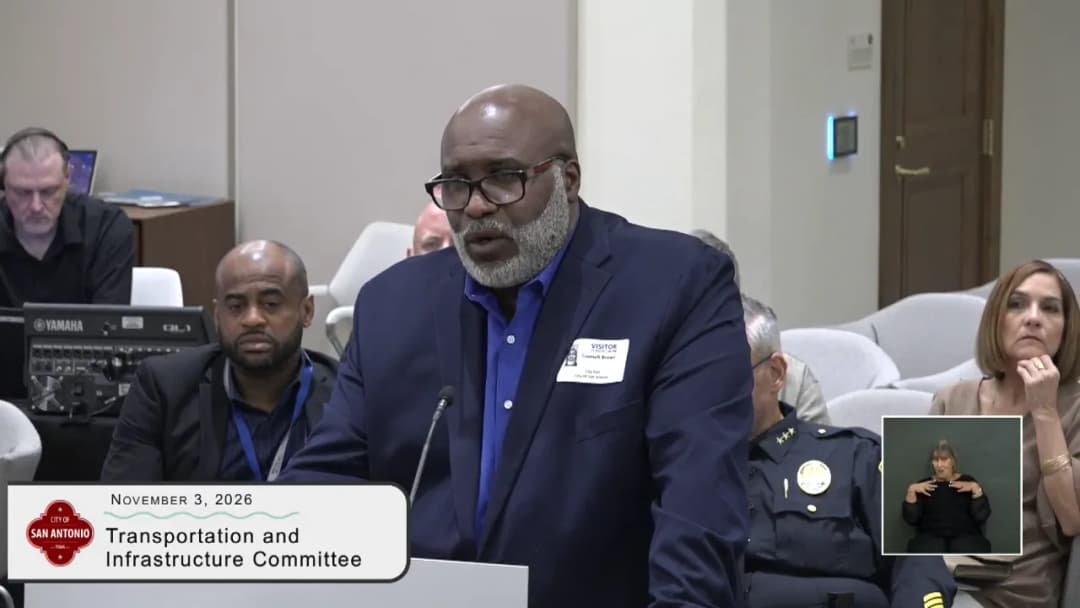
The Transportation Infrastructure Committee met from 2:05 p.m. to 3:54 p.m. on November 3, 2026. No agenda or minutes were provided; this summary is based on the raw transcript. A quorum was present, with Chair McKee Rodriguez presiding and Councilmembers Corps (online), Mungia, Alderete Gavito, and Spears participating. The meeting covered Waymo autonomous vehicles, VIA safety and security, and a Council Consideration Request for a floodplain tree planting program. Consent Calendar - Approved the prior Transportation and Infrastructure Committee minutes by unanimous voice vote. The transcript notes a clerical error that labeled the body as Planning and Community Development; the chair corrected it to Transportation and Infrastructure. Public Comments & Testimony - Bianca Maldonado, president of the Monticello Park Neighborhood Association, spoke on items 2, 3, and 4. On VIA, she raised safety and operational concerns around high-ridership bus stops, including the recent closure of a stop on the 100 block of Mary Louise to reduce conflicts with bus turns across a high-pedestrian area; she asked for safer access, reduced conflicts near Fredericksburg Road, more VIA transit police presence, and attention to trash, free-speech activity, and pop-up vendors. She said 311 does not resolve mobile pop-up vendor issues and that same-day supervisor dispatch is needed. On the tree/floodplain item, she expressed support for more green infrastructure in the floodplain and the CCR. On Waymo, she said a Waymo almost hit her in an HEB parking lot, questioned whether mapping matches actual roadways, and asked Waymo to stay on highways rather than residential streets because of long-term street maintenance costs. Discussion Items - Waymo informational briefing: Annabelle Chang and Dr. Robert Chen presented. Waymo cited 170 traffic fatalities on San Antonio roads in 2024, many involving pedestrians, cyclists, or impaired driving, and said those are non-factors for its vehicles. It described more than 15 years of autonomous-vehicle work, fully autonomous commercial service since October 2020, operations in 14 other cities, about 100 vehicles in San Antonio, a 100,000-square-foot depot in the chair's district, and more than two dozen full-time employees with benefits. Waymo said its sensor stack includes LIDAR, radar, 29 cameras, and microphones; it reported 500,000 paid rides per week nationally and more than 1 million fully autonomous miles on public roads. A safety paper based on a 270 million mile benchmark reported 95% fewer serious-injury-or-worse crashes than human drivers. The company described its April 20 incident in San Antonio, when an unoccupied Waymo entered a flooded roadway and was pulled into an active waterway; there were no riders or injuries. Waymo paused service, issued a voluntary software recall, improved vehicle, avoidance-area, and operational-policy measures, and later resumed and expanded service. On accountability, Waymo said local law enforcement can ticket it, Texas DMV regulates it, collisions are federally reported, and it accepts liability when responsible. On privacy, Waymo said sensor data is used for safety and technology improvement, in-cabin audio is off unless rider support is activated, in-cabin camera use is limited, and data is provided only under valid legal requests such as a court order or warrant; Waymo said facial-recognition or ad-targeting use cases are not current capabilities. Council members asked about service-area limits, highway operations, construction zones, emergency response plans, insurance limits, empty-vehicle congestion, data retention, job impacts, and expansion. Waymo said its service area reflects demand, the airport, and the single depot's charging range; that San Antonio operations do not currently include highways; that construction zones are difficult without clear markings and are an area for improvement; that it did not have insurance limits immediately available; and that it had no imminent expansion plans. Chair McKee Rodriguez noted state law limits local regulation and raised concerns about accountability via fines, surveillance, and broader job impacts. Councilmember Corps raised routing through District 1 neighborhoods including Crown Hill and Lavaca/Indianola/Durango; Waymo said it made operational adjustments to reduce through traffic in Crown Hill while preserving local pickups and drop-offs. Councilmember Corps also raised empty Waymo vehicles causing congestion and requested demand-based deployment; Waymo did not share utilization data. Waymo agreed to provide its emergency response plan submitted to DPS and said its first-responder ambassador team has trained over 1,000 first responders. Waymo also said it does not yet have enough San Antonio data for city-specific apples-to-apples safety comparisons. - VIA safety and security briefing: Chair McKee Rodriguez said he agendized the item after fare-free transit debate and concerns that charging $1.30 would improve safety; he questioned that premise and asked about outreach coordination. Tom Marks, Tremel Brown, Chief Joseph Rose, and Sean Kagan presented. VIA reported 1,058 bus drivers, service from about 4 a.m. to 12:30 a.m., coverage of 1,210 square miles, more than 7,000 bus stops, and more than 2,500 sheltered stations. It described 24/7 transit security officers and transit police, a 13-week operator training program focused first on customer experience, de-escalation and ADA/mental-health awareness, biannual refreshers, post-accident refreshers, and refreshers after more than 30 days away. VIA also described camera and vehicle-tracking systems, dispatch coordination next to SAPD at TransGuide, panic alarms, See Something Say Something reporting, maintenance and accident-prevention efforts, National Transit Database reporting, customer conduct rules, shelter and lighting upgrades, a solar lighting pilot adding at least 15 seconds of illumination per activation, emergency management coordination, and its FTA-aligned Safety Management System. VIA said its National Transit Database safety performance was best in Texas and number one in the country for response and lowest number, as recognized by the Federal Transit Administration. Chair McKee Rodriguez asked about coordination with homeless outreach and floated an outreach-worker ride-along pilot; VIA cited discounted fare partnerships with 129 nonprofits, representing more than $3 million in annual impact, and said it would continue the discussion offline. VIA said vehicular accidents are the most frequent incident type, followed by verbal and physical assaults, often tied to rule enforcement or fare disputes; it said protective barriers and de-escalation training have reduced some incidents. VIA said transit ambassadors are planned. Councilmember Alderete Gavito noted 5,100 students signed up for free student fares, thanked VIA for quick changes at the Mary Louise stop, and asked about transit police shifts; VIA said officers operate 24/7. Councilmember Mungia asked about fare evasion and overall safety; VIA said safety is not a frequent complaint in satisfaction surveys and that fare evasion is not a major issue. Councilmember Corps requested incident data as a follow-up and announced a business-stakeholder meeting on November 16 at 9 a.m. at Volera restaurant to bring VIA and other stakeholders together regarding construction impacts on small businesses; VIA agreed to provide incident data and said it would participate. The chair requested that any future move toward autonomous buses include robust community engagement and no surprises; VIA agreed. - Floodplain tree planting CCR: Ross Hosea, Urban Forestry Manager, presented a Council Consideration Request filed by District 10 Councilmember Mark White in March. The CCR asks for a floodplain tree planting program with four components: authorize tree mitigation funds for planting, identify priority sites, require appropriate species, and establish a maintenance plan with annual reporting. Staff said existing UDC 35-523 authority already allows tree mitigation funds to plant on public and private property with up to three years of maintenance. Staff reported that in FY24 through FY26, over 1,800 trees, about 40% of non-residential plantings, went into flood-prone areas, and the adopted current budget includes 644 trees, with 37% of non-residential plantings in such areas. Staff defined flood-prone as within the 100-year floodplain or within 100 feet adjacent. Staff described a multi-phase project with over 400 trees in and adjacent to the floodplain and said the program would formalize a framework for annual coordination with Public Works and the river authority while ensuring plantings do not impede water flow or create maintenance problems. Staff said no policy change is required and current allocations would not change; the program would inform future budgets. Councilmember Mungia asked about updated floodplain maps; staff said it is working from a draft map and also considering unmapped areas known to the river authority. Councilmember Alderete Gavito expressed support and mentioned Woodlawn Lake and heat-island planting on Bandera Road medians. Key Outcomes - Prior committee minutes were approved by unanimous voice vote after correcting the body name. - Waymo and VIA items were informational; no formal committee action was taken. Waymo agreed to provide its DPS emergency response plan; VIA agreed to follow up with incident data and to participate in the November 16 business-stakeholder meeting. - The floodplain tree planting CCR was referred to the December 3 full Council agenda for adoption by unanimous committee vote. - The chair invited members to submit future agenda ideas focused on gaps and policy discussions, and the meeting adjourned at 3:54 p.m. on November 3, 2026.

PUBLIC TRANSPORTATION 36% · TECHNOLOGY AND INNOVATION 21% · PUBLIC SAFETY 15% · TRANSPORTATION SAFETY 7%
05
NEWNOV 3, 2026 · SAN ANTONIO, TEXAS · BOARDS & COMMISSIONS
San Antonio Zoning Commission Meeting – November 3, 2026

The San Antonio Zoning Commission held a regular meeting on November 3, 2026, called to order at 1:00 PM by Chair John Bustamante and adjourned at 2:33 PM. The commission approved a consent calendar, heard four individual zoning cases, postponed one case, canceled a future meeting, and approved prior minutes. Consent Calendar - Approved items 1, 8, 9, 10, 11, and 12, and item 1 as amended. Item 1 concerned five dwellings at 1911 Burnett Street and was amended to C-2 permitted uses for four dwellings; 36 notices were sent and no opposition was reported. - Item 7 concerned a conditional use for two dwellings at 1518 Navidad Street; 24 notices were sent and the neighborhood association agreed. - Item 8 concerned a C-2 case at 7551 Callaghan Road; no neighborhood association was registered within 200 feet. - Item 9 concerned a C-1 commercial case with two dwellings; 40 notices were sent, no opposition was reported outside 200 feet, and one support was recorded. - Item 10 concerned 119 Simon Street; the neighborhood association did not respond. - Item 11 concerned an FM-03 change at 845 North New Braunfels Avenue; 25 notices were sent and the neighborhood association was in favor. - Item 12 concerned a C-2 conditional use for contractor outdoor storage at 14732 Walbert Road; 32 notices were sent and no opposition was reported. Public Comments & Testimony - No general public comment was recorded. Testimony came primarily from applicants. - James Cole Jeffers, applicant for item 3 at 403 F Street, testified that the project would be workforce housing with 50% affordable and 50% market-rate units, and he asked for MF-33 zoning to make the project feasible. - Eduardo Castillo, applicant for items 4 and 5, described plans to remodel existing homes and use rear areas for storage or an additional dwelling unit. - Argent de la Garza, applicant for item 6 on Casterville Road, testified that the existing 1920 house would be preserved for office use and the rear used for storage; he said he attended three neighborhood association meetings and amended the request to C-2 commercial without alcohol sales. Discussion Items - Item 3: 403 F Street, District 2. The applicant requested MF-33 multifamily zoning on a 2.81-acre site. Staff recommended denial of MF-33 and supported MF-18 to retain surrounding urban residential density; MF-33 would yield about 70 units, MF-25 about 53 units, and MF-18 about 38 units. The applicant said the land budget alone was about $1.2 million and described amenities including a pool, playground, and walking path. The Planning Commission recommended approval. The Zoning Commission approved MF-33. - Item 4: 3359 West Commerce area. The applicant requested C-3 high-intensity zoning for warehouse use. Staff and the Planning Commission recommended denial. The applicant said he wanted to remodel an existing house and use the rear vacant lot for an office and storage of equipment. 34 notices were sent; one support and one opposition were recorded, and the Martinez Creek Neighborhood Association did not respond. The commission continued the case four weeks to December 1, 2026, for neighborhood outreach. - Item 5: a property on Yale Avenue described as case 332 Yale. The applicant requested R-4 to IDZ-1 zoning for two dwelling units. Staff recommended denial because the only access would be from North Trinity, while the Planning Commission recommended approval. 32 notices were sent and no opposition was reported. The applicant said he had remodeled a nearby home and wanted to add a second unit with rear parking. The commission approved the request. - Item 6: Casterville Road. The applicant initially requested a change from R-4 residential to industrial zoning and later amended to C-2 commercial with a submitted site plan. Staff recommended denial. 19 notices were sent, with one support and no opposition. The applicant, vice president of Construction RCO, said the existing 1920 house would be preserved as an office and the rear used for storage; he also said the request excluded alcohol sales. The commission approved C-2 with the submitted plan; barbed-wire concerns were discussed but not made a condition of the motion. - Item 13: The commission discussed canceling the January 5 meeting. The transcript inconsistently refers to January 5, 2022, and January 5, 2027; given the November 3, 2026 meeting date, the intended date appears to be January 5, 2027. - Minutes: The commission approved the minutes of the October 20, 2026 meeting with two abstentions. Key Outcomes - Item 1 was approved as amended to four dwellings, and items 7, 8, 9, 10, 11, and 12 were approved on the consent calendar. - Item 2 was postponed; no hearing was held, and a new notice will be issued when the case is rescheduled. - Item 3 was approved for MF-33 zoning by a unanimous vote, contrary to the staff recommendation. - Item 4 was continued to the December 1, 2026 meeting by a unanimous vote. - Item 5 was approved by a unanimous vote. - Item 6 was approved as C-2 with the submitted site plan by a unanimous vote. - The January 5 meeting was canceled by unanimous vote, with the transcript year discrepancy noted above. - The October 20, 2026 minutes were approved with two abstentions. - The meeting adjourned at 2:33 PM.

ZONING AND LAND USE 67% · AFFORDABLE HOUSING 10% · PROCEDURAL 9% · INFRASTRUCTURE 4%
06
NEWNOV 3, 2026 · SAN ANTONIO, TEXAS · COUNCIL COMMITTEES
San Antonio Transportation and Infrastructure Committee Meeting — November 3, 2026

The San Antonio Transportation and Infrastructure Committee met on November 3, 2026, from 2:05 p.m. to 3:54 p.m. with a quorum. Chair Maki Rodriguez presided. The committee approved minutes, received a Waymo autonomous-vehicle presentation, received a VIA transit safety presentation, and advanced a Council Consideration Request from Councilmember Mike White on floodplain tree planting. Consent Calendar - Approved the meeting minutes with a correction; the motion was seconded and carried on a voice vote. Public Comments & Testimony - Bianca Maldonado, president of the Monticello Park Neighborhood Association, commented on all three items. On VIA, she raised concerns about seven routes on Fredericksburg, 4,000 users in the area, inadequate bus-stop infrastructure and restrooms, fatalities at bus stops, a recent bus-stop closure in a dense pedestrian area, need for designated transit police, trash on buses, vendors blocking sidewalks, and 311 not resolving cases; she urged calling supervisors in real time. She also called for more trees and green space in floodplain areas. She said a Waymo vehicle nearly hit her in an HEB parking lot and that autonomous vehicles should operate on streets, not in neighborhoods. Discussion Items - Waymo: Anabel Chain and Dr. Robert Chang presented. They said San Antonio had 170 roadway fatalities in 2024, with significant cyclist and pedestrian deaths, and argued autonomous driving can improve safety. Waymo described airport-to-downtown service, 100 miles of coverage in the district, 12 employees with benefits, 24/7 operations, presence in 14 other U.S. cities, and global operations. The vehicle uses 29 cameras, radar, microphones, 3D imaging, and AI; Waymo cited a 270 million-mile safety benchmark and a 95% reduction in injuries or crashes compared with human drivers. On privacy, they said audio is off unless the support button is pressed, interior cameras are for lost items or medical emergencies, there is no facial recognition or advertising use, and data can be deleted. Jobs include fleet deployment, sensor work, and charging, with first-generation roles not requiring a four-year degree. - Council members asked about coverage, camera retention, accident data, waitlists, highway operations, senior-center transport, empty-vehicle congestion, neighborhood routing, construction zones, liability insurance, first-responder training, and expansion. Waymo said it does not operate on San Antonio highways, has no imminent expansion plan, and has state and local insurance requirements; it could not provide insurance limits at the meeting. Council members raised District 1 impacts, including Indianola and Durango, no sidewalks, and an airport route using Broadway rather than freeways. A member asked Waymo to operate only when there is demand to reduce empty-vehicle congestion. Another asked about construction-zone incidents; Waymo said it is training its system to be more sensitive to construction and missing signage. The chair said state law limits local regulation and noted initial neutrality, while saying some human drivers should not be on the road and AV replacement could be useful. - VIA: Tom Marks, Jamont Broad, Joseph Rose, and Sean Cage presented on operator and passenger safety. VIA said it has 1,058 bus drivers, service until about 12:30 a.m. while working toward 24-hour service, a 1,240-square-mile service area from Sandy Oaks to St. Hedwig and from Trader Village to Alamo Ranch, more than 1,000 bus stops with seating and shade, and daily service to more than 2 million people in Bexar County. Safety measures include licensed security officers at maintenance centers 24/7, transit police 24/7, cameras, vehicle tracking, alarms, see-something-say-something reporting, a passenger code of conduct, shelter and lighting improvements, and a bus-stop safety button that extends lighting for at least 50 minutes. VIA also described its emergency command center and federal Safety Management System. Training includes de-escalation, customer service, mental-health awareness, annual refreshers, post-incident review, and return-to-work training after 30 days absence. VIA said it partners with 129 nonprofits and uses $3 million for direct rider assistance and discounted fares. VIA said the most common incidents are vehicle collisions and verbal altercations; robberies are not frequent, and 400 operators have clean records over 1 to 3 million miles. - Council members asked about homelessness outreach and connecting riders to housing, police shift changes and bus-stop monitoring, lighting complaints from Monticello Park, shelter placement, heat islands, and fare enforcement. VIA said it is open to partnerships with Metro Health and housing providers, that transit police patrol 24/7 and SAPD can be dispatched through a 10-digit number, and that it has identified some shelter and lighting locations. Councilmember DeRete Gavito thanked VIA for meeting at a bus station and for rapid action. VIA committed to attend a November 16 meeting on VIA service and businesses affected by construction. The chair stated that if there were any interest in a pilot or move to replace VIA buses with autonomous vehicles, there should be robust community engagement and no surprises; VIA agreed. - Floodplain tree planting: Ross José of Parks and Recreation presented a Council Consideration Request from Councilmember Mike White, received March 30 and discussed with the community in May. The request would formalize a program to plant and maintain trees in floodplains using the tree mitigation fund. Staff cited UDC 35-523, which allows planting on public and private property and maintenance for up to three years. Staff said more than 10,800 trees were planted in these areas in FY 2024-26, and the current budget includes 644 trees, with 37% of new non-residential trees in floodplain areas within 100 feet. A case study with Councilmember DeRete Gavito would bring 400 trees to Woodland Park to stabilize banks and reduce water entering the land. Staff recommended no policy change, but a formal framework coordinated with Public Works and the River Authority to avoid flood impacts. Councilmember Corr asked about cost; staff said it is already budgeted and would not change. Councilmember Munguía asked about updated floodplain maps; staff said it is working with the River Authority. Councilmember DeRete Gavito supported the item and mentioned Woodland Park irrigation, birds, heat islands, and Bandera medians. Key Outcomes - Minutes approved with a correction. - No formal vote on Waymo; the committee received the presentation and requested follow-up on neighborhood routing, construction-zone performance, liability and insurance information, first-responder training, demand-based deployment, and community engagement before any autonomous bus replacement. - No formal vote on VIA; the committee received the safety presentation, and VIA committed to the November 16 meeting and follow-up on lighting, 311 complaints, and partnerships. - The tree-planting CCR was referred to the December 3 agenda for formal adoption; the motion was seconded and passed unanimously.

TRANSPORTATION SAFETY 35% · TECHNOLOGY AND INNOVATION 21% · PUBLIC TRANSPORTATION 13% · PUBLIC SAFETY 10%
07
NEWNOV 3, 2026 · SAN ANTONIO, TEXAS · COUNCIL COMMITTEES
San Antonio City Council Reviews 2027 Federal Legislative Agenda on Nov. 3, 2026

On November 3, 2026, at 10:11 a.m., the San Antonio City Council convened for a lightly scheduled meeting focused on the initial draft of the city's 2027–2028 federal legislative agenda. Staff presented six priority areas and requested council feedback. Election Day was noted. The meeting adjourned shortly after 10:30 a.m. Consent Calendar - Council unanimously approved the meeting minutes. Discussion Items - Sally Basurto (Government Affairs) and Jeff (staff) presented the initial legislative agenda, developed with input from city departments and partner organizations. - Six priority areas were outlined: community and economic development; military protection; public safety and homeland security; infrastructure, transportation and resilience; education and workforce; and human services and public health. - Housing: The agenda supports expanding affordable housing through federal incentives, grants, and programs such as the "Road to Housing" act, CB/DG and ESG funds, and the Opportunity Home tool. - Military/VA: The agenda includes a $30 million appropriation request for land acquisition for the new veterans hospital; an environmental impact decision has been completed. - Public safety: Staff highlighted a $16 million federal grant for 128 new police officers and continued UASI funding. The transcript states San Antonio has received "90 billones de dólares" in UASI funds since 2004; this figure is quoted as stated, though it may be a transcription error. - Infrastructure: Staff discussed advocating for a $580 billion five-year transportation authorization (referred to in the transcript as "ACT 258 de Act America"), airport improvement grants, and flood mitigation funding. - Education/childcare: Examples included $3.5 million for Early Head Start and $7.5 million in federal funding for the Rising Star childcare quality initiative. - Health: Staff proposed support for SNAP benefit expansion and efforts to prevent cost increases under the No Surprises Act arbitration process. - Next steps: Staff will incorporate council feedback, return in December for another briefing, and revisit the agenda in early February 2027. Councilmember Comments & Positions - President Macki Rodríguez expressed support for the overall agenda but stressed opposing ICE detention center installation, supporting pathways to citizenship, and prioritizing affordable housing, rehabilitation, infrastructure, flood mitigation, rail quiet zones, arts and recreation grants, and crime prevention beyond hiring more officers. - Councilmember Alderete Gavito echoed the President, called for USPS to address mailbox theft, supported undocumented community rights, and backed infrastructure resilience, solar/heat island mitigation, and childcare provider support. - Councilmember Mesa González thanked staff, supported the new veterans hospital (in District 8), asked about federal grants for the diversion center (staff identified over 20 possible grants), and urged support for housing, education, workforce, and preventing detention center expansion. - Councilmember Spears added priorities on cybersecurity, nuclear energy under economic development, data centers, military installation protection, the medical center, infrastructure resilience, and workforce education. Key Outcomes - Minutes approved unanimously. - Staff directed to incorporate councilmembers' additional ideas into the legislative agenda and distribute the presentation. - Future briefings scheduled for December 2026 and early February 2027.

FEDERAL ADVOCACY 29% · AFFORDABLE HOUSING 16% · PROCEDURAL 12% · PUBLIC SAFETY 12%
08
NEWNOV 3, 2026 · SAN ANTONIO, TEXAS · COUNCIL COMMITTEES
Intergovernmental Relations Committee Meeting - November 3, 2026: Draft Federal Legislative Program

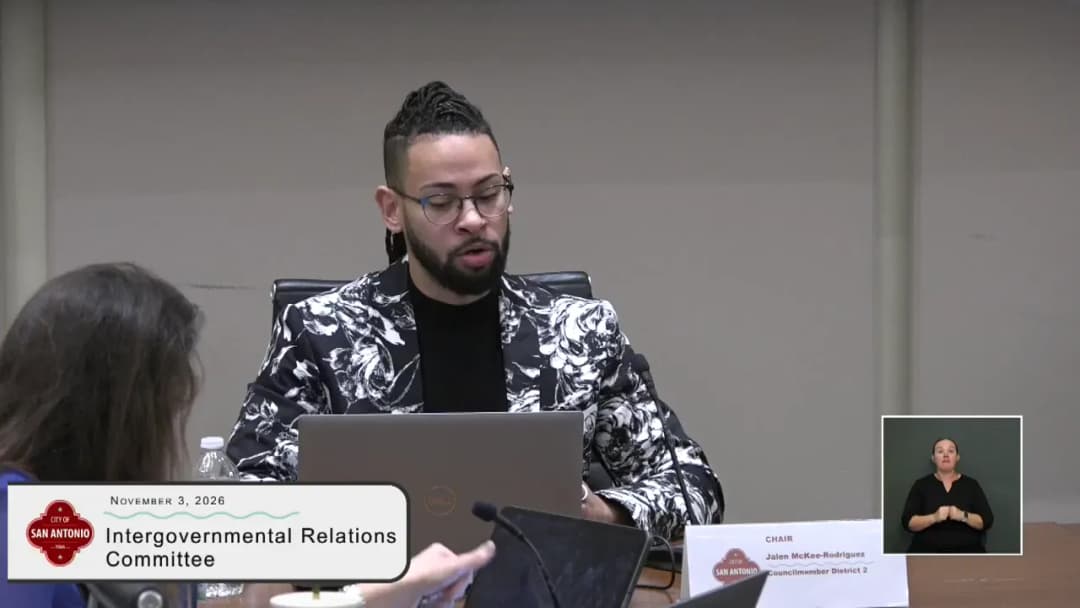
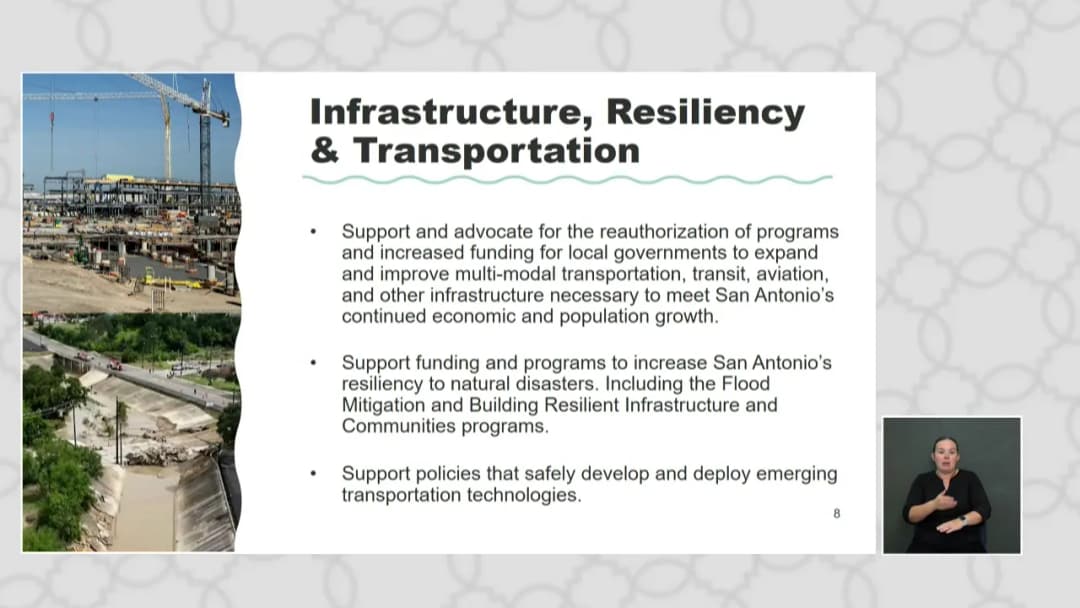
The Intergovernmental Relations Committee of the San Antonio City Council met on November 3, 2026, at 11 a.m. to discuss the draft federal legislative program for the 2027-2028 congressional term. Chair McKee Rodriguez presided, and quorum was present. The meeting focused on presenting the draft program, gathering feedback from council members, and outlining next steps for finalization. Consent Calendar - Approval of Minutes: The minutes from the September 29, 2026 committee meeting were approved unanimously by voice vote. Discussion Items - Presentation of Draft Federal Legislative Program: Sally Basurto, Director for Government Affairs, presented a two-year draft program aligning with the new Congress convening in January 2027. The program covers six key areas: - Economic and Community Development: Support for affordable housing through the 21st Century Road to Housing Act (signed July 2026), which expands CDBG/HOME/ESG programs, creates a $200 million competitive innovation fund, and prioritizes opportunity zones. Also, support for the sports and entertainment district, data center regulation (Rate Payer Protection Act, American Affordability and Jobs Act), and federal grant reform. - Military City USA & Military Protection: Sustain JBSA missions; support the replacement of the 1973 Audie Murphy VA Hospital (record of decision completed, $30 million for land acquisition in House MILCON bill). - Public Safety & Homeland Security: Expand COPS hiring grants ($16 million awarded in last three years for 128 officers), UASI grants, firefighter assistance, and cybersecurity grants. - Infrastructure, Resiliency & Transportation: Reauthorization of surface transportation bill (America 250 Act), airport improvement grants, flood mitigation (BRIC program), and emerging technologies (autonomous vehicles, advanced air mobility). - Workforce & Education: Support for workforce training, child care (Head Start: $21.9 million FY27), and justice-involved youth. - Public Health & Human Services: Food security (farm bill SNAP delay), universal health care access, maternal mortality prevention, and reform of the No Surprises Act. Councilmember Feedback - Chair McKee Rodriguez: Emphasized explicit opposition to ICE detention facilities and support for fair pathways to citizenship; requested focus on affordable housing (public housing stock), quiet zones (federal assistance due to train noise), grants for public art, parks, transit/rail, root-cause crime prevention, and Metro Health programs. Also stressed the need to protect utility ratepayers from data center costs. - Councilmember Alderete Gavito: Urged addressing cluster mailbox theft (federal USPS responsibility) and supporting undocumented residents' rights; called for floodplain removal, heat island mitigation (especially on west side), and child care ecosystem support. - Councilmember Mesa Gonzalez: Commended inclusion of the new VA hospital in District 8; inquired about federal grants for a diversion center (staff identified over 20 grants for wraparound services). Supported housing, education, workforce development, and opposition to ICE detention centers. - Councilmember Spears: Highlighted public safety (UASI, cybersecurity), nuclear energy opportunities, data center policies, military medical expansion, flood mitigation, and workforce/education as cross-cutting priorities. Noted quiet zones as an area of interest. Key Outcomes - The committee unanimously supported the direction of the draft program, with feedback to be incorporated. - Staff will reach out to all 10 council members and the mayor for individual feedback and compile a report before the next meeting. - A revised federal legislative program will be brought back for further committee discussion and adoption. - The meeting adjourned at 10:53 a.m.

FEDERAL ADVOCACY 43% · PROCEDURAL 11% · PUBLIC SAFETY 9% · INFRASTRUCTURE 7%
09
NEWOCT 29, 2026 · SAN ANTONIO, TEXAS · CITY COUNCIL
San Antonio City Council Meeting – October 29, 2026

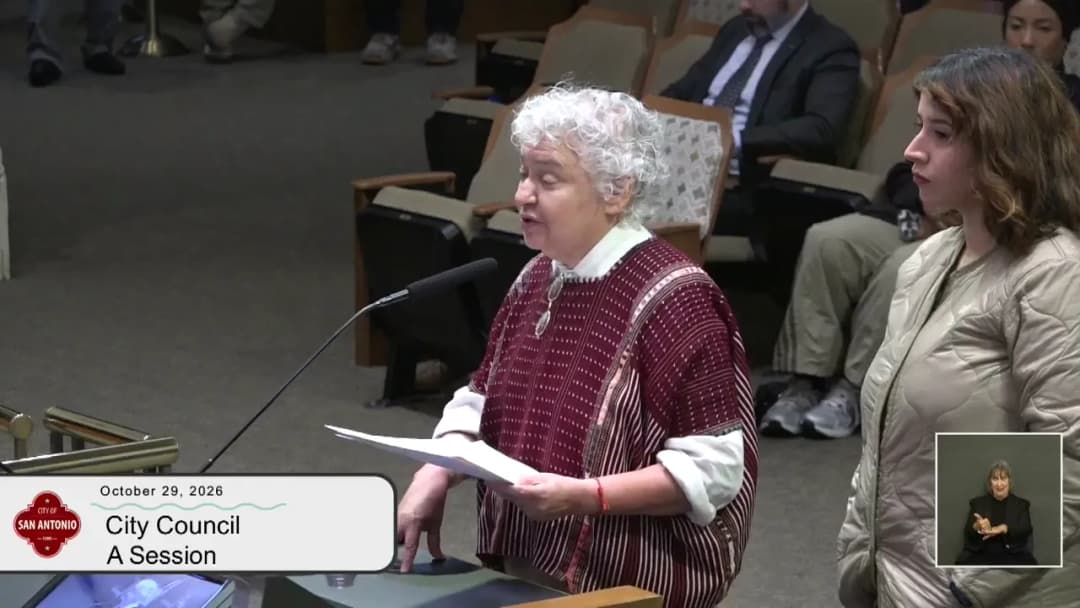
The San Antonio City Council met on October 29, 2026, starting at 9:15 AM. The meeting included proclamations, public comments, and major decisions on data center regulations and the 2027 bond program. The council approved an ordinance amending the Unified Development Code (UDC) to regulate data centers, requiring special use authorization in most zones (Option 2), and approved a $442 million bond package without a property tax increase. Consent Calendar - Approval of minutes from the meetings of October 7, 8, 14, and 15, 2026 (motion passed unanimously). - Consent agenda items 8–33 were approved as a group after speakers on item 19 (audit plan) and item 10 (Volvery Road construction contract) were heard. Item 6 was moved to the consent calendar by staff. Public Comments & Testimony - Data Center Ordinance (Item 5): Over 30 speakers addressed the council. Supporters (primarily union electricians and contractors from Local 60, IBEW, and others) argued that data centers provide stable, high-paying jobs, benefits, and economic investment. They urged adoption of Option 1 (by-right in commercial zones with setbacks) or the Zoning Commission recommendation to avoid uncertainty. Opponents (residents, environmental groups, public health advocates) cited concerns over noise, light pollution, water consumption (e.g., 463 million gallons over two years), air quality impacts (diesel generators, NOx emissions), increased utility rates, and declining property values. They demanded stronger regulations, specific use permits, minimum distances of at least 1,000 feet (or 2 miles), and notification of affected communities. Many called for a moratorium. - Consent Agenda: Jack Finger spoke on the audit plan (item 19) requesting scrutiny of all departments and inquiry into citizenship status of affordable housing recipients. Rebeca Villagrán spoke in support of the South Texas Parkway and legislative priorities. - Bond Program: Speakers urged maintaining the 1.5% public art allocation and prioritizing infrastructure in underserved areas (east, west, south sides). Jack Finger opposed any property tax increase. Discussion Items - Proclamations: The council issued proclamations for the D. Howard Foundation (10th anniversary of the Hall of Fame), Cybersecurity Awareness Month, and Pedestrian Safety Month (October as Walk Month). Officials from ActiveSA, AARP, and partner organizations highlighted education, safety, and the need for continued investment in sidewalks and crosswalks. - City Manager’s Report: Eric reported that Metro Health’s BREATHE program received an EPA leadership award, San Antonio will host a global public health conference (10,000 attendees), and Assistant City Manager Alex López was elected vice president of the ICMA Executive Board. - Data Center Ordinance (Item 5): Staff presented two options. Option 1: by-right in C3 districts with 500-foot setbacks, no Edwards Aquifer recharge zones. Option 2: special use authorization in C3, light industrial, and business parks; by-right only in heavy industrial zones if criteria met (300-foot setback, landscaping, generator enclosures, downward lighting). The Zoning Commission recommended a hybrid: special use in most zones, by-right in heavy industrial with stricter standards. After extensive debate and multiple amendments, the council adopted Option 2 (Galván’s proposal) with additional amendments: - Added UNESCO World Heritage sites to the list of locations where minimum distances may be required (unanimous). - Adopted a definition of “data center” that excludes small server rooms and office IT (unanimous). - The final vote was 9–2 (Councilmembers Spears and White dissenting). - Bond Program (Item 6): Staff recommended a $442 million bond package for streets ($259M), critical streets ($50M), parks ($280M), drainage, affordable housing ($50M), and other categories. The council discussed prioritizing underserved areas, the 1.5% public art ordinance, and a proposed $35 million central infrastructure project to be paid by PFC (failed repeatedly). After amendments redistributing funds among districts, the resolution passed with a motion including the staff recommendation and the council’s adjustments. Key Outcomes - Data Center Ordinance: Approved (9–2). The UDC now requires special use authorization for data centers in most zones; by-right only in heavy industrial areas meeting strict criteria. The Edwards Aquifer recharge zone is excluded. (Effective immediately.) - Bond Program Resolution: Approved (unanimous). The $442 million bond package will be placed on the 2027 ballot without increasing property taxes. The council allocated funds as amended, including $35 million for central infrastructure (to be paid from PFC funds, though a separate motion to remove it from the bond failed). - Proclamations and Recognitions: All proclamations were adopted. - Future Steps: The bond program will proceed with community committee meetings in November–December and return to council in January 2027. The data center ordinance will be reviewed in the next UDC amendment cycle. Meeting adjourned at approximately 4:15 PM.

DATA CENTERS REGULATION 33% · PROCEDURAL 9% · INFRASTRUCTURE 9% · WORKFORCE DEVELOPMENT 7%
10
OCT 28, 2026 · SAN ANTONIO, TEXAS · CITY COUNCIL
San Antonio City B Session Update on Downtown Sports and Entertainment District - October 28, 2026

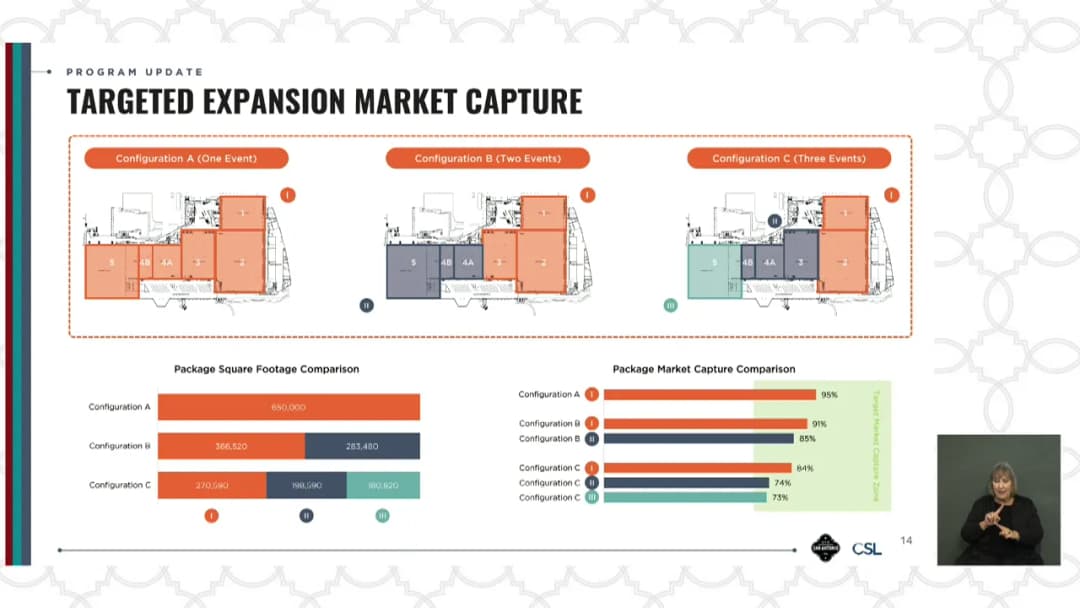
The City of San Antonio B session, called to order at 2:03 p.m. on Wednesday, October 28, 2026, provided a comprehensive update on the proposed downtown sports and entertainment district. Presentations covered the convention center expansion feasibility study, Alamo Dome capital improvement plan, financing updates, district cost of services study, mobility and accessibility study, exploratory procurements, community engagement, and next steps. Council members discussed financial assumptions, phasing, revenue projections, and community benefits. Convention Center Expansion Feasibility - Michael Lockwood of Populous presented the feasibility study for expanding the Henry B. Gonzalez Convention Center. The current exhibit hall occupancy is at 75%, exceeding the 70% practical maximum that signals a need for expansion. Current total sellable inventory is 728,000 sq ft (514,000 exhibit, 94,000 ballroom, 120,000 meeting). The recommended targeted expansion would grow to 650,000 sq ft contiguous exhibit space, add a 50,000 sq ft ballroom, and increase meeting space to 143,000 sq ft, at a total project cost of $850 million. Phasing is possible: Phase 1 ($700 million) includes full exhibit hall expansion and flexible ballroom designed to double as meeting space; Phase 2 ($150 million) adds 36,000 sq ft of meeting rooms. The expansion would put San Antonio in the top 10 nationally for contiguous exhibit space. Market capture analysis shows configuration A (full facility) captures 95% of market share; configuration B (two events) captures 85–91% each. - Mary O from Visit San Antonio presented booking pace data. Compared to 2017–2019 benchmark years, future bookings for 2031–2033 show a significant deficit (e.g., 96,000 room nights behind for 2031, 62,000 for 2032, 86,000 for 2033) due to competing convention center expansions in other Texas cities. The study identifies 74 additional groups representing $718 million in potential economic impact that could be pursued with the expansion. Alamo Dome Improvements - Ben outlined a proposed $125 million capital investment over 10 years for the Alamo Dome, focusing on technology systems, equipment, and end-of-life replacements. This replaces the previously assumed $100 million plan. The investment supports operations through the early 2030s, positioning the city to make a decision around 2035 on a major renovation or continued investment. Financial Update - Ben presented the financing structure for the arena ($489 million city contribution) using Spurs arena lease, property taxes from guaranteed development, ground leases, and project financing zone (PFZ) state revenues. The PFZ baseline revenue projection totals $1.923 billion over 30 years at a 4.6% compound annual growth rate. The model assumes approximately 1,160 additional hotel rooms by 2029, with historical growth of about 225 rooms per year. The base model produces about $1.2 million in estimated annual incremental general fund revenue, and about $1.0 million in annual recurring service costs, resulting in a nearly break-even position ($163,000 positive). Revenue sources include sales tax, mixed beverage tax, CPS Energy, and SAWS. The PFZ revenue starts small (projected $2.5M in 2026, actual closer to $1M) and grows to $157.6M by 2055. - Key assumptions: city hotel tax compound annual growth rate of 3.5% (base), with stress scenarios from 2.75% to 4.3%; interest rates from 3–4% on earnings to 5–7% on debt. District Cost of Services Study - Troy Elliott reviewed the study by MuniCap and ESI, evaluating the financial impact of the sports and entertainment district (arena, Wood Courthouse venue, convention center expansion, mixed-use private development). The model projects incremental general fund revenues and service costs, assuming full built-out district (Phase 1 and 2 private development, arena operational, Wood Courthouse operational, convention center expanded). Estimated annual incremental revenue: $1.2 million; estimated annual general fund costs: $1.0 million, primarily from mixed-use development and Hemisphere Park maintenance. Venue costs are allocated back to events/venues to avoid general fund impact. The model allows for dynamic adjustments based on event types and concurrency. Mobility & Accessibility Study - Shannon Miller presented the downtown accessibility and mobility study led by Walker consultants. Key findings: downtown does not lack parking supply (over 30,000 public spaces), but challenges stem from single-occupancy vehicle dependence, uneven parking utilization, event-day congestion, and lack of integrated information. Emerging recommendations: improve parking discovery and wayfinding, optimize event parking supply through coordination and pricing, strengthen multimodal access (VIA transit, ride-share, park-and-ride), and implement demand management strategies. A separate Reconnecting Communities grant is studying improved connections across I-37 between the East Side and downtown. Final reports expected early 2027. Exploratory Procurements & P3 Opportunities - Staff proposed issuing solicitations in spring 2027 for: (1) P3 opportunities for the

CONVENTION CENTER 21% · BUDGET 16% · PUBLIC ENGAGEMENT 12% · TRANSPORTATION INFRASTRUCTURE 11%
0102
NEXT →
OPENPUBLICA · PUBLIC MEETING INDEXUPDATED DAILY · openpublica.com