Browse by city
Date range
Search help

Search titles, summaries, topics and stored transcripts together. Keywords may match separately; put the whole query in double quotes for a phrase. Matching follows word analysis, so punctuation is not exact. Both dates are included. Documents are not searched.

SHOWING 11–20 ENTRIES
11
OCT 28, 2026 · SAN ANTONIO, TEXAS · BOARDS & COMMISSIONS
San Antonio City Commission Meeting - October 28, 2026

The San Antonio commission met on October 28, 2026, beginning with roll call and a quorum. The chair described a combined consent agenda and an individual hearing agenda. Although the chair initially said item 14 had been withdrawn, the commission later heard and voted on item 14. Consent Calendar - The combined consent agenda was approved by roll-call vote. Commissioner Profe made the motion and Commissioner Cooper seconded it; staff had recommended approval without detailed discussion. Public Comments & Testimony - A speaker registered for item 9, Clay Consent, was not present when the item was called. - Item 11 – Sherman Henson (503 Hampton Street) expressed concerns: the street name appeared misidentified in the documents, the project could increase property taxes, sidewalks were missing nearby, and he did not know which neighbors had been consulted. He asked how the added density would benefit the existing neighborhood. - No public comments were heard for items 14 or 15. Discussion Items - Item 10 – Continuation request: The applicant requested a two-week continuance to November 18 for the matter at 7510. The commission voted to continue the item to the next meeting. - Item 11 – Residential density request: Planning staff reported four notifications in favor, one in opposition, and no response from the homeowners association. Staff said the property, sized from 5,000 to more than 20,000 square feet, was in a dense area, located more than 2,000 feet from principal arterials, and recommended denial as inconsistent with the area development plan. Applicant Jay Michael Jeffers, representing the owner, said the proposal would create workforce housing with 50% affordable and 50% market-rate units, cited construction costs of about $1.2 million, and said he had engaged the adjacent homeowners association and neighbors. He requested MF-33 zoning and said he could accept MF-25 if needed, describing 0.7 parking spaces per residence, buffers, sidewalks, and professional management. In response to Henson, Jeffers said the project would add sidewalks, clean existing walkways, and serve teachers, firefighters, and similar workers. Commissioners expressed support for quality workforce housing and good-neighbor design. The commission voted to approve the request. - Item 14 – West Kennes Highway area zoning request: Staff reported zero notifications in favor, one in opposition, and no HOA response. The request was from R-5 to IC-3 high-intensity use, with permitted uses for flexible office and office in a home. Staff recommended denial because the proposed mixed-use/storage use was not appropriate for an established residential area. Applicant Eduardo Castillo, representing his daughter, said he needed rear storage for construction materials while renovating the vacant property, not a commercial warehouse, and pointed to nearby commercial and mixed uses. Commissioner questions explored accessory dwelling/storage options and access. The commission voted to approve the applicant's request despite staff's recommendation. - Item 15 – Future land use and density request: Staff said the request would change low-intensity urban residential to medium-density residential, with no HOA response, and recommended denial because the use was not appropriate and the property had only one entrance. The applicant said he had spent three years renovating an abandoned house, wanted two tenant parking spaces and rear access, and was requesting the higher intensity only for rear modifications. Commissioners praised the rehabilitation of an abandoned property. The commission voted to approve the request. Key Outcomes - Consent agenda approved. - Item 10: continued to November 18. - Item 11: approved, contrary to staff recommendation; no no votes appear in the transcript. - Item 14: approved, contrary to staff recommendation; no no votes appear in the transcript. - Item 15: approved, contrary to staff recommendation; no no votes appear in the transcript. - No director's report was presented; the meeting adjourned at 2:33 p.m.
ZONING AND LAND USE 77% · PROCEDURAL 14% · AFFORDABLE HOUSING 9%
12
OCT 27, 2026 · SAN ANTONIO, TEXAS · COUNCIL COMMITTEES
San Antonio Planning and Community Development Committee Meeting on October 27, 2026

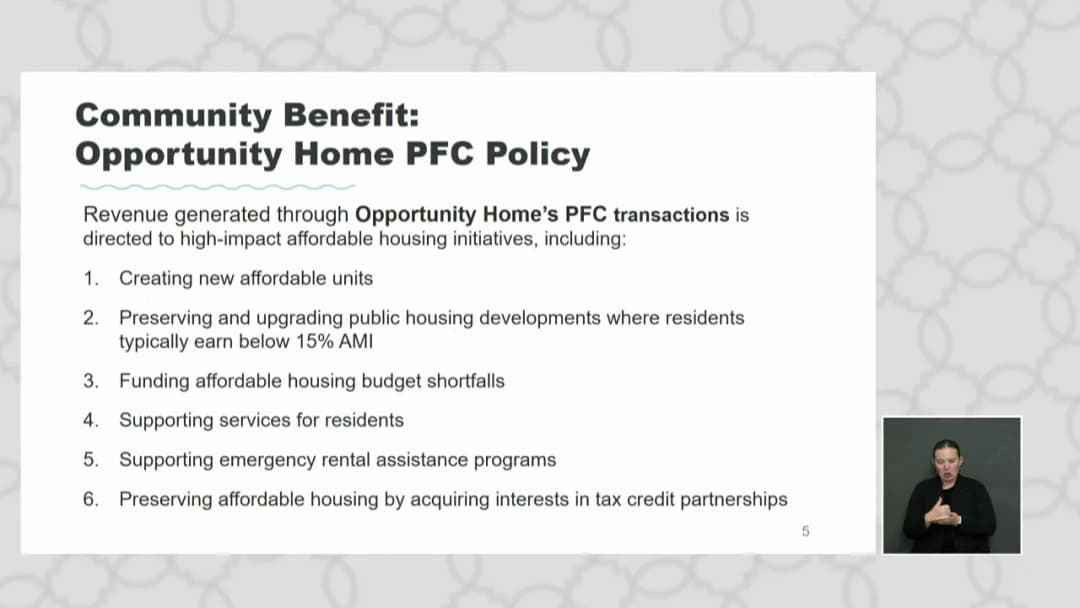
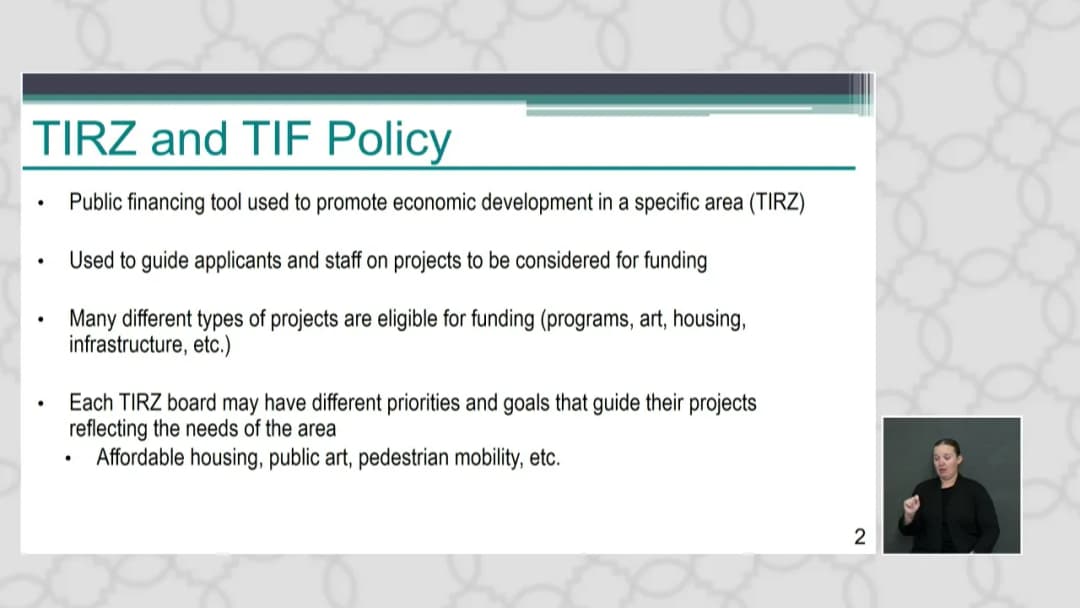
The Planning and Community Development Committee met at 10:08 a.m. on Tuesday, October 27, 2026, and adjourned at 10:44 a.m. Councilmembers Castillo, Galván, Mesa González, and Chair Munguía were present. The committee approved the prior meeting minutes, received an informational briefing on the Northeast Subregion extraterritorial jurisdiction (ETJ) plan, approved an Opportunity Home public housing PFC tax exemption item for full Council consideration, and approved a Jones Avenue project recommendation within the Midtown TIRZ. Consent Calendar - The committee approved the minutes of the September 22 meeting by voice vote; no opposing votes were heard. Northeast Subregion ETJ Plan – Informational Update - Staff presented an informational update on updating the city's comprehensive extraterritorial jurisdiction plan, originally adopted in 2016. Many policies are being updated to align with state law, and a management plan was added to influence future planned development. - The planning effort divides areas for analysis and includes demographic and economic analysis, a technical working group, community participation, and recommendations. Areas mentioned included Garden Ridge, Universal City, and surrounding cities to the east. - The technical group's recommendations included protecting military missions and assets within military bases. Community concerns addressed growth, traffic, and drainage. - A chart showed the population is projected to double by 2050. Draft future land use recommendations include low-density designations in topographically sensitive areas to preserve the environment. - In discussion, staff clarified that the plan applies to the ETJ subregion outside San Antonio city limits, not to the city's existing portfolio. A follow-up presentation may come in December. Opportunity Home Public Housing PFC Tax Exemption Request - Staff from the Neighborhood and Housing Services Department presented a request related to a Public Facility Corporation tax exemption supporting the acquisition, construction, and rehabilitation of housing. Revenue from the transactions is directed to creating affordable housing and providing services for residents. - Staff referenced the 2037 Centennial Vision, adopted in June 2026, and said the revenue plan is used to preserve and improve public housing. Projects mentioned included Henry B. González site 7, Terry Town Apartments in District 1, Mary McGuire Apartments in District 1, Villa Hermosa Apartments in District 1, and Westway of Promise in District 7. - Staff noted a $1.5 million per month funding reduction at Opportunity Home Public Housing because funds were taken away, and recommended moving the item to Session A for full City Council consideration. - A motion to approve the staff recommendation was seconded and passed by voice vote. - During discussion, several councilmembers praised the project and the partnership with Opportunity Home. One councilmember said the project was very important for District 8 because of nearby La Cantera, The Rim, Fiesta Texas, and the medical area. - Councilmember Castillo said the AMI breakdown for the proposal was less than 15 percent, that the proposal was in alignment with strategic plan implementation, and that more three-bedroom housing is needed throughout the city; he stated he would oppose the item because other areas of the city are also needed. A development consultant said surveys had been conducted showing a need for three-bedroom units and agreed to provide the list of survey recipients. - Another councilmember suggested reviewing AMI categories by region during current updates, citing a market study showing significant need among single renters and noting this would help the bond committee understand where to invest. - Councilmembers asked why some projects need full Council approval and others do not. Staff explained the difference between 303 and 392 structures under state law: 303 projects require meeting with the council representative and full Council approval, while 392 PFC projects do not require full Council approval and are brought as a courtesy; the difference is the sponsor, with 392 used exclusively by the housing authority. A councilmember asked for follow-up information on the selection criteria. Jones Avenue Project – Midtown TIRZ - Staff presented a request for the Jones Avenue mixed-use project in the Midtown Tax Increment Reinvestment Zone, District 1. The developer proposes a mixed-use project with offices and retail on approximately six acres, with a total investment of $277 million. - The site is currently vacant, adjacent to the River Walk and near I-35, with existing infrastructure that can be modernized. The project is proposed in two phases: the first phase is projected to start in 2027 and finish in 2031; the second phase is projected to start in 2029 and finish in 2032. - Staff recommended a reimbursement of up to $7.5 million for public-benefit infrastructure, including river improvements, a pedestrian bridge, sidewalks, a bus station, and land improvements. Investment in basic services would not be reimbursed. Staff also recommended an affordable housing contribution of 25% of the increment. The TIRZ termination date is September 30, 2060. - Projections presented: the land is currently valued at $29 million, is projected to be worth $154 million after development, $334 million in 2060, and is projected to generate $80 million in sales tax over 32 years. - Staff requested committee approval to proceed and return with the final contract in November or December 2026. A representative of the applicant spoke as the applicant's representative. - Committee members thanked staff and the applicant; the motion to approve the staff recommendation was seconded and passed by voice vote. Key Outcomes - Approved the September 22 meeting minutes. - Approved the staff recommendation to forward the Opportunity Home Public Housing PFC item to Session A for full City Council consideration. - Approved the Jones Avenue project staff recommendation, allowing staff to finalize the agreement and return for final consideration in November or December 2026. - No formal action was taken on the Northeast Subregion ETJ plan; it was an informational briefing.

AFFORDABLE HOUSING 37% · PLANNING 34% · ZONING AND LAND USE 17% · PROCEDURAL 8%
13
OCT 27, 2026 · SAN ANTONIO, TEXAS · COUNCIL COMMITTEES
Planning Community Development Committee Meeting - October 27, 2026

Planning Community Development Committee Meeting – October 27, 2026\n\nThe San Antonio Planning Community Development Committee met on October 27, 2026, at 10:08 AM to discuss three main agenda items: the Northeast Subregion Extraterritorial Jurisdiction (ETJ) Plan, the Lone Star at Presidio affordable housing development, and the Jones Avenue mixed-use project in the Midtown TIRZ. The meeting was called to order by Chair Mungia, with a quorum present. All three items received committee approval to move forward to full City Council.\n\n Consent Calendar\n- Minutes Approval: The committee approved the minutes of the previous meeting by a voice vote with no corrections.\n\n Discussion Items\n Item 2: Northeast Subregion ETJ Plan\n- Staff presented a briefing on the proposed ETJ plan for the northeast subregion, which covers areas north of San Antonio including Camp Bullis, Garden Ridge, Universal City, and Selma. The plan updates the city’s annexation and growth management policies in response to changes in state law (e.g., Senate Bill 6) and community input.\n- Key changes include reducing maximum residential density from 33 units per acre (under existing sector plans) to 6–8 units per acre in most areas, designating more land as agricultural and low-density residential to protect environmentally sensitive areas, the Edwards Aquifer, and military operations at Camp Bullis and Randolph Air Force Base.\n- The plan was developed over 2025–2026 with a technical working group and stakeholder engagement including property owners, utility providers (SAWS, CPS Energy), the Edwards Aquifer Authority, and Joint Base San Antonio (JBSA).\n- Council members discussed the role of the planning department in shaping development versus merely reflecting community desires. Councilman Court questioned whether the plan simply limits development rather than encouraging growth in designated centers. Staff clarified that the ETJ plan applies to county land, while the city’s comprehensive plan focuses growth in regional centers and along transit corridors.\n- The committee voted to approve staff’s recommendation to forward the plan to the Planning Commission and then to City Council for full consideration in December 2026. Motion passed unanimously.\n\n Item 3: Lone Star at Presidio Multifamily Development\n- Ian Ben Avita, Deputy Director of Neighborhood Housing Services, presented a request to approve a 316-unit multifamily rental housing development named Lone Star at Presidio, located at Presidio Parkway and Vance Jackson Road in Council District 8. The project is a partnership between Lone Star Development Partners and the San Antonio Housing Facilities Corporation (SAHFC), a public facility corporation (PFC) of Opportunity Home.\n- The development includes 1-, 2-, and 3-bedroom units (primarily 1 and 2 bedrooms) with affordability set at 50%, 60%, and 80% of Area Median Income (AMI) and market-rate units. The project will accept Section 8 Housing Choice Vouchers. Revenue from the PFC will be used to preserve and improve existing public housing properties operated by Opportunity Home, which currently lose over $1.5 million per month due to operating deficits.\n- Council members discussed the difference between PFC structures (303 vs. 392) and why some projects require city council approval while others do not. Opportunity Home staff explained that 303 PFCs require council approval, while 392 PFCs (exclusive to housing authorities) do not.\n- Councilwoman Castillo expressed opposition, citing the absence of 30% AMI units and only 18 three-bedroom units, which she said does not align with the city’s Strategic Housing Implementation Plan. Councilwoman Mesa Gonzalez supported the project as needed for the I-10 corridor employment area.\n- The committee voted to approve staff’s recommendation to forward the item to full City Council. Motion passed with Councilwoman Castillo opposed.\n\n Item 4: Jones Avenue Development – Midtown TIRZ Agreement\n- Justina (staff) presented a proposed development agreement for the Jones Avenue project, a mixed-use development (office, retail, food and beverage) on a nearly 6-acre site in District 1, adjacent to the San Antonio River Walk and I-35. The developer is Emmy Jones, and the project is located in the Midtown Tax Increment Reinvestment Zone (TIRZ).\n- Total project cost is approximately $277 million. The project will be built in two phases (Phase 1: 2027–2031; Phase 2: 2029–2031). Staff recommended reimbursing up to $7.5 million from TIRZ increment for public infrastructure (roads, river improvements, pedestrian bridge, land improvements), but not for utility costs. Additionally, 25% of the TIRZ increment must be set aside for affordable housing until a plan is approved by City Council.\n- The land currently valued at $30 million is projected to grow to $335 million by 2060, generating approximately $80 million in sales tax revenue for the city’s general fund over the life of the TIRZ.\n- Councilman Court thanked staff, particularly Justina (who is transitioning to another city role), for their work on the project. The committee voted to approve staff’s recommendation to finalize the agreement and present it to the Midtown TIRZ Board and City Council for final approval in November/December 2026. Motion passed unanimously.\n\n Key Outcomes\n- ETJ Plan: Committee approved forwarding the Northeast Subregion ETJ Plan to the Planning Commission and City Council for adoption in December 2026.\n- Lone Star at Presidio: Committee approved the project to move to full City Council; Councilwoman Castillo voted against.\n- Jones Avenue: Committee approved staff to finalize the TIRZ agreement and bring it to the Midtown TIRZ Board and City Council for approval.\n- The meeting adjourned at 10:44 AM.

ZONING AND LAND USE 40% · AFFORDABLE HOUSING 19% · TAX INCREMENT FINANCING 14% · PUBLIC HOUSING 12%
14
OCT 27, 2026 · SAN ANTONIO, TEXAS · COUNCIL COMMITTEES
San Antonio Economic & Labor Development Committee Meeting – October 27, 2026

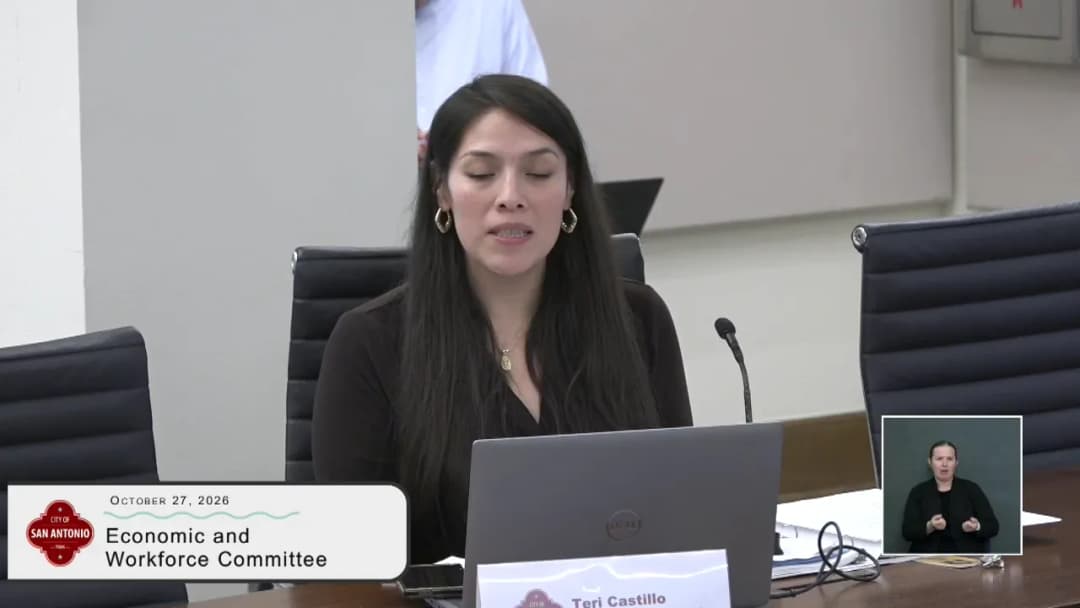
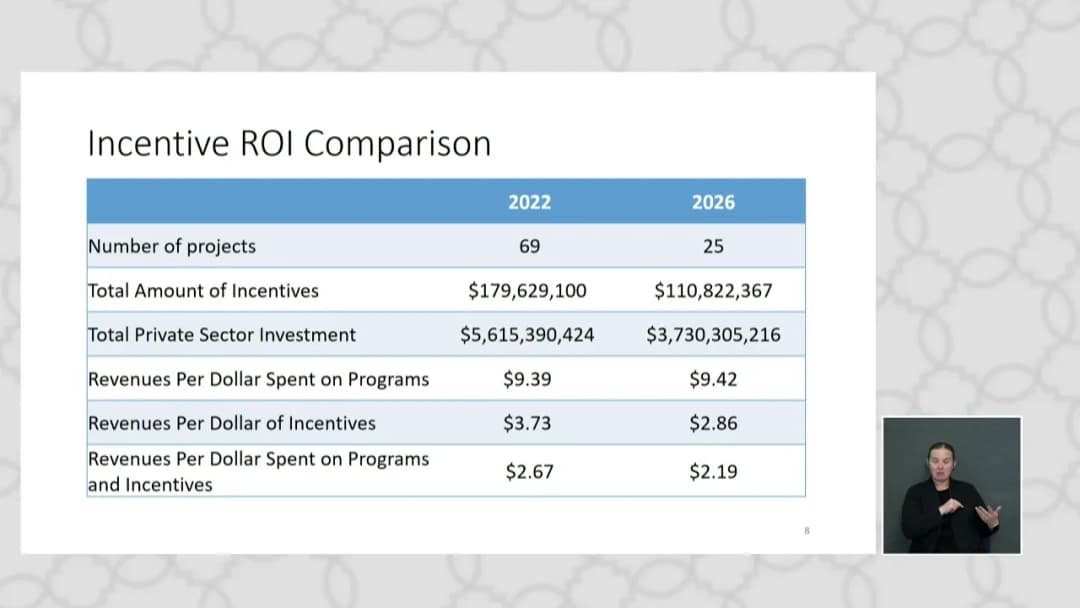
The Economic Development Labor Committee met at 2:03 p.m. with Chief Villagrán presiding and Councilmembers Castillo, Galván, Mesa González, and Spears present. The committee approved the previous meeting minutes, heard no public comment, considered renewal of the Launch small-business resource center contract, and received an informational return-on-investment study of city incentive programs. Consent Calendar - Minutes from the September 22 meeting were approved by unanimous voice vote. Public Comments & Testimony - No members of the public had signed up or provided comment. Contract Renewal – Launch Small Business Resource Center - Charles Wooden, Ralph Bruce, and program staff presented the renewal of a contract with the City of San Antonio that began in 2023 to operate Launch, a resource center for entrepreneurs and small-business owners. The program's goals were accessibility, usable resources for founders wherever they are, and advisory/mentorship support. - Presenters reported three-year results: one-on-one sessions of 30 minutes to one hour; 574 events; more than 10,000 connections with entrepreneurs; 700 hours of partner collaboration; quarterly partner meetings; 30 business owners providing feedback; 60 business owners reached through community events; and events in each of the city's districts, including library events at the Central Library and branches. - The renewal would extend the contract with a one-year option. Planned work included central library activation, partner collaboration, veteran-focused programs, and technology/education workshops. - Councilwoman Spears asked for specific business-expansion numbers and district-level event breakdowns. Staff committed to sharing detailed three-year data. She called for measurable growth in one-on-one sessions, including 2-3% growth, more partner and mentor hours, and more regional events, such as two additional events in the west and one in the center. - Councilwoman Castillo thanked the team for on-the-ground outreach, requested district 5-specific information, and asked about tracking by age group and industry, quality vs. quantity metrics, and alignment with the city's strategic work. - Councilmembers expressed support for continuation, emphasizing small businesses' loss of funds, inflation, new tariffs, and automation/AI replacing workers as reasons to keep the service active. - A motion to send the Launch contract renewal to the City Council was made, seconded, and passed unanimously. ROI Study – Incentive Program Economic Growth - Dr. Steve Nivens presented the third ROI study of San Antonio's economic development incentive programs, prepared with city staff. - Methodology: the study covered monitored and active projects through December 31, 2025, with no new 2026 incentive agreements; projects from 2010 to 2021; 25 projects in the current study; and a conservative model that excluded pre-2010 projects, finished projects that still generate returns, and gains beyond twice the incentive period. Data came from economic development, finance, CPS Energy, the county appraiser, and impact models. - Results over a 20-year period: $33 million in program staffing costs; almost $11 million in total incentives; $316.4 million in city revenue generated; $172 million in net gains to the City; and $3.7 billion in private-sector investment. The transcript states '$3.7 million,' but the reported $336-per-incentive-dollar ratio implies billions. - ROI metrics: $336 in private-sector investment per $1 of incentives; $9.42 in city gains per $1 spent administering the program; $2.86 in gains per $1 of incentives; and $2.19 per $1 spent on incentive programs. - Compared with the 2022 study, the project count fell from 69 to 25, total incentives fell from $180 million to $11 million, and private-sector investment fell from about $5.6 billion to $3.7 billion. The administrative-cost gain rose slightly from $9.39 to $9.42 per dollar; gains per incentive dollar fell from $3.73 to $2.86; and gains per program dollar fell from $2.67 to $2.19. - During discussion, Councilwoman Mesa González asked how the study could guide future investment and whether industry-level analysis was available. Dr. Nivens said no industry-level analysis had been done; staff noted that a proposed incentive policy seen by the City Council would lower caps from $10 million to $5 million to encourage capital-intensive projects. - Councilwoman Castillo asked whether other city costs, including CPS Energy incentives, infrastructure, public safety, and EDD staff time, were included. Staff responded that broader non-EDD costs were not fully included and that EDD staff time was counted proportionally, about 40% in aggregate. - Councilwoman Spears asked how to identify jobs created, best-performing agreements, comparable data from other cities, and district-level breakdowns. She noted that District 7 appears to return $33 per incentive dollar and urged using district-level data and business-leader meetings to recruit medium-sized businesses. - The item was informational only; the committee took no action on it. Key Outcomes - Approved the September 22 meeting minutes by unanimous voice vote. - Recommended the Launch contract renewal to the City Council by unanimous voice vote. - The next committee meeting was announced for November 23, with a bulletin to be sent to members; the meeting ended around 3:00 p.m.

ECONOMIC DEVELOPMENT 77% · PUBLIC ENGAGEMENT 8% · SMALL BUSINESS SUPPORT 7% · VETERAN AFFAIRS 2%
15
OCT 27, 2026 · SAN ANTONIO, TEXAS · COUNCIL COMMITTEES
San Antonio Economic and Workforce Development Committee Meeting - October 27, 2026

The Economic and Workforce Development Committee met on October 27, 2026, from 2:03 p.m. to 3:08 p.m. to consider the Launch SA contract renewal and receive a return-on-investment study of economic development incentives. Committee Chair Viegeran presided, with members Castillo, Galvan, Mesa Gonzalez, and Spears present. No agenda or minutes were available; this summary is based on the meeting transcript. Speakers were allowed two rounds of comments per item: five minutes in the first round and three minutes in the second. Consent Calendar - Approval of minutes: The committee unanimously approved the minutes of the previous meeting by voice vote, with a motion, second, and all ayes. Public Comments & Testimony - No members of the public signed up to speak, and no public comment was heard. Discussion: Launch SA Program Administration and Contract Renewal - Charles Wooden, CEO of Geekdom, introduced the presentation, describing Geekdom's three focus areas when it applied for the Launch SA RFP: accessibility, valuable resources, and one-on-one consulting/advising. - Matt Espinosa, Director of LaunchSA, presented the impact of the three-year contract between the City of San Antonio and Geekdom, which began in 2023 and focused on relaunching Launch SA. Highlights included over 1,000 people served through one-on-one advising sessions, over 2,500 assistance request form submissions, a Launch SA Link partner network of 68 partners, more than 700 hours of partner collaboration, over 500 events with more than 10,000 attendees, and a library roadshow with events in all 10 council districts. - Launch SA also ran Waypoint, an eight-week early entrepreneurship program for businesses from zero to six months old, and small business peer groups of 6 to 10 business owners, including at Sip and Sit coffee shop. Planned initiatives included a veteran entrepreneurship cohort and digital presence/AI education workshops. - Alfred Brewer, Assistant Director for Economic Development, recommended exercising a one-year extension of the agreement with three additional one-year renewal options, funded by $602,280 from the Economic Development Incentive Fund, matched 100% by Geekdom, and moving the item to full City Council. - Councilmember Spears asked for outcome data, district breakdowns, and program metrics. Matt Espinosa said assistance requests split roughly 50-50 between pre-startup businesses and existing businesses; the roadshow reached each district. Alfred Brewer stated that about 16 participants had completed the two Waypoint cohorts to date, and the committee would receive additional data. The transcript also includes Matt Espinosa saying "about 30" business owners went through the Waypoint program, a figure that is not reconciled with the later 16-participant count. - Councilmember Mesa Gonzalez asked about post-startup support, physical space needs, district/industry breakdowns, and collaboration with Supply SA. Matt Espinosa said the peer group was open to businesses past one year, common industries included food and beverage, retail, and business services, and Supply SA was a Launch SA Link partner. - Councilmember Castillo asked about district-specific data, peer group trends, metric tracking, the Waypoint curriculum, and alignment with the city's strategic framework. Alfred Brewer said Launch SA plays a key role as connector/infrastructure in the small business ecosystem. - Chair Viegeran requested future reporting with growth goals, including increasing advising by 2-3%, raising partner/mentorship activity from a cited 747 figure toward 800, hosting at least four regional events plus one downtown, and strengthening work with legacy/family-owned businesses and veterans. - The committee voted unanimously to move the Launch SA agreement to full City Council. Discussion: Economic Development Return on Investment Study - Dr. Steve Niven presented the third return-on-investment study of City of San Antonio incentive programs, covering all monitored active projects through December 31, 2025, excluding terminated/recaptured projects and pre-2010 projects. - Methodology: costs included Economic Development Department staff time on incentive programs; revenues included real and personal property tax, sales tax from created jobs, and CPS Energy revenue. The analysis period ran from 2010 through 2051, using the incentive term doubled and flatlined beyond actual project lives. - Results: $33.6 million in program administration costs and almost $11 million in incentives granted produced $316.4 million in total revenue to the city, $172 million in net revenue, and $3.7 billion in total private sector investment. ROI figures were $33.66 in private sector investment per dollar of incentives, $9.42 in revenue per dollar of program spending, $2.86 in revenue per dollar of incentives, and $2.19 in revenue per dollar spent on both programs and incentives. - Compared with the 2022 study, revenue per program dollar rose slightly from $9.39 to $9.42; revenue per incentive dollar fell from $3.73 to $2.86; and combined ROI fell from $2.67 to $2.19. Dr. Niven attributed the changes to a different project mix and noted the original Toyota project was not included; staff added that the most recently approved Toyota agreement, with $3.6 billion projected investment, was also not included. - Councilmember Mesa Gonzalez asked how the data should guide future investments; Anna Bradshaw noted the current incentive policy proposal lowers the minimum capital investment from $10 million to $5 million to encourage capital investment. - Councilmember Castillo asked about CPS Energy revenue methodology, the E16 rate, staff cost assumptions, and excluded infrastructure/public safety costs. Staff said they would follow up on whether any analyzed projects received E16 incentives and that staff costs were applied proportionally based on time. - Councilmember Spears asked about jobs, which projects performed well, and whether peer-city benchmarks existed. Dr. Niven said the study was unique and no clear benchmark was available; Anna Bradshaw said project-level analysis occurs during incentive consideration, while this study is an aggregate indicator. - Chair Viegeran characterized the ROI as positive but noted lower returns than 2022 because there was no Toyota-scale project; she requested district-specific details, connection to zoning, and ways to highlight infrastructure and community benefits from development. - The item was for briefing only; no action was taken. Key Outcomes - Approved previous meeting minutes unanimously. - Unanimously recommended moving the Launch SA agreement renewal and $602,280 funding to full City Council. - Received the Economic Development Return on Investment Study as informational; no vote was held. - Staff committed to provide additional data on Waypoint participation, district and industry breakdowns, peer group metrics, and E16/CPS Energy follow-up. - The next committee meeting was announced for November 23.

ECONOMIC DEVELOPMENT 69% · PUBLIC COMMENT 6% · SMALL BUSINESS SUPPORT 6% · DATA ANALYSIS 6%
16
OCT 26, 2026 · SAN ANTONIO, TEXAS · BOARDS & COMMISSIONS
San Antonio Board of Adjustment Meeting - October 26, 2026

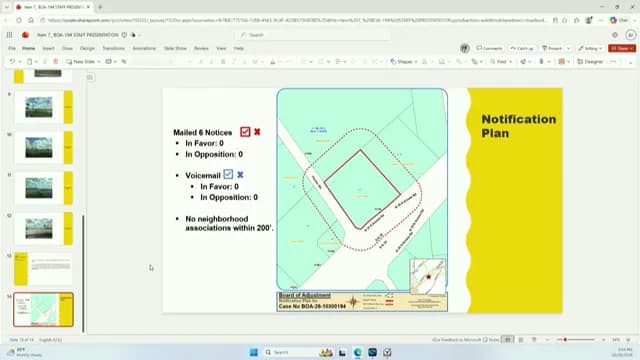
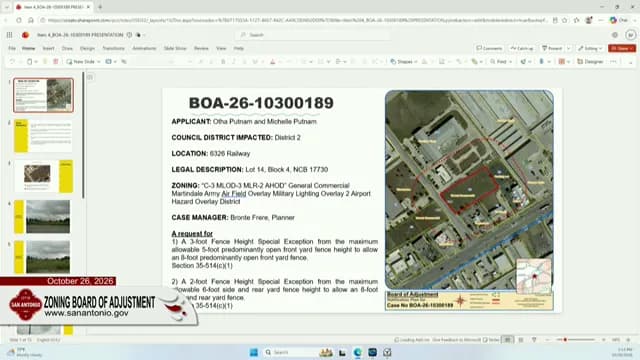
The San Antonio Board of Adjustment met at 1:02 p.m. on October 26, 2026, with a quorum of 11 commissioners. Chair Oren explained that the board is an administrative body, that applicants bear the burden of proof, and that approval requires 75 percent of the full board, or 9 votes. Simultaneous Spanish interpretation was available for the public. The board heard short-term rental permit revocation appeals, zoning variance requests, fence special exceptions, and a buffer-landscaping modification. The meeting adjourned at 3:37 p.m. Public Comments & Testimony - In the Arriaga case, adjoining property owner Angie Trujillo testified in opposition, saying the enlarged carport came too close to her fence and directed rainwater onto her property. She said she would not object if professional gutters were installed and the structure stayed on the applicant's side. - In the short-term rental appeal at 10214 Grenadier, 3 neighboring properties and the neighborhood association opposed the appeal by written notice; no opponent appeared in person. - No opposing residents appeared in person for the Tyrone Fields, Jenny Barrera, Putnam, Horizon Design, and George cases; mailed notices generally produced no written support or opposition. Discussion Items 1. Tyrone Fields short-term rental appeal - 1439 Lamar Street. Staff recommended denial, citing a delinquent hotel occupancy tax account that led to permit revocation after 90 days' nonpayment. Forty-five notices were sent and none supported or opposed the appeal. The applicant said he had paid all taxes, had no code complaints, and did not receive the revocation correspondence because the account was in the property owner's name, Michael White. The board voted 10-0 to grant the appeal, with commissioners noting that the city's notification system needed fixing. 2. Michael Fernández short-term rental appeal - 10214 Grenadier. Staff recommended denial after missed occupancy tax payments and reports, revocation, and an active listing. Thirty notices produced 3 opposing responses and neighborhood-association opposition. The applicant admitted the missed payments were his responsibility and asked for time to speak with neighbors. The board granted a continuance to November 23, 2026, for that purpose. 3. Arriaga variances and fence exceptions - BOA 2610300159. Staff recommended denial of the accessory-structure setback and fence-height exceptions and approval of the clear-vision variance. After the applicant amended the request to include gutters and minimum one-foot clearances, the board approved the fence exception unanimously and then approved the variances unanimously, with conditions addressing drainage and separation from the neighbor's property. 4. Jenny Barrera variances - 811 Teo Parkway. Staff recommended approval of the requested side setback and lot-size variances and denial of the clear-vision variance. The board approved all three variances 11-0, finding the existing 4-foot chain-link fence and lot configuration common in the Mission Historic District. The applicant said the house had been neglected and the work would preserve it. 5. Putnam fence special exceptions - the transcript lists the address as both 6328 Rollwin and 6326 Railway; the formal motion cited 6326 Railway. Staff recommended denial of the front-yard fence exception and approval of the side/rear fence exception. The board approved the requested 8-foot fence exceptions as modified, including an open front fence set back 20 feet from the property line, by a 10-1 vote. The dissenting commissioner said such height/razor-wire fencing should be limited to critical facilities. 6. Horizon Design Development buffer modification - 111 Fisher Road, with the later motion citing 118 Fisher Road. Staff recommended denial of the request to eliminate the Type C buffer, because the UDC already provides relief for utility easements. The board approved a partial elimination by unanimous vote, requiring the 15-foot buffer on the west side and conditioning the approval so the 5-foot reduction provision was not invoked. 7. George variance request - St. Mary's Street property. The board approved variances for an extensively remodeled 1910 residence, including lot size, a one-inch side setback, rear setback, and carport setback, unanimously, with no opposition after 35 notices. Key Outcomes - Tyrone Fields appeal granted: 10-0. - Michael Fernández case continued to November 23, 2026, to allow applicant-neighbor consultation. - Arriaga fence exception and variances approved unanimously with conditions. - Barrera variances approved 11-0. - Putnam fence special exceptions approved 10-1. - Horizon Design buffer modification approved unanimously, with conditions. - George variances approved unanimously. - Meeting minutes approved unanimously.

ZONING AND LAND USE 20% · NEIGHBOR DISPUTES 19% · SHORT-TERM RENTAL REGULATION 15% · HISTORIC PRESERVATION 12%
17
OCT 26, 2026 · SAN ANTONIO, TEXAS · BOARDS & COMMISSIONS
San Antonio Board of Adjustment Meeting Summary - October 26, 2026

The San Antonio Board of Adjustment convened on October 26, 2026, at 1:02 PM. A quorum of 11 members was present, with Chair O'Reilly presiding. The board addressed seven cases involving appeals of short-term rental (STR) permit revocations, variances for residential and commercial development, and fence height special exceptions. A 75% concurrence vote (9 votes) is required for motions to carry. The meeting adjourned at 3:37 PM. Public Comments & Testimony - Tyrone Fields (Item 1): Applicant for 1439 Lamar Street stated he was unaware of the monthly HOT reporting requirements, relying solely on platform remittances. He dedicated the STR to his late mother and argued a lack of direct correspondence. - Michael Fernandez (Item 2): Applicant for 10214 Grenadier admitted to a breakdown in communication with his wife regarding HOT payments, calling it their fault. He noted the property income supports his special needs children and expressed remorse. - Angelina Trujillo (Neighbor, Item 3): Owner of 206 McNarney Street testified that modifications to the applicant's carport and rear shed caused significant water runoff onto her property. She expressed dissatisfaction with the placement of gutters on her side of the fence. - Michelle & Albert Ariaga (Item 3): Applicants for 202 McNarney Street stated the carport was built over a decade ago and they attempted to mitigate the neighbor's issues. - Jamie Barrera (Item 5): Applicant for 811 Theo Parkway argued that the chain-link fencing and lot configurations were consistent with the historic neighborhood. - Michelle & Ortha Putnam (Item 4): Applicants for 6326 Railway requested an 8-foot fence with barbed wire for a planned auto service center, citing high vehicle theft rates in the area. - George Shilabad (Item 6): Applicant for 222 Sam Myers Street, planning a full rehab of a 1910 home, noted he owns the adjacent lot and sought variances for the substandard lot. Discussion Items - Item 1 – STR Revocation Appeal (1439 Lamar St): Staff detailed the revocation due to non-payment of HOT taxes. Commissioners noted the applicant did not receive notices as they were sent to the property owner. The board discussed systemic issues with contact information for operators versus owners. Staff recommended denial. - Item 2 – STR Revocation Appeal (10214 Grenadier): Commissioners questioned the applicant on 10 missed notices and neighborhood opposition from the HOA. The board offered a continuance to November 23, 2026, which the applicant accepted. Staff recommended denial. - Item 3 – Comprehensive Variance (202 McNarney St): The board extensively debated the multiple variance requests for a carport, sheds, and fences. The neighbor's water runoff concerns were central. The applicant amended the application to include gutters on the carport and ancillary structures. The board crafted specific limits on the fence height special exception to match neighborhood scale. Staff recommended denial for the structures and fence, approval for clear vision. - Item 5 – Variance for Renovation (811 Theo Parkway): Staff recommended denial of the clear vision variance due to safety concerns. Commissioners proposed and the applicant accepted a condition limiting the fence height in the clear vision area to 4 feet to mitigate the risk. Staff recommended denial for clear vision. - Item 4 – Fence Height Special Exception (6326 Railway): Staff recommended a split decision (approve sides/rear, deny front). Commissioners struggled with the 9-foot total height (8ft fence + 1ft barbed wire) at a business on an arterial. A compromise was reached to require the front fence to be set back 20 feet from the property line. Staff recommended denial for the front yard fence. - Item 7 – Buffer Elimination (1118 Fisher Rd): The landscape designer explained constraints from a CPS gas line and detention pond. Staff and the Chair proposed a compromise to provide a 15-foot buffer on the west side of the driveway and eliminate the buffer requirement elsewhere. Staff recommended denial of full elimination. - Item 6 – Variance for Rehab (222 Sam Myers St): Commissioners focused on preventing a 2-story wall on the 1-inch western setback line. The motion was carefully worded to limit the 1-inch setback to the first story only and require gutters for the new carport. Staff recommended denial. Key Outcomes - Item 1: Appeal Granted (Motion by Manna, Seconded by Braggman). Vote: 10 for, 0 against, 1 abstention. - Item 2: Appeal Continued to November 23, 2026. Vote: Unanimous. - Item 3 (Part 1 - Fence): Special Exception Granted. Vote: 11-0. - Item 3 (Part 2 - Remaining Variances): Variances Granted with conditions for gutters and specified setbacks. Vote: 11-0. - Item 5: Variances Granted with condition limiting fence height to 4 feet in the clear vision space. Vote: 11-0. - Item 4: Special Exception Granted with condition restricting the front fence to no closer than 20 feet from the property line. Vote: 10-1. - Item 7: Partial Buffer Elimination Granted (with 15-foot buffer required on the west side). Vote: 11-0. - Item 6: Variances Granted with conditions limiting the second story and requiring carport gutters. Vote: 11-0. - Minutes: Approved from the previous meeting. - New Alternate Board Members: Welcomed to their first meeting.

ZONING AND LAND USE 57% · SHORT-TERM RENTAL REGULATION 13% · PROCEDURAL 8% · TAXATION 7%
18
OCT 23, 2026 · SAN ANTONIO, TEXAS · BOARDS & COMMISSIONS
San Antonio Historic Compliance Board Meeting - October 23, 2026

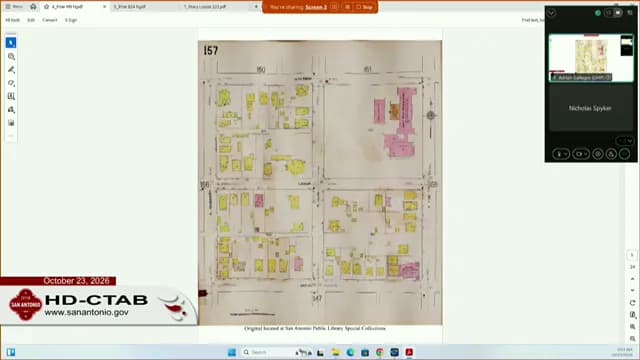
On October 23, 2026, the Compliance and Technical Advisory Board (Junta de Cumplimiento y Asesoría Técnica) convened at 8:30 AM (assumed, based on meeting start time) with a quorum present. Chair Juanita Sepulveda and Vice Chair Jason Vázquez led the meeting. The board reviewed five individual cases concerning certificates of appropriateness for properties in historic districts. No public comments were received beyond those related to agenda items. Consent Calendar - Approved minutes from September 18, 2026. - Approved consent agenda items for 732 East Guten Street and 730 East Gulden Avenue (certificates of appropriateness issued). Discussion Items Case CITAP 2026-288 – 1331 Fulton Avenue - Request: Replace 13 historic wood windows and 3 metal windows with vinyl windows. - Staff Recommendation: Denial, based on guidelines stating the windows are repairable (less than 50% deterioration) and vinyl is not consistent with historic character. - Applicant Position: Leticia Sandoval Cuetz, homeowner since 2005, requested approval citing financial hardship ($16,000 for vinyl vs. $50,000 for wood), health concerns (lead paint, child with asthma and special needs), and difficulty maintaining wood windows. She emphasized the need for a long-term, low-maintenance solution. - Public Testimony: None. - Board Discussion: Commissioners expressed empathy but noted staff findings that windows are repairable. They questioned the applicant about alternative weatherization and energy efficiency programs (e.g., CPS Energy). Some commissioners noted the short lifespan of vinyl windows (10-15 years) and the availability of local wood window restoration specialists. - Outcome: Motion to approve staff recommendation (denial of vinyl replacement). Vote: 8-0. The board directed the applicant to work with staff to explore restoration and available resources. Case 2026-279 – 919 North Pine Street - Request: Replace roofing on three accessory structures with standing seam metal. - Staff Recommendation: Approval, subject to compliance with installation specifications and coordination with staff. - Applicant Position: Nicolas Spiker (participated virtually) stated the metal roof is more durable, citing past hail and tornado damage; the front structure already has standing seam metal (installed without historic approval). He noted the accessory structures are not publicly visible. - Public Testimony: None. - Board Discussion: Staff clarified that the structures are part of the historic collection (original house built 1898, district guidelines adopted 2012). Some commissioners questioned the consistency of the metal profile (standing seam vs. corrugated). Staff recommended standing seam only. - Outcome: Motion to approve with staff stipulations. Vote: 8-0. Case 2026-285 – 824 North Pine Street - Request: Install a front yard fence with a vehicular gate along the sidewalk. - Staff Recommendation: Approval for a 4-foot fence only, with no vehicular gate (gate to be located at rear porch). - Applicant Position: The applicant’s representative (Ashley’s fiancé) requested a gate at the front due to homeless encampments and to secure a dog. They noted many neighbors have similar front gates. - Public Testimony: None (but staff noted a letter from a neighbor supporting the staff recommendation). - Board Discussion: Commissioners observed inconsistencies in the neighborhood but emphasized following guidelines. The motion specified compliance with the staff recommendation (gate at rear). - Outcome: Motion to approve per staff recommendation. Vote: 8-0. Case 2026-284 – 222 Mary Louise Street - Request: Construct an 18-inch tall stucco retaining wall with a red river rock cap in the front yard. - Staff Recommendation: Denial; the board recommended maintaining the historic berm with low-growing vegetation to control erosion. - Applicant Position: The owner (a landscape architect) stated the wall would prevent erosion, improve the formal garden aesthetic, and match the stucco house. He declined alternative plantings, preferring a clean architectural feature. - Public Testimony: Bianca Malone (Monticello Park neighborhood president) spoke in opposition, showing photos of other properties with walls that predated the historic district or were unapproved. She argued that a wall would detract from the house’s character and asked for consistency with prior denials. - Board Discussion: Commissioners praised the house’s beauty but noted that the wall would introduce a non-original element. They suggested landscape alternatives (berms, plants) and noted that other similar requests had been denied. - Outcome: Motion to approve staff recommendation (denial). Vote: 8-0. Case 2026-259 – 601 Burnett Street - Request: Install an 8-foot tall privacy fence along approximately 30 linear feet of the rear property line. - Staff Recommendation: Denial; maintain existing fence configuration (assumed 6-foot standard). - Applicant Position: The homeowner (since 2020) stated that neighboring houses are elevated, making the standard 6-foot fence insufficient for privacy. He cited a young child, a small pool, and poor neighbor relations (past dog attack). He noted the fence would be screened from public view and would not affect the historic facade. - Public Testimony: None. - Board Discussion: Commissioners explored alternatives such as fast-growing plants (jasmine, laurel). The applicant expressed concern about space and maintenance. One commissioner asked about movable screens. The board emphasized preserving historic character and encouraging vegetation. - Outcome: Motion to approve staff recommendation (denial). Vote: 6-2 (Davis and Sepulveda voted no; Spiller, Siga, Fullerton, Spitz, Vázquez, and Bergard voted yes). The motion passed. Key Outcomes - Minutes and Consent Calendar: Approved unanimously. - 1331 Fulton Avenue: Denied vinyl window replacement; board directed staff to assist applicant with restoration and energy efficiency resources. - 919 North Pine Street: Approved metal roofing on accessory structures with conditions. - 824 North Pine Street: Approved 4-foot front fence with rear vehicular gate per staff. - 222 Mary Louise Street: Denied retaining wall; board encouraged landscape alternatives. - 601 Burnett Street: Denied 8-foot privacy fence; board recommended vegetation for screening. - Case 6 on the agenda was postponed. The meeting adjourned at 10:23 AM.

HISTORIC PRESERVATION 55% · ZONING AND LAND USE 20% · PROCEDURAL 10% · NEIGHBOR DISPUTES 8%
19
OCT 23, 2026 · SAN ANTONIO, TEXAS · BOARDS & COMMISSIONS
San Antonio Compliance and Technical Advisory Board Meeting - October 23, 2026

The Compliance and Technical Advisory Board met on October 23, 2026, with Chair Juanita Sepulveda presiding and Vice Chair Jason Vasquez present. After roll call established a quorum, the board approved prior meeting minutes, acted on a consent agenda, and considered certificate of appropriateness (COA) requests. One agenda item was postponed at the applicant's request. The meeting adjourned at 10:23 a.m. Consent Calendar - The board approved the September 18, 2026, meeting minutes by unanimous roll call. - The board approved the consent agenda unanimously. The approved properties were 732 East Gunther Street and 730 East Woodlawn Avenue. No public comments were received for these items, and certificates of appropriateness will be emailed within 10 days. - Item 6 was postponed at the applicant's request and was not heard. Public Comments & Testimony - Bianca Maldonado, president of the Monticello Park Neighborhood Association, spoke in opposition to the retaining wall request at 222 Mary Louise. She said the home was a contributing Atlee B. Ayres home, called the front berm a character-defining feature, cited nearby walls that were built before the historic district or were not approved, and asked the board to be consistent with prior denials. - The applicant representative for 824 North Pine spoke in favor of the proposed front gate, citing safety concerns and nearby examples. A DHA letter on 824 Pine agreed with staff's recommendation. - Additional case-specific applicant testimony is summarized in the discussion items below. Discussion Items - 1331 Fulton Avenue (CTAP 2026-288): The applicants, longtime homeowners who are caregivers for their adult son, requested a COA to replace 13 historic wood windows and 3 metal windows with vinyl. They cited an estimate of about $16,000 for vinyl double-pane windows versus about $50,000 for wood double-pane windows, a $34,000 difference, and said maintenance, lead-paint exposure, and health concerns made replacement necessary. Staff reported that a site visit found the wood windows repairable, with less than 50% deterioration, and recommended repair and retention plus weatherization and retrofit options. The board voted unanimously to approve staff recommendations, denying the vinyl replacement and directing the applicants to work with the Office of Historical Preservation on further solutions. Staff also noted the applicants could pursue administrative approval for replacement of the three metal windows. - 919 North Pine (CTAP 2026-279): The applicant requested approval to replace shingle roofs on three rear accessory structures with standing-seam metal roofs. Staff recommended approval with a standard-installation stipulation and an OHP inspection before work begins. The applicant disagreed with the ridge condition but accepted the process. The board voted unanimously to approve staff recommendations. This item was initially deferred until the applicant could connect by phone and was heard after the next item. - 824 North Pine: The applicant requested a 4-foot-tall front-yard iron fence with a pedestrian gate and an operable vehicular gate at the sidewalk. Staff recommended approval with the vehicular gate located fully behind the front facade wall plane at the rear of the front porch. The applicant's representative said the gate was needed for safety and privacy and cited similar gates in the neighborhood. The board approved the staff recommendation with the stipulation, with the motion referencing consistency with the neighborhood. - 222 Mary Louise (CTAP 2026-284): The applicant, a landscape architect, requested a COA for an approximately 18-inch-tall front-yard retaining wall with a stucco finish and red brick cap. Staff did not recommend approval and recommended maintaining the historic berm with low-growing plants. The applicant described the wall as an aesthetic and formal landscape feature and said if denied he would plant grass. After public testimony opposing the wall, the board voted to approve staff recommendations, denying the request. - Privacy fence screening request (Gary Ames): The applicant requested a COA to add two feet of horizontal wood-slat screening on top of an existing 6-foot-tall wood privacy fence. He said the property has about 150 linear feet of fencing and he sought screening for only 48 feet, or about 32%, making the fence no more than 8 feet tall, to protect family privacy from a neighboring two-story view. Staff did not recommend approval and recommended retaining the existing rear fence configuration. The board voted to approve staff recommendations, denying the request, with Davis and Sepulveda voting against. The chair urged the applicant to work with staff on alternative solutions. Key Outcomes - The board denied the vinyl window replacement at 1331 Fulton Avenue and approved staff's repair-and-retain recommendation, while allowing potential administrative review for the three metal windows. - The board approved the metal roof replacement at 919 North Pine with the stipulated standard installation and inspection requirements. - The board approved the 824 North Pine front fence with a stipulation that the vehicular gate be placed behind the front facade wall plane at the rear of the front porch. - The board denied the 222 Mary Louise front retaining wall request. - The board denied the privacy fence screening increase and referred the applicant to OHP staff for next steps.

HISTORIC PRESERVATION 69% · PROCEDURAL 13% · PRIVACY 5% · PUBLIC SAFETY 4%
20
OCT 22, 2026 · SAN ANTONIO, TEXAS · COUNCIL COMMITTEES
San Antonio Community Health Board Meeting - October 22, 2026

The Community Health Board met on October 22, 2026, with a full quorum present. Agenda and minutes were not available in the source material, so this summary is based on the meeting transcript. The meeting opened with public testimony, unanimously approved the previous meeting's minutes, and included presentations on food insecurity, the 2026 poverty report, and the Financial Empowerment Center. The meeting was adjourned at 11:39 a.m. Consent Calendar - Members unanimously approved the minutes of the last meeting. No opposition or abstentions were recorded. Public Comments & Testimony - Tyler Ferguson, executive director of Blueprint Ministries and a Metro Health partner, described how the Metro Health Equity Network helps organizations collaborate on food and housing security. He said clients are forced into impossible choices, such as repairing a home, buying children's clothes, or taking medication. He encouraged the city to continue supporting equity-network models so public investments go further. - Gudelia Ramón, director of Family Services, said the equity network helped her agency build relationships and create more resources for San Antonio. She cited produce markets that served 167 ZIP codes over four events, with a grant from Blue Shield supporting a more sustainable model. She called attention to food deserts and the need for affordable, nutritious food. - Jenny Castro, executive director of Powerhouse, said her organization serves girls and families who must choose between food, rent, and medicine. She expressed support for the health equity network as a way to reduce barriers, connect families to resources, and create collective change. - Mario Obledo, representing the San Antonio Food Bank, said the food bank is part of a safety net covering 250 counties through 20 food banks in Texas. He noted rising demand, praised city departments and volunteers, and said the food bank responds to both daily poverty and natural disasters. - Mercedes Briston, executive director of the association for grandparents raising grandchildren, said kinship caregivers are often overlooked. She noted that for every child in foster care, 120 are in informal kinship care, and many families visit multiple food banks weekly to cover meals. She described taking 160 grandparents to the state capital over three legislative sessions and urged continued collaboration instead of working in silos. Food Insecurity Presentation and Discussion - Metro Health staff presented the city's coordinated food insecurity strategy. The speaker reported that food insecurity was one of four CHIP priorities at 22.6% in 2024 and that trends are moving in the wrong direction. - New Feeding America data were cited showing that one in four Texas children, one in seven older Texans, and one in three Black Texans experience food insecurity. - SNAP participation was approximately 33% and has fallen by more than 20% since September. The speaker noted that the USDA stopped producing national food insecurity reports for 2026, making local data collection more important. - Bexar County ALICE data show that 44% of residents are living below the threshold needed to cover basic needs. The city's stated goal is to reduce food insecurity by 20 points by 2030. - The presentation described distribution efforts, including more than 50,000 pounds of fruits and vegetables, over 70 community partners, and work to coordinate referrals, SNAP enrollment, and benefit access. - Council members asked about rising SNAP delays and the relationship between food insecurity and economic empowerment. Some members called for stronger state and federal advocacy on SNAP processing times and for connecting residents to living-wage jobs. 2026 Poverty Report Discussion - Laura Serrano, chief demographer of the Department of Human Services, presented the 2026 poverty report. She said the official poverty measure undercounts hardship in San Antonio. - About 250,000 San Antonio residents live below the federal poverty line. 32% of census tracts within the city have high poverty rates, and most have been persistently poor for three decades. - San Antonio has the second-highest poverty rate among large Texas cities, after Houston. Dallas was cited as a city that measurably reduced poverty. - The report used United Way's ALICE framework to show that many families earn above the official poverty line but still cannot cover basic needs. In Bexar County, a family with a young child was said to need about $54,000 to cover basic needs, far above official poverty thresholds. - Housing costs were cited as a major driver: homebuying costs rose 24.5% from 2019 to 2024 while incomes grew only 0.4%. Half of renters pay more than 30% of income for housing, and one in four pays more than 50%. - Poverty disproportionately affects children under five, older adults, single-mother families, women, Black residents, and people with no more than a high school diploma. The report noted that 87% of single-parent families are headed by single mothers, women earn about 81 cents for every dollar men earn, 23% of Black residents live in poverty, and 65% of people in poverty have no more than a high school diploma. - DHS recommendations included strengthening coordination among programs, prioritizing services by vulnerability, using flexible funding, and applying a collective-impact approach to reduce poverty. Financial Empowerment Center Presentation - Department of Human Services staff presented the city's Financial Empowerment Center, a national model launched in New York City in 2008 under Mayor Bloomberg and expanded in 2013 to five cities, including San Antonio. The program now operates in 52 communities, with additional sites in Waco, Dallas, and Houston. - The center provides confidential one-on-one financial counseling in four areas: building credit, reducing debt, accessing safe financial resources, and long-term planning. Counselors are certified, complete 24 hours of practical training, 30 hours of continuing education, and one hour of ethics training, and must pass an exam. - Since 2013, the center has worked with more than 28,000 clients and helped reduce $45.9 million in debt. Recent 2026 figures included more than $767,000 in debt reduction. - Planned 2027 outreach focuses on older adults, Head Start families, college students, and partnerships with other city departments and community organizations. - Council members discussed expanding services to the east and south sides, working proactively with employers and credit unions, and helping residents avoid predatory financial products. Key Outcomes - The board unanimously approved the previous meeting's minutes. - Council members requested that food insecurity and poverty data be brought to a city council "Session B" briefing and asked for ALICE data by council district or neighborhood. - A council member said she and Councilmember Mesa González plan to partner with a nonprofit to measure the collective impact of city-funded programs and ensure tax dollars are used strategically. - Officials agreed to explore closer coordination with housing, neighborhood services, and strategy departments on poverty and housing programs. - The Financial Empowerment Center will continue expanding outreach to vulnerable populations and community partners.

FOOD SECURITY 33% · POVERTY 21% · FINANCIAL EMPOWERMENT 11% · PUBLIC HEALTH 10%
OPENPUBLICA · PUBLIC MEETING INDEXUPDATED DAILY · openpublica.com