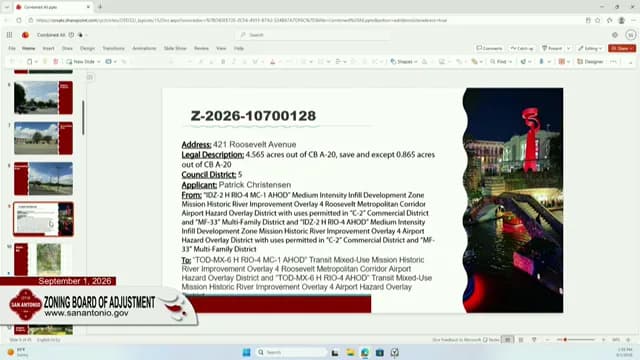
[The ]San Antonio Zoning Commission met on September1,2026 at 1:01 PM under Chair John Bustamante. The hearing covered a consent agenda, a continuance request, and an indidual hearing on a controverted rezoning proposal. All agnda items were voted on with the commission acting as a recommendng body to City Council. Consent Calendar - Item 2 (3857 East Souh Cross Boulevard): Rezone from O-2 to C-2; 30 notces maild, 0 in faor, 0 osed; PCAN Valley Neighborod Association not opposed. Approved unanimously. - Item3 (421 Roosevet Avenue): Rezoe from IDZ-2 to TOD MX6 with amendd legal description; 2 notces mailed, 1 in faor, 0 opposed; Rossvelt Park Neighborod Association in faor. Approved as amended. - Item4 (4847 Lyceum Drive): Rezone from R5 to R5 CD with conditional use for two dweling units; 19 notces mailed,5 in faor,0 opposed; Dream Hill Estates NA did not respond. Approved. - Item5 (1232 Rebus Street): Rezone from R5 to R2; 49 notces mailed, 2 in faor, 0 opposed; Prosepect Hill and West End Hope in Action NAs in faor. Approved. - Item7 (8666 Hebner Road): Rezone from C3 to C2 CD with conditional use for food processing; 9 notces mailed,0 in faor,0 opposed; no registered NA within 200 feet. Approved. All comsens items passed on a single motion (Huey/Inojosa) with a unanimous roll call vote. Public Comments & Testimony - On Item1 (5050 Hemp Hill Drive), neighbor Luclle Oyervides (510 Hamfield Drive) oppoed the rezoning, stating the lot is not sutabe for two houses and that parking issues would worsen. She expressed concern about increased traffic and cars parking near her fence. Discussion Items - Item1 (5050 Hemp Hill Drive): Applcant Patick Christesen (315 East Commerce) requested a rezone from R5 to R3 on a 7,50 square foot corer lot to subdivide into two 3,750 sq ft lots for two single-faily homes. He argued the area lacks new constrction, the lot is underutilized, and the corner lot allows access from two streets (Hemp Hill and Edgecliffe). Staff recommended denial, citing that the surrounding area is exclusively R5 with larger lots, and th smaller lot size would disrupt community character. Staff noted no R3 zoning exists in the vicinity. Commissioners discussed the uniqueness of the corner lot, the exising density in the area (some duplexes observed on Google Maps), and the policy goal of encouraging infill deveopment inside Loop 410. Commissioner Duval expressed concern that this would be an outlier, whie Commissioner Sipes advocated for approval given the corner lot and the vacant condition of the property. Key Outcomes - Item 1: Motion to approve (Sipes/Kellum) carried 8-1 (Dval dissenting). The comission recommends City Council approve the rezone to R3. Neighbors were encouraged to contact their council representative. - Item 8 (601 Delaware Street): Motion to continu to Septembe 15, 2026 (Huey/Duval) passed unanimously. - Minutes: The August 18, 2026 minutes were approved by acclimation. - Directors Report: None. Meeting adjourned at 1:31 PM.
Public Meetings - San Antonio, Texas
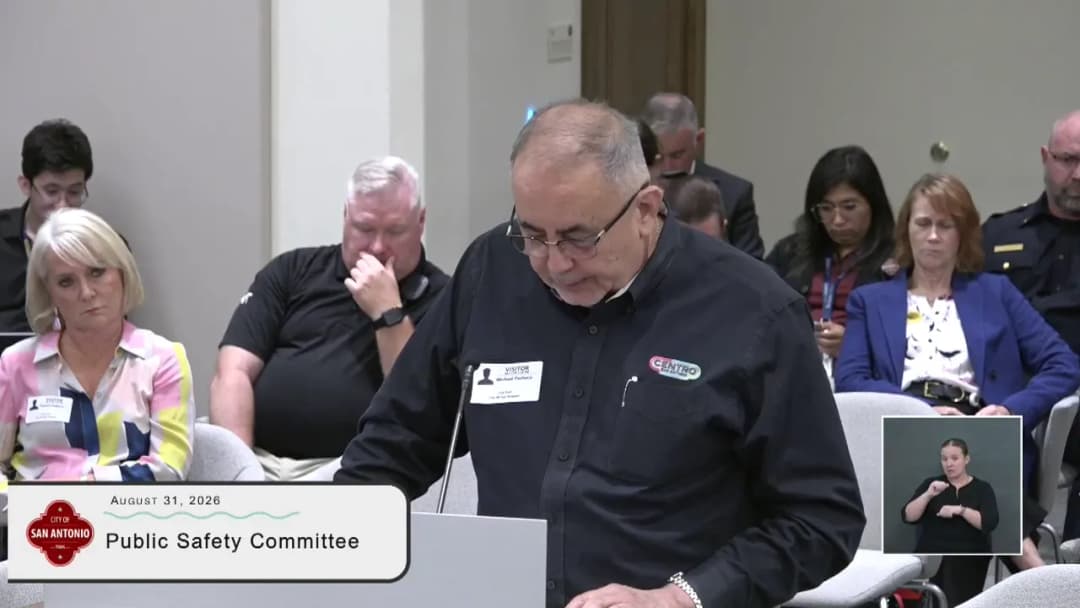
Public Meetings - San Antonio, TexasThe San Antonio Public Safety Committee met on August 31, 2026, at 2:08 PM, with a quorum present. The meeting covered three major items: a "Love and CCR" to protect transgender, non-binary, and intersex residents; a pilot diversion center program for low-level offenders; and a clarification of the graffiti ordinance regarding chalk. All items were approved and forwarded to the full City Council for action. Consent Calendar - Approval of Minutes from June 16, 2026: The committee unanimously approved the minutes without discussion. Public Comments & Testimony - Love and CCR: Multiple residents and organization representatives spoke in strong support. Speakers included: - Sofia Sepoveda (Equality Texas, District 1 resident) – argued the ordinance protects privacy and safety, especially for trans and immigrant communities. - Drew Norris (District 10) – described being questioned in women's restrooms and urged support. - Dominique Huerta (ACLU of Texas) – emphasized safety and privacy benefits of single-user restrooms. - Rachel Cundy (District 7, medical student) – noted health consequences of avoiding care due to privacy fears. - Kate Sanchez (Planned Parenthood South Texas) – called the ordinance a simple, evidence-based solution. - Tracy Bradley (District 8, retired RN) – highlighted privacy needs for people with medical conditions. - Nico Bonner (District 1) – argued public safety includes proactive environment design. - Ananda Thomas (Act for SA) – connected privacy to public safety, citing documented risks. - Diversion Center Pilot: - Alex Hester (UT Health Houston, contractor for feasibility study) – supported the pilot, noting that other Texas diversion centers recommend moving quickly to a pilot to tailor operations. - Graffiti Ordinance: - Pedro Ruiz (Project Unida) – supported removing chalk from graffiti definition, citing mutual aid and public art. - Joshua (self-identified as frequent recipient of chalk-related citations) – noted SAPD has not cited him for chalk since 2024, but San Antonio Park Police have; argued the ordinance is overly broad. - Michael Pacheco (General Manager, Centro San Antonio) – raised concerns about maintenance, sanitation, and hate speech, recommending restrictions in the downtown PID. Discussion Items - Love and CCR (Looking Out for Vulnerable Impacted Neighbors): Presented by Dr. Jennifer Matha (Compliance Opportunity and Access Department). The CCR seeks protections for transgender, non-binary, and intersex individuals, including self-selected name/gender options on IDs, privacy of health/personal information, and expansion of single-user restrooms. Key points: The city already has administrative directives (AD 4.67, AD 7.12) protecting privacy and anti-discrimination; SB8 compliance already identified 406 single-user restrooms in city facilities. The recommended action is to add single-user restrooms in future city construction and major renovations. Councilmember McKee Rodriguez (sponsor) noted the issue was necessitated by state attacks. Councilmember White questioned scope and cost; staff clarified the recommendation is for city facilities only, not private businesses. Councilmember McKee Rodriguez argued that taxpayer-funded private projects should also comply. Councilmember Castillo urged moving quickly for inclusion in bond projects. The committee voted to forward to A session with individual briefings. - Diversion Center Pilot: Maria Vargas (Deputy City Manager) introduced an update on an ad hoc city-county committee exploring a pre-arrest diversion center. Center for Health Care Services (CHCS) presented a pilot program: 15 beds at Josephine Recovery Center for non-residential criminal trespass and theft under $100, targeting downtown and central SAPD substations. The pilot would cost about $625,000 from the city (funded via Westside TIRZ) for a six-month period (total $1.9 million split among city, county, and University Health). CHCS noted 78 individuals per month with mental health needs in low-level trespass cases; SAPD cited 1,700 criminal trespass arrests in 2025, with many having mental health/unsheltered flags. StRAC would convene governance. Councilmember Castillo (co-chair of ad hoc committee) emphasized pre-arrest diversion reduces jail costs. Councilmember White asked for defined success metrics; staff agreed governance group would set them. Councilmember McKee Rodriguez raised concerns about the service area not covering the facility's neighborhood (Government Hill) and suggested adding Intercity TIRZ funding. Compromise: CHCS will return in three months with a progress update. Motion to approve and forward to September 10th A session passed. - SAPD Graffiti Ordinance Clarification: Chief Salome presented recommended removal of chalk from the definition of "graffiti implement" (paint stick). The current ordinance could treat chalk as a graffiti implement; enforcement data showed only 12 possession citations from 2024-2026 (22% conviction rate). The change clarifies that implements must leave an indelible mark. The committee discussed that hate speech or obscene chalk could still be addressed under disorderly conduct or criminal mischief. Councilmember McKee Rodriguez noted the conflict is between Centro and a single activist, and that the ordinance change does not resolve underlying tensions. Councilmember White and Castillo supported the clarification but emphasized mutual respect. Motion to forward to September 10th A session passed. Key Outcomes - Love and CCR: Motion carried to forward to an A session (September date not specified in transcript) with staff individual briefings to council members. (Vote: all in favor, none opposed). - Diversion Center Pilot: Motion carried to approve funding from Westside TIRZ and place on the September 10, 2026 A session agenda. (Vote: all in favor, none opposed). CHCS to begin outreach to neighborhood businesses. - Graffiti Ordinance: Motion carried to send the ordinance clarification to the September 10, 2026 A session. (Vote: all in favor, none opposed).
El Comité de Desarrollo Económico y Laboral se reunió el 31 de agosto de 2026 a las 10:38 a.m. bajo la presidencia de la Presidenta Villagrán, con la presencia de los concejales Castillo, Galván, Mesa González y Spears. La reunión cubrió la aprobación de actas, una postergación de un presupuesto, una recomendación de subvenciones, una actualización del marco de desarrollo económico, un informe sobre gastos locales, una discusión sobre contrataciones relacionadas con ICE, y una actualización del sistema de adquisiciones. Consent Calendar - Aprobación de actas: Se aprobaron las actas con correcciones mediante moción y secundación, con todos a favor. - Asunto 2 – Presupuesto del programa Work for Solution Salamo año fiscal 2027: Se aprobó por consentimiento postergar el asunto a una sesión B del consejo en septiembre de 2026 para una presentación más detallada. Monto: $195,380,770. - Asunto 3 – Subvenciones de crecimiento: Se aprobó por consentimiento recomendar al pleno del ayuntamiento a 9 de 20 solicitantes que calificaron. Los 11 no calificaron por no cumplir con al menos dos años de crecimiento en los últimos 5, ganancias menores a $1 millón o no haber recibido SPI federal. Public Comments & Testimony - No hubo comentarios públicos. Discussion Items - Asunto 4 – Actualización del Marco de Desarrollo Económico (presentación informativa): El personal presentó una actualización del marco estratégico para el desarrollo económico de San Antonio, destacando mejoras en cuatro metas principales: innovación e industria, ubicación y bienes raíces, talento y fuerza laboral, y capacidad y recursos. Se discutieron estrategias como Ready to Work 2.0, infraestructura, inteligencia artificial, y la necesidad de retener y expandir empresas locales. Los concejales expresaron preocupaciones sobre la inversión en infraestructura, la definición de "local" y la importancia de medir el éxito. No se tomó acción. - Asunto 5 – CCR sobre fondos municipales para empresas locales: Se presentó una solicitud del Concejal Alderete Gavito para crear una definición uniforme de "local", reportar gastos a empresas locales, y llenar vacíos en las iniciativas. El personal recomendó definir "local" como dirección dentro de los límites de la ciudad de San Antonio. Los concejales discutieron la necesidad de claridad y solicitaron una página resumen para el próximo paso. - Asunto 6 – Actualización sobre contrataciones relacionadas con ICE: El personal presentó dos opciones para mayor transparencia en contratos estatutorios y no estatutorios. Se discutió que las ciudades de Texas no tienen políticas restrictivas, pero otras ciudades (California, Filadelfia) sí. Se acordó llevar el tema a una sesión B para explorar políticas potenciales. - Asuntos 7 y 8 – Actualización del proceso de adquisiciones: Se presentó una revisión del sistema SAP (costo estimado de $70 millones) y un plan para involucrar a 1,600 proveedores y grupos comunitarios. Se discutió la importancia de transparencia y participación. Próximos pasos: encuestas y juntas presenciales en septiembre y octubre. Key Outcomes - Asunto 2: Aprobado por consentimiento para postergar a sesión B del consejo en septiembre 2026. - Asunto 3: Aprobado por consentimiento para recomendar las 9 subvenciones al pleno. - Asunto 5: Se solicitó al personal preparar una página resumen con opciones de definición de "local" para discusión futura. - Asunto 6: Se acordó llevar a una sesión B para mayor análisis de políticas de transparencia en contratos con ICE. - Asuntos 7 y 8: Se continuará con el plan de participación comunitaria y actualización del sistema SAP. - Sesión ejecutiva: Se realizó de 12:20 a 12:32 p.m. sin acción tomada. La reunión concluyó a las 12:32 p.m.
The Public Safety Committee met on August 31, 2026, from 2:08 PM to 4:24 PM, with Council Members Maki Rodriguez, Castillo, Spears, White, and President Corr present. The meeting was conducted in Spanish; this summary is based on the Spanish-language transcript. The committee unanimously approved the June 16, 2026, meeting minutes, advanced a council consideration request (CCR) to protect vulnerable neighbors (including transgender, non-binary, and intersex residents), approved funding for a six-month diversion center pilot program, received an update on elder abuse prevention, and clarified the graffiti ordinance as it applies to sidewalk chalk. Consent Calendar - The minutes of the June 16, 2026, meeting were approved unanimously with no changes or comments. Public Comments & Testimony Item 2 – Vulnerable and Impacted Neighbors CCR: - Sofía Sepúlveda (District 1 resident) expressed support, citing medical privacy rights and the need for transgender residents to use restrooms "in peace and without fear." - Junior Norris, a district resident, voiced support for single-person restrooms, noting he has been questioned when using the women's restroom. - Tommy Knecuerta, speaking for himself and for the state of Texas, expressed support for privacy protections for all Texans, including those who wear gowns or robes for their work. - Rachel Candy (District 7) asked the committee to protect the privacy and safety of all San Antonians. - Kate Sánchez, representing the parenting preparation organization Preparación para Padres, expressed support, citing documented assaults and killings of transgender people and ICE detentions leaving children behind. - Tracy Bradley (District 8) supported the measure on behalf of people with health conditions including celiac disease, Crohn's disease, irritable bowel syndrome, and colostomies. - Nicole Bonner (District 1) called privacy and safety fundamental rights and an opportunity to strengthen the community. - Ananda Thomas, executive director of a community organization, stated: "When San Antonio is safe for all vulnerable people, San Antonio is safe for all." Item 3 – Diversion Center Pilot: - A UT Health professor expressed support for the pilot, reporting that most of 35 interviews conducted this month with law enforcement and public health agencies favored launching and testing the program. Item 5 – Graffiti Ordinance: - Pedro Ruiz, a chalk artist who described creating chalk messages of hope for immigrants over the past 12 weeks, opposed restricting sidewalk chalk, stating his chalk messages are temporary and wash away with rain. He reported being arrested for 20 hours in 2024 for sidewalk chalk in District 5 and winning his case (covered by the San Antonio Express-News), and claimed his videos showing San Antonio police in a poor light have received over 30 million views. He also cited Texas code 51.002 as preventing cities from enacting ordinances stricter than the penal code. - Mac Becheco (also transcribed as Michael Pacheco), general administrator of Center City San Antonio and its downtown ambassadors, expressed conditional concern. While supporting public art, he urged the committee to consider sanitation, accessibility, maintenance, public safety, and financial consequences before permitting unrestricted sidewalk chalk downtown, noting downtown crews have cleaned 832 square feet of sidewalk so far in fiscal year 2026. Discussion Items Item 2 – Council Consideration Request: Vulnerable and Impacted Neighbors - Staff presenter Jennifer Matas outlined the CCR, requested on April 9, 2026, to protect transgender, non-binary, and intersex San Antonians from discrimination and service barriers, including access to correct identification, safety for people seeking public health services, and expansion of single-occupancy restrooms in city facilities. - Staff noted that Metro Health protects individual health information under HIPAA, JIPA, and Hi-Tech laws; Administrative Directive 4.67 prohibits discrimination based on gender identity and expression and requires use of chosen names and pronouns; and Administrative Directive 7.2 protects personal and sensitive personal information. - The city has already posted standardized notices about restroom access laws and created an inventory of single-occupancy restrooms. Staff recommended prioritizing single-occupancy restrooms in major future renovations funded through the capital budget. - Council Member Maggie (Maki) Rodriguez, the CCR sponsor, made the motion, stating the measure responds to state and federal overreach involving restroom policing. - Council Member Spears voiced support. Council Member White raised concerns that supporting documents referenced private businesses and potential costs, but staff confirmed the recommendation applies only to city-owned public facilities. White stated he opposes future expansion of such requirements to private businesses. - Council Member Castillo defended the measure, stating the state manufactured the issue and that transgender people are being attacked and photographed in restrooms. - Council Member Maki Rodriguez requested tracking of the percentage of public facilities with single-occupancy restrooms to document progress through the 2027 capital program. Item 3 – Diversion Center Pilot Program - Staff (Maria Vargas) reported that the CCR was introduced by Council Member Terry Castillo in October 2025. The ad hoc committee, co-chaired by Castillo and County Commissioner Justin Rodríguez, has met four times with city and county partners. - Jolene Burley of the Center for Healthcare Services presented the work plan developed with the UT Houston School of Public Health; recommendations are expected around January 2027. - Jail data from January to May showed 56% of arrested individuals faced criminal trespass charges. 2025 misdemeanor data showed 1,700 criminal trespass arrests, including roughly 612 individuals with mental health conditions and 805 experiencing homelessness. Processing times average about 8 hours for county jail and 12 hours for police arrests, during which individuals can decompensate. - The proposed six-month pilot, funded at approximately $625,000 by the city and University Health (with no General Fund cost), would make 15 beds available at the existing crisis and respite center at 711 Josephine Street (District 2). The target stay is 14 days with up to 90 days of follow-up care. MEDCOM clinical staff would screen eligible individuals for voluntary admission before arrest for agreed eligible offenses in the central response area. - Council Member White asked how success will be measured and noted the funding would come from the West Side TIRZ. Council Member Maki Rodriguez questioned the geographic scope, the use of West Side TIRZ funds, and the concentration of a citywide program in one neighborhood; she requested a progress update in about three months and suggested a 50-50 cost split to lessen the burden on the West Side TIRZ. CHS indicated the pilot could launch around January 1, 2027. Item 4 – Elder Abuse Prevention Update - The committee received a memorandum updating ongoing work to inform older adult populations about abuse prevention and interpersonal violence. No action was taken. Item 5 – Graffiti Ordinance Clarification - Police Chief Salomé presented a recommended clarification to the city's graffiti ordinance. State law defines graffiti as unauthorized paint, markers, or etching. The current ordinance includes chalk (GIS) under substances applied with pressure. From 2024 to 2026 there were 147 graffiti offenses, of which 136 involved the penal code graffiti statute; in 2024, 22% of graffiti citations resulted in incarceration for non-compliance. - Staff recommended removing chalk from the ordinance's definition unless it leaves an indelible mark, while retaining authority to remove chalk marks from public and private property in response to complaints. - Council Member White questioned enforcement for inappropriate chalk content; city counsel confirmed that the change does not alter graffiti removal policy and that other codes can address offensive displays. - Council Member Maki Rodriguez expressed frustration that public resources were spent on what she characterized as a conflict between the chalk artist and Center City, and called the issue "very silly," but supported moving the clarification forward. Key Outcomes - Item 1: The June 16, 2026, minutes were approved unanimously. - Item 2: A motion passed by voice vote to advance the recommendation (single-occupancy restrooms in city facilities) to the full City Council's Session A, with staff directed to provide information to all council members. - Item 3: A motion passed to approve approximately $625,000 in West Side TIRZ funding for the six-month diversion center pilot; the item will be presented to the full council on September 10, 2026. - Item 5: A motion passed to move the graffiti ordinance clarification to Session A for full council consideration on September 10, 2026. - The meeting adjourned at 4:24 PM.
The Economic and Workforce Development Committee of the San Antonio City Council met on August 31, 2026, from 10:38 a.m. to 12:32 p.m. (including a closed executive session). Chair Viagran presided, with Councilmembers Castillo, Calvan, Ms. Agonzales (likely M. Gonzalez), and Spears present. The committee reviewed consent items, heard briefings on the updated economic development strategic framework, a council consideration request on local spending transparency, procurement practices regarding ICE, and the ongoing procurement process review. No public comments were made. Consent Calendar - Item 2 – Workforce Solutions Alamo FY 2027 Operating Budget: The committee approved moving this item to the full City Council B session on September 16, 2026, for a more detailed presentation. The budget amount is $195,380,770. The motion passed by voice vote. - Item 3 – Growth State Grant Program Applications: Staff recommended 9 of 20 applicants for award; 11 were deemed ineligible for not meeting criteria such as demonstrating at least two years of growth over five years, having at least $1 million in annual revenue, or (for SBIR/SDTR grants) having received a federal SBIR grant. The committee approved the recommendation by voice vote. Discussion Items Briefing on the Economic Development Strategic Framework (Item 4) Consultant John (along with Tom Stellman and Alexis Angelo) presented an updated draft framework, building on stakeholder interviews, a small business survey with over 180 responses, and interviews with site selectors. The framework retains three goals (Innovation & Industry, Placemaking & Real Estate, Talent & Workforce) with enhanced strategies including: - Telling the city’s story as a business destination. - Scaling up startups and attracting investment capital. - Expanding small business procurement opportunities (e.g., Supply SA). - Site readiness for manufacturers (analysis of 10 sites). - Elevating Ready to Work 2.0 with sustainable funding. - AI adoption and talent ecosystem partnerships. - Pursuing new state, federal, and private funding sources. Chair Viagran emphasized the importance of continuing the TERS incentive program, funding for organizations like Texas BiomedSA, and retaining headquarters (USAA, SWBC). Councilmember Galvan requested clearer place-based investment strategies for areas with different market viability. Councilmember Castillo stressed infrastructure investment, AI adoption not eliminating jobs, and tying dollar amounts to framework metrics. Councilmember M. Gonzalez asked for near-term actionable items, measurable success beyond private investment (job creation, retention), and alignment with the Medical Alliance report. Councilmember Spears expressed support for the framework and requested updates on global engagement and business retention. CCR on Reporting City Funds to Local Businesses (Item 5) Councilwoman Gavito’s chief of staff presented the CCR, calling for a uniform definition of “local,” annual reporting of local spending, and use of data to identify workforce gaps. Staff recommended defining local as vendors with a remit address within San Antonio city limits, reporting contract awards and payments, but noted inability to track subcontractor or industry-specific spending with the current ERP system. The new SAP upgrade may enable future improvements. Councilmembers discussed expanding the definition to include regional (Bexar County) businesses and coordinating with SABETA. Chair Viagran preferred annual procurement reporting over a public dashboard. Councilmember Castillo raised concerns about national corporations with local remit addresses and suggested using SABETA infrastructure. Councilmember Galvan wanted to capture small, local businesses rather than large entities. Councilmember M. Gonzalez asked about alignment with Supply SA. The committee directed staff to develop options for the local definition and report back. Briefing on Procurement Practices Related to ICE (Item 6) CFO Troy Olive reviewed options for vendor disclosure of contracts with ICE or detention facilities. He distinguished between statutory procurements (invitations for bids, construction, etc.) where disclosure can be requested but cannot affect responsiveness, and non-statutory procurements (professional services, leases) where council can refuse awards based on disclosure. Examples from Oakland, Berkeley, Los Angeles, Philadelphia, and Chicago were provided. Chair Viagran supported requiring disclosure forms for all contracts, noting that vendors not doing business with ICE would likely be willing to disclose. Councilmember Castillo asked if non-disclosure could render a bidder non-responsive; for statutory contracts, it cannot, but staff would provide the information to council. Councilmember Galvan supported public transparency of disclosures. Councilmember M. Gonzalez asked about subcontractor disclosure and the process for statutory awards. The committee directed staff to move the item to a B session for further policy development. Briefing on Procurement Process Review (Item 7) Deputy Finance Director Victoria Rader updated the committee on the SAP upgrade (COSA Connect Finance), costing approximately $70 million, funded by certificates of obligation. The upgrade includes external stakeholder engagement: a survey of 1,600 vendors and in-person meetings with a random sample of 200 vendors, plus advocacy groups. The survey will be sent in September 2024, with feedback used during the design phase. Existing vendor data will be migrated. Councilmember M. Gonzalez confirmed the project is in the 2027 budget. Councilmember Castillo requested a breakdown of selected stakeholders to ensure inclusivity. Councilmember Galvan noted the need to form the trades advisory council subcommittee. The committee acknowledged progress and requested continued briefings. Key Outcomes - Consent Calendar: Item 2 moved to full council B session on September 16, 2026; Item 3 approved for award. - Economic Development Strategic Framework: Briefing only; staff will present a final draft to full council in September/October 2026. - Local Spending Reporting: Staff to develop options for a uniform definition of “local” and report back to committee before advancing to full council. - ICE Procurement Disclosure: Staff to prepare a policy proposal for a B session, including disclosure forms and potential non-award mechanisms for non-statutory contracts. - Procurement Process Review: Ongoing stakeholder engagement will continue; committee to receive updates on SAP implementation and feedback. - Executive Session: No action taken. Meeting adjourned at 12:32 p.m.
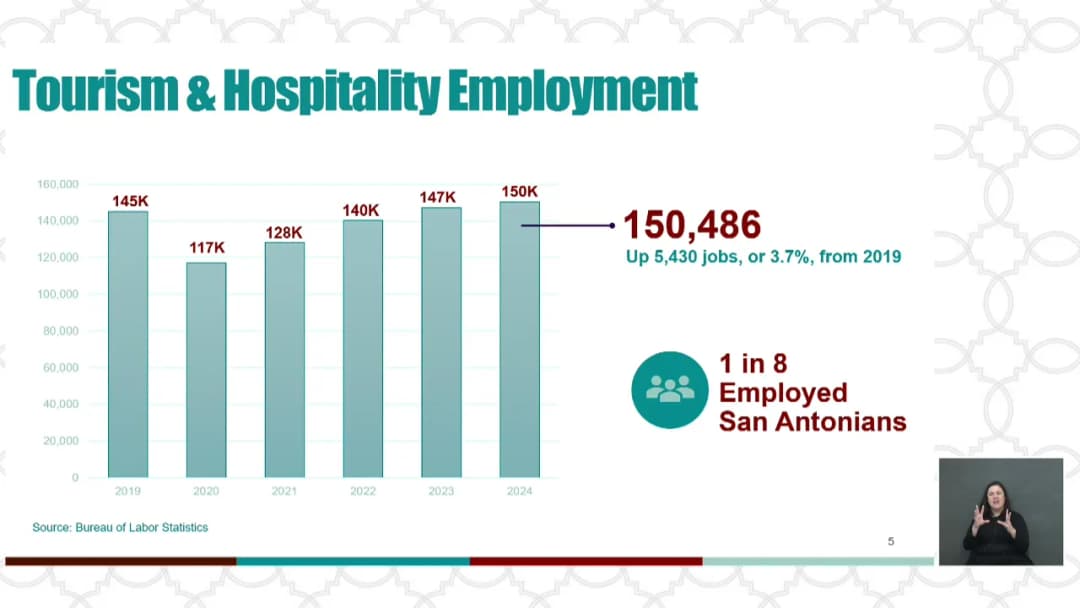
On Wednesday, August 26, 2026, at 2:01 p.m., the City of San Antonio City Council convened a budget work session to review proposed fiscal year 2027 budgets for the Convention & Sports Facilities, Arts & Culture, Visit San Antonio, and Airports departments. The meeting lasted until 5:10 p.m. and featured presentations by department directors, followed by questions and discussion from council members. No formal votes were taken; the session was informational in advance of budget adoption. Convention & Sports Facilities Department Presentation - Hotel Occupancy Tax (HOT) Context: The current HOT rate is 17% (6% state, 2% Bexar County, 9% city). FY27 HOT collections are projected at $109.4 million, a 20% increase since 2018. FY26 collections were slightly higher due to $2 million in back taxes. The city’s 9% is allocated: 2% for convention center capital/debt, and 7% for tourism-related activities (15% to Arts & Culture, 15% to History & Preservation, 35% to Visit San Antonio, up to 35% to convention facilities). - Facilities Overview: The department oversees Henry B. Gonzalez Convention Center, Alamo Dome, Carver Center, and leases for Nelson Wolff Stadium and Toyota Field. The 2025 Men’s Final Four had an estimated $440 million economic impact. San Antonio ranked 9th best conference city by U.S. News. Alamo Dome will host five major concerts in September 2024 with projected attendance over 195,000 fans; 75,000 will travel from outside the area. - Proposed Budget: Total FY27 funding across all funds is $84.6 million. General fund contribution is $1.5 million (Carver Center) plus $700,000 in special revenue. Facility revenues have grown 57% since 2018 ($18.8 million). Event days at Alamo Dome: 112 in FY27 (12 marquee, up from 5 in FY18). Convention center occupancy is at 75% (practical maximum). - Program Changes: Proposed $1.8 million in new/adjusted venue fees (first increases in 10 years) — including $724,000 from Alamo Dome parking/ticket fee adjustments to offset police traffic control costs (total SAPD traffic support = $2 million). Other fee adjustments at convention center. - Capital Planning: $8.1 million in FY27 and $6.1 million in FY28 for critical Alamo Dome maintenance (HVAC, lighting, Wi-Fi, concession upgrades, arena floor). Convention center capital improvements of $4 million (carpet replacement) funded from the 7% HOT, not the 2% expansion fund. - Contract Extensions Recommended: 10-year contract extension with Visit San Antonio; 10-year renewal for Tourism Public Improvement District (TPID); third and final five-year extension of Wolff Stadium agreement with Missions baseball club (early exit allowed when new stadium is ready). - Contract Compliance: Adding one position for contract monitoring; implementing new forms and procedures to reduce risk. Arts & Culture Department Presentation - Department Overview: Director Crystal Jones presented the FY27 proposed budget of $14.2 million. 62% goes to core grants programming for nonprofits and artists. $500,000 for public art maintenance. 24 positions funded. Film incentive program: 10 incentive projects, 782 filming days, 862 paid local positions created (7 of 10 projects qualified for extra 2% incentive because they hired above required veterans). Estimated $21.03 direct spending per $1 granted. - Grants Programming: Third year of three-year funding cycle: $7.2 million for nonprofits (41 operational grantees, $4.9 million; 10 cultural heritage grantees, $2.2 million; event grants $150,000). Artist grants: $262,000 for 30 San Antonio-based artists ($7,500 or $15,000 each). New three-year cycle guidelines will be brought later. - Public Art: 20 installations/dedications this year (driven by 2022 bond). 21 public art projects as part of airport expansion. 9 “art as shade” projects addressing urban heat island effect. 26 planned maintenance projects for FY27. $500,000 general fund for maintenance is third year of dedicated funding; funds are used for structural repairs, graffiti removal, and lighting upgrades. - Film Impact: 1,200 hotel room nights from film productions. Film incentive recently increased to 14% matching state incentive. Visit San Antonio Presentation - Economic Impact: Tourism/hospitality generated a record $23.4 billion total economic impact in 2024 (8.8% increase over 2023). Generated $284 million in city tax revenues. Industry supported over 150,000 jobs (1 in 8 employed San Antonians). Visit San Antonio’s efforts directly generated $1.9 billion in 2025. - Sales & Marketing: Record-breaking sales year: nearly 1 million room nights booked, over 800 events confirmed, 74 citywides secured. Communications team secured 1,200 media stories ($30 million earned media value). Marketing campaigns generated 214 million engagements, driving 2.1 million trips. - Local Creative Economy: More than 100 contracts with local artisans, musicians, entertainers; 650 business referrals to meetings/conventions industry. Free Riverwalk community programming attracted nearly 1.8 million attendees. - Challenges: Convention center at capacity; competition from Austin, Houston, Dallas expanding facilities (over $7 billion total). Booking pace shows risk of losing groups after 2030. Example: Texas High School Coaches Association (18,000 attendees) is considering Austin for 2032. - ROI: Every dollar invested in Visit San Antonio returns $45 in demonstrable visitor spending (based on attributable sales, earned media, and marketing attribution). - International Visitors: 2.6 million international visitors in 2024 (2.4 million from Mexico, 50,000 from Canada, then UK). Focus on growing drive markets and group business. - Scholarship Program: San Antonio Hospitality Foundation raised record $150,000; awarded five scholarships ($2,500 each) to St. Philip’s College and UTSA students. Airports Department Presentation - Proposed Budget: FY27 total $222 million (up 17% from $185 million). Revenue: $76.1 million aeronautical (airline) and $109.8 million non-aeronautical (parking, concessions, etc.). Operating expenses $107 million (3% increase). Debt service $32 million. $46 million to capital improvement fund. Same number of personnel (487 positions). - Capital Program: $2.6 billion overall. In FY27, $859 million will be spent. Terminal C (850,000 sq ft, 18 gates) opens in 22 months (by end of 2028). Parking garage (2,500 spaces, 7 stories, $132 million) under construction. Current terminal A+B combined is 700,000 sq ft; Terminal C more than doubles footprint. - Air Service: 47 nonstop destinations (down from 50 due to Spirit exit, loss of Fort Lauderdale, San Juan, Oklahoma City). Enplanements down 5% FY26 vs FY25 due to three government shutdowns. FY27 projected enplanements 2.5 million (2.8% above FY26). Target markets: Sacramento, Portland, Rio Grande Valley, Pittsburgh; also Mexico leisure destinations (Cabo, Tulum, Cancun) and transatlantic service (300 passengers daily from Europe start journey in San Antonio). Cargo down 20% year-over-year. - Rate Changes: Proposed new parking/ground transportation fees to yield $10 million in FY27. TNCs (Uber/Lyft) from $2.50 to $5 per trip; shuttles $1.50 to $5; limos $1.25 to $5; charters $3 to $5; taxis unchanged. Parking: long-term from $16 to $20/day; short-term from $29 to $30; valet unchanged. Surface lot veteran/military parking unaffected. - Federal Grants: $320 million in grants secured from FAA since 2020. Received $30 million for air traffic control tower modernization. - Stinson Municipal Airport: 78 acres available for development; master plan includes four alternatives for advanced air mobility (EVTOL) hub; discussions with South Texas Chamber and Brooks. - Passenger Experience: 189 initiatives identified to improve operations before Terminal C opening, scaled to 52 focus areas. Council Discussion & Positions - Councilmember Corps (District 2) praised collaboration among departments and asked about HOT projections: slight decrease explained by one-time back taxes and flat occupancy/ADR. She requested data on concert attendee origins and strategies for booking bilingual artists; also asked if IMP projects could include arts components like bonds do. - Councilmember White (District 9) supported film investment but questioned $500,000 general fund for art maintenance, suggesting moving it to HOT to free up funds for traffic safety (30 radar feedback signs and flashing stop signs eliminated). He asked why Visit San Antonio’s share of HOT (35%) is higher than Austin (16%) or Dallas (25%); Mario Vaz responded that ROI is $45 per $1 invested, and the formula is conservative. White noted Visit San Antonio’s shift to focus on group business and drive markets was smart. - Councilmember Mesa González (District 8) supported proposed fee changes and asked about contract re-evaluation outcomes (process improvements, no cost savings). Asked about arts grants being on same three-year cycle (sustainability). Inquired about film studio incentives (state media production development zone). Asked whether proposed parking rate changes affect disabled veteran/military parking program (surface lot unaffected; garages have discounts). She suggested improving veteran parking application instructions. - Councilmember Alarcón Gavito (District 7) asked about coordination with VIA for downtown parking (existing park-and-ride promotion; suggested council newsletters). Expressed strong support for keeping $500,000 art maintenance in general fund to show city commitment; argued arts are a “must have.” Questioned overlap between arts grants and delegate agency funding for same nonprofits (e.g., CEC, Book Festival) and suggested being strategic about city funding. Asked about international visitor breakdown (majority Mexico). Urged Visit San Antonio to share best practices from other cities with council. - Councilmember Castillo (District 5) asked about reduction in contracted supplemental cleaning from $38 to $4 (due to full staffing; can be re-added if needed). Supported adding a contract monitoring position. Mentioned roof repair line item and asked about insurance coverage. Stressed importance of arts funding from D5 residents, noting roundtable feedback: prioritizing local artists, ensuring maintenance fund, improving transportation to arts venues. Highlighted literary arts and Book Festival’s role in literacy. - Councilmember Viagran (District 6) emphasized need for Rio Grande Valley direct flights. Thanked Visit San Antonio for efficient use of tax dollars. Noted that Dallas and Houston have state entertainment funds and NFL teams, so San Antonio’s 35% HOT share is justified. For arts, defended $500,000 general fund for art maintenance as a city commitment (not a “nice to have”). - Councilmember Spears (District 9) expressed concerns about art projects in bond projects, citing $500,000 roundabout art piece that was not local and poorly managed. Stated arts funding is unpopular in her district given traffic safety needs. Acknowledged visit San Antonio’s success but worried about losing conventions to Austin/Dallas. Asked about declining event days at convention center (department explained focus on bigger, higher-impact events). Asked for comparison of fees to peer cities (fees are aligned). - Councilmember Mungia (District 3) praised functional art (shade structures) and community engagement. Noted airport is a regional asset. Expressed interest in Rio Grande Valley flights. - Councilmember Galvan (District 1) thanked departments and noted excitement for upcoming concerts (Black Veil Brides, Pierce the Veil). Asked for detailed list of history & preservation HOT allocations and expressed concern about cultural heritage districts funding reductions. - Councilmember McKee Rodriguez (District 2) noted that Visit San Antonio and Airport receive zero general fund dollars; Arts & Culture $500,000; Convention & Sports $1.5 million (for Carver). Asked about art maintenance necessity and process (structural, expert conservation). Supported maintaining general fund art maintenance but open to future HOT funding as pot grows. - Mayor Jones asked about Terminal C impact on enplanements (expected 5-8% organic growth, 500,000-800,000 additional). Discussed airport incentives for new routes (three-year now allowed). Noted cargo is down 20%. Asked about convention center capacity: 75% is operational maximum; 232 events vs 275 target due to short-term business not materializing due to economy, tariffs, federal funding cuts. Inquired about average room nights generated by Alamo Dome (leisure, not contracted). Asked about timeline for other cities’ convention center expansions. Noted that HOT-funded arts organizations should demonstrate accessibility; questioned San Antonio Museum of Art’s only 14 free hours per month. Expressed desire to shift general fund arts funding to HOT where possible to free up core services. Proposed potential amendments to redistribute HOT grants. Key Outcomes - No formal votes taken; work session to inform FY27 budget adoption. - Council members directed staff to provide follow-up memos on: hotel occupancy tax allocation details for history & preservation; feasibility of using HOT for art maintenance; room night generation by Alamo Dome; detailed timeline of other Texas convention center expansions; financial impact of convention space shortage in 2031-2033; list of state media production development zones; detailed breakdown of arts funding equity and accessibility. - Several council members expressed intent to propose amendments: potentially moving the $500,000 art maintenance from general fund to HOT; reallocating some HOT grants from well-endowed museums to local artist grants; ensuring homeless tax funds are used efficiently. - Airport director will bring forward a new air service incentive program for council approval. - Convention center expansion feasibility study and longer-term capital plans will be presented at a future B session. - Update on Wolff Stadium master plan will come during Economic Development department work session next month.
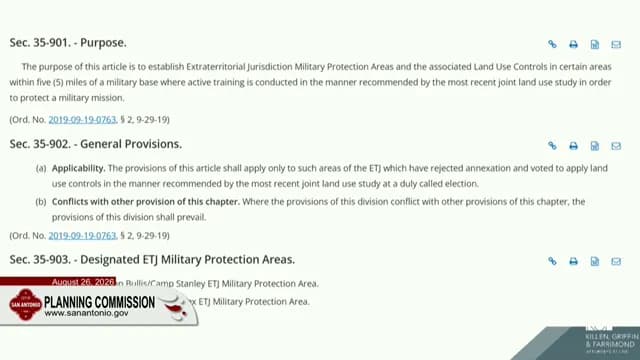
The San Antonio Planning Commission met on August 26, 2026, at 2:00 PM and adjourned at 2:55 PM. The commission considered four items: three landscape irrigation variance requests and one plan amendment in the Camp Bullis extraterritorial jurisdiction (ETJ) military protection area (MPA). The consent agenda comprising routine approvals was passed unanimously. Key votes: one irrigation variance was initially denied then approved after a second motion, two other irrigation variances were approved, and the plan amendment was approved. Consent Calendar - The consent agenda (all items except 10, 12, 14, and 17) was approved by unanimous roll call vote. Public Comments & Testimony - Item 10 (Bill Miller BBQ landscape variance): Applicant Daniel Eisling read a letter from SAWS (San Antonio Water System) stating that if an irrigation system is required by ordinance, the customer is eligible for a rebate to permanently remove it. He argued that installing a system only to later remove it is wasteful and costly. - Item 12 (Small Sliders landscape variance): The applicant (Ken from Brown and McDonald) cited expansive soil conditions, water conservation, and financial hardship ($50,000 for landscaping and $50,000 for irrigation) as unique hardships. - Item 14 (ASCO Equipment landscape variance): Applicant Bryce Beckwith stated the new structure is 750 feet from the existing water tap, creating an economic hardship. ASCO’s property management team would water by hand. - Item 17 (Plan amendment for assisted living facility): Applicant Emily Weissler (Killing Griffin and Fairman) and property owner Victoria Tejeda argued the request is for a residential use (assisted living home with seven or more residents) in the ETJ, which is compatible with surrounding uses and supported by JBSA (Joint Base San Antonio). Victoria Tejeda described the facility as a home-like setting for aging in place, with no drivers among residents and only two staff cars per shift. - Item 17 – Opponent: Linda Guerrero, a neighbor at 8515 Flint Rock Drive, raised concerns about traffic on a one-lane county road, infrastructure strain (wells, septic), parking on easements, and emergency vehicle access. She stated the existing facility has caused neighborhood discontent. Discussion Items - Item 10 – Landscape variance for Bill Miller BBQ (4102 N Loop 1604 E): Staff recommended denial, stating the variance fails the intent of the code and no unique hardship was identified. The applicant agreed to enter a maintenance agreement with the city and confirmed staff would water the plants. Commissioner Wallerstead noted that the SAWS rebate letter confirms that installing irrigation triggers eligibility for its removal – questioning the need to install it at all. A motion to deny failed (3 yes, 6 no), after which a motion to approve passed (7 yes, 3 no). - Item 12 – Landscape variance for Small Sliders (8743 State Highway 151): Staff recommended denial, noting expansive soil is a regional condition, not a site-specific hardship. Applicant cited economic hardship. Commissioner Wallerstead recommended removing Bermuda grass from the plan. The variance was approved 8-2. - Item 14 – Landscape variance for ASCO Equipment Pavillion (1920 SE Loop 410): Staff recommended denial, but the commission noted the unique distance from water source. Approved unanimously. - Item 17 – Plan amendment for assisted living facility on TP Lane (ETJ, Camp Bullis MPA): Staff recommended denial to avoid encouraging multifamily expansion into existing residential neighborhoods. The applicant requested a change from Residential Estate to Urban Low Density Residential to allow an assisted living home with seven or more residents. Discussion clarified that the use is residential, not commercial; JBSA had no objection; parking and traffic are under Bexar County jurisdiction; the city cannot regulate use minutiae in the ETJ. Motion to approve passed 9-1. Key Outcomes - Item 10 – Landscape variance (0744): Motion to deny failed (3-6); motion to approve passed (7-3). The applicant’s request to waive irrigation requirements was granted. - Item 12 – Landscape variance (0419): Approved 8-2. Irrigation requirements waived. - Item 14 – Landscape variance (0376): Approved unanimously. Irrigation requirements waived. - Item 17 – Plan amendment (Camp Bullis MPA): Approved 9-1. The land use designation was amended to Urban Low Density Residential to allow the assisted living facility.
On August 26, 2026, the San Antonio City Council convened a budget session to review four departments: Sports & Conventions, Arts & Culture, Visit San Antonio, and the San Antonio Airport. The meeting focused on proposed budgets for fiscal year 2027, operational updates, and challenges related to capacity, competitiveness, and funding allocations. Council members raised questions and expressed positions on maintenance funding, hotel tax distribution, and the need for expanded convention space. Discussion Items - Sports & Conventions (Patricia Mosquis Cantor): The department manages the Henry B. González Convention Center, Alamodome, Carver Center, Toyota Field, and other venues. The proposed FY2027 budget is $84.6 million. The hotel occupancy tax (HOT) revenue for FY2027 is estimated at $919.4 million, up slightly, with 1.1% growth. The department highlighted the need for capital improvements: $8.1 million in FY2027 and $6.1 million in FY2028 for Alamodome critical needs. The convention center is operating at maximum capacity (75% operational maximum), limiting the ability to host additional events, while competing cities (Austin, Houston, Dallas, Fort Worth) are spending over $7 billion on expansions. The council discussed the impact on future hotel room nights and the need for a 10-year contract extension. Councilmember Alderete Gabito requested a financial impact analysis and a timeline of competitor convention center openings. Councilmember Spears asked about comparative fees and parking costs, noting that parking can exceed event ticket prices. Councilmember Munguia inquired about the $12.8 million in capital projects, clarifying that the 2% set aside for expansion cannot be used for the described maintenance projects. - Arts & Culture (Christopher Johnson): The proposed FY2027 budget for arts and culture is $14.2 million. The department supports over 1500 individuals through free programs, 30 artist trusts, and 60 public art projects. A $500,000 allocation for arts maintenance (funded from the general fund) was discussed. Councilmember White questioned whether $500,000 for art maintenance could be better used for traffic safety signs and suggested moving the funding to HOT. Councilmember Villagrán argued that the $500,000 should remain in the general fund to signal the city’s commitment to arts and culture. Councilmember Castillo noted the importance of the Carver Center and asked about the transfer of funds from general to entertainment fund. Councilmember Munguia requested an explanation for the large increase in projected participants (from 57 to 1,500) in arts programs, and asked about how eligibility for HOT funding is determined for non-profits that also receive general fund support. - Visit San Antonio (Mario Vaz): The organization reported an economic impact of $23.4 billion in 2024, up 8.8% from the prior year, generating $284 million in city hotel taxes. In 2025, 1.9 million hotel room nights were sold through direct sales efforts, with a 45:1 return on investment. The council discussed the need to maintain competitiveness as other cities expand their convention centers. Councilmember Spears asked about the operational functions of Visit San Antonio’s scholarships and grant process. Councilmember Alderete Gabito requested that Visit San Antonio provide a breakdown of hotel room nights by event type (e.g., medical groups vs. others) and noted that DEI-focused groups have lost federal funding, impacting bookings. Councilmember Munguia questioned the relationship between short-term rentals and hotel occupancy. - San Antonio Airport (Jesus H Sanz): The proposed FY2027 airport budget is $222 million, with $859 million in capital projects, including the new Terminal C (1.7 billion total, 26% construction complete). The airport serves 47 non-stop destinations and is working to expand service, particularly transatlantic routes. The council discussed the current passenger count (near 11.3 million) and the need to reach 13.5–14 million to achieve Category 1 status. Councilmember Alderete Gabito asked about the airport’s incentive program for new routes, and Councilmember Spears inquired about staffing vacancies (80 open positions, mostly police) and the $30 million federal grant for air traffic control modernization. Councilmember Munguia shared a personal travel experience to illustrate inconvenience of layovers and stressed the importance of direct flights. Councilmember Castillo asked about the timeline for Terminal C opening (expected early 2027) and the need for communication about construction-related traffic. Key Outcomes - No formal votes were taken; the session was informational and for discussion. - The council requested that Visit San Antonio and the Sports & Conventions department provide a financial impact analysis of potential convention center expansion and a detailed timeline of competitor expansions. - Several council members expressed support for keeping the $500,000 arts maintenance allocation in the general fund, while others suggested exploring alternative funding sources (e.g., HOT) to free up general fund dollars for other priorities. - The airport director committed to providing updated market studies and incentive program details for new routes, and to developing a communication plan for construction-related disruptions. - Councilmembers agreed to further explore the overlap in funding between arts and culture non-profits and other city agency-delegated programs, with a goal of ensuring equitable distribution of HOT funds. - The council will receive a follow-up report on the proposed 10-year contract extension for convention center management, including alternative options and associated costs.
The San Antonio Planning Commission met on August 26, 2026, at 2:00 PM (meeting adjourned at 2:55 PM) to consider a consent agenda and four individual items: three variance requests related to irrigation requirements for green areas, and a land use amendment in the extraterritorial jurisdiction (ETJ) for an assisted living facility. The meeting was conducted in Spanish with interpretation provided. Consent Calendar - The consent agenda, consisting of all items except Articles 10, 12, 14, and 17, was approved unanimously by voice vote. Note: The chair initially stated that Articles 13 and 14 were withdrawn, but Article 14 was subsequently discussed and voted on separately. Public Comments & Testimony - Linda Guerrero (neighbor of the proposed assisted living facility under Article 17) opposed the project. She cited concerns about traffic on a single-lane county road, lack of infrastructure (wells, septic tanks), inadequate parking, and emergency vehicle access. She stated that the current facility on the opposite side of the street has caused friction with neighbors. She argued that the use is a business, not a residential use, and that it would negatively impact the neighborhood. Discussion Items - Article 10 – Irrigation Variance (4102 North 1604) - Applicant Daniel Lansley (representing Barbaco) requested a variance to waive the installation of an irrigation system for a 4,200-square-foot project. He presented a letter from the San Antonio Water Conservation Department indicating that customers who remove irrigation after a rebate program are allowed to maintain landscaping manually. He argued that manual watering is more cost-effective and that the irrigation system would be removed after installation. The staff recommended denial, stating that the proposed variance does not meet code requirements and that no hardship was identified beyond the applicant's preference. - A motion to approve the variance was made by Commissioner Suki and seconded by Commissioner Miller. The motion passed with a vote of 7 in favor (De Suki, Miller, Sánchez, Orion, Prophet, Peck, and one other) and 3 against (Cooper, Wallston, Sigo). Commissioner López was not recorded as voting. - Article 12 – Green Area Variance (88743 Highway 151) - Applicant Mike Brown McDanum (HDR One) requested a variance to waive the irrigation requirement for a 4,300-square-foot project. He argued that the cost of installing irrigation ($50,000) would force him to abandon a $45,000 existing landscaping program, and that manual watering is more efficient. He noted that similar variances were granted administratively in the past. Staff recommended denial, citing that the project exceeds the threshold for required irrigation and that the hardship was financial, not geographic. - A motion to approve the variance was made by Commissioner Sánchez and seconded by Commissioner Prophet. The motion passed with a vote of 8 in favor (Sánchez, De Suki, López, Cooper, Miller, Orion, Prophet, Peck) and 1 against (Wallston). Commissioner López's vote was not clearly recorded but appears to be in favor. - Article 14 – Green Area Variance (1920 South Loop 410) - Applicant Price Beckway (representing I40 Group Partnership) requested a variance to waive irrigation for a pavilion project. He cited economic hardship and the location behind the frontage road, making irrigation access difficult. He also noted that heavy equipment would damage any irrigation system. The applicant agreed to maintain the landscaping manually. Staff recommended denial. - A motion to approve the variance was made by Commissioner Miller and seconded by Commissioner Prophet. The motion passed unanimously (8-0). Commissioner López was not recorded but is presumed to have voted yes. - Article 17 – Land Use Amendment (ETJ, T B Lane) - Emily Weiss and Victoria Tejeda (applicant and owner) requested approval of a resolution to amend the land use plan from low-density residential to allow a 16-bed assisted living facility (a replica of an existing facility across the street). They argued that the use is residential, not commercial, and that it serves a community need. They noted that the existing facility has operated for three years with minimal traffic (two staff, occasional visitors) and that the property is a cul-de-sac with no through traffic. The Joint Base San Antonio (JBSA) joint land use study (2017) was cited as supportive of compatible residential uses. Staff recommended denial. - Public commenter Linda Guerrero opposed the project, citing the above concerns. - A motion to approve the amendment was made by Commissioner Sigo and seconded by Commissioner Cooper. The motion passed with a vote of 8 in favor (Sigo, Cooper, Sánchez, De Suki, López, Orion, Prophet, Peck) and 2 against (Wallston and another commissioner not named, possibly Miller). Commissioner Miller's vote was not recorded. Key Outcomes - Article 10: Variance approved (7-3). The applicant is not required to install an irrigation system; manual watering and a maintenance agreement with the city will be accepted. - Article 12: Variance approved (8-1). The applicant may proceed without an irrigation system, subject to manual watering and a maintenance agreement. - Article 14: Variance approved (8-0). The pavilion project may use manual watering instead of an irrigation system. - Article 17: Resolution to amend the land use plan approved (8-2). The property in the ETJ may be developed as a 16-bed assisted living facility, subject to county and state permitting. - No director's report was given, and the meeting adjourned at 2:55 PM.
The San Antonio City Council held a special session from 2:03 p.m. to 3:20 p.m. on Tuesday, August 25, 2026, to discuss data center development, a staff analysis of possible Unified Development Code (UDC) amendments, and a council-requested review of a potential temporary development moratorium. The meeting was called in response to a memo filed by council members from Districts 5, 6, and 8. No public comment was taken because the special session was not posted for public comment; after roll call, the council moved directly to a staff presentation and council discussion. Staff Presentation - Staff presented two possible paths: (1) permanent UDC amendments restricting data centers to intense commercial and industrial zoning, requiring larger setbacks, landscape buffers, and fencing, prohibiting data centers over the Edwards Aquifer Recharge Zone, and allowing developers who do not meet the requirements to seek specific use authorization from City Council; and (2) a temporary moratorium governed by state law (Local Government Code Chapter 212, Subchapter E) that requires written findings and is limited to 90 days, extendable by another 90 days for a maximum of 180 days. - Amin Tomas, Director of Development Services, said UDC amendments could go to the Zoning Commission on September 15 and to full council on October 15 if council chooses that path. He said the moratorium process would take about three and a half months; if initiated September 3, the earliest approval would be around December 30 or January 1. - Staff noted a moratorium would not stop projects already underway, including those that have received utility service agreements, and would not apply to federal facilities. Staff also cited Hill Country, near Waco, which attempted a one-year moratorium, was sued, and dropped it; Fort Worth recently began the moratorium process but had not issued public findings. - Staff summarized state actions: Governor Abbott's June 10, 2026 directive proposing statewide standards, an August 3, 2026 statewide moratorium on new data center connections to the Texas power grid, and an ERCOT audit due by December 2026. Reports cited at the meeting indicated almost 2,000 pending requests at the state level, about 1,800 of them data centers. Staff recommended pursuing UDC amendments as the quicker and more permanent solution. Council Discussion - Councilmember Galvan (District 6) described resident concerns about noise, lighting, construction traffic, road wear, tree clearing, energy and water demand, and air quality from backup diesel and natural gas generators. He supported the UDC changes but urged that every data center require specific use authorization so residents and council can weigh in regardless of zoning. He also said a moratorium is worth considering while UDC changes, utility tariff and rate work, a community benefits agreement working group, and state policy catch up. Staff replied that requiring specific use authorization for all data centers could be doable. - Councilmember White supported the staff recommendation, emphasizing neighborhood quality of life, and noted new closed-loop systems recycle about 75% of water. He cautioned about ratepayer impacts but said data centers can bring revenue and jobs. - Councilmember Mesa Gonzalez supported the UDC timeline and the use of specific use authorization, citing existing examples such as car washes over the Edwards Aquifer Recharge Zone. She asked about the proposed setback; staff said the current proposal was 500 feet, with some other Texas cities using 250 to 350 feet and Tempe, Arizona using 500 feet. Staff said at 500 feet, data center noise would measure about 50 decibels, similar to a refrigerator hum. - Councilmember Spears supported the staff recommendation and argued data centers are critical to workforce and economic growth, citing more than 4,800 construction jobs for a single large data center, 24 to 36 month construction periods, and San Antonio's advantages in fiber, land, military, defense, and medicine. He called much public concern misinformation and said San Antonio should lead in this space. - Councilmember Alderete Gavito supported the UDC changes and cautioned against a moratorium, saying labor representatives warned it could drive out good jobs and that a moratorium could reduce regulatory control. She called for considering intended and unintended consequences. - Councilmember Castillo supported the UDC process and said District 5 has one data center and residents ask about future growth, sound mitigation, and accountability. She mentioned IBEW labor conversations, a Trades Advisory Committee, potential city general fund impacts from data centers moving to their own energy sources, and said the conversation deserves urgency. In a second round, she raised civil liberties and surveillance concerns related to data collected by license plate readers and cameras. - Councilmember Ravia Gadon (District 3) opposed a moratorium as 'just a patch,' saying her district has been central to data center conversations and that labor leaders warned a 'shotgun approach' would cost jobs. She supports a comprehensive, evidence-based San Antonio solution and directed staff to present the issue to the Trades Advisory Board through EWDC. She also noted a citywide data center survey is still open. - Councilmember Makia Rodriguez expressed strong support for a moratorium, describing data centers as an urgent threat to natural resources, utilities, and public health. She cited potential electricity use equivalent to more than 100,000 homes, millions of gallons of daily water use, harmful noise, tree loss, and ratepayer impacts, and said the city should not wait for the state. - Councilmember Mungia supported the UDC and CCR process and said the public needs transparency about what a moratorium would and would not do. She noted Texas is the second-largest home to data centers outside Virginia and DC, asked for utility usage data, and confirmed with staff that a moratorium would not stop county construction or federal facilities. Staff said roughly 23 data centers exist in city limits and about 12 are going through some level of building permit review, with staff later saying about 11 are in permitting. - Councilmember Corr said she lacked enough data to decide on a moratorium and requested a spreadsheet showing projects in the pipeline, where they are in the process, whether a moratorium would affect them, water and energy usage, recycled-water use, and job impacts. She noted UDC changes alone cannot regulate utility access without SAWS and CPS coordination and wanted more analysis before action. - Mayor Jones said she was not ready to commit to a moratorium and asked staff to analyze how much could be accomplished through UDC amendments, including possible requirements on potable water, water-efficient technologies, pretreatment of cooling effluent, noise limits of 50 dBA daytime and 45 dBA night, enclosed backup generators, tier four emission standards, early neighborhood notification, green space replacement, and decommissioning or repurposing if facilities become obsolete. Staff said a potable-water prohibition would require close legal review and had not been seen before as a zoning condition. SAWS Senior Corporate Counsel Keith Martin said SAWS is clarifying utility service agreements to consider potable versus non-potable water, location, amount, and available resources, and noted state law requires potable water service within its CCN but not non-potable service. Key Outcomes - No formal vote, ordinance, or moratorium was adopted; the session was informational. - Staff will continue working on UDC amendments, with a return to the Planning and Community Development Committee before bringing amendments to the Zoning Commission on September 15 and City Council on October 15. - Staff will provide additional requested data, including project pipeline and permit status, utility usage and recycled-water data to the extent available from SAWS and CPS, job impact information, and information on NDA limitations on utility disclosures. - Staff will analyze the legal and policy questions raised by the Mayor and council members and report back, with air quality monitoring recommendations expected as part of the October presentation. - Councilmember Ravia Gadon directed staff to bring the issue to the Trades Advisory Board through EWDC. - No public hearing or public comment was held.