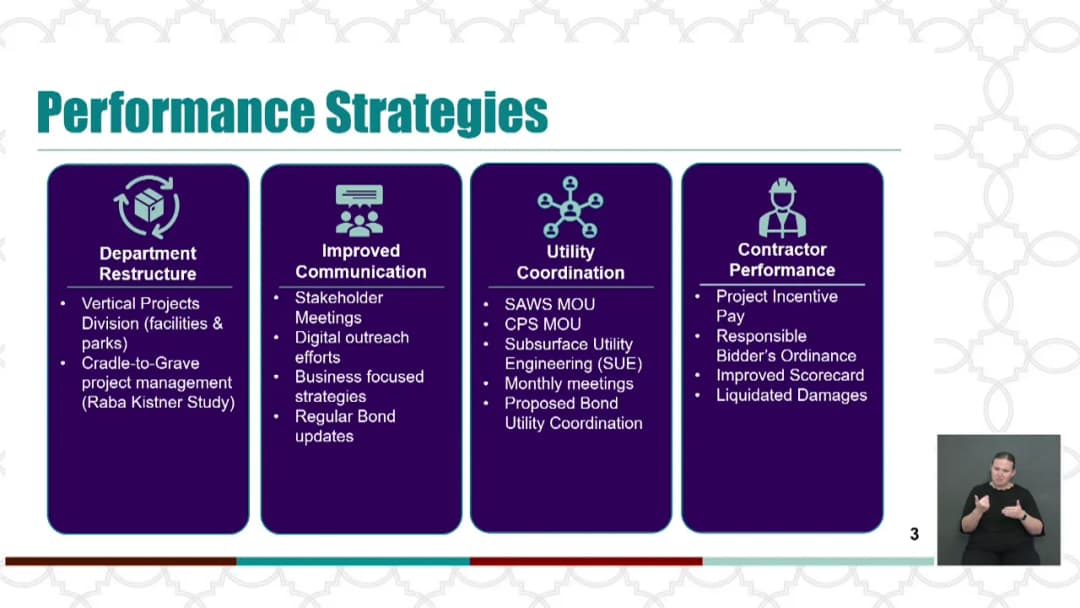
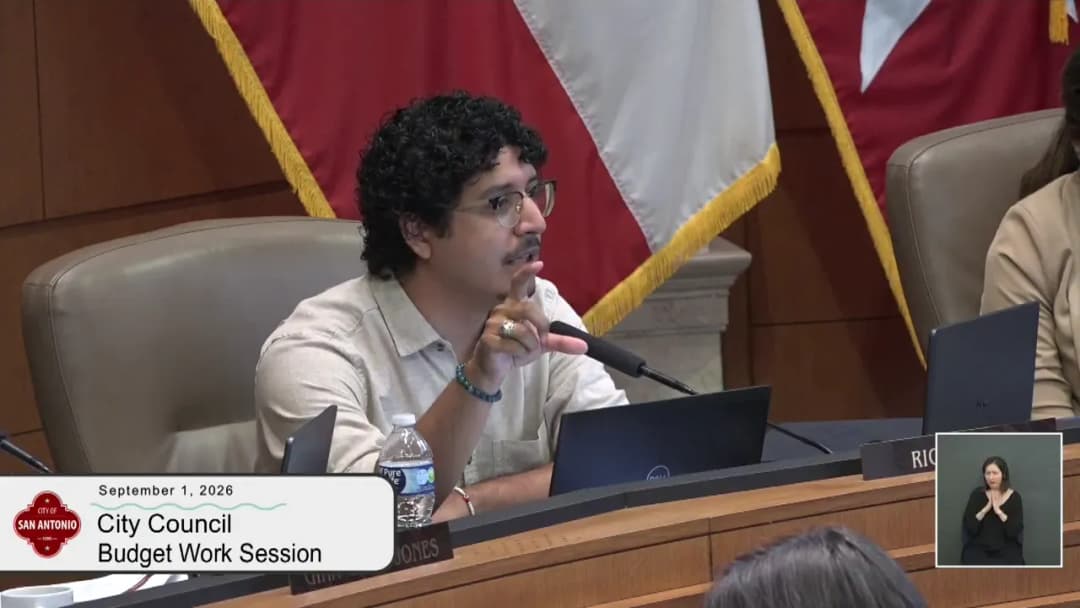
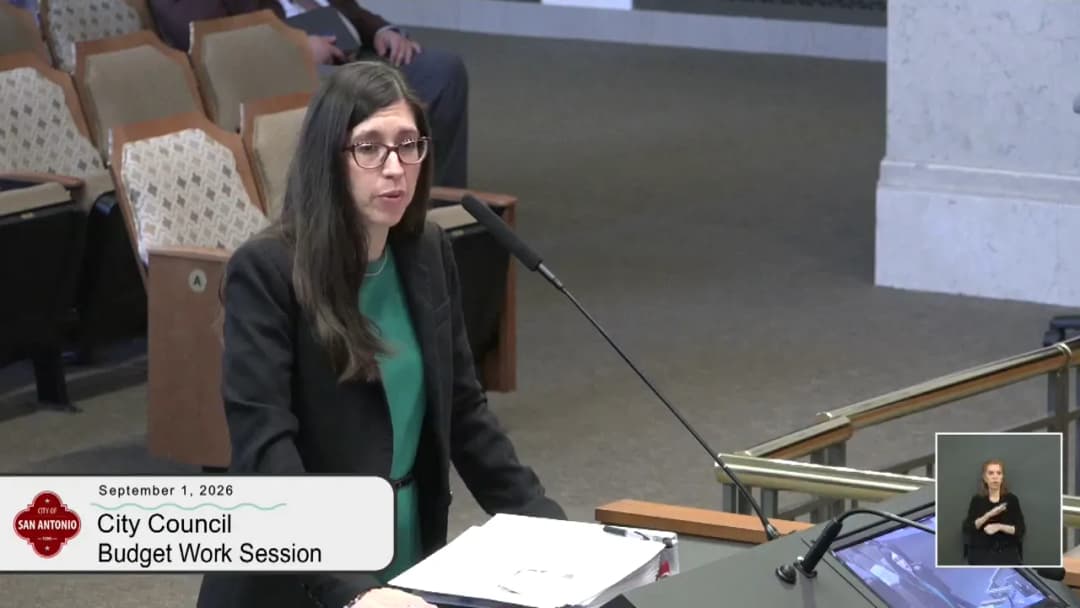
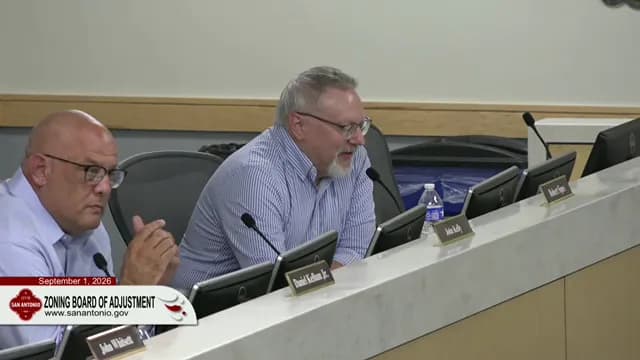
This was a budget work session of the San Antonio City Council held on September 2, 2026, starting at 1:06 PM. The meeting focused on reviewing the city's debt management plan, the capital delivery program, the bond program, and public works operations. Presentations were made by finance director Troy, capital budget director Mike Shannon, and public works director Art. Council members discussed multiple scenarios for future bond capacity, tax rate implications, and project delivery performance. Discussion Items - Debt Management Plan (Troy): The city maintains a debt policy with a target tax rate of 21 cents per $100 of assessed value for debt service. Troy presented the current debt portfolio, including general obligation bonds, certificates of obligation, tax notes, and revenue bonds. The city holds a strong credit rating (AAA from Fitch for certain bonds, A+ for airports). Three scenarios were presented for future bond capacity: a baseline of $450 million, a moderate scenario of $1.2 billion, and an aggressive scenario of $1.0 billion with variable tax rates. The impact on property tax bills was discussed: for example, to support $1.2 billion in bonds, an additional 2.4 cents per $100 of assessed value would be needed, equating to about $49 per year for the average homeowner. Council members questioned the sensitivity of growth assumptions and the need for potential tax adjustments. - Capital Delivery Program (Mike Shannon): The capital budget department has completed 82 projects year-to-date, with 153 expected by year-end. Focus is on timely delivery, budget adherence, and community communication. Performance metrics include contractor scorecards and incentives for early completion. The department manages a $317 million operating budget and a $1.4 billion capital budget, with $285.6 million for direct project delivery. The 2022 bond program is 49% complete; 87% of projects from that cycle are completed or under construction. Council members requested more detailed project-by-project cost and timeline comparisons. - Public Works (Art): The public works department presented on street and sidewalk maintenance, traffic safety, and vegetation management. Key figures: $129.8 million for 534 miles of street repairs, $12.8 million for sidewalk work (with 72% of sidewalks in excellent or good condition). Traffic safety includes a $400,000 study for speed limit policies in District 7 and $500,000 for external consultants. A proposed 550,000 per district allocation for capital improvement projects (CIP) was noted. Council members discussed equity in resource allocation, coordination with CPS Energy and the county, and the need for faster project delivery. Key Outcomes - No formal votes were taken; the session was informational to guide budget decisions. - Council members expressed differing views on the preferred bond scenario: some (e.g., Councilwoman Castillo, Councilman Rodríguez) leaned toward a higher capacity scenario (e.g., $1.2 billion) to meet infrastructure needs, while others (e.g., Councilman White) opposed any tax increase and favored staying with the baseline $450 million. Councilman Spears emphasized the risk of inaccurate projections and the need for flexibility. - Councilwoman Corr praised the debt rating and asked for a projection of how different scenarios would affect credit ratings. - Several council members requested more accessible communication materials for residents to understand the bond proposals and tax implications. - Councilman Munguía highlighted coordination challenges with SOS and asked for a district-by-district breakdown of project timelines and types. - Councilwoman Mesa González asked for a comprehensive impact analysis per household for each scenario. - Councilman Rodríguez called for equity metrics to ensure all districts receive fair infrastructure investment, and for better data on project delivery times by district and category. - The city manager's office will compile a list of potential amendments and return with additional analysis for the September 30 budget discussion. The bond program election is anticipated in May 2027, with the first bond issuance in summer 2027. - Staff will follow up on requests for detailed project cost comparisons, sensitivity analyses, and district-level delivery data.
Public Meetings - San Antonio, Texas
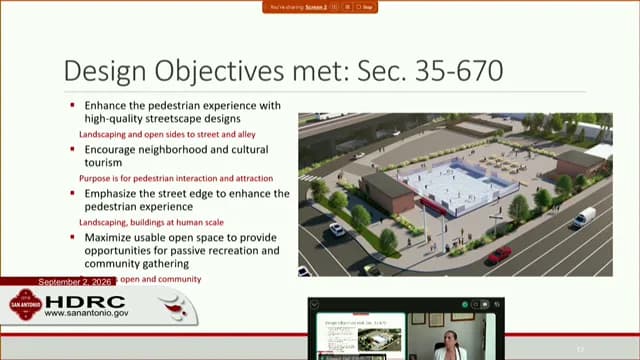
Public Meetings - San Antonio, TexasThe Historic and Design Review Commission (HDRC) met on September 2, 2026, at 3:00 PM. The commission addressed consent calendar items, public testimony, and discussed several applications for certificates of appropriateness, including a controversial multifamily project at 421 Roosevelt Avenue, a public art location at San Pedro Springs Park, a building exception at 1611 Broadway, and residential projects in historic districts. The meeting lasted approximately 2 hours and 30 minutes. Consent Calendar - The commission approved the minutes of the August 19, 2026, meeting (unanimous vote). - Items on the consent calendar were approved after removing agenda items 5 and 7 at the request of commissioners. Approved addresses include: 436 Westgate Place, 115 Main Plaza, 427 Presa Street, 1111 Isleta, 4130 Broadway, 42 Brian Glenn, and 10 Kendall Street. Certificates of appropriateness will be issued within 10 days. Public Comments & Testimony - Daniel Mind Senior (resident at 235 Yellowstone) spoke in opposition to agenda item 5 (421 Roosevelt Avenue). He argued that the existing buildings (constructed between 1938–1940) are historic and should not be demolished without proper review. He raised concerns about building height (proposed 3–4 stories vs. surrounding 2-story structures), traffic congestion on narrow streets (Mission Road and Roosevelt), lack of additional traffic studies, and the need for archaeological oversight. He noted that 48% of San Antonio's housing is apartments and that the project would add over 400 units with only one exit. He also questioned the use of aluminum windows in a historic district. Discussion Items - Agenda Item 5 – 421 Roosevelt Avenue (Multifamily Development) - Applicant: Michael Clancy (Alamo Architects) and David Moran (project partner). They proposed a four-story, multi-family development on a site with former industrial/commercial buildings. The applicant stated that architectural style is inspired by industrial and Mission Revival elements, and that they held two meetings with the Roosevelt Neighborhood Association, which supported the project. Staff recommended conceptual approval with conditions regarding windows and archaeological monitoring. - Commissioners raised concerns about height (4 stories) being out of scale with the surrounding residential neighborhood and the adjacent San Pedro Springs Pool. Commissioner Sabino moved to limit height to 3 stories, but the motion failed due to lack of a second. Commissioner Fetzer suggested exploring a modular massing with lower heights on the south side. After debate, the commission voted to approve the conceptual design with staff stipulations and a requirement to return to the HDRC for final design review. Vote: 8-0 (Commissioner Pfizer left the room; all present voted yes). - Agenda Item 7 – Public Art at San Pedro Springs Park - Applicant: City of San Antonio Department of Arts and Culture (represented by Kimberly Villalobos). They requested approval of a location for a public art piece as part of a community-driven process. The artist will be selected through an RFP, with final designs due in October 2026. The commission discussed the appropriateness of approving a location without seeing the artwork. Commissioner Sabino argued that the location alone is insufficient for review; others noted that the art will be context-specific. Commissioner Fetzer suggested that approving the location now allows the artist to work within constraints. The commission voted to approve the conceptual location for the art. Vote: 8-0. - Agenda Item 10 – 1611 Broadway (Commercial Building Exception) - Applicant: James McKnight and team. They requested an exception to the IDZ/RIO-2 code to move a generator and trash enclosure to a different location, and to keep an accessory building on the south side per previous commission feedback. The project includes a family gathering space and aims to connect Pearl to the river. Staff recommended approval of the exception and the amended design. The commission approved both the exception and the design certificate of appropriateness unanimously. - Agenda Item 11 – New Single-Family Residence in Monte Vista Historic District - Applicant: Cesar Sostray (Cesar Design Build). The project proposed a one-story residence with modifications to windows and massing per staff recommendations. Commissioner Sabino noted that the two small windows on the south elevation (for bathroom and laundry) should be the same size. The applicant agreed to adjust them. The commission approved the design with staff stipulations, including that the window sizes be made consistent. - Agenda Item 12 – Residential Addition at 926 East Huisache Avenue - Applicant: Chelsea McGovern. She proposed a 550 sq ft addition, partial enclosure of a side porch, and replacement of windows. The house is located in a historic district. The applicant explained that the porch enclosure is needed to create three full bathrooms and address plumbing issues. Staff recommended approval of items 1 and 3 (modifications and window replacement) but not item 2 (porch enclosure) because it would alter the historic porch. The applicant argued that the porch is already modified and that the addition would be reversible. Commissioner Fetzer moved to approve all three items, including the porch enclosure, with the condition that the new material clearly differentiate from the historic stone. The motion passed 8-0. Key Outcomes - Agenda Item 5 (421 Roosevelt): Conceptual approval granted with staff stipulations; applicant must return for final design review. The commission encouraged the applicant to consider reducing height and massing, especially near the San Pedro Springs Pool. (Vote: 8-0) - Agenda Item 7 (Public Art at San Pedro): Approved the conceptual location for the art piece. The artist will present final designs to the public, and the commission will review the final artwork before installation. (Vote: 8-0) - Agenda Item 10 (1611 Broadway): Approved the exception and the amended design certificate of appropriateness. (Vote: 8-0) - Agenda Item 11 (New Residence in Monte Vista): Approved with staff stipulations, including window size adjustments. (Vote: 8-0) - Agenda Item 12 (926 East Huisache): Approved with amendments to include the porch enclosure, provided new materials clearly distinguish from historic fabric. (Vote: 8-0)
The Historic Design Review Commission (HDRC) met on Wednesday, September 2, 2026, at 3 p.m., with Chair J. Maurice Gibbs presiding. The commission approved the August 19, 2026 meeting minutes, addressed a nine-item consent agenda, and heard public comment before taking up pulled items. Chair Gibbs announced a free event with over 57 exhibitors at Wonderland of the Americas on Saturday from 10 a.m. to 2 p.m. Consent Calendar - Approved minutes of the August 19, 2026 meeting by roll call. - Approved the remaining seven consent items (items 5 and 7 were pulled) with staff stipulations; approvals included properties at 436 West Craig, 115 Main Plaza, 427 South Presa, 11 Aslata, 431 Broadway, 4214 Briar Glen, and 502 Kindle. - Vice Chair Jeffrey Fetzer recused himself from the balance of the consent agenda. Public Comments & Testimony - Daniel Meinsinger, 235 Yellowstone, a resident of the area since 1963, spoke in opposition to item 5 (421 Roosevelt). He questioned how 1938-1940 historic buildings were demolished, argued that proposed three- and four-story buildings were out of scale with the area, raised traffic and parking concerns, cited San Antonio's 48% apartment turnover rate, criticized the allowance of aluminum windows for new construction when historic homeowners must use wood, and said archaeological requirements under the Texas Antiquities Code had not been followed during site work. He also described the property as an eyesore. Discussion Items - Item 5 – 421 Roosevelt (conceptual approval): Alamo Architects sought conceptual approval for the project. A Conservation Society letter raised concerns about height, design, and archaeology. Staff said a prior demolition was approved in 2020 after a finding of non-contributing status, though the applicant's partner later referred to a 2024 demolition permit and archaeological study, and a commissioner asked staff to verify prior site-work records. Staff explained that a traffic impact analysis was not required because the site is in an IDZ, and that the window policy does not prohibit aluminum if windows meet profile, trim, recess, and color standards. The applicant said the industrial design responds to nearby industrial history, stated that the Roosevelt Park Neighborhood Association supported the project after two meetings, and agreed to attend a design review committee (DRC) session. Staff noted the underlying Rio 4 district allows up to seven stories or 84 feet. Commissioner Velasquez expressed concern that four stories near a public pool was excessive. Commissioner Savino moved to limit heights to three stories on both phases, but that motion died for lack of a second. The original motion for conceptual approval with staff stipulations and a DRC session carried; Commissioner Savino voted no. - Item 7 – San Pedro Springs Park public art site: The City Department of Arts and Culture requested conceptual approval of a single location for future public art on historic park property. Staff and applicants explained that the HDRC reviews only physical impacts and location, while art content is reviewed by the public art board. Several commissioners felt site selection was premature without seeing artwork. The RFP had been issued, with artist proposals due in October and a public meeting planned. A motion for conceptual approval of the site carried unanimously. One commissioner suggested using the next UDC amendment cycle to clarify the review sequence. - Item 10 – 1611 Broadway waiver and amended design: The applicant requested a waiver to accept a subsequent application and an amended certificate of appropriateness to keep the south auxiliary building in place, remove a previously proposed generator pad, and make the dumpster enclosure permanent. Staff recommended approval with stipulations including a detailed landscaping plan and archaeology compliance. The waiver and amended design were each approved unanimously. - Item 11 – 1037 Dawson infill home: The applicant sought approval for a one-story single-family home in the Dignity Hill Historic District. Staff recommended approval with stipulations on fenestration balance, window specifications, a 10-foot maximum driveway width, and a final column detail. A letter of opposition was on file. Commissioner Savino asked that the shower and laundry windows be revised; the applicant agreed. The project was approved unanimously with staff stipulations. - Item 12 – 2026-218 rear addition, porch enclosure, and window replacement: The applicant proposed a roughly 550-square-foot one-and-a-half story rear addition, partial front porch enclosure, reconstruction of a limestone column, and replacement of non-original aluminum windows. Staff recommended approval of the addition and window replacement, but not the porch enclosure. During discussion, the motion was revised to permit the partial porch enclosure with wood siding differentiated from the historic stonework so it reads as an addition that could be removed in the future. The revised motion carried unanimously. Key Outcomes - Approved minutes, consent items, and all four discussed items; item 5 passed over one negative vote and the other discussed items passed unanimously. - An amendment to cap the 421 Roosevelt building at three stories failed for lack of a second. - Directed the 421 Roosevelt applicant to attend a design review committee session before final approval. - Approved public art site selection in San Pedro Springs Park, with a planned community meeting and future final review. - Confirmed that certificates of appropriateness will be emailed within 10 days and that permits are required before any work begins. - The meeting adjourned after the last case.
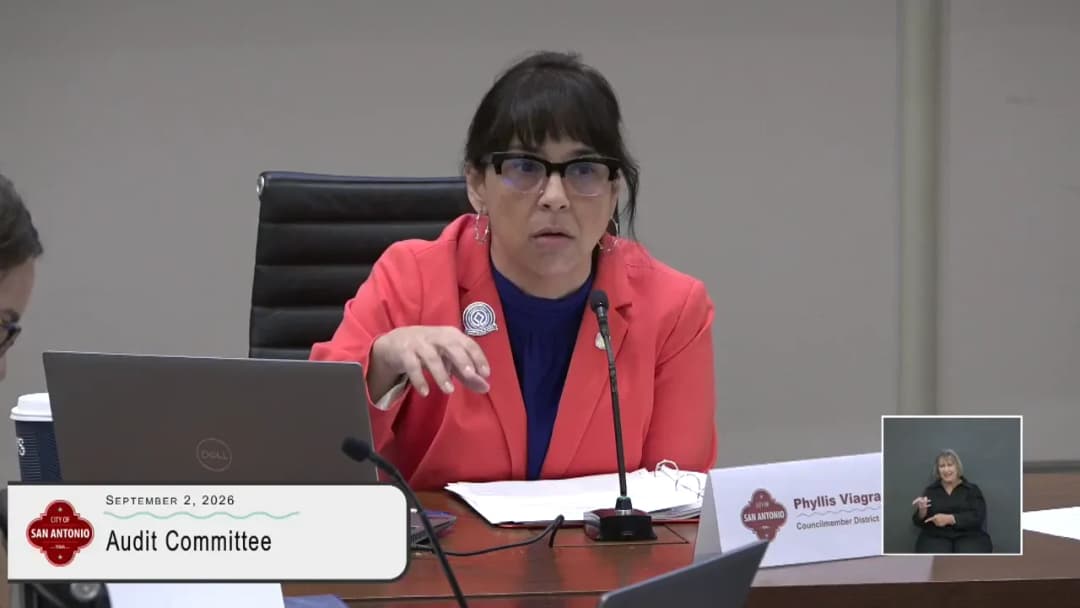
The Audit Committee met on September 2, 2026, from 10:03 AM to 12:12 PM, to review pre-solicitation and post-solicitation briefings, accept two internal audit reports, and receive the fiscal year 2026 external audit plan. The meeting began with approval of the previous minutes and included no public testimony. Consent Calendar - The committee approved the minutes of the prior meeting unanimously. Discussion Items Pre-Solicitation Briefings 1. Citywide Security Officer Services (Item 2) – The Information Technology Services Department (ITSD) presented a briefing on a solicitation for citywide security officer services with an estimated total value of $45 million over three years with two one-year renewal options. The contract serves 52 city buildings (excluding Alamo Dome and Airport). Council members asked about including public safety staff on the evaluation team and about potential consolidation of security services. The briefing was for discussion only. 2. Main Plaza Renovations (Item 3) – The Capital Delivery Department presented an $11 million construction contract for Main Plaza renovations. The project is a partnership with the Main Plaza Conservancy and involves significant historic and community considerations. Committee members emphasized the importance of honoring the site's history and working with the Archdiocese. No vote was taken. 3. Gap Funding for Affordable Housing (Item 4) – The Neighborhood and Housing Services Department presented two RFPs totaling $11.2 million for rental housing ($8.7M) and homeownership production ($2.5M). The funds come from the 2022-2027 Affordable Housing Bond, HOME, and CDBG programs. Affordability periods require at least 20 years (preferring 40+). Committee members asked about the number of expected projects and the impact on poverty reduction. The briefing was for discussion only. Post-Solicitation Briefings (Approvals) 4. Collab Road Loop Planning and Design Services (Item 5) – The committee approved moving forward to City Council a $9 million contract for planning and design services for the Collab Road Loop (410 to General McMullen). The recommended vendor (Vendor B) scored highest after interviews. The motion passed unanimously. 5. Temporary Electrical and Plumbing Services for Convention Center and Alamodome (Item 6) – The committee approved two revenue-generating contracts for temporary electrical and plumbing services at the Henry B. Gonzalez Convention Center and Alamodome. The contracts have an estimated revenue value of $9.5 million over three years with two one-year renewal options. The recommended vendors (A and B) scored highest. Motion passed unanimously. 6. Library Print Materials, Cataloging, and Processing Services (Item 7) – The committee approved a $24.5 million contract for print materials and cataloging services. The recommended vendor (Vendor A) scored highest across categories. Discussion included declining circulation of print materials, pricing inflation, and the need to provide historical spending data. A follow-up memo to full council was promised. Motion passed unanimously. Internal Audit Reports 7. Audit of ACS Dangerous and Aggressive Dog Program (Item 8) – The audit found the program operating effectively but identified improvements needed in documentation of investigations, compliance inspections, affidavit tracking, fee assessment, and system access. ACS management agreed with all recommendations and implemented corrective actions by August 2026. The committee accepted the audit report unanimously. 8. Audit of SAFD Uniformed Employee Overtime (Item 9) – The audit determined that increased absences, use of various leave types, and implementation of new programs without additional staffing were primary drivers of overtime rising from $15M to $25M between FY2019 and FY2023. The audit also identified areas lacking clear policies and potentially abusive practices, such as pyramiding premium pay and strategic scheduling of leave and overtime. The fire department agreed with recommendations and implemented corrective actions, including a $1.5M reduction in minimum staffing overtime budget. The committee accepted the audit report unanimously. External Audit Plan 9. Fiscal Year 2026 External Audit Planning (Item 10) – Forvis Mazars presented the required communications for the upcoming external audit. Significant risk areas include revenue recognition, management override, grant compliance, and implementation of GASB 103. The committee took no action. Key Outcomes - Approved minutes (unanimous). - Approved moving Item 5 (Collab Road) to full council (unanimous). - Approved moving Item 6 (convention center services) to full council (unanimous). - Approved moving Item 7 (library materials) to full council (unanimous) with a commitment to provide historical spending data. - Accepted Item 8 (ACS dog program audit) (unanimous). - Accepted Item 9 (SAFD overtime audit) (unanimous). - Received Item 10 (external audit plan) for information.
The Audit Committee of the San Antonio City Council convened on September 2, 2026, at 10:03 AM to review several pre-solicitation and post-award contract reports, accept two internal audit reports, and discuss the upcoming independent audit. No public comments were registered. The committee voted to forward multiple contracts to the full City Council and accepted the audit findings. Key discussions focused on evaluation criteria, local business participation, and overtime management in the fire department. Consent Calendar - Approval of Minutes (August 21, 2026): Unanimously approved. Pre-Solicitation Reports (Discussion Items) - IT Security Officer Services (Item 2): Presentation by Ben Cell, IT Chief. A contract for security officer services valued at $45 million over three years with two one-year renewal options. The solicitation is for all departments except Alamo Dome and airport. Evaluation criteria: 30 points experience/background/qualifications, 40 points proposed plan, 20 points price, 10 points small business. A 5% subcontracting requirement applies. Timeline: release September 11, 2025, with contract award expected January 2027. Councilmember Mesa González suggested adding public safety representatives to the evaluation committee. The item was informational; no vote taken. - Main Plaza Renovations (Item 3): Presentation by Michael Shannon, Capital Delivery Director. A construction contract for renovations at 11 Main Plaza, District 1, estimated at $11 million. Funded by 2024 bond. Evaluation: 30 points experience/qualifications, 30 points project approach (high-profile space near cathedral), 10 points San Antonio experience, 15 points price. 6% SBE requirement. Timeline: advertisement end of September 2025, council approval March 2026, construction start May 2026. Councilmember White emphasized preserving the history and local character of Main Plaza. Informational. - Housing Department Funding for Rental and Homeownership (Item 4): Presentation by housing department staff. Two solicitations totaling $11.2 million from 2022-2027 bond, HOME, and CDBG programs. Rental component: $8.7 million for rehabilitation/production serving up to 30% AMI, with 15% of units for families at or below 30% AMI, proximity to green/silver transit lines, family units, senior multifamily, and leverage of other funds. Homeownership: $2.5 million for single-family homes up to 80% AMI. Evaluation: 30 points accessibility (15% units at 30% AMI), project readiness/risk review, 15 points development experience, 10 points high-quality pre-K, 10 points nonprofit status, 5 points veteran-owned business. Timeline: pre-solicitation September 4, post-solicitation November, council approval January 2027. Councilmember Mesa González noted funding gaps and asked about project goals. Informational. Post-Solicitation Approvals (Discussion and Votes) - Culebra Road Planning and Design (Item 5): Michael Shannon presented. An RFQ issued for design services for a 5-mile corridor on Culebra Road (Districts 5, 6, 7) valued at $9 million from 2022 bond and other funds. Ten responses received; four shortlisted and interviewed. Company B received the highest score. The committee voted to forward the contract to the full council. Motion approved unanimously. - Plumbing and Electrical Services for Convention Center and Alamodome (Item 6): Presentation by Mónica Ramos. Two annual contracts for plumbing and electrical services valued at $1.9 million annually, total $9.5 million over three years with two one-year renewal options. Funded by Visitor Facilities Fund. Evaluation: 45 points experience/qualifications, 30 points proposed plan, 10 points SBE, 10 points local preference, 5 points small business. Providers A and B were top-ranked. Councilmember Villagrán asked about energy efficiency in the convention center expansion. Motion to forward to full council passed unanimously. - Library Materials and Processing Contracts (Item 7): Presentation by Neil McNeil. Three contracts for library materials (print and digital) in English and Spanish, valued at $24.5 million over five years with two one-year renewals. Six categories; Provider A was recommended for categories 1-3. No local vendors available. Councilmember White requested historical spending data and circulation trends before full council consideration. Motion to forward passed unanimously. Internal Audit Reports - Dangerous and Aggressive Dog Program Audit (Item 8): Presented by Michael Gutiérrez. Audit concluded the program operates effectively but identified improvements: inconsistent documentation of investigations, non-compliance with 30-day and annual inspections, untimely responses to court orders, and forgiveness of fees ($7,000+ in 22 cases, 19 waived without policy). Also, user access to Chameleon and Teams not properly monitored (90 of 260 users no longer with department). ACS management accepted recommendations and implemented new procedures in August 2026. Jengar, ACS director, noted workload increase (224 cases in 2024 to 500+ in 2025). Councilmembers emphasized public trust and safety. Audit accepted unanimously. - Overtime for Uniformed Employees (Fire Department) Audit (Item 9): Presented by Nastasha Lish. Audit examined factors driving overtime not returning to pre-pandemic levels. Overtime increased from $15M to $20M between FY2022-2023; hours increased by 980,000. Key issues: increased absenteeism, special assignments (87% increase from 2019 to 2023), discretionary leave, and lack of controls. 43% of retirees worked overtime hours before disability leave. Recommended tracking long-term absences, evaluating duties for civilian roles, implementing policies on premium pay, and improving internal controls in Telestaff system. Fire Chief Valerie Rustern and Assistant City Manager María provided context: overtime is needed for minimum staffing; some premium pay issues require collective bargaining. Estimated $1.5 million savings from implementing recommendations. Councilmember Mesa González asked about system integration with Telestaff and SAP. Audit accepted unanimously. Independent Audit Communication (Item 10) - Victoria Rader and Amanda (from Forbes Massars) presented the FY2026 independent audit plan. The audit will review internal controls, compliance, and financial statements. New this year: GASB 13 implementation. The committee was asked to report any suspected fraud or control deficiencies. The plan was noted; no formal vote required. Key Outcomes - All motions to forward contracts to the full City Council were approved unanimously. - Both internal audit reports (dog program and fire overtime) were accepted unanimously. - The independent audit plan was acknowledged; the committee will receive results later. - The meeting adjourned at 12:00 PM after an executive session (no action taken).
On Tuesday, September 1, 2026, the San Antonio City Council held a special session starting at 2:05 PM to discuss two agenda items: the reauthorization of the Pre-K 4 SA program for the November ballot and the final report from the Mayor's Commission on Voter Participation. The meeting ended at 4:22 PM after a loss of quorum. Discussion Items Pre-K 4 SA Reauthorization Presentation - Dr. Sarah Bray presented the program's results since 2012, emphasizing brain development (90% of brain development occurs before age 5, with 1 million neural synapses per second in the first year). She cited research showing a 13.7% annual return on investment for early childhood education for ages 0-3, and a 7% return overall. - The proposed reauthorization aims to expand access, improve quality, and increase affordability. Plans include growing from 90 providers to 300 programs, serving children under 3, and offering non-traditional hours. The program currently serves approximately 2,000 children directly and 500 more through partners. - Council members expressed strong support. Councilman Manny Rodriguez highlighted the program's impact and asked about expanding capacity for infants and providers with alternative hours. Councilman John Courage inquired about the cost per child and transparency, noting that some voters perceive $31 per child when actual costs are distributed across services. Councilwoman Ana Sandoval asked about coordination with school districts and capital investments. Councilwoman Rebecca Viagran praised the program's work. - Councilmember Melissa Cabello Havrda asked about cost trends and the Texas Rising Star rating system. Councilwoman Shirley Gonzales emphasized the importance of early childhood education for workforce development, noting that 845 women have left the workforce in Bexar County due to lack of childcare. Councilman Roberto Treviño asked about serving military families and children with special needs. - No vote was taken; the item was informational. The Pre-K 4 SA measure will appear on the November ballot. Mayor's Commission on Voter Participation Final Report - Commissioners Katy Bell (vice president of Bexar County Voters) and Jill Tober (president of the League of Women Voters of San Antonio) and facilitator Drew Galloway presented the report. The commission met over 8 weeks, producing 9 recommendations. - Key recommendations include: creating a civic participation office (Recommendation 1), establishing a non-profit roundtable for coordination (Recommendation 3), setting public voter registration goals (Recommendation 6), and creating a centralized voter information hub (Recommendation 8). The commission noted that Bexar County has the highest percentage of suspended voters in Texas (153,000 registered voters on the suspense list), and San Antonio's voter turnout in 2025 was 9.2% of 1.2 million registered voters, compared to Houston (17%), Austin (24%), and Dallas (10%). - Council members expressed mixed views. Councilman Clayton Perry questioned the process, noting that the commission was formed outside the usual council process and without staff analysis. He raised concerns about costs, duplication with the existing Communications and Neighborhood Engagement department, and the need to coordinate with Bexar County. Councilwoman Viagran agreed that efforts should be regional. Councilman Manny Rodriguez and Councilwoman Gonzales praised the work and supported the recommendations. Councilman Cruz said he was open to further discussion. - The alcalde (Mayor) noted that the feedback would inform next steps. No formal vote was taken. Key Outcomes - The council received the Pre-K 4 SA presentation; the program will proceed to the November ballot without opposition from the council. - The council received the Mayor's Commission on Voter Participation report; no formal action was taken. The mayor indicated that the recommendations would be considered further, with input from council members. - The meeting adjourned early due to a loss of quorum at 4:22 PM.
The San Antonio City Council held a budget work session on Tuesday, September 1, 2026, from 2:05 p.m. to 4:22 p.m. The meeting included two major agenda items: an update on Pre-K 4 SA's reauthorization plan for the November ballot, and a presentation of the Mayor's Commission on Voting's final report. No votes were taken; the session served as a discussion and briefing for council members. Discussion Items Pre-K 4 SA Reauthorization Update Dr. Sarah Bray, Pre-K 4 SA's leader, presented the program's results and plans if reauthorized. She highlighted that brain science shows one million neural synapses form per second in the first year of life. Nobel Laureate James Heckman's research found a 7% annual ROI for high-quality preschool for 4- and 5-year-olds, and 13.7% for programs starting at ages 0–3. Pre-K 4 SA has returned over $59 million in community benefits in its first eight years. Since 2012, the program has served about 2,000 children directly and 5,000 through partner providers, with 80% of seats going to low-income families. The proposed reauthorization would expand access for children under 3, increase quality through provider support and teacher credentialing, and improve affordability via public-private cost-sharing models. Dr. Bray noted that only 20% of eligible 3-year-olds in Bexar County are enrolled in public pre-K, and Texas loses $9.3 billion annually in productivity due to lack of reliable child care. The city attorney reminded council not to advocate for or against the proposition, which will appear on the November 2026 ballot. Council members expressed support for the program and asked detailed questions. Councilmember Mickey Rodriguez (District 2) praised the results and asked about expanding infant/toddler care to all four campuses and funding for non-traditional hours. Dr. Bray responded that expansion would depend on need and that pilots are underway. Councilmember Messi Gonzalez (District 5) tied pre-K to workforce development and noted 845,000 women have left the workforce due to caregiving pressures. Councilmember Galvan (District 5) asked about public-private models and coordination with school districts; Dr. Bray described tri-share models and ongoing partnerships with ISDs. Councilmember Aldrete Gavito (District 9) raised the cost per child ($31,000) and questioned scope creep; Dr. Bray clarified that the budget covers direct instruction, partner support, family services, and professional learning, and that per-hour costs are lower than comparable programs. Councilmember Corr (District 1) requested a detailed voter guide and highlighted that Texas ranks 43rd in per-pupil spending. Councilmember Mungia (District 4) asked about supporting children with special needs and improving teacher benefits. Dr. Bray said reauthorization would allow long-term planning for inclusive classrooms and benefit pooling. Mayor's Commission on Voting Report Commission members Kathy Vale, Jill Torbert, and facilitator Drew Galloway presented nine recommendations to improve voter participation and civic engagement. Vale noted that Bexar County has 153,000 registered voters on the suspension list—the highest percentage in Texas. In the 2025 municipal election, only 9.2% of registered voters cast ballots, with the lowest turnout among 18–29 year olds. The commission recommended creating a Civic Engagement Coordination Round Table (Recommendation 3), setting annual civic participation goals (Recommendation 6), establishing a centralized voting information hub (Recommendation 8), and creating an Office of Civic Participation (Recommendation 1). Galloway emphasized that the office would elevate existing work and align city departments. The report was released July 8, 2026. Councilmember White (District 8) criticized the process, noting the commission was formed without council approval and that the city's Communications & Engagement (C&E) department already handles civic outreach with three employees. He argued that creating a new office would duplicate efforts and cost money, especially amid a $158 million budget deficit. Councilmember Galvan (District 5) expressed support for the recommendations, particularly the round table and information hub, and suggested partnering with the county. Councilmember Messi Gonzalez (District 5) supported the work and asked about making TVSA meetings available on streaming services. Councilmember Mungia (District 4) noted low turnout in his district and highlighted the problem of college students being placed on the suspension list due to address issues. Councilmember Via Gran (District 3) opposed Recommendation 1 but supported a regional, city-county round table. Councilmember Corr (District 1) emphasized direct community engagement and cited examples of block walking and surveys. Mayor Jones defended the commission's creation, stating the original motion would have delayed work too long given upcoming election threats. Key Outcomes - No formal votes were taken on either agenda item. - Pre-K 4 SA will release a voter guide in the coming weeks to detail the reauthorization proposal. - The Mayor's Commission on Voting report will be used to inform future civic engagement efforts; the mayor indicated that council feedback will guide next steps, with some recommendations possibly implemented quickly. - Council members expressed interest in further B session discussions on both topics.
The San Antonio City Council convened a work session on September 1, 2026, to review proposed budget items, including Tax Increment Financing (TIF) extensions, housing services, and homelessness programs. Presentations were made by Verónica Garcia (Director of Housing Services) and Mark (Director of Homeless Services). No formal votes were taken; the council will consider these items on September 10, 2026. TIF (Tax Increment Financing) Discussion - Verónica Garcia presented an overview of the TIF policy adopted in March 2026, emphasizing priorities such as housing, arts and culture, economic development, and historic preservation. The proposed TIF budget for the year is $46,628,621 for city-initiated projects. - Staff recommended extending several TIF districts to 2060, including the ITC property for UTSA, the zoological and botanical gardens, Brackenridge Park, and several other projects. The council will consider these extensions on September 10. - Councilmember Corr expressed strong support for TIF as a tool to attract investment and benefit underserved communities, particularly in District 3. He noted that TIF allows the city to fund infrastructure that the general fund cannot cover. - Councilmember White supported TIF extensions but requested that extensions be tied to tangible neighborhood benefits and that staff provide data on how TIF investments outside the district benefit the originating area. - Councilmember Rodriguez thanked staff and expressed support for TIF-funded projects like the senior center and Roosevelt Park renovations. He urged colleagues to view TIF as an equity tool rather than using it for controversial sports projects. - Councilmember Castillo asked about TIF affordability requirements; staff clarified that the council can impose affordability conditions on a project-by-project basis. She also requested data on the percentage of affordable housing produced within TIF districts. - Councilmember Munguía noted that TIF funded projects that benefit cultural institutions, but expressed concern that funds are diverted from the general fund to areas that are already developed. - Councilmember (unnamed) expressed skepticism about TIF, acknowledging its benefits but worrying about the accountability of outcomes and the opportunity cost of forgoing property tax revenue for the general fund. Housing Services Discussion - Verónica Garcia presented the proposed budget for neighborhood and housing services (NHSD), including a strategic housing implementation plan (SHIP) with a goal of preserving 20,000 homes by 2027. The plan includes 36 strategies and collaboration with multiple partners. - The proposed budget includes $1.5 million for minor repairs, $7.7 million for major rehabilitation, and $6.2 million for rental assistance. Staff recommended transferring $500 million (likely $500,000) from other funds to housing programs. - A reduction of $210,000 was proposed for property tax workshops, transitioning to online resources. Councilmembers emphasized the importance of maintaining one-on-one support for homeowners. - Councilmember Spears asked about completion rates: staff reported that by the end of FY2026, approximately 9,000 units (50% of the 20,000 goal) will be completed. She also asked about tracking long-term outcomes (e.g., whether residents remain housed after six months). - Councilmember Galván asked about cost comparisons with other cities' homeless services and requested data on per-unit or per-bed costs. - Councilmember Mesa González asked about criteria for priority projects and supported preservation initiatives. - Councilmember Castillo expressed concern about a fee increase for the San Antonio Housing Trust from $2,500 to $50,000, worried that it would raise costs for deep affordability projects. - Councilmember Munguía praised the good neighbor program and urged that tree maintenance be included in rehabilitation programs. Homeless Services Discussion - Mark, Director of Homeless Services, reported that the department started on October 1, 2025, and has helped over 2,500 people. The proposed FY2027 budget includes $5.1 million from the general fund and $8 million for delegate agencies. - A camp removal pilot program was proposed, focusing on improving outcomes for homeless individuals through daily outreach by social workers for 4-6 weeks before moving to new locations. - Staff highlighted a partnership with Goodwill for a day labor program and a $3 million annual grant for behavioral health and housing stability. - Councilmember Spears asked about indirect costs to police and fire; staff estimated $34 million in indirect costs. She supported the pilot program. - Councilmember Galván asked about capacity compared to other cities; staff acknowledged the need to start small and learn from other cities like Denver. - Councilmember Mesa González asked about the number of new people entering homelessness annually; staff reported approximately 750 per year in FY2026. - Councilmember Castillo noted barriers to shelter for migrants and supported low-barrier shelter access. - Councilmember Corr reiterated support for homeless services but urged collaboration with the county and surrounding cities. - Councilmember (unnamed) asked about legal assistance for eviction prevention; staff reported $100,000 allocated for third-party legal services helping 330 referrals. Key Outcomes - No votes were taken; the council will consider TIF extensions, housing, and homelessness budget items at the September 10, 2026 meeting. - Staff will provide additional data requested by councilmembers, including: - Metrics on TIF investment outcomes and affordability requirements. - Per-unit cost analysis for homeless services. - A report on how TIF funds are used outside the district and the resulting benefits. - A plan to incorporate tree maintenance into rehabilitation programs for storm-affected areas. - The council expressed general support for the proposed budget direction, with some members emphasizing the need to prioritize equity and accountability in TIF spending.
The San Antonio City Council held a budget work session on Tuesday, September 1, 2026, from 9:07 a.m. to 12:16 p.m. to review proposed FY 2026-27 budgets for Tax Increment Reinvestment Zones (TIRZs), the Neighborhood and Housing Services Department (NHSD), and the Homeless Services and Strategy Department (HSSD). No agenda or minutes were provided; this summary is based solely on the transcript. The meeting was mostly discussion with no votes taken. Staff also announced work on an emergency homeowner repair program following the previous Friday's storm. Opening: Emergency Storm Response - The city manager's office announced it is developing an emergency homeowner repair program for residents affected by Friday's storm, primarily in Districts 4, 5, 1, and part of District 10. - Staff expect to present a proposed program by the end of the week, using FY26 resources if possible, avoiding redirecting FY27 home repair funds, and considering city-initiated TIRZ funds and state/federal assistance. The EOC has contacted FEMA about eligible programs. Tax Increment Reinvestment Zones (TIRZs) - Veronica Garcia, NHSD director, and CFO Troy Elliott presented on TIRZs under Chapter 311 of the Texas Tax Code. Under the mechanism, a zone's tax base is frozen, and future incremental property tax revenue is captured into a TIRZ fund to pay for eligible improvements. Total property tax revenue expected to be contributed to TIRZs next year is $46,628,000. - The city has nine city-initiated TIRZs and several developer-initiated TIRZs. City-initiated TIRZ areas include Houston Street, Inner City, Brooks City Base, Verano, Mission Drive-In, Midtown, West Side, Northeast Corridor, and HemisFair. - Staff requested consideration on September 10 of term extensions to 2060 for the Inner City, Midtown, Mission Drive-In, and Northeast Corridor TIRZs, saying the extensions align terms, allow debt issuance, and provide financing flexibility. - Scheduled September 10 TIRZ actions include the Inner City TIRZ's District 2 Senior Center and Aquatic Center (about $46 million); Mission Drive-In TIRZ's District 3 Aquatics Facility ($1.8 million) and World Heritage Pavilion ($750,000); Northeast Corridor TIRZ's neighborhood signage pilot ($1.3 million); Midtown TIRZ purchases and cultural partners (ITC property from UTSA; $10 million each for the San Antonio Zoo, San Antonio Botanical Gardens, and Brackenridge Park Conservancy); and West Side TIRZ diversion center pilot funding ($638,000). - Developer-initiated TIRZs reviewed included Rocio Creek (term through 2050), Mission Del Lago, Lackland Hills, Northeast Crossing, and Hunter's Pond. Stablewood Farms, Mission Creek, Halley Heights, and Heathers Cove have expired; Lackland Hills is expected to end in September 2027 and Northeast Crossing in 2028. - Council positions and discussion: - Councilmember Viagran strongly supported TIRZs as an equity and investment tool, especially on the South Side. She said she preferred the budget option that restores services using a property tax rate increase, but would support the city manager's presented budget if colleagues lack appetite for that option. She opposed moving TIRZ money to the general fund and said council should not ask departments for new money while declining a property tax increase. - Councilmember White supported TIRZ investments tied to concrete neighborhood benefits, including the Northeast Corridor signage program. He asked that TIRZ extensions be tied to tangible projects and expressed concern about spending on homelessness without clear progress. - Councilmember McKee Rodriguez credited the Inner City TIRZ with helping fund the District 2 senior center, home repair, parks, and affordable housing. She asked staff to return with a financing proposal combining proposed TIRZ projects with a significant affordable housing package, and cautioned that extensions could become a blank check to developers. She also warned against using TIRZ dollars for controversial sports venues. - Councilmember Spears noted District 9 has no TIRZ and asked how TIRZ investments outside a zone demonstrate benefit to the zone; staff said they report back to each board. - Councilmember Mungia said developer-initiated TIRZs have addressed infrastructure deficits in Districts 2, 3, and 4 and that developers do not always recoup all costs. - Councilmember Galvan expressed general skepticism about TIRZs, asking when redevelopment is 'complete' and when the increment should return to the general fund for citywide services. - Councilmember Core raised the possibility of using Midtown TIRZ funds for storm-repair assistance and for preserving naturally occurring affordable housing, and supported continued funding for cultural corridor partners. - Mayor Jones asked how the city tracks whether TIRZ projects would happen without public investment, how TIRZ investments meet policy objectives, and what assumptions about the general fund support long-term extensions. Staff acknowledged they would need to provide additional analysis. Neighborhood & Housing Services Department (NHSD) - Veronica Garcia presented NHSD's proposed FY2027 budget of $77.8 million: $37.7 million for affordable housing programs, $29.4 million for implementation of the affordable housing bond, and $10.7 million for essential programs and services. - NHSD proposed $4.3 million in reductions and transfers: about $300,000 in actual savings (including a $210,000 reduction to property tax help workshops, with $40,000 retained for online outreach, plus $70,000 in line-item efficiencies), and $4 million in fund-balance transfers, including $2 million from minor repair general fund dollars replaced with TIRZ/affordable housing funds, $1.5 million from the Inner City Incentive Fund, and $500,000 from the TIV fund for the city fee waiver program. - Programs highlighted include: $6.2 million for rental assistance to help over 2,600 families with rent and relocation; a new $500,000 voucher incentive pilot with Opportunity Home expected to support up to 800 households; eviction prevention staff at every Bexar County precinct court for about 18,000 eviction hearings a year; $1.5 million for down payment assistance for 68 first-time homebuyers; $7.7 million for major rehab for 42 homeowners; $8 million for minor repair for over 450 homeowners; and Good Neighbor grants for exterior safety repairs. - On the Strategic Housing Implementation Plan (SHIP), the 10-year goal is to produce or preserve 28,000 homes by 2031. Five years in, staff expect to reach 50% of the overall goal by year-end, with about 9,000 homes completed. A SHIP refresh is underway, with Housing Commission review on August 20, PCDC briefing planned later in September, and City Council adoption planned in October. - The affordable housing bond has funded over 5,200 homes, with 94% of funds committed and over 3,900 homes expected to be completed by the end of 2027. About 20% of units are for seniors. City-incentivized rentals have over 93% occupancy versus about 85% citywide. Each $1 of bond funds is leveraged with about $7 from private, philanthropic, and federal sources. - Council discussion included: - Councilmember White asked how much of the $4.3 million in NHSD reductions was actual savings versus transfers; staff answered about $300,000 in savings and $4 million in fund-balance transfers. He also urged attention to permitting costs and delays that increase housing costs. - Councilmember Castillo asked about a proposed increase in the San Antonio Housing Trust due diligence fee from $2,500 to $50,000 and expressed concern it could increase costs for deeply affordable housing; budget staff said the fee aligns with debt issuance costs. - Councilmember Mungia praised NHSD's Good Neighbor Grant and constituent service, but also asked for the impact of the Housing Trust fee. She said NHSD staff presence at eviction courts is critical. - Councilmember Core asked for follow-up on why rental-relocation applicant numbers changed while assisted individuals increased, and asked for details on limited one-on-one property tax workshop support. She requested exploration of TIRZ support for storm-damaged homes and NOAH preservation. - Mayor Jones noted 15,796 evictions in Bexar County in 2025, an eviction filing against about one in every 11 renter households in 2024, 51% of renters cost burdened, and 25% severely cost burdened. He asked staff to assess whether the $1.5 million down payment assistance program could be redirected to eviction prevention and asked for restoration of the property tax help workshops. Homeless Services & Strategy Department (HSSD) - Mark Carmona, Chief Housing Officer and HSSD director, presented the department's proposed FY2027 budget of $29.3 million, including $5.1 million in general funds, $8 million in delegate agency funding, capital funding for shelter/day center capacity, and federal/state grants. The department launched October 1, 2025, with the goal of making homelessness rare, brief, and non-recurring. - This year, the street outreach team engaged over 1,000 people; the encampment response team coordinated nearly 1,400 abatements. In FY25, 1,738 people were new to homelessness. Carmona said the latest data show return-to-homelessness dropping to 480. He also cited that of more than 4,100 people on the streets last year, about 2,800 were engaged and placed into shelter/housing. - Two stakeholder work sessions included 68 partners; 98% reported willingness to continue collaborative work. The main theme was that the gap is coordination rather than invention. Next steps include a shared client management system, shared data alignment, a strategic funders alliance, and strengthening the community connections hotline. - FY27 initiatives include: expanding the PIC (Program for Intensive Care Coordination) model with $750,000 over three years from state opioid settlement funds for unsheltered individuals with opioid use disorder; submitting the San Antonio HEAL Initiative, a four-year, $12 million federal grant request ($3 million annually) to SAMHSA; aligning three social work positions with encampment decommissioning; exploring a day work program with Goodwill; coordinating with the jail diversion center; and launching an encampment decommissioning pilot using daily outreach and social work for four to six weeks at selected sites. - Shelter capacity: the FY26-funded low-barrier non-congregate shelter lease ended this month, providing 185 beds. The proposed budget includes $9 million in housing bond funds for capital development of additional emergency shelter space through an RFP, with funds anticipated by fall 2027. In the pipeline, 145 new shelter beds are planned for 2027, including about 80 from SAM Ministries pending state funding and 65 from the Salvation Army. An interim plan proposes repurposing $200,000 for medication-assisted treatment from the general fund, up to $100,000 in shelter lease savings, and $150,000 in opioid settlement funds to add roughly 40 beds with shelter partners. - Direct spending on homelessness is about $31.4 million, including solid waste, parks, code, and police support during encampment work; indirect costs for police and fire response are about $30.4 million, for roughly $61 million total. - Council discussion included: - Councilmember Viagran called prevention and permanent supportive housing key, and said no property tax increase means no new spending requests. - Councilmember White asked where efficiencies can be found; Carmona cited partnerships with healthcare, county, and other systems rather than taking on all costs internally. - Councilmember Spears fully supported the new behavioral-health direction, volunteered District 9 as a pilot, supported the SA HEAL grant application, and said behavioral health is the biggest obstacle in homelessness. She asked about private/philanthropic funding and indirect public safety costs. - Councilmember Galvan asked whether the city has enough non-congregate shelter and outreach/housing capacity compared with other cities that have done decommissioning; Carmona said the pilot intentionally starts small to avoid making promises the city cannot keep. Galvan also asked about coordination with Animal Care Services on pets of homeless residents. - Councilmember Mungia said the numbers might seem stagnant, but prevention work is keeping numbers from rising faster, and asked for consistent updates on the decommissioning pilot and tracking deaths in the homeless community. - Councilmember Castillo noted barriers to shelter entry, including a case where an unhoused individual died despite outreach efforts, and supported more low-barrier shelter. - Councilmember Aldrete Gabito asked about indirect spending and stressed prevention, particularly for youth aging out of foster care. - Councilmember Core asked for street outreach metrics separate from delegate agency metrics, and for details on how pilot sites are chosen. - Mayor Jones asked whether Ready to Work funds could support the day work program, and asked for performance measures comparing city-provided outreach versus delegate agency outreach. He also asked about registering homeless residents in CARELINK through contracts with delegate agencies. Key Outcomes - This was a work session; no formal council votes were taken. - Staff will return by the end of the week with a proposed emergency homeowner repair program for storm-affected residents. - On September 10, Council will consider the TIRZ term extensions, Inner City District 2 Senior and Aquatic Center, Mission Drive-In projects, Northeast Corridor signage, Midtown TIRZ purchases/cultural funding, and West Side diversion center pilot. - Staff will follow up on a TIRZ financing proposal that includes currently proposed projects and a significant affordable housing package, as requested by Councilmember McKee Rodriguez. - Staff committed to follow-up analysis on eviction resolution outcomes, rental-relocation program data, San Antonio Housing Trust fee impacts, TIRZ performance/ROI metrics, aggregate TIRZ/general fund fiscal assumptions, and options for using TIRZ funds for storm assistance where legally permissible. - The Homeless Services Department will continue pursuing the SAMHSA grant, meet with Goodwill about the day work program, explore Ready to Work or other non-general-fund sources, and return with more data on the encampment decommissioning pilot and client outcomes.
The San Antonio Zoning Commission met on September 1, 2026, to consider several zoning cases, including a consent calendar, a postponement, and a contested individual hearing. The commission recommended approval for most items, with one notable vote on a subdivision request. Consent Calendar - Items 2, 3 (with legal description amendment), 4, 5, and 7 were approved unanimously. These included: - Item 2: Rezoning at 3857 South Cross Boulevard. - Item 3: Rezoning from Z2 to MF33 (TOD overlay) with an amendment to the legal description. - Item 4: Rezoning from R5 to R5 CD for residential use at Light Sun Zoom Drive. - Item 5: Rezoning from R5 (with superimposed same) to R2 MLOD at 1232 River Street. - Item 7: Rezoning from C3 to C2 CD for food processing at 8666 Hibner Road. - No public comments were made on these items. The motion passed unanimously (11-0). Public Comments & Testimony - Lucia Oyervides (resident of 5102 Hempfield Drive for 25 years) spoke in opposition to the individual hearing case (Item 1). She stated the lot at 5050 Hempfield Drive is too small for two houses, citing insufficient parking and existing on-street parking issues. She expressed concern that two units would create problems for the neighborhood. Discussion Items - Item 1 (5050 Hempfield Drive) – Rezoning from R5 to R3 for Subdivision - The applicant’s representative (Mr. Christianson) requested a zoning change from R5 to R3 to subdivide a 7,500 sq. ft. corner lot into two lots of 3,750 sq. ft. each for single-family homes. Staff recommended denial due to lot size inconsistency with the surrounding R5 neighborhood (typically 7,500 sq. ft. lots). - The applicant argued the property is challenging for a single house (adjacent to 100-ft. utility towers, empty structure) and that the corner lot allows two frontages. They noted the lots would be for sale, not rentals. - Commissioners questioned staff about accessory dwelling units (ADUs) allowed in R3, setback requirements (3 ft. front and rear in R3 vs. 10 ft. in R5), and the presence of duplexes in the area. Staff clarified that the area is predominantly R5 with larger lots, and the recommendation was based on lot size and neighborhood character. - Commissioner Saibs (District 7) moved to approve, noting that corner lots often have a bonus and that the commission’s role is to recommend. He acknowledged the neighborhood opposition but argued for better use of the vacant lot. - The motion passed 9-1, with Commissioner Dugo voting no. The recommendation will go to the City Council. Key Outcomes - Consent Calendar (Items 2,3,4,5,7): Approved unanimously. The cases will proceed to the City Council in approximately two months. - Item 8 (601 Delaware Street): Postponed to the September 15, 2026, hearing. Motion passed unanimously. - Item 1 (5050 Hempfield Drive): Recommended for approval (9-1) to rezone from R5 to R3 to allow subdivision into two lots. The vote was: Saibs (yes), Kellum (yes), Hinojosa (yes), Pete Rodríguez (yes), Kelly (yes), Juites (yes), Wissit (yes), Bustamante (yes) – 9 yes; Dugo (no) – 1 no. - Minutes of August 18, 2026: Approved unanimously by voice vote. - Items 6 and 9 were postponed prior to the hearing and will be rescheduled.