The Public Safety and Livable Neighborhoods Committee met on March 9, 2022, at 9 a.m. virtually, due to the ongoing COVID-19 pandemic, under California Government Code Section 54953E. The committee considered several informational and consent agenda items, including library reopening and staffing, an equity audit of recreation programming, the Falck ambulance contract update, and the 2022 committee work plan. Public comment was heard on non-agenda items, consent agenda items, and specific agenda items. Consent Calendar - Approved items 1 and 2 (joint use agreements between Parks and Recreation and San Diego Unified School District, providing 6.3 acres of parkland, playgrounds, and ball fields to neighborhoods in District Eight). Public Comments & Testimony - Non-agenda public comment: Six speakers addressed various topics, including bike lane planning concerns, opposition to marijuana storefronts, and public health risks from vaping products. One speaker referenced a Pennsylvania Office of Medical Marijuana recall of over 500 products containing contaminants. Another speaker urged the committee to consider the impact of marijuana normalization on youth. - Consent agenda public comment: One speaker attempted to comment but was unable to unmute; no substantive testimony was received. - Item 5 (Library reopening): One speaker expressed frustration that District Two has the most library vacancies, stating "from what I have heard, district two has the most vacancies to fill." - Item 7 (Falck ambulance contract): Six speakers testified. Tony Sorcy (president of SCAP) reported improved working conditions and service levels due to weekly meetings with Falck management. Aaron Brennan, a retired San Diego firefighter, criticized Falck for "bait and switch" regarding promised ambulance deployment, stating "It seems that Falk did a bait and switch and should be held accountable." Another speaker expressed disappointment in the city council for signing the contract despite knowing Falck's record from other cities. Discussion Items - Item 5: Reopening of Libraries and Staffing Update – Presented by Misty Jones, Library Director. Libraries began reopening in June 2021; lost about one-third of workforce during the pandemic. The FY2022 budget included converting hourly positions to permanent, with 145 offers to fill. All branches will reopen at pre-pandemic levels, though Central Library hours reduced for consistency. Committee members thanked staff and discussed hiring timelines and vacancy challenges. Councilmember Campillo noted the need for urgency in filling positions. - Item 6: Performance Audit of Equity in Recreation Programming – Presented by City Auditor Andy Hass and team. The audit found notable progress but significant inequities in recreation programming funding, availability, and access across communities. Made 16 recommendations; Parks and Recreation agreed to implement if resources allocated. Councilmember Moreno highlighted disparities south of the I-8 freeway, noting facilities are older and less maintained, and programs are fewer. Councilmember von Wilpert asked about transparency in fee structures and needs assessments. The audit emphasized the need for a strategic, comprehensive approach. - Item 7: Falck Mobile Health Corporation Contract Update – Presented by Fire Chief Paul Umstowell and Deputy Chief Jody Pierce. Covered first 94 days of the contract (started November 27, 2021). Cited turnover in Falck leadership, which created challenges. Performance measures: 50% compliance with ambulance response time objectives for Advanced Life Support, 54% for Basic Life Support; 50% deployment compliance; 44 ambulances in service vs. contracted 66. Falck also failed to meet co-located positions but is working toward them. Committee members expressed strong disappointment and anger. Councilmember Campillo requested weekly updates and emphasized urgency. Vacancies reported at 317 sworn firefighter positions. Committee urged Fire Department to hold Falck accountable and consider legal action if necessary. - Item 8: 2022 Neighborhoods Committee Work Plan – Informational only. Committee members thanked staff and expressed alignment on priorities. Chair Montgomery Steppe highlighted commitment to equitable services. Key Outcomes - Consent agenda items 1 and 2 approved unanimously. - Items 3 and 4 (originally on agenda) returned to staff. - No motions required on informational items (5, 6, 7, 8). - Committee directed Fire Department to provide regular, potentially monthly, updates on Falck contract performance and to explore performance bond or legal recourse. - Committee acknowledged the library staffing update and expressed support for continued hiring efforts. - Committee accepted the equity audit findings and recommendations, with expectation that Parks and Recreation will implement them as resources permit. - Work plan for 2022 was acknowledged with appreciation for staff efforts.
Public Meetings - San Diego, California
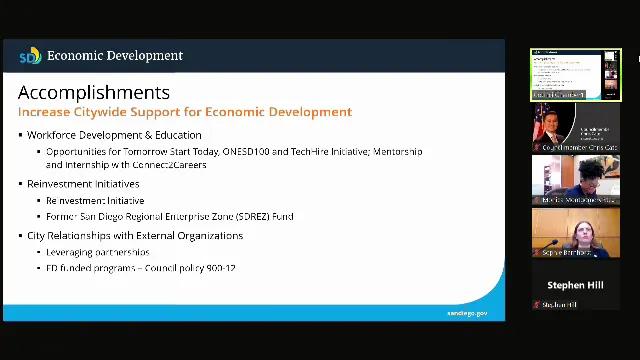
Public Meetings - San Diego, CaliforniaThe Economic Development and Intergovernmental Relations Committee met virtually on March 9, 2022, to consider three agenda items: a consent agenda item for a public art project, a major disposition and development agreement for the East Village Quarter (Tailgate Park) with the Padres Development Team, and an informational update on the city's economic development strategy. The committee also heard non-agenda public comments on the fentanyl crisis and cannabis issues. Consent Calendar - First Amendment to Consulting Agreement with Christian Moeller Studio, LLC for Purewater North City Public Art Project: The committee unanimously approved the consent agenda item without discussion or public comment. Public Comments & Testimony - Non-Agenda Public Comments: - Peggy Walker (youth substance abuse prevention, 25 years) cited alarming data from the District Attorney: fentanyl is the number one killer of those 18–34 in the U.S.; overdose deaths in San Diego rose from 152 in 2019 to 840 in 2021. She urged the committee to stimulate intergovernmental discussion on the border drug crisis. - Becky Rapp (parent, public health educator) expressed concerns about marijuana exports to Mexico, citing a Washington Post report that 55% of customers at a local dispensary are Mexican nationals. She opposed producing more cannabis. - A caller (phone number ending 7234) criticized the city's reduction of the marijuana cultivation tax rate from 8% to 2%, calling it preferential treatment, and urged compliance policies so the city receives promised taxes to address health and welfare damages, especially for youth. - Public Comment on Item 2 (East Village Quarter DDA): Seven speakers supported the project: - Matthew Labor Gonzalez (San Diego Building and Construction Trades Council) emphasized local hire, good wages, benefits, and a project labor agreement. - Keith Jones (Ace Parking) applauded the transparent process and urged approval. - Mark Ballmert (San Diego Military Advisory Council) supported the housing component, particularly for the military community. - Jorge Villa Montes (Carpenters Union Local 619) highlighted jobs and parking replacement, and favored approval. - Stephanie Benvenuto (San Diego Regional Chamber of Commerce) praised the project for homes and jobs. - Rebecca Ribsick (Downtown San Diego Partnership) noted it would bring the largest concentration of affordable housing downtown and transform a parking lot into a vibrant community. - Jesse Garcia (San Diego Carpenters Union Local 619) supported the project labor agreement and fair wages. - Francisco Peña (carpenter for 30 years) favored the 15% on-site affordable housing, aligning with Mayor Gloria's 'Homes for All of Us'. - Joy Sanyata (District 3) raised three questions about redevelopment law, the Park Boulevard at-grade project, and a blighted pocket park, but expressed support. - Public Comment on Item 3 (Economic Development Strategy): Three speakers: - Joy Sanyata praised the staff report and highlighted the word 'inclusive' in the RFP. - Stephanie Benvenuto (Chamber) emphasized the need for inclusive growth given high costs of housing and childcare. - Rebecca Ribsick (Downtown Partnership) commended the department's past work and looked forward to the new strategy. Discussion Items - East Village Quarter Tailgate Park Disposition and Development Agreement: - Christina Bibler (Director of Economic Development) presented the project: 5.25 acres downtown, purchased from former redevelopment agency in 2016. After a competitive process, the Padres Development Team (Padres, Tishman Speyer, Ascendant Capital) was selected. The $35.1 million purchase price exceeds the $34 million appraised fair market value. The project includes 1,800 housing units (15% affordable: 10% at 60% AMI, 5% at 150% AMI), 1,200 parking spaces, 50,000 sq ft retail/office, and a nearly 2-acre public park. Phase 1 includes 900 units and the parking garage; completion by December 2035. The developer will enter a project labor agreement. - Eric Gruppner (Padres CEO) noted the project has been envisioned since Prop C and respects parking requirements for Petco Park. - Paul DiMartini (Tishman Speyer) described guiding principles, fault lines reducing developable area by over 30%, and sustainability commitments including renewable energy. - Baku Patel (IBA) noted no concerns, emphasizing the prescriptive redevelopment dissolution process. - Committee members expressed strong support. Council President Pro Tem Montgomery Stepp clarified affordable housing percentages and confirmed that affordable units would be front-loaded in Phase 1. Chair Campillo asked about performance remedies and green building; the team confirmed accountability measures and sustainability features (Padres' solar array and renewable energy commitment). The chair also urged inclusion of childcare in ground-floor space. - Economic Development Strategy Update (Informational): - Christina Bibler reviewed the history of the city's economic development strategy (last updated in 2016) and highlighted accomplishments: Tech Hire program (1,415 opportunity youth served), reinvestment initiatives ($112 million for affordable housing, workforce, etc.), nonprofit academy, Connect All business accelerator, Library Next STEM program, Metro Connect export program (95% export growth, $95 million increase), and the San Diego Promise Zone. A new strategy will be developed via an RFP in March 2022, with community engagement through 2022 and council approval targeted for January 2023. The strategy will focus on inclusive growth, post-pandemic recovery, and integration with new plans. - Councilmember Montgomery Stepp requested attention to underserved neighborhoods like her district, citing the need for revitalization and the Black Arts and Culture District. - Councilmember Campbell praised the department's work and looked forward to equitable, globally competitive recovery. - Chair Campillo emphasized the importance of workforce policies, specifically parental leave (currently 4 weeks), which she plans to address as a committee priority in 2022. Key Outcomes - Consent Agenda: Approved unanimously (4–0). - East Village Quarter Tailgate Park DDA: Moved to full City Council with a unanimous vote (4–0). The committee approved staff's recommendation to forward the item. The purchase price is $35.1 million, with the city's net share approximately $6 million. The developer must close by December 2022 and complete all phases by December 2035. Annual progress reports are required. The project will include a project labor agreement. - Economic Development Strategy: No vote required (informational). The committee endorsed the plan to issue an RFP in March 2022 for a consultant to draft a new strategy, with council approval expected in January 2023. Chair Campillo indicated her intent to involve the committee in the process.
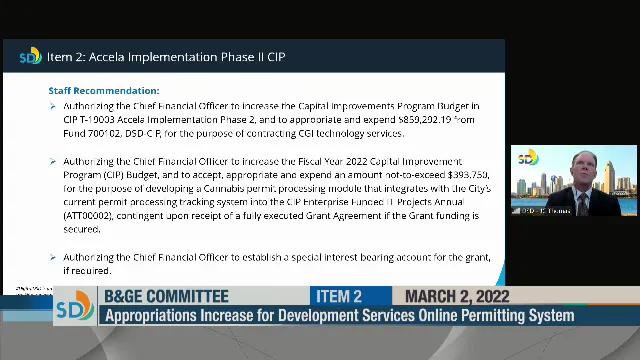
The Budget and Government Efficiency Committee of the San Diego City Council met on Wednesday, March 2, 2022, in a hybrid format with public participation via Zoom. Committee members present were Vice Chair Eli Rivera, Council President Pro Tem Monica Montgomery Steppe, and Councilmember Moreno. The committee addressed three discussion items, including a stormwater financing proposal, a development services permitting system upgrade, and an as-needed plan check and inspection services contract. All items were approved unanimously. Consent Calendar - Approval of committee actions from February 2, 2022, was moved by Vice Chair Eli Rivera, seconded by Council President Pro Tem Montgomery Steppe, and passed unanimously. Public Comments & Testimony - Non-agenda public comment: Chris Vamos, Chief Steward of Teamsters Local 911, representing ocean lifeguards, thanked the committee for supporting lifeguard requests in budget memos and stressed the importance of lifeguards to San Diego's beaches and bays. - Item 3 (NV5 contract): Kathleen Higgins, MEA labor officer for Development Services Department, spoke on behalf of the Municipal Employees Association (MEA). She said DSD staff are experiencing burnout, stress, and anxiety due to high vacancy rates and workloads, and that MEA does not take outsourcing lightly but supports a compassionate approach given recruitment and retention challenges. Discussion Items - Item 1 – Stormwater Capital Improvement Program and WIFIA Loan Commitment: - Staff from the Debt Management and Stormwater Departments presented a proposal to accept a U.S. EPA Water Infrastructure Finance and Innovation Act (WIFIA) loan commitment not to exceed $359 million to finance a stormwater program of up to $733 million. The city would provide the remaining 51% ($374 million) from various sources. A first loan installment of up to $212 million was expected in May. The loan would be a general fund obligation structured as a lease-leaseback, with total debt service estimated at $35 million annually starting in FY2029. The program includes corrugated metal pipe replacement, pump station rehabilitation, waterway restoration, green infrastructure, and integrated stormwater features. - The Office of the Independent Budget Analyst (IBA), via Jordan Moore, noted the city's matching commitment of up to $374 million, which would be a significant increase in stormwater spending, and raised questions about workload capacity and the unidentified source of the match. IBA also noted that if the match had been included in the CIP outlook, it would have lowered the unfunded stormwater deficit by approximately $200 million. - Committee members expressed strong support for the low-cost financing. Councilmember Moreno moved the item, seconded by Council President Elia Rivera. Discussion addressed staff capacity, NEPA requirements, and the risk of cost increases if the loan is not executed before May 15. The motion passed unanimously, forwarding the item to City Council. - Item 2 – Accela Implementation Phase 2 and Cannabis Grant: - Development Services staff requested approval to increase the CIP budget by $859,292.19 for CGI Technology Services to complete the Accela online permitting system implementation. This includes converting more than 28,000 active hybrid PTS projects into Accela and migrating 500,000 historical permits and inspection records. The department also requested approval to accept a $764,261 grant from the California Department of Cannabis Control, with $393,750 allocated to develop a cannabis licensing and permitting module. - The IBA had no significant comments on this item. Council President Pro Tem Montgomery Steppe moved approval, seconded by Councilmember Moreno. Discussion focused on customer benefits, including 24/7 access and virtual appointments. The motion passed unanimously. - Item 3 – Agreement with NV5 Inc. for Plan Check and Inspection Services: - Development Services staff presented a request to award a one-year, not-to-exceed $250,000 contract to NV5 Inc. to augment existing staff. DSD reported 20% vacancy rates among permit processing and inspection positions, over 62,000 permit applications received in 2021, 120,000 field inspections completed, and 28,000 hours of overtime. The contract would be cost-recoverable through permit fees. - IBA noted that this item highlights the need for a full discussion of vacancies citywide during the budget process. - Councilmember Moreno supported the temporary measure but emphasized the need to hire city employees long-term. Council President Elia Rivera asked how the city could support DSD further; DSD Director Elise Lowe stated that $250,000 is less than half a percent of DSD's $93 million budget, will likely be insufficient, and additional actions may come before the committee. She also noted 40 hires are in process and that an additional 110 positions were requested in the FY23 budget. The motion, moved by Montgomery Steppe and seconded by Moreno, passed unanimously. Key Outcomes - Item 1: The committee voted unanimously to forward the stormwater WIFIA loan financing ordinance to the City Council, docketed for March 15, 2022. - Item 2: The committee voted unanimously to authorize the CFO to increase the CIP budget, appropriate $859,292.19, accept the cannabis grant, and establish a special interest-bearing account if required. - Item 3: The committee voted unanimously to authorize the NV5 agreement, expenditure not to exceed $250,000, and related appropriations. - The committee adjourned to a special meeting on Wednesday, April 13, 2022, at 9:00 a.m.
The Active Transportation and Infrastructure (ATI) Committee met virtually via Zoom on February 17, 2022, at 9 a.m. per California Government Code Section 54953G. Committee members participated remotely, and the public was not in attendance. The meeting focused on the FY 2023-2027 Five-Year Capital Infrastructure Planning Outlook, which revealed a $4.32 billion gap between capital needs and projected funding, as well as actions on several infrastructure projects and the 2022 committee work plan. All actions passed unanimously. Consent Calendar - Item 1: Approved FY 2022 budget revision to Otay Mesa Fire Station 49 Capital Improvement Program Project S00784. - Item 2: Approved consultant agreement H2125819 with Trussell Technology Inc. for design and construction support services for the SBWRP reverse osmosis system project. - Item 3: Approved First Amendment to contract H197073 with Burns McDonald Engineering Company Inc. for the Los Peñasquitos Lagoon Restoration Phase 1 project. Vice Chair Lakava highlighted the importance of the lagoon restoration in reducing flooding for Sorrento Valley biotech firms and supporting climate action goals. The committee approved the consent agenda unanimously. The motion was made by Councilmember Campbell and seconded by Chair von Wilpert. Public Comments & Testimony - Janet Rogers (Safe Walkways) raised concerns about the city's handling of rental scooters, citing violations of state law and lack of enforcement, including lack of 'no scooter' signs, geofencing, and dedicated police enforcement. She also mentioned a $30,000 monthly cost for impounding scooters. - Nicole urged accountability from the RTA office for reckless driversdurga, questioned road expansions in Grantville and other areas for inducing car reliance, and raised concerns about bike lane surface quality on Linda Vista Road and Nimitz. - Lori Saldania requested assessment of ADA compliance in older neighborhoods like Normal Heights, and raised safety concerns for unsheltered individuals with mobility issues during encampment cleanups, advocating for medical teams on site. - Daniel Schmioffski strongly opposed rental scooters, calling them 'toys for drunken 30-year-old boys' and demanding their removal, while expressing skepticism about Vision Zero and asserting his trust in his own eyes over statistics. During the informational item on the capital outlook, public speakers also commented: - Jonathan Freeman (Safe Walkways) argued that rental scooters increase carbon emissions when life-cycle, charging, and behavioral factors are considered, urging the committee to consider the climate action plan impact. - Nicole questioned the exclusion of maintenance from the program, and voiced that parks should be considered priority needs given their contributions to stormwater management, sea level rise mitigation, shade, and community health. On the work plan item: - Jonathan Freeman requested that the committee ensure operational requirements for shared mobility devices are not removed in municipal code changes, and asked for clarification on how the new contract-based system will be monitored and enforced. - Matthew Vasilakis (Climate Action Campaign) expressed gratitude for prioritizing the Mobility Master Plan, noting it is six years delayed and critical for achieving mode shift targets. - Will Radigan (San Diego County Bicycle Coalition) praised the work plan, especially the exploration of quick-build infrastructure, citing the Pershing Drive bikeway as a successful example built in three weeks with Jersey barriers. Discussion Items - Item 7: FY 2023-2027 Five-Year Capital Infrastructure Planning Outlook (Informational) Presented by James Nagelvoort, Director of Strategic Capital Improvements. The report identified $8.44 billion in total capital needs over five years, with $4.12 billion in projected available funding, leaving a $4.32 billion gap. Priority needs (e.g., life safety, legal mandates, operational needs) accounted for 81% ($6.84 billion). The largest and fastest-growing gap was stormwater, at $1.4 billion (32% of total gap). The IBA noted the gap has grown $2.6 billion since the first outlook. Challenges include rising construction costs, aging infrastructure (post-WWII assets reaching end of life), and increased regulations. The city is forming task forces to pursue federal infrastructure (IIJA) funding. Committee members discussed maintenance, equity, EV charging needs, and grant-writing capacity. - Item 4: Task Order Modification 4 with Due Right Construction Requested authorization to expand the contract by $417,000 for cooling tower replacements at Pump Stations 1 and 2. The total project cost would rise to $1.39 million. Because the modification exceeds the mayoral authority limit, council approval was required. The scope included replacing programmable logic controllers, adding IT conduits, and other unforeseen conditions. Staff also outlined planned municipal code changes to increase task order limits. The motion passed unanimously. - Item 5: Consultant Agreement with WSP USA Inc. for Gatewood Hills Pump Station Requested authorization to award a consultant agreement for design and construction support, not to exceed $889,937.75. The pump station in Rancho Bernardo replaces a 1973 facility. WSP exceeded its 20% SLBE/ELBE goal with 34.1% certified participation and 24.6% non-certified participation. The IBA noted ongoing review of EEO contracting issues. The motion passed unanimously. - Item 6: 2022 Committee Work Plan The work plan emphasized Vision Zero, Mobility Master Plan updates, Council Policy 800-14, and climate action goals. Council members expressed alignment and support. The motion passed unanimously. Key Outcomes - All agenda items passed unanimously: consent calendar (items 1-3), items 4, 5, and 6. - The five-year capital outlook was received as informational; no vote needed. - The next regular meeting is scheduled for April 6, 2022, at 2 p.m. Notes - The meeting was held virtually with public call-in participation. - The committee chair noted a new mayoral representative and new director for Engineering Capital Projects.
The Environment Committee of the City of San Diego met virtually on February 17, 2022, to discuss a habitat acquisition, stormwater funding, implementation of Senate Bill 1383, and the 2022 committee work plan. All four members were present (Chair LaCava, Vice Chair Von Wilpert, and Councilmembers Campillo and Campbell). Staff from various departments provided presentations, and public testimony was heard on multiple items. Consent Calendar - Approval of minutes from January 20, 2022. The motion by Vice Chair Von Wilpert, seconded by Councilmember Campbell, passed 4-0. One member of the public attempted to comment but was redirected to non-agenda public comment. Public Comments & Testimony - Non-Agenda Public Comment: Speakers addressed a range of environmental issues: - Carol Toy called for extended sea lion pupping season closure (May 1 to October 31) and a larger protected area at Point La Jolla. - Becky Rapp and Kelly McCormick expressed concern about air and water pollution from marijuana cultivation and manufacturing, urging air quality checks near facilities. - John Leake (Sierra Club member) opposed creating a municipal reserve for sea lions, stating it would not be ecologically beneficial or legal and would divert park resources from underserved communities. - Peggy Walker urged the committee to support Assembly Bill 1690 banning single-use smoking products. - Kurt Hoffman argued that the coastal development permit for Point La Jolla inaccurately claims no sensitive habitat or threatened species will be impacted, referencing impacts from sea lion waste. - Robin (SEAL Society and Sierra Club) supported year-round management and a closure from May 1 to October 31, noting ongoing harassment of sea lions and tourists getting too close. - Ellen Shively requested closure dates from May 1 to October 31 and a prohibition on dogs. - Item 2 (Stormwater): Multiple speakers (Jean-Li, Lucero Sanchez, Matthew Vasilakis, Andrew from San Diego Audubon, Sister Mary Maria Mohammed) supported dedicated stormwater funding via a ballot measure, citing the $2 billion shortfall and benefits for clean water, climate resilience, and green jobs. - Item 3 (SB 1383): One speaker (Diane Wolkey) asked about PFAS and pesticide testing in compost. - Item 4 (Work Plan): Speakers included: - Matthew Vasilakis (Climate Action Campaign) thanked the committee for prioritizing climate implementation but urged alignment with climate science and equity. - Will Radigan (San Diego County Bicycle Coalition) requested addition of a mode shift monitoring program to the work plan, noting gaps in achieving non-car mode share targets. - Sean Kioni Ellis (Plumbers and Pipe Fitters Union) supported the work plan and emphasized a circular economy with waste-to-energy. - Andrew Meyer (San Diego Audubon Society) encouraged oversight of the wetlands plan and promotion of native plants. - Sandra Stahl raised concerns about toxic lead air pollution from Montgomery Gibbs Executive Airport, an environmental justice area. - Diane Wolkey requested a moratorium on synthetic turf fields due to toxic chemicals and heat island effects. Discussion Items - Item 1: East Elliott Habitat Acquisition – Staff presented a proposal to transfer and expend funds from the Habitat Acquisition Fund (HAF) for a 1.2-acre parcel in East Elliott, appraised at $30,000 per acre. The property is surrounded by existing conserved land and is within the Multi-Habitat Planning Area (MHPA). The committee discussed the importance of preserving open space and wildfire risk. A motion by Councilmember Campillo, seconded by Councilmember Campbell, passed 4-0. - Item 2: Stormwater Funding Strategy Final Audit Response – Staff (Chris McFan, Bethany Bizek) presented survey and focus group results showing strong public support for increased stormwater funding. The most equitable funding mechanism identified is an impermeable area method with rates of 4–5 cents per square foot. The city’s annual need is $334 million; revenue from such a fee would not fully close the gap without a ballot measure. The Office of the Independent Budget Analyst noted that if a ballot measure is not pursued, competing priorities will create larger deficits in future years. No action was taken; the item was informational. - Item 3: Senate Bill 1383 Implementation Update – Staff (Renee Robertson, Matthew Cleary, Ken Crew) detailed the city’s plan to comply with SB 1383 by 2024, including new organic waste collection for city-serviced homes (green bins and kitchen pails), a new organic processing facility at Miramar, and expanded food recovery programs. Key milestones: 43 new collection trucks ordered (delayed to fall 2022 due to COVID), bin delivery starting November 2022, and 40 new drivers being hired with sign-on bonuses. ESD will return in March 2022 with ordinance amendments. The item was informational. - Item 4: 2022 Environment Committee Work Plan – Consultant Brian Elliott presented the work plan, developed from committee member priorities and a public survey (339 responses). Core principles include advancing climate goals, equity, and high-quality job standards. Priority issues: energy/decarbonization (building electrification, public power), water/sustainability (stormwater, SB 1383, Pure Water), environmental justice (oil drilling, indigenous inclusion), and natural resources (trees, wildfire prevention, wetlands). The plan will be reviewed mid-year. No action taken. Key Outcomes - Item 1 approved (4-0) – Authorization to transfer funds for the East Elliott habitat acquisition. - Stormwater funding strategy – The audit response is complete; staff and the IBA highlighted the need for a dedicated funding source and possible ballot measure. The committee supported continued education and outreach via ThinkBlue. - SB 1383 implementation – Next steps include bringing ordinance and franchise agreement amendments to the committee in March 2022, plus a grant application and ongoing hiring. - Work Plan – Adopted as an informational framework. The committee acknowledged suggestions from public testimony (mode shift monitoring, synthetic turf review) but these were not formally added at this meeting.
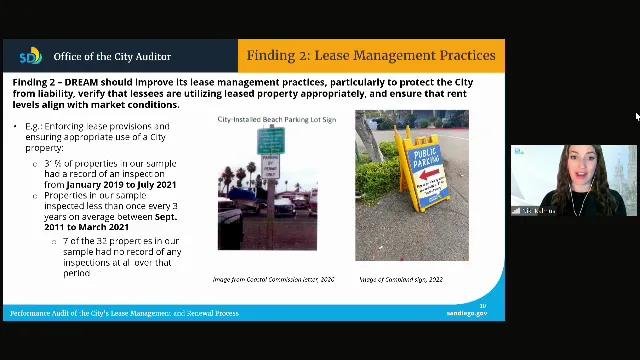
This meeting of the San Diego City Audit Committee, chaired by Councilmember Stephen Whitburn, was held via Zoom due to public health concerns. The committee reviewed a performance audit of the city's lease management and renewal processes, received the City Auditor's annual accomplishments report for 2021, and heard public testimony on prior audits and homelessness. The meeting took place on Wednesday, February 16, 2022, from 9:00 a.m. (local time). Consent Calendar - Approval of Committee Actions (January 26, 2021): Motion by Vice Chair Vivian Moreno, seconded by Committee Member Stuart Halpern, passed unanimously (5-0). Public Comments & Testimony - Non‑Agenda Public Comment: - Lori Soldania (former Assembly Housing Chair) congratulated the committee on the new select committee for Housing Commission oversight and reform. She urged the committee to examine the city's return on investment for public safety spending on homeless encampments (e.g., the Midway encampment) and questioned whether Project Homekey purchases have resulted in suitable permanent housing. - Martha Sullivan (San Diego Housing Emergency Alliance) criticized that $110 million of the $250 million in CARES Act funding went to the police, far exceeding spending on homeless strategies ($39 million). She called on the audit committee to explore this disproportionate police spending. - Public Comment on Lease Management Audit: - Lori Soldania asked whether the audit considered equal opportunity, climate action plan compliance, and diversity of leaseholders. She advocated for energy audits of leased buildings and broader equity considerations. - Martha Sullivan described holdover leases (especially on Mission Bay for entities like SeaWorld and large hotels) as “corporate welfare” that disadvantages small businesses and residential renters. She urged the committee to ensure corporate lessees pay fair market value. - Public Comment on City Auditor's Annual Report: - Lori Soldania emphasized that audits have life‑and‑death implications, citing the CARES Act audit. She argued that the audit focused too narrowly on shower costs at the convention center while ignoring the larger issue of police/fire receiving over half of CARES funds, when Project Roomkey could have provided safer housing. - Joy Sanyata (District 3) thanked the City Auditor and staff for their work, especially the parks and recreation equity audit, and praised growing collaboration. - Martha Sullivan reiterated the need for independent legal counsel for the City Auditor, comparing it to the independent police commission. - Public Comment on Monthly Activity Report: - Lori Soldania again supported independent legal counsel and urged the auditor to examine police response to homelessness, including overtime for moving shopping carts, citing equity concerns and derogatory language used by dispatchers. Discussion Items - Performance Audit of the City's Lease Management and Renewal Processes: - Presented by City Auditor Andy Hanau, Principal Performance Auditor Nathan Otto, and Performance Auditors Shady Mattar and Nikki Kalmas. - Key findings: 24% of active leases (101 of 421) were in holdover as of July 2021, a rate far higher than benchmarked cities (Austin, Seattle, Houston all below 5%). Many holdovers had lasted over a decade, leading to potential lost revenue and perceived favoritism. The Department of Real Estate and Airport Management (Dream) is significantly understaffed relative to comparable agencies. Only 23% of sampled leases had up‑to‑date insurance documentation, and inspections were infrequent (31% inspected; average once every three years from 2011–2021). Only 61% of leases contained a financial disincentive clause for holdover. - Dream agreed to all 14 audit recommendations, with a target implementation date of February 2024. - Vice Chair Moreno moved to accept the report and forward it to the City Council, seconded by Committee Member Halpern. The motion passed unanimously. - Committee members discussed the need for additional staffing for Dream, the lack of a formal prioritization process for renewals, and the importance of setting measurable benchmarks for reducing holdovers. Dream Director Penny Moss noted that the Surplus Land Act and coordination with HCD are new challenges, and that she will request additional positions in the upcoming budget. - City Auditor's Annual Activities and Accomplishments Report for Calendar Year 2021: - Presented by Andy Hanau. The office issued 8 performance audits, 1 agreed‑upon procedures review, 1 hotline investigation, and 4 quarterly hotline reports. 58 recommendations were made, with 98% accepted by management. Notable audits included the Climate Action Plan, industrial wastewater (Part 2), CARES Act funding, major building acquisitions (101 Ash Street), and equity in recreation programs. - The office also launched an interactive recommendation follow‑up dashboard and is pursuing a ballot measure for independent legal counsel. - Committee members praised the office's work, especially the equity audit and the fraud hotline. Committee Member Halpern inquired about the police body camera audit; Hanau confirmed that data (over 400 videos) is now being received after a delay due to COVID. The committee accepted the report without objection. - City Auditor's Monthly Activity Report: - Hanau reported that since the last meeting, the office issued the lease audit and the annual accomplishments report, and a memo on independent legal counsel. Three audits are in fieldwork (workers' compensation, SDPD body cameras, code enforcement); two are in planning (fire‑rescue 911 system, Get It Done app); six have not yet started, including the vehicle towing audit requested by Chair Whitburn. A new senior IT auditor has been hired. The office expects to substantially complete about 80% of the FY22 work plan. Key Outcomes - Vote on Lease Management Audit: Motion to accept the report and forward to City Council passed unanimously (5-0). - Acceptance of Annual Report: The committee accepted the City Auditor's 2021 accomplishments report. - Continued Oversight: The committee will receive a recommendation follow‑up report in March 2022. The next meeting is scheduled for Wednesday, March 16, 2022, at 9:00 a.m. - Independent Legal Counsel: The City Auditor's memo on independent legal counsel was referred to the Rules Committee for discussion that afternoon.
The Rules Committee met virtually on February 16, 2022, at 2:00 PM. The committee considered a ballot measure to provide the city auditor and audit committee independent legal counsel, approved a five-year email retention policy, and received an update on access and transparency initiatives from the city clerk. One item was returned to staff, and another was continued to a future meeting. Consent Calendar - Approval of Minutes (January 19, 2022): Unanimously approved (5-0) via roll call. Public Comments & Testimony - Non-Agenda Public Comment: - Daniel Smihovski advocated for campaign finance reform, criticizing the influence of money in nonpartisan council elections. - John Stump (District 9) urged the city to require truthfulness as a condition of employment, referencing future agenda item 3. - Becky Rapp (parent and public health educator) expressed concern about reducing cannabis production taxes from 8% to 2%, arguing it sets a poor precedent and questions special treatment for the industry. - Item 1 – Auditor Independent Counsel: - Nicole Crosby (Deputy City Attorney Association) pledged good-faith meet-and-confer but supported dedicated, conflict-free government attorneys. - John Stump raised ethical rules concerns about the city attorney representing multiple clients. - Kyle Elser (former assistant city auditor) supported the measure, citing structural conflicts. - Eduardo Luna (former city auditor) supported, noting federal and state precedents. - Matt Wallstrom (Hillcrest) criticized the city attorney for delaying the process. - Michael Aguirre (former city attorney) advocated for an ethics wall within the city attorney's office. - Stuart Halpern (public member of audit committee) urged moving the ballot measure forward. - Item 2 – Email Retention Policy: - Maria Severson argued the five-year policy harms transparency, citing 101 Ash Street emails that would have been deleted. - Andrew Bowen (San Diego SPJ) opposed, noting the city's indefinite retention is a strength; suggested a 10-year policy. - Matt Wallstrom opposed, stating storage costs are negligible relative to the budget. - Lori Saldania (former assembly and IT educator) argued storage costs are minimal and urged retention longer than five years, citing use of text messages to avoid records. - Michael Aguirre opposed, calling emails the city's collective memory, vital for historical research. - Item 3 – Access and Transparency (City Clerk Presentation): - Lori Saldania praised City Clerk Liz Maland for her exceptional work and commitment to preserving institutional memory. - Joan Signat (District 3) thanked the clerk for her presentation and suggested increased outreach for public participation and translation services. - John Stump raised concerns about private email use by employees and urged testing any policy changes with the attorney general. - Continuance of Item 4: - Lori Saldania requested timely rescheduling of the item. Discussion Items - Item 1 – Proposed Ballot Measure for Auditor Independent Counsel: - City Auditor Andy Hanows presented the proposal, citing structural conflicts in audits (e.g., 101 Ash Street, public liabilities, contract award) and the need for independent legal counsel. Estimated costs: $15,000 for ballot measure drafting, under $60,000 annually ongoing. Requested council reauthorize meet-and-confer and city attorney provide outside counsel. - City Attorney Mara Elliott opposed, stating no legal conflict exists, the proposal is not fully vetted, and it could create accountability issues. She warned the city attorney's office would not defend actions based on outside counsel's advice. - Councilmember Kate made a motion to support the auditor's two requests. Council President Elo-Rivera offered an amendment to vest sole authority in the audit committee (not the auditor) to determine when independent counsel is in the city's best interest. After debate – including concerns about retroactive approval and unelected committee power – the amendment passed 4-1 (Whitburn no). The main motion then passed 3-2 (Whitburn and Campillo no). - Item 2 – Five-Year Email Retention Policy: - CIO Jonathan Banke presented a resolution to adopt a five-year retention policy, replacing indefinite retention. Key statistics: 7.5 million new emails per month (90 million annually), storage issues, and estimated $1.2 million savings over five years. Legal holds and official records (10-year retention) would be exceptions. - Discussion: Council President Elo-Rivera questioned handling of real estate emails. City Clerk Liz Maland confirmed official records (e.g., real estate transactions) are retained permanently or for 10 years in a separate system. Council President asked staff to explore a 10-year policy for the Real Estate and Airport Management Department. Motion by Campillo, seconded by Kate. Unanimous approval (5-0). - Item 3 – Overview of Access and Transparency (City Clerk): - City Clerk Liz Maland presented achievements including virtual meeting transition, expanded translation services in 200+ languages, new audio/visual voting system, digitized archives (over 1 million items), passport services, and upcoming initiatives (e-commend, JAWS, digital kiosk for Brown Act noticing). Councilmembers praised her office's work; no action required as it was an information item. - Item 5 – Appointments to Boards and Commissions: Returned to staff due to a personal emergency, to be rescheduled. - Item 4 – Presentation by Funds Commission: Continued to a future rules committee meeting due to time constraints, after public comment. Key Outcomes - Item 1: Motion passed 3-2, recommending the city council reauthorize the meet-and-confer process with the deputy city attorneys association and request the city attorney provide outside legal counsel for drafting the ballot measure. The measure will specify that the audit committee has sole authority to deem independent counsel necessary. - Item 2: Resolution adopted unanimously (5-0) to implement a five-year email retention policy, replace indefinite retention, amend the master record schedule, and begin implementation February 1, 2023. Staff will explore a 10-year retention policy for the Real Estate and Airport Management Department. - Item 5: Returned to staff for future consideration. - Item 4: Continued to a future rules committee meeting. - Next Meeting: Wednesday, March 16, 2022, at 2:00 PM.
The EDIR Committee, chaired by Councilmember Campillo, met virtually on February 10, 2022, to consider the Fiscal Year 2021 San Diego Tourism Marketing District Performance Report, a sidewalk vending ordinance, and a work plan continuance. The committee unanimously approved the consent calendar, heard public testimony, and passed motions on both agenda items. Consent Calendar - Approval of committee actions passed unanimously (4-0). Public Comments & Testimony - Non-agenda public comment: No speakers. - Item 3 – Tourism Marketing District Performance Report: Four speakers commented. Suzanne Barracini requested guidance on how tax dollars from campaigns are spent and by zip code. Renee Contreras expressed concern about increased tourism straining city resources (parks, lifeguards, police) amid COVID-19. Matthew Gardner, a Mission Beach business owner, urged reinvestment of TOT funds into neighborhoods for cleanup and beautification. Gloria Robles had technical difficulties and did not speak. - Item 1 – Sidewalk Vending Ordinance: 56 speakers provided comments. Positions were divided: many residents and business owners from coastal and downtown areas (e.g., Mission Beach, Ocean Beach, Gaslamp Quarter, La Jolla) supported the ordinance with amendments, citing safety hazards, unfair competition, trash, and blocked access. They requested year-round moratoriums, coastal commission exemption, and inclusion of additional high-traffic streets. Many immigrant rights and community organizations (e.g., Alliance San Diego, Center on Policy Initiatives, San Diego Immigrant Rights Consortium, Environmental Health Coalition) opposed the ordinance as too restrictive, punitive, and discriminatory, noting barriers such as government ID requirements, impoundment, and lack of translation. They called for a first-time warning system, annual review, and a vending permit option without a business tax certificate. Several vendors spoke in favor of regulation but requested designated spots and fair implementation. Discussion Items - Item 3 – Fiscal Year 2021 San Diego Tourism Marketing District Performance Report: Elizabeth Studebaker, Colleen Anderson, and Carrie Kapich presented the report. Key statistics: FY2021 saw 16.3 million visitors (37% below FY20), visitor spending of $5.2 billion (down 41%), and average hotel occupancy of 50.9% (down 21%). July 2021 was a strong month with 78.9% occupancy and $218 ADR. TOT collections in FY20 were 50% of FY19; FY22 YTD (through January) collected $105.9 million. The TMD achieved a 28:1 ROI due to SDTA's leisure marketing. Staffing challenges persist, with hospitality jobs down 27% as of August 2021. Committee members expressed appreciation for the work and noted the long recovery horizon (2024-2025 for conventions and international travel). - Item 1 – Repeal of Push Carts and Sidewalk Vending Ordinance: Venus Molina (Councilmember Campbell's chief of staff) presented the proposed ordinance, which responds to SB 946. It requires permits, sets distance regulations, defines prohibited areas (e.g., high-traffic zones in Gaslamp, Little Italy, East Village, parks with summer moratorium), and creates entrepreneurship zones. Key provisions: no insurance required, permit valid one year, fines escalate from $100 (with permit) to $1,000 (without) and permit revocation for fourth violation. Public comment showed strong community divide. Committee members discussed amendments: Chair Campillo proposed four amendments: (1) extend change-of-information deadline from 5 business days to 15 calendar days; (2) reduce distance between vendors from 100 ft to 50 ft; (3) clarify that prohibited sales do not include apparel; (4) implement a first-time warning and referral system (no fine) for first violation. Councilmember Campbell accepted the first three and agreed to work on the fourth. Councilmember Montgomery Steppe proposed an amendment to change impounding authority from "city" to "environmental services department" for fourth or greater violations; accepted. The motion passed unanimously. Key Outcomes - Item 3 – Tourism Marketing District Report: Accepted as information; no vote required. - Item 1 – Sidewalk Vending Ordinance: Approved unanimously (4-0) with amendments as described. The ordinance will be forwarded to the full City Council with the final language on the first-time violation warning and referral to be drafted collaboratively. The committee also voted to continue the work plan item (Item 2) to the next meeting (March 9, 2022). - Votes: All votes were unanimous (4-0).
The Land Use and Housing Committee of the San Diego City Council met virtually on February 10, 2022, at 9:00 AM. The committee addressed a consent agenda, declarations of surplus land, an affordable housing preservation update, and the 2022 work plan. Key actions included unanimous approval of a consent agenda and a unanimous motion to advance the SDSU Mission Road property sale to full council.
This meeting of the Public Safety and Livable Neighborhoods Committee was held virtually via Zoom due to the COVID-19 pandemic. The primary agenda item was the SAFE Act (Stop Adolescent Addiction to Flavored E-Cigarettes Act), an ordinance regulating the sale of flavored electronic cigarettes and, via a proposed amendment, menthol cigarettes. After extensive public comment, the meeting lost a quorum and was adjourned without a vote; the item will be docketed directly to the full City Council. Consent Calendar - The committee unanimously approved the actions from the November 10, 2021 and January 21, 2022 meetings. Public Comments & Testimony - Non‑agenda public comment: Eight speakers addressed topics including a proposed “protect ordinance” (with several speakers opposing it as harmful to policing and public safety), the need for speed trailers and gang intervention funding, a request to repeal and replace the vehicle habitation ordinance, and concerns about homelessness and business impacts in the Gaslamp Quarter. - SAFE Act public comment (Item 2): Over 77 speakers offered one‑minute testimony. Positions were sharply divided: - Supporters included pediatricians, public health advocates, parents, students, and community groups (e.g., American Heart Association, American Cancer Society, San Diegans vs. Big Tobacco). They argued that flavored e‑cigarettes and menthol cigarettes are deliberately marketed to youth and communities of color, leading to addiction and health harms. Many urged a comprehensive ban on all flavored tobacco products, including hookah and menthol, with strong enforcement. - Opponents included local small‑business owners (convenience stores, smoke shops, hookah lounges), their employees, and some cultural advocates. They contended the ban would not stop youth access (blaming online sales and black markets), would unfairly harm law‑abiding retailers and their employees, would drive sales to neighboring cities or online, and that the issue should be decided by statewide vote in November 2022. Several hookah advocates requested an exemption, citing cultural traditions and the product’s low youth usage. Discussion Items - SAFE Act Presentation and Deliberation: Councilmember Von Wilpert introduced the SAFE Act, which initially targeted flavored nicotine‑based e‑liquids. She announced an amendment to add menthol cigarettes and align definitions with state law. Quinton Grounds presented a slide deck showing the rise in adolescent vaping, FDA warnings, and lawsuits against Juul. California Secretary of State Dr. Shirley Weber gave powerful remarks supporting the amendment, emphasizing that menthol cigarettes have been deliberately marketed to African American communities and are not a cultural tradition. The committee then heard over 70 public speakers. After public comment, Chair Montgomery Stepp noted the committee had lost a quorum due to other commitments. Councilmember Von Wilpert stated she would request direct docketing to the full City Council. Key Outcomes - The committee did not vote on the SAFE Act due to loss of quorum. - Councilmember Von Wilpert announced she will request the item be placed directly on the full City Council agenda, including her proposed amendments (adding menthol cigarettes and tightening definitions). - Item 3 (not discussed) was returned to staff. - The meeting was adjourned until March 9, 2022.