Browse by city
Date range
Search help

Search titles, summaries, topics and stored transcripts together. Keywords may match separately; put the whole query in double quotes for a phrase. Matching follows word analysis, so punctuation is not exact. Both dates are included. Documents are not searched.

SHOWING 611–620 ENTRIES
611
FEB 2, 2022 · SAN DIEGO, CALIFORNIA · BUDGET & GOVERNMENT EFFICIENCY COMMITTEE
San Diego Budget Committee Meeting: FY22 Mid-Year Report and FY23 Priorities - February 2, 2022

The Budget and Government Efficiency Committee met on February 2, 2022, to review the FY22 mid-year budget monitoring report, establish FY23 council budget priorities, and adopt the committee's 2022 work plan. The committee approved the mid-year report recommendations and forwarded a resolution on FY23 budget priorities to the full City Council with added amendments. Consent Calendar - Approval of Committee Actions: Motion passed 3-0 (Councilmember Moreno absent, later joined). Public Comments & Testimony - Non-Agenda Public Comment: Joy Sanyata (District 3) praised the IBA's new citizens guide to the budget process and expressed readiness to meet budget challenges. - Item 1 (Mid-Year Report): Joy Sanyata thanked staff for their work and expressed appreciation for collaboration and transparency. - Item 2 (FY23 Priorities): - Joy Sanyata thanked the IBA and council members for their priority memos, requesting more transparency on excess equity, ARPA, and IIJA funds. - Susan Baldwin (Parks and Recreation Coalition) urged robust funding for parks, urban forestry, and the Parks Master Plan. - Kiara O'Laughlin (Center on Policy Initiatives/Community Budget Alliance) supported housing stability fund, urban tree canopy, CAP implementation, youth environmental corps, and language access; added priorities for youth care, climate equity fund, ADA staffing, and excluded worker fund. - Madison Coleman (Climate Action Campaign) thanked the council for prioritizing climate and environmental justice. - Michael Schmidt expressed general appreciation. - Item 3 (Work Plan): Joy Sanyata supported the work plan items, especially expanding corporate partnerships. Discussion Items - Fiscal Year 2022 Mid-Year Budget Monitoring Report: Rolando Chaviel (Finance Director) and Chris Purcell presented. Key points: - General fund revenues projected $20.7M over budget; however, this includes $150M in American Rescue Plan Act (ARPA) funds used to close a structural deficit. Without ARPA, the general fund would face a $120M deficit to maintain current service levels. - Major revenues (excluding ARPA) are $31.1M over budget, driven by sales tax ($20.3M over) and transient occupancy tax ($24.4M over), partially offset by property tax ($13.7M under). - Expenditures projected $20.5M over budget, with overtime overruns in police ($6.9M) and fire rescue ($13.5M, offset by $6.4M in savings). Non-personnel expenditures over budget due to public liability claims and transfers. - Vacancies: 1,787 vacant positions citywide as of November, including 354 in public utilities, 141 in engineering, 126 in DSD, 124 in library, 123 in environmental services. - Proposed appropriation adjustments: $20.5M in increased appropriations, supported by revenue increases, including $15.1M for public liability claims and $1.5M for stormwater. - Police Chief David Nisleit reported on overtime and neighborhood policing: 17% increase in 911 calls, rise in violent crime, and staffing shortages (1,888 sworn vs. budgeted 2,036; 37 officers in process of leaving to other agencies). Neighborhood policing division focused on homelessness outreach, with over 10,000 contacts and 3,200 shelter connections in first five months. - Committee members questioned about vacancies (personnel director Doug Edwards described recruitment efforts), overtime drivers, and use of ARPA. Council President Ilo Rivera noted that without ARPA, maintaining services would require $120M in new revenue or cuts. - Fiscal Year 2023 City Council Budget Priorities: Charles Monico (IBA) presented the consolidated priorities from council member memos (over 150 pages). Operating budget priorities included: - Environmental/Climate: CAP 2.0 implementation, urban forestry (8 members), stormwater (8), mobility master plan (7), climate equity fund (6), grant writers (6), climate resilient SD (5), public power feasibility (5). - Public Safety: Lifeguard resources (unanimous), additional fire rescue personnel (majority). - Neighborhood Services: Library resources (unanimous), brush/whee abatement, code enforcement, parks and recreation services. - Human Capital: Recruitment and retention, competitive pay. - Homelessness and Housing: Housing stability fund (rental relief), senior pilot subsidy, shelters for LGBTQ and seniors. - Youth Services: Office of Child and Youth Success, youth environmental corps. - Accessibility: ADA compliance, internet access (SD Access for All), language translation services. - Other: Arts and culture, Office of Labor Standards Enforcement, public banking feasibility, IBA technical support. - Infrastructure Priorities (unanimous support): Pedestrian/bicycle safety, traffic calming, street lights, streets/sidewalks, stormwater. Also: parks, recreation, library, fire facilities, ADA infrastructure. - Resource Priorities: Use of excess equity ($26.7M estimated), ARPA funds (remaining $300M), IIJA funds, stormwater revenue source (future). - Council President Pro Tem Montgomery Step moved to approve with amendments adding Office of Race and Equity, Digital Equity, Commission on Police Practices, and Small Business/Nonprofit Relief. Councilmember Moreno seconded. Council President Ilo Rivera emphasized climate action as complementary to safety; requested IBA to project potential dollar amounts for revenue options. - 2022 Committee Work Plan: Chair Kate outlined the work plan, including budget review meetings (April-May), service level reports, KPI updates, vacancy reports, overtime tracking, human capital audit, grant writer positions, and corporate partnerships. Information item; no motion required. Key Outcomes - Item 1: Motion to approve staff recommendations for the FY22 mid-year budget report passed 4-0 (Councilmember Moreno present for final vote). - Item 2: Motion to approve the FY23 budget priorities resolution, as amended with four additional priorities, passed unanimously (4-0). The resolution will be forwarded to the full City Council. - Item 3: The 2022 committee work plan was received as an information item; no vote taken.
BUDGET 44% · PUBLIC SAFETY 25% · PUBLIC COMMENT 5% · PARKS AND RECREATION 5%
612
JAN 26, 2022 · SAN DIEGO, CALIFORNIA · AUDIT COMMITTEE
San Diego Audit Committee Meeting – January 26, 2022

The Audit Committee of the San Diego City Council met on Wednesday, January 26, 2022, at 9:00 a.m. via Zoom. Chair Stephen Whitburn presided over the meeting, which included updates from the City Auditor, approval of reports, and a presentation of the Fiscal Year 2021 Annual Comprehensive Financial Report. The committee heard no public testimony. Members unanimously approved the committee actions from November 17, 2021, accepted the quarterly fraud hotline report, accepted and forwarded the performance audit of the city’s financial condition to the City Council, and received and filed the FY2021 ACFR. Consent Calendar - Approval of Committee Actions (November 17, 2021): Motioned by Vice Chair Moreno, seconded by Committee Member Halpern, and passed unanimously (5-0). - Quarterly Fraud Hotline Activity Report (FY2022 Q2): Presented by Senior Fraud Investigator Andy Harida. The committee voted unanimously to accept the report as an information item. (Motion by Vice Chair Moreno, second by Halpern, passed 5-0.) Public Comments & Testimony - No members of the public offered testimony during any of the public comment periods. Discussion Items - Item 4 – City Auditor’s Monthly Activity Report: City Auditor Andy Hanau reported that two work products were issued since the last meeting: an audit of the city’s financial condition and the quarterly fraud hotline report. He highlighted ongoing audits (workers’ compensation, SDPD body camera usage), audits in planning (IT audit of fire rescue emergency response system, Get It Done app, code enforcement division), and an update on the independent legal counsel ballot measure. The city is targeting the November 2022 election for the measure, and negotiations with labor unions are set to resume. Committee members (Moreno, Halpern, Mafia, Tabshuri) expressed strong support for the independent legal counsel initiative and discussed options for reaffirming committee support. Chair Whitburn noted several procedural paths but took no formal action. - Item 2 – Performance Audit of the City’s Financial Condition as of FY2020: Principal Performance Auditor Chris Kime and colleagues presented the audit, which assessed 10 financial ratios over a 10-year period (FY2011–2020) and compared San Diego to six peer cities. Key findings: San Diego ranked first or tied for first overall, but areas of concern included financial performance volatility and net change in capital assets (ranked fifth). The presentation also covered contingencies, commitments (stormwater obligations increased by $760 million to nearly $4 billion), and pension/OPEB trends. Committee members discussed the need for infrastructure investment, the city’s conservative debt policy, and the limitations of peer comparisons. Vice Chair Moreno moved to accept the report and forward it to the City Council; motion seconded by Halpern and passed unanimously (5-0). - Item 3 – Fiscal Year 2021 Annual Comprehensive Financial Report (ACFR): Director of Finance Rolando Charvel and Assistant Director Jeff Peel presented the report. External auditor Peter George of MGO confirmed a clean (unmodified) opinion, no material weaknesses, and no significant deficiencies in internal controls. The city received its seventh consecutive Certificate of Achievement for Excellence in Financial Reporting for FY2020. General fund unassigned balance was $126 million; emergency reserve $106.1 million; stability reserve $99.5 million. Committee members commended the finance team for the exceptionally clean audit. Vice Chair Moreno moved to receive and file the report; seconded by Halpern and passed unanimously (5-0). Key Outcomes - Approval of Committee Actions (Nov 17, 2021): Unanimously approved (5-0). - Quarterly Fraud Hotline Report (FY2022 Q2): Accepted as information (5-0). - Performance Audit of City’s Financial Condition (FY2020): Accepted and forwarded to City Council as informational item (5-0). - FY2021 Annual Comprehensive Financial Report: Received and filed (5-0). - Other: Committee members thanked retiring Assistant City Auditor Kyle Elser for his 27 years of service. Chair Whitburn noted the next meeting is scheduled for February 16, 2022, at 9:00 a.m.

AUDIT FOLLOW-UP 29% · PUBLIC COMMENT 19% · PROCEDURAL 11% · BUDGET EQUITY ANALYSIS 7%
613
JAN 26, 2022 · SAN DIEGO, CALIFORNIA · ACTIVE TRANSPORTATION & INFRASTRUCTURE COMMITTEE
Active Transportation and Infrastructure Committee Meeting - January 26, 2022

This meeting of the San Diego Active Transportation and Infrastructure Committee was held virtually on January 26, 2022. The committee approved the use of city forces for 10 storm drain pipe repair projects and two creek restoration projects, authorized a $5 million contract for dam condition assessments, and set priorities for the 2022 calendar year. All votes were unanimous. Consent Calendar - The committee unanimously approved the minutes from the December 15, 2021 meeting after no public comment. Public Comments & Testimony - Item 1 (Pipe Repair Projects): Several speakers expressed support. Sally thanked the city for the projects and urged adding a third crew. Corrine Wilson (MEA) supported the item, noting city employees should do city work. Timothy Douglas (Local 127) supported keeping work in-house. Two speakers from the Construction Industry Force Account Council (CFAC) opposed: Michelle Pickens argued that the work should be competitively bid to be faster and more efficient, and Patty Rascone stated the work is an upgrade, not repair, and should be bid per municipal code. - Item 3 (Committee Priorities): Will Radigan (San Diego County Bicycle Coalition) urged updates to the mobility master plan, a complete streets ordinance, quick-build program monitoring, and mode shift data tracking. Matthew Vaslakis (Climate Action Campaign) emphasized including climate-related items, a mobility master plan, and complete streets policy. Nicole supported green infrastructure, Vision Zero, quick-build, and a healthy commuter incentive program. Rachel shared personal stories of friends killed by cars and urged Vision Zero implementation. Discussion Items - Item 1: Storm Drain Pipe Repair and Creek Restoration – Staff from the Stormwater Department presented a plan to use city forces for 10 corrugated metal pipe (CMP) repair projects (costing up to $4.5 million from CIP) and to create two new standalone creek restoration CIP projects (Choyas Creek Restoration and Upper Auburn Creek Restoration, each with $250,000 initial funding). The work is part of a larger strategy to address 36 miles of aging CMPs. The IBA noted that city code requires council approval for city force work over $100,000. Council members discussed the proactive approach, filling of 25 new crew positions, project selection based on asset management, and the potential for a third crew. The motion passed unanimously. - Item 2: Dam and Outlet Tower Condition Assessment Contract – Staff from the Public Utilities Department presented a $5 million, five-year as-needed contract with GEI Consultants for dam safety assessments, leveraging a $440,000 FEMA grant. The contract will support condition assessments, risk evaluations, and compliance with DSOD requirements. Council members discussed the backlog of dam repairs, the need for regular updates, and the importance of maintaining water storage capacity. The motion passed unanimously. - Item 3: Committee Priorities for 2022 – Chair von Wilpert outlined priorities including Vision Zero, ADA compliance, complete streets, street repair, green infrastructure, mobility action plan, and EV charging. Council members added items: updated OCI study (Campbell), traffic calming, interagency coordination (Montgomery Steppe), quick-build program, lifeguard facilities, sidewalk repair, tree canopy, coastal bluff stabilization (LaCava). Public testimony supported these priorities. The committee voted unanimously to direct staff to create a work plan. Key Outcomes - Item 1: Approved use of city forces for 10 pipe repair projects and two creek restoration CIPs, with $4.5 million for labor and $500,000 for preliminary design. All council members voted yes. - Item 2: Approved contract with GEI Consultants for up to $5 million over five years for dam and outlet tower condition assessments. Unanimous. - Item 3: Approved directing staff to develop a 2022 committee work plan based on the priorities discussed. Unanimous. - The committee also acknowledged the departure of IBA representative Jillian Cassie and welcomed Aaron Noel.

PUBLIC COMMENT 23% · STORMWATER MANAGEMENT 20% · PROCEDURAL 12% · PROCUREMENT 11%
614
JAN 21, 2022 · SAN DIEGO, CALIFORNIA · PUBLIC SAFETY & LIVABLE NEIGHBORHOODS COMMITTEE
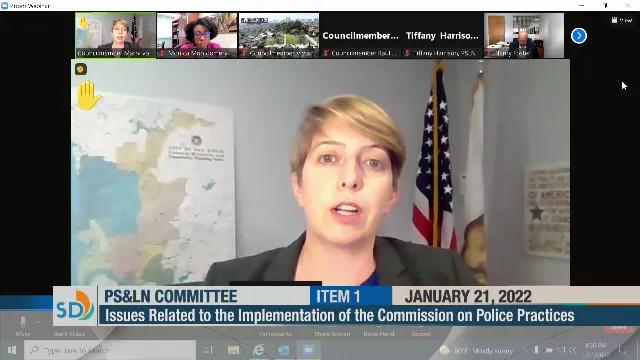
Public Safety Committee Meeting on CPP Implementation - January 21, 2022

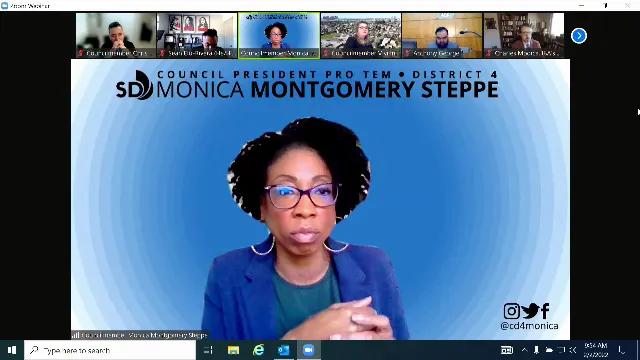
The Public Safety and Livable Neighborhoods Committee held a special meeting on January 21, 2022, starting at 2:00 PM, to consider the implementation ordinance for the Commission on Police Practices (CPP) and to discuss 2022 committee priorities. The meeting was conducted virtually due to the COVID-19 executive order. Key actions included advancing the CPP ordinance with several amendments to the full City Council and approving the committee's 2022 work plan. Public Comments & Testimony - Kim Knox (League of Women Voters) requested removing the statement that commission records are personnel records to ensure transparency, and requiring access to original sources and immediate incident scene access. - Yasmin Abid (Mid City CAN) thanked the council for including two youth seats and one seat per district, but asked for removal of felony/misdemeanor exclusions and for the commission to have access to original sources. - Pablo Martin (San Diegans for Justice) requested including original sources in the definition of investigation, removing references to collective bargaining, making all complaints and findings public, and requiring immediate access to incident scenes. - Julie Wood (District 7 resident) asked for removal of collective bargaining references to ensure transparency. - Lori Saldana (former state representative) emphasized the importance of the commission for accountability and measurement. - Doug Case (CPP First Vice Chair) noted the new draft addressed some concerns but requested unfettered access to all records, including disciplinary records. - Brandon Hilpert (CPP Chair) highlighted the need for immediate access to officer-involved shooting scenes and involvement in selecting the executive director. - Andrea St. Julian (San Diegans for Justice) asked for a one- to two-week postponement for community review of the latest draft and advocated for removing collective bargaining language. - Tasha Williamson supported removing felony/misdemeanor exclusions, citing that officers with crimes remain on the force. - Layla Aziz (Pillars of the Community) requested removing the felony disqualification and ensuring system-impacted individuals have guaranteed seats. - Francine Maxwell (Black Men and Women United) asked to keep the item in committee due to insufficient time for community review of the amended draft. - Numerous other speakers from organizations such as Women Occupy, San Diego Pride, Center on Policy Initiatives, Youth Will, and community members echoed similar requests: remove felony/misdemeanor exclusions, remove collective bargaining references, ensure access to original sources, make records public, and allow more time for review. Discussion Items - Staff Presentation: Tiffany Harrison (committee consultant) presented the background of the CPP, the charter amendment (Measure B, approved Nov 2020), and the draft implementation ordinance. Key policy considerations included commission composition, qualifications, terms, duties, access to records, subpoena power, whistleblower protections, and the civil service appeal process. - Councilmember Moreno (Vice Chair): Expressed concern about the felony bar, noting that a 20-year-old conviction should not automatically disqualify a nominee. Asked about the process for sharing complaints with the commission; SDPD Assistant Chief Chris McGrath confirmed all complaints must be accepted and routed to supervisors. Questioned the timeline for meet and confer; Mayoral staff had no timeline but would report back. - Councilmember Campillo: Questioned the evolution of the felony disqualification language. Proposed friendly amendments: (1) add "including from original sources" to the definition of investigation; (2) add an annual special meeting for community nominations; (3) add "law enforcement practices and oversight" to at-large member qualifications; (4) change "may" to "shall" for the commission to develop nominating procedures (but Chair accepted "may" to avoid delegation issues). Also raised concerns about the definitions of findings (sustained/not sustained) and promised to bring that up at full council. - Councilmember Von Wilpert: Emphasized that the ordinance tracks Measure B. Asked about investigator access to scenes; Richard Pierota (outside counsel) confirmed that an operating procedure will be developed. Discussed collective bargaining: clarified that meet and confer does not allow secret changes; any union requests come to council in open session. Supported removing the felony bar, but did not have specific language and agreed to continue discussion. Expressed support for moving the item forward to allow full council engagement. - Chair Montgomery Stepp: Provided legal basis for personnel records (Penal Code 832.5) and collective bargaining (MMBA). Asked for trust from the community, noting that this is an evolving process and she will continue town halls. Accepted Campillo's amendments (with the change of "shall" to "may" for the nominating process). Key Outcomes - Vote on Item 1: The committee voted 3-0 (Moreno, Von Wilpert, Campillo) to advance the two draft ordinances (CPP implementation ordinance dated Jan 20, 2022, and civil service ordinance dated June 24, 2021) to the full City Council, with the friendly amendments proposed by Councilmember Campillo. The motion also directed the city's management team to begin the meet and confer process on mandatory subjects of bargaining, and for the council to seek advisory recommendations from the Civil Service Commission on the appeal process. - Item 2 (2022 Priorities): The committee approved the 2022 work plan, including priorities submitted by community members. The motion passed unanimously. - Next Steps: The CPP ordinance will go to the full City Council for policy consideration. Chair Montgomery Stepp announced she will hold additional town halls. The next committee meeting is scheduled for February 9, 2022, at 9:00 AM.

POLICE OVERSIGHT 64% · PUBLIC SAFETY 10% · COMMUNITY ENGAGEMENT 9% · PUBLIC COMMENT 5%
615
JAN 20, 2022 · SAN DIEGO, CALIFORNIA · ENVIRONMENT COMMITTEE
San Diego Environment Committee Meeting - January 20, 2022

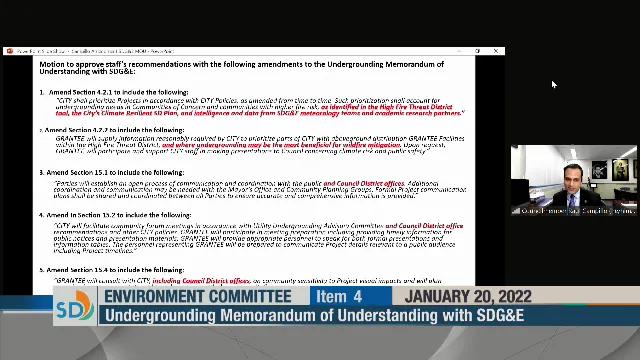
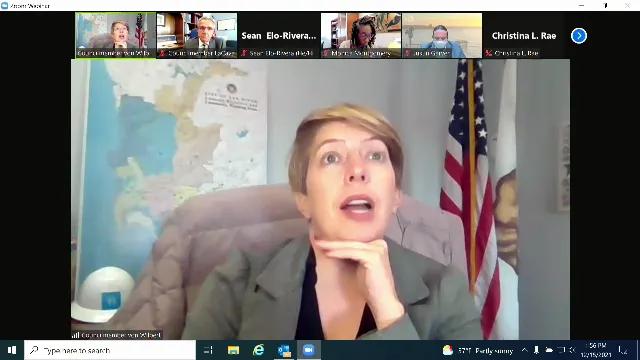
The Environment Committee of the San Diego City Council met virtually on Thursday, January 20, 2022, at 1 p.m. Chair Joe Lacava presided with Vice Chair Marni Von Wilpert, Councilmember Jennifer Campbell, and Councilmember Sean Campillo. The meeting was held via Zoom and televised. The committee took action on three items: leashed dog access at Mission Bay Park, a contract amendment for the San Vicente Hydroelectric Pumped Storage Project, and the undergrounding memorandum of understanding with SDG&E. It also heard an informational update on the utilities undergrounding program and discussed the 2022 work plan. Call to Order and Committee Actions - All four members were present virtually. The committee unanimously approved the committee actions from November 18, 2021. Non-Agenda Public Comments - Lori Saldagna criticized the committee for not allowing public comment on prior committee actions, urged activation of the citizen task force for a public power feasibility study that was allocated $1 million, asked for stronger support for rooftop solar, and encouraged the committee to hear from San Diego Community Power. - Kathleen Lippett highlighted environmental justice concerns, stating that low-income communities bear disproportionate pollution burdens and that the city often defers to special interests. - John Leake questioned why marine wildlife management was not listed as a committee priority, specifically the sea lion rookery in La Jolla. - John Bodaroff and Suzanne Hume, representing CleanEarth4Kids, called for a ban on toxic synthetic pesticides and fertilizers on city-owned lands and golf courses, citing health risks to children and citing statistics about the toxicity of wood smoke. Item 2: Leashed Dog Access at Mission Bay Park (Action) - Staff from the Parks and Recreation Department presented a proposal to amend Municipal Code Section 63.20.12. The change would simplify seasonal leash restrictions and adopt a year-round prohibition from 10 a.m. to 4 p.m., while adding exemptions for guide, service, and signal dogs in training consistent with state law. The current rules prohibited leashed dogs from 9 a.m. to 4 p.m. in winter and 9 a.m. to 6 p.m. in summer. The change was brought forward with support from the Pacific Beach Town Council, the Mission Bay Park Committee, and the Parks and Recreation Board. The fiscal impact is approximately $10,000 for signage. - Public speakers, including Marcella Bothwell (president of the Pacific Beach Town Council), Marshall Anderson (Mission Bay Park Committee), and Andrew Meyer (San Diego Audubon Society), supported the change. Meyer emphasized that the proposal applies to leashed dogs and urged continued management of off-leash dogs. Laurie Saldania supported the consistency and suggested extending similar rules citywide. - Councilmember Jennifer Campbell made a motion to approve the staff recommendation, seconded by Councilmember Sean Campillo. The motion passed unanimously, 4-0. Item 3: San Vicente Hydroelectric Pumped Storage Project – Energy Market Expert Contract Amendment (Action) - Juan Guerrero, Executive Assistant Director of the Public Utilities Department, requested authorization for the fourth amendment to the sole-source agreement with Dr. David Victor. The project, a 500-megawatt long-duration energy storage facility proposed jointly with the San Diego County Water Authority, could generate up to $3 billion in net revenues and provide power for approximately 135,000 homes. Dr. Victor has been a consultant since 2014; the contract currently totals $480,000 and expires August 2022. The amendment would extend the term to August 2025 and add $200,000 from the water utility operating fund. State funding of $18 million received in July 2021 is advancing the project through initial design and licensing. - Public comment came from Lori Saldania, who voiced support but urged the city to activate a citizen task force for its public power study, saying a $1 million allocation appears unused. - Councilmember Campillo moved to approve the amendment. Councilmember Marni Von Wilpert said she would vote no because of concerns about consultant financial disclosure and lack of information about the billing rate; staff later confirmed Dr. Victor's rate is $210 per hour. Councilmember Campbell asked whether information could be shared with San Diego Community Power. The motion passed 3-1, with Von Wilpert voting no. Item 5: Status of Utilities Undergrounding Program (Information) - Gene Matter, Assistant Director of the Transportation Department, provided an informational update. The city has approximately 1,200 miles of overhead utility lines remaining to underground. The work credit balance at the start of calendar year 2021 was about $105 million, and the surcharge fund balance was $171 million. Annual revenue from SDG&E franchise fees is between $60 million and $80 million. In fiscal year 2021, the city completed 8.7 miles of undergrounding. Nineteen projects are ready to move forward once a new memorandum of understanding (MOU) is adopted. The CPUC has decided to stop issuing Rule 20A work credits at the end of calendar year 2022, though the program may continue after a second-phase review. - Public comments included frustration from a Claremont resident about long delays, a Pacific Beach resident who submitted 170 petitions from seniors concerned about low-hanging wires, concerns from Ann Fage (Community Forest Advisory Board) about tree protection, and from Catherine Rhodes about the high fund balance and lack of a project schedule. Several speakers urged more transparent project lists and coordination with mobility and tree canopy improvements. - Councilmembers discussed the high fund balance, the lack of projects in Linda Vista, and the need for wildfire risk prioritization. No formal action was required. Item 4: Undergrounding Memorandum of Understanding with SDG&E (Action) - Staff and representatives from SDG&E presented the new MOU required under the franchise agreement adopted in summer 2021. Key provisions include a compliance review committee with citizen members appointed by the City Council, improved cost transparency, competitive bidding requirements, and detailed project coordination. SDG&E will need significant internal changes, including a new accounting structure and procurement practices, with a six-to-nine-month startup period. A list of ten legacy projects will continue under the old MOU terms to avoid further delays. - Public comment included appeals for strong tree protections (Ann Fage), cost control and distributed energy resource considerations (Jay Powell), workforce diversity (Lori Saldania), and completion timelines and local hire requirements (Catherine Rhodes). - Councilmember Campillo offered amendments to incorporate wildfire risk data from the city's Climate Resilient SD plan and SDG&E's meteorology team, and to require communication with council district offices. Both city staff and SDG&E agreed. Councilmember Campbell made the motion to approve with amendments, seconded by Councilmember Campillo. The motion passed unanimously, 4-0. Item 1: 2022 Environment Committee Work Plan and Priorities (Action) - Chair Lacava explained that committee members submitted priorities by January 7, and a public survey is open in English and Spanish until February 4. He noted a strong response. - More than a dozen public speakers offered priorities. Many urged a needs assessment for the Multiple Habitat Planning Area (MHPA) and the Subarea Plan, including representatives from San Diego Canyonlands, Sierra Club, Friends of Rose Canyon, and others. Youth speakers, including members of Youth for Oil, requested afternoon/evening meeting times and a resolution supporting a statewide phase-out of oil drilling. Others called for climate action plan implementation, building electrification, urban forest management, stormwater funding, and restoration of advisory boards. - Vice Chair Von Wilpert made a motion to direct staff to work with the chair to develop the work plan, seconded by Councilmember Campillo. The motion passed unanimously, 4-0. Key Outcomes - Unanimously approved the Mission Bay leashed dog ordinance amendment (4-0). - Approved the contract amendment with Dr. David Victor (3-1, Vice Chair Von Wilpert voting no). - Unanimously approved the undergrounding MOU with SDG&E, including Councilmember Campillo's amendments (4-0). - Unanimously approved the motion to develop the 2022 work plan (4-0). - The committee adjourned until its next regularly scheduled meeting on Thursday, February 17, 2022, at 1 p.m.

UTILITIES UNDERGROUNDING 40% · PROCEDURAL 9% · PUBLIC COMMENT 6% · ENERGY AND SUSTAINABILITY 6%
616
JAN 19, 2022 · SAN DIEGO, CALIFORNIA · BUDGET & GOVERNMENT EFFICIENCY COMMITTEE
Budget & Government Efficiency Meeting Jan 19, 2022: User Fees, Park Fees, Priorities

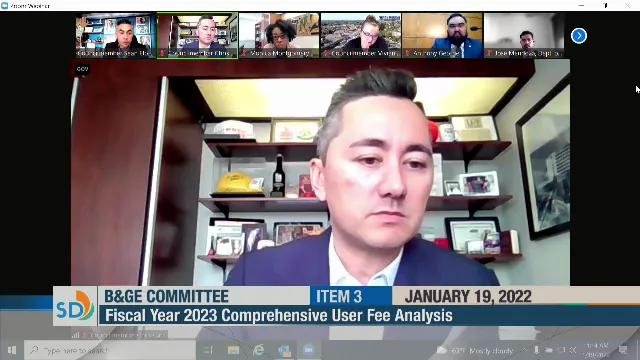
The Budget and Government Efficiency Committee met virtually on January 19, 2022, to consider the Fiscal Year 2023 Comprehensive User Fee Analysis, the Parks and Recreation Department user fee revision, and to set committee priorities for the year. The committee heard extensive public testimony, reviewed presentations from multiple city departments, and voted on items including forwarding the user fee analysis to the full City Council and adopting the updated parks fee schedule with amendments. Consent Calendar - Approval of Minutes: Minutes from October 13, 2021 and November 19, 2021 were approved unanimously. - Consent Agenda Items: - Extension of the Lexus Texas contract and approval of amendment number two. - Second amendment to the 1998 Commission Center Management Agreement between the San Diego Unified Port and the City of San Diego. - Both items were approved unanimously without discussion or public comment. Public Comments & Testimony Non-Agenda Public Comment: - Judy Strang, parent advocate, spoke against reducing marijuana taxes, calling the industry's request a "bait and switch" and urging the committee not to lower taxes. On Item 3 – FY2023 Comprehensive User Fee Analysis: - Luis Montero Adams (San Diego LGBT Community Center) urged freezing all fees for nonprofit special events, citing pandemic hardship and increased costs. - Brad Ramsey (Road One Towing) opposed the 34% increase in police towing franchise fees, stating it cannot be absorbed without a corresponding storage fee increase. - Benjamin Nichols (Hillcrest Business Association) asked to reject police fee increases for nonprofit events, noting events like Hillcrest City Fest fund neighborhood improvements. - Laurel McFarland (San Diego Event Coalition / McFarland Promotions) said proposed police and fire fees feel punitive after the pandemic and urged keeping fees as is for nonprofit and free events. - Medi (Pacific Auto Center) supported raising the franchise fee but requested it be linked with storage fees to avoid negative impact on license impound providers. - Jen LaBarbara (San Diego Pride) stated Pride generates $26.7 million in economic impact, and city fees have risen 91% over 10 years, threatening their ability to give back to the community. - Michael Trimble (Gaslamp Quarter Association) said increases of over 120% in three years will jeopardize small events that support civic improvements. - Mike Dorvier (I Love a Clean San Diego) opposed increasing costs for charity events, which divert funds from beneficiaries. - David Casper (San Diego Pawnbrokers Association / Firearms Dealers Association) requested no increase, noting profits are down and fees cannot be passed on due to state/federal regulation. - Kathleen Lippett argued that the city should increase marijuana business fees to recover costs of addiction and youth impacts, rather than subsidizing that industry. On Item 4 – Parks and Recreation User Fee Revision: - No public comments were received. Discussion Items Item 3 – FY2023 Comprehensive User Fee Analysis - Rolando Travel (Finance Director) and Jose Mendoza presented the citywide effort to update user fees, noting that personnel costs rose 30% from 2019 to 2023. The analysis covers general fund and special revenue/enterprise funds. 501 fees in the general fund are proposed to change: 283 increases, 28 decreases, 115 unchanged, 23 new, 52 eliminated. Non-general fund: 80 fees proposed to change. Projected $8.4 million in new revenue ($7.7M general fund), with $6.3 million subsidy ($6.2M general fund). - Department Presentations: - City Clerk: Proposed increasing lobbyist registration fees and decreasing passport photo fee to $10.50. Passport execution fee recently updated. - City Treasurer: Proposed small increases for disabled placard admin fee and police-regulated ID card fee; decrease payment plan fee; eliminate half-year residential parking permit fee. - Real Estate & Airports: Proposed new and increased fees at Montgomery-Gibbs and Brown Field airports to align with industry practices, projected $23,000 additional revenue. - Development Services (DSD): Proposed 42 fee changes, including large increases to LEA fees (not updated since 2000) and a $1,000 appeal fee. Estimated $488,000 in additional revenue across funds. - Fire-Rescue: Proposed 103 fees: 75 increases, 6 decreases, 3 new, 1 elimination. Increases driven by personnel costs; new fees for large assembly inspections and defensible space inspections. Projected $2.5 million additional general fund revenue, plus $133,000 for junior lifeguard program. - Library: Proposed no fee increases; 2 decreases (processing fees for lost items), 2 new rental fees for the City Heights Performance Annex, 5 eliminations. Projected $273,000 revenue. - Police: Proposed 60 fees: 48 increases, 3 eliminations, 9 unchanged. Major increases include special event police services (commercial rates to $55/hr non-sworn, $178/hr sworn; nonprofit rates unchanged in FY23, phased discounts of 50% in FY24 and 33% in FY25). Tow franchise fee to $11, ticker fee to $90. No changes to alarm fines. Projected $4.2 million additional general fund revenue. - Public Utilities: Proposed modifications to reservoir recreation fees (7 increases, 2 decreases) to move toward cost recovery. Fishing, boat launching, water contact activities would reach 80-90% cost recovery. Projected $430,000 additional revenue. - IBA Comments: No significant comments, but noted they reviewed the fees. - Committee Discussion: Councilmembers expressed support for cost recovery but acknowledged hardship on nonprofits, especially after COVID-19. Councilmember Moreno encouraged benchmarking for fire fees. Council President Pro Tem Montgomery Stepp asked about tiered systems for nonprofits. Councilmember Elo Rivera questioned parking fee structure and residential permit limits. Chair Kate emphasized that 40% of fees are staying the same, decreasing, or eliminated. Item 4 – Parks and Recreation User Fee Revision - Andy Field (Director) and Shelley Stoll (Deputy Director) presented 263 fees: most partially recovered, only 8% are program fees. Proposed 10.8% CPI increase (since 2015) on most fees, generating $225,000 additional revenue. New opportunity fund fee (hourly charges on park use) to support equity programs in communities of concern. Also proposed recreation center fund fees, credit card processing fees, and elimination of outdated fees. Department will develop written policy for opportunity fund distribution. - Committee Discussion: Councilmember Montgomery Stepp expressed concerns about lack of clarity in relationships with permittees and historical underinvestment, and voted no. Councilmember Elo Rivera made an amendment to keep Mount Hope low-income burial fees at current levels and request a cost-of-service study for beach parking (city lots), mooring fees, and boat launch fees for non-residents. Councilmember Moreno supported the opportunity fund but urged a written distribution policy and highlighted deep inequities in programming (47% higher spending in northern areas). She also asked for continued work on fee waivers and marketing. Key Outcomes - Item 3 – User Fee Analysis: Motion to forward the proposed FY2023 Comprehensive User Fee Schedule to the full City Council for review and approval passed unanimously (4-0). - Item 4 – Parks and Recreation Fees: Motion to adopt the revised fee schedule with an amendment (maintain current low-income burial fees at Mount Hope and request cost-of-service studies for non-resident beach parking, mooring, and boat launch fees) passed 3-1 (Councilmember Montgomery Stepp opposed). The department will also bring a written policy on the opportunity fund to the Public Safety and Livable Neighborhoods Committee. - Item 5 – Committee Priorities: Motion to approve the committee work plan based on submitted priority memos passed unanimously (4-0). Key priorities include small business outreach, monitoring expenses and revenues, service level reviews, contract and EOC oversight, and review of COVID-19 relief funds.

USER FEE ANALYSIS 22% · PUBLIC ENGAGEMENT 9% · PUBLIC PARKS 9% · PUBLIC COMMENT 7%
617
JAN 19, 2022 · SAN DIEGO, CALIFORNIA · RULES COMMITTEE
San Diego Rules Committee Meeting – January 19, 2022: Priorities and Direct Docketing Review

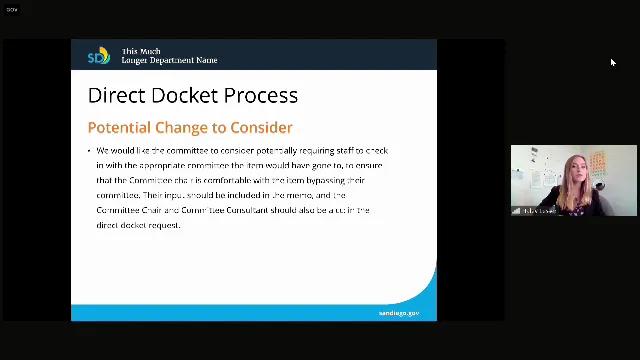
The Rules Committee of the San Diego City Council met virtually on January 19, 2022, at 2:00 PM under Assembly Bill 361 teleconferencing rules. Chair Elo-Rivera presided with Vice Chair LaCava and Councilmembers Campillo, Whitburn, and Kate present. The meeting covered approval of prior minutes (with a correction), non-agenda public comment, discussion of 2022 committee priorities, and an informational update on the direct docketing process. All motions passed unanimously. Consent Calendar - Approval of Committee Actions (December 8, 2021): Initially approved unanimously. Later, during the meeting, Councilmember Campillo moved to reconsider and amend the minutes to correct the identification of a public speaker from "Lori S" to "Lori Saldania" for her comments on equal opportunity hiring. The motion was seconded by Vice Chair LaCava and passed unanimously. The minutes were corrected accordingly. Public Comments & Testimony - Non‑Agenda Public Comment: - A single mother expressed concern about a marijuana outlet reconsideration at the Planning Commission, urging impartiality and transparency in municipal code changes. - Lori Saldania requested correction of the December 8 minutes (addressed above) and recommended adopting digital signatures for nominating petitions to protect public health during the pandemic, noting the current requirement of at least 240 qualified signatures for citywide candidates. - Becky Rapp, a parent and public health advocate, opposed loosening marijuana regulations, citing a U-T article where industry insiders admitted to operating on both legal and illicit markets. She urged the city to uphold current ordinances. - Public Comment on Item 1 (2022 Priorities): - Joyce Lane (San Diego 350) urged the committee to address climate advisory boards: many lack quorums due to vacancies and no new appointments. She called for a formal climate emergency task force with diverse stakeholders. - Lori Saldania supported digital signatures for petitions, urged focus on trash service transition, and stressed the need to fill board and commission vacancies, noting that a $1 million working group on public power had not received appointments despite submitted applications. She also pointed out the lack of women on the Rules Committee. Discussion Items - Item 1: 2022 Rules Committee Priorities – Chair Elo-Rivera opened discussion, noting that 2022 is an election year with a focus on ballot measures and transparency. Councilmembers submitted written priorities. Comments from staff: - Heather Herbert (City Attorney) reminded the committee of a municipal code requirement to review the standing committee structure every three years (last done over two years ago) and to hold a biennial review of boards and commissions, including sunsetting obsolete ones. - Jeff Kawar (IBA) highlighted the need for timely final ballot language to develop fiscal impact statements; deadlines are March 15 for June and August 16 for November 2022 elections. - Councilmembers Campillo, LaCava, Whitburn, and Kate expressed broad support for priorities including election accessibility, translation services, Safeguard San Diego (ballot measure), child care at parks and rec facilities, revisiting Measure E, improving transparency, and strengthening boards and commissions. Councilmember Whitburn stressed the importance of early review of ballot measures. - A motion by Councilmember Campillo, seconded by Vice Chair LaCava, directed the chair to draft a 2022 work plan based on member and public input. It passed unanimously. - Item 2: Informational Update on Direct Docketing Process – Haley Besser (Council President’s Office) presented the historical list of items that can bypass committee review directly to council (e.g., appointments, settlements, tax levies). She proposed requiring staff to check with the appropriate committee chair before direct docketing and to include that in the memo. Randy Wilde (Mayor’s Office) added that citywide meet‑and‑confer items often require direct docketing to full council. Public commenter Lori Saldania cautioned against allowing real estate transactions to bypass committee review, citing risks of reduced transparency. Councilmembers discussed: - Vice Chair LaCava supported retaining the original 2013 list but opposed adding items like routine easements or time‑sensitive real estate, noting potential pitfalls. He endorsed the proposal to notify committee chairs. - Councilmember Whitburn was comfortable with most items except time‑sensitive real estate transactions, urging consultation with the IBA and city attorney, and suggested checking with the relevant council office for geographically specific items. - Councilmember Kate appreciated proactive notification and agreed with colleagues on the need for thorough review. - Chair Elo-Rivera emphasized the importance of the committee process and promised a follow‑up memo incorporating feedback. No motion was taken as the item was informational. Key Outcomes - Unanimous approval of committee actions from December 8, 2021, as amended to correct the public speaker's name. - Unanimous approval of a motion to direct the chair to create a 2022 Rules Committee work plan based on member and public input. - The committee received input on the direct docketing process; a memo will be issued by the Council President’s office to codify updated procedures, including a requirement to consult committee chairs before direct docketing. - The next Rules Committee meeting is scheduled for February 16, 2022.

PUBLIC COMMENT 34% · PROCEDURAL 22% · PUBLIC ENGAGEMENT 14% · TRANSPARENCY 9%
618
JAN 13, 2022 · SAN DIEGO, CALIFORNIA · LAND USE & HOUSING COMMITTEE
Land Use and Housing Committee Meeting: Homes for All of Us Package - January 13, 2022

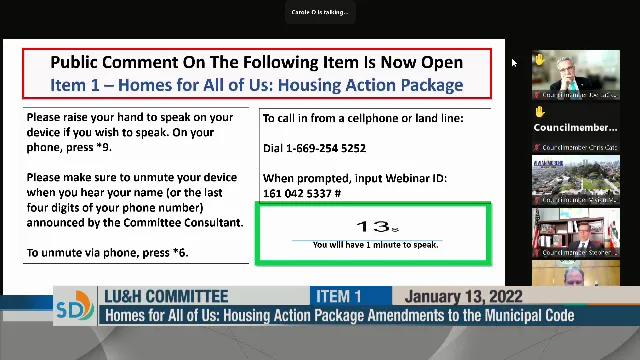
The Land Use and Housing Committee of the San Diego City Council met virtually on Thursday, January 13, 2022, at 9:00 a.m. (PT) via Zoom webinar due to Executive Order N08-21, which suspends certain Brown Act requirements during the COVID-19 pandemic. The meeting was televised and live-streamed on the city's website. Committee members present: Chair Vivian Moreno, Vice Chair Raul Campillo, Councilmember Jennifer Campbell (listed as Kate?), and Councilmember Joe LaCava (the transcript references Vice Chair Lakava and Councilmember Kate, likely Councilmember Jennifer Campbell, and Councilmember Whitburn). The committee unanimously approved the consent calendar and, after extensive public comment and deliberation, unanimously approved the major discussion item: the "Homes for All of Us" Housing Action Package amendments to the Municipal Code and Local Coastal Program amendments. Consent Calendar - The committee unanimously approved the actions from the December 9, 2021 committee meeting. The motion was made by Councilmember Whitburn and seconded. Vice Chair LaCava, Councilmember Whitburn, Councilmember Kate, and Chair Moreno all voted yes. Public Comments & Testimony (Non-Agenda) - Eight public speakers addressed non-agenda items, primarily focused on potential changes to the city's marijuana ordinance (removing sensitive use restrictions), concerns about homeless shelters near schools, and the need for data-driven homelessness spending. Speakers included Barbara Gordon, Becky Rapp, Laura Saldania, Terri Ann Skelly, Daniel Schmikowski, Kelly McCormick, Matthew Kearney, and others. Several urged the committee to reject proposed amendments to marijuana regulations, citing public health and youth safety concerns. Others encouraged the committee to measure outcomes of homelessness programs and address shelter conditions. Discussion Item: Homes for All of Us Housing Action Package - Staff from the Planning Department (Seth Lichney, Renee Mezzo, Kelly Stonko) presented the three-part housing action package: (1) local housing programs and incentives, (2) Senate Bill 9 (SB9) implementation, and (3) accessory dwelling unit (ADU) regulation amendments. - The package includes the "Affordable Housing in All Communities" program, which would allow 100% affordable multifamily housing in zones that currently disallow it, with location criteria such as transit priority areas (TPAs) and high-resource communities. It also includes amendments to density bonus and inclusionary housing regulations, an employee housing incentive program, housing at city facilities, housing accessibility, and housing for families (incentives for 3+ bedroom units). - SB9 implementation local provisions include zero-foot setbacks for single-story units, four-foot setbacks for two-story structures adjacent to residential uses, parking requirements based on TPA location, tree canopy requirements, and development impact fees (DIF) for third and fourth units. - ADU amendments include increasing setbacks for multi-story ADUs, new landscape/tree requirements, and DIF charges for ADUs beyond the first two (with a state-law exemption for units under 750 square feet). - The Community Planners Committee on December 14, 2021, recommended revisions to Sections 2 and 3 consistent with a letter from Neighbors for a Better San Diego (NBSD). Public Comment on the Item - The committee heard a 10-minute organized presentation from Jeff Hutter, Chair of Neighbors for a Better San Diego. He urged the committee to align SB9 and ADU codes more closely with state law, specifically regarding transit proximity (using walking distance not "as-the-crow-flies" TPAs), total building mass, parking, fire hazard exclusions, and the elimination of the bonus ADU program. He proposed a "size bonus" for affordable ADUs and cited over 5,800 petition signatures. - 54 individual speakers signed up to speak. Speakers expressed a wide range of positions: - Supporters of the package included the San Diego Building Industry Association (Laurie Feyler), City Heights CDC (Eric), Climate Action Campaign (Madison Coleman), Circulate San Diego (Jesse O'Sullivan), San Diego Regional Chamber of Commerce (Angeli Kalinog), YIMBY Democrats (Marcia Tucker Borquez), and several residents who emphasized the need for more housing supply and ADUs. - Opponents or those requesting amendments included numerous residents and representatives of community groups (e.g., Talmadge Community Planning Group, Uptown Planners, Community Forest Advisory Council). Common concerns were: the TPA definition unfairly expanding density bonuses, lack of true affordability (110% AMI considered too high), insufficient parking requirements, fire hazard risks, loss of mature trees, infrastructure burdens, and investor-driven development harming single-family neighborhoods. - Several speakers shared personal stories of being negatively impacted by existing ADU developments, including being towered over by new construction and losing privacy. - The Independent Budget Analyst's office (Charles Matica) noted that the employee housing incentive program is opt-in and does not allow building units in lieu of fees, and that some amendments in the package mirror items continued from an earlier council meeting. Committee Deliberation and Amendments - Councilmember Kate (Campbell) asked about maps of affordable housing opportunities and whether the package impacts ongoing community plan updates. She moved staff's recommendation. - Vice Chair LaCava proposed an amendment to require a four-foot setback for all ADUs adjoining residential uses, but staff noted this could make ADUs infeasible on smaller urban lots; Councilmember Kate (Campbell) declined to accept the amendment. - Councilmember Whitburn asked staff to analyze lowering the affordability threshold (from 110% AMI) for deeded affordable ADUs and to consider deed restriction lengths. Staff agreed to include this in an economic analysis to be completed by the end of 2022. - Chair Moreno expressed strong support for the package, particularly the housing at city facilities and housing for families components. - The committee ultimately voted unanimously (4-0) to approve the staff recommendation, including the amendments as presented. Key Outcomes - The committee unanimously approved the "Homes for All of Us" Housing Action Package amendments to the Municipal Code and Local Coastal Program, forwarding them to the full City Council. The motion was made by Councilmember Kate (Campbell) and seconded by Vice Chair LaCava. All committee members voted yes (4-0). - Staff committed to: (1) conducting an economic analysis of the ADU density bonus program, including the impact of lower income thresholds and deed restriction lengths, with findings expected by the end of 2022; (2) comprehensively reviewing the TPA definition across city programs, in coordination with the Sustainability and Mobility Department; and (3) clarifying language regarding floor area ratio (FAR) for residential uses in non-residential parcels. - The committee adjourned to its next scheduled meeting on Thursday, February 10, 2022, at 1:00 p.m.

HOUSING 32% · AFFORDABLE HOUSING 31% · PUBLIC ENGAGEMENT 6% · CANNABIS REGULATION 5%
619
JAN 12, 2022 · SAN DIEGO, CALIFORNIA · ECONOMIC DEVELOPMENT & INTERGOVERNMENTAL RELATIONS COMMITTEE
San Diego Economic Development & Intergovernmental Relations Committee Meeting - January 12, 2022

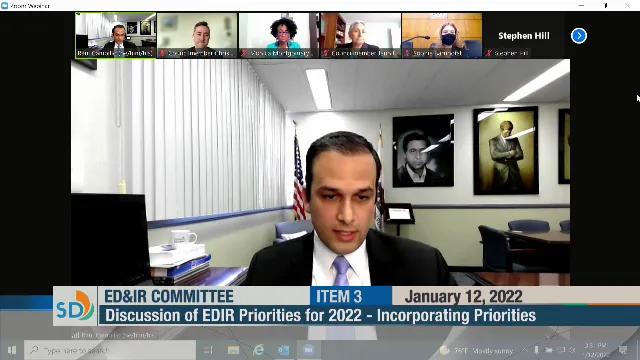
The Economic Development and Intergovernmental Relations (ED&IR) Committee of the San Diego City Council met virtually on January 12, 2022, pursuant to AB 361, with no members of the public physically present. Chair Campillo presided, joined by Vice Chair Chris Kate, Councilmember Jen Campbell, and Councilmember Monica Montgomery Steppe. The committee unanimously approved the November 17, 2021 meeting minutes, heard public testimony on several topics, and addressed four agenda items: a city child care facilities assessment, a federal lobbying contract, 2022 committee priorities, and the Fiscal Year 2021 grants report. Consent Calendar - Approved the meeting actions of November 17, 2021 via unanimous vote (motion by Councilmember Campbell, second by Vice Chair Kate). Public Comments & Testimony Non-Agenda Public Comment - Lori Saldania raised concerns about a downtown public restroom (replaced with a Portland Loo) that has frequently been non-operational; she requested the master association's maintenance agreement and cited the importance of sanitation to prevent disease. - Daniel Smychowski described witnessing homeless encampments along the trolley line and a man who had fallen from a wheelchair and was barely breathing; he criticized the paramedic response and called it "the new normal." - Kathleen Lippitt said council priorities sometimes undermine or conflict with other policy priorities, including support for biotech and life sciences. - Carol Green opposed changes to the municipal code for marijuana businesses, citing statistics that employees testing positive for marijuana had 55% more industrial accidents, 85% more injuries, and 75% higher absenteeism; she urged considering negative impacts on the workforce. - Michael Trimble, executive director of the Gaslamp Quarter Association representing over 400 businesses, urged the committee to move forward on the sidewalk vending ordinance, asking that it be scheduled for the February meeting. - William Dorsett, a busker and artist, urged the vending ordinance to include strong exemptions for buskers and artists to protect First Amendment rights and avoid future lawsuits. Item 1 – Child Care Facilities Assessment - Daniel Smychowski suggested using Mission Bay Golf Course for child care with prefab buildings, citing the value of location. - Martin Huisi (affiliation unclear) supported the report's recommendations and encouraged accepting them. - Erin Hogaboom (San Diego for Every Child / Children First Collective) commended the committee and staff, and urged action including a charter amendment and ensuring equitable access for small providers. - Courtney Baltiski (YMCA Childcare Resource Service, co-facilitator of Children First Collective) supported the staff recommendations, encouraged making child care a 2022 committee priority, and highlighted funding mechanisms and technical assistance. - Lori Saldania suggested focusing on human capital and co-location of child care with senior centers, referencing a vacant senior center in Claremont. - Stephanie Benvenuto (San Diego Regional Chamber of Commerce) supported the recommendations, noted the high cost of child care (about $1,000 per child per month), and urged pursuit of state/federal funding and on-site child care pilots. - Kathleen Lippitt recalled that marijuana businesses displaced churches that provided affordable child care and asked the committee to protect such resources. - Susan Villarriel (University Heights resident) expressed strong support for the city's efforts. Item 3 – 2022 Committee Priorities - Barbara Gordon urged the committee not to prioritize the marijuana industry, citing surveys showing lifetime prevalence of marijuana use among 12th graders at 15.6% and 28.3%. - Kelly McCormick, a public health educator, opposed making cannabis a priority, noting that an average of 29 people per day are sent to hospital emergency departments due to marijuana. - Joy Singata (District 3) suggested priorities including port updates, biotech/life sciences, homelessness funding, cross-border cooperation, opportunity zones, and waterway pollution. - Judy Strang, a mother and grandmother, urged focus on youth aged 15–25 and using parks, community centers, and libraries for workforce development; she opposed moving forward with marijuana businesses. - Becky Rapp, a mother of three, supported youth employment and workforce development, and questioned how cannabis equity aligns with youth priorities; she cited that marijuana is present in 20% of completed suicides. - John (LivedAdvisors.com) asked that homelessness and housing be given greater priority, along with mental health services. Item 4 – FY21 Grants Report - John (LivedAdvisors.com) thanked the grants team and offered to provide lived-experience advocates to support homelessness and housing grant applications. Discussion Items Item 1: Assessment of Child Care Facilities Staff from the Department of Real Estate and Airport Management (DREAM) presented findings. They noted that families in San Diego County with two children spend up to 40% of monthly income on child care; 535 child care providers have closed since the pandemic; and 40% of San Diego families with children have both parents working. The city has 11,000 employees. Staff identified 121 city-owned properties after excluding fire stations, police stations, and other unsuitable uses; after applying criteria of at least 5,000 square feet of ground floor space with adjacent outdoor space or parking, they narrowed the list to 72 viable properties: 42 park and recreation centers, 18 libraries, and 12 office buildings. Zoning may require conditional use permits or overlay compliance, though the city may have exemptions. Staff recommended issuing a Request for Information (RFI) in late spring or early summer 2022 to identify potential child care operators. Committee members discussed the findings. Chair Campillo made a motion to support staff recommendations. Vice Chair Kate seconded and noted that a charter amendment would be required to use parklands for child care; he also corrected the record that the Claremont Senior Center is not neglected but is now a monoclonal antibody treatment center. Councilmember Montgomery Steppe asked about building condition and equity concerns, and Councilmember Campbell clarified that the child care would be open to all San Diego families, not just city employees. The motion passed unanimously. Item 2: Federal Lobbying Contract (Holland & Knight LLP) Staff presented the recommendation to award a five-year federal legislative consulting contract to Holland & Knight LLP. The city issued an RFP on August 20, 2021, and received five responsive bids; Holland & Knight scored about 20 points above the next bidder. The contract would be at a monthly retainer not to exceed $14,000, for a total not to exceed $840,000 over five years. The firm would represent the city before Congress, the White House, and federal agencies, and assist with grant funding. Reporting measures include two annual reports to the committee and availability to council offices. Councilmember Montgomery Steppe expressed concerns about workforce underrepresentation in the proposed team, noting that none of the five bidders met the city's EOC (Equal Opportunity Contracting) points. Staff acknowledged the disappointment and stated the firm has committed to working on diversity; the team lead, Eve Maldonado Tool, is a woman of color. Chair Campillo and Councilmember Campbell expressed support; Campbell seconded the motion. The deputy city attorney clarified that the recommendation includes a conflict of interest waiver. The motion passed unanimously, and the item will go to the full City Council. Item 3: Discussion of 2022 Committee Priorities No formal presentation was given. Committee members had submitted priority memos. Vice Chair Kate made a motion to direct the chair to develop a work plan for 2022; Montgomery Steppe seconded. Members highlighted overlapping priorities including an update to the city's economic development strategy, child care access, youth employment and workforce development, veteran entrepreneurship, the sidewalk vending ordinance, arts and culture, World Design Capital 2024, the Blue Economy, microloans, and the Black Arts and Culture District. The motion passed unanimously, with the work plan to be presented at the next meeting. Item 4: Department of Government Affairs Fiscal Year 2021 Grants Report The grants division reported that in FY21 the city submitted 79 grant applications with a combined value of over $195 million and received 55 awards totaling nearly $142 million. Awards increased by 22% in number and by 39% ($56 million) in funding compared with FY20. The top five grant-active departments accounted for approximately 93% of applications. Staff highlighted improved grant coordination, a new grants working group, and state/federal funding opportunities including the infrastructure bill and climate resilience grants. The item was informational only. Councilmember Campbell asked about grant writer staffing needs; staff said they are conducting a top-down assessment and will share results for budget consideration. Montgomery Steppe asked for a breakdown of competitive versus formula grants; staff said that will be included in next year's report. Chair Campillo asked about the SB 1383 grant application due February 1; staff said the city is applying for approximately $1.8 million. Key Outcomes - Unanimously approved the November 17, 2021 minutes. - Unanimously approved the child care facilities assessment recommendation, directing staff to issue an RFI in late spring/early summer 2022. - Unanimously approved the federal lobbying contract with Holland & Knight LLP, including the conflict of interest waiver; the contract will be forwarded to the full City Council. - Unanimously approved development of the 2022 committee work plan, to be presented at the February 9, 2022 meeting. - Received the FY21 grants report as information; staff will follow up on grant writer staffing assessments and improved competitive grant data. Next meeting: Wednesday, February 9, 2022, at 2 p.m.

PUBLIC COMMENT 28% · CHILD CARE 17% · FEDERAL AFFAIRS 11% · GRANT MANAGEMENT 9%
620
DEC 15, 2021 · SAN DIEGO, CALIFORNIA · ACTIVE TRANSPORTATION & INFRASTRUCTURE COMMITTEE
Special Active Transportation and Infrastructure Committee Meeting - December 15, 2021

This special meeting of the San Diego City Council's Active Transportation and Infrastructure (ATI) Committee was held virtually on December 15, 2021, at 1:00 PM. The committee reviewed consent calendar items, heard public testimony, and discussed three major agenda items involving contract extensions, change orders, and new consultant agreements for water and sewer infrastructure projects. All items passed unanimously. Consent Calendar - Approval of Committee Actions (November 10, 2021): Approved unanimously. - Item 1 & 2 (Consent Agenda): Approved without discussion. Item 1 extended the Tierra Sanit Pump Station construction contract with JF Shea Construction Inc. Item 2 extended the Navajo Pump Station contract with TC Construction Company E. Councilmember Von Wilpert asked for clarification on the expired contract, and staff explained that pump testing and redesign caused delays. Council President Pro Tem Montgomery Step read into the record workforce report data showing underrepresentation of certain groups in TC Construction's workforce, emphasizing the need for progress on equity. Public Comments & Testimony - Non-Agenda Public Comment: John Brady, owner of Lib Advisor, spoke about public bathroom issues downtown. He stated that public-private partnerships are failing, noting that the Marion restroom is frequently out of service and Pinnacle Park bathrooms are inaccessible. He recommended the city install porta potties in Pinnacle Park and suggested that current maintenance contracts are insufficient. Discussion Items - Item 3: Change Order 10 and Transfer of Appropriations for Pacific Beach Pipeline South (TC Construction): Staff presented a request to extend the contract by seven months to December 4, 2022, and appropriate $2,593,000 for unforeseen conditions (buried roadway, unsuitable soils, unmarked utilities, etc.). Construction is 95% complete. The EOC goal was 11% MBE and 4% WBE, but actual certified participation was only 0.9% for MBE/WBE. Council President Pro Tem Montgomery Step expressed concern about low minority and women business participation on a $40 million contract. Committee members discussed the difference between unforeseen and unforeseeable conditions. The item passed unanimously. - Item 4: Consultant Agreement with Rick Engineering for Otay Second Pipeline Phase 4 Design: Staff requested authorization to award a $3,077,440, eight-year consultant agreement to Rick Engineering for design and construction support of a three-mile pipeline replacement. The project faces environmental, jurisdictional, and easement challenges. The voluntary EOC goal is 20%, and Rick Engineering committed to 32.3%. Staff agreed to provide a six-month update on EOC commitments. The item passed unanimously. - Item 5: Extension of MAC Contract for Water, Wastewater, Stormwater, and Pipeline Projects: Staff requested a 12-month extension (no new funding) for the multiple award construction contract (MAC) with Orion Construction/Balboa Joint Venture and TC Construction to complete five remaining projects. Construction is 80-95% complete. Some projects added road repairs and overlays. Councilmember Von Wilpert asked about wildfire-related delays and coordination with SDG&E. Staff noted they are tracking delays with utilities. The item passed unanimously. Key Outcomes - All four action items (consent items 1-2 and discussion items 3-5) were approved unanimously by Vice Chair Lacava, Council President Pro Tem Montgomery Step, and Council President Elo Rivera. - Staff committed to providing a six-month update on EOC commitments for the Otay Second Pipeline Phase 4 contract (Item 4). - The committee discussed the need for a future ATI agenda item to address workforce equity and contract compliance, as suggested by Council President Pro Tem Montgomery Step and Chair Von Wilpert. - Chair Von Wilpert thanked departing committee member Council President Elo Rivera for his service and welcomed incoming Councilmember Campbell.

PIPELINE CONSTRUCTION 19% · PUBLIC ENGAGEMENT 13% · PUBLIC COMMENT 13% · EQUAL OPPORTUNITY CONTRACTING 13%
OPENPUBLICA · PUBLIC MEETING INDEXUPDATED DAILY · openpublica.com