The Land Use and Housing Committee of the San Diego City Council met on April 21, 2022, at 9:00 AM to consider two major agenda items: the shortlisting of development teams for the redevelopment of the 48.5-acre Midway Sports Arena site under the Surplus Land Act (SLA), and the proposed Fiscal Year 2023 Affordable Housing Fund Annual Plan. The meeting included public comment, staff presentations, and committee deliberation. Consent Calendar - Approved the committee action minutes of March 10, 2022, unanimously. - Approved the consent agenda (Items 1–4) unanimously, including the sale of city-owned airport land at 9575 Arrow Drive, a lease amendment at Montgomery Gibbs Executive Airport, a license agreement with SDUSD for open space trails at University City High School, and a lease amendment for a city communications facility on a U.S. Navy complex. Non-Agenda Public Comments - Daniel Smikowski (District 2) opposed the city's proposed ADU ordinance, expressing concern about setbacks, height limits, parking, and occupancy restrictions, and urged the city to roll back the proposal. - Becky Rapp (parent and public health educator) requested that the city ban marijuana billboards on local highways to protect youth, citing state law and research linking teen exposure to increased use. Discussion Item 5: Notice of Availability for the Midway Site – Recommendation to Shortlist Development Teams Staff (Penny Moss, Director of Real Estate and Airport Management) presented that the city received seven responses to the NOA, five of which were responsive. The five teams presented their proposals: - Discover Midway (Affirmed Housing, ASM Global, Brookfield Properties, National Corps): 1,035 affordable units at 56% AMI, no middle-income units, 2,242 market-rate units, arena renovation, 11+ acres of parks/open space. Offered to self-finance affordable housing gap financing (estimated $100 million), avoiding regional subsidies. - Hometown SD (Monarch Group, Essex, Eden Housing, JMI Sports): 1,726 affordable units at 40% AMI, 305 middle-income units, 1,219 market-rate units, replace arena, 18+ acres parks/open space, 300-key hotel. Committed to 62.5% affordable + middle-income housing. - Midway Rising (Zephyr, Chelsea, Legends): 2,000 affordable units at 40% AMI, 250 middle-income units, 2,000 market-rate units, replace arena, 20 acres parks/open space, 200-key hotel. Included a community benefits framework with child care, health care, broadband, and a hospitality career training center. - Midway Village Plus (Bridge Housing, Toll Brothers, Revitate): 1,610 affordable units at 48% AMI, 600 middle-income units, 2,000 market-rate units, new multi-purpose venue, 12-acre central park, 250-key hotel, 300,000 sq ft office. Included on-site child care and units for acutely low-income households. - Neighborhood Next (CONAM, Community Housing Works, Wakeland, Malik): 1,650 affordable units at 53% AMI, 1,100 middle-income units, 2,950 market-rate units, arena renovation (once partner secured), 14 acres open space, 125-key hotel, 35,000 sq ft cultural center. Emphasized being the number one in total housing and middle-income units. Staff recommended shortlisting Midway Rising (highest affordable units and deepest affordability), Hometown SD (second), and Midway Village Plus (third), consistent with SLA priority. The recommendation was based on the number of affordable units and affordability levels, with HCD concurrence on the approach. Public Testimony (23 in-person, 22 virtual speakers): - Midway Pacific Highway Community Planning Group Chair DK Aniwo requested that all five teams be advanced for further analysis, citing unanswered questions about density, infrastructure, mobility, climate goals, and financial feasibility. He emphasized that the community plan allows 2,000 units on the site, while proposals exceed that. - Doug Austin (architect/former planning commissioner) urged consideration of unit quality, middle-income housing, and holistic circulation solutions. - David Watson (Midway Rising) supported the staff recommendation and noted that SLA requires affordable housing on-site. - Chuck Steedman (ASM Global, Discover Midway) requested inclusion of Discover Midway in analysis. - Rick Bates (Unite Here Local 30) and Richard Disbro (IATSE Local 122) asked for all five teams to be analyzed, citing labor agreements and need for economic study. - Andrew Malik (Neighborhood Next) urged all teams to move forward. - Frank Pavel (resident) expressed concern about public awareness and urged thorough study. - Byron Ware (former councilmember) recalled past projects and urged careful analysis of all five. - Chuck Pretto (Kobey’s Swap Meet) asked to be included in the process and for all five teams to be studied. - Mary Jane Jagodzinski (Community Housing Works) requested a consultant experienced in affordable housing before making a shortlist. - Several student speakers (Aidan Lynn, Andrew Sitko, Rihannon Callahan, Aniala Drummond, Leanna Cortez, Matthew Ware, Wyatt Ewing, Rachel Lau, and others) urged prioritizing housing over a new arena and called for thorough vetting of all five proposals. - Gretchen Newsom (IBEW 569) noted all five teams reached PLA agreements with trades council. - Lori Saldania (former Assemblymember) asked for commitments to microgrids, on-site energy, and climate action goals. - Kathy Jolly (Pacific Beach resident) supported Hometown SD for its community outreach. - Carl Rand (Pacific Beach Planning Group) suggested prioritizing arena placement on the eastern side for transit access, favoring Hometown SD. - Robert Trip Jackson (Peninsula Community Planning Board) agreed with the planning group’s call for fiscal analysis of all five. - Robert Pearson supported Midway Village Plus for its bold vision. - Isaac Lara (student) questioned staff’s top recommendation (Midway Rising) and urged independent analysis. Committee Discussion and Vote: - Chair Moreno moved to recommend that the city council conduct detailed due diligence and economic analysis on all five development teams, including a determination of local subsidy needed for affordable units. - Councilmember Kate offered an amendment to include a priority order (Midway Rising, Hometown SD, Midway Village Plus) but after discussion, the committee adopted a motion (by Councilmember Whitburn, seconded by Chair Moreno) that agreed to the first sentence of Councilmember Kate’s proposal: recommending adoption of a resolution expressing the council’s preference to review all responses to the NOA so that the city may conduct detailed due diligence and economic analysis with up to five associated development teams. The motion did not include explicit prioritization. - Councilmember Lacava voted against, arguing that the committee should shortlist a smaller number based on SLA priority. - The motion passed 3-1 (Moreno, Kate, Whitburn in favor; Lacava opposed). Discussion Item 6: Proposed Fiscal Year 2023 Affordable Housing Fund Annual Plan Staff (Sikhet Tayal, EVP Business Administration, and Christelle Vanderwin, Finance Director) presented the plan. The fund has two sources: Housing Trust Fund (established 1990) and Inclusionary Housing Fund (established 2003). Projected fund balance for FY2023: $51 million, with $7.4 million in new collections, totaling $58.7 million. Proposed allocation: $45 million for rental housing production, $3 million for homeownership/ADU programs, and $7 million for homeless programs. Key changes: establishing a rental housing anti-displacement fund, renaming the companion unit pilot to ADU finance pilot, and expanding the capacity building program for homeowners developing ADUs. The committee was asked to recommend approval of $57.4 million in allocations. Public Testimony: - Jim Silverwood (Affirmed Housing) initially opposed the allocation but clarified after understanding that $10 million is for new production; he urged the city to supplement the fund. - John Seymour (National Community Renaissance) expressed concern that only $10 million is available for new production, given at least 2,000 units in the pipeline, and asked for coordination with planning departments to project future needs. - Lori Saldania asked for flexibility to fund nontraditional housing (e.g., faith-based projects) and suggested the housing commission work with Sandag’s housing equity committee. - Stephen Russell (San Diego Housing Federation) noted that $6.6 million for homeless initiatives and $2.6 million for homeownership/ADUs are not housing production, and urged the city to use general fund for those activities to preserve the housing fund for production. Committee Discussion and Vote: - Councilmember Lacava moved to send the item to the full council without a recommendation, noting concerns about the use of fund for non-production activities. The motion passed unanimously. Key Outcomes - Item 5 (Midway Site): The committee voted 3-1 to recommend that the full council adopt a resolution expressing preference to review all five responsive development teams and conduct detailed due diligence and economic analysis. Staff will continue to consult with HCD. The item is expected to be docketed for full council after the May budget cycle. - Item 6 (FY2023 Affordable Housing Fund): The committee voted unanimously to forward the annual plan without a recommendation to the full council for further discussion. The council will consider the proposed $57.4 million allocation and model program amendments. The meeting adjourned at approximately [not specified] and the next regular meeting is scheduled for June 16, 2022, at 1:00 PM.
Public Meetings - San Diego, California
Public Meetings - San Diego, CaliforniaThe Rules Committee of the San Diego City Council met on April 20, 2022, at 10:00 AM to review and take action on several ballot measure proposals for the November 2022 election, as well as non-agenda public comments and a major charter amendment proposal on city hiring practices. The meeting was conducted via hybrid format due to the state of emergency. All actions were unanimous unless noted. Consent Calendar - Approval of March 16, 2022 Committee Actions: Approved unanimously without public comment. Public Comments & Testimony - Catherine Rhodes: Proposed a waterfront city hall location for $1 as an alternative to the current plan tied to 101 Ash Street. (Non-agenda) - Ashika Srinivas (Time to Act United): Presented research on redistricting reform, noting San Diego is the only major city in California that does not meet criteria for non-retired judge appointing authority, two-part selection, political party representation, and partial district detachment. Urged city attorney review and charter amendments. - Carol Green, Becky Rapp, Peggy Walker: Expressed concern about cannabis industry promotion at Balboa Park's Earth Fair, alleging violation of city ordinances prohibiting marijuana advertising at public events. Called for enforcement. - John Stump: Supported Rhodes' waterfront plan and praised redistricting reform presentation; criticized the 2021 redistricting process as flawed and corrupt. - Multiple speakers on ballot sub-items (see below). Discussion Items Ballot Measure Proposals (Sub-items 2A–2R) The committee reviewed 18 proposals in alphabetical order. Each proponent had five minutes, public had one minute. Actions taken: - 2A (Councilmember Kate – Coastal Height Limit for Midway): Motion passed to direct city attorney to develop ballot language to exempt the Midway Pacific Highway Planning Area from the 30-foot coastal height limit. Unanimous. - 2B (Councilmember Kate – Child Care in Parks): Motion passed to work with city attorney, parks, and real estate departments to craft a charter amendment allowing child care in park spaces. Unanimous. - 2C (More Choice San Diego – Ranked Choice Voting): Motion passed to request IBA and city attorney analysis and a report back. Proposal would advance top five candidates from primary to general election with ranked-choice voting. Supporters cited increased turnout and diversity. Some council members raised concerns about primary elimination and implementation date (2024 vs. 2026). Unanimous. - 2D (Elise Dearborn – Supplemental Energy Guide Labeling): Proponent absent; no action taken. - 2E (Catherine Rhodes – TOT Increase by 3.5%): No action taken. - 2F (Catherine Rhodes – Online Travel Agency Tax Clarification): No action taken. Councilmember Campillo expressed interest in further study. - 2G–2R (John Stump and others – various proposals including city manager government, nuclear energy, public utility transition, budget priorities, school district restructuring, animal tourism, council size, ethics reform, etc.): All received no action, ending consideration. Several received supportive public comments but lacked committee motion. Item 3: City Employee Hiring and Recruitment Practices (Charter Amendment) Councilmember Von Wilpert presented a proposal to move the Personnel Department under the mayor's office to streamline hiring, while retaining the Civil Service Commission's oversight on appeals and investigations. Personnel Director Doug Edwards opposed, arguing it would politicize hiring and reduce protections. Public comment was mixed: Robert Otley and League of Women Voters opposed; Tim Douglas (union representative) supported. After extensive debate, the committee voted unanimously to forward the measure to the full City Council for meet and confer and further refinement. Key Outcomes - Approved for ballot language development: Coastal height limit (2A), child care in parks (2B). - Approved for further analysis: Ranked choice voting (2C) – IBA and city attorney report, district council member working group. - No action taken: All other sub-items (2D–2R) – ended consideration. - Forwarded to City Council: Personnel/hiring charter amendment (Item 3) – with direction to refine language, protect employee rights, and begin meet and confer. - Next meeting: June 8, 2022, at 2:00 PM.
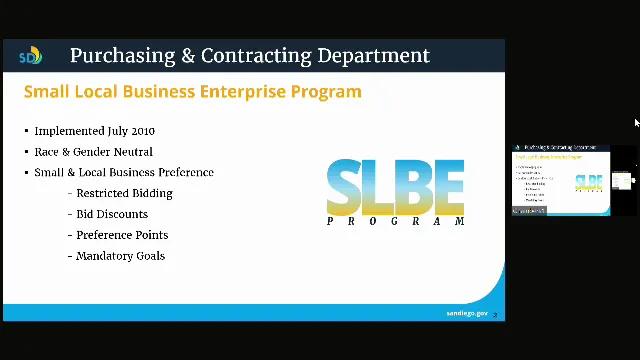
The Budget and Government Efficiency Committee of the San Diego City Council met on April 13, 2022, to consider several items, including a consent agenda, an informational presentation on personnel expenditure savings, and two action items: a sales and marketing services contract for the San Diego Convention Center and an agreement for SAP technical support services. The committee also received the Fiscal Year 2021 Business Diversity Annual Report. All action items passed unanimously. Consent Calendar - Approved committee actions from March 3, 2022, unanimously. - Approved a reimbursement resolution for stormwater capital improvement program expenditures (consent agenda item) unanimously. Public Comments & Testimony - Non‑Agenda Public Comments: - John Leek (citizen) opposed a scheme to defeat the mayor’s Keystone Parks policy, arguing that creating a tourist attraction in La Jolla on state trust land for marine mammals would violate the Marine Mammal Protection Act. He urged the city not to assume management responsibility for federally protected marine mammals. - Joy Signata (District 3) requested assistance in understanding the full FY23 budget after learning that $20 million from the general fund would be used for organic waste recycling. She also expressed support for fair employee wages and the Climate Action Plan. - Item 4 – Personnel Expenditure Savings Presentation: - Corrine Wilson (San Diego Municipal Employees Association, MEA) expressed appreciation for recent recruitment and retention efforts but noted that MEA‑represented positions face 20–30% vacancy rates, with some even higher. She argued that vacancy savings come at the cost of overworked employees and unsustainable service levels, and urged continued investment in city staff. - Joy Signata again spoke, praising the presentation and requesting more data on reasons for resignations and support for the pay equity study. - Item 2 and Item 3 – no public comments were submitted. - Item 5 – Business Diversity Annual Report – no public comments. Discussion Items 1. Budget Personnel Expenditure Savings Presentation (Informational Item) Rolando Charvel, Director of Finance, presented an overview of the city’s vacancy situation, budget practices for vacancy savings, and recent recruitment/retention efforts. Key points: - As of January 2022, there were approximately 1,800 vacancies (about 15% of the budgeted 12,000 FTEs). - Causes include non‑competitive compensation (after years of stagnant wages), macroeconomic factors (hot labor market, Great Resignation), and special circumstances (e.g., new sanitation driver positions for SB 1383, pandemic‑related losses of hourly employees in parks and libraries). - The city uses a “vacancy factor” to estimate savings, which are redirected to other budget priorities. Historical variance between estimated and actual personnel expenditures has been less than 0.33% over the past five years, demonstrating accuracy. - Recent mitigation actions include a total compensation philosophy to reach market median, pay equity studies, special salary adjustments for 180 positions (3–40% increases), and labor negotiations with MEA, Local 127, and safety groups. - A preliminary analysis of the $270 million general fund contracts budget revealed that about 40% ($108 million) is for internal services (e.g., fleet, energy), and approximately $51 million represents external services that could potentially be reduced by filling vacancies. Committee members (Councilmember Moreno, Council President Pro Tem Montgomery Steppe, Council President Ilo Rivera, and Chair Kate) discussed the importance of filling vacancies, the need to raise salaries for positions underpaid compared to other agencies (park rangers – 32% less, management analysts – 28% less, library assistants – 22% less), and the desire for better tracking of service levels and the impact of outsourcing. 2. Sales and Marketing Services Contract – San Diego Convention Center Corp. & San Diego Tourism Authority (Action Item) Presented by Carol Kim (Convention Center Board Chair), Carlos Coda (Vice Chair), Rip Rapatto (President/CEO of the Convention Center), and Julie Coker (President/CEO of the Tourism Authority). Key details: - The contract covers long‑term sales and marketing services for the Convention Center, previously approved in 2012 and 2017, with the current term expiring June 30, 2022. - Proposed new term: five years (July 1, 2022 – June 30, 2027) with an option to renew for an additional five years. - Annual cost: $2.65 million, with a 3% escalation per year. This represents a savings compared to maintaining the prior contract structure (which would have been $2.8 million in the first year). - Efficiencies include merging two VP‑level sales positions into one, reducing sales staff while focusing on quality (higher ancillary revenue from food & beverage, AV, etc.), and having the Tourism Authority take over convention services (arranging off‑site events, hotel rooms). - Metrics will be tracked via an annual Program of Work, including room‑night goals, facility rental fees, attendance growth strategies, and an Event Scoring Profile (ESP) that incorporates ancillary revenues. - IBA noted that funding comes from the city’s COP fund (non‑general fund); last transfer was $2.1 million in FY20. The committee unanimously approved the item (motion by Councilmember Moreno, second by Montgomery Steppe). 3. Agreement with Deloitte Consulting LLP for SAP Technical Support Services (Action Item) Presented by Jonathan Banke (Chief Information Officer, Department of IT) and Arlo McPanty (Deputy Director). Key details: - The city’s SAP ERP system, in use since 2009, supports payroll, financials, procurement, asset management, and HR. - The current contract with CGI expires in June 2022. After an RFP process with 26 firms, Deloitte was selected based on highest cumulative score (including 25% SLBE participation commitment). - Proposed contract: five‑year term with a not‑to‑exceed amount of $23 million, covering 17 full‑time equivalent positions for technical support (security, system administration, development) plus a 20% contingency for future modernization/enhancement projects. - The hybrid model (consultants augmenting city staff) is necessary because the city cannot recruit and retain staff with required SAP skills. - IBA noted no concerns and confirmed the approach is effective. The committee unanimously approved the item (motion by Montgomery Steppe, second by Moreno). 4. Fiscal Year 2021 Business Diversity Annual Report (Informational Item) Presented by Claudia Barca (Director, Purchasing & Contracting) and Christian Silva (Program Manager, Equal Opportunity Contracting). Key data: - The Small Local Business Enterprise (SLBE) program, adopted in 2010, has 404 certified firms (construction, goods & services, professional services, suppliers). - FY21 CIP aspirational goal of 20% was exceeded by 8% (28% achieved). - Total SLBE/ELBE awards: $54.9 million for construction and A&E contracts; $58.4 million across all contract types (construction, A&E, goods & services). - However, overall SLBE participation decreased compared to prior years (10% of $568.8 million total awards, the lowest in five years), partly due to large Pure Water projects with different subcontracting requirements. - Women‑owned business awards also declined. - The “unidentified” ethnicity/gender category will be eliminated in the FY22 report. - Staff noted understaffing in EOC and commitment to implementing disparity study recommendations (to be presented to committee in May 2022, then to full council). - Committee members (Montgomery Steppe, Moreno, Ilo Rivera) expressed interest in bringing the report to full City Council for action, expanding the program, and improving outreach metrics. Key Outcomes - Action Items Approved Unanimously: - Sales and Marketing Services Contract between San Diego Convention Center Corp. and San Diego Tourism Authority (5‑year term, $2.65 M/year + 3% escalation). - Agreement with Deloitte Consulting LLP for SAP technical support services (5‑year term, not‑to‑exceed $23 M). - Informational Items Received: - Budget Personnel Expenditure Savings Presentation – staff will continue recruitment/retention efforts; further analysis of external contracts anticipated. - FY21 Business Diversity Annual Report – staff directed to bring disparity study implementation plan to committee in May 2022 and to consider scheduling the report for full council discussion. - Next Meeting: The committee adjourned to its next regularly scheduled meeting on May 25, 2022 at 9:00 a.m., with budget review committee meetings to follow.
The Economic Development and Intergovernmental Relations Committee met on April 13, 2022, at 10:00 AM (UTC) in a hybrid format. The committee approved minutes from March 9, 2022, heard non-agenda public comments, and unanimously advanced three agenda items: a resolution to designate the San Diego Black Arts and Culture District in Encanto, a second amendment to the compensation agreement with Civic San Diego for the East Village Green Project, and the Fiscal Year 2023 Business Improvement District (BID) budgets. Consent Calendar - The committee unanimously approved the committee actions from the meeting of March 9, 2022, with no public comments. Public Comments & Testimony Non-Agenda Public Comment: Three speakers addressed the committee: - A speaker (parent) expressed concern about reduced marijuana tax rates (from 8% to 2%) and urged restoration to fund youth recreation programs, referencing the upcoming City Council item 201 on equity in recreation. - Joyce Sanyata (District 3) highlighted the new IIJA federal infrastructure law guide and urged the city's government affairs team to stay informed on program rollouts. - Becky Rath, a parent and public health advocate, supported new street vendor restrictions but raised concerns about enforcement and a planned "Cannabis Row" at Earth Fair in Balboa Park, questioning compliance with the city's marijuana ordinance near parks. Item 1 – San Diego Black Arts and Culture District: Six speakers supported the resolution: - Christine Martinez (Arts & Culture San Diego) expressed full support. - Joyce Sanyata voiced support and noted the decades-long effort. - Peter Kaminski (Balboa Park Cultural Partnership) strongly encouraged moving forward. - Daniel Schmiehowski praised the district and mentioned historical figures. - Francine Maxwell (Southeastern San Diego resident) applauded the work and thanked the council. Item 2 – East Village Green Funding: Five speakers spoke: - Betsy Brennan (Downtown San Diego Partnership) strongly supported the funding allocation. - Daniel Schmiehowski questioned park design elements and suggested French-style sculptures. - Diane Peabody Straw (East Village Association) thanked staff and expressed excitement. - Joyce Sanyata (District 3) supported the project but asked for clarity on DIF funding and emphasized security needs. Item 3 – FY2023 BID Budgets: Seven speakers, all BID managers or representatives, expressed support and gratitude: - Betsy Brennan (City Center BID) thanked staff for professionalizing KPIs. - Benjamin Nichols (Hillcrest Business Association) highlighted the BID program's return on investment. - Michael Trimble (Gaslamp Quarter Association) thanked staff. - Jody Rudick (La Jolla Village BID) noted membership growth to 1,276 (near pre-pandemic levels). - Diane Peabody Straw (East Village Association) thanked staff for partnership. - Chris Gomez (Little Italy Association) requested moving budgets forward. - Daniel Schmiehowski praised former Mayor Susan Golding's work on BIDs. - Joyce Sanyata (District 3) asked about outdoor cafe roof removal timelines. - Marco Ortiz (Diamond Business Association, president) emphasized the BID's critical role during COVID-19. Discussion Items Item 1 – Resolution to Designate the San Diego Black Arts and Culture District - Council President Pro Tem Montgomery Step introduced the item. Tiffany Harrison (PSL Link Community Consultant) presented the background, history, and community support for designating Imperial Avenue from 61st to 69th Street in Encanto as a cultural district. Dehan Blevins (District 4 Arts and Culture Commissioner) and Gayeti Fini (San Diego African American Museum of Fine Arts) provided remarks. The resolution acknowledges the area's historical significance, uplifts community organizations, and highlights the need for Caltrans signage. The City Attorney noted that final resolution language would be drafted by her office. Council members expressed strong support, with Vice Chair Kate noting parallels to the Convoy Pan-Asian Cultural District. Chair Campillo committed to advocating for state and federal funding for the district. The item passed unanimously. Item 2 – Second Amendment to Compensation Agreement with Civic San Diego for East Village Green Project - Christina Bibler (Director of Economic Development) and Brian Schoenfish (Deputy Director) presented the project. The East Village Green is a two-acre park with a recreation center, central lawn, playground, splash pad, restrooms, public art, and an underground parking garage (182 spaces). The original project budget of $52 million (2019) was exceeded by the lowest qualifying bid, raising total costs to approximately $79 million. No general fund dollars are requested; the gap is funded by downtown-specific sources: additional development impact fees, parking garage/meter revenues, and FAR bonus fund revenues. Four deduct alternates (decorative overhead structure, decorative fence, two vendor buildings) were eliminated to reduce costs. The project timeline: City Council approval in May 2022, construction start in August 2022, completion by February 2025. Council members asked about restroom provisions (11 stalls, including flush toilets) and maintenance. Parks Director Andy Field confirmed improved restroom access. The item passed unanimously. Item 3 – Fiscal Year 2023 Business Improvement District Budgets - Sean Carafin (Program Manager) presented the FY2023 BID budget package for 18 districts managed by 17 nonprofits. Total assessments of approximately $1.7 million will be collected from about 12,000 businesses. The process requires two Council meetings per state law. Staff also reported performance metrics and accountability provisions from a 2016 audit, including annual bylaw reviews for disparate impact, anti-harassment policies, and public input opportunities. Council President Pro Tem Montgomery Step noted the removal of the holiday bridge lights program from the Diamond BID budget and requested further discussion. The item passed unanimously. Key Outcomes - Item 1: Motion by Council President Pro Tem Montgomery Step, seconded by Vice Chair Kate, to adopt the staff recommendation and forward the resolution to the full City Council. Passed unanimously (4-0). - Item 2: Motion by Vice Chair Kate, seconded by Chair Campillo, to approve the second amendment and additional funding. Passed unanimously (4-0). - Item 3: Motion by Council President Pro Tem Montgomery Step, seconded by Chair Campillo, to approve the FY2023 BID budget package. Passed unanimously (4-0). - The committee adjourned to the next meeting scheduled for Wednesday, May 18, 2022, at 2:00 PM.
On April 7, 2022, the Public Safety and Livable Neighborhoods Committee (PSNL) met virtually to consider two items: designation of authorized agents for disaster cost recovery and the FY2023 annual action plan for HUD programs. The meeting was conducted via teleconference due to public health concerns, with quorum present. The committee unanimously approved both items. Public Comments & Testimony - Item 1 – Authorized Agents: Two public speakers addressed the committee. Judy Strang asked whether there would be general public comment, and the Chair clarified that special meetings do not include non-agenda public comment. Daniel Smyowski objected to the lack of non-agenda public comment, arguing it should be allowed despite the special meeting format. No public comment was received for Item 2. Discussion Items - Item 1 – Designation of Authorized Agents for Disaster Cost Recovery: Megan Beale, Program Manager in the Office of Emergency Services (OES), presented a request to renew a resolution designating city officials authorized to execute applications for federal and state financial assistance after emergencies. The resolution must be renewed every three years per California Governor’s Office of Emergency Services requirements. Authorized agents include the Mayor, Chief Operating Officer, Chief Financial Officer, Fire Chief, OES Executive Director, and OES Program Manager. The resolution covers three programs: FEMA Public Assistance (for debris removal, emergency protective measures, and permanent repair), FEMA Fire Management Assistance Grants (FMAG), and the California Disaster Assistance Act (CDAA). Past qualifying events include COVID-19, 2017 winter storms, 2007 firestorms, 2018 Lilac Fire, and 2019 winter storms. Councilmember Von Wilpert made a motion to approve, seconded by Vice Chair Moreno. The committee voted unanimously to approve. - Item 2 – FY2023 Annual Action Plan for HUD Programs: Angela Nazareno, HUD Program Manager, along with Michelle Morano and Leonardo Alicone, presented the FY2023 annual action plan covering the Community Development Block Grant (CDBG), HOME Investment Partnerships Program, and Emergency Solutions Grant (ESG). The CDBG budget is estimated at over $27 million, with allocations limited by HUD regulations: 20% for administration, 15% for public services, and 65% for other priorities (30% affordable housing, 25% city projects/nonprofit facilities, 10% economic development). The competitive NOFA process resulted in 41 eligible proposals from 44 submissions; 15 public service projects, 6 microenterprise technical assistance projects, and several nonprofit facility improvements were recommended for funding totaling over $5 million. The HOME program, administered by the San Diego Housing Commission, has an estimated budget of over $21 million, with 85% allocated to rental housing production, 5% to first-time homebuyer assistance, and 10% to administration. The ESG program has about $1 million for shelter, rapid rehousing, and HMIS. The committee also approved continuing projects: $1.3 million set aside for homeless services (including Neil Good Day Center, Father Joe’s Village, Connections Housing, and a new family shelter site), $1 million for the Homelessness Response Center, and $5.4 million for two city capital improvement projects (a community park on Fire Boulevard and ADA improvements at Agers South Bay Community Park). The Housing Commission reported that the first-time homebuyer assistance program now provides up to 22% down payment assistance (up from 17%), with average assistance over $100,000; last year, 26 households were assisted. The annual action plan public comment period runs April 1–30, 2022, with City Council consideration on April 26, 2022. The IBA’s Aaron Noel noted that the CIPRAC committee did not formally review the CIP projects due to timing issues, but EDD staff reviewed them and the Project Controls Committee received an informational briefing. Staff committed to more frequent updates. Councilmember Campillo made a motion to approve, seconded by Vice Chair Moreno, with support from Councilmember Von Wilpert. The committee voted unanimously to recommend City Council approval. Key Outcomes - Item 1: Unanimous approval (3-0) of the resolution to designate authorized agents for disaster cost recovery. - Item 2: Unanimous approval (3-0) to recommend City Council approval of action items 1–22 for the FY2023 annual action plan and associated HUD allocations. - The committee requested more frequent updates on CDBG and HUD programs, particularly on the status of NOFAs and progress toward homelessness goals. - The next regular committee meeting was scheduled for Wednesday, April 27, 2022, at 9:00 a.m.
The Active Transportation and Infrastructure Committee of the San Diego City Council met virtually on April 6, 2022, at 2:00 PM. The meeting was chaired by Councilmember von Wilpert, with Vice Chair Lacaba, Council President Pro Tem Montgomery Steppe, and Councilmember Campbell absent. The committee approved consent items, heard public comments, and discussed two major items: a fee adjustment for the Regional Transportation Congestion Improvement Program (RTCIP) and a contract amendment for the West Mission Bay Drive Bridge project. Consent Calendar - Item 1: Authorized construction change order number six for contract Louis SEAL Group 1803 (slurry seal). Councilmember Montgomery Steppe asked questions about American Asphalt and legal matters. The work had already been completed; if not approved, the contractor could sue. The committee approved unanimously (3-0, with Campbell absent). Chair von Wilpert also noted a comment from Mobility Board member Nicole Burgess about linking slurry seal contracts to climate action goals. Public Comments & Testimony - Daniel Schmiansky (non-agenda public comment): Expressed frustration that trees promised five years ago on Morena Boulevard were never planted, feeling let down by the city. Also noted difficulty accessing the February agenda online. - Matthew Vasilakis (Climate Action Campaign): Expressed support for a comprehensive CAP implementation funding plan with associated costs, citing the need to compete for federal infrastructure dollars. - Joy Sonata (District 3): Praised the IBA's updated "Citizen's Guide to Infrastructure," especially the chart on CIP outlook and the sentence about competing for IIJA funds. - Daniel (on item 3 – West Mission Bay Bridge): Voiced concern that the bridge project appeared abandoned and noted that building more bridges may conflict with climate action goals. Discussion Items - Item 2 – RTCIP FY2023 Fee Adjustment: Senior Planner Alphonse Gathell presented a request to recommend approval of a 2% increase to the RTCIP fee, as approved by SANDAG on February 25, 2022. The fee for single-family units would rise from $3,069 to $3,130, and for multifamily from $2,456 to $2,505. The increase maintains purchasing power and compliance with the Transit Extension Ordinance. Vice Chair Lacaba moved approval, noting the Build Better San Diego program would address broader fee reform in June. Councilmember Montgomery Steppe seconded and linked the item to Council Policy 800-14 updates. The committee approved unanimously (3-0). - Item 3 – West Mission Bay Drive Bridge Project Amendment: Alex Garcia (ECP) and Isaac Vallejo presented a request for a 39-month extension and $2,064,597.56 in additional funding for construction management services with Kleinfelder Construction Services. The project, which includes replacing the West Mission Bay Bridge, faced delays due to cast-in-drilled-hole issues (8 months, partially mitigated) and new environmental permit requirements (e.g., certified biologist, predator control). The additional funds come from project contingency ($10M set aside, leaving $7M) and federal Highway Bridge Program funds. The bridge is expected to open in October 2022, with environmental monitoring through 2024 and project closeout in 2025. Councilmember Montgomery Steppe expressed concerns about foresight in design and the use of contingency; staff committed to providing further briefings. Vice Chair Lacaba seconded the motion, and the committee approved unanimously (3-0). Key Outcomes - Approved consent calendar (Item 1) unanimously. - Recommended approval of the RTCIP fee adjustment (Item 2) to City Council unanimously. - Authorized the first amendment to the West Mission Bay Bridge consultant contract (Item 3) unanimously. - The committee will hold its next meeting on April 27, 2022, at 2:00 PM.
The Environment Committee of the San Diego City Council met on March 17, 2022, chaired by Councilmember Joel Akava. The meeting was held virtually under AB 361. The committee approved the previous meeting’s minutes, heard public comments, and took action on three agenda items: extending the downtown circulator shuttle (Fred), amending the recycling code for SB 1383 organic waste requirements, and amending the non-exclusive solid waste franchise agreements. Informational updates were provided by San Diego Community Power and SDG&E on the Energy Cooperation Agreement. Consent Calendar - The committee unanimously approved the actions of the February 17, 2022 meeting of the Environment Committee. (Motion by Councilmember Von Wilpert, second by Councilmember Campillo; vote: 4-0) Public Comments & Testimony - Non-Agenda Public Comment (30 minutes): - Members of the Sierra Club Seal Society (Robin Davanoff, Susan Cuello, Carol Toy, Ellen Shivley) spoke on the coastal development permit for seasonal closure of the sea lion rookery at Point La Jolla and Boomer Beach. They argued that the city’s proposed closure dates (starting May 25) are too late and boundaries are too small, urging a minimum closure from May 1 and reinstatement of the temporary boundary to protect sea lions and pups. They noted that 17 other California seal rookeries are closed during pupping season. - Speakers also commented on: - Need for a comprehensive implementation plan for the Climate Action Plan and building electrification reach codes (Wendy Maholik, Kelly Linden). - Support for AB 1690 (Smoking Waste Prevention Act) to ban cigarette filters and single-use vapes (Peggy Walker, Carol Green). - Environmental impacts of marijuana cultivation facilities (Becky Rapp). - Proper disposal of e-cigarettes as hazardous waste (Kelly McCormick). - Support for AB 2764 to prohibit new factory farms and slaughterhouses in California (Lori Saldania, Dave Engel, Tommy Howe, Colton Herman). - Additional speakers: Daniel Schmikowski (sea lions, surfing), Jay Powell (energy independence). - Public comments on specific agenda items are noted under those items below. Discussion Items Item 4: Informational Update on San Diego Community Power (SDCP) - Presentation by Cody Hooven (COO) and Rita de la Fuente (Director of External Affairs). SDCP now serves seven member agencies (adding National City and unincorporated county areas). Residential enrollment in San Diego begins in May 2022. Current products: Power On (50% renewable) at slightly lower cost than SDG&E, and Power 100 (100% renewable) for an additional $3–5/month. SDCP has signed 340 MW of long-term renewable contracts and is developing local programs (feed-in tariff, community solar, rooftop solar incentives). Members asked about local generation, net metering, and renter eligibility. No action required. Item 1: Third Amendment to Agreement with San Diego Free Ride, LLC (Fred) - Staff (Christy Reeser, Alyssa Muto) presented. Fred is a free, on-demand, all-electric circulator shuttle in downtown. The amendment extends the contract for one year (through fall 2022) using $1.2 million from downtown community parking district funds. Ridership in 2021 was 180,000 (down from 275,000 pre-pandemic). The city intends to use a future SANDAG vendor bench for similar services. Public comment was supportive. Committee discussion highlighted first/last mile connectivity and environmental benefits. Motion by Councilmember Campillo to approve, seconded by Councilmember Von Wilpert; passed unanimously (4-0). Members expressed interest in expansion to other neighborhoods. Item 2: Amendments to Municipal Code for SB 1383 Organic Waste Requirements - Staff (Ken Prue, Renee Robertson) presented. The amendments require all properties to have a three-container system (green for organics, blue for recycling, gray/black for trash) with universal colors, contamination tracking, and edible food recovery reporting. The city will not increase AB 939 or franchise fees. $9 million is allocated for initial implementation (new trucks, green bins). Public comments were overall supportive; one speaker noted challenges for small haulers accessing composting facilities. Committee discussion included landfill capacity (Miramar Landfill may close by 2030 without diversion), outreach, and hiring for code compliance. Motion by Councilmember Campillo to approve, seconded by Councilmember Von Wilpert; passed unanimously (4-0). Item 3: Amendments to Non-Exclusive Solid Waste Collection Franchise Agreements - Staff (Renee Robertson) presented amendments to franchise agreements to incorporate SB 1383 requirements and a cap on third-party diversion credits at 10% to incentivize actual diversion. Universal container colors, education, and penalty provisions are included. Franchise fees unchanged. Public comment from Jeremy Ogle (San Diego County Disposal Association) requested a delay to review the full amended contract, stating they received it only six business days prior and needed a strikeout version and more negotiation time. Several speakers echoed this request. Committee Chair Lacava moved to approve the staff recommendation, seconded by Councilmember Campillo, with a commitment that Environmental Services would continue working with haulers before the item goes to full council. Passed unanimously (4-0). Members acknowledged the need for timely implementation while allowing additional discussion. Item 5: Progress Report on Energy Cooperation Agreement (ECA) Implementation Plan with SDG&E - Presentation by Chad Colton (City) and Caitlin Haley (SDG&E). The ECA, part of the electric franchise, outlines five goal areas. SDG&E reported on progress: tree planting (76 trees at parks, 29 fruit trees at schools, community events), clean transportation (Power Your Drive program, fleet day), energy benchmarking, fire safety collaboration (helicopter flight, data sharing for undergrounding prioritization), microgrid planning, equity-focused solar program (launch targeted for late May/early June 2022, with 37 installations per year), and transparency commitments. Public comments were mixed: some praised tree planting and partnership, while others criticized high rates, questioned the focus on climate goals, and noted the lack of a public power study task force. Committee discussion focused on the compliance review committee (expected to be formed by July 2022, with three council appointees and two mayor appointees), EV charging timelines, and rate affordability. No action required; information only. Key Outcomes - Minutes Approved: Unanimous approval of February 17, 2022 meeting actions. - Fred Extension: Approved unanimously to extend the downtown circulator contract for one year through September 2022. - SB 1383 Organic Waste Ordinance: Approved unanimously to amend the recycling code to require three-container collection, universal colors, contamination tracking, and edible food recovery. - Franchise Agreement Amendments: Approved unanimously to amend solid waste franchise agreements to include SB 1383 requirements and cap third-party diversion credits at 10%. The committee directed staff to continue negotiations with haulers before the item reaches the full council. - Next Steps: The next regular Environment Committee meeting is scheduled for April 21, 2022, at 6 p.m.
The Audit Committee of the San Diego City Council met on March 16, 2022, at 9:00 a.m. via teleconference. The meeting focused on reviewing the city's internal financial controls, monitoring the implementation of audit recommendations, and receiving a monthly activity report from the City Auditor. Key actions included accepting reports, requesting status updates on overdue recommendations, and directing follow-up work plans. Consent Calendar - Approval of Minutes (Feb 16, 2022): Unanimously approved. Public Comments & Testimony - Mr. Schmiehovsky (public comment on non-agenda item): Raised concerns about the interim San Diego Housing Commissioner not disclosing his salary during a prior City Council meeting, stating he felt uncomfortable and requesting proper address in future. Discussion Items - Item 1: Annual Report on Internal Financial Controls (Calendar Year 2021) - Presented by Jeff Hill, Assistant Director of Finance. The report summarized management's evaluation of internal controls using the COSO framework, noted no material impacts from the pandemic, and highlighted a clean audit opinion and GFOA awards. The committee accepted the report unanimously and forwarded it to the full Council. - Item 2: Office of the City Auditor’s Recommendation Follow-Up Report (Period Ending Dec 31, 2021) - Presented by City Auditor Andy Hanau, Deputy Auditor Danielle Knighton, and Assistant Auditor Matt Helm. The report covered 196 open recommendations from 48 audits. As of the reporting period, 24 recommendations had been implemented, with 170 remaining in process. Key highlights included: - TAP Program (Recommendation 7, Hotline Investigation): HR attempted to renegotiate pricing but was unsuccessful; cost to city is minimal. OCA concurred with dropping the recommendation as no longer applicable. - Improper Free Trash Collection for STROs (Recommendation 1, Hotline Investigation): Administration determined legislative action is needed. OCA recommended keeping the recommendation in process until compliance is achieved through legislation. - SDPD Complaint Forms (Recommendation 8, Data Analysis Audit): SDPD declined to keep complaint forms in all vehicles, citing supervisor involvement as best practice. OCA recommended keeping the recommendation open to ensure accessibility. - Departmental updates were provided by various city departments (e.g., Development Services, Public Utilities, HR, Economic Development, etc.) for their specific open recommendations. - Item 3: City Auditor’s Monthly Activity Report (Information Item) - City Auditor Andy Hanau summarized recent and planned audits, including audits of workers' compensation, 911 system, body cameras, code enforcement, and more. He also discussed progress on a ballot measure for independent legal counsel for the Audit Committee, noting the City Attorney declined to assign outside counsel but agreed to assign in-house counsel. No action was taken on this item. Key Outcomes - Approved the annual report on internal financial controls and forwarded it to the City Council. - Accepted the Recommendation Follow-Up Report with the following specific actions: 1. Directed that the STRO free trash collection recommendation (Hotline Report) remain in process until full compliance is achieved through legislative action. 2. Authorized dropping the TAP program recommendation (Hotline Report) as no longer applicable. 3. Directed that the SDPD complaint forms recommendation (Data Analysis Audit) remain in process until fully implemented. 4. Requested status updates on three overdue audits to the appropriate City Council committees: (a) Advanced Metering Infrastructure Implementation, (b) Public Utilities Customer Service Call Center, and (c) Economic Development Department's Business and Industry Incentives Program. 5. Requested the City Auditor to work with the Economic Development Department on a Recommendation Implementation Work Plan (RIP) for the Business and Industry Incentives Program audit (Recommendation 1, Audit 18-015). - No action taken on the monthly activity report. - The next Audit Committee meeting is scheduled for April 20, 2022, at 9:00 a.m.
The San Diego City Council Rules Committee met virtually on March 16, 2022, to consider three major items: a proposed charter amendment to move the Personnel Department under the mayor to streamline hiring; a ballot measure to amend the 103-year-old People's Ordinance to allow cost recovery for residential refuse collection; and the creation of an Energy Independence Fund to study public power and support climate goals. The committee voted on all three items, with two passing 4–1 and one passing 4–0 (the energy fund). Consent Calendar - Approval of Committee Actions (February 16, 2022): Motion by Councilmember Campillo, seconded by Councilmember Kate. Passed unanimously. Public Comments & Testimony - Non‑Agenda Public Comment (four speakers): - Kelly McCormick (public health educator, parent): Asked the committee to consider impacts on children when changing municipal code, noting the need for adequate outreach to families. - Becky Rapp (parent, public health educator): Expressed concern about reducing marijuana production tax from 8% to 2%, stating it sends the wrong message to other struggling businesses. - Alex Zukis: Argued that policies narrowing roads and eliminating parking favour only 2–6% of cyclists, disadvantaging the 94–98% who drive; urged that cyclists help pay for infrastructure. - Rodney L. Fowler Sr. (first speaker, redirected to agenda item 2): Wanted to speak on the People's Ordinance but was told it would be heard later. Discussion Items Item 1 – Ballot Measure to Revise City Hiring/Recruitment Practices (Proposed Charter Amendment) - Presenter: Councilmember Marni von Wilpert (District 5) via phone, and chief of policy Justin Garver. - Proposal: Move the Personnel Director and Personnel Department from under the Civil Service Commission to under the mayor, consolidating hiring functions with existing HR and Risk Management to reduce the average 6–12 month hiring timeline and fill hundreds of vacancies. - Personnel Director Doug Edwards (appointed by Civil Service Commission): Emphasized that only 20–30% of the hiring process is controlled by his department; the rest is in hiring departments or external checks. He noted budget cuts and a 63% increase in recruitment workload. He warned that removing independent oversight could weaken merit protections. - Public comment: Rodney L. Fowler Sr. praised Personnel staff but cautioned against history of politicized hiring; urged addressing wages and remote work inefficiencies. - Committee discussion: Councilmember Kate supported the move, saying it holds the mayor accountable. Councilmember La Cava had questions about how meet‑and‑confer would work and whether the change would truly solve inefficiencies. Councilmember von Wilpert clarified this proposal differs from an earlier one (that sought to eliminate Personnel) – it preserves the department but changes reporting structure. - Motion: Councilmember Kate moved to direct staff to work with city attorney, IBA, and mayor’s office to draft charter revisions. Seconded by Councilmember Campillo. Vote: 4–0 (passed). Item 2 – Ballot Measure to Amend the People’s Ordinance (Refuse Collection Cost Recovery) - Presenter: Brendan Dentino, Rules Committee Consultant, on behalf of Council President Elo‑Rivera and Councilmember La Cava. - Proposal: Ask voters to amend Municipal Code Section 66.0127 to allow the city to recover costs for residential refuse collection (not to impose a fee, but to permit future fees). Would preserve customer bases and city jobs; close loopholes for vacation rentals, ADUs, and mini‑dorms; and include bin costs in any future fee. The People’s Ordinance, passed in 1919 and last amended in 1986, prohibits cost recovery for single‑family homes, costing the general fund $43.2 million in FY22 and $173 million from FY17–21. It also prevents pay‑as‑you‑throw models needed for state SB 1383 compliance and climate goals. - Independent Budget Analyst (IBA) / City Attorney: Noted that a fee would require Prop 218 compliance (community engagement, cost‑justified). - Public comment (14 speakers, limited to 1 minute each): - Kim Knox (League of Women Voters): Supported reform, noting inequity and $234 million cost over four years. - Ron Askland: Supported amending to free up general fund and allow pay‑as‑you‑throw. - Olivia Borak‑Bowden (Coastal Environmental Rights Foundation): Urged reform, said renters pay twice. - Dana Givens: Suggested committee first consider alternative options from 2019 auditor report; concerned city may not control costs. - Alex Zukis: Opposed blank‑check authority; wanted specific fee details in ballot language. - Michael Zuquet (MEASan Diego): Strongly supported putting the measure on the ballot. - Kiara O’Laughlin (Center on Policy Initiatives): Expressed concern about process; urged worker protections and stakeholder engagement. - Lucera Sanchez (San Diego Coastkeeper): Supported amendment for equity and CAP goals. - Daniel Orloff (Teamsters Local 911): Supported moving forward; said it will help fund city services. - Mr. Smihowski: Offered metaphor, ended with support. - Rodney L. Fowler Sr. (retired refuse collector): Disappointed council did not reach out to frontline workers; opposed the measure. - Matthew Vostalakis (Climate Action Campaign): Supported reform as critical for CAP implementation. - Alison Schlick (Zero Waste San Diego): Urged action to avoid SB 1383 penalties and address inequity. - Richard Anthony: Thanked presenters; noted zero‑waste plan encourages wasting; supported amendment. - Committee discussion: - Council President Elo‑Rivera (moved): Emphasized the measure is only about allowing future cost recovery, not imposing a fee; cited broad coalition support; stressed worker protections. - Councilmember La Cava (seconded): Supported as step to fairness, CAP goals, and modernizing government. - Councilmember Campillo: Expressed concerns: November 2022 may be too soon; cost of ballot ($200–300K); risk of failure; need for polling and clear campaign strategy; questioned timing (non‑presidential election). He said he might change his vote later but needed more information. - Councilmember Whitburn: Shared concerns about low voter turnout in midterms; failure could set back reform for years. Asked about path to success. - Council President Elo‑Rivera responded: Outside research shows majority support; waiting two more years is not acceptable given budget deficits and worker strain. - Motion: Council President Elo‑Rivera moved to direct city attorney to draft ballot language. Seconded by Councilmember La Cava. Vote: 4–1 (Councilmember Kate opposed). Item 3 – Creation of an Energy Independence Fund - Presenter: Brendan Dentino on behalf of Council President Elo‑Rivera and Councilmember La Cava. - Proposal: Establish a fund to (1) cover potential prorated refund of SDG&E franchise bid amounts if the city terminates early, (2) pay for professional services studying public power/municipalization, and (3) support city‑controlled energy projects (solar, microgrids, etc.). At least 20% of franchise bid payments ($2.1M/year for first 5 years) should be allocated to the fund, but allocations are subject to annual budget process and may be waived by council. The fund is meant to give the city flexibility and leverage for its energy future. - Public comment: J. Powell (Community Energy Action Network) supported, asked to include Sustainable Energy Advisory Board (SEAB) in oversight, filling vacancies, and suggested linking to existing energy trust fund. - Committee discussion: - Councilmember La Cava (moved): Called it a financial tool to reach clean energy goals and explore alternatives to investor‑owned utilities. - Councilmember Campillo (seconded): Asked IBA capacity to analyze impact on general fund. IBA (Charles Modica) said they can. Asked City Attorney about legal efficacy – resolution is a goal, not a binding appropriation; majority vote to waive. Wanted to ensure the fund does not affect the separate SDG&E solar equity program (staff confirmed it does not). - Councilmember Kate: Expressed concerns about the “should” language and its intent; worried the fund redirects money from other services. He said he would support using the fund as an escrow for potential franchise termination, but not for municipalization studies or city energy projects, which he argued are roles for the CCA (San Diego Community Power). - Councilmember La Cava responded: CCA is focusing on large power purchases; local microgrids may need supplemental funding; intent is to maintain flexibility. - Council President Elo‑Rivera supported: Stressed the fund prepares the city for future decisions and provides negotiating leverage with SDG&E. - Motion: Councilmember La Cava moved to approve resolution authorizing creation of the fund. Seconded by Councilmember Campillo. Vote: 4–1 (Councilmember Kate opposed). Key Outcomes - Item 1 (Hiring Reform): Motion passed 4–0. Staff will draft charter amendment language for future Rules Committee consideration. Meet‑and‑confer process with unions will follow if the measure advances. - Item 2 (People’s Ordinance): Motion passed 4–1. City attorney directed to draft ballot measure language for the November 2022 election; to return to Rules Committee for further review. Councilmember Kate voted no. - Item 3 (Energy Independence Fund): Motion passed 4–1. Resolution adopted to create the fund; mayor to include recommended allocations in annual budget. Councilmember Kate voted no. - Next Meeting: The Rules Committee is scheduled to meet next on Wednesday, April 20, 2022, at 2:00 p.m.
The Land Use and Housing Committee of the San Diego City Council met virtually on Thursday, March 10, 2022, at 9:00 AM. The meeting was held via teleconference due to the COVID-19 public health emergency, with public comment available via Zoom. Key agenda items included an informational update on the San Diego Housing Commission's Accessory Dwelling Unit (ADU) pilot programs and an informational update on proposed amendments to council policies governing community planning groups (CPGs). The committee also approved the minutes from the February 10, 2022 meeting. Consent Calendar - The committee unanimously approved the committee actions of February 10, 2022 (motion by Vice Chair Lacava, second by Councilmember Whitburn, all members voting yes). Public Comments & Testimony Non-Agenda Public Comment: - Daniel Schmikowski (Bay Park, Bay Ho) expressed concern about state and city ADU policies, arguing that setbacks and neighborhood integrity are being compromised and that the pace of change is too fast. - A caller (last four digits 7234) raised issues regarding the unsheltered population, including physical handicaps, mental health, and drug addiction. - Becky Rapp (San Diego resident, public health educator) criticized Councilmember Whitburn's memorandum on marijuana outlet ordinances, arguing that communities of color do not want more marijuana businesses as reparations. - A speaker advocated for banning car-centric uses around transit priority areas (TPAs) to meet climate action and vision zero goals, urging the committee to revisit the proposal. - Judy Strang noted that a county webinar on social equity in marijuana businesses lacked Latino, Vietnamese, and Asian parent leaders, and emphasized that communities of color want community centers and youth transition support, not marijuana stores. - Joy Sanyata (District 3) reflected on Mayor Gloria's statement about unsheltered people on sidewalks, expressing sadness and frustration, and wishing for more bathrooms and blanket distribution. - Lorna Zukis opposed road diets and parking requirement reductions, citing that only 8% of San Diego residents bike and that such policies hurt working-class car-dependent residents. She also noted that population growth projections (17.6% from 2016-2050) are lower than the 33% housing increase, suggesting overbuilding. - Kelly McCormick (public health advocate) thanked the council for regulating street vendors, particularly regarding marijuana products, and urged adding drug paraphernalia to the list of prohibited items. Public Comment on Item 1 – ADU Pilot Programs: - Joy Sanyata (District 3) praised the ADU program but questioned the 7-year deed restriction and 80% AMI requirement, suggesting longer affordability. She also proposed using similar small homes for the unsheltered. - Nicole Burgess applauded the program but suggested including two-story ADUs to capture density and preserve gardens. - Daniel Schmikowski expressed skepticism, citing unanswered questions about zoning, property tax, Proposition 13, and Fannie Mae, and warned about neighborhood integrity. - Lorna Zukis supported the program in concept but cautioned about potential financial risks for low-income homeowners, referencing the 2007-2008 housing crisis, and asked about safety nets. - Sharon Gale (District 3) commended the housing commission and suggested developing plans for ADUs above garages, noting that ADUs have existed in Mission Hills for over 100 years without harming neighborhood character. - Susan Baldwin advocated for longer and deeper affordability requirements in the pilot program. - Oscar Tavera (Mission Hills resident, age 32) strongly supported the ADU program, stating it provides flexibility for young people who cannot afford to live in San Diego, and argued that it does not negatively change neighborhood character. Public Comment on Item 2 – CPG Reforms: - Rudy Lopez (Chair, San Isidro CPG) spoke in defense of community planning groups, expressing concern about loss of review ability due to SB 9 and other policies. He generally supported the CPC recommendations but opposed the requirement for CPGs to take ownership of official documents and designated seats/quota categories. - Wally Wolfeck (Chair, CPC and planning group) criticized the proposal for lacking proactive measures to assist CPGs in achieving democracy and for potentially severing the long-standing relationship between the city and CPGs. - Aidan Lynn supported the reforms but expressed concern that common-sense changes like term limits and fair election requirements were being watered down in response to criticism from the same institutions that need reform. He called for more outreach to equity-based stakeholders. - Chris Nielsen (Chair, University CPG, speaking personally) emphasized that CPGs are voluntary and time is a scarce resource; he asked for clarity on social media use to avoid Brown Act violations. - Liana Cortez (University City) supported reform, noting that her CPG is 86% white and dominated by homeowners, while the community is 48% white and 52% people of color, with 50% aged 15-34. She argued that structural barriers exclude young renters and people of color. - Egan Lai (renter) supported reform, stating that land use decisions directly affect housing affordability and that renters' voices are often excluded. - David Modi (Chair, Kensington-Talmadge CPG) disagreed with prior comments, stating that the proposal drastically tightens term limits, including a two-year break in service, which he argued is unnecessary. - Ashika Shrinivas (University City) supported reform, describing a structural bias toward single-family homeowners in her CPG, where South University City (25% of population) holds a large majority of seats. - Rachel Graham (young renter, Carmel Mountain Ranch) supported reforms, particularly prohibiting meeting attendance requirements to vote, and advocated for greater outreach to renters. - Joy Sanyata (District 3) thanked Councilmember Lacava for his passion and support for CPGs, agreeing that they should reflect the communities they represent. - Matt Adams (Building Industry Association) supported the reforms as practical and important for consistency and bringing fresh perspectives, noting that planning groups often lack diversity and that attendance requirements to vote should be removed. - Melanie Cohn (University Community Plan Update Committee) supported reform, noting that the University City CPG disenfranchises students by designating only one seat for on-campus students, and called for more transparent voting processes. - Jesse O'Sullivan (Circulate San Diego) supported the reforms and recommended that annual funding for CPGs continue, be available upfront, that planning department staff be assigned to each CPG, and that training be expanded. - Sally Small (Chollas Valley CPG, representing Emerald Hills) appreciated positive changes but noted that minimum meeting requirements are necessary to prevent takeover by troublemakers, and that term limits with a two-year break may be too burdensome for hard-to-fill seats. - Madison Coleman (Climate Action Campaign) supported the reforms, emphasizing that CPGs must include diverse voices, and echoed recommendations for planning department staff and expanded training. - Caleb Shimke (young renter, District 2) supported reform, noting low voter turnout in CPG elections and the need for better public information and removal of obstacles to participation. - Mario Grassi (Eastern Area Committee member) expressed concern about attracting young people and renters, and advocated for at least one meeting attendance requirement for candidates. - Rob Hickson III (Chair, Otay Mesa CPG) thanked the committee and emphasized the challenge of getting more people involved, particularly in areas with limited rental housing. - Paul Jameson strongly supported reforms, encouraging further outreach to underrepresented groups and collection of demographic data, and argued that CPGs should work within the RHNA framework. - Amanda Nelson (Uptown Community Planner, black woman renter in her late 30s) supported reform, stating that she was scared off by animosity from getting involved as a renter and that such hostility discourages participation. - Alexis Goldschmidt supported reform, citing a land use survey in University City where 70-75% supported medium and high density, but the planning group's narrative does not reflect that, and argued that inequitable structures must be addressed. - Sharon Gale (District 3) argued that unrepresentative CPGs give bad advice and should not get city support to fight middle-class housing, and opposed no-cost appeals. - Eva Yakutis (former member, College Area Planning Board) focused on the need for better training and building stronger relationships between CPGs and City Hall. - Monica De la Cruz (Greater Golden Hill CPG) supported reforms, stating that attendance requirements are exclusionary, and called for collecting demographic data. - Deborah Knight (University City, 20-year attendee) supported no attendance requirement to vote but argued that candidates should be required to attend at least one meeting to know what they are getting into. - Ryan Klumpner (Vice Chair, Housing Commission, speaking personally) supported reform, stating that CPGs often delay or kill affordable housing, and that opposition is often from a small minority of older homeowners; he noted that renters face hostile comments when they participate. - Clint Daniels (Uptown CPG) supported reforms, arguing that meeting attendance requirements are anti-democratic, and urged moving the item to full council. - Alex Azukas thanked Councilmember Lacava but suggested two amendments: the city should provide a website repository for CPG documents, and at least two meetings attendance should be required to show commitment. - Sandra Stahl (Sierra Mesa CPG) requested templates for required documentation, and expressed difficulty in attracting minorities and renters to meetings, asking for suggestions. - Brenda Fake (La Jolla Parks and Beaches, personal capacity) noted that the proposal stems from a grand jury and audit, but also suggested an audit of the planning department. - Suzanne Barricchini (newly elected, La Jolla CPG, speaking personally) supported greater outreach, noting that in the March election only 0.6% of the population participated, and only 60 of 90 eligible voters actually voted. - Jeff Huder supported the changes but cautioned against mandating demographics or seat allocations, arguing that planning groups are being transformed into unpaid elected offices and that mandating outcomes violates election principles. - Judy Strang (attends three CPGs) noted that CPC did not vote in February due to unanswered questions, and that the current proposal is very different from earlier discussions. She supported outreach but advocated for at least one meeting attendance requirement and noted that CPG votes are usually mixed. - Dickie Granowitz (former chair, North Park CPG) thanked Councilmember Lacava, warned against the fallacy of one meeting requirement (people sign in and leave), and supported demographic data collection. Discussion Items Item 1 – Informational Update: San Diego Housing Commission ADU Pilot Programs - Emily Jacobs (Executive Vice President, SDHC) presented two pilot programs: the ADU Development Pilot Program and the ADU Finance Pilot Program. The development pilot built five ADUs (224 to 1,200 sq ft) in Council District 8, with costs ranging from $116,803 to $342,078. The finance pilot will provide up to $200,000 in construction loans to low-income homeowners (≤80% AMI) with a 7-year affordability covenant, in partnership with First Republic Bank. Technical assistance will be provided. The programs aim to increase ADU production, which could yield up to 5,500 units over 10 years per the Housing Commission's report. - Committee members (Councilmembers Kate, Whitburn, Vice Chair Lacava, and Chair Moreno) asked questions about loan terms, down payments, closing costs, deed restrictions, hardship provisions, and program scale. Chair Moreno commended the program and noted that pre-approved plans and manufactured homes reduce costs. She also read the 16-page lessons learned report during the holiday break. - No motion was taken on this informational item. Item 2 – Informational Update: Proposed Amendments to Council Policies 600-09 and 600-24 (Community Planning Groups) - Kathleen Ferrier (Policy Director for Councilmember Lacava) presented proposed amendments to clarify CPG independence, ensure compliance with the city charter, and increase community representation. Key changes include: CPGs will take ownership of official documents, agendas, and compliance with the Brown Act; they will be encouraged to designate seats for renters, business, and nonprofits; meeting attendance requirements for voting or candidacy will be prohibited; term limits will include a two-year break; and the city will continue to provide stipends, meeting space, agenda posting, and training. The city will not support no-cost appeals. Planning groups will need to submit revised bylaws and seek recognition from City Council within six months to a year. - Councilmember Kate asked about a sentence in the policy regarding preference for previously recognized CPGs; Councilmember Lacava clarified it was intended to ensure current groups are recognized under the new policy. Chair Moreno suggested strengthening the language from "may give preference" to "shall give preference." She also raised concerns about the burden on planning groups, including costs of maintaining websites, printers, and reports, and asked whether the proposed $500 stipend is sufficient. She requested that the city attorney's office clarify whether stipends can be provided upfront rather than on a reimbursement basis. Deputy City Attorney Noah Brazier confirmed that non-reimbursement stipends are possible. Chair Moreno also asked about the requirement for projects to be heard by CPGs; Mr. Brazier noted that in most cases there is no requirement, and the municipal code amendments remove the few remaining requirements. Chair Moreno advocated for a longer recognition period (end of calendar year 2023) and for city staff to provide ongoing resources, including a webpage with external support groups. - Councilmember Whitburn discussed the balance between encouraging diversity and not forcing outcomes, and leaned toward opening participation and removing barriers. - Councilmember Kate noted that running for city council does not require attending a meeting, so requiring attendance for CPG candidacy sets an unnecessary barrier. - No motion was taken on this informational item. Key Outcomes - The committee approved the minutes of February 10, 2022, unanimously. - No formal votes were taken on the informational items (ADU pilot programs and CPG reforms). - Councilmember Lacava will continue to refine the CPG policy based on feedback from the committee and public, with the intent to return to the Land Use and Housing Committee for a recommendation before going to City Council for adoption. - The meeting was adjourned to the next meeting on Thursday, April 14, 2022, at 1:00 PM.