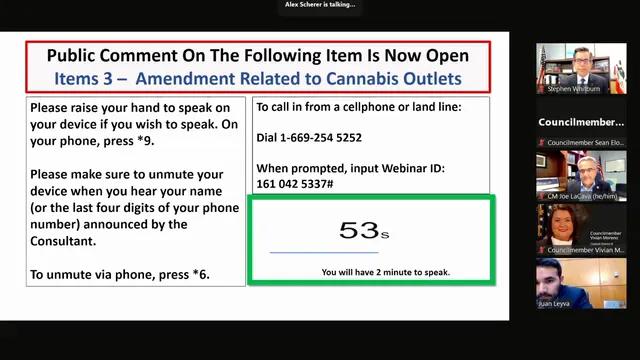
The Land Use and Housing Committee met via Zoom on Thursday, December 9, 2021, at 1:00 PM. Chaired by Council President Pro Tem Stephen Whitburn, the committee considered three items: a consent agenda item on a joint use agreement with SDG&E, a discussion item on a lease surrender with the American Institute of Architects, and a major proposal to amend cannabis outlet regulations. After extensive public testimony and committee debate, the cannabis amendments were continued to the February 2022 meeting following a lack of a second for approval and a unanimous vote to continue. Consent Calendar - Item 1: Authorization to enter into a joint use agreement with San Diego Gas & Electric Company for use of a portion of public right-of-way known as Eastgate Mall. Approved unanimously (4-0). Public Comments & Testimony - Non‑Agenda Public Comment: Five speakers (Judy Strang, Carol Green, Kathleen Lippett, William Purno, Barbara Gordon) urged postponement of the cannabis item (Item 3), citing lack of public notice, inadequate community input, and the planning commission's earlier request for a delay. Several noted the challenge of remote participation during the pandemic. - Item 2 – Lease Surrender (AIA): No public speakers. - Item 3 – Cannabis Amendments: 14 speakers addressed the committee. Opponents (including Carol Green, Dawn Kamale, Becky Rapp, Kelly McCormick, Francine Maxwell of NAACP, Lisa Bridges, Judy Strang, Kathleen Lippett, Terri Ann Skelly, and Dr. Lynn Silver) argued that the proposed changes would weaken protections for youth, churches, parks, and residential areas; that the process lacked community outreach; and that the state guidelines are minimums, not ceilings. Supporters (including Alex Schrader, Summer Bales of the Chamber of Commerce, Virginia Casey of Blue Water Government Affairs, Lisa Cohen of SDRC 21 Plus, and attorney Jessica McElfresh) stressed alignment with state law, fairness for businesses affected by redistricting, and the need to unlock the remaining 10 of 36 allowed permits. They also cited over $25 million in annual tax revenue from current outlets. Discussion Items - Item 2 – Lease Surrender with American Institute of Architects: Staff presented a request to terminate the lease for the former Downtown Johnny Brown's site at 1220 Third Avenue. The AIA, a tenant in good standing, asked to exit due to fundraising challenges and the pandemic. Councilmember LaCava raised a question about the Surplus Land Act; staff clarified that any lease over 5,000 sq ft and three years would require a disposition process. The item was approved unanimously. - Item 3 – Amendments Related to Cannabis Outlets: Jacob O'Neill (District 3 policy director) presented the proposal to align city regulations with state law. Key changes included: - Expanding operating hours from 7 AM–9 PM to 6 AM–10 PM daily. - Reducing the list of sensitive uses from 11 (including parks, churches, libraries, residential zones) to three (schools, daycare centers, youth centers). - Reducing the distance requirement from 1,000 ft to 600 ft for those three uses, measured property‑line‑to‑property‑line (instead of topographically). - Codifying that existing outlets redistricted into a new district with a full cap may continue operating, and allowing amendments to their CUPs without considering district changes. - The planning commission had continued the item to February 3, 2022 for community outreach and a hearing before the Community Planners Committee. Committee members LaCava and Moreno expressed concerns about insufficient public engagement, and President Ilo Rivera noted the pending social equity assessment (target completion: end of 2022). - Councilmember LaCava asked the City Attorney to clarify the effective date of redistricting; the City Attorney confirmed that new boundaries take effect November 2022, removing the claimed urgency. - Chair Whitburn moved to approve the staff recommendation, but no second was offered. Councilmember LaCava then moved to continue the item to the February 2022 Land Use and Housing Committee meeting; the motion was seconded and passed unanimously (4-0). Key Outcomes - Consent Item: Approved unanimously (4-0). - Item 2: Lease surrender and termination agreement with AIA approved unanimously (4-0). - Item 3 (Cannabis Amendments): The committee voted unanimously (4-0) to continue the item to the Land Use and Housing Committee meeting scheduled for February 2022. The next consideration will occur at the San Diego Planning Commission on February 3, 2022. - The committee approved minutes from November 3, 2021, unanimously.
Public Meetings - San Diego, California
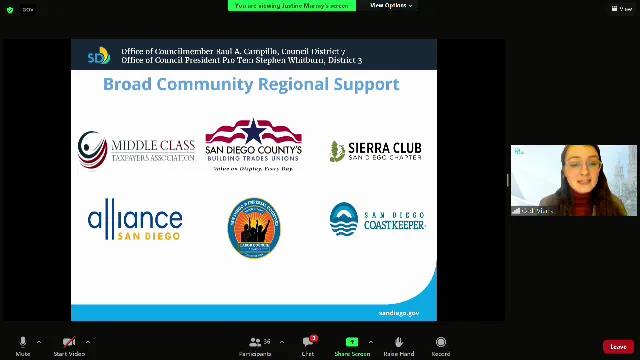
Public Meetings - San Diego, CaliforniaOn December 8, 2021, the San Diego City Council Rules Committee held a virtual meeting (via Zoom) to conduct the second review of a proposed ballot measure for the November 2022 general election. The measure, called “Safeguard San Diego,” would amend the city’s contracting policies to repeal the 2012 ban on project labor agreements (PLAs) and bring the city into compliance with state law. After a brief recess to resolve technical issues, the committee heard a staff presentation, 11 public comments (mostly in support), and debated the item before voting 4–1 to forward the measure to the full City Council. The meeting also included non-agenda public comment. Consent Calendar - Approval of October 27, 2021 Committee Actions: The committee voted unanimously (5–0) to approve the minutes from the previous meeting. Public Comments & Testimony - Nephi Hancock (retired electrician, IBEW 569) – Expressed full support, calling the existing ban an “injustice” that puts communities at risk of losing infrastructure funds and local jobs. - Lori Saldano (retired AFT teacher, former union carpenter) – Supported the measure but urged the city to review equal opportunity goals, noting that women and people of color are often left behind in construction trades. She called for inclusive PLAs with firm diversity requirements. - Matthew Laba Gonzalez (San Diego Building Construction Trades Council) – Stated it is imperative to remove the PLA ban to comply with state law and avoid losing state infrastructure funding. - Javier Alvarado (San Diego Laborers Union Local 89) – Supported the measure, urging protection of taxpayers and workers. - Gretchen Newsom (IBEW 569) – Urged full support, highlighting that the measure restores the city’s ability to use PLAs for local hiring, adds public disclosure, accountability, and oversight. She also noted the importance of recruiting more women into the trades. - Hector Meza (new journeyman electrician, IBEW 569) – Supported the measure, stating it means more quality work opportunities for local workers and the ability to mentor apprentices. - Carol Kim (Business Manager, San Diego County Building and Construction Trades Council) – Argued that the city’s outdated contracting rules risk losing millions in state funding ($64 million in 2019, tens of millions in 2020). She emphasized that the measure includes taxpayer accountability tools, a citizens oversight board, and non-discrimination clauses. She refuted claims that PLAs discriminate against women or people of color, stating that overturning the status quo is the best way to create equity. - Jennifer Wilson (Navy veteran, electrician, IBEW 569) – Supported the measure, stating it is urgently needed to protect San Diego’s share of state infrastructure funding. - Christina Marquez (IBEW 569 apprenticeship graduate, environmental organizer) – Supported the measure, noting that unions ensure equal pay for women. She invited Lori Saldano to attend a women’s committee meeting. - Sean Kioni Ellis (Political Organizer, United Association Local 230) – Strongly supported the measure, stating unions built the middle class and that PLAs uplift vulnerable communities. He argued that opposition means wanting to keep more money in their own pockets. - Calvin Barrios (Director of Government Affairs, Laborers Local 89) – Supported the measure, quoting the presentation’s provisions for local hiring, apprenticeship opportunities, and equitable access for women and minority-owned firms. - Adam Paraies (Marine Corps veteran, United Association Local 230) – Supported the measure, citing his personal experience with PLAs providing a living wage for his family. He called for the measure to preserve state funding for neighborhoods, roads, and jobs. - Eddie Spreco (AGC San Diego chapter) – Opposed the measure, calling the premise that funding is at risk a “bold face lie.” He argued that the city council is siding with powerful special interests (building trades) and that the measure would overturn a citizen’s initiative. He urged a “no” vote. - Richard Marcusen (Western Electrical Contractors Association) – Opposed the measure, stating that the risk of lost state funding was created by the state building trades council in response to voter‑approved Measure A. He argued that Measure A already includes escape clauses for state/federal funds and that the measure is unnecessary and would overturn voter decisions. - Derek Phillips (Field Rep, Laborers Union) – Supported the measure, urging protection of taxpayers and workers and putting the measure on the ballot for voters to decide. Discussion Items - Presentation by Councilmember Campillo and Staff: - Councilmember Raul Campillo (Vice Chair) introduced the item, explaining that the ballot measure would repeal the 2012 ban on project labor agreements (PLAs) and update contracting policies to comply with state law (SB 922 and SB 829). He argued that PLAs protect taxpayers, eliminate costly delays, and promote local jobs. He noted that the state has a large surplus and that San Diego risks losing millions in infrastructure funding if it does not act. - Justine Murray (Chief of Policy for Councilmember Campillo) and Cody Vieira (Deputy Chief of Staff for Council President Pro Tem Whitburn) presented details: The city received $64 million from the state in 2009 but could have received more if policies were updated. The Pure Water Project nearly lost $140 million in state funding and required special state legislation. Other major California cities (Los Angeles, San Jose, San Francisco) allow PLAs. The measure includes priority local hiring, apprenticeship opportunities, a citizens oversight board, expanded public disclosure, stricter audits, and best value contracting. - Cody Vieira noted that Chula Vista’s Measure E passed with 67.5% support in 2020, and recent polling shows 63% of San Diegans support this policy. - Councilmember Comments: - Councilmember Campillo (mover) – Thanked staff and public speakers. He moved to direct staff to continue working with the city attorney to finalize language and forward the item to the full council for consideration on the November 2022 ballot. He requested a specific section (22.4403) be reverted to original language to better reflect state law. - Council President Pro Tem Whitburn (seconder) – Thanked colleagues and staff. He emphasized that putting the measure on the ballot respects the will of voters, and that the measure will help secure state funding for infrastructure improvements. - Councilmember von Wilpert – Supported the measure, noting that PLAs include worker safety protections, pay equity, and non-discrimination clauses. She cited successful PLAs on the Pure Water Project and the San Diego Airport Terminal One project. She thanked the presenters and public speakers. - Councilmember Chris Kate – Opposed the measure. He argued that there is no actual ban on PLAs (citing the Pure Water PLA), that state laws SB 829 and SB 922 were enacted after Measure A was passed, and that in seven years on the council he has not seen any denial of state funding due to Measure A. He acknowledged the measure is likely headed to the ballot and said he would vote no. - Chair Campbell – Supported the measure, disagreeing with Councilmember Kate. He noted that lawsuits delayed the Pure Water Project and required state intervention, costing the city millions. He argued that the measure helps secure revenue without raising taxes and promotes local jobs. Key Outcomes - Vote on Motion: The committee voted 4–1 to approve the motion to direct staff from Districts 7 and 3 to continue working with the city attorney’s office to finalize the ballot measure language and forward the item to the full City Council for consideration for the November 2022 ballot. - Ayes: Campillo, Whitburn, von Wilpert, Campbell - Noes: Kate - Next Steps: The measure will go to the full City Council for further deliberation before being placed on the November 2022 ballot. Non-Agenda Public Comment - Lori Saldano (retired teacher) – Commented on the city’s equal opportunity hiring, citing a recent economic development committee report showing that women and people of color are underrepresented in technical and innovation work, including the Pure Water Program. She urged the city to add equity components to any hiring agreements and fund additional staff to review equal opportunity guidelines. The meeting adjourned at approximately 3:30 PM.
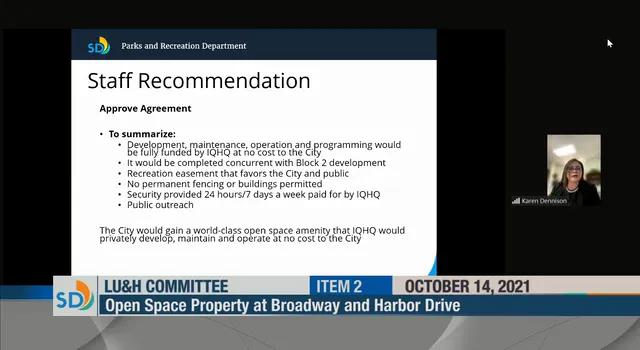
The Land Use and Housing Committee of the San Diego City Council met on November 30, 2021, to consider several agenda items, including a consent item and a major discussion item regarding a public-private partnership for a downtown open space. The meeting was conducted via teleconference due to public health concerns. Items 3-5 were returned to staff for further analysis. Consent Calendar - Item 1: Authorization to grant San Diego Gas & Electric Company a gas pipeline easement on city-owned property for the San Diego Regional Airport Authority project was approved unanimously via consent agenda, with no public comment. Public Comments & Testimony - Non-agenda public comment: Three speakers addressed the committee. - Becky Repp expressed concern about marijuana businesses, urging the city to require annual background checks for all employees and to allocate collected fees to education and prevention. She cited a recent Chula Vista fee implementation. - Carol Green (speaking as an individual, not as PTA) shared her personal experience with her son’s cannabis-induced psychiatric disorders and read from a Chula Vista resolution showing that licensing costs exceeded anticipated revenues, suggesting San Diego conduct a cost-benefit analysis. - Jan Hitzman (President, Friends of the College Rolando Library) raised a land use issue in District 9, stating the library lost control of its driveway and parking due to a prior land deal. She requested the city secure a permanent easement before an upcoming plan amendment and zoning change, urging Councilmember Elo Rivera to act. - Jeff Heuter (Chair, Neighbors for a Better San Diego) criticized the city’s ADU ordinance, especially density bonuses in transit priority areas, arguing they incentivize investor speculation and increase car dependency. He noted Councilmember Elo Rivera’s proposed changes were insufficient and called for a full hearing. He also raised concerns about SB9 potentially allowing unlimited ADUs on single-family lots. - Item 2 public comment: None. Discussion Items - Item 2: Easement Use and Maintenance Agreement with IQHQ for Block A1 - Staff presented a proposal to enter into a long-term agreement (until May 31, 2117) with IQHQ regarding the 1.5-acre open space parcel known as Block A1, located at the southeast corner of Broadway and Harbor Drive. The parcel sits atop an underground parking garage with over 2,000 public spaces. The agreement includes: - A public access easement. - IQHQ will develop, maintain, and program the park at no cost to the city, including security 24/7. - The park will be open daily from 6 a.m. to 10 p.m., designed for passive recreation, with space for events, concerts, and other activities. IQHQ will retain a private operator to manage permits and collect fees for park maintenance. - If the city were to develop the park itself, construction costs were estimated at $5-7 million and annual maintenance at over $100,000 (excluding security and enhanced services). - Councilmember Whitburn (in whose district the site is located) strongly supported the project, noting it provides a valuable asset the city could not otherwise afford. Councilmember LaCava praised the public-private partnership, highlighting amenities like restroom access and public parking. Councilmember Moreno also supported the project, noting the city gains a park without incurring typical costs. Vice Chair Elo Rivera expressed support but lamented that the city had to relinquish rights to achieve such a space, urging the city to build capacity to undertake such projects independently. - The committee voted unanimously to approve the staff recommendation. Key Outcomes - Consent agenda item 1: Approved unanimously. - Item 2: Approved unanimously. The agreement will go before the full City Council on October 25, 2021 (note: date discrepancy with meeting date of November 30, 2021 per instruction). IQHQ committed to a public workshop within 90 days of the effective date, and targeted construction completion by Q3 2023. - Items 3-5: Returned to staff for further analysis (not heard). - The meeting adjourned at 12:30 p.m. (approximate). The next committee meeting was scheduled for Wednesday, November 3, 2021 at 2:00 p.m.
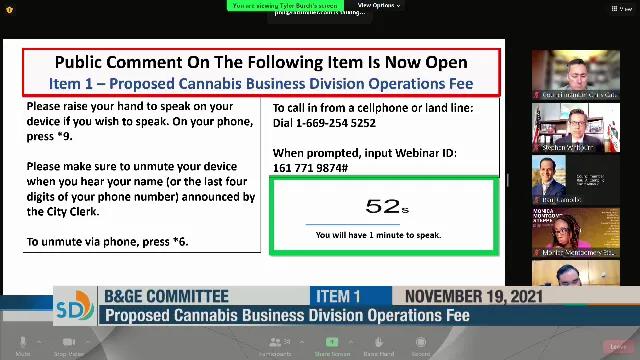
The Budget and Government Efficiency Committee met on November 19, 2021, to review three budget-related informational items and one action item on cannabis fees. Presentations covered the first quarter FY2022 budget monitoring report, the five-year financial outlooks for the general fund and public utilities, and a proposed annual operating fee for cannabis businesses. The committee heard public testimony and voted 3–1 to approve the cannabis fee. Public Comments & Testimony - Item 2 (First Quarter Report): Judy Strang urged the committee to preserve quality-of-life services such as weed abatement, pothole repairs, sidewalk upgrades, street resurfacing, tree maintenance, and increased garbage collection at parks and beaches, warning that those items might lose funding due to projected deficits. - Item 1 (Cannabis Fee): Multiple industry representatives (Cynthia Morgan Reed, Dave Barmore, Phil Rath, Jessica McElfresh, Rocky Goyle) opposed the proposed fee, arguing that it was too high, that enforcement should target the illegal market instead of legal operators, and that the city should use Measure N tax revenue to fund the Cannabis Business Division. Some requested the fee be applied only to operating businesses. Community member Becky Rapp expressed concern about public health and safety, while Kathleen Lippett criticized the industry's tax treatment and impact on neighborhoods. Judy Strang supported full cost recovery but noted the fee should not be charged to non-operating permit holders. - Items 3 and 4: No public comments were received. Discussion Items First Quarter FY2022 Budget Monitoring Report - Staff from the Department of Finance (Chris Purcell) presented the report based on three months of actual activity. Major general fund revenues are projected to exceed budget by \$18.3 million by year-end. - Revenue highlights: Sales tax is \$11 million over budget due to continued pandemic recovery; transient occupancy tax (TOT) is \$17.5 million over budget due to accelerated tourism recovery; property tax is \$10.2 million under budget (primarily due to lower CPI and reduced motor vehicle license fee payments). - Expenditure updates: Police overtime is projected at \$19.4 million, an increase of \$5 million over the adopted budget, driven by a 20% increase in calls for service, rise in violent crime, and staffing shortages. Fire rescue overtime is projected at \$5.9 million over budget due to backfill for COVID-19 and delayed academies. The department anticipates offsetting savings and FEMA reimbursements. - The report noted uncertainties: potential COVID-19 impacts, federal infrastructure investments, inflation, and winter travel patterns. The mid-year report is due January 28, 2022. FY2023–2027 Five-Year Financial Outlook (General Fund) - Department of Finance (Rolando Charbel, Nikki Chelfon) presented the outlook, which serves as the starting point for the FY2023 budget process. - Baseline projections: A shortfall of \$66.8 million in FY2023, with continued deficits in FY2024 and FY2025, but a surplus projected in FY2026 and FY2027. Revenues are expected to reach pre-pandemic levels by FY2023; TOT is expected to fully recover by FY2024. - Funding sources: Remaining American Rescue Plan Act (ARPA) funds of \$150.4 million and \$26.7 million in excess equity are available to cover shortfalls through FY2025. - Expenditure assumptions: Salary increases of 3.05% for non-negotiated units are included for the first time; reserve contributions resume to reach policy targets by FY2025. - Above-baseline needs: New facilities (libraries, fire stations, parks), compliance requirements (stormwater, SB 1383 organic recycling), and service-level improvements identified through the Get It Done app (e.g., pothole repairs, weed abatement, sidewalk maintenance). The IBA noted that over 500 new positions are implied by these service goals, but added that high vacancy rates must be addressed first. Public Utilities FY2023–2027 Five-Year Financial Outlook - Public Utilities Department (Shauna Lawrence, Adam Jones) presented outlooks for water and wastewater systems. - Water system: The outlook assumes a 0.75% annual rate increase starting April 1, 2023, due to delays from the PASS court decision. Wholesale water purchases from the San Diego County Water Authority (CWA) are the largest expense (46% of operating expenditures). The outlook takes a conservative mid-point between CWA’s high (2.6%–11.3%) and low scenarios. Pure Water Phase 1 is expected to come online in FY2025, reducing purchased water volume by 17,000 acre-feet, but debt service for loans (WIFIA/SRF) rises significantly that year. - Wastewater system: The outlook aligns with rate increases approved in September 2021; additional increases may be needed in calendar years 2026–2027. Funding is included for erosion monitoring at Point Loma Wastewater Treatment Plant and for deferred maintenance. - A $3 million facilities master plan is underway to address decades of deferred maintenance; results are not yet incorporated into the outlook. Proposed Cannabis Business Division Operations Fee - Development Services Department (PJ FitchCherald) proposed an annual cannabis operating permit fee of \$20,191 per facility (reduced from an initial \$28,000 after stakeholder feedback) to fully recover costs of the Cannabis Business Division (CBD). The fee would apply to all 66 conditional use permit (CUP) holders (26 retail outlets and 40 production facilities). The CBD currently has seven budgeted positions, but only five will be filled; the fee covers those five positions. - The fee is authorized under San Diego Municipal Code §42.1506. The city plans a comprehensive fee study that may adjust the fee later. - Industry representatives opposed the fee, arguing the city should use Measure N tax revenue (estimated at \$21 million in FY2021) to fund CBD operations, and that the fee should only apply to operating businesses. Community members supported cost recovery but wanted enforcement against illegal operators. Key Outcomes - Item 1 (Cannabis Fee): The committee voted 3–1 to recommend City Council approval of the proposed annual fee of \$20,191 per facility. Voting in favor: Vice Chair Whitburn, Councilmember Montgomery Steppe, Councilmember Campillo. Voting against: Chair Kate. The motion included an amendment proposed by Vice Chair Whitburn (no change to the fee). - Items 2, 3, and 4: These were informational items only; no action was taken. The Independent Budget Analyst announced it will release detailed analyses of the reports in early December before they go to full City Council. - The next Budget Committee meeting is scheduled for December 8, 2021, at 9 a.m.
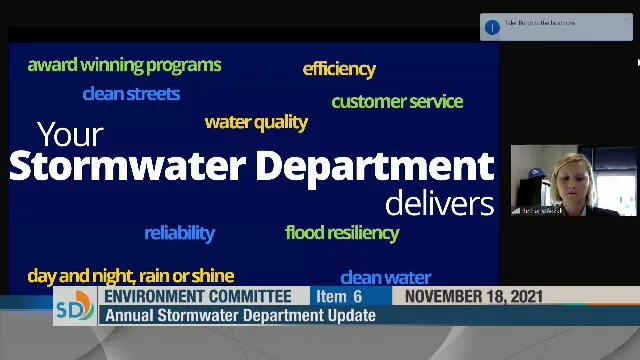
The San Diego City Council Environment Committee met virtually on November 18, 2021, via Zoom in accordance with California Government Code Section 54953(g) (Assembly Bill 361). Chair Elo Rivera presided, joined by Vice Chair Marni Von Wilpert and Councilmember Raul Campillo (listed as "Lakava" in transcript). Councilmember Chris Kate was absent. The committee approved the consent agenda, approved the Climate Resilient SD plan, and received informational updates on the Climate Action Plan, stormwater, and golf operations. Consent Calendar - The committee approved its actions from October 21, 2021, by a unanimous 3-0 vote, with Councilmember Kate absent. - The consent agenda (items 1, 2, and 3) was approved unanimously 3-0. Item 3 was a $250,000 contract amendment for legal services supporting the San Vicente Energy Storage Facility at FERC. Vice Chair Von Wilpert noted the contract had lapsed in February 2021 and asked how much had already been spent; Deputy City Attorney Ray Palmucci said approximately $100,000 had been spent, leaving $150,000 for ongoing litigation. Councilmembers Von Wilpert and Campillo requested a future committee briefing on the project, but did not pull the item. Public Comments & Testimony - Non-agenda public comment: Lori Saldaña raised concerns about power washing with disinfectants in downtown San Diego, lack of public restrooms, and potential storm drain/water quality impacts. Jay Powell, Craig Rose, and Jerry Wanatec urged the committee to docket a resolution creating a public power study citizens task force, with Council oversight of the $1 million feasibility study. - Consent agenda (item 3): Diane Conklin of the Mussey Grade Road Alliance opposed the San Vicente Energy Storage Facility, stating it would industrialize preserved lands and set a bad precedent. Lori Saldaña also opposed it, citing environmental justice and equity concerns, including lack of diversity at the contracted law firm. - Climate Resilient SD (item 4): Speakers generally supported the plan but asked for stronger implementation details and tree protections. Paul Kruger asked for tree replacement requirements for ADUs; Brenda Garcia Milan (Climate Action Campaign) said the plan lacked a detailed implementation plan, costs, timeline, and an equity strategy; Ann Feige (Community Forest Advisory Board) noted the city had removed as many trees as it planted; Michael Wynne called it a framework rather than a plan; Suzanne Hume (CleanEarth4Kids.org) supported the plan and urged funding nature-based solutions. - Climate Action Plan update (item 5): Kyle Hastel (Environmental Health Coalition) praised the clean air section but urged specific air pollution reduction goals; Harold Standifer (San Diego Building Electrification Coalition) supported building electrification; Jay Powell asked for municipal solar and reactivation of the Sustainable Energy Advisory Board; Paul Krueger asked for developer tree replacement requirements; Lori Saldaña suggested student climate contests; Ann Feige called the tree canopy goals unachievable; Malika Morrison (Climate Action Campaign) asked about funding, a 2025 benchmark, and legal enforceability; Karina Gonzalez (Hammond Climate Solutions) urged faster timelines and full environmental review. - Stormwater items (6 & 7): Victor Avina (Falcon Strategies, representing Biomed Realty) thanked staff for channel maintenance; Jenna Harrison (San Diego County Taxpayers Association) requested historical data on funding; Jack Monger (Industrial Environmental Association) requested financial impact analysis for commercial/industrial properties; Bertha Rodriguez (Climate Action Campaign) supported a 2022 funding measure with green infrastructure and good jobs; Lucero Sanchez (San Diego Coastkeeper) urged the committee to push for a November 2022 ballot measure. - Golf division (item 8): No public speakers. Discussion Items - Item 4: Climate Resilient SD and General Plan Amendments - Planning staff presented the city's first climate adaptation and resiliency plan, required by Senate Bill 379 by January 1, 2022. The plan addresses wildfire, sea level rise, extreme heat, and variable precipitation, and includes 86 potential strategies. Staff announced the city would receive National Coastal Resilience Fund money for a coastal resilience master plan. Councilmember Von Wilpert asked for wildfire resiliency actions to be moved to a "near and ongoing" timeframe; Councilmember Campillo asked about implementation leadership and funding. Chair Elo Rivera raised concern about sea level rise potentially exposing toxic groundwater contamination in industrialized areas like Barrio Logan. The committee voted unanimously 3-0 to approve the plan, with the expectation that contamination issues would be acknowledged in the package sent to full Council. - Item 5: Climate Action Plan Update (Informational) - Staff presented the draft update, which sets a net zero greenhouse gas emissions target for 2035 and a 2030 interim fair-share goal. More than 3,300 people participated in engagement; the plan uses the Climact Prio prioritization tool. Key strategies include decarbonizing buildings, 100% renewable energy through San Diego Community Power, transportation mode shift, circular economy, resilient infrastructure, and emerging actions. IBA's Jordan Moore noted a 2018 IBA recommendation for a CAP funding outlook was never produced. Alyssa Muda, Director of Sustainability and Mobility, said an implementation plan framework and staffing analysis would be available in early 2022. Chair Elo Rivera stressed that housing policy is climate policy and that the city needs additional revenue. No vote was taken. - Item 6: Annual Stormwater Department Update (Informational) - Staff reported the city received only 4 inches of rain in 2021 versus a typical 10 inches, and already had three storm events and two emergency channel maintenance actions. The department faces a $65 million shortfall in proactive projects, has over 2,000 known pipe failure locations, three failing pump stations, and $16 million in unfunded levee deficiencies. Stormwater funding covers less than one-third of annual needs. No vote was taken. - Item 7: Stormwater Funding Strategy Implementation Update (Informational) - Staff recommended a special parcel tax based on impervious surface area, with rates of 4.5 to 5 cents per square foot tested in surveys. Approximately 45% of estimated revenue would come from single-family properties. The plan includes exemptions, discounts, credits, citizen oversight, and potential WIFIA loans exceeding $600 million. Next step is a final recommendation to City Council in early 2022. No vote was taken. - Item 8: Golf Division Business Plan Update (Informational) - Customer satisfaction ranged from 95% to 98%. In FY21, rounds increased significantly due to COVID-19, with Balboa Park's 9-hole course up 79% and Mission Bay up 54% to 102,000 rounds. Expenditures rose 9% ($1.7 million) since FY19. The division invested $18.5 million in capital improvements. Fees will increase January 1, 2022: 3% for residents and 5% for non-residents. The Farmers Insurance Open is scheduled January 26-29, 2022. Staff noted water-efficient irrigation systems, state-licensed superintendents, and a transition to electric equipment. No vote was taken. Key Outcomes - Approved October 21, 2021 committee actions unanimously (3-0). - Approved consent agenda items 1, 2, and 3 unanimously (3-0). - Approved Climate Resilient SD and associated general plan amendments unanimously (3-0), with a commitment to address sea level rise-related contamination concerns and revisit wildfire action timelines. - Directed staff to provide a future briefing on the San Vicente Energy Storage Facility legal services contract. - The Climate Action Plan, stormwater updates, stormwater funding strategy, and golf business plan were informational only; no votes were taken. - Committee adjourned to its next meeting in January 2022.
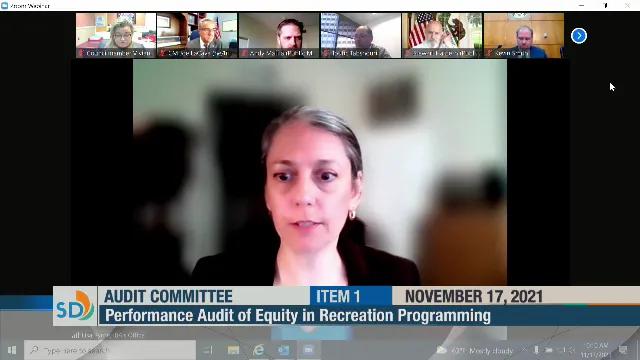
On November 17, 2021, the San Diego City Audit Committee met virtually via Zoom to discuss a performance audit of equity in recreational programming, review the quarterly fraud hotline activity report, and receive the city auditor's monthly activity report. The committee approved the previous meeting's minutes and unanimously voted to accept the equity audit report and forward it to the City Council, with an amendment to also refer it to the Public Safety and Livable Neighborhoods (PSNLN) Committee. Consent Calendar - The committee unanimously approved the committee action minutes of October 27, 2021, with Vice Chair Lakava, Committee Members Halpern, Tapsri, and Mafia voting yes. Public Comments & Testimony - Non-agenda public comment: No speakers. - Item IA (Equity Audit): One public speaker, Francine Maxwell, Canal Recreation Advisory Member, expressed support for the audit and highlighted the need for education and training on the Parks Master Plan, concerns about nepotism and racism in promotions, and the importance of community advocacy for equitable recreation. Discussion Items Item IA: Performance Audit of Equity in Recreational Programming - City Auditor Andy Henous presented the audit, which found significant inequities in recreation programming funding, availability, and access between northern (Community Parks 1) and southern (Community Parks 2) areas of San Diego. Key findings included: - Recreation centers in CP1 received 47% more funding on average than those in CP2. - CP1 had twice as many programs and participants as CP2, driven by contracted programs. - 55% of San Diego residents were unaware of available programs (vs. 24% national average). - Fee waivers were limited to two programs and required burdensome applications. - Language access was inadequate, with only 3 of 18 recreation centers in high-LEP areas offering Spanish program guides. - The audit made 16 recommendations, including: 1. Conduct a community needs assessment every five years. 2. Develop a strategic plan for recreational equity. 3. Implement a resource allocation model. 4. Measure program quality. 5. Hire a marketing professional. 6. Expand fee waivers and language access. 7. Improve data accuracy in ActiveNet. - Parks and Recreation Director Andy Field agreed to all recommendations, contingent on sufficient resources. - Deputy Director of Policy Matt Yagiagan expressed the mayor's commitment to equity and highlighted related initiatives (e.g., Parks for All of Us, Parks Master Plan). - Council members (Moreno, Lakava, Halpern, Tapsri, Mafia) commented on the gravity of the disparities, praised the audit, and urged faster implementation. Chair Moreno moved to accept the report, forward it to City Council, and request that staffing/consulting costs be considered in the mid-year budget, with updated implementation timelines after FY23 budget passage. Vice Chair Lakava seconded, and an amendment to also send the audit to PSNLN was accepted. Item II: Quarterly Fraud Hotline Activity Report – FY22 Q1 - Senior Fraud Investigator Andy Harita reported 53 fraud hotline reports received in Q1. 36 were within purview (6 assigned to city auditor, 30 to departments). 33 cases were closed, leaving 56 open. Six substantiated allegations led to corrective actions (e.g., medical leave fraud, code violations, theft). One city auditor investigation and four department investigations resulted in corrective actions. - Committee members discussed advertising of the hotline and noted that most reports are anonymous; media coverage drives public awareness. The committee accepted the report unanimously. Item III: City Auditor's Monthly Activity Report - City Auditor Andy Henous summarized the office's pending and completed audits: two reports in writing (fiscal sustainability and lease holdovers), two in fieldwork (body cameras and workers' comp), one in planning (fire rescue IT), and eight not yet started. Five reports with 33 recommendations have been issued in FY22. The item was informational. Item IV: Closed Session – Public Employment Performance Evaluation (City Auditor) - No public comments. The committee adjourned into closed session. Key Outcomes - Motion on Item IA: The committee unanimously voted (5-0) to accept the performance audit of equity in recreational programming, forward it to the City Council, request consideration of resources in the mid-year budget, and send it to PSNLN. Implementation target dates will be updated after FY23 budget passage. - Motion on Item II: The committee unanimously accepted the quarterly fraud hotline activity report. - Next meeting: Scheduled for Wednesday, January 26, 2022, at 9:00 a.m.
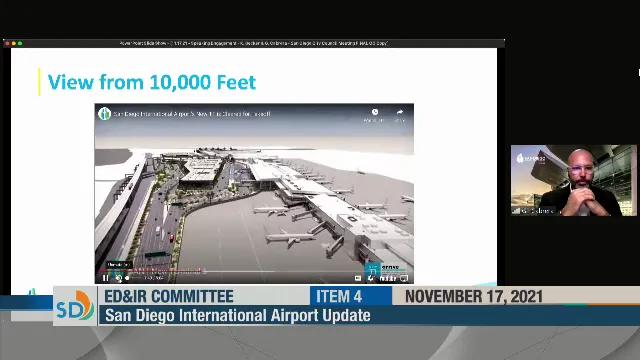
The Economic Development and Intergovernmental Relations Committee met virtually on November 17, 2021, with Chair Campillo presiding, Vice Chair Kate, Councilmember Moreno, and Councilmember Ilo Rivera present. The meeting included informational updates on the San Diego Promise Zone, Port of San Diego, San Diego International Airport, and the first round of the Affordable Housing Notice of Funding Availability (NOFA), as well as a vote on a proposed reduction to the cannabis production facility tax rate. Public comment was heard on several items. Consent Calendar - Approval of October 20, 2021 Committee Actions: Motion by Councilmember Ilo Rivera, second by Vice Chair Kate. Passed unanimously (4-0). Public Comments & Testimony - Promise Zone Update: Wanda Rogers (Jacobs Center) asked how to be recognized as a partner; Kathleen Leppett criticized the city for prioritizing marijuana businesses over community needs. - Cannabis Tax Reduction: 21 speakers total. Supporters included Summer Bales (San Diego Regional Chamber of Commerce), Spencer Andrews (March and Ash), Rob Howard (Columbia Care), Roger Tower (cannabis real estate consultant), Chris Boudreau (Cannabis Chamber of Commerce), Terry Best (Americans for Safe Access), Miklos Campuzano (CREC), Lisa Cohen (SDRC Cannabis 21 Plus), Adam Hijazi (Long Beach Collective Association), Lance Rogers (attorney), Rocky Goyal (retailer), David Dalal (Tory Holistics), Phil Rath (United Medical Marijuana Coalition), Aaron Magagana (High Key Cannabis), Brittany Biesterfeld (Austin Legal Group), Daniel (operator), and Virginia Casey (Blue Water Government Affairs). Opponents included Kathleen Lippitt, Kelly McCormick, Judy Strang (parent advocate), and Barbara Gordon. - Port of San Diego Update: Lori Saldania urged electrification (cold ironing) and public restrooms. - Airport Update: Lori Saldania asked about women-owned business contracting opportunities. - Affordable Housing NOFA: Lori Saldania questioned why the city is not more aggressively pursuing Project Homekey funds. Discussion Items - San Diego Promise Zone Update: Presented by C O Mali Crespo (Promise Zone Program Manager). The federal designation covers 6.4 square miles in Barrio Logan, Logan Heights, Southeastern San Diego, and parts of East Village. Key achievements include expedited permitting, a new data website, and nearly $50 million in grants to partners. A five-year partnership with California Coast Credit Union provides $60,000 annually for small grants. Councilmembers discussed interaction with Opportunity Zones, federal administration changes, and capacity building for underserved neighborhoods. - Cannabis Tax Reduction Proposal: Presented by Justine Murray (Chief of Policy, District 7). Proposed reducing the cannabis production facility (CPF) tax from 8% to 2% to improve competitiveness, citing that only 19 of 40 permitted CPFs operate. The Office of the Independent Budget Analyst (Jordan Moore) requested additional fiscal impact information before full council consideration. After public testimony and committee discussion, a motion to recommend the ordinance to the full council passed unanimously (4-0), with the request for further IBA analysis. - Port of San Diego Update: Presented by Board Chair Michael Zuquet and Commissioner Rafael Castellanos. Highlights: about $100 million in federal stimulus allocated to deferred maintenance and electrification projects (including a $14 million electric mobile harbor crane at 10th Avenue Marine Terminal); the new Maritime Clean Air Strategy aiming for 100% electrification of cargo truck trips by 2030; Harbor Drive 2.0 corridor improvements; recovery of cruise business (100 calls scheduled); and the new Bayside Performance Park. Councilmember Moreno commended the clean air strategy for its environmental justice focus. Councilmembers asked about Harbor Island development and Seaport Village redevelopment timelines. - San Diego International Airport Update: Presented by CEO Kim Becker and Board Chair Gil Cabrera. Passenger volume recovered to 75% of pre-COVID levels, with 17 new routes added in 2021. The new Terminal 1 project (30 gates, 5,600 parking spaces) began construction November 1, 2021, with Phase 1 opening targeted for Q2 2025. Economic impact: $12 billion regionally; 15,000-20,000 construction jobs. Concession outreach will prioritize local, small, and veteran-owned businesses. Councilmembers discussed international route expansion, concession timeline, and sustainability. - Affordable Housing NOFA Round One Update: Presented by Monica Hardman (Deputy Director, Economic Development). Seven projects recommended for funding, creating or rehabbing 662 units across Council Districts 3, 5, 8, and 9. Funding sources: Low Mod Income Housing Asset Fund, Permanent Local Housing Allocation (PLHA), and CDBG. The next NOFA round (Q1 2022) will have $15-20 million. Councilmember Ilo Rivera requested that future criteria include affirmatively furthering fair housing (de-segregation). Key Outcomes - Approved consent calendar (unanimous). - Voted unanimously to recommend the cannabis tax reduction ordinance (8% to 2% for CPFs) to the full City Council, with a request for additional fiscal analysis from the IBA. - Received informational updates on the Promise Zone, Port of San Diego, Airport, and Affordable Housing NOFA; no votes required. - Meeting adjourned; next meeting tentatively scheduled for Wednesday, January 12, 2022, at 2:00 PM.
The Public Safety and Livable Neighborhoods Committee met virtually on November 10, 2021, at 17:00 UTC. The meeting was called to order by Chair Montgomery Steppe, with Vice Chair Campio and Member Whitburn present. The committee discussed four agenda items: adoption of the 2019 California Fire Code, the Age-Friendly San Diego Action Plan, and two information items regarding housing and ambulance transition. Public comments were heard on non-agenda topics and on specific items. Consent Calendar - No consent items were presented. Public Comments & Testimony - Non-Agenda Public Comment: Kathy Lippett expressed concerns about marijuana storefronts displacing churches and criticized municipal code changes favoring cannabis operations. - Item 1 (Fire Code): No public speakers. - Item 2 (Age-Friendly Plan): Francine Maxwell urged broader outreach to African American seniors and requested sign-in sheets and Zoom logs to ensure diversity. - Item 3 (Housing Commission Apartments): Francine Maxwell criticized the housing commission for lacking transparency and failing to include African American seniors. Sandy Miskowski shared her positive experience being housed through Father Joe's and urged continued support for permanent supportive housing. - Item 4 (FALC Transition): John Brady recounted past threats of a $1,400 ambulance bill while homeless and urged that such practices not continue. Laura Sadania echoed similar concerns about excessive charges and called for cultural competency training. Francine Maxwell demanded attention to diversity and inclusion in San Diego Fire-Rescue, noting the NAACP was promised a committee that was never formed. Discussion Items - Item 1: Adoption of the 2019 California Fire Code and Associated Municipal Code Repeal and Adoption – Deputy Chief Fire Marshal Tony Tosca presented the routine three-year code update. Assistant Fire Marshal Mark Dossett explained that local amendments address climactic and geological conditions. Vice Chair Campio asked about provisions expanded beyond state code; staff cited continuity and safety. The committee voted unanimously to approve. - Item 2: Age-Friendly San Diego Action Plan – Andy Field (Parks and Recreation), Christy Fenneck, and Lori Clark (SDSU) presented the plan based on community input and policy scans focusing on six key areas: transportation, housing, social participation, etc. Vice Chair Campio and Chair Montgomery Steppe expressed strong support, emphasizing equity and implementation. The committee voted unanimously to approve. - Item 3: San Diego Housing Commission's Kearny Vista and Valley Vista Apartments (Information Only) – Rick Gentry, Jeff Davis, and Lisa Jones provided an update on permanent supportive housing projects. Chair Montgomery Steppe thanked them for transparency. No vote was required. - Item 4: FALC Mobile Health Corporation Transition Status (Information Only) – Chief Colin Stoll and Deputy Chief Jody Pierce reported that 31 of 36 milestones were met, with four more expected before the November 27 go-live. The one remaining milestone involved electronic patient care record deployment. Vice Chair Campio and Member Whitburn expressed confidence in the contractor. No vote was required. Key Outcomes - Item 1: Motion to adopt the 2019 California Fire Code and associated municipal code changes passed unanimously (3-0). - Item 2: Motion to approve the Age-Friendly San Diego Action Plan passed unanimously (3-0). - Item 3: Information received; no action taken. - Item 4: Information received; no action taken.
The Active Transportation and Infrastructure Committee met virtually on November 10, 2021, via Zoom, in accordance with California Government Code Section 54953G. The meeting was streamed on City TV and online. All committee members were present: Vice Chair Lacaba, Committee Member Montgomery Step, and Committee Member Ilo Rivera. The committee unanimously approved all agenda items, including a consent calendar, the Fiscal Year 2022 CIP mid-year budget monitoring report, consolidated CIP budget revisions, ratification of emergency contracts, a design contract amendment, and a construction contract extension. Consent Calendar - Approved the committee actions from October 13, 2021. - Approved the first amendment to the as-needed landscape architectural design consultant agreements with Estrada Land Planning Inc., Schmidt Design Group Inc., and Spurlock Landscape Architects. All votes were unanimous. Public Comments & Testimony - Francine Maxwell spoke on Item 2 (CIP mid-year report), expressing concern that the committee had not adequately educated the community about budget movements, transparency, and equity. She emphasized the need for community training and checks and balances. - Andrew Meyer, Director of Conservation for San Diego Audubon Society and Rewild Mission Bay Program Manager, spoke on Item 3 (Mission Bay Golf Course improvements). He asked for clarification on whether investments in the golf course were for temporary or permanent structures and urged the committee to consider long-term uses for the park. Discussion Items - Item 2: Fiscal Year 2022 CIP Mid-Year Budget Monitoring Report and CIP Budget Revisions – Presented by Rolando Travel (Finance Director) and Karen McGriff. The report consolidated over 60 routine budget adjustments totaling $23.8 million in increases, with no impact on project delivery. The committee approved the report unanimously. - Item 3: Consolidated Budget Revisions to Various FY22 CIP Projects – Presented by Steve Finley and others. Included funding for Mission Bay Golf Course electrical work ($1+ million) and other adjustments. Staff clarified that the golf course improvements were for temporary uses and structures, and that the course operates as an enterprise fund. Approved unanimously. - Item 4: Ratification of 13 Emergency Sole Source Contracts for FY2021 – Presented by James Nagelborg (City Engineer). The contracts were for emergency repairs related to stormwater, sewer, and other infrastructure. Staff noted that only emergency work can be performed under such contracts; no additional non-emergency work is allowed. Approved unanimously. - Item 5: First Amendment to Agreement with RIC Engineering for Stream View Drive Improvements Phase Two – Presented by Nicole. The amendment covered design services with subcontracting participation of 31.3% certified and 12.8% non-certified. Committee members asked about biofiltration and its relation to the Pure Water system; staff clarified it treats stormwater separately. Approved unanimously to forward to the full council without recommendation. - Item 6: Extension of Contract K155716 for University Avenue Pipeline Replacement with Burtec Pipeline Inc. – Presented by Massine. The project faced multiple construction challenges (unforeseen utilities, traffic delays) but was near completion within the original budget contingency. The extension allowed for finishing remaining work. Approved unanimously. Key Outcomes - All six agenda items were approved unanimously by the committee. - Item 5 was forwarded to the full City Council without a recommendation; all other items were approved for implementation. - No items were pulled from the consent calendar. - The committee did not take up any non-agenda public comment beyond the items listed. - The meeting concluded after Item 6.
The Public Safety and Livable Neighborhoods Committee met virtually on November 5, 2021, via Zoom due to the COVID-19 emergency. The committee considered three items: a contract for police helicopter maintenance, the FY21 Urban Area Security Initiative (UASI) grant program, and an informational update on the Falck ambulance transition. Public comments addressed concerns about helicopter oversight, community engagement in grant decisions, and support for the new ambulance service. The committee voted 3-1 to approve the helicopter maintenance contract and unanimously approved the UASI grant program. Public Comments & Testimony - DeAndre Simmons expressed concern about lack of oversight and accountability for spending on helicopter maintenance and urban security grants, requesting more detailed reporting. - Ann Baron questioned where public input is included in creating the UASI grant proposal and asked for clarification on the term "other projects" in the grant scope. - Jesse Jackson McCree (called in after technical difficulties) commented on both previous items, emphasizing the need for an oversight committee including community members. He highlighted the terrorizing impact of helicopter operations in marginalized communities, particularly on children, elderly, and disabled residents, and urged that a portion of spending be dedicated to improving police-community communication and mental/emotional well-being. - Juan Carlos Hernandez (president and CEO of California Southern) expressed strong support for the new Falck ambulance service, citing their resources, experience, and community partnerships. Discussion Items - Police Helicopter Maintenance Contract (Item 1): Staff presented a five-year, $12.5 million contract with Rotorcraft Support Incorporated for maintenance, OEM parts, and mandated overhauls of four Airbus helicopters. Funding is included in annual budgets. Staff also committed to improving communication with area stations about helicopter activities to address community inquiries. Committee members discussed the contract; one member (identified as Vice Chair Campillo) voted no, expressing concerns about noise and community relations, while others voted yes. The motion passed 3-1. - FY21 Urban Area Security Initiative Grant (Item 2): Megan Beale from the Office of Emergency Services presented the $9.16 million grant from DHS/FEMA, passed through Cal OES. Funds support counter-terrorism and all-hazards preparedness across the region, including equipment, training, and exercises for police, fire, and IT departments. The committee reviewed a list of project allocations. Public comment raised concerns about oversight and community participation. A working group has begun holding public Brown Act meetings to increase transparency. The committee unanimously approved the item. - Falck Mobile Health Corporation Transition Update (Item 3): Deputy Chief Jody Pierce and Troy Hagen from Falck provided an informational update on the transition to a new ambulance service provider starting November 27, 2021. Falck reported progress on hiring staff, acquiring fleet, and coordinating with the fire department. Several public speakers expressed support for Falck's community engagement. No action was taken on this information item. Key Outcomes - Approved the police helicopter maintenance contract with Rotorcraft Support Incorporated (3-1). - Approved the FY21 Urban Area Security Initiative grant program (unanimous). - Received the informational update on the Falck ambulance transition; no vote required. - The committee thanked former consultant Chloe Triplett and welcomed new consultant Tiffany Harrison. - The next meeting was scheduled for Wednesday, November 10, 2021.