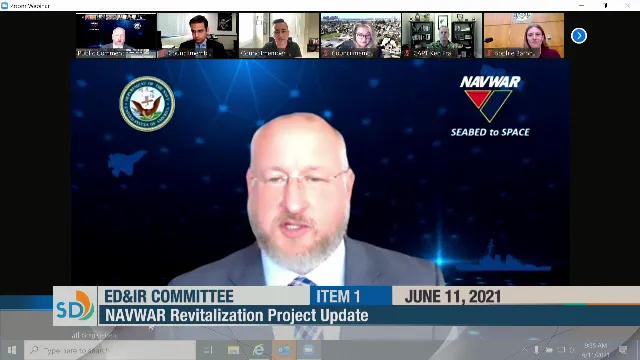
The Economic Development and Intergovernmental Relations Committee of the San Diego City Council met virtually on Friday, June 11, 2021, to receive updates on two major economic drivers: the Naval Information Warfare Systems Command (NAVWAR) site revitalization and the city's cannabis industry. The meeting included presentations from Navy officials and city staff, public testimony, and council member discussion. No formal votes were taken as both items were informational. Consent Calendar - Unanimously approved the committee actions from the meeting of May 26, 2021 (4-0). Public Comments & Testimony - Non-agenda public comment: No speakers. - Item 1 – NAVWAR Revitalization: No public comment. - Item 2 – Cannabis Business in San Diego: Eight speakers testified, all expressing support for the industry and calling for specific policy changes. Key speakers and positions: - Tim Penwell (Columbia Care): Expressed strong support for social equity programs; urged reducing barriers such as high application fees, taxes, and fingerprinting requirements; supported creating new permit categories (delivery, consumption lounges) and lowering taxes on production facilities. - Alex (industry representative): Emphasized that the 8% tax on production facilities is too high, making them uncompetitive; noted that Long Beach and Costa Mesa have 1% rates, and urged reduction to allow local businesses to thrive and generate jobs. - Sabrina Alvarado (High Key Cannabis Outlet, District 9): Supported reducing the 8% tax on production facilities, enforcing existing permits or reallocating unused permits, extending hours of operation (7am-9pm to 6am-10pm), and amending zoning to allow the remaining outlets to open. - Phil Rath (UMMC Inc., trade association): Representing most retail cannabis stores; requested the city advance a Business Improvement District (BID) to pool resources for marketing and moving consumers away from the illicit market (noted unanimous committee support in November 2020 but no action); supported lower taxes on production facilities; raised concerns about redistricting potentially forcing store closures and suggested proactive measures. - Gina Austin (Lee Austin Legal Group): Representing licensed operators; echoed calls for lower production taxes, noting that at 8% San Diego is out of line with jurisdictions like Oceanside (0.5-2.5%) and Vista (2%); requested a mechanism for retail facilities to relocate without losing their entitlement; supported redistricting protections as done in Chula Vista. - Jessica McElfresh (attorney): Supported lower taxes for production facilities; encouraged using Measure N tax revenue for social equity purposes, such as loan funds for equity applicants (citing Fresno as an example); proposed new zoning, reduced distance buffers, and new uses (delivery, lounges); stressed economic benefits beyond tax revenue, including jobs and foot traffic. - Will Sen (Urban Leaf, founder/president): Stated that production facilities contributed only about 10% of Measure N tax revenue; cited examples of San Jose, Costa Mesa, and California City lowering tax rates to 1-2% and seeing increased investment and tax revenue; urged the committee to set competitive rates to attract investment and create thousands of jobs. - Chris Horsley (NineCloud Cannabis, co-founder): Echoed tax concerns; noted excessive security requirements (guards, no signage) for locked facilities; requested review of security measures. Discussion Items - Item 1 – NAVWAR Revitalization Project Update: - Presented by Captain Ken Franklin (Commanding Officer, Naval Base Point Loma) and Greg Geyson (Revitalization Project Manager, NAVWAR). - Objectives: Modernize NAVWAR facilities on the Old Town Campus (70.5 acres, two miles from downtown); replace aging World War II-era buildings; meet national security needs. - Alternatives analyzed in the Draft Environmental Impact Statement (EIS): - Alternative 1: Military construction only (no commercial development, Navy retains all property). - Alternatives 2 & 3: Public-private partnership (P3) with residential development (4,000-6,000 units) and limited commercial; no transit center. - Alternatives 4 & 5: P3 including a transit center (preferred). - Alternative 4 (preferred): Up to 10,000 housing units, 2 million sq ft commercial, 400+ hotel rooms, 400,000+ sq ft retail; best flexibility; tallest building modeled at 350 feet (32 stories). - Economic impact: NAVWAR supports 5,200 jobs, $3.2 billion impact; military overall $33.6 billion direct spending, 300,000+ jobs. - Environmental review: 730-page EIS; 60-day public comment period ends July 13, 2021; public meeting June 23. - Council members expressed strong support (Moreno, Ilo Rivera, Campillo) and asked about housing mix, military housing, ownership (rental vs. for-sale), childcare, parks, and the decision authority (Assistant Secretary of the Navy for Installations and Energy). - Item 2 – Cannabis Business in San Diego: - Presented by Sammy Ma (Development Project Manager, Cannabis Business Division, DSD) and Elise Lowe (Development Services Director). - Current statistics: 36 cannabis outlets allowed citywide (4 per district); Districts 2, 6, 8 at capacity; none in District 5; 40 production facility permits all issued, operating at 30% capacity. - Cannabis tax: 8% of gross receipts, generating $2 million/month for the general fund. - Cannabis Business Division launched November 2020; goals: regulate, enforce, support, and develop equity program. - Equity program: Partnering with Office of Race and Equity; hiring consultant; targeting winter 2021 to present a program to council. Eligible for up to $5 million in state grant funding (first awarded to San Diego in 2021). - Planned regulatory changes: Consider reducing sensitive use buffers, adding new zones, permitting consumption lounges, delivery-only licenses, and special events. - Operational fee: Proposing an annual operating fee on cannabis businesses to cover division costs (modeled after other cities up to $25,000); to be brought to council within 90 days. - Council discussion: Vice Chair Kate noted a previously approved BID (November 2020) had not been implemented; requested staff and mayor's office coordinate. Councilmembers debated tax rates on production facilities: several speakers argued 8% is too high and uncompetitive; Councilmember Ilo Rivera emphasized equity concerns and the need to make licensing accessible to historically impacted communities; suggested exploring employee-owned business models. Councilmember Campillo asked about collaboration with the county (ongoing enforcement with Sheriff's Office, equity program coordination). Key Outcomes - No formal votes or motions on either agenda item; both were informational. - NAVWAR: Council members expressed support for the project, especially the preferred alternative (Alternative 4) including transit-oriented development. They encouraged continued collaboration and urged public participation in the EIS comment period (deadline July 13, 2021). - Cannabis: The committee directed staff to: (1) advance the equity assessment and program development by winter 2021; (2) bring forward proposed annual operating fee within 90 days; (3) provide GIS mapping of potential zoning changes; (4) coordinate with the Mayor’s Office on the previously approved Business Improvement District; (5) consider reducing the 8% tax rate on production facilities as part of policy changes to support equity and competitiveness. - Next committee meeting scheduled for Wednesday, June 23, 2021, at 2 p.m. (third industry review meeting).
Public Meetings - San Diego, California
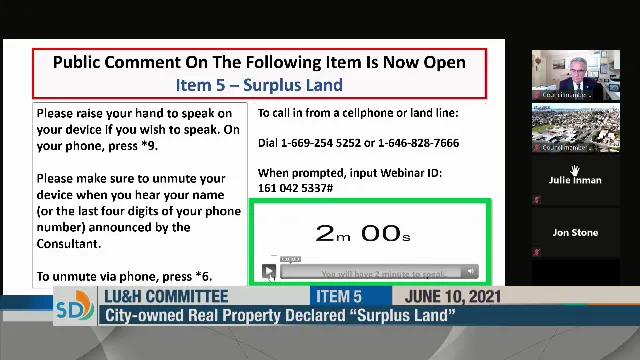
Public Meetings - San Diego, CaliforniaThe Land Use and Housing Committee met on June 10, 2021, at 9:00 AM via Zoom to discuss several items including the approval of consent items, a presentation on the first-time homebuyer program, a declaration of surplus land, and an acquisition of a habitat conservation parcel. The meeting was chaired by Councilmember Stephen Whitburn, with Vice Chair Sean Elo-Rivera, Councilmember Joe LaCava, and Councilmember Vivian Moreno present. Consent Calendar - Unanimously approved committee actions from April 22, 2021. - Approved four consent items: 1. Lease surrender and termination with Lutheran Social Services of Southern California for the Claremont Senior Center (noted due to pandemic closure; staff to explore reopening). 2. Declaration of 3440 Sandrock Road as exempt surplus land for affordable housing development. 3. Acceptance of a recreational public trail easement from Tri-Point Homes in Carmel Valley. 4. Memorandum of Understanding with City of Chula Vista and Tri-Point Homes for annexation of the Nicano property (future discretionary action expected). Public Comments & Testimony Non-Agenda Public Comments (6 speakers): - Barbara Gordon expressed frustration with expanding marijuana businesses, citing problems from existing outlets. Opposed further expansion. - Kelly McCormick (volunteer) highlighted illegal hazardous waste dumping by a permitted marijuana manufacturer, questioning the city’s oversight and enforcement. - Becky Rapp (mother, District 5) opposed reducing sensitive use distances for marijuana (1,000 feet), citing increased teen use and mental health issues. - Sandra Stahl (Executive Director, Montgomery Gibbs Environmental Coalition) requested investigation into airport deputy director for misleading council about unleaded aviation fuel availability. - Madison Coleman (Climate Action Campaign) spoke about rising rents pushing low/middle income households from urban centers (brief). - David Grubb urged raising inclusionary housing requirement from current 2% to 10% immediately. Public Comment on Consent Agenda: None. Public Comment on Item 7 (First-Time Homebuyer Program): None. Public Comment on Item 5 (Surplus Land Declaration): - Matt Wallstrom (Hillcrest) opposed blanket surplus declaration, urging city to consider social housing and require historical review for historic property (Item 7 on list). Public Comment on Item 6 (Land Acquisition): None. Discussion Items First-Time Homebuyer Program Presentation (Item 7, Informational): - Presented by Emily Jacobs (EVP Real Estate) and Sujata Rahman (VP Single Family Finance) of the San Diego Housing Commission (SDHC). - Program details: deferred payment loans up to 17% of purchase price at 3% interest for households ≤80% AMI; closing cost grants; mortgage credit certificates (currently unfunded). - Since 1988, helped 5,898 families; FY2021 data: average home price $374,181, average income 65% AMI, 48 households assisted; FY2022 budget $7.8M targeting 100 households. - Councilmembers discussed expansion: Councilmember Moreno requested exploring a moderate-income program (up to 120% AMI) similar to Los Angeles; SDHC open to study. Vice Chair Elo-Rivera and Councilmember LaCava discussed equitable access, rental credit reporting, and moving tenants to homeownership. - SDHC noted low default rate (0.02%) and partnership with lenders. Declaring City-Owned Properties Surplus (Item 5): - Presented by Mary Carlson (Program Manager, Real Estate Assets) and Penny Moss (Director). - AB 1486 requires council declaration before disposal; 10 properties proposed as surplus to initiate 60-day notice and potential negotiation with affordable housing sponsors. - Councilmember LaCava asked about prioritizing affordable housing; staff confirmed discounting land is common. One property (Eider Street) is PUD and cannot be sold below market value. - Approved unanimously. Acquisition of 40-Acre Parcel for Habitat Conservation (Item 6): - Presented by Barry Slotten (Program Manager, Real Estate Assets) and Megan Hickey (Senior Planner, PUD). - Parcel in San Pasqual Valley (north of Highway 78), surrounded by city-owned watershed land, landlocked. Appraised at $312,000; purchased for $212,000 from motivated sellers (11 trusts). - Acquisition protects habitat, source water (Santa Isabel Creek), and meets MSCP goals (97% of required acreage conserved). - Funded from Water Utility Operating Fund ($217,000 all-in). CEQA exemption. - Approved unanimously. Key Outcomes - Approval of April 22 Committee Actions: Unanimous. - Consent Agenda (Items 1-4): Approved unanimously. - First-Time Homebuyer Program (Informational): No vote; Councilmember Moreno requested future docket to explore expansion to moderate-income households; SDHC to study and return with proposal. - Surplus Land Declaration (Item 5): Approved unanimously. City will send 60-day notices to agencies; future dispositions require council approval. - Land Acquisition (Item 6): Approved unanimously. Mayor authorized to execute purchase; expenditure up to $217,000 from Water Utility Operating Fund. - Next Meeting: July 23, 2021, at 9:00 AM.
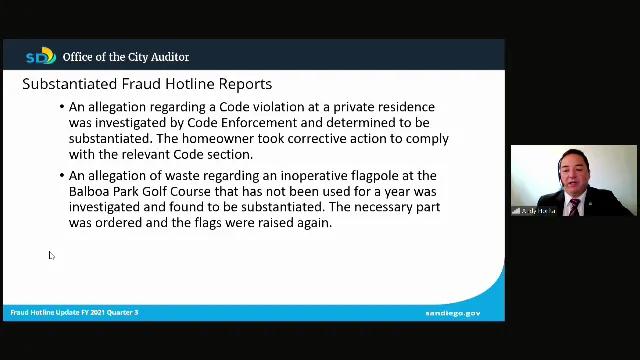
The San Diego Audit Committee met virtually on June 9, 2021, at 5:00 PM UTC, to discuss confidential audit reports, create subcommittees, appoint a member to the Disclosure Practices Working Group, and receive updates on fraud hotline activity, auditor monthly activity, and the auditor's 2020 accomplishments. The meeting was held under Executive Order N-29-20 due to public health concerns. Consent Calendar - The committee unanimously approved the minutes of the April 21, 2021, meeting. (Vote: 3-0, with one member absent) Public Comments & Testimony - No members of the public spoke during non-agenda public comment or on any agenda items. Discussion Items - Item 1: Confidential Audit Report Review – City Auditor Andy Hanhaus and Chief Deputy City Attorney Heather Ferbert presented options for discussing confidential audit reports. The auditor noted that of 45 confidential recommendations outstanding as of December 31, 2020, 15 were implemented, 30 were not, and 25 of those in process were past their original target date. The committee voted unanimously to create an ad hoc subcommittee of two members (Halpern and Tapsuri) to review the confidential report and report back with a recommendation on whether to forward it to the Mayor, Council President, and City Attorney for Council closed session discussion. (Motion by Vice Chair Lakava, second by Halpern) - Item 2: City Auditor Performance Metrics – The committee voted unanimously to create an ad hoc subcommittee (Halpern and Tapsuri) to recommend performance metrics for the City Auditor, to be reported at the July 28, 2021, meeting. (Motion by Lakava, second by Halpern) - Item 3: Appointment to Disclosure Practices Working Group – The committee unanimously appointed Vice Chair Lakava to represent the committee on the City's Disclosure Practices Working Group, which oversees compliance with securities laws. (Motion by Chair Moreno, second by Halpern) - Item 4: Quarterly Fraud Hotline Activity Report (FY21 Q3) – Senior Fraud Investigator Andy Horita reported 45 fraud hotline reports received in the quarter, 26 within purview, and 31 cases closed, leaving 39 open. Two department-referred cases were substantiated; three resulted in corrective actions. The committee unanimously accepted the report as information. (Motion by Lakava, second by Halpern) - Item 5: City Auditor Monthly Activity Report – City Auditor Hanhaus updated the committee on ongoing audits (including CARES Act, 101 Ash Street), staff changes, and efforts toward a 2022 ballot measure for independent legal counsel. This item was informational; no vote required. - Item 6: City Auditor's 2020 Annual Accomplishments Report – Assistant City Auditor Kyle Elser presented the report, noting 14 performance audits, 117 recommendations, and 490 volunteer hours at the convention center homeless shelter. The committee expressed appreciation. Informational item; no vote. Key Outcomes - Created ad hoc subcommittee (Halpern, Tapsuri) to review confidential audit reports; report due at future meeting. - Created ad hoc subcommittee (Halpern, Tapsuri) to develop performance metrics for the City Auditor; report due July 28, 2021. - Appointed Vice Chair Lakava to the Disclosure Practices Working Group. - Accepted the quarterly fraud hotline report (unanimous). - Noted the City Auditor's monthly activity and 2020 accomplishments. - Next meeting: Wednesday, July 28, 2021, at 9:00 AM.
The Rules Committee of the San Diego City Council met virtually on June 9, 2021, to receive an informational presentation from the Communications Department. The meeting covered the department's history, structure, 2020 achievements, staffing vacancies, language access initiatives, and upcoming projects. No public testimony was offered, and no votes were taken. Discussion Items - Communications Department Overview: Interim Director Nicole Darling and Deputy Director Maureen Hugar presented the department's evolution since 2013, when scattered public information officer (PIO) positions were consolidated. The department now includes City TV and Creative Services, Public Information and Media Services (15 PIOs serving various city departments), and the Public Records Act (PRA) administration team (4 staff). In 2019, six new unclassified positions were approved but only partially funded; three are filled, three remain unfilled and unfunded. - 2020 by the Numbers: The department managed over 2,000 media inquiries, had more than 500,000 social media followers, broadcast 179 public meetings, provided AV support for 120 news conferences (including 66 straight days of COVID briefings), produced 140 videos, and designed 77 collateral pieces. The PRA team received 5,800 requests and closed 5,700. - Staffing and Budget: There are seven vacancies, including two multimedia production coordinator positions (currently being recruited), a senior PIO, and a program manager. The department requested budget corrections to properly fund three filled unclassified positions that lacked designated funding—a carryover from the previous administration. - Language Access: Vice Chair Campillo and other members emphasized expanding language services beyond English and Spanish. Darling noted the department is exploring a citywide translation contract (potentially using PEG funds) and has consulted with New York and Seattle. Current reliance on Google Translate is inadequate for technical terms. The clerk's office uses census data to prioritize languages. - Upcoming Projects: The department is supporting the hybrid meeting technology upgrades, redistricting commission meetings (expected 40-50 additional broadcasts), the climate action plan update, SB 1383 organics recycling outreach, and Think Blue (stormwater) initiatives. They also assisted with the Access for All digital equity program, including logo design and multilingual postcards. Key Outcomes - No formal actions were taken as the item was informational only. - The committee expressed strong support for the department's work and urged continued progress on language access and filling vacancies. - The next Rules Committee meeting is scheduled for July 14, 2021, at 2 p.m.
The Environment Committee of the San Diego City Council met virtually on May 28, 2021, at 1:00 p.m. via Zoom, in accordance with Executive Order 29-20 and public health protocols. The meeting was chaired by Councilmember Elo-Rivera, with Vice Chair Von Wilpert and Councilmembers LaCava and Kate present. The committee approved the minutes of April 15, 2021, unanimously and then proceeded through a consent agenda, discussion items, and an informational presentation. Consent Calendar - Item 1: Authorized an as-needed consulting agreement with Geologic Associates Incorporated for disposal site water monitoring services. - Item 2: Authorized a second amendment to the agreement with SCS Engineers Incorporated for interim landfill gas systems operation, maintenance, and gas supply services at the Miramar landfill. - Both items were approved unanimously without discussion. Public Comments & Testimony - Non-Agenda Public Comment: - Robin Davidoff (Sierra Club Seal Society) urged the city to budget for a full-time ranger at Point La Jolla Sea Lion Rookery, citing 92 reported harassment incidents per month and approaching pupping season. She noted that every hour over 300 tourists disturb resting sea lions. - Dave Engel (San Diego Direct Action Everywhere) thanked Councilmember LaCava for his vote against the SDG&E franchise agreement and called for a ban on SeaWorld’s nightly fireworks due to animal distress and pollution. - Christy DiMaria requested adding a SeaWorld fireworks ban to the agenda, citing terror to animals, people with PTSD, and environmental pollution from gunpowder and chemicals. - Ellen Shivley described a fatal attack on a sea lion pup at La Jolla and asked for better oversight, rangers, and signage. - Kirk Broton (Mission Hills resident) noted fireworks can be heard from his home, causing distress to his rescue dog, and advocated for drone alternatives. - Public Comment on Item 6: Victor Vino (Falcon Strategies, representing Biomed Realty) spoke in support of the Los Peñasquitos Lagoon restoration cost share agreement, highlighting its benefits for flood reduction and stormwater management. - Public Comment on Item 8: Andrew Meyer (San Diego Audubon) endorsed the Green New Deal Alliance presentation and called for accelerating wetland restoration projects like Rewild Mission Bay. Discussion Items - Items 3 & 4 – Authorizing Environmental Services Agreements: Staff presented a combined proposal for two citywide on-call contracts (ICF Jones & Stokes and DUDAC) for as-needed environmental services related to stormwater management (channels, pump stations, outfalls). Each contract is for a five-year term, not to exceed $7.5 million. Staff noted the contracts were pulled from the previous month’s agenda to allow additional union coordination; unions are now on board. The committee approved both items unanimously. - Item 5 – Clean SD Contract Amendment: Staff from Environmental Services presented a contract amendment with the Center for Employment Opportunities (CEO), a nonprofit employing formerly incarcerated individuals. The contract, originally $2 million per year, was increased to $2.6 million annually due to higher-than-expected waste volumes (300–400 tons per month). The total over the remaining contract life is $11.5 million. CEO provides labor for six neighborhood policing abatement teams, removing illegal dumping and litter. Robert Smith (CEO) highlighted success stories, including a participant who had been homeless. Councilmembers discussed career pathways into city employment; staff agreed to explore formalizing such pathways. The item was approved unanimously. - Items 6 & 7 – Los Peñasquitos Lagoon Restoration Phase 1: - Item 6 (Cost Share Agreement): The committee authorized a cost share agreement among the City of San Diego, County of San Diego, City of Del Mar, and City of Poway to fund phase 1 of the lagoon restoration ($35.2 million total, of which San Diego’s share is 78% or $27.5 million). The project will restore at least 23 acres of salt marsh, improve water quality (sediment TMDL compliance), and reduce flood risk for Sorrento Valley businesses. Caltrans will contribute a lump sum during construction. The city will pursue state revolving fund loans and other sources. - Item 7 (Sole Source Agreement): A 15-year, up to $984,000 sole source agreement with the Los Peñasquitos Lagoon Foundation for technical advisory committee services, stakeholder engagement, and design/permitting support. Mike Hastings (Foundation) spoke in support, noting the Foundation’s long history and expertise. Both items were approved unanimously. - Item 8 – Informational Presentation: San Diego Green New Deal Alliance – Principles of Climate Action: - Representatives from the Alliance (including Malika Marison, Karina Gonzalez, Maria Mohammed, Joyce Lane, Lucero Sanchez, Rick Bates, and Cynthia Harris) presented a vision for zero carbon by 2035 through a just transition, equitable green jobs, community engagement, building electrification, solar expansion, and stormwater infrastructure investment. They emphasized the need for a CAP advisory committee with intergenerational leadership from communities of concern, climate ambassador programs, anti-displacement policies, and tribal co-management of natural resources. Councilmembers expressed strong support and discussed related topics: organic diversion (SB 1383), building electrification, the recent SDG&E franchise vote, and federal/state funding opportunities. Rick Bates noted an upcoming study (June 2021) on just transition economics. The presentation was informational only; no vote was taken. Key Outcomes - All action items (1–7) were approved unanimously. - The committee heard non-agenda public comment on sea lion protection and SeaWorld fireworks, but no formal action was taken on these topics. - The next Environment Committee meeting is scheduled for June 17, 2021, at 1:00 p.m. - Chair Elo-Rivera wished all a safe Memorial Day weekend and adjourned the meeting.
The Budget and Government Efficiency Committee met virtually on May 26, 2021, to consider several items including master services agreements, a debt policy update, a vehicle lease, and an informational report on wastewater financial planning. All votes were unanimous, and no public comments were received. Consent Calendar - The consent calendar, consisting of five unspecified items, was approved unanimously. A motion by Vice Chair Whitburn, seconded by Councilmember Montgomery Steppe, passed with all committee members voting yes. Public Comments & Testimony - No public comments were submitted for any agenda items. For each item, the public comment queue was empty. Discussion Items - Item 6: Approval of Master Services Agreement with CGI Technologies and Solutions Inc. - Staff (Jonathan Banke, CIO; Sean Kilpak, Deputy Director; Robbie Mahollingum from AvaSant) presented the agreement for application development, maintenance, and support services. The 10-year contract has a not-to-exceed value of $84.2 million. The motion passed unanimously. - Item 7: Approval of Master Services Agreement with Zensar Technologies - Staff presented the agreement for workplace and enterprise compute services. The contract term is 9 years 4 months for workplace services and 10 years 4 months for enterprise compute, with a not-to-exceed value of $122.8 million. The motion passed unanimously. - Item 8: Updates to the City's Debt Policy - Staff (Lakshmi from debt management) presented the revised policy. The Office of the Independent Budget Analyst (IBA) expressed support. Vice Chair Whitburn questioned the removal of language requiring the IBA to receive advanced copies of bond financing documents; IBA confirmed they still have access. Discussion also addressed debt affordability ratios, noting a projected peak of 24.2% in fiscal year 2026 and a decline thereafter. The motion passed unanimously. - Item 9: Master Lease Agreement to Finance Vehicles and Equipment - Staff from fleet services presented the lease. Councilmember Campillo requested an estimate of sales tax and outfitting costs, which staff agreed to provide. The motion passed unanimously. - Item 10: Independent Review of Wastewater Financial Plan, Cost of Service and Rate Study (Informational) - Jillian Kazdi from the IBA presented the review. No action was taken; the item was received as information. Key Outcomes - Consent calendar approved unanimously. - Items 6, 7, 8, and 9 approved unanimously without amendment. - Item 10 received as informational; no vote required. - No public comments were made on any item.
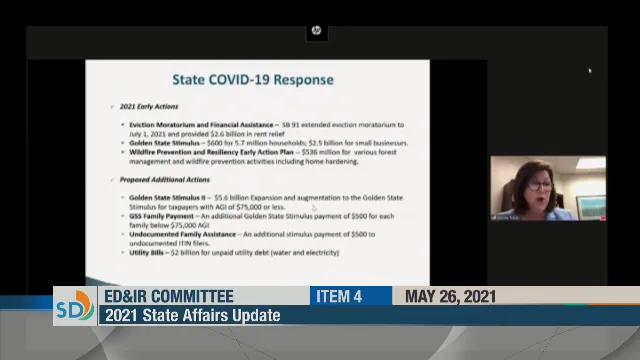
The Economic Development and Intergovernmental Relations Committee, chaired by Councilmember Raul Campillo, met virtually on Wednesday, May 26, 2021, at 10:00 AM. The meeting focused on the child care crisis during COVID-19, a facilities assessment for child care, the FY2022 Tourism Marketing District plan, and a state affairs update. All committee members (Campillo, Vice Chair Kate, Moreno, Ilo Rivera) attended virtually. Consent Calendar - Unanimously approved the actions from the April 14, 2021 meeting. Public Comments & Testimony - Non-agenda public comment: Two speakers addressed the committee. Becky Rapp (mother and youth mentor) expressed concern about a presentation to the Land Use and Housing Committee on April 22 regarding cannabis businesses near care facilities and churches. She urged upholding distancing requirements from marijuana outlets. A second speaker (phone ending in 7234) advocated for affordable housing with on-site child care and opposed a marijuana storefront across from Hollywood Pines affordable housing complex, citing inequity for children. - Item 3 (State of Child Care): Three public speakers shared their positions during the public comment period for item 3, but were redirected because they were commenting on the next item (facilities assessment). A fourth speaker, Samantha Rodriguez (YMCA intern), expressed support for child care services. - Item 1 (Facilities Assessment for Child Care): Eight speakers offered support for the facilities assessment. - Rebecca Ribsick (Downtown Partnership) urged support to explore city properties for child care. - Shelby Gomez (YMCA Child Care Resource Service, mother in District 3) shared personal difficulty finding child care and called for the Office of Child and Youth Success. - Kira Pina (Center on Policy Initiatives/Community Budget Alliance) supported the assessment and the office. - Martin Luisi (Casa San Diego) supported the assessment and noted the city’s role as a large employer. - Dr. Janet Hootin (Navy Region Southwest) described partnerships for military child care, citing 4,000 military families on waiting lists. - Laura Cohn (Mission Driven Finance, ECE Advocacy Coalition) co‐authored the Workforce Plus Child Care report and emphasized drawing down state child care facilities funding of $455 million. - Brenda Aguirre (Chicago Federation family resource navigator) supported the assessment and the Office of Child and Youth Success. - Aaron Hogeboom (Church San Diego for Every Child) expressed full support for the assessment and the office. - Alessandra Lazama (CEO of Tuthras Childcare on Demand) urged public‐private partnerships and technology platforms for child care. - Blake Hopsted (Educational Enrichment Systems) cited 20 years operating centers on city property and the need for facilities. Discussion Items Item 3 – State of Child Care During the COVID-19 Pandemic (Information Item) Courtney Baltiski, Director of Advocacy and Strategic Partnerships for YMCA Community Support Services, presented: - Pre‑pandemic, only 30% of children ages 0–4 in San Diego had access to licensed child care. - Approximately 2,076 child care providers operated on razor‑thin margins. - Families with two children could spend up to 40% of their household budget on child care. - As of May 2021, San Diego County had 480 child care centers closed (15%) and still 10% of family child care homes closed. - Of providers surveyed in March 2021, 61% of centers and 40% of family child care homes were not at full enrollment. - 47% of centers lost $90,000 or more; 28% of family child care homes lost $5,000–$15,000. - 17% of early educators live in poverty. - Top requested supports: cash stipends, vouchers, facility expansion funding, and workforce development. - Committee members asked about licensing wait times, employer engagement, and the need for a comprehensive cradle‑to‑career plan. Councilmember Moreno noted that increasing pay, expanding facilities, and state subsidies are key solutions. Councilmember Ilo Rivera emphasized systems‑level planning and the proposed Office of Child and Youth Success. Item 1 – Facilities Assessment for Child Care (Action Item) Sophie Barnhorst, Committee Consultant, presented the proposal: - Pre‑pandemic gap of 190,000 licensed child care slots in San Diego. - 522 child care businesses closed county‑wide as of April 2021. - Requested staff to: (1) identify city properties adaptable for child care, (2) report findings within six months. - Chair Campillo made a motion to approve the two actions. Councilmember Moreno offered an amendment to add: (3) study feasibility of a master lease of real estate for child care, and (4) explore permit reforms to convert commercial/office space to child care. The amendment was accepted, and the motion passed unanimously. - Penny Moss (Real Estate Assets Department) noted the timing aligns with the city’s “Office of the Future” planning to optimize space. Item 2 – FY2022 San Diego Tourism Marketing District Report of Activities (Action Item) Presented by Colleen Anderson (TMD Corporation) and Carrie Kapuch (San Diego Tourism Authority): - Tourism lost 20 years of economic gains in 2020; visitor spending down 56% ($6.4 billion loss). - FY2022 assessments estimated at $39.3 million, with $26.7 million to the Tourism Authority. - Recovery projected to reach 2019 levels by 2024 for spending, 2025 for average daily room rates. - Marketing priorities: domestic leisure travel (“Happiness is Calling You Back”), meetings and conventions campaigns, and limited international outreach (UK, Canada, Mexico). - The motion to approve the report and expenditures passed unanimously. Item 4 – 2021 State Affairs Update (Information Item) Presented by Walt Bishop and Moira Top: - California’s May Revision budget proposes a $75.7 billion surplus, plus $25 billion federal funds, creating the California Comeback plan. - Key proposals: $9.3 billion for affordable housing, $3.5 billion for homelessness (Homekey extension), $1 billion for small business relief, $250 million for child care facilities, 100,000 new child care slots. - City priorities: advocating for direct city allocations (no specific city dollars in May Revise), supporting bills such as AB 816 (Homelessness Inspector General), AB 482 (mixed‑income housing), SB 7 and SB 9 (housing streamlining), AB 899 (988 mental health hotline), and SB 264 (ban on gun shows on state/county property). - City staff are preparing an application for the federal Outdoor Recreation Legacy Partnership program (deadline June 18, 2021). - Councilmember Moreno requested advanced materials and urged hosting state officials for tours. Councilmember Ilo Rivera stressed the importance of immigrant inclusion and child care funding. Key Outcomes - Consent Calendar: Approved unanimously. - Item 1: Motion passed unanimously, with amendments to include master lease feasibility and permit reform studies. Staff to report findings within six months. - Item 2: FY2022 Tourism Marketing District report and expenditures approved unanimously. - Item 3: Received as information; no vote needed. - Item 4: Received as information; no vote needed. Committee members will follow up on specific grants and advocacy priorities. - Next committee meeting scheduled for Friday, June 11, 2021, at 9:00 AM.
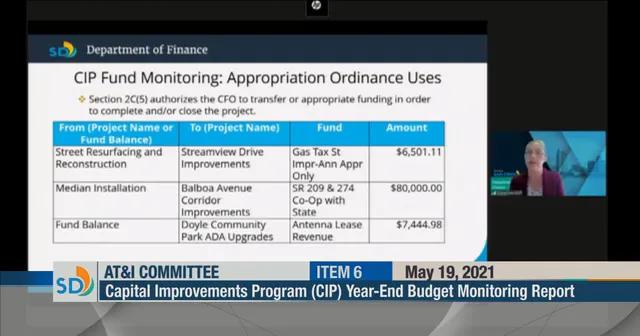
The Active Transportation and Infrastructure Committee met virtually on May 20, 2021, via Zoom due to the public health emergency. The meeting covered a range of items including shared mobility device regulations, street resurfacing funding, capital improvement program updates, a franchise extension, and dam safety. Key discussions focused on enforcement of scooter regulations, funding for a street condition assessment, and prioritization of infrastructure investments. Several public comments highlighted concerns about safety, equity, and climate action. Consent Calendar - The committee unanimously approved the minutes from the April 7, 2021 meeting. - Consent agenda items (1-3) were approved unanimously: first amendment to agreement with GHD Inc. for pipeline design, ratification of contract with Dick Miller Incorporated, and contract extension for PB Pipeline South with TC Construction Inc. Public Comments & Testimony - Non-agenda public comment: Noah Harris from Climate Action Campaign urged the committee to secure funding to complete the Mobility Action Plan Phase 2 within 1-2 years and commit to 20 miles of protected bike lanes in the next year, emphasizing the climate emergency. - Item 4 (Shared mobility devices): Multiple speakers addressed the proposed code amendments: - Kathy Eyes (Mission Beach resident) expressed dissatisfaction with scooter company enforcement and stated geofencing does not work. - Morgan Roth (Bird Government Partnerships Manager) supported the amendments and noted Bird's community pricing plan and fleet distribution beyond downtown. - Jonathan (Safe Walkways) criticized the proposals for not improving public safety and asked that scooters be parked in the street, not sidewalks. - Alex April (Spin) supported the move to an RFP process and the clarity on removal of devices. - Janet Rogers (Safe Walkways) stated the city is not enforcing state scooter laws and noted scooters illegally operating on high-speed roads. - Pat Pressell (resident) said scooters block his disabled husband's mobility scooter and raised concerns about new removal rules. - Jesse O'Sullivan (Circulate San Diego) supported the RFP process and stressed the need for ADA compliance. - Nicole Burgess (Bike SD) asked for a diversified fleet including e-bikes and equitable distribution across communities. - James Bushiers (Lyft) supported the amendments and noted challenges with unsanctioned removal of devices. - Item 5 (Street resurfacing): Noah Harris (Climate Action Campaign) urged using RMRA funds for complete streets improvements rather than auto-centric resurfacing, prioritizing frontline communities. Nicole, Thomas DeFranco, and Matt Stucky echoed calls to invest in alternatives to cars. - Item 7 (Franchise extension): Rebecca Ribzik (Downtown San Diego Partnership) spoke in support, noting the vital cooling service provided to downtown properties. Discussion Items - Item 4: Shared Mobility Device Regulations - Alyssa Mudo (Mobility Director) presented proposed amendments to the municipal code covering three areas: cleanup, scooter removal requirements, and a sunset clause for transitioning to an RFP process. The presentation included background on scooter operations and data management. Committee members Vice Chair LaCava, Montgomery Steppe, and Elo Rivera raised concerns about enforcement, parking on sidewalks citywide, accountability measures for operators, and legal review by the City Attorney. The committee initially moved to forward without recommendation, but after discussion, the item was returned to staff for further work. - Item 5: FY22 RMRA Project List - Christy Reeser (Street Division) presented the proposed list of five slurry seal projects covering 210 miles, funded with $27.8 million from the state. Chair von Wilpert proposed an amendment to include funding for a street condition assessment (estimated $700,000-$800,000) as an option for council consideration, to better prioritize maintenance. The motion passed unanimously, directing staff to present two options to the full council. - Item 6: FY21 CIP Year-End Monitoring - Karen McGriff (Finance) presented a consolidated report requesting $13.2 million in fund transfers and allocations. The IBA noted $1.7 billion in carryover funds and highlighted $1 million transferred from sidewalk repairs to new sidewalk projects in District 4. The committee approved the item unanimously. - Item 7: Franchise Extension for Energy Center San Diego - Heather Werner (Sustainability) requested a two-year extension of the 50-year franchise (expiring August 2021) to allow a competitive process. The franchise provides cooling to downtown buildings, including two city buildings. The committee approved unanimously. - Items 8 & 9: Dam Safety - Juan Guerrero, Vian Hong, and Adam Jones (Public Utilities) presented a risk-based approach to dam safety, noting that the city's nine dams are aging (61-109 years old) and require approximately $1 billion in investments over several decades. Item 8 requested authorization to apply for a High Hazard Potential Dam Rehabilitation Grant for pre-construction activities at five dams. Item 9 provided an update on the dam safety program. The committee approved item 8 unanimously, with item 9 informational only. Key Outcomes - Item 4 was returned to staff for revisions; no vote taken. - Item 5 passed unanimously with an amendment to present two options to council: the original project list and an alternative including a street condition assessment funded from RMRA. - Items 1-3 (Consent) approved unanimously. - Items 6, 7, and 8 approved unanimously. - The next regularly scheduled meeting is June 16, 2021.
On May 20, 2021, the City of San Diego held a series of events including a digital equity announcement, a public safety symposium for the Asian American and Pacific Islander (AAPI) community, and a formal Budget Review Committee meeting. The budget committee reviewed the FY2021 third quarter budget monitoring report and the FY2022 May revision to the proposed budget, with discussions on revenue shortfalls, federal relief funds, and restoration of library hours. The day also featured community engagement on hate crimes and crime prevention. Digital Equity Announcement - Mayor Todd Gloria, Councilmember Ilo Rivera, and San Diego Public Library Director Misty Jones announced the SD Access for All program, which includes the purchase of hundreds of laptops and 900 mobile hotspots for library checkout. The program aims to bridge the digital divide for 53,000 San Diegans without direct internet access. Partners Cox Communications and AT&T were thanked for their support. Cox Senior Vice President Sam Aticia highlighted the company's Connect to Compete program offering $9.95/month broadband to low-income families. The initiative provides free Wi-Fi at 10 outdoor community computer labs and laptop checkouts for up to two hours. Public Safety Symposium for AAPI Community - Councilmember Chris Cate hosted a public safety symposium at the Convoy District, with Mayor Gloria, District Attorney Summer Stephan, Police Chief David Nislight, and community relations officers. Speakers emphasized reporting hate crimes and hate incidents, with DA Stephan noting that hate crimes against the AAPI community have tripled in San Diego and that three felony hate crime cases have been charged. Chief Nislight urged reporting of all incidents, including non-criminal hate incidents, to prevent escalation. Officers provided practical tips for business security (e.g., removing cash, installing alarms) and personal safety (e.g., avoiding dangerous situations, using intuition). Community leaders and a QR code resource for reporting were also introduced. Budget Review Committee Meeting Public Comments & Testimony - 14 speakers addressed the committee on the FY2022 May revision. Speakers from the Community Budget Alliance and other groups called for reallocating police funding to alternatives such as homeless outreach, youth violence intervention programs, and a rent registry/vacancy tax study. They also advocated for increased funding for arts and culture, parks in underserved communities, a grant writer for climate action, and an Office of Child and Youth Success. Several speakers expressed disappointment that the mayor's budget maintained the status quo and urged the council to champion bold changes. Discussion Items - FY2021 Third Quarter Budget Monitoring Report: Presented by Sarah Mayan, Assistant Director of Finance. General fund revenues are projected to be $61 million below budget, primarily due to a $31.6 million shortfall in Transient Occupancy Tax (TOT) revenue. Expenditures are $8.9 million under budget, resulting in a net deficit of $52.2 million. The mayor recommends using $37.7 million in American Rescue Plan Act (ARPA) funds and $14.5 million in unassigned FY2020 fund balance to cover the deficit. The report was accepted unanimously. - FY2022 May Revision to Proposed Budget: Presented by Rolando, Director of Finance, and Karen McGriff. The revision increases the budget by $73 million, including $39 million for capital projects. Key additions: $5.1 million to restore library hours with a new staffing model (34 additional FTE positions), $3.8 million for IT service provider transition costs, $1.4 million for the animal services contract, and 12 positions for a Safe and Sustainable Transportation team. The climate equity fund receives $5 million for projects in underserved communities, and $10 million is allocated for complete streets. The revision also accounts for tentative labor agreements and uses $5.9 million in ARPA funds for FY2022, with $150 million preserved for FY2023. Council members expressed support for library restoration, the climate equity fund, and the Commission on Police Practices, while noting concerns about weed abatement, graffiti, and sidewalk repairs. Several members committed to filing budget memos with additional priorities. Key Outcomes - The FY2021 third quarter budget monitoring report was accepted unanimously (all present voting yes, Councilmember Kate absent). - The FY2022 May revision was discussed as an informational item; no vote was taken. Council members will submit budget modification memos by June 9, 2021, with final budget adoption scheduled for June 14, 2021. - The city will use ARPA funds to close the FY2021 deficit and support FY2022-23 budgets, but a structural deficit remains beyond FY2023.
The Public Safety and Livable Neighborhoods Committee met virtually on May 19, 2021, at 9:00 a.m. Chair Montgomery Steppe called the meeting to order with Councilmembers Campio, Whitburn, and Von Wilpert present. The meeting covered approval of prior minutes, a discussion item on Fiscal Year 2022 Recreation Center Fund budgets, and an informational update from the Criminal and Community Justice Division. Consent Calendar - Approval of Committee Actions (April 14, 2021): Moved by Vice Chair Campio, seconded, and passed unanimously (4-0). Public Comments & Testimony On Item 1 (Recreation Center Budget): - Caller ending in 7234: Expressed strong support for the Come Play Outside initiative and equitable recreation programs for youth. Then pivoted to argue against marijuana storefronts and billboards, stating they threaten young people’s health and that 77% of California cities do not permit such storefronts. Urged the city to maintain protections for sensitive locations and dial back marijuana advertising. - Becky Rapp: A mother raising teens and a young boy, she praised the city’s recreation efforts but expressed alarm at marijuana billboards in Barrio Logan visible from apartment windows. She urged removal of marijuana billboards in disadvantaged neighborhoods to protect children’s mental health. - Alita Chavez (Oak Park Community Council, District 4): Commended Parks & Recreation staff for their work at Chollas Lake Regional Park and requested higher budgets for recreation centers in Districts 4, 8, and 9 to help children cope with COVID-19 stress. - Sally Small (Emerald Hills Neighborhood Council): Supported increased budgets for communities of concern in Districts 4, 8, and 9, and hoped gift funds would be directed to those neighborhoods. On Item 2 (Criminal Justice Update): No public comments were received. Discussion Items Item 1: Fiscal Year 2022 Recreation Center Fund Budgets Staff from Parks and Recreation (Andy Field, Karen Dennison, Sarah Arazzo) presented. Key points: - Recreation Center Funds were established in January 2018 after city charter violations were identified. The 60 funds derive from class registration fees (78%) and permit fees (22%). - During the pandemic, staff conducted over 1,000 virtual programs reaching 9,000 participants and served 250,000 summer meals at 17 parks. - The proposed FY22 budget is similar to FY21 ($300,000 in actual expenditures) with minor adjustments. New funding from the Mayor ($400,000), County ($750,000), and Price Charities ($150,000) will support 16 communities of concern through Summer for All of Us and Come Play Outside initiatives (e.g., movies in the park, learn-to-swim, Junior Lifeguards). - Wi-Fi has been installed at 23 recreation centers, with 35 more planned in 2021. - Committee questions addressed the difference between staff-run and contractual programs (contractual are more costly and based on community willingness to pay), equity challenges (some recreation centers have more offerings because participants can pay full cost), reopening plans (phased starting June 1), and fee structures for little leagues (special use permits involving maintenance in exchange for reduced fees). - The committee voted unanimously to approve the staff recommendation. Item 2: Criminal and Community Justice Divisions Update (Informational) John Hemmerling (Assistant City Attorney) and Nicole Crosby (Chief Deputy City Attorney) presented. Highlights: - The division receives about 20,000 criminal cases annually. Priorities focus on victims, guns, and DUIs; drug abuse is treated as a public health crisis. - Gun Violence Restraining Orders (GVROs): Since program inception, over 1,000 firearms have been seized. In 2020, 40% of respondents were involved in family violence, 35% in suicide threats. The office has trained 350+ agencies statewide. - Nuisance Abatement Unit: Collaborates with code enforcement and police on substandard housing and neighborhood issues. Even during the pandemic, investigators continued work. - Unsafe Facilities Task Force: A pilot in Southeastern Division reduced average police/fire calls from 128 in two years prior to 13 in 13 months. The program is expanding. - PLEADs Program (Prosecution and Law Enforcement Assisted Diversion): In 2020, 1,200 unique individuals were referred; nearly 800 were accepted for treatment, and 32% of those accepted services. 87% were homeless. The average cost of jail per person ($160.48/day male, $36.09/day female) contrasts with diversion’s savings. - SMART Program: Extended 750 offers; 385 accepted, 270 assessed, 135 enrolled. Program addresses substance abuse and co-occurring issues. - Committee members asked about ghost guns (rising concern, office supports legislation), GVRO training (resuming as restrictions ease), and data on success of PLEADs vs. other shelter programs. Councilmember Von Wilpert requested follow-up on ghost gun ordinance possibilities. Chair Montgomery Steppe asked about community engagement for the high-risk team and expressed interest in a holistic approach to violence prevention. Key Outcomes - Item 1: Motion to approve the FY2022 Recreation Center Fund budgets passed unanimously (4-0). - Item 2: Informational; no vote required. Committee members expressed appreciation for the office’s work and requested additional briefings on PLEADs program. - The meeting was adjourned, with the next committee meeting scheduled for Wednesday, June 16, 2021, at 9:00 a.m.