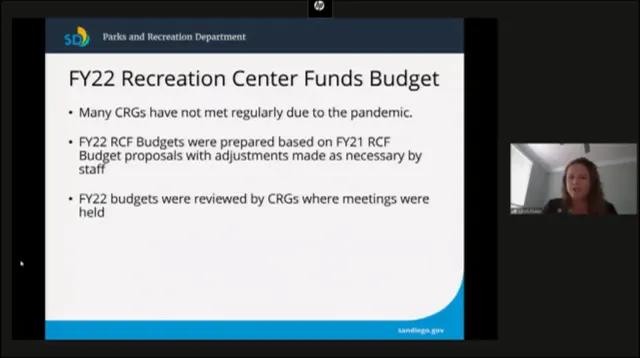
The Public Safety and Livable Neighborhoods Committee of the San Diego City Council met virtually on May 19, 2021, at 9:30 AM. The meeting was held via Zoom due to the COVID-19 pandemic (Executive Order 29-20). Key agenda items included approval of prior minutes, fiscal year 2022 recreation center fund budgets, and an informational update from the Criminal and Community Justice Division of the City Attorney's Office. The meeting was live-streamed on the city's website and public comment was accepted via Zoom. Consent Calendar - Approved the committee actions of April 14, 2021, unanimously (3-0). Public Comments & Testimony - Non-Agenda Public Comment: One speaker mistakenly commented on item 1 and was asked to call back when that item was called. No valid non-agenda comment was taken. - Item 1 (Fiscal Year 2022 Recreation Center Fund Budgets): Four speakers provided comment. - Caller ending in 7234: Expressed general concern about marijuana advertising and storefronts, arguing that they threaten youth mental health and that 77% of California cities do not permit marijuana storefronts. She urged the city to continue protecting sensitive locations. - Becky Rapp: Mother of three teens and raising a young boy due to his mother's drug habits. She praised the parks and recreation efforts but raised concern about large marijuana billboards in Barrio Logan, visible from residential windows, and asked the city to remove all marijuana billboards in and around neighborhoods, especially those experiencing health inequities. - Alita Chavez (District 4, representing Oakport Community Council): Commended staff for their work at Tijuana River Valley Regional Park but requested that communities of concern in Districts 4, 8, and 9 receive higher budgets and that recreational programs be fully maintained to help children cope with COVID-19 stress. - Sally Small (representing Emerald Hills Neighborhood Council and Choice Valley Community Planning Group): Echoed Alita Chavez's request for increased budgets in communities of concern (D4, D8, D9) for recreation center funds. Discussion Items - Item 1: Fiscal Year 2022 Recreation Center Fund Budgets - Staff from the Parks and Recreation Department (Andy Field, Karen Dennison, Sarah Arazzo) presented the proposed budgets. The recreation center funds were established in January 2018 after a December 2017 determination that fees collected by recreation councils were in violation of the city charter. These funds (60 separate funds) are derived from class registration fees and permit fees. Approximately 78% of fund balances come from recreation program fees and 22% from permit fees. The presentation highlighted that during the COVID-19 pandemic, staff pivoted to virtual programs (over 1,000 programs reaching over 9,000 participants), summer meals at 17 parks (over 250,000 meals), and grab-and-go holiday events serving 18,000 children. For FY22, staff proposed budgets similar to FY21 with minor adjustments, as many community recreation groups did not meet during the pandemic. Additional funding for equitable recreation includes $400,000 from the Mayor's proposed FY22 budget, $750,000 from the county, and a pending $150,000 from Price Charities, supporting 16 communities of concern with programs like movies in the park, Fern Street Circus, Junior Lifeguard, Learn to Swim, and flexible community-specific programming. Wi-Fi installation is underway: 23 recreation centers already equipped, with 35 more scheduled for 2021. An equity audit is underway and expected mid-summer. Recommended actions: authorize the Chief Financial Officer to appropriate and expend recreation funds in FY21 and FY22, including carryforward, and to permit expenditure of permit fees from outside geographic areas for department-wide programs. - Committee members discussed the balance between staff-run and contractual programs, the influence of community willingness to pay, and equity concerns. Council President Pro Tem Whitburn asked about Wi-Fi coverage (all but about 10 facilities expected after 2021). Councilmember Von Wilpert asked about the deficit in FY21 (approximately $20,000 more expenses than revenue) but was told carryforward funds cover such variances. She also asked about safe reopening plans, with staff noting a phased reopening starting June 1, 2021. Chair Montgomery Steppe inquired about agreements with little leagues: staff explained that youth nonprofit leagues pay nominal fees ($25 per field, $20 per team) and that special use permits allow leagues to perform higher-level maintenance in exchange for preferential use. - Item 2 (Informational): Criminal and Community Justice Divisions Update - John Hammerling (Assistant City Attorney) and Nicole Crosby (Chief Deputy City Attorney, Head of Strategic Development) presented an update on the Criminal and Community Justice Division. They described the division's structure, strategic priorities (victims, guns, DUIs), and key initiatives. The division receives about 20,000 criminal cases per year for prosecution. They highlighted the Gun Violence Restraining Order (GVRO) program: since inception, over 1,000 firearms have been seized. In 2020, 35% of GVRO cases involved family violence and 35% involved threats of suicide. The Nuisance Abatement Unit targets substandard housing, particularly for vulnerable populations, working with multi-agency partners. An example from the Southeastern Division pilot showed an average call volume drop from 128 calls in two years prior to 13 in 13 months after intervention. The Prosecution and Law Enforcement Assisted Diversion (PLEAD) program diverts low-level drug users to community-based services before filing. In 2020, 1,200 unique individuals were referred; about 800 were accepted and referred to treatment, and of those, 32% accepted some form of treatment. 87% of PLEAD participants were homeless or at some level of homelessness. The Special Prosecutions Unit handles firearms, vehicular manslaughter, hate crimes, unlawful marijuana dispensaries, and high-profile cases vertically. - Committee members asked several questions. - Vice Chair Campillo: Asked about ghost guns (unserialized firearms). Staff confirmed a troubling increase in ghost guns, including 3D-printed and assembled from parts. They noted the City Attorney signed onto supporting state legislation. Staff also said GVROs are being sought for ghost gun possession. Regarding state trainings, staff have trained about 350 agencies before the pandemic and expect to resume. On case issuance, overall issuance rate is high, with domestic violence cases being lower due to lack of independent witnesses. - Council President Pro Tem Whitburn: Thanked staff for work on ghost guns, GVROs, and unlawful cannabis enforcement. He also supported the PLEAD diversion program for addressing homelessness and behavioral health, noting the importance of repeated attempts to connect individuals to services. - Councilmember Von Wilpert: Praised the work on elder abuse and substandard housing. Asked about success rates of PLEAD vs. SMART program. Staff reported that of about 750 offers made via SMART, 385 accepted, 270 were assessed, and about 135 remained enrolled. She also asked about prosecutorial discretion regarding marijuana dispensaries, especially for historically disadvantaged individuals. Staff said they focus on illegal operators, often using nuisance abatement rather than criminal prosecution, and work with legal dispensaries that report illegal competitors. Regarding GVRO outreach, staff advised people to call the police or the City Attorney's gun violence response unit. On ghost guns, she asked if the council could pass an ordinance; staff said they would consider and get back to her. - Chair Montgomery Steppe: Asked for a future briefing on the PLEAD system to understand how individuals access it. She also praised the work on substandard housing, especially in Southeastern San Diego. She asked about high-risk team community engagement (domestic violence crisis support) — staff said it is confidential and connects victims to appropriate non-profit agencies (e.g., domestic violence council, Freedom to Thrive). She also emphasized the holistic approach to gun violence, including addressing underlying conditions (economic, behavioral health) and referenced the "Let's Live" initiative and "No Shots Fired" cognitive behavioral program. Key Outcomes - Item 1: Motion to approve staff recommendation (authorize appropriation and expenditure of recreation center funds for FY22, including carryforward and permit fee expenditure for department-wide programs) was made by Vice Chair Campillo, seconded by Council President Pro Tem Whitburn, and passed unanimously (3-0). - Item 2: Informational only; no vote required. - The meeting was adjourned at approximately 11:10 AM (estimated based on meeting duration) with next meeting scheduled for Wednesday, June 16, 2021, at 9:00 AM.
Public Meetings - San Diego, California
Public Meetings - San Diego, CaliforniaThe Budget Review Committee of the San Diego City Council met virtually on May 11, 2021, to review the proposed fiscal year 2022 budgets for the San Diego Convention Center Corporation, the San Diego Housing Commission, and the San Diego City Employees Retirement System (SDCERS). The meeting was held via Zoom due to the COVID-19 pandemic, with council members and staff participating remotely. Chair Kate presided. The committee heard presentations from each agency, reviewed reports from the Independent Budget Analyst (IBA), and received public testimony. Public Comments & Testimony - SDCERS Public Comment: Michelle Krug expressed frustration with the lack of accessibility for individuals without computer access during the pandemic, stating she did not receive a call back after multiple attempts. SDCERS CEO Greg Rodemaker apologized and noted that a remote call center has since been implemented. - No public comments were submitted for the Convention Center or Housing Commission items. San Diego Convention Center Corporation Budget Review - Presentation: CEO Rip Rippetoe and CFO Martin Maddox presented the corporation's budget. Due to the COVID-19 pandemic, the convention center operated as a homeless shelter (April 2020 – March 2021) and then as a federal emergency intake site for unaccompanied children (starting March 26, 2021). The budget assumes a reopening for events in October 2021, with attendance at 25% of pre-pandemic levels ramping up to 80% by year-end. The corporation faces a total FY22 loss of $16.5 million, including a $13.6 million operating deficit. It plans to exhaust its $4.2 million reserve and requests a $10.2 million operating subsidy from the city. Additional revenue may come from a $2 million PPP loan forgiveness and a $90,000 grant. The corporation outlined a 10-year capital plan with over $74 million in needs. - IBA Comments: Deputy Director Jeff Kawar reported on the reserve policy, the need for a long-term capital financing plan, and recent developments (emergency intake site, earlier reopening). He recommended allowing the corporation to use any net revenue from the intake site to rebuild reserves or address capital needs. He also noted the city's ongoing annual contributions of $13.3 million (debt service and dewatering) and the potential for Measure C funds. - Council Discussion: Councilmembers thanked the staff for their pandemic response. Councilmember LaCava questioned the need for the full $10.2 million and the monitoring plan. Council President Pro Tem Whitburn asked whether the full subsidy was necessary given the earlier reopening; CFO Maddox affirmed the need due to cash flow challenges, repayment delays from the federal intake site, and a $1.2 million Ibank debt payment due in July. Councilmember Montgomery Steppe asked about funding for Operation Shelter to Home ($20.8 million from the city). Councilmember Von Wilpert inquired about employee recall difficulties. Councilmember Campillo asked about rising insurance costs. Councilmember Moreno questioned post-pandemic demand and how the city can support the center. Councilmember Elo Rivera asked about the possibility of a loan versus a grant; the IBA indicated a loan would be difficult to repay. Chair Kate asked about capital and repair maintenance spending. - Key Outcomes: The committee reviewed the budget; no vote was taken. It was noted that the corporation will provide monthly cash flow projections to city finance. The IBA recommended a mid-year update. San Diego Housing Commission Budget Review - Presentation: Deputy CEO Jeff Davis, EVP Suket Dial, and CFO Tracy McDermott presented a proposed FY22 budget of $585 million, the largest in history. The increase primarily reflects federal, state, and city funds for COVID-19 relief programs, including the Housing Stability Assistance Program ($92 million). The budget also includes over $120 million for homelessness programs, $20 million for property acquisitions for permanent supportive housing, $8 million for rehabilitation of existing units, $16.6 million to preserve naturally occurring affordable housing, and $7.8 million for the homeownership program (up $5 million). The Housing Commission anticipates administering 470 new emergency housing vouchers and potential additional funds from the American Rescue Plan Act. - IBA Comments: Analyst Jillian Cassidy noted that $64 million in rent relief funds will carry over from FY21, and the city will receive an additional $54 million for rent relief. She highlighted the homeownership increase and the redeployment of unspent NOFA funds. - Council Discussion: Councilmember LaCava proposed creating a "Housing Day" for a comprehensive needs assessment. Councilmember Montgomery Steppe requested a briefing on allegations of voucher discrimination from the NAACP. Councilmember Von Wilpert asked about governance, fund balances (nearly $200 million unspent), and the serial inebriate program funding. Councilmember Campillo asked about first-time homebuyer assistance (expected to help up to 100 households). Councilmember Moreno expressed concern about slow distribution of rental relief (only $1.5 million of $90 million disbursed) and questioned application processing times. He also asked about internal controls for property acquisition. Councilmember Elo Rivera asked about service provider capacity to utilize non-congregate shelter funding and noted frustration that funds were available but staffing limited. Chair Kate noted the additional state rent relief announced by the governor. - Key Outcomes: The commission's budget will be presented to the full council for approval on June 14, 2021. Several councilmembers requested additional briefings. The committee discussed the need to accelerate rent relief distribution and build provider capacity. San Diego City Employees Retirement System (SDCERS) Budget Review - Presentation: CEO Greg Rodemaker and Controller Ted Lasalvia presented an administrative budget of $14.4 million for FY22, with 51 full-time equivalent employees (an increase of 3 to support the pending reopening of the pension plan to new city employees). SDCERS manages a $10 billion trust fund and serves over 20,000 members. The budget is approved by the SDCERS Board and does not require council approval. Key costs include salaries and benefits (57%), general operations ($3.4 million), IT, and legal fees ($365,000). Investment expenses for FY20 were $47.3 million, a $8.2 million increase from FY19, driven by private equity and opportunistic strategies. - IBA Comments: Analyst Lisa Byrne noted the three additional FTEs related to Proposition B unwinding and that investment fees increased as a percentage of assets in certain categories. - Council Discussion: Councilmember LaCava and Council President Campbell had no questions. Council President Pro Tem Whitburn emphasized the need for accessibility for an aging population and commended the new call center. Councilmember Von Wilpert asked about readiness for reopening the pension plan; Rodemaker confirmed they are prepared. Councilmember Elo Rivera asked if additional staff might be needed; Rodemaker responded that the three new positions should suffice for now. - Key Outcomes: The committee received the report; no further action required. SDCERS apologized for past accessibility issues and noted improvements.
The Budget Review Committee (BRC) of the San Diego City Council held an afternoon session on Tuesday, May 11, 2021, to review proposed budgets for several city departments and offices. The meeting was conducted virtually via Zoom due to the COVID-19 pandemic. Committee members and department heads presented budget overviews, discussed critical needs, and heard public testimony. Key themes included requests for additional staffing in the City Attorney's Office, support for the newly created Commission on Police Practices, and efforts to restore funding cuts to the City Auditor's Office. Consent Calendar - No consent calendar was noted; all items were discussed individually. Public Comments & Testimony - Colleen Kuzak (criminal defense attorney, speaking on City Attorney's Office item): Stated that the City Attorney's Office has refused to provide discovery to individuals charged with infractions since 2016, arguing that the office claims inability to afford compliance despite prosecuting indigent defendants. She urged the council to inquire about compliance with legal obligations. - Michelle Krug (speaking on Boards & Commissions item): Raised concerns about the Citizens Equal Opportunity Commission's website not being updated since August 2020, impeding public access to meetings and a disparity study. She alleged Brown Act violations. - Youth Organizer (unidentified, from Mid City CAM): Thanked the mayor's office for allocating funding to the Commission on Police Practices and expressed excitement about continuing collaboration. - Francine Maxwell (NAACP San Diego Branch President, speaking on Commission on Police Practices): Stressed the need to expedite seating permanent commissioners and hiring investigators to build community trust, citing an incident where an unsheltered man was shot. Urged fast-tracking the implementation ordinance. - Francine Maxwell (during non-agenda public comment): Called for a hearing on the police department budget and reallocation of resources, specifically reducing the number of assistant chiefs. Emphasized that the community wants proactive changes, not defunding, and urged transparency across the city. - Catherine Rhodes (during non-agenda public comment): Requested a legal opinion from the City Attorney's Office on whether homeless camping or safe parking lots can be placed in dedicated parklands like Mission Bay, citing the city's homeless shelter crisis. Also asked for funding from CDBG or the low-moderate income housing fund. - Colleen Kuzak (during non-agenda public comment): Accused City Attorney Mara Elliott and Criminal Division Chief John Hammerling of misleading the committee by denying they prosecute infractions. She cited the city charter and noted that previous city attorneys provided discovery without claiming they were not the prosecutor. City Attorney's Office Budget Review - City Attorney Mara Elliott presented the office's mission and achievements, including leadership in gun violence restraining orders (nearly 900 obtained, taking almost 1,000 guns off the street), restructuring civil advisory, expanding the Family Justice Center to include sex trafficking survivors, and defending the city in litigation. She requested four additional positions not in the mayor's proposed budget: - One Deputy City Attorney for civil litigation (estimated cost $168,101) to address a 37% increase in civil cases (500 cases assigned to 43 attorneys) and avoid costly outside counsel (e.g., $664,000 in two cases). - One Deputy City Attorney for the vulnerable victims program (estimated cost $168,101) to prosecute elder abuse and health/safety code violations. - Two clerical assistants for the Family Justice Center (estimated cost $53,246 each) to handle front desk duties, allowing victim service coordinators to focus on direct services. - Independent Budget Analyst (IBA) noted that the proposed budget includes $900,000 for outside counsel (a reclassification) and $57,000 for Family Justice Center security. IBA suggested examining vacancy savings, as the office historically averages $600,000 in savings, not the $1.3 million assumed. - Councilmembers (Campillo, LaCava, Campbell, Whitburn, Montgomery Steppe, Von Wilpert, Moreno, Elo-Rivera) expressed support for the requests, with several noting the high cost of outside counsel, the importance of in-house expertise, and the human toll of understaffing. Council President Campbell advocated for three civil litigators, one criminal attorney, and two clerks. Councilmember Von Wilpert highlighted that 25 of 43 civil litigators have left in five years due to stress. City Auditor's Office Budget Review - City Auditor Andy Hanau reported on the office's accomplishments: issuing 15 reports in FY20 and 10 so far in FY21 with 73 recommendations; managing the fraud hotline (200 allegations/year); and tracking 186 unimplemented recommendations. He highlighted audits on the industrial wastewater control program (finding cost recovery violations and under-regulation), SDPD data analysis, employee performance management, and the climate action plan. He requested restoration of a $91,000 budget reduction to avoid going over budget in FY22. - IBA confirmed the audit committee unanimously recommended restoring the $91,000. - Councilmembers (LaCava, Campbell, Whitburn, Montgomery Steppe, Von Wilpert, Campillo, Moreno, Elo-Rivera) unanimously supported restoring the reduction, praising the office's value in transparency and cost savings. Councilmember Moreno (audit committee chair) stressed that reducing resources would be counterproductive, especially during an economic downturn. - Councilmember Elo-Rivera asked about independent legal counsel for the auditor; Hanau noted a potential need for a ballot measure in 2022 to access independent legal counsel without city attorney approval. City Clerk's Office Budget Review - City Clerk Liz Maland reviewed the office's broad responsibilities (legislative services, elections, records management, passport services, public information). Accomplishments included upgrading the council chambers AV system (funded by PEG fees), completing the 2020 redistricting commission recruitment (over 100 applicants), and facilitating virtual council meetings. She requested a program manager for archives and a software program (Web Dam), which were not funded. The proposed budget includes a 4.3% reduction in contracts. - IBA noted no significant budget changes and suggested future funding for online archives might be appropriate. - Councilmembers (LaCava, Campbell, Whitburn, Montgomery Steppe, Von Wilpert, Campillo, Moreno, Elo-Rivera) praised the clerk's office for transparency and service. Councilmember Campillo asked about translation services; Maland detailed efforts to provide real-time Spanish translation and a new multilingual outreach program for seven languages. Councilmember Von Wilpert supported additional funding for archives. Office of Boards and Commissions Budget Review - Director Matthew Gordon reported on the office's work managing over 40 boards and commissions, 500+ appointments, and increasing diversity (75% of appointees are persons of color). The proposed budget is $761,000, a reduction of $146,000 due to the transfer of the executive director position to the new Commission on Police Practices. - IBA confirmed the transfer. - Public comment raised issues about the Citizens Equal Opportunity Commission's website and lack of public access. - Councilmembers (LaCava, Campbell, Whitburn, Montgomery Steppe, Von Wilpert, Campillo, Moreno, Elo-Rivera) appreciated the office's efforts and inquired about consolidation plans and KPIs. Director Gordon indicated that a new clerk-based system to track performance would be implemented by late June. Commission on Police Practices Budget Review - Interim Executive Director Sharmain Mosley and First Vice Chair Doug Case presented the inaugural budget for the new commission, created by Measure B in November 2020. The proposed budget is $1.1 million (6.33 FTEs), with additional requests of $140,000 for salary increases and start date changes, totaling $1.3 million. The commission aims to hire staff, secure office space, and implement an implementation ordinance. Critical needs include independent investigations of officer-involved shootings and in-custody deaths. - IBA noted that the May revise would include the additional $140,000. - Public comment (Francine Maxwell, NAACP) urged expediting the process to seat permanent commissioners and hire investigators. - Councilmembers (LaCava, Campbell, Whitburn, Montgomery Steppe, Von Wilpert, Campillo, Moreno, Elo-Rivera) expressed support for full funding and expedited implementation. Councilmember Montgomery Steppe recommended that no new hires be made until a permanent executive director is chosen. Councilmember Elo-Rivera suggested funding for transportation and childcare for commissioners to reduce barriers to participation. Government Affairs Department Budget Review - Director Adrian Granda highlighted achievements: securing $300 million in federal COVID relief funds, $21 million in HOME funds, $50 million for homelessness (HAP and Project Homekey), and passage of state legislation (AB 2731) and federal legislation (Ocean Pollution Reduction Act). No significant budget changes; the department runs lean with 7 FTEs. - IBA noted no KPIs in the proposed budget, but the director will develop them. - Councilmembers (LaCava, Campbell, Whitburn, Montgomery Steppe, Von Wilpert, Campillo, Moreno, Elo-Rivera) praised the department's work and asked about state grant competitiveness, county relations, and rental assistance flexibility. Director Granda discussed efforts to improve state grant applications (e.g., GGRF) and collaboration with the county. Councilmember Von Wilpert inquired about funding for gun violence restraining orders and wildfire prevention. Personnel Department Budget Review - Director Doug Edwards presented the department's role in hiring, classification, payroll, and investigations. The proposed budget includes a 4% reduction (389,000), with six positions kept vacant. The department requested two program coordinator positions (one for pre-employment background processes, one for data analytics) to be added to the budget (previously unfunded). - IBA confirmed the 4% reduction continues and impacts service levels (e.g., time to issue certified lists). - Councilmembers (LaCava, Campbell, Whitburn, Montgomery Steppe, Von Wilpert, Campillo, Moreno, Elo-Rivera) supported the requests and discussed hiring challenges. Edwards noted that the 4% reduction forced the loss of a recruiter, affecting diversity recruitment. Councilmember Moreno found it ironic that the city lacks funds to fill positions that help fill vacancies. Ethics Commission Budget Review - Executive Director Sharon Spivak reported on the commission's work: 380 ethics advice requests, 40 complaint screenings, 11 audits completed, and ongoing training. The proposed budget includes a reduction of $109,000, mainly in contracts for outside counsel. The commission can absorb this reduction but may need additional funds for administrative hearings. - IBA had no additional comments. - Councilmembers (LaCava, Campbell, Whitburn, Montgomery Steppe, Von Wilpert, Campillo, Moreno, Elo-Rivera) thanked the commission for its work and noted 100% KPIs in training and advice. Key Outcomes - City Attorney's Office: The committee expressed broad support for adding four positions (two deputy city attorneys, two clerical assistants). The requests will be considered in budget memos due May 26, with final budget modifications in June. - City Auditor's Office: The committee unanimously supported restoring the $91,000 wage reduction as recommended by the audit committee. - City Clerk's Office: The unfulfilled request for a program manager and software for archives was noted; the committee expressed interest in future funding for online archives. - Commission on Police Practices: The committee supported full funding and expedited implementation. Councilmembers requested that permanent executive director hiring precede other staff hires. A policy change for commissioner childcare/transportation support was flagged for consideration. - Personnel Department: The committee supported the addition of two program coordinator positions. The impact of the 4% reduction on recruitment and diversity was acknowledged. - Non-agenda public comment: A legal opinion on homeless camping in parklands was requested. Council will take these comments under advisement. Next BRC meeting is scheduled for Thursday, May 20, 2021, at 2:00 p.m.
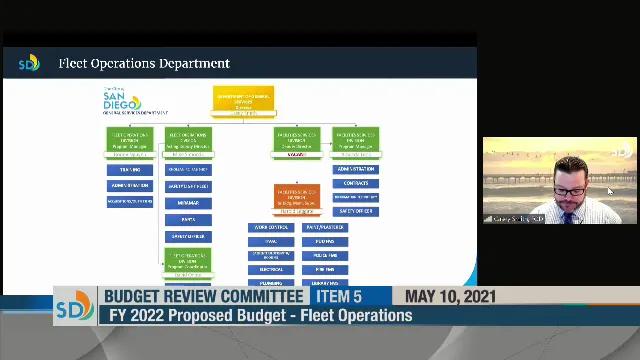
The San Diego City Council Budget Review Committee met virtually on May 10, 2021, to review the proposed FY22 budgets for the Public Utilities, Stormwater, Transportation, Real Estate Assets, and Fleet Operations departments. The meeting also covered the planned consolidation of Fleet Operations with Facility Services into a new Department of General Services. Council members expressed broad support for increased funding for infrastructure, maintenance, and sustainability, while several speakers called for additional resources for tree maintenance, street sweeping, and clean transportation. Public Comments & Testimony - Stormwater Department: Lucero Sanchez (San Diego Coast Keeper) expressed support for the budget’s funding for new hires and the stormwater funding strategy, and emphasized the need for long-term funding. Sally Small (Emerald Hills Neighborhood Council and Troyas Creek Coalition) thanked the department for increasing activities and requested adjustments to street sweeping routes and frequency in District 4. - Transportation Department: Anne S. Feige (Chair, Community Forest Advisory Board) requested an additional $200,000 for two urban forestry professionals and noted that the program is understaffed, which increases liability. Jacob Mandel (San Diego County Bicycle Coalition) asked the council to direct immediate action on Vision Zero corridors using quick-build infrastructure. Nicole Burgess praised the department’s systematic safety strategies and integration of water, sidewalks, and shade trees. Mike Pallett (West Coast Arborist) supported increased shade tree funding. Devonna Hall (continuing Feige’s comments) requested $1.6 million for tree trimming contracts and $500,000 for planting 2,500 street trees in underserved neighborhoods. - Real Estate Assets Department: Sandra Stahl (Montgomery Gibbs Environmental Coalition) requested $85,000 in the airport’s fund to purchase a fuel tank to offer unleaded aviation fuel, citing an FAA grant that would cover most costs. - Fleet Operations Department: No public comments were offered. Discussion Items Public Utilities Department Director Shauna Lawrence and Assistant Director Lisa Salaya presented a $1.7 billion total department budget. The operational budget increases by $36 million, including 71.76 net new FTEs. Key additions: positions for dam regulation compliance, regulatory compliance for labs, Pure Water operations, and preventive maintenance for water and wastewater infrastructure. The department is transitioning from reactive to proactive maintenance. The budget does not assume rate changes; a cost-of-service study will come in fall 2021. Council members praised the leadership and asked about the modified permit for Point Loma (passed House committee), the expansion of the AMI program (RFP for consultant mid-summer), condition assessments for dams (RFP within a month) and non-dam infrastructure (RFP within next month, report within a year), and conflicts with SDG&E affecting Pure Water scheduling (potential delays and cost increases being mitigated). Members also noted the need for an agricultural lease manager for San Pasqual and for brush management on PUD properties. Stormwater Department Director Chris McFadden presented a proposed $56 million general fund budget, an increase of $8.6 million and 13.5 positions. The presentation emphasized the need for a long-term funding strategy, given that the current storm drain fee generates only $5.7 million. Key additions: $2.5 million for funding strategy development, a second pipe repair crew, $500,000 for bacteria studies (San Diego River Investigative Order), two parking enforcement officers for street sweeping, five positions for DigAlert compliance, and a code compliance officer. The IBA noted unfunded requests for levee maintenance, pipe cleaning, and a reinspection fee. Council members supported the funding strategy and the pipe repair team, and asked about the alternative compliance program ($300,000 for consultant services), the Los Peñasquitos Lagoon restoration ($36 million total, city share $27 million, construction 2023–2024), and the need to prioritize weed abatement and street sweeping in underserved areas. Transportation Department Chris McFadden also presented the transportation budget (increase of $2 million). The department plans to repair 200 miles of streets, add 60 miles of bikeways, and invest in Vision Zero projects. The IBA noted that weed abatement is proposed for a cut (from 85 to 40 acres), tree trimming cycle remains at 24 years for shade trees, and graffiti abatement is underfunded by $100,000. The department requested four positions for DigAlert and $200,000 for SDG&E damage repairs. Council members expressed concern about cuts to weed abatement and tree trimming, and many pledged to restore funding. Councilmember Moreno requested a report on transitioning slurry sealing to city employees. Council President Campbell, Councilmember Whitburn, and others supported increasing graffiti abatement funding by $100,000. Councilmember Montgomery Stepp sought details on filling the new sidewalk repair positions. Real Estate Assets Department New Director Penny Moss presented the FY22 budget. The department manages the city’s real estate portfolio, including Petco Park, two municipal airports, and parking garages. Total general fund expenditures increase by $1.3 million, with a $1.2 million decrease in revenue (COVID impacts on leaseholders). Key additions: $600,000 for a program coordinator to manage homelessness services agreements, $492,000 for maintenance of homeless facilities, $112,000 for a consultant for sports arena redevelopment, and $603,000 for homeless service support. Revenue from Mission Bay and Pueblo lands is projected to decline. Council members welcomed Moss and asked about lease renegotiations for small businesses (rent deferral program with two-year payback), reassessment of city office space (study underway pending return-to-work plan), and agricultural leases (potential specific manager). On 101 Ash Street, the city is maintaining the building and deferring lease payments pending litigation outcomes. Fleet Operations Department / Facility Services Director Casey Smith presented the combined budget for the new Department of General Services. Fleet Operations: $73 million in the replacement fund, including purchase of 708 vehicles (40 all-electric), and a $1 million reduction in rental fees. Facility Services: minimal changes; they completed 10,534 work orders and converted Golden Hall into a homeless shelter. The IBA noted the low fund balance ($545,000) and need for the Kearny Mesa repair facility ($13.8 million). Council members asked about the plan to electrify the fleet (infrastructure constraints), the timeline for the Kearny Mesa facility (design complete, construction negotiation 2–4 months, construction 12–16 months), and how to fill vacant trades positions (labor negotiations expected to help). Council President Campbell praised proactive work on Rose Canyon containment areas. Councilmember Moreno requested a memo on the history of debt financing for vehicles. Key Outcomes - No formal votes were taken; the committee reviewed budgets and provided direction for the May revise. - Several council members indicated they would request restoration of cuts to weed abatement ($327,000), tree trimming ($1.6 million recommended by IBA), graffiti abatement ($100,000), and sidewalk repair funding. - The committee expressed support for the stormwater funding strategy and the second pipe repair team. - Councilmember Moreno requested a report on the feasibility of transitioning slurry sealing and tree trimming to city employees. - The Real Estate Assets Department will explore an agricultural lease manager and continue lease deferral programs for small businesses. - Fleet Operations will bring a commercial paper item to council to fund the Kearny Mesa repair facility. - The afternoon session (trailed) will cover the FY22 CIP budget and the Economic Development department.
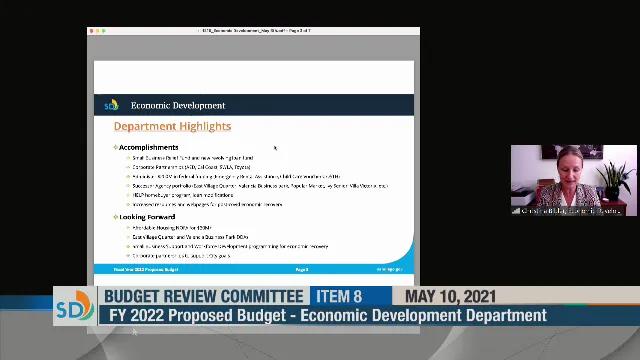
The Budget Review Committee held a virtual meeting on May 10, 2021, to review the proposed fiscal year 2022 budgets for the Engineering and Capital Projects (ENCP) Department, the Capital Improvements Program (CIP), and the Economic Development Department. The meeting included presentations from department heads, comments from the Independent Budget Analyst (IBA), public testimony, and questions from council members. Public Comments & Testimony - Steve Lamprides (District 4) opposed the proposed Fairmont Fire Station (project S14018), citing lack of environmental review and inadequate community outreach. - Catherine Rhodes recommended creating a special study zone for fault mapping on reclaimed tide lands, including the airport and Seaport Village. - Paul Jolson, Victor Bloomberg, and others requested repairs for Collier Avenue between Austin Drive and 54th Street, noting it had not been repaired in 30 years. - Patricia Mooney and Mark Schultz advocated for the long-delayed San Carlos Library, requesting expedited land purchase and construction. - Nicole Burgess supported the department's work but urged better sidewalk accessibility and stormwater capture, and opposed the Fairmont Fire Station location. - Michael Schmidt complained about poor road conditions in Rancho Peñasquitos. - Cindy Moore asked for Village Glen Drive and Sarah Mesa to be added to the resurfacing list. - Catherine Rhodes (again) questioned the low $5 million budget for undergrounding utilities, suggesting it be combined with 5G infrastructure. - After the CIP presentation, additional public comments included Rebecca Ribzik (Downtown San Diego Partnership) supporting the Economic Development Department budget, and Alexis Villanueva criticizing the Back to Work SD program as insufficient and calling for grants rather than loans. - Others spoke on non-agenda items: Catherine Rhodes questioned the lack of a budget for Civic San Diego and accused SDG&E of hindering the Pure Water project. Discussion Items Engineering and Capital Projects (ENCP) Department - Director James Nagelvoort presented the department's budget, noting 825.5 FTE positions (unchanged), a 20% vacancy rate (169 vacancies), and a proposed $500,000 ongoing expense for survey monument maintenance (currently funded by general fund). He highlighted 52 construction contracts awarded totaling $718 million, including $586 million for Pure Water Phase 1. The department plans to award $1.28 billion in construction value in FY22. - IBA Jillian Cassidy noted the capacity challenge: ENCP would need to dramatically increase project delivery to address the $3 billion capital infrastructure funding gap. She also flagged the 169 vacancies and encouraged future discussions on capacity. - Council members discussed recruitment, in-house vs. consultant work (goal 70/30, currently 60/40), training costs, and the transfer of prevailing wage and procurement teams to other departments. They also noted the departure of Deputy Director Mark Nassar after 30 years. Capital Improvements Program (CIP) - James Nagelvoort presented the State of the CIP, covering first six months of FY21: $270 million in expenditures (down from previous year due to COVID and vacancies), 113 miles of paving completed, 8.79 miles of water pipe replaced, 12.94 miles of sewer pipe replaced. Key performance indicators showed average days to award contracts at 100.67 (up from 90 target). The department is working on three council policy updates (transparency, prioritization, and customer service). - Karen McGriff (Finance) presented the proposed FY22 CIP budget of $747.5 million, part of an $11.68 billion multi-year program. Nearly 50% is for Pure Water, 37.9% for other water/wastewater, 8.8% for city buildings, 4.4% for transportation, and less than 1% for parks and golf. General fund contribution is only $5.4 million for organics processing. An additional $255.7 million is anticipated from various sources. - IBA Jillian Cassidy noted that the $49 million for general fund capital infrastructure is down 29% from FY21 and well below the $660 million needed, so the infrastructure gap will grow. She highlighted $75 million for street overlay/reconstruction (84 miles funded, but only 29 miles expected to be completed in FY22). No funding for new park improvements, libraries, or fire stations. - Council members discussed undergrounding slowdown due to SDG&E franchise agreement, street assessment, specific district projects (e.g., Fairmont Fire Station, San Carlos Library, Alvarado Canyon Road), and the need for community engagement. Economic Development Department - Director Christina Bibler presented the FY22 budget, including a $15 million Back to Work SD program: $10 million for small business/nonprofit forgivable loans/grants (with $2 million match from San Diego Foundation), $750,000 for small business enhancement, $750,000 for Connect to Careers youth employment, $500,000 for youth diversion summer programming, $251,000 for a small business ombudsman (two temporary positions), and $250,000 for street vendor assistance (permitting, grants, outreach). The department also manages assessment districts, corporate partnerships, and HUD programs. - IBA Jordan Moore noted that the $10 million is general fund, providing flexibility, and that many items are one-time but continue previous programs. - Council members supported the programs but raised concerns about loan vs. grant structure, equitable distribution, and outreach to underserved communities. Councilmember Moreno opposed the $250,000 for street vendor ordinance compliance. Councilmember Elo Rivera asked about outreach to ensure equity. Key Outcomes - The meeting was informational; no votes were taken. The committee will reconvene on May 11, 2021, at 9 a.m. - Council members directed staff to follow up on specific issues, including the Fairmont Fire Station community update, San Carlos Library timeline, Collier Avenue repairs, and street vendor outreach. - The presentations provided a foundation for the final budget adoption later in the year.
The Budget Review Committee of the San Diego City Council met on Friday, May 7, 2021, from approximately 9:00 a.m. to 2:00 p.m. (with a lunch break) to review the proposed Fiscal Year 2022 budgets for the Police Department, Fire-Rescue Department, Office of Homeland Security, Development Services Department, and Environmental Services Department. The meeting was held virtually via Zoom due to the COVID-19 pandemic, with public comment provided by phone and online. No votes were taken; the session was informational. Public Comments & Testimony - Police Department: 34 public speakers addressed the committee. Approximately half urged maintaining or increasing police funding, citing concerns about rising crime, homelessness, and the need for public safety. Speakers representing downtown businesses, the Gaslamp Quarter, and the tourism industry requested additional foot and bike patrols. The other half called for defunding or reallocating police funds to community services, mental health, housing, and youth programs. Several speakers cited racial disparities in stops and use of force, and criticized the department’s overtime spending. Notable speakers included Michael Friedman (support funding), Kira Pina (Center on Policy Initiatives, opposed increase), John Weber (downtown business owner, support), Jack Schaefer (Police Officers Association, support but called for reimagining with investment), and Tasha Williamson (opposed increase). - Fire-Rescue Department: Two speakers addressed the budget. Anna Shepherd (Naval Base Coronado) requested enforcement of vessel anchorage ordinances at Zuniga Shoal. Linda Kaufman questioned the cost escalation of the proposed Fairmont Avenue Fire Station. - Office of Homeland Security: One speaker (caller ending 9063) raised concerns about homelessness and shelter closures, unrelated to the department’s budget. - Development Services Department: Three speakers commented. Ann Sage (urban forester) requested a code enforcement officer for tree work and fee waivers for concrete removal in underserved areas. Francine Maxwell (D4 resident) urged evening shifts for code enforcement to catch illegal dumping. A third speaker (caller 9063) again raised homelessness issues. - Environmental Services Department: No public speakers for this item. Discussion Items - Police Department (Item 1): Chief David Nisleit and Administrative Services Manager Kyle Mukes presented a $592 million general fund budget (up 4.1% from FY21). Key increases included $15.1 million in pension costs, $4.5 million in non-discretionary expenses, and $4.4 million to reallocate Neighborhood Policing overtime from seized assets to the general fund. Reductions included $2 million in extension-of-shift overtime, $1 million in Clean SD overtime, and $1 million in Neighborhood Policing overtime. The IBA noted that the $4 million in overtime reductions were not reallocated to non-law enforcement services. Council members debated racial disparities, hiring, and the need for reform. Councilmember Montgomery Stepp highlighted the No Shots Fired pilot program ($250,000) and discussed the Gang Intervention Unit’s funding. Councilmember Moreno pressed for quarterly analysis of stop/search data and questioned the three-day notice for officer interrogations. Councilmember Elo Rivera asked about alternative response models. - Fire-Rescue Department (Item 2): Chief Colin Stowell presented a $308 million budget (up $20.6 million) with 1,354 FTEs. Key additions: three fire academies ($863,000), advanced lifeguard academy ($256,000, 3 FTEs), wellness program restoration ($307,000), and various equipment upgrades. The IBA noted that the mobile operations detail (Gaslamp) and Copter 1 maintenance were unfunded but likely needed. Council members praised the department’s vaccine efforts and the women’s fire prep academy. Councilmember Von Wilpert asked about brush management and Copter 1 funding. Councilmember Moreno raised diversity goals. Councilmember Campillo inquired about landscaping maintenance at Fire Station 29. - Office of Homeland Security (Item 3): Interim Program Manager Megan Beal presented the proposed budget, noting the office would move from under the Police Department to report directly to the Chief Operating Officer. The only addition was an Executive Director position (1.0 FTE). The IBA had no additional comments. Council members expressed support for the reorganization and emphasized transparency in grant funding and public records. - Development Services Department (Item 4): Director Elise Lowe and Acting Deputy Director Elsa Lopez presented the budget. Major changes: transfer of dockless scooter revenue ($1.5 million) to the new Mobility Department, addition of positions for small business liaisons, and transfer of the urban plan review program (8 positions) from Civic San Diego. The IBA noted the department still pays for 101 Ash Street while leasing elsewhere. Council members praised the digital transition and asked about code enforcement caseloads (Leslie Senate answered), ADU permitting, and the small business ombudsman program. Councilmember Montgomery Stepp requested evening code enforcement shifts. - Environmental Services Department (Item 5): Interim Director Renee Robertson presented a $133 million budget (up $10 million), driven by SB 1383 compliance (organics recycling). Expenditures included $40 sanitation driver positions, route optimization software, facility upgrades ($5.4 million), and education materials. The IBA noted that the People’s Ordinance prevents charging single-family homes for trash collection, costing the general fund $42.3 million annually. Council members discussed the rollout timeline, landfill capacity, and the need for state funding. Councilmember Elo Rivera questioned the possibility of reducing police presence at cleanups. Key Outcomes - No votes were taken; all items were informational. The committee heard public testimony and council discussion. The proposed budgets will be considered by the full City Council in subsequent meetings. - The committee noted the need for further analysis of police department data and reform, alternative response models, and funding for SB 1383 compliance. - The Office of Homeland Security’s reorganization and the Development Services Department’s small business liaison program were broadly supported.
The Budget Review Committee met on May 6, 2021, to review the Fiscal Year 2022 proposed budgets for multiple city departments, including the Library, Parks and Recreation, Cultural Affairs, Special Events and Filming, Information Technology, Human Resources, Sustainability, Planning, and Mobility departments. The meeting was held virtually due to the COVID-19 pandemic. Key discussions centered on proposed budget reductions, staffing model changes, and the potential restoration of funding in the upcoming May revise. Public testimony was heard for each department. Public Comments & Testimony - Library Department: Numerous speakers, including Patrick Stewart (Library Foundation CEO), Kara Camden, Charlie Goldberg, Natalie Gans, Wendy Urushima Khan (Library Commission Chair), Joan Reese (Friends of the San Diego Public Library), Jan Hinzman, Sally Small, Elida Thomas, Pat Wilson, Joe Felton, and Catherine Tamposhel (Youth Will) urged the committee to restore the proposed $5.6 million budget cut, support new investments in materials and programming, and transition hourly staff to benefited positions. Many highlighted the library's essential role in digital equity, education, and community support, especially in communities of concern (Districts 4, 8, and 9). - Parks and Recreation Department: Speakers Ann Feige (Community Forest Advisory Board), Friends of Balboa Park, Amy Hayes (Save Our Heritage Organization), Marcella Bothville (San Diego Parks Foundation), Sally Small, Martha Phillips (San Diego Parks Foundation), Peter Kaminski (Balboa Park Cultural Partnership), Catherine Johnston (Sustainable Parks Foundation), Connie Matsui (Balboa Park Conservancy), Catherine Tamposhel (Youth Will), Courtney Baltiski (YMCA), Michelle Anderson (San Diego Parks Foundation), and Sophia Haidai (Youth Will) expressed support for the proposed budget, particularly the addition of a chief park ranger, seven maintenance positions, and youth programs. Some called for additional funding for pest control and tree maintenance. - Cultural Affairs Department: Speakers Steve Snyder (Fleet Science Center), Dee Candice Paul (San Diego Performing Arts League), Tyler Hughes (Commission for Arts and Culture), Amy Hayes (Save Our Heritage Organization), Teresa Cozen (San Diego Regional Arts and Culture Coalition), Jessica Baron (Guitars in the Classroom), Kent Lee (Pacific Arts Movement), Aaron Bullard (Villa Musica), Jerry Buckley (Playwrights Project), and Peter Kaminski (Partners in Arts and Culture San Diego) expressed disappointment that the proposed budget maintained steep cuts from the previous year. They urged restoration of Organizational Support Program (OSP) and Creative Communities San Diego (CCSD) funding to pre-pandemic levels, funding for a citywide cultural plan and Balboa Park experience plan, and a commitment to achieving the "Penny for the Arts" goal within four years. - Sustainability Department: Speakers Malika Marston (Climate Action Campaign), Ann Feige, Matthew Vostalakis (Climate Action Campaign), and Amy Hayes (Save Our Heritage Organization) supported the Climate Action Plan update and the Climate Equity Fund, but requested additional funding for a public power feasibility study, a dedicated grant writer, and increased staffing to meet CAP goals. - Mobility Department: Speakers Janet Rogers (Safe Walkways), Jonathan Freeman, Noah Harris (Climate Action Campaign), Nicole Burgess (Mobility Board), and Jacob Mandel (San Diego County Bicycle Coalition) called for improved scooter enforcement, a clear revocation process, and a mobility action plan that prioritizes communities of concern and achieves mode-shift targets. Discussion Items - Library Department: Director Misty Jones presented a proposed $5.6 million reduction, primarily from reducing hourly staff and temporarily cutting hours to 42.5 per week (closed Sundays and Mondays). The department plans to convert hourly positions to benefited part-time positions and restore hours to Monday-Saturday (46 hours per week) with additional funding. The Independent Budget Analyst (IBA) noted that the reduction would be $6.9 million for full restoration to pre-COVID levels, and eight council members prioritized library hours. The Mayor's office (Matt Yagyagan) stated the intent to restore library hours and restructure staffing in the May revise, aiming for a seven-day schedule over the next year. Councilmembers expressed strong support for restoring funding, with many emphasizing the library's importance for equity and community recovery. - Parks and Recreation Department: Director Andy Field presented an $8.1 million general fund increase, including seven new maintenance positions, a chief park ranger, and funding for youth programs (Back to Work SD). IBA noted the addition of 5.9 FTEs for new parks and youth services. Councilmembers praised the budget and discussed specific needs such as brush management, sea lion management, and joint-use agreements in underserved areas. - Cultural Affairs Department: Director Jonathan Glus highlighted equity initiatives, data collection, and COVID-19 response. The proposed budget maintains a 50% cut in arts funding due to reduced Transient Occupancy Tax (TOT) revenue. Councilmembers expressed disappointment and advocated for restoring the "Penny for the Arts" goal over four years. - Special Events and Filming Department: Executive Director Natasha Kalra presented the new department's budget, which was restored to previous levels. Highlights include an online permitting system and preparations for the U.S. Open at Torrey Pines. Councilmembers supported the department's role in economic recovery. - Information Technology Department: CIO Jonathan Banke presented a $389,000 general fund increase for computer replacements and the SD Access for All digital equity program. The IBA noted a $9.5 million increase in IT fund contracts for desktop support and data center services. Councilmembers praised the department's pandemic response and emphasized cybersecurity. - Human Resources Department: Director Julie Perez Roscoe outlined the department's role in COVID-19 response, employee development, and recruitment. The budget includes two program coordinators for strategic human capital management and funding for LinkedIn Learning and the Employee Assistance Program. Councilmembers discussed vacancy rates and the need for a compensation strategy. - Sustainability Department: Interim Director Alyssa Mudo presented the budget for the Climate Action Plan (CAP) update and the new Climate Equity Fund ($5 million from franchise fees). The IBA noted that no projects have been identified yet. Councilmembers supported the CAP update and requested a public power feasibility study and a grant writer position. - Planning Department: Director Mike Hanson presented an $8.7 million budget with no FTE changes. Key initiatives include the Parks Master Plan and community plan updates. Councilmembers supported funding for a Coastal Commission liaison and emphasized equity in community engagement. - Mobility Department: Director Alyssa Mudo (dual role) presented a $120,000 allocation for the Mobility Action Plan (Phase 2) and $362,000 for scooter enforcement (SWEEP). Revenue from scooter permits is projected at $870,000. Councilmembers expressed frustration with scooter issues and called for stronger enforcement and a focus on equity in mobility planning. Key Outcomes - Library Department: The Mayor's office committed to restoring library hours and restructuring staffing in the May revise. The council expressed unanimous support for full restoration. - Parks and Recreation Department: The proposed budget was well-received, with councilmembers supporting the new positions and youth programs. No major changes were requested. - Cultural Affairs Department: Councilmembers committed to pushing for restoration of arts funding and the "Penny for the Arts" goal in the May revise. - Special Events and Filming Department: No changes were proposed; the department was commended. - Information Technology Department: Councilmembers supported the digital equity and cybersecurity investments. The IBA noted a duplicate $206,000 line item to be removed. - Human Resources Department: Councilmembers emphasized filling vacancies and developing a strategic plan. The department will host a job fair in September. - Sustainability Department: The Climate Equity Fund was established, but projects are yet to be identified. Councilmembers requested a public power feasibility study and a grant writer. - Planning Department: The department will continue community plan updates. Councilmembers supported the Coastal Commission liaison position. - Mobility Department: The scooter enforcement contract and Mobility Action Plan were discussed. Councilmembers urged stronger scooter enforcement and quicker implementation of transportation improvements. The department will bring forward an RFP for scooter permits and an updated ordinance.
2021-05-05 The Budget Review Committee convened on May 5, 2021, at 9 a.m. via Zoom to review the Mayor's proposed FY22 budget. The Independent Budget Analyst (IBA) presented a comprehensive analysis, noting the budget is balanced at $1.7 billion using $209 million in mitigations, primarily American Rescue Plan funds (67.6%). Key issues included library hour cuts, police budget increases, homelessness funding, and capital infrastructure gaps. The committee heard public testimony and conducted departmental reviews. Public Comments & Testimony - Over 100 public speakers addressed the committee, with the majority opposing increases to the police budget and supporting library funding. Speakers urged reimagining public safety, investing in community services, and creating an Office of Child and Youth Success. Representatives from arts organizations, library advocates, and community coalitions (e.g., Community Budget Alliance, ACLU, Sunrise Movement) emphasized equity and long-term solutions. Discussion Items - IBA FY22 Budget Review: Andrea Tevlin summarized the balanced budget, noting $209 million in mitigations including $141.3M from ARP. Revenue improvements in property tax, sales tax, and TOT were projected, but ongoing structural challenges remain. Notable concerns: library hour reduction (101 FTEs eliminated), police budget increase ($23.5M, mostly pension costs), and $10M one-time homelessness investments. - Office of Race and Equity: Director recruitment underway; proposed budget of $771,000 for 3 positions; $3M Community Equity Fund fully funded. - Performance & Analytics: Get It Done app enhancements, Medallia platform, pay equity study. Proposed $12,600 reduction in contracts for new features. - Communications Department: Requested 4 additional positions (3 filled as supplementals). Debate over centralized vs. embedded PIO model, translation services, and vacancy rates (22%). - Compliance Department: New department consolidating labor standards, safety programs, and administrative hearings. $3.3M budget with 29 positions (including prevailing wage). Equal Opportunity Contracting location under discussion. - Homelessness Strategies & Solutions: Reorganization with 3 new management positions; $10M in ARP for shelter, outreach, and substance use interventions. IBA noted lack of performance metrics and one-time funding reliance. - Additional departments reviewed: City Treasurer, Debt Management, Finance, Special Promotional Programs, Citywide Program Expenditures, Purchasing & Contracting, Risk Management. Key Outcomes - No formal votes were taken; all items were informational. The Mayor's May Revise is due May 20, followed by council member budget memos by May 26, and final budget adoption by June 14.
This informational meeting of the San Diego City Council's Budget and Government Efficiency Committee focused on the presentation and discussion of the 2020 City of San Diego Disparity Study, the first such study in over 25 years. The study examined whether gaps exist in the city's contracting with minority- and women-owned businesses and provided recommendations for remedying disparities. The meeting was held virtually due to the COVID-19 public health emergency. Consent Calendar - Unanimously approved the committee actions of April 7, 2021 (motion by Vice Chair Whitburn, seconded by Chair Kate, all members voted yes). Public Comments & Testimony - Christine Castodio Suero (Christine Swarrow), Chair of the Citizens Equal Opportunity Commission (CEOC), expressed the CEOC's support for the disparity study and urged the committee to include the CEOC, Economic Development, Small Business Advisory, and the new Office of Race and Equity in policy discussions. She also recommended the city commission disparity studies on a more frequent basis, citing the City of Philadelphia's annual study. - David Alvarez, speaking on behalf of the Latino Equity Council (a volunteer organization), thanked the committee and stated that the disparity study clearly shows substantial disparities and inferences of discrimination. He urged the city to implement a race- and gender-conscious program, expand the mandatory goal approach used in Engineering and Capital Projects to other contracting segments, and create an ad hoc committee to bring forward recommendations, noting budgetary implications. - Michelle Krug echoed Alvarez's points, emphasizing that Proposition 209 has tied the hands of public agencies and that the disparity study is a necessary step to address institutional barriers. - Wanda Rogers, owner/operator of CNC Mentor Protégé Program and associated businesses, thanked the committee and directed attention to sections two and three of the study regarding disparities affecting African American women-owned businesses. She urged the city council and mayor to take action to change the contracting landscape. Discussion Items - Presentation of the 2020 Disparity Study – Kevin Williams of BBC Research and Consulting presented the methodology and findings. Key statistics: - Study period: July 2014 – June 2019. - Total city contracting: approximately $2.2 billion. - $415 million (19%) went to minority- and women-owned businesses. - Overall disparity index: 62 (below the 80 threshold indicating substantial disparity). - For Engineering and Capital Projects (with mandatory SLBE goals), disparity index was 87.8; for Purchasing and Contracting (voluntary goals), disparity indices were 29.8 for professional services and 35.3 for goods and services. - Availability estimate: 31% of dollars expected to go to minority- and women-owned firms based on firms ready, willing, and able. - Qualitative research included 40 in-depth interviews, five focus groups, and five public meetings; community engagement identified barriers such as contract size, bonding/insurance requirements, and the impact of Proposition 209. - Recommendations included: implementing mandatory goal programs on Purchasing and Contracting contracts, expanding set-asides to professional services and goods, unbundling large contracts, enhancing bonding assistance, improving prompt payment, and increasing staffing for EOC and procurement. - The report is preliminary; a final report will be brought to council after further review. - Committee Questions and Comments: - Vice Chair Whitburn noted the city's good data collection and asked about comparisons to other agencies. Mr. Williams highlighted that San Diego's data is among the best he has seen. Ms. Abarca stated it is too early to tell if post-2019 changes have affected the numbers, but annual reports show relative stability. She indicated that the recommendations are a starting point and implementation may require additional staffing. - Councilmember Montgomery Steph expressed appreciation for the study but raised concerns about the availability determination for Black American-owned businesses in construction and professional services. She questioned the reliance on Dun & Bradstreet data without using the California State Contractors License Board (CSLB) database, and noted that her office received calls from Black contractors who were not contacted. She requested that the consultant re-review the availability for those groups. She also called for a race- and gender-conscious program, implementation of all Chapter Nine recommendations, and increased staffing for EOC and procurement. Ms. Abarca acknowledged vacancies and said a staffing plan would accompany future program recommendations. - Councilmember Campillo highlighted the concentration of dollars (e.g., 14 Hispanic American-owned businesses accounted for 75% of dollars to that group, with one firm receiving 25%). He asked about the SLBE certification process (free, web-based, 5–10 business days) and the 5% bid preference. He noted that no local agency in California has successfully defended a race- and gender-conscious program under Proposition 209 except as required by federal law (e.g., Caltrans DBE program). He suggested exploring a race- and gender-neutral program targeting young businesses (under 5–7 years old) and asked for data on business age. - Chair Kate asked about survey response rates: of roughly 1,500 firms with working phone numbers, 638 were contacted successfully, and 395 establishments were included in the final availability database. She also noted that unbundling large contracts, as discussed for the Pure Water program, involves balancing equity with project efficiency and deadlines. Key Outcomes - This was an informational item; no votes were taken. - Councilmember Montgomery Steph requested that the consultant re-examine the availability determination for Black American-owned businesses in construction and professional services, using additional data sources such as the CSLB. - Staff will continue to work with council offices to review the preliminary report and develop a final report with recommendations for implementation. - The committee will hold future discussions on the disparity study, with a final report and policy proposals expected to return to the committee and full council within a few months. - The next regular committee meeting is scheduled for Wednesday, May 26, 2021, at 9 a.m.
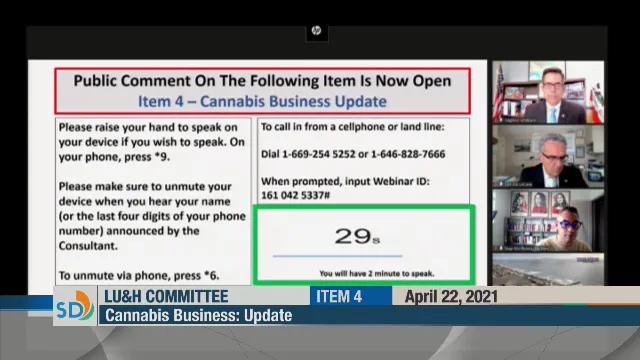
The Land Use and Housing Committee met on April 22, 2021, via Zoom due to executive order 2920. Chair Whitburn presided, with Vice Chair Ila Rivera, Councilmember LaCava, and Councilmember Moreno present. The committee approved consent items, discussed the FY2022 Affordable Housing Fund Annual Plan, and received an informational update on cannabis businesses. Public comment was heard on non-agenda items, the consent agenda, and both agenda items. Consent Calendar - Item 1: Joint use agreement with the City of Chula Vista for the extension of E Street between I-5 and Bay Boulevard over a portion of San Diego's 78‑inch South Metro Interceptor Sewer Pipeline. - Item 2: Ordinance setting aside a portion of dedicated city parkland (Mira Mesa Open Space) for street opening and maintenance in conjunction with the Three Roots project, pursuant to San Diego Charter Section 55. - Both items were approved unanimously. Councilmember LaCava expressed reluctance about giving away parkland but voted yes. Public Comments & Testimony Non‑Agenda Public Comment (before consent agenda): - Kathleen Lippett criticized city leaders for not prioritizing community concerns such as clean air, safe communities, and healthy food, and argued that policies add burdens rather than removing them. - Judy Strang shared concerns from the Barrio Logan Planning Group about air quality from trucks and secondhand smoke (tobacco and marijuana), urging the city to improve air quality in vulnerable communities. - Terry Ann Skelly requested the city remove marijuana billboards, citing Prop 64 restrictions and a judge’s ruling in November 2020. She quoted a student from City Heights who said billboards near schools undermine youth goals. - Catherine Rhodes spoke about the housing element, noting it was only conditionally approved and that the city missed an April 15 deadline to provide more information. She suggested increasing the affordable housing percentage and exploring reservoir development for housing. Public Comment on Consent Agenda: No speakers. Public Comment on Item 3 (Affordable Housing Fund): - Catherine Rhodes argued the city is in non‑compliance because it does not properly report on development fees collected, and criticized the San Diego Housing Commission for not spending available funds, instead holding large balances. She requested that more money be issued immediately in NOFAs rather than held back. Public Comment on Item 4 (Cannabis Businesses): 13 speakers offered varied positions: - Scott Chipman (San Diegans for Safe Neighborhoods) opposed expansion, citing child deaths, addiction, and lack of public health protections. - Phil Raff (United Medical Marijuana Coalition) stated that 50% of cannabis sales are illegal, supported lower production tax rates, and urged reasonable retail growth. - Spencer Andrews (March & Ash) urged smart, data‑informed growth with transparency and community benefit. - Tyler McCormick (high school sophomore) opposed expansion, arguing that cannabis industry advertisements and stores negatively affect youth aspirations and neighborhoods. - Armand King (community leader and patient) supported social equity and argued alcohol is more harmful, with no known cannabis overdose deaths. - Dave DeWal (Torrey Holistics) supported legal industry and noted illegal markets pose health risks from untested products. - Sabrina Alvarado (High Key) supported aligning operating hours with state law (6 a.m. – 10 p.m.), licensing remaining outlets, and lowering the production tax rate. - Alex Scherer emphasized lowering taxes to make production facilities viable, citing competitiveness. - Carrie Jakes (children’s pastor) strongly opposed removing churches from sensitive use status, urged retention of 1,000‑foot buffer. - Carol Green questioned compliance checks, shared personal story of son’s death from cannabis‑induced psychosis, and urged caution. - Barbara Gordon opposed expansion, questioned who is driving the process, and cited scientific evidence of harm. - Will Senn (Urbana) supported lowering production tax to 1–2% to spur investment and tax revenue growth. - Gina Austin (attorney) advocated for relocation opportunities for CUP holders and tax reduction to compete with neighboring cities. - Judy Strang (repeat) argued Prop 64 does not mandate local businesses and that the city should not use Vista/La Mesa ratios due to density differences. - Peggy Walker (public health) expressed outrage, called the presentation a marketing arm for the industry, and cited impacts on youth and addiction. - Jay Bowser (Paving Great Futures) supported social equity, argued against fear‑mongering, and noted CDC states cannabis overdose is extremely unlikely. - Grant Tom (UFCW) supported building good jobs and living wages in the cannabis industry. - Becky Rapp (parent and mentor) opposed removing churches as sensitive uses, shared personal story of family impact. - Dallin Young (Cannabis Chamber of Commerce) supported social equity program, zoning changes, lounges, and lower taxes. Discussion Items Item 3 – Proposed FY2022 Affordable Housing Fund Annual Plan - Staff presented the plan: $64 million available ($7M new collections + $57M fund balance). Proposed allocation of $60.2M across rental housing finance, homeownership, and homeless housing initiatives. Staff requested committee recommendation to council. - Councilmember Moreno expressed strong support for the first‑time homebuyer program and requested a dedicated committee discussion on expanding it. He also asked that the navigation center / homeless response center come to this committee as a standalone item. He moved to approve staff’s recommendation. - Vice Chair Rivera seconded the motion. She asked about community engagement opportunities and the administrative‑cost ratio of new revenue. Rick Gentry (CEO, Housing Commission) provided responses. - Councilmember LaCava asked about how priorities are set, the need to quantify housing targets, the ADU assistance program (answered by Emily Jacobs), and the 11% of funds allocated to homeless housing initiatives rather than building/preserving homes. - All committee members voted yes; motion passed unanimously. Item 4 – Cannabis Businesses Update (Informational) - Staff (led by PJ Fitzgerald, Deputy Director, Cannabis Business Division) presented current state: 40 production CUPs issued (30% operational), 23 retail outlets approved (13 of 36 cap remaining), FY2020 tax revenue $17.3M (FY2021 projected $22.7M). Discussed separation requirements, proposed changes, social equity grant ($75,000 awarded for assessment/program development), illegal market challenges, and national trends. - Chair Whitburn emphasized equity and asked about tools to combat illegal delivery services (Detective Vejita cited staffing needs). He requested a deeper discussion on zoning framework and CUP process. - Vice Chair Rivera supported equity, criticized racist enforcement of prohibition, and asked about permit cap alternatives and tax rate comparisons. - Councilmember LaCava expressed cautious support for targeted regulatory changes, not a broad expansion. He asked about illegal market enforcement and coordination with the county on social equity. - Councilmember Moreno had no questions but thanked staff. - Staff (Elise Lan) confirmed that the equity grant will require policy recommendations to come back to committee and council. Key Outcomes - Consent Agenda (Items 1 & 2) approved unanimously. - Item 3 – Affordable Housing Fund Annual Plan: Motion to recommend council approval of the $60.2M plan and model programs, with authorization to reallocate among programs, passed unanimously. Councilmember Moreno’s request for a future focused discussion on first‑time homebuyer programs was accepted by the chair. - Item 4 – Cannabis Businesses Update: Informational only; no vote taken. The chair directed staff to return with updates on zoning framework, CUP relocation, and tax rate options for production facilities. The cannabis equity program will be brought forward for policy recommendations as part of the grant requirements. - Meeting Adjourned: Next meeting scheduled for June 10, 2021 at 1:00 p.m.