The Audit Committee met virtually to discuss and vote on a new recommendation implementation work plan process, review outstanding audit recommendations, and consider the FY22 budget for the Office of the City Auditor. All agenda items and motions passed unanimously. Consent Calendar - Item 1: Approval of consent agenda. Motion by Vice Chair Lakava, seconded and approved unanimously. Public Comments & Testimony - No members of the public spoke during any of the public comment periods for the consent agenda, discussion items, or the budget item. Discussion Items - Item 2: Recommendation Implementation Work Plan Process – City Auditor Andy Henouse and Industrial Wastewater Control Program Manager Joy Newman presented a proposed process for developing action plans to implement audit recommendations, including a pilot program for the Industrial Wastewater Control Program. The process aims to increase transparency and accountability. Committee members expressed support. Vice Chair Lakava moved to accept the report, seconded by Halburn. Passed unanimously. - Item 3: Recommendation Follow-Up Report – The committee reviewed a report on outstanding audit recommendations (Attachment C). The Mayor's Office, through Deputy Director Matt Yagiagan, expressed support for resolving outstanding recommendations. Chief Compliance Officer Matt Helm acknowledged progress but noted challenges. Committee member Tapshuri led a detailed review of each overdue recommendation, calling on department staff for updates. Staff reported progress on several items, including pay equity analysis, strategic human capital management, and community planning group policy. After the review, a motion was made to accept the report and apply the new implementation work plan process to a list of specific recommendations (as identified by committee members). The motion was seconded and passed unanimously. - Item 4: Office of the City Auditor FY2022 Proposed Budget – Assistant City Auditor Kyle Elser presented the mayor's proposed budget, which included a $91,251 vacancy factor reduction. The audit committee had previously recommended no cuts. Elser requested the committee amend its January 27th motion to recommend restoring the reduction. Committee members spoke in favor, noting that the office had no vacancies and the reduction was counterproductive. Vice Chair Lakava moved to restore the funding, seconded by Halburn. The motion passed unanimously. Key Outcomes - Item 2: The recommendation implementation work plan process report was accepted. The committee will continue to monitor the pilot program. - Item 3: The recommendation follow-up report was accepted. The committee directed that specific outstanding recommendations be subject to the new action plan process (list to be determined by auditors and management). - Item 4: The committee amended its prior recommendation to city council, now requesting restoration of the $91,251 vacancy factor reduction to fully fund the Office of the City Auditor for FY22. - All votes were unanimous (5-0). The next meeting was scheduled for June 9, 2021.
Public Meetings - San Diego, California
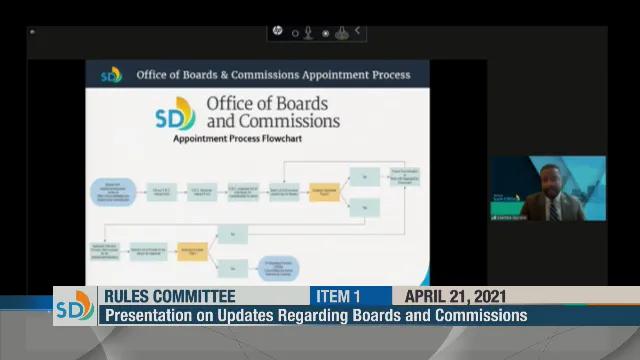
Public Meetings - San Diego, CaliforniaThe San Diego City Council Rules Committee met virtually on April 21, 2021, at 10:00 a.m. The meeting was held via Zoom in accordance with Executive Order 29-20, with no public in attendance. The committee approved the actions from the February 21, 2021 meeting and received an informational update on the state of the city's boards and commissions from Matthew Gordon, Director of Appointments to Boards and Commissions. Public Comments & Testimony - Catherine Rhodes (public comment, non-agenda) recommended that the city put forward an alternative Transient Occupancy Tax (TOT) ordinance during the upcoming recall election of Governor Newsom. She proposed a 3% to 3.5% TOT increase with 50% of revenue directed to homelessness, 20% to affordable housing, and 30% to infrastructure, instead of the current measure that allocates 59% to the convention center, 31% to homelessness, and 10% to road repair. She urged the committee to consider replacing Measure C with a new special tax. - No public speakers were present for the boards and commissions agenda item. Discussion Items - Item 1: Updates regarding boards and commissions – Matthew Gordon presented the work of the Office of Boards and Commissions, created in 2018 after a 2017 audit identified lack of diversity, expired terms/vacancies, and no standard analysis of new boards. The office supports over 40 boards and commissions, including three executive directors for the Citizens Advisory Board on Police Community Relations, the Commission on Gang Prevention and Intervention, and the Commission on Police Practices. Gordon highlighted accomplishments: standardized annual reports, Brown Act training for members, bi-monthly meetings with city staff liaisons, and a streamlined appointment process. Under Mayor Todd Gloria, over 75% of appointees are persons of color, and 30 individuals have been appointed to 15 different boards in the first 100 days. A new ClerkBase system is being implemented (funded in part by PEG funds) to replace Excel spreadsheets, providing a user-friendly website with real-time seat status, member profiles, and appointment history. The system is expected by July 1, 2021. An add-on module for demographic data tracking is planned. Committee members asked about language accessibility, attracting applicants, youth commission revival, and the role of council offices. Gordon committed to consistent communication and noted that an outreach plan is being developed. Key Outcomes - Approved the committee actions from February 21, 2021 (unanimous). - No formal action was taken on the boards and commissions update, as it was informational only. - The next Rules Committee meeting is scheduled for June 9, 2021, at 2:00 p.m.
The Environment Committee of the San Diego City Council met virtually on April 15, 2021, at 9 a.m., pursuant to Executive Order 29-20. The committee unanimously approved minutes from the previous meeting, took non-agenda public comment, and heard a presentation on the City's 2020 Urban Water Management Plan (UWMP) and Water Shortage Contingency Plan (WSCP). It also received informational presentations from the Port of San Diego on the Maritime Clean Air Strategy and the Pond 20 wetland mitigation bank, and from the Edison Electric Institute on investor-owned utilities and energy industry trends. Agenda items 2 and 3 were returned to staff and not heard. Consent Calendar - Unanimously approved the committee actions of March 18, 2021 (motion by Councilmember Lacava, second by Vice Chair Von Wilpert; vote 4-0). Public Comments & Testimony - Non-agenda: Ann Fage, chair of the Community Forest Advisory Board, expressed concern about tree removals due to development, drought, and pests; noted rising costs for removing date palms due to the South American palm weevil; and called for better resources to protect San Diego's urban canopy. - Item 1 (UWMP/WSCP): Lucero Sanchez (San Diego Coastkeeper) commended the revised demand forecast but urged greater stormwater capture and asked how past droughts informed the shortage tiers. Jay Powell (Sustainable Energy Advisory Board) asked about energy intensity and Pure Water's net-zero energy goal. - Item 4 (Maritime Clean Air Strategy): Kyle Heiskala (Environmental Health Coalition) said the draft was not strong enough, requesting 100% zero-emission trucks by 2030 and four zero-emission vehicle charging sites by 2024. Jay Powell suggested partnering with San Diego Community Power and using port sites for microgrids. - Item 6 (Investor-Owned Utilities): Eight speakers (Sonia Robinson, Matthew Vasilakis, Jay Powell, John Stump, Joyce Lane, Heather Hofche, Karina Gonzalez, and Tara Hammond) opposed the IOU model, criticized SDG&E's rates and practices, and urged the committee to pursue a short-term franchise, include a right-to-purchase, and fund a public power feasibility study. Discussion Items - Item 1 – 2020 Urban Water Management Plan and Water Shortage Contingency Plan: Public Utilities Department staff (Director Shauna Laurent and Assistant Deputy Director Kelly Baylow) presented the state-required plan. Key points: pure water phase two will reduce imported water reliance from a historical high of 90% to 40%, with local supplies meeting 60% of demand by 2045; the demand forecast is about 20% lower than the 2015 forecast; total 2045 demand is projected at 228,000 acre-feet per year (12% higher than today); the city has exceeded the state's 20% conservation target, using 102 gallons per capita daily versus the 142 baseline; and the WSCP expands from four to six shortage levels. Councilmember Kate clarified that Pure Water's water-side cost is approximately $1,700 per acre-foot, not the higher figures sometimes cited. The committee voted unanimously to recommend adoption by the full City Council (motion by Councilmember Kate, second by Vice Chair Von Wilpert). - Item 4 – Port of San Diego Maritime Clean Air Strategy (MCAS): Port Chairman and Commissioner Jennifer Lasar presented a discussion draft addressing emissions from cargo terminals, trucks, ships, and tenants. Goals include reducing cargo handling equipment emissions by 50–90% by 2026, developing a zero-emission truck program starting in 2024, achieving zero emissions for fixed short-haul trips by 2031 (four years ahead of state targets), and expanding shore power. The public review period ends April 20, with port board consideration on May 11. Committee members asked about charging infrastructure, Harbor Drive 2.0, and funding coordination. No action was required. - Item 5 – Port of San Diego Wetland Mitigation Bank at Pond 20: The Port described plans to restore an 83.5-acre parcel of the 95-acre former salt evaporation pond into tidal wetlands, creating the first coastal wetland mitigation bank in San Diego Bay. Construction is expected to begin in 2022 and take about 18 months. The estimated construction cost is $30 million, and credit sales could generate roughly $30 million over 10 years for adjacent communities (Council District 8 and Imperial Beach). Committee members asked about timeline, public access, and future lessons. No action was required. - Item 6 – Edison Electric Institute (EEI) on Investor-Owned Utilities: Brad Viatour, EEI Vice President of External Affairs, presented general benefits of IOUs, including lower carbon emissions (45% below 2005 levels), economies of scale, access to cheap capital, and CPUC oversight. He noted that since 2000, of more than 60 communities that considered municipalization, only nine succeeded and two later returned to an IOU. Committee members and public speakers pushed back with concerns about high rates, lack of transparency, and the need for accountability measures such as shorter franchise terms and off-ramps. No action was required. Key Outcomes - Unanimously approved the March 18, 2021 committee actions (4-0). - Recommended approval of the 2020 UWMP/WSCP to the full City Council. - Items 2 and 3 were returned to staff and not heard. - Informational items (4, 5, and 6) required no votes. - The next Environment Committee meeting is scheduled for Friday, May 28, 2021, at 9 a.m.
The Public Safety & Livable Neighborhoods Committee met virtually on April 14, 2021, due to Executive Order 29-20 suspending certain Brown Act requirements. The committee reviewed and approved consent items, heard public testimony on marijuana normalization and police accountability, and discussed four major agenda items: FY2022 HUD entitlement grant allocations, San Diego Police Department officer wellness, the Tech Hire workforce program, and the Urban Area Security Initiative (UASI) grant update. The meeting lasted from approximately 9:00 a.m. to 11:30 a.m. Consent Calendar - Approval of March 10, 2020 committee actions: Moved by Vice Chair Campillo, seconded by Committee Member Whitburn, passed unanimously (3-0). - Item 1 – Bird Rock Maintenance Assessment District Agreement: Approved unanimously (3-0) as part of the consent agenda. Public Comments & Testimony - Non-Agenda Public Comment: - Becky Rapp (parent and youth group mentor): Raised concerns about marijuana use among youth and adults, linking it to mental health crises. Urged the committee to protect the city from normalizing marijuana and to educate about negative effects. - Kathleen Lippitt (parent and educator): Compared the marijuana industry to Big Tobacco, arguing it targets low-income and minority communities under the guise of social justice. Asked the committee to resist legitimizing high-potency marijuana. - Francine Maxwell (NAACP San Diego Branch): Requested public hearings on San Diego Police Department policy changes and outcomes, demanded a transparent investigation of the February 12 shooting of Mr. Penn, and criticized reliance on the Citizens Advisory Board (CAB). Announced a town hall on traffic stops on April 21. - Item 2 Public Comment: - Alexis Villanueva (Senior Program Manager, City Heights CDC): Supported the Community Economic Development NOFA, stressing that communities severely impacted by COVID-19 need recovery funding. - Item 3 Public Comment: - Samantha Jenkins (District 4 constituent, CAB member): Thanked the police department for the wellness presentation and asked for the timeline of the Center for Policing Equity study on SDPD practices. - Items 4 & 5: No public comments. Discussion Items - Item 2 – FY2022 HUD Entitlement Grant Program Allocations & Annual Action Plan: - Staff (Angela Nazareno Clark and Michelle Morano) presented the $28 million+ CDBG budget, $13.8 million HOME program, and $1 million Emergency Solutions Grant. Key allocations included $3.43 million through competitive NOFA, $1.3 million homeless set-aside, $10 million for a first-ever affordable housing NOFA, $7.7 million for city capital improvement projects (e.g., University Avenue Complete Street, Southeastern Mini Park), and continuation of Tech Hire, Connect to Careers, and city mentorship programs. The Consolidated Plan Advisory Board had unanimously recommended approval. - Committee members asked about the affordable housing NOFA (managed by Economic Development, not Housing Commission), extensions due to COVID, and the status of the Cortez Hill Family Center (property sold to Community Housing Works for affordable housing, families moved to Palm Avenue motel). The SMART program at the motel is paused. - Committee voted to recommend City Council approval of actions 1–28 (motion by Vice Chair Campillo, second by Committee Member Whitburn). All voted yes. - Item 3 – San Diego Police Department Officer & Civilian Staff Wellness (Informational): - Assistant Chief Keith Lucas, Captain Bernie Cologne, and Sergeant Edwin Coretti presented the department’s Wellness Unit, established in 2011. It includes 17 contracted therapists, 14 chaplains, over 100 peer supporters, and a 24/7 hotline. In response to COVID-19, a 24-hour hotline was set up for symptom tracking, testing, and contact tracing. The unit provides mindfulness training, the Corticle app, and family support. - Committee members discussed the stigma reduction, budget (estimated $50,000–$100,000 annually), and services for addiction. The unit has two female staff to serve female officers. Committee expressed support and requested a budget line item for future funding. - No vote required. - Item 4 – San Diego Workforce Partnership Tech Hire Program Update (Informational): - Michelle Morano and Kelly Wilkinson reported on the program’s fourth year. Since inception, 797 job seekers served (81% low/moderate income). In FY2021 (with $500,000), 115 enrolled, 66 placed in employment at an average wage of $21/hour. Notable success stories included internship conversions and Microsoft Azure certifications. Proposed FY2022 allocations: $800,000 for Tech Hire (target 132 job seekers), $200,000 for Connect to Careers, and $500,000 for the city mentorship program (from FY2021 carryover). - Committee discussed the cost per participant ($800k for 132 vs. $500k for 115 earlier), the wage increase to $18/hour for internships, and engagement with major employers. About 55% of the budget goes to direct wage subsidies; 76 participants reported no fixed address. - No vote required. - Item 5 – San Diego Urban Area Security Initiative (UASI) Update (Informational): - Megan Beale (Office of Homeland Security) explained the UASI grant, administered by FEMA. San Diego is one of 31 high-risk urban areas eligible. FY2020 allocation was $13.9 million. The grant requires 25% for law enforcement terrorism prevention, a 50% personnel cap, and national priority minimums (e.g., 7.5% for cybersecurity, 7.5% for combating domestic violent extremism in FY2021). The Urban Area Working Group (UAG) had previously operated without public Brown Act meetings, but as of March 11, 2021, the UAG charter was updated to comply with the Brown Act. The first Brown Act-compliant UAG meeting was held March 25. - Committee questioned the risk assessment (THIRA), election security funding (portable bollards for polling places), and transparency. The city of San Diego’s voting member is Fire Chief Colin Stowell. Future council documents will include the list of funded projects. - No vote required. Key Outcomes - Item 2: Committee unanimously recommended City Council approval of all 28 actions for FY2022 HUD entitlement grants, including the annual action plan and funding allocations. The final action plan must be submitted to HUD by May 14, 2021. - Consent Calendar: Both the March 10, 2020 minutes and the Bird Rock Maintenance Assessment District agreement were approved unanimously. - Informational Items: No formal votes were taken on items 3, 4, and 5. Committee members expressed support and requested follow-up briefings on specific topics (e.g., THIRA results, budget for wellness, and updates on the SMART program and Cortez Hill property). - Next Meeting: Scheduled for Wednesday, May 9 a.m. (date not specified in transcript).
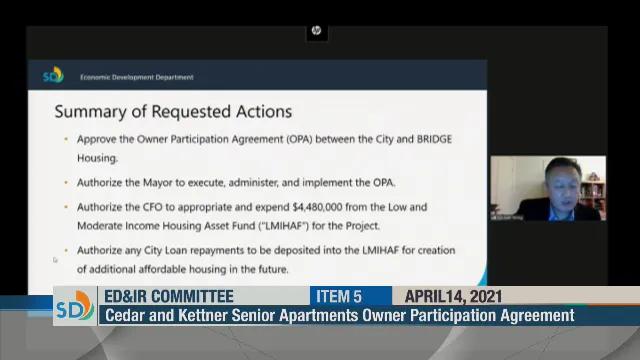
The Economic Development and Intergovernmental Relations Committee met virtually on April 14, 2021, to discuss multiple items including a proposed amendment to remove a public restroom requirement from a downtown development, approval of FY22 Business Improvement District budgets, amendments to affordable housing agreements, and an informational update from the Small Business Advisory Board. The committee took action on consent and discussion items, with several public comments addressing specific agenda items. Consent Calendar - Item 2 – Second Amendment to Software License and Maintenance Agreement with Open Counter Enterprises Inc.: Approved unanimously (4-0). Councilmember Ilo Rivera requested that the forthcoming RFP for San Diego's business portal include language services beyond English and Spanish to improve access for non-English speakers. Public Comments & Testimony - Non-Agenda Public Comments: - Kathleen Lippett expressed concern about a growing monopoly in marijuana business permits, urging the committee to review the concentration of applicants and permittees. - Ben Nichols (Executive Director, Hillcrest Business Association; President, San Diego Small Business Alliance) advocated for full funding of the Economic Development Department in the FY22 budget, noting its critical role during the pandemic. - Jim Schneider (Executive Director, College Area Business District; BID Alliance) supported full funding of the Economic Development Department and highlighted the Storefront Improvement Program as vital for COVID-19 recovery. - Sunny Lee (Executive Director, Discover Pacific Beach; member of the Business Improvement District) praised the Economic Development Department's pandemic response, including outdoor dining expansion and the Small Business Relief Fund, which assisted over 10,500 applicants and awarded nearly $20 million. - Item 1 – First Amendment to Park and Market Disposition and Development Agreement (Portland Loo): - Michelle Woodson (Executive Director, Think Dignity) opposed removing the public restroom requirement, calling it inhumane and a threat to public health during a pandemic. - Jerry Hall (East Village resident) urged rejection, citing the 2017 hepatitis A outbreak that killed 20 San Diegans and noting the developer has not yet opened the required park and plaza. - Genevieve Jones Wright (Executive Director, MOGO) opposed the amendment, highlighting the lack of hygiene resources for unhoused residents and comparing San Diego unfavorably to Vallejo’s recent investment in restroom facilities. - Christine Lopez (District 6 resident) argued that removing restrooms criminalizes homelessness and perpetuates the cycle of homelessness. - Janui (local organizer and academic) called the issue a no-brainer, emphasizing basic human dignity and public health. - Item 3 – FY22 Business Improvement District Budgets: - Rebecca Ribsick (Downtown San Diego Partnership) supported the City Center BID budget, noting BIDs provided vital public health information and outdoor dining activations during the pandemic. - Ben Nichols (Hillcrest Business Association) highlighted that for every dollar the city invests, the Hillcrest BID returns over $5 in services and programs. - Item 6 – Small Business Advisory Board Update: - Austin Evans (Board member) offered brief remarks in support of the board’s presentation. Discussion Items - Item 1 – First Amendment to Park and Market Disposition and Development Agreement (removal of Portland Loo requirement): - Staff requested to withdraw the item for further work. The chair allowed public comment before withdrawal. After public testimony, committee members expressed strong opposition to the amendment. Chair Campillo noted the Portland loo was to provide 24/7 restroom access for homeless individuals. Councilmember Moreno stated she could not support the amendment without equivalent compensation to the city, and suggested the developer should provide an interim restroom until a permanent one opens in East Village Green (2023). Councilmember Ilo Rivera echoed concerns about basic dignity, health risks, and ensuring the city gets a fair deal. The item was withdrawn without a vote; it may return at a future meeting. - Item 3 – FY22 Business Improvement District Budgets: - Staff presented the annual appropriation process for 18 BIDs, with an estimated $1.4 million in assessments collected from 12,000 businesses. Revenue during COVID-19 months initially dropped 35.9% but rebounded 15.9% in subsequent months. The committee approved the recommendation to council unanimously. - Item 4 – Amendment to Agreement Affecting Real Property – Hacienda Townhomes: - Staff requested approval to amend the affordability covenants to align with TCAC rent levels, allowing up to 5% annual rent increases (an additional $32–$64/month) to address $400,000 in critical immediate repairs and position the 52-unit project for comprehensive renovation. Councilmembers raised concerns about the impact on tenants during a pandemic. The developer noted 19 project-based vouchers had been secured to mitigate rent burden. The amendment passed unanimously. - Item 5 – Owner Participation Agreement – Cedar and Kettner Senior Apartments: - Staff presented a $4.48 million city loan (from Low/Moderate Income Housing Asset Fund) to Bridge Housing for construction of a 64-unit senior affordable housing project in Little Italy. The project is shovel-ready; 63 units will be restricted to low- and very low-income seniors for 55 years. The committee approved the recommendation to council unanimously. - Item 6 – Small Business Advisory Board Update (Informational): - Board members Michelle Gray (Chair), Tristan Farnum, and Jim Schneider presented the board’s mission, recent activities, and recommendations. They advocated for full funding of the Economic Development Department in the FY22 budget (particularly the Storefront Improvement Program), improved data collection on business demographics (e.g., using business tax certificates), and highlighted access-to-capital resources. The board will begin submitting formal written recommendations to the mayor and council. Committee members thanked the board and encouraged ongoing collaboration. Key Outcomes - Item 2 approved unanimously (4-0). - Item 1 was withdrawn by staff after public comment; no vote taken. - Item 3 (FY22 BID budgets) approved unanimously with a recommendation to city council. - Item 4 (Hacienda Townhomes amendment) approved unanimously. - Item 5 (Cedar and Kettner Senior Apartments OPA) approved unanimously. - Item 6 was informational; no action taken. - The committee adjourned to the next meeting on Wednesday, May 26, 2021, at 2:00 PM.
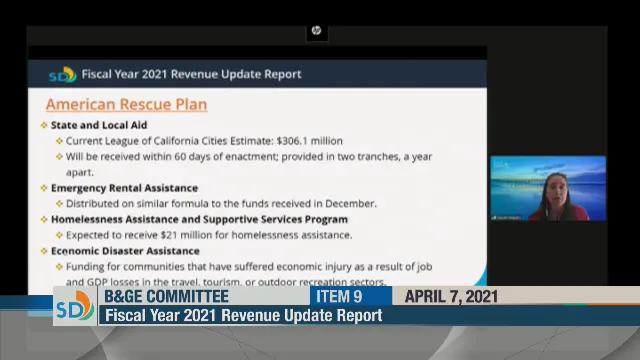
The Budget and Government Efficiency Committee met on April 7, 2021, via Zoom due to the pandemic. The committee approved consent items and discussed several contracts, financial matters, and informational items. All votes on action items were unanimous. Consent Calendar - Approved the committee actions from March 3, 2021. - Approved two consent items: (1) proposed candidate nominating fee, and (2) agreements with Sharp Rees-Stealy Medical Group and Concentra Medical Centers for industrial medicine services. Public Comments & Testimony - Kevin Keppen, Assistant Chief of Finance for Otay Water District, opposed the proposed unitary recycled water rate on item 8, arguing it constitutes an unlawful tax on Otay customers who do not benefit from the North City Water Reclamation Plant. He requested a zonal rate structure. - Michael Dwyer asked whether the staff report on item 8 included combined water and wastewater charges and whether Pure Water Phase One is funded from user fees. Discussion Items Item 3: Authority to Purchase from AMREP Manufacturing - Casey Smith (Director of Fleet Operations) presented a sole-source five-year contract for new and refurbished parts and services for 97 automated sideloaders, with a not-to-exceed amount of $8.43 million. The contract is needed due to proprietary parts and warranty requirements. Councilmember Montgomery Steppe raised concerns about EEO underrepresentations; staff noted AMREP has been notified and will be monitored. Motion passed unanimously. Item 4: Third Amendment to CGI Technologies Agreement - Jonathan Banke (CIO) and Sean K. presented a $21.5 million increase to extend application development and maintenance services through June 2022 during a transition to new contracts. IBA noted expected cost increases in future contracts. CGI Vice President Shauna Patton highlighted local employment, community service, and diversity efforts. Motion passed unanimously. Item 5: Second WIFIA Loan for Pure Water Phase One - Alison Falkenstein (Debt Management) requested authorization for a $95 million EPA loan at an estimated 2.18% interest rate over 34 years, covering 86% of the water system's share of Pure Water costs. The loan is subordinate to existing obligations. Motion passed unanimously. Item 6: Citywide Cooperative Agreements for MRO Items - Claudia Barca (Interim Director of Purchasing) and Angela Arico presented five cooperative contracts for maintenance, repair, and operations items, with a cumulative not-to-exceed $44.4 million over five years. Councilmember Montgomery Steppe requested a cost-benefit analysis and noted EEO underrepresentations. Motion passed unanimously. Item 7: FY2021 Amendment to Airport Fund Budget - Penny Moss (Director of Real Estate) and Jorge Rubio requested $1.52 million from the airport enterprise fund for emergency cleanup after a February 13 aircraft accident ($911,000), operational needs ($337,000), and a master plan amendment ($272,000). IBA confirmed no general fund impact. Motion passed unanimously. Item 8: Wastewater Cost of Service Study and Water Pass-Through (Informational) - Staff from Public Utilities Department presented proposed rate increases: wastewater rates rising 5% in FY22, 4% in FY23-24, and 3% in FY25, with a single-family residential bill increasing from $40 to $48 per month (based on 7 HCF). A water pass-through of 2% is proposed to cover San Diego County Water Authority increases. IBA and Stantec are conducting an independent review. No action taken; item to return in June. Item 9: FY2021 Revenue Update (Informational) - Sarah Mayne (Assistant Director of Finance) reported major general fund revenues increased $8.5 million from mid-year, driven by higher franchise fees ($7 million). Projections incorporate impacts from the pandemic and American Rescue Plan funding ($306 million expected). Convention center operations and reopening guidance were discussed. No action taken. Key Outcomes - All consent and action items (items 3–7) were approved unanimously. - Informational items (8 and 9) received no votes; further presentations are scheduled for May and June.
The Active Transportation and Infrastructure Committee met virtually on April 7, 2021, from approximately 2:00 PM to 4:00 PM to discuss two main agenda items: an adjustment to the Regional Transportation Congestion Improvement Program (RTCIP) fee schedule and an update on the city's street resurfacing program. Items 2 and 3 were returned to staff for further work. Consent Calendar - Approved the committee actions of February 24, 2021, unanimously (4-0). Public Comments & Testimony Non-Agenda Public Comment: - Jonathan Freeman (Safe Walkways) urged the committee to update the ordinance governing motorized scooter rentals, citing 9,500 permits issued in January 2021, over 2,000 Get It Done complaints that month, only 18 scooters impounded (costing $160-$300 each), and a class action lawsuit by Disability Rights California. He argued the current ordinance fails to protect public safety. - Mike Bullock (Oceanside resident) spoke about traffic congestion and induced demand, stating that adding lanes or improving transit will not reduce congestion and that the city's climate action plan must include enforceable measures to reduce vehicle miles traveled. - Janet Rogers (Safe Walkways) echoed support for scooter ordinance updates, including corral-only in-street parking, a curfew, geofencing, and enforcement of state laws. She noted Mayor Gloria's previous support and urged immediate executive action. - Michael Schmidt (resident) complained about poor road conditions in the Rancho Peñasquitos/Carmel Mountain area near Charter 100 shopping center. Public Comment on Item 1 (RTCIP Fee Increase): - No speakers. Public Comment on Item 4 (Street Resurfacing Update): - Noah Harris (Climate Action Campaign) urged that all resurfacing projects include complete street improvements for pedestrians, cyclists, and transit users, and prioritize historically underinvested communities. - Nicole Burgess (District 2 resident) emphasized the need to prioritize overlay projects over slurry seal, integrate Vision Zero goals, and complete the half-built cycle track on West Point Loma (a class IV project that lost funding for the second segment). Discussion Items Item 1: Regional Transportation Congestion Improvement Program (RTCIP) Fiscal Year 2022 Fee Schedule Adjustment - Staff presentation by Angela Beta (Supervising Management Analyst, Planning Department): The TransNet Extension Ordinance requires an annual adjustment of the minimum exaction fee by no less than 2% (based on the Construction Cost Index). SANDAG voted on February 26, 2021, to increase the fee by 2%. The proposed fees are collected at building permit issuance on new residential development (single-family and multi-family), with affordable housing units and ADUs exempt. The city has a two-tiered system. Staff noted there are about 30 active CIP projects using RTCIP funds. - Questions/Comments: - Vice Chair Lakaba asked about how RTCIP funds are acquired and retained (staff confirmed the fees collected in the city stay with the city), how projects are added to the Regional Arterial System list (through CIPRAC and Council Policy 800-14), and whether the Climate Action Plan influences project prioritization. Staff (Scott Mercer, Marco Kumacho) noted that Council Policy 800-14 is being updated to include climate and equity considerations. - Committee Member Montgomery Steppe asked if the program includes landscape architecture (street trees, medians); staff replied eligibility is based on whether the project is part of the Regional Arterial System. - Committee Member Elo Rivera asked about equity scoring; staff replied that eligibility is rules-based, but the upcoming update to Council Policy 800-14 will address equity. Director James Nagelbert confirmed the update will be presented at the next committee meeting. - Chair von Wilpert asked for the Engineering Construction Index adjustment for this year (staff responded it was 0.3% for Los Angeles, less than 2%), total RTCIP revenue (approximately $5.6 million collected in FY21 to date, consistent with the five-year average), and examples of transit-oriented projects (staff cited the University Avenue Mobility Project and noted RTCIP funds can be used for bike and transit projects). - Outcome: The committee unanimously recommended approval of the 2% fee increase (motion by Vice Chair Lakaba, second by Montgomery Steppe). Item 4: Street Resurfacing Program Update (Informational Only) - Staff presentation by Christy Reeser (Engineering and Capital Projects) and Mark Nissar: Overview of pavement types (90% asphalt, 10% concrete), the Overall Condition Index (OCI) scoring system (0-100), repair types (pothole patching, slurry seal, overlay/inlay, concrete panel replacement), costs ($130,000/mile for slurry seal, $780,000 for overlay, $1.5 million for concrete replacement, $6-7 million for reconstruction), and the city's pavement management strategy to maintain an average OCI of 70. They showed historical repair mileage (2011-2020) and OCI by council district (2015/2016). They discussed the bundling of street repairs with subsurface utility work using an enterprise asset management system and the upcoming update to Council Policy 800-14 for prioritization (inclusion of equity and climate). - Questions/Comments: - Vice Chair Lakaba asked about the need for a new citywide condition assessment (last done in 2015/2016; cost about $500,000); staff supported doing another assessment. He asked about useful life of slurry seal (3-7 years), effectiveness of the street preservation ordinance (moratorium on trenching after slurry/paving), and street damage fees (not yet cost-recoverable). He noted that streets already in good condition sometimes get resurfaced again due to preventive maintenance or contractor warranty failures. He advocated for complete streets and protected bike lanes. - Committee Member Montgomery Steppe noted that District 4 has the lowest historical repair mileage and stressed the need for equitable funding, especially for overlay on older streets. She asked about unimproved roads and how they fit into the network (they are not assessed if unpaved but can be funded via new Council Policy 200-01). She requested data on specific OCI scores and better understanding of the scoring ranges. - Committee Member Elo Rivera emphasized the need for more resources to address underfunded infrastructure and supported equity-focused prioritization. - Chair von Wilpert asked about funding sources (RMRA, gas tax, TransNet), whether resurfacing contracts include restriping for bike lanes (yes, coordinated with Transportation Engineering), and why some planned street repairs were removed (staff noted coordination with SDG&E gas line work and transition to bundled projects). She urged support for a new OCI assessment in the budget and asked for tips on using the Get It Done app (accurate location and photos including surroundings). - No vote taken (informational item). Items Returned to Staff - Item 2: (No details provided; required more time to work with MEA on consultant duration.) - Item 3: (Contract extension and change order for road repair; ordinance terms did not match change order; staff will refine and return.) Key Outcomes - Consent Calendar: Approved unanimously. - Item 1: Unanimous recommendation to the full City Council to approve the 2% increase to the RTCIP fee schedule for FY2022, effective July 1, 2021. - Item 4: Informational only; no action taken. Staff will bring an update to Council Policy 800-14 (prioritization criteria including equity and climate) to the next committee meeting (May 19, 2021). - Next Meeting: Scheduled for Wednesday, May 19, 2021, at 2:00 PM.
The San Diego City Council Environment Committee met virtually on March 18, 2021, from approximately 9:00 AM to 12:00 PM, via Zoom due to Executive Order 29-20. The meeting covered five agenda items, including the 2020 Climate Action Plan (CAP) Annual Report, a performance audit of the CAP, a naming opportunity program for Balboa Park's Botanical Building, a software agreement for the My Water SD portal, and a presentation on equitable park access. The committee also acknowledged recent violence against the Asian American and Pacific Islander community. Consent Calendar - Approved the committee actions of March 4, 2021, by a vote of 4-0. Public Comments & Testimony - Robin Davidoff (Sierra Club/SEAL Society) urged the committee to address sea lion harassment at Point La Jolla and Boomers Beach, requesting a future agenda item to discuss solutions. - On the CAP Annual Report (Item 4), multiple speakers expressed support but noted the city is not on track to meet its goals: - Joyce Lane (San Diego 350, Building Electrification Coalition) thanked the city and supported a regional climate authority. - Malika Marsten (Climate Action Campaign) called for a detailed transportation roadmap, a CAP five-year outlook, a grant writer, and increased funding for sustainability. - Ann Fege (Community Forest Advisory Board) emphasized equitable tree canopy investments and underfunding of urban forestry. - Sheila Ott (Hammond Climate Solutions) supported the climate equity index. - Kelly McCormick highlighted the carbon footprint of indoor marijuana cultivation and urged transparency. - Melissa Elder (Sunrise Movement San Diego) stressed bold actions in CAP 2.0 and holding departments accountable. - Other speakers (Scott Anglin technical issues, a caller on border pollution and rail) also testified. - On the CAP audit (Item 1), speakers agreed with findings: - Malika Marsten (Climate Action Campaign) urged accelerated timelines and mayor's office leadership. - Joyce Lane (San Diego 350) supported recommendations and called for a five-year outlook. - Kyle Haskala (Environmental Health Coalition) requested equity-focused prioritization and a grant writer. - Ann Fege gave examples of poor inter-departmental coordination. - Victoria Morales (Climate Action Campaign) and Sheila Ott also supported the recommendations and building electrification. - On the Balboa Park naming program (Item 2), both speakers supported: - Jen Davies (San Diego Tourism Authority) supported approval. - John Bolthouse (Friends of Balboa Park) endorsed the proposal. - On the My Water SD agreement (Item 3), no public comment was received. - On the Parks for Everyone report (Item 5), speakers supported: - Joy Sanyata praised the report and noted the upcoming Parks Master Plan and an audit on program equity. - Randy Torres Van Vleck (City Heights CDC) shared a story about transit access to the beach and encouraged using the report's data. Discussion Items - Item 4 (Information): 2020 Climate Action Plan Annual Report - Staff (Eric Caldwell, Ashley Rosia Tremonte, Scott Anders) presented the fifth annual report. Key points: total emissions at 0.6 million metric tons CO2e; on-road transportation is 55% of emissions; energy category is 40%. Progress included the launch of San Diego Community Power, a benchmarking ordinance with 48% compliance, 96 electric vehicles in city fleet, 47.3 miles of bike lanes added, and methane capture at 99.9% at Point Loma. A change in renewable energy data methodology was discussed. CAP 2.0 planning includes a climate equity index and targeted engagement. - Item 1 (Discussion): Performance Audit of the Climate Action Plan - City Auditor Andy Hanau and team presented findings: oversight mechanisms are weak; lack of department accountability; sustainability roundtables held only 13 times from 2015-2020; no cost estimates or formal prioritization; CAP annual report only goes to committee, not full council. Six recommendations were made, all accepted by the sustainability department. - Item 2 (Discussion): Balboa Park Botanical Building and Gardens Restoration Naming Program - Parks and Recreation Director Andy Field proposed a donor recognition program for 15 specific sites (e.g., welcome gallery, gardens, pergola) after Phase 1 restoration (funded by state grant, completion in 2023). Phase 2 would be philanthropically funded. The proposal had prior approvals from the Balboa Park Committee and Park and Recreation Board. - Item 3 (Discussion): My Water SD Software Agreement - Staff requested a five-year, $16.3 million sole-source agreement with Smart Energy Water for the web portal and mobile app. Licensing fees total $1.2 million; the bulk of cost is credit card processing fees (currently utility-paid). Three payment options exist: utility-paid, customer-paid convenience fee, or in-house processing. - Item 5 (Information): San Diego Foundation Parks for Everyone 2020 Report - Everett and Les (Outdoor Outreach) presented findings: equitable park access remains a problem, with physical and functional barriers (transportation, fees, safety, cultural inclusion). The report recommends increasing green space, improving transit access, and streamlining permitting for community-based organizations. The city's Parks Master Plan update, Climate Action Plan, and Climate Equity Fund are opportunities to address gaps. Key Outcomes - Item 4: Informational only; no action required. - Item 1: Motion by Vice Chair Von Wilpert to accept the audit report and forward it to the full City Council. Passed 4-0. - Item 2: Motion by Vice Chair Von Wilpert to advance the naming opportunity program to the City Council. Passed 4-0. - Item 3: Motion by Councilmember Kate to approve the five-year agreement with Smart Energy Water. Passed 3-1, with Councilmember Lacaba dissenting, citing a preference for switching to the customer-paid convenience fee model immediately. - Item 5: Informational only; no action required. Next Meeting: Thursday, April 15, 2021, at 1:00 PM.
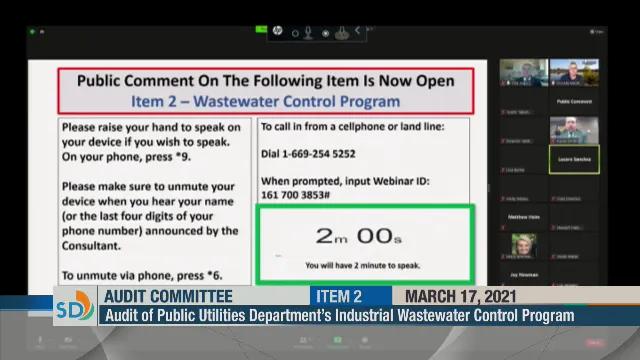
The Audit Committee of the City of San Diego met virtually on March 17, 2021, due to the COVID-19 pandemic. The meeting was live-streamed and public comment was accepted via Zoom. All committee members were present (Vice Chair Locava, members Halburn, Tapsuri, Valdivia, and Chair Moreno). The agenda included approval of prior minutes, a report on internal financial controls, a performance audit of the Industrial Wastewater Control Program (Part 2), and the City Auditor's monthly activity report. Consent Calendar - The committee unanimously approved the committee action of February 24, 2021. Public Comments & Testimony - Non-Agenda Public Comment: No speakers. - Item 1 (Internal Financial Controls): Joy Sonata (District 3) commended the report and requested that upcoming budget hearings include clarity on city service levels by department. - Item 2 (Industrial Wastewater Audit): Lucero Sanchez, representing San Diego Coastkeeper, urged acceptance and forwarding of all recommendations, emphasizing the importance of ensuring unpermitted entities are covered and inspected. - Item 3 (Auditor's Monthly Activity Report): Joy Sonata asked whether the planned parks and recreation audit would begin before or after the updated parks master plan. Discussion Items Item 1: 2020 Annual Report on Internal Financial Controls Rolanda Travell, Director of Finance, and Jeff Peel, Assistant Director, presented the report. They explained the COSO framework, the city's internal control program, and highlighted 2020 accomplishments: pandemic risk response (remote work software, increased remote access), a clean audit opinion for FY2020 CAFR with no material weaknesses, creation of a risk oversight committee, and implementation of a formal materiality threshold policy for complex or large transactions. The Independent Budget Analyst (IBA) asked about the materiality policy, and staff detailed its risk-based approach. Committee members praised the work and emphasized continuous improvement. A motion by Vice Chair Locava to accept and forward the report to City Council as an information item passed unanimously. Item 2: Performance Audit of the Public Utilities Department – Industrial Wastewater Control Program (Part 2) City Auditor Andy Hanao, along with principal performance auditor Luisa Brezeno and performance auditor Shadi Mittar, presented the audit. Key findings: The Industrial Wastewater Control Program (IWCP) uses outdated methods (including the phone book) to identify industrial users; a comparison to county business data found that 58% of businesses in select categories were not in the city’s permit database, suggesting potentially hundreds of unregulated businesses. For Significant Industrial Users (SIUs), inspections occur on average every 12.7 months, while non-SIUs are inspected only every 5.9 years. Permit processing for non-SIUs averaged 6.5 months, and 12% of industrial users operated with expired permits (some for over five years). The audit made seven recommendations, including modernizing identification methods (e.g., using county data, adding IWCP permits to the city’s Open Counter portal), setting target inspection frequencies, monitoring performance, and conducting a staffing analysis. Public Utilities Department (PUD) Director Shauna Laurence and Program Manager Joy Newman agreed with all recommendations, noting that the program had already added six new positions and was working on improvements. IBA asked about implementation timelines. Committee members expressed support, with some criticizing past management and emphasizing the need for urgency. Vice Chair Locava moved to accept and forward the report to City Council as an information item. Chair Moreno added an amendment to also present the findings to the Environment Committee, which was accepted by the mover and seconder (Committee Member Tapsuri). The motion passed unanimously. Item 3: City Auditor’s Monthly Activity Report (Informational) Andy Hanao reported on the Office of the City Auditor’s activities since the last meeting: one audit report issued (IWCP Part 2), four audits in fieldwork (real estate assets, IT service delivery, CARES Act funding, Mission Bay fund), one in planning (user fees), and ten not started. Ongoing initiatives include recommendation implementation work plans, seeking independent legal counsel, and updating report templates. No action was taken on this informational item. Key Outcomes - Approved the February 24, 2021 committee action (unanimous). - Forwarded the 2020 Internal Financial Controls report to City Council as an information item (unanimous). - Forwarded the Industrial Wastewater Control Program performance audit to City Council as an information item, with a directive to also present it to the Environment Committee (unanimous). - No action on the City Auditor’s Monthly Activity Report. - The next audit committee meeting is scheduled for Wednesday, April 21, 2021, at 9:00 a.m.
The Land Use and Housing Committee of the San Diego City Council met on Friday, March 12, 2021, via Zoom. The meeting was called to order in the afternoon. Members present: Vice Chair Ila Rivera, Councilmember LaCava, Councilmember Moreno, and Chair Whitburn. The committee unanimously approved the consent agenda and a discussion item regarding a lease at Montgomery Gibbs Executive Airport. An informational presentation on accessory dwelling units (ADUs) was also heard. Consent Calendar - Item 1: Lease agreement between the San Diego Housing Commission and the City of San Diego for space at 1122 Broadway in downtown San Diego. The item was initially described incorrectly as 9370 Chesapeake Drive but was corrected. Councilmember LaCava inquired about parking validation and transit fare reimbursement; staff indicated they would follow up. The consent agenda was approved unanimously (4-0). Public Comments & Testimony - Non-agenda public comment: Joey Signata, a member of the public, spoke about the importance of parks in communities, citing examples of downtown parks that are failing. He emphasized that parks are essential services comparable to water and sewer. - No public comment was received on the consent agenda or the discussion item. Discussion Items - Item 2: Flat rate lease agreement with MYF Properties LLC (doing business as Executive Airport) for 26.2 acres of aviation-designated land at Montgomery Gibbs Executive Airport. The requested action was to authorize a 40-year lease. Presenter Jorge Rubio, Deputy Director for City Airports, provided an overview of the site and proposed redevelopment. Councilmember LaCava asked about the relationship to the airport master plan (update expected in 2022) and about sustainable aviation fuel (SAF) opportunities. Staff noted the project is within the planned master plan and that SAF infrastructure could be included. The motion to approve the resolution passed unanimously (4-0). - Item 3: Informational presentation on accessory dwelling units (ADUs) by Gary Giler, Assistant Director of Development Services. Key statistics: ADU applications rose from 16 in 2015 to 797 in 2020; permits issued increased from 1 in 2016 to 288 in 2018 and 575 in 2020. Discussion covered regulations, financing challenges for low-income homeowners, coordination with short-term rental policies, and maximum occupancy rules. Councilmembers raised concerns about equity and potential for ADU financing assistance programs like Santa Rosa’s $40,000 grant. No action was taken. Key Outcomes - Unanimous approval of consent agenda (Item 1). - Unanimous approval of resolution authorizing the mayor to execute a 40-year lease with MYF Properties for 26.2 acres at Montgomery Gibbs Executive Airport (Item 2). - Informational item on ADUs received and discussed; no vote. - Staff to provide follow-up information on parking validation/transit fare reimbursement for the Housing Commission lease.