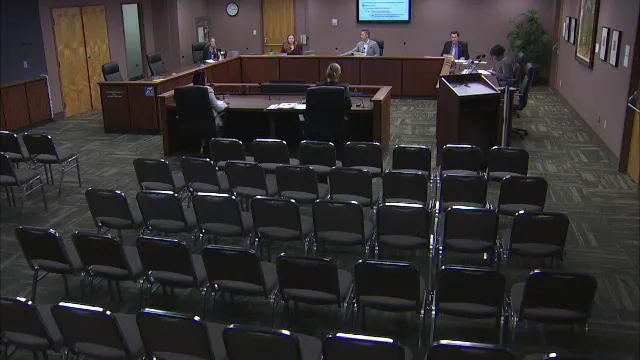
The Public Safety and Livable Neighborhoods Committee of the San Diego City Council met on Wednesday, July 15, 2020. Under Executive Order N-29-20, the meeting was conducted with some members participating via teleconference and public comment taken by phone. Committee members present included Chair Councilmember Monica Montgomery, Council President Pro Tem (Vice Chair) Barbara Bree, Councilmember Kate, and Councilmember Moreno. Staff present included Deputy City Attorney Paige Fultman, Conrad Ware from the Mayor's Office, and Baku Patel from the Independent Budget Analyst Office. The agenda included a consent item, two proposed surveillance technology ordinances, a comprehensive parks master plan, and a fire-rescue COVID-19 response briefing. Consent Calendar - Item 1 – Building 191 Concession Agreement (Naval Training Center Park): The committee unanimously approved a concession agreement with the San Diego County Bicycle Coalition to renovate Building 191 as a community bike center. Public commenters Richard Opper and Andy Henshaw (San Diego County Bicycle Coalition) spoke in support. Motion by Councilmember Moreno, seconded by Councilmember Kate; passed 4–0. Public Comments & Non-Agenda Testimony - Barbara Gordon expressed concern about proposed changes to marijuana business permitting (process three to process two), stating it would reduce public input and eliminate an appeal level. - Kathleen Lippett, speaking for concerned community members, criticized municipal code changes adopted by City Council the previous day, saying marijuana businesses were seeking to expand into vulnerable neighborhoods. - Francine Maxwell, president of the San Diego NAACP branch, requested that the committee send a letter to the Mayor's office to encourage training and appointments for boards and commissions, especially for newly engaged community members. - Kelly McCormick objected to the 12th update to the Land Development Code, alleging substantive changes were made without public input and would reduce transparency for marijuana businesses. - Terry Shearson asked the committee to reconsider the third municipal code change regarding distance measurement from marijuana businesses to residential property lines, noting the Planning Commission did not support that change. Discussion Item: Surveillance Technology and Privacy Commission - Trust SD Coalition members Lily Irani (UCSD associate professor) and Homaira Yusufi (PANA deputy director) presented two proposed ordinances: a "Transparent and Responsible Use of Surveillance Technology" ordinance and a "Privacy Advisory Commission" ordinance. They argued the ordinances would create a structured process for evaluating surveillance technology, require community input, minimize fiscal risks, and protect civil liberties. - Many public speakers, representing organizations including Defund School Police SD, Climate Action Campaign, League of Women Voters of San Diego, San Diego Progressive Democratic Club, PANA, and others, voiced support for both ordinances. - Deputy City Attorney Paige Fultman noted that legal review would be required and that state labor law might require meet-and-confer with employee organizations if the ordinance affects terms and conditions of employment. - Councilmember Kate raised questions about definitions, emergency exceptions, and retroactive application. She said she would provide a memo detailing concerns. - Chair Montgomery made two motions: (1) direct the City Attorney to prepare the surveillance ordinance for full Council consideration (including meet-and-confer if required); and (2) direct the committee consultant, Office of Boards and Commissions, and City Attorney to draft a privacy advisory committee ordinance and forward it to the Rules Committee. Both motions passed unanimously (4–0). Discussion Item: Complete Communities Play Everywhere – Parks Master Plan - Planning Department staff (Heidi Von Blum, Jonathan Avila) presented a comprehensive parks master plan proposing a shift from an acreage-based standard (2.8 acres per 1,000 residents) to a "recreational value" standard (12 points per 1,000 residents), a 10-20-30-40 minute access goal (10-minute walk, 20-minute bike, 30-minute transit, with at least 40 minutes of enjoyable use), and a new citywide park development impact fee. - Staff noted that under the current system, only 5% of park development impact fees have been spent in "communities of concern" (areas identified by the Climate Equity Index as low-access). Existing fees range from $600 to $30,000 per unit depending on community. The proposed citywide fee would pool funds to build parks across the city. Four fee options were presented. - Public comment was divided: supporters included the Mission Bay Park Committee and Mobility Board chairs; opponents and critics included the Community Planners Committee chair (Wally Wolfeck) and several planning group chairs, who said the plan was being rushed, lacked input from community planning groups, undervalued park acreage, and had unresolved CEQA implications. Several speakers asked for an extended public review period. - Councilmember Kate made a motion to forward the plan to full City Council without a recommendation, with requests that staff provide a redlined version of changes and further analyze how funds would be allocated, especially in districts with large planned growth. The motion passed unanimously (4–0), though Vice Chair Bree said she voted reluctantly and asked for extended public review. Discussion Item: Fire-Rescue COVID-19 Response - Fire Chief Colin Stoll and Deputy Chief Stephen Lozano presented a detailed timeline of SDFD's COVID-19 response, including standing up an Incident Management Team (60 personnel), establishing health screening and designated infection control officer protocols, procuring PPE, and creating a COVID division (9 personnel). - Key statistics: N95 mask inventory grew from 815 to 22,000 (20,000 more on order); surgical masks 150,000; gowns from 36 to 5,600. Voluntary asymptomatic testing of 811 personnel found one positive case. The city of San Diego had 10,000 positive cases, roughly 46–49% of the county's 20,000 cases. As of the report, fire personnel in isolation: 6, lifeguards: 9, non-sworn: 2. - Chief Stoll expressed concerns about community spread among off-duty personnel, a recent county change to quarantine definitions, and wildfire season. No formal action was taken; the item was informational. Councilmembers thanked the chiefs and asked about testing, call volume, and academy impacts. Key Outcomes - Consent item (Building 191 concession) approved unanimously. - Motion to forward the surveillance ordinance to full Council approved unanimously. - Motion to draft and forward the Privacy Advisory Commission ordinance to the Rules Committee approved unanimously. - Parks Master Plan and related general plan amendment/development fee moved to full City Council without recommendation, approved unanimously. - Fire-Rescue COVID-19 update received; no motion or vote.
Public Meetings - San Diego, California
Public Meetings - San Diego, CaliforniaThe Economic Development and Intergovernmental Relations Committee met on Wednesday, July 15, 2020, beginning at 10:00 AM PDT. The meeting was conducted with remote participation due to COVID-19. The committee approved consent items, discussed four substantive agenda items (including a computer donation partnership, a property disposition for affordable housing, a loan modification, and received updates on state affairs and the small business relief fund), and passed all action items unanimously. Consent Calendar - Item 1: Compensation Agreement for Park Boulevard at Grade Crossing, Downtown Wayfinding Signage, and Imperial Avenue Streetscape Improvements Projects - The consent agenda included these three projects. Public comments included opposition from Nicole Burgess (Mobility Board) who called the Park Boulevard project a "monster project" and urged re-evaluation; Joy Sanyata requested the item be pulled for discussion but ultimately it remained on consent; and Marshall Anderson (Downtown San Diego Partnership) expressed support. Councilmembers Montgomery and Ward commented on the long-awaited improvements. The consent calendar was approved unanimously. Public Comments & Testimony - Nicole Burgess (Mobility Board) opposed the Park Boulevard at Grade Crossing project, calling it a "six-lane corridor" inappropriate for the area. - Joy Sanyata asked to pull the consent item for presentation but later deferred to the chair; on Item 2 she praised the "modernize and evolve" approach; on Item 3 she urged "realistic and equitable" affordable housing; on Item 4 she supported the loan modification; on Item 5 she thanked the state affairs team. - Marshall Anderson (Downtown San Diego Partnership) supported the consent items and Item 3 (Kilroy ENA). - Cassandra Lineline (Cox Communications) supported Item 2, commending the partnership with San Diego Futures Foundation. - Jesse Stein (Voices for Children) supported Item 2, noting foster youth received computers. - Sarah Cooper (League of Amazing Programs) supported Item 2, citing 160 children unable to join online classes without computers. - Ariel Hughjar (business owner) supported Item 3, praising Kilroy's support. - Rebecca Lieberman (San Diego Regional Chamber of Commerce) supported Item 3. - Maya Roth (Circulate San Diego) supported Item 3, noting the project's mobility certification. - Martha Welch (public) spoke on Items 3 and 5, expressing concerns about empty downtown towers and county issues. - John Straw (East Village Association) supported Item 3. Discussion Items Item 2: Approval of Ordinance to Donate End-of-Life Computers to San Diego Futures Foundation Jonathan Banke (CIO) and Jen LeBron (Digital Strategy Manager) presented the proposal to bridge the digital divide by donating the city's retired computers (about 800 per year) to the San Diego Futures Foundation for refurbishment and distribution to low-income residents, students, veterans, and others. The foundation provides Windows 10 and Microsoft Office licenses, training, and a one-year warranty. The service is provided at no cost to the city. Councilmember Montgomery asked about outreach and training; Councilmember Ward asked about recipient criteria and requested a report back. The committee voted unanimously to approve the ordinance. Item 3: Popular Market Site Disposition – Kilroy Realty Corporation Christina Bibler (Director of Economic Development) presented options for the city-owned 20,000 sq. ft. parcel at Broadway and 13th Street, constrained by a fault line. Kilroy Realty, owner of the adjacent 40,000 sq. ft. block, proposed to acquire the site for integration into a 600,000+ sq. ft. office project. Three options were presented: (1) sale at premium to market value ($7-8M appraised), with proceeds deposited into the Low/Mod Income Housing Asset Fund to create 60-80 affordable units; (2) land swap; (3) partnership with an affordable housing developer. Kaiser Marston analysis showed standalone development would yield fewer affordable units and require subsidies. Councilmember Ward moved to enter into an exclusive negotiating agreement (ENA) with Kilroy, with proceeds from a sale transferred to the San Diego Housing Commission for affordable housing creation. The motion was seconded by Vice Chair Montgomery and passed unanimously. Councilmembers noted the option would produce affordable units faster than alternatives. Item 4: Modification of Loan Documents for 900 F Street Partners LP Monica Hardman (Assistant Deputy Director) presented a loan modification for a 115-unit affordable housing project (86 affordable units) built in 2002. The developer requested: reduction of interest rate from 6.75% to 3%, conversion to a fixed amortized loan ($183,000/year), and no forgiveness of accrued interest. In exchange, the affordability restrictions would be extended 10 years to 2061. The committee approved the modification unanimously, with Councilmember Ward praising the extended affordability. Item 5: 2020 State Affairs Update (Informational) Adrian Granda (Government Affairs), Moira Tope, and Nick Garcia provided an update on state legislative and budget activities. Key topics: COVID-19 impact on legislative schedule, the state budget ($54.3B deficit), federal funding triggers, housing and homelessness funding ($550M for Project Homekey), CEQA streamlining bills (SB 995), and police reform legislation (AB 1196). The presentation was for information only; no vote was taken. Item 6: Small Business Relief Fund Informational Update Christina Bibler reported on the Small Business Relief Fund launched March 24, 2020. As of July 14, 2020: 10,232 unique applications received, 804 awards distributed, totaling $7.1 million across five funding sources (CDBG, EDA, former enterprise zone funds, private donations, CARES Act). The program has supported 3,837 jobs, with an average business size of 5.1 FTEs. 60% of awards went to low- and moderate-income areas. Updates included expanded eligibility to sole proprietors and independent contractors. The committee received the report for information. Key Outcomes - Consent Calendar (Item 1): Approved unanimously. - Item 2 (Computer Donation): Ordinance approved unanimously. - Item 3 (Popular Market Site): Committee directed staff to enter into an ENA with Kilroy Realty, with proceeds to be used for affordable housing via the Housing Commission. Approved unanimously. - Item 4 (900 F Street Loan Modification): Approved unanimously. - Items 5 & 6: Received as informational; no action taken. - Next Meeting: Scheduled for Wednesday, September 9, 2020, at 2:00 PM.
The Land Use and Housing Committee held a special meeting on June 24, 2020, from 10:00 AM (Pacific) via teleconference due to the COVID-19 pandemic. The agenda included two major items: the San Diego Affordable Housing Preservation Study and the Complete Communities Housing Solutions and Mobility Choices Initiative. The committee voted unanimously on the preservation study and forwarded the complete communities package to the City Council without recommendation by a 3-1 vote. Consent Calendar - The committee unanimously approved the amendments from the committee record of actions of February 27, 2020. Public Comments & Testimony - Non-Agenda Public Comment: Callers addressed the SDSU Mission Valley project land cost and the need for greater tenant protections and stakeholder involvement for homeless voices. - Item 1 – Affordable Housing Preservation Study: Eight callers spoke. Matthew Vostalakis (Climate Action Campaign) expressed support for preservation and anti-displacement policies. Joe Waneo (350 San Diego) urged increasing very low-income units in disadvantaged communities. Laura Nunn (San Diego Housing Federation) supported the recommendations, especially redirecting redevelopment funds. Joy Sanyata emphasized preservation, tenant protections, and collaboration. Other callers urged implementation and incorporation into the Complete Communities initiative. - Item 2 – Complete Communities Housing Solutions and Mobility Choices: 31 callers testified. Supporters included David Allen (developer), Brian Rivelli (small-scale developer), Colleen Clemenson (SANDAG), Lindsay Jakes (Circulate San Diego), Marcella Escobar Eck (planning professional), Andy Hanshaw (Bike Coalition), Kyle Haskela (Bike SD), Kevin Hastings (Ocean Beach planner – opposed), Rebecca Lieberman (Chamber of Commerce), Laura Nunn (Housing Federation), Neil Hayton (Hex Solberg – concerns about R&D classification), Carter Rubin (NRDC), and Sean Van Diver (homeowner). Opponents and critics included Julie Corralis (Barrio Logan – need 40% affordable), Andre Schlagter (off-site affordable units creates inequality), Linda Lawrence (maintain 30-ft height limit in Ocean Beach), Tom Mullaney (base zoning affordable calculation flawed), Howard Wayne (spot zoning delegation), and Wally Wolfe (Community Planners Committee – insufficient outreach). Many callers urged doubling affordable requirements in disadvantaged communities and addressing displacement risks. Discussion Items - Item 1: San Diego Affordable Housing Preservation Study – Presented by Suket Thyal, Wendy DeWitt, and Marcus Sproul of the San Diego Housing Commission. The study analyzed the city's multifamily rental inventory: 555,000 total housing units, half renter-occupied; 164,000 multifamily rental units, 14% (23,000) deed-restricted, 86% unrestricted; 47,000 units are naturally occurring affordable housing (NOAH). There is a gap of 47,000 units for households earning ≤50% of area median income (AMI). Trends show a loss of unrestricted affordable units: from 92,000 in 2000 to 26,000 in 2020, projected to 9,000 by 2040. Preserving all 13,450 at-risk units over 20 years would require $86 million per year in gap funding, leveraging $400 million annually for 672 units/year. The strategy framework includes 10 recommendations in four categories: capital resources, preservation policies, tenant protections, and capacity building. The Independent Budget Analyst noted that redirecting redevelopment funds (boomerang funds) would reduce general fund revenue. Councilmember Sherman requested a presentation on incentive programs (recommendation 5) by September. Councilmember Kercy raised concerns about the condition of SROs and the need for minimum standards. Chair Ward directed staff to return with implementation strategies for recommendations 2, 4, 5, and 6 (SRO ordinance) at future meetings. The motion passed unanimously. - Item 2: Complete Communities Housing Solutions and Mobility Choices Initiative – Presented by Heidi Von Blum, Brian Schoenfish, and Mike Hansen. The initiative has two components: Mobility Choices (compliance with SB 743) and Housing Solutions (voluntary opt-in affordable housing program). Housing Solutions requires 20% affordable units (10% low-income, 10% up to 120% AMI), uses floor area ratio (FAR) based density (4.0 in coastal zone, 8.0 elsewhere, unlimited downtown), includes anti-displacement measures, a neighborhood enhancement fee, and design standards. Mobility Choices establishes four mobility zones based on VMT efficiency, with streamlined review for zones 1-3 and an active transportation in-lieu fee for zone 4. At least 50% of funds must be spent in communities of concern. The deadline for adopting VMT metrics is July 1, 2020. The programmatic EIR covers both components. Discussion focused on the affordability levels, fee calculator accuracy, impact on zone 4, coastal height limit preservation, prevailing wage, community outreach, and bifurcation concerns. Councilmember Kercy expressed concern about the in-lieu fee being too high and proposed a friendly amendment to return the fee for further analysis, but it was not adopted. Councilmember Campbell requested more information on the fee calculator and coastal height limit. The committee voted 3-1 to forward the item to the City Council without recommendation, with direction to staff to continue working with stakeholders. Key Outcomes - Preservation Study: Motion approved unanimously to direct the San Diego Housing Commission to return to the committee in July with the SRO ordinance policy draft and in September with detailed implementation strategies for recommendations 2, 4, and 5 (redevelopment funds, preservation ordinance, incentive programs). - Complete Communities: Motion to forward to City Council without recommendation passed 3-1 (Chair Ward, Councilmember Sherman, Councilmember Campbell in favor; Councilmember Kercy opposed). Staff will continue stakeholder engagement and refine the fee calculator and other provisions before council consideration. - The next Land Use and Housing Committee meeting is scheduled for July 16, 2020, at 1:00 PM.
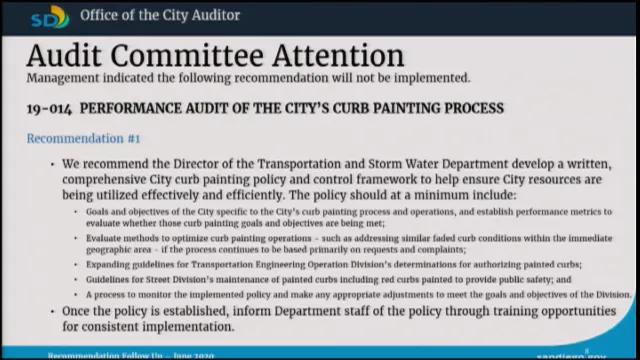
The San Diego Audit Committee met on Wednesday, June 17, 2020, via teleconference due to the COVID-19 pandemic. The committee discussed and acted on several audits, including the recruitment process for a new City Auditor, a performance audit of the city's public liability management, and audits of the Mission Bay and Regional Parks Improvement Funds and citywide data classification and encryption. All votes were unanimous. The meeting concluded with a monthly activity report from the City Auditor and a commitment to reconvene on July 22, 2020 at 9 a.m. Approval of Minutes - The minutes from the May 20, 2020 meeting were approved with a vote of 3-0, with two abstentions (Members Valdivia and Tabshouri, who were not present/members at that meeting). Consent Calendar - No consent calendar was presented; the meeting proceeded directly to agenda items. Public Comments & Testimony - Non-Agenda Public Comment: One caller, Louis Relico, attempted to comment on the SDSU Mission Valley project, but was redirected because that item was not on the agenda and was scheduled for the City Council meeting later that day. - Item 1 (City Auditor Recruitment): No public comments were received. - Item 2 (Public Liability Management Audit): No public comments were received. - Item 3 (Mission Bay and Regional Parks Improvement Funds Audit): No public comments were received. - Item 4 (Data Classification and Encryption Audit): No public comments were received. - Item 5 (Recommendation Follow-Up Report): No public comments were received. - Item 6 (City Auditor Monthly Activity Report): No public comments were received. Discussion Items Item 1: City Auditor Recruitment Process - The committee discussed the process for recruiting a new City Auditor. The Office of the Independent Budget Analyst (IBA) offered to assist, and there was debate on whether to use an outside hiring firm or conduct the search in-house. - Several committee members, including Councilmember Moreno and Member Valdivia, expressed support for an in-house search, citing past dissatisfaction with a private recruiter. Member Halpern and Member Tabshouri raised concerns about capacity and timing but ultimately supported the in-house approach. - The committee voted to direct the IBA to work with city departments to create a job posting and begin recruitment, and to form a subcommittee composed of Members Halpern and Valdivia to assist in the process. The motion passed unanimously. Item 2: Performance Audit of the City's Public Liability Management - The Office of the City Auditor presented findings showing that the city spent approximately $220 million on public liability claims from FY10 to FY18, with an average of 2,200 claims closed per year. The audit found the city's approach to risk management was reactive and siloed, recommending an enterprise risk management (ERM) approach. - Key findings included that 60% of trip-and-fall claims occurred in high pedestrian areas, but those areas received only 38% of sidewalk replacements and 27% of sidewalk slicing. Larger sidewalk uplifts (1.5 inches) accounted for 55% of trip-and-fall claims and six of seven claims costing over $100,000. - City COO Kris Michell expressed strong support for the audit, noting ongoing efforts to implement ERM, including a risk oversight committee and a new chief compliance officer. She also noted that a proactive vehicle training policy (AR 7512) had been agreed to with four of six labor unions. - Committee Member Tabshouri expressed skepticism about the city's ability to implement ERM, suggesting hiring an outside risk management firm. He also highlighted employment and civil rights claims, which totaled $40 million over the period, and recommended a deeper dive into that area. - Councilmember Moreno moved to accept the report and forward it to the City Council, additionally requesting that it be presented to the Active Transportation and Infrastructure Committee. The motion passed unanimously. Item 3: Performance Audit of Mission Bay and San Diego Regional Parks Improvement Funds, FY2019 - The Deputy City Auditor presented a clean audit of the improvement funds. The Mission Bay Improvement Fund had revenues of $8.1 million, expenditures of $3.5 million, and a balance of $42.7 million as of June 30, 2019. The San Diego Regional Parks Improvement Fund had revenues of $4.3 million, expenditures of $3.4 million, and a balance of $18.2 million. - The audit found that all expenditures were allowable, appropriate, and compliant with city charter requirements. The only issue was two Mission Bay Park Committee members exceeding term limits, which the mayor's office had resolved by selecting new appointees. - The committee accepted the report unanimously. Member Tabshouri suggested expanding future audits to include project-level sampling, but the auditor noted that they already review invoices for all projects. Item 4: Performance Audit of Citywide Data Classification and Sensitive Data Encryption - The audit found that the city lacks a centralized data management strategy, with three departments (Department of IT, Performance & Analytics, and City Clerk) operating in silos. This led to redundant inventories and classification efforts, and security risks. - The audit made five recommendations, including creating a centralized strategy, establishing a classification scheme, and defining the role of a Chief Data Officer. Management agreed to all recommendations, with target implementation dates extending to 2023. - Several committee members expressed concern about the long timelines, with Member Tabshouri initially voting against the motion due to the delays. Councilmember Moreno amended her motion to include a request that the administration provide the City Council with a detailed rationale for the timelines and potential ways to accelerate implementation before the report is heard at council. - The amended motion passed unanimously. Item 5: Recommendation Follow-Up Report (through December 31, 2019) - The Office of the City Auditor reported 142 open recommendations across 40 audit reports. During the period, 25 recommendations were implemented, two were deemed no longer applicable, and two were designated as "will not implement." - Four recommendations were highlighted for committee attention: curb painting process (transportation/stormwater), central stores handheld devices, a contract oversight recommendation, and a fraud hotline report recommendation. - The committee discussed the curb painting recommendation, with Member Sherman expressing concern about the reactive approach. The committee voted to keep the two "will not implement" recommendations as "in process" rather than dropping them, and to drop the two "no longer applicable" recommendations. - The motion, as amended, passed unanimously. Item 6: City Auditor Monthly Activity Report - City Auditor Kyle Elser reported that since the last meeting, the office had issued four audit products, with two more in report writing, three in field work, and two in planning. He also noted that the City Council had restored cuts to the auditor's budget and that the Rules Committee had approved a ballot measure proposal for independent legal counsel. - Committee members asked about the climate action plan audit (expected in 3-6 months) and the Ash Street building audit (to be added to next year's audit plan). Member Valdivia raised concerns about prime contractors hiring subcontractors to meet EOC goals but not actually using them; the auditor confirmed this is part of the ongoing Equal Opportunity Contracting audit. Key Outcomes - City Auditor Recruitment: Directed the IBA to begin an in-house recruitment process and formed a subcommittee (Members Halpern and Valdivia) to assist. Timeline: job posting to close by August 31, 2020, with interviews expected in September or October. - Public Liability Management Audit: Approved the report and forwarded it to the City Council and the Active Transportation and Infrastructure Committee. Management agreed to implement all recommendations. - Mission Bay and Regional Parks Improvement Funds Audit: Accepted the report and forwarded it to the City Council. - Data Classification and Encryption Audit: Approved the report and forwarded it to the City Council, with a request for the administration to provide the Council with more detailed rationale for the implementation timelines and potential acceleration. - Recommendation Follow-Up Report: Accepted the report and approved the recommendation to drop two items deemed no longer applicable; kept two "will not implement" items as "in process" for future review. - City Auditor Monthly Activity Report: Accepted as informational. - All votes were unanimous.
On June 10, 2020, the San Diego City Council Rules Committee convened via teleconference to consider several ballot measures for the November 2020 election, including proposals on coastal height limits, independent legal counsel for the city auditor, clean elections, ranked choice voting, and project labor agreements. The meeting also included a report on ranked choice voting for school board elections. Public comments were accepted via telephone, with over 100 callers participating across the agenda items. The committee voted on several measures, advancing most to the full council. Consent Calendar - Approval of the committee records from May 13, 2020, passed unanimously. Public Comments & Testimony - Item 1 (Coastal Height Limits): 24 speakers commented. Supporters included representatives from the Midway Planning Group, San Diego Regional Chamber of Commerce, Downtown San Diego Partnership, Circulate San Diego, and local businesses. They argued that the 30-foot height limit stifles economic development, housing, and transit-oriented growth. Opponents included individuals concerned about coastal access, gentrification, and the erosion of the 1972 Coastal Preservation Act. One speaker called the measure a "concerted effort to erode height restrictions." - Item 2 (Independent Auditor Counsel): 4 speakers, all in support, emphasizing the need for audit independence. - Item 3 (Clean Elections): 7 speakers voiced support, stressing the need to reduce money in politics and increase candidate diversity. - Item 5 (Ranked Choice Voting): 25 speakers; many supported the top-four primary model, while some argued for ranked choice in the primary or elimination of the primary. Concerns about implementation costs and voter confusion were raised. - Item 6 (Project Labor Agreements): 51 speakers, split sharply. The Black Contractors Association (BCA) and associated groups strongly opposed, arguing PLAs discriminate against minority-owned businesses and non-union workers. Union representatives and community organizations (e.g., Homework program) supported the measure, stating it protects state funding and creates local jobs. The AGC and other contractors opposed, citing increased costs and exclusion of non-union apprentices. Discussion Items - Item 1: Coastal Height Limit Overlay Zone (Midway Area) – Councilmembers Campbell and Kate proposed a ballot measure to exempt the Midway-Pacific Highway Community Planning Area from the 30-foot coastal height limit. The measure would allow development up to existing parcel-specific heights, aiming to catalyze the 2018 community plan. The committee discussed community benefits, including parks, fire stations, and affordable housing. Concerns were raised about the RFP for the Sports Arena site referencing the 30-foot limit, creating potential conflict. Vote: 3-2 to advance. - Item 2: Independent Legal Counsel for City Auditor – Interim City Auditor Kyle Elser presented a charter amendment to allow the auditor and audit committee to hire independent counsel when conflicts arise with the city attorney. The IBA estimated minimal costs ($60,000/year). The committee voted 4-1 to advance. - Item 3: Clean Elections Ordinance – Proponents Mark Linsky, Derek Cassidy, and others proposed a public financing system for city elections, funded by $4 per resident annually ($5.7M initially). The IBA warned the fund could be depleted by 2022. The city attorney noted six policy issues requiring direction, including timeline alignment and equal treatment of citywide candidates. The committee voted 4-1 to advance with direction to staff. - Item 4: Ranked Choice Voting for School Board – The city attorney reported that the school board cannot be included in the same ballot measure as city elections due to different voter pools and existing district-only election measures. No action was taken. - Item 5: Ranked Choice Voting (Top-Four Primary) – More Choice San Diego proposed a charter amendment to advance the top four candidates from the primary to a ranked-choice general election. The city attorney provided an alternative draft aligning with charter procedures. Estimated implementation costs: $990,000–$1.27 million. The committee voted 3-2 to advance the alternative draft. - Item 6: Project Labor Agreements (Safeguard San Diego) – The San Diego County Building Trades proposed a measure to repeal the 2012 ban on PLAs, arguing it jeopardizes state infrastructure funding. The measure includes a citizens oversight committee and transparency provisions. The city attorney confirmed a pending lawsuit (AGC vs. City) and ambiguous state funding status. Councilmember Montgomery requested an amendment requiring council approval for any PLA. The committee voted 3-2 to advance, with direction to incorporate council approval language. Key Outcomes - Item 1: Passed 3-2 (Ward, Montgomery, Kirsey yes; Bree, Gomez no). To proceed to full council. - Item 2: Passed 4-1 (Bree, Montgomery, Kirsey, Gomez yes; Ward no). To proceed to full council. - Item 3: Passed 4-1 (Bree, Ward, Montgomery, Gomez yes; Kirsey no). To proceed to full council with direction to staff. - Item 4: No action taken; report accepted. - Item 5: Passed 3-2 (Bree, Montgomery, Kirsey yes; Ward, Gomez no). To proceed to full council with alternative draft. - Item 6: Passed 3-2 (Ward, Montgomery, Gomez yes; Bree, Kirsey no). To proceed to full council, with amendment to include council approval for PLAs. The next regular Rules Committee meeting was scheduled for July 22, 2020, at 2:00 PM.
The Budget Review Committee (BRC) held a virtual meeting on May 21, 2020, pursuant to Executive Order 29-20 (suspending Brown Act requirements), with councilmembers participating via teleconference. The meeting covered two agenda items: the Fiscal Year 2020 Third Quarter Budget Monitoring Report and the Mayor's May Revision to the Fiscal Year 2021 Proposed Budget. The committee heard the city attorney's office make a special opening statement (agenda item one was not formally noticed for questions), took public testimony from nearly 50 callers, and voted unanimously on item one. No vote was taken on item two; councilmembers were scheduled to deliver their budget prioritization memoranda the following morning, with final action set for City Council on June 9, 2020. Consent Calendar No consent calendar was presented in this meeting. City Attorney's Statement on FY20/21 Budget (Opening Comment) - City Attorney Elliott stated the office anticipates reducing or leaving vacant up to 40 positions (over 10% of the office workforce) under the current proposed budget, which would undermine public safety. The criminal division reviews approximately 20,000 misdemeanor cases and about 3,000 domestic violence cases per year. Since the pandemic began, the office obtained 77 gun violence restraining orders (vs. 55 in same span last year), received 1,000+ calls to the Family Justice Center, and provided more than 600 telehealth counseling sessions. The City Attorney's office did not receive any CARES Act funding. Assistant City Attorney John Hammerling described the department's continuous COVID-19 mitigation work (prosecuting cases, responding to victims, reducing jail population), and noted that deputies continue to receive hundreds of new cases, including domestic violence and elder abuse. The chair noted these comments were not formally noticed as an agenda item, so no questions were taken. Public Comments & Testimony The committee received one call on Item 1 (Jory Sunyata, a member of the public concerned about FY21 carryovers of $700,000 for the prevention/other funding program and the $1.85 million flexible spending pool). For Item 2, about 50 callers were in queue; the clerk read a written comment (in Spanish) from Esperanza Gonzalez of the City Heights community requesting rental relief, protection of tenants' rights, elimination of late fees, and a translation was provided. Speakers' positions are summarized below: - Joel Anderson, Haney Hong (CEO, SD County Taxpayers Association): advocated for opening of all San Diego County lakes for fishing and hunting, urging partnering with the County for cost-sharing; considered these activities as naturally available. - Michelle Anderson, Shelley Bay (San Diego Parks Foundation), and Anne Perod (Dine president), Haney Hong: thanked the mayor and council for having rec center hours restored, and urged restoration of grounds maintenance and recreation hours. They highlighted the Parks Foundation's work to bring free Wi‑Fi to 24 rec centers (it was praised). No negative effects of funding on donations were raised. - Shelley Bay (Deputy City Attorneys Association) and Rev. Sherry McTeare (Inter-Religious Worker Justice of San Diego County) called to allocate CARES funds to the city attorney's office: Shelley Bay emphasized that city attorneys are essential (FAMILY JUSTICE). - John Dahlhouse (Friends of Balboa Park) (also numerous other speakers representing Parks Foundation): asked the council to add Balboa Park recreation centers to the list of those whose hours are restored and to reinstate a program manager position at Balboa Park. Multiple speeches honored the mayor and staff for no further cuts to the Commission for Arts and Culture. - Representatives of the Community Budget Alliance (CBA) and member groups (ACRE, Environmental Health Coalition, Mid-City Can, Youth Will, SD350, Circulate San Diego, Logan Heights CDC, Employee Rights Center, other union groups): demanded a “People’s Budget” including rent relief, tenant counsel—including tenant counseling and legal services, housing for all, a cash fund for undocumented families, internet access expansion for all, no cuts to living wage enforcement, no cuts to workers' rights, and for the police's $42 million CARES fund to be reallocated to social ministries. Multiple speakers requested a—rent relief. - Margaret Hanney (SD Parks Foundation) and multiple parks foundation board members: cited their foundations (ACCA lauded value) focus (e.g., trees in Bay Terrace, 46 trees). They appreciated the restoration of hours over safety concerns. - Trees: many speakers (public and forestry board) opposed the proposed 75% cut to tree maintenance (from $2.4 million, but they stated tree budgets). They discussed their need for to be maintained and the danger of decreased maintenance was a concern. - Several speakers (Joey Sunyata again) praised the Mayor's preserve of Mountain View Library and asked for libraries open 5 days per week, and no cuts to city clerk or city auditor departments. - Many speakers (community groups) opposed the large allocation to the police improvement in FY21 and called to reallocate those funds to tenant assistance and local housing programs. - Michael ZugetIda (President of the San Diego Municipal Employees Association) told the council they would be asking to restore all filled positions continued their (45 proposed wipe out restricting). Also suggested utilizing the pension stabilization reserve of $7.9 million. - The wiener men, sharks, fish and hunting (County Wildlife Federation, Coastal Construction Association) requested open all city reservoirs to all users and to increase fees on all users to use the city funds more fairly. - Haney Hong (CEO of SD County Taxpayers Association) advocated for no lapses into structural fixes, but to cut fiscal structural deficits, [and to consider], make friends like outsourcing, closing parks, libraries that are less efficient or utilized, and using more stable revenue sources such as property tax and franchise fees. Discussion Item (Item 1): FY20 Third Quarter Budget Monitoring Report - The report was presented by Sarah Main (Assistant Director, Department of Finance) and Adam Jones (Financial Operations Manager) highlighting the financial status as of 9 months actual data and projections for the remaining 3 months of FY20. - Major forecast: revenues projected $50.7 million (3.3%) below budget; expenditures projected $17.7 million (1.1%) below; results in a net deficit of $10 million. The deficit offsets by using that—the $10 million that came from a transfer of prior-year general fund contributions (CARES funds) to various CIP projects. - Revenue drivers: Sales tax growth rate reduced from +3.75% to −20.95%, causing a $21.8 million shortfall; Transient Occupancy Tax (TOT) growth revised from +3% to −21.2%, causing a $43.5 million shortfall; Franchise fees down $6.1 million (SDGE, refuse haulers, cable) and property tax exceeds budget by $8.9 million. - Expenditure drivers: Savings in salaries ($3.8 million): hiring freeze put in place in March 2020; offset by increased overtime for police/fire/lifeguards; salaries increased with expected OT. Non-personnel spending $17.6 million under (due to restricted spending, deferred reserve member contribution, and lower city park fees): police NPE deficit of $4 million (safety supplies, crown liabilities, and forensic examinations + housing of misdemeanants); fire NPE deficit $2.2 million; Neighborhood Services Department $3.6 million more‚ — partial offset (£) to operate Operation Shelter to Home and staff/в . ▪ $268.3 million in eligible state and federal relief (propose $10.3 million to Operation Shelter to Home, $5 million for child care, $11.5 million for increased CDBG/EDG/HOPWA allocations and reimbursement of $85 million to public safety and other depts for COVID expenses). ▪ Suggested mitigations: use of excess equity ($27.9 million) and $$$$ (the $10 million from capital projects to general fund) to reduce back to a balance budget while leaving reserves intact. - CIP: Combined into third quarter report: requests $10 million to be returned from CIP funds to the general fund; includes cuts of $1.7 million to West Mission Bay Drive Bridge and $1 million for other obligations, of which $9.3 million deappropriated from not-for-construction projects (like $— many projects), to be reimbursed from commercial paper issuance in FY21. Priorities reported include $1.7 million to the West Mission Bay Drive Bridge, $1 million to the O&P, and $500,000 for Palm Avenue/ I-805 interchange. • Did any questions arise? (any other procedural tokens: Councilmember Kersey about Hickman Field and all of Grove—the design will be completed on time — budget will be transferred from general fund (with base bid’ to available for them but not for a full add); new requests to develop the next commercial paper memo in June. - Council member comments: council members voted with the motion from Montgomery. No citizens speaking at the actual time gave testimony. Vote— unanimous (8–0) yes. Discussion Item 2: May Revision to the Fiscal Year 2021 Proposed Budget - Presentation: Matt Vespe (Director of Finance) and Adrian Del Rio (Assistant Director, Department of Finance) presented the mayor's FY21 May Revision. It maintains the balanced budget at $1.6 billion in the general fund. It costs a cumulative negative impact of more than $350 million in FY20/21 combined; uses $268 million in state-federal relief (including $146.1 million reimbursed COVID-19 operational costs and other funds supporting Operation Shelter to Home and Small Business Relief). - Increased of net $63 million in general fund expenditures, also brings a restores $79 FTE positions including: park and rec centers and pools returning to 60/week (54 positions with $5.6 million); 16 code-enforcement positions (fully reimbursed by fine income); Mountain View Beckworth Library reopened; $15.9 million in new expenditures including larger pension; $2.4 million for debt service (based on updated football stadium sale revenue); changes in market-non-Labor. - Made $9.2 million in updated reductions: savings on the Veterans Village shelter; an increase to Park Improvement Fund based on decreased Mission Bay lease revenues (charter §55.2); $1 million in savings on decent, energy, and fringe; $1.7 million cut to smart street systems (general fund no longer stagger street lights); cut to 8 werepassed in police department (to be absorbed by staff); reduction for 8 White, okay. but they also eliminated S the limit overhead 1.2: $300,000 in convention center funds (long-term marketing) and Cut(q) to SD Convention Center (Tourism board marketing). - Revenues: A drop of $83.1 million additional from proposed budget: TOT down $62.1 million (negative 36.7% growth; $177 million in FY20 vs. $270 million prior; cumulative loss $176 million); sales tax down $7.7 million (negative 13.5% growth; cumulative $61 million); all other revenue down $13.3 million. The CARES fund use is $146.1 million (which includes $94 million in reimbursable public safety personnel and pay-roll supplies). - Funding for COVID-19 (CARES + 2-35) includes $248 million from CARES, $11.5 million CDBG/ESG/HOPWA (approved 5/19), $7.1 million state homeless task array, total uses $268 million: FY21: $39.7 million for Operation to Home Shelter/Home, 1,500 rooms; including exit and durable housing funds; $12.8 million for Small Business Rescue Fund (more than 10,000 small business applied to only $6.1 million grant); and $100 million for reimbursement for public expenditures. - CIP: also included an increase of $6.4 million – mostly enterprise enterprise for water/wastewater/sewer projects; deappropriation of $4.1 million from gas tax and TransNet revenue (impacting street overlay). About $75 million remains annual for pavement overlay projects. - Future: The IBA will present its Fiscal Review and FY20 Q3 analyses; the city council will meet to take action on June 9 (corrected from a verbal error to June 19th). The deadline for societal/mayor and Finance May budget submittals is de Bloom of that day. Additional Discussion (Libraries, Reservations/Hunting, New Departments, and COP-funded CARES) - Multiple council members asked questions and raised pending suggestions for the FY21 council action–possible additional changes: restoring libraries to 7 days (with street service here point considering limited reopening), restoring the expected budget level for tree-trimming/weed/graffiti and pot-hole crews ($3.5 million), CMU rule but no available (carbon), not to fund 5.5 new fulltime positions for stadium; continuing added on the San Diego Police, rather use and city vest — functions; also not to fund creation of 2 new departments (mobility and others). - Specific questions gone: for new departments (mobility–Stormwater‐), the single director position was fully loaded using SERS pension (higher annual coad (but ACOO (full added) earlier by IB--). Question about the real growth in police, then; the initial request for Caries money – chief compliance officer Matt Helm provided CARES guidance on public safety using the Expenditure: public safety is flexible. Failure to obtain maintenance. - The city attorney officer’s total expenses: use of the 50 / 45-person portfolio could cut litigation; assistant of CARES relief – maintained measurement. - Fire National, Sharkey's Restaurant dated with the TOT; trip budget = July-December (110( Key Outcomes - 1) The committee voted unanimously (8–0 by a roll call vote) to approve the FY2020 Third Quarter Budget Monitoring Report and its appropriations, including the $88.4 million in finally executed COVID-19 relief authorization and various interfund transfers. It includes a $10 million return from Capital Improvement Program funds to the general fund, and establishes $5 million requested authority for project lists (reimbursements from commercial paper). - 2) No vote was taken in at to (№2), instead each council member will submit a budget priority memo (due the following morning on May 22, 2020) to the IBA staff. The final decision on adjustments will be made at the June 9 (not the meeting) meeting. - 3) The IBA says to be issuing their annual budget report on III
The San Diego City Audit Committee met on May 20, 2020, via teleconference due to the COVID-19 emergency, to discuss and vote on several audit-related items. The meeting covered the 2019 annual report on internal financial controls, a hotline investigation into gifts received by a city employee, a performance audit of strategic human capital management, the quarterly fraud hotline activity report, and the city auditor's monthly activity report. All voted items were approved unanimously. Consent Calendar - The committee unanimously approved the minutes from the February 19, 2020 meeting. - Item 1 (consent agenda) was approved without discussion or public comment. The motion was made by Councilmember Moreno, seconded by Committee Member Halpern, and passed unanimously. Public Comments & Testimony - Stacey Fulhorst (San Diego Ethics Commission) called in to note that expanding the Ethics Commission's jurisdiction to include approximately 750 classified employees, as recommended in the hotline report, would require additional staffing (estimated 2–4 new staff). She asked the committee to consider this cost. - John Stump (public commenter) commented on the human capital management audit, noting that the compensation comparison was flawed because it did not include the general San Diego workforce, where city employees earn 2–10 times more. He also questioned the charter citation for police funding priority and suggested high turnover in the City Attorney's Office is due to trial experience seeking. - Joy Sanyata (District 3 resident) expressed appreciation for the committee's work and urged focus on the challenges of the COVID-19 transition period. Discussion Items - 2019 Annual Report on Internal Financial Controls (Item 2): Jeff Peel (Assistant Director, Department of Finance) presented the report, highlighting the city's use of the COSO framework and seven new controls implemented since the FY2018 CAFR error. Management concluded internal controls are effective and certified. The committee voted unanimously to accept the report and forward it to the City Council. - Hotline Report of Gifts Received by a City Employee (Item 5): Gina Ruza (Fraud Investigator, City Auditor's Office) presented a confidential report on a classified employee who received gifts (e.g., Vegas shows, golf events) from vendors in exchange for steering extra contract money. The employee had been in the position from approximately 2012 to 2016; the hotline complaint was made in 2015. The FBI investigated, and city management agreed to all four recommendations: add classified employees to Ethics Commission jurisdiction, investigate the employee, and consider debarment of two vendors. Chair Sherman and other members expressed frustration over the slow timeline (5 years from complaint to action). Matt Helm (Chief Compliance Officer) and James Nagelvoort (Director of Infrastructure Projects) confirmed that personnel action is substantially complete and debarment proceedings are underway for one vendor (suspension expected within weeks). The committee voted unanimously to accept the report and forward recommendations to the City Council. - Performance Audit of the City's Strategic Human Capital Management (Item 3): Andy Hanaw (Interim Assistant City Auditor) and Nathan Otto (Principal Performance Auditor) presented the audit. Key findings: The city lacks a comprehensive compensation strategy; most employee groups are 14% or more below median compensation of benchmark cities, with police being the most competitive (5% below median for new hires, 12% for 5-year employees). Turnover rate is 9% (FY16–17), but police quit rates were lower than city average (3.5%) while deputy city attorneys had 13% quit rates. The city does not comprehensively track or monitor key workforce metrics. Recommendations included developing a compensation strategy, creating an annual workforce report (HR proposed biennial, but committee agreed with auditor's recommendation for annual), and improving the special salary adjustment (SSA) process. Management agreed to 10 of 14 recommendations fully; partial disagreements on some timelines and methods. The committee voted unanimously to accept the report and forward to the City Council, with the motion emphasizing the need for an annual workforce report. - Quarterly Fraud Hotline Activity Report, FY2020 Q3 (Item 4): Gina Ruza reported 74 reports received in Q3, 52 within purview. 28 cases were closed, leaving 80 open cases (the highest ever). One substantiated case involved personal use of city facilities for private fundraising, which will no longer occur. The committee voted unanimously to accept the report as information. - City Auditor's Monthly Activity Report (Item 6): Kyle Elser (Interim City Auditor) reported five audit products issued since the last meeting, including the hotline report and a memo on independent legal counsel. He noted the mayor's proposed budget cut of 7.3% ($295,000) to the auditor's office, which would require leaving a vacancy unfilled and possibly layoffs or salary cuts. He emphasized the importance of audits during tight budget years. The committee took the report as information. Committee Member Spencer requested a future presentation on the peer review results. Key Outcomes - Unanimous approval of the consent agenda, minutes, and all four action items (Items 2, 5, 3, and 4) to forward to the City Council. - Directive: Management will proceed with employee discipline and vendor debarment in the gifts case; suspension of bidding for the more egregious vendor expected within 1–2 weeks. - Directive: The performance audit recommendations will be forwarded with the committee's support for an annual (not biennial) workforce report. The city auditor's office will continue to follow up on recommendations with partial agreement. - Next steps: The committee requested an update on the peer review findings at the next meeting (scheduled for June 17, 2020, at 9:00 AM). The city auditor's budget will be discussed with the City Council in upcoming budget debates.
The Rules Committee met on May 13, 2020, to discuss and vote on several ballot measure proposals for the November 2020 election, as well as a school board election reform measure. The meeting was conducted remotely due to the COVID-19 pandemic. Key decisions included advancing measures on school board district elections, coastal height limits, independent legal counsel for the city auditor, clean elections, ranked choice voting, and project labor agreements. Consent Calendar - None. Public Comments & Testimony Public comments were received on multiple items. Key speakers included: - Item 1 (School Board Elections): Todd Killinoi (Parents for Quality Education) presented the proposal. Public speakers (e.g., Byron Ware, Carolyn Woodbury, John Stump, Francine Maxwell, Dr. Nile Elworthani) overwhelmingly supported district-only elections. - Subitem A (Coastal Height Limits): Speakers included supporters (Gary London, Maya Rosas, Judy Palmer, Sean Van Diver) and opponents (Scott Andrews, John McNib, Carolyn Woodbury, Tom Mullane). - Subitem D (Auditor Independent Counsel): Francine Maxwell spoke in support. - Subitem E (Clean Elections): Supporters included Dan Dreyfert, Carolyn Woodbury, Samantha Jenkins, and others. - Subitem F (Ranked Choice Voting): Many speakers supported the top-four approach; opponents cited cost and complexity. Notable speakers: Jeannie Brown, Alicia Betters, Colin Campbell, Gil Cerri, Lori Keel (League of Women Voters), Pedro Hernandez (Fair Vote), Will Rodriguez Kennedy (opposed), and Jeff Marston (Independent Voter Project). - Subitem K (Project Labor Agreements): Deeply divided. Supporters included Caitlin Haley (Labor Council), Colin Perrin (Circulate San Diego), Joe Lacava, Congressman Scott Peters. Opponents included Brad Barnum (AGC), Pete Salcito, Douglas Bournemouth, Randy Finch, and several apprentices. - Subitem R (Zoo Maintenance): Sean Van Diver commented. - Non-Agenda: Francine Maxwell highlighted Wi-Fi access issues and food distribution needs. Discussion Items Item 1: School Board Election Reform (Parents for Quality Education) - Proposal: Change San Diego Unified School Board elections from at-large to district-only elections, per the California Voting Rights Act. - Presenter: Todd Killinoi (Parents for Quality Education) argued the city charter is in violation and urged a unanimous vote to place the measure on the November ballot. - Committee Discussion: All members expressed support. Councilmember Ward noted reservations about city involvement in school district affairs but saw no reason to oppose. Councilmember Montgomery and Carsey strongly supported. - Vote: Unanimous (5-0) to advance to full city council. Item 2: Ballot Measure Proposals for November 2020 (18 subitems) Subitem A: Coastal Height Limits (Councilmembers Campbell & Kate) - Proposal: Remove the 30-foot coastal height limit overlay in the Midway Pacific Highway Community Plan area to allow redevelopment consistent with the community plan. - Presenters: Councilmembers Campbell and Kate highlighted community planning group support and potential for revitalization. - Committee Discussion: Councilmember Carsey moved to advance; Councilmember Bree opposed due to cost and timing. Councilmember Ward wanted community benefits; Councilmember Montgomery supported; Council President Gomez supported. - Vote: 4-1 to advance to legal review and return June 10. Subitem B: City Attorney Charter Amendments - Proposal: Several amendments to clarify and update charter provisions, including funds commission, volunteer status, and a PETCO Park ticket issue (withdrawn). - Presenter: Senior Deputy City Attorney Joan Dawson. - Committee Discussion: Councilmembers noted lack of urgency and budget constraints; no motion was made. - Outcome: Did not advance. Subitem C: CFO Certification of Funds - Proposal: Amend charter sections 39 and 80 to modernize the certification process using electronic systems. - Presenter: CFO Ronaldo Chavel. - Committee Discussion: Councilmembers preferred budget committee review; no motion. - Outcome: Did not advance. Subitem D: Independent Legal Counsel for City Auditor - Proposal: Authorize the city auditor to obtain independent legal counsel when conflicts of interest arise. - Presenter: Interim City Auditor Kyle Elser. - Committee Discussion: Councilmember Bree moved to advance; Councilmember Ward opposed; Councilmember Montgomery seconded; Councilmember Carsey suggested potential combination with other measures; Council President Gomez opposed. - Vote: 3-2 to advance. Subitem E: Clean Elections Ordinance - Proposal: Create a public financing system for city elections to reduce the influence of money. - Presenters: Mark Linsky and John Hartley. - Committee Discussion: Council President Gomez moved to advance; Councilmember Bree opposed due to cost; Councilmember Ward seconded; Councilmember Montgomery supported; Councilmember Carsey opposed. - Vote: 3-2 to advance. Subitem F: Ranked Choice Voting (Top Four Primary) - Proposal: Keep the primary but advance top four candidates to the general election with ranked choice voting. - Presenter: Ed Chaplin (More Choice San Diego). - Committee Discussion: Councilmember Carsey moved to advance, including adding San Diego Unified School Board elections. Councilmember Ward opposed; Councilmember Montgomery supported; Councilmember Bree seconded; Council President Gomez opposed. - Vote: 3-2 to advance, with inclusion of school board elections. Subitem G: TOT Increase for Homelessness - Proposal: Increase the Transient Occupancy Tax by 3.5% to fund affordable housing and homeless services. - Presenter: Catherine Rhodes. - Committee Discussion: No motion. - Outcome: Did not advance. Subitem H: Online Travel Agents TOT - Proposal: Reclassify online travel agencies as hotel operators to close a tax loophole. - Presenter: Catherine Rhodes. - Committee Discussion: No motion. - Outcome: Did not advance. Subitem J: Child Abuse Prevention at City-Funded Organizations - Proposal: Require child abuse reporting protocols for organizations receiving city funds. - Presenter: Matt Bellinski. - Committee Discussion: Councilmembers expressed interest in administrative solutions; no motion. - Outcome: Did not advance. Subitem K: Project Labor Agreements (Repeal Prop A) - Proposal: Repeal the 2012 ban on project labor agreements to protect state infrastructure funding. - Presenters: Carol Kim and Tom Lemon (San Diego County Building Trades). - Committee Discussion: Councilmember Ward moved to advance; Councilmember Bree opposed; Councilmember Montgomery supported with conditions; Councilmember Carsey opposed; Council President Gomez seconded. - Vote: 3-2 to advance. Subitem M: Nuclear Energy Prohibition - Proposal: Prohibit installation, operation, or purchase of nuclear energy and storage. - Presenter: John Stump. - Committee Discussion: No motion. - Outcome: Did not advance. Subitem N: Council Participation in Major Contracts - Proposal: Require council approval for contracts, leases, or grants over $10 million. - Presenter: John Stump. - Committee Discussion: Councilmember Ward suggested a policy rather than ballot measure; no motion. - Outcome: Did not advance. Subitem O: School District Reorganization - Proposal: Break up San Diego Unified into five neighborhood elementary districts and one high school district. - Presenter: John Stump. - Committee Discussion: No motion. - Outcome: Did not advance. Subitem P: Human Services and Housing Department - Proposal: Create a consolidated budget for human services and housing. - Presenter: John Stump. - Committee Discussion: No motion. - Outcome: Did not advance. Subitem Q: One Election Rule for School Board - Proposal: Make school board election rules consistent with city elections. - Presenter: John Stump. - Committee Discussion: Noted that Item 1 already addressed district elections; no motion. - Outcome: Did not advance. Subitem R: Zoo Maintenance and Budgeting - Proposal: Require Zoo Global to offset costs for public services and comply with city policies. - Presenter: John Stump. - Committee Discussion: Councilmembers expressed interest in follow-up; no motion. - Outcome: Did not advance. Key Outcomes - Item 1 (School Board Elections): Unanimously advanced to full city council. - Subitem A (Coastal Height Limits): Advanced 4-1. - Subitem D (Auditor Independent Counsel): Advanced 3-2. - Subitem E (Clean Elections): Advanced 3-2. - Subitem F (Ranked Choice Voting): Advanced 3-2, with inclusion of school board elections. - Subitem K (Project Labor Agreements): Advanced 3-2. - All other proposals did not advance. The next Rules Committee meeting is scheduled for June 10, 2020, at 2 p.m.
The San Diego City Council Budget Review Committee convened on Friday, May 8, 2020, to review proposed Fiscal Year 2021 budgets for several independent departments, hear public testimony, and provide direction to the Independent Budget Analyst (IBA). Due to the COVID-19 pandemic, the meeting was conducted remotely with members participating via teleconference, and the public was allowed to provide live phone testimony. A quorum was present, including Councilmembers Campbell, Ward, Montgomery, Kirsey, Kate, Sherman, Moreno, and Council President Gomez. Public Comments & Testimony - John Stump repeatedly called for the city to audit or recover costs from Zoo Global, stating the city provides services to the private corporation without full reimbursement. He also raised concerns about marijuana and tobacco advertising in city libraries and urged the city attorney to prosecute the matter. - Nicole Crosby, a member of the Deputy City Attorney Association, opposed drastic cuts to the city attorney's office, stating deputy city attorneys are the most underpaid in the state and that cuts would make it impossible to retain qualified attorneys. - Joy Sanyata publicly asked Mayor Faulconer to place all new department creations on hold unless they directly help public safety or public health. - Rhonda Baramaki (in non-agenda public comment) expressed concern about tenants during COVID-19, noting many have not paid rent and face potential evictions despite the moratorium, and asked what the city is doing to help them. Personnel Department Budget Review - The Personnel Department presented its operations, including hiring 953 employees, testing approximately 2,000 police recruits, 800 fire recruits, 300 dispatcher applicants, and 123 lifeguard applicants. It received over 30,000 applications and conducted 287 recruitments. - The department discussed the proposed 4% budget reduction and the negative impacts it would cause, including delays in hiring, classification/ salary studies, investigations of discrimination, and administration of reductions in force. - The IBA's Lisa Byrne noted the 4% reduction is approximately $389,000, equivalent to about five of 19 budgeted associate personnel analyst positions. - No public speakers commented on this item. - Councilmember Kirsey requested data on hiring process timelines compared to previous years. Council President Gomez said she could not support adding a new position at this time, citing the need for fairness across departments, but suggested revisiting in six months. Ethics Commission Budget Review - Executive Director Stacey Fulhorst presented the Ethics Commission's accomplishments, including responding to approximately 400 requests for advice, transitioning to online training during COVID-19, and updating charts for new state campaign advertising laws. - She noted the budget reflects six full-time positions, up from 5.5 due to a mid-year hire, and mentioned her upcoming retirement in early 2021. - The commission reduced its budget for legal fees and professional services to meet the 4% reduction. - The IBA had no comments. - Public commenter John Stump hoped the Ethics Commission would review election processes for Charter Section 66 city schools, which need review and oversight. - Councilmembers praised Fulhorst's service. Councilmember Ward asked about the 0.25 FTE increase for a three-month transition overlap; Fulhorst explained the need for mentoring a successor in a small, niche field. Office of the City Auditor Budget Review - Interim City Auditor Kyle Elser presented the office's accomplishments, including issuing 18 audit reports and one hotline report in FY19, with 85 recommendations. He highlighted recent audits on the city's strategic human capital management, homelessness response, and financial condition. - The proposed FY21 budget is $3.7 million, a reduction of $293,000 (7.3%) from the prior year. Personnel salaries were cut by $244,000, requiring at least two positions to be cut or staff salaries reduced. - Elser respectfully asked the committee to restore $244,000 in salaries and related fringe costs, arguing audits and investigations are more important during an economic crisis. - The IBA had no comments. - Public commenter John Stump urged the auditor to audit unreimbursed city costs provided to Zoo Global. - Multiple councilmembers, including Campbell, Montgomery, Sherman, and Moreno, expressed strong support for restoring the auditor's budget and opposed personnel cuts. Sherman also asked about the process for hiring a permanent city auditor, noting no funding was allocated for that in the budget. Office of the City Attorney Budget Review - City Attorney Mara Elliott presented a detailed overview of the office's workload: reviewing about 20,000 misdemeanor cases and 3,000 domestic violence cases annually, with a 95% conviction rate. The Family Justice Center served 8,000 adults and children last year and provided 593 telehealth counseling sessions since the pandemic began. - The office faced a proposed 4% budget cut ($2.4 million), combined with budgeted vacancy savings, equating to about 8% of its budget and up to 40 positions eliminated or left vacant. - Elliott requested funding for a security guard at the Family Justice Center, citing safety concerns. - IBA's Angela Colton noted concerns about the high vacancy savings in the mayor's proposal and said the IBA would monitor it. - Public commenter John Stump urged enforcement against marijuana and tobacco advertising in city libraries; Nicole Crosby of the Deputy City Attorney Association opposed the cuts. - Councilmembers were largely opposed to the cuts. Councilmember Kercy asked about potential CARES Act reimbursement for COVID-19-related legal work; Elliott said the office is tracking hours. Councilmember Moreno asked about the rapid increase in the vacancy factor, which the Department of Finance explained. Questions remained about how much cuts would impact charter duties. Office of the City Clerk Budget Review - City Clerk Liz Maland presented her office's role as "public access infrastructure," including election information, records access, and council meeting support. The office processed over 28,000 passport applications, generating about $842,000 for the general fund since 2014. - The proposed 4% reduction of $239,660 would equate to 65% of the department's discretionary non-personnel budget, creating significant risk to legally mandated tasks. - Maland noted the office expects a busy year with elections and redistricting, but has consistently returned surplus funds (averaging more than $276,000 annually). - IBA's Jordan Moore highlighted that the only programmatic change is the 4% reduction, and there is no increase for redistricting commission work within the clerk's budget. - Public commenter John Stump praised the office as efficient and urged no cuts. - Councilmembers strongly supported protecting the clerk's budget, citing the election year and redistricting. Several mentioned efforts to reallocate funds from other areas to avoid cuts. Closing Remarks and Direction to IBA - Councilmembers made closing statements and gave specific direction to the IBA. - Councilmember Campbell emphasized the need for priority-based budgeting, not equal cuts across all departments, and highlighted core services such as public safety, clean water, and homelessness reduction. - Councilmember Montgomery asked the IBA to review homeless strategies costs, potential savings in the police department to preserve the STARPL program, alternative funding sources, and potential savings in the communications department. - Councilmember Kercy requested analysis of the zeroing of the infrastructure fund, CARES Act funding opportunities, and whether proposed new departments are truly cost-neutral. - Council President Gomez opposed the creation of new departments at this time, would not accept any library closures (specifically the Mountainview library), and supported addressing the technology divide. - Chair Bree (Councilmember Barbara Bree) listed numerous items for the IBA to analyze, including CARES Act funding, borrowing options, hiring freezes, elimination of high-earning PIO positions, and savings from reduced office space and furloughs. - The IBA's Andrea Tevlin reminded members that a list of funded and unfunded vacancies was sent by the COO, and encouraged memos to be submitted by May 22. - A motion directing the IBA to include all recommendations stated during the meeting in its upcoming report (due June 3) was made, seconded by Councilmember Moreno, and passed unanimously with all present councilmembers voting yes. Non-Agenda Public Comment - John Stump repeated his call for the city to charge Zoo Global for services. - Rhonda Baramaki raised tenant concerns, stating about 30% of tenants have not paid rent in April and May, and asked what the city is doing to prevent evictions after the moratorium. Key Outcomes - The committee voted unanimously to direct the IBA to incorporate all recommendations made during the meeting into its final report scheduled for June 3. - No other votes were taken; the meeting served as a budget review and discussion session. - The meeting was adjourned to the next scheduled city council meeting on Monday, May 11, 2020, at 6 p.m.
Chair Barbara Bree convened the Budget Review Committee meeting via teleconference due to the COVID-19 pandemic. The committee reviewed the proposed FY21 budgets for the San Diego Convention Center Corporation, the San Diego Housing Commission, the San Diego City Employees Retirement System (SDCERS), the Government Affairs Department, the Office of Boards and Commissions, the Communications Department, the Planning Department, the proposed Mobility Department, and the Real Estate Assets Department. Councilmembers participated remotely, and public comment was taken by phone on several items. The meeting focused on the severe fiscal impacts of COVID-19, the need to balance budgets while preserving core services, and ongoing debates over new departmental structures. Consent Calendar - No consent calendar was presented. Public Comments & Testimony - Item 2 – Housing Commission: Joyce Sanyata expressed strong support for the $22 million set aside for affordable housing preservation. Samantha Jenkins (District 4 resident, former housing specialist) urged allocating more funds to homelessness prevention rather than exclusively rapid rehousing, noting post-COVID eviction risks. - Item 6 – Communications: Joyce Sanyata praised City TV and the department’s work during the pandemic. - Item 7 – Planning: Esperanza Gonzalez (District 9 resident, translated by staff) and Laura Benavidez (Environmental Health Coalition, City Heights) opposed any reduction in translation services for planning groups, emphasizing that language should not be a barrier to civic participation. - Item 8 – Mobility Department: Seven callers spoke. Supporters (e.g., Andy Hanshaw – Mobility Board chair, Malika Marsden – Climate Action Campaign, Maya Rosas – Circulate San Diego, Marissa Tucker – advocate, Sean Van Diver, Jennifer Hunt – San Diego County Bicycle Coalition) argued the new department is budget-neutral and critical for achieving climate action and vision zero goals. Opponents (Charla Hank – Accessibility Advisory Board, Patricia Sigwin Perry – Accessibility Advisory Board) opposed the transfer of the Office of ADA Compliance to the mobility department, citing reduced staffing and dilution of ADA’s mission. - Item 9 – Real Estate Assets: No public testimony. - Non-Agenda Public Comment: Two callers (representing the Maintenance Corporation Trust Fund and a former cleaning company worker) opposed cuts to the Living Wage Office (ODA), warning that a single enforcement FTE would increase labor and health violations. Discussion Items 1. San Diego Convention Center Corporation – President/CEO Rip Riteau and CFO Martin Maddox presented. FY20 revenues were $2M above budget pre-COVID, but by April the corporation faced an $11.4M loss from canceled events through July. FY21 assumes zero activity through July; net loss of $2.9M is expected, drawing reserves down to $2.1M (5.2% of revenues, below the 8% minimum). Lost business from March to July 2020 included: 411,000 attendance, 382,000 room nights, $421M direct attendee spending, $14.5M tax revenue, and $700M in regional impact. The city’s FY20 investment of $15.9M (debt service, dewatering, marketing) yielded $18M in taxes (13% ROI). The corporation obtained a $4.7M PPP loan and is pursuing a $1.25M IBank loan for roof design. The IBA warned that if the homeless shelter continues past July, the budget could be off by $10M+, and recommended the city use CARES Act funds to cover shelter facility costs. Councilmembers thanked the corporation for pivoting to a homeless shelter. Councilmember Moreno questioned the $2.1M marketing expenditure when booking is on hold, suggesting suspension. Council President Gomez emphasized workforce impacts. Chair Bree noted the general fund’s heavy reliance on tourism. 2. San Diego Housing Commission – President/CEO Rick Gentry, Chief of Staff Jeff Davis, and CFO Tracy McDermott presented a $515M proposed budget (14% increase). Key initiatives: $22M for affordable housing preservation, $10M for rapid rehousing (potential hotel/SRO acquisition), $19M for acquisition of hotel/SRO properties, $20M for COVID-19 tenant hardships, and $14M reserve for unforeseen COVID impacts. The budget adds five new positions. The IBA noted that the preservation initiative and hotel acquisitions may be eligible for CARES Act funding. Councilmembers praised preservation funding. Councilmember Moreno asked about use of $3.1M in CARES Act funds; Gentry said it will be used for COVID-related expenses, with a revised budget to follow. Council President Gomez requested that rental relief be prioritized. The Housing Navigation Center’s operations (open M–F, 8am–5pm, 202 engagements in April) were discussed; Gomez and Bree suggested reconsidering its funding and exploring alternative uses for the building. The Cortez Hill property will be sold, as the Housing Commission redirected funds to hotel acquisitions. 3. SDCERS – CEO Greg Rodemaker and Controller Ted LaSalvia presented a $13.9M administrative budget (down two FTEs to 48). Investment portfolio returned -13% in Q1 2020 and -4% fiscal year-to-date (April 30). Long-term target return is 6.5%. The IBA noted investment expenses of 0.45% of assets. Councilmembers asked no substantive questions. 4. Government Affairs – Deputy Director Adrian Granda presented the $1.2M budget (7 FTEs, unchanged). Accomplishments included securing $21M for the Park at Grade crossing, $15M for Tijuana River Valley, $5M for Coronado Bridge suicide prevention, and $248M in direct CARES Act allocation for the city. The IBA noted the mayor’s office took a larger cut to spare this department. Councilmembers expressed strong support for the department’s advocacy work. 5. Boards and Commissions – Director Joel Day presented. Proposed budget eliminates one vacant administrative aide position (supporting the Community Review Board on Police Practices). Two positions from the mayor’s office will be transferred in. IBA noted an error in the proposed FTE count (will be corrected to six). Councilmember Montgomery expressed concern about the CRB losing administrative support; Day said the impact is being monitored. 6. Communications – Director Craig Gustafson presented. Budget decreases by $251,486, eliminating one vacant senior PIO position. IBA noted this is the fourth consecutive year of PIO reductions and that a $100,000 request for Spanish translation services was not funded. Councilmember Montgomery questioned the management structure and asked for an org chart and details on general fund vs. enterprise fund billing. Councilmember Gomez asked about translation funding; Gustafson responded that it has been requested twice but not granted. 7. Planning – Director Mike Hansen presented a $7.5M general fund budget (down $2.5M and 18 FTEs). Ten FTEs are eliminated (five environmental planning, one community planning, three administrative); eight are transferred to the proposed mobility department. Translation services for planning groups will be moved to the General Plan Maintenance Fund ($71,000), with no service reduction. The IBA noted no funding for the Rewild Mission Bay alternative in the De Anza EIR. Councilmembers asked about the impact on community plan updates; Hansen stated all current updates (Kearny Mesa, Clairemont Mesa, University, etc.) remain on schedule. Councilmember Moreno opposed the transfer of planning positions to a mobility department. Council President Gomez also opposed creating a new department at this time. 8. Mobility Department – Deputy Director Alyssa Muto presented the proposed new department as budget-neutral, funded by special revenues ($2.95M general fund allocation offset by $1.6M in repayments from parking district, shared mobility device, and GPMF revenues). The department would consolidate eight positions from Planning, three from Economic Development, and three from the Office of ADA Compliance. Two new positions (executive director, program manager, project coordinator) would be added. The IBA noted that the ADA office would shrink to three staff, potentially affecting federal compliance. Public testimony was split. Councilmember Campbell opposed creating a new department during a fiscal crisis; Councilmember Ward supported it; Councilmember Moreno and Council President Gomez also opposed, citing the need to focus on critical services. The committee appeared divided, with a majority expressing opposition. 9. Real Estate Assets – Director Sidel Thompson presented. General fund budget reduced by $4M and 43 FTEs, including all 30 positions at the stadium (assuming sale or lease to SDSU by July 1). IF the sale is delayed, the city could be left with no budget for stadium operations (current lease runs through Dec. 31). The IBA noted that sale revenue is projected at $52.8M (less than the $55.2M assumed). Councilmember Moreno asked detailed questions about contracts, vacancies, and preventative maintenance; Thompson agreed to email responses. Council President Gomez noted the Cortez Hill property will be sold. Key Outcomes - Convention Center: No formal action; committee acknowledged the corporation’s budget and the need for ongoing monitoring. Councilmember Moreno’s suggestion to suspend marketing funding was noted. The IBA’s recommendation to use CARES Act for shelter costs was supported by several members. - Housing Commission: The committee did not vote; the budget will be considered by the full council. Preservation funding was widely praised. Council President Gomez and Chair Bree suggested re-evaluating the Navigation Center and Cortez Hill sale. - SDCERS: Minimal discussion; budget noted as routine. - Government Affairs: Strongly supported; no cuts recommended. - Boards and Commissions: Concerns raised about CRB staffing; will be addressed in May revise. - Communications: Questions about management structure and enterprise fund billing; director will provide details. - Planning: Councilmember Moreno and President Gomez opposed the mobility-related transfers; several members stated they would not support creating a mobility department. - Mobility Department: A majority of council members (Campbell, Moreno, Gomez, and likely others) expressed opposition to creating the new department at this time. The proposal appears unlikely to advance. - Real Estate Assets: The stadium sale timeline is critical; if delayed, the city has no FY21 budget for operations. Council discussed the need to preserve affordable housing and maintain city assets. - Non-Agenda Items: The committee heard concerns about the Living Wage Office cuts but took no formal action. The meeting recessed at approximately 1:00 PM and reconvened for the afternoon session at 2:00 PM, adjourning around 5:30 PM. The next meeting is scheduled for Friday, May 8, 2020 at 9:00 AM.