The Land Use and Housing Committee met on February 6, 2019, to consider a consent calendar, a major transit-oriented specific plan for the Balboa Avenue Trolley Station area, a proposed reform of parking requirements for multifamily residential development in transit priority areas, and the committee's 2019 work plan. The meeting featured extensive public testimony and unanimous votes on all action items. Consent Calendar - Item 1: First amendment to office lease for the Family Justice Center at 1122 Broadway between the San Diego Housing Commission and the City of San Diego. Approved unanimously. - Item 2: Grant of three easement agreements with SDG&E on dedicated Mission Bay Park and Mission Valley Preserved properties. Approved unanimously. Public Comments & Testimony (Non-Agenda) - Eric Domier (architect) recommended reducing the dwelling-unit-to-square-footage ratio in all commercial zones and RM zones to improve affordability, specifically suggesting changing from 1 DU per 400 sq ft to 1 per 200 or 100 sq ft. - Carolyn Chase (Pacific Beach resident) requested attention to the De Anza area, particularly a tributary to Rose Creek being mismanaged, invasive Arundo, and the need for pedestrian-friendly connections between the Balboa Station plan and Mission Bay Park. - John Karpinski advocated for allowing condo towers higher than 500 feet in southern downtown, arguing that the FAA height limit does not apply there and that taller buildings could include more affordable units. - Tony Coutree (architect and Marina Vista resident) expressed support for the Planning Department's work on the Balboa Station plan. Discussion Items Item 3 – Balboa Avenue Station Area Specific Plan - Staff (Michael Prince, Laura Black, Claudia Brizuela) presented the plan to transform an auto-oriented corridor into a transit-oriented village, increasing housing capacity from 763 existing units to up to 4,729 units, with densities up to 109 dwelling units per acre. The plan includes bicycle/pedestrian improvements, a reconfigured intersection at Grand Avenue and Mission Bay Drive, and a pedestrian bridge over Balboa Avenue. - Public speakers: - Carolyn Chase (Pacific Beach Planning Group) urged that the I-5 undercrossing be built before the trolley opens, requested dedication of Rose Creek as parkland, and supported a unit cap of 2,000 before the pedestrian/bike bridge is built. She also called for photo enforcement at Balboa and Mission Bay Drive. - Mary Leiden (Housing You Matters Coalition) supported the plan, citing the need for housing near transit and the benefits of streamlined zoning. - Donna Regalado requested that the plan not be approved until funding for the Balboa Avenue underpass is secured. - Dr. Karen Zirk (Friends of Rose Creek) opposed the plan, arguing that the PEIR failed to study impacts on Rose Creek and that the plan guarantees more traffic and environmental harm without adequate transit improvements. - Brian White (Pacific Beach Town Council) supported the planning group's recommendations and called for Rose Creek to be dedicated as parkland. - Stephanie Benvenuto (San Diego Regional Chamber of Commerce) supported the plan but stressed the need for connectivity between PB and the station. - Nicole Burgess (Bike SD) opposed the plan because it is based on level of service (LOS) for cars rather than prioritizing safe bike/pedestrian access; she called for removal of LOS standards around transit. - Matt Adams (Building Industry Association) strongly supported the plan, noting that similar plans in Grantville have produced results including affordable units. - Kristen Victor (Beautiful PB) asked for a pause to improve collaboration among agencies and to incorporate “quality in my backyard” principles, including better handling of Rose Creek, multimodal connections, and urban amenities. - Committee discussion: Councilmember Campbell moved to approve staff recommendations with amendments to coordinate with SANDAG and Caltrans on a feasibility study for a pedestrian/bicycle bridge over I-5, program the connection in the regional plan, and explore grants and development impact fees. Councilmember Ward seconded, asking about timing for underpass improvements and questioning why more Class IV bike facilities were not used. Councilmember Sherman supported the plan, noting the success of the Grantville plan. The motion passed unanimously. Item 4 – Proposed Parking Requirement Regulatory Reform for Multifamily Residential Development in Transit Priority Areas - Staff (Alyssa Mudo, Brad Richter) presented data-driven recommendations to eliminate minimum parking requirements in transit priority areas (TPAs) and downtown, impose a maximum of one space per unit downtown, require unbundled parking, and establish transportation amenities. The proposal was based on peer city benchmarking and parking occupancy studies. - Public speakers: - Gary Smith (San Diego Downtown Residence Group) expressed concerns about unintended consequences, such as ADA placard holders using street parking and the lack of investigation into permit parking reforms. - Mary Leiden (Housing You Matters) supported the reform as a way to reduce housing costs and align with the Climate Action Plan. - Alexandra Brenter (Downtown San Diego Partnership) supported the removal of minimums but opposed strict maximums, arguing for flexibility. - Rick Bates (Unite Here Local 30) supported the staff recommendation but called for a transit-first policy at SANDAG to ensure success. - Ashley Gossel (Bosa Development) strongly opposed the downtown parking maximum, stating that one space per unit is insufficient for condominium buyers, especially for larger units. - Clifford Weiler (private citizen) opposed the reform, arguing that families need cars and that the parking study may be flawed because many units are unoccupied. - Maya Rosas (Circulate San Diego) supported the reform as a climate action measure and noted that many residents, including herself, do not own cars. - Haney Hong (San Diego County Taxpayers Association) praised the data-driven approach but urged flexibility and periodic updates. - Matt Adams (BIA) supported the reform, emphasizing that it provides flexibility and that the market will determine parking needs; he also asked for reconsideration of the downtown maximum. - Stephanie Benvenuto (Chamber) supported the reform, noting that mandating expensive amenities like parking can be counterproductive. - Amir Tafi (tech-savvy millennial) supported the reform, citing trends toward autonomous vehicles and reduced car ownership among younger generations. - David Motty (Community Planners Committee) requested data collection to measure the reform's effects and raised concerns about unenforced parking in existing neighborhoods. - Tim Hutter (attorney for developers) supported the reform but opposed the downtown maximum, arguing it would hinder production of larger family units. - Molly Kirkland (Southern California Rental Housing Association) supported the reform, calling it bold and necessary; she said the city can amend later if needed. - Kristen Victor (Sustainability Matters) supported the reform, citing examples of young people choosing not to own cars. - Rami Cortez (small-scale infill developer) supported the reform, noting that parking requirements make small projects infeasible. - Marcella Escobar (private citizen) supported the reform, arguing that we need to stop “housing cars” and make walking more attractive. - Nicole Burgess (Bike SD) supported the reform, emphasizing the need for safe biking infrastructure. - Committee discussion: Councilmember Sherman expressed support for removing minimums but concern about the downtown maximum, noting that the market should dictate. Councilmember Campbell questioned the data on car ownership and the bicycle parking requirement, and expressed concern that the reform is premature before transit is adequate. Councilmember Ward supported the reform, highlighted unbundled parking, and asked staff to explore adjustments to the downtown maximum and ADA issues. Chair Marino noted that the city attorney's office still reviewing the ordinance. Councilmember Sherman moved to approve staff's recommendation, seconded by Ward. The motion passed unanimously. Item 6 – 2019 Land Use and Housing Committee Priorities and Work Plan - Chair Marino presented the work plan, focusing on housing reform measures. Public comment from Siomali Crespo (Taxpayers Association) and Nicole Burgess (Bike SD) urged inclusion of Vision Zero and removal of level of service standards. Councilmembers Sherman and Ward thanked staff and highlighted specific priorities such as development impact fee reform, ADU toolkit, interim ground floor residential flexibility, and permanent supportive housing. The item was informational only; no action required. Key Outcomes - Item 3 (Balboa Station Plan): Approved unanimously (motion by Campbell, second by Ward) with amendments to: (1) coordinate with SANDAG and Caltrans to initiate a project study report for a pedestrian/bicycle connection over I-5; (2) coordinate with SANDAG to program the connection in the Regional Transportation Plan; (3) explore grants and consider development impact fees for the feasibility study. Staff will also work on Rose Creek improvements and timing of underpass upgrades. - Item 4 (Parking Reform): Approved unanimously (motion by Sherman, second by Ward) to forward to City Council with staff’s recommendations. The mayor’s office agreed to further study the downtown parking maximum and ADA issues before the council hearing. The ordinance remains under review by the city attorney. - Item 6 (Work Plan): No action taken; informational item. The committee will meet next on March 6, 2019.
Public Meetings - San Diego, California
Public Meetings - San Diego, CaliforniaThe Budget and Government Efficiency Committee met on January 31, 2019, to review the fiscal year 2019 mid-year budget monitoring report, the Public Utilities Department's five-year financial outlook, a contract for IT consulting services, a master lease agreement for vehicle and equipment financing, city council budget priorities, the purchasing and contracting procurement plan, an update on animal services, and the committee's own priorities for 2019. The committee took several votes and heard public testimony on a range of issues. Consent Calendar - The committee approved the committee record of actions from the November 14, 2018 meeting by a vote of 3-0 (Councilmember Kate absent). Public Comments & Testimony - Martha Wells (non-agenda public comment) criticized the city's use of performance budgets instead of detailed line-item budgets, questioned the legitimacy of various fees (e.g., cable franchise fees, sales tax rates), and alleged that water bills are based on inaccurate readings. - Mike Zucat (General Manager, San Diego Municipal Employees Association) expressed strong concern about the city's high vacancy rate (2,300 vacant positions, nearly 20% of budgeted positions) and argued that the city's non-competitive compensation is the root cause. He urged the committee to adopt a long-term policy on compensation competitiveness and to act immediately on special salary adjustments. - Martha Wells (again, on item 1) argued that sales tax increases require a public vote, that franchise fees (e.g., San Diego Gas & Electric, cable) are passed to consumers without a vote, and that the city's fees are illegitimate. - Tiffany Mittel (Chair of IROC) praised the Public Utilities Department's first five-year financial outlook, stating it provides early input opportunities for ratepayer representatives, and offered to serve as a resource. - Sophie Wolfram (Climate Action Campaign) spoke in support of council budget priorities for CAP strategies 3 and 5 (biking, walking, transit, urban forestry) and urged adding staff capacity for equity in the Sustainability Department and using the forthcoming five-year CAP outlook to guide budget development. - Dr. Whitesman (San Diego Humane Society) thanked the committee for the animal services contract, highlighted collaborative working relationships, and reported that the Humane Society has handled nearly 11,000 animals for the city, has 51 officers on patrol, and opened a new Center for Shelter Medicine. Discussion Items 1. Fiscal Year 2019 Mid-Year Budget Monitoring Report - Presentation (Sarah Mann, Jeff Peel, Jose Mendoza, Dept. of Finance): General fund revenues projected $41.2M over budget (led by sales tax and departmental revenue); expenditures projected $23.1M over budget (led by public safety overtime and contract costs). Projected excess equity of $30.7M, which the mayor recommends using for one-time FY20 expenditures. The report also detailed homeless service expenditures ($460K bridge shelter, $620K outreach team) and Clean San Diego costs. The mayor requested $11.9M in appropriation adjustments (e.g., disparity study, fire academy, immigrant affairs manager, police lateral incentives). - IBA Comments (Chris Olsen): Noted that the mid-year ordinance allows council to approve or modify up to the $11.9M recommended by the mayor; cautioned that excess equity ($30.7M) must be used for one-time costs to avoid structural imbalance. - Public Testimony: Mike Zucat and Martha Wells spoke (see above). - Committee Discussion: Councilmember Moreno questioned the relationship between vacancy savings and overtime, requesting a closer financial trade-off analysis. Chair Breed responded that the administration prefers full staffing and noted efforts to fill vacancies (e.g., police recruitment package, fire engineer certification pay). Councilmember Montgomery asked about homelessness data system costs and park maintenance funding. The committee agreed to docket a discussion on the vacancy issue for the next meeting. - Vote: The committee approved the report and appropriation recommendations unanimously (3-0). 2. Public Utilities Department FY20-FY24 Five-Year Financial Outlook (Information Item) - Presentation (Matt Vespi, Charles Modica, Leanne Santos): First-ever five-year outlook for water and wastewater funds, highlighting the Pure Water program as a major cost driver ($1.4B of $3B capital program over five years, 70% of new operating expenditures). Water revenue projected to grow from $636M (FY20) to $813M (FY24); wastewater rates remain unchanged since 2010. Planned use of reserves for wastewater rate stabilization ($5M in FY20-21, $15M in FY22-23). Rate increases are preliminary; a full cost-of-service study will be brought to council in spring 2020. - IBA Comments (Angela Colton): Commended the department for the outlook; noted that rates are preliminary and will be refined through the cost-of-service study; highlighted that Pure Water is the main driver of cost growth. - Committee Discussion: Councilmember Montgomery asked about withdrawals from the wastewater rate stabilization fund (to meet financial targets). Chair Breed thanked staff and noted that Vice Chair Kate had requested the report. No vote required (information item). 3. Agreement with AvaCent LLC for IT Consulting Services - Presentation (Jonathan Banke, Sean Kilpak): Request to approve a five-year, $650K not-to-exceed contract with AvaCent for consulting services to develop RFPs for upcoming IT service contracts (data center, application support, help desk, desktop support). The contract was competitively bid; no minimum spend commitment. - IBA Comments: None. - Public Testimony: None. - Committee Discussion: Councilmember Montgomery asked if AvaCent's expertise covers the city's 380 custom applications (yes) and how the contract will help address recent IT audit findings (expected cost savings, similar to prior contracts). Chair Breed noted the contract encourages small and local business participation. - Vote: Motion to approve (Councilmember Montgomery), seconded by Councilmember Moreno. Approved 3-0. 4. Master Lease Agreement with JP Morgan Chase for Vehicles and Equipment - Presentation (Jyoti Pantlu, Alia Corey): Request to approve a master lease agreement up to $34.4M to finance fleet replacement (including police cars, fire trucks, garbage trucks, etc.) and fire breathing apparatus compressors. The agreement has a five-, seven-, and ten-year repayment terms, fixed interest rates currently 2.6-2.8%, capped at 6%. The city intends to reimburse itself for expenditures advanced. - IBA Comments: None. - Public Testimony: None. - Committee Discussion: Councilmember Montgomery asked about confidence in the need for $34M in new vehicles (staff expressed high confidence, citing fleet age and audit recommendations) and whether procurement timelines would improve (yes, average decreased from 87 to 54 days). Safety of motorized scooters was briefly mentioned. - Vote: Motion (Councilmember Moreno), seconded by Councilmember Montgomery. Approved 3-0. 5. Fiscal Year 2020 City Council Budget Priorities - Presentation (Chris Olsen, IBA): Reviewed the process of compiling council member priorities. Unanimous priorities: homelessness/housing programs, parks and rec infrastructure, and transportation safety (Vision Zero). Majority priorities: arts/culture funding, Clean SD, CAP strategies 3 and 5, filling vacant positions, 311/Get It Done app, library improvements, public safety retention/recruitment, and lifeguard positions. - Public Testimony: Sophie Wolfram spoke (see above). - Committee Discussion: Councilmember Montgomery highlighted police reform and accountability. Chair Breed noted significant overlap among all nine council members' priorities. - Vote: Motion to approve and forward to full council (Councilmember Montgomery), seconded by Councilmember Moreno. Approved 3-0. 6. Fiscal Year 2019 Purchasing and Contracting Procurement Plan (Information Item) - Presentation (Christina Pralta): Presented the work plan for upcoming contracts over $3M requiring council approval (up to 23 contracts). The plan is updated from prior years and aims to keep council informed. - Committee Discussion: Councilmember Moreno requested that documents be provided earlier than the day of the meeting to allow review. Chair Breed thanked staff for creating the work plan, noting it helps with advance review. - No vote (information item). 7. Six-Month Update on Animal Services Contract with San Diego Humane Society (Information Item) - Presentation (Christiana Gagger): Provided performance data: live release rate for city animals 98.85% (second quarter), 3,600+ calls for service by humane law enforcement officers, improved animal shelter maintenance and customer amenities, and a new Center for Shelter Medicine. A fund for unrecoverable veterinary services was established. - Public Testimony: Dr. Whitesman (see above). - Committee Discussion: Councilmember Moreno raised the need for a South Bay presence (drop-off location) since the county's Benita facility is no longer accessible. Staff acknowledged the issue and said it will be part of future discussions when coming to council for additional funding (expected by end of 2019). Councilmember Moreno expressed willingness to engage with the county. - No vote (information item). 8. 2019 Budget and Government Efficiency Committee Priorities (Information Item) - Discussion: Chair Breed summarized common priorities: contract scheduling, equal employment opportunity improvements, small business access, vacancy factor management, and operational efficiencies. Councilmember Moreno added his priorities: using redevelopment tax funds for economic development/affordable housing, controlling outside consultant costs, managing vacancies, and exploring cost savings from insourcing (e.g., slurry seal). Councilmember Montgomery highlighted disparity study follow-up and small business assistance programs. - No vote (information item). Key Outcomes - Approved (3-0): Committee record of actions from 11/14/2018. - Approved (3-0): FY19 mid-year budget monitoring report and appropriation adjustments. - Approved (3-0): Contract with AvaCent LLC for IT consulting services ($650K, five-year term). - Approved (3-0): Master lease agreement with JP Morgan Chase (up to $34.4M) for vehicle and equipment financing. - Approved (3-0): FY20 City Council Budget Priorities resolution to be forwarded to full council. - Docketed: A discussion on vacancy management and compensation competitiveness will be added to the next budget committee meeting (March 6, 2019). - Future Reports: Public Utilities Department will bring a full cost-of-service study to council in spring 2020; animal services contract funding and performance review to come before end of 2019 calendar year. All votes were 3-0 (Councilmember Kate absent for the entire meeting).
The Audit Committee of the City of San Diego met on January 30, 2019, at 8:45 AM PST to review the Fiscal Year 2018 Comprehensive Annual Financial Report (CAFR), quarterly fraud hotline activity, responses to a grand jury report on community planning groups, a performance audit of community planning groups, the process for hiring a new city auditor, and the city auditor's monthly activity report. The committee received a clean audit opinion on the CAFR, discussed compliance and transparency issues with community planning groups, and approved several motions. Consent Calendar - The committee approved the minutes of the previous meeting by unanimous consent (motion by Mr. Hebrink, second by Mr. Spencer). Public Comments & Testimony - Multiple speakers addressed the grand jury and audit reports on community planning groups. David Swearens (former planning group chair) expressed concern about the tone of the reports and emphasized the need for collaborative partnership. Maya Rosas (Circulate San Diego) supported reform and increased representation. David Modi (Community Planners Committee chair) requested videotaped training and clearer roster categories. Colin Parent (Circulate San Diego) raised concerns about voting eligibility barriers and representation of renters and military families. Heather Foley (Urban Land Institute) pledged support for training and outreach. Marcella Escobarek (former city staff) advocated for adequate staffing and resources, and noted that most groups want to do right but need support. Other speakers included Sean Kerrigan (San Diego Regional Chamber of Commerce), Molly Kirkland (Southern California Rental Housing Association), and additional supporters. Discussion Items - Review of FY2018 CAFR: City CFO Rolanda Trevelle and Finance staff presented the CAFR, which received a clean (unmodified) opinion from MGO auditors. Key changes included implementation of GASB 75 for OPEB, increasing the reported liability from $276 million to $550 million (no budgetary impact). The report also noted increased commitments and encumbrances due to capital projects like Pure Water. Committee member Tom Hebrink asked about fluctuations in SDG&E fees, debt activity, and encumbrances. The committee accepted the report and forwarded it to City Council (motion by Mr. Hebrink, second by Mr. Spencer, unanimous). - Quarterly Fraud Hotline Activity Report: Fraud Investigator Andy Harida reported that in the second quarter of FY2019, the hotline received 46 reports; 42 were within purview, 48 were carried over from prior quarter, for a total of 90 active cases – the second highest inventory. Three department investigations were substantiated (theft of time, workplace conflict). Five investigations resulted in corrective actions. The office recently added a second investigator. The committee accepted the report (motion by Mr. Hebrink, second by Mr. Valdivia, unanimous). - Grand Jury Report on Community Planning Groups (Item 4): Planning staff Laura Black and Brian Schoenfish summarized the city's responses to five grand jury recommendations. They noted that consolidation of planning groups had been reviewed with no further consolidation identified, tools to improve recruitment (standard rosters, electronic survey) have been developed, staffing all meetings would require seven new planners (not feasible), continued guidance and training are being expanded, and mandatory orientation/refresher training for all members is supported. Public comments followed. - Performance Audit of Community Planning Groups (Item 3): Principal Auditor Chris Kime presented the audit findings. The audit found that the city should provide more oversight, guidance, and training; lack of transparency and compliance with Council Policy 624 and the Brown Act; incomplete rosters and missing annual reports; risk of renters not being adequately represented; and unclear project review deadlines leading to unreliable data. Of 299 Process 3/4 projects reviewed, community planning groups approved 263; of the 25 denied, the city still approved 21. Recommendations included annual training, formal project review mechanisms, and improved documentation. The planning department agreed to implement all recommendations. The committee voted to accept the report and refer it to the Land Use and Housing Committee and City Council as information (motion by Mr. Hebrink, second by Councilmember Campbell, unanimous). - Informational Report on Hiring the City Auditor: Felipe Monroeg (Mayor's office) and search consultant Bob Slavin provided an update on the nationwide search for a permanent city auditor. A search committee has been formed (including Chair Sherman, Mr. Hebrink, IBA, others). Slavin outlined a 90-day process including recruitment, screening, interviews, and background checks. The cost is approximately low-to-mid $20,000. Councilmember Campbell asked about criteria and background checks. The committee discussed the need for independence and transparency. No vote required. - City Auditor's Monthly Activity Report: Interim City Auditor Kyle Elser reported that the office issued three audit products since the last meeting (IT security audit (confidential), community planning groups audit, quarterly fraud report). Four audits are in report writing or fieldwork stage, two in planning. Three staff vacancies have been filled. The committee took no formal action. Key Outcomes - The committee accepted the FY2018 CAFR and forwarded it to the City Council (unanimous). - The committee accepted the quarterly fraud hotline activity report (unanimous). - The committee accepted the performance audit of community planning groups and referred it to the Land Use and Housing Committee and City Council as information (unanimous). - The committee heard updates on the grand jury response, auditor hiring process, and monthly activity report; no formal votes were taken on those items. - The next audit committee meeting is scheduled for February 20, 2019, at 9:00 AM.
The Active Transportation and Infrastructure Committee met on January 30, 2019, at 10:00 AM. Vice Chair Chris Ward and Councilmember Vivian Moreno were present; Councilmember Kate was absent. The committee addressed consent items, a five-year capital infrastructure outlook, budget revisions, an MOU with MTS, construction and engineering contracts, and an informational item on a creative crosswalk pilot program. All votes were unanimous. Consent Calendar - Meeting Minutes (Nov. 14, 2018): Approved unanimously after Councilmember Moreno confirmed she had reviewed materials from before her tenure. - Consent Items 1 & 2: Forwarded to City Council with recommendation for approval. Item 2 – a consultant agreement for design of Phase 2 of the Mira Mesa Community Park improvements – was noted as a priority for Councilmember Kate. Public Comments & Testimony - Martha Welch (non-agenda): Expressed strong concerns about cracked roads, potholes, storm drains discharging untreated water into the ocean, and questioned where infrastructure funds have gone. She claimed to work with the governor and warned of impending federal indictments. - Martha Welch (on Item 4): Expressed support for the MOU, urging quick trolley extension completion. - On Item 9 (creative crosswalks): - Howard Blackson: Supported the pilot but urged broader creative possibilities, citing studies showing positive psychological and social effects of colorful crosswalks. - Robert Lay (San Diego Pride): Expressed full support for the rainbow crosswalk in Hillcrest, noting Pride would serve as fiscal sponsor. - Beryl Foreman: Supported creative crosswalks but criticized the proposed restrictions, arguing they limit community-driven artistic expression and should allow more design freedom. - Kristen Victor (Beautiful PB): Supported creative crosswalks but highlighted that safety comes from traffic calming, not paint color, and urged broader policy review. - Ben Nichols (Hillcrest Business Association): Expressed strong support for the pilot, noting the crosswalk reinforces community identity and that the association has raised over $4,000 for installation. Discussion Items Item 8: Five-Year Capital Infrastructure Planning Outlook (FY2020–2024) - Presentation by James Nagelvert (Director of Public Works) and Myrna Day: The report is a planning tool, not a budget. Over $2 billion invested in infrastructure from July 2014–December 2018 (445 completed construction contracts). Key statistics: total asset needs over five years projected at $5.6 billion; projected revenue $3.8 billion; resulting funding gap $1.8 billion. The gap is concentrated in general fund assets (especially stormwater, at $700 million). Trends: costs rising due to high construction demand, skilled labor shortages, and material cost volatility (especially steel). The city's asset base is aging, with many 1960s and 1970s assets reaching end of life. - IBA Comments (Jillian Cassie): Noted that capital needs grew 29% ($1.3 billion) over the prior report, driven by Pure Water, water/wastewater, and stormwater. Sidewalk repair backlog costs rose from $46M to $94M. Funding gap increased 18% to $1.86B (including park condition assessment). Recommended council feedback from fall 2018 survey be incorporated sooner. - Committee Discussion: - Chair Kersey: Thanked staff and noted the report is sobering but important for long-term vision. Asked about fire station funding spike ($94M in 2024) – staff explained it reflects project data and will be normalized. Discussed procurement strategies to reduce materials cost volatility (e.g., city buying asphalt/concrete). - Councilmember Moreno: Asked about development impact fee collections ($32M in FY18) and grant forecasting; staff explained conservative approach. Stated 80% of revenue comes from non-general fund sources, so the gap falls on general fund. Called for bringing forward revenue options to close the gap; IBA offered to refresh a 2015 report on the topic. - Vice Chair Ward: Suggested breakout of Pure Water costs in summary tables. Supported exploring bulk materials purchases. Raised that council office CIP priorities were omitted due to timing; staff acknowledged the error. Discussed fungibility of repaving funds for other right-of-way needs. Clarified that stormwater gap increased due to TMDL requirements and corrugated pipe replacement; noted ongoing negotiations with state board. Item 3: CIP Budget Revisions and Appropriations - Presentation by Elif Chitin: Request to move $5M into 11 projects, reallocate $4.5M from completed or delayed projects, and add $650K in new appropriations. Notable: Thompson Medical Library canceled after high bids; $2M reallocated to other park projects (including Ocean Beach Dog Beach walkway). - IBA Comments: Recommended more detail on the Dog Beach project and better reporting on commercial paper expenditures. - Committee Discussion: Vice Chair Ward sought assurance that ADA project at Hunapero Sarah Museum (funding deferred) would be replenished; staff confirmed intent. Councilmember Moreno questioned why $2M from city facility improvements was not needed and flagged Fire Station 6's condition. Staff clarified the language meant funds not needed that day, and projects would be re-funded later. The item was forwarded to council. Item 4: MOU with MTS for Light Rail Transit Street Use - Presentation by Duncan Hughes: The MOU consolidates prior agreements and governs maintenance responsibilities for the Mid-Coast LRT extension (under construction, completion 2021). City will maintain crash cushions (reimbursed by MTS); MTS will maintain rail facilities and pedestrian bridges with free public passage. - Committee Discussion: Councilmember Moreno (UCSD alum) expressed support. Motion to forward to council, passed unanimously. Item 5: Construction Management Service Contracts - Presentation by Luis Shahr: Request to award three contracts (total $45M over 5 years) to Arcadis, Kleinfelder, and Louis Berger to augment in-house staff. About 80% of work done in-house; contracts provide flexibility. - Committee Discussion: No public comment. Motion to forward to council, passed unanimously. Item 6: Engineering Contract for Alvarado Canyon Road Realignment - Presentation by Akron Bastioni: Request to award $3.5M contract to Doken Engineering for design over eight years. Project aims to alleviate congestion at the intersection of Alvarado Canyon Road, Mission Gorge, and Camino del Rio North. - Committee Discussion: No public comment. Motion to forward to council, passed unanimously. Item 7: Sole Source Contract for La Media Road Improvements - Presentation by Akron Bastioni: Request to award $665K contract (with amendment authority up to $1M) to RIC Engineering for design and construction support over seven years. Project addresses flooding and improves truck route to border crossing. Total project cost estimated at $33M; funding not fully identified. - Committee Discussion: Councilmember Moreno emphasized the road's regional importance and expressed hope for state/federal funding. Motion to forward to council, passed unanimously. Item 9: Creative Crosswalks Pilot Program (Informational) - Presentation by James Nagelvert and Kathy Duncan: Staff presented a pilot allowing up to two intersections per council district with multicolored crosswalks (painted between white bars) at all-way stop signs, under 35 mph, with specific design and material standards. Process: council offices sponsor applicants; applicants pay permit fees ($3,700) and maintain the crosswalks; city retains removal rights. Goal: test and evaluate safety and community satisfaction before making permanent. - Public Testimony: Multiple speakers supported broader creative opportunities, but all were generally favorable. - Committee Discussion: Vice Chair Ward (sponsor) praised the pilot as a way to celebrate community pride, citing examples in other cities. Councilmember Moreno requested future inclusion of signalized intersections and school zones. Staff noted the pilot is a first step; school district coordination needed. The item was informational only; no vote taken. Key Outcomes - Consent Calendar items (minutes and items 1 & 2): Forwarded to City Council. - Item 8 (CIP Outlook): Received and discussed; no formal vote. - Item 3 (Budget revisions): Forwarded to City Council (motion by Vice Chair Ward, second by Councilmember Moreno; unanimous). - Item 4 (MOU with MTS): Forwarded to City Council (motion by Councilmember Moreno, second by Vice Chair Ward; unanimous). - Item 5 (CM contracts): Forwarded to City Council (motion by Vice Chair Ward, second by Councilmember Moreno; unanimous). - Item 6 (Alvarado Canyon design contract): Forwarded to City Council (motion by Vice Chair Ward, second by Councilmember Moreno; unanimous). - Item 7 (La Media Road contract): Forwarded to City Council (motion by Councilmember Moreno, second by Vice Chair Ward; unanimous). - Item 9 (Creative crosswalks): Informational only; staff will issue a memo to council offices by February 1, 2019, inviting applications for the pilot program. No vote.
No agenda, minutes, or coherent transcript were provided for this meeting. The raw transcription contained only nonsensical lyrics and poetic text, not a record of city government proceedings. Therefore, no substantive summary can be generated. No decisions, votes, or public comments were identifiable.
The San Diego Environment Committee met on January 24, 2019, under new Chair Dr. Jennifer Campbell, with Councilmembers Vivian Moreno (Vice Chair), Chris Bree, and Scott Sherman present. The meeting covered approval of previous minutes, non-agenda public comments, a discussion of the 2019 committee priorities and work plan, and three action items: a $10 million amendment to the Pure Water engineering contract with Stantec, two $10 million engineering services agreements with Kleinfelder and HDR, and a central discussion on establishing a Community Choice Aggregation (CCA) program. The CCA item drew extensive public testimony and was forwarded to the full City Council without a committee recommendation. Consent Calendar - The minutes of the November 29, 2018 committee meeting were approved unanimously. Public Comments & Testimony - Joe Lakava urged the city to join a lawsuit with Imperial Beach, the Port, and Chula Vista seeking relief from sewage spills in the Tijuana River Valley, citing $2–3 million annual cleanup costs and health threats to lifeguards, stormwater employees, and residents. - Martha Welch criticized the county for failing to build wastewater treatment plants promised under NAFTA, claimed the city “does not do the right thing,” and alleged that committee work on “dry solids” and pump stations has stalled. - Mr. Glenn (unidentified full name) argued that the homeless situation is a key environmental issue, especially downtown, and left handouts. - Karen Zirk (Friends of Rose Creek) called on the committee to push city departments to collaborate beyond their silos, citing Rose Creek as an example managed only for flood control despite potential recreation and habitat benefits. - For the work plan discussion, Ann Feige (Community Forest Advisory Board Chair) supported climate action and urged robust discussion on the urban natural environment for mitigation and adaptation. J. Powell (Sustainable Energy Advisory Board) supported the work plan, highlighted the undergrounding program’s link to the franchise agreement expiring in two years, and emphasized local clean energy generation. - On the Pure Water item, Martha Welch expressed hope for local jobs and union contracts. - On the CCA item, 33 individual speakers and a coalition presentation addressed the committee. The coalition (Gretchen Newsom, IBEW 569; Eddie Price, Grid Alternatives; Matt Vesalakis, etc.) outlined 15 provisions including adoption of the business plan, JPA pathway, competitive rates, regular reports, public participation, a strategic plan, investments in communities of concern, project labor agreements, union neutrality, prevailing wages, exclusion of coal and nuclear, and transparency in power mix notices. Many subsequent speakers supported CCA with these provisions, including Joe Lakava, Joyce Lane (San Diego 350), Paul Cleary (Grid Alternatives San Diego), Clovis Honore (NAACP San Diego), Barry Pollard (Southeast San Diego resident), Sebastian Sarria (San Diego Community Choice Alliance), Kareem Boris (Business for Good), Karen Burnett (Small Bar and Grill), Scott Borden (Uptown Tavern), Mikey Nab (Ponce’s Mexican Restaurant), Tara Hammond (Solar and Energy Storage Association), Brenna Alexandre, Taylor Markwith, Taylor Basso (all from Sullivan Solar Power), Dr. Peter Anderson (Sierra Club San Diego), Anthony DeGuzman (Alliance San Diego), Bill Powers (Powers Engineering – supported but urged city council engagement on the franchise agreement), Cody Peterson (San Diego County Democrats for Environmental Action), Tyson Siegel (Protect Our Communities Foundation), Jennifer Summers (SDG&E – affirmed support for customer choice and partnership), Karen Zirk (also as individual), Steven Gunther (Center for Sustainable Energy), Will Moore (small business lawyer), Kristen Victor (Pacific Beach Eco District), Ciamalis Crespo (San Diego County Taxpayers Association – supported JPA for financial protection), Tommy Howe (former president of San Diego County Democrats for Environmental Action), Jay Powell (emphasized local energy development), Shandon Harbour (Associated Builders and Contractors – opposed union-only language, supported skilled/trained workforce and prevailing wage but not discrimination), Evelyn Andrade Heimsfield (Santee resident – noted Santee last night voted to study CCA with Chula Vista and La Mesa), and Jason Anderson (Cleantech San Diego – supported moving forward). Discussion Items - 2019 Environment Committee Priorities and Work Plan: Chair Campbell presented a topic-based work plan aiming for efficiency and innovative policy. Councilmembers shared priorities: Moreno highlighted Tijuana River Valley pollution and holding federal/Mexico governments accountable; Bree focused on climate action plan implementation, mobility, mode share, sea level rise, stormwater, the SDG&E franchise agreement, and Pure Water; Sherman emphasized completion of Mission Trails Regional Park Master Plan (funded in 2008), San Diego River Park, invasive species removal, review of zero waste goals after China’s “National Sword” policy, stormwater regulation reform, and continued cleanup. No vote was taken as it was informational. - Pure Water Consultant Agreement Amendment (Item 1): John Halminski (Assistant Director) and Amy Dorman presented amendment 2 to the Stantec engineering contract, adding $10 million ($3.9M wastewater-funded, $6.1M water-funded) to support Phase 1 activities (owner-controlled insurance, high-purity oxygen testing, pipeline working groups, etc.) and Phase 2 planning (alternatives study, demonstration plant, regulatory strategy). The contract was originally $30M (Jan 2015) and amended $16.4M (Dec 2016). Accomplishments included a Title 22 engineering report (first for surface water augmentation), pilot studies, and value engineering. Councilmember Moreno questioned Stantec’s EOC goals; Doug Owen (Stantec) reported 22.4% for EOC and over 25% including WBE. Bree confirmed the $10M was already in the $1.4B Phase 1 budget and the contract was competitively bid. Sherman opposed due to the council’s recent vote on construction-phase discriminatory employment practices (union-only requirement). The motion passed 3-1, with Sherman voting no. - Engineering Services Agreements (Item 2): Matt Vespi (Interim PUD Director) and Soraya Rashid presented two $10 million, five-year as-needed contracts with Kleinfelder and HDR for specialized services (condition assessments, planning studies, regulatory support). Moreno asked about routine work and EOC compliance; staff confirmed they meet EOC goals and contracts supplement in-house staff. Examples included dam assessments after the Oroville spillway incident. The motion passed 4-0. - Community Choice Aggregation (CCA) Discussion (Item 3): Cody Hooven (Chief Sustainability Officer) and Mark Fulmer (MRW & Associates) presented the business plan, recommending a Joint Powers Authority (JPA) model. Key points: CCA would enable the city to meet its 100% renewable electricity goal by 2035; the business plan shows competitive rates vs. SDG&E generation; revenue could fund local programs, reserves, or lower rates; startup and working capital needs range from $200,000 (city budget) to $5–10M (startup) and $30–120M (working capital, financed by JPA/loans). Risks include legislative/regulatory changes and PCIA uncertainty. To meet the December 31, 2019 CPUC filing deadline for a 2021 launch, staff sought a resolution accepting the business plan, supporting the JPA pathway, authorizing JPA discussions, and pursuing objectives (100% renewable, fiscal responsibility, competitive rates, local jobs, equity). The city attorney noted Charter Section 40 and flagged legal issues with some of the 15 coalition provisions (prevailing wage, PLA, etc.). Councilmember Moreno moved to refer the staff recommendation to full council with no committee recommendation and to have city staff analyze all stakeholder recommendations. Councilmember Bree initially preferred a motion with specific negotiating objectives but ultimately supported Moreno’s motion. Councilmember Sherman seconded, expressing concerns about a government-run utility and union-only mandates, but favored advancing the discussion. Chair Campbell supported moving forward. The motion passed 4-0. Key Outcomes - Approval of Pure Water Stantec Amendment: Passed 3-1 (Sherman dissenting). - Approval of Kleinfelder and HDR Engineering Agreements: Passed 4-0. - CCA Referral to City Council: Passed 4-0 to forward the staff recommendation without committee recommendation, with a request for city staff to analyze all stakeholder recommendations (including the 15 provisions from the coalition) and report back. - Meeting adjourned: Next meeting scheduled for February 14, 2019.
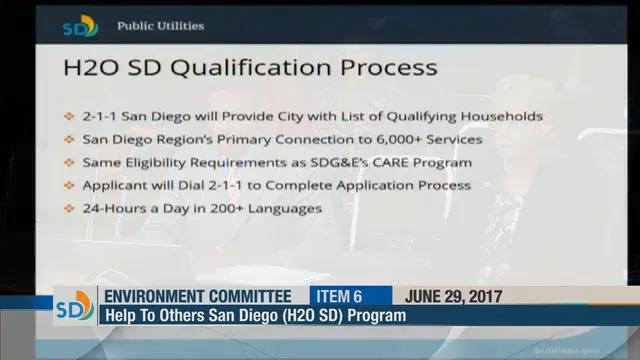
The Environment Committee of the San Diego City Council met on June 29, 2017, to consider consent items, hear public comment, and receive updates on the utilities undergrounding program, advanced metering infrastructure, and the new H2O San Diego low-income assistance program. Councilmembers Kate, Sherman, and Alvarez were present; Councilmember Ward joined later. The meeting was chaired by Councilmember Alvarez. Consent Calendar - Approved the minutes of the May 25, 2017 meeting by unanimous consent. - Approved three consent items (items 1-3) unanimously. The chair asked questions on item three regarding the evaluation criteria for a selected bid, specifically how EOC (Emerging Local Business Enterprise) participation and climate action plan goals factored into the selection. Staff clarified that EOC is one factor among many and that the selected vendor will assist with the municipal energy strategy. - All consent items passed unanimously. Public Comments & Testimony - Ms. Welch, a member of the public, spoke on a non-agenda item. She expressed concerns about water supply and conservation, stating that San Diego's water comes from the Colorado River and not from northern California via pipeline, and urged the committee to continue water conservation efforts. Discussion Items - Utilities Undergrounding Program Status Report (Item 4): Presented by Hassan Yousaf and Jim Namba. The program has converted over 400 miles of overhead utilities. Annual revenue has increased to approximately $68 million for FY17. There are 26 projects in construction this fiscal year, with 12 more anticipated to start in FY18. Staff recommended accepting the report and approving a list of 29 new projects. Councilmembers discussed staffing additions (six new positions), coordination with SDG&E, five-year planning efforts, and concerns about carrying forward large fund balances (approximately $140 million). The motion to accept the report and approve the project list passed unanimously. - Advanced Metering Infrastructure (AMI) Update (Item 5): Presented by Leanne Joan Santos and David Bryant. The program has installed smart meters at about 11,500 locations (accounting for 30% of water usage) and completed the citywide network. Approximately 85,000 of 225,000 meters have been replaced with AMI-ready meters, and endpoints will be installed at around 270,000 additional locations. The new My WaterEasy customer portal and mobile app will launch in fall 2017. Discussion covered installation schedules, meter reader retraining, leak detection capabilities, data privacy, and potential future pricing models. This was an informational item; no action taken. - Help to Others San Diego (H2O SD) Program Update (Item 6): Presented by Susan Lanier and Wilson Kennedy. The donation-driven program helps low-income customers pay water/wastewater bills, in compliance with Proposition 218. It partners with 211 San Diego for qualification. To date, over $160,000 in donations has been received (including $150,000 from Service Line Warranties of America and $10,000 from Qualcomm). The program aims to serve at least 500 households per year through FY2020, offering up to $100 per 12-month period. Donations can be made online via the San Diego Foundation. Councilmembers expressed strong support, shared personal stories about utility struggles, and offered suggestions for corporate outreach and donation methods. Informational item only. Key Outcomes - Approved consent items and the minutes unanimously. - Approved the utilities undergrounding program status report and proposed project list unanimously. - Accepted the AMI and H2O SD updates as informational items; no formal votes were required. - Next meeting scheduled for July 20, 2017 at 1 p.m. (note: the transcript also mentions July 28, creating a discrepancy; the earlier date is used here).
The Land Use and Housing Committee of the San Diego City Council met on January 16, 2019, at 10:00 AM. The meeting was chaired by Councilmember Moreno (with Vice Chair Ward presiding over the consent agenda due to Moreno's recusal). Members present included Councilmembers Ward, Campbell, Sherman, and Moreno. The committee addressed a consent item, a major discussion on housing reform, and three action items, all of which were approved unanimously. Consent Calendar - Item 1 – Sale of City-Owned Land at San Isidro: Approved 3-0 (Chair Moreno recused). The sale of city-owned land at the southwest corner of West San Isidro Boulevard and Derrymart Road to Left Coast Investment Inc., including reservation of easements for water pipelines and utilities. Public Comments & Testimony Non-Agenda Public Comment: - Joy Sunyata (District 3): Suggested deleting the word "homeless" from the city's vocabulary, arguing it implies "less than." Shared personal experience of choosing homelessness for four years. - Martha Welch: Criticized the city's use of AMI, claimed downtown towers are empty, and alleged mismanagement of HUD money by the county. - Terri Ann Skelly: Expressed dismay over the proliferation of marijuana production facilities (MPFs), citing community shock at the approval of 40 business locations and the negative impact on youth. - Peggy Walker: Opposed an MPF on Pickwick Street in City Heights, noting its proximity to drug treatment centers and calling for more sensitive land-use decisions. - Kathleen Rhodes: Asserted that the San Diego Housing Commission has $324 million in unrestricted net position and that the city is "rich enough" to house every homeless person. Called for an independent forensic audit of housing funds. Public Comment on Housing Reform (Item 5): 29 speakers addressed the committee, representing a wide range of stakeholders. Key positions included: - Lori Pfeiffer (Housing New Matters/Habitat for Humanity): Supported lowering parking standards near transit, specific plans for transit stations, and the climate action plan. - Stephen Russell (San Diego Housing Federation): Recommended an informational item on local land-use policies that could increase eligibility for state housing funds (Prop 1, 2, SB2). - Matt Adams & Guy Asaro (Building Industry Association): Urged decisive change, citing a 50,000-unit shortfall under the 2010 RHNA. Proposed regulatory streamlining, CEQA reform, self-certification, and fee restructuring. - Colin Parent (Circulate San Diego): Advocated for citywide policies over community plan updates, noting the 2016 density bonus increased citywide capacity by 11% vs. 4% from four community plans. - Craig Benedetto (NAIOP): Called for elimination of height limits outside the coastal zone, programmatic EIRs, and reduced parking requirements. Opposed new regulations that would increase costs. - Dr. Murtaza Baksamusa & Carol Kim (Building Trades): Highlighted the need for skilled workers, stagnant wages in residential construction, and the importance of prevailing wage and union apprenticeship programs to create middle-class careers. - Keith Maddox (Labor): Noted that only 33 moderate-income units were built out of a needed 15,000, and stressed the need to build across all income levels and neighborhoods. - Jonathan Siegel (Architect/Developer): Called for eliminating discretionary processes (Process 2, 3, 4) and standardizing engineering requirements. Opposed community input on form-based projects. - Molly Kirkland (Apartment Association): Opposed additional regulation like rent control, which she said creates panic. Suggested using rental business tax revenue for displacement or affordable housing funds. - Joe Locava (Build Better San Diego): Resubmitted 2017/2018 policy recommendations, including mandatory inclusionary housing. Criticized reliance on private investment for public housing needs. - Rick Bates (Unite Here): Noted that hospitality workers cannot afford housing near their jobs and urged adoption of inclusionary housing reform. - Stephanie Benvenuto (Chamber of Commerce): Supported the mayor's proposals, including middle-income housing bonus and parking reductions. Asked for data on lost units due to CEQA. - Betsy Brennan (Downtown Partnership): Supported by-right development and praised the downtown Civic process. Asked for flexibility in parking maximums. - Haney Hong (Taxpayers Association): Emphasized the need for data-driven housing policy. - Jeannie Crescenzo: Argued that affordable housing must include those earning less than 30% AMI, and that trickle-down housing has not reduced rents in her neighborhood. - Brian Pease: Urged adoption of the 2017 Build Better San Diego letter, including tenant protections and source of income discrimination (already passed). - Rafael Bautista (Tenants Union): Demanded rent control at 2%, criticizing the council for inaction and calling the mayor "do nothing." - Julie Corrales: Proposed the city build its own housing, create overlay zones for affordable housing, and extend eviction notice periods for long-term tenants. - Susan Baldwin: Called for a stronger inclusionary housing ordinance requiring on-site construction of affordable and moderate-income units in large projects. Discussion Items Item 5 – Housing Reform Discussion (Taken First): Chair Moreno opened the discussion, stating the housing crisis is the committee's top priority. Public comments were heard for over two hours. Committee members then offered their own priorities: - Councilmember Ward: Emphasized setting housing goals by community, incentivizing development in willing neighborhoods, using programmatic EIRs, monitoring state action, addressing DSD staffing shortages, and preserving existing affordable housing. Also called for city-owned property to be used to underwrite development costs. - Councilmember Sherman: Noted that 47% of housing costs come from government regulation. Proposed companion unit fee reductions, commercial flexibility, middle-income density bonuses, community planning group reform, restructuring impact fees (per square foot instead of per unit), and self-certification. - Councilmember Campbell: Supported efficient permitting, mandates for affordable and middle-class housing (eliminating in-lieu fees), a city bank for housing funding, assistance for workers (police, fire, teachers) with mortgages, and careful consideration of height limits in context of neighborhood character. Item 2 – Contract with Energy Center San Diego (NRG) for Chilled Water: Staff presented a 20-year contract (with two 5-year renewals) to provide chilled water to 1200 Third Avenue and 101 Ash Street. The alternative (repairing the chiller plant) would cost $900,000 in repairs plus $1.7 million in replacement, with annual maintenance of $120,000. The NRG system is projected to save $12.4 million over 20 years. The contract was approved unanimously. Item 3 – 20-Year Nonprofit Agreement with Educational Enrichment Systems (EES): EES has operated a subsidized child care center at 2360 East Jewett Street since 1998, serving 2,500 children. The lease extension includes a new playground funded by grants. The city requested a waiver of council policy 700-12 to allow below-market rent. Approved unanimously. Item 4 – Two-Year Extension of Stadium Naming Rights for SDCCU Stadium: The city will receive $1.5 million for two years (Dec 31, 2020) from SDCCU, up from $500,000 for the previous 15-month term. Fox Sports will receive a 22% commission. The contract includes a right of first negotiation. Approved unanimously. Key Outcomes - All action items (Items 2, 3, 4 and the consent item) were approved unanimously. - The housing reform discussion was informational; no formal action was taken. Chair Moreno will incorporate public comments and committee priorities into the 2019 work plan, to be presented at the next meeting on February 6, 2019. - The committee will continue to evaluate policy proposals including parking reform, inclusionary housing, density bonuses, and process improvements.
The Economic Development and Intergovernmental Relations Committee met on December 6, 2018, at 10:15 AM. Present were Chair Ward, Vice Chair Kercy, and Councilmember Bree. Councilmember Alvarez was absent. Also in attendance were Deputy City Attorney Daphne Scogan, Adrian Grande from the Mayor's Office, Angela Colton from the Independent Budget Analyst's Office, and Committee Consultant Lucas O'Connor. The committee approved minutes, heard non-agenda public comments, and took action on two lobbying contract items before receiving an informational report on the San Diego Convention Center's FY2018 performance. Consent Calendar - Approval of Minutes – The committee approved the committee record of actions from October 25, 2018, by a motion from Vice Chair Kercy, seconded by Councilmember Bree. The vote was unanimous with Councilmember Alvarez absent. Public Comments & Testimony - Martha Welch – Criticized the Metropolitan Transit System (MTS), stating that bus route changes (e.g., the 7 bus no longer going to Mesa, stopping at College) make it hard for residents to ride the bus. She also faulted trolley routes (orange line to court, blue line to the mayor; green line not going everywhere) and argued that property taxes are not legal because residents did not vote on certain taxes (like TransNet), which she said drive up rents. She called for a better transit system and noted that county supervisors are term-limited and will soon be gone. - Rob Gordon – Provided an update on the Strategic Growth Council planning grant opportunity ($200,000). He stated that SanDAG was "a little bit snobbish" but the San Diego Housing Commission was helpful, while the city was unresponsive. He also reported that his group, Beach Area Self-employed, is expanding to become San Diego Independent Business Professionals, and that the Small Business Development Centers addressed some of his concerns. Lastly, he attended an Open San Diego meeting and noted concerns that the city, especially economic development groups, is closed to input; he mentioned a STEM proposal that limited areas for startups and highlighted low-hanging fruit in business data sharing, noting the county's release of fictitious name data. Discussion Items Approval of Lobbying Contracts (Items 1 and 2) - Presentation – Patrick Batteller, Director of Government Affairs, and Adrian Gronda, Government Affairs Public Policy Manager, presented a combined proposal for two contracts: - Item 1: Agreement with Squire Patton Boggs, LLP for federal legislative and executive branch consulting services and representation. - Item 2: Agreement with Platinum Advisors LLC for state legislative and executive branch consulting services and representation. - Both contracts are for 36 months with two optional 12-month extensions, aligned to end with a calendar year to avoid disruption during legislative sessions. The state contract cost is $1,000 more per month than the previous contract; the federal contract is $500 more per month, and these rates are locked for the duration. - Batteller explained that the firms were selected through an RFP process and provide on-the-ground presence in Washington, D.C., and Sacramento to implement the council-approved legislative platform, build relationships, and maximize federal and state funding. - Accountability measures include semi-annual presentations to the committee, availability to council members, and monthly or as-needed reports during legislative sessions. - Committee comments: Vice Chair Kercy expressed support, recalling a previous mayor who thought he could act as the city's own lobbyist—which did not work out. Councilmember Bree asked for examples of accomplishments: at the state level, the HEAT program ($500 million for homelessness) including a $14 million direct allocation to San Diego, and a carve-out of $30 million from Prop 68; at the federal level, UASC (Unaccompanied Alien Children) funding secured even when the city dropped on the priority list. Chair Ward added appreciation for the firms' work and noted the inclusion of an EEO plan for the federal contract; he requested more frequent written updates (quarterly summaries) on legislative tracking. - Motions: On Item 1, Vice Chair Kercy moved to recommend council approval; Councilmember Bree seconded. The vote was unanimous (3-0). On Item 2, the same motion was made and seconded, also passing unanimously. San Diego Convention Center Corporation FY2018 Year-End Sales and Marketing Report (Item 3) - Presentation – Gil Cabrera (Chair of the Convention Center Board), Ripper Bateau (President & CEO), and Joe Terzi (President & CEO, San Diego Tourism Authority) provided an informational update. - FY2018 Performance Statistics: - Regional economic impact: $1.1 billion - Direct attendee spending: $652 million - Room nights: 694,000 - Hotel sales tax revenue to the city: $24.7 million - Attendance: 785,460 - Events: 133 total (56 primary citywide events, 77 secondary/short-term events) - 13 citywide medical conventions, each with a per-attendee spend of $1,759 - Top six events by combined sales tax and hotel (TOT) revenue: Comic-Con International ($3.267M), American Association of Clinical Chemistry, ESRI, American Academy of Dermatology, CEDIA, and Rheumatology. - Bookings: Fourth consecutive year exceeding one million room nights booked. Joe Terzi showed a slide with future room nights booked by year (e.g., 2019: 28,900 rooms booked; concern about 2023 due to cancellations). Lost business analysis shows 60-70% lost due to lack of availability/space/dates. - Building Occupancy: 71.7%, above the practical maximum occupancy of 70% (per PricewaterhouseCoopers). National average is 50-54%. At 60%, facilities begin turning away business. Chair Cabrera noted that the Convention Center operates above full and has done so for 3-4 years. - Revenues: FY2018 total revenues $39.1 million (down from FY2017 due to cyclical nature of events – American Society of Hematology was not in FY2018). Food & beverage is the largest revenue line ($10M+). Rental revenue is $9.2M (23% of total). Expenditures were $35.1 million, with over 60% going to salaries, wages, and benefits. Capital projects from an infrastructure bank loan ($25.5M) included roof replacement, fire alarms, escalator/elevator renovations; annual loan repayment of $1.7M begins now. - Challenges and Strategies: - The building is aging and undersized compared to competitors (e.g., Anaheim, Orlando, Atlanta). Joe Terzi noted that many large medical conventions outgrow San Diego; Hematology required a tent outside the building. Chair Cabrera said the city is "leaving money on the table" by not expanding. - Strategies include focusing on short-term bookings (40,666 room nights exceeded goal of 40,000), developing new accounts (12 new accounts), targeting medical citywide conventions, leveraging sales team synergies, and pursuing non-traditional revenue (e.g., co-owned events, a digital network system expected to generate six-figure income). - City Help: Rip Bateau asked the committee to help promote the convention center as the "People's Convention Center" and consider reducing costs for local non-profits through bundling and labor agreements. - Economic Concerns: In response to a question from Councilmember Bree, the presenters stated that food & beverage spend is the first to decline in a downturn, but medical conventions rarely cancel due to their educational/credentialing mission. - Chair Change: Gil Cabrera noted this was his last meeting as board chair; Zima Jacobson will succeed him. The committee thanked him for his service. - This item was received as information; no motion was required. Key Outcomes - Item 1 (Squire Patton Boggs federal contract): Approved unanimously (3-0) and recommended for City Council approval. - Item 2 (Platinum Advisors state contract): Approved unanimously (3-0) and recommended for City Council approval. - Item 3 (Convention Center report): Received as information; no action taken. - The committee concluded its 2018 meetings. Chair Ward thanked members and staff, noting upcoming work in 2019 on the business cooperation program, veterans contracting, inclusive economic development, binational ties, and the small business advisory board. The next meeting will be sometime in 2019.
The Public Safety and Local Neighborhoods Committee met on December 5, 2018, with Chair Kate, Vice Chair Bree, and Councilmember Gomez present. The meeting covered non-agenda public comments, approval of previous minutes, a fire station agreement with UCSD, an annual update from the Community Review Board on Police Practices (CRB), the Crime Free Multi-Housing program, the Unmanned Aircraft System Integration Pilot Program, and the Age-Friendly Communities initiative. Consent Calendar - The committee approved the action items from the October 24, 2018 committee meeting unanimously, with a motion by Councilmember Gomez and a second by Vice Chair Bree. Public Comments & Testimony - Terry Best (San Diego Americans for Safe Access) criticized Councilmember Lori Zapf's stance on medical cannabis, alleging she ignored patients and used junk science. - Becky Johnson expressed concerns about marijuana product safety, lack of testing, and risks to children from edibles, and called for odor remediation standards. - Martha Welch complained about limited police station hours, officer shortages, pension issues, and marijuana testing failures. - Kelly McCormick argued the number of marijuana production facilities is excessive, citing impacts in Kearny Mesa, Otay Mesa, and Mira Mesa, and raised concerns about normalization leading to youth use. - Alicia Nicole Mason reported being harassed and unlawfully detained by police at 30th and Ocean View Boulevard, describing the incident as discriminatory. - Catherine Mendoza (community cop watch) described an incident where a subject in custody experienced excited delirium, was tased, and had a seizure while in a wrap, with delayed medical response; she argued police should not be first responders to mental health crises. - Martha Welch (on item 2) opposed the fire station deal, questioning the land donation and timeline. - Jeff Gaddis (UCSD Assistant Chancellor) expressed strong support for the fire station collaboration, noting benefits for campus and community. - Evie (Women Occupy San Diego) called for an independent CRB and criticized appointment processes. - Brittany McLean opposed the CRB report, citing dismissive handling of the carotid restraint issue and lack of community consideration. - Darwin Fishman (Actors San Diego, Racial Justice Coalition) argued CRB policy recommendations are ineffective, police reject them, and called for more investigative power and professional staff. - Tasha Williamson reported on Aaliyah Jenkins, who was in ICU after being in police custody, alleging SDPD narrative of overdose was contradicted by doctors; called for release of tapes and reform. - Chloe Triplett (ACLU of San Diego) raised privacy concerns about drones, questioned data sharing with federal agencies, and asked for a use policy to be made public. - Alan Schmiding (St. Paul's Senior Services) supported age-friendly planning. - Eric Tilkemeyer (City Heights CDC) supported age-friendly principles aligning with city goals. - Lillian Choney (Revisions Resources) supported the age-friendly initiative, citing the eight domains of livability. - Bob Kaiser (AARP volunteer) shared his experience with community advisory groups and supported joining the network. - Philip Manson supported age-friendly planning for mobility and community engagement. - William Kelly expressed strong optimism for age-friendly communities as a solution to demographic challenges. Discussion Items - Item 2: Fire Station Purchase Agreement (UCSD) – Real Estate Assets Department presented a package deal: UCSD contributes land and up to $20.556 million for design/build, city responsible for equipment ($1.2M) and annual operations ($1.865M). City also grants UCSD an option to purchase Torrey Pines Center South in 2042-2044 at appraised value (currently $35.3M) with 2.41% annual escalator. The IBA noted the deal is contingent and that construction must start within 5 years. Vice Chair Bree and Councilmember Gomez supported the motion, which passed unanimously. - Item 3: CRB Annual Update – CRB reported on fiscal year 2018: reviewed 43 cases (down from 54), majority in Southeastern and Mid-City. Board agreed with IA findings in most cases; officer-involved shootings (6) all found within policy, but not all unanimous. In-custody death case also within policy (non-unanimous). Body-worn camera use improved (99% on). Treasurer noted budget for outside counsel was depleted. Councilmember Gomez asked for faster report delivery, breakdown of findings, and reconsideration of carotid restraint. Vice Chair Bree offered to include budget request in mid-year revisions. - Item 4: Crime Free Multi-Housing Program – Officer Louie Roman and Marsha Lyon (Say San Diego) presented the three-phase certification program: manager training, safety inspection, residential engagement. Over 340 properties in program, 126 fully certified. Program aims to reduce crime and calls for service. Councilmember Gomez asked about eviction data and requested maps and statistics. Vice Chair Bree praised the partnership. - Item 5: Unmanned Aircraft System Integration Pilot Program – Office of Homeland Security and EDC presented four concepts: public safety (pre-stationing drones), package delivery (Uber), border inspection (reduce wait times), and medical delivery (UCSD Health). Community outreach includes surveys and town halls. ACLU raised privacy concerns. Committee members supported the program while emphasizing safeguards. - Item 6: Age-Friendly Communities Program – San Diego Foundation and AARP presented the initiative, noting San Diego is the last major California city without an age-friendly action plan. The eight domains of livability would be customized. Grant funding available for planning phase. Committee expressed strong support and commitment to advancing the program. Key Outcomes - Item 2: Motion by Vice Chair Bree, second by Councilmember Gomez, to authorize the fire station agreement, option agreement, and lease amendment, along with associated financial actions. Passed unanimously. - Item 3: No action required (information item). Councilmember Gomez requested the chief reconsider the carotid restraint policy; Vice Chair Bree offered to increase CRB's outside counsel budget. - Item 4: No action required. Councilmember Gomez requested follow-up data on evictions and property locations. - Item 5: No action required. Committee members urged continued community engagement and privacy safeguards. - Item 6: No action required. Committee members expressed support and requested to be kept informed as the mayor's office considers signing the letter of commitment. The meeting was adjourned with thanks to members and staff, and holiday wishes.