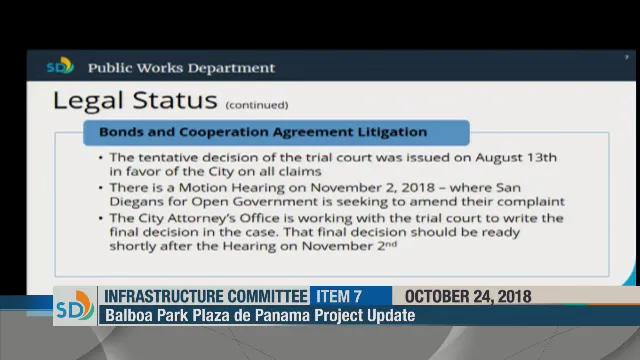
The Infrastructure Committee met on December 4, 2018, to discuss several items including an update on the Balboa Park Plaza de Panama project, a cooperative agreement for bicycle improvements, an amendment for engineering services on the Palm Avenue/I-805 interchange project, and ratification of emergency sole source contracts. Public comments were heard on the Plaza de Panama project and non-agenda items. All action items were approved unanimously. Consent Calendar - The committee unanimously approved consent agenda items one, two, and three (specific items not detailed in the transcript). Public Comments & Testimony - Non-agenda public comment: Robert Buck, a retired plumber and pipe fitter, expressed opposition to replacing functioning sewer pipes with liners, citing concerns about durability and liability. Martha Welch complained about potholes, lack of maintenance, and general dissatisfaction with city actions. - Plaza de Panama project opposition: David London, president of the Balboa Park Heritage Association, opposed the project on financial grounds, arguing that parking revenue estimates are unrealistic due to ride-sharing and scooters, and that the city would face bond default and general fund obligations. He requested no substantive votes until after the November election. - Plaza de Panama project support: Peter Komiskey (Balboa Park Cultural Partnership), Tomas Herrera Mischler (Balboa Park Conservancy), Stephen Schindler (Connectivity LLC), Jennifer Davies (San Diego Tourism Authority), and Catherine Johnston (Balboa Park Committee) expressed strong support, citing improved pedestrian safety, accessibility, new parkland, and enhanced visitor experience. Discussion Items - Balboa Park Plaza de Panama Project Update: Public Works Director James Negelborn and staff presented a status update. The $79 million project includes a bypass bridge, underground parking, and pedestrianized plazas. The city's share is $49 million ($39 million bonds, $10 million cash). Two lawsuits (CEQA by Save Our Heritage Organization and bonds by San Diegans for Open Government) have been resolved in the city's favor; a final appeal decision was issued that day. Construction bids open December 2018, award expected March 2019, completion June 2021. Committee members questioned cost overruns (covered by Plaza de Panama Committee), revenue projections, and bond counsel opinions. No vote was taken as it was an informational item. - Cooperative Agreement with Caltrans for Bicycle Improvements at I-5 and SR 56: Gene Matter and Gary Chewy from Transportation and Stormwater Department presented. The agreement funds a 1,100-foot bike connector to link existing paths. City contribution is $2.25 million ($1.63M from Carmel Valley Consolidated FBA fund, $620K from Carmel Valley Diff Fund). Construction planned for fall 2020, taking about a year. The committee approved the staff recommendation unanimously. - Third Amendment to Engineering Services Contract for Palm Avenue/I-805 Interchange Improvements: Abby Palisade and Dan Nutter from Public Works presented. The amendment ($78,646) updates the environmental document to meet Caltrans template changes and extends the contract duration. The project will widen the bridge, add a cycle track, and realign ramps. Two alternatives include a loop ramp (alternative one) or diamond interchange (alternative two). Public review of the draft environmental document is ongoing. The committee approved the recommendation unanimously. - Ratification of 11 Public Works Emergency Sole Source Contracts: Julie Baezteros and Zhang Choi presented. The contracts, totaling $7.4 million, cover storm drain, water/wastewater, and building repairs from fiscal year 2018. These were awarded without advertisement due to emergencies. The committee approved ratification unanimously. Key Outcomes - Consent Agenda: Approved unanimously. - Cooperative Agreement with Caltrans: Approved to forward to full City Council. - Third Amendment for Palm Avenue/I-805: Approved to forward to full City Council. - Ratification of Emergency Contracts: Approved to forward to full City Council. - Meeting Minutes from September 26, 2018: Approved unanimously after being tabled earlier. - No action taken on Plaza de Panama project as it was an informational item; committee members expressed intent to monitor costs and revenue projections.
Public Meetings - San Diego, California
Public Meetings - San Diego, CaliforniaThe San Diego City Council Environment Committee met on November 29, 2018, with Chair Councilmember David Alvarez presiding and Councilmembers Kate and Sherman present (Councilmember Gomez was absent). The agenda included approval of prior meeting records, a non-agenda public comment period, a $919,600 funding transfer for resurfacing the Balboa Park golf course parking lot, an update on a proposed public-private partnership for expanded polystyrene (EPS) foam recycling, and the third annual departmental recycling diversion update. Chair Alvarez delivered farewell remarks noting this was his final committee meeting after eight years as chair. Consent Calendar - The committee unanimously approved the record of action items from the November 1, 2018 meeting, on a motion by Councilmember Sherman seconded by Councilmember Kate. Public Comments & Testimony - Martha Welch (non-agenda comment): Requested that whoever succeeds Councilmember David Alvarez continue requesting updates on the Pure Water project. She noted that infrastructure is 'very old' (referencing a '1958 pump') and expressed concerns that the city lacks a proper sewer plant, does not perform 'dry solids' processing, and that water department performance audits are insufficient. She also cited snowpack reports (over a foot of snow in the Sierra, two more inches, limited snow at Big Bear) and said she hopes the region is out of the drought. - Martha Welch (on EPS item): Expressed support for recycling but cautioned not to invest too heavily in EPS recycling because the proposed ban 'is supposed to be... go away.' She said she supports bamboo and sugarcane containers because they break down, and raised concerns about enforcement because the county, not the city, regulates restaurants. - Sophie Barnhorst, San Diego Regional Chamber of Commerce (representing nearly 2,500 members and about 300,000 employees): Stated the Chamber supports the city's EPS recycling efforts and views the industry partnership as a real opportunity, especially given an expected budget deficit and the depletion of the city's recycling fund. She urged the committee to forward the item to the full council. - Chris Duggan, California Restaurant Association: Expressed strong support for the partnership, arguing EPS is proven recyclable (staff already incorporate it in curbside containers), that removal would impose significant costs on restaurant operators and customers, and that the product offers functionality and reliability (resists breakdown with hot or cold foods such as soups or coffee). He said it is 'demanded by our customers' and urged moving forward. Discussion Items 1. Balboa Park Golf Course Parking Lot Resurfacing Scott Bentley (Assistant Deputy Director, Golf Division) and John Howard (Golf Manager) requested approval to move $919,600 from the golf enterprise fund balance to the Balboa Park Golf Course Capital Improvement Program fund to repave the parking lot and adjacent asphalt areas (three parking areas outlined in red, plus yellow adjacent areas). The quoted cost is $836,000 with a 10% contingency. Staff cited disrepair, safety concerns, and poor customer first impressions. Councilmember Sherman confirmed the number of parking spaces will not change and the lot will remain ADA compliant. Councilmember Kate asked whether the department had researched alternative, heat-reducing surfacing materials (piloted in Los Angeles); staff said they became aware of the concept the day before, contacted Public Works but received no information, and would research it before the December 11 council hearing. The motion by Sherman, seconded by Kate, passed unanimously. 2. Public-Private Partnership for Expanded Polystyrene (EPS) Foam Recycling Environmental Services Deputy Director Barbara Lamb and Recycling Program Manager Ken Prue reported that the city has accepted EPS block material in curbside recycling since December 2014 and added EPS food packaging in July 2017, processed through a specialized secondary material recovery facility in Los Angeles (Titus). Actual costs in FY18 were $124,000, with $180,000 projected for the current year (transportation/tipping fees). The American Chemistry Council's Food Service Packaging Group (PFPG) proposed a partnership with two components: (1) bridge support funding of up to $250,000 - $35,000 in the first month plus subsequent payments through June 2019 - to offset secondary processing and transport costs; and (2) up to $735,000 per facility (up to two facilities) for optical sorting equipment and retrofitting, through an addendum to the city's curbside recycling request for proposals (RFP) issued November 13, 2018. The partnership is contingent on continued acceptance of EPS food containers; staff stated it would be off the table if Councilmember Ward's proposed EPS reduction policy (which had a first reading at City Council) is adopted and implemented. The RFP closes December 21, 2018 at 2 p.m. Councilmember Kate asked about the timeline and noted that while the bridge funding would be a grant to the city, the equipment partnership would primarily benefit the processor with no direct rebate to the city and could represent a potential added cost for services not provided. He requested that the item return as a potential action item in January 2019 under the new committee chair. Councilmember Sherman noted that even if a ban passes, EPS material (e.g., packaging from online orders) would still enter the waste stream, requiring a policy decision on whether to continue recycling or landfill it; he also raised concerns about China's National Sword policy and its effect on recycling markets. Staff confirmed the RFP was structured to accommodate EPS inclusion or exclusion depending on the policy outcome. 3. Update on Recycling at City Facilities Chelsea Clacious (Supervising Recycling Specialist), with Deputy Director Barbara Lamb, delivered the third annual update. Since FY15, following adoption of the Climate Action Plan and Zero Waste Plan, department directors have been required to comply with the city recycling ordinance, appoint recycling liaisons (34 citywide), and attend quarterly meetings. This year's highlights included collaboratively developed branded signage, facility tours, personalized technical assistance, and diversion support during the executive complex staff relocation. Diversion rates were reported by department for the first time (previously by facility): the number of departments below the 50% diversion rate fell from seven to five to four over three years, with the goal of 50% by 2020. Transportation & Stormwater was reported at 25%, which staff explained reflects heavy operational materials such as asphalt grindings and concrete that were not fully captured; its office/dumpster-level diversion was 77%, and the street division alone is on track to bring the department above 50% this fiscal year. Councilmember Sherman asked whether departments are being held to achievable goals and whether recyclability data is available; staff confirmed the calculations are data-driven and that the 25% figure resulted partly from a data-capture gap in the prior year. Chair Alvarez congratulated staff on the progress, noting Environmental Services, Fleet Services, Treasurer, and Controller clustered at the top. Chair's Farewell Remarks Chair Alvarez highlighted the committee's achievements over his eight years: Council approval (a couple weeks prior) of the Pure Water Project Construction with nearly $2 billion in construction contracts for Phase One; changes to water billing rate structure to encourage conservation; working with the IBA to contract an independent rate consultant; the upcoming city council action on the Barrio Logan truck route (recommended by this committee) to reduce noise, traffic, and pollution; storm channel maintenance that protected the city during storms; climate action plan adoption and monitoring; zero-waste strategies to extend the life of the Miramar landfill; PACE program implementation for solar installations; and the forthcoming Community Choice Aggregation decision. Councilmember Kate thanked the Chair for his thoughtful approach and openness to public input. Councilmember Sherman thanked him for his leadership, noting their collaboration on storm channel maintenance and saying he would miss working alongside him. Key Outcomes - Approved unanimously: Transfer of $919,600 from the golf enterprise fund to the Balboa Park Golf Course CIP fund for parking lot resurfacing (motion by Sherman, second by Kate). Staff to research cool-pavement alternatives before the December 11, 2018 city council hearing. - Approved unanimously: Record of action items from the November 1, 2018 meeting. - Informational item: The EPS recycling public-private partnership update was received; no formal action was taken. Councilmember Kate requested, and Councilmember Sherman voiced support, that the item return in January 2019 as a potential action item with the new committee chair; Chair Alvarez urged the Mayor's Office and IBA's Office to help ensure continuity. - Next steps identified: The curbside recycling RFP closes December 21, 2018 at 2 p.m.; the EPS partnership will proceed only if the proposed EPS reduction ban is not enacted.
The City of San Diego Audit Committee met on November 28, 2018, to review several audit reports, the City Auditor’s FY2020 budget, and a recommendation follow-up report. The committee heard public comments, discussed findings on the Development Services Department’s Exela system implementation, employee compensation reporting, and the Auditor’s Office budget, and took unanimous votes on each item. Public Comments & Testimony - Martha Welch (non‑agenda speaker) expressed frustration with the city’s financial management, stating that performance audits are insufficient and that she wants to see audits of monies spent. She complained about roads and sidewalks not being fixed, Mission Bay rents being too high (citing a 3% or 5% of gross profit provision), and the lack of a budget for library books. She also noted that Mission Bay funds go to the general fund instead of parks, contrary to a 1964 vote. - Clive Richard (non‑agenda speaker, resident of Council District 9) thanked the committee for its service, expressed hope for hiring a new city auditor, and welcomed the new interim auditor, Kyle Elser. He also greeted Kyle, noting he had been away for two years. Monthly Activity Report (Item 5) Interim City Auditor Kyle Elser presented the monthly activity report, noting that three audit products had been issued since the last meeting: IT audit of the Exela Implementation, Department of Finance External Financial Reporting, and a recommendation follow‑up report. Three audits are in the report‑writing stage (community planning groups, IT security of City Hub, transportation stormwater curb painting), three in field work (park joint‑use agreements, tree trimming, AMI implementation), and two in planning (public utilities call center, neighborhood services homelessness). Two memos on the FY2020 proposed budget were also issued. Discussion Item 1: Performance Audit of Development Services Department (DSD) Exela Permitting System Implementation - Principal IT Auditor Steven Gomez presented the audit, finding that DSD skipped steps to document and analyze processes before replacing the aging Project Tracking System (PTS). The original $10.9 million, 18‑month implementation (planned go‑live May 2017) is now expected to cost $17.7 million and be completed in 2020 – a 60% cost overrun. The system architect retired suddenly, and DSD terminated its relationship with Exela’s professional services (though retaining the Exela platform). The audit made four recommendations to improve IT governance and prevent future cost overruns; management agreed fully. - DSD Director Elise Lowe and Deputy Director Karen Dennison responded, acknowledging the issues and noting that the code enforcement module went live in January 2018, achieving paperless operations within a month and improving efficiency. They are now using CGI contractors with Exela certification. - Committee members (Mr. Hebrank, Mr. Sherman, Mr. Spencer) praised the audit’s quality. Mr. Sherman noted that the committee has seen more transparency and progress since new leadership came in. The committee voted unanimously to accept the report and forward it to the City Council. Discussion Item 2: Performance Audit of the City’s Annual Employee Compensation Reports - Principal Performance Auditor Andy Hannah and Senior Auditor Nathan Otto presented the audit. The city’s compensation reports omitted employer contributions to defined benefit pension plans, listing them as $0 for every employee. The missing amount averages about $7,900 per affected employee (2017), totaling $52 million citywide. This understates compensation and makes the city appear less attractive for recruitment. The State Controller’s guidelines require reporting these contributions, and most other California cities include them. - Recommendations: (1) begin calculating and reporting the missing component going forward; (2) correct the 2017 report. The Department of Finance agreed to implement both, with the 2017 correction expected by April 2019 (revised from June 2019). - Committee members asked about the feasibility of the methodology and the effect on recruitment (especially for police). The committee voted unanimously to accept the report and forward it to council. Discussion Item 3: City Auditor’s FY2020 Proposed Budget - Interim City Auditor Kyle Elser explained that the proposed budget is the same as FY19 adopted, with no new positions or additions. However, the Chief Operating Officer requested a 3% reduction ($123,000) from all general fund departments. The Auditor’s Office determined that a full reduction would require terminating a staff member, discontinuing the electronic work paper system, or cutting training. They proposed a $10,000 reduction from the contracts budget (for specialized consultants), representing an 8% reduction in discretionary non‑personnel spending. - Committee members (Mr. Sherman, Mr. Hebrank, IBA Lisa Byrne) argued that the office runs a tight ship and that the requested cut is “budget dust” – pennywise and pound foolish given the savings generated by audits. They recommended keeping the budget as is, with no increase or decrease. The motion passed unanimously. Discussion Item 4: City Auditor’s Recommendation Follow‑Up Report (Period Ending June 30, 2018) - Deputy City Auditor Danielle Knighton presented the report. Of 143 outstanding recommendations, 48 were implemented or no longer applicable, leaving 95 carried forward. 27 are one‑to‑two years old, 35 are under a year old. One recommendation from Environmental Services was deemed not applicable (they incorporated key elements into franchise agreements). - Committee members (led by Mr. Hebrank) reviewed each department’s outstanding recommendations, noting progress and delays. Significant discussion focused on: - Purchasing & Contracting: Long‑standing debarment recommendations (2014, 2016, 2017) concerning vendors who colluded with city employees. Several committee members expressed frustration that the city has not permanently debarred individuals who defrauded the city. The committee requested a memo from the City Attorney’s office on the debarment process. - Advisory Board Recommendations: Eight recommendations from a performance audit of advisory boards were not yet implemented. The committee requested a special report within 60 days on their status. - Purchasing & Contracting – Ariba System: A disconnect remained between the department and the auditor on whether controls for contracts not yet in Ariba are sufficient. The committee requested an update on the status of these recommendations. - Motion: Accept the report, drop recommendation 1503‑4 (as outlined in Attachment A), and request (1) a special report on advisory board recommendations within 60 days, (2) a City Attorney memo on debarment issues, and (3) an update on purchasing and contracting recommendations. The motion passed unanimously. Committee Comments & Farewell - Councilmember Lori Zapf (Chair) was not present at the start; after the agenda items, she returned and received farewell remarks from committee members. Councilmember Scott Sherman and Mr. Hebrank expressed gratitude for her leadership and common‑sense approach. Ms. Zapf thanked the committee, noting her eight years of service and her commitment to “doing more with less” for taxpayers. She shared personal reflections on her background and concluded the meeting. Key Outcomes - Unanimous votes to accept and forward the performance audit of the Exela implementation and the compensation reports to the City Council. - Unanimous vote to recommend the City Council adopt the City Auditor’s FY2020 budget with no cuts from the FY19 approved level. - Unanimous vote to accept the recommendation follow‑up report, drop one recommendation, and request three follow‑up items (advisory board special report, City Attorney debarment memo, purchasing and contracting update). - No consent calendar items were presented. - Next steps: The reports will be forwarded to the City Council; the City Auditor will provide the requested updates within 60 days or as directed.
The Budget and Government Efficiency Committee convened on November 14, 2018, with Chair Bree and members Vice Chair Ward, Councilmember Kate, and Councilmember Gomez present. The committee reviewed the first quarter budget monitoring report, the five-year financial outlook for FY2020-2024, several procurement contracts, and annual reports on the Living Wage Ordinance, business diversity, and prevailing wage compliance. Consent Calendar - The committee approved the minutes from the October 17, 2018 hearing. Public Comments & Testimony - Ann Feige, Chair of the Community Forest Advisory Board, urged the city to address climate change evidence in the five-year outlook, highlighting the low cost and high effectiveness of tree investment for cooling, stormwater management, and community benefits. She noted the city needs more forestry staff (currently 8 positions vs. a recommended 15) to manage proactive tree care. - Beth Cransberger, representing the Citizens Equal Opportunity Commission, called for an updated disparity study, noting the last one was in 1996. She argued it could be done for less than previously discussed and that it is essential for effective equal opportunity contracting. - Mr. Lemon, a construction industry representative, commended staff for increasing apprenticeship violations flagged but warned of widespread prevailing wage cheating. He offered partnership with building trades to help enforce compliance, noting the city’s exposure to losing state funding if violations are found. Discussion Items - Items 10 & 11: First Quarter Budget Monitoring Report and FY2020-2024 Five-Year Financial Outlook - Finance staff reported general fund major revenues exceeding budget by $24.9 million, driven by property tax ($8.7M above) and sales tax ($15.7M above, partly due to delayed FY18 revenue). Public safety overtime projections showed fire rescue exceeding by $6.9M (vacancies, strike teams, unbudgeted academy) and police exceeding by $9.3M (extension of shift overtime, neighborhood policing, transitional storage center security). The five-year outlook projected a $74 million revenue shortfall for FY2020, largely due to pension cost increases, police recruitment/retention investments, infrastructure fund transfers, and reserve funding. Staff noted that the outlook includes $35.8 million in critical strategic expenditures for FY2020, including public safety positions, infrastructure maintenance, and new facilities. - Councilmember Kate questioned the connection between FY18 unaudited ending fund balance ($227.4M vs. $225.6M in year-end report) and the $12.5M excess equity estimate. She also asked about the sales tax increase being one-time or baseline; staff clarified large amount is one-time and will contribute to excess equity. She inquired about the breakdown of police overtime for the transitional storage facility ($2M), riverbed ($500k), and patrol staffing ($2.5M). Councilmember Gomez asked about the grant writer position, firefighter attrition (steady at 60/year), and requested more granular data for Clean SD and tree trimming schedules. Vice Chair Ward asked about the relationship between revenue variance and excess equity, and how police overtime savings from vacancies offset overtime costs. The IBA noted they are drafting a report and asked about the fiscal impact of new responsibilities at the Navigation Center; staff said it is being evaluated and will be in the mid-year report. - Councilmember Bree requested a consolidated view of all general fund homeless service costs for FY19 and FY20, including funds taken from the Housing Commission. - Items 5, 6, 7: Fleet Vehicle Purchase Agreements – Fleet Operations presented three cooperative contracts for sedans/SUVs/trucks ($72M through FY21), heavy-duty chassis ($55.4M through FY22), and sewer/drain cleaning vehicles ($20.5M through FY23). The items support replacement of vehicles beyond lifecycle and advance climate action plan goals. The committee approved all three. - Item 8: First Amendment to Insight Public Sector Technology Contract – Staff requested a $7.6 million increase (total not to exceed $10.6M) for commodity IT hardware and software. The IBA recommended splitting the increase contingent on the County of Fairfax extending the underlying cooperative contract. Councilmember Kate moved to adopt the IBA recommendation, which was approved. - Item 12: Living Wage Ordinance FY18 Annual Report – Staff reported 352 active contracts subject to living wage, an increase from 128 in FY17. $113,900 in remedies were assessed on behalf of 23 employees for violations. A new electronic payroll reporting system was piloted to improve compliance efficiency. Goals for FY19 include mandatory contractor training, educational materials, and implementing an administrative enforcement process. Councilmembers commended the work and emphasized the importance of proactive monitoring. - Item 13: Business Diversity Annual Report – Staff reported that FY18 SLBE participation on construction contracts reached 23%, exceeding the 20% goal. Awards to non-white firms were $77M (16% of total), the highest in recent years. Awards to female-owned businesses also increased. Staff noted ongoing outreach and proposed future policy changes (income cap increase, shelter competition, good faith effort revisions). Multiple councilmembers called for an updated disparity study, with the Chair committing to include it in budget priorities and schedule a future discussion. Councilmember Ward suggested exploring philanthropic funding for the study. - Item 14: Prevailing Wage FY18 Annual Report – Staff reported monitoring 356 projects valued at $1.4 billion. One audit found $51,000 in underpayments, which was referred to the Department of Industrial Relations (DIR); $690 recovered so far. Apprenticeship violations increased significantly. Staff noted challenges with capacity (two vacancies, one remaining) leading to fewer site visits. The prevailing wage compliance team was transferred to Public Works for better integration. Councilmember Gomez and Vice Chair Ward asked about partnership with construction trades to enhance enforcement; staff agreed to meet with Mr. Lemon. Key Outcomes - The committee approved consent calendar, all recommended action items (1-4, 5-7, 9) and item 8 with the IBA’s contingent amendment. - Chair Bree instructed staff to provide a consolidated report of all general fund homeless service expenditures and funding taken from the Housing Commission. - The Chair committed to including funding for a disparity study in her budget priorities and placing it on the committee agenda for future discussion. - Staff agreed to meet with Mr. Lemon to discuss prevailing wage enforcement partnerships. - The meeting adjourned; the committee will reconvene in 2019.
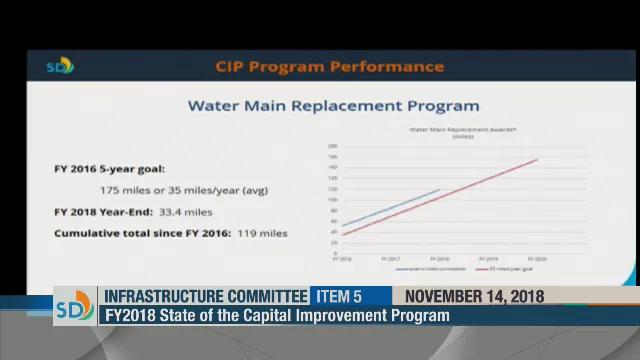
On Wednesday, November 14, 2018, the San Diego City Council Infrastructure Committee met to discuss and act on several items, including impact fee studies, capital improvement program updates, and a review of the sidewalk maintenance policy. The meeting featured a special presentation on earthquake resilience and included public testimony on various infrastructure issues. Consent Calendar - Approved the meeting minutes from October 24, 2018, unanimously. - Approved the consent agenda (items 1 and 2) with a commendation from Councilmember Ward for RIC Engineering's work on South Park's 30th Street, noting quick resolution of a parking issue for a local business. Public Comments & Testimony - Martha Welch opposed the city's use of sales tax, fuel tax, and other fees, arguing they are illegal and drive up housing costs. She called for an audit of road funds and criticized the city for not putting certain projects on the list. - Robert Buck (retiree, Local 230, native San Diegan) opposed the relining of sewer laterals in American Park, calling it unnecessary and unwanted. He also objected to plans to underground utilities, stating the city's underground department is unresponsive and inflexible. - Catherine Rhodes spoke on two items: first, about grandfathered airport revenues, arguing that the city and SANDAG have failed to achieve the promised 14% transit to the airport. She referenced a March 2018 SANDAG analysis that she believes is incorrect. Second, during the earthquake presentation, she urged the city to follow seismic laws and noted that San Diego did not adopt Seismic Zone 4 standards until the mid-1990s, leaving many buildings unretrofitted. She also pointed out that the Mid-Coast trolley and other projects have not adequately investigated fault lines. - David Swearens (Old Town Community Planning Group member) supported the Old Town Impact Fee Study, stating it eliminates an expensive unnecessary project and spreads costs over a larger pool, reducing fees by nearly a third. Discussion Items Earthquake Resilience Presentation (Item 7) - Dr. Lucy Jones (founder, Dr. Lucy Jones Center for Science and Society) presented on earthquake risks, focusing on the Rose Canyon Fault and its potential for a magnitude 6.9 earthquake. She highlighted vulnerabilities in water systems, buildings (especially unreinforced masonry and non-ductile concrete), and the economic impact of a disaster. She noted that San Diego's lower seismic zone designation has left it with weaker building codes and fewer retrofits compared to Los Angeles. She recommended the city conduct a vulnerability analysis and prioritize seismic-resistant water pipes. - Committee members discussed local fault lines, the need for an inventory of vulnerable buildings, and the city's water infrastructure. Chair Kersey asked about state requirements for inventorying unreinforced masonry buildings; staff indicated that the city is not required to have such an inventory because it was not in Seismic Zone IV when the 1986 law passed. The committee also discussed the use of seismic-resistant pipes and the need for a plan to address old infrastructure. Old Town San Diego Impact Fee Study (Item 3) - Staff presented the updated fee study, which reduces the residential fee from $5,595 to $3,874 per unit (a 31% decrease) and the non-residential fee from $751 to $231 per average daily trip. The decrease is due to additional units and removal of a parking structure from the plan. The Old Town Planning Group voted to recommend approval, contingent on including a roundabout as a priority project. - Public comment: David Swearens supported; Martha Welch opposed, arguing that fees make housing expensive and are a misuse of funds. - Committee approved the motion to recommend council approval. Mission Beach Impact Fee Study (Item 4) - Staff presented the updated fee study, which sets a residential fee of $3,647 per unit and a non-residential fee of $521 per ADT. The Mission Beach Precise Planning Board voted unanimously to recommend approval. The committee approved the motion to recommend council approval. FY18 State of the Capital Improvement Program (Item 5) - Public Works staff provided an informational update on CIP achievements, including the Pure Water Program, Clear Wells project, West Mission Bay Bridge, and downtown mobility bikeways. They reported that the city completed 330 miles of road repair in 2018, reaching a cumulative 930 miles, exceeding the 1,000-mile goal ahead of schedule. The FY18 CIP budget was $929 million, with $552.6 million expended. Staff highlighted streamlining efforts, including electronic change orders, and noted challenges with rising construction costs and employee retention. - 101 Ash Street Update: Staff reported that construction began September 24, 2018, with demolition on floors 1, 2, and 19, and asbestos abatement starting next week. So far, no issues with schedule or budget. FY19 CIP Mid-Year Budget Monitoring Report (Item 6) - Staff presented a consolidated action to adjust $74 million in CIP budgets, including returning $3.5 million from completed projects, allocating $23.5 million in new funding, and transferring $28.6 million between projects for cash management. The report also allocated $18.6 million in regional park and Mission Bay improvement funds and $3 million in new grants. Staff noted successful spend-down of Transnet funds held at SANDAG, reducing the balance from $55 million in 2016 to an estimated $27.5 million by end of 2019. - Committee members praised the efficiencies and asked about specific projects, including Chicano Park and Fairbrook Park. The motion to recommend council approval passed unanimously. Sidewalk Maintenance Policy Review (Item 8) - The Office of the IBA presented a report reviewing proposed changes to the city's sidewalk maintenance policy. The report found that shifting all repair costs to the city would increase the fiscal burden (over $50 million backlog) and weaken the city's legal defense in trip-and-fall cases. The IBA recommended that the city develop a plan to address the backlog, including clear goals, staffing, and funding. They also suggested looking at other cities' approaches, such as point-of-sale requirements and lien programs. - Committee members discussed barriers to fixing sidewalks, including high permit fees and low participation in the 50-50 cost-share program. Vice Chair Alvarez requested that the committee bring back the issue for further discussion and action, particularly before the next budget cycle. The item was informational only; no vote was taken. Key Outcomes - Consent Agenda approved unanimously. - Old Town San Diego Impact Fee Study recommended for City Council approval (motion by Ward, second by Alvarez, passed unanimously). - Mission Beach Impact Fee Study recommended for City Council approval (motion by Zeff, second by Alvarez, passed unanimously). - FY19 CIP Mid-Year Budget Monitoring Report recommended for City Council approval (motion by Ward, second by Zeff, passed unanimously). - Informational items (earthquake resilience, CIP state of the program, sidewalk policy review) were received and discussed; no votes taken. The committee agreed to revisit the sidewalk policy discussion in early 2019, with a focus on creating a plan and exploring options such as permit fee reductions and point-of-sale requirements.
The Committee of the Environment met on November 1, 2018, to discuss and vote on several major items, including the Pure Water program, an advanced metering infrastructure contract, a golf operations update, and a public-private partnership for expanded polystyrene (EPS) foam recycling. All council members were present. Consent Calendar - Approved the record of action items from the September 13, 2018 meeting by unanimous vote. Public Comments & Testimony - Non-agenda public comment: Martha Welch spoke about utility issues, alleged mismanagement, and a potential lawsuit. She referenced a sewer plant, consultant reports, and drought concerns. - On Items 1-3 (Pure Water): - Jim Pugh (Audubon Society) expressed full support for Pure Water, calling it environmentally beneficial and a model for other cities. - Bernadette Buckwitz (Plumbers and Steamfitters Union) urged use of skilled and trained workforce and local hire provisions; opposed awarding contracts solely to lowest bidders. - Gretchen Newsom (IBEW) echoed support for skilled workforce, local hire, and veteran programs; requested specialty subcontractors (C10, C36 licenses). - Brad Barnum (Associated General Contractors) supported the project but opposed government-mandated project labor agreements (PLAs), which he argued would exclude non-union apprentices. - Pete Salcedo (AGC apprenticeship) and Franklin Manuel (AGC graduate) argued against PLAs as discriminatory, saying they would shut out their 900+ apprentices. - Richard Marks (Western Electrical Contractors Association) supported qualified specialty contractors but urged inclusion of all state-approved apprenticeship programs, not just joint labor-management ones. - Julia Chen (Surfrider) supported the project and asked that upstream dischargers be held responsible for residuals. - Tom Lemon (Building Trades) defended joint apprenticeship programs, noting they graduate 92% of California apprentices. - On Item 6 (EPS recycling): - Kim Miller (American Chemistry Council/Dart) proposed a public-private partnership (PPP) worth up to $1.97 million to support EPS recycling. - Sophie Barnhorst (San Diego Regional Chamber) supported the recycling program and minimizing business costs. - Chris Duggan (California Restaurant Association) endorsed the PPP, highlighting optical sorters' benefits. - Michael Torti (Surfrider) opposed EPS recycling, citing low recyclability (0.2% in CA), environmental harm, and health risks; supported the recent plastic reduction ordinance. - Roger Hubie (Five Gyres Institute) argued that industry-sponsored EPS recycling has failed for 30 years, referencing New York City's findings. Discussion Items - Items 1-3: Pure Water Program - Staff presented combined updates: authorization for construction contracts (up to $1.081B), amended regional wastewater disposal agreement, and an owner-controlled insurance program (OCIP). - Key details: timeline moved from 2021 to 2024 for full 30 MGD production; total project cost $1.62B (Pure Water $1.44B, non-Pure Water bundled $184M). - Council discussed funding (WIFIA loan $614M, state revolving funds, Prop 68 grant), schedule updates to regulatory boards, community working groups, and workforce local hire reporting. - Item 4: Advanced Metering Infrastructure (AMI) with Itron - Staff requested approval of a $25.2M contract for smart meter equipment (ERTs) and services. - Council asked about customer notification, installation costs (covered by existing CIP), proprietary network (Itron-only), and potential future cost overruns. - Item 5: Golf Operations Business Plan Update (informational) - Staff reported stable rounds, increased expenses (water, labor), and a proposed fee increase at Torrey Pines North Course (3% resident, 5% non-resident) effective Jan 1, 2019. - Youth outreach programs (Play Golf) reached 2,600 kids; capital investments of $40M over six years. - Item 6: EPS Foam Recycling Public-Private Partnership (informational) - Staff reviewed current EPS recycling (15 tons recovered FY18, cost $124K, rising to $180K due to China's import restrictions). - PPP proposal from American Chemistry Council: up to $1.97M in bridge funding, technical support, and optical sorters for two facilities. - Council divided: Sherman supportive of continued recycling; Gomez skeptical of effectiveness; Kate noted additional waste diversion (2,700 tons residual plastic sent to secondary processor). Key Outcomes - Item 1 (Construction contracts & related): Approved unanimously with amendments for regular project reporting to committee (semi-annual) and inclusion of local workforce/contractor metrics. - Item 2 (Amended wastewater disposal agreement): Approved unanimously as presented. - Item 3 (Owner-controlled insurance program): Approved unanimously as presented. - Item 4 (AMI contract with Itron): Approved unanimously as presented. - Item 5 (Golf update): No action required; informational only. - Item 6 (EPS recycling PPP): No action taken; staff directed to continue evaluating the proposal and report back. The next committee meeting is scheduled for November 29, 2018.
The Audit Committee of the City of San Diego met on October 31, 2018, to discuss and act on several items including a performance audit of fleet operations vehicle acquisition, the award recommendation for the comprehensive annual financial report (CAFR) audit contract, a CAFR milestone update, the quarterly fraud hotline activity report, and a progress report on water billing operations improvements. The meeting was chaired by Councilmember Zaf, with all members present. Monthly Activity Report (Item 4) - Interim City Auditor Kyle Elsner presented the monthly activity report, noting that four audit products had been issued since the last meeting: the fleet operations vehicle acquisition report, a mishandled payroll check report, a jury duty service fraud report, and the quarterly fraud hotline report for Q1 FY19. - Four reports are in the writing stage (IT audit of Acela, community planning groups, transportation stormwater curb painting) and are expected in November; the Department of Finance external financial reporting audit is planned for early December. - Two audits are in fieldwork (IT security of City Hub, park and recreation joint use agreements), and four are in planning (public utilities call center, AMI implementation, transportation stormwater tree trimming, neighborhood services homelessness). Nine audits on the FY19 plan have not yet started. Performance Audit of Fleet Operations Vehicle Acquisition Process (Item 1) - Principal Auditor Chris Kime presented the audit, which assessed whether fleet operations meets the city's needs. The audit reviewed a judgmental sample of 64 vehicles from fiscal years 2016 and 2017 (out of approximately 400 vehicles) across three acquisition phases. - Finding 1: Fleet operations may be able to get vehicles in service more quickly. The average time from vehicle delivery to in-service (phase 3) was 84 days in FY16 and 57 days in FY17. Data reliability issues were noted, and key acquisition dates were not systematically tracked. - Finding 2: The Fleet Focus software is underutilized. Only 9 of 16 purchased modules have been implemented, and the city lacks staff with specialized skills to fully leverage the system. - Recommendations included setting performance goals, developing policies to track acquisition times, establishing roles and responsibilities via an administrative regulation, collecting more specific data, and working with the personnel department to fill a system administrator position. - Councilmember Sherman expressed concern about the lack of data entry and the time taken to fill the system administrator position. Fleet Operations Director Ali O'Corey noted that a position had been requested but rejected by personnel; Personnel Director Doug Edwards explained that a business systems analyst classification was not appropriate and that an unclassified position would be pursued. The committee discussed the need to streamline hiring processes. - A motion to accept the audit and forward it to the City Council passed unanimously. Award Recommendation for CAFR Audit Services (Item 2) - Interim City Auditor Kyle Elsner and Danielle Knighton presented the evaluation committee's recommendation for a five-year contract (FY19–FY23) to provide annual audit services for the CAFR, single audit, and other audit services. - The RFP was released on July 12, 2018, and closed on September 7, 2018. 153 firms were notified; six proposals were received. MGO (the incumbent) received the highest score of 84.9 evaluation points. No SLBE/ELBE points or oral presentations were applicable. - MGO demonstrated a clear understanding of the audit services, proposed to rotate the engagement partner (as required by California state law), and reduced fees by nearly 3% from the previous contract, totaling over $2.5 million for the five years. - Committee members commended MGO's past performance and the competitive process. A motion to accept the recommendation and forward it to the City Council passed unanimously. 2018 CAFR Milestone Update (Item 3) - Scott Clark, Assistant Director of the Department of Finance, reported on the status of the FY18 CAFR. The first draft had been submitted to the outside auditor, and a second draft was expected by the end of the week. The audit opinion is anticipated in early December, with the committee review scheduled for January 2019. - The committee accepted the report unanimously. Quarterly Fraud Hotline Activity Report (Item 5) - Fraud Investigator Andy Horita reported that during Q1 FY19 (July–September 2018), the hotline received 59 complaints. Of these, 10 were assigned to the Office of the City Auditor, 32 to departments, and 17 were outside the purview of the hotline. - At the start of the quarter, 32 cases were open; 42 new cases were added, and 26 were closed, leaving 48 open cases. - Two city auditor investigations were substantiated: one regarding jury duty fraud (four recommendations made) and one regarding improper handling of a paper paycheck (two recommendations made). Three department investigations were substantiated, and three city auditor investigations led to corrective actions. - The committee accepted the report as informational. Progress Report on Water Billing Operations Improvement (Item 6) - Deputy Chief Operating Officer Johnny Perkins and Public Utilities Interim Director Matt Vespey presented the October 2018 activity progress report on implementing the 10 recommendations (25 deliverables) from the city auditor's performance audit of water billing operations. - As of September 30, 2018, 10 deliverables had been completed, affecting seven recommendations. All planned activities for August and September were accomplished per the management response timeline. The department is on track to implement all 10 recommendations by June 2019. - Specific actions included: implementing new standard operating procedures (SOPs) for meter reading controls (e.g., resetting supervisor codes monthly, requiring personal IDs and passwords), creating a re-bill report (1,161 customer rebills in September out of 149,000 customers), strengthening supervisory review of meter reader accuracy, and formalizing customer communication for bill-impacting activities. - Additionally, the department engaged West Monroe LLP, which issued eight recommendations focused on meter-to-cash operations. Several overlap with the city auditor's recommendations. The department is tracking implementation of both sets of recommendations. - Committee members commended the department's progress, noted the collaborative effort with labor unions, and highlighted the focus on improving customer service. - The report was informational; no motion was required. Key Outcomes - Performance Audit of Fleet Operations: Motion to accept and forward to City Council passed unanimously. - CAFR Audit Services Award: Motion to accept the recommendation and forward to City Council passed unanimously. - 2018 CAFR Milestone Update: Motion to accept the report passed unanimously. - Quarterly Fraud Hotline Activity Report: Accepted as informational. - Water Billing Operations Progress Report: Received as informational.
The Economic Development and Intergovernmental Relations Committee of the San Diego City Council met on October 25, 2018, to discuss five agenda items including a banner ordinance, Census 2020 preparation, Civic San Diego's investment plan, worker cooperatives, and the small business ecosystem. The meeting was chaired by Councilmember Chris Ward, with Councilmembers Alvarez and Bree present; Vice Chair Kercy was absent. Consent Calendar - The committee unanimously approved the minutes from the September 27, 2018 meeting. Public Comments & Testimony - Non-Agenda Public Comment: Jennifer Nelson, Pro Bono Manager at San Diego Volunteer Lawyer Program, described their free legal services for low-income entrepreneurs, focusing on City Heights. Rob Gordon reported on a Strategic Growth Council meeting and a pending $200,000 planning proposal, offering to assist; he also announced a new online forum for regional growth discussions. Joyce Yada urged intergovernmental collaboration and praised the city's handling of a recent housing item. - Item 1 – Banner Ordinance: Alexander Brinter, representing the Downtown San Diego Partnership, expressed support for the ordinance. - Item 3 – Civic San Diego Plan: Joy Sunyata, a former CCDC participant, praised the plan but emphasized the need for better outreach. Rick Bates (Unite Here Local 30) criticized the lack of meaningful community benefits in Civic-sanctioned projects, citing the developer selection process for the central library site. Armando Nunez, a carpenter, condemned labor practices and low wages on Civic projects. - Item 4 – Worker Cooperatives: Rob Gordon supported the concept, shared his experience trying to start a cooperative, and praised the presentation. - Item 5 – Small Business Ecosystem: Rob Gordon discussed challenges small businesses face with the SBDC's approach to outreach and suggested improving referral systems. Discussion Items Item 1: Ordinance to Authorize Banners in Business Improvement Districts - Proposal: To reauthorize the installation of banners in BIDs and PBIDs, correcting an error in the municipal code from 2008. Modifications allow banners to be displayed for up to six months with a six-month extension, installation by licensed contractors with city-approved hardware, and annual permitting. The responsibility and liability for fixtures remain with the BIDs. - Deliberation: Committee members asked about liability, community complaint process, and distinction from other banner programs. Councilmember Alvarez clarified that the ordinance applies specifically to BIDs and PBIDs, and existing banner districts are unaffected. - Outcome: Motion to adopt the staff recommendation by Alvarez, seconded by Bree. Unanimous approval (3-0, with Vice Chair Kercy absent). The item will be forwarded to full City Council. Item 2: Census 2020 Preparation – Report from State of California Complete Count Office - Overview: State and local officials presented on the importance of a complete census count for federal funding and representation. Challenges include the shift to an online census, underfunding of the Census Bureau, language barriers, and distrust, especially among hard-to-count communities (e.g., immigrants, people of color, renters, homeless). California has allocated $90 million for outreach, with funding to counties and community-based organizations. - Key Points: The county of San Diego will be given 90 days to opt in as a fiscal agent for state funds; if not, the city or SANDAG may be asked. Christopher Wilson urged the city to establish its own Complete Count Committee, warning that the county has shown little interest. Councilmembers expressed concerns about the county's past performance and asked about the process for the city to act as fiscal agent. - Outcome: Informational only; no action taken. Councilmember Ward suggested sending letters to county supervisors and continuing to monitor. Item 3: Civic San Diego – 2018-2019 Community Investment Three to Five Year Plan (Update) - Overview: Civic San Diego outlined its plan with four components: financial tools (New Markets Tax Credits, a new $30-50M equity fund for missing middle housing, and formation of a CDFI); business attraction and retention (e.g., BID Access to Capital collaborative with embedded interns); community revitalization and job creation (including a supplier diversity initiative and neighborhood tours); and community engagement (lunch-and-learns, strategic grants). - Public Concerns: Commenters questioned the effectiveness of community engagement, the lack of robust community benefits agreements, and the prevalence of low-wage, non-local labor on Civic projects. - Councilmember Comments: Councilmember Ward expressed interest in improving job quality, local hiring, and community benefits, and requested a list of upcoming New Markets Tax Credit opportunities. Councilmember Bree emphasized the need for small businesses to benefit. - Outcome: Informational; no action taken. Item 4: Worker Cooperative Overview – Report by Democracy at Work Institute - Overview: Presenters defined worker cooperatives as value-driven businesses where workers own and govern the enterprise. Benefits include higher wages, wealth building, job tenure, and community investment. Examples included Cooperative Home Care Associates, C-Squared cleaning coop, and Rainbow Grocery. Municipal initiatives in New York City, Madison, San Francisco, and Philadelphia were highlighted. - Discussion: Councilmember Bree connected this to employee ownership models in tech and suggested connecting with Connect for All. Councilmember Ward asked about obstacles (lack of models, financing, societal bias) and inquired about state/federal support. He noted the potential for legislative advocacy. - Outcome: Informational; no action taken. Item 5: San Diego Small Business Ecosystem – Report by SBDC - Overview: Danny Fitzgerald presented results of a survey of 522 small businesses. Top challenges: getting customers (41%), accessing capital (34%), and lack of awareness of available resources (only 15% had used SBDC services, 32% were unaware). The majority of respondents had under 20 employees and were optimistic about growth. The SBDC network reported $270 million economic impact and almost $40 million in capital accessed in 2018. - Discussion: Councilmember Bree offered to promote services via her newsletter and Nextdoor, and asked about how to connect minority-owned businesses with city contracts. Councilmember Ward noted the need for better communication and mentioned upcoming outreach for new SBDC satellite offices. - Outcome: Informational; no action taken. Key Outcomes - Item 1 (Banner Ordinance): Approved unanimously and referred to full City Council. - Items 2-5: Informational; no formal actions. Committee members requested follow-up on census coordination, Civic San Diego's community benefits and job quality, and small business resource dissemination.
The committee met on October 24, 2018, to discuss and vote on several items including an Arborist tree maintenance agreement, an update on the EMS transport contract, a proposed incentive-based illegal dumping reporting program, an appeal of a liquor license denial, and a regulatory framework for dockless scooters. Public comments addressed concerns about marijuana businesses, police patrol practices, and the safety and regulation of electric scooters. Consent Calendar - The committee approved the actions from the September 19, 2018 meeting. A motion by Councilmember Gomez was seconded and passed unanimously. Vice Chair Bree abstained (she had not attended the prior meeting). Public Comments & Testimony - Kelly McCormick (parent/works with teens): Expressed strong opposition to marijuana marketing, citing a Health and Human Services study showing increased teen marijuana use, with 42% of users using daily or near daily and 22% of 18-25 year olds currently using. She argued that marketing normalizes pot and harms youth cognition, urging leaders to protect children. - Kathleen Lippitz (assisting disenfranchised businesses): Criticized the city for giving preferential treatment to marijuana businesses over churches, youth organizations, and professional businesses, leading to disenfranchisement of long-term community-friendly businesses. - William Perno: Stated that a marijuana production facility in a disadvantaged neighborhood (Promise Zone) was permitted in error. He noted it is within 833 feet of an elementary school (524 students), 805 feet of a church, and 100 feet of homes—violating city ordinances. He expressed confusion that DSD recommended approval despite clear code violations. - Francine Maxwell (4th District resident): Raised concerns about police patrol practices in Southeastern San Diego and City Heights, noting that unnecessary units linger at traffic stops after scenes are secured, wasting resources in communities that are 219 officers short. She requested a policy to ensure rapid dispersal. - Martha Welch: Criticized city services for police and fire, stating stations are often closed, 911 response is poor, and the city is
The Infrastructure Committee of the San Diego City Council met on Wednesday, October 24, 2018, at 10:00 AM. The meeting included non-agenda public comment, approval of a consent agenda, an informational update on the Balboa Park Plaza de Panama project, and action items on bicycle improvements, an interchange project amendment, and ratification of emergency contracts. The committee also approved the minutes from the September 26, 2018 meeting. Consent Calendar - The committee unanimously approved items 1, 2, and 3 on the consent agenda (details not specified in the transcript). Public Comments & Testimony - Non-Agenda Public Comment: - Robert Buck expressed concerns about a sewer liner product, arguing it could cause blockages and void warranties, and that laterals are property owner responsibilities. - Martha Welch criticized city inaction on potholes, sidewalks, sewer pumps, and hiring, referencing litigation and alleging lack of maintenance. - Balboa Park Plaza de Panama Project Testimony: - Opposition: David London (President, Balboa Park Heritage Association) argued the project’s parking revenue estimates are unrealistic, citing a 30–40% drop in downtown parking due to ride-sharing and scooters. He claimed the garage will remain empty, leading to default on bonds and a $39 million general fund obligation, and requested no substantive votes until after the November 6 election. - Support: - Peter Kamisky (Balboa Park Cultural Partnership and Balboa Park United) spoke enthusiastically in favor, noting enhanced pedestrian safety, parkland creation, and $30+ million private investment in the House of Charm (Mingei Museum). - Tomas Herrera-Misler (Balboa Park Conservancy) emphasized improved accessibility, pedestrian-vehicle conflict reduction, and the project’s role in enhancing the visitor experience. - Stephen Schindler (trustee, San Diego Art Institute) supported the project for its benefits to guest experience and accessibility. - Jennifer Davies (San Diego Tourism Authority) expressed support, stating the project is critical for promoting Balboa Park as a world-class urban park. - Catherine Johnston (chair, Balboa Park Committee and Park and Rec Committee; trustee, Balboa Park Conservancy) noted the project was approved by the city’s official advisory committee and thanked the mayor’s team. Discussion Items - Balboa Park Plaza de Panama Project (Informational): - Staff provided an update: The $79 million project (city contribution $49 million, $39 million from bonds, $10 million cash) includes resurfacing plazas, a bypass bridge, an underground parking structure, and 6.3 acres of parkland. Litigation updates: CEQA challenge – Court of Appeal ruled in city’s favor on October 24, 2018; bond/cooperation agreement challenge – trial court decision expected November 2, 2018. Construction bids open December 2018, award March 2019, completion June 2021. The project will be built while the park remains open. - Committee members raised questions about cost overruns (committee responsible per agreement), revenue projections and bond repayment (general fund would cover shortfalls), and the construction timeline. Staff noted a 10% contingency in estimates and that revenue projections would be updated before bond issuance. - Cooperative Agreement with Caltrans – I-5 & SR‑56 Bicycle Improvements (Action): - Staff presented a proposal for a 1,100-foot bike connector linking the SR‑56 bike path to Sorrento Valley Road. City contribution: up to $2.25 million ($1.63M from Carmel Valley FBA fund, $620K from Carmel Valley Diff Fund). Caltrans to construct; city to maintain. Construction projected fall 2020, one year duration. The committee approved the item for full council consideration. - Third Amendment – Palm Avenue & I‑805 Interchange Project (Action): - Staff requested a $78,646 amendment to extend the contract with Kleinfelder Inc. for updating environmental documents and completing project specifications. The project will widen the bridge, add sidewalks and a Class IV cycle track, and realign ramps. Two design alternatives (loop ramp vs. diamond interchange). Public comment period on draft environmental document open until early November. The committee approved the item for full council. - Ratification of 11 Emergency Sole Source Contracts (Action): - Staff presented ratification of 11 emergency contracts totaling $7.4 million for FY18, covering storm drain, water/wastewater, and building/structural repairs. Contracts were awarded to pre-qualified contractors on a rotational basis. The committee approved the item. Vice Chair Alvarez inquired about the trend: the number of emergency projects decreased from 31 two years ago (El Niño) to 11 this year. Staff also provided updates on the Park Boulevard elevators (on schedule for completion November 2019) and the Lofty Trails Drive storm drain replacement (in closeout phase). Key Outcomes - Approved consent agenda (items 1–3) unanimously. - Approved meeting minutes from September 26, 2018, unanimously. - No action taken on the Balboa Park Plaza de Panama information item; staff will return after bids and updated revenue projections. - Approved cooperative agreement for I-5/SR‑56 bike improvements (moved to full council). - Approved third amendment for Palm Avenue/I‑805 interchange project (moved to full council). - Approved ratification of 11 emergency sole source contracts (moved to full council).