The Economic Development and Intergovernmental Relations Committee met on January 31, 2018, to discuss tourism marketing district reports, the 2018 state and federal legislative platform, resolutions on concealed carry reciprocity and offshore oil drilling, and the committee's work plan. The meeting included public testimony and votes on several items. Consent Calendar - The minutes and committee record of actions from November 9, 2017, were approved by unanimous consent. Public Comments & Testimony - Martha Welch (non-agenda public comment) criticized the Port of San Diego for leaving a scar on Harbor Drive, complained about MTS bus route changes, and alleged that the county uses illegal taxes without voter approval. Her comments were noted. - Concealed Carry Reciprocity (Item 2): Multiple speakers testified in opposition to the resolution. Mike Johnson (SD Must) argued it would protect law-abiding citizens. Joseph Holyfield, Joe Dramisi, Wendy Halfin, Michael Schwartz, Ryan Holmes, Daniel Gray, Chuck Everling, and Scott Gould all opposed the resolution, stating that CCW holders are law-abiding and that the presentation contained inaccuracies. Speakers in favor included Sandy Housley and Carol Landale, who argued that the bill would lower California's strict standards to the weakest state laws. - Offshore Drilling (Item 3): Speakers in favor included George Courser (Sierra Club), Ryan Vaughn (Surfrider Foundation), Larry Emerson (San Diego 350), and Sabine Prather (Sierra Club). They emphasized the risks of oil spills and seismic air gun blasting to marine life and the economy. Discussion Items 1. Tourism Marketing District Reports (Items 5 & 6) - Destination Master Plan (Experience San Diego 2040): Brian Hughes, Executive Director of the San Diego Tourism Marketing District (TMD), presented a 20-year strategic plan. The plan aims to increase TOT (Transient Occupancy Tax) collections from $933 million (2013-2017) to $1.33 billion over the next five years. Key pillars include leisure, branding, transportation, and meetings. Initial projects focus on the Los Angeles leisure market, Balboa Park promotion, and the Chinese visitor market. The plan also includes a goal to expand the convention center. Committee members asked about hotel room revenue projections and the feasibility of a direct LA-San Diego rail line. The report was received. - FY 2017 TMD Performance Report: Hughes reported that TOT rose 9% in FY 2017, with an overall ROI of 26:1 (for every dollar of TMD funds, $26 in hotel revenue was generated). Occupancy and average daily room rates increased. The committee discussed cultural tourism spending, the need to diversify funding applicants and board membership, and the impact of the loss of the Poinsettia Bowl. The report was received. 2. 2018 State and Federal Legislative Platform (Item 1) - Patrick Buteller (Director of Government Relations) and Denise Garcia (Director of Binational Affairs) presented the platform. Key priorities include homelessness (the Big 11 mayors are sponsoring a bill for crisis funding), housing, support for SB 635 (state Promise Zone), opposition to offshore drilling, support for San Onofre nuclear waste removal, Midcoast Trolley funding, DACA, and resolution of Tijuana River Valley sewage issues. Committee members proposed amendments: oppose solar tariffs, monitor telecom preemption (SB 649), support border water infrastructure, address broadband antitrust, include CCA (community choice aggregation) language, add labor standards, and soften TNC mandates. The motion to approve the platform with amendments passed unanimously. 3. Resolution Opposing HR 38 and S 446 (Concealed Carry Reciprocity) (Item 2) - Carol Landale and Wendy presented a resolution opposing bills that would force states to recognize concealed carry permits from other states, including those with weaker standards. They argued it would endanger public safety and law enforcement. Committee members debated: Mr. Alvarez and Ms. Bree supported the resolution; Mr. Kirsey opposed, stating it was not a city issue and that the bill was intended to protect law-abiding citizens like the Philadelphia mother. The resolution passed 3-1 (Chair Ward, Vice Chair Bree, and Councilmember Alvarez in favor; Councilmember Kirsey opposed). 4. Resolution to Protect Coast from Offshore Oil and Gas Drilling (Item 3) - Brady Bradshaw (Oceana) presented a resolution opposing new offshore oil and gas leasing in U.S. waters, including off California. He noted that the draft proposal includes waters three miles from the coast, and that seismic air gun blasting harms marine life. The committee discussed the economic impact (tourism supports 89,000 jobs in San Diego County) and the need for an exemption similar to Florida's. Councilmember Bree offered amendments to add language about the military's training missions. The resolution passed unanimously 3-0. 5. Committee Work Plan (Item 4) - The committee adopted its 2018 work plan, which includes a focus on workforce development, economic justice, and other priorities. The motion passed unanimously. Key Outcomes - Consent Calendar: Minutes approved unanimously. - Legislative Platform: Approved with amendments (unanimous). - Concealed Carry Reciprocity Resolution: Approved 3-1, to be forwarded to full City Council. - Offshore Drilling Resolution: Approved unanimously (3-0), to be forwarded to full City Council. - Committee Work Plan: Adopted unanimously. - Next Meeting: Scheduled for February 22, 2018, at 2:00 PM.
Public Meetings - San Diego, California
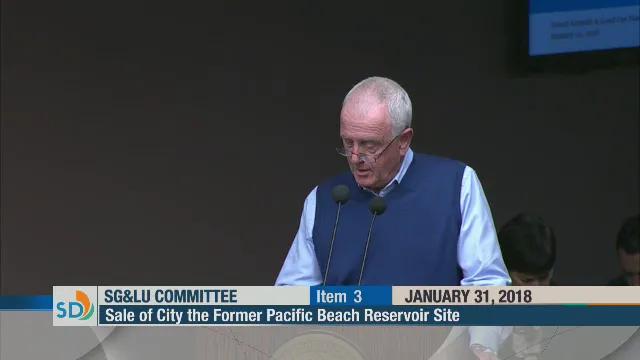
Public Meetings - San Diego, CaliforniaThe City Council Smart Growth and the Entities Committee met on January 31, 2018, to discuss several items including the sale of city-owned properties, updates to the Land Development Code, and amendments to affordable housing density bonus regulations. The meeting included public comments, committee discussions, and votes on multiple agenda items. Consent Calendar - Committee Records of Action (December 7, 2017): Approved by unanimous consent without discussion. Public Comments & Testimony - Non-Agenda Public Comment: - Anne Faggy (Chair, Community Forest Advisory Board) expressed support for trees as infrastructure, noting that trees provide shade, stormwater retention, and support for climate action. She highlighted staffing shortages in the tree program and urged the committee to include trees in infrastructure discussions. - Martha Walsh commented on new tower developments, expressing concerns about high rents and the need for affordable middle-income housing. She noted that many new units remain empty and are too expensive for workers and teachers. - Item 3 – Sale of Former PB Reservoir: Multiple speakers from the Los Altos Road neighborhood opposed the sale at current zoning, citing safety concerns due to narrow roads without sidewalks, traffic congestion, and the rural character of the area. They requested a density reduction (larger lot sizes) and noted the historical significance of the Kate Sessions area. A petition for rezoning with 278 signatures was presented. - Item 6 – 11th Update to Land Development Code: Several speakers supported the update: - Representatives from charter schools (KIPP San Diego, Thrive Public Schools, City Heights Prep) supported item 15 (school use changes), stating it would reduce costs and allow them to focus resources on education. - Infill developers and urban designers supported lot consolidation and live-work changes, citing improved housing production. - Claire Crawford (public interest) opposed item 15, arguing that reduced public process would harm neighborhoods and that charter schools are not required to serve local students. - Ann Faggy raised concerns about tree planting distances (change from 6 to 4 feet) and urged careful tree placement. - Item 7 – Affordable Housing Density Bonus Amendments: - Mariana Bustamante (Build Better San Diego) opposed the amendments, arguing they give developers more without requiring enough on-site affordable housing. - José Rodriguez (SDOP) stated the amendments do not address the housing crisis and called for inclusionary housing requirements of 20-25% on large projects. - Colin Parent (Circulate San Diego) supported the amendments, noting they incentivize on-site affordable housing and are proven successful. - Other supporters included the San Diego Housing Federation, Circulate San Diego, and the Building Industry Association, who highlighted the program's effectiveness and the need to reduce regulatory costs. Discussion Items - Item 1 – Sale of City-Owned Property at Imperial Avenue & 32nd Street: Staff presented; committee members expressed comfort with the recommendation. Approved unanimously without further discussion. - Item 2 – Second Property Sale: Similar to item 1; approved unanimously. - Item 3 – Sale of Former PB Reservoir (4.7 acres, zoned RS1-4): - Staff presented the history: the city followed Council Policy 700-10, offered the property to other agencies (including the Housing Commission, which declined due to cost and zoning), and the appraised value is $8.8 million. A previous buyer backed out. - Committee discussion focused on the possibility of downzoning versus upzoning, the city attorney's memo warning that downzoning could require compensating the water fund, and the Housing Commission's explanation that single-family zoning made the site unsuitable for affordable housing. - Councilmember Sherman moved staff recommendation; Councilmember Alvarez seconded. The motion passed 3-1 with Councilmember Staff voting no. - Item 4 – San Diego Square (Sale for $100 to Housing Commission): Staff explained the property is ground-leased for a 155-unit senior affordable housing project. The sale would transfer administrative costs and deed-restrict the property in perpetuity. Approved unanimously. - Item 5 – La Jolla Marine (Similar Sale for $100 to Housing Commission): Eight townhomes on Cuvier Street; same rationale. Approved unanimously. - Item 6 – 11th Update to Land Development Code (50 issue items): - Staff summarized key changes: repeal of Zone and Use Certificate, elimination of Site Development Permit for lot consolidation in RM zones, commercial signage in residential zones, ground floor height clarification, paleontological resource monitoring thresholds, school use expansion (up to 600 students by right), live-work expansion, and historic resource parking and floor area relief. - Committee discussion raised questions about lot consolidation and consistency with recently updated community plans (North Park, Golden Hill) that discourage consolidation. Staff noted that all development regulations still apply. - Councilmember Sherman expressed support but requested further work on live-work provisions (parking ratio, ground-up construction, square footage) and committed to a standalone item in June 2018. He moved approval of staff recommendation. - Councilmember Alvarez wanted to move without recommendation to allow further discussion on several items (signage, parking reform, affordable housing processing). Councilmember Gomez stated she could not support item 15 (school use) due to reduced community input. - After debate, a motion to forward the item to council without a committee recommendation (no recommendation) passed unanimously. The committee did not adopt a position. - Item 7 – Affordable Housing Density Bonus Amendments (Housing San Diego): - Staff presented changes to comply with state laws (AB 2501, AB 2556, AB 2442, AB 1934) and city-proposed incentives: additional density for not exceeding building envelope, 100% density bonus for micro-units (average ≤600 sf, no unit 800 sf) in transit priority areas, and expanded density for transitional foster youth, disabled veterans, and homeless persons. - Committee discussion included parking reductions (staff noted ongoing comprehensive parking study), the need for more aggressive parking requirements for supportive housing, and the importance of on-site affordable housing. - Councilmember Sherman moved approval; Councilmember Alvarez seconded. The motion passed unanimously. Key Outcomes - Approved Unanimously: Records of approval (consent calendar); items 1, 2, 4, 5, and 7 (density bonus amendments). - Approved 3-1: Item 3 (sale of former PB reservoir) – Councilmember Staff voted no. - Forwarded Without Committee Recommendation: Item 6 (11th Land Development Code update) – sent to full council with no committee position. Staff will continue work on live-work provisions and parking reform for future updates. - The committee will next meet on Wednesday, February 21, 2018.
The Public Safety and Livable Neighborhoods Committee met on January 24, 2018, to receive updates on youth programs, animal services contracting, and to discuss the committee's 2018 work plan. Public comments addressed homelessness, marijuana regulation, traffic safety, and police staffing. Consent Calendar - The committee adopted the record of action items from December 6, 2017, by unanimous consent. Public Comments & Testimony - Homelessness and Police: An unidentified speaker asserted that 20% of jail inmates are homeless, criticized police treatment of homeless individuals, and claimed the city is short of police officers because academies are not funded. - Judy Strang (District 1): Clarified that Prop 64 did not mandate pot businesses; state regulations and permitting were established two years prior via AB 64 and SB 94 to protect consumer safety, public safety, and tax compliance. - Scott Chipman: Read a high school student's opinion piece arguing marijuana is a toxin that harms youth, citing research that 29% of teens use marijuana because friends do, and urged adults to set a better example. - Kathleen Lippitz: Argued that vertical integration in the marijuana industry mirrors
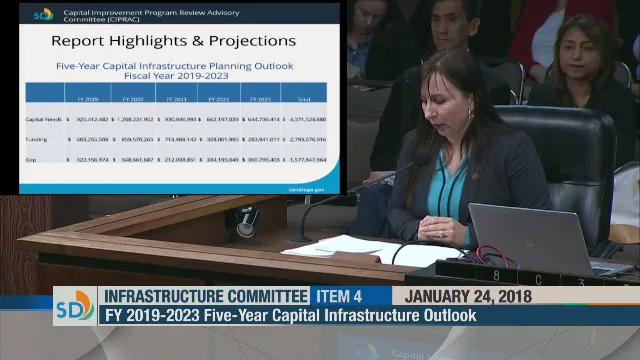
The San Diego City Council Infrastructure Committee met on January 24, 2018, with a full complement of members including Vice Chair Alvarez, Council Members Zapf and Ward, as well as representatives from the City Attorney, IBA, Mayor's office, and the infrastructure committee consultant. The meeting covered approval of consent items, authorization of a contract amendment for the Marina Reservoir Outlet Tower Upgrades project, and an informational presentation on the FY19-23 Five-Year Capital Infrastructure Planning Outlook. Public comments were received on road conditions and the credibility of planning documents. Consent Calendar - Approved the meeting minutes from December 4, 2017, as distributed. - Consent items included: - Agreement related to the OTI Mesa project: acknowledged work on road and housing development with a focus on quick reimbursement processes. - A 900-foot section of a bike path: Caltrans is taking over maintenance responsibility; concerns were raised about ensuring the Get It Done app effectively routes complaints to Caltrans. Vice Chair Alvarez clarified that the city retains maintenance responsibility for that segment. - The consent agenda was moved by Councilmember Zapf, seconded by Vice Chair Alvarez, and approved unanimously. Public Comments & Testimony - Martha Welch (non-agenda public comment): Expressed frustration over persistent road disrepair, sinkholes that are growing, and accusations that the city lies to the public about fixing issues. Claimed the city lacks workers and uses contractors like Acom instead of public works, leading to delays. - Martha Welch (during Item 4): Criticized the five-year capital plan, asserting that similar plans in the past resulted in no construction and that the city hides problems. She stated that nothing gets built. Discussion Items Item 3: Second Amendment to Contract with Richard Brady and Associates for Professional Services – Marina Reservoir Outlet Tower Upgrades - Presentation: Abby Palosi (interim deputy director, Public Works) and Elif Cheton (assistant deputy director) outlined the project: constructing a new outlet tower (140 ft high), a bridge from the dam, raising the dam crest by 4 ft, upsizing pipes from 48 to 72 inches, and adding a diesel generator. The need stems from operational requirements and state Division of Safety of Dams (DSOD) mandates, including drawdown capacity (10% in 10 days, full in 120 days). The project was initially selected in 2001 but put on hold; reinitiated in 2011; a 2014 amendment added hydrologic analysis leading to the new tower design. The existing tower may be deemed historic (by SHPO), requiring seismic retrofit and preservation. The second amendment for $1,000,000 extends the contract to 2020 and covers additional design and construction support. Total design fees: $1.9M; total project cost: $26.5M (construction $22M, admin/soft costs $2.6M, soft cost 26% vs. 30% state benchmark). Funding from CIP and potential state revolving loan fund. - Committee Questions: - Vice Chair Alvarez asked about the historic determination (DSOD's 2016 finding is a starting point; SHPO makes final decision), the purpose of the 4-ft crest raise (to prevent wave overtopping during maximum rain events per 100-year hydrology), and whether the amendment covers full design including potential seismic/historic work (yes; savings if less work needed). - Councilmember Ward asked about additional acre-feet from the raise (not for volume; safety only), whether the reservoir ever overtopped (spillway handled flows), why a new tower instead of capping the old (existing tower cannot accommodate larger pipe; seismic risk may make demolition cheaper), and funding sources (CIP for design; state revolving loan or commercial paper for construction). - Chair expressed hope that the project proceeds and that historic designation does not apply to old infrastructure. He requested status updates. Motion by Vice Chair Alvarez, seconded by Councilmember Ward; approved unanimously. Item 4: City's FY19-23 Five-Year Capital Infrastructure Planning Outlook (Information Only) - Presentation: James Nagelvoard (director of Public Works) and Kerry Purcell (assistant deputy director) presented the fourth annual report. Objective: balanced infrastructure via condition assessments, service level standards, and funding strategies. Covers FY19-23. Key data: $4.4 billion in capital needs identified; $2.8 billion in projected funding; resulting gap of $1.57 billion (increase of $300M from last year, attributed to conservative estimating and lower FBA projections). Major needs by asset type: stormwater ($563M needed vs. $104M funded), general fund facilities ($285M planned against $900M+ total need), bike facilities ($121M need, $5M funded), roads (fully funded). Funding from enterprise assets (water/sewer) and non-enterprise (general fund, Prop H, grants). Not included: sea-level rise adaptation, convention center expansion, IT improvements, non-capital maintenance. Public input via CPC survey. - IBA Comments: Gillian Cassie highlighted that the gap is concentrated in non-enterprise assets; the report shows a peak in FY19-20 due to Pure Water Phase I, then decline. Council can set priorities through budget review and priority memos. - Committee Discussion: - Councilmember Ward: questioned revenue drop from $3.0B to $2.8B (due to missing large grants like West Mission Bay Bridge and lower FBA projections from development slowdown). Expressed concern about housing affordability implications. Asked about grant writing (not projected until secured). Noted fleet needs for CAP not included (brick and mortar only). Bicycle facilities gap of $116M – projects like downtown mobility plan are city-funded, not SANDAG; SANDAG’s $150M is not in the report. Stormwater gap is the largest; suggested exploring efficiencies, regulatory refinements, and integrated planning. Asked if fire station needs align with upcoming CityGate report (yes). - Vice Chair Alvarez: noted that needs are not decreasing except for roads; capacity to deliver projects exists if funding is provided, but three years of Pure Water work strain capacity. Asked about EIFD funding (not yet incorporated), CDBG allocations (diminishing, but repayment from state not shown), bike facilities gap (downtown mobility plan is city-funded), gas tax repeal implications, and sidewalks (maintenance goal to replace all damaged sidewalks by 2024 capital program; new sidewalks at 33,000 linear ft/year only top 10% of needs). Also queried TransNet 30% minimum for maintenance (can be higher, reducing new asset funds). - Councilmember Zapf: noted the stormwater mandate came suddenly; asked about alternative technologies (e.g., direct potable reuse, purple pipes – potential cost waste). Staff mentioned integrated planning, alternative compliance for on-site treatment, and using stormwater for supply. Expressed hope that not spending all money now allows better future solutions. - Chair: highlighted large ticket items (city complex, Balboa Park, stormwater) and urged that the Infrastructure Fund (Prop H) should not be used solely for stormwater; should also fund sidewalks and backfill potential gas tax repeal. Announced intention to develop project oversight guidelines for this committee to track large projects, and to incorporate maintenance needs into future capital outlooks. - No vote; informational item. Key Outcomes - Consent Calendar: Approved unanimously. - Item 3: Motion to approve the second amendment to the contract with Richard Brady and Associates and forward to full City Council passed unanimously. Committee requested status updates. - Item 4: Received as information; no formal action taken. Chair committed to preparing oversight guidelines and exploring inclusion of maintenance needs in future reports. - Public comments: Both comments were acknowledged and entered into the record.
The San Diego City Council Rules Committee convened on January 10, 2018, at 09:15 AM. Members present: Council President Cole, Vice Chair Kercy, and Councilmembers Kate, Ward, and Bree. The meeting included non-agenda public comment, an update from the San Diego Unified School District (SDUSD) on school board election reform, and initial review of 20 ballot measure proposals for potential placement on the November 2018 ballot (with June 5, 2018, as the submission deadline). The committee voted on several motions and referred multiple items for further analysis. Public Comments & Testimony - Beryl Flom (League of Women Voters of San Diego) urged the committee to revisit city attorney opinions on removing city manager references and integrating Article 15 (strong mayor) into the charter. - Daniel Shamowski highlighted sidewalk repair as a public safety issue, noting it cost over $3,000–$4,000 for property owners and contradicted the city’s Vision Zero and alternative transportation goals. - John Stump proposed a workshop on lowering the voting age to 16 or 13 and requested a council policy on contract provisions (climate, stormwater, water conservation, waste management) to avoid brinkmanship. - Catherine Rhodes raised concerns about missing comprehensive annual financial reports (CAFRs) for the successor agency and low‑moderate income housing asset fund since FY2012 and reported that the district attorney would investigate her charges of corruption. - Byron Ware (Prevent Drowning Foundation of San Diego) requested assistance with a proposed junior lifeguard facility on parkland, referencing a 2015 city attorney opinion on Section 55 of the charter. - Peter Komiskey (Rise Up for Us and Culture, representing 70+ arts organizations) expressed support for increased services funded through the Transient Occupancy Tax (TOT). - Numerous public speakers testified on school board election reform, expressing both support for and opposition to term limits, subdistrict elections, and the SDUSD community engagement process. Discussion Items - Item 2 – Update from San Diego Unified School District on Grand Jury Report: SDUSD Board Trustee Richard Barrera and Vice President Dr. Sharon Whitehurst-Payne presented a community engagement plan approved unanimously by the school board. The plan includes an advisory committee, town hall meetings in each subdistrict, a survey, and a report with recommendations. The committee discussed the process, and Councilmember Cole requested an update in April 2018. No vote was taken. - Item 1 – Ballot Measure Proposals (Subitems A–T): The committee reviewed 20 proposals grouped by subject. Key presentations and votes: - Subitem A (Councilmember Alvarez): Dedicate TOT growth to homelessness services. Motion by Councilmember Ward to refer option two (half of incremental TOT growth) to staff and the budget committee for analysis. Passed 3-2 (Cole, Ward, Bree in favor; Kercy, Kate opposed). - Subitems E, F, J (School Board Term Limits/Reform): Motions to advance individual proposals all failed 2-3 (Kercy and Kate in favor; Cole, Ward, Bree opposed). - Subitem B (Robert Ottily – Ethics Reform): Motion by Ward to refer for staff analysis failed 2-3 (Bree, Ward in favor; Cole, Kercy, Kate opposed). - Subitem O (League of Women Voters – Salary Setting Commission): Motion by Bree lacked a second, so no action. - Subitems C and D (Renee Smith – Zoo Tax and Balboa Park Maintenance): No motions were made. - Subitem S (John Stump – Zoo Budgeting Standards): Motion by Ward to refer to Economic Development Committee lacked a second; the chair agreed to docket it. - Subitem G (Catherine Rhodes – Online Travel Agents TOT): No motion. - Subitem I (Jeff Bennett – Nonpartisan Offices): No motion. - Subitem K (University Heights Library District): No motion. - Subitem L (CLEAR – Public Electric Utility): Motion by Bree to refer to Budget Committee passed 3-2 (Bree, Ward, Cole in favor; Kercy, Kate opposed). - Subitem M (John Stump – Net Neutrality/Municipal Broadband): Motion by Bree to refer to Economic Development Committee passed 3-1 (Kercy recused; Cole, Ward, Bree in favor; Kate opposed). - Subitem N (League of Women Voters – People’s Ordinance): Motion by Ward lacked a second. - Subitem Q (John Stump – Public Health & Housing Budget): No motion. - Subitem R (Veterans Business Preference): Motion by Kercy to direct city attorney legal analysis passed unanimously. - Subitem T (IBA – Audit Committee Appointment): Motion by Cole to refer to staff for drafting, with a later decision on which ballot (June or November), passed unanimously. - Item 3 – Review of 2017 Rules Committee Year‑End Report: Informational item; Councilmember Ward noted the omission of Councilmember Kate and a missing report from the City Funds Commission. No action taken. Key Outcomes - Subitem A: Referred to staff and budget committee for further analysis on dedicating half of incremental TOT growth to homelessness (motion carried 3-2). - Subitems E, F, J: School board election reform proposals not advanced to ballot draft stage (all failed 2-3). - Subitem B: Ethics reform proposal sent for staff analysis (motion failed 2-3). - Subitem L: Public electric utility feasibility referred to Budget Committee (motion carried 3-2). - Subitem M: Municipal broadband/net neutrality referred to Economic Development Committee (motion carried 3-1). - Subitem R: City attorney directed to perform legal analysis on veterans’ business tax and employment preference (motion carried unanimously). - Subitem T: City attorney directed to draft charter amendment language for audit committee appointment process; committee will later decide whether to place on June or November ballot (motion carried unanimously). - The committee will hold its next meeting on February 7, 2018.
The Audit Committee met on January 8, 2018, at 17:15 UTC with a quorum present. Members included Council Member Scott Sherman, Thomas Hebrink, and Alan Spencer; Ricardo Valdivia was absent. Also present were City Auditor Eduardo Luna, Deputy City Attorney Priscilla Dugard, Interim City Comptroller Scott Clark, and IBA representative Lisa Byrne. The committee approved prior meeting minutes, heard the City Auditor's monthly activity report, discussed the FY2019 budget, received the FY2017 Comprehensive Annual Financial Report (CAFR), and considered a proposed ballot measure on audit committee appointments. Consent Calendar - Approved the November 8, 2017, Audit Committee meeting minutes by unanimous consent. Public Comments & Testimony - None. Discussion Items Monthly Activity Report (Informational) City Auditor Eduardo Luna reported that since the last meeting, his office issued two audit products: a hotline investigation report on an IT contract and a hotline investigation report on waste in the transportation alternatives program. Two audits are in report writing: the economic development department business and industry incentive program (with a response deadline extended to January 12, 2018) and the stormwater division audit. Four audits are in fieldwork: IT audit of the Excel implementation, development impact fees, data security controls for sensitive police data, and the city's fiscal sustainability and financial condition report (near completion). Eight audits are in planning. No committee questions were raised. FY2019 Budget Proposal and Required 2% Cut The City Charter requires the Audit Committee to recommend the Office of the City Auditor's budget and the City Auditor's compensation to the City Council. Eduardo Luna explained that his FY2019 budget submission was initially identical to the FY2018 adopted budget, with no new positions. However, after the November meeting, the Chief Operating Officer requested all general fund departments submit 2% budget reduction proposals. The Financial Management Department asked the Auditor's Office to cut $79,781 (2% of its FY2018 budget). Luna stated that such a cut would have a significant negative impact, potentially requiring termination of a staff member, ending the electronic workpaper system, or cutting training. He proposed a $14,000 reduction from the contracts budget (earmarked for technical services). Council Member Sherman noted the department is small and already took a 3% cut last year; he argued the discretionary budget is largely for mandatory continuing education and fixed costs, making a $79,000 cut unrealistic. He moved to recommend the budget with no cuts, seconded by Hebrink. The motion passed unanimously. Comprehensive Annual Financial Report (CAFR) for FY2017 Interim City Comptroller Scott Clark and MGO engagement partner Kevin Starkey presented the FY2017 CAFR. Key points included: - The city received a clean (unmodified) audit opinion, with an emphasis of matter on the implementation of GASB 80, which reclassified the San Diego Convention Center as a blended component unit (no change to financial results). - New GASB standards 73 and 82 affected pension reporting. The city's net pension liability increased by $937 million as of the June 30, 2016 measurement date, primarily due to revised actuarial mortality tables and a lower discount rate. - Notes cover pensions (Note 12), other post-employment benefits (Note 13), commitments and contingencies (Notes 17 and 18), and subsequent events (Note 24). - No material weaknesses or significant deficiencies were reported in the separate report on internal controls. - Committee members questioned franchise fee revenue decreases due to Public Utility Commission methodology changes, water utility commitments for the Pure Water initiative, credit rating outlook changes, and the DeAnsha Cove cleanup (not a recorded liability because it is a discretionary city project). - The motion to recommend the council receive and file the CAFR was made by Sherman, seconded by Hebrink, and passed unanimously. Proposed Ballot Measure on Audit Committee Appointments (Information Only) Lisa Byrne (IBA) presented a proposed ballot measure to amend Charter Section 39.1 to allow the waiver of the two-candidate pool requirement for reappointment of an incumbent audit committee public member, provided the City Council approves the reappointment. The measure aims to avoid lengthy recruitment processes when incumbents are reappointed. The measure will be heard as an action item at the Rules Committee on January 10, 2018. Committee members Sherman and Spencer expressed support, but noted concerns about ensuring a process if the council is not keen on an incumbent. No formal action was taken. Key Outcomes - Approved the November 8, 2017, meeting minutes by unanimous consent. - Unanimously recommended that the City Council adopt the Office of the City Auditor's FY2019 budget with no cuts (no reduction from FY2018 adopted budget). - Unanimously recommended that the City Council receive and file the FY2017 Comprehensive Annual Financial Report. - Provided feedback on the proposed Charter amendment (no formal vote).
Note: The transcript references "November 8, 2017" as the meeting date, but the provided metadata indicates the meeting occurred on December 7, 2017. This summary uses the date from the metadata, but the discrepancy is noted. The Smart Growth Land Use Committee, with Councilmember Kate absent, met to approve a consent agenda and discuss an amendment to a parking garage management contract. The meeting was chaired by a committee member (not named in the transcript). Consent Calendar - Items 1–4 were approved unanimously by a motion from Councilmember Alvarez and a second from Councilmember Gomez. No items were pulled for separate discussion. - Item 2 (B Street property sale): Councilmember Alvarez expressed that selling land to the highest bidder without ensuring it is used for housing during a declared housing and shelter crisis is not ideal, but he supported the item. Councilmember Rowlers agreed and requested information on rent revenue changes from the previous year for item 4. Real Estate Assets staff clarified the property is a 0.115-acre parcel currently leased to Jiffy Lube, with a lease that will be assigned to the new buyer. Public Comments & Testimony - No public speakers were present. Discussion Items - Item 5: Amendment to management services and construction of fully automated parking garage agreement for the Evan Jones parkade with ACE Parking. - Miguel Duran (ballpark administrator) and Risa Sanchez (supervising property agent) presented the amendment, which reallocates responsibilities for credit/debit card processing and PCI compliance to ACE. No additional funds are requested; the amendment allows cross-year spending of the existing $1,393,000 authorization. - Committee members expressed frustration with the slow pace of implementation (contract approved in February 2016, but system not yet fully operational). Councilmember Alvarez and Councilmember Gomez raised concerns about PCI compliance, the city's limited credit card acceptance, and delays in the project. Staff noted that the change in merchant account and data network caused the delay, and that the system should be operational within two weeks of council approval. - Councilmember Gomez also questioned the net profit from theater events at the parkade, which staff offered to provide. The committee discussed ongoing issues with graffiti and elevator maintenance, which staff said are being addressed. Key Outcomes - Consent agenda (Items 1–4) passed unanimously. - Item 5 (parkade agreement amendment) passed unanimously on a motion by Councilmember Alvarez and a second by Councilmember Gomez. - Item 6 was returned to staff due to new information and will be brought back at a later meeting. - The meeting adjourned with a note that the next committee meeting date would be announced later.
The Committee of the Environment held its last meeting of the year on December 7, 2017, with Councilmembers Alvarez (Chair), Ward, Sherman, and Kate present. The agenda included amendments to the municipal code for recyclable material franchise exclusion, adoption of the Vernal Pool Habitat Conservation Plan, annual climate action plan report, a new planning tool for community plan updates, and a recycling update at city facilities. Consent Calendar - Approval of the record of action items from the November 2, 2017 meeting and consent agenda items 1-7 were approved unanimously. Public Comments & Testimony Item 8 (Recyclable Material Franchise Exclusion): - Ellie Brown (San Diego Food System Alliance/Healthy Soils Coalition) supported the amendments but asked for periodic enrollment until 2020 and a food recovery vision. - Sarah Messina (Food to Soil) supported, highlighting community composting benefits. - Mickey Nabb (Business for Good) supported, asked for space for future innovation. - Jeremy Ogle (San Diego County Disposal Association) expressed concern about revenue loss (up to $27 per ton in fees) and asked for a cap on certified collectors or limiting eligibility to pre-July 2017 operators. Item 9 (Vernal Pool Habitat Conservation Plan): - Jim Whalen (Planning Commission) supported the plan as a compromise. - David Hogan (11 environmental organizations) supported in concept but requested improvements including a larger preserve in Otay Mesa, addressing the Pure Water site, and improving the inventory. - Tom Story (Crossborder Express) opposed expansion, stating the proposed preserve is already larger than needed. - Richard Halsey (California Chaparral Institute) concerned about missing vernal pools and lack of educational component. - Van Collinsworth (Preserve Wild SAND) asked for modifications. - Frank Landis (California Native Plant Society) asked for delay to resolve issues. - Matthew Adams (San Diego Building Industry Association) supported as a compromise. - Deborah Knight (Friends of Rose Canyon) asked staff to work with environmental groups. Item 10 (Climate Action Plan Annual Report): - Sebastian Saria (Climate Action Campaign) urged moving forward on Community Choice Energy (CCE) business plan with a clear timeline. - Sophie Wolfram (Climate Action Campaign) raised concerns about VMT projections, mode share targets, adaptation plan funding, and need for a transportation master plan. Item 11 (Planning Tool for Community Plans): - Sophie Wolfram reiterated the need for a transportation master plan. Discussion Items Item 8: Recyclable Material Franchise Exclusion Amendments Staff (Mario Sierra, Ken Prue) presented proposed revisions to the Municipal Code allowing food waste under the existing 1,000-ton carve-out for certified recyclers, adding exclusions for solid/liquid byproducts from food processing, and requiring property owner notification for food waste. Fiscal impact estimated at up to $540,000 per year. Committee discussed balancing revenue loss with support for community composting. Councilmember Ward requested an analysis of permits and an IBA report by fall 2018. Item 9: Vernal Pool Habitat Conservation Plan (VPHCP) Staff (Jeff Murphy, Kristen Fauberger) presented a 31-year plan to protect seven vernal pool species, with a conservation strategy allowing impacts to degraded pools in exchange for preservation/restoration of high-value habitat. Total cost $13 million (2014 dollars), no new budget needed. Environmental groups raised concerns about inventory completeness, road rut pools, and preserve size in Otay Mesa. Developers supported the plan. Committee voted to forward to council with a request for continued stakeholder meetings and IBA analysis. Item 10: Climate Action Plan 2017 Annual Report Staff (Cody Hooven) reported a 19% reduction in GHG emissions below 2010 baseline, 66% waste diversion, and progress on clean energy and mobility. Committee discussed data accuracy, mode share metrics, and the enforceability of CAP targets. Next steps for CCE include quarterly updates starting February 2018. Adaptation plan funding: $438,000 SB1 grant plus $100,000 Coastal Commission grant (total need $800,000). Informational item; no vote. Item 11: Community Plan Updates Planning Tool Staff (Jeff Murphy, Alyssa Mudo) introduced a custom modeling tool to assess land use scenarios against CAP mode share targets, using SCAG and MXD models. Tool will produce heat maps for density and employment intensity. First use with Midway and Old Town community plan updates in spring 2018. Informational item. Item 12: Recycling at City Facilities Staff (Angela Colton) reported city facility diversion rate reached 69% in FY2017, up from 25% in FY2016, due to expanded data collection and education. Eight of 13 department groups exceed 50% goal. Next steps: address underperforming departments, streamline data. Informational item. Key Outcomes - Item 8: Motion to forward to full City Council with friendly amendments (analysis of CRMC permits and IBA report by fall 2018) passed unanimously. - Item 9: Motion to forward to full City Council with request for continued stakeholder meetings and IBA analysis passed unanimously. - Items 10, 11, 12: Informational only; no votes taken.
The Public Safety and Livable Neighborhoods Committee (PSLN) of the San Diego City Council met on December 6, 2017, at 9:00 AM (afternoon session). The meeting covered three major agenda items: the first annual report of the Citizens Advisory Board on Police Community Relations (CAB), proposed changes to the Park and Recreation Department fee schedule and recreation council revenue handling, and an update on enforcement against illegal marijuana operations. The committee also approved a consent calendar and heard public testimony. Consent Calendar - The record of action items from November 16, 2017, was adopted unanimously by voice vote. Public Comments & Testimony - Citizens Advisory Board Report: Christy (ACLU of San Diego and Imperial Counties, Coalition for Police Accountability and Transparency) testified in support of the CAB report, urging the committee to act on the SDSU racial profiling study recommendations and to ensure a transparent police chief selection process. Jamie Wilson shared a personal account of her son's interrogation by police, illustrating racial bias and the need for action. - Recreation Council Fee Schedule: Numerous recreation council members and volunteers spoke against the proposed changes. Key speakers included Bill Robbins (La Jolla), Glenda Gates (Mountain View), Pat Warren (Ocean Beach, 43-year volunteer), Greg Goonin (Mira Mesa, attorney), Ted Bringle, Terry Cords (Allied Gardens and San Carlos), Robin Kaufman (Rancho Bernardo), John Horst (Mira Mesa), Dave Roger (Adams Avenue), Jim Nickel, Marilee Picelli (Carmel Valley), Melanie Nickel, Joe Frichtel (Mira Mesa), Doug Beckham (Window to Recreation), Susan Mornian, and Ginny Barnes (past Park and Recreation Board member). They expressed that the process was rushed, lacked transparency, and would undermine volunteer involvement, increase costs, and reduce local control. Many requested an extension of the Special Use Permits (SUPs) beyond December 31, 2017, and a larger working group. They also demanded written indemnification assurances. - Illegal Marijuana Enforcement: William Perno (Central Region Prevention Coalition) presented concerns about city-permitted marijuana businesses promoting drug-impaired driving and public consumption, and called for 24/7 code enforcement and advertising regulations. Kathy Lippetz echoed concerns about enforcement burdens and industry accountability. Phil Rath (United Medical Marijuana Coalition) thanked the committee for enforcement efforts and urged dedicated resources to combat illegal delivery services. Discussion Items - Citizens Advisory Board on Police Community Relations (CAB) Annual Report: Joe Lacava (Vice Chair of CAB) presented the report, highlighting the board's authority, geographic rotation of meetings, milestones (bylaws adopted in August 2017, first work plan), and early actions including recommendations on the police chief recruitment process and adoption of the SDSU Traffic Enforcement Study's 10 recommendations. The board's work plan for 2018 focuses on seven themes: crime prevention, police training, community policing, policies, recruitment/retention, mental health, and race relations. Committee members thanked the board and expressed support for transparent police chief selection and implementation of AB 953 data collection. The report was received as information. - Park and Recreation Department Fee Schedule and Recreation Council Revenues: Deputy Chief Operating Officer Graham presented six recommended actions to address legal concerns about city funds being held in private recreation council bank accounts. Proposed changes include directing all fees to the city treasury into special revenue funds, allowing the Park and Recreation Director to set programming fees, assuming contracts with independent contractors, and retaining nonprofit-raised funds. The department will issue interim Standard Operating Procedures (SOPs) on December 8, 2017, and form a working group of recreation council members to revise Council Policy 742. Committee members debated the proposal. Councilmember Ward moved to forward the item to the full City Council for further deliberation. Councilmember Zaff opposed, citing insufficient time and lack of trust. Councilmember Bree expressed conditional support but wanted the minimum actions and a longer spending deadline. The motion passed on a 2-2 vote (with the chair presumably breaking the tie) and will be considered by the full council. - Illegal Marijuana Operation Enforcement Update: Lieutenant Matt Novak (SDPD Narcotics) and Assistant City Attorney John Hemmerling reported on the successful elimination of nearly all illegal storefront dispensaries through criminal prosecutions, and the shift to enforcement against illegal delivery services. They described two recent raids (Left Coast Collective and Pretty Dank) resulting in arrests and seizures of large quantities of marijuana and cash. The city attorney's office is researching a nuisance per se ordinance and enhanced enforcement tools. Committee members discussed platform liability (e.g., Weedmaps), technology to distinguish legal from illegal deliveries, advertising regulations, and the need for dedicated resources. The chair (Cate) committed to addressing advertising regulations in 2018. Key Outcomes - Consent Calendar: Approved unanimously. - CAB Annual Report: Received as information; committee members encouraged future updates and continued work on police chief selection and AB 953 compliance. - Recreation Council Fee Schedule: The item was forwarded to the full City Council on a 2-2 vote. The committee recommended that the council consider the six proposed actions, with the understanding that interim SOPs will be released on December 8, 2017, and a working group will be formed. Indemnification for recreation council volunteers will be confirmed in writing. Councilmember Bree's request for a six-month spending deadline (until June 30, 2018) and retention of the 10.5% recreation council fee was noted. - Illegal Marijuana Enforcement: The report was received. The committee will continue to evaluate advertising regulations, platform liability, and enforcement resources. The city attorney's office will provide an update on platform enforcement tools within six months.
Consent Calendar The committee approved the meeting minutes from the November 13, 2017 meeting. Public Comments & Testimony - Catherine Rhodes (Point Lema) raised concerns about the FY2017 San Diego Housing Commission comprehensive annual financial report, alleging the hiding of assets and revenues in relation to the CIP budget. She praised the city for acknowledging previously hoarded funds and reducing the push for deferred capital bonds. Rhodes urged the city to comply with state law requiring construction start and end dates for all CIP projects and recommended adopting SANDAG's multi-year project templates. - Catherine Rhodes (on Item 1) reiterated her call for construction dates and clearer reporting on fund balances, revenues, and expenses. She claimed the city was holding $64 million in pre-2010 successor agency bonds beyond the three-year spending requirement. Rhodes also asserted the city had $20.85 million in excess Transnet funds over the allowable 30% cap, which she recommended be redirected to housing or homeless services pending SANDAG approval. Committee Comments - Vice Chair Chris Ward expressed extreme disappointment with contractor performance on recent street resurfacing in Mission Hills. He detailed complaints from dozens of constituents regarding contractors YBS and SRM Contracting, including damage to curbs, removal of landscaping without notice, sloppy paving (asphalt over gutters), and the use of a known bad batch of asphalt. Ward called on the city to hold contractors accountable and improve quality management. - Chair Mark Kersey voiced frustration with lengthy delays on private developer road projects in his district, where lanes and intersections have been torn up for months, in one case over a year. He stated he was working with the Mayor's office to revise right-of-entry permits to include more strict milestones and timelines to hold developers accountable. Discussion Items: FY18 CIP Mid-Year Budget Monitoring Report Presentation by Matt Vespi (Deputy Director, Financial Management) and Adam Jones (CIP Budget Coordinator) The report focused on a consolidated request for council action and updates on cash management. - Consolidated Budget Adjustments: The report combined 83 individual council actions into one, recommending approximately $100 million in appropriations and reallocations (including an amendment to the Regional Transportation Improvement Program), saving an estimated 415 staff hours citywide. Key adjustments included: - $11.7 million for the Torrey Pines South golf course improvements (ahead of the 2021 U.S. Open). - $21.2 million in developer fees (expedited appropriation to speed up spending by six months). - $49 million for water and sewer enterprise projects. - Cash Management and Spending: - Transnet: Fund balance at SANDAG decreased by 40% since July 2015, reflecting increased spending. The city received commendations from the Oversight Board. - Gas Taxes: Fund balances and revenues for gas taxes and the new Road Maintenance and Rehabilitation Account (RMRA) are fully budgeted. A citizens' initiative to repeal the new gas taxes poses a $121 million risk to road funding. - Infrastructure Fund: Flexible funds from Proposition H have been programmed for slurry seal, drainage, and facility improvements. - Lease Revenue Bonds (DC3): Spending has averaged $8.5 million per month since April 2017. The city is on track to meet the IRS requirement to spend 85% of proceeds within three years. - New Financing & Efficiencies: - Commercial Paper: The water enterprise fund has drawn $62.6 million from a $250 million line of credit at an average interest rate of 1.03%. A $75 million General Fund commercial paper program is planned for spring 2018 to fund active construction projects. - Encumbrance Process: A pilot on the SR 163 project, using reliable Transnet revenue to encumber future years, freed up $2.9 million for other priorities. - Pooled Contingencies: A pilot program for water and sewer mains reduced project contingencies from 5% to a pooled 3%, freeing $3 million. Only one project has drawn from the pool so far. - Committee Questions & Discussion: - Councilmember Gómez clarified Transnet spending figures ($37M spent vs $31.9M received in 2017). Staff confirmed that excess funds from the near-complete Fire Station 17 project will be reallocated to the Mission Bay Lifeguard Station, and the Fairmont Fire Station design is fully funded. - Councilmember Zapf praised the streamlining efforts. She inquired about the pilot contingency program; staff confirmed it will continue to be monitored for another year before a potential expansion. She also requested follow-up information on remaining funds for the Rosecrans Street repaving project to coordinate with community planning. - Chair Kersey praised the report as a great success story, highlighting the flexibility of the infrastructure fund and the faster spending of lease revenue bonds. Key Outcomes - The committee voted unanimously to adopt the staff recommendation for the FY18 CIP Mid-Year Budget Monitoring Report and forward it to the full City Council. Vice Chair Ward recused himself from the vote due to a property interest affected by a project in the report. - The Independent Budget Analyst (IBA) announced that an office report responding to the CIP report would be issued later that week. - The meeting concluded the committee's business for the 2017 calendar year.