Browse by city
Date range
Search help

Search titles, summaries, topics and stored transcripts together. Keywords may match separately; put the whole query in double quotes for a phrase. Matching follows word analysis, so punctuation is not exact. Both dates are included. Documents are not searched.

SHOWING 941–950 ENTRIES
941
MAR 8, 2018 · SAN DIEGO, CALIFORNIA · ENVIRONMENT COMMITTEE
Environment Committee Meeting Summary – March 8, 2018

The Environment Committee meeting on March 8, 2018, chaired by Councilmember Alvarez, covered updates on water billing issues, the Pure Water program, construction management contracts for Pure Water, a pilot litter and graffiti abatement program, and a five-year expenditure outlook for the Climate Action Plan (CAP). All council members were present. Consent Calendar - Items 1 and 2 were approved unanimously with a motion by Councilmember Kate and second by Member Sherman. No public comments or committee questions were raised. Public Comments & Testimony - Non-Agenda Public Comment: Martha Welch expressed concerns about continued use of aviation fuel (Avgas) at city-owned airports. A second speaker raised issues about water infrastructure age and high bills, citing alleged threats and control by an individual. - Item 6 (Water Bills): Rafael Romero, a constituent of District 8, described his experience with a high water bill (average $100-149 spiking unusually) and difficulty getting the meter read. He requested assistance. - Item 5 (Pure Water Implementation): David Hogan (environmental activist) supported the project but urged consideration of alternative sites for the purification facility to protect vernal pools and wildlife connectivity. Marco Gonzalez (Coastal Environmental Rights Foundation) supported the project and opposed Murphy Development’s alternative pipeline alignment, calling it hyperbolic. Caitlin Arduino (Murphy Development), Marcella Escobar Eck, Christopher Niels (counsel to Murphy), Doug Wright (Mission Federal Credit Union), and Bob Ioko (Scripps Ranch Planning Group) opposed the alignment through Scripps Ranch Business Park, arguing it would disrupt development and offering an alternative route. They claimed the city’s EIR analysis was insufficient and that a route change would not significantly delay the project. - Item 8 (CAP Expenditure Outlook): Sophie Wolfram (Climate Action Campaign) thanked the IBA for the report, supported the recommendations, and urged including a CAP attachment to the five-year financial outlook, developing performance measures, and separating Pure Water costs from CAP-related expenditures. Discussion Items - Customer Water Bills Update (Item 6): Public Utilities Director Vic Bianas and staff presented an update on high bill complaints. Key points: wait times dropped from 1 hour to 5–20 minutes after doubling staff; 343 initial cases of human error with one meter; average refund $500 (range $4.50 to $11,000); 97,000 AMI meters installed (15,000 automatically read); water shutoffs suspended as of the Tuesday before the meeting; $66 meter controversy test fees waived and refunded for payments since July 2017. The City Auditor confirmed an ongoing audit, but data delays from IT may push completion past June. Councilmembers expressed concerns about meter reading accuracy, proactive outreach, and the need for monthly billing. - Pure Water Implementation (Item 5): John Helminski presented an update: Phase 1 cost estimated $1.1–1.3 billion; EIR certification expected April 2018; regulatory approvals on track; design nearing completion; grant applications (WISIP $219M, SRF loans, etc.) in process. Public comments highlighted opposition from Murphy Development and support from environmental groups. The City Attorney advised that specific EIR discussion should be avoided to preserve due process for the quasi-judicial North City Pipeline project. The Mayor’s office committed to facilitating discussions with Murphy and environmental advocates before the Council hearing. - Construction Management Contracts (Items 3 & 4): John Helminski presented two contracts: $75 million with Parsons/Black & Veatch for treatment plants and $45 million with CH2M Hill for conveyance projects, both for five years. The contracts were approved unanimously. Committee members asked about discrimination allegations against Parsons (answered that they are addressed through proper channels) and lack of small/disadvantaged business participation, flagged for future attention. - Litter and Graffiti Abatement Pilot (Item 7): Mario Sierra (Environmental Services) reported the one-year pilot (May 2017–April 2018) removed over 850 tons of litter from nine hotspots, but daily tonnage increased from 3.5 to 5.8 tons, indicating the pilot was not effective in reducing dumping. Graffiti removal addressed 2,400 sites. The program will transition into the Clean San Diego initiative, with FY19 budget proposals expected. Councilmembers noted reduced complaints in some areas. - Five-Year CAP Expenditure Outlook (Item 8): IBA’s Jeff presented the report showing $1.1 billion in identified CAP-related expenditures over FY19–23, mostly Pure Water. Recommendations: incorporate CAP into the five-year financial outlook, develop implementation timelines/costs for strategic plans, and create performance measures tied to CAP goals. The Mayor’s sustainability officer noted the CAP already has performance measures and that social equity metrics are being developed. The chair indicated a referral to the budget committee to consider amending council policy. Key Outcomes - Consent calendar items approved unanimously. - Water bills: No immediate votes. The City Auditor’s audit continues; data delays noted. The committee urged proactive customer outreach and monthly billing evaluation. - Pure Water: No formal action taken. The Mayor’s office will convene discussions with Murphy Development and environmental groups before the Council hearing. - Construction contracts (Items 3 & 4): Approved unanimously. - Litter program: Informational; program will be folded into Clean San Diego. - CAP outlook: Recommendations noted; the chair committed to referral to the budget committee for potential policy changes. Further dialogue with the CFO and departments will follow. Meeting adjourned at conclusion; next regular meeting scheduled for April 12, 2018.

WATER AND WASTEWATER MANAGEMENT 34% · PUBLIC ENGAGEMENT 13% · CLIMATE CHANGE 9% · PROCEDURAL 7%
942
MAR 7, 2018 · SAN DIEGO, CALIFORNIA · RULES COMMITTEE
San Diego Rules Committee Meeting on CRB Measure G Implementation and Charter Amendments - March 7, 2018

The Rules Committee of the San Diego City Council met on March 7, 2018, at 10:00 AM to discuss two main agenda items: a draft ordinance implementing Measure G (the Community Review Board charter amendment) and a discussion of charter amendment proposals from the 2015-2016 Charter Review Committee that were not placed on the 2016 ballot. The committee heard public testimony, deliberated, and took action on the first item. Public Comments & Testimony - Robert McNamara (opposition to the CRB ordinance): Argued that Measure G did not fully address all original amendments, failing to include an independent investigator, subpoena power for the board, and permanent funding for independent legal counsel. He requested a referral to the Rules or Public Safety Committee to investigate those aspects. - Kate Yavendetti (in favor, representing Women Occupy San Diego and National Lawyers Guild): Expressed support for the draft ordinance because it allows the CRB to audit Category II complaints, a change she welcomed. However, she raised a concern that the appointment language stating "members shall be appointed by the mayor and confirmed by the city council" does not comply with Measure G, which she believes gives council members equal appointing authority. She urged the language be changed to include council members as appointers. - Robert McNamara (second appearance, on charter amendments): Spoke in favor of three specific charter amendment proposals: changes to Charter Section 12.1/24.141.1, renaming the Ethics Commission to the San Diego Fair Political Practices Commission, and transferring oversight of school board elections to the San Diego Unified School District. Discussion Items 1. Implementing Measure G – Community Review Board (CRB) Ordinance and Standard Operating Procedures - Staff (Mr. Graham) and CRB Chair Doug Case presented the draft ordinance. Key changes include: the board will be administered jointly by the mayor and city council; the board retains its 23-member composition, with appointments made by the mayor and confirmed by council; creation of a "CRB Academy" training program to replace the former prospective/alternate member system; two-year terms (up to eight consecutive years); a process for removal by council and mayor for misconduct; and a new ability to audit Category II complaints for civilian oversight. The standard operating procedures enshrine existing case review processes. - Committee members asked about the training program, timeline to fill vacancies, and ensuring geographic diversity across council districts. Staff replied that the existing vetting process would continue under the academy, and that outreach to all council districts is conducted. The mayor's office is committed to moving forward a slate of appointments quickly after ordinance adoption. - Council President made a motion to refer the draft ordinance to the City Attorney's Office for legal review and preparation of a final ordinance to bring to the full City Council for consideration. The motion was seconded by Committee Member Kate. 2. Charter Amendment Proposals from the 2015-2016 Charter Review Committee - The committee discussed which of the proposals from Attachment 1 of the final report to prioritize for possible placement on the November 2018 ballot. Committee Member Kate listed several: reorganization of charter articles on legislative powers (Article III), independent non-mayoral departments, strong mayor form of governance, Planning Commission (Section 41C), and ethics commission name change (Section 41D). Committee Member Bree noted she is already committed to two charter-related measures (school board elections and Section 225 disclosure of business interests) and raised the question of bundling related items subject to the single-subject rule. The Independent Budget Analyst (IBA) proposed a name change to "Office of the Independent Budget and Policy Analyst." - No motion was made. The committee gave direction to the City Attorney's Office to research which proposals have already been partially drafted or researched and to bring back an informational item at a future meeting, well ahead of the June 5 deadline for November ballot measures. Key Outcomes - Motion on CRB Ordinance: The committee voted 4-0 to refer the draft ordinance to the City Attorney's Office for final legal review and drafting, with the intent to bring it to the full council for consideration. The ordinance will incorporate changes including Category II complaint auditing and the new training academy. - Charter Amendment Direction: No formal vote was taken. The City Attorney's Office was directed to compile a report on the status of previously worked-on charter amendment proposals (especially those listed by Committee Member Kate) and return to the committee for further consideration. The IBA's name change suggestion was noted for potential inclusion.

POLICE OVERSIGHT 35% · PUBLIC COMMENT 32% · PUBLIC SAFETY 15% · CHARTER AMENDMENTS 9%
943
FEB 22, 2018 · SAN DIEGO, CALIFORNIA · ECONOMIC DEVELOPMENT & INTERGOVERNMENTAL RELATIONS COMMITTEE
San Diego Economic Development and Intergovernmental Relations Committee Meeting – February 22, 2018

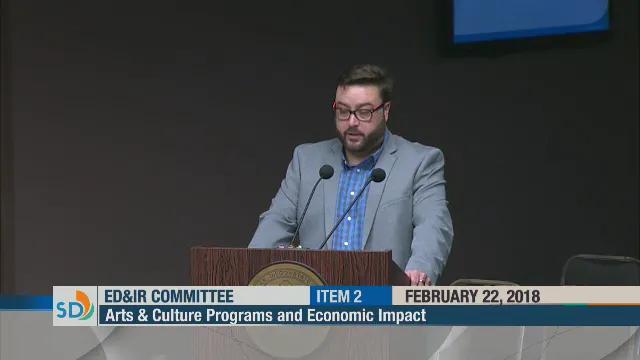
The Economic Development and Intergovernmental Relations Committee met on February 22, 2018, with Councilmembers Alvarez and Bree present and Council Vice Chair Kircy absent. The committee approved the January 31, 2018 minutes, postponed one agenda item, and heard presentations on municipal broadband and net neutrality, the economic impact of Balboa Park, and the economic impact of arts and culture programs. No action was taken on the informational Balboa Park or arts and culture items. Opening, Postponement, and Approval of Minutes - The committee approved the record of actions from January 31, 2018 by unanimous consent. - Item 4, the San Diego Workforce Partnership Connected Careers update, was postponed due to a scheduling issue and will be brought back to a future committee meeting. Public Comments & Testimony - Martha Welch argued that the county and city are not properly handling property tax responsibilities, that certain taxes and projects such as the RTP CIP were not approved by voters, and that the 2004 sales tax cannot be used for other purposes. She stated that property tax and sales tax are different and described several tax-related actions as illegal. - For the municipal broadband item, Chanel Hawken, representing Cox, opposed municipal broadband, citing failed municipal networks, including Seattle's estimated $500 million cost and $75 per month service. She noted Cox's $10 billion infrastructure investment, gig-speed deployment, free Wi-Fi at city libraries and events, and the $9.95 per month Connect to Compete program. - Ignacio DeLatore, representing AT&T, opposed municipal broadband, stating that San Diego already has abundant and low-cost broadband, including $5 to $10 per month options. He argued that the Stockholm model is more relevant to smaller 'B cities' and that numerous municipal broadband ventures have failed, making taxpayer investment risky. - Buzz Schott, representing Charter Communications, opposed municipal broadband, saying government-owned networks mostly fail. He cited Charter's $25 billion infrastructure investment over four years. - On the Balboa Park item, John Stump said the economic report omitted a full accounting of expenses and maintenance needs. He identified the zoo tax as the largest source of park funding, requested a second report on needs, asked how much park payroll goes to San Diego residents, and urged true cost accounting, including the environmental costs of tourism, and a trolley connection up Park Boulevard. - On the arts and culture item, Carla Velasquez, a Barrio Logan parent, expressed strong support for arts and culture programs, saying that without them her son would need to travel an hour away, or ten hours per week on a bus. She praised the '52 Weeks of Science' program and said such programs have improved Barrio Logan's reputation. - Taylor Ward, chair of Rising Arts Leaders of San Diego and representing the Rise Up for the Arts and Culture movement, urged the committee not to cut arts funding. He said the arts are a struggling sector, that OSP and CCSD support more than a hundred institutions, and that many arts employees would not survive cuts. - Garrett Redlings, a North Park parent, supported continued and increased funding for arts and culture, especially the San Diego Youth Symphony, which he called one of the crown jewels of Balboa Park. - John Stump also spoke on the arts item, saying he supports the arts but asking that cuts be made from the top rather than the bottom. He suggested that organizations receiving city funding with chief executive salaries higher than the Parks and Recreation director should be ineligible, and that larger institutions with large budgets and free rent should perhaps pay triple net leases. He asked for data on how many City of San Diego residents are employed by arts organizations. Discussion Items - Municipal Broadband and Net Neutrality Referral: John Stump, who initiated the referral, argued that the city should examine whether residents and businesses are getting the best, least expensive, and most available internet service. He provided background on city council policies, cited Stockholm's city-owned fiber network where providers rent access, and urged the committee to study different municipal broadband approaches. Councilmember Bree said that municipal broadband is not the right path at this time, but expressed concern about the FCC's December net neutrality repeal and said she wants to pursue statewide solutions and affordable internet for every family. Councilmember Alvarez asked about the status and timing of cable franchise agreements and highlighted the digital divide in his district. Chair Ward noted concern about net neutrality and the changing technology landscape, including a SpaceX launch that morning. The committee passed a motion, unanimously, to request the mayor's office and relevant departments to examine feasibility, opportunities, and barriers for broadband, explore Wi-Fi hotspots in city parks and libraries, and report back, with additional information on franchise agreements. - Balboa Park Regional Economic Impact Study: Thomas Herrera-Misler, President and CEO of the Balboa Park Conservancy, presented a study by SDSU's Payne School of Tourism and Hospitality. He reported that Balboa Park generates approximately $600 million in annual benefits for San Diego, including $192 million in direct visitor spending, 311,000 hotel nights, $6.7 million in hotel taxes, and $3.2 million in local sales tax. The study found $111 million in value from free or subsidized recreation, $44 million in health benefits for 40,000 people who exercise in the park, and about 1,100 jobs with $52 million in annual salaries. About 2.6 million local residents visit the park an average of ten times per year, and about two million visitors come from outside the region. Herrera-Misler said the park is an underperforming asset, with only about half of the master plan improvements completed, and he called for sustained public funding and reinvestment. In response to questions, he clarified that the study counted only visitors who came to San Diego primarily or largely because of Balboa Park, based on a survey of 2,200 people, and that the zoo was not included. Councilmembers discussed the park's return on investment, tourism marketing, and the need for a master plan implementation plan. This was an informational item. - Arts and Culture Programs and Economic Impact: Janet Poutre, Chair of the Commission for Arts and Culture, and Tyler Hughes, Chair of the Arts and Culture Advocacy Committee, presented an update. They reported that in FY18 the commission contracted with 133 nonprofits and distributed $11.3 million through operating support and Creative Community San Diego grants, and that 156 applications were under review for FY19. Hughes presented data from an Americans for the Arts study showing over $1.1 billion in annual economic activity from arts and culture organizations and audiences, $48 million in direct tax revenue, and almost 36,000 full-time equivalent jobs. The study counted 3.6 million non-resident attendees, representing 30% of total attendance and 2.5 times the economic activity of local attendees. He noted that cultural tourists spend more, and that about 13,000 volunteers contribute an estimated $13 million in time. Councilmember Alvarez said arts funding should not be cut and suggested exploring the roughly $30 million TMD reserve for potential lawsuit liabilities as a possible source. Councilmember Bree noted that six of nine council members prioritized arts funding in budget requests and asked about grant process transparency and philanthropic support. Poutre said organizations must provide a three-to-one match, so every city dollar is at least tripled. Chair Ward highlighted the relationship between arts and economic development and the discrepancy between projected TOT growth and possible arts cuts. This was an informational item. Key Outcomes - Approved the January 31, 2018 committee minutes by unanimous consent. - Postponed the San Diego Workforce Partnership Connected Careers update. - Passed a unanimous motion on the municipal broadband/net neutrality referral, directing the mayor's office to study feasibility, opportunities, and barriers, explore Wi-Fi hotspots in parks and libraries, and report back, including information on franchise agreements. - Received the Balboa Park economic impact study and the arts and culture economic impact report as informational items, with no formal action. - The committee's next meeting was scheduled for March 22, 2018 at 2 p.m.

ARTS AND CULTURE 25% · TECHNOLOGY AND INNOVATION 16% · PUBLIC PARKS 12% · TOURISM 10%
944
FEB 21, 2018 · SAN DIEGO, CALIFORNIA · PUBLIC SAFETY & LIVABLE NEIGHBORHOODS COMMITTEE
Public Safety and Mobile Neighborhoods Committee Meeting - February 21, 2018

The Public Safety and Mobile Neighborhoods Committee met on February 21, 2018, at 9 a.m. to discuss several items, including public comments on the California Values Act (SB 54), a consent agenda item on the Play All Day program, a fire rescue equipment replacement, a library overdue fines policy change, police recruitment and retention, police communications center performance, and identity theft investigations. The meeting included public speakers, committee member questions, and unanimous approvals on action items. Consent Calendar - The consent agenda included adoption of action items from January 24, 2018, which were adopted by unanimous consent without being pulled. - Item 1 on the consent agenda (Play All Day program) had one public speaker in opposition, but the committee chose to move it forward. A motion was made and seconded to approve the item; it passed unanimously. Public Comments & Testimony - Margaret Baker (resident and property owner in Nestor, representing South Bay People Power) urged the committee to expedite implementation of SB 54 (California Values Act), stating that local resources should not be used for mass deportations and that safeguards are needed for public facilities. She noted that the law went into effect in January but policies were not yet updated. - Martha Welch (speaking on consent agenda Item 1) opposed the Play All Day program, arguing it was a cheap way to create parks without bathrooms, that no budget line existed for school payments, and that the city should not use school funds for parks. She also commented on Mission Bay funding, claiming $20 million was allocated inappropriately. - Scott Chipman (San Diego's for Safe Neighborhoods) spoke against the marijuana industry, citing health risks, increased black market activity (380% increase in Colorado), and the presence of carcinogens, pesticides, and fungus in cannabis. He urged the committee to prioritize public health and safety. - No other public speakers were present for later agenda items. Discussion Items - Play All Day Program (Consent Agenda Item 1): Committee members discussed restrooms and lighting infrastructure. Andy Field (Assistant Director of Park and Recreation) and Shannon Scoggins (Park Designer) answered questions about plans for evening use and amenities. - Fire Rescue Equipment Replacement (Item 2): Chief presented on replacing old equipment through an RFP process. New equipment is expected to last 12–15 years. The item was approved unanimously. - Library Overdue Fines Policy (Item 3): Missy Jones (Library Director) proposed moving from an overdue fines model to a materials recovery model. The discussion included partnerships with schools and community colleges, and improvements in testing for library programs. - Police Recruitment and Retention (Item 4): Chief reported on recruiting efforts, including partnerships with universities and high schools, a written test implemented in January 2018 with improved pass rates, and a focus on building a pipeline. Committee members discussed marketing strategies and the use of police service officers as a funnel to sworn positions. This was an information item only. - Police Communications Center (Item 5): An informational report on call wait times. February 1–20 statistics showed an average wait time of 7 minutes 19 seconds during peak hours (9–10 a.m.), with 56% of calls answered within 2 minutes overall. Committee members expressed concerns about abandoned calls and quality-of-life issues in beach communities. - Identity Theft Investigations (Item 6): Lieutenant Martha Sines presented an overview, noting increased public awareness and proactive measures. She discussed challenges with Prop 47 (theft thresholds), the need for cumulative theft laws, and offered resources for seniors. Committee members asked about success rates in catching criminals and the process for security freezes. Key Outcomes - The consent agenda (including Item 1) was adopted unanimously after a motion and second. - Fire rescue equipment replacement was approved unanimously. - The library overdue fines proposal, police recruitment report, communications center report, and identity theft report were informational and required no vote. - The next committee meeting was scheduled for March 21, 2018, at 9 a.m.

PUBLIC SAFETY 25% · POLICE RECRUITMENT 23% · IDENTITY THEFT 14% · LIBRARIES 11%
945
FEB 21, 2018 · SAN DIEGO, CALIFORNIA · LAND USE & HOUSING COMMITTEE
Smart Growth and Land Use Committee Meeting - February 21, 2018

This meeting of the Smart Growth and Land Use Committee (formerly known as Smart Growth in the AMUs) was held on February 21, 2018, with Chair Gomez presiding and Vice Chair Alvarez, Councilmember Sherman, and Councilmember Hillary Sach present. The committee approved minutes from January 31, 2018, heard non-agenda public comments, discussed the sale of city-owned land, received an informational status report on the housing affordability crisis, a presentation on the proposed California Sustainable and Affordable Housing Act (CASA), and reviewed the 2018 work plan. Numerous members of the public testified on affordable housing, parking, transit-oriented development, and inclusionary policies. Consent Calendar - Approval of minutes from January 31, 2018 – approved unanimously without discussion. Public Comments & Testimony - Rambesis Surban (Rancho Peñasquitos Planning Board member, speaking as an individual) called attention to the Pacific Village redevelopment project on the March 5 City Council docket. He stated that the project would replace 332 affordable housing units with only 60 affordable units (10% minimum required), representing a net loss of affordable housing. He urged the committee to remember city policy goals to protect affordable housing when voting on the project. - Martha Walsh complained about Section 8 housing management, property taxes, and lack of affordable housing construction. She claimed managers give vouchers arbitrarily and called for accountability. - David Modi (Community Planners Committee) proposed a compromise on lot consolidation: allow it citywide except for communities like Greater Golden Hill and North Park that have specific concerns in their community plans. - Joy Sonietta (District 3 resident) highlighted a statistic that 23,800 K-12 youth are homeless in San Diego County, urged attention to prevention efforts, and noted Councilmember Ward's plan focusing on prevention. - Mark Jules criticized San Diego's lack of expertise in smart growth, arguing the city's development is car-dependent. He suggested obtaining outside expertise and cited the high cost of auto-oriented infrastructure. - José Rodriguez (San Diego Organizing Project / Build Better San Diego Coalition) called for increasing on-site affordability beyond the current 10% requirement and argued the housing crisis requires urgent solutions. - Vicky Granowitz (San Diego Planning Commission, speaking personally) expressed concern about affordable housing units losing their certification and urged the city to plan for preservation. She cited the PQ project as an example where more affordable units could have been included. - Maya Rosas (Circulate San Diego) supported the work plan, especially parking reductions and DIF restructuring. She also recommended reforms to community planning group voting procedures. - Mariana Usamante (Build Better San Diego Coalition) emphasized the need for inclusionary housing and anti-discrimination policies to prevent displacement, noting that families with Section 8 vouchers face discrimination. - Eric Tilkmeyer (City Heights Community Development Corporation) supported the aggressive work plan, especially inclusionary housing and anti-displacement policies, and urged actual development of habitable units rather than fees in lieu. - Molly Kirkland (San Diego County Apartment Association) thanked the committee and suggested education and outreach to increase landlord participation in housing voucher programs. - Marta Flores (Our Lady of Guadalupe Church, Barrio Logan) urged expedited action on affordable housing, especially for families, and called for a progress report to track the city's efforts. - Brad Mills (same parish) echoed the need for family-sized affordable housing and supported requiring 25% of new units to be affordable. - Matthew Adams (San Diego Building Industry Association) supported the committee’s collaborative approach and cautioned that inclusionary housing must be carefully designed to avoid harming middle-income housing production. Discussion Items Item 1: Sale of 2.7 Acres of City-Owned Land to OTI Land Company Mary Carlson (Real Estate Assets) presented the proposal to sell city-owned land in Chula Vista (appraised value $51,000, reflecting an easement for a water pipeline) to the adjacent property owner. The property is not needed for municipal use, and the sale would put it back on tax rolls. Councilmember Sherman moved approval; Councilmember Alvarez asked about the appraisal date (February 2, 2018, independent). The motion passed unanimously. Item 2: Informational Item – Addressing the Housing Affordability Crisis 2018 Status Report Wendy and Jenny Vanderheid (San Diego Housing Commission) reported progress on all 11 action items from the 2015 report. Highlights included citywide housing production goals, AB 1637 (middle-income housing pilot), the 11th code update, reduced parking near transit, and increased density bonus from 35% to 50%. Councilmembers expressed frustration with slow progress on parking requirements, CEQA thresholds, and inclusionary housing. Vice Chair Alvarez urged bolder action and noted that the report should go to full council. The item was informational; no vote was taken. Item 4: California Sustainable and Affordable Housing Act (AB 2372) – CASA Act Lara Gates (Councilmember Gomez’s office) presented a proposed state bill that would allow cities to opt into a floor-area-ratio (FAR) density bonus for developments that set aside 20% of units at 50% AMI or less, reduce parking to 0.1 spaces per unit, and allow impact fees on a per-square-foot basis. The bill aims to incentivize smaller, naturally affordable units along transit corridors. Developers David Allen and Andrew Malik spoke in favor, as did Matthew Adams (BIA). Sophie Wolfram (Climate Action Campaign) urged ensuring livable wages and family-sized units. The item was informational; no vote was taken. Item 3: 2018 Work Plan Chair Gomez presented a draft work plan focusing on parking requirement updates, preservation of existing affordable housing, companion units, and other priorities. Public comments highlighted inclusionary housing, anti-discrimination policies, and expedited action. Councilmembers Alvarez and Sherman stressed the need for bold measures, including upzoning, CEQA reform, and reducing parking requirements. Elise Lowe (Mayor’s Office) provided a timeline: TPA parking study by early June, code updates in fall, and DIF methodology workshop in April. The work plan was discussed but not formally voted on. Key Outcomes - Consent Calendar: Approved unanimously. - Item 1 (Land Sale): Approved unanimously. The 2.7-acre property will be sold to OTI Land Company at the appraised value of $51,000, with proceeds to the capital outlay water fund. - Item 2 (Housing Report): Informational; no action taken. Councilmember Alvarez indicated the report should be presented to full council. - Item 4 (CASA Act): Informational; no action taken. The city is a sponsor of the state bill. - Item 3 (Work Plan): Discussed. The committee will continue to refine the work plan. Upcoming milestones: parking study completion in June 2018, DIF methodology workshop in April 2018, and CEQA threshold review in fall 2018. - The committee’s next meeting is scheduled for March 21, 2018.

AFFORDABLE HOUSING 64% · HOUSING 13% · TRANSPORTATION 5% · HOMELESSNESS 3%
946
FEB 14, 2018 · SAN DIEGO, CALIFORNIA · AUDIT COMMITTEE
San Diego Audit Committee Meeting - February 14, 2018

The San Diego Audit Committee met on February 14, 2018 (Valentine's Day) with a quorum present including Councilmember Scott Sherman, Tom Hebrink, Alan Spencer, and Ricardo Valdivia. Also present were City Auditor Eduardo Luna, Deputy City Attorney Priscilla Dugard, Interim City Comptroller Scott Clark, IBA representative Lisa Byrne, and committee consultant Bruce Williams. The committee reviewed three discussion items: the monthly activity report, a performance audit of the city's grants management program, a performance audit of the Communications Department's charges for services to enterprise funds, and the quarterly fraud hotline activity report. Discussion Items Monthly Activity Report - City Auditor Eduardo Luna presented the monthly activity report, listing audits issued (quarterly fraud hotline report for Q2 FY2018 and an audit of the Economic Development Department's business and industry incentive program), audits in report writing (stormwater division), and audits in progress (IT audit of Excel implementation, planning department development impact fees, data security of police data, fiscal sustainability, fleet services, curb painting, human capital, community planning groups, and real estate assets). Upcoming audits include climate action plan, cure fee program, IT disaster recovery, and two annual audits. Committee members requested more detailed status charts (e.g., bar chart showing audit phase) and prioritized the water meter accuracy audit, which is expected to complete by early spring 2018. The report was for information only. Performance Audit of City Grants Management Program - Assistant City Auditor Kyle Elser and lead auditor Arles Erickson presented findings. The city received approximately $558 million in grant revenue from fiscal year 2000 to fiscal year 2016, averaging $80 million annually. In FY2017, 148 active grants were managed, with 89% from federal and state sources. The audit found that city guidelines had not established requirements for coordinating searches or assessing grants prior to application, and departments lacked written procedures for grant administration. Recommendations included streamlining the application process, creating an oversight committee, and establishing a control framework. City staff (Sarah Brennan, Natasha Kaller, Stacey Lamedico) reported ongoing efforts to implement a streamlined process, with a goal to bring a proposal to the Budget Committee in March 2018. Discussion focused on the inefficiency of requiring City Council approval for all grant applications; the proposed threshold of $1 million for streamlined approval was supported. Councilmember Scott Sherman noted that no grant application had ever been pulled from consent. The committee voted unanimously to accept the report and forward it to City Council. Performance Audit of Communications Department Charges for Services to Enterprise Funds - Supervisor Shine Pickney and primary auditor Greg Cleary presented. The audit examined billing accuracy for communications services provided to enterprise fund departments and whether consultant use increased after the 2015 consolidation. Findings showed that billing mechanisms could be strengthened by requiring all staff to maintain activity logs with internal order numbers, and by providing periodic detailed reports to client departments. The department agreed to implement both recommendations. Committee members questioned the delay in implementing a project tracking tool (since October 2016) and requested that IT provide a list of evaluated systems. The committee voted unanimously to accept the report and forward it to City Council, with a request for IT to report on software options. Quarterly Fraud Hotline Activity Report (Q2 FY2018) - Fraud Investigator Andy Harida reported 71 complaints received in the quarter. Six were assigned to the City Auditor, 47 to departments, and 18 were outside purview. 58 complaints were closed, leaving 47 open. Two auditor investigations were substantiated: one involving a vendor using city water without payment (four recommendations), and another involving a staff report that omitted material information on a $14 million contract (six recommendations). One auditor investigation into the Transportation Alternatives Program found significant internal control weaknesses (overpayments, unreconciled cash, contracting deficiencies), resulting in 12 recommendations. Eight department investigations were substantiated for issues such as theft of time, abusive behavior, and improper disposal. Corrective actions were taken in 11 department cases. CFO Rolando Trevel provided an update on automating the transportation subsidy process to eliminate cash handling. The committee accepted the report. Key Outcomes - Accepted and forwarded to City Council: Performance audit of grants management (unanimous). Performance audit of communications department charges (unanimous, with request for IT to report on tracking software). - Accepted for information: Monthly activity report, quarterly fraud hotline report. - Next meeting scheduled for March 7, 2018.

GRANT MANAGEMENT 20% · FRAUD PREVENTION 15% · AUDIT FOLLOW-UP 13% · COMMUNICATIONS 13%
947
FEB 14, 2018 · SAN DIEGO, CALIFORNIA · ACTIVE TRANSPORTATION & INFRASTRUCTURE COMMITTEE
San Diego Infrastructure Committee Meeting – February 14, 2018

The Infrastructure Committee of the San Diego City Council met on February 14, 2018, chaired by [Chair not named in transcript] with Vice Chair Alvarez and Councilmembers Zap and Ward present. The agenda included non-agenda public comments, a consent calendar with three items (amendments and change orders), and one discussion item (construction management services). The committee approved the consent calendar and forwarded the discussion item to full council. Public Comments & Testimony - Martha Welch expressed concern about untreated sewage outfall into the ocean, citing potholes and damaged roads that affect pump stations, and criticized the city’s neglect of ocean health and infrastructure. She urged the committee to address these issues. - Guy Proce requested the city convert the old football stadium into a trolley-accessible park with river access and install 48 missing sidewalks in Paradise Hills to create a walkable community. Consent Calendar - Item 1: Consultant amendment for the SAP (Infrastructure Asset Management) project – $150,000 increase for post-go-live support after a delayed go-live date (moved from December 2017 to March 2018 for a complex GIS solution). Staff noted the funds come from project contingency and will cover six weeks of post-go-live support. - Item 2: Second amendment for the TRSANA pump station design and construction support contract – $331,000 increase (from $980,000 to $1.31 million) for scope additions (security, control systems, facility improvements) and construction support. Staff stated the project’s soft costs remain below the state benchmark of 33% (at 28%). - Item 3: Third amendment for León and Roe Incorporated’s design and construction support contract – $2.1 million increase (from $2.1 million to $4.35 million) as part of a larger pump station project that escalated from an original $26 million to $56 million (previously reported at $72 million in July 2017). Councilmembers expressed concern about the doubling of costs and requested briefings before the item goes to full council. Staff attributed the growth to EPA regulatory changes, new security requirements, and design changes discovered during construction. The funds come from State Revolving Fund loans. - Motion: Vice Chair Alvarez moved to approve all three consent items, seconded by Councilmember Ward. Passed unanimously on voice vote. Discussion Items - Item 4: First amendment to three agreements with Lewis Berger, Harris, and Arcadis for as-needed construction management (CM) services. The original contracts were $4 million each for five years (total $12 million). Staff requested an additional $3 million per firm (total $9 million increase) because all three firms reached their capacity within 1.5 years due to increased CIP and permit workload. The additional capacity is intended to bridge the period until a new RFP is awarded (expected by end of 2018). Key points: - The CM firms provide inspection services (not construction), similar to city resident engineers. - Staff cited a 60% in-house / 40% consultant split for all CIP work in FY2017, but expect that to approach 50/50 with the large Pure Water project. - Councilmembers questioned the high cost of contracted inspection ($4 million per firm in 18 months), the city’s recruitment/retention challenges (vacancy rate 12-13% in Public Works), and the rationale for contracting out work that could be done in-house if staff capacity existed. - Staff explained that they cannot staff for peak demand due to special revenue fund constraints (billing to projects); they use CM firms for workload peaks and specialized expertise (e.g., complex pump stations). - A briefing on Public Works’ business model and cost comparisons between in-house and contracted services was offered for a future committee meeting. - Motion: Vice Chair Alvarez moved to forward Item 4 to full council with a recommendation for approval, seconded by Councilmember Ward. Passed unanimously on voice vote. Key Outcomes - Consent Calendar: Items 1, 2, and 3 were approved unanimously and forwarded to full council with the understanding that briefings on Item 3 (TRSANA pump station cost escalation) will be provided to councilmembers before the full council hearing. - Item 4 (Construction Management Services): Approved and forwarded to full council for adoption. The additional $9 million will allow the three firms to continue providing inspection services while a new contract RFP is processed. - Future Directions: The committee requested a presentation on Public Works’ operating budget, staffing model, and cost-effectiveness of in-house vs. contracted services. The next committee meeting was noted as March 14, 2018.

CONSTRUCTION MANAGEMENT 37% · INFRASTRUCTURE MANAGEMENT 29% · PUBLIC WORKS 28% · PROCEDURAL 3%
948
FEB 8, 2018 · SAN DIEGO, CALIFORNIA · RULES COMMITTEE
San Diego Rules Committee Meeting – February 8, 2018: Audit Committee Amendment, Housing Bond Proposal, and 2018 Priorities

Note: The transcript references February 7, 2018, but the meeting date has been provided as February 8, 2018. The San Diego City Council Rules Committee met to discuss a charter amendment regarding audit committee appointments, a $900 million housing bond proposal, and committee priorities for 2018. The committee approved previous minutes, heard public testimony, and advanced the housing bond to the drafting stage. Consent Calendar - The committee record of actions from January 10, 2018 was approved unanimously. - Committee members Bree, Kate Ward, and Vice Chair Kersey were present; Council President Cole chaired. Public Comments & Testimony - Non‑agenda public comment: - Martha Welch urged the city to restore pension benefits for firefighters, arguing that without pensions the city would struggle to recruit firefighters. - A second speaker (name not stated) supported Councilmember Alvarez’s proposal to redirect Transient Occupancy Tax (TOT) revenue to homelessness, but also stressed the need for funding Balboa Park’s deferred maintenance. The speaker cited statistics: Balboa Park generates a $350 million economic impact, $63.8 million in hotel occupancy taxes, and $6.7 million in TOT for the city, yet receives no city contribution. - Item 1 – Audit committee appointment amendment: - Andrea Guerrero (Alliance San Diego) spoke not in opposition to the amendment itself but urged placement on the November ballot to align with voters’ preference for general elections, citing Measure L’s broad support and minimal voter fatigue (only 3% drop‑off between ballot measures). - Robert McNamara registered support for the proposal. - Item 2 – Housing bond proposal: - 18 speakers testified in favor, including representatives from Circulate San Diego, Hillcrest Town Council, Community HousingWorks, BIA, Serving Seniors, and others. Key points: - Maya Rothas (Circulate San Diego) highlighted that 80,000 households wait 8–10 years for Section 8 vouchers and that 150,000–220,000 new homes are needed over the next decade. - Kath Rogers stressed that the homelessness crisis requires long‑term affordable housing solutions, noting 20 deaths from hepatitis A. - Sue Reynolds (Community HousingWorks) warned that without a local match, San Diego would lose state bond funds (SB3) to other regions. - Tom Thyssen (former board president, Regional Task Force on the Homeless) stated that lack of affordable housing is the core obstacle to solving homelessness. - Several speakers cited the 5,000 homeless individuals nightly, 58% unsheltered, and rising median age of homeless persons (nearly 50). Discussion Items - Item 1 – Charter amendment to Section 39.1 (audit committee public members): - Lisa Byrne (Office of the Independent Budget Analyst) presented the proposal, which would allow waiver of the two‑candidate pool requirement when an incumbent is reappointed and approved by council. The item had been heard in January 2018 and was unchanged. - Committee members debated whether to place the measure on the June 2018 or November 2018 ballot. Council President Cole and Councilmember Ward preferred November due to lower cost and lack of urgency (next vacancy not until 2019). Councilmember Kate expressed frustration, arguing the council should have a clear policy on June vs. November ballot placement. Vice Chair Kersey disputed the applicability of Measure L to charter amendments and stated the council has full authority to choose either election. - No motion was made; the chair indicated the item would be redocketed for the November election once that election is called. - Item 2 – San Diego Housing Federation proposed $900 million housing bond: - Stephen Russell (Executive Director, San Diego Housing Federation) presented the proposal: a general obligation bond for affordable housing and homelessness, raising $900 million via property taxes estimated at $19 per $100,000 of assessed value. Funds would be administered by the San Diego Housing Commission, subject to an independent oversight committee and annual audits. The measure would target three equal categories: permanent supportive housing, housing for fixed‑income seniors/veterans/disabled persons, and low‑wage working families with children. Estimated production: 5,000–10,000 units (median 7,500). Polling showed 73% voter approval (71% when cost was stated), well above the two‑thirds threshold. - Councilmember Bree made a motion to direct the city attorney, working with the IBA and mayor’s office, to draft a measure and bring it back to the committee. Councilmember Ward seconded. - Councilmember Kate raised detailed fiscal questions (administration cost cap, bond issuance schedule, tax rate precision, leveraging requirements, land acquisition, and construction worker provisions) and cautioned against relying solely on polls, citing a prior failed sales‑tax measure. She stressed the need for thorough due diligence before placing another tax increase on the ballot. - Vice Chair Kersey opposed the motion, questioning the lack of a detailed spending plan and the burden on city taxpayers while the county has not contributed. The motion passed with Vice Chair Kersey voting no; other committee members voted aye. - Item 3 – Rules Committee priorities for 2018 (informational): - Council President Cole outlined top priorities: reviewing ballot measures for permanent supportive housing (including a homelessness council meeting scheduled for April 24, 2018), updating municipal code to align with 2016 charter amendments (e.g., Proposition G renaming the Citizens Review Board), and improving the process for mayoral/council appointments to boards and commissions (45‑day rule). - Councilmember Bree added priorities for addressing San Diego Unified School Board election issues and advancing a charter amendment on mandatory disclosure of business interests (Charter Section 225). - Councilmember Ward emphasized improving customer service, open government, the “Get It Done” app/311 system, and integrating constituent outreach technology with city departments. Key Outcomes - Item 1: No vote; the committee will redocket the audit committee charter amendment for the November 2018 ballot. - Item 2: Motion passed (3–1, with Vice Chair Kersey opposed) to direct the city attorney, in consultation with the IBA and mayor’s office, to draft a $900 million housing bond measure. The draft will return to the rules committee for further discussion and policy direction before potential referral to full council. - Item 3: No action taken; committee priorities for 2018 were noted and will guide future docketing. - The next rules committee meeting was scheduled for March 7, 2018.

AFFORDABLE HOUSING 50% · HOMELESSNESS 21% · ELECTIONS AND BALLOT MEASURES 16% · PROCEDURAL 8%
949
FEB 8, 2018 · SAN DIEGO, CALIFORNIA · ENVIRONMENT COMMITTEE
San Diego Environment Committee Meeting Addresses Water Billing, Undergrounding, and Climate Action Plan – February 8, 2018

The Environment Committee of the San Diego City Council convened at 9:00 AM on Thursday, February 8, 2018, with Chair Alvarez and Councilmembers Kate, Sherman, and Gomez present. The agenda covered updates on water billing errors, utility undergrounding, and the Climate Action Plan, along with approvals for a water pipeline loan, a consulting agreement amendment, and a joint use agreement with SDG&E. Public testimony focused heavily on Community Choice Energy. Consent Calendar - Approval of the record of action items from the December 7, 2017 meeting: unanimous consent with an abstention from Councilmember Gomez (3–0–1). Public Comments & Testimony - Non-agenda public comment: Martha Welch spoke about high SDG&E kilowatt rates, the absence of a city/county sewer plant, and untreated sewage going into the ocean. - Sophie Wolfram (Climate Action Campaign) reported San Diego scored bronze on CAP implementation, and said a 20% drop in transportation emissions was a "statistical glitch" due to SANDAG modeling changes, with VMT rising since 2012. - On the SDG&E joint use agreement, Jay Powell opposed, asking why a major transmission-line investment was proceeding before the master plan update. - On the CAP/100% renewable item, many speakers supported Community Choice Energy, including Aaron Wilson, Joyce Lane, Sonia Robinson, Mikey Nabb, Ryan O'Connor, and Sebastian Saria. They cited SDG&E rate increases (24% between 2015 and 2017 per the Office of Ratepayer Advocates), monopoly concerns, and the need to move forward. Rochelle Melius urged tree preservation and code compliance enforcement. Sophie Wolfram recommended adding an FTE for equity criteria, completing a transportation master plan, fully funding cycle tracks, and adding four urban forestry FTEs. Eddie Price challenged the council to connect climate investments to community benefits. - On the committee priorities item, Jay Powell suggested reviewing the Environmental Growth Fund and franchise agreement conditions. Discussion Items - Water Billing Issues Update: The PUD found 343 misread meters out of 3,041 reviewed in Carmel Valley, Mira Mesa, Rancho Bernardo, and Rancho Peñasquitos; overcharges averaged $186–$420 for single-family customers. Factors included the 6.9% rate increase effective August 2017, a 10-day extended billing period in Nov–Dec 2017, leaks, and warmer weather. PUD will implement process changes and provides a customer hotline (619-515-3500). The chair raised concerns about rate tiers, monthly billing, and payback; the next update is scheduled for March. - Item 1 – Marina Pipeline SRF Loan: The committee unanimously approved authorizing a Drinking Water State Revolving Fund loan up to $39 million for the Marina Pipeline project ($38.2 million estimated cost plus $1.8 million contingency). The project, which adds transmission capacity to La Jolla and Pacific Beach, will be bid with Pure Water North City components. Repayment term is 30 years with estimated $1.7 million annual debt service beginning FY2023. - Item 2 – San Vicente Hydroelectric Pump Storage: The committee unanimously approved the third amendment to Dr. David Victor's consulting agreement for energy market review. The project is a 300–500 MW pump storage facility at San Vicente Reservoir. Dr. Victor's services are city-only and average $60,000/year. Two finalists (Tenasca Diamond and Brookfield Renewables) were identified, with Tenasca Diamond slightly ahead; term sheet expected in spring/summer 2018. - Item 4 – Utilities Undergrounding Status: Staff reported that over 400 miles are complete, with 1,250 miles remaining under the updated master plan. Annual revenue from the surcharge increased from $50 million to $60 million. Project boundaries now follow SDG&E circuitry to avoid the delays seen in Sherman Heights, where poles remain from a 2004-05 project; completion is expected by next year. - Item 3 – Kearny Mesa Transmission Line Undergrounding and Joint Use Agreement: The committee unanimously approved a $20.4 million project funded by the undergrounding surcharge to underground 3.7 miles of 69-kV transmission lines (TL663) and associated distribution/communication lines in Kearny Mesa. The city's share includes $9.8 million for transmission and $10.6 million for distribution/communication. A joint use agreement shares future relocation costs 50-50 with SDG&E. - Item 5 – CAP Phase One and 100% Renewable Energy Update: Staff reported all 18 CAP actions are in progress; phase one actions were completed, deferred, or on track. GHG emissions are trending downward. For 100% renewable energy, the city is exploring both SDG&E's procurement proposal and Community Choice Aggregation. A CCA feasibility study found competitive rates. The PCIA exit-fee proceeding's proposed decision is expected in July; a third-party review of SDG&E's proposal is due early March. Committee members requested better equity metrics and data collection. The city attorney noted San Diego intervened in the PCIA proceeding, with a final decision possibly in August. - Committee Priorities: Chair Alvarez outlined the 2018 work plan, including Pure Water monitoring, stormwater capture, water conservation, water billing fixes, cost of service study, Tijuana sewage, storm drain maintenance, CAP implementation, lead poisoning prevention, and regional parks/open space. Key Outcomes - Approved the December 7, 2017 meeting action record (3–0–1). - Unanimously approved the Marina Pipeline SRF loan authorization. - Unanimously approved the third amendment to Dr. Victor's agreement. - Unanimously approved the Kearny Mesa transmission line undergrounding and joint use agreement. - Received the water billing update; PUD will return on March 8, 2018. - Received the CAP/100% renewable update; staff will provide quarterly updates and a decision target of Q4 2018. - Adopted the 2018 committee priorities; next meeting is March 8, 2018.

ENERGY AND SUSTAINABILITY 26% · UTILITIES UNDERGROUNDING 18% · WATER AND WASTEWATER MANAGEMENT 12% · COMMUNITY CHOICE AGGREGATION 12%
950
FEB 1, 2018 · SAN DIEGO, CALIFORNIA · BUDGET & GOVERNMENT EFFICIENCY COMMITTEE
San Diego Budget Committee Meeting - February 1, 2018

The Budget and Government Efficiency Committee convened on February 1, 2018, to review the mid-year budget monitoring report, a proposed network services contract, a deferred compensation plan change, and to establish City Council budget priorities for fiscal year 2019. The committee heard public testimony on franchise fees, arts funding, and pedestrian safety. Key decisions included approving the mid-year report with no general fund adjustments, recommending approval of a $79.6 million network services contract with Zensar Technologies, approving the transition to a CalPERS 457 plan, and forwarding the FY19 budget priorities to full Council with an amendment adding lifeguard positions. Public Comments & Testimony - Martha Welch: Expressed opposition to franchise fees appearing on cable bills and property sewer/water fees, arguing they were imposed without a vote. - Arts and Culture Advocates (Rise Up for Arts and Culture): Multiple speakers (Rob Sidner, Jimmy Saba, Molly Tarbovich Reidnauer, Peter Komiskey, Jaclyn Silverman, Lita Levine Klager, Frank Casciani) urged continued or increased city funding for arts and culture, citing a $1.1 billion annual economic impact and the threat of a 33% cut to the Commission for Arts and Culture. They thanked council members who included arts in their budget memos. - Maya Rosas (Circulate San Diego): Highlighted seven pedestrian deaths in January 2018 and urged support for safe streets projects, thanking council members for prioritizing pedestrian and cycling safety. Discussion Items - Mid-Year Budget Monitoring Report (FY18): Tracy McCraner (Financial Management Director) and staff presented. Revenues projected $7 million over budget (driven by property tax growth of 6%, TOT up $2.2M, and fire rescue reimbursements). Expenditures projected $12.6 million over budget (due to hepatitis A sanitation efforts, fire rescue lease expenses for helicopters, increased water usage, and the Clean San Diego program). The net deficit is $5.6 million. The mayor recommended no immediate appropriation adjustments but continued monitoring and hiring review. The IBA noted a process concern: the Clean San Diego program ($2M estimated for FY18, $6M projected for FY19) was not formally presented for council action, limiting council's role. Clean San Diego would increase the FY19 deficit from $10M to $25M when combined with pension increases. The committee discussed vacancy rates (9.1% as of December 4, 2017, with 1,042 vacancies), the RPTTF redevelopment dissolution impact, and the need for additional information on hepatitis A education spending, transitional camp costs, and Clean San Diego funding sources. - Network Services Contract with Zensar Technologies: CIO Jonathan Banke and Deputy Director Sean Kilpatrick presented a contract to manage the city's phone, internet, and network services for up to 10.25 years, not to exceed $79.6 million. The contract follows an RFP process with 8 responses. Zensar, rated 1 in customer satisfaction by Gartner, will provide 28 dedicated staff (50% in San Diego) and subcontract with local SLBE IMG Networks. The contract includes improved service levels (less than 1 hour internet downtime per year), stronger governance (30-page governance section), and estimated $7 million in savings compared to the current contract over six years. Public speakers Nishit Verma (Zensar) and Ed Arguellas (IMG Networks) spoke in support. The IBA recommended quarterly reports back to committee. The committee approved the contract with an amendment to report in October 2018 (after transition) and January 2019 (after three months of service). - CalPERS 457 Deferred Compensation Plan: Julio Canizal (Risk Management) recommended terminating the city's current 457(b) plan (administered by BALIC, with $160M in assets and 3,200 participants) and joining the CalPERS 457 plan. Advantages include simplified investment options, lower fees due to economies of scale, and no cost to the city or employees. All employee organizations were notified and raised no concerns. The committee approved the resolution unanimously. - FY19 City Council Budget Priorities: Chris Olsen (IBA) presented a synthesis of council members' budget memos. Unanimous priorities included: services for homeless, Climate Action Plan programs, and capital projects. Majority priorities: public safety (police recruitment/retention, fire rescue RAP), stormwater infrastructure, sanitation services, arts and culture funding above the mayor's outlook, Connect to Careers program, enforcement of earned sick leave/minimum wage, and code compliance hiring. Suggested funding sources included excess equity, risk management reserves, and exploring one-time revenues. Chair Bree moved to forward the priorities to full Council with an amendment to add two FTE lifeguard positions (Lifeguard III) for La Jolla Cove and one FTE senior management analyst for lifeguard services, citing $700,000 overage in lifeguard services. The motion was seconded and approved. Key Outcomes - Mid-Year Budget Report: Approved with no general fund appropriation adjustments. Non-general fund appropriations for Development Services and Fleet Operating Fund were approved. The committee will receive a year-end report by March 31, 2018. - Zensar Network Contract: Approved (motion by Councilmember Gomez, second by Councilmember Kate) with an amendment requiring reports to the committee in October 2018 and January 2019. - CalPERS 457 Plan: Approved (motion by Councilmember Gomez, second by Councilmember Kate) to terminate the current 457(b) plan and transfer assets to CalPERS. - FY19 Council Budget Priorities: Approved (motion by Chair Bree, second by Vice Chair Ward) with an amendment adding lifeguard positions. The resolution will be forwarded to the full City Council for formal adoption.

BUDGET 41% · TECHNOLOGY AND INNOVATION 14% · PUBLIC HEALTH 8% · ARTS AND CULTURE 7%
OPENPUBLICA · PUBLIC MEETING INDEXUPDATED DAILY · openpublica.com