The Budget and Appropriation Committee, chaired by Supervisor Connie Chan, met to hear the March 2026 update of the city's five-year financial plan, discuss threats from federal and state funding cuts, and explore mitigation strategies. The committee received presentations from Mayor's Budget Director Sophia Kittler and the People's Budget Coalition, followed by public testimony. Five-Year Financial Plan Update - Budget Director Sophia Kittler presented updated deficit projections: a two-year deficit of $642.8 million, a nearly $300 million improvement from the December 2025 joint report. The year-one deficit is $168.5 million, growing to over $1 billion by year four. The city continues to assume approximately $306 million in revenue losses from HR1 (federal immigration and health policy changes), which accounts for 48% of the deficit. - Positive factors include: a spike in business tax revenue in year one due to Prop M filing timing, improved hotel and sales tax (hotel tax up $36–$37 million over two years), increased patient census revenue at SF General and Laguna Honda ($30 million in year one), and a $150 million fund balance from current-year savings and additional tax revenue. - Negative pressures include: rising labor costs, health insurance rate increases (9.5% annually), property tax appeal refunds ($56 million), correction of OCII bond property tax treatment ($40 million), and ongoing ERAF risk from state proposals (AB 2526 and enrollment-based attendance changes, estimated $15–$90 million). - Federal and state risks highlighted: HR1 implementation (work requirements, six-month re-enrollment, loss of Medi-Cal eligibility for 7,500–10,000 people in San Francisco); proposed cuts to continuum of care ($55–$70 million annually); potential elimination of non-citizen Medi-Cal; and state ERAF diversions. The city maintains a $400 million HR1 reserve, with $3.5 million spent to date. - Key uncertainties: recession risk, federal policy volatility (tariffs, H1B changes), pension return rates, unresolved police/fire labor contracts, and June ballot measures that could affect revenue. Community Impact Presentation from People's Budget Coalition - Coalition coordinator Anya Worley Ziggman presented analysis showing that proposed local cuts disproportionately impact immigrants (60% of cuts affect immigrants), low-income families, and communities of color. 20% of all grant funding to Filipino, Pacific Islander, and transgender communities is proposed for elimination. Cuts to workforce development, HIV services, and immigrant services are compounding federal reductions. - Laura Thomas (San Francisco AIDS Foundation) detailed federal threats to Ryan White funding: a 19% reduction over five years due to formula changes, and ongoing litigation against executive orders targeting HIV prevention and gender-affirming care. She noted that local cuts to HIV services undermine the safety net for people losing Medi-Cal. - JM Jaffey (Lyon-Martin Community Health Services) described the collapse of gender-affirming care networks as hospitals scale back services. They reported that city cuts are canceling out new state investments, and that providers are absorbing increased demand from across the state and nation. They urged backfilling federal losses. - Katya Padilla (Latino Task Force) stated that cuts shift burdens onto community-based organizations without resources, and that 60% of cuts target immigrants. - Marnie Regan (Larkin Street Youth Services) warned that SNAP/Medicaid work requirements starting June 1 will harm homeless individuals without corresponding workforce program investments. - Colleen Rebecca (TNDC) and Stone Thomas Selseth (PSH resident) highlighted the compounding effects on housing stability, food access, and benefit navigation, calling for updated city mandates and capital improvements in supportive housing. Discussion Among Committee Members - Supervisor Walton questioned whether the city is in a better position than last year. Director Kittler replied that the two-year deficit is smaller, but HR1 reversed progress made by prior tough budget decisions. Walton urged honest assessment and preserving services. - Vice Chair Dorsey explored HR1 mitigation, including creative work requirement compliance (e.g., volunteer service) and additional eligibility workers. He requested more details on disability waivers for those in drug treatment. - Chair Chan emphasized the need for frequent communication between the Mayor's Office and community partners, proposed regular meetings before June, and requested breakdowns of workforce development and LGBTQ program funding across departments. She encouraged progressive taxation and expressed solidarity with LGBTQ and immigrant communities. - Director Kittler committed to earlier engagement, cross-departmental analysis of grant cuts to avoid double-hitting organizations, and shifting cuts to year two when possible to allow planning. Public Comment - Speakers expressed support for preserving safety net services, protecting immigrant and LGBTQ communities, and opposing cuts. One speaker opposed tax increases and expressed support for Trump administration policies. Others urged release of the HR1 reserve to backfill DPH cuts. Key Outcomes - The hearing was heard and filed on a motion by Chair Chan, seconded by Vice Chair Dorsey. The motion passed 4-0 (Supervisors Dorsey, Sauter, Chen, and Chan voting aye; Supervisor Walton absent). - The committee urged continued dialogue and partnership between the Mayor's Office, city departments, and community organizations ahead of the June budget finalization.
Public Meetings - San Francisco, California
Public Meetings - San Francisco, CaliforniaMeeting Overview The San Francisco Board of Supervisors held its regular meeting on April 7, 2026, beginning at 10:15 AM. The board addressed a wide range of items including consent calendar approvals, multiple ordinances and resolutions, introductions of new legislation, public hearings, and a major appeal regarding a conditional use authorization for a property at 524-526 Vallejo Street. The meeting also featured special recognitions for retiring BART official Molly Burke and La Casa de las Madres on its 50th anniversary. The board voted on several key items, including upholding the planning commission's de facto denial of a conditional use authorization (CUA) for the Vallejo Street project. Consent Calendar - Items 1 through 9 were approved unanimously (10 ayes) without objection. These routine items included ordinances and resolutions considered non-controversial. - Minutes from the February 24, 2026 and March 3, 2026 meetings were approved unanimously after a roll call vote (10 ayes). Unfinished Business - Item 10 (ordinance on compact mobile food operation definitions and fees) was finally passed without objection. - Item 11 (ordinance to de-appropriate $34.36 million and appropriate same amount to police department overtime for FY 2025-2026) was finally passed without objection. - Item 12 (ordinance requiring DPW to evaluate mechanical street sweeping and update refuse receptacle requirements) was finally passed without objection. - Item 13 (ordinance approving police surveillance technology policy for electronic location tracking devices) was passed on a 9-1 vote with Supervisor Walton voting no. New Business (Items 14-30) - Item 14 (resolution approving third modification to contract with Hallmark Aviation Services LP for airport services, increasing contract amount by $10.4 million to $30.4 million) was adopted unanimously (10 ayes). - Items 15 and 16 (resolutions approving amendments to agreements with San Francisco AIDS Foundation and Rafiki Coalition for Health and Wellness for health access point services) were adopted without objection. Item 15 increased funding by $11.9 million (new total $21.8 million) and extended term through June 2030. Item 16 increased funding by $10.6 million (new total $20 million) and extended term through June 2030. - Item 17 (resolution to authorize second amendment to contract with Sapient Corporation for property assessment system replacement) was continued to April 14, 2026, upon motion by Supervisor Chan, who cited the need for more information on $15 million in staffing costs. The motion was approved without objection. - Item 18 (resolution approving second amendment with Instituto Familiar de la Raza Inc. for health access point services, increasing amount by $9.2 million to $17 million and extending term to June 2030) was adopted without objection. - Item 19 (resolution retroactively approving contract with San Francisco Marin Food Bank for CalFresh Stop Gap Emergency Gift Card Initiative for $9.1 million for two months in 2025) was adopted without objection. - Items 20 and 21 (resolutions approving ground lease and revenue note for Wisteria Lane Affordable Housing Project – 100% affordable 158-unit development at Balboa Reservoir) were adopted without objection. The ground lease is for 75 years with a 24-year extension option, and the loan agreement is for $29.3 million over 57 years. Item 21 authorized a $112 million multifamily housing revenue note. - Item 22 (ordinance approving airport surveillance technology policy for transportation network company virtual queue technology) was passed on first reading without objection. - Item 23 (resolution authorizing the Mayor's Office of Victims' Rights to solicit donations for crime victims for six months) was adopted without objection. - Item 24 (resolution urging mayor to establish a citywide women's advancement and gender equity action plan) was adopted without objection. - Item 25 (resolution adopting San Francisco Behavioral Health Services Act annual update for FY 2025-2026) was adopted without objection. - Item 26 (motion approving mayoral reappointment of Anna Vandegna to redevelopment successor agency oversight board) was approved without objection. - Items 27 and 28 (motions approving mayoral nominations to Treasure Island Development Authority Board of Directors – Eric Dazmalke and Timothy Kojo Minta) were approved without objection. - Items 29 and 30 (motions approving mayoral reappointments to Municipal Transportation Agency Board of Directors – Dominica Henderson and Stephanie Cahina) were approved without objection. Committee Reports - Item 35 (ordinance amending environment code to update climate action goals and planning process) was passed on first reading without objection. - Item 36 (motion to approve President Mandelman's nomination of Lily Wong to Board of Appeals) was approved without objection. Introductions of New Business (Roll Call) - President Mandelman introduced legislation to clarify and define electrical work under the San Francisco Building Code, requiring work to be performed by properly certified contractors. He also offered in memoriams for Andrea Shorter (political strategist, died March 19, 2026) and Brixton, a therapy dog. - Supervisor Melgar introduced legislation to close a loophole in the health code regarding smoking in outdoor spaces of bars and restaurants, noting that six of nine bar patios tested by UCSF had peak air quality readings in the EPA unhealthy range. She also introduced a resolution in support of State Senate Bill 1091 (community anti-displacement and preservation program), citing 3,740 evictions in San Francisco in the last year, the highest in 10 years. - Supervisor Sauter introduced a resolution in support of HR 2410 (Revitalizing Downtowns and Main Streets Act), a federal tax credit for converting commercial buildings to housing. - Supervisor Walton introduced a resolution standing with San Francisco's Pacific Islander community against targeted threats, and a resolution declaring April 11-17 as Black Maternal Health Week, noting that Black birthing mothers account for 4% of births but 50% of pregnancy-related deaths in San Francisco, and that rates of very premature births among Black babies increased 71% between 2016 and 2024. He also offered an in memoriam for barber Anderson J.B. Williams. - Supervisor Chan introduced in memoriam for John Elberling, affordable housing advocate and president of Tenants and Owners Development Corporation (TODCO), who owned about 1,000 units of low-income housing in SOMA. - Supervisor Chen introduced hearings on conditions for women in custody and on family affordability, including analysis of proposed budget cuts from the Mayor's Office of Housing and Community Development and the role of community-based organizations. - Supervisor Mahmoud introduced legislation to prohibit sale and delivery of uncertified lithium-ion batteries and powered mobility devices, citing over 120 building fires in the last five years caused by these batteries, with a significant concentration in District 5 and the Tenderloin. - Supervisor Dorsey introduced a hearing request on police staffing challenges in the Southern police district, noting that patrol officers respond to 390 calls per officer (second highest citywide) and staffing is at 78% of recommended levels. 2:30 Special Order – Recognitions - Molly Burke was recognized for 35 years of service with BART and four decades in Bay Area transportation. She retired from her role as community outreach manager. Supervisor Wong presented the commendation. - La Casa de las Madres was recognized on its 50th anniversary of serving survivors of domestic violence. The organization has served over 14,000 survivors since 1976. The board proclaimed April 7, 2026 as La Casa de las Madres Day. 3:00 Special Order – Public Hearing and Vote on Appeal (Items 31-34) This was a public hearing on the appeal of the de facto denial of a conditional use authorization (CUA) for a project at 524-526 Vallejo Street and 4-4A San Antonio Place. The project proposed to legalize the merger of three dwelling units into one and reinstate one ground floor unit within a legally four-unit building. The planning commission had a 3-3 tie vote on December 4, 2025, resulting in a de facto denial, which the appellant (the property owner, Caitlin Holloway and Ben Ramirez) appealed to the board. Appellants' Position: The appellants argued that the four-unit designation was never lawfully granted because the units were never constructed, the permit was issued without required public hearing and exceeded density limits (lot allows 2.4 units under RM-1 zoning), and that the building was built as a single-family home. They claimed the developer (Peter Escander) was the bad actor, that DBI signed off on a building that didn't match plans, and that forcing four units would displace their family of four. They requested approval of a two-unit configuration (return to original) with one added unit. Planning Department Position: The department recommended upholding the denial, citing consistent records from multiple agencies (DBI, Fire Department, 3R reports) showing four legal units. They argued that approving the CUA would legalize an unauthorized merger, result in a net loss of two rent-controlled units, conflict with the Housing Element, and set a dangerous precedent. Public Comment: Seven speakers supported the appeal, describing the family's community involvement and arguing the developer acted fraudulently. Fifteen speakers opposed the appeal, representing tenant advocacy groups (San Francisco Tenants Union, Housing Rights Committee, North Beach Tenants Committee, San Francisco Anti-Displacement Coalition, Chinatown Community Development Center, others). They argued that the owners knowingly bought a four-unit building, that approving the appeal would incentivize illegal mergers and evictions, and that rent-controlled units must be preserved. One former tenant (Joseph Padilla) submitted a letter confirming he lived in Unit 4A from 1990. Key Discussion Points: - The 2016 certificate of final completion and subsequent listing of the property as a single-family home within 45 days raised questions about DBI inspections. DBI confirmed the inspector on that permit was under investigation for unrelated matters. - The lot's density under RM-1 zoning is 2.4 units, meaning the four-unit permit should not have been issued. - Supervisor Sauter proposed a compromise to direct findings that a three-unit project might be desirable, but this motion failed on a 5-5 vote (Supervisors Mandelman, Melgar, Walton, Chan, Chen voted no; Sauter, Cheryl, Wong, Dorsey, Mahmoud voted yes). - The board then voted 10-0 to approve item 32 (uphold the planning commission's denial) and table item 33, effectively denying the appeal. Findings for the decision were not prepared due to the failure of item 34 vote. General Public Comment - Comments included a call for rights of nature laws, an announcement of Poems Under the Dome event on April 24, 2026, criticism of the Hayes Street closure study and treatment of residents, comments in support of American Muslim Appreciation and Awareness Month, and critiques of city policies on policing and homelessness. Adoption Without Committee Reference (Items 39-47) - Item 40 (resolution recognizing April 2026 as American Muslim Appreciation and Awareness Month) was adopted without objection after a separate vote. Supervisor Mahmoud noted a record 8,658 complaints of anti-Muslim bias nationwide in 2024. - Item 45 (resolution supporting California State Assembly Bill 2344, which would establish a statewide animal abuse registry) was adopted without objection. Supervisor Dorsey sponsored. - Other items (39, 41, 42, 44, 46, 47) were adopted without objection. Item 43 (resolution) was sent to committee by Supervisor Walton. Key Outcomes - Approved: Consent items 1-9, minutes, unfinished business items 10-12, surveillance tech policy (13), numerous contracts and appointments (14-16, 18-30), climate action ordinance (35), Board of Appeals appointment (36), and multiple resolutions on introductions (women's action plan, behavioral health update, etc.). - Continued: Item 17 (Assessor Recorder contract) to April 14, 2026. - Denied: Appeal of de facto denial of CUA for 524-526 Vallejo Street (items 31-34). The board voted 10-0 to uphold the planning commission's denial (approve item 32, table item 33). Item 34 (findings) failed 5-5. - Adjourned in memory of: Andrea Shorter, Brixton (therapy dog), Anderson J.B. Williams, and John Elberling.
The Rules Committee, chaired by Supervisor Shimon Walton, met on April 6, 2026, to consider three items: the nomination of Lily Wong to the Board of Appeals, a resolution affirming independent civilian oversight of the Police Commission, and an ordinance establishing a Fire Code Technical Advisory Council. The meeting featured public testimony from residents affected by the high-rise sprinkler retrofit mandate. The committee approved the nomination, continued the police oversight resolution for one week, and forwarded the fire code council ordinance to the full board with a split vote. Public Comments & Testimony - Item 2 (Police Commission Resolution): Griffin Lee (Connected SF staff) opposed the resolution, calling it "added government bloat" and arguing it was about accountability, not racism. Susanna Rojas supported the resolution, citing the importance of civilian oversight after witnessing police shootings. - Item 3 (Fire Code Technical Advisory Council): Dozens of residents from affected high-rise buildings spoke in favor of the ordinance but urged modifications. Key points included: - Financial hardship: Speakers described costs of $330,000+ per unit forcing seniors and families out of their homes. A 78-year-old physical therapist stated she could not afford the sprinkler cost. An 84-year-old retired teacher said she cannot afford a quarter-million-dollar assessment. - Displacement concerns: Residents cited mental health impacts (depression, anxiety) and risk of displacement. One speaker warned of hundreds or thousands of San Franciscans being forced to leave. - Alternative methods: Many requested the council consider non-sprinkler fire safety measures, especially for concrete buildings. - Composition concerns: Ed Fish objected to labor union seats on the council as a conflict of interest. Others asked for an economist seat and that findings be reported to the Board of Supervisors, not just the fire department. - Calls for investigation: Several speakers alleged corruption and self-dealing in the original mandate's passage, asking for a City Attorney probe. Discussion Items - Item 1: Appointment of Lily Wong to Board of Appeals – President Mandelman nominated Wong, citing her community engagement, land-use experience, and mediation background. Wong testified about her background as a lifelong San Franciscan, immigrant, and ADR expert. The committee heard brief public comment from Board of Appeals President John Tresvini, who supported the nomination. The committee voted unanimously to approve. - Item 2: Resolution on Police Commission Oversight – Chair Walton introduced the resolution, arguing the Prop E task force's recommendations to weaken the Police Commission were racist and dangerous, referencing past police killings. President Mandelman and Vice Chair Sherrow expressed concerns about the resolution's blanket opposition, particularly regarding mayoral hiring/firing of the police chief. Mandelman requested a one-week continuance to propose targeted amendments. Walton agreed but emphasized the harm of an all-white committee making such recommendations. The committee voted unanimously to continue the item to April 13, 2026. - Item 3: Fire Code Technical Advisory Council (TAC) – Vice Chair Sherrow and Supervisor Sauter presented the ordinance, noting a forthcoming Budget and Legislative Analyst report and stressing the need for data-driven decisions on the high-rise sprinkler mandate. Fire Chief Dean Crispin supported the council, which would advise the Fire Marshal on financial hardship, displacement, and alternative protections. Chair Walton questioned how financial hardship would be determined and objected to having a supervisor serve on the TAC, calling it a conflict of interest. Sherrow defended the supervisor seat as necessary for ongoing representation. The committee voted 2-1 to forward the ordinance to the full board, with Chair Walton dissenting. Key Outcomes - Item 1 (Wong Appointment): Motion to approve passed unanimously (3-0). Wong's nomination will go to the full Board of Supervisors on April 14, 2026. - Item 2 (Police Resolution): Motion to continue to April 13, 2026, passed unanimously (3-0). President Mandelman plans to propose amendments. - Item 3 (Fire Code Council): Motion to recommend to the full board passed 2-1 (Vice Chair Sherrow and President Mandelman in favor; Chair Walton opposed). The ordinance will appear on the April 14, 2026, board agenda.
This regular meeting of the San Francisco Board of Supervisors' Land Use and Transportation Committee, chaired by Supervisor Mirna Melgar, included three main agenda items: a commemorative street naming, a package of 14 landmark designations, and an ordinance updating the city's climate action goals. All items were unanimously recommended to the full Board. Consent Calendar - Agenda items 2 through 15 – 14 ordinances designating landmarks under Article 10 – were handled as a single block. They were presented by a legislative aide for Supervisor Mandelman and by Planning Department staff. All properties received positive recommendations from the Historic Preservation Commission. No objections were raised, and the committee voted unanimously to send them to the full Board. Public Comments & Testimony - Item 1 (street naming): No public speakers. - Items 2–15 (landmarks): Woody LeBounty from San Francisco Heritage spoke in strong support, emphasizing that streamlining housing production required also streamlining protections for historically and architecturally significant places, and noted the diversity of histories represented (LGBTQ, American Indian, German, Russian Orthodox). - Item 16 (climate action): Twelve speakers commented, nearly all expressing support for the updated Climate Action Plan and urging adequate funding for the Department of the Environment and retention of the Commission on the Environment. Speakers included representatives from the San Francisco Climate Emergency Coalition, Food and Water Watch, Sierra Club, 1000 Grandmothers, Climate Reality Project, IFPTE Local 21, and community members. Specific concerns raised: need for binding geographic equity in tree canopy, risk of budget cuts (proposed 80% general fund reduction), and importance of the Commission's oversight role. One speaker criticized the transportation section as sparse. Another urged action on consumption-based emissions at multiple governance levels. Discussion Items - Item 1: Commemorative Street Name – Officer Lewin Tankel Way - Supervisor Mahmood (co-sponsor) spoke about honoring Officer Elia Lewin Tankle's courage and sacrifice after a life-changing injury sustained in the line of duty. Supervisor Chen also added co-sponsorship. SFPD Commander presented details of the incident and urged support. - Items 2–15: Landmark Designations - Committee members had no questions. Chair Melgar thanked staff for the extensive work. - Item 16: Climate Action Plan Update (Environment Code Chapter 9) - Director Ju and Climate Program Manager Cindy Comerford presented. Key changes: updated sector targets (61% reduction by 2030, net zero by 2040), removal of the 2030 consumption-based emissions target (due to measurement challenges), new emphasis on biodiversity over carbon sequestration, and strengthened governance with semi-annual mayoral reviews and public dashboards. - Supervisor Mahmood asked about the shift away from carbon sequestration (explained as minimal potential in dense urban areas), accountability mechanisms, and what the Board can do to help. Staff responded that stronger governance, dashboard tracking, and potential future legislation would support implementation. - Supervisor Chen asked about budget cuts and governance authority. Director Ju noted ongoing budget conversations and that the plan reflects shared accountability across departments. - Chair Melgar asked about consumption-based emissions, externalities, and funding. Staff acknowledged the complexity and committed to developing a circular economy roadmap and exploring mechanisms like utility user tax restructuring. Key Outcomes - Item 1: Motion to recommend to the full Board (positive recommendation). Vote: 3-0 (Chen, Mahmood, Melgar all aye). Passed. - Items 2–15: Motion to recommend all 14 landmark ordinances to the full Board. Vote: 3-0. Passed. - Item 16: Motion to send the ordinance as a committee report to the full Board (agenda of April 7, 2026). Vote: 3-0. Passed. Chair Melgar noted the need to preserve department capacity during upcoming budget discussions.
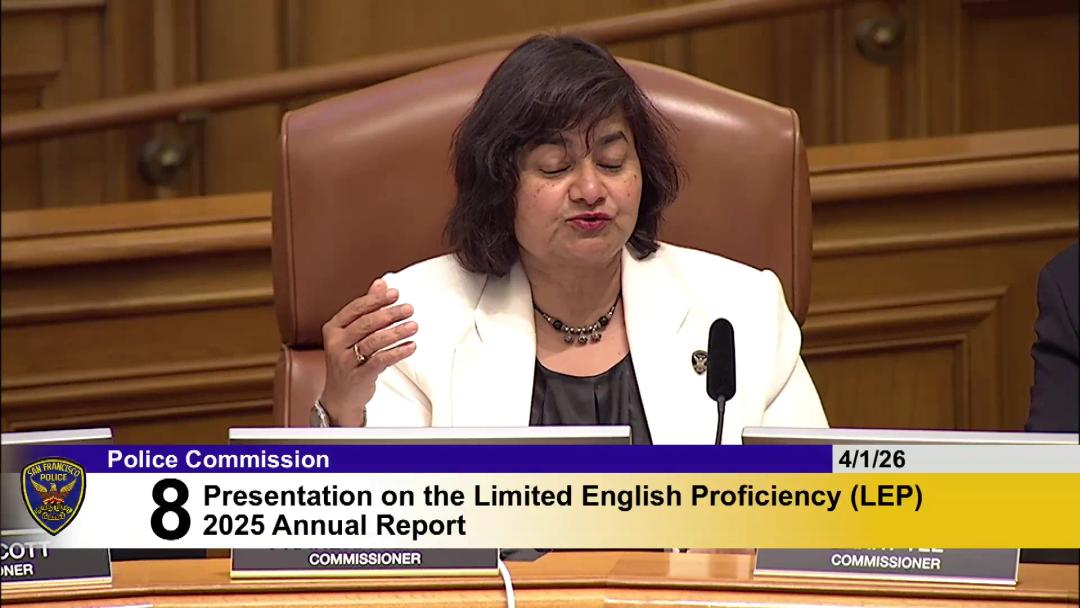
On April 1, 2026, the San Francisco Police Commission convened at approximately 1:45 PM to discuss crime trends, departmental reports, and language access policies. The meeting included a consent calendar, the Chief’s report on weekly crime statistics and a notable SFO incident, an update from the Department of Police Accountability (DPA), a presentation on the 2025 Limited English Proficiency (LEP) annual report, and a vote on revised Department General Order (DGO) 5.20 regarding language access services. Consent Calendar - Line Item 3: Unanimously approved to receive and file the Safe Streets for All fourth quarter 2025 update and the Police Commission report of disciplinary actions for the first quarter of 2026. - Line Item 4: Unanimously adopted minutes from the meetings of February 4 and 11, 2026. Public Comments & Testimony - Marlene Tran (community advocate): Expressed strong support for the LEP pilot program (language proficiency pins for officers), noting her 30-year advocacy for language access and appreciation that the sheriff’s department had adopted a similar idea. - Annie Jiang (Coalition for Community Safety and Justice): Urged the commission to delay the vote on DGO 5.20, arguing that the latest draft was shared only on March 30 and that more time was needed to address concerns such as undefined terms (e.g., “preferred language”) and weak language (“should” vs. “shall”). - Janice Lee (Chinese for Affirmative Action): Asked for a postponement to refine outstanding requests, stating that “should” versus “shall” makes a huge practical difference and that the community and SFPD are very close to a final version. - Laura (Mujeres Unidas y Activas, Spanish speaker through interpreter): Emphasized the need for proper language access services, noting that without translation the community feels disconnected and unable to trust police during emergencies. - Alma Santana (Mujeres Unidas y Activas, Spanish speaker): Requested a delay in voting so that the community and SFPD can resolve pending language access issues, highlighting the frustration of not understanding proceedings due to lack of interpretation. Discussion Items - Chief’s Report (Line Item 5): Chief Liu reported overall Part I crimes down 28% year-to-date compared to 2025. Violent crimes decreased 19%, but homicides rose to 14 (compared to 4 in 2025) with 13 closed by arrest. Gun violence (people injured or killed by firearm) increased 18%. The Chief detailed four recent homicides, an attempted Bay Bridge takeover (85 bikes seized, 85 citations), a bomb threat at SFO, and a large peaceful rally. He also addressed a March 22 SFO incident involving ICE, clarifying that SFPD had no pre-coordination with ICE and that officers responded only for public safety, while reiterating the department’s commitment to immigrant communities and state/city sanctuary policies. - DPA Director’s Report (Line Item 6): Executive Director Henderson noted a recent collaborative meeting with SFPD, a spike in cases related to the SFO incident, and statistics: since March 18, 85 new cases opened and 99 closed (196 open investigations). Complaint volume is 16% higher than the same period last year. Eight cases have exceeded 270 days, and 48 sustained internal cases remain pending with the department. - Commission Reports (Line Item 7): Commissioner Yi reported on a Chinatown community meeting about traffic safety after a fatal accident and a stabbing; Commissioner Scott announced Crime Victims United Month events on April 19–20. - LEP Annual Report (Line Item 8): A presentation covering 2025 language access statistics: 468 certified bilingual members (573 total), over 36 languages represented, 4,840 calls for service requiring interpretation, and 13,000 total interpretations. A six-month pilot program for LEP identity pins will launch at five stations (Central, Mission, Ingleside, Bayview, Richmond). Vietnamese was newly declared a core language, requiring document translations by June 23, 2026. - DGO 5.20 Language Access Services (Line Item 9): Director Steves reported on three community listening sessions (Feb 26, Mar 12, Mar 24) held after the commission’s February resolution. Based on feedback, the department proposed revisions including: adding Vietnamese as a required language, clarifying restrictions on using family/children as interpreters in criminal incidents, expanding training to all public-facing employees, and moving from a “periodic” to a “two-year” training cycle (amended from three years). The department recommended approval with this amendment. Key Outcomes - Consent calendar and minutes were approved unanimously (6–0). - DGO 5.20 was approved with a motion to advance the proposed revision, including an amendment to require language access training every two years instead of three. The motion passed 5–1 (Commissioner Benedicto voted against, citing the need for more time to review community input). The DGO will now proceed to the required “meet and confer” process with affected bargaining units (POA, SEIU, Local 21, MEA) before final adoption. - The commission acknowledged the extensive community engagement and directed the department to continue refining language access policies through future working groups.
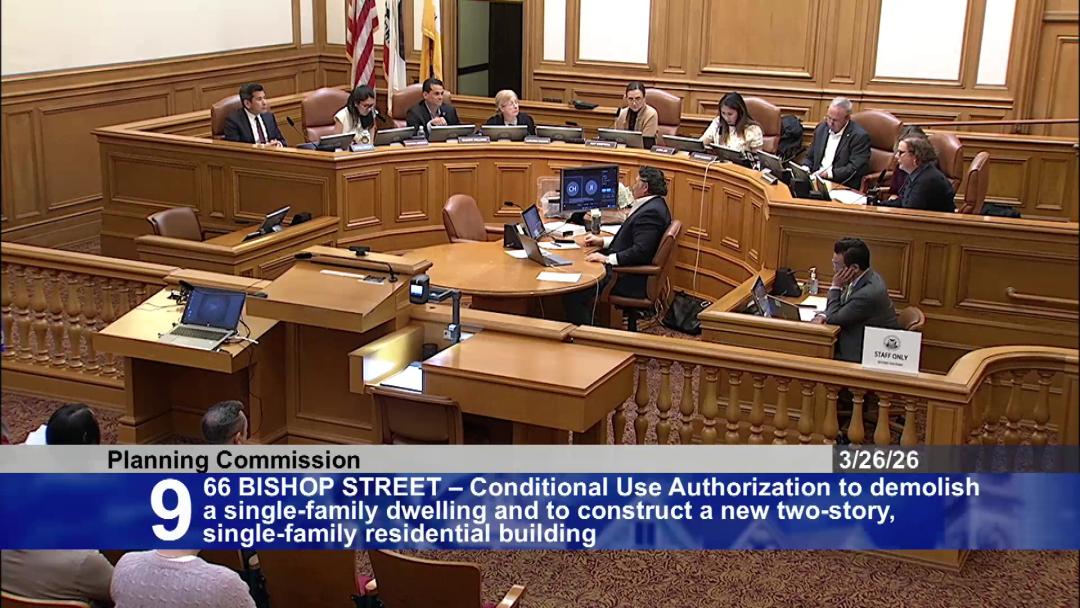
The San Francisco Planning Commission met on March 26, 2026, to consider several items including an appeal of a preliminary mitigated negative declaration (PMND) for the West Side Emergency Firefighting Water System, a conditional use authorization (CUA) for demolition and new construction at 66 Bishop Street, a discretionary review (DR) for a rooftop addition at 2303 Filbert Street, and an informational presentation for a project at 1053–1055 Texas Street under SB 423. The commission also adopted draft minutes, heard general public comment, and continued one item. Consent Calendar - Items 1 & 2 (Continuance): The commission voted 7-0 to indefinitely continue case 2024-00524 CUA (2089 Ingalls Street) and to note withdrawal of case 2025-00651 DRP (16 Cuvier Street). - Item 4 (Minutes): The commission voted 7-0 to adopt the draft minutes from March 12, 2026. Public Comments & Testimony - Michael Turon (property owner at 2722 Folsom Street): Requested the commission direct staff to calendar his request to withdraw a pending permit application (PRJA 2024-011657), citing a settlement agreement and a federal court finding of good faith. He argued that only the commission can break the procedural loop preventing his item from being scheduled. - Georgia Shootish (public commenter): Expressed concerns about rising housing prices, de facto demolitions in Noe Valley, and the absorption of second units. She urged proactive enforcement of the Residential Flat Policy and suggested adding boilerplate reminders in planning approval letters. Discussion Items - Item 8 – West Side Emergency Firefighting Water System Project (Appeal of PMND): The appellant (Sunset Parkside Action Committee, known as SPEAK) argued that the project may have significant environmental impacts not adequately addressed, including risks to drinking water quantity/quality, dam inundation hazards at Sunset Reservoir, and failure to analyze emergency firefighting operations. The planning department and SFPUC staff presented the project as meeting CEQA requirements with feasible mitigation measures, emphasizing that the project does not warrant an EIR. Public comment echoed concerns about the project’s complexity and cost. The commission deliberated, with several members noting that the appeal raised project merits rather than deficiencies in the environmental review. The commission voted 7-0 to uphold the PMND and reject the appeal. - Item 9 – CUA at 66 Bishop Street: The project proposes demolition of a 480 sq ft single-family home and construction of a new two-story home (1,467 sq ft) with a ground-floor ADU (699 sq ft). Staff recommended approval with a condition to change the shared entry from a solid door to a gate to ensure transparency and prevent future conversion to a single-family unit. The commission voted 7-0 to approve with that condition. - Item 11 – DR at 2303 Filbert Street: The project, previously continued from February 12, 2026, revised the design from an airstream trailer with spiral staircase to a 10-foot-high, 166 sq ft sitting room and bathroom with a solid parapet. Staff recommended taking DR and approving the modified design. The commission voted 7-0 to take DR and approve as modified. - Item 10 – SB 423 Informational Presentation (1053–1055 Texas Street): The project sponsor did not appear, leading to discussion about procedural expectations. The commission voted 7-0 to continue the item to April 16, 2026, to allow the sponsor to present and receive public comment. Key Outcomes - West Side Emergency Firefighting Water System: The commission upheld the PMND (7-0), affirming the department’s determination that with mitigation measures the project would not have significant environmental impacts. The appeal was rejected. - 66 Bishop Street CUA: Approved (7-0) with a condition requiring a gate instead of a solid door at the shared entry. - 2303 Filbert Street DR: Approved (7-0) as modified by staff. - 1053–1055 Texas Street SB 423 Presentation: Continued to April 16, 2026 (7-0) due to sponsor absence. - General: The commission adopted minutes (7-0), approved continuances (7-0), and acknowledged Commissioner So’s continued representation on the Arts Commission.
On Thursday, March 26, 2026, the Public Safety and Neighborhood Services Committee of the San Francisco Board of Supervisors, chaired by Supervisor Matt Dorsey and joined by Vice Chair Balal Machmood and Supervisor Alan Wong, convened to hear an update on the Fiscal Year 2025–2026 Behavioral Health Services Act (BHSA) annual update, formerly the Mental Health Services Act (MHSA). The committee received a presentation from Jessica Brown, Director of the Office of Justice, Equity, Diversity, and Inclusion and Behavioral Health Services Act lead for the Department of Public Health, who outlined program outcomes, funding transitions under Proposition One, and next steps for the county’s integrated plan. Discussion Items - Presentation on the BHSA Annual Update: Jessica Brown, joined initially by Deputy Director Danielle Marshall, presented the FY 2025–2026 annual update. Key points included: - San Francisco historically received about $30 million per year from MHSA, which has grown to $72 million in the current spending plan. - The city supports 95 programs and services, including full-service partnerships (FSP), peer support, vocational services, and housing. - Under Proposition One (passed March 2024), MHSA is transitioning to the BHSA, with three new funding categories: 35% to full-service partnerships, 30% to housing, and 35% to behavioral health services and support (including workforce, innovation, prevention, and capital facilities). - The new law expands eligibility to include substance use disorders and requires targeting vulnerable populations: children/youth, chronically homeless, and veterans. - The county is required to engage 26 stakeholder groups; 12 community planning meetings have already been held. - An integrated plan covering all behavioral health services must be submitted to the state by April 2026, with a 30-day public comment period, final approval by June 30, 2026, and implementation by July 1, 2027. - Failure to submit a timely plan could impact future funding. - Chair Supervisor Dorsey’s Questions and Comments: - He asked about flexibility to address non-substance addictive disorders (e.g., social media addiction) under the new framework. Brown noted that innovation funding under BHSS allows pilot programs for emerging issues, and 50% of funding must go to early intervention for populations under 25. - He requested further explanation of full-service partnerships, which Brown described as intensive case management with 24/7 access, wraparound services (housing, employment, peer support), and holistic care. - He expressed interest in vocational assistance for people in recovery and asked how the city engages recovery community organizations (e.g., the Dry Dock, Castro Country Club) that are not city-funded. Brown explained that the city’s outreach includes translated materials, partnerships with CBOs, and now expanded state-mandated stakeholder engagement (including labor unions and law enforcement). Key Outcomes - Motion and Vote: Chair Dorsey moved to forward the item (resolution authorizing adoption of the BHSA annual update) to the full Board of Supervisors with a positive recommendation. The motion passed unanimously with all three committee members (Dorsey, Machmood, Wong) voting aye. - Next Steps: The Department of Public Health will submit the integrated plan to the state in April 2026, post it for a 30-day public comment period, and return to the Board of Supervisors in May 2026 for final approval. The plan is required to be submitted by June 30, 2026, and will take effect July 1, 2027.
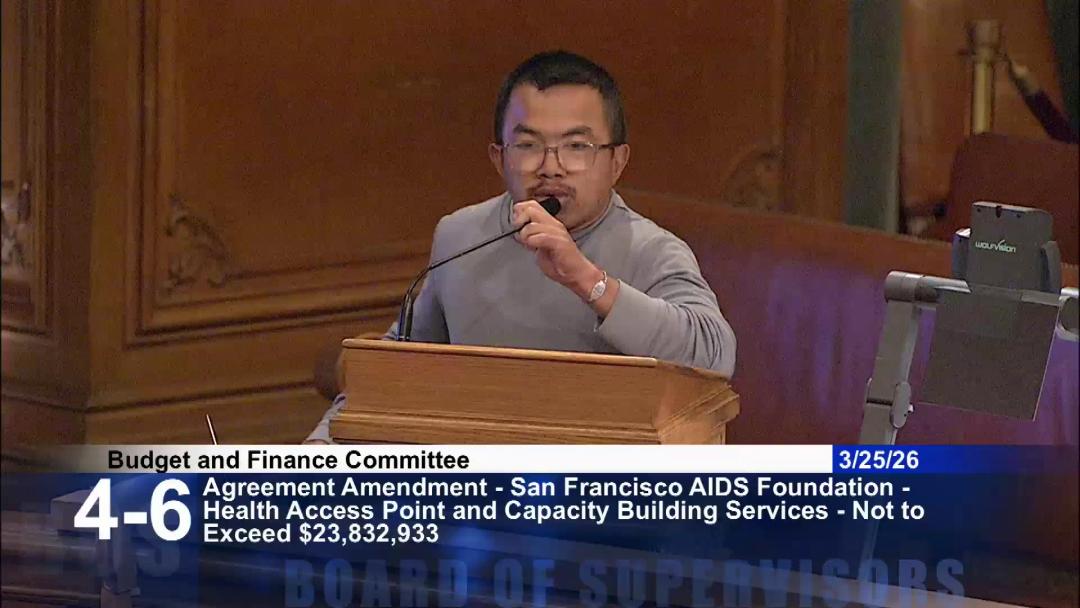
The Budget and Finance Committee, chaired by Supervisor Connie Chan and joined by Vice Chair Matt Dorsey and Member Danny Souter, met on March 25, 2026 to consider seven agenda items. The committee heard presentations from the San Francisco International Airport (SFO), the Assessor-Recorder's Office, the Human Services Agency (HSA), the Department of Public Health (DPH), and the Mayor's Office of Housing and Community Development (MOHCD). All items were approved with recommendations to the full Board of Supervisors. Consent Calendar - No consent calendar items were listed. Public Comments & Testimony - Item 3 (CalFresh Stopgap Gift Card Initiative): Griffin Lee, a resident, thanked the Mayor, the Board, the San Francisco Marin Food Bank, and Crankstart Foundation for the rapid response to federal funding cuts, calling it a crucial step in supporting vulnerable residents. - Items 4–6 (Health Access Points): Griffin Lee, representing Connected SF, opposed the three contract amendments, arguing that the contracts lack measurable outcomes and accountability. He noted that “harm reduction” appears dozens of times in the documents and called for an audit of the programs, citing ongoing overdose deaths on city streets. Discussion Items - Item 1 – Hallmark Aviation Contract (SFO): The committee considered a resolution to approve modification number three to a contract with Hallmark Aviation Services LP to extend the term by one year through June 30, 2027 and increase the not-to-exceed amount by approximately $10.4 million to a new total of $30.4 million. The contract provides airport information and guest assistance services, including line management, wayfinding, and information desks. SFO staff reported that in 2025, Hallmark staff assisted 2.7 million guests at 16 information desks. The Budget and Legislative Analyst (BLA) recommended approval. Chair Chan inquired about the 22.6% contingency budget; SFO's Director of Guest Experience explained it covers potential additional staffing for a new airport integrated operations center and construction support, with costs that are still uncertain. No public speakers appeared. The committee voted 3-0 to send the resolution to the full board with a positive recommendation. - Item 2 – SAPient Corporation Contract (Assessor-Recorder): The committee considered a resolution to authorize amendment number two to a contract with SAPient Corporation for the implementation and maintenance of the property assessment system (SMART). The amendment increases the contract by approximately $6.7 million to a new total of $33.9 million and extends the term by about four and a half years through June 2032. The system went live in September 2025 after significant delays. The BLA reported that implementation costs increased by $16.6 million due to vendor-caused delays, with the vendor absorbing $15.3 million of those costs. Chair Chan requested detailed staffing breakdowns for the $15.3 million in vendor costs to be included in the legislative file. The assessor's office noted they are developing a plan to transition system support in-house. The committee voted 3-0 to send the resolution to the full board with a positive recommendation. - Item 3 – CalFresh Stopgap Emergency Gift Card Initiative (HSA): The committee considered a resolution retroactively authorizing a contract with the San Francisco Marin Food Bank for the CalFresh Stopgap Emergency Gift Card Initiative, with a two-month term through December 2025 and a not-to-exceed amount of $9.1 million. HSA staff reported that after the USDA withheld federal emergency funds, the city and Crankstart Foundation each contributed $9 million to create an $18 million gift card program. 80% of eligible households (65,000 individuals) activated cards, totaling $14.4 million in benefits; 92% of activated funds ($13.2 million) had been spent by March 22, 2026. The program served 112,000 CalFresh recipients, including 48,000 seniors and 18,000 children. Unspent funds will be split between the city and Crankstart. The committee voted 3-0 to send the resolution to the full board with a positive recommendation. - Items 4–6 – Health Access Point Contracts (DPH): The committee considered three resolutions approving amendments to contracts with the San Francisco AIDS Foundation (SFAF), Rafiki Coalition for Health and Wellness, and Instituto Familiar de la Raza (IFR) to extend terms through June 2030 and increase amounts. The programs provide integrated HIV, HCV, STI testing, primary care, mental health, and overdose prevention services tailored to specific populations. The BLA noted that SFAF and IFR exceeded standards, while Rafiki was rated below standards due to missed service units and invoicing issues; DPH reported that Rafiki is now on track. DPH proposed a clerical amendment to item 4 (SFAF) to reduce the not-to-exceed amount from $23.8 million to $21.8 million, reflecting a $400,000 reduction in capacity building support. The committee accepted the amendment and voted 3-0 to send all three resolutions to the full board with a positive recommendation (item 4 as amended). - Items 7–8 – Balboa Reservoir Building A Affordable Housing (MOHCD): The committee considered two resolutions for the development of 158 affordable rental units at 105 Westeria Lane (Balboa Reservoir Building A). Item 7 approves a ground lease (75 years, $15,000 annual base rent) and a $29.9 million loan from MOHCD; Item 8 authorizes the issuance of up to $112.7 million in tax-exempt and taxable bonds. The project serves families at 40–80% of area median income and includes 13 studios, 65 one-bedrooms, 42 two-bedrooms, and one three-bedroom manager's unit. Total development cost per unit is higher than typical due to infrastructure costs; the city's total contribution to Balboa Reservoir affordable housing is approximately $87 million, $36 million more than required by the development agreement. MOHCD requested a clerical amendment to change the developer's name from Balboa Lee Avenue LP to Balboa Gateway LP. The committee accepted the amendment and voted 3-0 to send both resolutions to the full board with a positive recommendation. Key Outcomes - Item 1 (Hallmark Aviation): Approved 3-0. Referred to the full Board of Supervisors for the April 7, 2026 meeting. - Item 2 (SAPient): Approved 3-0. Chair Chan requested a detailed staffing breakdown of vendor costs be added to the legislative file before the April 7, 2026 board meeting. - Item 3 (CalFresh Gift Cards): Approved 3-0. Referred to the full Board of Supervisors. - Items 4–6 (Health Access Points): Approved 3-0. Item 4 (SFAF) amended to reduce the not-to-exceed amount to $21.8 million. All three referred to the full Board of Supervisors. - Items 7–8 (Balboa Reservoir Building A): Approved 3-0. Item 7 clerically amended to correct the developer name. Both referred to the full Board of Supervisors.
The Budget and Appropriation Committee, chaired by Supervisor Connie Chang, held a hearing on March 25, 2026, to receive the San Francisco Youth Commission's budget and policy priorities for fiscal years 2026-2027 and 2027-2028. Commissioners Taylor Ahmir, Leah Mordehai, Evelyn Conboy, and Harper Fort Gane presented 19 priorities across three subcommittees, highlighting areas such as immigration, youth violence prevention, gender-based violence, economic empowerment, homelessness, transit safety, climate change, and the commission's own charter and staffing. The committee heard public comment and filed the hearing unanimously. Public Comments & Testimony - Emily Yang (Youth Commissioner) urged restoring funding for the San Francisco Environment Department, specifically allocating $3.4 million from the general fund to prevent the loss of eight staff members, citing climate threats and the department's impact on youth. - Alondra Esquivo Garcia (former Youth Commission Director) urged continued support for the Youth Commission and suggested using the budget priorities report as a framework for a citywide youth agenda. Discussion Items - Presentation by Youth Commissioners: The commission presented 19 Budget and Policy Priorities (BPPs) across three committees: Transformative Justice, Civic Engagement and Education, and Housing, Recreation, and Transit. Key priorities included: - Immigration: Allocate $3.5 million for legal defense, fund community-based organizations for newcomers, and invest in language access (e.g., Vietnamese specialists). - Youth Violence Prevention: Partner with gun buyback programs, expand youth mental health access (counseling staff, reduced wait times), and support community organizations (United Playas, Hunters Point Foundation, Salmon Community Development Center). Mentioned that shootings have risen 74% in five years and one in three homes with children have a gun. - Gender-Based Violence: Renew the Title IX student advisory group, implement SFUSD curriculum on sexual assault, and provide non-competitive funding for domestic violence survivors. Noted that in 2022 only 5 out of 24 Title IX sexual harassment complaints in SFUSD were investigated. - Economic Empowerment: Strengthen youth employment pathways (partnerships with SFUSD, Office of Workforce Development, SF Youth Works) and workplace protections (work permit verification, anti-harassment training). - Reducing Youth Homelessness: Expand transitional age housing options beyond the Tenderloin, create youth-specific housing assessment processes, and strengthen collaboration among organizations. Cited 405 youth and 1,001 TAY experiencing homelessness, with family homelessness up 82% since 2022. - Street Safety and Transit: Continue free Muni for youth, invest in lighting and security cameras at high-traffic stops, and include youth in transit safety surveys. - Climate Change: Protect SF Environment by allocating $3.4 million for eight at-risk positions, expand climate education (district-wide day of action, permanent funding for the High School Climate Action Fellowship). - Commission-Wide Priorities: Keep the Youth Commission in the city charter (opposing a task force recommendation to move it to administrative code) and support the clerk's office budget to maintain a fully staffed team of three (director, youth development specialist, community partnership specialist). - Q&A with Supervisors: - Chair Chan asked about youth violence trends and prevention, and expressed concern about SFUSD's counselor shortages (e.g., one counselor for 2,000 students). She also requested future input from the commission on identifying budget reductions. - Vice Chair Dorsey praised the presentation, discussed the challenge of handgun regulation, and asked about the Title IX complaint investigation rate. He suggested a compromise on charter status (leaving the commission in the charter but moving prescriptive details to administrative code). The commission agreed to discuss this at a future full meeting. - Member Sauter asked for more details on economic empowerment and AI regulation. Commissioners acknowledged the AI priority (authored by an absent member) and promised to provide full written priorities. They also discussed school resource officers (SROs), noting that SRO presence can create fear and potentially increase weapon carrying, and advocated for preventative mental health support instead. - Chair Chan expressed strong support for advisory bodies and the Youth Commission's independence, and committed to following up on the Title IX student advisory group and gender-based violence issues. Key Outcomes - The committee voted unanimously (3-0) to hear and file the hearing (Supervisors Walton and Mandelman excused). - Chair Chan requested that the Youth Commission provide written responses on AI regulation and the Title IX advisory group, and that the commission return with recommendations for budget reductions given the city's nearly $1 billion deficit. - The Youth Commission will discuss Vice Chair Dorsey's hybrid charter proposal at its next full meeting.
The San Francisco Board of Supervisors held its regular meeting on March 24, 2026, commencing at 10:15 AM. The meeting included a roll call, excusal of Supervisor Fielder, passage of multiple ordinances and resolutions, a lengthy discussion on surveillance technology, a series of commendations for Women's History Month, a debate on the Petrero Yard Modernization Project, and several new business introductions. Key votes included approval of an electronic location tracking device policy (9–1) and adoption of a resolution for the Petrero Yard project with amendments urging funding for affordable housing (10–0). Consent Calendar - Item 1: Ordinance requiring notaries to provide information on free or low‑cost immigration legal services – finally passed (10–0). - Items 2 & 3: Zoning map amendments for 2245 Post Street SUD and Mission & 9th Street SUD – finally passed without objection. - Item 4: Ordinance enhancing sidewalk flower stand permit program – finally passed. - Item 5: Ordinance ordering conditional vacation of portions of Christmas Tree Point Road and Twin Peaks Boulevard for the Twin Peaks Promenade Project – finally passed. - Item 6: Ordinance modifying five downtown activation locations – finally passed. - Items 8–12: Various ordinances (mobile food facility definitions, police overtime appropriation of $34.36 million, gift acceptance of $100,000 for animal care, two lease amendments for Human Services Agency) – all passed on first reading or adopted without objection. - Items 15–19: Port commission lease, budget process motion, commemorative street name, mechanical street sweeping evaluation ordinance, appointments to Sheriff’s Department Oversight Board – all passed/adopted without objection. - Items 20–37: 18 resolutions initiating landmark designations for properties including the Century Club, Inverness Garage, Presidio Theater, and others – adopted without objection. - Items 40–42, 45–46: Resolutions for adoption without committee reference (unanimous) – adopted. - Item 43: Resolution recognizing March 2026 as Endometriosis Awareness Month – adopted. - Item 44: Resolution recognizing March 29–April 5, 2026 as Community‑Based Doula Week – adopted. Public Comments & Testimony - General Public Comment (Items 40–46 and other matters): - A speaker condemned the fentanyl crisis, stating that a two‑year‑old recently died from an overdose and that between 2019 and 2026 approximately 5,000 people have died from fentanyl in San Francisco. The speaker blamed far‑left Democrats and corrupt nonprofits for enabling chaos. - Another speaker recited headlines from March 2026, including the deportation of a six‑year‑old deaf boy, a scuffle involving Mayor Lurie’s security, and an ICE agent seen “terrorizing” a woman and child at SFO. The speaker urged the board to pass resolutions supporting the return of the deported child and dropping charges against a homeless man involved in the altercation. - Richard Johnson, co‑founder of HV Safe, criticized the process behind the potential permanent closure of Hayes Street, alleging that Supervisor Mahmud’s office initiated and directed the closure study without proper public process and used transportation funds intended for Octavia improvements. - One speaker suggested a rules change to hold commendation ceremonies on a separate day. - A final speaker noted the complexity of city issues and cautioned against hyperbole from previous commenters. Discussion Items Item 7 – Surveillance Technology Policy (Electronic Location Tracking Devices) Supervisor Chan requested a continuance to obtain answers from SFPD regarding use of tracking devices (Star Chase) and automated license plate readers (Flock ALPR) in light of a 2012 Supreme Court ruling. An SFPD representative explained that GPS tracking is a search requiring a warrant unless an exception (e.g., exigent circumstances) applies; Flock captures images in public view where there is no reasonable expectation of privacy. The department’s policy includes safeguards, audit logs, and oversight. Supervisor Walton spoke against the technology, citing privacy concerns, disproportionate impact on people of color, and erosion of trust. He argued for a pause. Supervisor Wong spoke in support, emphasizing the tool’s value in reducing dangerous vehicle pursuits and noting the policy’s strict guardrails. The vote was 9–1, with Supervisor Walton casting the only no vote. Item 14 – Petrero Yard Modernization Project Supervisor Chan introduced non‑binding amendments to urge the Mayor’s Office of Housing and Community Development (MOHCD) to identify funding sources for future affordable housing and to urge SFMTA to deliver the originally intended 465 affordable housing units at other sites. The original project had been scaled back from 465 affordable units (part of an entitlement approved in March 2024) to 100 units after a $70 million podium cost increase made the larger housing component infeasible. Judson True (SFMTA) explained the history, noting that the podium would cost about $70 million and that building housing above a bus yard would be extremely expensive (roughly $191,000 per unit in land‑acquisition cost) and unfunded. Supervisor Melgar supported the amendments as they did not delay the project. Supervisor Sherrill expressed concern about urging the city to spend money on something that might reduce overall affordable housing production. Supervisor Mandelman voted no on the amendment. The amendment passed 9–1, and the item as amended passed 10–0. Commendations (Women’s History Month and Other Recognitions) - Misha Olivis (District 6, Supervisor Dorsey): Co‑founder of United Players; recognized for 30+ years of youth mentorship, including pandemic‑era support through the SOMA Youth Collaborative. Praised for her motto “It takes the hood to save the hood.” - Britt Alexandria Benton (District 7, Supervisor Melgar): Government Affairs Coordinator at the California Academy of Sciences; honored for connecting communities to science and civics, and for her resilience and grace. - Sharice Dorsey Smith (Supervisor Walton): Executive Director of the Department of Children, Youth, and Their Families (DCYF); recognized for leading the Community Hubs Initiative, $115 million investment in community‑based organizations, and her calm strategic leadership. - Lynn Davis (District 2, Supervisor Sherrill): Outgoing President of the Opera Plaza HOA; honored for decades of community service, including volunteering with Bread & Roses, the Tenderloin Community School, and the SFPD Northern Station Community Police Advisory Board. - Bree Mann (District 3, Supervisor Sauter): Executive Director of Fisherman’s Wharf Community Benefit District; recognized for revitalizing the Wharf with new events, a public plaza, and the SkyStar Ferris Wheel. - American Red Cross, Bay Area Chapter (District 4, Supervisor Wong): Marking the 120th anniversary of partnership with San Francisco; recognized for responding to 860+ disaster events, collecting 150,000 units of blood, and training 100,000 people in first aid/CPR in the past year. - Tatiana Alabosi (District 5, Supervisor Mahood): Manager of the Safe Passage Program in the Tenderloin; honored for nearly a decade of ensuring children’s safety on their way to school and for community advocacy that led to street improvements. - Women’s Housing Coalition (District 1, Supervisor Chan): Recognized for advocating for over 3,000 unhoused women in San Francisco; coalition of 22 organizations pushing for shelter, affordable housing, and wraparound services for survivors of domestic violence and trafficking. - Dr. Edwards (District 11, Supervisor Chen): Principal of Sheridan Elementary School; honored for fostering a safe space that has become a multigenerational community anchor. Key Outcomes - Item 7 (Ordinance approving SFPD electronic location tracking device policy) – Passed 9–1, with one no vote (Supervisor Walton). - Item 14 (Resolution approving Petrero Yard Modernization Project agreement) – Amendment passed 9–1 (Supervisor Mandelman no); the resolution as amended passed 10–0. - All other items on the consent calendar and regular agenda were passed without objection or with unanimous votes. - New business introduced includes a resolution condemning ICE actions at SFO, a resolution in support of SB 1292 (curb management), an ordinance raising the grant approval threshold from $100,000 to $1 million, and initiation of 15 historic landmarks in District 3. - The meeting adjourned at approximately 2:50 PM after the in‑memoriam for José de Jesús García.