Browse by city
Date range
Search help

Search titles, summaries, topics and stored transcripts together. Keywords may match separately; put the whole query in double quotes for a phrase. Matching follows word analysis, so punctuation is not exact. Both dates are included. Documents are not searched.

SHOWING 291–300 ENTRIES
291
NOV 17, 2025 · SAN FRANCISCO, CALIFORNIA · RULES COMMITTEE
San Francisco Board of Supervisors Rules Committee Meeting (November 17, 2025)

The Rules Committee met on November 17, 2025, chaired by Supervisor Shimon Walton with Vice Chair Stephen Sherrill and President Rafael Mandelman (joined during the meeting), and welcomed Supervisor Bilal Mahmood as a guest. The committee acted on an ordinance creating a Fillmore Entertainment Zone, confirmed the Controller’s appointment of the City’s first Inspector General, and advanced multiple appointments/reappointments to the Assessment Appeals Boards amid discussion of heavy caseloads (including statements that appeals have risen to “over 10,000 cases a year,” compared with “3,000 to 5,000” when one member started). Public Comments & Testimony - Fillmore Entertainment Zone (Item 1) - Community member (name not stated) expressed support for the entertainment zone and requested an amendment to extend the zone “over to Webster Street” to protect Gene Suttle Plaza; also stated the legislation would help with a future ISCOT hearing and expressed a desire to restart “Fillmore Fridays.” - Majid Crawford (Executive Director, New Community Leadership Foundation) expressed support, stating corridor stakeholders were excited; said the Fillmore Collaborative (formed in 2020) helped bring “millions of dollars” into the corridor and that businesses believe the zone could have a “tremendous impact.” - Inspector General confirmation (Item 2): No public comment. - Assessment Appeals Board appointments (Items 3–5): No public comment. Discussion Items - Item 1 — Ordinance creating the Fillmore Entertainment Zone - Supervisor Bilal Mahmood requested the committee send the item forward as a committee report with a positive recommendation. He described the entertainment zone as a near-term action alongside a longer community action planning process, stating it would allow alcohol-serving establishments on the Fillmore corridor to sell “drinks to go” during specified events (initially focusing on larger events such as the annual Juneteenth celebration). He emphasized coordination with OEWD on a management plan for safety and neighborhood compatibility, and thanked community advocates and city staff involved. - Supervisor Catherine Stefani asked to be added as a co-sponsor and expressed support, citing discussions with the Fillmore Street Merchant Association and stating entertainment zones can give small businesses flexibility. - Chair Shimon Walton expressed support, citing the Fillmore’s cultural history and framing the initiative as supportive of small businesses and as a step toward addressing gentrification-related impacts. - Item 2 — Motion to confirm/reject the Controller’s appointment of Alexandra Shepard as Inspector General (Charter § 3.105J) - Alexandra Shepard (Inspector General appointee) described her background: 25+ years of investigative experience as an attorney, including nearly 20 years as a DOJ prosecutor in San Francisco; she noted she was speaking in her personal capacity. She described work on cases including fraud, public corruption, money laundering, bid rigging, price fixing, and obstruction of justice. - Controller Greg Wagner supported the appointment and emphasized the recruitment process and the need for a fair, objective partner within the city’s “public integrity ecosystem.” - Chair Walton questioned how the IG would prioritize investigations. Shepard emphasized “impact investigations,” highlighting (1) potential to return significant money to the City and (2) outsized deterrence. She cited bid rigging in municipal contracting as an example of a high-dollar impact area. - Shepard referenced the Controller’s whistleblower hotline volume, stating it received “close to 700” complaints last year, and described how the IG could focus on more complex matters (similar to the Controller team’s category 1 or 2 items) and coordinate with the DA, City Attorney, and Ethics Commission. - In response to a question, Shepard said departmental overtime abuse “could be” an investigative area. - Vice Chair Sherrill asked about balancing ROI in dollars versus public trust; Shepard said public trust should be a key factor and noted the IG could pursue matters important to public confidence even if they do not return substantial funds. - Shepard also discussed proactive detection using data analytics to identify patterns early. - Items 3–5 — Assessment Appeals Board appointments/reappointments - Item 3 (Board 1, two members; term ending September 4, 2028): - Franco Cirelli described financial/real estate credentials (MBA, CPA, CFP, real estate broker; taught real estate at City College) and willingness to serve on any board to help address backlog referenced in news. - Jeffrey Jonathan Morris sought reappointment, describing over a decade on Board 1 and providing examples of complex cases (e.g., possessory interest marina slip, large hotel valuation disputes, Millennium Tower matters, Westfield-related value reduction discussions). - Nicholas Goldman (noted a name typo as “Gottman”) described being an estate planning attorney with prior real estate/mortgage experience; stated he joined Board 2 in January and was asked to join Board 1. - Item 4 (Board 2, three members; term ending September 4, 2028): - John Lee sought a fourth term reappointment (serving since 2013), stating caseload increased from “3,000 to 5,000 cases a year” to “over 10,000 cases a year,” and emphasized running efficient, fair hearings. - Assessment Appeals Board Administrator Alistair Gibson reported Jose Edmondson-Sabral could not attend due to Achilles tendon surgery and requested to be put back on the calendar for a future meeting. - Mervyn Conlon (10+ years on the board) emphasized the need for equitable hearings given disparities in presentation capabilities and noted appraisal experience. - Susan “Betsy” Elizabeth Miller sought reappointment, describing litigation experience and emphasizing fairness, questioning, and ensuring both assessor and appellants are heard. - Item 5 (Board 3; multiple seats with varying terms): - James Reynolds stated he has 25 years as a residential real estate appraiser and 10 years as a board hearing officer. - Administrator Alistair Gibson stated Christine Nelson could not attend due to being out of town; he relayed that she sought appointment to Board 3 as an alternate member because she wanted a smaller role than the regular rotation. - President Mandelman thanked applicants and stated the City is being “flooded with appeals”; he supported proceeding with Nelson’s alternate appointment based on staff recommendation. Key Outcomes - Item 1 — Fillmore Entertainment Zone ordinance: Approved to forward to the full Board with a positive recommendation as a committee report; passed without objection. - Item 2 — Inspector General confirmation: Committee recommended confirmation as amended (removing “rejecting” language) and forwarded as a committee report for full Board consideration on November 18, 2025; vote 3-0 (Sherrill Aye, Mandelman Aye, Walton Aye). - Item 3 — Assessment Appeals Board 1 (term ending September 4, 2028): - Reappointed Jeffrey Jonathan Morris to Seat 1; appointed Nicholas Goldman to Seat 4; vote 3-0. - Item 4 — Assessment Appeals Board 2 (term ending September 4, 2028): - Reappointed John Lee (Seat 2), Mervyn Conlon (Seat 3), and Susan Miller (Seat 4); vote 3-0. - Jose Edmondson-Sabral: continued/held for future scheduling due to medical recovery (Achilles surgery), per administrator’s request. - Item 5 — Assessment Appeals Board 3: - Forwarded appointments: Franco Cirelli (Seat 1), James Reynolds (Seat 4), Christine Nelson (Seat 6, alternate member role as described by staff); vote 3-0.
ECONOMIC DEVELOPMENT 38% · ELECTIONS AND GOVERNANCE 28% · FISCAL SUSTAINABILITY 18% · COMMUNITY ENGAGEMENT 10%
292
NOV 17, 2025 · SAN FRANCISCO, CALIFORNIA · LAND USE AND TRANSPORTATION COMMITTEE
San Francisco Land Use & Transportation Committee Regular Meeting (Nov 17, 2025)

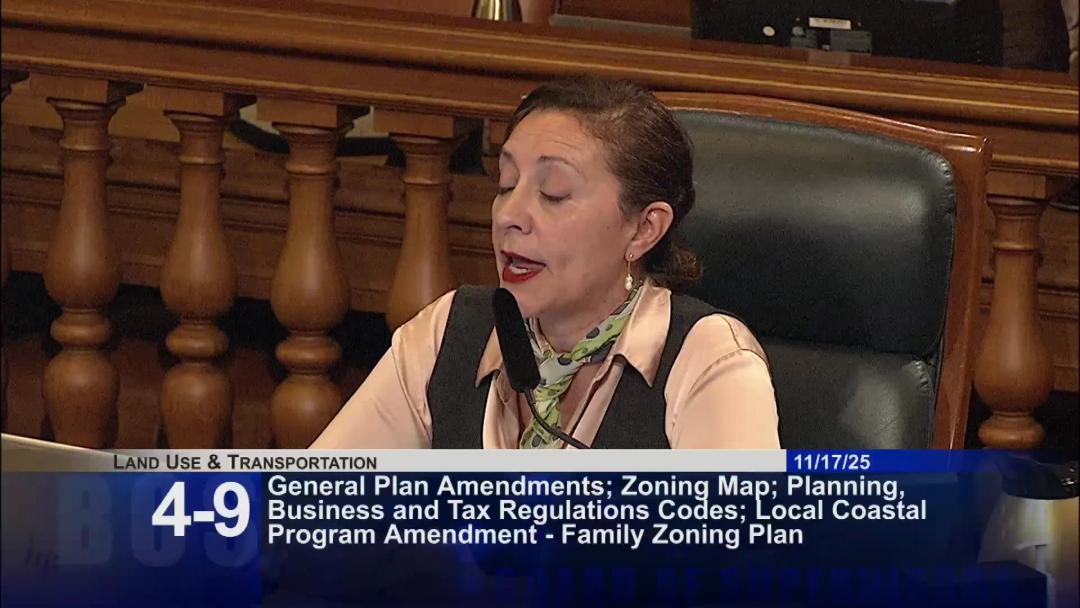
The Land Use & Transportation Committee met on November 17, 2025 to advance a building-permit timeline reform, consider a District 8 “large residence” special use district (SUD) boundary/cleanup ordinance, and hear extensive testimony on a sweeping Residential Tenant Protection Ordinance (TPO). The committee also held its third hearing on the Mayor’s Family Zoning Plan / Housing Choice San Francisco rezoning package and related code, map, and coastal program changes, with debate centered on state housing compliance (RHNA capacity, HCD constraints), tenant displacement risk, historic resource protections, and small business impacts. Public comment limits were set at 2 minutes per speaker for items 1–3 and 1 minute per speaker for rezoning items (items 4–9). Items continued are expected to appear on the Board’s agenda beginning December 2, 2025 unless otherwise stated. Discussion Items - Building permit expiration timelines (Item 1) - Sponsor/lead: Supervisor Bilal Mahmood. - Key policy changes described: - Create a flat 2-year expiration for building permit applications. - Create a 1-year deadline from permit issuance to start work, with the 1-year clock resetting when progress is made (e.g., inspection or site permit addendum). - Reaffirm validity of applying the building code in effect at the time of application, addressing situations where DBI required updates to newer codes. An example cited was 400 Divisadero, where a DBI request to update codes/plans was estimated to add $4 million. - Findings updated to demonstrate legality under SB 130 and clarify timelines with DBI consultation. - Staff present: Tate Hanna (DBI Legislative Affairs Manager). - Central Neighborhoods Large Residence SUD expansion / Corona Heights SUD deletion & merger (Item 2) - Sponsor/lead: Board President Rafael Mandelman. - Purpose (in plain terms as stated): expand District 8 “large residence” controls to include Cole Valley (added to District 8 in 2022) and clean up code language. - Background/intent: curb “monster homes” (described as demolishing modest buildings and replacing them with very large single-family homes, cited as 6,000–8,000 sq ft). - Planning Department: Aaron Starr reported the Planning Commission (Aug 1, 2024) recommended approval with modifications, including: - Do not include accessory garage space in gross floor area calculations. - Exclude multi-unit building shared space from unit gross square footage. - Residential Tenant Protection Ordinance (TPO) (Item 3) - Sponsor/lead: Vice Chair Supervisor Cheyenne Chen. - Context given: State laws (notably SB 330 – Housing Crisis Act) increase exposure to displacement; ordinance aims to strengthen local protections and enforcement. - Key provisions described (as presented by sponsor and Planning staff): - Applies citywide to projects involving demolition of residential units (whether or not a Conditional Use Authorization (CUA) is required). - Expanded tenant notification requirements (language-access compliant) through entitlement and lease-up. - Relocation assistance for all displaced tenants, with additional assistance to low-income tenants; Planning staff described additional payments of up to 39 months for low-income households to cover the gap between Section 8 fair market rent and what is affordable at their income level. - Broadened definition of “existing occupants” to include people present at preliminary application and those displaced by harassment, noncompliant buyouts, owner move-in evictions, temporary capital improvement displacement, and (via sponsor amendment) tenants displaced by Ellis Act eviction within the past 5 years. - Stronger replacement unit standards (comparable units: same bedrooms/full bathrooms, ≥90% of original square footage, accessibility when applicable). - Replacement affordability: affordable replacement units remain affordable for the life of the project (not 55 years). - Right to return / right of first refusal structure described by sponsor (including return to same site units). - Creates private right of action for tenants and qualifying organizations; sponsor amendment sought to match existing Rent Ordinance language for 501(c)(3)/(c)(4) tenant-rights organizations. - Rent Ordinance amendments: added relocation payments when temporary displacement for capital improvements extends beyond 3 months; tenant harassment hearing standards updated; buyout disclosure requirements enhanced. - Planning staff statistics: Planning Department staff stated San Francisco demolishes relatively little housing, averaging 18 units per year (as described during discussion of broader eviction drivers). - Chair amendments (Supervisor Myrna Melgar) described: - Require landlords filing Ellis Act withdrawal notices to disclose whether they intend to redevelop versus condo/TIC conversion (data/visibility rationale). - Align Planning Code demolition/CUA lookbacks with SB 423 concepts: 10-year lookback for tenant occupancy for affordable/rent-controlled units outside PEGs; PEG (Priority Equity Geographies) rules would remain as today. - Proposed restructuring of CUA findings (making certain criteria mandatory vs. point-scored); chair noted this portion required additional cleanup and was deferred. - Family Zoning Plan / Housing Choice San Francisco package (Items 4–9) - Presentations: Mayor’s Office representative Allie Bonner and Planning Department leadership (Joshua Switzky; Lisa Chen) presented methodology for RHNA shortfall rezoning and SB 79 interaction. - Key compliance figures and methods discussed: - RHNA target for the period: 82,000 units; with 15% buffer = 94,000. - Counted from existing sites/pipeline: 58,000 units; remaining gap: 36,200 (the rezoning “shortfall”). - HCD letter (dated Sept 9, 2025) found the rezoning methods sufficient in combination. - Three capacity estimation methods: - Citywide zoning buffer method: several hundred thousand legal units; historic entitlement share yields 39,000 “realistic capacity.” - Soft sites method: rezoning yields 40,000–64,000 units depending on assumptions. - Financial feasibility (UrbanSim): 19,000–40,000+ units depending on economic scenarios. - SB 79 discussion: - SB 79 effective July 2026; sets minimum heights/densities around rail stops and certain rapid bus corridors. - Planning calculated SB 79 citywide capacity at 763,000 units vs. San Francisco zoning under the Family Zoning Plan at 800,000+ units in those areas. - City would need to adopt an SB 79 “alternative plan” ordinance in Q1 2026 (goal: submit to HCD by end of March 2026 for the 120-day review window). - Amendments debated: - President Mandelman: exempt listed Article 10 landmarks and contributors from rezoning height/density increases. - Supervisor Stephen Sherrill: District 2 parcel swaps/adjustments stated to be capacity-neutral. - Supervisor Connie Chan and Supervisor Chen: multiple proposed “non-negotiable” protections (anti-demolition, historic, coastal, PEG changes), plus requests for HCD to appear publicly at a future hearing. Public Comments & Testimony - Item 1 (Permit timelines): - Joseph Smook (REP Coalition) opposed a provision he characterized as eliminating deadlines for completing construction after permits are obtained; argued it could encourage speculation and increase risk of “permanent displacement,” referencing a relocation assistance limit of 42 months under SB 330. - Item 2 (Large residence SUD): - Speakers raised concerns about large-home conversions using ADU configurations to circumvent limits; referenced an 8,000 sq ft project with a 665 sq ft ADU at 45 Montclair discussed at Planning Commission and raised concerns about historic resources. - Item 3 (TPO): - Numerous tenant advocates and residents expressed support for stronger tenant protections, emphasizing buyout disclosure enforcement, Ellis Act and harassment-related displacement, and deeper affordability in Priority Equity Geographies (PEGs). - Some commenters urged making buyout ordinance compliance a mandatory prerequisite for demolition approval. - PEG-focused comments cited an income disparity statistic: median income in PEGs of $50,000 vs. $111,000 outside PEGs, urging deeper replacement affordability (e.g., affordability at or below 50% AMI). - One speaker questioned where replacement units would be located; Supervisor Chen responded that rights of first refusal apply to comparable units on the same site and described interim housing options including relocation payments up to 42 months. - A minority viewpoint cautioned that stronger requirements may reduce demolitions and thus reduce housing production; one architect suggested tenant protections should prioritize lower/middle-income tenants rather than “wealthy tenants” in rent-controlled units. - Items 4–9 (Family Zoning Plan package): - Commenters split sharply. - Supporters argued new housing reduces displacement and rent growth; one cited research claiming new housing reduces nearby residents’ displacement risk by 17%; others warned losing compliance could risk $100–$110 million/year in state/federal funding. - Opponents argued upzoning would incentivize demolition/speculation, harm historic neighborhoods, and displace tenants and small businesses; many supported “Chan & Chen” amendments and urged more transparency, including requests for HCD testimony in public. - Some raised concerns about inclusionary obligations for small projects and argued many new units could be built without inclusionary contributions if under certain thresholds. Key Outcomes - Item 1 – Building permit expiration reform - Voted 3–0 to adopt amendments and continue the ordinance as amended to December 1, 2025. - Item 2 – Central Neighborhoods Large Residence SUD / Corona Heights SUD merger - Voted 3–0 to adopt amendments and continue the ordinance as amended to December 1, 2025. - Item 3 – Residential Tenant Protection Ordinance (TPO) - Voted 3–0 to adopt a set of amendments (including Planning Department amendments, Supervisor Chen amendments, and two Chair Melgar amendments) and continue the ordinance as amended to December 1, 2025. - Chair Melgar stated her third proposed CUA-criteria restructuring amendment was not ready and would return with cleaner reconciled language. - Items 4–9 – Family Zoning Plan / Housing Choice SF package - Mandelman landmark exemption amendment: Adopted 2–1 (Chen aye, Melgar aye, Mahmood no). - Supervisor Sherrill District 2 map amendments: Adopted 3–0. - Supervisor Chen unit-mix amendments (local program): Adopted 2–1 (Chen aye, Melgar aye, Mahmood no). - Supervisor Chen SFMTA-site affordability/ROFR amendment: Failed 1–2 (Chen aye, Melgar no, Mahmood no), with discussion noting potential constraint/timing/uncertainty impacts on SFMTA joint development. - Supervisor Chen PEG removal amendment: Failed 1–2 (Chen aye, Melgar no, Mahmood no), with staff describing significant capacity/compliance impacts and potential SB 79 consequences. - Duplicate rezoning/code files (Items 6 and 8): Tabled 2–1 (Mahmood aye, Melgar aye, Chen no). - Continued to Dec 1, 2025 (3–0): - Item 4 (General Plan amendments) - Item 5 (Zoning Map amendments) - Item 7 (Planning Code / Housing Choice SF program) - Item 9 (Coastal Commission transmittal resolution)

AFFORDABLE HOUSING 35% · CODE ENFORCEMENT 20% · RACIAL EQUITY 10% · HISTORIC PRESERVATION 8%
293
NOV 13, 2025 · SAN FRANCISCO, CALIFORNIA · PLANNING COMMISSION
San Francisco Planning Commission Hearing — November 13, 2025

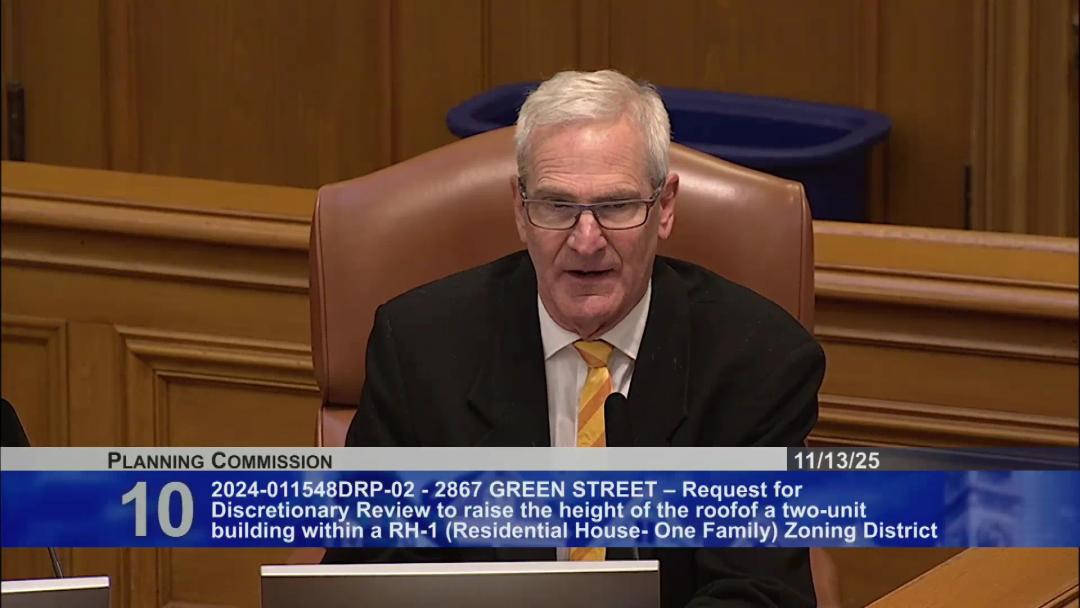
The San Francisco Planning Commission met on Thursday, November 13, 2025 (webinar format) with 6 commissioners present (President Soe, Vice President Moore, Commissioners Braun, Campbell, Imperial, and McGarry) and Commissioner Williams absent. The Commission approved two consent items, heard two conditional use authorizations pulled from consent, considered a Planning Code amendment redefining “family”/“dwelling unit” rules for shared housing, and decided two discretionary review (DR) requests. Consent Calendar - Items pulled from consent (for later hearing on regular calendar): - Item 2: 555 Fulton Street, Suite B (CUA) — pulled at public request. - Item 4: 825 Sansom Street (CUA) — pulled at public request. - Approved on consent (unanimous): - Item 1: 960 Market Street, Unit 421 (CUA) — approved 6-0. - Item 3: 2238 Market Street (CUA) — approved 6-0. Department Matters - Planning Director Sarah Dennis Phillips announced the second Fillmore Community Action Plan workshop held 6:00–8:00 p.m. that evening at the African American Arts and Culture Complex, with a parallel Zoom event next Tuesday (details on the Planning Department website). Public Comments & Testimony - General public comment (non-agenda items): - Speaker (name not captured in transcript) urged investigation of alleged code compliance and enforcement issues at 147 Marietta Drive, citing an enforcement notice “on hold since 2019,” permit/inspection timelines (e.g., last inspection stated as December 2024 and special inspections approved November 5), and alleging improper approvals across Planning/DBI. - Paul Wormer (speaking for himself) expressed concern/opposition regarding an “upzoning plan,” arguing it could be “gamed” to produce high-end units without inclusionary requirements; he cited examples such as potentially adding “one unit” to obtain height bonus, and asserted that “every three units requires 0.9 to 1.2 below market rate units” based on Planning nexus studies. Discussion Items 555 Fulton Street, Suite B — Conditional Use Authorization (Item 2; Case 2025-007422) - Staff (Matthew Chandler, Planning): - Noted the published staff report omitted information; provided redlined copies. - Request: CUA to exceed principally permitted non-residential use size in the Hayes-Gough NCT controls (trigger at 3,000 sq. ft.). Proposed 7,055 sq. ft. arts activity use in a ground-floor space vacant since 2020 (building completed in 2020). - Business: “The Clay Room,” combined pottery and woodworking studio. - Stated Class 1 CEQA exemption and no public comment received prior to hearing. - Recommended approval with conditions. - Project sponsor (Jeremy Shaw, Shaw Valley Architects): - Confirmed change of use to 7,000 sq. ft. arts/crafts studio. - Stated sponsor contracted with Charles Salter for acoustic separation between commercial space and residential units above. - Public comment (Jerry Drantler): - Requested adding a condition addressing what he described as an expired $49 million building permit and asserted current occupancy may be illegal due to lack of final completion/occupancy; cited a temporary certificate of occupancy (TCO) and stated the Building Code limits TCO duration to 12 months. - Commission deliberation: - Commissioner Braun supported the arts use but did not want to tie building-wide permit/TCO issues to the ground-floor CUA; encouraged Planning to follow up with DBI. - Vice President Moore requested the concern be acknowledged; asked Deputy City Attorney Austin Yang for advice. - Deputy City Attorney Yang advised department follow-up with DBI, noting it is an “awkward fit” to control habitability/TCO matters through the land use approval. - Director Phillips committed Planning to follow up with DBI and (per discussion) to report/brief later as appropriate. 825 Sansom Street — Conditional Use Authorization (Item 4; Case 2025-008202) - Staff (Michelle Langley, Planning): - Proposed change of use of an existing multi-level public parking garage (built 1922) with a basement containing 96 parking spaces. - New uses: - Upper level: 31 private fleet EV chargers. - Ground level: 18 public EV chargers. - Basement: private parking garage with 31 spaces. - Net effect: reduction of 16 parking spaces. - Zoning: C-2; both private fleet charging and private parking garage require CUA. - Historic context: Category A historic resource; contributor to Jackson Square Historic District Extension. - Operations described as supporting an “in-house zero-emission fleet,” with dispatch/return daily and secure charging during off-peak hours; stated co-location reduces off-site travel and congestion. - Transportation staff found no additional transportation review required, expecting only a “modest increase” in turnover similar to the current garage use. - Noted one letter of opposition from Teamsters Joint Council 7. - Recommended approval with conditions. - Project sponsor (Eric Lentz, representing Tesla) and Tesla representative (Michael Hugh): - Emphasized separation by floors and separate entrances/egress. - Stated basement parking would function as a queue buffer for up to 30 vehicles. - Stated Tesla performed a traffic simulation and planned dispatch to avoid peak congestion (described trough around 3–5 p.m.). - Provided charging throughput estimate: using “roughly” 48 charger posts / “roughly” 30-minute charging per car, estimating about 96 vehicles per cycle and “roughly” 1–2 vehicles per minute in/out (as characterized in testimony). - Public comment (Mark Gleason, Teamsters Joint Council 7): - Expressed opposition; argued Tesla had not shown why this site was necessary versus industrial areas. - Claimed fleet charging serves corporate fleet needs, not neighborhood needs. - Raised compatibility concerns with the historic district and asserted 24/7 queuing would be incompatible. - Claimed cumulative impacts were not analyzed under CEQA, asserting proximity (200 feet) to Waymo operations and stating CEQA analysis did not mention Waymo or Tesla. - Commission deliberation: - Commissioner Campbell supported the land-use logic of adapting an existing garage for EV charging and emissions reduction. - Commissioner Imperial expressed concern about congestion/robo-taxi circulation, asked for departure time; sponsor stated vehicles would depart around 6 a.m. and return late (referencing 11 p.m. for returns in sponsor testimony). Imperial suggested a future informational discussion on traffic analysis for emerging AV/robo-taxi impacts. Planning Code Amendments — “Shared Housing Reform Act” (Item 9; Case 2025-006246 PCA) - Sponsor’s office (Raynell Cooper, aide to Supervisor Bilal Mahmood): - Presented the Shared Housing Reform Act, arguing current “family” definition can make common roommate living arrangements illegal unless criteria such as cooking together are met. - Described proposed new definition of “household”, requiring members share expenses and limiting to nine or fewer leases to avoid a loophole around inclusionary requirements that trigger at 10 units (as described). - Said a substituted version would be introduced if the Commission recommended approval, including: - Removing the nine-lease requirement for existing buildings (keeping it for new construction). - Requiring sharing at least one living expense. - Requiring residents have 24-hour access to kitchen and bathroom to qualify. - Planning staff (Aaron Starr, Legislative Affairs): - Explained proposal replaces “family” with “household”, removing relationship and shared-meals requirements. - Key elements discussed: - Nine-lease cap (to distinguish from group housing/inclusionary triggers). - Reclassifying small residential care facilities (6 or fewer residents) as residential use and aligning with state law. - Allowing groups meeting household definition to occupy dwelling units. - Noted sponsor’s proposed amendments (lease definition includes rental agreements/licenses/other contracts; expense sharing clarification; subpoena authority expansion; clerical changes). - Department recommended approval with modifications, including: - Make all residential care facilities a residential (not institutional) use. - Ensure household definition includes single/multi-provider households with dependents. - Include sponsor amendments. - Monitor implementation and report back three years after effective date (later amended in Commission motion). - Public comment: - Avi (Chinatown CDC) requested continuance for more outreach and deeper analysis; expressed concern the change could weaken ability to prioritize family housing and enable corporate-run shared housing with weaker tenant protections. - Brianna Morales (Housing Action Coalition) expressed support, stating the change modernizes code to reflect how people live and supports equity/fair housing. - Commission deliberation: - Commissioners generally supported modernizing definitions but raised concerns about unintended consequences (e.g., commercialized group housing models). - Discussion highlighted potential inclusionary-fee impacts if residential care facilities are treated as residential use; staff indicated they did not intend to subject residential care facilities to inclusionary fees. - Vice President Moore raised concerns about rushing and suggested a more incremental approach (expanding definitions rather than overturning) and questioned including residential care facilities in the same legislation. Discretionary Review — 2867 Green Street (Item 10; Case 2024-011548DRP-02) - Staff (David Winslow, Planning): - DR request related to work exceeding permit scope: raising third-floor roof by 10 inches; NOV issued requiring legalization. - Indicated parties had reached an agreement. - DR requesters’ representatives (Deborah Hawley; Marco Quazzo): - Reported a written agreement with sponsor. - Submitted revised plans (dated November 12) with two clarifying notations: - Roof is unoccupied and no roof deck proposed. - Elevations’ heights are inclusive of curbs/lips. - Commission action: - Commission chose to not take DR and approve based on revised drawings (referenced as dated November 13, 2025 during motion/clarification) with the above notations incorporated into the record. - President Soe cautioned against last-minute plan submissions becoming common practice. Discretionary Review — 45 Montclair Terrace (Item 11; Case 2024-005749 DRP) - Staff (David Winslow, Planning): - DR request for demolition of existing single-family home and construction of two dwelling units in RH-1. - Site: approx. 61 ft x 85 ft, lateral and upsloping; existing structure Category C (not historic resource). - Project described as code-complying and a Housing Accountability Act project; staff stated non-objective Residential Design Guidelines could not be required, and objective standards adopted later were not applicable due to SB 330 vesting/lock-in. - CEQA review: site subject to 25-degree slope requirements; preliminary geotech reviewed with further DBI review anticipated; staff archaeologist found no CEQA-significant archaeological resources expected. - Staff recommended not taking DR (no exceptional/extraordinary circumstances). - DR requester testimony (Karen DiGiorgio on behalf of Stephen Sattler/2390 Hyde HOA and neighbors): - Sought clarification of demolition scope and compliance with plan check issues; requested Commission direct sponsor to adopt staff-requested revisions and address planning code sections cited (including rear yard, ADU, demolition rules). - Cited concerns about narrow street context, alleged deficiencies, and challenged cost/budget assertions (e.g., stated proposed budget was $1.4 million and compared it to per-square-foot estimates). - Public comment (multiple neighbors): - Expressed opposition/concerns about front setback compatibility, construction impacts on a narrow one-lane street, view/light/air impacts, geotechnical risk, potential “gaming” of rules, tourist access impacts near Lombard, and protection of mature cypress/heritage trees. - Some speakers asserted the ADU would not serve rental housing needs and described it as a “scam” or primarily for in-house use. - Project sponsor/architect (Yaku Askew): - Stated project is full demolition and replacement with a two-family residence; said project is code-compliant and HAA applies. - In rebuttal, stated the project includes 10 ft front setback and 5 ft side yards. - Legal and zoning clarification: - Deputy City Attorney Austin Yang summarized Housing Accountability Act limits on denial/density reduction for code-complying housing. - Zoning Administrator Corey Teague explained that after the Constraints Reduction Ordinance, in certain areas (outside specified geography), a full demolition does not require a demolition CUA when the project results in a net unit increase (here, 1 to 2 units). - Commission deliberation: - Several commissioners expressed frustration that state law limited discretion while acknowledging neighbors’ concerns, and strongly encouraged sponsor to continue dialogue and refine design voluntarily. Key Outcomes - Consent Calendar: - Approved 960 Market St Unit 421 and 2238 Market St CUAs: 6-0. - Pulled from consent for separate hearing: 555 Fulton St Suite B and 825 Sansom St. - 555 Fulton Street, Suite B (CUA): Approved 6-0. - Directive/next step (non-binding, discussed): Planning to follow up with DBI regarding concerns raised about TCO/permit finalization for the larger building. - 825 Sansom Street (CUA): Approved 6-0. - Commission discussion flagged interest in future policy/information on traffic analysis for AV/robo-taxi operations. - Shared Housing Reform Act (Planning Code amendments): Recommended for approval 4-2 (Imperial and Moore No). - Approved with staff modifications as further amended by Commission, including: - Clarify residential care facilities should be exempt from inclusionary requirements, and encourage sponsor to prevent loopholes where other projects could exploit that exemption. - Shorten monitoring/report-back from 36 months to 24 months after effective date. - Encourage consideration of Chinatown CDC’s concerns (tenant protections and broader impacts). - 2867 Green Street (DR): Motion to not take DR and approve with revised plan notations passed 6-0. - 45 Montclair Terrace (DR): Motion to not take DR and approve passed 4-1 (Imperial No).

AFFORDABLE HOUSING 35% · CODE ENFORCEMENT 15% · ENGINEERING AND INFRASTRUCTURE 15% · TECHNOLOGY AND INNOVATION 12%
294
NOV 13, 2025 · SAN FRANCISCO, CALIFORNIA · PUBLIC SAFETY AND NEIGHBORHOOD SERVICES COMMITTEE
Public Safety & Neighborhood Services Committee Meeting — November 13, 2025

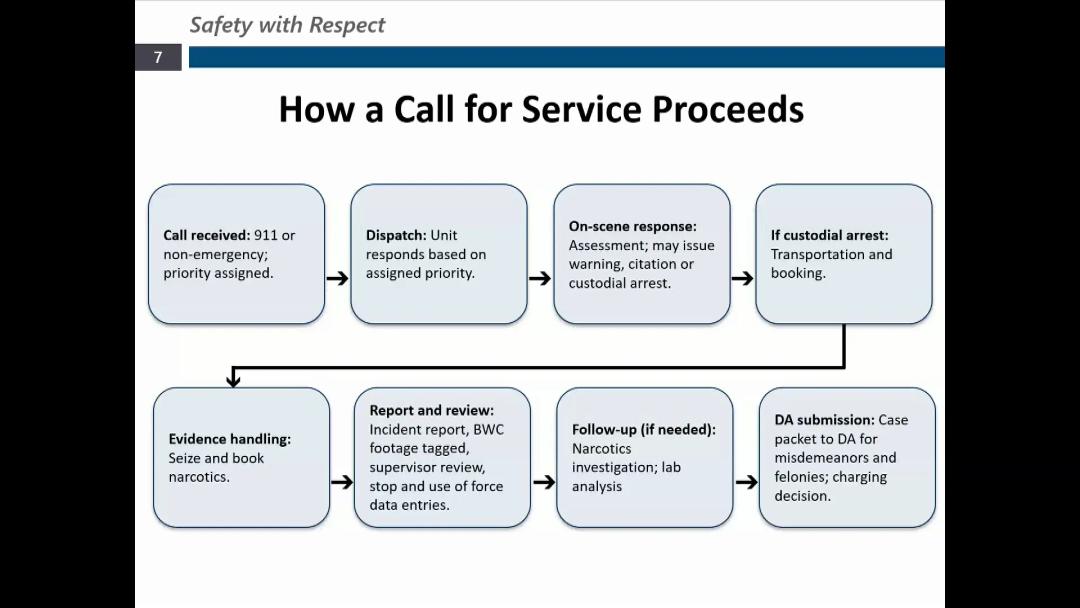
The committee (Chair Matt Dorsey, Vice Chair Lal Mahmood, and Supervisor Danny Sauter) held a regular meeting focused on (1) a public convenience or necessity finding for a theater liquor license in the Mission, (2) increased fines for vehicle sideshow misdemeanors, (3) a resolution urging a comprehensive enforcement/intervention plan for drug activity within 250 feet of parks/playgrounds/schools (later amended to include youth centers), and (4) an SB 276-aligned ordinance expanding enforcement tools for unpermitted vending of targeted retail-theft merchandise. All items advanced to the full Board with unanimous 3–0 votes. The clerk stated items acted on were expected to appear on the Board of Supervisors agenda on December 2, 2025 unless otherwise stated. Discussion Items - Item 1 — Public Convenience or Necessity (PCN): Type 69 beer & wine theater license (Roxy Theater, 3117 16th St.) - Presenter: Officer Brandon Erickson (SFPD Alcohol Liaison Unit). - Project description (as presented): Application for a Type 69 “special on-sale beer and wine theater” license. - Context/statistics: 0 letters of protest and 0 letters of support; located in Plot 413 (high crime area) and Census Tract 0202.01 (high concentration area); Mission Station had no opposition. - Recommended conditions (summarized): Noise not audible beyond premises except as authorized by an Entertainment Commission permit; monitor area to prevent loitering; maintain adjacent area free of litter. - Committee discussion: Chair Dorsey expressed support for preserving neighborhood cultural anchors and stated Supervisor Fielder (district supervisor) was supportive. No applicant representative appeared and there was no public comment. - Item 2 — Ordinance: Increase misdemeanor sideshow fine from $500 to $1,000 - Sponsor/presenter: Supervisor Danny Sauter. - Proposal (factual): Amend Police Code to raise the maximum fine for misdemeanor sideshow convictions from $500 to $1,000 (described as adopting the state maximum). Supervisor Sauter emphasized it is a discretionary maximum (not a mandatory fixed fine). - Committee discussion: Chair Dorsey described sideshows as dangerous events disrupting neighborhoods and damaging infrastructure. - Public testimony: - Yoel Haile (Director, Criminal Law and Immigration Project, ACLU of Northern California) — Opposed. Stated increased fines have not meaningfully reduced sideshow frequency in cities that raised them; cited claims that after Oakland increased fines in 2023, OPD’s Special Operations Division stated sideshow incidents increased in 2024, and that in 2025 OPD has seized more than 170 vehicles tied to sideshow activity. Argued higher fines can burden low-income residents and risk sweeping in bystanders; referenced a Stockton example where a bystander still faced harms more than a year later with a vehicle impounded. Urged environmental/community-based strategies (e.g., Oakland DOT installing bollards/curb extensions and residents reporting decreases). - Sponsor response: Supervisor Sauter stated the city needs “all of the above,” noting increased SFPD enforcement and infrastructure changes by SFMTA/DPW at hotspots. - Item 3 — Resolution: Urge SFPD comprehensive enforcement/intervention plan for drug use/suspected drug activity within 250 feet of parks/playgrounds/schools (amended to include youth centers) - Sponsor/presenter: Supervisor Stephen Sherrill. - Resolution focus (factual): Urges SFPD to develop and implement a plan addressing drug use/suspected drug activity especially within 250 feet of parks, playgrounds, and schools (amended to include youth centers), including enforcement actions (citations/removal for processing) and linkage to detoxification/treatment. - Key departmental presentations: - Deputy Chief Derek Liu (SFPD) with Commander Scott Biggs and Captain James Ahern present. - Scope/resource context: Map of 250-foot buffers shows the impact is citywide and “all-encompassing,” presenting resource challenges. - Call volume (Jan 2024–Sep 2025; 21 months): SFPD reported about 17,400 narcotics complaints related to vehicles and 31,300 suspicious person calls near parks/schools (nearly 49,000 calls total). - Incident/arrest patterns: Incidents within buffers were described as primarily personal use/simple possession, with possession of paraphernalia the top category (over 1,100 cases), followed by meth possession; sales offenses were described as rarer. Arrests were reported as 2,883 from those calls (about a 6% arrest rate), with a note that warrant arrests were not included in that calculation. - Operational/process description: Deputy Chief Liu outlined the “life cycle” of a call (dispatch priority, on-scene assessment, warning/citation/custodial arrest decisions, transport/booking, evidence handling, reporting/BWC tagging/supervisor review, lab needs, DA case packet). Emphasized misdemeanor cite-and-release requirements and competing priorities. - DMACC reference (statistics): Described the Drug Market Agency Coordination Center (DMACC) as concentrated on Tenderloin/SOMA; since mid-2023, DMACC operations resulted in more than 7,000 arrests and over 155 kilos of fentanyl seized, plus large volumes of methamphetamine, and “almost 4,000” warrant arrests. - Potential tool: Highlighted a “promising next step” of a new sobering center pathway led by the Sheriff’s Office and DPH to reduce administrative burden and increase options for officers to move people off the street quickly. - Recreation & Park Department: Beverly Ng and David Murphy referenced (Murphy absent). - Key point: Park Rangers are limited to citations under Park Code; RPD described preventive measures (fencing, lighting, ambassadors) but noted resource constraints. - Sheriff’s Office (sobering center concept): Presented as a “between a jail and a hospital” option for intoxication/under-the-influence cases (referencing H&S 11550 and PC 647F), with a compelled custodial stay until release/clearance, offering recliner-chair setting and a “soft handoff” to care providers; goal is up to 23 hours of stay. - Department of Public Health (DPH): Chris Tagate described on-site triage/monitoring by a contracted provider, plus stronger peer engagement and case management; emphasized assertive (not coercive) engagement and workflows to connect people to treatment, including transportation and coordination for bed placement. Stated DPH has opened “hundreds more beds” and more are in the pipeline, while acknowledging placement barriers can still occur. - Committee discussion highlights: - Supervisor Sherrill and committee members discussed arrest thresholds for misdemeanors, the paperwork and reporting burden (including stop-data requirements), repeat offenders/bench warrants, and potential value of stay-away orders (noting DA/court role). - Questions raised about whether Park Rangers’ authority could be expanded to cite under Health & Safety Code (city attorney consultation suggested). - Discussion noted existing dispatch pathways to Street Crisis Response Teams for certain situations. - Amendments read into the record (by Supervisor Sherrill): - Added “youth centers” alongside parks/playgrounds/schools. - Added DEM and DPH explicitly as part of an interagency effort. - Added language prioritizing intervention and connection to crisis stabilization, detoxification, or treatment services. - Added clarification that technology tools should be adopted pursuant to city technology policies, including Chapters 19B and 22J. - Public testimony: - Alondra Esquivel-Garcia (Director, San Francisco Youth Commission) — Reported the Youth Commission voted to positively recommend the resolution; raised concerns about implementation, including potential over-policing and impacts on older youth; urged youth-centered training/approaches, measures to avoid displacement, sustainability, outreach to youth/families, and collaboration with youth-focused organizations. - Alex Ludlum (public speaker) — Expressed strong criticism of perceived lack of police effort and consequences regarding fentanyl use in parks. - Natalie Ortiz (public speaker; also later spoke on Item 4) — Urged greater collaboration beyond policing, including HSH and stronger care coordination/case management; stated “just the police is not the answer.” - Item 4 — Ordinance: SB 276 implementation for targeted unpermitted vending enforcement (Public Works Code/Port Code amendments) - Presenters: Diana Ponce de Leon (Office of Workforce and Economic Development) and Alejandro Del Calvo (Public Works), with Commander Scott Biggs (SFPD) available. - Background (as presented): SB 946 (2018) decriminalized sidewalk vending and shifted enforcement to local authorities (in SF, DPW). Presenters stated that combined with COVID and other factors, conditions contributed to increased fencing/stolen goods sales and unsafe sidewalk conditions in some neighborhoods. - Proposal (factual): Amend Public Works Code (Article 5.9) and Port Code to align with SB 276, authorizing enforcement for vending targeted merchandise on city property without a permit through warnings, infractions, misdemeanors, and fines up to $1,000 (and noted potential misdemeanor penalties up to 6 months). - Civil rights/due process elements (as presented): Permit process continues to require proof of lawful ownership (e.g., receipts). Permit application does not collect immigration/citizenship/place of birth, criminal history, fingerprints, or background checks; maintains low-cost permits for low-income applicants. - Targeted merchandise list (categories described): Food/beverages; clothing/accessories; cosmetics/skin care; personal hygiene/toiletries; household cleaning/paper products; electronics/batteries; medicine/vitamins/tobacco; bags/backpacks/suitcases; currency/cards; household goods/decor; tools/hardware/automotive parts. (List described as compiled with SFPD Crime Analysis Unit data.) - Enforcement escalation (as presented): - 1st violation: DPW issues a written warning (including name/date/time). - 2nd–3rd violations (within 18 months): Eligible for infractions, with police able to engage. - 4th and subsequent violations (within 18 months): Can escalate to misdemeanor; punishable by up to 6 months jail and/or a fine not to exceed $1,000. - Implementation/oversight: Annual reporting to the Board of Supervisors and relevant California legislative committees; targeted list to be submitted annually and renewed with fresh data. Presenters also stated the state legislation expires in 2031. - Committee discussion: Supervisor Sauter and Chair Dorsey expressed support, emphasizing balance between vibrant permitted vending and preventing harm to permitted vendors and brick-and-mortar businesses. - Public testimony (positions): - Edward Seale (Chinatown Burgers United Associations; also referenced Sunset District) — Supported stronger enforcement; argued unpermitted vending harms small businesses and raises health concerns. - Boris Delapine (Port of San Francisco Government Affairs Manager) — Supported; cited ongoing unpermitted vending challenges along the waterfront since the pandemic; stated Port conducts 4 to 14 operations monthly with DPW and the Vendor Enforcement Task Force. - Mission Street Vendors Association members (multiple speakers, many in Spanish) — Predominantly supported SB 276/ordinance; emphasized safety, fairness, differentiation between permitted “honest” vending and illegitimate vending, and benefits for neighbors/vendors/businesses. - Alma Castellanos (Director of Operations, GLECHA) — Supported and urged approval; noted organizational advocacy in Sacramento. - Joshua Jacobo (Director of Justice and Reentry, Nuestra Causa) — Supported the law’s intent and protections but urged equitable implementation to avoid increased criminal justice involvement for people selling to survive; stated outreach had not effectively reached unpermitted/informal/system-impacted sellers and asked for resourcing trusted organizations. - Natalie Ortiz (Director of Strategic Initiatives, Nuestra Causa) — Supported clear rules and recognized vendor leadership; raised concerns about outreach gaps and urged investment in community partners; additionally stated the ordinance gives the Public Works Director broad authority to update the restricted items list quarterly “without public input,” recommending added transparency/accountability. - Leila Ovando (Director of Food Access and Equity, Nuestra Causa) and Karina (Nuestra Causa organizer) — Emphasized supporting vulnerable unpermitted vendors through trusted community partners to prevent harmful criminalization. Public Comments & Testimony - Item 2 (sideshow fines): ACLU of Northern California (Yoel Haile) opposed, citing Oakland post-fine-increase trends (as stated), equity impacts, and recommending infrastructure-based prevention. - Item 3 (drug activity near parks/schools): Youth Commission supported with implementation concerns (over-policing, youth-centered approaches, displacement, sustainability). Additional speakers urged more accountability and/or broader social services collaboration. - Item 4 (SB 276 vending enforcement): Broad support from Mission Street vendors and some business/port stakeholders; Nuestra Causa speakers urged equitable outreach, transparency, and resources to avoid unintended criminalization. Key Outcomes - Item 1 (Roxy Theater Type 69 PCN finding): Motion directing clerk to prepare a PCN resolution and forward to full Board with positive recommendation passed 3–0 (Dorsey, Mahmood, Sauter). - Item 2 (sideshow fine increase to $1,000 max): Ordinance forwarded to full Board with positive recommendation passed 3–0. - Item 3 (drug activity enforcement/intervention plan resolution): Committee accepted amendments as read into the record and forwarded the resolution to the full Board with positive recommendation passed 3–0. - Item 4 (SB 276 targeted unpermitted vending enforcement ordinance): Ordinance forwarded to the full Board with positive recommendation passed 3–0.

PUBLIC SAFETY 45% · ECONOMIC DEVELOPMENT 30% · COMMUNITY ENGAGEMENT 15% · ARTS AND CULTURE 5%
295
NOV 12, 2025 · SAN FRANCISCO, CALIFORNIA · BUDGET AND FINANCE COMMITTEE
Budget and Finance Committee Meeting – November 12, 2025

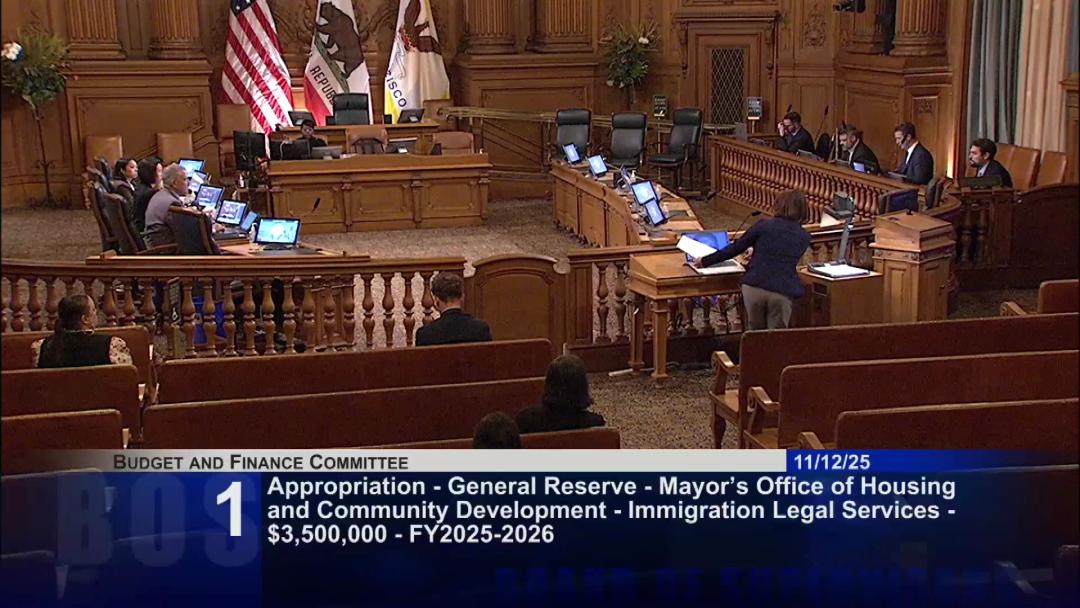
The San Francisco Budget and Finance Committee met on November 12, 2025, at 6:15 PM under Chair Supervisor Connie Chan, joined by Vice Chair Supervisor Matt Dorsey and Member Supervisor Beya Alcaraz (substituting). The committee considered a single item: an ordinance appropriating $3.5 million from the General Reserve to the Mayor's Office of Housing and Community Development (MOHCD) to expand coordinated immigrant legal defense and community response services for fiscal year 2025-26. After presentations, public testimony, and discussion, the committee voted unanimously to amend the ordinance and forward it to the full Board of Supervisors with a recommendation. Public Comments & Testimony - Omar Delacruz (Center for Gender and Refugee Studies, SF Immigration Legal Defense Collaborative): Urged support for the supplemental, highlighting the need to sustain legal services that protect families, support rapid response, and help immigrants access work permits and stay in the country. - Zeta Blottner (Pangea Legal Services): Stressed that there is no right to counsel in immigration proceedings, and that funding is essential for outreach and organizing. Argued that disengagement from the system would be costlier in the long run. - Andrew Craycroft (Immigrant Legal Resource Center): Expressed support for the collaboratives, noting they provide vital legal defense, safety planning, and ensure immigrants can participate in civic life despite federal enforcement. - Victoria Hartanto (API Legal Outreach): Thanked the committee for support, noting that additional funding would increase capacity for urgent consultations, habeas petitions, and responses to ICE detention. - Claire Deck (USF Law Immigration and Deportation Defense Clinic): Stated that demand on their program is increasing daily and that more funding would allow them to file habeas petitions to secure release for unconstitutionally detained clients. - Katie O'Neill (Lawyers Committee for Civil Rights): Urged passage of the supplemental, emphasizing that existing collaboratives already have the expertise to meet the moment but need more resources. Discussion Items - MOHCD Presentation: Staff presented a brief overview of the division, noting investments in homelessness prevention, housing stability, and community safety. They reported that the immigrant legal services hotline received over 1,400 calls in the first quarter of fiscal year 2025, a 350% increase over the same period last year and 20% above the annual goal of 1,200 calls. The supplemental would fund additional attorneys, paralegals, technology upgrades, and multilingual outreach. - Budget Legislative Analyst (BLA) Report: Nick Renard from the BLA office summarized that the $3.5 million represents a one-time 28% increase over the current $12.3 million budget. He noted that taking from the General Reserve would require replacement next year under city reserve policy. The BLA offered policy considerations: assessing linguistic barriers, identifying disproportionately impacted communities, evaluating provider performance and capacity, and comparing unit costs across providers. - Committee Discussion: - Chair Chan asked about long-term strategy for immigration legal services, noting the need for a sustainable budget approach and prioritization of work permits and citizenship applications. MOHCD responded that immediate focus is on defenses against detention, but with supplemental funding, they could look toward affirmative strategies. - Vice Chair Dorsey echoed the importance of accountability and stated that the city has a moral imperative to support immigrant and transgender immigrant communities, especially as philanthropic support diminishes. - Supervisor Alcaraz inquired how MOHCD would assess which organizations are best positioned to expand capacity. MOHCD replied that they have completed a procurement process and will perform due diligence once the ordinance passes, and offered to provide future briefings. Key Outcomes - Amendment: Chair Chan introduced an amendment (to page 1, lines 5–6) to clarify that the funds are for “services for immigration legal defense” and to allow MOHCD flexibility in disbursement. The motion passed 3-0 (Dorsey aye, Alcaraz aye, Chan aye). - Forward to Full Board: The committee voted 3-0 to forward the amended ordinance to the full Board of Supervisors with a positive recommendation. The item is expected to appear on the Board’s agenda on November 18, 2025. - Adjournment: No other business; the meeting adjourned.

IMMIGRATION POLICY 85% · PROCEDURAL 15%
296
NOV 12, 2025 · SAN FRANCISCO, CALIFORNIA · POLICE COMMISSION
San Francisco Police Commission Meeting – November 12, 2025

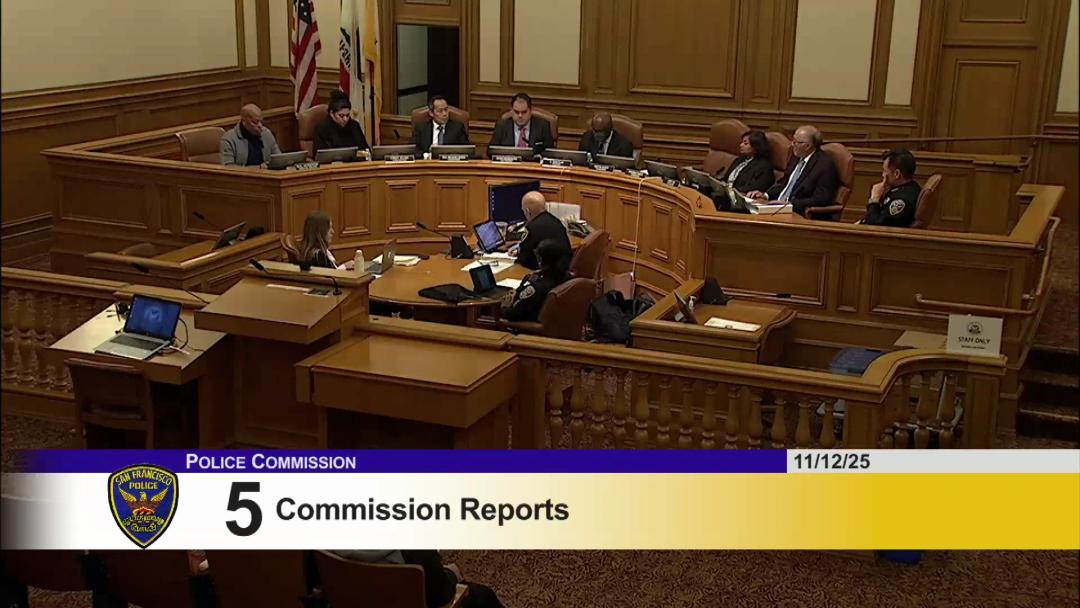
The San Francisco Police Commission met on November 12, 2025, at 1:45 PM. The meeting included a consent calendar, reports from the Chief of Police and the Department of Police Accountability (DPA), commissioner reports, and a closed session where the commission nominated candidates for police chief to forward to the mayor. Key crime statistics and operational updates were presented, and several actions were taken unanimously. Consent Calendar - The commission unanimously voted (6-0) to receive and file a donation from the California State Automotive Association valued at $9,926 for the Vehicle Theft Abatement Awards Luncheon. Public Comments & Testimony - One member of the public addressed the commission during general public comment, delivering a rambling statement that referenced child trafficking and criticized the police, but the specifics were largely incoherent. No other public comments were made on any agenda items. Discussion Items - Chief’s Report: Interim Chief Yep reported on weekly crime trends for the week ending November 9, 2025. Overall part one crimes were down 26% year-to-date. Violent crimes decreased 17%, homicides were down 23% (23 homicides this year), gun violence down 14%, rapes down 15%, assaults down 13%, and robberies down 23% (robberies using a firearm declined 44%). Human trafficking incidents increased 120%. Property crime fell 27%, burglaries down 28%, and larceny theft down 22%. The chief highlighted a 54% decrease in robberies from the previous week after a 104% spike. An analysis of chain snatch robberies since August 1 identified 28 incidents, with 11 in October; 39% occurred in the Mission district and 29% in Ingleside. Suspects averaged 16–22 years old; eight incidents involved weapons (7 guns, 1 knife). Nine arrests were made. Notable incidents included an officer-involved shooting on November 9 at Market and O’Farrell Street (town hall scheduled for November 18), a homicide of a six-month-old infant (originally reported September 13, death ruled homicide on November 3), and three shooting incidents resulting in seven victims (one in the Mission district, one at Ocean Beach with five victims). Operational efforts by the Drug Market Activity Coordination Center (DMAC) led to over 70 arrests, seizure of 9.4 pounds of narcotics (including fentanyl, heroin, cocaine, and methamphetamine), and recovery of four firearms in just over a week. A robbery-with-knife series on November 5 resulted in two arrests. - DPA Director’s Report: Executive Director Paul Henderson reported that DPA intake volume is up 22% compared to 2024, with the most common complaints alleging officers speaking or behaving inappropriately. Eleven cases have investigations exceeding 270 days (all “TOLD” cases). The use of force audit is being finalized and will be sent to SFPD for comment within 48 hours. A review of protest policies (DGO 8.10) is underway, with a request to expand the scope to include facilitation of peaceful protest. The DPA has digitized 800,000 pages of an estimated 2.8 million pages of older case records. Henderson confirmed a 2024 annual report will be produced (timeline to be provided next week). - Commission Reports: President Clay reported that all discipline sign-outs are current and no DGOs require further action. Commissioner Benedicto noted that an update on SFPD’s progress on the stop audit (originally on the agenda) was delayed due to benchmark issues, and expressed hope for timely rescheduling given community interest from the League of Women Voters and the prexops coalition. Key Outcomes - Consent Calendar: Approved unanimously (6-0) to receive and file the donation. - Closed Session: The commission voted unanimously (6-0) to enter closed session pursuant to California Government Code and San Francisco Administrative Code. After closed session, the commission reported that it voted to make one or more nominations for appointment of police chief and forward those nominations to the mayor for his consideration. The commission then voted unanimously (7-0) not to disclose any discussion from closed session. - Meeting Adjournment: The meeting adjourned after the closed session report.

PROCEDURAL 82% · POLICE OVERSIGHT 17% · PERSONNEL MATTERS 1%
297
NOV 10, 2025 · SAN FRANCISCO, CALIFORNIA · BOARD OF SUPERVISORS
San Francisco Board of Supervisors Special Meeting – November 10, 2025

The San Francisco Board of Supervisors held a special meeting on November 10, 2025, at 6:00 PM (UTC) in the legislative chamber of City Hall. The meeting began with a land acknowledgment of the Ramaytush Ohlone people, the recitation of the Pledge of Allegiance, and a welcome to new District 4 Supervisor Bea Alcaraz, appointed by Mayor Daniel Lurie on November 6, 2025. The single agenda item was an ordinance appropriating $9.1 million for CalFresh benefits backfill. Discussion Items - Item 1 – Ordinance Appropriating $9.1 Million for CalFresh Benefits Backfill: The ordinance appropriates $9.1 million from the state and federal revenue risk reserve to the Human Services Agency for CalFresh benefits backfill in fiscal year 2025–2026. Supervisor Chen was added as a co-sponsor. No members of the public provided comment. Key Outcomes - Vote on Item 1: The Board unanimously passed the ordinance. The roll call recorded ayes from Supervisors Chen, Dorsey, Fielder, Mahmood, Mandelman, Melgar, Sauter, Cheryl, Walton, Alcaraz, and Chan. Without objection, the ordinance was finally passed. The meeting then adjourned.

PROCEDURAL 59% · PUBLIC HEALTH 41%
298
NOV 10, 2025 · SAN FRANCISCO, CALIFORNIA · PUBLIC UTILITIES COMMISSION
San Francisco Public Utilities Commission Meeting - November 10, 2025

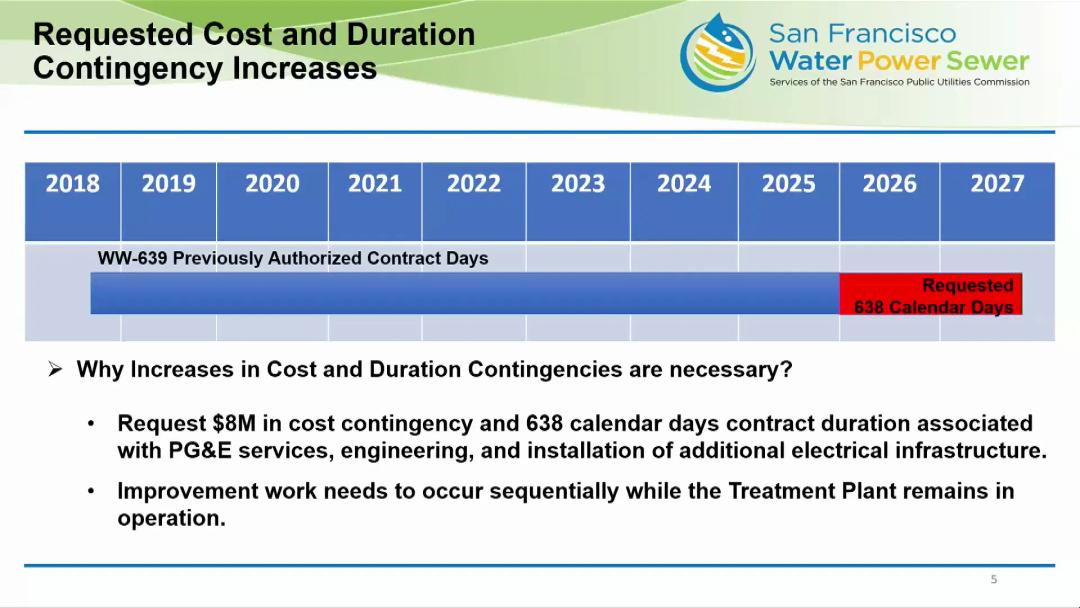
The San Francisco Public Utilities Commission (SFPUC) held a regular meeting on November 10, 2025, from approximately 9:30 AM to 2:36 PM. The meeting included approval of minutes, general public comment, a consent calendar, and several agenda items related to contract modifications for wastewater and power infrastructure projects. All votes were unanimous, with Vice President Leveroni absent. Commissioners also discussed future hearings on climate programs and the Citizens Advisory Committee's recommendations. Consent Calendar - Approved six items (6A through 6F) on the consent calendar unanimously. Commissioner Stacey clarified that item 6C is an extension and increase for construction staff augmentation services related to item 9, and item 6F is an interim improvement to extend pump and concrete structure lifespan by 15 years while a new booster station is planned. Public Comments & Testimony - General public comment (item 4) featured multiple speakers alleging retaliation, corruption, and wrongful termination of employees Joseph King, Conrad King, and Adolfo Badilla at the SFPUC Water Department. Speakers—including family members, community advocates, and union representatives—described the employees as hardworking and unfairly targeted after raising safety concerns. They demanded an investigation and restoration of their jobs. A remote caller (Peter Dreckmeyer, Policy Director for Yosemite Rivers Alliance) urged the commission to hold a workshop on the Tuolumne River Voluntary Agreement and to analyze whether SFPUC can meet Bay-Delta Plan flow requirements without risking water supply. He also expressed support for the earlier speakers. - During item 6 (consent calendar), one speaker praised project manager Jagnesh and criticized management corruption, though did not comment on specific consent items. - No public comments were made on items 7, 8, 9, 10, or 11. Discussion Items - Item 7: Southeast Water Pollution Control Plant Power Feed and Primary Switchgear Upgrades – Staff requested an increase of $1.5 million to cost contingency and 360 calendar days to duration contingency for contract WW-662R (Block of Construction Inc.) due to new PGE regulatory requirements for an interrupter mechanism. Construction is 90% complete. The commission approved the modification unanimously. - Item 8: Oceanside Water Pollution Control Digester Gas Utilization Upgrades – Staff requested an increase of $8 million to cost contingency and 638 calendar days to duration contingency for contract WW-639 (Monterey Mechanical Co.) to comply with PGE wholesale distribution tariff requirements. The project is 90% complete; the original contract duration was corrected to 820 consecutive calendar days. The commission approved the modification unanimously. - Item 9: West Side Reliability Improvements Project – Staff requested an increase of 602 calendar days to duration contingency for contract WW-645R (Anvil Builders Inc.) to complete underground electrical infrastructure work along Skyline Boulevard. Construction is 65% complete. The commission approved the modification unanimously. - Item 10: North Shore Pump Station Wet Weather Improvements – Staff presented closeout of contract WW-685R (Western Water Constructors Inc.), approving modification No. 19 increasing duration by 249 calendar days and authorizing final payment. The project achieved redundancy for the 150 million gallons per day wet weather facility. The commission approved unanimously. - Item 11: Communications – Commissioner Stacey requested a future hearing on the annual multi-enterprise climate program update, praising the report. Commissioner Jamdar echoed the request. President Arce noted he found compelling arguments from the PUC Citizens Advisory Committee (CAC) against recommendations from the city's streamlining task force and against term limits for the CAC, expressing concern about loss of expertise. - Item 12: Items Initiated by Commissioners – Commissioner Stacey reiterated the request for a hearing on the climate program update. Key Outcomes - Approved minutes of October 28, 2025 (unanimous). - Approved consent calendar (unanimous). - Approved contract modifications for items 7, 8, 9, and 10 (all unanimous). - Commissioner Stacey’s request for a hearing on the climate program update was acknowledged; staff indicated it could be scheduled after the turn of the year. - President Arce’s individual reflections on the CAC letter were noted but no formal action taken.

ENGINEERING AND INFRASTRUCTURE 47% · PERSONNEL MATTERS 40% · PROCEDURAL 9% · COMMUNITY ENGAGEMENT 4%
299
NOV 6, 2025 · SAN FRANCISCO, CALIFORNIA · PLANNING COMMISSION
San Francisco Planning Commission Hearing on Tenant Protections, Bridge EIR, and More – November 6, 2025

The San Francisco Planning Commission met on Thursday, November 6, 2025, for a regular hearing. The meeting began with roll call, continuances, and consent calendar approvals (7-0). Major agenda items included a landmark Tenant Protections Ordinance (TPO) aimed at strengthening protections for renters facing displacement from demolitions and renovations, the certification of the Final Environmental Impact Report (EIR) for the Islais Creek Bridge replacement, and a conditional use authorization to remove an unauthorized dwelling unit at 175 Margaret Avenue. The commission heard extensive public testimony, debated amendments, and voted on each item. Consent Calendar - Items 4 (440 Potrero Avenue Conditional Use) and 5 (case 2022-008315) were approved on a single roll call vote (7-0). Public Comments & Testimony - Item 11 (Tenant Protections Ordinance): Over 20 members of the public spoke, with most strongly supporting the ordinance and urging adoption of amendments from Supervisor Chen and Supervisor Melgar. Speakers included representatives from the Castro LGBTQ Cultural District, Housing Rights Committee, REP SF Coalition, Mission Economic Development Agency, Young Community Developers, and tenant advocates. They emphasized the need for stronger demolition definitions, mandatory conditional use standards, harassment protections, Ellis Act disclosures, and priority protections for low-income tenants and communities of color. A few speakers expressed concerns about potential unintended consequences on housing supply but generally supported the direction. - Item 12 (Islais Creek Bridge EIR): No public comment was offered. - Item 13 (175 Margaret Avenue): No public comment was offered. Discussion Items - Director’s Announcements: Planning Director Phillips announced successful distribution of replacement food benefits for families affected by the federal shutdown, praised the Urban Land Institute conference in San Francisco, and reported the departure of senior leader Miriam Chong. A reorganization plan was detailed: equity work will be elevated department-wide under Lisa Gibson, and community planning teams will move under Rachel Tanner. Commissioner Williams expressed concern about maintaining community relationships after the transition. - Review of Past Events (Item 10): Legislative Affairs Manager Aaron Starr reported on recent Board of Supervisors land use committee actions, including the proposed Gateway Special Use District, adaptive reuse ordinance, planning fees ordinance, and legacy business protection legislation. The Family Zoning Plan economic impact report was presented, and several amendments were advanced to the full board. - Item 11 – Tenant Protections Ordinance (TPO): Supervisors Chen and Melgar presented the ordinance and their amendments. Staff (Melena Leon Ferrera) gave a detailed presentation explaining that the TPO codifies and expands SB 330 requirements, including enhanced relocation payments (e.g., a family of four at 50% AMI could receive $2,227/month for up to 39 months, totaling over $86,000), expanded definition of existing occupants, a right of first refusal, and mandatory replacement of protected units. The department recommended adoption with modifications. Commissioners debated the appropriate threshold for conditional use findings (80% vs. 70%) and the definition of demolition. Commissioner Imperial and others pushed for stronger protections, especially for Priority Equity Geographies. Commissioner Moore supported retaining 80% and urged further study of demolition thresholds. The commission voted unanimously to recommend approval with modifications. - Item 12 – Islais Creek Bridge EIR: Staff (Liz White) presented the Final EIR, noting the bridge’s poor structural rating (20 out of 100) and the need to address sea level rise and seismic deficiencies. The preferred variant reduces closure from 24 to 15 months for vehicles and pedestrians, with transit closure up to 24 months. Significant unavoidable impacts to historic resources and transit delay remain. Mitigation measures include community engagement and a mobility strategy. Commissioner McGarry raised concerns about freight access, and Commissioner Williams questioned community outreach (staff listed 10+ organizations consulted). The commission certified the EIR (7-0). - Item 13 – 175 Margaret Avenue Conditional Use: Staff (Heather Samuels) recommended approval to remove an unauthorized dwelling unit built without the owner’s knowledge. The property owner, a daughter who inherited the home, stated that the master tenant constructed the unit in 2011 and vacated in 2022. The owner used the Ellis Act to exit the rental market. Commissioners Moore and Imperial found the situation unique and the owner acted in good faith. The commission approved the conditional use (7-0). Key Outcomes - Tenant Protections Ordinance: Approved for recommendation to the Board of Supervisors with modifications (including staff and supervisor amendments) by a unanimous 7-0 vote. Further study on demolition thresholds and harassment protections was directed. - Islais Creek Bridge Final EIR: Certified unanimously (7-0). The project will next seek approvals from the Director of Public Works and the SFMTA Board. - 175 Margaret Avenue Conditional Use: Approved with conditions (7-0), allowing removal of the unauthorized unit and restoration to single-family use.

AFFORDABLE HOUSING 59% · LAND USE 20% · COMMUNITY ENGAGEMENT 5% · TRANSPORTATION SAFETY 5%
300
NOV 6, 2025 · SAN FRANCISCO, CALIFORNIA · GOVERNMENT AUDIT AND OVERSIGHT COMMITTEE
San Francisco Government Audit and Oversight Committee Hearing on Taylor Street Facility Conditions – November 6, 2025

On November 6, 2025, the San Francisco Board of Supervisors' Government Audit and Oversight Committee, chaired by Supervisor Jackie Fieler and joined by Vice Chair Janie Sauter and Supervisor Mahmood, convened a hearing to examine allegations of neglect, abuse, civil rights violations, and the death of Melvin Bulawan at the Taylor Street Center (111 Taylor Street), a residential reentry facility operated by Geo Group Inc., a private prison corporation. The meeting also addressed five settlement ordinances (items 2–6). Consent Calendar - Items 2–6: Five ordinances authorizing settlement of lawsuits against the city were forwarded to the full Board of Supervisors with a positive recommendation, without public comment. Public Comments & Testimony - Melvin Bulawan's family (son Andrew Bulawan and mother Amelia Miguel) testified emotionally about his death on July 14, 2025. Andrew stated that his father called him on July 13, saying, "I'm scared. I'd rather go back to jail than stay here." Despite multiple calls requesting a wellness check, the facility hung up. Andrew criticized Geo Group's profit motive and lack of accountability. Amelia Miguel urged the committee to ensure no other mother endures the same loss. - Janetta Johnson (Miss Major Alexander L. Lee TGIJP Black Transcultural Center) spoke from her experience as a former resident in 2012, describing pat-downs, breathalyzers, forced unpaid labor, disgusting food, and retaliation against those who complained. She noted that many residents prefer prison over the facility. - Quinn Dior (Compton's Coalition) characterized the facility as a "for-profit, carceral institution" operating illegally under group housing zoning. He demanded Geo Group's exit and called for release of all records, on-site inspections, and enforcement of violations. He highlighted that the site is a landmark of trans resistance (Compton's Cafeteria). - Wilder Zeiser (Compton's Coalition) reported survey findings of consistent complaints: sexual violence by staff, trash buildup, fires, insect infestations, lack of hot water, and food poisoning outbreaks. - Dozens of other community members gave one-minute testimonies detailing similar abuses, including denial of medical care, confiscation of phones, lack of kitchen access, and fear of retaliation. Several speakers noted that Geo Group also operates ICE detention centers, contradicting San Francisco's sanctuary city values. Discussion Items Hearing on Taylor Street Center (Item 1) - Victoria Westbrook (Adult Probation Department) presented the city's reentry portfolio, emphasizing that their 14 housing programs (e.g., CASC, Westside Community Services) provide longer stays (12–18 months) and address criminogenic needs. She stated that Adult Probation has no contract with Geo Group and that best practices require at least 12 months of structured support. - Nadia Iqbal (Public Defender's Office) described parole violations as punitive and noted clients are forced into halfway houses like 111 Taylor, where conditions include crowded dormitories (up to 14 per room), restrictive curfews, and prohibitions on speaking to media. She cited a documentary showing lack of COVID protocols. She recommended starting over with community-based housing models like the Homecoming Project. - Chief Chris Karuba-Katz and Chief Sylvia Olugo (U.S. Probation and Pretrial Services) defended the facility as a "last resort" alternative to detention. They emphasized that 78% of federal participants discharged successfully in 2024, and that the facility allows for community integration. They admitted they do not track building code violations or inspect conditions beyond visual tours. - Molly Rose Graves and Maria Richard (Geo Group/Taylor Street Center) argued the program is voluntary and structured, with 400 new participants in 2024, 78% successful discharges, and average savings of $2,000–$5,000 per resident. They denied reports of 14-person rooms, maggots in food, and phone confiscation. Regarding Melvin Bulawan's death, they refused to comment on specific cases, citing contractual confidentiality. - Supervisor Mahmood questioned Geo Group on: lack of on-site medical or mental health staff (care is outsourced); noncompliance with group housing kitchen access requirements (non-conforming use); unpaid labor (residents clean the facility); and whether AB 32 (ban on private incarceration contracts) applies. Maria Richard maintained that the facility is a community reentry center, not a detention center. Key Outcomes - Motion to Continue Item 1: Supervisor Mahmood moved to continue the hearing on the Taylor Street Center to the call of the chair, to allow further investigation. The motion passed unanimously (3–0, with Supervisor Cheryl excused). - Items 2–6 Forwarded to Full Board: The five settlement ordinances were sent to the full Board of Supervisors with a positive recommendation (3–0). - Next Steps: The committee will schedule further hearings; community advocates demanded subpoenas for Geo Group records, on-site city inspections, and a transition plan to remove Geo Group from 111 Taylor Street.

PUBLIC HEALTH 25% · POLICE OVERSIGHT 14% · CORRECTIONS AND REENTRY 13% · REENTRY SERVICES 12%
OPENPUBLICA · PUBLIC MEETING INDEXUPDATED DAILY · openpublica.com