The San Francisco Public Utilities Commission (SFPUC) met on July 28, 2026, at 9:45 AM. The meeting included approval of the consent calendar, a report on the Hetch Hetchy Capital Improvement Program, updates on the General Manager search, adoption of the amended Alameda Watershed Management Plan, several financing authorizations, and contract awards. All votes were unanimous (4-0) with President Arce excused. Consent Calendar - Approval of Minutes of July 14, 2026 – Approved unanimously. - Consent Calendar Items (6A, 6B, 6C) – Approved. Commissioner Stacy inquired about the relationship between Item 6B (as-needed spot sewer repairs) and Item 6C (large-diameter sewer inspections). Staff clarified that 6C inspections are for known locations, while 6B is a flexible contract for future identified work. - General Consent Items – All routine approvals and actions passed without objection. Public Comments & Testimony - Francisco de Casta (on Item 4 – General Public Comment) – Expressed concerns about confined space safety at SFPUC facilities. He criticized remote management practices, urged commissioners to personally inspect reservoir sites, and stated he had opened an OSHA case and was supporting traumatized workers. - Peter Directmeyer (on Item 14 – GM Search) – Representing Yosemite Rivers Lowland. Urged the commission to conduct a fully competitive national search, noting that the previous search in 2021 was effectively overridden by the mayor and resulted in only one applicant. Recommended verifying mayoral support for an open process. Discussion Items - Item 5a: Hetch Hetchy Capital Improvement Program Quarterly Report (Q4 FY 2025-26) – Katie Miller, Director of Water Capital Programs, presented. The program includes 22 major projects funded by water, power, or joint revenue/bonds. As of June 30, 2026, $568 million had been spent against an $2 billion budget, with $62 million in Q3/Q4 and $109 million in total for FY 2025-26. No new cost variances were reported. Key milestones included completion of Priest tunnel repairs, erection of Priest flow control facility walls, and progress on Moccasin Water Filtration Plant. Commissioner Stacy asked about Moccasin penstock alternatives; staff explained that geotechnical investigations are underway to compare tunnel vs. above-ground/buried pipeline options, with a decision expected by January 2027. - Item 14: Update on General Manager Selection Process – Sean Sherburn from the Department of Human Resources (DHR) reported that bids from executive search firms were received by July 24 and are under evaluation. Commissioner Stacy was designated as the commission’s point person. DHR aims to have a firm selected by the next meeting (September 8). Sherburn emphasized evaluating firms based on past performance (diverse candidate pools, relevant municipal water/wastewater experience). Commissioners Jamdar and Stacy stressed the importance of diversity. Discussion included timelines for job posting, stakeholder outreach, and community engagement (e.g., surveys, public forums). The commission will consider a draft job description and roadmap in September. - Item 7: Adopt Amended Alameda Watershed Management Plan – Tim Ramirez, Division Manager, presented the plan update (first since 2000). Key changes: allowing public fishing access at Calaveras Reservoir (shoreline only, no boats or docks) to help control non-native bass while protecting native trout by catch-and-release; updated grazing and land management rules; and inclusion of acquired properties. The program is expected to open in July 2027. Commissioner Stacy asked about monitoring (staff will check permits daily, with support from Fish and Game wardens and sheriff), overnight camping (only by East Bay Regional Park District under its own lease), and water rates for lessees (all now pay commission-approved rates). The plan was adopted unanimously. - Item 8: Wastewater Revenue Bonds (Series 2026 A and B) – Staff presented a two-part financing: up to $506 million in taxable Series A bonds for the Biosolids Digester Facilities Project and retire commercial paper, and up to $556 million in Series B bonds to refund certain outstanding bonds to achieve savings. The refunding transactions (2010 Build America bonds and 2016 bonds) are expected to produce $32.6 million gross savings ($1.7 million/year for 10 years). Staff also announced that S&P and Moody’s recently affirmed the SFPUC’s ratings and restored the stable outlook. Approved unanimously. - Item 9: Credit Facility Agreements for Wastewater Enterprise – Edward Quang requested approval to replace an existing Bank of America liquidity facility (Series A6) with a lower-cost Royal Bank of Canada facility (reducing fee from 42 to 33 basis points) and to establish a new $125 million series (A9) with TD Bank (27 bps fee) using remaining authorized interim funding capacity. Approved unanimously. - Item 10: Water Revenue Bonds (Direct Purchase) – Staff requested authorization for up to $400 million in direct-purchase water revenue bonds from Wells Fargo Bank to cover short-term capital needs and support reserve releases. The bonds are structured as fixed-rate (expected 3.58%) and will be repaid by a larger financing in August 2027. Approved unanimously. - Item 11: Standby Letters of Credit for Non-Capital Permits – Staff requested general manager authority to enter standby letters of credit required by California Department of Fish and Wildlife permits for the wastewater enterprise. These are not financing instruments and have never been drawn upon. Approved unanimously. - Item 12: Contract Amendment for Moccasin Powerhouse Generator Rehabilitation – Javad Mersadi requested a $400,000 cost increase and 212-day extension to Contract DB-121R2 to install a vibration monitoring system. The original generator rewind work encountered shaft misalignment (now corrected); the monitoring system will proactively detect future alignment issues. Approved unanimously. - Item 13: Award Power Capital Program Management Contract to Deloitte – Jimmy Leong presented: a $30 million, 10-year contract for program management services (strategic planning, delivery support, technical modeling) to support the Power Enterprise’s $2.2 billion capital improvement program. This is the first such contract for power. Staff noted procurement challenges (only Deloitte responded after readvertisement) and emphasized that the contract includes knowledge transfer to SFPUC staff. Approved unanimously. - Item 16: Items Initiated by Commissioners – Commissioner Stacy requested a future hearing on the Alternative Water Supply Program report, noting the commission had not reviewed it in two years. Key Outcomes - Consent Calendar – Approved (4-0). - Item 7: Alameda Watershed Management Plan – Adopted (4-0). Fishing access to open July 2027. - Item 8: Wastewater Revenue Bonds – Authorized up to $506M (Series A) and $556M (Series B) (4-0). Ratings outlook restored to stable. - Item 9: Credit Facilities – Approved replacement and new facility (4-0). - Item 10: Water Revenue Bonds (Direct Purchase) – Authorized $400M (4-0). - Item 11: Standby Letters of Credit – Authorized general manager to administer (4-0). - Item 12: Contract Contingency Increase – Approved $400K and 212 days for vibration monitoring (4-0). - Item 13: Power Program Management Contract – Awarded to Deloitte Transactions and Business Analytics LLP for $30M over 10 years (4-0). - Closed Session – Commission voted unanimously to assert attorney-client privilege and later voted not to disclose discussions.
Public Meetings - San Francisco, California
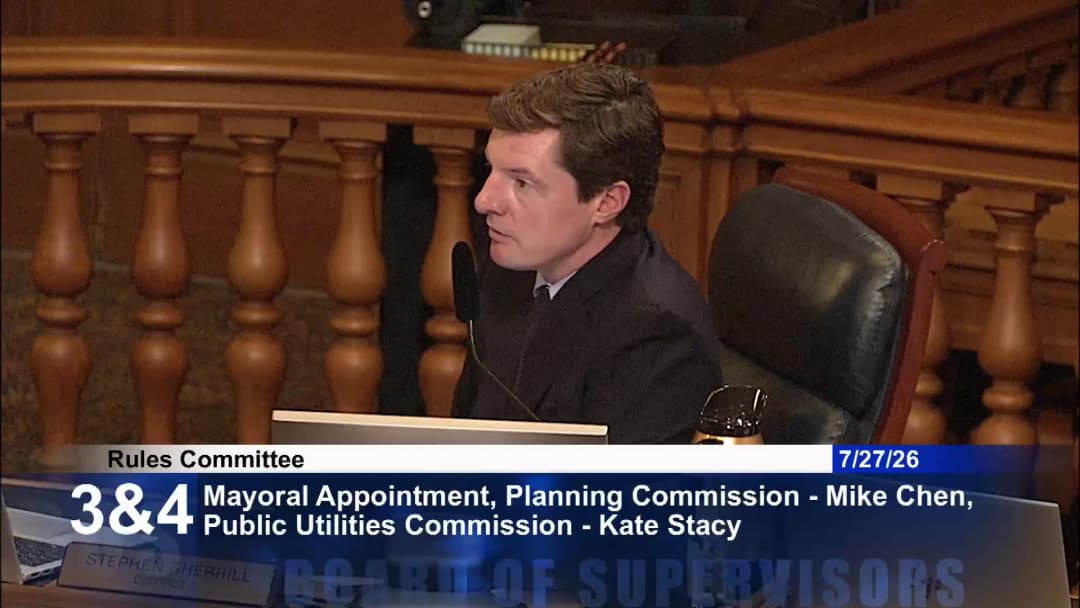
Public Meetings - San Francisco, CaliforniaThe Rules Committee met to consider nominations to the Planning Commission and Public Utilities Commission. Chair Supervisor Shimon Walton presided, joined by Vice Chair Stephen Sherrill and Committee Member President Rafael Mandelman. The committee heard public comment and voted to recommend approval of Joel Koppel, Elizabeth McDonald, Mike Chen, and Kate Stacy for various terms. Public Comments & Testimony On Items 1 & 2 (Koppel and McDonald for Planning Commission): - Peter Albert spoke in support of Elizabeth McDonald, citing her equity and sustainability focus. - Mark Gleason (Teamsters Joint Council 7) supported Joel Koppel, praising his insight and leadership. - Mark Babson (Emerald Fund) supported Koppel, highlighting his experience and housing support. - Peter Beldon (Sierra Club) stated the club could not support or oppose either nominee due to lack of information, requesting more time. - Jeremiah Cadigan (San Francisco Firefighters Local 798) strongly supported Koppel, noting his fire safety awareness. - Mozu (SFMB) requested continuation on McDonald’s nomination to learn her views on housing supply. - Jonathan Buneman (Northern Neighbors/SF YIMBY) asked to continue McDonald’s nomination, citing insufficient record on housing. - Maxine Anderson (District 5) urged consideration of equity and avoiding past planning mistakes. - Jules Andre Samar (SFMB) also requested continuation for more information. On Items 3 & 4 (Chen for Planning Commission and Stacy for PUC): - Mozu (SFMB) strongly supported Mike Chen, highlighting his housing advocacy. - Ali Zhang (District 8) supported Chen, emphasizing need for housing for young people. - Peter Beldon (Sierra Club) strongly supported Chen, noting his thoughtfulness on SFMTA board. - Jonathan Buneman (SF YIMBY/Northern Neighbors) strongly supported Chen as a housing movement leader. - Bob Akasvendiari (United Democratic Club) supported Chen, praising his problem-solving. - Elijah Ball (District 3) supported Chen, citing his backing of Family Zoning Plan. - Jules Andre Samar (D5) supported Chen, noting his renter perspective. - Maxine Anderson (D5) raised concerns about data centers and equity in planning. - Rob Roundtree (District 9) supported Chen. - Dane Willette (SF YIMBY) supported Chen, praising his responsiveness on transit. Discussion Items Items 1 & 2: Nomination of Joel Koppel and Elizabeth McDonald to Planning Commission President Mandelman introduced both nominees. Joel Koppel, a former planning commissioner with 24 years in the electrical industry, answered questions from Vice Chair Sherrill about his motivation to serve again, the commission’s changing role, and his support for the Family Zoning Plan. He emphasized block-by-block context and efficiency. Elizabeth McDonald, a retired UC Berkeley planning professor and urban designer, discussed emerging concerns such as climate change, lane width standards (citing Octavia Boulevard), livability, and her support for ministerial review and the Family Zoning Plan. She stated that good design need not increase costs. Chair Walton and Vice Chair Sherrill expressed support, with Walton emphasizing that commissioner selection should be based on values and experience, not predetermined votes. Items 3 & 4: Nomination of Mike Chen to Planning Commission and Kate Stacy to Public Utilities Commission Mike Chen, a renter and housing advocate with SFMTA board experience, introduced himself and stressed the urgency of the housing crisis. Kate Stacy, a four-year PUC commissioner, outlined her priorities: leadership transition, watershed protection, water resilience, wastewater improvements, clean energy, and affordability. Vice Chair Sherrill questioned Stacy about affordability and neighborhood flooding (Marina Boulevard). Stacy acknowledged the need to address climate change and expand sewer capacity. Chair Walton asked about selecting a new general manager; Stacy advocated for an inclusive, transparent process with a diverse applicant pool. Key Outcomes - Item 1 (Joel Koppel): Motion to amend to approve and forward to full board with positive recommendation. Passed unanimously (Vice Chair Sherrill aye, President Mandelman aye, Chair Walton aye). - Item 2 (Elizabeth McDonald): Same motion, passed unanimously. - Item 3 (Mike Chen): Motion to amend to approve and forward to full board with positive recommendation. Passed (Vice Chair Sherrill aye, President Mandelman aye, Chair Walton absent – motion carried without objection). - Item 4 (Kate Stacy): Same motion, passed (same vote). All four nominations were recommended for approval by the full Board of Supervisors.
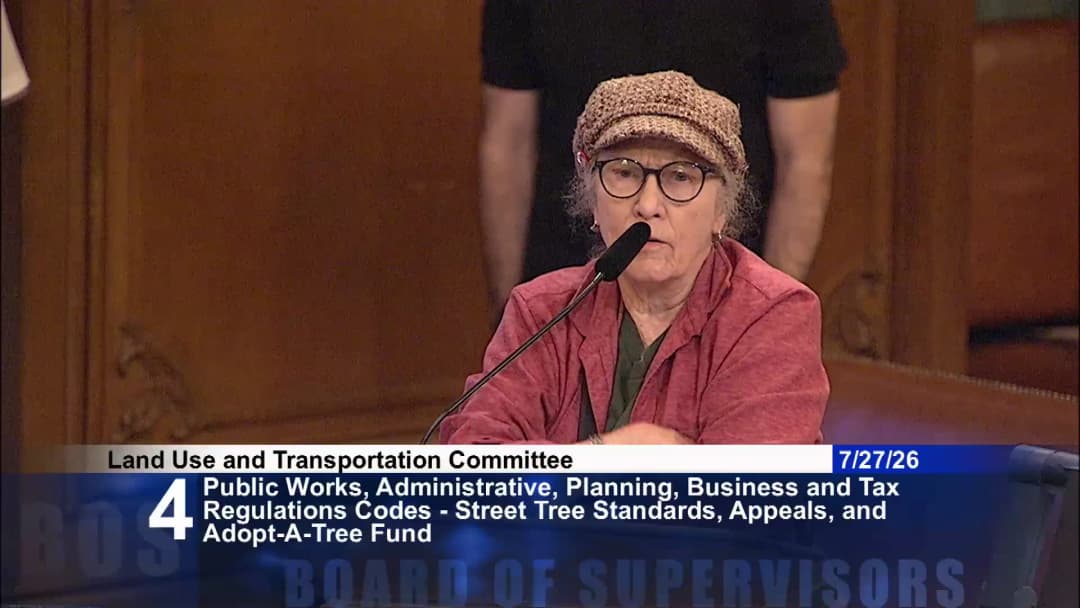
The Land Use and Transportation Committee of the San Francisco Board of Supervisors met on July 27, 2026, at 9:45 AM, chaired by Supervisor Mirna Melgar, with Vice Chair Cheyenne Chen and Supervisor Bilal Mahmood. The committee considered five items: an infrastructure acceptance for Hunters View Hope SF Phase 2, a commemorative street naming for Dr. Carlotta Texador Del Portillo, an initiative to start an undergrounding process on Homestead Street via Rule 20B, an ordinance updating street tree requirements and appeal processes, and a landmark designation for the site of the Compton's Cafeteria Riot. All items except the landmark designation were passed unanimously; the landmark item was continued to the call of the chair. Public comment was heard on items 2, 3, and 4. Item 1: Hunters View Hope SF Phase 2 Infrastructure Acceptance - Description: Ordinance to accept public infrastructure (streets, sidewalks, utilities) for Phases 2 and 3 of the Hunters View Hope SF project, including dedicating public improvements, establishing sidewalk widths, and delegating authority to the Director of Public Works. The item was amended to strike a reference to a trailing easement vacation ordinance not yet introduced. - Staff Presentation: Jason Liu, Hope SF Program Manager, provided an overview of Hope SF's history (created in response to diminishing federal funding for public housing, aiming to achieve reparations for systemic racism). Phase 2 includes 179 affordable housing units, new park, childcare, wellness center. Phase 3 completed earlier in 2026 with 118 affordable units. The project will total up to 400 market-rate units and includes community spaces. - Public Comment: No speakers. - Vote: Moved by Chair Melgar to adopt the amendments and send to full board as a committee report. Unanimously passed (3-0). Item 2: Commemorative Street Name – Dr. Carlotta Texador Del Portillo Way - Description: Resolution to add the commemorative street name "Carlotta Texador Del Portillo Way" on Bartlett Street between 21st and 22nd Streets, recognizing her leadership in establishing City College of San Francisco's Mission Campus and her civic service. The name was amended to drop "Dr." to fit signage. - Staff Presentation: Grace Huang from President Mandelman's office described Dr. Del Portillo's accomplishments: first Latina on the Human Rights Commission, Civil Service Commission, Fire Commission; helped integrate the Fire Department; first Latina elected citywide to the School Board; co-founded community organizations. - Public Comment: Seven speakers spoke in support, including former School Board President Juanita Owens, Dean Gregoria Cejil, community leaders Mary Hernandez and Josepadia. They highlighted her mentorship, advocacy for educational equity, and transformative impact on students' lives. One speaker noted this would be the first commemorative street naming for a Latina in San Francisco. - Vote: Motion by Chair Melgar to adopt the amendment and send to full board with positive recommendation. Unanimously passed (3-0). Item 3: Resolution of Intention – Undergrounding on Homestead Street (Rule 20B) - Description: Resolution to initiate an undergrounding process for Homestead Street between 24th and 25th streets using Rule 20B (property owner-funded undergrounding, with PG&E contributing overhead-equivalent costs). This is a novel process not previously used in San Francisco. The city's role is to provide legislative framework and establish an assessment district. - Staff Presentation: Reneal Badjoy from President Mandelman's office explained that the traditional Rule 20A (ratepayer-funded credits) is exhausted and in debt. Rule 20B allows property owners to fund undergrounding with assessments. The process is lengthy: this resolution is the first step; later steps include engineering report, public hearing, and ballot for assessment district. - Public Comment: Three speakers. Ernie Baffle supported the effort and provided guidance from other cities (Newport Beach, Palm Springs). Two speakers (Josh Clip and Catherine Howard) urged consideration of tree placement and green infrastructure in planning undergrounding. - Vote: Motion by Chair Melgar to send to full board as committee report. Unanimously passed (3-0). Item 4: Street Tree Planting Requirements, In-Lieu Fees, and Appeal Process Updates - Description: Ordinance to modernize street tree rules: allow smaller projects to pay in-lieu fees instead of planting; require larger projects (triggered by Better Streets Plan criteria) to plant on-site every 20 feet; exempt ADUs; improve tree removal appeals for city-initiated and hazard trees; establish a separate account in the Adopt-a-Tree Fund for in-lieu fees; require earlier notice of tree obligations. - Staff Presentation: Ian Schneider (DPW Government Affairs) and David Moore (Bureau of Urban Forestry Superintendent) presented the need to balance canopy expansion with development efficiency. They cited a case at Grove and Hyde Streets where protracted appeals led to tree failures. The committee considered amendments from Supervisor Mahmood (restoring director-level appeal for hazard trees) and Supervisor Dorsey (directing in-lieu funds to environmental justice communities). - Public Comment: Approximately 15 speakers opposed the ordinance. Key concerns: in-lieu fees may not guarantee replacement trees; the city has $4.5 million in unused in-lieu fees; hazard tree removal appeal elimination undermines community oversight; examples of abuse by DPW (e.g., healthy trees mislabeled as hazards). Several speakers noted San Francisco has the lowest tree canopy of any major U.S. city. The Board of Appeals president argued the change was unnecessary given only two appealed city-initiated removals in 2024. - Amendments Adopted: (1) Supervisor Mahmood's amendment: retain appeal of hazardous tree removal to the Director of Public Works, but eliminate further appeal to Board of Appeals. (2) Supervisor Dorsey's amendment: add finding that the department intends to prioritize environmental justice communities for in-lieu fund expenditures. - Vote: Motion by Vice Chair Chen to adopt Supervisor Dorsey's amendment (passed 3-0). Motion by Chair Melgar to adopt Supervisor Mahmood's amendment (passed 3-0). Motion to send amended ordinance to full board with positive recommendation (passed 3-0). Item 5: Landmark Designation – Site of the Compton's Cafeteria Riot - Description: Ordinance to amend landmark designation for Landmark 307 (Turk and Taylor Streets) to include the entire building at 101-121 Taylor Street and expand the period of significance. - Discussion: Supervisor Mahmood requested a continuance to allow further work with the City Attorney and advocates on a more thorough landmarking. - Public Comment: No speakers. - Vote: Motion to continue to the call of the chair. Unanimously passed (3-0). Key Outcomes - Items 1, 2, 3, and 4 were approved as amended and sent to the full Board of Supervisors for consideration on July 28, 2026 (expected Board agenda September 1, 2026 unless otherwise noted). - Item 5 was continued indefinitely (to the call of the chair). - All votes were unanimous (3-0). - The committee adopted amendments to the tree ordinance that preserve a director-level appeal for hazard trees and direct in-lieu fees to environmental justice communities.
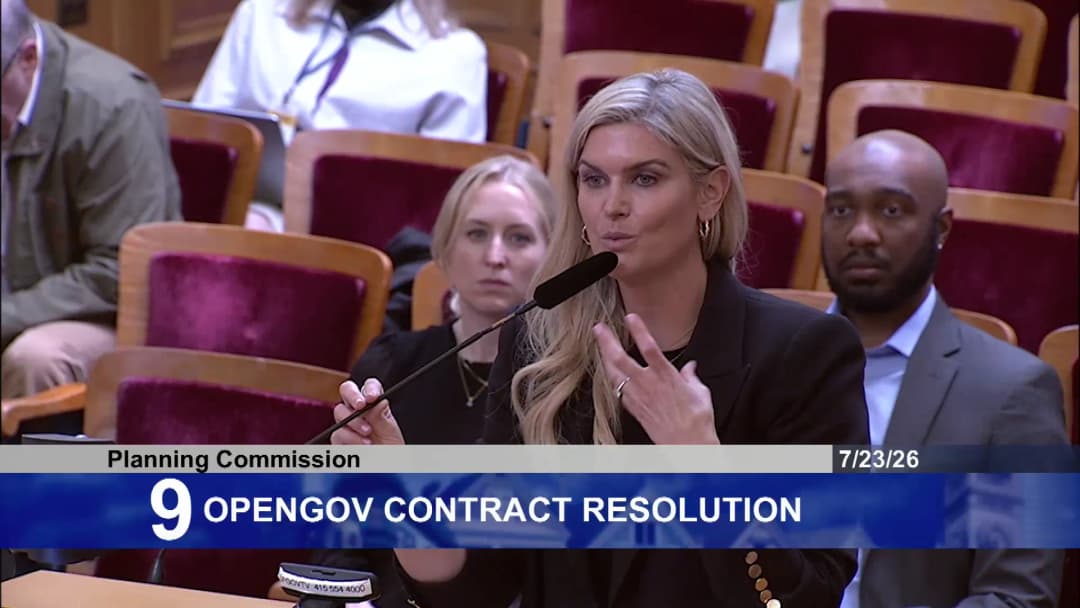
The San Francisco Planning Commission held a regular hearing on Thursday, July 23, 2026, at approximately 1:15 PM. The meeting covered a wide range of items including environmental review reforms, permitting technology upgrades, affordable housing policies, and two conditional use authorizations. All votes were unanimous (4-0) with four commissioners present (President Campbell, Commissioners Braun, McGarry, and So). Consent Calendar - Items 1, 2, and 3 (conditional use authorizations at 580 Hayes Street, 2101 Chestnut Street, and 1780 Fulton Street) were approved unanimously on a single roll call vote. - Minutes from the July 9, 2026 meeting were adopted unanimously. Public Comments & Testimony - General Public Comment: Ace Washington (Fillmore Corridor Ambassador) and Eris Edward (Fillmore resident) expressed strong frustration with the Fillmore Community Action Plan, alleging insufficient community engagement and historical disenfranchisement from urban renewal. They called for the process to be halted and reorganized. - Item 8A/8B (Shade Act & Wind Threshold): Multiple speakers opposed the Shade Act, including Terry Owning (former co-chair, Committee for Better Parks and Recreation in Chinatown), Jenny Liu, Lance Gartley (Telegraph Hill Dwellers), Apollo, Romolyn Schmaltz, and David Wu (SOMA Pilipinas). They argued the act would reduce public notice, eliminate public comment opportunities, and weaken environmental review. Whit Turner (Housing Action Coalition) spoke in support, citing the need to speed up housing production. One speaker (Bivette Brackett) also raised health and equity concerns regarding shadows. - Item 9 (Permit SF/OpenGov): Jerry Dratler questioned the five-year contract extension, citing unresolved issues and the need for a two-year extension. Another speaker supported the digital transformation for small businesses. - Item 10 (100% Affordable Housing): Annie Chung (Self-Help for the Elderly) supported the ordinance, especially for adaptive reuse of residential care facilities. Jessica Rubio (MEDA) requested targeted amendments for the Mission District to preserve ground floor activation. Alex Santiago (college student) urged retaining activation requirements for safety. - Item 13 (5300 Third Street - Autozone): A large number of community members opposed the project, including Aronde Sterling (Bayview Hunters Point Coordinating Council), Thomas Fisher (Bayview CAC), Justin Saw, Dr. Chad White, Evangela, Tiffany Carter, and others. They argued the site should be used for grocery, pharmacy, or community-serving uses, and that the process lacked meaningful community engagement. Supporters included a local resident (daily walker) and the property owner’s son (Nick Hill), who emphasized the need to activate the vacant site and the extensive search process. Discussion Items - Items 8A & 8B: Shade Act Legislation & Wind Threshold Resolution - Staff presented detailed proposals to amend the local CEQA process: removing shadow analysis from CEQA (but retaining Prop K), reducing appeal periods from 30 to 15 days, eliminating draft EIR hearings at the Planning Commission, and adopting a nine-hour wind standard (replacing the one-hour standard). Commissioners discussed the importance of public notification and supported the HPC recommendation to evaluate notification methods. The commission voted unanimously to recommend approval of both the ordinance and the resolution. - Item 9: Permit SF Overview & OpenGov Contract Resolution - Liz Wady (Director of Permit SF) gave a comprehensive presentation on the first year of Permit SF, including digital permitting, legislative improvements (e.g., sidewalk café attestation, minor encroachment exemptions), and the need for a five-year, $33 million OpenGov contract for phase two. Commissioners praised the work and addressed concerns about the contract length and customer service. The resolution was approved unanimously. - Item 10: 100% Affordable Housing Planning Code Amendment - Staff presented the ordinance to remove commercial space and mid-block alley requirements for 100% affordable housing, allow interim uses, and create an adaptive reuse program for residential care facilities. Public comment included support from Self-Help for the Elderly and requests for Mission District exemptions from MEDA. Commissioners supported the legislation and noted the ongoing dialogue with the Mission community. The commission voted unanimously to recommend approval. - Items 11A & 11B: San Francisco Shoreline Adaptation Plan - Informational presentation and resolution for a $664,000 state grant. Staff outlined the two-year planning process, community engagement, and regulatory requirements (SB 272). Public comment emphasized the need for equitable outreach and evening meetings. The commission voted unanimously to adopt the resolution. - Item 12: 230 Anza Street Conditional Use Authorization - Project proposed to demolish a vacant two-story building and construct an 8-story, 8-unit building (including 2 affordable units) under the Housing Choice SF program. Public comment from neighbors raised concerns about height, scale, and parking. Commissioners noted this was the first family zoning project and supported the transit-oriented development, approving the conditional use unanimously. - Item 13: 5300 Third Street Conditional Use Authorization - Proposal to replace a former Walgreens with an Autozone (formula retail). After extensive public comment and a continuation from July 9, the commission heard from the property owner (Raj Kal) and Autozone regional manager (Vince Vigna) about commitments to local hiring, job training partnerships, and beautification. Staff recommended conditions including indoor fluid collection, pedestrian-scaled signage, and a mural. Commissioners debated the community’s desire for a different use vs. the reality of a long-vacant site, and ultimately approved the conditional use with conditions (4-0). Key Outcomes - All votes were unanimous (4-0) on every item. - Item 8A: Recommended approval of the Shade Act ordinance (Administrative Code amendments) to the Board of Supervisors. - Item 8B: Adopted a resolution establishing a nine-hour wind threshold of significance for CEQA. - Item 9: Adopted a resolution supporting the five-year, $33 million OpenGov contract for Permit SF phase two. - Item 10: Recommended approval of the 100% affordable housing code amendment to the Board of Supervisors. - Item 11B: Adopted a resolution to accept a $664,000 state grant for the Shoreline Adaptation Plan. - Item 12: Approved conditional use authorization for 230 Anza Street with conditions. - Item 13: Approved conditional use authorization for 5300 Third Street (Autozone) with conditions including a mural, signage restrictions, and indoor fluid collection. Next Steps: The Shade Act and affordable housing legislation will proceed to the Board of Supervisors for hearings in September 2026. The Shoreline Adaptation Plan will begin community engagement and planning over the next two years. The OpenGov contract will be executed to continue permitting modernization.
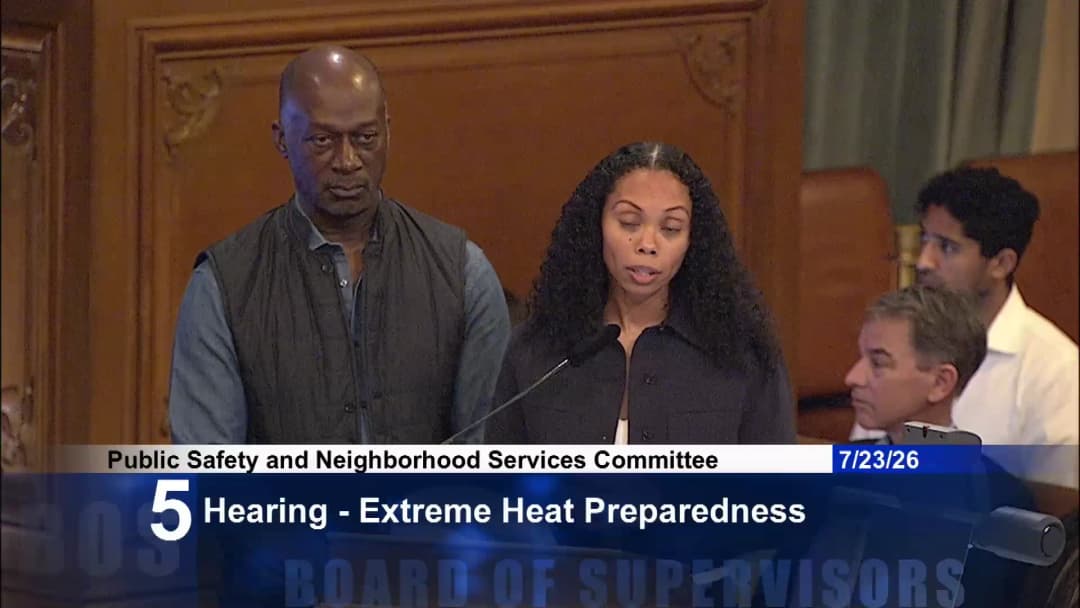
On July 23, 2026, the San Francisco Board of Supervisors' Public Safety and Neighborhood Services Committee, chaired by Supervisor Matt Dorsey and including Vice Chair Danny Sauter, convened to consider four routine liquor license transfers, a hearing on extreme heat readiness, and a brief update on the Vicious and Dangerous Dog Unit. Supervisor Alan Wong was excused from the meeting. Consent Calendar - Item 1 (Type 48 License, Out of Sight Productions LLC/Reggie and Mods, 456-460 Larkin St.): Unanimously approved (2-0) with conditions including noise control, litter management, and loitering prevention. The applicant, Eric Yaler, expressed excitement about contributing to downtown vibrancy. Supervisor Sauter also voiced support. - Item 2 (Type 64 License, Tenderloin Museum, 835 Larkin St.): Unanimously approved (2-0) with similar conditions. The museum received Supervisor Dorsey's praise for preserving neighborhood history. - Item 3 (Type 21 License, College Market, 995 Ellis St.): Unanimously approved (2-0) with conditions on loitering and litter. - Item 4 (Type 20 License, Hello Mart, 2135 Buchanan St.): Unanimously approved (2-0) with conditions. Supervisor Dorsey noted the market's community support in Pacific Heights. Public Comments & Testimony - Susan Green (San Francisco Climate Emergency Coalition) urged substantial, sustained city funding for building electrification, citing a 2023 estimate of $500 million needed. She criticized cuts to the environment department’s climate budget. - Dr. Robin Cooper (San Francisco Physicians for Social Responsibility, Climate Psychiatry Alliance) highlighted mental health impacts of extreme heat, including cognitive impairment, increased violence, and higher suicide rates. - Ashley Pack (Bright Line Defense) called for more neighborhood-level data, sustained CBO funding, and leveraging state investments for communities like the Tenderloin, SOMA, Chinatown, and Bayview Hunters Point. - Alexander Chen (UCSF medical student) emphasized brain health risks from heat stroke and urged prevention akin to earthquake preparedness. - Mark Pohalski (TNDC, director of facilities) argued that proactive maintenance is far cheaper than reactive fixes, citing an example of providing air conditioning to a building for $50,000 rather than $2-4 million. - Tracy Florida Figadoa (Sierra Club San Francisco Bay Chapter) advocated for building weatherization and heat pump installation as key resilience investments. Discussion Items - Extreme Heat Readiness (Item 5): The committee heard a multi-hour presentation on San Francisco’s preparedness for extreme heat events, called by Board President Raphael Mandelman. Key data and statements: - Dr. Nita Thakur (UCSF) reported that 95% of surveyed residents experienced negative health impacts during heat events; she emphasized structural barriers like renter status and language barriers. - Brian Strong (Office of Resilience and Capital Planning) noted that heat is the number one weather-related killer in the U.S. and that 911 calls rise by 73% during extreme heat events. - Matt Wolf (DPH) stated that only 34% of San Francisco households have central air conditioning (vs. 92% national average); two days prior, the city hit 85°F, the hottest July day in 11 years. - Alex Morrison (ORCP) reported that the city has 31 medium- to long-term strategies in its Heat and Air Quality Resilience Plan but lacks funding for implementation; two part-time staff (one FTE) manage the entire HACKER program. - Cindy Cumberford (SFE) discussed building decarbonization goals: 15,000 residential and 2,000 commercial buildings need to transition by 2030; funding is insufficient (e.g., $400,000 city allocation vs. New York City’s $34 million). - Mary Ellen Carroll (DEM) described improved emergency protocols, prescripted alerts, and community partnerships, but noted that cooling centers are rarely used; the city instead invests in existing community facilities. - Jackie Bryant (Resilient Bayview) highlighted the role of CBOs in outreach and preparedness, noting that a three-year foundation grant ends this year. - Winnie Yu (Self-Help for the Elderly) stressed the vulnerability of seniors, particularly homebound and limited-English residents, and called for continued coordination like during COVID-19. - Vicious and Dangerous Dog Unit (Item 6): Supervisor Sherrill’s office reported that a hearing officer has been hired and hearings will restart; the item was heard and filed unanimously. Key Outcomes - Items 1-4: All liquor license transfers approved unanimously (2-0) with conditions from the Alcohol and Beverage Control (ABC) liaison. - Item 5: The hearing was continued to the call of the chair (unanimous vote, 2-0) to allow potential further discussion with the Mayor’s office. - Item 6: The hearing was heard and filed unanimously. - The committee excused Supervisor Alan Wong from the meeting at the outset (vote 2-0).
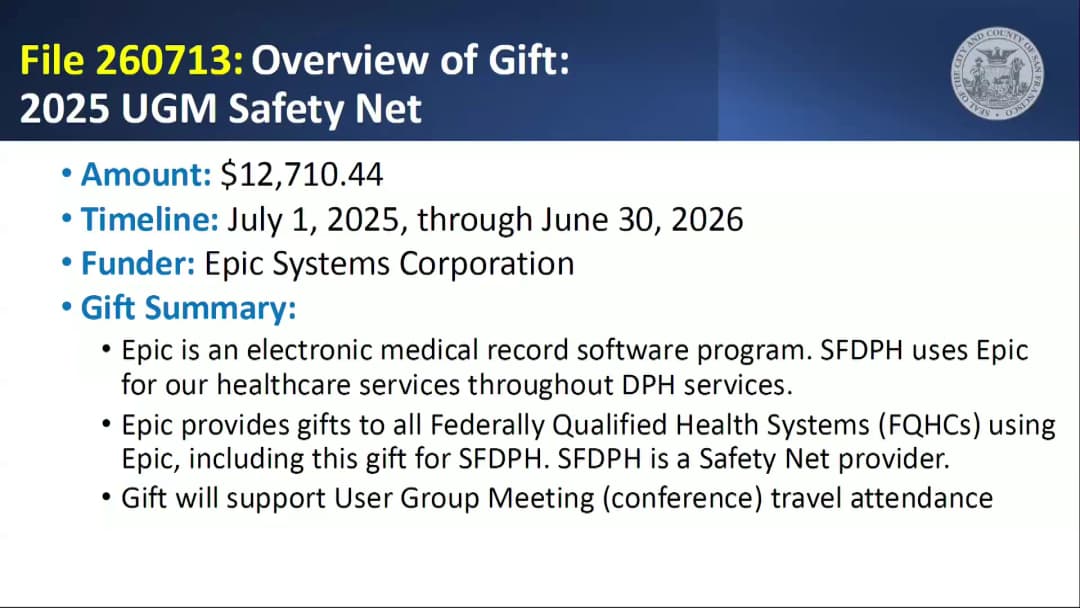
The Budget and Finance Committee of the San Francisco Board of Supervisors met on July 22, 2026, at 10:00 AM (estimated) to consider 19 agenda items, including resolutions, ordinances, and hearings. The committee voted on all items, forwarding most to the full board with positive recommendations. Key discussions included a ban on retail nitrous oxide sales, emergency dredging at the Marina Yacht Harbor, and a major affordable housing development in Chinatown. Public Comments & Testimony - Item 4 (Nitrous Oxide Ban): Jack Pereira expressed concern about spending $600,000 without local data, urging a study first. Carolyn Gusin (Public Defender's Office) opposed criminal enforcement, citing existing state laws and suggesting civil tools. Elya Romero, a lifelong resident, argued the funds should go to existing public health programs like maternal/child health, not new enforcement. - Items 9-10 (Pacific Avenue Housing): Several speakers supported the rent forgiveness and project, including Sydney Yi Siou (Chinatown Media Arts Collaborative), Jenny Lung (Chinese Cultural Center), Dixon Lee (on behalf of Housing Authority Commissioner Sharon Lai), Sharon Ng (Chinatown CDC), and Jeremy Lee (Rose Pack Asian American Club). They emphasized the cultural importance of New Asia Banquet Hall and the need for community gathering spaces. - Item 11 (Youth Center Lease): Michelle Roberts (Third Street Youth Center and Clinic) supported the lease expansion, describing plans for therapy rooms, a wellness center, barbershop, and computer lab. Discussion Items - Item 1 (Foreclosure Exemption): Unanimously approved without discussion. The ordinance would eliminate the real property transfer tax foreclosure exemption for most properties and increase the city's appropriations limit for four years. It was moved to the full board with a positive recommendation. - Item 2 (Marina Dredging Emergency): The Recreation and Park Department reported that the initial contractor (Marineship LLC) failed to complete dredging, leading to an emergency declaration. The second bidder, Dutra, completed the work by June 30, 2026, at a cost of $1.8 million (of the $2.5 million estimate). The budget legislative analyst (BLA) recommended approval. Supervisor Chen asked about preventing future contractor failures; the department mentioned considering best-value contracting and long-term agreements. - Item 3 (Sunset Dunes Grant): The Recreation and Park Department presented a $200,000 state grant for striping and signage to improve safety for pedestrians and cyclists. The project aims to clarify multi-use zones and reduce conflicts. Approved unanimously. - Item 4 (Nitrous Oxide Ban): Supervisor Sauter introduced substantive amendments (circulated) to clarify the display of nitrous oxide and make clerical improvements. The BLA estimated enforcement costs at $600,000/year and recommended data collection before implementation. Supervisor Sauter declined to delay, citing similar bans in other cities and state/federal efforts. The committee voted to amend and continue the item to the next meeting (September 2, 2026). - Item 5 (Sheriff's Office Reserve Funds): The Sheriff's Office requested release of $1.125 million in reserve funds for rent ($25,000), body-worn camera software ($93,000), and salary/fringe ($1 million) to cover increased hiring and service expansions. Approved. - Item 6 (Juror Per Diem Grant): The Treasurer's Office accepted a $250,000 grant from the Jane Trevetti Fund to increase juror pay to $100/day for low-income jurors, but noted the program would need to reduce to $75/day due to funding shortfall. Approved. - Items 7-8 (Furniture Contracts): Two contract amendments with Resource Design Interiors were approved, extending terms through 2029 and increasing totals to $10.63 million and $17.75 million, based on historical spending. - Items 9-10 (Pacific Avenue Affordable Housing): The Mayor's Office of Housing and Community Development (MOHCD) presented a plan to acquire 758 Pacific Avenue and develop 100% affordable senior housing. The BLA raised concerns about the tenant (New Asia) not paying rent since March 2020 and recommended a competitive process for future commercial tenants. MOHCD accepted two of three BLA recommendations, including filing a notice with the clerk and reporting back by January 15, 2027. The committee approved both resolutions with amendments. - Item 11 (Youth Center Lease): A $1/year lease for two floors at 888 Post Street to expand the Lower Polk Transitional Aged Youth Navigation Center, funded by over $1 million in private donations. Approved. - Item 12 (HUD Continuum of Care Grant): The Department of Homelessness and Supportive Housing (HSH) will apply for up to $56.1 million in federal funding for homeless services. The 2026 competition is more competitive, with tier one limited to 60% of renewal demand. Approved. - Item 13 (Sexual Health Grant): A $250,000 state grant for comprehensive sexual and reproductive health services, retroactively authorized. Approved. - Item 14 (STD Prevention Grant): A $1.1 million increase from the CDC for STD prevention and control, retroactively authorized. Approved. - Items 15-17 (Epic Systems Gifts): Three gifts from Epic Systems Corporation totaling $12.7 million, $115,000, and $37,500 for training, user group meetings, and materials. Approved. - Items 18-19 (Closed Session Settlements): The committee went into closed session to discuss two employment-related settlements (Local 21 and SEIU 1021) totaling approximately $382,000. After closed session, the committee voted to forward both settlements to the full board and not disclose deliberations. Key Outcomes - Item 1: Approved (3-0) and forwarded to full board. - Item 2: Approved (3-0) and forwarded. - Item 3: Approved (3-0) and forwarded. - Item 4: Amended and continued to September 2, 2026 (3-0). - Item 5: Approved (3-0) and heard and filed. - Item 6: Approved (3-0) and forwarded. - Items 7-8: Approved (3-0) and forwarded. - Items 9-10: Approved as amended (3-0) and forwarded. - Item 11: Approved (3-0) and forwarded. - Item 12: Approved (3-0) and forwarded. - Item 13: Approved (3-0) and forwarded. - Item 14: Approved (3-0) and forwarded. - Items 15-17: Approved (3-0) and forwarded. - Items 18-19: Approved (3-0) and forwarded; closed session deliberations not disclosed.
The San Francisco Board of Supervisors held a regular meeting on July 21, 2026, beginning at 10:15 AM. The meeting covered the annual budget, multiple policy ordinances, a special order for commendations, and two committee-of-the-whole hearings: one on Kaiser Permanente’s behavioral health contract proposals and one on the renewal and expansion of the Downtown Community Benefit District. Key actions included passing the budget on first reading, enacting new penalties for fireworks, and advancing the Downtown CBD renewal. Consent Calendar - Items 1–3 (routine ordinances) were approved unanimously (11-0). Public Comments & Testimony - Public Comment on Kaiser Hearing (Item 52): Several Kaiser patients, union members (UNITE HERE, San Francisco Labor Council), and NASW-California representatives expressed strong opposition to Kaiser’s proposals, citing risks to patient safety and worker autonomy. One caller was cut off for making a personal attack. - Public Comment on Downtown CBD (Items 53–54): Over a dozen property owners, business leaders, and residents voiced support for the renewal and expansion, citing improved cleanliness, safety, and economic recovery. One speaker from the ACLU raised concerns about surveillance, homeless outreach, and privacy. A resident of District 6 expressed opposition, arguing the CBD disproportionately benefits businesses and increases police presence. - General Public Comment: Speakers addressed the removal of peer counselors from the street crisis response team, offered a poem criticizing ICE and surveillance, and paid tribute to Clint Riley. Discussion Items - Annual Budget (Items 4–19): Budget Chair Supervisor Chan praised the committee’s work. Supervisor Fielder noted the budget closes a massive deficit without mass layoffs, though she expressed reservations about a 14% police pay raise over four years. The budget passed on first reading (11-0). - Inclusionary Housing Program Changes (Item 21): Ordinance reduced affordable housing requirements for projects of 25+ units, deleted requirements for smaller projects, and allowed land dedication in lieu of fees. Passed 9-2 (Walton, Chen opposed). - Drug-Free Permanent Supportive Housing (Item 22): Ordinance requiring new city-funded PSH to be drug-free. Passed 7-4 (Walton, Chan, Chen, Fielder opposed). - Fireworks Penalties (Item 40): Ordinance made first-offense fireworks discharge an infraction ($125–$250), and second offense within five years a misdemeanor (up to $750 fine or six months jail). Supervisor Wong argued current law lacks enforcement. Supervisor Fielder opposed, citing risk to low-income communities and youth. Passed 9-2 (Walton, Fielder opposed). - Repeal of Outdated Codes (Items 41–42): Ordinance repealed prohibition on circulating libraries lending to under-21 without parental consent (Item 41) and repealed bans on open-basket bread transport and unsterilized rag laundering (Item 42). Both passed unanimously. - Committee of the Whole – Kaiser Permanente Behavioral Health (Item 52): Supervisor Chen convened a hearing to examine Kaiser’s contract proposals with NUHW. Presenters from NUHW, NASW, Psychotherapy Action Network, and CNA detailed Kaiser’s “terrible three” demands: sole discretion over care models, unrestricted outsourcing, and refusal to limit AI use. Clinicians testified that AI triage has led to dangerous delays and that Kaiser has canceled thousands of therapy appointments and been fined $231 million. Kaiser did not attend, which several supervisors called disrespectful. Supervisor Chan announced a forthcoming resolution urging Kaiser to drop the demands. The hearing was filed. - Committee of the Whole – Downtown Community Benefit District Renewal (Items 53–54): The board considered the 10-year renewal and expansion of the Downtown SF Partnership. The proposal expands boundaries to include Port of SF properties, increases clean/safe services, and dedicates $1.8 million for future Embarcadero Park programming. The district will fund a 24/7 ambassador program and a new homeless outreach team. No majority protest was found (weighted ballots: 85% in favor, 14.85% opposed). The resolution was adopted 10-0. Key Outcomes - Annual Budget: Passed on first reading (11-0). Final vote scheduled for July 28. - Inclusionary Housing Changes: Ordinance finally passed (9-2). - Drug-Free PSH Policy: Ordinance finally passed (7-4). - Fireworks Enforcement: Ordinance passed on first reading (9-2). - Repeal of Outdated Codes (Items 41–42): Both passed on first reading (11-0). - Kaiser Hearing: Filed; Supervisor Chan to introduce a resolution urging Kaiser to withdraw “terrible three” demands. - Downtown CBD Renewal: Resolution adopted (10-0); ballots tallied showing no majority protest. - Commendations: Honored Mary Lindy (retiring CEO of Heritage on the Marina), Art With Elders/Mark Campbell, Probation Services Week, Abaddon Fight Club boxers, Damien Posey (community leader), Paul Osaki (retiring executive director of JCCNC, with August 29 proclaimed Paul Osaki Day), and Lee Housekeeper (37 years organizing the 1906 earthquake commemoration).
The San Francisco Board of Supervisors Rules Committee convened on July 20, 2026, chaired by Supervisor Shiman Walton with Vice Chair Stephen Sherrill, President Rafael Mandelman, and Supervisor Mahmoud. The committee processed multiple unanimous reappointments to city commissions and debated the proposed Affordable Groceries Act. Public Comments & Testimony - Reappointments (Items 1, 2, 7, 8): Forrest expressed support for Joshua Arce and Lydia Soh. Olga Miranda (SEIU Local 87, San Francisco Labor Council) praised Joshua Arce as a dedicated bridge builder and hardworking commissioner. Brian Kwan urged support for Lydia Soh, highlighting her professional expertise as an architect, her status as the only Chinese American on the Planning Commission, and her Cantonese literacy. Rebecca Saroyan (Vice President, Board of Appeals) supported John Trasviña, noting his perfect attendance and dignified leadership. John Trasviña endorsed Robin Abad, citing his valuable planning expertise. - Affordable Groceries Act (Items 3 & 9): A representative from Indivisible SF supported the measure, citing a 19% rent increase and the need to prioritize health over corporate interests. David Elliott Lewis (Tenderloin People's Congress) strongly supported the act, describing the Tenderloin as a food desert without a pharmacy or full-service grocery store. He alleged that corporate interests (Amazon/Whole Foods) pushed the mayor to kill the legislation, challenging the committee to correct him if he was wrong. Discussion Items - Reappointments (Items 1, 2, 4, 5, 6, 7, 8): Seven nominees presented their qualifications. Joshua Arce (PUC) discussed his work as ratepayer advocate, a $12.5 billion capital plan, and efforts to expand community presence. Lydia Soh (Planning) highlighted the Stonestown redevelopment (2,500+ homes), office-to-housing conversions, and bilingual community outreach. Kimberly Hartwick Schulman (Sanitation & Streets) focused on clean public spaces. Lindsay McLeese (Building Inspection) offered structural engineering expertise. Eleanor Blum (Public Works) was approved in her absence. John Trasviña (Board of Appeals) reported a 50% reduction in appeals and an 87% resolution rate within 75 days. Robin Abad (Board of Appeals) brought a decade of Planning Department experience. - Affordable Groceries Act (Items 3 & 9): Supervisor Mahmoud introduced a motion to create an affordable grocery fund (Item 3) and a motion to schedule a hearing on a tax on vacant formula retail stores (Item 9). He stated he lacked the votes for passage and requested a continuance, announcing plans to introduce a revised package at the July 28th full Board meeting. This package included restoring funding for the healthy retail program, grocery startup incentives (fee exemptions and grants), and zoning reforms modeled on New York City's FRESH program. Chair Walton suggested building on a prior grocery fund pushed by former Supervisor Safai and instead moved to table both items rather than continuing them. Key Outcomes - Unanimous Reappointments (Items 1, 2, 4, 5, 6, 7, 8): The committee voted unanimously on each item to amend the motions (striking "rejecting" for "approving") and recommended all seven nominees to the full Board of Supervisors. - Affordable Groceries Act Tabled (Items 3 & 9): The committee voted unanimously (Chair Walton, Vice Chair Sherrill, President Mandelman) to table both items. Supervisor Mahmoud stated he will introduce a revised legislative package focused on subsidies, incentives, and zoning reforms rather than the vacated property tax.
The Land Use and Transportation Committee of the San Francisco Board of Supervisors convened on July 20, 2026, at 9:45 AM. Chair Supervisor Mirna Melgar presided, joined by Vice Chair Supervisor Cheyenne Chen and Supervisor Bilal Mahmoud. The committee considered four agenda items, all ordinances, and voted unanimously to advance each to the full Board of Supervisors with positive recommendations. Discussion Items Item 1: Illegal Dumping Cost Recovery Ordinance Supervisor Sauter introduced an ordinance amending the Public Works Code to authorize the Department of Public Works to recover the city's full costs for abating illegal dumping through administrative enforcement proceedings. The current fine is capped at $1,000, which is insufficient for large cleanups costing thousands of dollars. The ordinance also affirms the Planning Department's environmental determination. The item was on the agenda as a potential committee report, with the possibility of being sent to the Board of Supervisors for consideration on July 21, 2026. Supervisor Chen expressed support and was added as a co-sponsor. No public comments were received. The committee voted 3-0 to recommend the ordinance to the full board. Item 2: Landmark Designation for House of Latin Rock Supervisor Jackie Fielder, sponsor of the ordinance, presented the case to designate 2880 25th Street as a landmark. The property, known as the House of Latin Rock, is owned by Richard Segovia and has served as a cultural hub for Latin rock music since the 1970s, hosting rehearsals, recording sessions, and youth mentorship. Notably, artist Michael Rios created the cover art for Carlos Santana's multi-platinum album "Supernatural" at this location. The building features a large mural documenting the history of Latin rock. The Historic Preservation Commission had unanimously recommended landmarking in May 2026. Multiple public speakers, including Richard Segovia, musician Richard Bean, and family members, testified in strong support, emphasizing the house's role in preserving Latin rock heritage and community identity. Planning staff confirmed the property meets landmark criteria. Chair Melgar added herself as a co-sponsor. The committee voted 3-0 to recommend the ordinance. Item 3: Landmark Designation for Engine Company 33 Supervisor Chen presented an ordinance to designate 117 Broad Street, Engine Company No. 33, as a landmark. Built in 1896, it is among the oldest standing firehouses in San Francisco and was the last horse-drawn unit in the fire department, converted to motorized apparatus in 1921. It served as a fire station until 1974 and later became a private residence. The Historic Preservation Commission recommended approval on June 17, 2026. No public comments were offered. Chair Melgar added herself as a co-sponsor. The committee voted 3-0 to recommend the ordinance. Items 4–24: 21 Landmark Designations in District 8 Renail Bajoy from Supervisor President Metelman's office and Planning staff Alex West presented 21 ordinances designating properties in District 8 as Article 10 landmarks under the Family Zoning Plan. These properties, ranging from the Alexander Adams Home to the Lang House, reflect diverse architectural styles and historical significance, including the James C. Hormel Mansion (home of America's first openly gay ambassador) and the Phoenix Brewery. The Historic Preservation Commission had recommended all 21 properties on May 20, 2026. No public comments were offered. Chair Melgar made a motion to recommend all 21 ordinances to the full board. The committee voted 3-0 in favor. Public Comments & Testimony - Item 2: Eight speakers testified in support of the House of Latin Rock landmark, including owner Richard Segovia, musician Richard Bean (of the band Malo), family members, and community artists. They highlighted the property's role as a creative anchor for Latin rock music, youth mentorship, and cultural preservation. No opposition was expressed. - Items 1, 3, and 4–24: No public comments were made. Key Outcomes - Item 1: Recommended as a committee report to the full Board of Supervisors (vote: 3-0). The ordinance may be considered on July 21, 2026. - Item 2: Recommended as a committee report to the full Board of Supervisors (vote: 3-0). - Item 3: Recommended as a committee report to the full Board of Supervisors (vote: 3-0). - Items 4–24: All 21 ordinances recommended as committee reports to the full Board of Supervisors (vote: 3-0). All items acted upon are expected to appear on the Board of Supervisors agenda of July 28, 2026, unless otherwise noted. The meeting was adjourned after the final vote.
The Government Audit and Oversight Committee of the San Francisco Board of Supervisors met on July 16, 2026, at 18:15 UTC. Chair Stephen Sherrill presided, joined by Vice Chair Bilal Mahmood, Supervisor Fielder, and Supervisor Sauter. The committee considered nine agenda items covering Treasure Island infrastructure financing, parental leave eligibility, ethics code reforms, and settlement approvals. Consent Calendar - Items 1-2: Resolutions related to the Treasure Island Infrastructure and Revitalization Financing District (IRFD), authorizing a maximum of $520 million in additional bonds and approving an annexation supplement. Unanimously forwarded to the full board with a positive recommendation. - Items 7-15: Nine ordinances and resolutions approving settlements of lawsuits and unlitigated claims. Items 7, 9, 10, 11, and 13 were forwarded as committee reports; items 8, 12, 14, and 15 were forwarded with a positive recommendation. All passed unanimously. Public Comments & Testimony - Item 3 (Parental Leave): Multiple speakers testified in support, including a registered nurse (Quinn) who was unaware of the benefit, a parent organizer (Maria Lustorian) who noted the Philippines offers longer leave, a parent of a child with autism (Hong Wing), a representative from Safe and Sound (Virginia Taylor) who said paid leave is prevention, and Alex Megowski of Children's Council who called it a commitment to families. - Items 4-6 (Ethics Reforms): One speaker (Bill Reedy of Indivisible SF, also representing Common Cause California, California Clean Money Campaign, and League of Women Voters) opposed the legislation as proposed, citing public desire for more transparency. Natalie G, a former grassroots candidate, testified that raising the contribution limit to $1,000 would disadvantage grassroots candidates and that the real problem is outside spending and Citizens United. Discussion Items - Items 1-2 (Treasure Island IRFD): Jamie Kruben (COO, Treasure Island Development Authority) presented the need to annex stage two properties (Project Areas F-I) into the IRFD to capture new property tax growth. The $520 million bond authorization brings the total maximum to $1.3 billion. The fiscal impact analysis projects a $33 million positive net fiscal impact to the city's general fund. No questions from committee members; item passed. - Item 3 (Parental Leave Ordinance): Supervisor Sauter introduced the ordinance reducing the waiting period for paid parental leave from 180 to 90 days. He noted broad support and offered an amendment allowing employers with fewer than 100 employees until January 1, 2028, to comply. Vice Chair Mahmood spoke in support, citing affordability challenges for families. The amendment was adopted; the item was forwarded to the full board. - Items 4-6 (Ethics Code Reforms): Board President Mandelman presented three ordinances streamlining campaign consultant disclosures, recusal notifications, major developer disclosures (Item 4); overhauling the public financing program including raising contribution limits from $500 to $1,000, increasing the match rate from 6:1 to 8:1, and replacing the incremental expenditure ceiling system with a single threshold that is lifted when independent expenditures exceed 50% of a candidate's ceiling or a non-participating opponent raises/spends 75% of the ceiling (Item 5); and eliminating disclosure requirements for candidates to benefit-related boards (Item 6). Zach D'Amico (Deputy Director, Ethics Commission) explained the changes are needed to free up staff resources and improve effectiveness. Supervisor Fielder expressed concerns about reduced transparency and the contribution limit increase. An amendment to Item 5 (making the ceiling lift candidate-specific rather than race-wide) was adopted on a 2-1 vote (Fielder no). However, all three items were continued to the call of the chair, meaning they did not advance to the full board at this time. Key Outcomes - Items 1-2: Unanimously forwarded to the full board with positive recommendation. - Item 3: Amended (small business compliance deadline moved to 2028) and forwarded to the full board as a committee report (unanimous). - Item 5: Amended (ceiling lift now per candidate) on a 2-1 vote. - Items 4, 5, 6: Continued to the call of the chair (unanimous), effectively pausing the legislation. - Items 7-15: All approved and forwarded to the full board (unanimous).