The San Jose City Council met on May 13, 2025, for a regular session that included a public hearing on the proposed 2025-2026 operating and capital budgets, acceptance of a code enforcement operational assessment, updates on the Berryessa Flea Market redevelopment, approvals of multifamily housing incentive program amendments and loan commitments, and a street renaming to "Sharks Way." The meeting began with ceremonial items recognizing Hepatitis B Awareness Week (May 18-25), the May Day Coalition, and Global Accessibility Awareness Day. The consent calendar was approved unanimously, including a settlement with Calpine Energy Solutions ($900,000 credit), employee health services vendor agreements (up to $8.7 million combined), a T-Mobile macro cell site permitting agreement, acceptance of $3.654 million in federal One Bay Area Grant funds for bikeway projects, and various boards and commissions appointments. Consent Calendar - Approved routine items including: settlement agreement with Calpine Energy Solutions (credited $900,000 over 36 months); agreements with 1582 Medical Corporation, Fast Response On-Site Testing, and Carbon Health for employee health services (five-year terms, maximums $2.24M, $1.21M, $5.26M respectively); T-Mobile West macro cell site funding and reimbursement agreement; acceptance of $2.233M for Better Bikeway San Fernando and $1.421M for Downtown Bikeways Quick Strike (local match totaling $473,000); and eight Youth Commission appointments. Councilmember Mulcahy recused from item 2.9 (T-Mobile) due to a conflict of interest. Public Comments & Testimony - Budget Hearing (Item 3.3): 38 speakers addressed the council, with most urging the council to prioritize affordable housing using Measure E funds rather than diverting them to shelters and enforcement. Speakers from SiREN, REaL Coalition, Sacred Heart Community Service, and others opposed criminalizing homelessness and called for increased investment in prevention, a 24/7 TRUST crisis response team, and $1.5 million for immigrant rapid response and legal defense. Several speakers opposed cuts to the Older Adult Health and Wellness Grant ($526,000) and advocated for maintaining funding for nine nonprofits serving seniors. A few supported the budget's balanced approach, including the Chamber of Commerce representative who praised investments in sports entertainment, small business ADA compliance, and interim housing. - Other items: Public comment on the Berryessa Flea Market (Item 8.1) included testimony from vendors and advocates urging action to secure a relocation site (especially Singleton landfill) and coordination with VTA. Union representatives opposed the Aquino project (Item 8.2) for lacking prevailing wage requirements. Supportive comments were heard for the Sharks Way renaming (Item 10.2) and affordable housing projects (Items 8.3, 8.4). Discussion Items - Budget Public Hearing: The council heard a verbal report from the City Manager and accepted public testimony; no action was taken. - San José Clean Energy Selection Criteria (Item 6.1): Staff presented new criteria for long-term power purchase agreements, emphasizing workforce development, environmental stewardship, and community engagement. Councilmembers discussed balancing affordability with other goals. Approved unanimously. - Code Enforcement Operational Assessment (Item 7.2): Staff and Guidehouse presented findings: 26-inspector staffing gap, outdated technology, and process inefficiencies. Recommendations included hiring a transformation manager, adopting new case management software (Codex), expanding pilot programs (FAST, vacant buildings), and increasing fines (up to $500,000). Councilmember Ortiz and Vice Mayor Foley successfully amended to ensure fines are not limited to historic properties. The report and Phase 1 workplan were accepted. - Berryessa Flea Market Status (Item 8.1): Staff reported on market studies (economic impact: $20-40M annual sales, 1,000+ jobs), site assessments (former Sears, fairgrounds, Singleton landfill), and $5M vendor transition fund (15% spent). Councilmember Cohen moved to pursue an RFP for Singleton in accordance with the Surplus Land Act, with staff to report back in Q1 2026. Councilmember Duan's amendment to include mixed-use evaluation was not adopted. Motion passed 9-1 (Duan dissenting). - Multifamily Housing Incentive Program – The Aquino (Item 8.2): Approved a tax and fee waiver of up to $4.07 million for a 278-unit market-rate project (14 affordable at 100% AMI) at 498 W. San Carlos Street. Motion passed 10-1 (Mahan absent, Duan voting no). - Multifamily Housing Incentive Program Amendments (Item 8.3): Approved adding Santana Row Lot 12 (358 Hatton Street), increasing eligible units from 1,500 to 1,800, and refunding $3.44 million in previously paid AHIF fees to Federal Realty. Councilmember Kamei successfully amended the direction to "explore extending the cutoff date" rather than committing to an extension. Approved unanimously. - Loan Commitment – Berryessa Station Affordable Housing (Item 8.4): Approved a $9.9 million construction-permanent loan for a 193-unit all-affordable development (74% extremely low- and very low-income) at 1565 Mabury Road, leveraging $29M in state AHSC funds, $11.1M from the county, and $60M from the Bay Area Housing Innovation Fund. Approved unanimously. - Street Renaming to Sharks Way (Item 10.2): Approved renaming a 1,200-foot segment of West St. John Street (from San Pedro to the arena) and connecting segments to "Sharks Way," and directed staff to prioritize a companion renaming of a portion of North Almaden Boulevard to "Little Italy Way." Approved unanimously. Key Outcomes - Budget: Public hearing conducted; further study sessions and town halls scheduled before final adoption. - Code Enforcement: Accepted operational assessment and Phase 1 workplan; directed staff to hire a transformation manager, implement escalated intervention program, increase maximum fines (to $500,000) beyond historic properties, and report back with detailed work plan and milestones in summer 2025. - Berryessa Flea Market: Directed staff to prepare a timeline for a Surplus Land Act-compliant RFP for Singleton site; report to council in Q1 2026 with findings and recommended next steps, including potential mixed-use development and coordination with VTA. - Housing Production: Approved tax/fee waivers for two market-rate projects (The Aquino, Santana Row Lot 12) and a $9.9M loan for Berryessa Station affordable housing; expanded MFHIP capacity from 1,500 to 1,800 units; directed staff to explore extending the program cutoff date and return in September 2025 with an update. - Street Renaming: Approved "Sharks Way" for the section connecting San Pedro Square to SAP Center; directed staff to prioritize "Little Italy Way" for a perpendicular segment of North Almaden Boulevard.
Public Meetings - San Jose, California
Public Meetings - San Jose, CaliforniaThe San Jose City Council held a budget study session on Monday, May 12, 2025, from 9:30 AM to after 5:00 PM, focusing on the 2025-2026 Proposed Operating Budget and 2025-2027 Proposed Biennial Capital Budget. The session covered Neighborhood Services, Public Safety, Strategic Support, and Appointees, with extensive discussion on homelessness policy, public safety resources, and internal operations. No formal votes were taken; the session was a study session for council questions and staff presentations. Public Comments & Testimony - Support for Responsibility to Shelter: Multiple residents, including business owners, neighborhood association leaders, and individuals, urged the council to support the mayor's responsibility to shelter initiative, citing public safety concerns, encampment impacts, and the need for accountability. Speakers shared personal stories of crime, fire, and health hazards near encampments. - Opposition to Criminalization: Many speakers, including representatives from Sacred Heart Community Service, SOS, and family members of those experiencing homelessness, opposed the responsibility to shelter policy, arguing it criminalizes homelessness, lacks adequate shelter capacity, and ignores root causes such as lack of affordable housing and mental health services. They called for investment in permanent housing and prevention. - Senior Health & Wellness Grants: Several speakers from organizations like Senior Adults Legal Assistance (SALA) and SourceWise urged the council to restore funding for the $526,000 Older Adults Health and Wellness Grant program, which provides free legal aid, Medicare counseling, and other services at senior centers. - Library and Other Issues: Foundation representatives requested increased funding for library materials and permanent elimination of late fees. Other speakers supported the mayor's pay-for-performance proposal for council members. Discussion Items Neighborhood Services CSA - Library Services: Staff reported that library hours are preserved, but the acquisitions budget is constrained. A $500,000 general fund offset is proposed. The mayor highlighted a potential partnership with school districts to improve third-grade reading levels. - Senior Health & Wellness Grants: Staff acknowledged the difficulty of eliminating the $550,000 grant program, which funds 10 organizations serving seniors. They noted that core senior nutrition and social programs remain, and they will work with SourceWise to fill gaps. Council members expressed concern about impacts on isolated seniors. - OLEV Program (Lived-in Vehicles): Staff reported the program has engaged 20 sites, with voluntary compliance high (12 vehicles towed so far). The MBA proposes expanded enforcement for one-off vehicles and bio-waste dumping. Council members questioned the effectiveness of moving vehicles without adequate shelter options. - Homelessness Prevention: Councilmember Campos advocated for increased prevention funding, noting that for every one person housed, 1.8 become homeless. Staff confirmed $5.2 million in prevention funding is included, with potential additional HAP dollars. The mayor emphasized the need for a balanced approach of shelter, prevention, and intervention. - Animal Care: The budget includes $200,000 for contracted spay/neuter services, aiming to increase surgeries from 6,200 to 7,000-8,000 per year. Staff discussed leveraging volunteers and partnerships. Public Safety CSA - Fire and Police Budgets: The fire department vacancy rate is 6.94% (50 positions), with a 30-person academy planned. Police vacancies are 125-130, with a 40-44 recruit academy expected. The first responder fee program is set to begin January 2026. - Responsibility to Shelter Policy: The mayor and staff presented a comprehensive approach: 1) expanded housing outreach (Enhanced Engagement Team), 2) a new Neighborhood Quality of Life Unit (1 sergeant, 6 officers) to enforce violations, and 3) a code of conduct prioritizing abatement for those who refuse shelter. The goal is to intervene in cycles of addiction and mental illness, using the Mission Street Recovery Station (27 beds) for diversion. Council members raised concerns about lack of county partnership, insufficient shelter capacity, and potential criminalization of homelessness. The city attorney noted ongoing discussions with the DA and public defender. - 911 Call Diversion: The city is seeking to embed a county clinician in the 911 center to improve diversion to 988. The county has expressed openness to a meeting but cited clinician shortages. The PERT program is at risk of defunding, which would end co-response with police. Strategic Support & Appointees - Internal Services: The strategic support CSA budget is largely flat, with minor adjustments. The 311 app is being revamped; a homelessness reporting component is expected within 6-8 months. - Pay for Performance: Mayor Mahan and Vice Mayor Foley proposed an ordinance to tie 5% of council members' base salary to performance metrics based on citywide focus area outcomes. The proposal avoids a costly charter amendment by using existing charter authority. Council members debated the potential for perverse incentives, impact on district representation, and the message to diverse candidates. The item will be heard at the Rules Committee on Wednesday. Capital Budget & Prioritization - Staff presented MBA 3, which analyzes 270 existing council referrals. Recommendations include 131 to continue or combine, 19 to drop or defer, and a reduction in council committee meetings from 10 to 6 per year to free up staff capacity. Council members expressed support for efficiency but concerns about oversight. Key Outcomes - No formal votes were taken; the session was a study session for council questions and staff presentations. - Council direction: Staff will refine the responsibility to shelter policy, including performance metrics, and return with more details. The city manager will continue discussions with the county on joint homelessness initiatives and 911 diversion. - Budget timeline: The council will continue budget discussions on Wednesday, May 14, 2025, with a final vote expected in June 2025. - Public hearing: A separate public hearing on the budget is scheduled, with town halls in each district.
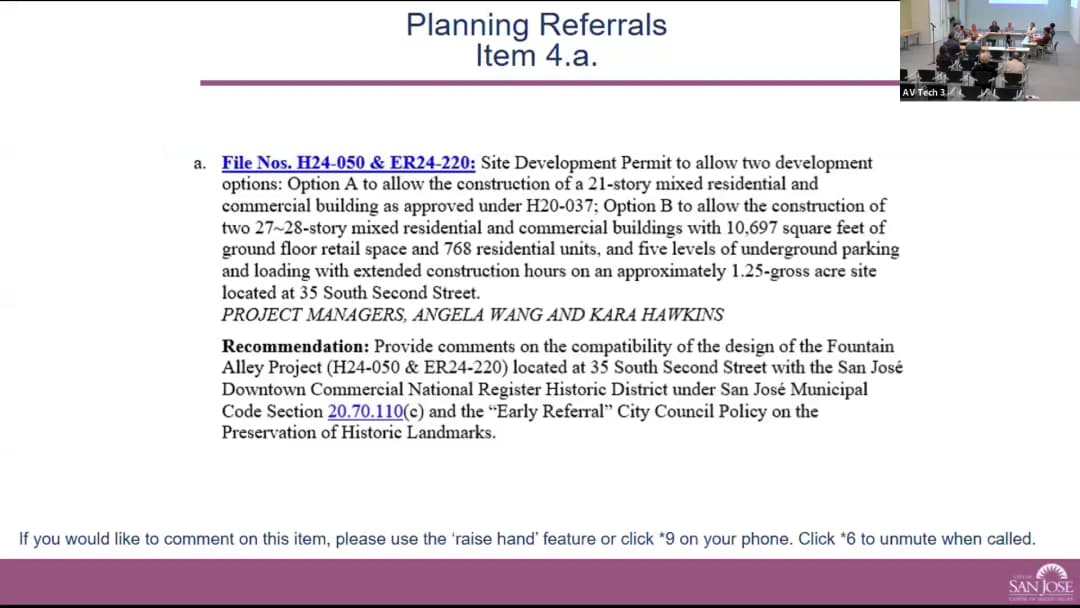
The Historic Landmarks Commission met on May 8, 2025, at 7:30 PM. The meeting included a proclamation for Historic Preservation Month, a planning referral for the Fountain Alley project (two development options), and a discussion on forming an adaptive reuse incentive committee. No consent calendar or public hearings were on the agenda. Seven commissioners were present (Commissioner Bainowal absent). Proclamation - Councilmember Michael Mulcahy presented a proclamation recognizing May 2025 as Historic Preservation Month in San Jose, with the theme "Harnessing the Power of Place." He highlighted San Jose's history as home to California's first historic landmarks commission (1945-46) and its nearly 230 historic landmarks, eight historic districts, and seven conservation areas. Planning Referral: Fountain Alley Project (H24-050) - Staff Report: Project managers Angela Wang and Kara Hawk introduced the site development permit for two options at 35 South 2nd Street. Option A (previously approved in 2022) is a 21-story mixed-use building with 194 residential units and office/commercial space. Option B proposes two 27-28 story buildings with 768 residential units, 10,697 square feet of ground-floor retail, and five levels of underground parking. The site is within the San Jose Downtown Commercial National Register District and within 100 feet of nine city landmarks, including the Bank of Italy. Staff sought HLC comments on design consistency with downtown design standards and guidelines regarding historic context and adjacency. - Applicant Presentation: The applicant (West Bank) stated they are focusing on Option B, emphasizing a modern design that does not replicate historic buildings but uses materials (tinted GFRC) to nod to the terracotta of the Bank of Italy. They highlighted breaking up the massing, improving pedestrian experience with alleyways and a public plaza, and including public art. The project would provide 770 units and ground-floor retail, aiming to bring vibrancy to downtown. - Commissioner Questions: Questions addressed the height limit (no strict limit, only FAA constraints), the distinction between design standards and guidelines (guidelines are not mandatory under state law for housing projects), the project's consistency with the 60-foot height guideline in the historic district, outreach to Bank of America, and the shift from office to residential. Some commissioners noted improvements in massing but expressed concerns about materials and the overwhelming scale relative to the Bank of Italy. - Public Comments: Two speakers testified. Mike Sod expressed appreciation for the broken massing and material deference but said the project still does not adequately respond to the Bank of Italy; he suggested a design review subcommittee and adjustments to the ground-floor experience. Gail Frank stated the project is too massive and engulfs historic buildings, detracting from the historic district and walking tours. - Commissioner Comments: Commissioners expressed mixed views. Some praised the improved massing and viewshed (Option B), while others criticized the glass and concrete design as incompatible with the historic district, overbearing to the Bank of Italy, and lacking harmony. Several commissioners requested an "Option C" with more masonry, terracotta, or other materials and a better ground-floor experience. The chair noted that this was an early referral, and no vote was taken; comments will be forwarded to the planning director. General Business: Adaptive Reuse Incentive Committee - The commission discussed forming a committee to explore adaptive reuse programs for historic buildings, inspired by Los Angeles' program. Commissioner Royer volunteered, and Commissioner Galandari also volunteered. However, staff (Deputy Director Manira Sandar) noted limited capacity due to budget constraints and existing work programs. The commission decided to defer the committee formation until the city has resources available, possibly linking it to future ordinance amendments. Open Forum - A member of the public asked about the schedule for the hardship committee meeting. The vice chair (Royer) indicated it will be scheduled soon. Reports and Approval of Minutes - The Design Review Subcommittee reported on a meeting held April 17, 2025, regarding a project at 445 North Sixth Street (a two-story, six-unit multifamily building on a vacant lot; a historic preservation permit will come before the full commission). - The commission unanimously approved the action minutes from the March 5, 2025 meeting (7-0 vote). Key Outcomes - No formal votes on the Fountain Alley project; the commission provided early referral comments to the planning director. - The adaptive reuse incentive committee was deferred due to staff capacity. - The March 5, 2025 meeting minutes were approved 7-0.
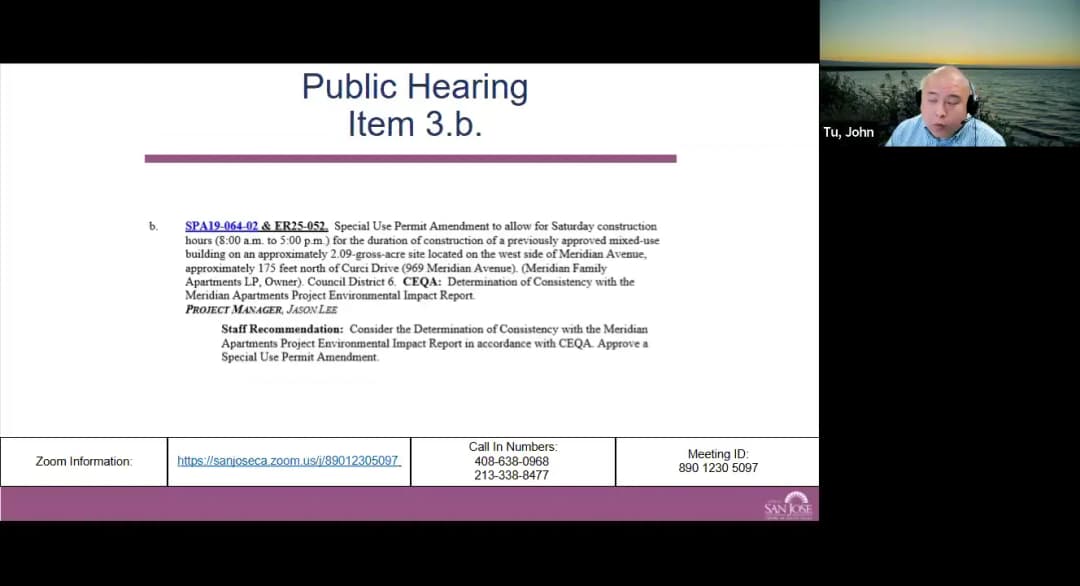
Note: The transcript of the meeting begins with "May 7th, 2025", but the provided meeting date is May 8, 2025. This discrepancy is noted. The meeting was called to order by Hearing Officer John 2, acting on behalf of the Director of Planning, Building and Code Enforcement. The primary agenda item was a special use permit amendment to allow Saturday construction hours for a 100% affordable housing development at 969 Meridian Avenue. A consent calendar item was also considered and approved without discussion. Consent Calendar - Item 3A (PD 24-023, ER24307): Plan development permit for three accessory structures at 2233 Terrain Valley Drive. Staff recommended approval, and the permit was approved as a consent item with no public comment or objection. Public Comments & Testimony - Several residents from neighboring apartment complexes (Redwood Senior Apartments and Tanglewood Apartments) spoke in opposition to the Saturday construction request. Key concerns included: - Noise disruption on weekends, which is the only time residents have for rest and family. - Traffic congestion and parking issues caused by construction workers. - A petition with 41 signatures from Redwood Senior Apartments objecting to Saturday construction because many seniors cannot attend the meeting electronically. - One resident noted that the existing weekday permit allows work until 7 p.m., but that time is not fully used; thus, Saturday work is unnecessary. - Another resident argued that delays caused by PG&E are not the community's burden and that the developer should exhaust other options before imposing Saturday work. - The applicant, Jim Campbell (Rome Development), acknowledged the disruption and stated that the Saturday work would involve quieter activities (stucco, material loading, landscaping) and would be limited to 15–20 intermittent Saturdays, not every Saturday. Discussion Items - Staff Presentation (Jason Lee): The request (SPA 19-064-02) is for a special use permit amendment to allow exterior construction on Saturdays from 8 a.m. to 5 p.m. (interior construction on Saturdays was already permitted). The project is a 233-unit, 100% affordable housing development approved by City Council in 2020. Delays were caused by PG&E pole removal. A noise addendum found that Saturday work noise levels would be consistent with the previously certified EIR. Staff recommended approval. - Applicant Presentation (Jim Campbell): Rome Development has 40 years of experience. The Saturday work would save 6–8 weeks of overall construction time, allowing earlier occupancy (targeting late 2026). The current phase is the noisiest; Saturday work would be quieter. - Hearing Officer Deliberation: The hearing officer acknowledged the disruption but noted the project’s affordable housing status and the need to meet funding deadlines. To mitigate impacts, he proposed modifying the conditions: staging may begin at 8 a.m., but heavy machinery operation may not start until 9 a.m. (hours remain 8 a.m. to 5 p.m.). The applicant agreed to this condition. Staff confirmed the condition could be added. Key Outcomes - Approved Item 3B (SPA 19-064-02): The special use permit amendment for Saturday construction hours (8 a.m. to 5 p.m.) was approved with the following additional condition: staging and preparation allowed from 8 a.m., but heavy machinery operation shall not commence until 9 a.m. This condition aims to reduce early-morning noise for nearby residents. - Consent Calendar Item 3A: Approved as submitted. - The meeting adjourned at 9:28 a.m.
The City Council held a budget study session on May 8, 2025, from approximately 9:45 AM to 12:00 PM, focusing on the Transportation & Aviation Services (TAS) and Environmental & Utility Services (EUS) service areas. Councilmembers reviewed proposed budgets, performance metrics, and discussed key operational challenges and strategic investments. Discussion Items Transportation & Aviation Services (TAS) - Speed Camera Pilot Program: Vice Mayor Foley inquired about the status of the speed camera program, noting a $8.5 million federal grant is frozen. Deputy Director John Risto stated the city is waiting one month for the freeze to lift (Plan A) and has a Plan B for a phased approach using other funds. The city is also seeking a state legislative extension of the pilot from five to six or seven years due to federal delays. - Copper Wire Theft: Councilmember Candelas and Duan raised concerns about copper wire theft causing street light outages, particularly in Districts 8 and 7. Risto reported that at one point 1,600 lights were out; currently about 800 remain. The proposed capital budget includes $1 million (construction excise tax fund) to catch up on repairs. Deterrent methods (locking devices, concrete) have been ineffective. Police have made one arrest. - Expressway Maintenance: Councilmember Mulcahy asked about coordination with Caltrans and the county. Risto noted the city is exploring a delegated maintenance agreement with the county for expressways, but no funds are in the current budget. The city prefers the county to pay for enhanced maintenance. - Airport Economy: Aviation Director Muki Patel reported passenger traffic dropped 9% in January, 9% in February, and 5.3% in March, attributed to recessionary fears and a shift to leisure travel. Delta is cutting system-wide capacity but not eliminating nonstop destinations from San Jose; the BWI nonstop will pause for six weeks around New Year’s. - Pavement Condition Index (PCI): Councilmember Ortiz questioned the flat PCI target of 74 despite heavy paving. Risto explained that Measure T bond funds will expire in two years, losing 40% of the paving budget, causing future PCI decline. The city is monitoring regional sales tax measures for replacement. - Sidewalk Repairs: A $250,000 proposal for sidewalk repairs adjacent to city-owned properties will prioritize high-walking areas. The city also has a program assisting private property owners with 50% or full cost of sidewalk repairs. - Parking Enforcement: The extended stay parking enforcement program is being eliminated due to low efficiency (vehicles move 50% of the time). A new program using automated license plate readers to target unregistered vehicles will be proposed. Pilot projects for more proactive street sweeping enforcement are also planned. - Performance Metrics: Mayor Mahan led a discussion on distinguishing between “health metrics” (indicators) and “performance measures” (targets with a theory of change). Budget Director Jim Shannon noted that targets have been recalibrated to be more achievable. Examples: bike network completion expected to rise from 14% to 16% due to grant-funded projects; passenger perception of airport cleanliness improved from 68% to 75% and is expected to continue rising. Environmental & Utility Services (EUS) - Clean Energy Power Mix: Director Lori Mitchell explained a regulatory change in Diablo Canyon allocation caused a drop in carbon-free resources in FY24-25. New renewable power purchase agreements coming online will increase the renewable content in FY25-26. - Recycling Contamination: The recycling ambassador “lid flip” program reduced contamination from 50% to 41%, saving $6 million annually. Mayor Mahan noted that despite the gain, residential landfill diversion targets were lowered; Deputy Director Valerie Osmon stated targets are now more achievable based on trends. - Garbage Cart Size: Councilmember Duan suggested making larger garbage carts affordable to reduce recycling contamination. Osmon noted 85% of single-family homes use the 32-gallon cart; a study giving larger carts to 9,000 homes was inconclusive in reducing contamination. The city encourages use of extra garbage stickers. - Waste-to-Energy: Councilmember Duan asked about using solid waste (wipes, etc.) for energy. Regional Wastewater Facility General Manager Mariana Chavez stated the facility already uses organics for cogeneration, supplying 80% of its energy. Future projects will accept fats, oils, grease, and potentially food waste for co-digestion. Burning is limited by air emission regulations. - Recycled Water: Councilmember Salas noted recycled water delivery is at 12 million gallons per day, with potential to double as new customers (e.g., data centers) come online. - FTE Reductions: Councilmember Ortiz asked about a net reduction of 7.0 FTEs under staffing consolidation. Jeff Provenzano stated the reductions are mostly from vacant positions and realignments, with no expected service impact. - Stormwater Permit Compliance: Councilmember Campos asked about the impact of a recent Supreme Court decision. Provenzano said the decision does not affect the city’s state stormwater permit. The city is on track to meet the 100% trash load reduction requirement by December 2025, currently at 97% through trash capture devices. Non-compliance could lead to citations or violations. - Food Waste Separation: Councilmember Kamei asked about curbside food waste separation. Osmon explained that San Jose uses back-end processing: all garbage goes to a material recovery facility where organics are sorted out, so residents do not need to separate food waste. Key Outcomes - No formal votes were taken; this was a study session for discussion only. - Staff will proceed with a phased approach for speed cameras if the federal grant remains frozen, and will seek state legislative extension of the pilot program. - The $1 million for copper wire theft repairs will be included in the proposed capital budget if approved by council. - The city will continue exploring a delegated maintenance agreement with the county for expressways. - The new parking enforcement program targeting unregistered vehicles will be proposed in the Manager’s Budget Addendum (MBA). - Performance metrics in the budget will be updated to reflect a clearer distinction between indicators and performance measures; targets will be adjusted to be more realistic. - The MBA will also include pilot projects for proactive street sweeping enforcement. - No public comments were made. The meeting adjourned at approximately 12:00 PM, with the next session scheduled for Monday, May 12, 2025, at 9:30 AM.
The Neighborhood Services and Education Committee (NSE) of the City of San José met on Thursday, May 8, 2025, at 1:30 PM to receive annual reports on older adult programs, the Youth Commission, youth violence prevention programs, and an audit implementation status report for Animal Care and Services. All committee members (Chair Peter Ortiz, Vice Chair Bien Doan, David Cohen, Domingo Candelas, Pamela Campos) were present. All items were accepted unanimously. Consent Calendar No items were considered on the Consent Calendar. Public Comments & Testimony - No public comments were made on items 1 through 3. - For item 4 (San José Animal Care and Services Audit Implementation Status Report), ten members of the public spoke. Key concerns included: - A dog reported as unable to walk was left by Animal Control (Kay Blom). - A malnourished kitten not properly fed at the shelter (Kay Blom). - The presentation was difficult to understand; friendly cats being turned away; public told to go to PetSmart to give away kittens; low adoption numbers; lack of a daily veterinarian; no public spay/neuter clinic (Anne DeShane, Sustain Our Shelters, Liz Holtz, others). - TNR appointments limited; return-to-field rate high; friendly stray cats being released after spay/neuter; kittens euthanized above a certain number (Sustain Our Shelters, Dinah Hayes). - The citizens action committee not yet formed (Sustain Our Shelters). - Calls for increased spay/neuter capacity, better record-keeping, and an ordinance on illegal breeding (Christina, others). Discussion Items 1. Older Adults Age 50+ 2023-2024 Programs and Services Status Report - Presented by Maria de Leon (Deputy Director, PRNS), Jeremy Schoffner, and Rhonda Vargas. - The number of San José residents over age 50 is 325,287 and growing. The Senior Nutrition Program served an average of 914 meals/day, an increase of 114 from the prior year. A total of 948 classes and programs were offered (69% increase in participation). The Older Adult Health and Wellness Grant Program awarded $526,424 to nine agencies, but the proposed FY 2025-26 budget recommends elimination of this grant. Staff emphasized maintaining core services (nutrition, city-led activities like chair yoga, dance socials, color walk). Committee members asked about transportation (103 gap passes, 3,475 taxi rides), connecting seniors to rent relief, and how to meet needs if the grant is eliminated. Staff noted collaboration with the county and referral networks. 2. Youth Commission Annual Report - Presented by Youth Commissioners Lon Mascarenas (Chair, District 10), Neha Pradeep Kumar (District 2), Peter Vu (District 7), and Andrew Liu (District 5). - The Youth Commission represents approximately 248,000 youth. Their survey of 463 youth (82% completion) found top concerns: violence/safety (4.25/5) and poverty/housing/homelessness (4.24/5). Work plan included gender-based violence awareness, environmental stewardship (tree planting at Basking Ridge Park, cleanups), college/career pathway evaluation, and an innovation committee. Commissioners and YAC members volunteered 1,085 service hours. The commission will lose eight graduating senior members. Committee members praised the youth and asked about engaging more youth, disability considerations in violence prevention, and budget advocacy. 3. San José Youth Empowerment Alliance, BEST, Safe Summer Initiative Grant, and Youth Intervention Services Programs Annual Report - Presented by Olimpia Williams (PRNS Deputy Director), Laura Buzo (Youth Intervention Services Division Manager), and Petra Reguero (Program Manager). - The collective impact model aligns with the Children and Youth Services Master Plan. Four pillars: prevention, intervention, diversion/re-entry, and healing. In FY 2023-24, 8,245 youth were served (slight decrease due to staffing changes). 89% of youth in grant programs reported feeling safe. Key objectives include reducing chronic absenteeism at three priority high schools, increasing school presence, and implementing a "no wrong door" pilot in Mayfair, Pocaway, and Santee Seven Trees. Committee members asked about disability inclusion, housing, literacy, the Latino Health Assessment, and job training success (target of 180 youth connected to work through San José Works). Chair Ortiz shared his personal experience with Clean Slate and Work to Future programs. 4. San José Animal Care and Services Audit Implementation Status Report - Presented by Matt Lesh (Director of Public Works), Dr. Elizabeth Cather, and Kiska Yikard. - The audit included 39 recommendations. As of the meeting, March implementation targets were all met; June targets are on track (including expanding spay/neuter to five days/week by June and low-cost appointments starting at 5/week); December targets are in progress. TNR numbers increased: 409 cats altered in first four months of 2025 vs. 36 in same period 2024. The shelter has three veterinarians (one vacancy) and limited registered veterinary technicians. Director Lesh acknowledged the citizens advisory committee had not been formed due to personal family emergencies; it will be established by December. Committee members and the public raised concerns about intake policies, capacity (315 cat cages with portals reducing usable space), adoption availability, and the need for increased spay/neuter capacity. Staff explained that industry standards guide housing and that the shelter prioritizes the most vulnerable animals. Key Outcomes - All four staff reports were accepted by unanimous votes. - On item 4, the committee approved the report and directed staff to: - Provide a detailed update on TNR and spay/neuter capacity through the upcoming May Budget Amendment (MBA) and the September city auditor report. - Address the status of the citizens advisory committee in the December report. - No additional items were added to the work plan. - The meeting adjourned at approximately 4:00 PM.
The City Council held a budget study session on May 7, 2025, starting at 9:15 AM, to review the proposed 2025-2026 operating budget, the economic outlook, and the Community and Economic Development (CED) city service area. The session featured detailed presentations from Budget Director Jim Shannon and Deputy Director Bloggy Salalic, followed by council questions and discussion. Key topics included a $35.6 million general fund shortfall, the reallocation of Measure E funds, economic challenges, and investments in affordable housing and community services. Discussion Items - Budget Overview: The proposed budget fully resolves the $35.6 million shortfall for FY 2025-2026 and cuts the projected $52.9 million shortfall for FY 2026-2027 in half. The total proposed budget is $5.6 billion across all funds, with the general fund at $1.44 billion. The budget includes $27 million set aside in a future deficit reserve for the next year. Key revenue sources include a $5 million one-time increase from delayed regulatory changes on cardroom business taxes, $2 million (starting January 2026) from a new first responder fee, and $1.5 million from a business tax amnesty program. Expenditure reductions total $11.7 million in FY 2025-2026 and $15 million ongoing, including deferral of the fire station 32 truck company and activation of the South San Jose police substation. No layoffs are expected for employees with rights to other positions, with fewer than 15 employees impacted, and one unrepresented employee may be separated. The city’s general purpose reserves are projected at 6.6% of general fund expenditures, well below the 10% policy target. - Economic Context: Deputy Director Bloggy Salalic presented an economic outlook covering national, state, and local trends. National GDP contracted by 0.3% in Q1 2025, and tariffs are expected to reduce GDP by up to 1.1%. California’s unemployment rate is over 5%, and San Jose’s unemployment is 4.1%. The city lost 6,000 net jobs year-over-year (March 2024 to March 2025), with growth in healthcare and government offset by losses in professional services, manufacturing, construction, and information. Sales tax revenue declined 1.2% in 2024, while property tax remains steady. Commercial real estate sales have dropped significantly, and hotel occupancy remains below pre-pandemic levels at 67%. - Measure E Reallocation: The proposed budget reallocates $39.2 million in FY 2025-2026 (rising to $42.8 million in FY 2026-2027) from affordable housing to homeless sheltering and supportive services. The total Measure E revenue is projected at $55 million for FY 2025-2026 and $60 million for FY 2026-2027, with 10% reserved for homelessness prevention. No new Measure E funds will be allocated to affordable housing in the upcoming year. However, staff identified approximately $60 million in prior-year Measure E and other fund balances for a new Notice of Funding Availability (NOFA) for affordable housing, and approximately $100 million through innovative financing strategies (revenue bonds, asset refinancing, master leasing) for future affordable housing investments. - CED Service Area: The Community and Economic Development presentation covered land use, planning, housing, and economic development services. Key priorities include major sporting events in 2026, affordable housing gap financing, general plan updates, CEQA streamlining, and development services improvements. The Office of Economic Development will be realigned into four core services focusing on job creation, downtown vitality, cultural activation, and talent development. The housing department is pursuing alternative financing strategies to sustain the affordable housing pipeline. - Council Questions: Councilmembers raised concerns about the impact of budget cuts on vulnerable populations, the need for robust homelessness prevention, the importance of equitable economic development (including support for street vendors and the African American community), and the need for streamlined development processes (CEQA, permits). Councilmember Ortiz noted that the Measure E reallocation decision is not final and requires eight votes. Councilmember Campos emphasized the link between foster care and homelessness and the need for targeted prevention. Councilmember Doan inquired about plans for the Singleton site. The Mayor concluded by urging colleagues to bring forward proposals to address unsheltered homelessness at scale. Key Outcomes - The proposed budget fully resolves the $35.6 million FY 2025-2026 general fund shortfall and cuts the FY 2026-2027 shortfall from $52.9 million to approximately $26 million. - Measure E funds are proposed to be reallocated: $39.2 million in FY 2025-2026 (growing to $42.8 million in FY 2026-2027) for homeless sheltering and supportive services, with 10% continuing for homelessness prevention. No new Measure E funds will go to affordable housing in the upcoming year, but $60 million in prior-year balances and $100 million in innovative financing are identified for future affordable housing. - No reductions to library hours, parks maintenance, community center programming, aquatics, scholarships, or senior nutrition are included. - Fewer than 15 employees will be impacted by position eliminations, with no layoffs for employees with rights to other positions; one unrepresented employee may be separated. - The city will proceed with a study session on Monday, May 12, 2025, covering neighborhood services, public safety, strategic support, fees and charges, and capital budget. The final budget adoption is scheduled for June 17, 2025.
The joint meeting of the Rules and Open Government Committee and the Committee of the Whole convened on Wednesday, May 7, 2025 at 2:00 PM in the Council Chambers. The committee reviewed the final agenda for the May 13, 2025 City Council meeting and the draft agenda for the May 20, 2025 meeting, approved the consent calendar, and heard public comments. The meeting adjourned at 2:10 PM. Consent Calendar - The committee approved the consent calendar, which included the following items: - Receive and file the Public Record for April 24, 2025 – May 1, 2025 (ROGC 25-163). - Approve the Auditor’s Office Monthly Report of Activities for April 2025 (ROGC 25-164). - Retroactive approval and approval of various events sponsored by Council District 8 (Candelas) including community clean-ups, movie nights, immigration legal clinic, Dia del Niño events, dumpster days, Pizza and Policy, and the Music in the Square Summer Series (ROGC 25-165). - Retroactive approval and approval of various events sponsored by Council District 4 (Cohen) including community cleanup, Berryessa Safe RV Parking Site Grand Opening, townhall, art festival, Pride Flag Raising, dumpster day, leadership forum, and community coffee (ROGC 25-166). - All consent items were approved by a single motion without separate discussion. Public Comments & Testimony - Blair Beekman spoke during the consent calendar public comment period. He expressed appreciation for the city’s practice of including new broadband tower placements in the public record, noting that this practice had stopped for about five years but resumed two or three years ago. He also commended the Auditor’s Monthly Report, specifically highlighting the item on community energy practices. He urged the city to continue asking how to further separate from PG&E and questioned whether there is consistency with the city’s super energy plans. - During Open Forum, Mr. Beekman again spoke, raising concerns about the public meeting process. He stated that the Brown Act requires public comment on each agenda item when called out by the meeting sponsor, and that the city does not allow public comment on the City Manager’s Report. He requested further conversation on the matter. Discussion Items - Review of May 13, 2025 Final Agenda: The committee reviewed the final agenda, noting a closed session at 9:30 AM, regular session at 1:30 PM, cancellation of the evening session, consent items on pages 4-7, strategic support items, environmental utility services, neighborhood services, community economic development, and land use items (including a land use consent calendar with items 10.1 and 10.3). An ad sheet was included. The committee approved the final agenda as amended. - Review of May 20, 2025 Draft Agenda: The committee reviewed the draft agenda. Councilmember Kamei recommended starting the regular session at 11:00 AM instead of 1:30 PM to allow a study session to be heard immediately following the regular session but not before 3:00 PM. The draft agenda included consent items on pages 4-8, strategic support, transportation and aviation services, community and economic development, and land use items. The committee approved the draft agenda with the 11:00 AM start time. Key Outcomes - Approval of Final Agenda for May 13, 2025: Approved with the ad sheet included. (Motion passed unanimously.) - Approval of Draft Agenda for May 20, 2025: Approved with the revised start time of 11:00 AM for the regular session. (Motion passed unanimously.) - Approval of Consent Calendar: Approved as a single motion, including the public record, auditor’s monthly report, and all event approvals from Districts 8 and 4. (Motion passed unanimously.) - No further actions: The committee did not discuss any other items under Rules Committee Reviews or other business.
The City Council met on Tuesday, May 6, 2025, at 1:30 PM in Council Chambers. The meeting began with ceremonial proclamations and an invocation, followed by a consent calendar, a joint meeting with the San Jose Financing Authority, and action on several policy and land-use items. All substantive votes were unanimous. Ceremonial Items - Asian American & Pacific Islander Heritage Month: Councilmembers Kamei and Doan presented a proclamation recognizing May 2025 as AAPI Heritage Month. Vanessa Hatakayama, Executive Director of the Japanese American Museum of San Jose, accepted the honor. - Rebuilding Together Silicon Valley: Councilmember Candelas presented a commendation to the organization for transforming over 5,000 homes and community facilities. Development Director Elena accepted, noting the importance of safe housing. - Cinco de Mayo: Councilmember Ortiz presented a proclamation declaring May 5, 2025 as Cinco de Mayo. David Polanco and Armando Barboja of the United Lowrider Council accepted, highlighting the revival of the parade and festival with over 300 lowriders and 20,000 attendees. Consent Calendar - Approval of Minutes, Ordinances, Committee Minutes, Excused Absences, Travel Reports, and Liaison Reports: All routine items were approved unanimously without discussion. - Item 2.7 – Youth Service Corps Program: Adopted a resolution accepting a $5,645,628 grant from California Volunteers and authorizing agreements with multiple organizations to implement the Resilience Corps program. - Item 2.8 – Free Use of City Hall Rotunda: Authorized free use for a homelessness forum on June 7, 2025. - Item 2.9 – Milligan Parking Lot Project: Approved a contingency increase from 15% to 25% ($400,000) for a total of $1,011,646. - Item 2.10 – Pride and Transgender Flag Raisings: Approved the Progressive Pride and Transgender Flag Raising on June 3, 2025, and lighting programming June 1-7, 2025, accepting donations. Joint City Council & Financing Authority Meeting (Items 1 & 2) - Item 1 – Commercial Paper Program (Letter of Credit): Adopted a resolution authorizing a new letter of credit with TD Bank, N.A., replacing the expiring U.S. Bank letter. Expected annual savings of $112,000. - Item 2 – AMI Project Commercial Paper Issuance: Conducted a public hearing and adopted a resolution authorizing the issuance of up to $23,000,000 in lease revenue commercial paper notes to finance the Advanced Metering Infrastructure (AMI) system, upgrading approximately 27,000 water meters to a cellular-based system. Public Comments & Testimony - Shopping Cart Ordinance (Item 7.3): Kat Angelou (San Jose Chamber of Commerce) supported the balanced approach to reducing blight. Tim James (grocery representative) opposed mandatory city retrieval and cost-recovery legislation, urging focus on implementing the new ordinance. Blair Beekman urged the council to avoid penalizing unhoused individuals. - Guadalupe Gardens (Item 10.2): Jordan Muldau (District 3) argued the land was originally purchased for airport approach zones and should remain open space, citing FAA regulations and the city's General Plan. - Affordable Housing (Item 10.3): Alex Shore (Catalyze SV), Esmeralda Virelas (Destination Home), and Mona Salazar (SV@Home) testified in strong support of the 94-unit 100% affordable project, noting its proximity to transit and alignment with housing goals. - Open Forum: Multiple speakers (Pranith Calredi, Rithick, Anisha, Sidatagali, Vijaya, David) addressed the eminent domain eviction of Silicon Valley Granite by VTA, requesting fair relocation support and time. Blair Beekman also spoke on homelessness policy and tech accountability. Discussion Items & Actions - Item 3.3 – Advanced Metering Infrastructure Solution: Adopted a resolution authorizing a three-year agreement with Badger Meter, Inc. (maximum $21,322,261 plus $2,132,226 contingency) and four five-year renewal options, with $1,500,000 appropriation from the Water Utility Capital Fund. Unanimous. - Item 7.1 – Report on City Charter Regarding Parks: Accepted the report and memorialized the policy on Section 1700. The inventory listed 207 charter parks out of 222 total parks. Staff clarified that trails, golf courses, and standalone community centers are evaluated under the three-prong test. Councilmember Candelas raised concerns about closed parks like Smythe Field and Columbus Park, and discussed creative lease options. Unanimous. - Item 7.3 – Abandoned Shopping Cart Prevention Plans: Approved an ordinance amendment requiring large retailers (76+ carts) to adopt at least one of three loss-prevention strategies (theft prevention devices, security deposits, or a cart retrieval contract). Staff reported on SB 753 (Cortese) to simplify cart retrieval and increase fines. A pilot retrieval program in two high-impact areas will launch in May 2025, with a full report back in September 2025. Unanimous. - Item 10.1a – General Plan Text Amendment (Policy IP-5.15): Approved a city-initiated amendment to address stable internal funding for urban village planning. Unanimous. - Items 10.2 & 5.1 – Coleman/Hedding Commercial Development & Guadalupe Gardens Master Plan Amendment: Approved the General Plan Amendment (from Open Space and Light Industrial to Combined Industrial Commercial) and rezoning to OS(PD) Planned Development for four sites totaling approx. 11.27 acres. Also approved removing the sites from the Guadalupe Gardens Master Plan. The airport plans to release an RFP in early 2026. Unanimous. - Item 10.3 – Burbank 45 Annexation & Affordable Housing: Approved annexation, prezoning, General Plan Amendment, and a mitigated negative declaration for a 94-unit 100% affordable housing project (Villas on the Row) at 1921-1927 West San Carlos Street. The project includes permanent supportive housing and commercial space. Councilmember Salas raised parking and management concerns based on past PATH projects. Next steps include a second hearing on May 20, 2025 for the annexation order. Unanimous. Key Outcomes - All votes on agenda items were unanimous (no recorded dissents). - The city will pursue SB 753 to simplify abandoned cart retrieval and increase fines. - A pilot shopping cart retrieval program will operate in two areas (Capitol Expressway/Tully Road and Blossom Hill/Almaden Expressway) beginning May 2025. - The AMI project will move forward with Badger Meter and $23 million in commercial paper financing. - The charter park inventory and policy are memorialized; staff committed to evaluating future parks for charter status. - The Coleman/Hedding sites are cleared for commercial development, with an airport RFP planned for early 2026. - The Burbank 45 affordable housing project will proceed to annexation and LAFCO certification, contingent on applicant conditions. - Mayor Mahan acknowledged the VTA eminent domain case from Open Forum and noted his engagement as a VTA board member; the council does not have direct jurisdiction.
On April 30, 2025, at 9:00 AM, the San Jose Planning Director Hearing, presided over by Hearing Officer Sylvia Doe on behalf of Director Christopher Burton, convened via Zoom to consider a single agenda item: a live tree removal permit (TR25-122) for a Dollar Tree store at 1121 Cock Lane. The hearing concluded at 9:34 AM with approval of the permit. Public Comments & Testimony - Lillian (District 3): Expressed concern over the removal of redwoods, calling them an important California tree. She asked for clarification on what a "box tree" is and commended the applicant for keeping replacement trees on site. - Celene Sabeda (neighbor on Denny Way): Described the removal of 60–70-year-old redwoods as significantly impacting her property and the street's beautification. She urged the city to require even larger replacement trees than the 24-inch box size, and also noted that the Dollar Tree's signage is not fully lit at night. - Sue Williams (resident on Denny for 47 years): Expressed deep upset at the removal of redwoods that had been there for 47 years. She agreed that 24-inch box trees are inadequate and criticized the property's poor maintenance, which she said affects property values and neighborhood quality of life. Discussion Items - Staff Presentation (Alex Hughes, Code Enforcement Planner): Explained that the seven redwoods were removed without a permit due to a miscommunication with a DOT permit. Three remaining trees were topped and considered unsafe by the city arborist. Standard replacement for native species is 5:1 (35 15-gallon trees), but because this is a code enforcement case, the ratio is doubled to 70 15-gallon trees. The applicant proposes 35 24-inch box trees (each box tree counts as two 15-gallon trees), which meets the requirement. Recommended approval. - Applicant Comments (Gino Borello, ownership group, and Kyla Phillips, consulting arborist): Borello acknowledged the situation and expressed commitment to a good path forward. Phillips explained that "24-inch box" refers to the size of the root ball, which is planted in the ground after removing the wooden box. Proposed tree species include columnar magnolia, maple (for fall color), and strawberry trees. Also noted that oak trees in the park strip were part of the separate DOT project. Borello added that the project will include wood chipping, a slurry seal, restriping, and improved weekly maintenance, and he will investigate the signage issue. - Hearing Officer Deliberation: Sylvia Doe confirmed the standard 5:1 replacement ratio for native redwoods, doubled due to code enforcement. She noted that planting 35 24-inch box trees on the property is a positive outcome, providing larger and quicker-maturing trees for the neighborhood. She also acknowledged that the three topped trees are unsafe and must be removed. Key Outcomes - Decision: Approved the tree removal permit (TR25-122) to legalize the removal of seven redwood trees at 1121 Cock Lane. - Condition Amended: Permit condition 1 was updated to clarify that the seven removed trees are redwoods (changing "trees" to "redwood trees"). - Replacement Requirement: The applicant must plant 35 24-inch box trees on the property (equivalent to 70 15-gallon trees, satisfying the doubled code enforcement ratio). Species must be suitable as determined by the city arborist. - No Deferrals or Consent Calendar Items: No items were deferred, and there were no consent calendar items.