This is a summary of the Planning Director Hearing held on October 23, 2026, conducted via Zoom by Hearing Officer Ruth Gueto on behalf of the Director of Planning, Building and Code Enforcement. The sole agenda item was a proposed wireless facility at 8790 Village View Drive, including an 80-foot monopine tower, antennas, generator, and equipment. The hearing officer approved the project after considering public testimony and staff recommendations. Public Comments & Testimony - Bob Dando (Villages homeowner, representing homeowners committee): Expressed support for the ATT tower project but opposed the proposed location. Requested alternative sites such as Corporation Yard, upper gardens, or behind the water tank. Cited concerns about direct sight lines from 15 Valvista residents, a narrow one-lane road, traffic mitigation issues, and a high-fire-risk area. Stated a gap exists between trees, giving residents a full view of the tower. - Robert Costa (directly affected homeowner): Opposed the chosen site, arguing the city's fact sheet misleadingly claimed views were considered. Noted 15 homes face the tower and urged relocation 80 feet west. Highlighted that the site is in a Cal Fire high-fire-hazard zone (fire insurance doubled) and near a seasonal creek bed with a riparian zone, for which exemptions should not apply. Stated residents are not against the tower but want a more appropriate location. Discussion Items - Staff (Jacqueline Guerrero) presented the project: the 80-foot monopine tower, antennas, generator, and cabinets on a 90-acre site. The project is in the R1PD zone; a planned development permit is required. Setbacks comply with R1 standards (nearest residence 230 feet). Height is allowed under Section 20.8530 due to the monopine design. A NEPA report found no direct effects on a nearby riverine wetland (within 70 feet) given existing development. The project is CEQA-exempt under Section 15303. Staff recommended approval. - Applicant representative (Mike McLaughlin, Western Fire Chiefs Association, for Public Safety Tower Company): Emphasized the critical need for FirstNet public safety broadband coverage, noting over 80% of 911 calls come from wireless devices and 80.2% of homes are wireless-only. The monopine design minimizes visual impact. Alternative sites (water tower, parks, etc.) were evaluated but did not meet coverage objectives. Addressed fire safety by stating wireless infrastructure is essential for first responders and cell tower fires are extremely rare (one reported worldwide in 2025). - Hearing Officer Ruth Gueto acknowledged community impacts but found that staff and applicant had worked on the project for over a year, examined alternative locations, and designed the tower to blend in. The 230-foot setback was deemed sufficient to limit visual impact. Regarding the riparian corridor, policy allows exceptions, which staff cited. Key Outcomes - Decision: The hearing officer considered the CEQA exemption (Section 15303) and approved the planned development permit (PD-25-004 and ER25-042) for the wireless facility. - The action is final upon signing and mailing the permit, subject to appeal under Title 20 (zoning) and Title 21 (CEQA) of the San Jose Municipal Code. - Conditions include obtaining required grading permits from Public Works and complying with NEPA report recommendations (e.g., protection for salamanders).
Public Meetings - San Jose, California
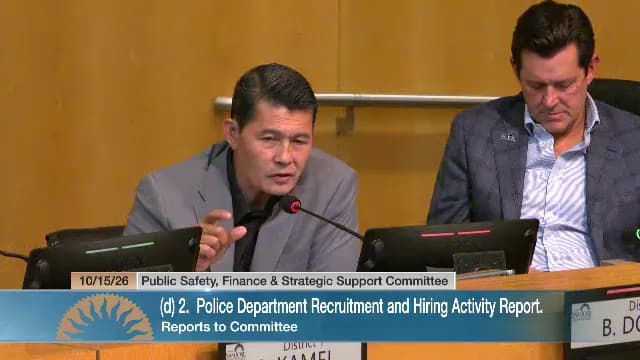
Public Meetings - San Jose, CaliforniaThe Public Safety, Finance and Strategic Support Committee (PSFSS) met on October 15, 2026, at 1:30 PM in a hybrid format. The committee reviewed three annual reports: retirement plan investment performance, police recruitment and hiring, and fire department operations. All reports were accepted unanimously after presentations, discussions, and public comment. Public Comments & Testimony - Brian (on Police Recruitment): Commented via Zoom, suggesting the police department create shows depicting real police work (investigative and community interaction) to improve recruitment. The police captain acknowledged the suggestion. - Brian (on Fire Department Operations): Asked whether the fire department tracked emergencies linked to unhoused individuals or fires in specific areas. Staff noted that data was not currently studied at that level. - Open Forum – Daniel (in person): Stated he witnessed a sexual assault eight years ago and has struggled to address it, feeling labeled as incompetent. He asked for assistance. The committee directed a staff member to follow up. - Open Forum – Brian (on Zoom): Commented on public safety related to driving, urging drivers to obey traffic laws to reduce accidents, which in turn reduces calls for police and fire services. Discussion Items 1. Retirement Plans Investments Annual Report (CC 26-109) - Presenter: John Flynn (CEO, Office of Retirement) and Jay Quan (Chief Investment Officer, Office of Retirement Services). - Key Details: For Fiscal Year 2025-2026, the Federated City Employees' Retirement System returned 13.6% and the Police and Fire Department Retirement Plan returned 13.1%, both exceeding the assumed rate of 6.6%. Performance was largely driven by global stocks, which returned about 20% over the fiscal year. The plans have beaten the discount rate for four consecutive years. - Committee Action: Councilmember Casey moved to accept the report; seconded and passed unanimously. 2. Police Department Recruitment and Hiring Activity Report (CC 26-111) - Presenter: Captain Mike O'Neill (Bureau of Administration) with Deputy Chief Dwyer. - Key Details: - 116 police recruits and laterals hired in FY 2025-2026, including 11 direct laterals (officers returning to SJPD). - Applications rose 162% year-over-year, but only 2.5–4.3% of applicants per academy class become hires (class sizes 30–38; academy capacity is 60). - Sworn staffing: 1,167 budgeted positions, 1,061 filled (106 vacancies). However, only 897 officers are “street ready,” and patrol staffing stands at 457 officers spread across 16 districts, 3 shifts. - Separations: 120 total, including 38 unprojected (unexpected) vacancies. - Gender representation: 12.74% female sworn (officer rank: 14.6%; sergeant: 4.2%; lieutenant: 9.8%). The department signed the “30 by 30” initiative aiming for 30% female by 2030. - Recruitment strategies: digital outreach (Epic, Cal-Hi Sports), Wednesday Night Fitness, military Skillbridge program, and a cadet program (59 cadets; over half female). - Early non-selection process to disqualify applicants with integrity issues, past criminal conduct, or failure to follow through, reducing background investigation costs. - Councilmember Inquiries: Chair Doan asked about patrol officer distribution per shift (approx. 68–75 per watch, minimum 68 on midnights) and the ideal staffing level. Staff noted San Jose is likely the lowest-staffed department of its size in the nation; one historical estimate suggested 400–500 additional officers were needed 20 years ago. Councilmember Kamei requested year-over-year data on gender representation to track progress toward the 30 by 30 goal. Councilmember Mulcahy asked about FY 2026-2027 trends and the cost of processing increased applications; staff noted early non-selection controls costs. - Committee Action: Councilmember Kamei moved to accept the report; seconded and passed unanimously. 3. Fire Department Operations Annual Report (CC 26-113) - Presenter: Assistant Chief James Dobson with Fire Chief Robert Sapian Jr. - Key Details: - Service area: 979,000 residents across 200 square miles. - FY 2025-2026 call volume: approximately 110,000 calls, a decrease of about 1.4% (1,000 fewer calls) from FY 2024-2025. EMS calls accounted for 66,000 (60%) of total calls. - Response time performance: City target of 80% of calls within 8 minutes; actual average was 63%. County EMS Code 3 performance averaged 85% (county target 90%). - Unit Hour Utilization (UHU): 28 response units exceeded the 10% threshold; 4 exceeded 20%. High call volume concentration in downtown core (Station 26 had 5,701 incidents, highest). - Initiatives: CAD-to-CAD link phase 1 active; next-gen 911 phone system planned for FY 2026-2027; traffic signal preemption pilot; closest unit dispatch implementation delayed to Q4 FY 2026-2027; community paramedicine mobile care unit launched October 1, 2026 (awaiting state authorization through Santa Clara County). - Fire station construction: Station 32 (scheduled completion Oct 2026) faces operational funding challenges; Station 36 (bid proposals winter 2027, completion winter 2028). A grant application for 7 firefighter positions was not awarded in the initial round; further rounds remain possible. - Councilmember Inquiries: Chair Doan questioned the impact of high UHU and the domino effect on response coverage; staff noted need for more resources or reduced call demand. Chair Doan asked about planning for resource needs when new stations open; the city manager's office noted that operational costs are forecast in base budgets but may be deferred during deficit years. Councilmember Kamei asked about the community paramedicine program's state authorization status and timeline; staff confirmed the application was forwarded and that mobile integrated health activities have already begun. - Committee Action: Councilmember Kamei moved to accept the report; seconded and passed unanimously. Key Outcomes - All three reports accepted unanimously: - Retirement Plans Investments Annual Report (CC 26-109) – accepted. - Police Department Recruitment and Hiring Activity Report (CC 26-111) – accepted. Committee directed staff to provide year-over-year gender representation data in future reports. - Fire Department Operations Annual Report (CC 26-113) – accepted. - Work Plan item deferred: Item CC 26-120 (Downtown High-Acuity Referral System) was deferred as previously directed. - Staff follow-up requested: The committee asked staff to reach out to the public speaker (Daniel) who reported witnessing a sexual assault.
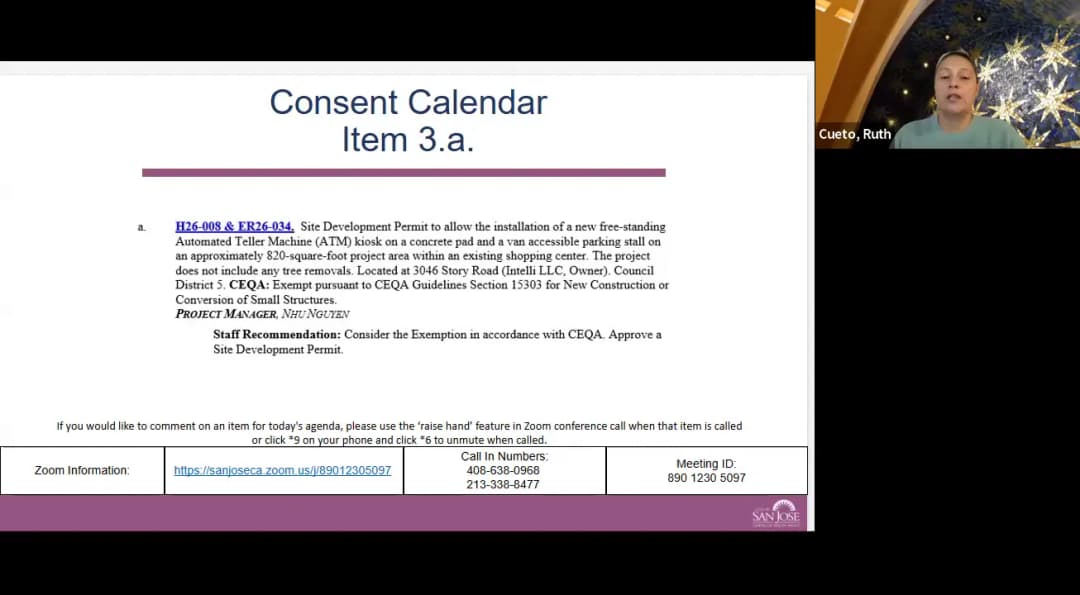
The hearing was called to order by Hearing Officer Ruth Gueto on behalf of the Director of Planning, Building, and Code Enforcement. The meeting was conducted via Zoom. The agenda included only consent calendar items, with no deferrals or public hearings requested. The consent calendar item was approved unanimously without public comment. Consent Calendar - Item 3a (H26-008 / ER26-034): A site development permit to install a new freestanding automated teller machine kiosk on a concrete pad and a van-accessible parking stall within an approximately 820-square-foot project area at 3046 Story Road, Council District 5. The project involved no tree removals and was found exempt from CEQA under Section 15303 (new construction or conversion of small structures). No requests to speak or public comments were received; the item was approved. Key Outcomes - The consent calendar item was approved as presented.
The Rules and Open Government Committee and Committee of the Whole met jointly in a hybrid meeting on Wednesday, October 14, 2026, at 2:00 PM in San José City Council Chambers. The committee reviewed upcoming City Council agendas, approved consent items, discussed ceremonial agenda limits, and agreed to cancel the next week's Rules Committee meeting because a quorum would not be available. The chair initially stated the meeting date as October 13 and was corrected to October 14. Agenda Reviews - October 20, 2026 Final Agenda: The committee reviewed the final agenda, which includes a 9:30 AM closed session, a 1:30 PM regular session, a canceled evening session, the City Manager's annual report, the conditional vacation of a portion of Spring Street, the IPA annual year-end report, the citywide planning work plan prioritization, and land use items including a general plan amendment and two land use appeals. - October 27, 2026 Draft Agenda: The committee reviewed the draft agenda, which includes a 9:30 AM closed session, a 1:30 PM regular session, consent items, a vehicle abatement audit, employee group contracts with MEF and IFPTE, amendments to solid waste management Chapter 9.10 and water code Section 15.10, the renaming of Cesar Chavez Park, and a community park departments conversion. Public Comments & Testimony - No public comment was submitted or offered on the agenda reviews, the consent calendar, or during open forum. Consent Calendar - The committee received and filed the Public Record for October 1–8, 2026. - The committee approved a $2,500 grant to the Rotary Club of San Jose Foundation for its Enterprise Leadership Conference and placed the item on the October 20, 2026 City Council agenda. - The committee retroactively approved travel for Councilmember Cohen to Redondo Beach, California from September 23–25, 2026 for the League of California Cities Expo and excused his absence from the September 23, 2026 Rules and Open Government Committee meeting. The motion was amended to correct the location to Anaheim, California, as noted by the chair. Discussion Items - Vice Mayor Foley noted that the October 20 agenda included four ceremonial items, while the policy and practice has been to limit ceremonials to three. She encouraged council members to keep ceremonial comments within five minutes, including their remarks. - Committee members discussed asking the Mayor's Office whether one ceremonial item could be moved to the October 27 agenda. Councilmember Candelas noted that his item was time-sensitive, and the committee agreed to continue the conversation offline. - The committee discussed the lack of a quorum for the next Wednesday's Rules Committee meeting because three members would be traveling. The Assistant City Attorney explained that with only two members present, the committee could meet but could not take action, and that virtual participation would not cure the quorum requirement because a quorum must be present in person and within city limits. The committee agreed to cancel the meeting rather than hold a non-actionable session. Key Outcomes - The October 20, 2026 Final Agenda review was approved on a 5–0 vote. - The October 27, 2026 Draft Agenda review was approved on a 5–0 vote. - The consent calendar, including the Rotary Club grant and the retroactive travel approval with the Anaheim correction, was approved on a 5–0 vote. - The committee agreed to cancel the October 21, 2026 Rules Committee meeting due to the lack of a quorum. - The meeting adjourned at 2:10 PM.
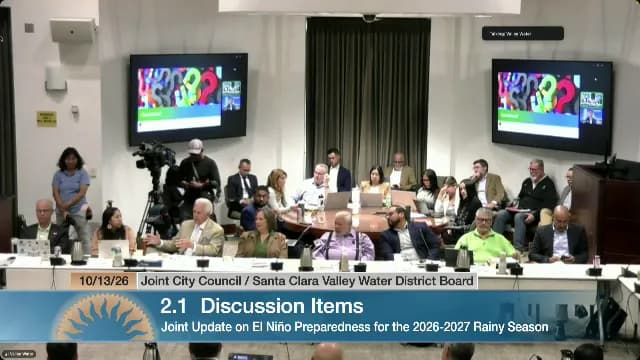
This special joint meeting between the San José City Council and the Santa Clara Valley Water District Board focused on preparing for the 2026-2027 El Niño rainy season, with updates on flood protection projects and interagency coordination. The meeting was held at Valley Water Headquarters in San José, starting at 1:00 PM. Mayor Matt Mahan participated remotely. Vice Mayor Pam Foley chaired the meeting. The board and council received presentations on El Niño preparedness, emergency response plans, and heard public testimony. Key outcomes included a motion directing city staff to work with Valley Water to produce a flood risk analysis and hotspot map. Public Comments & Testimony - Elizabeth Mencken (Nagley Park resident) asked how blockages are removed during storms and what equipment is available. Both Valley Water and city staff responded about their emergency contracts and monitoring of over 100 hotspots. - Michael (public speaker) recommended the book "A World Transformed" by Joshua Patison, highlighting historical flooding patterns and calling for proactive maintenance. - Gail Osmer (unhoused advocate for 30+ years) expressed concern that the unhoused population was not mentioned in the presentation, noting that 40% of unhoused residents are seniors. She asked about outreach, flyers, transportation to shelters, and allowing belongings. Staff responded that coordination with outreach teams occurs before storms and that shelter capacity exists. - Jordan Maldau (San José resident) raised issues about trail underpasses flooding after storms, citing slow cleanup due to jurisdictional complexities. He urged both agencies to streamline bureaucracy and improve drainage. - Betsy Magus (Santa Clara resident, bicycle commuter) seconded concerns about undercrossings, noting that Guadalupe River Trail underpasses were flooded for 70 days in past wet seasons. She suggested better drainage, prompt cleanup, and advance notifications. - Mark Schroeder (speaker on Coyote Creek) presented a petition signed by 230+ residents demanding action on nine major wood blockages on a 0.75-mile stretch of Coyote Creek, asking about risk of domino-effect floods. - John Davis (District 3 resident, Margaret Ave.) described personal cleanup efforts, spending $2,500 to clear debris, but said Valley Water told him it was a city problem and the debris remains. He proposed a quitclaim deed transferring creek property to Valley Water to clarify responsibility. Discussion Items - El Niño Preparedness Update (Item 2.1): Staff from Valley Water and the City presented a joint update. Chief Chris Hicks (Valley Water COO) explained that a very strong El Niño does not necessarily correlate to flooding but provides an opportunity to educate the public. He described 800 miles of waterways in the county, with Valley Water owning/managing 350 miles and maintaining 185 miles of constructed flood projects. City staff Jeff (ESD) outlined city preparedness, storm response, public information, and recovery roles. Ray Reardon (City OEM) highlighted the Joint Emergency Action Plan (JEAP) developed after the 2017 floods, tested 12 times, updated annually. Alex Gordon (Valley Water) discussed multi-agency exercises including tabletop, notification drills, and functional EOC exercises for Anderson Dam scenarios. Rachel Kippon (Valley Water) detailed public outreach: a flood awareness campaign launching October 15, over 48,000 mailers sent last year, targeted info to 17,000 residents in hotspot areas, and government relations efforts seeking state and federal regulatory relief (endangered species act flexibility). Community assistance programs include five sandbag sites (webcams on two), a Creekside Neighborhood Rebate Program, and a flood preparedness hotline. - Anderson Dam and Coyote Creek Flood Protection Update (Item 2.2): Ryan McCarter (Valley Water Deputy COO) gave a two-minute summary: the Anderson Dam Tunnel Project is complete and operational for this winter; Coyote Creek Flood Protection Project Phase One is complete, allowing tunnel flows through Coyote Creek; Phase Two and the Anderson Dam Seismic Retrofit Project are in early construction stages with contracts awarded. Key Outcomes - Motion by Mayor Mahan (approved unanimously): Directed city staff to work with Valley Water to produce a flood risk analysis and list of top hotspots within approximately 140 miles of waterways in San José, including a risk assessment and plans for high-risk areas, to be presented to the City Council. Seconded by Councilmember Kamei. Passed on verbal roll call. - Deferral of Pure Water Silicon Valley Update (Item 2.3): Due to time constraints, the item was deferred to the next joint meeting. - Ceremonial Item: Recognized Chair Tony Estremera for 31 years of service on the Valley Water Board, with a commendation presented by Councilmember Candelas. Estremera shared a personal story of his journey from a high school dropout to public service, emphasizing paying it forward. - Future Advocacy: Several councilmembers urged stronger joint advocacy for state and federal regulatory waivers to permit in-channel work before the rainy season, especially for Upper Penitencia Creek and other hotspots.
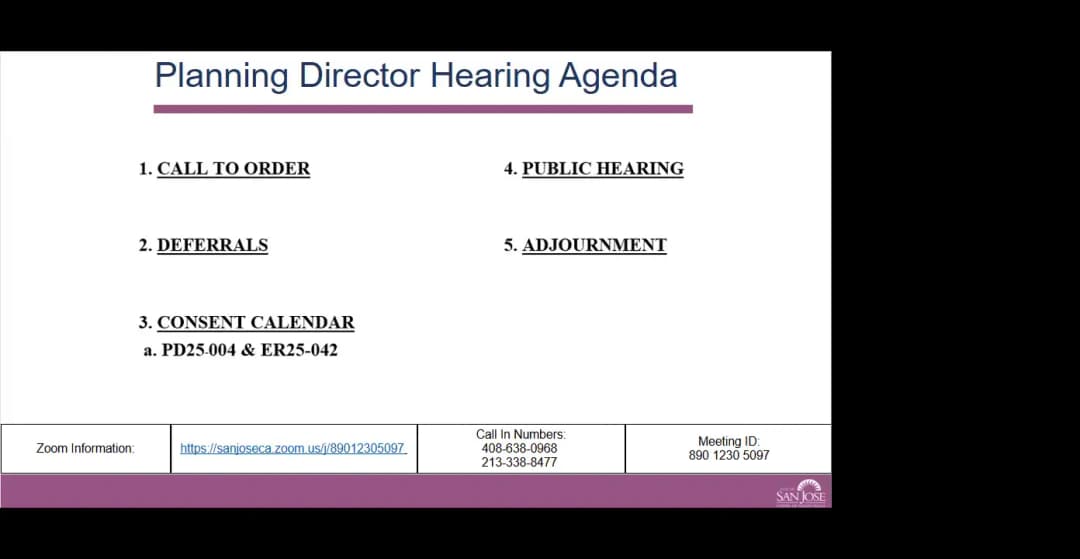
Note: The meeting transcript records the date as October 7, 2026, but the provided context specifies the meeting occurred on October 9, 2026. The summary below uses the specified date. The meeting was called to order by Hearing Officer John 2, acting on behalf of the Director of Planning, Building, and Code Enforcement. After handling a deferral request for the sole consent calendar item, the hearing was adjourned without any additional agenda items. Consent Calendar - Item 3A (PD 25-004 / ER25-042): A request for a development permit to install an 80-foot-tall monopole with 15 antennas, a 30 kW standby generator, ground-level cabinets, and other equipment within a fenced enclosure on an approximately 90-acre site at 8790 Village Drive. Staff requested a two-week deferral. The public was invited to comment on the deferral only. Public Comments & Testimony - Bob Dando (public speaker) spoke on the matter of deferral. He requested that the item be moved from the consent calendar to a separate discussion before the hearing officer when it returns in two weeks. Discussion Items - Deferral Request: Staff (Jacqueline Guerrero, project manager) requested a two-week deferral for Item 3A. The hearing officer noted that the item would return as a public hearing item on the next agenda. No other items were on the agenda for deferral. Key Outcomes - Item 3A Deferred: The hearing officer granted the two-week deferral, scheduling the item to return to the Director's Hearing on October 21, 2026 (transcript states "October 24st 21st," corrected to October 21 based on context). The item will be considered a public hearing item at that time. - Meeting Adjourned: With no remaining items, the hearing was adjourned at 9:07 AM.
Date: October 8, 2026, 09:30 UTC (the agenda listed 1:30 PM PT; the reason for the discrepancy is not specified). The Neighborhood Services and Education Committee (NSE) of the San José City Council met to review annual reports from the Senior, Parks and Recreation, and Youth Commissions; receive a status report on the Children and Youth Services Master Plan; and review the Animal Care and Services annual report. The meeting included discussion on commission roles, master plan implementation, and animal shelter operations, with public comments on several items. Consent Calendar - The consent calendar included the Senior Commission and Parks and Recreation Commission Annual Reports and Work Plans (CC 26-115) and the Youth Commission Work Plan (CC 26-116). - Councilmember George Casey removed item CC 26-115 for separate discussion. After discussion and public comment, the committee approved the consent calendar as presented unanimously. Public Comments & Testimony On the Parks and Recreation Work Plan (from consent calendar removal): - Ken Brennan, a three-year Parks and Recreation Commissioner speaking in his individual capacity, urged the committee not to approve the work plan as presented. He argued that the work plan lacked items addressing operational performance and reflected PRNS leadership priorities rather than oversight needs. He requested a one-month delay to incorporate meaningful oversight priorities. On the Animal Care and Services Annual Report: - Lynn Paulson criticized the lack of public access to shelter animals and transparency, stating that audit recommendations 6, 7, and 24 were inadequately implemented. - Dinah Hayes acknowledged the increase in spay/neuter services but said it remains far below community need. She noted that shelter intake data does not capture animals turned away or taken directly by rescues, and urged prioritizing spay/neuter with real accountability. - Ann (reading a letter from a former volunteer) described low volunteer morale and retention issues, with experienced volunteers leaving due to frustration. She stated that new volunteer retention is below 15% and that the city should evaluate volunteer experience, not just counts. - Andy Shane shared his experience adopting a cat with undisclosed medical issues, leading to $2,000 in unexpected veterinary costs. He questioned the shelter's medical care and adoption procedures. - Mike Wagner contested the report's claim of strong live outcomes, noting a 17.2% decline in cat/kitten adoptions, a 39% decline in three years, and a 67% increase in kitten euthanasia. He pointed out data inaccuracies and said the report was misleading. Open Forum (items not on the agenda): - Emma spoke about a pending sweep of an encampment near Allender Dog Park, affecting residents formerly part of the Jungle. She stated that an email from the city could stop the sweep and asked the committee to support the residents. - Raul (Blair Beekman) commented on the sale of a data center at Harry Lane, urging a deliberate community process and praising Councilmember Campos for her careful approach. Discussion Items Parks and Recreation Commission Work Plan - Councilmember Casey raised concerns about the commission's role and the work plan development process. He sought clarification on the oversight vs. advisory roles and suggested empowering the commission to take on more work. Angel Rios (City Manager's Office) and staff explained that the commission's role is advisory per charter, and the work plan was developed by the commission with staff guidance, approved by a majority vote. Casey also inquired about measurable performance metrics for park maintenance and proposed a pilot program for skilled volunteer maintenance work to address the backlog. Staff noted union and liability concerns but agreed to explore options. Chair Ortiz expressed hesitance to change commission dynamics given the majority was satisfied with the work plan but supported further discussion. The committee did not make changes; the consent calendar was approved. Children and Youth Services Master Plan Status Report (CC 26-117) - Andrea Flores Shelton (Assistant Director, PRNS) presented updates: the grand opening of the Capitol Park Navigation Center operated by GRAIL Family Services, with $200,000 in child care capital improvement funds; collaboration with County Social Services for on-site eligibility workers; and consideration of a bridge library at the site. Chair Ortiz raised safety concerns after a recent shooting at Capitol Park and ongoing issues with gambling and drinking. Staff described efforts to secure the facility and work with police. Councilmember Campos asked about alignment with the county's child care blueprint and development of a governance structure. Staff indicated they are working on a governance model and will present it to council later. The committee accepted the report. Animal Care and Services Annual Report (CC 26-118) - John Cisrelli (Director, PRNS) and Monica Wiley (Deputy Director) presented the report, highlighting 7,000+ spay/neuter surgeries, a licensing transition to DocuPet, 19,065 field service calls, 48 new rescue partners, and an 18% cost recovery model. The report noted a 95% live release rate for dogs but a drop in cat live release rate from 86% to 80%. Discussion focused on expanding spay/neuter capacity to reach a target of 10,000 surgeries per year, the classification of kittens as unhealthy/untreatable (often unweaned, but 89% saved), and the need to improve volunteer and rescue partner relations. Councilmember Casey emphasized volunteer retention and trust-building. Councilmember Candelas supported scaling spay/neuter and acknowledged the transition challenges. Chair Ortiz requested more detailed historical data and inclusion of Asilomar intake/outcome tables in future reports. Vice Chair Doan raised facility capacity issues and suggested purchasing an adjacent lot. The committee accepted the report. Key Outcomes - The consent calendar (Senior Commission, Parks and Recreation Commission, and Youth Commission work plans) was formally accepted. - The Children and Youth Services Master Plan status report was accepted. - The Animal Care and Services annual report was accepted. - Staff will provide a briefing on commission roles and responsibilities to clarify advisory vs. oversight functions. - Animal Care and Services will include year-over-year breakdowns of cat and kitten adoption, euthanasia, and live release rates, as well as complete Asilomar data in future reports. - The administration will explore expanding in-house spay/neuter capacity and increasing volunteer involvement. - A Levitt Pavilion update is scheduled for the committee's December meeting as part of the PRNS Community Impact Report. - The committee received and noted open forum comments regarding the encampment sweep and the data center sale.
The committee reviewed the draft agenda for October 20, 2026, approved a consent calendar of routine items, and discussed a proposal to study self-checkout safety and staffing standards for grocery and drug retail stores. Public testimony from retail representatives raised concerns about costs, customer preferences, and negative impacts from similar ordinances. The committee approved directing the City Manager to review policy options and return with an informational memo. Consent Calendar - Approved four items unanimously: receiving the public record (September 24 – October 1, 2026); setting a joint special meeting with Santa Clara Valley Water District on October 13, 2026 (1:00 p.m. – 3:00 p.m.); approving the Auditor’s monthly report for September 2026; and approving a proclamation, flag raising, and lighting for Taiwan Retrocession Day as a city-sponsored special event, with funds and donations accepted. Public Comments & Testimony - Multiple speakers representing retailers and business groups (California Retailers Association, Sprouts Farmers Market, Safeway, Silicon Valley Leadership Group, San Jose Chamber of Commerce, California Grocers Association, Tawa Supermarkets) urged the committee not to pursue an ordinance. Key points: - Customers value the speed, privacy, and convenience of self-checkout; eliminating it could drive consumers to online shopping or neighboring jurisdictions. - Grocery stores operate on thin margins (about 1.7%); increased staffing costs could double self-checkout operating costs, leading to higher prices or store closures. - Long Beach’s experience showed that similar regulations led to reduced self-checkout lanes, longer transaction times, lower customer satisfaction, and no reduction in theft. - Theft is already addressed through multiple layers of technology and trained staff; adding more attendants would not stop offenders who bypass checkouts altogether. - A private right of action would expose retailers to litigation. - Councilmember Candelas acknowledged letters from grocery associations and expressed willingness to engage with stakeholders. Discussion Items - Self-Checkout Safety Standards: Referred from September 16, 2026, the memo (co-authored by Councilmembers Candelas and Cohen) proposed directing the City Manager to review policy approaches from other jurisdictions, engage Santa Clara County on worker safety partnerships, and return with policy options, scope, and implementation considerations before the FY2027-2028 priority-setting process. - Councilmember Candelas supported studying the issue to develop data-driven policy and collaborate with stakeholders. - Councilmember Doan noted concerns but agreed further study was warranted, adding that no one had reached out to his office regarding opposition. - Vice Mayor Foley opposed, stating she was skeptical the study would lead to an ordinance rather than a memo, and worried about cost increases for consumers and harm to brick-and-mortar stores. - Chair Cohen clarified that the action requested only an informational memo (not an ordinance), which would help inform future council decisions and constituent conversations. Key Outcomes - Draft Agenda Approved: The committee approved the draft agenda for October 20, 2026, with an ad sheet added. Councilmember Candelas requested that civil service interviews be scheduled to be heard last (not before 4 p.m.); the chair noted it likely would not occur before 4 p.m. due to a heavy agenda but did not set a time certain. - Self-Checkout Study Approved: The motion to direct the City Manager to review self-checkout safety and staffing policy approaches and return with options passed. Vice Mayor Foley expressed her opposition; no formal roll call was recorded, but the motion carried with one stated dissenting vote. - The meeting adjourned at 2:25 p.m.
The San Jose City Council convened on October 6, 2026, at 10:00 AM (time inferred from 'good morning') and, after roll call establishing quorum, heard extensive public testimony from city employees and union representatives regarding ongoing contract negotiations. No formal agenda or minutes were provided. Over 148 people participated online, with 10 in-person speakers and additional online speakers. The meeting adjourned to closed session without taking any public votes or decisions. Public Comments & Testimony - Ben (unidentified affiliation): Stated that San Jose Public Works employees' average wage of $128,000 per year is near the low-income threshold of $117,700, and questioned why the city's last best and final offer does not reflect the middle-class status these jobs once held. - Francis (senior analyst, Finance Department, IFPTE Local 21): Expressed readiness to strike as a last resort, noting inflation has eroded wages and as a single mother she feels the financial strain. - Unnamed speaker (self-identified as a Sharks fan): Criticized the city for making false promises and prioritizing investments like the Sharks over core services; urged council to show commitment through actions. - Daisy (member of Aspen Local 101, Environmental Services): New employee from out of state, stated cost of living is unaffordable, turnover hurts service quality, and asked for fair contract to retain staff. - Dylan Colman Haley (Public Info Rep, Beautify San Jose): 10-year employee, noted his wife also works for city; described living within dangerous margins and actively seeking jobs elsewhere; urged support to retain talent. - Mary Morris (Senior Environmental Program Manager, Environmental Services Department, IFPTE Local 21, bargaining team member): 27-year employee, said she never expected to need enforcement skills with council; asked for leadership to get a fair contract. - Maria Garcia (Housing Department employee): Reported significant turnover in the housing department, loss of institutional knowledge, and increased workload for remaining staff; noted asset management oversees millions in affordable housing investments. - Cecilia Rios (20-year city employee, now manager): Former library page, said a former coworker left for Santa Clara County due to better pay and manageable workload; county closed an $800 million deficit while retaining staff; asked council to direct city manager to avert a strike. - David Parker (Code Enforcement Inspector, MEF 101, Nigley Park, District Three resident): Nearly 5-year employee and former negotiating team member, described never seeing such a negotiation; members are desperate and leaving; warned council their actions will be remembered in future elections. - Riley (Supervising Environmental Service Specialist, Local 21 Camp chapter bargaining team member): 8-year employee, said his salary is decent relative to colleagues but still insufficient; city's last best and final offer does not keep pace with inflation; strike is last option but will do it. - Catherine Walsh (Environmental Services Specialist, MEF 101, District 6 resident): Moved to San Jose for the job and loves the city but struggles to budget month-to-month; cost of living is untenable; strike is last resort. - Zita (Ira Bethanaz, Economy Intelligence, China Department Crime Analysis Unit): Only breadwinner, noted gas costs over $6/gallon; after three months without a contract, many cannot afford housing and family care; asked for fair contract. - Rob Perrin (Environmental Services Specialist, MEF 101, District 9, 15-year employee): Seeking fair wages, no contingencies, restoration of pensionable pay; stated members voted yes to strike. - Danielle (Planning Department employee, 9-year employee): Noted a cycle of employees staying five years and leaving due to cost of living and rigid work-from-home policy; many plan to leave; asked for fair contract. - Moses Arroyo (25-year employee, voted to strike): Stated city employees provide vital services in housing, environment, public services, and health; requested a contract that supports retention and recognizes contributions. Key Outcomes - No votes or decisions were made during the public session. Mayor Mahan thanked speakers, acknowledged the importance of the workforce, expressed desire for a fair contract that avoids layoffs or service cuts, and adjourned the meeting to closed session for further negotiations. The council did not take any formal action on the contract or strike authorization.
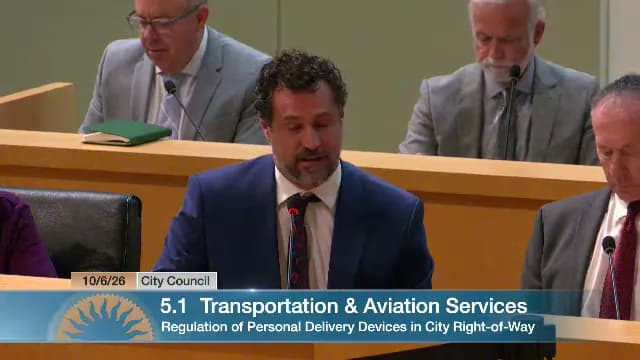
The San José City Council met on Tuesday, October 6, 2026, at 1:30 PM (after a Closed Session at 9:30 AM) to consider a range of items including ceremonial proclamations, routine consent calendar items, a city manager report, regulations for personal delivery devices, and two affordable housing developments. The meeting included public comments, extensive council deliberation on the delivery device ordinance, and unanimous approvals on housing items. One councilmember (Ortiz) and one (Candelas) were absent for parts of the meeting. Ceremonial Items - National Arts and Humanities Month: Councilmember Campos presented a proclamation declaring October 2026 as National Arts and Humanities Month, highlighting the role of arts in community life. Shelby Takeda, chair of the San José Arts Commission, accepted the proclamation. - Walk & Roll to School Day: Vice Mayor Foley proclaimed October 7, 2026, as Walk & Roll to School Day, encouraging safe active transportation to schools. DOT staff noted the program has grown to 115 participating schools. - Filipino American History Month: Councilmember Tordillos presented a proclamation declaring October 2026 as Filipino American History Month. Alan Guig, founder and president of SJSU’s Filipino Alumni Network, accepted and announced a Filipino American History Mural unveiling on October 30, 2026. Adjournment Recognition The meeting was adjourned in memory of Paz Richard Rocha Jr., a lifelong San José educator, coach, and athlete. Councilmember Candelas and family members spoke about his legacy. Over 250 people attended his celebration of life. Consent Calendar The Council approved all consent calendar items (2.1–2.15) by a unanimous vote. Items included approval of minutes, final adoption of ordinances, council committee minutes, travel reports, the dissolution of the Bay Area Regional Interoperable Communications Systems Authority, an amendment for criminal justice system access, annexation to Community Facilities District No. 8, master consultant agreements for sewer flow monitoring, free use of the rotunda for two events, retroactive approval of the Golden State Valkyries Flag Raising, authorization of travel for the Mayor's Director of Innovation, and a board appointment to the Arts Commission. Public Comments & Testimony - Item 5.1 – Personal Delivery Devices: - Vignesh Ram (Vice President of Public Policy, Serve Robotics) expressed support, noting the company has completed hundreds of deliveries in San José, serving 34 local businesses (90% small/independent). He emphasized the environmental and congestion benefits. - Jonas Pierce (Coco Robotics) also expressed support, highlighting thousands of deliveries and 38 businesses served, with CO2 savings of approximately 2.5 tons. - Two callers spoke: one skeptical, likening the robots to failed bike-share programs; Jordan Moldow (District 3) expressed cautious optimism but raised concerns about robot weight (350 lbs), speed in bikeways, and the need for per-minute fees for blocking pedestrians. - Open Forum: Two speakers addressed bike lane hazards on Santa Teresa Boulevard and general appreciation for the council's work. Discussion Items - Item 3.1 – City Manager Report (Verbal): City Manager Jennifer Maguire introduced Amber Hewitt as the new Director of the Office of Racial and Social Equity, effective October 25. Dr. Hewitt spoke about her background and commitment to equity. Council welcomed her. - Item 5.1 – Actions Related to Regulation of Personal Delivery Devices: Staff (John Russell, Ramses Madue, Laura Stutchinski) presented a proposed ordinance for sidewalk and bikeway delivery robots. Key provisions: one-year permit, $200 annual permit fee for sidewalk devices, $250 for roadway devices, 5 mph speed limit, 30-minute response for disabled devices, and a two-tier system (sidewalk permit, bikeway pilot). Vice Mayor Foley expressed strong concerns about insufficient disability community outreach, sidewalk congestion, and low fines ($100–$500). Councilmember Kamei raised concerns about device limits and scooter comparisons. Councilmember Tordillos supported the framework, noting that devices are already operating and regulation gives the city leverage. Councilmember Cohen moved approval, citing benefits and safeguards (ability to cancel permits). The motion passed 9–2 (Ortiz and Candelas absent). - Item 8.1 – Affordable Housing at 1510 North 1st Street: Eric Sullivan and Banu San presented a proposal for a $5.7 million loan to rehabilitate the former Comfort Suites into 57 permanent supportive housing units for extremely low-income individuals (30% AMI and below). The Santa Clara County Housing Authority is the developer. Construction is expected to start by year-end and take 12 months. Councilmember Mulcahy moved approval, noting the need for investment in the area. Motion passed unanimously (Candelas absent). - Item 8.2 – Arena Hotel Redevelopment and Homekey Program Transition: Staff explained a plan to convert the Arena Hotel into permanent housing through two phases: converting the existing motel and later building over 200 mixed-income units on the parking lot. The city has selected Episcopal Community Services of San Francisco as developer and will seek state approval to transfer the 30% AMI requirement to an alternative site. Councilmember Mulcahy moved to approve staff's recommendation with additional direction from a memo by Mayor Mahan and himself, requiring a progress report in six months. He noted the site's troubled history. Motion passed unanimously (Candelas absent). Key Outcomes - Personal Delivery Device Ordinance: Approved 9–2. The ordinance adds Chapter 11.91 to the municipal code, establishes permit and fee structures, and creates an administrative citation schedule. A nine-month pilot for bikeway devices will be evaluated. - 1510 North 1st Street Housing: Approved unanimously. A $5.7 million loan commitment was authorized, with appropriation amendments from the Low and Moderate Income Housing Asset Fund. - Arena Hotel Redevelopment: Approved unanimously. Authorized Exclusive Negotiation Agreements with Episcopal Community Services and a backup developer, Propertyworx. Directed the city manager to return in six months with an update on state negotiations. - Civil Service Commission Interview: Deferred to the end of the meeting but not conducted as the meeting adjourned after open forum. General Notes The meeting adjourned at approximately 3:30 PM (estimated from transcript length). All votes were recorded; roll call indicated a quorum of 11 members present at the start.