Note on date discrepancy: The transcript of the meeting states the date as February 5, 2025, but the provided metadata indicates the meeting took place on February 6, 2025. This summary uses the latter date as instructed. The hearing, presided over by Hearing Officer Sylvia Doe on behalf of the Director of Planning, Building, and Code Enforcement, Christopher Burton, was conducted via Zoom. The agenda included one deferral and one consent calendar item. No public hearing items were scheduled. Deferrals - Item 2A (SP24-027 / ER20-153): A special use permit for landscaping retaining walls greater than two feet in height at 582 Continental Drive was deferred to the February 19, 2025 director's hearing per staff request. No public comment was received, and the deferral was approved. Consent Calendar - Tentative Map T24-017 / ER24-116: A request to subdivide one residential lot into two lots on a 0.23-gross-acre site at 233 North 25th Street was approved without discussion. Staff recommended approval under CEQA exemption. No public comment was received, and the item was approved on the consent calendar. Key Outcomes - The deferral of item 2A to February 19, 2025, was granted. - The tentative map for 233 North 25th Street was approved. - The meeting was adjourned at 9:08 AM.
Public Meetings - San Jose, California
Public Meetings - San Jose, CaliforniaThe hearing officer, Ruth Gueto, called the meeting to order on January 30, 2025, via Zoom. The agenda included one consent calendar item. No public comments were received, and the item was approved without discussion. Consent Calendar - Item 3A (H23-026, ER23-207): Site development permit to allow the demolition (previously performed without permit) of an approximately 1,300-square-foot restaurant and removal of four trees (including three ordinance-sized trees) for the development of a surface parking lot with 93 parking spaces on a 0.87-acre vacant site adjacent to Westgate Community Bible Church at 5220 and 5330 Prospect Road. Staff recommended approval under CEQA exemption (Section 15301). The hearing officer approved the item as part of the consent calendar. Note: The transcript of this meeting indicates the date as January 22, 2025, but the meeting date provided for this summary is January 30, 2025.
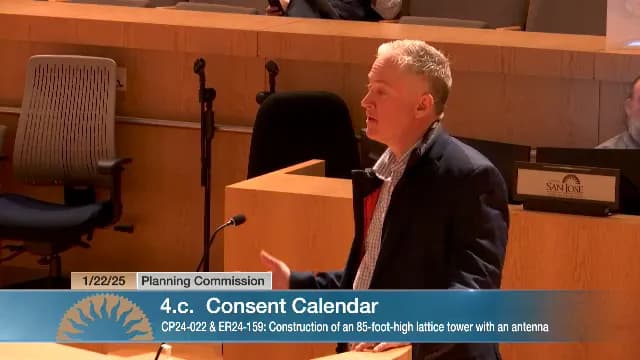
The San Jose Planning Commission met on January 22, 2025, at 6:30 PM (UTC) to consider routine consent calendar items, hear public testimony on a proposed telecommunications tower, and receive updates from City Council. The meeting was chaired by Anthony Tordillos with seven commissioners present at roll call and two absent (Commissioner Rosario and initially Commissioner Oliverio, who later joined). The commission approved most consent calendar items and voted to approve a conditional use permit for an 85-foot lattice tower, with one commissioner dissenting. Consent Calendar - The consent calendar included four items: A) Approval of December 4, 2024 meeting minutes; B) Conditional use permit (CP24-020/ER24-131) for an 85-foot lattice tower at 2268 Will Drive; C) Conditional use permit (CP24-022/ER24-159) for an 85-foot lattice tower at 12329 Mabury Road; D) Conditional use permit (CP24-027/ER24-192) for off-sale beer and wine at a 14,000 square foot grocery store at 1915 West San Carlos Street. - Item C was pulled from the consent calendar due to public comment. The commission voted unanimously (8-0-1, with Commissioner Rosario absent) to adopt the remaining three items. Public Comments & Testimony - Item C (12329 Mabury Road tower): Two residents spoke in opposition. Nitin Valentine, a nearby resident, expressed concerns about construction dust, lightning hazards, property devaluation, and visual impact. Giovanna Medi, also from the Creekland Circle community, cited previous construction dust that damaged her plants and argued the 85-foot tower (equivalent to an eight-story building) would lower property values and change the skyline. Both requested the commission block the project. - The applicant, Scott Hoffman of San Jose Water Company, used his five-minute presentation and subsequent five-minute rebuttal to emphasize the necessity of the tower for remote water meter reading, the site's history as a well site, and the 150-foot setback from residential properties. He warned that rejecting the location would require finding another site, potentially causing similar or greater disruption. Discussion Items - Item C – 85-foot Lattice Tower at 12329 Mabury Road: Staff planner Rena Sha presented the project, noting it is a private communications network for San Jose Water Company to read water meters remotely. The tower is 85 feet high, set back 115 feet from the eastern property line, and uses a radio band at 1.9 milliwatts (92% less than FCC maximum). The site is triangular, bounded by Penitentia Creek and residential development, and accessed via a 20-foot driveway. The project is categorically exempt under CEQA Section 15303. One resident had previously objected, but the applicant responded to concerns. Staff recommended approval. - Commissioner discussion: Vice Chair Cantrell asked about dust mitigation; staff confirmed standard environmental conditions (Condition 23) would apply. Commissioner Barrosio questioned whether the tower could be placed at the nearby BART flea market or partnered with other agencies; the applicant stated they only use their own properties and that alternative sites would require propagation studies. Commissioner Barrosio also asked about alternative technologies; the applicant explained that a radio network is the only viable option for real-time meter reading. Commissioner Bickford inquired about the number of similar towers already installed; the applicant stated one lattice tower has been built (85 feet), and six antennas have been placed on tanks, with a total of nine antennas planned. The chair asked about lightning and wildfire risk; staff said building permits would ensure structural soundness, and the site's limited vegetation reduces fire risk. Key Outcomes - Item C (CP24-022/ER24-159): Motion to approve the staff recommendation for the conditional use permit passed 6-1-2 (Commissioner Barrosio voted no; Commissioner Lardnois stepped out and did not vote; Commissioner Rosario absent; Commissioner Oliverio, who joined later, voted yes). The permit allows construction of an 85-foot lattice tower and related equipment at 12329 Mabury Road for remote water meter data collection. - City Council Report: Staff reported that on December 10 and 17, 2024, the City Council approved several items previously seen by the Planning Commission, including the General Plan annual report, growth area incentives for multifamily housing, the Paseo de Saratoga project, SB 1333 rezonings, NBD overlay ordinances, and a ministerial approval ordinance. - The meeting adjourned at 7:01 PM.
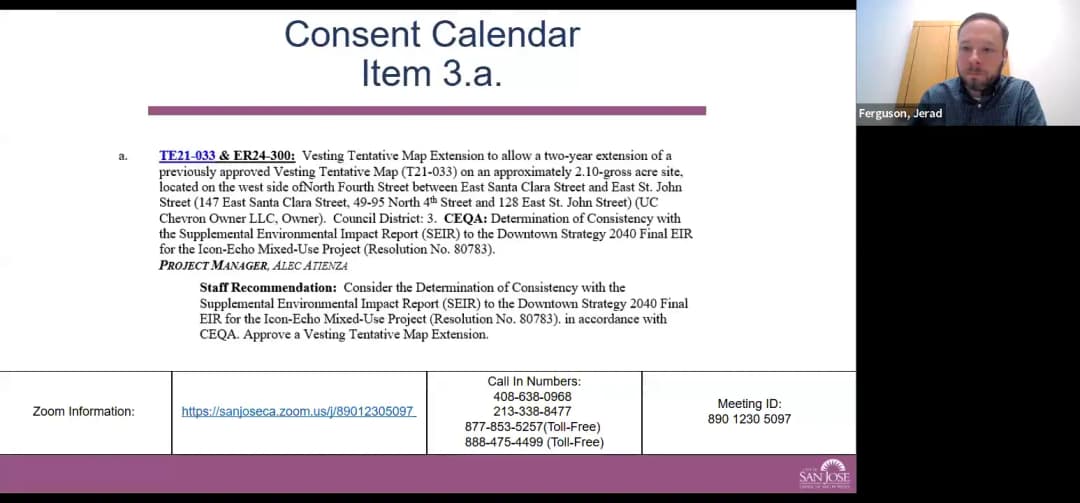
The planning director hearing was called to order by Hearing Officer Jared Ferguson on behalf of Director Christopher Burton. The meeting was held via Zoom. The sole substantive item was a request for a two-year extension of a previously approved vesting tentative map for the Icon Echo Mixed Use Project, along with a CEQA determination. No deferrals were requested or made. Consent Calendar - Item 3A (TE21-033 / ER24-300) was initially listed on the consent calendar. After a public hand was raised to speak, the hearing officer moved it to the public hearing portion for separate discussion. - No other consent items were discussed. Public Comments & Testimony - Rigo Gallardo, representing NorthCal Carpenters Union Local 405, expressed concern about Urban Catalytics' lack of commitment to hiring a responsible contractor on the project. He stated the developer is unwilling to pay prevailing standard wages and opts for low-road contractors, which exploits the workforce and jeopardizes quality. He urged the developer to prioritize a responsible contractor who pays area wages and hires from credited apprenticeship programs. He said if the developer cannot make this commitment, the site would be better served by a developer who values the community and workforce. Discussion Items - Staff project manager Alec Atienza briefed the hearing officer on the extension request, noting the applicant sought a two-year extension allowed under Title 19 of the municipal code. The new expiration date would be May 29, 2027, and no physical changes are proposed to the associated mixed-use project. - The applicant's representative confirmed no further comment but was available for questions. - Hearing Officer Jared Ferguson responded to the public comment by explaining that wage and hiring practices are not directly within his consideration for this extension approval. He acknowledged the city has certain rules around wages and enforcement, including recent approvals such as the responsible contractor ordinance. Key Outcomes - The hearing officer approved the staff recommendation, including a determination of consistency with the supplemental environmental impact report (SEIR) to the Downtown Strategy 2040 Final EIR (Resolution 80783) under CEQA. - Approved TE21-033, granting a two-year extension of the previously approved vesting tentative map for the Icon Echo Mixed Use Project, located on approximately 2.10 gross acres on the west side of North 4th Street between East Santa Clara Street and East St. John Street, in Council District 3. - The new expiration date for the map is May 29, 2027. - The hearing was then concluded with no further items.
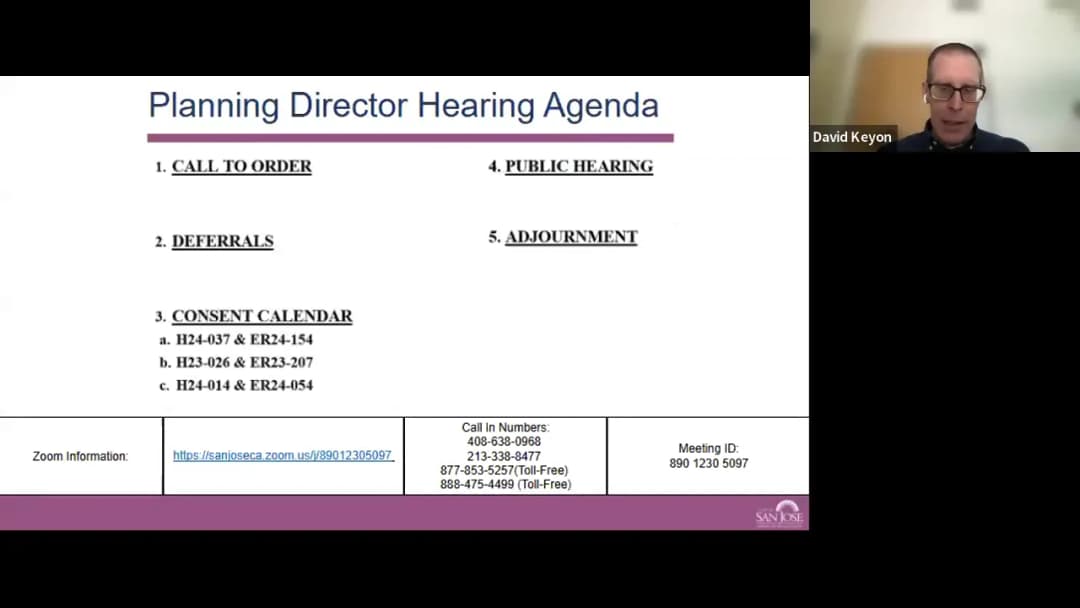
The hearing, presided by Hearing Officer David Keon, convened on January 8, 2025, at 9:00 AM and adjourned at 9:10 AM. The agenda included a consent calendar with two items and one discussion item that was deferred. No public comment was received. Consent Calendar - Item 3A (H24-037, ER24-154): Site development permit to legalize removal of a garage door, garage conversion to living space, installation of a bay window, and construction of an addition and attached patio cover to a non-conforming single-family house (approx. 900 sq ft) on a 0.15-acre lot at 2107 Short Ridge Avenue. CEQA exempt. - Item 3C (H24-045, ER24-160): Site development permit to legalize conversion of a one-bedroom to a two-bedroom unit and replacement of an existing garage with a new garage and attached carport on a non-conforming single-family house (approx. 1,200 sq ft) on a 0.64-acre lot at 909 Coleman Avenue. CEQA exempt. - Both items were approved unanimously without discussion. Discussion Items - Item 3B (H23026, ER23207): Site development permit for removal of four trees (including three ordinance-sized) and construction of a surface parking lot with 93 spaces on a 0.87-acre vacant site adjacent to Westgate Community Bible Church at 5220 and 5330 Prospect Road. Project Manager Cora McDonald requested the item be dropped and renoticed for the January 22, 2025, hearing because the prior demolition of an existing fast-food restaurant on the site was not included in the project description. The applicant agreed. The hearing officer opened a brief public hearing on the deferral; no public comment was received. The item was dropped and will be renoticed for January 22, 2025. Key Outcomes - Consent calendar items 3A and 3C were approved. - Item 3B was deferred to the January 22, 2025, director's hearing with new noticing required. - The hearing adjourned at 9:10 AM.
December 11, 2024 The San Jose Planning Director's Hearing convened on December 11, 2024, at 9:00 AM via Zoom, with Martina Davis serving as the hearing officer. The meeting addressed a consent calendar of routine items denials, one item moved to public hearing, and a public hearing item for an eight-unit residential project. Key actions included the approval of the consent calendar and the conditional approval of both public hearing items, subject to state housing laws and CEQA exemptions. No items were deferred.
The San Jose Planning Commission met on December 4, 2024, at 6:30 PM. The meeting included a consent calendar, two public hearing items, and public comment. The commission approved a deferral, adopted the consent calendar, recommended approval of an ordinance to allow residential uses in three neighborhood business districts, and recommended approval of a streamlined review process for infill housing projects. Consent Calendar - Item A: Minutes from the November 20, 2024 meeting were approved. - Item B: CP24-023 and ER24-094, a conditional use permit for a utility facility including an 85-foot lattice tower at 3601 Williams Road, was approved. - The consent calendar was adopted by a unanimous vote of 9-0. Public Comments & Testimony - Non-agendized Public Comment: One speaker requested that the city consider reinstating remote public comment, noting the difficulty of attending in person. Commissioner Lardnois requested staff to ask the city clerk for an update on remote public comment. - Public Hearing on PP24-011 (Streamlined Review): Multiple speakers addressed the commission: - Sandra Delvin opposed the elimination of public comment, stating, "We need more public comment and outreach." She requested more time and outreach, including from the new council members. - Rick Aitor argued that the absence of community input and environmental reviews is a significant concern, stating, "No one in the city feels like they have a say." - Jake Wilde (Catalyze SV) supported the policy, noting it was part of the housing element, and suggested that the only thing worse than no community meeting is a frustrating one. - Manuel Salazar (SVM Home) strongly supported the ordinance, emphasizing the need to reduce costs and meet housing goals, and requested future expansions. - Elizabeth Conlin (South Bay YIMBY) urged bold action, arguing the proposed policy is too narrow and should be expanded to more areas and allow limited waivers. - Dan Brown opposed bypassing neighborhood input, stating, "Not having the neighbors input is kind of starting off being a bad neighbor." Discussion Items - PP24-010: Ordinance Update for Residential Uses in Neighborhood Business Districts (NBDs): Staff presented a city-initiated ordinance to allow residential uses with specific development standards in the Japantown (Taylor Street only), North 13th Street, and Willow Glen NBDs. The ordinance updates the zoning map and code to implement a 2021 General Plan amendment. Community meetings were held in October 2024 with 6, 14, and 33 attendees, respectively. The proposed development standards include maximum densities of 50-65 dwelling units per acre and heights of 50-65 feet, with commercial replacement requirements. The commission discussed the no-net-loss provision (SB 330) and the HCD deadline. Commissioner Lardnois moved to approve the staff recommendation, seconded by Vice Chair Cantrell. The motion passed 9-0. - PP24-011: Streamlined Review Process for Infill Housing: Staff presented an ordinance to create a local ministerial approval process for eligible residential projects, as required by Housing Element Program P7. The ordinance would apply to approximately 600 acres in growth areas (urban villages, specific plans, station areas) and require a minimum density of 40 dwelling units per acre, no demolition of rent-controlled or recently occupied units, and compliance with objective standards. Projects would be exempt from CEQA and public hearings. Standard permit conditions were introduced for air quality, biological resources, hazards, noise, vibration, and tribal cultural resources. Staff noted that the average review time for ministerial permits is 10 months vs. 20 months for discretionary permits. Public outreach included a virtual meeting with 30 participants and meetings with stakeholder groups. Commissioner Lardnois moved to approve the staff recommendation, seconded by Commissioner Young. After extensive discussion (including concerns about public input, the pace of development, and the need to update the community outreach policy), the motion passed 7-1, with Commissioner Oliverio voting no and Commissioner Barosio absent. Key Outcomes - Deferral: CP 24-016 and ER24-145 (utility facility) were deferred unanimously (9-0). - Consent Calendar: Approved unanimously (9-0). - PP24-010 (NBD Overlay): The commission recommended approval to City Council by a vote of 9-0. - PP24-011 (Streamlined Review): The commission recommended approval to City Council by a vote of 7-1, with one absence. The staff recommendation was amended to include additional standard permit conditions as resolved by the commission. - Referral: Staff was directed to request an update from the city clerk on remote public comment. - Future Action: The City Council will hold public hearings on both ordinance items. The commission noted the importance of updating the community outreach policy (6-30) in 2025 to address public input for ministerial permits.
This meeting was a study session of the San Jose Planning Commission focused on the presentation of the 2024 General Plan Annual Performance Review Report for fiscal year 2023-2024. Staff presented highlights across the 12 major strategies of the Envision San Jose 2040 General Plan, followed by questions and discussion from commissioners. No public comments were offered for non-agendized items, and no formal votes were taken. Public Comments & Testimony - No members of the public came forward to provide comment on non-agendized items. Discussion Items - Presentation of the 2024 General Plan Annual Performance Review Report: Staff (Laura and David) presented key data for fiscal year 2023-2024, including: - Community-Based Planning: Since FY 2011-2012, the number of community meetings has remained steady; in FY 2023-2024, in-person meetings had significantly higher attendance than virtual ones. - Form-Based Plan & Growth Areas: 80% of residential, 86% of commercial, and 77% of industrial development since FY 2011-2012 occurred within designated growth areas. In FY 2023-2024, 66% of residential, 74% of commercial, and 100% of industrial development occurred in growth areas. ADU production increased after a brief decline. - Housing Production: Since FY 2011-2012, about 34,600 building permits for housing units were issued, averaging 2,666 units per year. Multifamily production rebounded in FY 2023-2024, nearing average levels. Single-family production increased to 52 units. ADU production increased after a decline in FY 2022-2023. - Non-Residential Development: Commercial production dropped to nearly its lowest level (698,000 sq ft) in FY 2023-2024, while industrial production continued to increase (840,000 sq ft). - Urban Villages: 16 urban village plans adopted; the Five Wounds Urban Village Plan is anticipated in spring 2025. New planning processes started for Saratoga and East Side Alum Rock. - Downtown: Office vacancy rate increased from 30% to 31%. Downtown events attracted over 2.5 million attendees in FY 2023-2024, surpassing pre-COVID levels. - Innovation & Regional Employment: Population declined for three consecutive years to 969,491 (down from 1,049,187 in 2020). San Jose has the lowest jobs-to-employed-resident ratio (0.79) among surrounding cities. - Transportation & Mode Share: The drive-alone mode share target is 45% by 2030 and 25% by 2040. Transit mode share has not increased post-pandemic. The city installed 17.6 miles of new on-street bikeways. - Climate Smart: San Jose is on track to meet its Climate Smart emissions reduction path by 2050 but slightly above the path to achieve carbon neutrality by 2030. - Fiscal Health: The adopted FY 2023-2024 budget totaled $6.13 billion, with a forecasted shortfall of $3.6 million for the next fiscal year. - Parks & Trails: Five new park openings, 3 miles of new trails, and over 57 Viva Park events. - Trail Network: 64.9 miles of off-street trails completed; goal of 100 miles. - Commissioner Questions and Clarifications: - Commissioner asked about the housing dashboard usage and adoption rates. Staff (Michelle Flores) noted that they do not have data yet but can look into it. - Commissioner questioned the lack of transit mode share improvement despite investments. Staff noted pandemic impacts and that DOT is working on transit priority projects; the Transit First Policy was adopted in 2022. Data on transit ridership may be provided in future reports. - Commissioner noted that the mode share data appeared inconsistent due to different data sources (American Community Survey vs. location data for 2022). DOT has purchased big data to improve future reports. - Commissioner asked about the decline in commercial construction. Staff attributed it to high office vacancy (31%) and hybrid/remote work; industrial construction remains strong. - Commissioner inquired about the Google downtown project status. Staff reported that entitlements are still valid (until 2051) but no active planning permits have been submitted. - Commissioner expressed confusion about the Climate Smart graph; staff clarified that the orange dots represent the city's progress, which is tracking the carbon neutral pathway. - Commissioner suggested expanding the 'healthful community' strategy (Strategy 11) beyond transportation to include indicators like access to healthy food, healthcare, and parks. Staff noted that the upcoming Environmental Justice Element (part of the TRI-E updates) will address many of these topics, and the General Plan Four-Year Review (starting 2026) could expand the strategy. - Commissioner asked about the jobs-to-employed-resident ratio and why it hasn't improved despite population decline. Staff explained that job losses (tech layoffs) and the addition of employed residents (even with job gains) have kept the ratio low. Remote work also affects tax revenue allocation. - Commissioner suggested a comparative analysis with cities like Fremont that have improved their ratio. Staff indicated that the Planning Department does not track that, but the Office of Economic Development might have information. Key Outcomes - No formal votes or decisions were made during this study session. - Staff noted that the next General Plan Four-Year Review is anticipated to begin in 2026 to prepare for the seventh cycle housing element. - The TRI-E Elements update (Open Space, Safety, and new Environmental Justice Element) is expected to be completed by January 1, 2026. - The Planning Division housing team is planning a study session with the Planning Commission in March 2025 to discuss the Housing Element Annual Report before submission to HCD. - The meeting was adjourned for a dinner break, with the regular session to reconvene at 6:30 PM in the council chambers.
The meeting convened at 9:57 a.m. (adjournment) to consider several items, including a deferral, a consent calendar, and two public hearing items. The hearing officer approved a deferral, a consent calendar item, and two major development permits after receiving public testimony and staff presentations. Consent Calendar - Item 3B (SP 24-013, ER24-076) – Approved without public comment. This special use permit allowed tree removal for a duplex addition and detached garage at 5092 and 5090 (address incomplete). Public Comments & Testimony - Item 3A (Caltrain project): - Jordan Moldell (District 3 resident) expressed disappointment in the high number of vehicle parking spaces (noting AB 2097), concern that it would induce driving and endanger cyclists on San Fernando Street, but praised the bicycle parking provision. - David Beatty (Executive Director, Santa Clara & San Benito Counties Building Trades Council) spoke in support of the project, urging a Project Labor Agreement (PLA) to ensure livable wages and apprenticeship standards. - Eli Robles (Carpenter's Local 405) supported the project and urged union labor standards. - Item 4A (Tesla/Arcadia project): - Samir questioned whether the auto service use (with electric batteries) should be classified as light industrial rather than commercial, and raised concerns about the environmental impact report. - Eli Robles (Carpenter's Local 405) opposed the project, stating the developer chose a contractor with a labor dispute that pays workers $20/hour, calling it exploitation. - Kiki (chairwoman, Tamien Nation) requested that cultural monitors be present during ground disturbance, noting a prior discovery of human remains nearby. She stated an agreement had been reached with Arcadia but was stalled due to Arcadia’s demand for $4 million in insurance, which she called unattainable for tribal monitors. - Adenola Kilo (resident of adjacent Astronaut community) voiced safety concerns about traffic, speeding cars on single-lane streets, Tesla’s history of improper hazardous waste disposal, and proximity to a softball complex used by children and seniors. - Tracy Carrasco (Tamien Nation) reiterated the request for a monitoring agreement as a condition of approval, asking the director to delay approval or require the agreement. Discussion Items - Item 2A (Deferral) – H24-037 and ER24-154: A site development permit for a 412 sq ft addition and 480 sq ft covered patio, plus legalization of a front bay window at 2107 Short Rich Avenue. Deferred to January 8, 2025, at staff’s request. - Item 3A (H22-031, ER22-186) – Caltrain project: Site development permit for removal of 86 trees (68 ordinance-size, 18 non-ordinance) and construction of two 16-story commercial office buildings (total 1.2 million sq ft) on 3.09 acres west of South Montgomery Street. The project includes four levels of underground parking, bicycle parking, ground-floor retail, and a publicly accessible plaza. Staff presented findings of consistency with the Downtown Strategy 2040 EIR addendum, zoning, and design guidelines. The applicant (Nadine Vogerty, Caltrain TOD director) emphasized the transit-oriented location adjacent to Diridon Station and future BART, community outreach, and a planned PLA. In response to parking concerns, she noted the amount was market-feasible and consistent with area projects; parking would be publicly accessible. The project was approved. - Item 4A (PD 23-017, ER23-209) – Tesla/Arcadia project: Plan development permit for a 50,323 sq ft auto sales and service building on 3.6 acres west of Elverley Place. Staff confirmed the use is allowed in the PD zoning district (citing CN and CP allowed uses). The project includes an infill exemption under CEQA. Public comments raised concerns about use classification, labor standards, tribal cultural resources, traffic, and hazardous waste. Staff responded that the site is within a planned development zone, fire code compliance will be enforced, traffic impact fees will be paid, and cultural resource conditions (monitoring by a culturally affiliated tribe) are required but the city does not specify a particular tribe or insurance terms. The applicant (Michael Fletcher, Arcadia Development) stated insurance requirements are set by their insurer and have been lowered as much as possible; another tribe has met the same requirements. The project was approved. Key Outcomes - Item 2A – Deferred to January 8, 2025. - Item 3B – Approved without discussion. - Item 3A – Approved (director’s decision). Staff recommendation to consider the CEQA addendum and approve the site development permit was adopted. - Item 4A – Approved (director’s decision). Staff recommendation to consider the CEQA exemption and approve the plan development permit was adopted. The hearing officer noted that any tribal monitoring agreement must be executed before ground disturbance, but the city does not mediate private insurance disputes. Meeting adjourned at 9:57 a.m.
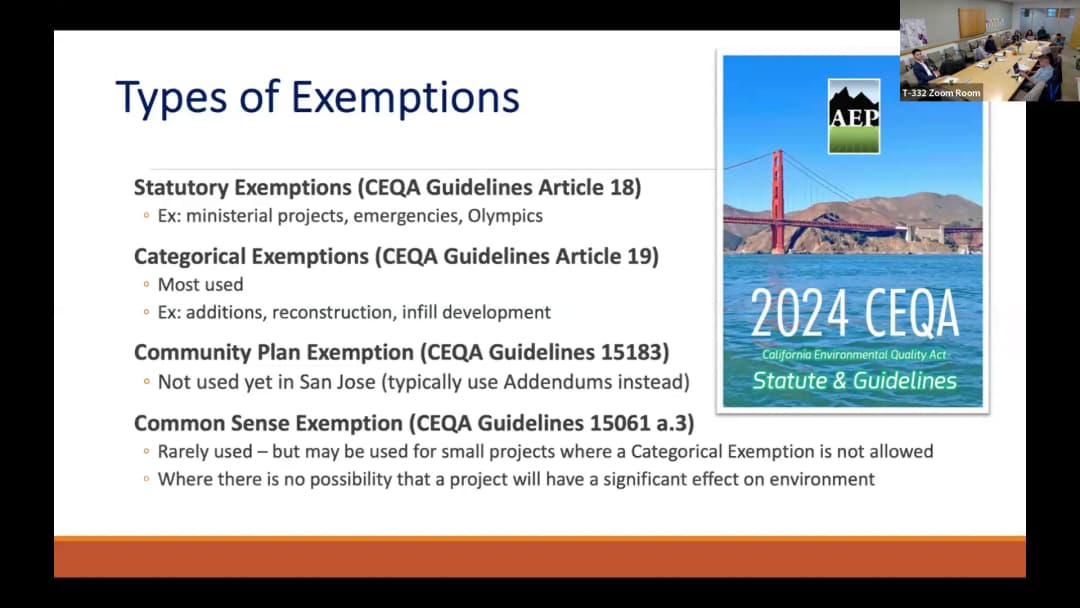
The San Jose Planning Commission held a study session on November 25, 2024, to discuss the cost of residential development, the city's development fee framework, long-term work plan, legislative updates (including the builder's remedy), and CEQA exemptions. The meeting also included a public comment period. Public Comments & Testimony - Maya (member of the public): Expressed interest in city improvement, noting that she has lived in San Jose for seven years and sees room for improvement. She mentioned the Burbank Theater area and suggested mixed-use development with studios and one- and two-bedroom apartments, as well as parking solutions. She also noted she has followed the Arts Commission and found it interesting. Discussion Items - Director's Opening Remarks (Chris): Thanked commissioners for their time and discussed the current moment in development, including the impact of state legislation on housing facilitation, the post-COVID office market collapse, and the importance of focusing on land use decisions within policy frameworks. He also addressed the role of the commission and encouraged open communication with staff. - Cost of Residential Development Study (Jared Ferguson, Principal Planner): Presented an update on the cost of development report, which began in 2018 to understand the economics of multifamily housing. The study uses conceptual prototypes (low-rise, mid-rise, high-rise) and shows that all residual land values are negative, indicating projects are infeasible even with zero land cost. Key drivers include a 27% increase in construction costs since the pandemic and rising interest rates. No market-rate high-density multifamily projects broke ground in 2024. - Development Fee Framework (Jared Ferguson): Outlined efforts to simplify and standardize fee administration, including aligning timing of payment, geography, and metric (square footage). The framework is being developed through a working group with multiple departments, with a draft policy expected for feedback in early 2025 and potential adoption by spring/summer. - Citywide Planning Work Plan (Ruth and others): Presented a dashboard showing 23 active projects with 19 staff. The long-term horizon extends to 2031, with mandatory state-mandated work (e.g., safety, open space, environmental justice elements) dominating capacity. The team is operating at about 92% capacity in the current fiscal year, and funding from permits is declining, raising concerns about future staffing. - Legislative Update (Danny, Principal Planner): Discussed the builder's remedy (AB 1893 and AB 1886), which clarifies the definition of "substantial compliance" with housing element certification and vests the builder's remedy at the time of preliminary application. AB 1893 writes the term into law, provides density maximums and minimums, lowers affordability set-asides (e.g., 7% for extremely low income, 10% for very low income, or 13% for lower income), and includes provisions that allow developers to choose which provisions apply, rendering projects infeasible. Danny expressed concern that these laws can allow development on employment lands and favor market-rate townhomes over affordable projects near transit. - CEQA Exemptions and Review (David Keon, Principal Planner): Provided an overview of CEQA exemptions, focusing on categorical exemptions (e.g., existing facilities, replacement/reconstruction, small structures, and infill development). Infill exemption (Section 15332) is the most common for substantial projects and requires consistency with general plan, no more than 5 acres, and technical studies to demonstrate no significant impacts. Exceptions (e.g., hazardous waste sites, historic resources, cumulative impacts) can kick projects out of exemption. Danny also noted that builder's remedy projects are attempting to use the infill exemption, but the city disputes this because they are not consistent with general plan designations; AB 1893 may allow it for CEQA purposes, but this is unresolved. Key Outcomes - No votes or formal decisions were taken; the session was informational. - Staff will continue to develop the fee framework and bring a draft policy to council in early 2025. - The citywide planning team will use the workload dashboard to communicate capacity constraints to council. - The legislative update clarified that many builder's remedy projects may be appealed to the director's level, but could come to the planning commission if appealed by the public. - Commissioners asked about pre-negotiating with labor unions to address CEQA litigation, and about exploring city financing (e.g., bond measures) to support housing development.