The commission heard a presentation from East Bay Agency for Children (EBAC) on their San Leandro Family Resource Center services, received updates on the annual Point-in-Time homeless count and commission elections, and discussed community programs including April Shower hygiene services. The meeting was called to order at 7:01 PM and adjourned at 7:35 PM. Presentation: East Bay Agency for Children (EBAC) - Stephanie Dragal (Program Director) and Selena Romero Perez (Bilingual Program Coordinator) presented on EBAC's mission to improve the well-being of children, youth, and families by reducing the impact of trauma and social inequities. - EBAC operates six Family Resource Centers in Alameda County; their San Leandro site at the Barbara Lee Center has been operating since 2014 with three staff members. - In the current year, they served 80 clients (57% from San Leandro), hosted parent cafes, and holiday events: Operation Cranberry Sauce provided 250 Thanksgiving meals with 60 volunteers; Toys for Tots provided gifts for 20 families. - Concrete supports included rent and bill assistance from a $220,000 grant, diapers, gift cards, and workshops on self-compassion, grief, and emergency preparedness. They served 273 drop-in visits and conducted outreach to over 1,000 people. - Partnerships: county health insurance and eligibility technicians on site, Crosswind Church for meals, and San Leandro Unified School District for referrals. - Outcomes: 100% of participants increased in at least one protective factor domain; 93% increased in nurturing and attachment, 86% in family function/resilience, and 93% in social supports. Satisfaction surveys showed high satisfaction. - Commissioners expressed appreciation for the specific numbers and direct impact. Consent Calendar - Approved minutes from the October 22, 2025 meeting (motion by Commissioner Lum, seconded by Commissioner Mason, unanimous). Staff Reports & Announcements Point-in-Time (PIT) Count Update - Commissioner O'Brien reported on the January 2026 unsheltered count (federally mandated every other year for unsheltered). - 18 teams and 52 volunteers participated (quota was 60). Teams deployed at 5 AM, including ARU and World Basquez Health Center teams. - One census tract not counted due to volunteer shortage. Data cleanup ongoing; numbers will be turned over to HUD in March, with public numbers expected in spring and a full report in summer. - Observations: a shift from unsheltered individuals to people living in cars/vans; more individuals found at parks. - Commissioners noted that lower counts could reduce funding for homeless programs, but hoped the new Llewellyn Center (Nimitz) is reducing homelessness. Commission Elections - Elections are scheduled for March per the commission handbook; nominations will be taken from the floor at the next meeting. Commissioners were reminded to consult potential nominees beforehand. Public Comments & Testimony - No public comments were received (no e-comments or in-person). Commission Reports & Announcements - Commissioner Roby expressed appreciation for the San Leandro Senior Center. - Commissioner O'Brien reported on the April Showers hygiene program: hours will shift from 11 AM–2 PM to 12 PM–3 PM starting July 5, 2026 to accommodate Sunday swimming. Demographics are shifting: more people in cars/vans; approximately 60–80 attendees per event, with 18–20 men and 8–12 women showering. The program provides food, clothing, and a small store (grant from San Lorenzo Community Church). Many attendees are working poor using gym memberships for showers. - Mentioned the Llewellyn Center (transitional housing and drop-in center) is doing well, with 29 transitional units and 19 people permanently housed. Key Outcomes - Unanimous approval of the consent calendar. - No action items; elections deferred to next meeting. - Staff will attempt to reschedule the missing presentation from Restorative Pathways (formerly Ruby's Place) for next month and bring a finalized calendar. - Meeting adjourned at 7:35 PM.

Public Meetings - San Leandro, California
Public Meetings - San Leandro, CaliforniaThe San Leandro Rules Committee met on July 22, 2026, at 9:00 AM to continue discussions on cannabis policy, specifically regarding the expansion of cannabis dispensary permits and related code amendments. The meeting was a continuation from May 27, 2026, and marked the ninth meeting on this topic. No formal action was taken; the committee did not reach consensus to forward a recommendation to the full City Council. Public Comments & Testimony - Michael Colbruno, representing HarborSide, commended the council for their thoughtful deliberation and staff professionalism. He urged the committee to provide clarity on where HarborSide could secure a permit, noting that a year had passed since the last permit award. - Zed Schlott, VP of Retail at HarborSide, stated that HarborSide employs 15 employees with competitive wages and benefits. He reported that since 2023, sales increased by over 200%, bringing additional tax revenue. He argued that current setbacks and restrictions make it nearly impossible to find compliant locations without cannibalizing existing operators, and urged expansion of zoning to allow operations in cannabis deserts in southern and eastern communities. Discussion Items - Staff Presentation (Deputy City Manager Eric Ingelbart): Staff recommended aligning setback requirements with state standards (600 feet from sensitive uses, eliminating the 500-foot residential setback), adopting the City of Alameda's youth center definition, and expanding allowed zoning districts to all commercial and industrial areas except downtown (per prior committee consensus). The legal analysis found that limiting permits to specific council districts (3 and 5) would be vulnerable to legal challenge without proper findings. - Councilmember Bowen questioned the rationale for district prioritization, noting that the legal analysis indicated it was likely illegal. She supported aligning with state law, the youth center definition, and expressed concern that the proposed map (showing eligible parcels in purple) was misleading because many parcels would not be viable due to additional subjective findings and public hearings. She requested that staff clarify the practical viability and process for council. - Mayor González expressed concern about reducing the school setback from 1,000 to 600 feet, but acknowledged it might not be a real issue. He raised questions about the youth center definition, specifically regarding businesses like martial arts studios that operate for more than five hours but might not be considered youth centers under the proposed definition. He stated he would not support moving the item to council until the youth center definition was resolved to his satisfaction, and declined to craft language from the dais. - Councilmember Bowen indicated she was fine with the youth center definition and noted that daycares near schools might already create constraints. She suggested that the committee could forward the item to council with no recommendation if there was a stalemate. - The City Attorney clarified that conditional use permits run with the land, but additional operator permits and business licenses provide enforcement mechanisms. Key Outcomes - No formal action was taken; the committee was deadlocked on the youth center definition (Mayor González opposed the proposed definition, Councilmember Bowen supported it). - The committee did not reach consensus to forward a recommendation to the full City Council. Staff may present the item to council without a recommendation, or the item will be continued to a future rules committee meeting. - The council district prioritization approach was effectively abandoned due to legal concerns. - The committee agreed to continue discussions on the youth center definition, with Mayor González stating he would work on language with staff outside of the meeting, but no timeline was set. - The meeting adjourned at 9:55 AM.
The San Leandro City Council Rules Committee met on July 22, 2026, at 9:00 AM to continue discussion on cannabis policy and proposed code amendments, following multiple previous meetings. The meeting, chaired by Mayor Gonzalez, included Councilmember Bond and Councilmember Bowen (Councilmember Simon absent). Deputy City Manager Eric Ingelbart presented staff recommendations. No final recommendation to the full council was reached due to a stalemate on the definition of a youth center. Public Comments & Testimony - Michael Colbruno (representing HarborSide) commended the council and staff for thoughtful deliberation over nine meetings, emphasized the need for fairness, and requested that HarborSide be given certainty on where to locate a second permit. He noted HarborSide is a good community operator. - Zed Schlott (VP of Retail at HarborSide) reported that HarborSide employs 15 workers with competitive wages, has increased sales by over 200% since 2023 (bringing additional tax revenue), but finds current setbacks nearly impossible for compliant locations. He urged expansion of zoning to capture cannabis deserts in southern and eastern communities. Discussion Items - Staff Presentation (Eric Ingelbart): Provided a refresher on the history: since May 2025 the council has held 9 meetings on this topic. The city council earlier directed staff to explore expansion of cannabis licenses and treat operators comparably. In March 2026, the full council sent the item back to rules committee. At the May 2026 committee meeting, there was clear consensus to not allow downtown as an allowed area. Staff presented: - Youth Center Definition: Borrowed from City of Alameda; requires 5 hours/day of youth-serving activities to qualify. A compendium of definitions from other Alameda County jurisdictions was provided, most of which are broader. - Legal Analysis on Council District Prioritization: City Attorney advised that limiting permits to Districts 3 and 5 using political boundaries would require strong findings to avoid legal vulnerability; staff recommends using zoning code instead. - Distancing Requirements: Staff recommends aligning with state standard of 600 feet from sensitive uses (currently 1,000 feet in many cases) and eliminating the 500-foot residential setback, which staff called particularly challenging. Staff noted that most other Alameda County cities do not have a residential setback. - Zoning Districts: Staff recommended expanding allowed areas to all commercial and industrial zones (except downtown per earlier consensus). Maps showed estimated eligible parcels under current (orange) and proposed (purple) zones; staff cautioned that many purple parcels might not be viable due to other constraints. - Goal: To bring proposed code amendments to full council after receiving direction on distancing requirements, youth center definition, zoning districts, and council district prioritization. - Councilmember Bowen: Asked about the rationale for council district prioritization and why Districts 3 and 5 were mentioned. Mayor Gonzalez clarified that it was a creative idea but likely illegal. Bowen expressed support for aligning with state law, the youth center definition, and modifying zoning districts. She requested that when presented to full council, staff clarify that the purple map does not mean all parcels are viable, noting the conditional use permit process with multiple guardrails (public hearings, subjective findings, appeals). - Mayor Gonzalez: Questioned the need for expansion, noting no specific problem being solved. Expressed concern about reducing school setbacks from 1,000 to 600 feet. Raised issue with the youth center definition using a hypothetical martial arts studio open 5.5 hours/day; argued the definition remained confusing and exclusionary. He prefers a simpler threshold based on hours minors are present. Mayor refused to craft a definition from the dais and insisted on further workshopping before sending to council. He indicated he would not support moving to full council until the youth center definition is resolved. - Councilmember Bowen: Noted that many San Leandro schools already have daycares nearby, suggesting 600 vs. 1,000 feet may not be a real issue. She asked if daycares fall under the definition (staff said they are separate). She disagreed with Mayor’s approach, suggesting that if there is no consensus, the item could go to council without a committee recommendation. She questioned the process of a single member working with staff to change language. - City Manager & City Attorney: Clarified that conditional use permits run with the land, but there are enforcement levers via business licenses and operator permits. Noted that historically, San Leandro’s code was more conservative due to being an early adopter; staff recommends modernizing to align with current state and county standards. Key Outcomes - No consensus on youth center definition: Mayor Gonzalez opposed the current definition; Councilmember Bowen supported it. The Mayor wants further discussion to refine the definition before moving to full council. No motion was made to send the item to council. - Council district prioritization effectively dead: Mayor stated it is likely illegal; Councilmember Bowen agreed. Not recommended. - Sensitive use distancing (schools): Mayor expressed hesitation about reducing school setback to 600 feet; Councilmember Bowen believed it is not a practical issue. - Modified zoning districts: Both members appeared supportive, but the committee did not finalize a recommendation because of the stalemate on youth center definition. - Next steps: Staff will await further committee direction. The Mayor indicated a willingness to work with Councilmember Bowen to refine the youth center definition, but no timeline was set. The meeting adjourned at 9:55 AM.
The San Leandro City Council met on July 21, 2026, at 7:07 PM in City Council Chambers. Mayor Juan González III presided, with six members present (James Aguilar, Victor Aguilar Jr., Dylan Boldt, Xouhoa Bowen, Sbeydeh Viveros-Walton, and the Mayor) and one absent (Fred Simon). The meeting covered a consent calendar with routine approvals, two pulled items (Casa Peralta restoration study and ACTC grant applications), a public hearing on delinquent charges, an appointment to the Community Police Review Board, and adoption of an updated parking and transportation demand management ordinance. Consent Calendar - Approved 14 items unanimously, including: a $200,000 safety program agreement with Forensic Analytical Consulting; a $1,345,585 Bay Fair development plan update (MTC grant funded); a $976,775 construction contract for the Cary Haas Pedestrian Bridge replacement; a $123,450 homeless outreach agreement with Building Futures; a $5,756,180 consulting agreement for the Bancroft/Williams crosstown corridors design; a $489,000 grant application for the LINKS shuttle program; a $35,000 pretreatment program review; acceptance of a $25,000 Kaiser Permanente grant; a $190,635 landscaping contract amendment; a $318,498 wall repair at Marina Community Center; amendments for IT support contracts; and minutes from the July 6 meeting. Public Comments & Testimony - Consent Calendar (in person and online): Nine speakers addressed various items. One speaker questioned the $5.7 million crosstown corridor design as unnecessary given other road needs. Multiple speakers urged the city to apply for ACTC funding to fix Lake Chabot Road, calling it a critical fire evacuation route for the Bay-O-Vista neighborhood. Speakers criticized the $566,596 Casa Peralta study as too costly, offering instead a $20,000 update by the Historical Society, and requested that the council explore options like gifting the property to a nonprofit. Another note questioned a $5 million discrepancy in item 5F, but staff clarified it was a contingency amount. One speaker supported funding for Building Futures and the LINKS shuttle but questioned consulting overhead. - Public hearing on liens: One speaker asked whether parking tickets are included in the lien process (staff clarified they are not). - General public comments (3 online): Residents raised concerns about an unfenced PG&E lot near Fulton Avenue with homeless encampments; thanked police for releasing video of a May 7 incident; urged the city to consider a long-term lease for Casa Peralta to a restaurant; and asked for better management of bus stops and loitering near the navigation center. Discussion Items - Item 5e – Casa Peralta Restoration Study: Councilmember Dylan Boldt pulled the item, expressing the $566,596 cost was excessive for updating a 10-year-old assessment. Multiple council members supported sending the matter to the Facilities and Transportation Committee for broader discussion on funding and disposition options, including possible gifting to a nonprofit. The city attorney noted a deed restriction requiring first offer to the donor family before transfer. A motion to refer to committee passed 6–0. - Item 5g – ACTC Grant Applications for Four Projects: Vice Mayor Viveros-Walton initiated discussion on the process for selecting projects. Staff explained the competitive criteria and timeline (applications due July 27). Applications included $3.7 million for RESCUE (Bay Trail), $863,000 for East 14th Street lighting, $1.394 million for Fairway Drive traffic calming, and $495,000 for Safe Routes to School. Councilmember Victor Aguilar, the city’s ACTC representative, reported discussions with ACTC staff about viability of a Lake Chabot Road project. He moved to approve the four applications as amended to also explore submitting a grant for Lake Chabot Road without jeopardizing existing opportunities. The motion passed 6–0. - Item 10b – Parking and Transportation Demand Management Ordinance (Second Reading): Planning Manager Waylon Lee presented the ordinance, which updates off-street parking standards and adds TDM requirements. Mayor González expressed concerns about potential neighborhood parking impacts from reduced minimums and questioned the mandatory bicycle repair station requirement. Councilmember Bowen supported the policy direction but asked for clarification on the bike repair scope and alignment with Vision Zero. Councilmember Bolt favored the ordinance as encouraging housing development. The ordinance passed 5–1, with Mayor González voting no. Key Outcomes - Consent Calendar approved unanimously, with items 5e and 5g removed for separate action. - Item 5e (Casa Peralta) referred to the Facilities and Transportation Committee for further analysis of funding and disposition options (vote 6–0). - Item 5g (ACTC Grant Applications) approved as amended to include exploring a Lake Chabot Road grant application, provided existing awards are not jeopardized (vote 6–0). Resolutions 2026-109 through 2026-112 adopted. - Public Hearing on Liens: The council adopted resolutions imposing $753,000 in liens on 257 delinquent accounts for solid waste, code enforcement, and other charges, and overruled protests (vote 6–0). - Appointment of David Jackson to the Community Police Review Board approved unanimously (Min Order 2026-025). - Parking and TDM Ordinance adopted (Ordinance 2026-009) by a 5–1 vote, with Mayor González dissenting. - Next Steps: The city manager and staff to pursue grant applications for the four ACTC projects and initiate conversations with ACTC regarding Lake Chabot Road. The Casa Peralta matter will be added to a Facilities and Transportation Committee agenda.
The San Leandro Senior Commission met on July 20, 2026, at 10:00 AM. The meeting included approval of June minutes, staff reports on recent events and grant awards, a discussion on age-friendly priority projects, and an update on Alameda County budget developments. Commissioners also addressed participation expectations and planned a coffee social for later in the week. Consent Calendar - Approved the draft minutes of the June 18, 2026 meeting unanimously (7-0, with two excused absences). City Staff Reports & Announcements - 250th Independence Celebration (July 4, 2026): Commissioners Bella and Laura reported a well-organized event with good food, music, and a VIP area, though note that stairs were a mobility challenge. - 2026 Annual Senior Resource Fair (June 30): 61 vendors, over 200 attendees, and 93 completed surveys. Feedback was overwhelmingly positive; suggestions included better signage for back rooms. - Caregiver Focus Support Focus Group (July 14): First listening session facilitated by Karen Grimsich (former executive director of Alzheimer's Services of the East Bay). Three commissioners attended; common challenges among family caregivers were identified. - Grant Application Updates: - Awarded a $25,000 Kaiser Permanente community health grant to sustain the senior food delivery program. - Applied for an Area Agency on Aging grant of $112,000/year for caregiver support services, including memory cafes, caregiver appreciation events, trainings, and subsidized recreational services. This one-year contract may be extended up to three additional years. - Paratransit Program Update: The FY 2026-27 proposal was approved by Alameda County Transportation Commission and City Council, sustaining flex shuttle, flex on-demand (subsidized Uber), senior day trips, senior evacuation pilot, and ride care programs. Public Comments & Testimony - No public comments were made. Discussion Items - Commission Commitments and Expectations: Chair Watchison addressed no-shows at the resource fair, emphasizing the need to honor sign-ups and communicate cancellations. Staff agreed to send reminders three days before events and to place RSVP requests prominently in emails. - July Coffee with Senior Commission Event: Scheduled for Thursday, July 22 (or 23?) at 9:30 AM in the activity room. Three commissioners will participate; no quorum permitted. Promotion via flyers, Facebook, and in-person announcements. - Age-Friendly Priority Projects Discussion: Staff presented three priority areas: caregiver support (memory cafes, focus groups, trainings, appreciation event), personal protection (cybersecurity workshops, senior evacuation pilot, emergency preparedness, safe routes to senior centers), and promotion/outreach (presentations, expo, community events). The commission agreed to integrate these discussions into regular monthly meetings rather than forming separate committees, with action items agendized for September on memory cafes, safe routes, and the senior services expo. - Alameda County Budget Developments: Commissioner Brennan summarized the county budget, noting $19.3 million invested in healthcare to eliminate 92 proposed layoffs and a strategic priority to secure sustainable funding for senior services. Staff confirmed $6 million of Measure W funds for the Area Agency on Aging. Key Outcomes - Approvals: Consent calendar (June minutes) approved. - Grants: Kaiser grant ($25,000) and proposed AAA grant ($112,000) noted; contract negotiations underway. - Paratransit: Contracts being executed; programs continue. - Commitment to Projects: Commission will use regular meeting agendas to focus on age-friendly priority projects, starting in September. - Coffee Event: Three commissioners confirmed for July 22 coffee; no quorum rules stressed. - Next Meeting: Commission will recess in August, next meeting September 2026. Commission Reports & Announcements - Chair Watchison visited former commissioners at a senior living facility. - Commissioner Brennan raised e-bike safety concerns at a coffee with Senator Grayson and Supervisor Tam, noting two state bills pending. - Commissioner Camillo suggested a senior prom event and a caregiver registry for middle-income families. - The meeting adjourned at 11:17 AM.
The San Leandro Culture and Library Commission met on June 16, 2026, at 2:30 PM. Chair Miller presided with seven commissioners present, achieving a quorum. The meeting covered a new library meeting room and facilities policy, updates on the grants program and several subcommittees, and a staff report on volunteer requirements for commissioners. Consent Calendar - The commission unanimously approved the minutes of the May 19, 2026 meeting. Public Comments & Testimony - No members of the public were present, and no e-comments were submitted. The public comment period was closed. Discussion Items - Library Department Meeting Room and Facilities Policy (Item 6A): Library staff presented a comprehensive new policy for meeting room and facility use, replacing previous brief guidelines. Key elements include: a fee structure aligned with the Recreation Department to prevent "facility shopping"; free use for events that are free and open to the public (e.g., nonprofits offering free programs); paid rental for private, invitation-only events or for-profit events that charge attendance fees; and a limit of 18 rentals per group per calendar year to prevent any single group from dominating the rooms. The policy took effect July 1, 2026, after review by the city attorney. Commissioners asked about the Casa Peralta grounds (explained as falling under the library because of its historic component) and the lecture hall's performance capabilities (noted as seating 214 with a good sound system and wings). The policy will also help grantees under the commission's grants program, who can use the rooms for free during their grant period. No action was required. - Commissioner Communication and the Brown Act: A discussion clarified that full-commission email chains could be considered an unagendized meeting under the Brown Act. Subcommittees (with fewer than five commissioners) may communicate via email about their specific topics without violation. New commissioners were invited to join existing subcommittees, provided the subcommittee stays under the quorum threshold of four members. Subcommittee Reports - Grants Committee (Item 8A): Staff reported that all FY25 grant payments have been issued. The committee is reviewing final reports from grantees to ensure funds were spent according to approved budget plans. A summary report on outcomes (including three funded murals visible around the city) will be presented at the July meeting. One commissioner noted they would be unavailable for two weeks starting the following Monday. - 2026 Game of Shrooms Committee (Item 8B): A report highlighted a highly successful event on Saturday, June 13, 2026. Approximately 20 people came in the morning to hide art, and about 50 people participated in the hunt. The event drew attendees who were not typical library patrons, and one person reportedly got a library card even though they didn't find any mushrooms. The founder of Game of Shrooms ("Attaboy") featured video of the event in his annual thank-you message. An artist hid pieces using the card catalog and posted clues on Instagram; all pieces were found. Staff and volunteers praised the team effort, including two pre-event art-making gatherings that supplied enough art. Lessons included better tracking of hidden pieces to ensure nothing is left behind. - Latinx Youth Writing Workshop Committee (Item 8C): The commissioner leading this effort reported that due to other commitments, they cannot execute the project at this time. They did not want to cancel the idea permanently, but will revisit it later. The commission agreed to remove the item from the agenda unless it is revived. - Library Bike Tour Committee (Item 8D): The commissioner reported that the subcommittee has not yet met. A draft sponsorship list and template still need to be created. The event is tentatively planned for a Saturday in June 2027, avoiding conflicts with Game of Shrooms and the Cherry Festival. The timeline allows a full year for planning. - Poetry Contest Committee (Item 8E): The subcommittee has not met since the previous meeting, so there is nothing to report. Key Outcomes - Minutes approved: Unanimously approved (7-0). - New meeting room policy: Effective July 1, 2026; presented to the commission for information, no vote required. - Latinx Youth Writing Workshop: Removed from the agenda; the commissioner will revisit later if interest and capacity align. - Future meetings: The next regular meeting will be in July 2026 (date not specified). - Adjournment: The meeting was adjourned at 3:11 PM (local time) following a unanimous vote.
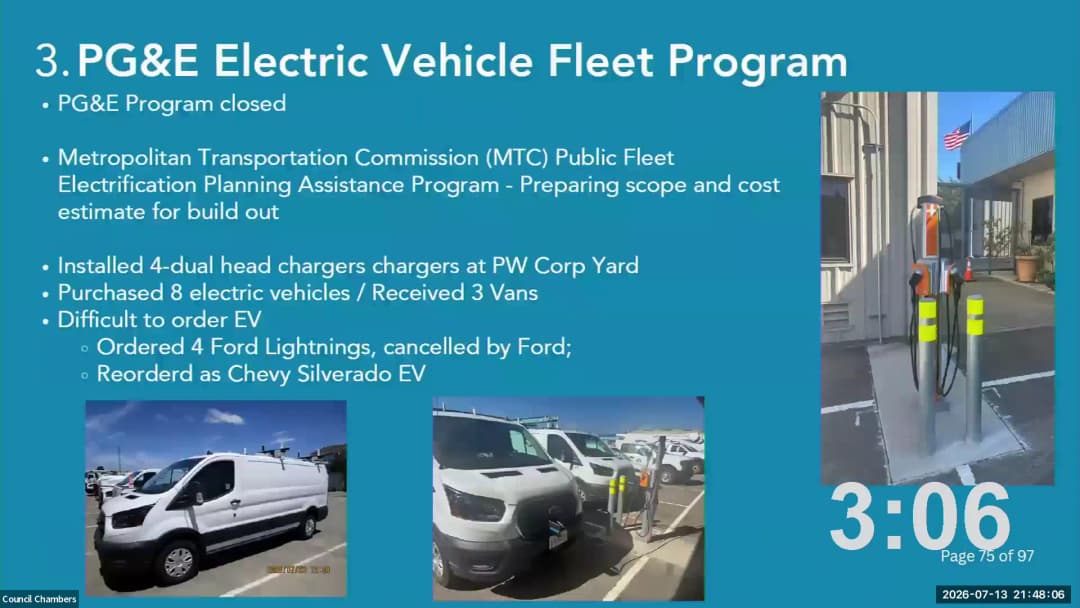
This work session focused on updates to the city's five priority work plans (Quality of Life, Economic Development, Public Safety, Infrastructure, Housing & Homelessness), plus a presentation from AC Transit on budget challenges and proposed service reductions. No formal actions were taken on the work plans; the meeting adjourned in memory of Supervisor Scott Hagerty. Presentations AC Transit Budget and Service Updates - Diane Castleberry (AC Transit) and Owen Christopherson outlined AC Transit's critical role, serving 13 cities with 40 million rides annually and over 140,000 weekday riders. Nearly two‐thirds of riders are low‑income. AC Transit projects a $200 million deficit over four years, necessitating potential service cuts of up to 16% if new funding is not secured. A state bridge loan of $55 million will close the current year’s gap but must be repaid. The proposed Connect Bay Area Act (November ballot) would generate an estimated $52 million annually for AC Transit through a half‑cent sales tax. - Owen Christopherson presented a contingency service plan preserving the primary route network but reducing frequency on lines 9, 97, 28, 34, 35, 40, and 93. If funding is secured, the plan will not be implemented. The AC Transit Board will consider approval in December 2026, with changes effective June 2027. Council Priority Work Plan Updates Quality of Life (Library Director Brian Simons, Recreation & Parks Director Vicente Zuniga) - Completed/on‑track: arts grants program ($30,000 funded), expanded art gallery spaces, cultural events (1,100 library events this fiscal year), native/drought‑tolerant plant initiative, tree canopy coverage (secured $244,000 state grant), litter receptacle upgrades, recreation programming (tripled all‑age offerings, $180,000 invested in food access for 23,000 residents), senior services expansion, and continued joint‑use agreements with San Leandro Unified School District. Economic Development (Economic Development Manager Katie Bowman) - Progress on: supporting target industries (clean tech, advanced manufacturing), retail attraction plan, city brand assessment (moving to ideation phase), zoning code update (delayed to Q3 2027), real estate assessment, public‑private partnership evaluation, commercial incentive programs ($5,000 grant streamlined), workforce training (San Leandro First Jobs manufacturing internship), and small business support (monthly advising at Chamber). Public Safety (Captain Ape Tang, Emergency Services Specialist Elizabeth Bessman) - Staffing: on track to meet hiring milestones (78% authorized by end of FY26, 82% by FY27), but traffic unit replacements on hold due to retirements/separations. - Animal control: transitioning from a dedicated animal control officer to cross‑trained police service technicians (PSTs) providing 24/7 coverage. Citations increased from 38 in all of 2025 to 70 in Jan–May 2026. - Encampment removals: exceeding goals, averaging 1 cleanup per week (target 3 per quarter); biweekly coordination with Union Pacific Railroad Police. - Emergency management: local hazard mitigation plan out for public comment through July 24; wildfire preparedness workshop and CERT training completed. Infrastructure (Assistant Public Works Director Nick Tom, City Engineer Jason Mai) - Stormwater fee update: beginning July 2026; fee has been unchanged since 1993. - EV fleet transition: PG&E program fully committed; city is purchasing EVs but deliveries delayed (only 3 of 8 ordered received). - CIP projects: Memorial Park, fuel tank projects complete; Carrie Haas Bridge on schedule; Lake Chabot Road delayed one quarter due to NEPA clearance; MacArthur roundabout delayed to January 2028. - Environmental programs: Trash‑Free San Leandro Initiative launched, green business certification expanded. Housing & Homelessness (Deputy City Manager Jessica Loberon, Housing Manager Carrie Husler, Planning Manager Wayland Lee) - Homelessness prevention rental assistance: launched April 2026, served 8 households (7 with minor children). - Rent program implementation: ordinance adopted, software completed, staff hired; full program launch January 2027. - Mobile home rent stabilization: timeline extended to allow phased outreach; draft ordinance expected in 2028. - Local preference disparate impact study: staff recommends discontinuing due to cost and lack of current affordable housing projects impacted. - Llewellyn Interim Housing & Drop‑in Center: 618 individuals accessed drop‑in; 36 moved from shelter to permanent housing in the first year. - Housing production: updated impact fees (reduced/eliminated for ADUs and deed‑restricted affordable), amended parking requirements, Bayfair TOD planning (funded by $1.8 million MTC grant), and development tracking improvements. Public Comments & Testimony - Alvaro Ramos (on AC Transit): expressed support for extending bus rapid transit, opposed AI use, called for more comfortable bus stops and bus lanes on East 14th and Mission. Later, on housing, urged financial assistance (medical debt, credit union options) and criticized work requirements. - Douglas Spaulding (on AC Transit): supported the November ballot measure, asked for rationale behind cuts to lines 97 and 9. Later, praised the work plan breadth but urged immediate attention to data centers and quicker action on mobile home rent stabilization. - Ginny Madsen (on housing): supported rent registry enforcement, urged faster process for mobile home rent stabilization (only 9 parks), and criticized delays on local preference policy. - Mike Katz‑Lakabe (on public safety): noted it has been over 65 days since a police‑involved shooting at the marina (May 7) and that AB 748 requires release of critical incident video within 45 days; called for prompt release and accountability. - Emily Grego (Chamber of Commerce): thanked staff for collaboration, highlighted workforce development workshops, and noted difficulty with translation for some Asian‑owned restaurants. Key Outcomes - The meeting adjourned in memory of former Supervisor Scott Hagerty. - Motions to extend the meeting by 30 minutes (4‑1) and by 15 minutes (5‑0) were approved. - No votes were taken on work plan items; updates were informational. Several staff recommendations to discontinue or defer specific deliverables were noted (EV fleet PG&E program, local preference disparate impact study, animal control officer transition).
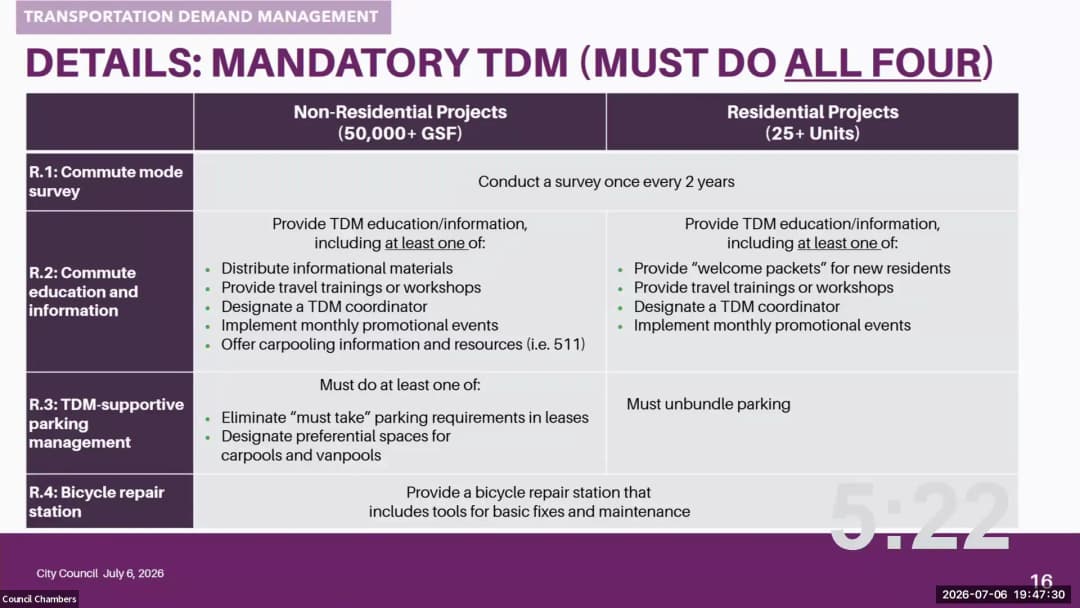
The San Leandro City Council met on July 8, 2026, at 7:06 PM in City Council Chambers (with teleconference participation). Mayor Juan González III presided. Five councilmembers were present (James Aguilar, Dylan Boldt, Xouhoa Bowen, Fred Simon, González); Victor Aguilar Jr. and Sbeydeh Viveros-Walton were absent. Key actions included approval of the consent calendar, a first reading of a zoning code amendment reducing parking minimums and establishing Transportation Demand Management (TDM) regulations, unanimous appointment of an interim police chief, and a decision to postpone a business license tax modernization measure to the November 2028 election. The meeting adjourned at 9:31 PM. Consent Calendar - Adopted (5-0-2) with no items pulled for separate discussion. Included: - Second reading of Ordinance 2026-007 prohibiting landlords from passing through the Rent Stabilization Program fee to tenants. - Resolution 2026-087: $300,000 agreement with Cognizant Technology Solutions for ERP post-go-live support and data migration. - Resolution 2026-088: Lease amendment with As Kneaded café at Main Library, reducing rent by $363.29 per month. - Resolution 2026-089: Acceptance of $50,000 donation from Friends of the Library for summer programs. - Resolution 2026-090: Acceptance of $154,722 in Transportation Development Act grant funds for crosswalk and sidewalk projects. - Resolution 2026-091: Measure BB funds ($1,826,461) for paratransit services. - Resolution 2026-092: Amendment No. 3 with David Sams for golf operations oversight ($81,600). - Resolution 2026-093: Amendment No. 3 with ANI Private Security ($68,792). - Resolution 2026-094: Certification of June 2, 2026 special municipal election results. - Motion 2026-024: Nomination of David Jackson to the Community Police Review Board. - Approval of minutes from May 27 (Finance), June 15 (Council), and June 24 (Rules) meetings. Public Comments & Testimony - Consent Calendar: Jenny Madsen and Douglas Spaulding spoke in support of the rent stabilization fee prohibition. Douglas Spaulding also thanked the mayor for the CPRB appointment and supported the As Kneaded lease reduction. Lucas commented that the pass-through prohibition may be ineffective in practice because landlords can bundle fees into overall rent increases, and urged careful stewardship of funds. - General Public Comments (non-agenda): Multiple residents (Marquita Banks, Linda Austin, Virginia Oxley) complained about parking restrictions in District 2 near San Leandro High School, especially ticketing on Saturdays and holidays, arguing residents cannot park near their homes. Jenny Madsen raised concerns about private equity firm ProLogis buying up warehouses. Mike Katzlacabe urged a ban on data centers due to high water/electricity use, noise pollution, and minimal local economic benefit. Douglas Spaulding supported studying a data center moratorium. - Public Hearing – Parking/TDM Ordinance: Alvaro Ramos requested that single-family and two-family parking minimums also be reduced, and asked about biodiversity lighting standards. - Action Item – Business License Tax: Eight speakers commented. Kristen Anderson (business owner), Emily Grego (San Leandro Chamber of Commerce), and David Stark (Bay East Association of Realtors) urged caution, citing the need for more business outreach and citing Union City’s two-year process. Jenny Madsen noted ACA 22 (constitutional amendment requiring 2/3 voter approval for special taxes, effective 2027). Douglas Spaulding and Lucas supported moving forward, arguing businesses are undertaxed relative to other cities. Camille Bowler worried about businesses leaving. Alvaro Ramos asked for rationale on the 25% discount for large businesses. Discussion Items 1. First Reading of Zoning Code Amendments – Parking and TDM (Item 8a) - Staff (Lourdes Suarez, Brian Kanepa, Alex McCurry) presented findings that current parking minimums exceed peak demand, increasing housing costs. Proposed two parking zones: a “blue” zone within ½‑mile of major transit stops (eliminating most minimums per AB 2097) and a “green” zone (outside) with reduced minimums (e.g., residential reduced by about 0.5 space/unit). TDM requirements apply to new developments of 25+ units or 50,000+ sq ft non-residential, including mandatory measures (mode share survey, education, bike repair station) and at least one optional measure (e.g., flexible work, transit benefits). Unbundled parking required for projects with 5+ units (expanding state law). Bicycle parking requirements decoupled from vehicle parking. Councilmember Bowen expressed support, noting alignment with housing element goals and regional trends. Councilmember Simon asked about enforcement for storefronts without parking. Mayor González voiced concern about potential spillover parking into neighborhoods and requested more time. The motion to approve (Bowen/Simon) passed 4-1 (González against; both absent). The ordinance will return for a second reading as a discussion item, not on consent. - Key speaker positions: Lourdes Suarez (staff) support; Brian Kanepa (consultant) support; Alex McCurry (consultant) support; Alvaro Ramos (public) supported broader reductions; Mayor González expressed concerns. 2. Appointment of Interim Police Chief (Item 10a) - HR Director Emily Hung recommended appointing retired annuitant Joseph Kreins as interim chief while Chief Angela Averett is on leave. No public comments. Unanimously approved (5-0-2). 3. Business License Tax Modernization (Item 10b) - Deputy City Manager Eric Ingelbart reviewed the process since February 2025. The June 8 council direction led to modifications: no tax changes for property rental and mobile home parks; increased warehouse rate to $4.50 per $1,000 gross receipts; 25% discount for businesses with $50M gross receipts. Two options were presented: place on November 2026 ballot or continue analysis for November 2028. Public comments were heavily opposed to rushing. Councilmember Bowen moved to defer to 2028 to allow more business outreach and analysis. Councilmember Bolt opposed, arguing the city needs revenue and the work is sufficient; he noted San Leandro’s current taxes are far lower than neighboring cities (e.g., $10,000/yr for a $400M retailer vs. nearly $1M in Oakland). The motion carried 4-1 (Bolt nay; two absent). Key Outcomes - Consent Calendar approved (5-0-2). - Parking/TDM Ordinance first reading approved (4-1-2); second reading set for future discussion. - Interim Police Chief appointment approved (5-0-2). - Business License Tax modernization postponed; staff directed to continue fiscal analysis and public outreach for the November 2028 election (4-1-2). - Council reports: Councilmember Bowen announced election as first vice president of StopWaste; Councilmember James Aguilar praised the city’s 250th celebration and Workday implementation; Mayor González highlighted wildfire risk education, California Conservation Corps visit, and the on-time implementation of the new ERP system.
The San Leandro Senior Commission met on Thursday, June 18, 2026, at 10:00 AM at the Senior Community Center. The meeting was called to order by Chair Watchison, with all nine commissioners present. Key topics included a debrief of the Cherry Festival parade, a proposed shift to quarterly age-friendly initiative updates with subcommittees, a discussion on lunch/coffee outreach with seniors, and a vote to cancel the August 2026 meeting. The meeting adjourned at 11:34 AM. Consent Calendar - The draft minutes of the May 21, 2026 meeting were approved with two abstentions (Commissioners Brennan and Rickson). Public Comments & Testimony - Representatives from MV Transportation (account manager Pauline Coleman Collins, safety and training manager Darren Watson, mechanic Celicity Clement William, and assistant general manager Juan) spoke to express gratitude for the partnership and noted the ease of removing windows for the parade shuttle. - Other MV staff praised the event, highlighting the visibility and enjoyment of the seniors on the bus. Discussion Items - Annual Senior Resource Fair: Human Services Program Coordinator Liliana Gray reported that the fair will be held June 30, 2026, 10:00 AM – 1:00 PM. 51 vendors are confirmed; last year saw about 200 attendees. A non-partisan project called America 250 will record seniors' stories at the fair. - Senior Services Updates: Gray reported a successful May day trip to Faloli House and Gardens (two shuttles, 28 seniors) and a Juneteenth celebration co-hosted with HHREC and Brilliant Mind Project, featuring African drumming, poetry, and quilt displays. - Cherry Festival Parade Debrief: Commissioners and staff praised the parade, noting strong community visibility. Suggestions included reducing wind-prone decorations (e.g., fans) and continuing to promote paratransit services (goal: 5% annual utilization increase). - Age-Friendly Initiative Priorities and Next Steps: Pedro proposed shifting to quarterly updates and forming three subcommittees (max 4 people each) on caregiver support, safe routes for seniors (already includes Chair Watchison, Vice Chair Comelo, Commissioners Pena and Brennan), promotion/outreach, and personal protection (including evacuation planning). Commissioners expressed support, asking for scope statements and a ranked-choice assignment process in July. Commissioner Brennan noted the need to avoid Brown Act issues for subcommittees. - Lunch with Seniors Discussion: After debate, the commission agreed to pilot a "Coffee with the Commissioners" event on Thursday, July 23, 2026, from 9:30–10:30 AM in the activity room, with four commissioners (Dylan, Pena, McMichael Cady, and Lopez Nicario) participating as a group of less than a quorum. Individual lunches with seniors remain optional. - San Leandro Improvement Association (SLIA) Discussion: Pedro confirmed SLIA is open to presenting; September or October 2026 is being considered. - County Budget Reductions Discussion: Commissioner Brennan raised concerns about potential cuts to senior social services. Pedro noted a county budget hearing scheduled for June 18, 2026 (2–5 PM, continued June 22), and offered to share the link. Key Outcomes - Approved consent calendar minutes (May 21, 2026) with two abstentions. - The commission voted unanimously to cancel the August 2026 meeting (motion by Commissioner Pena, seconded by Commissioner Lopez Nicario). - A pilot "Coffee with the Commissioners" event was scheduled for July 23, 2026, 9:30–10:30 AM, with signage to be placed. Performance will determine frequency. - Staff will bring scope statements and assignment process for age-friendly subcommittees to the July 2026 meeting. - New Commissioner Ann Rickson (27-year San Leandro resident, retired social service executive and LCSW, teaching at San Francisco State University) was officially welcomed.
Note: The meeting agenda and transcript indicate the meeting occurred on June 4, 2026, but the provided metadata states the meeting took place on June 23, 2026. This summary uses the date provided in the metadata as instructed. The meeting was called to order with all seven commissioners present. The consent calendar (minutes from May 7, 2026) was approved with one abstention. The main item was a public hearing on a resolution to amend the city's ADU and JADU zoning code to comply with recent state legislation. After staff presentation, commissioner questions, and no public testimony, the commission voted unanimously to recommend the amendments to the City Council. Additional staff updates covered the city's housing element annual progress report. Consent Calendar - Approved draft minutes of the May 7, 2026 Planning Commission meeting. Motion passed 6-0-1 (one abstention). Public Comments & Testimony - No members of the public spoke on any agenda item. Discussion Items - Zoning Code Amendments for ADUs and JADUs (ZCA26-002): Staff presented proposed updates to San Leandro Zoning Code Sections 1.12.108 and 2.04.388 to align with state law changes enacted since the last update in 2022. Key changes included allowing up to four ADU/JADU units on single-family lots, up to eight detached ADUs on existing multifamily properties, reduced review timelines (15 days for completeness, 60 days total for decision), HOA non-interference, and clarified multifamily definitions. Commissioners asked detailed questions about setbacks (required front yard definition, four-foot rear/side setback for detached ADUs, exception for replacement of existing structures), height limits (16 feet generally, 18 feet within half-mile of transit, 25 feet for attached ADUs), review process (no new comments after first review unless design changes), parking (state prohibits requiring parking for ADUs), square footage calculations (JADU square footage counts toward primary dwelling for 1200 sq ft cap), unpermitted ADU legalization (city must approve unless health/safety issue), and efficiency kitchen standards (liberal interpretation). Staff clarified that ADUs cannot be used for short-term rentals (must be 30+ days). Commissioner Rich expressed support, noting ADUs are the main source of new housing units, and asked about pre-approved plans (staff noted a process exists but no applications yet). - Housing Element Annual Progress Report (APR): Staff provided an update on the calendar year 2025 APR submitted to HCD. Over the first three years of the eight-year housing element cycle (2023-2031), the city has permitted 398 units, about 10% of the 3,855-unit goal. For ADUs specifically, the city has exceeded two-thirds of its 256-unit target. Staff noted over 4,000 units in the development pipeline and highlighted pro-housing initiatives including a rent registry and park impact fee restructuring. Key Outcomes - Unanimous Vote (7-0): The Planning Commission adopted Resolution No. 2026-XX recommending the City Council approve the zoning code amendments for ADUs and JADUs. The resolution will be forwarded to the City Council for final action. - Staff will continue to track housing production and implementation of the housing element.