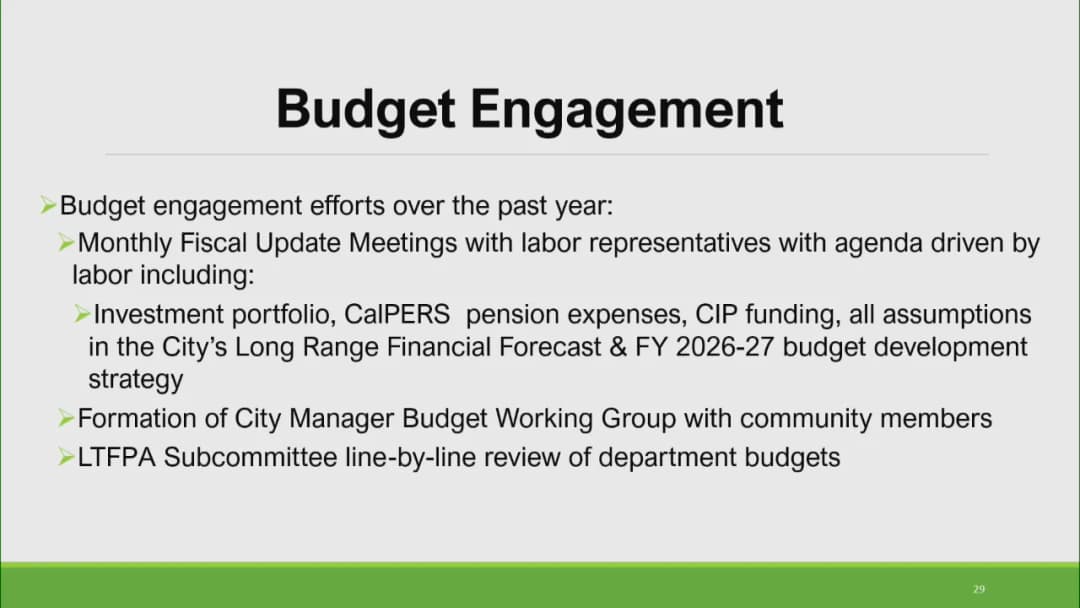
The Santa Rosa City Council held a regular meeting on June 16, 2026, beginning at 2:00 PM with a study session and reconvening at 4:00 PM for the regular session, adjourning at 9:02 PM. The meeting included a study session on the Downtown Economic Development Strategy, a proclamation for LGBTQ+ Pride Month, approval of a 21-item consent calendar, adoption of the FY 2026-27 budget and capital improvement program, and receipt of the Independent Police Auditor’s annual report. The council also approved revised fees for Sonoma County Animal Services and made appointments to the Library Commission and the RED Housing Fund Board. Consent Calendar - Approved 21 consent items (13.1-13.21) by a 7-0 vote. Key approvals included: - Purchase of video wall communication system components for the Emergency Operations Center from Coda Technology Group for $253,465.88 (Item 13.1). - First Amendment to professional services agreement with The Lew Edwards Group, increasing compensation by $40,750 to a total not to exceed $133,500, extending term to December 31, 2026 (Item 13.2). - Second Amendment to blanket purchase order with Canyon Rock Co., Inc. (dba River Ready Mix) for $100,000 increase, total not to exceed $172,000 (Item 13.3). - Five-year professional services agreement with WorkCare, Inc. for police wellness services, not to exceed $985,000 (Item 13.4). - Third Amendment with Jones Lang LaSalle Americas, Inc. for real estate brokerage services, increasing compensation by $200,000 to $498,000, extending term to December 31, 2028 (Item 13.5). - Professional services agreement with Conger Moss Guillard (CMG) Landscape Architects for the Santa Rosa Southeast Greenway master planning and design, total $2,671,409 (Item 13.6). - Fifth Amendment with Woolpert, Inc. for software license extension and purchase of Trimble “Unity” platform for $191,400, total not to exceed $2,514,867 (Item 13.7). - Second Amendment with Woolpert, Inc. for expanded services and Unity upgrade, total $401,000 (Item 13.8). - Adoption of the 2025 Urban Water Management Plan and 2025 Water Shortage Contingency Plan via Resolution RES-026-063 (Item 13.9). - Approval of nine administrative cost recovery liens for code enforcement violations via Resolution RES-026-064 (Item 13.10). - Professional services agreement with BKF Engineers for the North Santa Rosa Station Area Specific Plan Update and Subsequent Environmental Impact Report, appropriating $443,685 (including $300,000 MTC grant) via Resolution RES-026-065 (Item 13.11). - Adoption of the Article XIIIB appropriations limit for FY 2026-27 at $375,054,000 via Resolution RES-026-066 (Item 13.12). - Approval of acquisition of 2908 Santa Rosa Avenue for Fire Station No. 9, with $1,650,000 from Measure H reserves, via Resolution RES-026-067 (Item 13.13). - Extension of the local homeless emergency proclamation via Resolution RES-026-068 (Item 13.14). - Authorization to amend the Permanent Local Housing Allocation (PLHA) Plan to receive Round 5 funding via Resolution RES-026-069 (Item 13.15). - Approval of funding and operating agreements for the Safe Parking Program for FY 2026-27, accepting $979,040 from County of Sonoma (Measure O and HHAP funds) with total program cost not to exceed $1,000,000, via Resolution RES-026-070 (Item 13.16). - First Amendment to grant agreement for Keep People Housed (KPH) – Sonoma with COTS, extending term to June 30, 2027 and increasing compensation by $250,000 to $1,550,000, via Resolution RES-026-071 (Item 13.17). - Approval of FY 2026/2027 grant agreements for public services (Living Room, Catholic Charities) and fair housing (Fair Housing Advocates) totaling $3,177,647, with $100,000 from Homeless Reserves for Caritas Drop-In Center, via Resolution RES-026-072 (Item 13.18). - Adoption of classification and compensation study implementation, including new classifications, salary ranges, and updated Salary Plan, via Resolution RES-026-073 (Item 13.19). - Second reading adoption of ordinance establishing monthly salary of $28,452.33 ($341,428 annually) for the Interim City Manager (ORD-2026-012) (Item 13.20). - Second reading adoption of ordinance establishing monthly salary of $25,480.00 ($305,760 annually) for the City Attorney (ORD-2026-013) (Item 13.21). Public Comments & Testimony - Study Session on Downtown Economic Development Strategy: Several speakers expressed support for Option 3 (property exchange). Omar Lopez (Generation Housing) and Jenni Klose (Generation Housing) spoke in support. Ananda Sweet (Santa Rosa Metro Chamber) supported the item. Duane DeWitt and Fred Allebach raised skepticism, with Allebach cautioning against gentrification and displacement. - Consent Calendar: Duane DeWitt commented on items 13.6, 13.11, 13.15, and 13.18, urging authentic community engagement. Michael Hilber opposed items 13.16 (Safe Parking) and 13.17 (Keep People Housed), calling them wasteful. - Public Comment on Non-Agenda Matters (Item 14): Multiple speakers from the North Bay Organizing Project and community members raised concerns about the city’s contract with Flock Safety for automated license plate readers, citing data breaches, privacy risks, and potential violation of state laws. Speakers included Cameron Miller, Syrah Schween, Camille Escovedo, Jenny Gilpin, Noa Lewin, Joy Ayodele, and Sophia Norton. - Public Hearing on Budget: Jenni Gilpin spoke in support of funding for public safety but opposed Flock Safety. Duane DeWitt suggested wage freezes. Michael Hilber supported using roller compacted concrete for street resurfacing. - Independent Police Auditor Report: Michael Hilber criticized the police response to an incident near St. Rose Church. Discussion Items - Study Session – Downtown Economic Development Strategy (4.1): Staff presented three options: (1) maintain status quo (costly, no economic growth), (2) build new city hall ($82 million+), (3) property exchange – exchanging the City Hall campus (7 acres) for a new building, unlocking the site for mixed-use development (hotel, apartments, condos, retail, office, civic space). Projected new annual recurring revenue of $1.6–$1.8 million, with $8.4–$9.3 million in new downtown spending. Councilmembers unanimously supported Option 3, citing fiscal necessity and economic catalyst potential. Council directed staff to pursue the property exchange. - City Manager’s Litigation Report (9.1): Acting City Attorney Autumn Luna reported two settlements finalized in May: Pearson v. City of Santa Rosa ($3.68 million – $1M city, $2.68M risk pool) and settlement with former City Attorney Teresa Stricker ($145,000). Active caseload of 27 litigation matters with trial dates on 30%. - Council Reports: Councilmember Alvarez requested a future agenda item to develop an ordinance addressing unpermitted food vendors with a focus on environmental impact (grease disposal). Councilmember Rogers concurred. The request will be agendized for a future vote. - Appointments: - Sonoma County Library Commission (11.2.1): Appointed Sarah Laggos as City/County representative and Josh Hamzehee as City representative (6-0-1, Rogers absent). - RED Housing Fund Board (11.3.1): Appointed David Gouin to a second four-year term retroactive to March 15, 2026 (7-0). - Public Hearing on FY 2026-27 Budget (16.1): CFO Scott Wagner presented the proposed budget. The general fund budget has a deficit of $7.8 million (after adjustments), addressed through $9.5 million in expense reductions including elimination of 25 FTEs, strategic reserve use ($7.8 million), and pension savings. Year two (2027-28) projected deficit of $9.8 million, potentially requiring deeper cuts if no new revenue is found. Illustrative cuts presented: police (11 positions), fire (8 positions, one station closure), recreation, parks, public works, and other departments. Council adopted the budget via several resolutions. Also assigned $4.5 million from general fund reserves for critical facility needs (City Hall campus). - Independent Police Auditor Annual Report (15.1): Stephen Connolly (OIR Group) presented the report covering calendar year 2025. 55 misconduct allegations were processed; 17 were sustained. Highlights included real-time monitoring, participation in officer interviews, and system recommendations. Council received and filed the report. - Sonoma County Animal Services Revised Fees (15.2): Staff and SCAS representatives presented revised fee schedules effective July 1, 2026, with modest increases (mostly $1–$2) to improve cost recovery while maintaining access. Council approved Resolution RES-2026-080 (6-0, Fleming absent). Key Outcomes - Downtown Economic Development: Council directed staff to pursue Option 3 (property exchange) to redevelop the City Hall campus and create a new city hub. - FY 2026-27 Budget Adopted: Approved five resolutions: - Transportation and Public Works budget and staffing changes (6-0, MacDonald recused). - Primary budget, full-time equivalent staffing changes, Storm Water Assessment, and Public Safety and Prevention Implementation Plan (7-0). - Assignment of $4.5 million in reserves for critical facility needs (affirmed by consensus). - Consent Agenda: All 21 items approved 7-0. - Appointments: Library Commission appointees (6-0-1) and RED Housing Fund Board appointee (7-0). - Animal Services Fees: Resolution adopted (6-0). - Police Auditor Report: Received and filed. - Food Vendor Ordinance: Councilmember Alvarez’s request to agendize a future discussion on unpermitted food vendors was seconded and will be placed on a future agenda.
Public Meetings - Santa Rosa, California
Public Meetings - Santa Rosa, CaliforniaThe Santa Rosa City Council held a regular meeting on June 2, 2026, beginning with a closed session at 2:01 PM and a study session at 3:00 PM, followed by the regular session at 4:00 PM. The meeting included a housing strategy study session, a public hearing on water management, reports on community engagement and pension liability, and adoption of consent items. A key focus was direction on optional state housing policies and a major pension reform action. Housing Strategy Study Session (Item 4.1) - Planning staff presented the city’s housing strategy, highlighting compliance with state law, community needs, and the use of specific plans and incentive programs to promote housing production, particularly downtown and near transit. - Council discussed two optional state policies: Senate Bill 10 (SB 10), which allows rezoning for up to 10 units per parcel near transit or infill sites, and Assembly Bill 1033 (AB 1033), which permits separate sale of accessory dwelling units (ADUs) via a condominium model to boost homeownership. Public Comments on Housing Strategy - Duane De Witt (Sonoma County Housing Advocacy Group) and Adrian Covert (Santa Rosa YIMBY) expressed full support for adopting SB 10 and AB 1033 to increase housing supply and address affordability. - Paul Schwartz (Generation Housing/Corcoran Icon Properties) supported both policies, emphasizing housing as foundational for the economy. - John Contreras (Providence Foundation) urged support for housing options to retain families and support healthcare access. - Stephanie (Generation Housing) supported both policies, noting SB 10 enables desirable housing types like duplexes and triplexes. - Ananda Sweet (Santa Rosa Metro Chamber) supported exploring innovative housing approaches. - Nic Passarell and Rachel Jeffries (Habitat for Humanity) supported SB 10 and AB 1033 for creating affordable homeownership. - Paul Shawl (Santa Rosa Mobile Home Owners Association) supported affordable housing. - Valerie Schlafke supported senior communities and a senior overlay on senior parks. - Janice Karmann discussed 55-year mortgages and creative funding. Key Outcomes on Housing Strategy - Council gave staff direction to move forward with exploring adoption of AB 1033 within existing staff capacity and without impacting current projects. - Council directed staff to schedule a future study session on SB 10 with analysis of options, impacts, and timelines, also without affecting ongoing projects. Public Hearing: 2025 Urban Water Management Plan & Water Shortage Contingency Plan (Item 16.1) - The hearing was held to receive public comments on the draft plans, which assess long-term water supply reliability and shortage response. Staff confirmed projected supplies meet demand through 2050, even with new planned developments. No public comments were made; adoption will be considered at the June 16, 2026 meeting. Let’s Talk, Santa Rosa Report (Item 15.1) - Staff presented results from a community survey (over 2,200 responses) ranking city service priorities: maintaining 9-1-1 emergency medical/fire response ranked highest, followed by ties for second. Qualitative feedback highlighted concerns about public safety, street conditions, homelessness, and affordability. Council unanimously voted to receive the report. CalPERS “Fresh Start” Pension Reform (Item 15.3) - Chief Financial Officer Scott Wagner presented a resolution to authorize a re-amortization of the city’s $482 million unfunded accrued liability (UAL) through CalPERS’ Fresh Start program, combined with a strategic drawdown of $26 million in restricted pension funds. The strategy is projected to save $28 million over five years, $37 million overall, and retire the UAL six years earlier than scheduled. Key Outcomes on Pension Reform - Council unanimously (6-0) adopted Resolution RES-2026-054, authorizing the city manager to execute the amendment and approving the strategic use of $26 million in restricted pension funds. Consent Calendar - All consent items were approved in a single motion (6-0) with the following specifics: - Item 13.9 (FY 2026/2027 Grant Agreements) continued to June 16, 2026. - Item 13.14 (Wildland Urban Interface Code update) passed 5-0-1 (Mayor Stapp recused, Councilmember Fleming absent). - Approved consent items (13.1–13.18) include: - Abandoned vehicle abatement services agreement ($300,000). - Amendment to records management agreement with Sonoma County ($700,000 total). - Amendment for environmental logistics services ($449,000 total). - Pavement maintenance contract award ($708,400). - Purchase of six vocational trucks ($1,644,781.13). - Cooperative agreement with Caltrans ($170,000). - Construction/funding agreement with SMART ($1,181,887.50). - Utility easement grant for Hearn Community Hub. - Six administrative hearing officer service agreements ($300,000 aggregate). - Election resolutions for November 3, 2026 municipal election. - Appointment of Jason Nutt as Interim City Manager (salary $341,428/year). - Appointment of Ashle Crocker as City Attorney (salary $305,760/year). - Second reading adoption of Wildland Urban Interface Code update. - Second reading adoption of Open Government Code update (SB 707). - Pre-zoning of 1977 Marsh Road to Rural Residential. - Text amendment to Spring Lake Village Planned Development. - Rezoning for Spring Lake Village East Grove Project. Proclamations and Presentations - Council proclaimed May 2026 as Foster Care Awareness Month and recognized May 24, 2026 as Eritrean Independence Day. Staff Briefings and Reports - Community Empowerment Plan update presented (Item 8.1). - Independent Police Auditor Annual Report continued to June 16, 2026. - City Manager reported on Calistoga Road pavement project, new HAWK signal at Fulton Road, and Live at Juilliard concert series. Public Comments on Non-Agenda Matters - Diane Ballard opposed a community garden at Westgate Park, preferring children’s play space. - Duane De Witt raised concerns about transient activity and fire risk at Roseland Creek. - Patrice Doyle requested road repavement in the Creekside neighborhood. Public Comments on Consent Items (Item 13.14 - Wildland Urban Interface Map) - Multiple speakers (Jennifer McNeil, Don Nauman, Patrice Doyle, Susan Lamont, Gail Seymour) opposed the updated Wildland Urban Interface (WUI) map, arguing it would cause insurance premium increases/cancellations and that Creekside neighborhood is not high fire risk. They requested a 90-day stay and equal presentation time. Several incorporated formal objections into the record.
The Santa Rosa Planning Commission met on May 28, 2026, to consider two major agenda items: a conditional use permit and hillside development permit for the Stonehouse Hotel expansion, and a consistency determination for the Fiscal Year 2026–2027 Capital Improvement Program (CIP) with the General Plan 2050. The meeting included staff presentations, public testimony, and commission deliberations. Consent Calendar - Approval of Minutes: The draft minutes from the previous meeting were approved as submitted with no corrections. - Commissioner Reports: Staff acknowledged Assistant City Attorney Ashley Crocker, who is transitioning to City Attorney; she has provided legal support to the Planning Commission since 2017 and previously served as a commission member. Public Comments & Testimony Stonehouse Hotel (CUP & HDP) - Fred Olibach (neighbor): Expressed neutrality but urged the commission to secure workforce housing fees and a community workforce agreement for union wages; also raised concerns about Sunridge Drive traffic. - Deb Grabian (255 Brush Creek resident): Opposed, citing severe traffic congestion on Highway 12, dangerous single ingress/egress across a pedestrian walkway, noise from a rooftop terrace/pool, and lack of architectural compatibility with the historic Stonehouse. - Carolyn Kohlschweiser (120 Massimo Circle): Raised concerns about noise from the pool and bar area, lack of on-site management, and past events (fireworks, food trucks); also criticized the new building's design as not matching the historic stone house. - Greg Hamblin (128 Massimo Circle): Opposed, emphasizing noise from pool, fire pits, and bar; requested a solid eight-foot sound wall (precast or cement block) for security and noise mitigation. - Roy Tashera (124 Massimo Circle): Strongly opposed, citing 42 years of quiet neighborhood, potential property value loss ($100k–$200k), dangerous right-turn onto Highway 12 at 40 mph, and inadequate noise/visual barriers. - Helgi Toshera (124 Massimo Circle): Opposed, stating the project would negatively impact their property 20 feet away; noise from the existing hotel’s 10 rooms is already heard; asked commissioners to consider if they would want this behind their own homes. - Nicole Shannard (173 Wailupa Circle): Criticized aesthetics, stating the 70-room design is too large for the location and does not relate to the historic Stonehouse. Capital Improvement Program (CIP) - No public comments were submitted. Discussion Items Stonehouse Hotel – Major Conditional Use Permit (CUP) and Hillside Development Permit (HDP) - Staff Presentation (Suzanne Hartman): The project proposes a new 70-room hotel building and renovation of the existing Stonehouse Hotel into five boutique rooms, totaling 75 rooms on a two-acre site at 331 & 355 Highway 12. Parking: 77 spaces (2 over minimum). Height: max 34 feet (elevator tower 36 feet). Setbacks comply with hillside standards. Tree replacement: 66 on-site plus in-lieu fee for 42 trees. CEQA: Class 32 categorical exemption for infill. Traffic: Transportation & Public Works waived a full operational study because projected daily trips (under 400 vehicles/day) are considered low volume; the submitted traffic letter addresses operational issues. Noise study found compliance with city standards (ambient +5 dB). Conditions prohibit public food/beverage service without further review. - Applicant Presentation (Randy Figueroa, Tierney Ferrito Architects): Described site design – new building stepped up hillside, partially recessed parking garage, preservation of existing stone house, and provision of an eight-foot sound wall along some property boundaries. Pool and bar are hotel guest amenities only, not public. The rooftop “terrace” is an interior courtyard atop the parking garage surrounded by rooms, not a high-activity area. - Commission Deliberation: - Commissioner Sisko: Supported, noting adequate studies and ability to make all findings. - Commissioner Horton: Supported, aligned with Sisko. - Commissioner Sanders: Opposed, citing insufficient assurance that the pool/bar would not be a nuisance given lack of defined operating hours and potential large events; could not make finding D. - Commissioner Carter: Opposed, stating traffic analysis was insufficient (no operational study despite potentially 250 trips/day), grading appeared aggressive, and site plan might not be compatible with residential uses. - Acting Vice Chair Duggan: Supported, noting that pool hours could be conditioned and that city traffic staff approved the studies. - Vote on CUP: Motion passed 3–2 (Sisko, Horton, Duggan yes; Carter, Sanders no). - Vote on HDP: Motion passed 4–1 (Carter, Sisko, Horton, Duggan yes; Sanders no). The commission noted that the final decision is appealable within 10 calendar days to the City Clerk. Fiscal Year 2026–2027 Capital Improvement Program – General Plan Consistency - Staff Presentation (Sash Narbisla): Six new projects proposed: 1. Use of downtown parks development fees for downtown parks projects. 2. Transportation improvements on Bennett Valley Road and Maple Avenue (crosswalks, bike lanes, intersection safety). 3. Update of the Citywide Creek Master Plan (initial funding, likely needing additional fiscal year). 4. Stormwater capture and aquifer recharge feasibility studies. 5. Rehabilitation of 11,700 linear feet of trunk sewer and 31 manholes south of Ludwig Avenue. 6. (Not specifically detailed but included in list) The commission's consistency determination is not a CEQA project; each project will undergo individual environmental review later. - Commission Questions: Clarified that parks funding is limited to downtown zone; Creek Master Plan funding is initial; staff will follow up on why other zones aren't included. - Vote: Unanimous approval (5–0) with all members affirming that the six projects are consistent with General Plan 2050. Key Outcomes - Stonehouse Hotel Conditional Use Permit (CUP): Approved by a vote of 3–2. Conditions include no public food/beverage service without further review, noise mitigation measures (eight-foot sound wall), and likely operational hours for pool/bar (to be set by conditions). - Stonehouse Hotel Hillside Development Permit (HDP): Approved by a vote of 4–1. - CIP Consistency Determination: Unanimously approved (5–0) for the six new projects. - Next Steps: The Stonehouse Hotel decision becomes final unless appealed within 10 calendar days. The design review will be heard by the Design Review and Preservation Board next Thursday. The CIP projects will proceed to environmental review individually.
This special meeting of the Santa Rosa City Council on May 15, 2026, was held primarily to consider appointments in closed session. The council reconvened in open session to report its decisions. Public Comments & Testimony - No members of the public offered comments during the open session. Discussion Items - Report from Closed Session: The council reported the results of its deliberations on two key appointments. Key Outcomes - City Attorney Appointment: Ashley Crocker was appointed as City Attorney, effective June 3, 2026. The vote was 5–2. Voting in favor: Mayor Stopp, Vice Mayor Krepke, Councilmember Alvarez, Councilmember Rogers, and Councilmember McDonald. Voting against: Councilmember Fleming and Councilmember Van Wells. Note: The transcript contains conflicting information about which council members were absent; however, the recorded vote includes the named members. - Interim City Manager Appointment: Jason Nutt was appointed as Interim City Manager, effective June 27, 2026. The vote was unanimous (7–0).
The Santa Rosa City Council convened on May 12, 2026, at 3:01 PM for a regular meeting that included closed session, multiple proclamations, public hearings, and action on key items including wildland-urban interface (WUI) fire map updates, a senior housing expansion, and compliance with new Brown Act amendments (SB 707). The meeting lasted until approximately 7:35 PM with a brief recess. Consent Calendar - Items 13.1 through 13.4 were approved unanimously (6-0) without discussion or pull. Public Comments & Testimony - Dwayne DeWitt (Roseland resident) spoke during closed session public comment, urging a wage freeze for the city manager and referencing economic uncertainty and inflation (3.8% in the area). - During non-agenda public comment, Major Marcos Marquez (Salvation Army) thanked the council for a proclamation making May 2026 Salvation Army Week and highlighted the organization's 135 years in Santa Rosa. - Robert Maddock (Teamsters 856 representative) praised public works employees and urged the council to support them. - Dwayne DeWitt also spoke about renaming Roseland Creek Community Park to Pomo Park and Preserve, criticizing the onerous petition requirement (1,000 signatures, 500 from within half a mile, within six months). - On the WUI fire map item, numerous Creekside residents (Don Nauman, Jennifer McNeil, Patrice Doyle, John Papison, Maylee Purvis, Dr. Lauren Raymond, Gail Seymour, Chris Smith) expressed opposition, arguing the mapping was flawed, based on faulty satellite modeling, and would unfairly burden homeowners with insurance hikes and hardening costs while the city neglected creek fuel maintenance. They requested a postponement and ground-level reassessment. One speaker (Fred Olabach) supported the map, citing the need to balance fire risk and housing policy. - No public comments were made on the Spring Lake Village, Marsh Road pre-zoning, vacant positions, or SB 707 items. Discussion Items - Proclamations (Items 7.1–7.5): The council issued proclamations for Water Awareness Month, Affordable Housing Month, National Public Works Week, and National Police Memorial Day. Awards were presented to water efficiency winners and recognition was given to public works and police staff. - Item 16.1 – Wildland-Urban Interface (WUI) Fire Area Map Update: Fire Marshal Paul Lowenthal and Assistant Fire Marshal Jared McDaniel presented proposed changes to align local WUI boundaries with state-mandated CAL FIRE hazard severity zones. The update would add 3,882 properties (primarily in the Creekside/Bennett Valley area) and remove 811. Key points: the state maps were adopted in March 2025 and cannot be made less restrictive; the local WUI overlay applies defensible space inspections and mulch requirements but does not create new building code mandates for existing homes; the insurance commissioner has stated these maps are not to be used for rate setting. Mayor Stapp recused himself due to his home being within the mapped area. Public comment was heavily opposed to the Creekside inclusion. After discussion, the council approved the first reading of the ordinance 6-0. - Item 16.3 – Spring Lake Village East Grove Expansion: The project adds 32 living units to the existing continuing care retirement community, requiring a minor conditional use permit, hillside development permit, and rezoning. The EIR identified Alternative 2 (modified after tribal consultation) as the environmentally superior alternative with no significant unavoidable impacts. After presentations from staff and applicant, the council certified the EIR (6-0), introduced the rezoning and PD amendments (6-0, Councilmember Alvarez voting no on all three motions expressing respect for tribal concerns), and approved the permits (6-0). - Item 16.2 – 1977 Marsh Road Pre-Zoning: A request to pre-zone a 1.05-acre property to RR-20 to facilitate annexation for city sewer service for an ADU. The council unanimously approved the ordinance (6-0). - Item 16.4 – Vacant Positions & Recruitment Report (AB 2561): HR Director presented a citywide vacancy rate of 9.2% (117 vacancies as of March 2026). Robert Maddock (Teamsters) highlighted staffing shortages in technical and administrative units, payroll policy issues, and urged filling enterprise fund positions. Council received and filed the report (6-0) and directed review of outdated personnel policies. - Item 15.1 – SB 707 Brown Act Amendments: City Clerk Dina Manis presented required updates to council procedures, including amendments to the City Council Manual, adoption of an internet/telephonic service disruption policy, and modernization of city code sections on public access and minutes. Council adopted three resolutions and introduced the ordinance (6-0). Key Outcomes - WUI Fire Map Update: Approved first reading (6-0) to amend Chapter 18-46 to update the local WUI area, effective upon second reading. - Spring Lake Village: Certified Final EIR, adopted CEQA findings, introduced rezoning and PD amendments, and approved conditional use and hillside permits (all 6-0, one nay on each by Councilmember Alvarez). - Marsh Road Pre-Zoning: Introduced ordinance to pre-zone to RR-20 (6-0). - Vacant Positions Report: Received and filed (6-0). Council directed staff to review payroll and personnel policies. - SB 707 Compliance: Adopted three resolutions (Council Manual amendments, internet disruption policy, citizen participation policy update) and introduced ordinance to amend Chapter 1-10 (6-0). - Council Appointments: Appointed Georgia Meissler to the Board of Public Utilities (announced by Councilmember McDonald).
This was the second day of a two-day regular meeting study session (continued from May 5, 2026) focused on the proposed Fiscal Year 2026-27 Operations and Maintenance Budget and Capital Improvement Program (CIP) budget. No formal action was taken; the session was for information and discussion. Councilmember Eddie Alvarez was absent, and Vice Mayor Jeff Okrepkie participated remotely from Lahaina, Hawaii under traditional teleconferencing provisions of the Brown Act. The meeting was called to order at 9:02 a.m. and adjourned at 11:55 a.m. Public Comments & Testimony - No public comments were made during the meeting. Discussion Items Housing Authority Funds - Megan Basinger, Housing and Community Services Director, presented the Housing Authority budget, which covers mobile home rent stabilization, administration, rental assistance (supporting approximately 1,700 households through the Housing Choice Voucher Program), and the Housing Trust for affordable housing production. - Highlights: one position is being eliminated (a COVID-era rent program ending in 2026); rental assistance costs are increasing due to rising rents; the Housing Trust is decreasing because HUD reallocated funding for Housing Opportunities for Persons with AIDS (HOPWA) to the state. Internal Service Funds (IT, HR, Risk, Fleet) - CFO Scott Wagner presented on internal service funds, which allocate costs across departments. Key points: - IT Fund: The city spends 2.12% of its total budget on IT, well below the expected 3.5%–4%. An additional $6 million investment is needed. No staffing changes proposed (33 staff). The budget increased 7.4%, partly due to upfront costs for Excel software. - Human Resources: No staffing reductions proposed; one employee was shifted from general fund to risk fund. Overall HR budget increased 9.4%, mostly driven by risk management. - Risk Fund: Covers workers’ compensation, general liability, property insurance, and city health plans. Health premiums are jumping 30% due to a catch-up from last year’s underestimation and a demographic shift to family plans. The reserve is at actuarially recommended levels. - Fleet Fund: Replacement and repair funds are separate. Fleet reductions have occurred to mitigate budget pressures. Parts and new vehicle costs continue to rise, especially for police vehicles. Enterprise Funds - Transit: Director Dan Hennessy reported a structural deficit: major revenue sources (sales-tax-based, fares) are not keeping pace with costs. The transit fund is using $1.3 million in reserves to balance the FY 2026-27 budget. The city has 58 bus operator positions but intentionally keeps vacancies due to recruitment challenges. The fleet is aging; 12 buses have been replaced, and an additional 6 electric buses are pending grant obligation. The transit reserve is about $8–10 million, but service changes may be needed next year. The Veterans Ride Free program continues with $30,000 general fund transfer. - Parking: The parking enterprise fund is drawing $812,000 from reserves. The budget is conservative and does not fully account for recent rate increases. Parking enforcement staffing is short; a strategy using non-permanent positions is proposed. The reserve is $5 million, but deferred maintenance needs in garages are in the tens of millions. - Bennett Valley Golf Course: The general fund subsidy remains at $500,000 per year. Needed equipment replacements (roof, kitchen, beverage cart) are included. The debt service on bonds for the clubhouse and restaurant is scheduled to be paid off in 2031, but major infrastructure needs (e.g., $10 million irrigation system) remain. Councilmember Rogers expressed concern about a permanent subsidy. Assistant City Manager Jason noted that the next RFP for the operations contractor will aim to strengthen public-private partnerships. - Santa Rosa Water: Director Jennifer Burke presented the water enterprise budget, which is fully recommended by the Board of Public Utilities. Key changes: a 6% rate increase for water and 5% for wastewater, as previously adopted. The budget includes $156,000 for emergency storm drain repair, a $3.7 million increase due to Sonoma Water’s 8.21% wholesale rate increase, and $600,000 more for water CIP. The wastewater treatment plant is the largest electricity user in the county. No staffing changes are proposed. The stormwater fund includes a 2.49% CPI increase. Capital Improvement Program (CIP) - Director Hennessy presented the citywide CIP budget of $76.5 million, similar to last year. Breakdown: 60% water funds, 30% TPW, 10% parks, 1% fire and PED. - Parks: Nearly $9 million for park improvements, mostly from park development impact fees. The proposal includes borrowing from northwest and southwest quadrants to fund Martin Luther King Park and other southeast quadrant projects, with repayment next year. Councilmember Rogers emphasized tracking quadrant funds to ensure district benefits. - Pavement Maintenance: $12.8 million allocated (including $10.5 million for Oakmont paving). The city’s pavement condition index (PCI) is 61. The number of roads in very poor condition has doubled in five years; 44 centerline miles need $42 million to repair. The city focuses on preventative maintenance for arterials, but residential streets are deteriorating. CFO Wagner and Director Hennessy discussed potential bond measures for streets, but noted legal restrictions. City Manager Farrell indicated staff will bring recommendations on reinvestment. - Transportation Safety: Fatal and serious injury crashes dropped from about 40 annually to 15 in 2025, a 60% reduction. Director Hennessy attributed this to safety improvements and noted Santa Rosa is being highlighted as a case study by the Insurance Institute for Highway Safety. Year 2 Budget Impacts and Potential Cuts - CFO Wagner outlined the structural deficit and the need for year-two corrections. If a $13.8 million deficit were to be closed entirely through cuts, it would likely result in the loss of approximately 60 employees, including: - Fire: blackout of one truck company (half of the city’s ladder resources). - Police: consolidation or elimination of specialized units (gangs, narcotics, traffic, downtown enforcement, SET). - Recreation: elimination of adult recreation programs (e.g., adult softball league). - Public Works: significant reduction in street and park maintenance. - Planning: slowed permit processing, reduced community promotion. - IT: potential reduction in cybersecurity investment. - Wagner emphasized that the city has reached the end of administrative cuts and that further cuts will directly impact services. The current Measure Q sales tax (half-cent) sunsets in 2030–31, which would remove $25 million in ongoing revenue. He called for proactive revenue solutions. Key Outcomes - No formal votes were taken; the study session was for information and council direction. - Councilmembers expressed support for prioritizing public safety, infrastructure, and transparency. Several members (Fleming, Rogers, Bañuelos, MacDonald) stressed the need for bold revenue measures and community engagement. - City Manager Farrell announced next steps: the budget will be brought for adoption on June 16, 2026, incorporating council feedback from the two-day study session. In July, additional study sessions will discuss year-two service impacts and potential revenue options. - The city has cut approximately 75 positions over two years if the proposed budget is adopted, bringing staffing to Great Recession levels. - Council directed staff to continue exploring innovative funding strategies, including bond measures for street repairs and enhanced public-private partnerships for the golf course.
The Santa Rosa City Council held the first day of a two-day regular meeting on May 5, 2026, starting at 12:05 p.m. and adjourning at 5:13 p.m. The meeting featured a comprehensive study session on the Fiscal Year 2026-27 Operations and Maintenance Budget and Capital Improvement Program Budget, addressing a $17.5 million general fund deficit. The council also presented proclamations, heard public comments on non-agenda matters, and approved a consent calendar. Consent Calendar - Minutes: Approved minutes from March 24, 2026, April 20, 2026, and April 27, 2026 special meetings. The April 21, 2026 minutes were continued to May 12, 2026. - Consent Items (13.1–13.5): All approved unanimously (6-0, with Vice Mayor Okrepkie absent). - 13.1: Approval of cooperative purchase for Fire Department personal protective equipment from MES Service Company, LLC, not to exceed $450,000. - 13.2: Approval of cooperative purchase for Fire Department structural personal protective equipment from Great West Fire & Safety, Inc., not to exceed $450,000. - 13.3: Approval of purchase order with IPS Group, Inc. for parking meter communication and credit card fees, not to exceed $810,000. - 13.4: Approval of purchase order with Passport Labs, Inc. for mobile parking payment platform, not to exceed $210,000 for a one-year term with four optional extensions. - 13.5: Resolution approving Modification Number One of the funding agreement with Sonoma County for operations at Samuel L. Jones Hall Homeless Shelter, adding $255,000 annually (total $510,000) for FY 2026-2027. Public Comments & Testimony - Budget Study Session (during study session): Jennielynn Holmes, Catholic Charities, requested no further reductions to homeless services, stating that reducing services does not eliminate homelessness and shifts costs to other systems. A.J. Trombetta, representing downtown property owners and the Railroad Square Business Development Committee, emphasized the interdependence of economic development, public safety, homeless services, and parking, and noted that Railroad Square has seen reduced vacancies and renewed enthusiasm. - Non-Agenda Matters (Item 14): Several speakers addressed housing issues: - Sonia Byck Barwick, Generation Housing, urged support for SB 10 and AB 1033 to allow infill development and ADU sales, requesting the council bring these forward at the June 2 housing strategy session. - Abigail Zoger, Co-Chair of Climate Action Night, highlighted housing insecurity among students and supported the same legislation. - Bob Pendoli supported AB 1033 and SB 10 for infill and first-time homeownership opportunities. - Hannah Fain supported high-density housing near transit. - Paul Schwartz, a commercial real estate broker, endorsed the legislation, noting that housing affordability affects business retention and attraction. - Mario Castillo, a parent and student, emphasized the urgent need for affordable housing for future generations. Discussion Items - Study Session – FY 2026-27 Budget Review (Item 4.1): The council received a detailed presentation from Interim City Manager Lori Ann Farrell, Chief Financial Officer Scott Wagner, and Budget Manager Veronica Conner. Key points: - The city faces a $17.5 million general fund deficit, driven by revenue growth (4.5%) outpaced by expenditure growth (6.6%). - 64.5% of general fund spending goes to public safety. - Proposed strategies include: $7.6 million one-time use of reserves, a pension savings strategy (saving $38 million over 15 years), $1 million fire apparatus lease savings, $4.9 million in departmental reductions, and enhanced cost recovery. - Staffing: Net reduction of 28 FTEs (22 general fund, 6 non-general fund). General fund staffing would drop to 707 employees, slightly above the Great Recession low of 705, despite a 12% population increase since then. - Police and Fire overtime: Budgets will be realigned to match actuals, adding $1 million for police and $2.5 million for fire overtime. Chief Cregan noted overtime hours have been reduced by 9,600 hours over five years. Chief Westrope explained that fire minimum daily staffing (47 seats) requires overtime to fill vacancies. - In Response mental health program: Reduced due to expiring grant funding (ARPA and Measure O). Six single-role paramedic positions will be eliminated, but the program will continue with a licensed mental health clinician funded by the county under a three-year agreement. - SAFER grant: 12 firefighter positions will be absorbed into existing general fund and Measure H vacancies, avoiding layoffs. - Department reorganizations: CERO moved into City Manager’s Office; Parking Division moved from Finance to Planning and Economic Development. - Proclamations: - 7.1: Bike to Work Month & Day – presented by Council Member Rogers to Eris Weaver, Executive Director, Sonoma County Bicycle Coalition. - 7.2: National Wildfire Awareness Month – presented by Council Member MacDonald to Fire Marshal Paul Lowenthal. - 7.3: Jewish American Heritage Month – presented by Council Member Fleming to Danielle Feldman, JCRC Council Representative. - Staff Briefing – Community Empowerment Plan Update (Item 8.1): Communications Officer Misti Wood reported on upcoming events (City Works Festival, Deturk Round Barn lease, Junior Giants, Wednesday Night Market, Senior Expo). - Council Member Reports: Included updates on the Sonoma County Homeless Coalition, engineering awards, Sonoma State University partnership, and a federal lobbying trip for grant funding. Key Outcomes - No action taken on the budget study session; it will continue on May 6, 2026, at 9:00 a.m., focusing on Capital Improvement Program and water enterprise funds. - Consent items approved (6-0). - Minutes approved for three prior meetings. - Proclamations presented and accepted. - Public comment on non-agenda items was heard; no council action required. - The next regular meeting is scheduled for May 12, 2026.
The Santa Rosa City Council held a special meeting on April 27, 2026, at 2:30 PM (PDT) in the Council Chamber. The meeting was solely for a closed session conference with legal counsel regarding a potential litigation. No public comments were made, and no reportable actions were taken. Call to Order and Roll Call Mayor Stapp called the meeting to order at 2:31 PM. Six council members were present: Mayor Mark Stapp, Vice Mayor Jeff Okrepkie, Council Members Eddie Alvarez, Caroline Bañuelos, Dianna MacDonald, and Natalie Rogers. Council Member Victoria Fleming was absent. Closed Session Announcement The Council announced the closed session item: Conference with Legal Counsel – Significant Exposure to Litigation (Government Code § 54956.9, subdivisions (d)(2) and (e)(2)), concerning one potential case related to a potential employment-related claim. No members of the public provided comments. The Council recessed into closed session at 2:31 PM. Reconvening to Open Session The Council reconvened to open session at 3:26 PM. Report on Closed Session Mayor Stapp reported that there was no reportable action from the closed session. Adjournment The meeting was adjourned at 3:26 PM.
The Santa Rosa City Council met on April 21, 2026, starting at 12:16 p.m. after a delayed start due to Zoom technical difficulties. Only four of seven council members were present (Mayor Stapp, Vice Mayor Okrepkie, Council Members Alvarez and Rogers), with Council Members Bañuelos, Fleming, and MacDonald absent. The meeting included two study sessions on the General Fund budget and CalPERS pension unfunded liability, a proclamation for Sexual Assault Awareness Month, consent items, a report on the regional water reuse system budget, and a public hearing on the FY 2026/2027 HUD Action Plan. Consent Calendar - Amendment to MOU with County Probation for Weed Abatement (Item 13.1): Approved increase of $68,000, total not to exceed $167,000. - Amendment to Professional Services for Calistoga Road Pavement Rehabilitation (Item 13.2): Approved $499,100 increase, total not to exceed $908,900. - Construction Contract Award for Pierson St Rehabilitation (Item 13.3): Awarded to Coastside Concrete & Construction, Inc. for $1,584,746, with a 20% contingency, total $1,901,695. - Third Amendment for Computer Aided Dispatch System (Item 13.4): Approved $238,514 increase, total not to exceed $1,270,300. - Payment to AT&T for Utility Relocation at Fire Station 5 (Item 13.5): Approved $45,917.45 payment and delegated signature authority to department directors. - Adoption of 2026 CityBus Public Transit Agency Safety Plan (Item 13.6): Resolution adopted (RES-2026-041). - Adoption of Remote Participation Accommodation Policy and Repeal of Policy 000-34 (Item 13.7): Two resolutions adopted (RES-2026-042 and RES-2026-043). - Second Reading of Ordinance for Conditional Use Permit Process Improvements (Item 13.8): Ordinance adopted (ORD-2026-006). Public Comments & Testimony - Public Comment on Non-Agenda Matters (Item 14): Fred spoke about city staff salaries and cost of living adjustments, noting the definition of disadvantaged community at 80% of state median household income and requesting similar adjustments for the public. - Public Hearing on HUD Action Plan (Item 16.2): Victoria Yanez spoke about the needs of residents with very low or no income and asked if they are considered in the plan. Staff confirmed programs serve individuals from zero to 60% of area median income. - Second Public Comment on Non-Agenda Matters (Item 18): Victoria Yanez spoke about the Bethlehem Towers neighborhood, mentioning concerns about a local market removing its garbage can and high prices. Discussion Items - Study Session 4.1: General Fund Budget Update: - Chief Financial Officer Scott Wagner and Budget Manager Veronica Conner presented a projected $17.5 million general fund deficit for FY 2026-27, driven by expiring grant funding (SAFER, IN-RESPONSE), salary growth, and public safety overtime gaps. Revenues are projected at $223 million (up 3.6%), expenditures at $233.5 million (up 7.7%). Property and sales taxes account for over half of revenues. Police and fire departments comprise 65% of expenditures. - Staff proposed a two-year deficit reduction strategy: year one using $8.4 million in reserves, $1 million from major apparatus lease financing, $3.8 million from CalPERS cost avoidance (Option 1), leaving $4.3 million in department reductions. Department heads will present reduction options on May 5-6. - Council Member Rogers expressed reluctance to continue using reserves and emphasized the need to define core services. Vice Mayor Okrepkie noted the city's workforce has decreased 17% since 2007 while population grew 15%. - Study Session 4.2: CalPERS Pension Unfunded Liability Cost Avoidance: - Scott Wagner and NHA Advisors Vice President Michael Myer presented options to manage the city's $482 million unfunded accrued liability (UAL), with $331 million attributable to the General Fund. The city has a $14.5 million Section 115 trust and $26 million in total pension reserves. - Three options were presented: Option 1 (staff recommended) - a "fresh start" with CalPERS to level payments at $32-33 million annually, combined with strategic withdrawals from the 115 trust, achieving $36.6 million in total savings and paying off UAL six years earlier (by 2041). Option 2 uses only the 115 trust without fresh start ($30 million savings). Option 3 liquidates the trust to pay down specific UAL layers ($32.5 million savings). - Council directed staff to proceed with Option 1, with Council Member Rogers requesting a policy for ongoing pension management. The vote was 4-0 (three absent). Key Outcomes - Budget Direction: Staff directed to return on May 5-6 with proposed department reductions totaling $4.3 million as part of a two-year deficit strategy. Council expressed support for Option 1 CalPERS pension strategy. - CalPERS Fresh Start Approved: Council directed staff to amend the city's contract with CalPERS to implement Option 1 (fresh start), locking in level payments and using the 115 trust for near-term budget relief. Estimated FY 2026-27 savings of $3.8 million. - HUD Action Plan Adopted: Resolution RES-2026-045 approved authorizing submittal of the FY 2026/2027 Action Plan to HUD, accepting $1,268,543 in CDBG and $620,063 in HOME funds (total $1,888,606). Public services funding recommendations will return June 2. - Regional Water Reuse Budget Approved: Resolution RES-2026-044 approved the preliminary FY 2026-27 budget: $54,614,543 for O&M, $13,000,000 for CIP, and $18,306,469 for debt service, with allocations to partner agencies. - Airport Land Use Commission Appointment: Council directed the Mayor to support Ariel Kelley's appointment. - Wildland-Urban Interface Fire Code Hearing: Continued to a future date. - Minutes Approved: April 7, 2026 Regular Meeting and April 10, 2026 Special Meeting minutes approved. March 24, 2026 minutes continued.
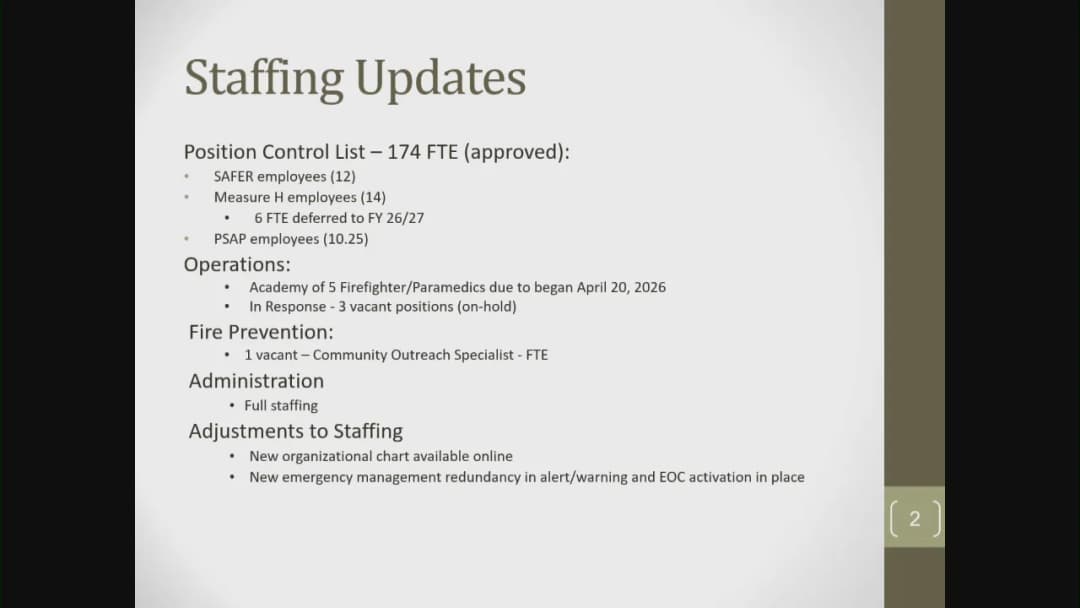
The Santa Rosa Public Safety Subcommittee met on April 21, 2026, from 9:01 a.m. to 9:58 a.m., with Chair Jeff Okrepkie and Mayor Mark Stapp present; Council Member Victoria Fleming absent. The meeting focused on an update on the city's illicit massage business enforcement, followed by reports from the Police and Fire Departments. Approval of Minutes - The minutes from the February 3, 2026 regular meeting were approved as submitted. Illicit Massage Business Enforcement Update Chief John Cregan and Planning and Economic Development Director Gabe Osburn presented a joint update on implementation of the massage ordinance adopted in March 2025 and amended thereafter. Enforcement is led by the Police Department’s Domestic Violence/Sexual Assault (DVSA) team and Code Enforcement. - Application Statistics: To date, 83 applications have been received (down from an initial estimate of 130 massage businesses in Santa Rosa). Of those, 40 have been approved, 9 denied, 37 are pending review, and 4 were returned incomplete or withdrawn. 36 inspections have been conducted. - Enforcement Actions: On April 15, 2026, Code Enforcement and DVSA detectives visited six locations. Four had received denials; two were operating without certification. Cease-and-desist orders were served on all six, triggering fines that can reach $500/day per violation. One business received an initial fine of $8,400. - Criminal Enforcement: A prior “shock and awe” operation involving the FBI resulted in felony charges (pimping, pandering, wage theft, money laundering, tax evasion) against three suspects. Five illicit businesses were shut down, and six victims were rescued and placed with Verity. Asset forfeiture is being pursued. - Landlord Outreach: Letters are sent to landlords to inform them of illegal activity and encourage evictions. In one case, a business used cash profits to purchase a building outright. - Regional Coordination: The city’s ordinance has been shared with all Sonoma County police chiefs and five adjoining counties. Officials have met with local mayors and city managers to encourage adoption of similar regulations, as illicit operations may be pushed into surrounding jurisdictions. - Reporting: Community members can report concerns via a Code Enforcement request form online or at SRCity.org. The chair suggested adding a specific category to the My Santa Rosa app. - Public Comment: Five members of the public spoke, all expressing strong support for the city’s efforts. Speakers included Lauren Friedeman, Kurtis Bennet, David Bloomer (campus manager, National Holistic Institute), David Cerretti (physical therapist), and Michelle Reckon. Bloomer noted the ordinance legitimizes licensed massage therapists and improves client safety. Cerretti observed neighborhood changes with illicit businesses appearing on nearly every corner since 1996. All thanked city staff and council for their leadership. Police Department Update Chief Cregan provided a high-level overview of operations: - Hiring: 7 officers are in two police academy classes (graduating May and August); 3 officer vacancies remain. Civilian positions: 2 vacancies, with 3 dispatchers and 2 police technicians in training. Two positions are frozen pending budget decisions. - Deployable Staffing: Out of 175 sworn positions, 21 officers are out with on-duty injuries, 4 are on FMLA leave, and 7 are in the academy. Combined with vacancies, 35 positions are non-deployable. - Violence Reduction: In 2025, there were 12 homicides (9 firearm-related). So far in 2026, zero homicides have occurred. Shootings are down 33% year-to-date. 255 illegal firearms have been seized through March, including 189 ghost guns—that number was heavily influenced by one large ghost gun lab with three 3D printers, yielding 160 ghost gun lowers. The chief noted ongoing challenges with legal loopholes for ghost guns. - Traffic Safety: Traffic stops and citations are down 18% and 22% respectively due to reduced traffic enforcement capacity (9 officers lost last budget cycle). Injury collisions are up 31%. DUI enforcement and DUI-related collisions are up 41.6%. - Community Engagement: Planned events include Taco with a Cop (Apple Valley, late May), Chat with the Chief at Wednesday night markets, a youth Community Police Experience (July), a Spanish-speaking program (fall), and Churros with the Chief at Bear Park. The eight-week Community Police Experience is underway with 28 participants. - Public Comment: None. Fire Department Update Chief Scott Westrope presented an update: - Staffing: Authorized strength is 174 FTE. 12 employees are funded through a SAFER grant (staffing ALS squads), 14 through County Measure H (with 6 more deferred to FY 2026-27), and 10.25 through PSAP/Measure O. An academy of 5 new firefighters began April 20. Three vacancies are being held pending budget decisions in May. The fire prevention administrative staff is fully staffed. - Reorganization: Following the loss of a deputy chief and deputy emergency manager, command staff was reorganized. Redundancy for emergency management has been implemented. - Apparatus: Five new Type I fire engines are arriving from Wisconsin; they will be in service by June 2026 (funded via general fund fleet replacement and PSAP). The chief noted that fire apparatus costs have nearly doubled (now $1.2–1.5 million per engine, $2.5 million per ladder truck) with build times of 4–5 years due to a monopoly of private equity firms in the industry. LA County and San Diego County are suing these firms over monopolization; the chief will bring more information to a future meeting. - Fire Stations: Fire Station 5 is open. Construction of Fire Station 8 (Roseland) is underway, with completion expected June 2027. The city has entered escrow to purchase the former Mancini Sleep World building at Santa Rosa Avenue and Court Street for Fire Station 9—a 30-year need now being addressed by Measure H. A CIP account has been opened for Fire Station 11 (temporary since 2007). - Public Comment: Stephan Dal Porto, representing Local 1401, noted 12 line staffing vacancies that must be filled at minimum staffing levels (three on engine, four on truck). He argued that unfilled positions save salary/benefit costs but increase overtime, and asked the subcommittee to consider both sides during upcoming budget discussions. Key Outcomes - Vote: Minutes from February 3, 2026 were approved unanimously. - Directives: Chair Okrepkie requested that a specific category for illicit massage business complaints be added to the My Santa Rosa app. Chief Westrope will share more details on the LA County/San Diego County lawsuit against private equity fire apparatus manufacturers at a future meeting. - No additional decisions or votes were taken. The meeting adjourned at 9:58 a.m.