Browse by city
Date range
Search help

Search titles, summaries, topics and stored transcripts together. Keywords may match separately; put the whole query in double quotes for a phrase. Matching follows word analysis, so punctuation is not exact. Both dates are included. Documents are not searched.

SHOWING 101–110 ENTRIES
101
NOV 4, 2024 · SHORELINE, WASHINGTON · CITY COUNCIL
Shoreline City Council Regular Meeting - November 4, 2024: Budget Hearings, Proclamations, and Legislative Priorities

The Shoreline City Council held a regular meeting on Monday, November 4, 2024, at 7:00 p.m. in the Council Chamber. The meeting included two proclamations, approval of the consent calendar, public hearings on the 2025-2026 proposed biennial budget and property tax levies, discussion of budget amendments, and review of the 2025 state legislative priorities. The meeting adjourned at 8:37 p.m. Proclamations - Mayor Roberts proclaimed November as National Native American Heritage Month and invited Duwamish Tribal Councilmen Paul Nelson and Ken Workman to accept the proclamation. They spoke about the enduring history and resilience of Indigenous peoples. - Mayor Roberts proclaimed November 11, 2024, as Veterans Appreciation Day and invited Charles Grenard and Tiffany Bothell to accept the proclamation. They thanked the city for its support of veterans. Consent Calendar - Approved the regular meeting minutes of October 14, 2024. - Authorized the City Manager to execute a construction contract with Harkness Construction in the amount of $477,093.60 for the 1st Avenue NE Sanitary Sewer Replacement Project. - Authorized the City Manager to execute the third extension of the Sewer Use Agreement between the City of Shoreline and Olympic View Water and Sewer District. - The motion to approve the Consent Calendar carried 7-0. Public Comments & Testimony General Public Comment (before public hearings): - Katie Lorah, Shoreline resident and member of Urbanist Shoreline, requested the Council prioritize funding for a consultant-led subarea planning process and the development of the 175th Street Corridor for multimodal uses. She also supported the 175th corridor as a state legislative funding priority and urged consideration of a vehicle lane reduction. Public Hearing on the 2025-2026 Proposed Biennial Budget (Revenue & Property Tax Levies): - No public testimony was offered; the hearing was closed. Public Hearing on the 2025-2026 Proposed Biennial Budget (Expenditures & CIP): - Emily Jones, Executive Director of Shoreline Lake Forest Park Senior Center, expressed enthusiastic support for funding a behavioral health specialist at the Senior Center. She reported that in 2023, of 136 unique clients served by the social worker, 65 exhibited symptoms of mental health concerns. In 2024, 55 of 126 unique clients were identified with possible mental health issues. She emphasized the need for in-person, low-cost services for low-income seniors. - Ben London, Shoreline resident and Executive Director of Sonic Guild, thanked the city for a five-year partnership supporting musicians through education and professional development. He noted the recent Shoreline Music Summit sold out and highlighted the city's recording studios. - Dave Guilland, Shoreline resident, criticized police enforcement and advocated for traffic camera enforcement over police traffic units. He cited a personal incident where a police vehicle violated a traffic law. - Heidi Shepherd, Shoreline resident and Board President of North Urban Human Services Alliance (NUHSA), advocated for funding a behavioral health specialist at the Senior Center, noting the need for accessible mental health services for low-income seniors experiencing loss and isolation. Discussion Items 1. 2025-2026 Proposed Biennial Budget & Property Tax Levies (Action Item 8A & 8B) - Sara Lane, Administrative Services Director, and Christy Hopkins, Budget and Tax Manager, presented the proposed budget. Total resources for the biennium are $424.260 million. The 2025 regular property tax levy is estimated at $24.9 million (levy rate $1.53 per $1,000), and the excess levy for park improvements is $2.96 million. Sales tax is projected to decrease 6.5% in 2025 due to lower construction sales, then increase 2.1% in 2026. Surface water fees increase 12.5% in 2025, then 8.5% thereafter. Wastewater fees increase $2.25 per month in 2027-2028. Total appropriations are $406.5 million. - Councilmembers discussed proposed amendments (to be voted on November 18): reduce council travel and training budget, extend sidewalk on 25th Ave NE, add a victim advocate position, and questions about the public dance license fee. Councilmember Ramsdell acknowledged public support for the behavioral health specialist. 2. Ordinance No. 1020 - Amending the 2023-2024 Biennial Budget (Study Item 9A) - Christy Hopkins presented the final amendment to the 2023-2024 budget, changing appropriations for 15 funds. The projected unassigned/undesignated ending fund balance is $26.692 million. Councilmember Robertson asked how pending amendments would affect the ending balance; staff will provide updated numbers before the November 18 action. 3. 2025 State Legislative Priorities (Study Item 9B) - Jim Hammond, Intergovernmental Relations Manager, and Debora Munguia, contract lobbyist, presented the draft legislative agenda for the 105-day session (starting January 13, 2025). The state faces a projected budget shortfall of $3 to $10 billion. Key priorities include addressing homelessness, affordable housing, transit-oriented development, behavioral health, transportation funding, and environmental protections. The city will focus on the 175th Street Corridor (total estimated cost $60 million) and continue engagement on transit-oriented development. Councilmember Scully cautioned against overextending resources on state TOD conversations and emphasized linking to infrastructure funding. Councilmember Ademasu supported legislative efforts to reduce greenhouse gas emissions and urged including carbon sequestration and stormwater management in the climate agenda. Mayor Roberts stressed the city's strong fiscal position and the need to encourage good budget practices statewide. Key Outcomes - The Consent Calendar was approved unanimously (7-0). - Both public hearings were closed; no testimony was received on the revenue hearing, and four speakers testified on the expenditure hearing. - The 2025-2026 Proposed Biennial Budget, property tax levies (Ordinance No. 1021), impact fees (Ordinance No. 1022), and fee schedule (Resolution No. 530) are scheduled for action on the November 18 consent calendar. - Ordinance No. 1020 (2023-2024 budget amendment) is scheduled for action on the November 18 consent calendar. - The 2025 State Legislative Priorities will be brought back for adoption on the consent calendar at a future meeting, with a modest amendment to incorporate climate resilience language as suggested by Councilmember Ademasu. - Councilmembers were encouraged to submit any additional budget amendments promptly for staff review.
BUDGET EQUITY ANALYSIS 17% · LEGISLATIVE PROCESS 17% · PUBLIC ENGAGEMENT 13% · PROCEDURAL 11%
102
OCT 28, 2024 · SHORELINE, WASHINGTON · CITY COUNCIL
Shoreline City Council Regular Meeting: GSP Update and 2025-2026 Budget Presentations, October 28, 2024

The Shoreline City Council met in regular session on Monday, October 28, 2024, at 7:00 p.m. in the Council Chamber at Shoreline City Hall (17500 Midvale Avenue N). Mayor Chris Roberts presided; all seven Councilmembers were present. The Council unanimously approved the agenda and consent calendar, heard public comment on tree preservation, received an update from Greater Seattle Partners, and continued its review of the proposed 2025-2026 biennial budget. Mayor Roberts left at 8:30 p.m., and Deputy Mayor Laura Mork declared the meeting adjourned at 8:43 p.m. City Manager & Council Reports - City Manager Bristol Ellington reported on upcoming events, including a Dia de los Muertos celebration at Spartan Recreation Center on November 2, the last open studio hours for the artist-in-residence at Richmond Beach Saltwater Park, a Shoreline Walks neighborhood walk on November 2, and upcoming meetings. - Councilmember Ademasu shared that she rode along with RCR and met with the Southwoods Preservation Group. Deputy Mayor Mork met with the new head of King County's Department of Natural Resources about potential stormwater park funding. Councilmember Scully attended a Washington Wildlife and Recreation Coalition event and discussed camping equipment lending with the Washington Trails Association. Councilmember Ramsdell attended a North Urban Human Service Alliance meeting on transportation and a presentation from the Director of Lake City Partners, noting that seniors are the fastest growing subset of people experiencing homelessness in the area. Mayor Roberts issued a proclamation for Extra Mile Day, attended President Biden's apology for the federal indigenous boarding school policy, and planned to attend a conference on preventing hate and building social cohesion. Consent Calendar - Approved unanimously (7-0) on a motion by Deputy Mayor Mork, seconded by Councilmember Pobee. - Approval of Special Meeting and Regular Meeting minutes of October 7, 2024. - Approval of expenses and payroll as of October 18, 2024, totaling $3,602,918.21. - Adoption of Ordinance No. 1023 amending Chapter 15.05, Construction and Building Codes, of the Shoreline Municipal Code to provide amendments to the Washington State Building Code - Energy Code - Commercial. - Adoption of Resolution No. 531, the Draft 2025-2029 Commute Trip Reduction (CTR) Plan. - Authorization for the City Manager to execute an interlocal agreement with King County for jail services through December 31, 2029. - Approval of a Multi-Family Tax Exemption Program contract with ACG Kinect Shoreline Owner LLC located at 18553 8th Avenue NE, with written public comment submitted by Andrew Hou. - Authorization for the City Manager to execute a contract with ABLE in the amount of $732,511 for design services for park improvements. Public Comments & Testimony - Kathleen Russell, a Shoreline resident speaking for Save Shoreline Trees, said residents were discouraged that they were too late to provide input on trees along North 145th phase one and North 175th phase one, and urged the Council to seek public input now while North 175th future phases are at 60% design. She questioned the design of a 13-foot-wide shared path versus a seven-foot sidewalk with a dedicated bike lane, cited the loss of 134 trees along North 145th west of Corlith and 274 trees along North 175th, and stated that in CAP research residents identified preservation of Shoreline's existing tree canopy as the most commonly expressed priority. She asked the Council to save more public trees. Discussion Items Greater Seattle Partners Update - Economic Development Program Manager Nathan Daum introduced GSP CEO Brian Surratt and Chief Operating Officer Rebecca Lovell. GSP is a public-private partnership responsible for international business attraction, site selection, investment, and trade across King, Pierce, and Snohomish counties. - Surratt framed the organization's work around community values such as equity, sustainability, and innovation, and stressed the importance of credibility and trust. Lovell described signature programs including the Site Certification program (which included tours of Shoreline properties with a focus on biotech and advanced manufacturing), the Export Accelerator program (expanding to semi-annual cohorts in 2025), and the 'Uncommon Thinkers Welcome' regional branding campaign, which generated over five million page views in its first year. The presentation noted a current pipeline of 87 leads across seven key sectors and the Select USA spin-off program, which brought about 30 companies from approximately 10 countries to the region. - Councilmember Scully expressed the position that attracting large industries and high-paying jobs to Shoreline is 'a fool's errand,' and said Shoreline's needs are more local and small-business focused; he encouraged GSP to consider local challenges such as high rents and startup costs. Surratt responded that affordability is a regional crisis and described a potential 'jobs hub' concept along the I-5 corridor. - Councilmember Ademasu asked whether GSP has programs to help small neighborhood businesses, such as a BIPOC-owned mini mart, lease or buy space. Surratt said GSP does not have specific programs for that function, which sits with state-designated Associate Development Organizations, but he agreed the region must integrate those functions. - Mayor Roberts raised workforce development concerns and noted regulations restricting community colleges from advertising programs outside their districts. Surratt agreed, describing his role as a Seattle Colleges District trustee and GSP's efforts to convene workforce development councils and healthcare employers around talent pipeline gaps. Lovell said companies view location decisions as generational investments and highlighted Shoreline's land and training program assets. 2025-2026 Proposed Biennial Budget - Department Presentations - Sara Lane, Administrative Services Director, presented the budget review schedule. Public hearings are set for November 4 and November 18, with Council action on November 18; all budget amendments must be submitted to staff by November 12. - Public Works (Director Tricia Juhnke): Proposed biennial budget of $16,276,159 with 49.6 staff. One-time items include an Aurora Ave street light fixture replacement fund transfer ($140,000), Aurora Ave landscape bed improvements ($80,000), a grounds maintenance dump truck with plow and spreader (listed at $549,898, which Juhnke said is overstated because of interfund transfers; the actual cost is approximately $275,000), and park landscape bed improvements ($70,000). Staffing changes include 1.0 FTE Construction Inspector ($141,114) and 0.75 FTE Grounds Maintenance Worker I - Parks Landscaping ($71,500). Councilmember Scully asked about Interurban Trail maintenance; Juhnke said that would fall under the Parks budget. - Surface Water Utility: Proposed budget of approximately $36,427,813 with 18.43 staff; over 60% of the utility is focused on capital projects. One-time changes include a business inspection source control program vehicle ($84,000), a surface water street sweeper ($496,000), and Salmon Safe water quality monitoring equipment program expansion ($176,600). Ongoing changes include street sweeper operations and maintenance ($107,100) and the Soak It Up (LID Rebate) program expansion ($92,000). Staffing changes include 1.0 FTE Public Works Maintenance Worker II ($80,400 from Surface Water and $15,200 from the General Fund) and 1.0 FTE Surface Water Inspector with program vehicle maintenance ($149,090). Deputy Mayor Mork suggested a tiered residential fee based on property size, given an anticipated 86% rate increase between 2022 and 2030; Juhnke said the current direction does not expand tiers to single-family properties but commercial parcel billing is changing. Mayor Roberts pointed out a mismatch between the 'single family' fee designation and the Comprehensive Plan's new 'Neighborhood Residential' zoning and suggested aligning the terminology; Juhnke said the fee is based on use rather than zoning and staff will continue monitoring the issue. - Wastewater Utility: Proposed budget of approximately $62,674,649 with 20.55 staff; the only ongoing change is two 0.5 FTE positions for records management ($79,583). Capital projects include a sewer relocation at 147th and 3rd Avenue NE in response to WSDOT's fish passage project. A councilmember asked why current 2023-24 pipe repair/replacement spending was about $10.5 million versus an estimate of about $2.5 million; Juhnke attributed the difference to project delays from vacant engineering positions. Concern was raised about the approximate 147% wastewater rate increase between 2022 and 2030; Lane responded that the majority of the increase funds capital investments needed to sustain growth and maintain the system. - General Capital Fund (Nickolas Borer, Parks, Fleet, and Facilities Manager): Parks Maintenance projects (4 projects, $16.77M), Facilities projects (4 projects, $18.00M), and Parks Development projects (multiple projects, $4.76M). Councilmember Robertson asked for the total public art fund allocation and expressed interest in creating a future winter light display. - City Facilities - Major Maintenance Fund: Budgeted at $1.78M for 6 projects, including City Hall reconfiguration and roof replacements at Kruckeberg Botanic Garden and Sunset School Park. Councilmember Scully asked that the Kruckeberg cottage be flagged for future consideration due to concerns about its value and ongoing maintenance costs. - Roads Capital Fund (City Engineer Elizabeth Kelly): Pedestrian and Non-Motorized projects (16 projects, $74.81M), Safety and Operations projects (9 projects, $135.53M), and System Preservation projects (3 projects, $18.9M). Kelly noted the Annual Road Surface Maintenance program is underfunded and staff are building a business case for additional funding. Councilmember Ademasu requested that language on the 145th Street project phases two and three address tree preservation, and asked whether the replacement Aurora Ave cobra-style lights are wildlife friendly; Kelly said they are hooded and aimed downward. - General Fund Transfers (Budget & Tax Manager Christy Hopkins): Total general fund transfers are approximately $16.7M, with $10.3M going to capital funds; debt service funds total approximately $11.8M; other funds include about $8.8M in accumulated transportation impact fees contributed to capital projects. - Councilmember Ramsdell noted the General Fund balance is higher than anticipated in September and announced he intends to propose an amendment to fund a counseling program at the Shoreline Lake Forest Park Senior Center. Deputy Mayor Mork announced she will propose a $40,000 amendment to study Firlands Way. Councilmember Ramsdell also floated potential future funding around Shoreline's 30th anniversary, the Shoreline Historical Museum's 50th anniversary, and the Declaration of Independence's 250th anniversary, and said he asked the museum for a funding suggestion. - Councilmembers Scully and Pobee praised the quality of the budget document and staff work; Scully noted the meeting drew three members of the public, versus the usual zero. Key Outcomes - The agenda was approved by unanimous consent. - The consent calendar was approved 7-0. - The Council received the Greater Seattle Partners update and the second night of 2025-2026 biennial budget department presentations. - Budget amendments must be submitted by November 12, 2024; public hearings and final Council action are scheduled for November 18, 2024. - Staff will respond to additional council questions in the Council Budget Question Matrix, including public art fund totals and wastewater rate study details. - Announced planned amendments: a senior counseling program (Councilmember Ramsdell) and a $40,000 Firlands Way study (Deputy Mayor Mork).

ECONOMIC DEVELOPMENT 29% · BUDGET EQUITY ANALYSIS 13% · WATER AND WASTEWATER MANAGEMENT 12% · WORKFORCE DEVELOPMENT 9%
103
OCT 24, 2024 · SHORELINE, WASHINGTON · PLANNING COMMISSION
Shoreline Planning Commission Public Hearing on 2024 Comprehensive Plan Update - October 24, 2024

On October 24, 2024, the Shoreline Planning Commission held a special meeting and public hearing to receive an overview of the Draft Environmental Impact Statement (DEIS) and to take public testimony on the draft 2024 Comprehensive Plan. No votes were taken; the hearing was informational and will inform a future recommendation to the City Council. Consent Calendar - The agenda was accepted as presented. - The draft minutes of the October 3, 2024 regular meeting were approved as presented. Public Comments & Testimony Public Comment (non-hearing): - Nicolaus Faino, Shoreline resident, expressed concern about a proposed school closure due to projected declining enrollments, which he argued contradicts the Comprehensive Plan's growth projections. He urged the Planning Commission to communicate with the Shoreline School Board to align data and projections. Public Hearing Testimony: - Kathleen Russell, Shoreline resident representing Save Shoreline Trees, thanked staff and requested that references to “established trees” (approximately 19 words of edits) be added to the natural environment and transportation elements of the plan to better recognize the natural environment. - Tom Lang, Parkwood homeowner and member of Urbanist Shoreline, supported the missing middle housing provisions but recommended eliminating all parking minimums to reduce hardscape and promote a greener city. He also encouraged allowing commercial uses in residential neighborhoods to increase walkability and inclusion. - Laura Zuchlewski, Shoreline homeowner and member of Urbanist Shoreline, supported removing residential and commercial parking minimums to lower development costs, retain trees, and encourage walking, biking, and transit. She also supported allowing neighborhood commercial in all neighborhoods to reduce car pollution and support climate goals. - Bob Danson, General Manager of Olympic View Water and Sewer District, stated that the DEIS incorrectly states Shoreline has no Critical Aquifer Recharge Areas (CARAs). He argued that the district’s wellhead protection area qualifies as a CARA and requested that the final Comprehensive Plan clearly identify the CARA and implement protections, including consultation on any proposed development in the buffer areas. Discussion Items After staff presentations by Planning Director Andrew Bauer and Planning Manager Elise Keim on the Comprehensive Plan update and DEIS, the Commission discussed: - Visual models: Commissioner Povick requested a visual or 3D model showing how multiple goals (e.g., no parking minimums, bike lanes, curb access) fit together at the block scale. Staff agreed to consult with traffic and transportation planners for examples. - Competing policies: Vice Chair Brinson noted that competing public policies create healthy tension that can be resolved at the block scale. Commissioner Povick cited the 185th Station’s lack of ground-floor retail as a missed opportunity and asked how to prevent similar outcomes. - Document length: Chair Mosier questioned whether parts of the 400-page plan could be removed. Planning Manager Keim responded that any removal would need to be reviewed against state, regional, and county requirements. - Commissioner Hadley commended staff on the comprehensive presentation. Key Outcomes - The public hearing was closed. - The Commission was asked to submit written feedback on the draft goals and policies by November 7, 2024, to inform the version to be considered at the November 21 public hearing (joint hearing on the plan and development code amendments). - The next Planning Commission meeting is scheduled for November 7, 2024, for a public hearing on the draft development code amendments. - Vice Chair Brinson reported that Planning Manager Keim presented Shoreline’s approach to middle housing at the Washington American Planning Association Conference, which was well received.

LAND USE PLANNING 44% · PROCEDURAL 13% · PUBLIC ENGAGEMENT 12% · ENVIRONMENTAL PROTECTION 8%
104
OCT 3, 2024 · SHORELINE, WASHINGTON · PLANNING COMMISSION
Shoreline Planning Commission Regular Meeting - October 3, 2024

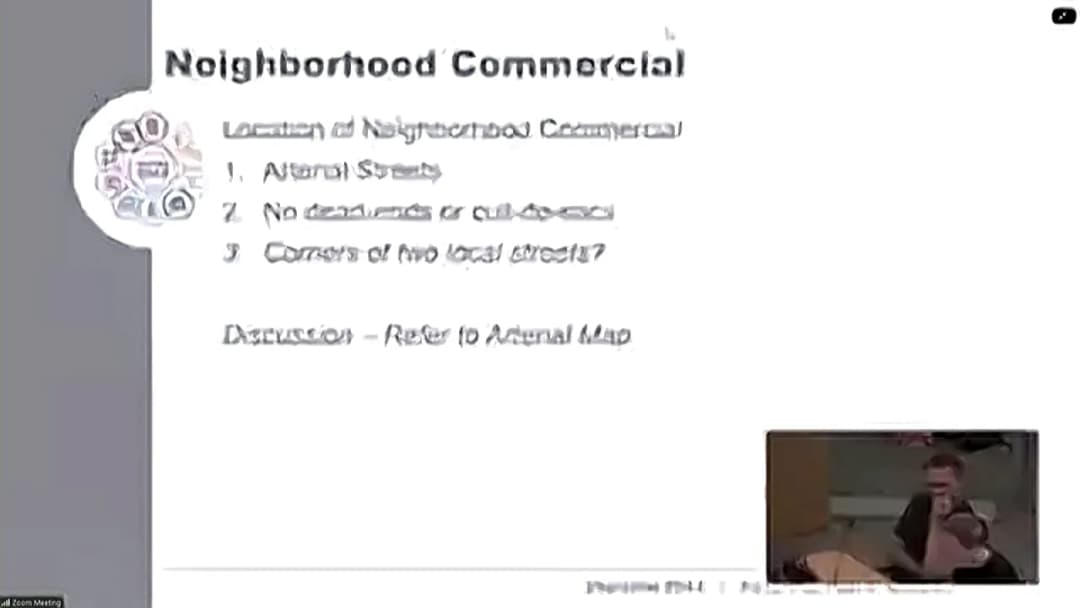
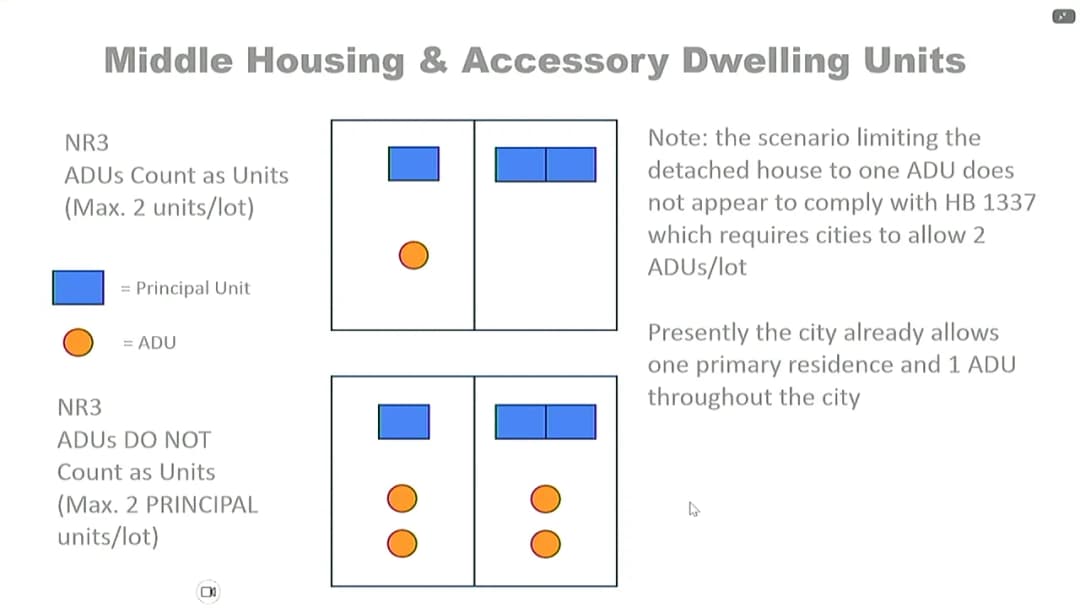
The Shoreline Planning Commission held a regular meeting on October 3, 2024, at 7:00 PM in the Council Chamber. The meeting focused on updates to the 2024 Comprehensive Plan, including the Draft Plan and Environmental Impact Statement (EIS), middle housing regulations, and general code amendments required by recent state legislation. Commissioners also heard public comment on development challenges and ADU policies. Public Comments & Testimony - Darren Chang (architect, Shoreline resident) expressed concern about the 25-foot-wide driveway requirement and 17-foot setback on 145th Street NE for a townhouse project, stating these requirements are "killing the project" for his clients. He noted that other developers face similar issues with Shoreline's stringent planning requirements and asked how the new Comprehensive Plan will affect single-family attached residential design guidelines. - Jonathan Lounds (online, Bellevue, Master Builders Association of King and Snohomish Counties) strongly urged the Commission to adopt policies excluding Accessory Dwelling Units (ADUs) from density calculations in both NR2 and NR3 zones, arguing ADUs provide affordable housing without significantly altering neighborhood character. Discussion Items - 2024 Comprehensive Plan: Update on Draft Plan and EIS – Planning Manager Elise Keim and Emily Larson (Otak) presented the full draft Comprehensive Plan, including goals, policies, and supporting analysis for each element. The Draft EIS evaluates three growth alternatives: No Action (Alternative 1), Moderate Pace (Alternative 2), and More Rapid Pace (Alternative 3). The DEIS is expected mid-October with a 30-day comment period. Chair Mosier asked why "typical" housing cost was used instead of "average" or "median"; staff agreed to clarify. Commissioner Lin asked how best to review the large document; staff recommended focusing on goals and policies. - 2024 Comprehensive Plan: Middle Housing Regulations – Staff presented updates on ADU policies and density regulation. Key discussion points: - ADUs and density: Commissioners debated whether ADUs should count toward the unit maximum. Consensus emerged (Fry, Mosier, Brinson, Lin, Povick) to not count ADUs against density caps, citing simplicity and the role of hardscape limits. Commissioner Hadley initially favored counting but later agreed with the majority. - Density regulation method: Staff proposed three options: (1) units per lot (downzones R12 lots), (2) move R12 to NR1, (3) regulate by square footage. All commissioners supported Option 3 (units per square foot) for clarity and scalability. - Neighborhood commercial locations: Commissioners generally supported allowing neighborhood commercial on all streets except dead ends and cul-de-sacs, not just at corners of local streets. Director Bauer suggested a future work plan for larger-scale neighborhood commercial. - Unit preservation: Staff outlined incentives including a 10% hardscape bonus for retaining existing structures, exemption of retained dwellings from unit caps, and non-conformity allowances. Chair Mosier raised concerns about excluding eaves from hardscape calculations; Vice Chair Brinson agreed. Commissioner Lin asked about height bonuses for preservation; after discussion, Chair Mosier noted current allowances are already generous. - Fire code and frontage improvements: Chair Mosier noted that HB 1337 prohibits requiring street improvements for ADUs, calling it counterproductive. Staff confirmed they are working with fire and public works on flexibility. - ADA parking: Commissioners discussed using street parking for ADA spots to preserve property. - 2024 Comprehensive Plan: General Code Amendments – Staff reviewed updates for SB 5290 (permit review timelines, 65/100/170 days), SB 6015 (parking design standards), and HB 1220 (emergency/supportive housing criteria). No revisions were requested. Key Outcomes - Consensus on ADU density: ADUs will not count toward unit maximums in any zone (policy direction to staff). - Consensus on density regulation: The Commission directed staff to use a per-square-foot approach (Option 3) for regulating density in middle housing zones. - Neighborhood commercial expansion: Staff will draft code allowing neighborhood commercial on all streets except cul-de-sacs and dead ends. - Meeting schedule: The October 17 regular meeting was cancelled; a special meeting is scheduled for October 24, 2024, to review the full draft code and Comprehensive Plan package. - Next steps: The Commission will continue review of the Comprehensive Plan and middle housing code, with a recommendation to City Council targeted for November 21, 2024.

LAND USE PLANNING 37% · AFFORDABLE HOUSING 28% · PERMITTING 10% · PROCEDURAL 6%
105
SEP 19, 2024 · SHORELINE, WASHINGTON · PLANNING COMMISSION
Shoreline Planning Commission Regular Meeting – September 19, 2024

The Shoreline Planning Commission held a regular meeting on Thursday, September 19, 2024, at 7:00 p.m. in the Council Chamber at Shoreline City Hall. The primary business was a public hearing on the 2025–2029 Commute Trip Reduction (CTR) Plan Update. The commission approved the agenda and minutes from September 5, 2024, and unanimously recommended the draft CTR plan to the City Council for adoption. Consent Calendar - Approved the agenda as presented. - Approved the regular meeting draft minutes of September 5, 2024, as presented. Public Comments & Testimony - No members of the public signed up to speak or provided testimony. Discussion Items - 2025–2029 Commute Trip Reduction Plan Update (Public Hearing) – Assistant Transportation Planner Catherine Lander and Transportation Services Manager Nytasha Walters presented a recap of the August 15 presentation, highlighting edits made based on prior commission feedback. Key edits included: clarifying that baseline data collection would precede program expansion, adding three new potential incentives (free/discounted helmets, employer subsidies for shared e-scooters/e-bikes, and programs like Lyft for Students), and acknowledging that parking incentives have been useful for some employers. The commission expressed support for existing incentives (ORCA program, telecommuting, multimodal facilities). - Survey Question on Disability – Commissioner Povick requested that a question about disability be included in the CTR survey to help analyze responses. Ms. Lander agreed to explore adding it as a supplemental question. - School District Exclusion – Chair Mosier asked why the Shoreline School District is not listed as a CTR-affected employer. Ms. Lander explained that the school district does not qualify under the state law. Key Outcomes - Motion: Commissioner Fry moved to recommend the draft 2025–2029 Commute Trip Reduction Plan (Attachment B) as presented to the City Council for adoption of Resolution No. 531. The motion was seconded by Commissioner Hadley and passed unanimously (7-0). - Next Steps: Staff will submit the plan to the Puget Sound Regional Council on September 20, 2024, for consistency review. The City Council will receive a presentation on October 7, 2024, and a resolution to submit the draft plan to the state is scheduled for October 28, 2024. Final adoption by ordinance is expected in the first quarter of 2025 after state approval.

TRANSPORTATION SAFETY 58% · PROCEDURAL 37% · DISABILITY RIGHTS 5%
106
SEP 5, 2024 · SHORELINE, WASHINGTON · PLANNING COMMISSION
Shoreline Planning Commission Regular Meeting – September 5, 2024: Middle Housing Code and Neighborhood Commercial

The Shoreline Planning Commission held a regular meeting on September 5, 2024, from 7:00 PM to 8:45 PM in the Council Chamber at Shoreline City Hall. Chair Christopher Mosier presided. The primary study item was the 2024 Comprehensive Plan update, focusing on the first draft of the Middle Housing Code, including residential design standards, unit preservation, and neighborhood commercial uses. The Commission provided direction to staff on several key topics. Consent Calendar - Agenda approved as presented. - Regular Meeting Draft Minutes of August 15, 2024, accepted as presented. Public Comments & Testimony - No oral public testimony was given. However, two written public comments were submitted by Jeff Morgan and Carmel Gregory and were noted by the Chair as available on the meeting calendar page. Discussion Items - Middle Housing Residential Code: - Townhouses in NR3: Staff proposed allowing all six required forms of middle housing (including townhouses) in NR3, as defining townhouses differently was problematic. Commission agreed that townhouses should be allowed, with concerns addressed through dimensional and design standards. - ADU Counting Toward Unit Caps: The question was whether ADUs should count toward the maximum number of units on a lot when middle housing is developed. Vice Chair Brinson and Commissioners Fry and Cabe argued ADUs should not count due to lot coverage and practical constraints; Commissioners Povick and Hadley thought they should count for simplicity and community impact. Chair Mosier proposed a compromise: if an existing home is retained (unit conversion), the homeowner can add two ADUs without counting them toward the unit cap, but if the home is demolished, ADUs count. This was supported by several commissioners. - Multiple Principal Units as Detached Homes: Commissioners concurred that multiple principal units on a lot can be detached homes (like two single-family homes) rather than forcing a middle housing form. This continues existing practice. - Building Design Standards (Massing/Articulation): Commissioners supported a light-touch approach. Vice Chair Brinson and Chair Mosier suggested focusing on facade length (e.g., stepping back beyond 15 feet) for larger developments, rather than complex modulation standards. Commissioner Fry preferred simplicity for single-lot projects. - Unit Preservation and Conversion: Staff presented incentives such as lot coverage discounts, reduced parking, and flexible setbacks for retaining existing homes. Commissioners agreed to explore these further, specifically wanting to ensure enough space for new units. Chair Mosier requested examples and noted concerns about tree retention and impervious surfaces. There was consensus that converted garages should not require additional parking. Discussion included deconstruction regulations and non-conforming structure rules. - Neighborhood Commercial Code: - Permitted Uses: Commissioners generally agreed with the proposed list (cafes, personal services, small markets, daycare, breweries, professional offices) but raised questions about retail and whether grocery stores could be allowed in some zones. Staff noted they would refine the list. - Location: Support for limiting to arterial streets. Commissioner Cabe liked including corners of local streets. Chair Mosier suggested a distance threshold similar to ground-floor non-residential. Dead ends and cul-de-sacs were not supported. - Floor Area and Parking: Vice Chair Brinson saw no need for different size limits between NR3 and NR2. Parking was controversial: staff proposed no required parking in NR3 and a maximum in NR2. Some commissioners (Povick, Hadley) worried that no parking would reduce accessibility and business viability; others (Brinson, Fry) argued no parking aligns with walkability goals. ADA parking was suggested as an important addition. - Site Improvements: Commissioners stressed the need for solid waste screening, especially for eating/drinking uses. Chair Mosier supported requiring right-of-way improvements (sidewalks) as a location condition, to be discussed with Public Works. - General Growth Concern: Commissioner Povick expressed concern that Shoreline is building faster than any other city and warned of potential liability if growth outpaces infrastructure, particularly regarding parking and street safety. She advocated for a 2.0-tier approach rather than 2.5. Key Outcomes - Townhouses: Allowed in NR3, regulated by design standards (consensus). - ADU Counting: Staff to explore a compromise where existing units can convert without ADUs counting toward the cap; otherwise, ADUs count. Further analysis needed for NR2 vs. NR3 differentiation. - Detached Units: Permitted as multiple principal units (consensus). - Design Standards: Light touch approach; staff to consider facade length threshold (e.g., 15 feet) for modulation requirements on larger buildings. - Unit Preservation: Staff to continue researching incentives (lot coverage discounts, parking reductions, flexible setbacks) and report back. No additional parking required for garage conversions. - Neighborhood Commercial: Staff to refine use list, consider ADA parking, explore location maps for arterial corners, and coordinate with Public Works on right-of-way improvements. No parking required in NR3 (but non-binding discussion); maximum rather than minimum parking in NR2. - Next Steps: Next briefing to Council on September 30, 2024. Next Planning Commission meeting on September 19, 2024, will include a public hearing on the Commute Trip Reduction Plan and further Comprehensive Plan discussion.

LAND USE PLANNING 44% · HOUSING AFFORDABILITY 24% · PUBLIC TRANSPORTATION 5% · PROCEDURAL 4%
107
AUG 15, 2024 · SHORELINE, WASHINGTON · PLANNING COMMISSION
Shoreline Planning Commission Regular Meeting – August 15, 2024

The Shoreline Planning Commission met on Thursday, August 15, 2024, at 7:00 p.m. in the Council Chamber at City Hall. Vice Chair Leslie Brinson presided in the absence of Chair Christopher Mosier. The commission reviewed the 2025–2029 Commute Trip Reduction (CTR) Plan update and continued discussion of the 2024 Comprehensive Plan amendments, focusing on the Capital Facilities and Utilities elements. No formal votes were taken; the meeting was adjourned at 7:51 p.m. Consent Calendar - Approval of Agenda: Accepted as presented. - Approval of Minutes: The regular meeting minutes of August 1, 2024, were accepted as presented. Public Comments & Testimony - Boni Biery (Shoreline resident) spoke in support of recommending that the residential portion of Firlands Way (from North 188th to North 195th) be used as green space and included as a goal in the Community Development Element of the Comprehensive Plan. She noted that the area is a recognized park desert and that the city already owns land that could benefit the neighborhood. Discussion Items - 2025–2029 Commute Trip Reduction Plan Update - Assistant Transportation Planner Catherine Lander presented the required update. Key points: - The state requires a new goal of a 60% drive-alone rate (DAR) for CTR-affected worksites (four out of ten commutes must be via alternatives to driving alone). - Shoreline currently has seven CTR-affected worksites (e.g., Krista Ministries, Department of Ecology, Shoreline Community College, City of Shoreline). - Outreach included a survey (662 responses, 81% from Shoreline residents), a mobility fair (340+ attendees), and focus groups in Spanish and Mandarin. - Common incentives desired: telecommuting, flexible hours, free bus passes, bicycle facilities, and direct cash payments. - Staff recommendations: promote remote work, support countywide centers, invest in walking/biking infrastructure, advocate for transit improvements, explore microtransit, and identify resources for alternative commute options. - Commissioners discussed: partnering with Lime for helmet distribution (Commissioner Povick), the effectiveness of parking fees and free ORCA cards (Commissioners Povick, Lin, Fry), surveying non-CTR employers about existing benefits (Commissioner Cabe), and the potential for microtransit to connect homes to light rail (Vice Chair Brinson, Commissioner Povick). - Commissioner Lin noted that the City of Shoreline offers bike lockers, showers, secure bicycle pens, ORCA passes, telecommuting, and compressed workweeks. - Vice Chair Brinson suggested awaiting baseline data before deciding on program expansion. - Discussion of the 2024 Comprehensive Plan Amendments – Capital Facilities and Utilities Elements - Senior Planner Steve Szafran responded to previous commissioner questions and public comments: - Capital Facilities: Past deficiencies are identified in functional plans (e.g., parks, transportation). Staff agreed to add “encourage” to policy CF-19. The city will investigate replacement/renovation cycles. The Save Shoreline Trees group submitted comments on natural water collection, urban forest, and hardscape reduction (see Attachment C). - Utilities: Staff will work with utility providers to increase access to financial assistance programs. The commission suggested working with solid waste providers (Recology, Waste Management) to mitigate cart storage crowding, especially as middle housing increases. Staff supports adding high-speed internet language to policies. Clarification was provided on the city’s two water providers (Seattle Public Utilities and North City Water District), and a revised policy on future water service options is being developed. - Vice Chair Brinson noted that Seattle City Light and Seattle Public Utilities are redesigning their financial assistance programs and that including a goal in the Comp Plan could help partnerships. She also encouraged shared solid waste services for middle housing. Key Outcomes - No formal votes were taken. The commission provided guidance for staff to incorporate into the final documents. - CTR Plan: Staff will refine the draft plan based on commissioner feedback and present it at a public hearing on September 19, 2024. The plan will then go to the City Council for adoption (target: October 14, 2024) and must be submitted to the state by November 2024. - Comprehensive Plan Amendments: Staff will make the following changes: - Add “encourage” to policy CF-19. - Add high-speed internet language to Utilities policies. - Investigate cart storage regulations and shared services with solid waste providers. - Work with utility providers on financial assistance programs. - Provide an update on capital facility replacement cycles when available. - Next Meeting: September 5, 2024, to discuss middle housing draft regulations.

PUBLIC TRANSPORTATION 41% · TRANSPORTATION SAFETY 21% · LAND USE PLANNING 10% · PROCEDURAL 9%
108
AUG 1, 2024 · SHORELINE, WASHINGTON · PLANNING COMMISSION
Shoreline Planning Commission Regular Meeting - August 1, 2024

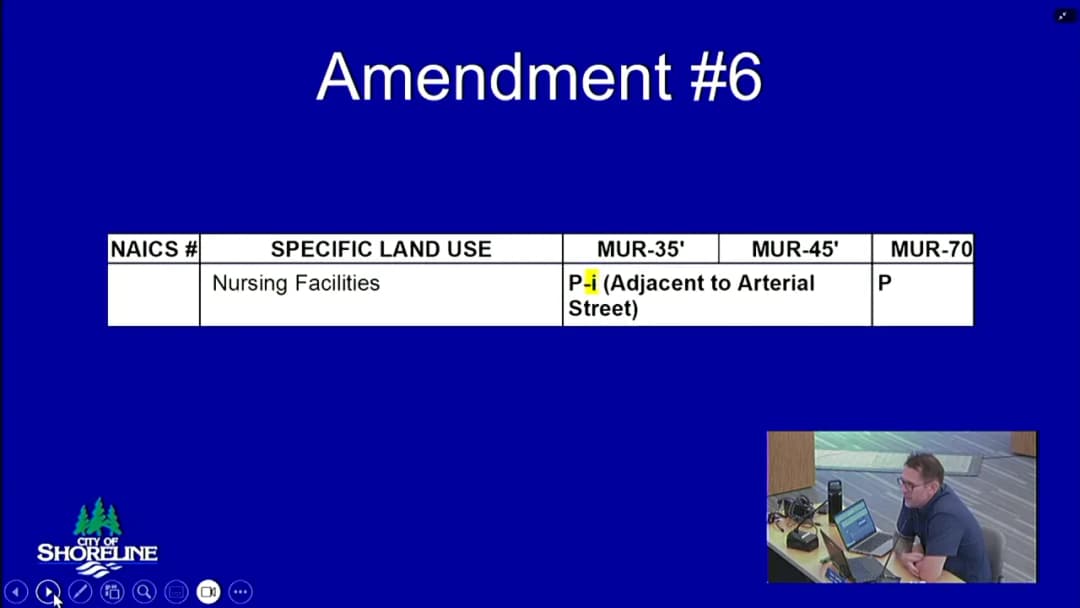
On Thursday, August 1, 2024, the Shoreline Planning Commission met at 7:00 p.m. in the Council Chamber at City Hall. Chair Christopher Mosier presided. Commissioners present: Vice Chair Leslie Brinson, Bradley Cabe, Lauren Hadley, Mei-shiou Lin, Julie Povick. Commissioner Colt Fry was absent excused. Staff present: Andrew Bauer (Planning Director), Steve Szafran (Senior Planner), Julie Ainsworth-Taylor, Carla Hoekzema. The meeting covered the 2024 Comprehensive Plan amendments docket and miscellaneous development code amendments. The meeting adjourned at 7:39 p.m. Consent Calendar - The agenda was approved as presented. - The minutes of the July 18, 2024 regular meeting were approved as presented. Public Comments & Testimony - Meghan Peterka (Ridgecrest neighborhood, Shoreline) commented on home occupation parking requirements. She applied for a business license as a massage therapist but was denied because her home lacked a two-car parking lot. She urged that parking requirements be reviewed case-by-case, considering the nature of the business and availability of on-street parking. Discussion Items (a) Discussion of the 2024 Comprehensive Plan Amendments Senior Planner Steve Szafran reviewed the six amendments proposed for the 2024 Comprehensive Plan major update: 1. Adopt the major update of the 2024 Comprehensive Plan. 2. Amend the Parks, Recreation, Open Space, and Arts (PROSA) element. 3. Change the land use map designation of the DNR-owned portion of the Fircrest Campus from Campus to Mixed Use 2 (staff recommendation). 4. Add a policy requiring that residential streets with public ROW greater than 60 ft be considered for Green Streets (staff recommended against, citing existing policies and a planned street typology study in 2025). 5. Revise Figure 7 (Existing Sidewalks) in the Transportation Element. 6. Add a policy to work with regional partners to construct a shared bicycle/pedestrian bridge across N. 205th Street (SR 104) (staff recommended against, noting existing policies and the project being in the Transportation Improvement Program). Commissioner Povick questioned why an explicit policy for the bridge crossing should not be added, suggesting it could help secure grant funding. Planning Director Bauer noted the TIP language references a crossing, not a bridge, and staff could craft policy aligned with the TIP. Some debate ensued about whether a policy would impact grant eligibility. Commissioner Lin asked about extra-wide rights-of-way (e.g., Firlands Street) and whether existing policies sufficiently address green streets. Staff reiterated that multiple policies already cover low-impact development and green street concepts, and a citywide street typology review is planned. Staff committed to bringing back revised language for Amendment 6. (b) 2024 Comprehensive Plan Update - Miscellaneous Development Code Amendments Mr. Szafran presented 14 miscellaneous amendments, including housekeeping, administrative fixes, and state-mandated changes: - Amendment 7: Allow two accessory dwelling units (ADUs) per lot, increase maximum size to 1,000 sq ft or 50% of primary residence, require one off-street parking space except within 0.5 mile of major transit stop (complying with HB 1337). - Amendment 9: Allow waiver of patron parking for home occupations if on-street parking is available along the parcel's street frontage or across the street. - Others: definitions, unit lot subdivisions, cleanup of outdated references, etc. Vice Chair Brinson asked how the ADU code and middle housing code (HB 1110) would interact. Staff acknowledged uncertainty and promised to provide clarity when middle housing code is presented in September. Commissioner Cabe raised concerns about waiving parking across busy streets; staff noted site-specific safety evaluations would apply. Commissioner Lin asked about ADA parking for home occupations; staff confirmed it is not required for home businesses. Key Outcomes - Staff will bring back revised language for Comprehensive Plan Amendment 6 (SR 104 crossing) for review with the draft plan in October. - For the development code amendments, staff will return with a more complete picture of how ADU regulations and middle housing code interact at the September meeting. - No formal votes were taken; the Commission provided direction for staff to incorporate into the 2024 Comprehensive Plan major update.

LAND USE PLANNING 71% · PROCEDURAL 13% · GRANT MANAGEMENT 5% · AFFORDABLE HOUSING 4%
109
JUL 18, 2024 · SHORELINE, WASHINGTON · PLANNING COMMISSION
Shoreline Planning Commission Regular Meeting - July 18, 2024

The Shoreline Planning Commission held a regular meeting on July 18, 2024, at 7:00 p.m. in the Council Chamber at Shoreline City Hall. The agenda included three study items related to the 2024 Comprehensive Plan Update: an introduction to the Capital Facilities and Utilities elements, discussion of the Community Development and Parks, Recreation, Open Space and Arts (PROSA) elements, and a presentation on middle housing public participation and draft regulations. Commissioners heard public testimony from three residents and engaged in extensive deliberation on housing, parking, affordability, and design standards. Consent Calendar - Approved the agenda as presented. - Approved the minutes of the June 20, 2024 regular meeting as presented. Public Comments & Testimony - Eric Sieverling, Shoreline resident (Parkwood Terrace), expressed concern about the rapid pace of growth and tree removal. He opposed proposed zoning changes that could allow three-story 12-plexes in his single-family neighborhood, urging the commission to consider the implications of rapid growth. - Sara Kubek, Shoreline resident (Parkwood Terrace), expressed concern that current upzoning due to light rail has led to construction of townhouses unsuitable for elderly or families with small children. She noted the area is unwalkable with the nearest grocery store a mile away, and urged the commission to be more thoughtful and assess the impacts of ongoing rezoning before moving forward. - Yonas Seifu, Shoreline resident (near Ballinger and 19th), requested upzoning of his property to be consistent with neighboring apartment zoning. He commended the commission’s work on addressing the housing crisis. Discussion Items (a) 2024 Comprehensive Plan Update – Introduction to Capital Facilities and Utilities Planning Manager Elise Keim and Emily Larson from Otak presented the Capital Facilities and Utilities elements, covering purpose, requirements, data sources, and the review timeline (commissioner comments due by August 4, with further discussion on August 15). Key discussion points: - Commissioner Brinson asked about policies for non-city governed entities; Larson said language focuses on coordination rather than provision for services outside city control. - Commissioner Povick expressed concern about Seattle City Light’s capacity to handle Shoreline’s rapid growth, labeling it potentially “reckless.” Larson replied that the city will meet with providers to understand capacity and plans. - Commissioner Povick also worried about Comcast and sewer infrastructure aging; Brinson noted that redevelopment often requires infrastructure upgrades by the developer. (b) 2024 Comprehensive Plan Update – Discussion of Community Development & PROSA Elements Staff summarized commissioner and public feedback on the two elements. Discussion included: - Chair Mosier praised east-west connections (non-motorized) and requested consistency in tree terminology. - Commissioner Brinson offered to connect staff with Seattle’s community liaison program and supported east-west connections. - Commissioner Povick argued that parks and nature should be “big rocks” prioritized over growth; Brinson countered that competing priorities like housing affordability must be balanced, with people front and center. - Commissioner Povick discussed minimum wage (Shoreline $16/hr vs Seattle $19/hr) and AMI for affordable housing (Shoreline uses 70% AMI, Seattle 65% for studios/1BR). She advocated for increasing minimum wage and negotiating lower AMI to make housing more affordable. Brinson noted that achieving lower AMI requires public subsidies (e.g., Seattle’s housing levy). - Staff noted an affordable housing study is planned to explore policy options. (c) 2024 Comprehensive Plan Update – Middle Housing Public Participation Summary and Draft Regulations Elise Keim presented public outreach results (visual preference survey favored cottages, duplexes, courtyard apartments, townhomes with covered entries, low fences, separate walkways) and draft code concepts. Commissioners discussed multiple sub-topics: - Uses: Staff proposed allowing six middle housing types in NR3 and nine in NR2 (excluding townhomes in NR3 due to resident feedback about their height). Commissioner Povick opposed six-plexes (Tier 2.5), preferring Tier 2. Chair Mosier noted middle housing can be owner-occupied, not just rentals. - Parking: HB 1110 prohibits required parking within ½ mile of transit; staff proposed zero stalls within ½ mile and one stall per unit beyond that, and asked whether to extend this to detached homes. Chair Mosier and Commissioner Fry supported extension. Commissioner Povick called for a study of street parking capacity. Commissioner Cabe agreed. Staff noted a parking enforcement position will be filled and that policy decisions will come through Public Works. - Dimensions: Chair Mosier found building coverage vs. hardscape confusing and recommended simplifying to lot coverage with an exemption for some roof overhang. He disagreed with the proposed 5-foot rear setback, advocating for 10 feet (Commissioner Fry agreed). Discussion on garage setback: the current 20-foot is meant to prevent vehicles overhanging the right-of-way; some flexibility was suggested. Height: commissioners generally supported a base height with additional allowance for pitched roofs to encourage variation. - Affordability: To allow four units per lot (Tier 2) with one affordable unit, or six units (Tier 2.5?) with two affordable units. Commissioner Brinson thought the most likely beneficiaries would be community land trusts or subsidized housing; she supported the proposed income levels (60% AMI rental, 80% AMI for-sale) and flexibility. Chair Mosier questioned whether a ratio should apply if multiple lots are combined. Commissioner Povick suggested moving affordable housing to 60% AMI for Aurora apartments. Staff noted an affordable housing study is forthcoming. - Design: Staff proposed applying design standards (front door orientation, fenestration, covered entryways, parking/utility location, building width/depth) to both middle housing and detached homes. Commissioner Fry and Cabe noted that requiring front doors facing the street could hinder conversions and courtyard/cottage layouts. Chair Mosier suggested allowing one unit to face the street. Commissioner Brinson emphasized flexibility for conversions. Commissioner Fry thought covered entryways weren’t necessary. Commissioner Povick urged the permitting department to be more flexible for conversions. Key Outcomes - The commission provided direction on middle housing concepts; no formal votes were taken. - Staff will incorporate feedback and present updated drafts at future meetings. - The August 1, 2024 meeting agenda will include the 2024 docket and annual code updates. - The meeting adjourned at 9:10 p.m.

LAND USE PLANNING 31% · HOUSING AFFORDABILITY 18% · AFFORDABLE HOUSING 13% · PUBLIC WORKS 6%
110
JUN 20, 2024 · SHORELINE, WASHINGTON · PLANNING COMMISSION
Shoreline Planning Commission Regular Meeting – June 20, 2024

The Shoreline Planning Commission convened at 7:00 PM on June 20, 2024, in the Council Chamber at City Hall. Chair Christopher Mosier presided over a meeting that included a Climate Action Plan update, introduction of new Comprehensive Plan elements, and a detailed discussion on Middle Housing tiers, alternative compliance, and draft land use maps. Commissioners present: Bradley Cabe, Lauren Hadley, Mei-shiou Lin, Julie Povick. Absent excused: Vice Chair Leslie Brinson and Commissioner Colt Fry. The meeting adjourned at 9:04 PM. Consent Calendar - The agenda was approved as presented. - The draft minutes of the June 6, 2024 regular meeting were accepted without changes. Public Comments & Testimony - Malynnda Read (North City resident) expressed concern about a pedestrian fatality at a marked crosswalk on 15th Avenue NE and NE 180th Street, noting that a Leading Pedestrian Interval (LPI) signal could have prevented it. She urged prioritizing pedestrian safety in the Comprehensive Plan update, especially east of I-5, as the new light rail at NE 185th will increase pedestrian traffic. - Trish Woollcott (Shoreline resident) commended the commission's climate work but criticized the Climate Action Plan for “ignoring preserving large trees,” citing heat-related fatalities nationwide. She urged new commissioners to review the 2019 Dayton Avenue tree-saving effort and warned that super-wide sidewalks and tree removal (e.g., on 175th Street) will worsen heat canyons and impervious surfaces. - Jonathan Lounds (Master Builders Association of King and Snohomish Counties) appreciated the commission's willingness to exceed HB 1110 minimums and still supported Tier 1 density. He suggested improving the Tier 2.5 option by allowing six units per lot within 0.5 mile of major transit and within 0.25 mile of a High Activity Area to better address housing affordability and environmental goals. Discussion Items (a) Climate Action Plan 2023 Year in Review - Environmental Sustainability Program Manager Paige Sheid presented the 2023 Year in Review, highlighting that 2023 was the first year of implementation. Key goals: reduce community GHGs 60% by 2030 (net zero by 2050), increase carbon sequestration/ecosystem health, and increase climate resilience. The GHG inventory showed transportation (56%) and energy sectors as largest emitters. 2023 actions included the Shoreline Tool Library, Communi-trees program (130 trees given away), and a cross-department Climate Action Team. 2024 priorities include urban forestry funding, density/walkability improvements, EV charging stations, home electrification, and a shared e-bike/scooter program. - Commissioners asked about vehicle miles traveled (regional pandemic dip), single-family car travel (addressed via Walk Ride Roll campaign and scooter/bike share), EV charging at affordable housing (data from upcoming grant), urban forestry grants for tree data, and a countywide heat mitigation strategy (coming summer 2024). Chair Mosier noted the need to address single-family car travel. (b) 2024 Comprehensive Plan Update – Introduction of Community Development and PROSA Elements - Planning Manager Elise Keim and Emily Larson (Otak) introduced two new elements. The Community Development element (new) combines urban design, neighborhood planning, and human services. The Park, Recreation, Open Space and Arts (PROSA) element guides strategic investments. Public feedback emphasized maintaining views, tree canopy, improved sidewalks, support for local commercial, and human services. The review timeline: goals and policies to be sent to commissioners by June 21, with comments due July 7; discussion scheduled for July 18. No commissioner questions were raised. (c) 2024 Comprehensive Plan Update – Middle Housing Discussion of Tier Options, Alternative Compliance, and Draft Land Use Maps - Staff (Keim, Larson, Senior Planner Steve Szafran) presented three tier options: Tier 2 (current requirement: two units per lot citywide, four near transit quarter-mile), Tier 1 (four units base, six near transit, triggered when population exceeds 75,000), and a hybrid Tier 2.5 (Tier 2 densities but with half-mile transit radius and added High Activity Areas with quarter-mile buffer). A comparison table showed Tier 2.5 would allow four units per lot on about 10,100 parcels (vs. 2,300 under Tier 2). Staff recommended advancing Tier 2.5. - Alternative compliance: Staff recommended only exempting lots subject to sea level rise and flood hazards, not critical areas (already protected by regulations) or higher displacement risk (addressed via anti-displacement policies). Commissioners unanimously supported this recommendation. - Displacement and anti-displacement policies were reviewed. The Racial Equity Analysis identified central and northern Aurora as highest risk. Staff discussed policies in four categories: increasing affordable housing, preserving existing affordable housing, protecting households, and equitably distributing benefits. Commissioner Povick requested demographic data (especially age) for high-displacement areas and questioned whether the city is ahead of growth targets. She also raised concerns that “affordable housing isn’t really affordable” and cited rental vacancy rates. Chair Mosier strongly supported Tier 1 but said he would tolerate 2.5; Commissioners Lin, Hadley, and Cabe supported 2.5; Commissioner Povick preferred Tier 2 pending more data. - Land use designations: Three new zones replace density-based system: Neighborhood Residential 3 (NR3, baseline), NR2 (higher density, allows small-scale commercial), and NR1 (highest, adjacent to commercial). Commissioners discussed whether neighborhood businesses should be allowed in NR2 everywhere or limited to main roads/schools/parks. Consensus favored allowing them with criteria to avoid over-commercialization. Regarding expansion of NR1 as a buffer between mixed-use and lower zones, Chair Mosier supported the idea, Commissioner Cabe liked more NR1, but Commissioner Povick opposed until growth target data is known. Staff noted that future subarea planning could address transitions. Key Outcomes - Alternative compliance: The commission reached consensus to follow staff recommendation: exempt only sea level rise and flood hazard areas. Exclusion of critical areas and high displacement risk not recommended (critical areas already regulated; displacement addressed via policy). - Tier selection: The commission directed staff to advance the Tier 2.5 concept (hybrid option) for middle housing density. Chair Mosier expressed strong support for Tier 1 but accepted 2.5; Commissioners Lin, Hadley, and Cabe supported 2.5; Commissioner Povick supported Tier 2 for now pending additional data. - Land use maps: Commissioners agreed to allow neighborhood commercial in NR2 zones subject to future zoning criteria (e.g., location on arterials, near schools/parks). No final decision on expanding NR1 as buffer; staff will bring draft code and criteria for the July 18 meeting. - Data requests: Commissioner Povick requested demographic data (age, renter characteristics) for high-displacement areas and clarification on whether Shoreline is ahead of its growth targets. Staff will provide responses. - Next steps: Staff will refine the Tier 2.5 concept and land use maps, incorporate commissioner feedback, and present a draft middle housing code framework on July 18, 2024. The next regular meeting is July 18 (July 4 meeting canceled). No unfinished or new business was considered.

LAND USE PLANNING 38% · HOUSING AFFORDABILITY 11% · ENVIRONMENTAL PROTECTION 10% · COMMUNITY ENGAGEMENT 10%
OPENPUBLICA · PUBLIC MEETING INDEXUPDATED DAILY · openpublica.com