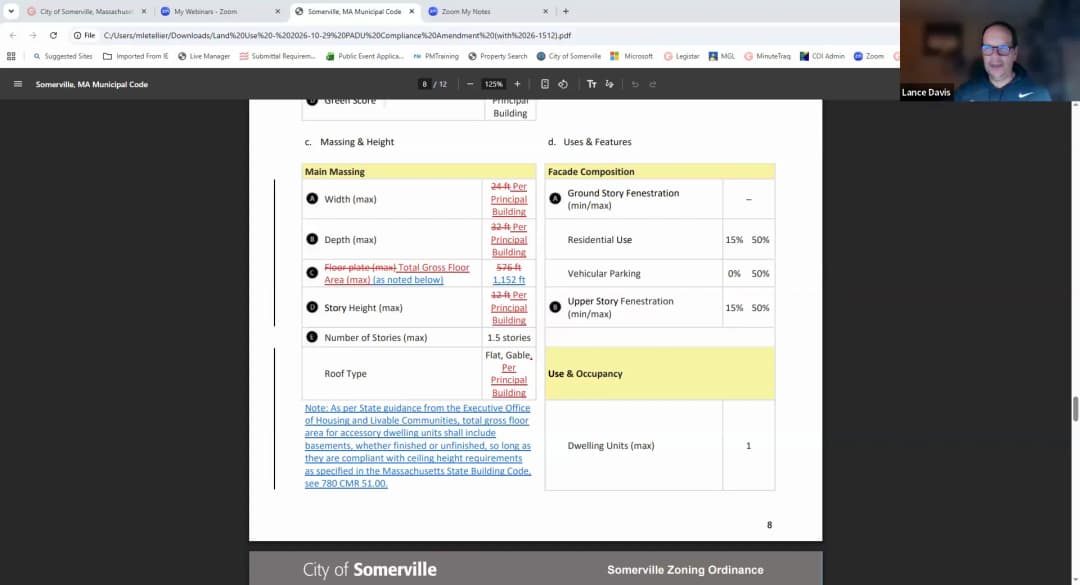
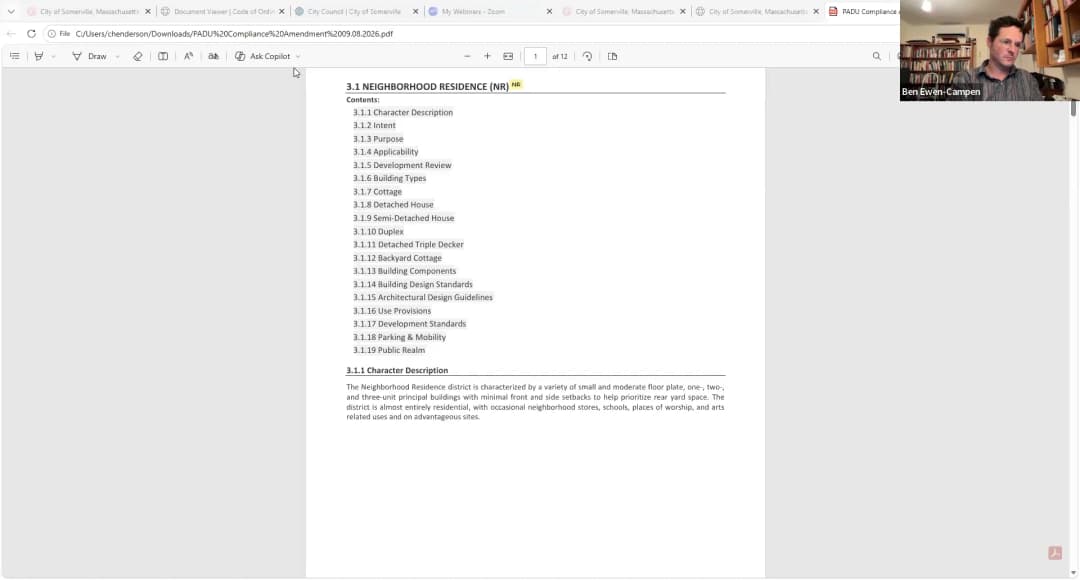
The Somerville Land Use Committee convened on October 31, 2026, at 4:15 PM to discuss a proposed amendment to the city's zoning ordinance regarding Protected Accessory Dwelling Units (ADUs), also known as backyard cottages. The primary aim was to align local regulations with state law while addressing concerns about the scale of newly constructed units. The meeting included an in-depth review of the proposed zoning text amendment and resulted in a unanimous committee recommendation to advance the item. Opening & Housekeeping - Roll Call: All councilors were present (Councilors Davis, Klingon, Said, McLaughlin, and Ewan Campin), establishing a quorum. The meeting was conducted via remote participation. - Items Withdrawn: Councilor Link's related item on ground floor entrances (Item 4) was withdrawn, with its content folded into the primary item (Item 26-1336) before the committee. - Minutes: Approval of minutes from previous meetings (items 26-15-17 and 26-157) was tabled for a vote at the end of the meeting. - Public Comment Period: The public hearing for this item was opened previously; the comment period remains open until noon the following day (November 1, 2026). Discussion Items - Amendment Overview: The proposed amendment (document "Land Use 2026 10 29 PADU compliance amendment") aimed to bring Somerville's zoning for ADUs into compliance with a recent state law. Key changes included setting a maximum gross floor area and limiting the number of stories. - Maximum Gross Floor Area: The amendment proposed a maximum total gross floor area of 1,152 square feet. This figure was derived from the previous allowance of two floors at 576 square feet each (representing a 24 ft by 24 ft footprint). This significantly reduces the potential square footage compared to what developers could build under previous interpretations. - Maximum Stories and State Law Conflict: The amendment set a maximum of 1.5 stories for an ADU. This directly conflicted with state guidance, which requires the number of stories to match the principal building on the lot (e.g., allowing a three-story ADU if the main house is a triple-decker). - The Chair argued that providing a more permissive square footage allowance (1,152 sq ft vs. the state's baseline of 900 sq ft) allows the city to enforce its own dimensional standards like the 1.5 story limit. - Director Dan Bartman stated this approach relies on a legal interpretation. The state has no direct enforcement mechanism, but a developer could challenge the local regulation. If a developer opts to use the state's baseline 900 square foot allowance, they could likely claim the right to match the principal building's full height. - The committee generally favored the Chair's argument, believing the increased square footage is a sufficient incentive for developers to accept the 1.5 story limit. - Basement Regulation and Enforcement: The amendment included language stating that basements (finished or unfinished) count toward the total gross floor area calculation, based on state guidance from the Executive Office of Housing and Livable Communities (EOHLC). - Councilor Davis raised concerns about a potential loophole where a developer builds a basement just under the ceiling height threshold (6 ft 8 in) and just under the grade threshold for counting as a story (5 ft in zoning, 6 ft in the updated building code), then finishes it illegally later. - Analyst Samantha Carr explained that enforcement for illegal finishing relies on building permits and public reporting. Director Bartman noted that adjusting the grade threshold would be a larger policy decision affecting all structures. - Garages and Ancillary Spaces: - Councilor Klingon inquired whether a garage could be built as part of the ADU structure. - Analyst Carr stated that garages, crawl spaces, and attics are explicitly excluded from gross floor area calculations per state CMR guidelines and would be treated as accessory structures. This could allow a developer to build a garage with living space above, potentially reaching the height of a three-story principal building. - Floor Plate Flexibility: The committee discussed whether to retain a specific maximum floor plate per story (576 sq ft) or just regulate total gross floor area. Councilors and staff leaned towards regulating only the total GFA to allow for more design flexibility (e.g., a larger first floor and a smaller second floor). Key Outcomes - Amendment Adopted: The committee unanimously voted to replace the original item language with the proposed amendment attachment, creating the new working version of the item. - Recommendation of Approval: The committee voted unanimously (5-0) to recommend approval of the item as amended. - Voting Yes: Councilors Davis, Klingon, Said, McLaughlin, and Ewan Campin. - Next Steps: The recommendation will be forwarded to the full City Council. No final action can be taken until the committee receives and considers a recommendation from the Planning Board. - Adjournment: After unanimously approving the previously tabled minutes, the meeting was adjourned.
Public Meetings - Somerville, Massachusetts
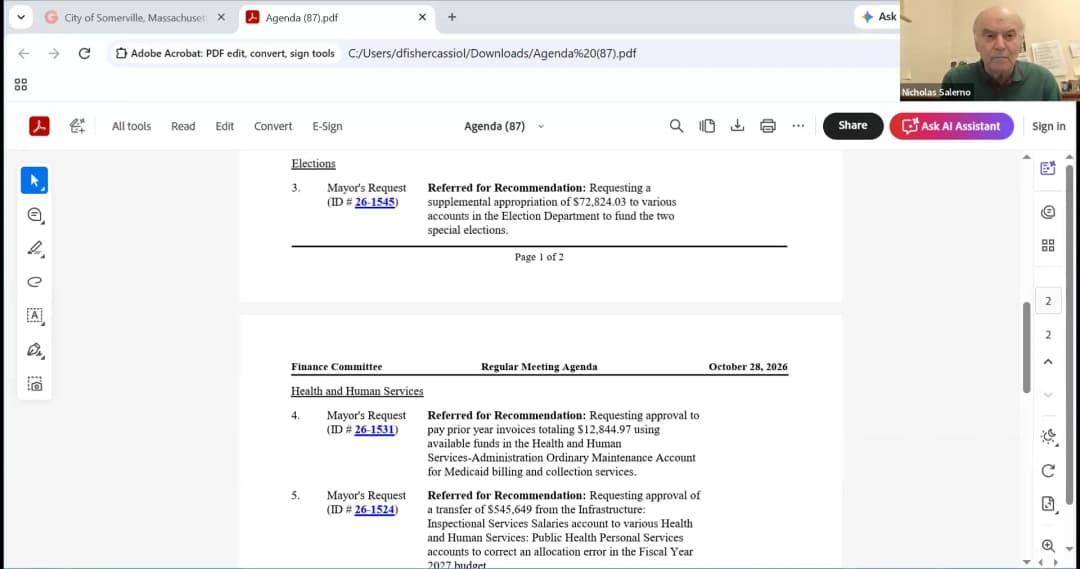
Public Meetings - Somerville, MassachusettsNote on date: The transcript of the meeting indicates Wednesday, October 28, 2026, but the user-provided metadata specifies the meeting took place on October 29, 2026. This summary uses the latter date as instructed. The Finance Committee of the Somerville City Council met remotely on October 29, 2026, at 6:00 p.m. with Chair Ben Wheeler presiding. All five committee members (Councilors Link, Strezzo, Hart, Scott, and Wheeler) were present, establishing a quorum. The committee considered seven agenda items, including appropriations, transfers, contract approvals, and a communication. After discussion, all actionable items were unanimously recommended for approval to the full City Council, and the meeting adjourned at 7:22 p.m. Consent Calendar - Item 1 (26-1578): Approval of minutes from the October 20, 2026 Finance Committee meeting. Laid on the table. - Item 2 (26-1514): Request to appropriate $100,000 from the Encore Artist and Cultural Support Stabilization Fund for local cultural council grants. Laid on the table. - Item 3 (26-1545): Supplemental appropriation of $72,824.03 for special elections in Wards 2 and 3 (preliminary February 2, 2027; final March 24, 2027). Laid on the table. - Item 4 (26-1531): Approval to pay prior-year invoices totaling $12,844.97 for Medicaid billing and collection services from Public Consulting Group. Laid on the table after extended discussion. - Item 5 (26-1524): Transfer of $545,649 from Infrastructure Inspectional Services Salaries to Health and Human Services Public Health Personal Services to correct an allocation error in the FY2027 budget. Laid on the table. - Item 6 (26-1539): Approval of a 60-month, $34 million contract with Boston Carting Services LLC for hauling municipal solid waste, recycling, and yard waste. Laid on the table. Public Comments & Testimony - No public comments were made during the meeting. Discussion Items - Item 2 (Arts & Culture Grant): Acting Arts and Culture Director Rachel Strutt (later referred to as Cultural Director) described the local cultural council (LCC) grant program, which redistributes Massachusetts Cultural Council funds and has been augmented by $100,000 annually from the Encore community benefits agreement since 2022. She noted that 179 applications requested a total of $659,000, making the process highly competitive. Councilor Link expressed strong support but requested more supporting documents in the future. Councilor Hart asked about the Encore fund, and Director Strutt explained it stems from a community benefits agreement providing $600,000 total, with $100,000 earmarked for LCC grants since 2022. Councilor Scott praised the program as a bright spot in city government for efficient spending. Councilor Strezzo emphasized prioritizing Somerville artists and residents, and Director Strutt confirmed that fellowship grants require Somerville residency, while project grants must serve the Somerville community and take place in Somerville. Chair Wheeler noted the ongoing strike by Unite Here Local 26 and Teamsters Local 25 at Encore and expressed hope for a resolution. - Item 3 (Special Elections): Commissioner of Elections Nicolas Salerno explained that the supplemental appropriation covers costs for poll workers, advertising, machine programming, and maintenance for the two special elections. Director of Intergovernmental Affairs Amanda Nadine Williams confirmed the funding comes from the tax levy using higher-than-projected revenue, avoiding free cash. No objections were raised. - Item 4 (Medicaid Billing Prior-Year Invoices): Health and Human Services Finance Manager Anuk Malik stated the invoice is the final FY2026 payment to Public Consulting Group for Medicaid billing and collection services, which arrived late due to reconciliation issues. He explained the contract runs through September 2027 and that the city receives reimbursements for services like nursing, occupational therapy, and speech therapy. Councilor Strezzo requested holding the item in committee to get answers about whether the work could be done in-house and about data privacy (HIPAA). Budget Director Mike Mastrobone clarified that Medicaid billing is a highly specialized field and not caused by staffing shortages; the city has used consultants for a long time. Chair Wheeler, supported by Councilor Scott, argued the invoice is for services already rendered and should be approved, with a commitment to provide written responses to questions before the next meeting. Councilor Strezzo ultimately agreed, and the item was laid on the table for approval. - Item 5 (Budget Correction Transfer): Budget Director Mike Mastrobone explained that after splitting Inspectional Services into Infrastructure and Health and Human Services, six positions (code enforcement inspectors, safety inspectors) were inadvertently budgeted in Infrastructure instead of Public Health. The transfer corrects this to avoid a deficit and align city records. Councilor Link asked about preventing future errors; Mastrobone noted they are implementing position control systems. The item was supported without further discussion. - Item 6 (Boston Carting Contract): Commissioner of Public Works Eric Wiseman presented a 60-month, $34 million contract with Boston Carting Services (recently acquired by Casella Waste Systems) for hauling residential solid waste, recycling, yard waste, mattresses, and white goods. Highlights include no rate increases for the first two years, 4% escalation thereafter, $2.3 million in projected savings, strengthened school zone safety provisions, and enhanced liquidated damages for missed pickups. Wiseman clarified that this is a hauling contract (collection and transport), separate from tipping (disposal) contracts. He noted Boston Carting's workforce is represented by Teamsters Local 25, with a collective bargaining agreement expiring June 30, 2028. Councilor Scott praised the presentation and noted the contract includes side guards for trucks (page 71) and wage details (pages 53-55). Councilor Link asked about potential strikes; Wiseman said Boston Carting has a strong relationship with the Teamsters and no disruptions occurred during recent labor unrest at other companies. Councilor Strezzo inquired about collection start times (7 a.m. as per contract, page 14) and school zone safety. Wiseman showed school-specific collection restrictions (page 45) to avoid conflicts with drop-off times. All councilors expressed support. - Item 7 (UASI Plan Communication): Chair Wheeler explained he filed a public records request with the City of Boston to obtain the Metro Boston Homeland Security Region's Urban Area Security Initiative (UASI) FY2024 plan and allocations, as these documents are not publicly available. The region includes Somerville, Cambridge, Boston, and other municipalities. Redacted versions were provided by the Massachusetts Office of Grants and Research, citing security concerns. The unredacted portions clarify compliance requirements for grants previously accepted by the council. Wheeler shared the documents for transparency. No questions were raised, and the item was marked work completed. Key Outcomes - Approvals: All six actionable items (Items 1–6) were laid on the table and later unanimously recommended for approval by a roll call vote: Councilors Link, Strezzo, Hart, Scott, and Wheeler all voted yes. The motion also included adjournment. - Directives: For Item 4, staff committed to providing written responses to Councilor Strezzo's questions about the Medicaid billing contract (including whether in-house alternatives exist and data privacy) before the next full council meeting on November 11 or 12, 2026. - Next Steps: The full City Council will consider the committee's recommendations at its next regular meeting. Item 7 (communication) required no further action.
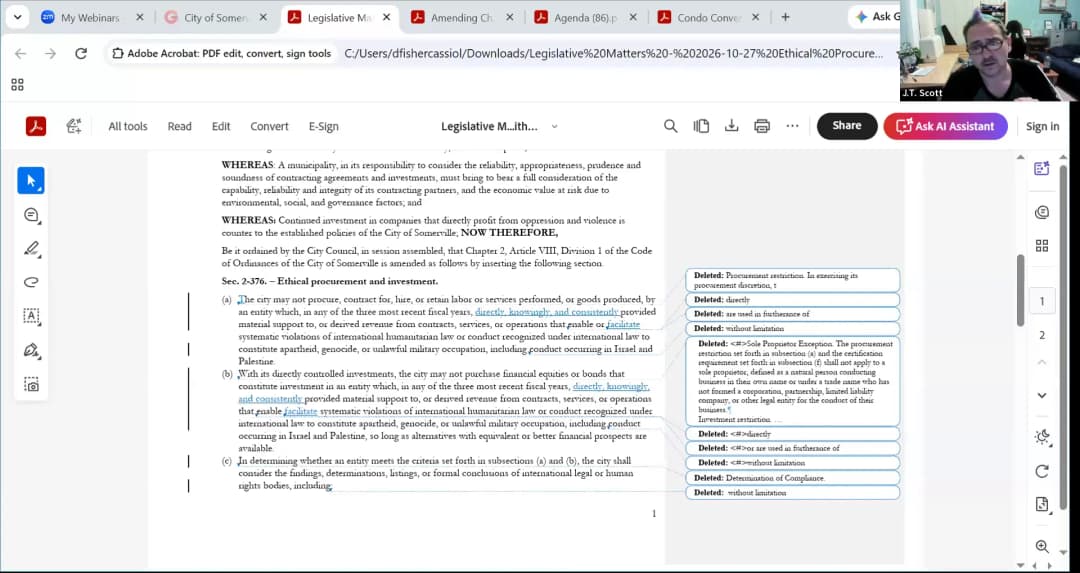
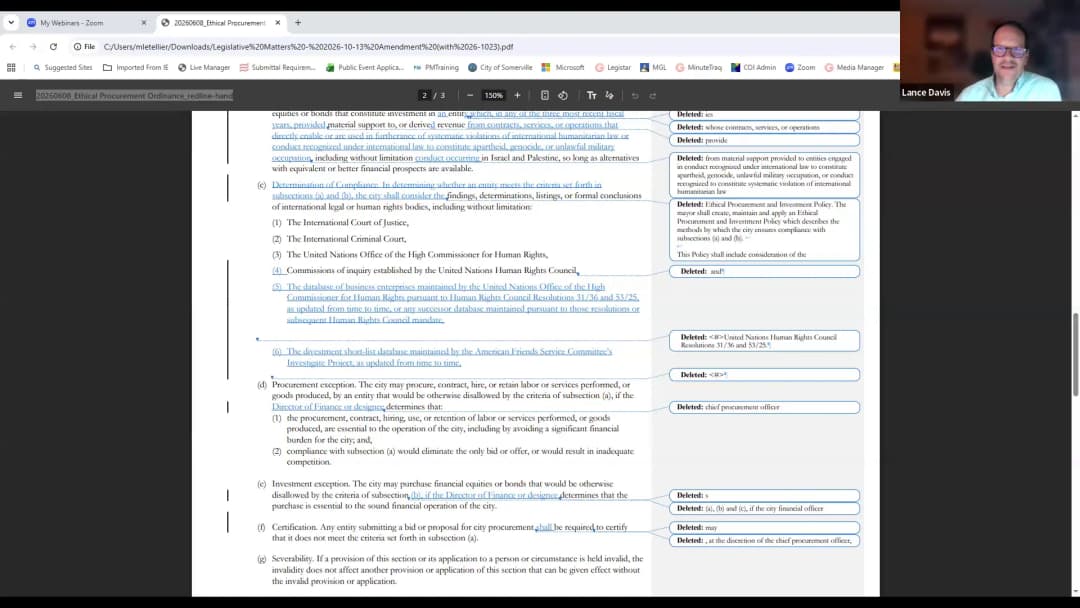
The Somerville City Council Legislative Matters Committee met remotely on October 28, 2026. The raw transcript opens by saying 'Good evening. This is Tuesday, October 27th at 6 p.m.,' so the date discrepancy is noted; this summary uses the supplied date of 2026-10-28 12:45 UTC. Chair JT Scott (Ward 2) presided, a quorum was present, and the meeting adjourned at 8:41 p.m. No agenda or minutes were available, so this summary is based solely on the raw transcript. Several agenda items were taken out of order to accommodate city staff schedules. Consent Calendar - The committee approved the October 13, 2026 meeting minutes and voted to adjourn in a single roll call vote, 5-0. Discussion Items Short-Term Rental Ordinance (26-1501) - Councilor Ewan Campen introduced amendments, on behalf of Councilors Link, Hart, and Ewan Campen, to tighten proof-of-primary-residence requirements for short-term rental operators. Under the amendments, applicants would need an income tax return for the last tax year, a recent utility/cable/phone bill or motor vehicle registration, and annual recertification. - Director Ziegler said he was satisfied with the changes but requested that the added documentation also be reflected in the registration information section. Policy Analyst Salisbury said no additional update was needed because the definition is cross-referenced, though he anticipated removing it during a future substantive review. - Councilor Mbah expressed support, saying the amendment strikes the right balance between legitimate property owner interests and preserving housing for people who live in the city. - The committee voted unanimously to recommend approval. Condominium Conversion Ordinance (26-1551) - Councilor Davis explained the amendment, filed by Councilor McLaughlin, would close a loophole in condo conversion notice requirements. It would treat demolition with intent to convert as a conversion event requiring notice to the condo review board, including for unoccupied or owner-occupied housing accommodations. - Director Davidson said the Housing Division had only received the amendments on Monday, had not yet reviewed them, and had not spoken with Councilor McLaughlin. She asked for time to assess the additional burden on staff and applicants. - Councilor Davis flagged possible drafting ambiguities, and Policy Analyst Salisbury offered to help clean up the language. Chair Scott supported the policy intent but agreed to hold the item in committee. Ethical Procurement Ordinance (26-1023) - Councilor Ewan Campen presented substitute text from a handout. He described non-substantive style changes, removal of the sole-proprietor definition with the exemption moved to subsection D2, and the addition of 'directly, knowingly and consistently' to describe companies that provide material support to, or derive revenue from, contract services or operations that enable or facilitate systematic violations of international humanitarian law, apartheid, genocide, or unlawful military occupation, including in Israel and Palestine. - Councilor Davis questioned whether the certification language in subsection F matched the apparent intent to exclude companies on referenced lists. Councilor Ewan Campen said a company should assess subsection A and that appearing on one of the listed sources would guide the city's non-compliance determination; he was open to clarifying the certification language. - City Solicitor Amara and Attorney Peaks said nothing in the amendments changed their legal opinion that, if challenged, the ordinance 'will not survive.' They cited federal preemption, commerce clause, international affairs concerns, and unresolved state procurement issues. - Director Allen raised practical implementation concerns: the city would need to determine what lists to consult, who would make disqualification judgments, whether the city has authority to debar bidders, and how to avoid confusion and delay while still obtaining essential city services. She said she had not determined that she could fully comply with the ordinance. - Councilor Strezzo opposed the ordinance, calling it illegal, discriminatory, dangerous, and harmful to community members, including Jewish residents who say they feel targeted. Councilor Mbah supported it, calling it a modest ordinance responding to genocide in Palestine and the public mandate to act. Chair Scott said legal outcomes cannot be predicted and expressed support for moving the policy forward. - The substitute text was adopted 4-1, and the committee recommended approval 4-1, with Councilor Strezzo voting no. Pay-to-Play Ordinance (26-1408) - Assistant City Solicitor Peaks presented administration amendments and timelines involving two grantees that were ineligible under the current ordinance. The current ordinance limits contributions by persons seeking no-bid contracts or financial assistance, with a disqualifying period covering the calendar year of application and the preceding calendar year, plus a four-year post-award prohibition on contributions over $500 to any candidate. - Proposed changes would: exempt financial assistance recommended by multi-member bodies, such as Community Preservation Act grants; allow the city to request more information; align the 12-month disclosure period with the disqualification period; require disclosure of post-award contributions; and clarify that remedies apply to grants as well as contracts. - Councilor Ewan Campen asked whether the multi-member body exemption would remove grants from bodies such as the Community Preservation Commission, Affordable Housing Trust Fund, and Jobs Creation and Retention Trust Fund from pay-to-play screening. Attorney Peaks confirmed that it would. - The committee adopted an immediate amendment to section 15-73B, striking 'in their capacity' so contributions made while serving as an officer, director, or manager are attributed regardless of capacity. The vote was 4-0, with Councilor Ewan Campen recused. Councilor Ewan Campen later said he would follow up about whether recusal was required due to his volunteer service on the Somerville Community Land Trust; Councilor Mbah did not recuse because his multi-member body service is in his official city capacity. - Chair Scott expressed concern about the moral hazard of exempting grants recommended by mayor-appointed multi-member bodies and suggested considering the ordinance's curative refund provision in section 15-76 instead. Councilor Davis supported letting the proposal 'stew' and possibly considering a short look-back period. Policy Analyst Salisbury said the faster fix was intentional, with a larger substantive review expected later. - The item remained in committee without a recommendation. Private Significant Trees During Construction (26-146) - Chair Scott introduced the amendment filed by Councilor Saeed. It would require protection measures for significant trees on an abutting lot impacted by construction, addressing situations where excavation severs a large tree's roots and threatens its survival. - Director Najim Williams said city staff were not available that evening, but a conversation with ISD, engineering, and the law department was being scheduled. Councilor Davis suggested that the phrase 'impacted by construction' could be misread to exempt projects unless the abutting lot itself is affected, and he requested legal and property-law review. - The item was held in committee. Artificial Intelligence Ordinance (26-1557) - Councilor Mbah introduced the proposed AI ordinance on behalf of Councilors Link, Wheeler, and himself. He said it would establish responsible guardrails for city government use of AI, addressing bias, privacy violations, inaccurate information, and lack of transparency while keeping human judgment central for decisions affecting residents' rights, services, and opportunities. - Councilor Davis said he had done a first quick read, saw some potentially overbroad sections, and noted that the administration may also be developing an AI policy. He urged collaboration to avoid duplication or contradictions. Policy Analyst Salisbury said the submitted ordinance differed significantly from an earlier draft discussed with staff and offered to reconvene the staff working group. - The item was held in committee. Key Outcomes - Recommended approval: short-term rental ordinance amendments (unanimous) and ethical procurement ordinance (4-1). - Held in committee for further discussion: condominium conversion amendment, pay-to-play amendments, private tree protection amendment, and artificial intelligence ordinance. - Adopted the pay-to-play section 15-73B amendment, 4-0, with one recusal. - Approved minutes and adjourned by a 5-0 roll call vote at 8:41 p.m. The committee indicated it would return in approximately two weeks; the transcript references November 10.
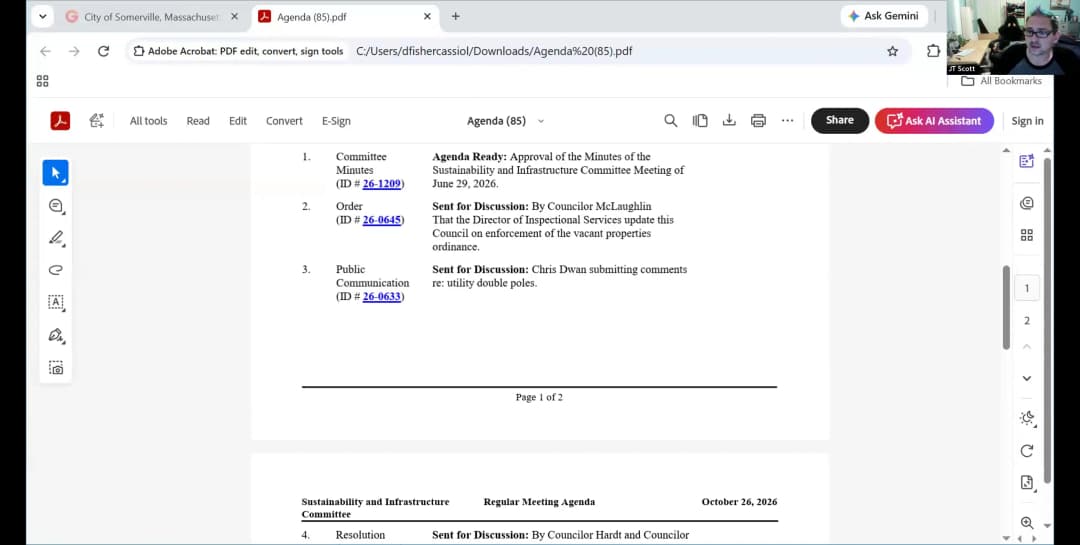
The Sustainability and Infrastructure Committee, chaired by Councilor Jesse Klingan, met on October 27, 2026, to discuss two main agenda items: enforcement of the city's vacant properties ordinance and the ongoing issue of double utility poles. Representatives from Eversource, Verizon, and multiple city departments participated, along with public testimony from a resident. The meeting lasted from approximately 1:45 PM to 7:59 PM (as per adjournment time). Consent Calendar - Approval of the minutes from the previous meeting was laid on the table for approval at the end of the meeting. The minutes were later approved unanimously as part of the adjournment vote. Public Comments & Testimony - Chris DeWan, a resident of the city, provided testimony on double utility poles. He confirmed that the double poles at either end of his block—one of which had been doubled since 2015—were recently resolved following council attention. However, he criticized the process as relying on "particularly active residents" and expressed frustration that verbal assurances from utility representatives during council meetings often do not translate into action. He also noted that a wire rubbing against a tree near his home, previously reported to Eversource, was never fixed, leading to the tree's removal. He urged councilors to view company representatives’ statements with skepticism. Discussion Items 1. Vacant Properties Ordinance Enforcement - Director Kevin Klein (Inspectional Services) and Colin Ziegler (Health Department) provided an update. Klein noted that residential vacancies are fewer due to the hot housing market, while commercial vacancies are a larger concern. He mentioned a $50 registration fee and emphasized a helping approach rather than punitive. Ziegler detailed the Health Division's role in identifying and ticketing vacant or dilapidated properties, collaboration with the AG's Office on the Neighborhood Revitalization Program (which has helped with contact information for property owners), and the challenges of staffing and definitions. - Amanda Natron Williams (Director of Intergovernmental Affairs) added that staff are seeking clarity on the definition of "vacant" (e.g., whether vacant lots are included) and that commercial and residential properties require different approaches. - Councilor Scott raised concerns that the ordinance (Section 11-11) has been on the books for over seven years but has not been actively enforced. He noted that the ordinance clearly defines vacancy (within 90 days) and allows inspectors access to properties—a tool that could help address rat infestations and structural hazards. He expressed frustration that the city relies on carrots (like OSPCD's spreadsheet) rather than sticks, and that many properties, such as a six-unit building on his block vacant for 15 years, remain unaddressed. He asked why the city is looking at Arlington's approach rather than using its own law. - Councilor Klingan acknowledged turnover in ISD and the need for a systematic approach. Councilor Hart requested that the next discussion include the Strategy & Development team to cover both incentives and enforcement. - The item was kept in committee for further discussion. 2. Utility Double Poles and Abandoned Wires - Councilor Klingan introduced three related items: a resident's communication (Item 3), an order by Councilors Hart and Scott for city staff to report on monitoring progress (Item 4), and an order for utilities to appear (Item 5). Representatives from Eversource and Verizon attended; representatives from Comcast and Astound were not present despite invitations. - Jason Wright (Eversource Community Relations) reported that Eversource uses the "ENGINE" system (National Joint Utility Notification System) to track double poles. As of mid-week prior, approximately 125 double poles existed in Somerville—down from a previous count of about 170. He explained that poles become doubled due to car accidents, upgrades, or end-of-life replacement. A new agreement with Verizon (about one year old) aims to improve efficiency: Eversource sets the new pole and transfers its facilities, then Verizon transfers its (lowest) attachments and pulls the old pole. - Tatum Kelleher (Verizon Government Affairs) confirmed the agreement and noted that Verizon has an internal goal of moving its facilities within 30 days of becoming "next to go." She stated that there were currently no double poles in Verizon's queue in Somerville. She also noted that non-participating attachers (e.g., municipal fire or street light attachments not in the system) can cause delays. - Brian Postlewaite (Director of Engineering) noted that his team coordinates with utilities on city construction projects and has found Eversource responsive when poles interfere with city work. Eric Weissman (DPW Commissioner) echoed that health and safety issues are addressed promptly. - Councilor Hart and Councilor Scott asked specific questions. Hart noted that in the ENGINE system, Comcast and RCN/Astound appear as the largest "next to go" backlogs. Scott highlighted three poles (191-0, 191-1, and 358-47) that are leaning dangerously—near an elementary school and the MBTA right-of-way—and expressed that some have been in the system since 2023 but remain unresolved. He showed photos of leaning poles on Kent Street and criticized the lack of progress. Ronit Goldstein (Eversource) offered to follow up on specific poles and suggested a working group with quarterly meetings involving all utilities and the city. - Councilor Klingan proposed the city pilot a plan to reduce the double pole count significantly. The representatives agreed to prioritize Somerville and provide updated lists. Key Outcomes - Vacant Properties Ordinance: Kept in committee. Future agenda will include the Strategy & Development team to address both commercial and residential approaches. Chair Klingan expressed hope for progress given new staff involvement. - Double Poles: - Item 3 (public comment from Chris DeWan) was discharged as completed. - Items 4 and 5 were kept in committee for further discussion. - Eversource and Verizon agreed to provide updated ENGINE reports to the council (to be sent to publiccomments@somervillema.gov). - Councilor Scott requested that specific pole data be shared, and Verizon committed to investigating pole 358-47. - A working group may be established involving city staff, councilors, and all utility companies (including Comcast and Astound) to systematically address double poles. - Councilor Scott and Councilor Hart emphasized the need for measurable goals and accountability, especially given state legislative discussions (HB 5562) that may alter deadlines. - Meeting adjournment: Motion to approve minutes and adjourn passed unanimously (Scott, Hart, Klingan all yes) at 7:59 PM.
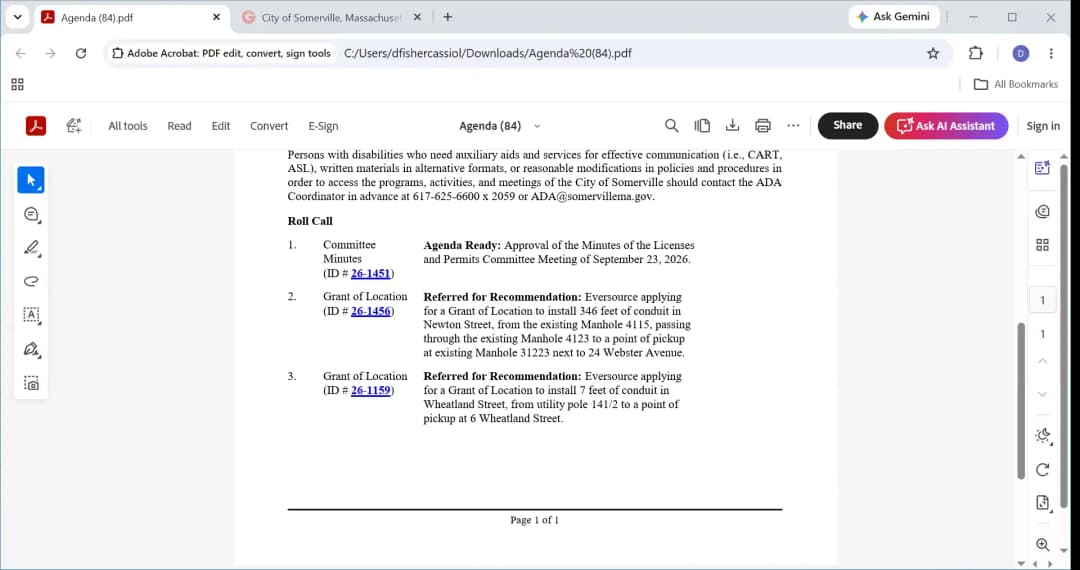
The Licenses and Permits Committee met on October 22, 2026, at 6:03 PM via Zoom, adjourning at 6:25 PM. Councilors Ben Wheeler and Emily Hardt were present (quorum achieved); Councilor Lance Davis was absent. The committee considered three agenda items: approval of previous minutes and two Grant of Location applications from Eversource. All items were recommended for approval by a 2-0 vote (Davis absent). Consent Calendar - Approval of Minutes (ID 26-1451): The minutes of the September 23, 2026, committee meeting were accepted unanimously. (Motion by Wheeler, second by Hardt; 2-0-1) Discussion Items - Eversource Grant of Location – Newton Street (ID 26-1456): Eversource requested 346 feet of conduit on Newton Street. A resident had previously asked at a public hearing whether this work could be coordinated with new construction at 32 Webster Avenue. Eversource Right-of-Way Agent Jacqueline Duffy reported that no work order exists for 32 Webster, and the timeline for that project is unknown. Chair Hardt noted ongoing consultation with the City Engineering Department. Councilor Wheeler observed that, given the winter moratorium and the lack of a work order, tying the two projects together is impractical. The committee recommended approval, with the understanding that coordination with 32 Webster could be revisited at the full Council meeting. - Eversource Grant of Location – Wheatland Street (ID 26-1159): Eversource requested 7 feet of conduit on Wheatland Street. Chair Hardt stated that Ward 4 Councilor Jesse Clingan was consulted and supports approval. No additional concerns were raised. The committee recommended approval. Key Outcomes - Minutes approved (2-0-1). - Newton Street conduit project recommended to be approved by full Council (2-0-1). - Wheatland Street conduit project recommended to be approved by full Council (2-0-1). - All three items were voted on together in a single roll call; the recommendations will be forwarded to the City Council for final action at its meeting on October 23, 2026.
The Somerville City Council met Thursday, October 22, 2026, from 7:03 PM to 10:07 PM in the City Council Chamber and remotely. Council President Lance L. Davis presided. The Council entered executive session at 8:01 PM and returned at 8:38 PM; no votes were taken in executive session other than the vote to return to open session. Councilor At Large Kristen Strezo was absent throughout; Councilor J.T. Scott arrived at 7:14 PM. Consent Calendar - Approved the September 10, 2026 regular meeting minutes. - Approved a moment of silence and remembrance for Patricia A. Galvin Sullivan. - Approved resolutions and orders that drew no extended debate, including: support for local businesses damaged by recent fires (referred to Public Health and Public Safety); a report on the West Somerville Neighborhood School roof and a risk-based review of school roof drainage systems (referred to School Building Facilities and Maintenance); support for the Artificial Intelligence Civil Rights Act of 2025; a call for city policies prohibiting AI-generated public-facing media and AI replacement of employees; a severe-weather construction protocol resolution; a resolution urging state protection of Mass Save and clean energy grants; a request for a Slow-Children-Crossing sign on Heath Street; and placing the MBHSR UASI FY2024 plan on file with a copy to Finance. - Approved public event licenses for the East Somerville Halloween Block Party and Pet Spooktacular (October 31, 10 AM-5 PM), Pumpkin Smash (November 7, 9 AM-3:30 PM), Powderhouse Park Foam Sword Games (October 24, 10 AM-4 PM), and MAMAS Free Store (November 14, 7:30 AM-4 PM), plus a drainlayer license for Duffy Excavation Inc. - Approved the Licenses and Permits Committee report and Eversource Grants of Location for 7 feet of conduit on Wheatland Street and 346 feet of conduit on Newton Street. - Approved the Traffic and Parking Committee report after a public hearing on construction parking permits, with a future staff discussion scheduled. - Approved the Legislative Matters Committee report covering the rental registry, short-term rental enforcement, and the proposed ethical procurement ordinance; older surveillance technology reports were placed on file or marked work completed. - Approved a request for the Chief Assessor to appear at the November 12, 2026 tax classification hearing and placed the City Clerk's block party license list on file. - Referred the Toucan Auto Center garage license for 619 Somerville Avenue to the Licenses and Permits Committee. Public Comments & Testimony - No oral public testimony was given during the open business session. Written public communications were placed on file from Caroline Levy (combined sewer overflows), Paul Garbarino (state law and zoning discrepancies), Lisa Shatz (Code of Ordinances amendment), Nathaniel Verter (Tufts University), Jon Landry (short-term rental ordinance), and Alexandra Sheldon (affordable housing). Discussion Items Artificial Intelligence Ordinance and Resolutions - Councilor Link introduced the proposed Artificial Intelligence Ordinance (26-1557), describing it as a baseline city policy to prevent AI from making consequential decisions about housing, policing, and benefits; require annual public reporting; and label AI-generated content. Councilors Wheeler and Mbah spoke in support; the item was referred to the Legislative Matters Committee. - Councilor Link also presented the resolution supporting the federal Artificial Intelligence Civil Rights Act of 2025 (26-1553), which would regulate discriminatory AI in consequential decisions such as employment, banking, and criminal justice; it was approved. - The Council approved resolution 26-1554 calling on the Mayor to prohibit city staff from using AI to generate public-facing media and from replacing city employees with AI. Link emphasized engaging local artists and treating AI as a force multiplier, not a job replacement. - The Finance Committee received an administration report on city AI contracts; a police department product called Blue Voice was described as a closed-loop AI system, and AI is increasingly embedded in ordinary software such as antivirus and traffic control systems. The related council order was marked work completed. Combined Sewer Overflow Resolution - Councilor Hardt, joined by Councilors Link and Mbah, introduced resolution 26-1552 opposing the draft combined sewer overflow (CSO) long-term control plan and calling for a regional solution. She explained that Somerville is under EPA/DEP legal obligation to produce a draft plan, that the current plan carries a large price tag and may not keep pace with climate change, and that CSO events create sewage contamination risks. She described the issue as a technical approach to a political problem and urged examining hybrid regional solutions and additional state, regional, and federal funding. - Councilor Mbah framed CSO as an environmental justice issue affecting public housing residents near the Alewife Brook floodplain. Councilor Link emphasized equity for ratepayers. Councilor Wheeler said he could not support the resolution's call for higher, more costly levels of control, citing projected annual rate increases of 15% or more and an unresolved cost discrepancy between a 3% cost difference reported by MWRA and roughly 45% more reported by city staff. Councilor McLaughlin supported the resolution but expressed frustration with rising water and sewer rates and argued a state river needs a state solution. - The resolution was approved 9-1 on a roll call vote, with Councilor Wheeler voting no and Councilor Strezo absent. FY2027-2031 Capital Investment Plan - Mayor Wilson and Budget Director Michael Mastrobuoni presented the five-year Capital Investment Plan (26-1556). The plan proposes roughly $8.1 million in ongoing investments, funded primarily with about $7 million in cash and reserves and $1 million in Community Preservation Act funds. It prioritizes completing active school and facility repairs, fleet replacement, street and sidewalk work, and fire apparatus. - Mastrobuoni reported a projected fiscal 2028 operating deficit of several million dollars and said 20-year bond yields had risen from about 4.3% to about 5.0% in the prior month. He noted the average city fleet age is about 13 years, and about $15.3 million is in the FY28 priority pipeline for future projects including school exterior/mechanical work, the Armory roof, and the Teal Square Fire Station slab. Future priorities include a new school at Sycamore, decarbonization, Union Square, and library investments, all needing financing strategies. - Director of Infrastructure and Asset Management Richard Raiche answered questions about sidewalk and street costs, school boiler replacements, fleet electrification, and solar-ready roofs. Councilors welcomed the risk-and-consequence prioritization framework. Sidewalk and road repair is a large recurring item, close to $10 million in FY27. The plan was placed on file. SomerStat Focus Areas Dashboard - Principal Analyst Samuel Shaffer presented an update on the city's new focus-areas framework grouping city work into 12 policy areas, with a public dashboard showing objectives, metrics, and status updates. A draft dashboard is already live, with a full public release planned for November 2026. The item was placed on file. Land Use and Zoning Matters - Councilor McLaughlin introduced an ordinance (26-1551) strengthening the condominium conversion ordinance to explicitly cover demolition and replacement of a building with condominiums. The item was referred to the Legislative Matters Committee. - Councilor Ewen-Campen reported that the Land Use Committee recommended four zoning amendments, all laid on the table pending Planning Board recommendations: correction of parking-maximum typos; removal of ground-story elevation requirements; clarification of principal entrance rules; and terminology changes making affordable dwelling units price-restricted dwelling units (PRDUs). He also described continued committee debate on accessory dwelling units, including a proposal to reduce maximum size to 1,152 square feet. - The Council waived readings of Mayor's zoning amendment requests 26-1525 through 26-1528, covering use tables, accessory structures, sustainable development elements, and building components, and referred them to the Land Use Committee with copies to the Planning Board. - Councilor Scott's supplemental ordinance (26-1579) to create an Upzoning Overlay District at Davis Square, Porter Square, and Ball Square was initially referred to the Land Use Committee without discussion. On reconsideration, Scott explained the transit-oriented overlay would allow up to four stories on most residential parcels and up to six on larger parcels, require compliance with affordable housing rules, and include anti-displacement payments of four times monthly rent. It was referred to the Land Use Committee with a copy to the Planning Board. Finance, Executive Session, and Other Mayor's Requests - The Finance Committee report was approved. The Council approved a $35,000 Massachusetts Department of Mental Health grant to the Police Department for Crisis Intervention Team Training overtime/backfill; $100,000 from the Racial and Social Justice Fund for the 2026 Community Grant Cycle; a $2,097,667.05 reduction in the Poplar Street Project borrowing appropriation; and $3,143,557 in new borrowing and appropriation for the Poplar Street Pump Station. The committee also discussed Teen Center cost estimates and received updates on AI contracts and the bankruptcy affecting 808 Windsor Place in Boynton Yards. - The Council entered executive session for Richard Nurse, Ronald Bonney, and Michael Browne v. City of Somerville, et al. after receiving advice that it met the Open Meeting Law standard. After returning, it approved a $2,500,000 appropriation from Free Cash to the Judgments and Settlements Account for that settlement by a 9-1 roll call, with Councilor McLaughlin voting no and Councilor Strezo absent. - The Council approved a $171,922 appropriation for the retroactive component of the firefighters collective bargaining agreement with Local 76; a $25,000 Barr Foundation grant to extend the Community Heat Resilience pilot; and a $1,776 Somerville Cambridge Elder Services grant for senior transportation. - The Council approved the two updated Body Worn Camera Surveillance Technology Impact Reports (26-1540 and 26-1541), with Councilor Scott noting they incorporate councilor-requested changes, including shifts from citizens to civilians and stronger reporting to the Council and civilian oversight body. - Items referred to the Finance Committee included the $100,000 Encore Artist and Cultural Support Stabilization Fund appropriation, a $72,824.03 supplemental appropriation for two special elections, a $545,649 budget allocation correction, a 60-month Boston Carting Services contract, and $12,844.97 in prior-year Medicaid billing invoices. Appointments of Gary Rogers and Fatima Climaco to the Condominium Review Board were referred to the Appointments Committee. Key Outcomes - Approved CSO resolution 26-1552 on a 9-1 vote (Wheeler no; Strezo absent). - Approved $2.5 million settlement appropriation on a 9-1 vote (McLaughlin no; Strezo absent). - Approved $3,143,557 Poplar Street Pump Station bond/appropriation and $2,097,667.05 borrowing reduction. - Ordained code amendment 26-1274 updating enforcement personnel on a 9-0 roll call (Clingan and Strezo absent). - Approved Body Worn Camera impact reports 26-1540 and 26-1541. - Referred AI Ordinance 26-1557, condominium conversion ordinance 26-1551, and Upzoning Overlay ordinance 26-1579 to committees. - Laid four Land Use zoning amendments on the table pending Planning Board recommendations. - Approved all remaining resolutions, grants, public event licenses, and routine items as listed above. - Adjourned at 10:07 PM.
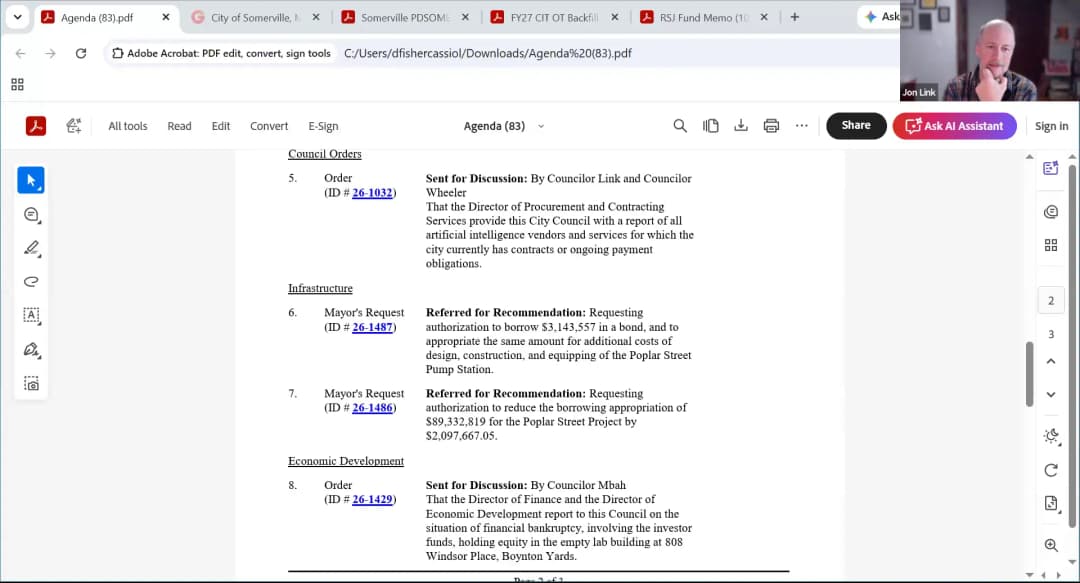
The Finance Committee of the Somerville City Council met on October 21, 2026 (per official scheduling; meeting minutes and transcript reference October 20, 2026) from 6:00 PM to 7:36 PM via Zoom. Chair Wheeler presided with Councilors Link, Hardt, Scott, and Wheeler present; Councilor Strezo was absent. The committee discussed eight agenda items covering racial justice grants, a teen center feasibility, police training grants, artificial intelligence contracting, infrastructure borrowing for the Poplar Street Pump Station, and the bankruptcy of an investor in a lab building at Boynton Yards. Discussion Items 1. Approval of Minutes (ID 26-1520): The minutes from the October 6, 2026 meeting were approved by a vote of 4-0. 2. Racial and Social Justice Fund Grant Cycle (ID 26-1472): Catherine Nakato, Director of Racial and Social Justice, requested approval to appropriate $100,000 from the Racial and Social Justice Fund to implement the 2026 Community Grant Cycle. She explained that the fund supports community-led ideas and strengthens connections between residents and government. Councilor Scott expressed appreciation for the fund and noted it had been underutilized. Councilor Link asked for examples; Director Nakato highlighted the Somerville Museum's project documenting the Pullman Porters and Black community, and a "Girls as Researchers" STEM program. Councilor Hardt inquired about public transparency; Director Nakato stated the City plans to publish project information on the website but has not decided whether to include grant amounts. Chair Wheeler clarified the reimbursement model (awardees pay upfront and get reimbursed) and asked about equity concerns for organizations lacking cash flow. Director Nakato confirmed the City is working with Finance to explore upfront funding options. The committee recommended approval (4-0). 3. Teen Center at Somerville High School (ID 26-1427): Councilor Link and Councilor Sait submitted a resolution requesting a memo on the cost of staffing Somerville High School as a teen center after school hours. Amanda Nagim-Williams, Director of Intergovernmental Affairs, reported that planning is ongoing; a walkthrough with the Mayor and Superintendent is planned for later in October 2026 to assess needs. Staffing and programming requirements depend on the space. Councilor Scott requested that councilors be invited to the walkthrough; Director Nagim-Williams said the administration would consider that or provide future updates. Chair Wheeler asked about departmental involvement (likely Parks and Recreation) and projected participant numbers; Director Nagim-Williams noted capacity depends on funding and that grants are being explored. Councilor Link emphasized the importance of making the space student-driven with unstructured programming. The item was kept in committee (no final vote). 4. Police Crisis Intervention Team Training Grant (ID 26-1414): Emily Wisdom, Police Director of Finance and Administration, requested approval to accept and expend a $35,000 grant from the Massachusetts Department of Mental Health for overtime/backfill to help officers obtain and maintain Crisis Intervention Team (CIT) certification. Director Wisdom explained that the grant is part of the same DMH program that funds the CIT training center and jail diversion. Chair Wheeler asked about public reporting on program outcomes; Director Wisdom noted that programmatic reports are submitted to the state and she would explore what can be shared. Councilor Scott offered to help obtain data. The committee recommended approval (4-0). 5. Artificial Intelligence Vendors and Services (ID 26-1032): Councilor Link and Councilor Wheeler sponsored an order for a report on all AI vendors and services under city contract. Amanda Nagim-Williams and Deputy IT Director David Slonina responded that the City currently has only one product purchased specifically for AI—Bluevoice (a closed-loop internal AI system). Deputy Director Slonina expressed concern about identifying other software with embedded AI features (e.g., antivirus with pattern recognition) due to security risks. Councilor Link shared an experience where Outlook's AI promotions folder misfiled constituent emails, causing delayed responses. Councilor Scott noted that other departments (Police, Engineering) use generative AI tools and called for a comprehensive inventory and clear AI policy. Deputy Chief Procurement Officer Joey Hustins clarified that the order pertains to AI contracting, not general usage, and that purchases under $10,000 may not be tracked. The committee recommended marking this item as work completed (4-0), but Councilor Link expressed a need for better future tracking. 6 & 7. Poplar Street Pump Station – Additional Borrowing and ARPA Adjustment (ID 26-1487 & 26-1486): Rich Raiche, Director of Infrastructure and Asset Management, explained two related requests. First, authorization to borrow $3,143,557 to cover increased costs from a mid-project change in EPA rules for disposing of PCB-contaminated soil at the Poplar Street site (historically a waste transfer station). The contractor initially sought $4.4 million; the City negotiated down to $3.14 million. Second, authorization to reduce the original borrowing appropriation by $2,097,667.05 because unspent ARPA funds (which had been allocated for other items like fire vehicles) were applied to the project instead, to avoid leaving ARPA money on the table. Councilor Scott praised the team's negotiation and risk management. The committee recommended approval for both items (4-0). 8. Bankruptcy of Investor at 808 Windsor Place (Boynton Yards) (ID 26-1429): Councilor Mbah sponsored an order for a report on the financial bankruptcy involving an investor in the empty lab building at 808 Windsor Place. Tom Galligani, Executive Director of OSPCD, reported that a German retail investment fund that was an equity investor in the building filed for bankruptcy in August 2026. The property was turned over to the lender, Bank OZK of Arkansas, which plans to continue operating the building and has retained the former property manager. Councilor Scott asked about future plans; Director Galligani stated no auction is planned. Councilor Link asked about tax revenue implications; Director Galligani explained that owners of vacant buildings can petition for tax abatements if assessed values decline. Chair Wheeler asked about community benefits agreements; Director Galligani confirmed that required payments had already been made upon construction and are unaffected. The committee recommended marking this item as work completed (4-0). Key Outcomes - Approved (4-0): Approval of minutes (ID 26-1520), $100,000 RSJ Fund grant cycle (ID 26-1472), $35,000 police CIT training grant (ID 26-1414), additional borrowing for Poplar Street Pump Station (ID 26-1487), and reduction of borrowing appropriation (ID 26-1486). - Kept in Committee: Teen center feasibility study (ID 26-1427). - Marked Work Completed: AI vendor report order (ID 26-1032) and investor bankruptcy report order (ID 26-1429).
The Somerville Land Use Committee convened on October 16, 2026, to discuss and advance several zoning amendments. The meeting focused on routine approvals, a technical fix to parking maximums, and extensive deliberation on accessory dwelling units (ADUs), including a proposed amendment to comply with state regulations. The committee voted to recommend approval on several items and left the ADU discussion open for further refinement. Discussion Items - Removal of Ground Story Elevation Requirement (Items 26-1259 & 26-1373): The committee discussed an amendment to remove the mandatory two-foot ground story elevation requirement for residential buildings. Planning Director Bartman explained that the requirement, originally intended for stylistic consistency, has created accessibility issues, particularly with ramps, and that such decisions should be left to property owners. Councillor Klingon raised concerns about potential flooding and pipe freezing, but Director Bartman noted these are handled through other permitting processes. Councillor Sae inquired about flood-prone area considerations for large developments, and Director Bartman confirmed that the Engineering Division manages site-specific stormwater and flood concerns. Councillor Kampen proposed an amendment to the mayor's version to also strike related language in the non-binding architectural design guidelines, which was approved. The amended item was then recommended for approval. - Clarification of Principal Entrance Requirements (Item 26-1373): This amendment allows principal entrances to be on the side of a building if a ground-story unit has a front door, and permits principal entrances on any side of an external accessory dwelling unit (ADU). Director Bartman explained that this is to accommodate modern triple-decker designs and ADU flexibility. Councillor Kampen questioned the logic of allowing a rear door on an ADU, but Director Bartman clarified that building codes regulate proximity to lot lines. Councillor Sae requested visuals for future discussion. The committee recommended approval. - Fixing Parking Maximum Typos (Item 26-1258): The committee approved a technical correction to fix typos in the parking maximums in the zoning code. Director Bartman confirmed it reflects the original intent of a prior amendment. - Updating Terminology for Affordable Dwelling Units (Item 26-1338): The committee approved a name change from "ADU" (affordable dwelling unit) to "Price-Restricted Dwelling Unit" (PRDU) and standardized related terminology to avoid confusion with the state's use of "ADU" for accessory dwelling units. This was a streamlining effort triggered by the state ADU law. Accessory Dwelling Units (ADU) – Item 4 This was the main focus of the meeting. The committee discussed a proposed amendment (Item 4) to bring the city into compliance with state ADU regulations. The mayor's proposal allowed for a 1,728-square-foot maximum (three 576-square-foot floors), which led to significant debate. - Director Bartman's Overview: He explained that the state regulations require municipalities to permit at least one ADU per lot, with dimensions that must match the principal structure's building type. The 1,728-square-foot figure was a starting point based on measuring existing backyard cottages. - Councillor Davis: Expressed strong frustration, stating the current implementation is not what the council intended. He said the mayor confirmed that the 1,500+ square-foot figure was not a firm position, and that the mayor has no objection to reducing it. He advocated for significant reductions, including a 900-square-foot cap, a 1.5-story height limit, and other levers to ensure ADUs remain "backyard cottages," not full-sized houses. - Councillor McLaughlin: Defended the overall policy, rejecting claims of widespread displacement. He requested data from the city solicitor on the legal interpretation of the state law, and data on demolitions and condo conversions since the new zoning code. - Councillor Klingon: Questioned the complexity of the state law, noting that it appears to require matching the principal building's dimensions, which could allow three-story ADUs. He expressed a desire to limit size and height. - Councillor Sae: Shared concerns that the state version could lead to "boxes" in backyards, supporting a 900-square-foot cap and a 1.5-story limit. She asked if the city had submitted comments to the state. - Councillor Kampen: Proposed capping the total square footage at 1,152 square feet (two floors of 576 square feet each) to naturally limit the building to a 1.5-story cottage. He argued this would be a straightforward solution and more likely to produce the intended housing type. - Councillor Davis: Raised concerns that developers will find ways to exclude basements from square footage calculations, and requested a review of green score requirements to address stormwater runoff. Committee Decision: The item was left in committee for further refinement. Councillor Kampen will work with staff to prepare revised language with a 1,152-square-foot cap, a 1.5-story height limit, and provisions to ensure basements are counted toward the total. Key Outcomes - Items 26-1259 and 26-1373 (Ground elevation & Principal entrances): Recommended for approval with amendment to strike architectural guidelines. - Item 26-1258 (Parking maximums): Recommended for approval. - Item 26-1338 (Terminology update): Recommended for approval. - Item 4 (ADUs): Left in committee for revision; staff to prepare new language based on discussion.
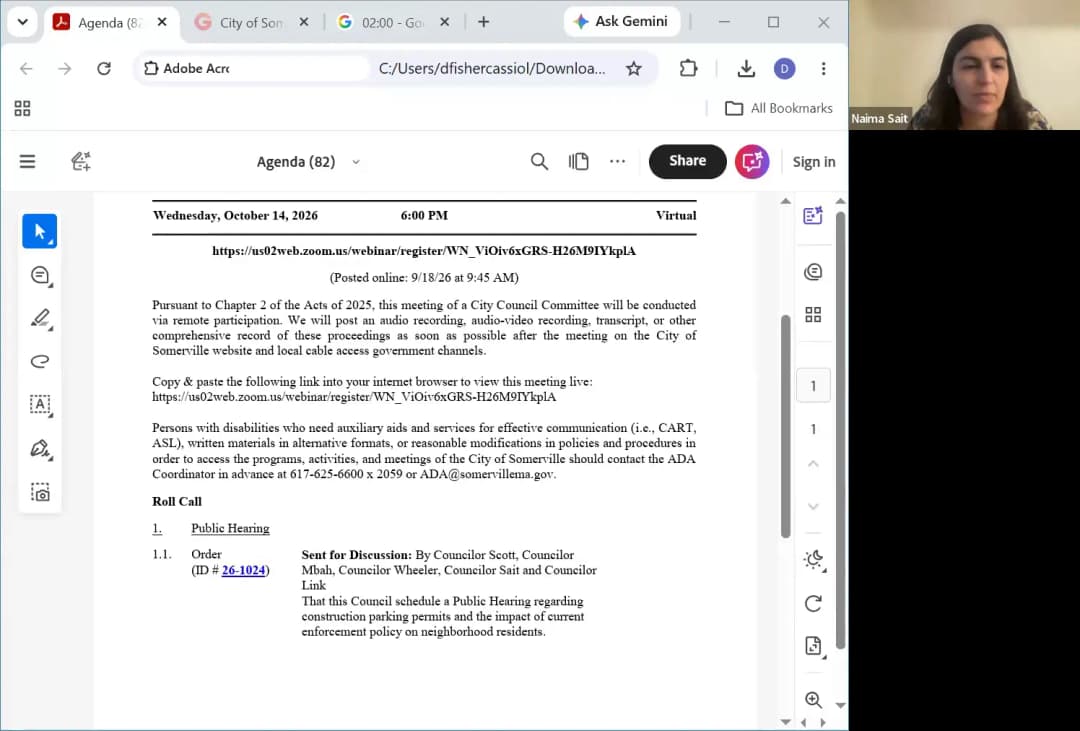
On October 15, 2026, the Somerville City Council Traffic and Parking Committee held a public hearing (ID 26-1024) regarding construction parking permits and the impact of current enforcement policies on neighborhood residents. Chair Naima Sait called the meeting to order at 6:02 PM, with all three committee members present (Councilors Wheeler, Mbah, and Sait). Ward 2 Councilor J.T. Scott introduced the item, noting that Ward 2 has the highest concentration of construction in the city but that challenges are citywide. Staff from the Engineering Division, Police Department, Inspectional Services, and Parking Department were present to listen. The hearing closed at 6:33 PM, and the committee marked the item as work completed, with plans to revisit the topic in a future meeting. Public Comments & Testimony - Serena Bodner (Bolton Street): Raised multiple concerns, including that eight of approximately 15 on-street parking spots on her block were occupied by contractor vehicles. She proposed suspending construction permits during snow emergencies, limiting permits per project, increasing pricing to encourage carpooling or transit, and revoking permits for violations. She noted workers using space savers (cones) illegally. - Greg (27 Oak Street): Highlighted safety hazards from construction vehicles parked in no-parking fire lanes at the end of Oak Street, creating blind spots for pedestrians, cyclists, and motorists. - Dorinda (address not given): Agreed with Councilor Scott that the low cost of permits (roughly $1/day) is a privilege not afforded to other groups. She noted Cambridge allows only three spots per construction project and pointed to empty spaces at the Boynton Yards and Webster Street garages. She also raised concerns about blocked sidewalks on Prospect Street. - Raquel Shot (21 Houghton Street): Described how vehicles blocking the fire lane at Houghton and Bolton Streets prevent garbage trucks from turning, causing prolonged horn-blaring and quality-of-life disruptions. Discussion Items - Councilor J.T. Scott: Introduced the item, emphasizing the need for creative solutions. He stressed that parking in fire lanes and blocking hydrants are serious safety issues. He suggested creating a process to revoke construction parking permits for egregious violations, similar to revocation of business licenses. - Staff introductions: Brian Postlewaite (Engineering – reviews street occupancy permits), Lt. Michael Holland (Police – enforces detail rules), Kevin Klein (Inspectional Services – engages contractors), Jackie Stagnari and Anna Rebelo (Parking – issues permits and enforces violations). - Kevin Klein (Director of Inspectional Services): Offered to visit Ward 2 with a ward inspector to meet contractors and encourage respectful behavior. He noted that keeping projects on schedule gives the city leverage. Councilor Scott welcomed the offer. Key Outcomes - The public hearing was closed at 6:33 PM. - The committee voted (3-0) to mark the item as work completed, with the understanding that Councilor Scott would file a new item to continue discussion at the next Traffic and Parking Committee meeting. - Director Klein committed to convening a meeting with contractors in Ward 2 within the week and to keep Councilor Scott informed. - The meeting adjourned at 6:37 PM.
The Somerville City Council Legislative Matters Committee met on October 15, 2026, from 6:02 PM to 8:07 PM via Zoom. Chair Scott presided. The committee addressed a public hearing on civilian oversight, multiple ordinances including a rental registry, short-term rental enforcement, ethical procurement, and enforcement personnel updates, and body-worn camera policies. All five committee members (Councilors Davis, Mbah, Ewen-Campen, Strezo, and Scott) were present. Consent Calendar - Approval of minutes from September 8, 2026 (ID 26-1385) and September 15, 2026 (ID 26-1449) – accepted unanimously. Public Comments & Testimony - Civilian Oversight Policy (ID 26-1407): Chair Scott opened the public hearing at 6:05 PM. No members of the public spoke. The hearing was closed at 6:07 PM, with the written comment period remaining open until Friday, October 16, 2026. Discussion Items - Rental Registry and Energy Disclosure (ID 25-1822): Director of Intergovernmental Affairs Amanda Nagim-Williams stated the administration supports the policy but is prioritizing the short-term rental and vacant property ordinances before providing a substantive update. No timeline was given. Councilor Ewen-Campen requested a defined timeline. The working group from spring 2026 has not been reactivated. The item was kept in committee. - Short-Term Rental (STR) Enforcement (ID 26-0240): Deputy Director of Public Health Colin Ziegler reported challenges including loopholes exploited by property management companies. The city has issued approximately 160 tickets in 2026, tracks 113 active licenses, and is procuring new STR identification software. A 311 complaint system for illegal STRs has been implemented. Councilor Ewen-Campen asked about enforcement mechanisms and integration with police reports. The committee voted unanimously (5-0) to mark the item work completed. - Ethical Procurement Ordinance (ID 26-1023): Councilor Ewen-Campen presented amendments to clarify the ordinance, focusing on companies with direct, ongoing, and knowing involvement in violations of international law. Key changes included redefining prohibited conduct, adding a sole proprietor exemption, and referencing a list from the American Friends Service Committee. Councilor Strezo opposed, calling the ordinance discriminatory and questioning the use of a religious group's list. City Solicitor Cindy Amara expressed caution about relying on external lists. Councilor Davis raised concerns about certification and scope. The committee voted 4-1 to replace the original text with the amended version (Strezo opposed). The item was kept in committee for further work. - Enforcement Personnel Update (ID 26-1274): Chair Scott described the amendment as a cleanup to update enforcement personnel references and zoning violation fines. The committee voted unanimously (5-0) to recommend approval. - Body-Worn Camera Policies (IDs 26-1272 and 26-1273): Public Safety for All Project Manager Jon Hillman reviewed the surveillance use policy and impact report. Revisions from July were submitted on August 27, with additional feedback from Councilor Hardt to be included. The committee voted unanimously (5-0) to place the current items on file, expecting a new submission at the next City Council meeting. Key Outcomes - Votes: - Minutes approved (unanimous). - Short-term rental enforcement marked work completed (5-0). - Enforcement personnel update recommended approval (5-0). - Body-worn camera policies placed on file (5-0). - Ethical procurement ordinance text replaced (4-1) and kept in committee. - Directives: The administration will submit updated body-worn camera policies at the next City Council meeting. The ethical procurement ordinance will be revisited in committee on October 27, 2026, after further revisions. - Items Marked Work Completed: 4.2 (STR enforcement), 6.1 through 6.6 (various communications and petitions). - Items Placed on File: 5.1, 5.2 (body-worn camera policies), and 7.1 through 7.7 (old surveillance technology reports).