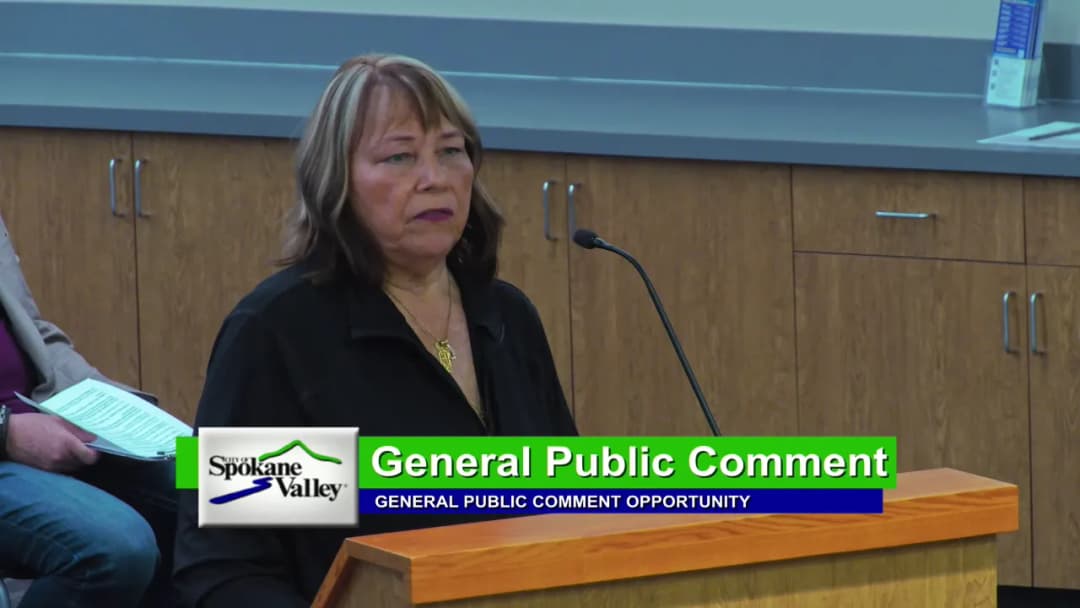
The Spokane Valley Planning Commission met on Thursday, October 8, 2026, at 6:01 PM at City Hall. The meeting was called to order with the Pledge of Allegiance, roll call, and approval of the agenda and minutes from September 24, 2026. Commissioners Winkler and Westerman were excused. The primary business was a study session on the Comprehensive Plan and Development Regulations, with public comment and discussion on several key topics including land use policies, battery energy storage, cannabis regulations, final plats, manufactured homes, and accessory structure lot coverage. Consent Calendar - Approval of the agenda (motion carried 5-0) - Approval of the minutes from September 24, 2026 (motion carried 5-0) - Excusal of Commissioners Winkler and Westerman (motion carried 5-0) Public Comments & Testimony - Kara Hamidi, a resident near Argon, expressed opposition to the current 10% lot coverage limit for detached accessory structures. She argued that the attached/detached distinction is arbitrary and makes it difficult for homeowners on narrow lots to build needed storage. She urged the commission to remove the separate limit and allow a single overall lot coverage percentage, emphasizing that such a change would encourage residents to stay in the city rather than move to acreage. Discussion Items - Comprehensive Plan Policies: Staff presented three concerns previously raised by Commissioner Winkler. (1) Land Use Policy 7: Adding "residential" to the policy text. The commission agreed this addition was appropriate. (2) Housing Policies 13 and 14: Whether additional flexibility was needed. The commission felt the policies were adequate as written. (3) Transportation Goal: A suggestion to add a goal supporting residential and local businesses. The commission agreed that existing Transportation Goal 1 already covers this intent. Staff will incorporate the change to Policy 7. - Battery Energy Storage Systems (BESS): Staff reported that technology has advanced, with containers now capable of up to 10 megawatt-hours (MWh) for backup power, up from 2 MWh six years ago. Commissioner Pockel proposed allowing 10 MWh in industrial zones with an exemption for critical infrastructure (e.g., hospitals, emergency services) in other zones. The commission supported this approach, noting BESS poses space and fire safety concerns, and directed staff to bring back code amendments with those parameters. The commission also agreed to revisit the limit in the future as technology evolves. - Cannabis Retail Regulations: Discussion focused on the city's interim ordinance that made existing cannabis stores non-conforming uses, preventing relocation. Multiple commissioners expressed concern that this is too restrictive for a legal business and risks losing approximately $250,000 in annual tax revenue. Commission consensus was that the current restriction is too strict and that stores should be allowed to move within their zone (with standard distance restrictions from schools, etc.). Staff will bring back code options and the city council's discussion materials on the interim ordinance for further review. - Final Plats: Staff noted an error classifying final plats as Type III (public hearing) instead of Type I (administrative). Since the final plat only verifies conditions from the preliminary plat, it should not require public process. The commission agreed to correct the classification to Type I. - Manufactured Homes: Discussion on whether to impose an additional age restriction beyond the current post-1976 requirement. Commissioners noted that market forces (insurance availability) already limit older units and that further regulation is likely unnecessary. No changes proposed. - Accessory Structures and Lot Coverage: Following the public comment, the commission discussed the disparity between 10% lot coverage for detached accessory structures and up to 50% for attached. The consensus was to simplify the code by establishing a single overall lot coverage percentage (e.g., 50% in R2/R3 zones) for both attached and detached structures, subject to existing height and setback requirements. Staff will bring back a code amendment. Key Outcomes - Directed staff to bring code amendments for the next meeting (October 22, 2026) on: - Land Use Policy 7: add "residential". - Battery energy storage: allow up to 10 MWh in industrial zones with critical infrastructure exemption. - Cannabis: allow existing stores to relocate within same zone (with restrictions). - Accessory structure lot coverage: combine attached and detached into a single overall percentage. - Scheduled a public hearing for October 22, 2026, on the Comprehensive Plan and Development Regulations. - Noted a community conversation on October 20, 2026 (5-6 PM) and a council preview of the draft code at 6 PM that same day. - Commission agreed to check availability for a potential special meeting on October 29, 2026, if needed. - Target date for final recommendation to city council: November 12, 2026.
Public Meetings - Spokane Valley, Washington
Public Meetings - Spokane Valley, WashingtonThe Spokane Valley Hearing Examiner Pro Tem, Jay Istone, convened an administrative appeal hearing on October 8, 2026, at 1:02 PM (resuming at 1:19 PM after a brief pause) to consider the appeal of a dangerous dog determination issued by Spokane County Regional Animal Protection Services (SCRAPS) under job number 90033. The hearing involved two dogs—Papa (owned by appellant Shade Kilgalen) and Tarek/Tariq (owned by appellant Kate Case Gulam Sarwar)—and an incident on August 8, 2026, where turkeys were killed or injured on property near 4900 block of N McDonald Rd, Spokane Valley. The hearing examiner will issue a written decision within 15 days. Hearing Overview - Date & Time: October 8, 2026; originally set for 1:00 PM, started at 1:02 PM, paused until 1:19 PM for late arrival of appellant Kilgalen, then proceeded with evidence and arguments. - Parties Present: - Appellants: Shade Kilgalen and Kate Case Gulam Sarwar (both present). - SCRAPS: Represented by Officer Chris Miller. - Witnesses for SCRAPS: Officer Chelsea MacArthur (responding animal control officer) and Ben Wick (property owner/complainant). - Legal Standard: SCRAPS bears the burden of proof by a preponderance of the evidence to show the dogs are dangerous under Spokane Valley Municipal Code. Evidence Presented by SCRAPS - Officer Chelsea MacArthur testified: - Responded to an emergency complaint from Danica Wick at approximately 7:30 AM on August 8, 2026. - Found two dogs running at large in the vicinity; the complainant positively identified them as the dogs involved in the turkey attack. - Impounded the dogs as strays; both owners arrived shortly after to reclaim them. - Issued a misdemeanor citation to Mr. Gulam Sarwar for the dog being at large and causing injury/death to an animal; issued infractions to Mr. Kilgalen. - Noted that Tarek had a prior potentially dangerous dog designation (case 85869) for a previous incident involving chickens, and both owners acknowledged that Papa was also involved in that earlier incident but was not caught. - Ben Wick (property owner) testified: - At approximately 6:37 AM, heard a disturbance near turkey pens, saw two dogs inside the pen, ran outside, and scared them off. - Found three turkeys injured; one died shortly after, a second died later, and a third had minor injuries. - The turkeys were broad-breasted white show turkeys raised by children for the interstate fair; the pen was fully enclosed with wire top and gate. - Identified both dogs from photographs shown by Officer Miller—citing distinctive markings (white stripe on chest, facial markings) that he remembered from when the dogs looked at him during the incident. - Exhibits: SCRAPS submitted a 96-page file (exhibits A–K) including photographs of the dogs at large, intake photos, and microchip records; also submitted a 26-page file from prior case 85869 involving Tarek. Testimony from Appellants - Shade Kilgalen (testified under oath): - Denied telling Officer MacArthur that Papa was involved in the prior incident with Tarek; said that claim was never made or proven. - Argued that the fact the turkeys were prize show birds belonging to children should not be used against the dogs, as dogs cannot know that. - Disputed Officer MacArthur’s statement that coffee shop workers had encountered the dogs before; said the dogs had never been in that area. - Kate Case Gulam Sarwar (declined to testify, citing potential pending criminal case; hearing examiner advised him of the right to remain silent). Closing Arguments - Ms. Bose (appearing on behalf of both appellants for closing argument): - Argued that no proper notice of intent was delivered to the appellants, violating due process. - Contended that SCRAPS failed to prove the dogs were responsible for the turkey deaths—no witness saw the dogs actually attacking, the turkeys could have been dead already, and the dog description (brown and white) did not match Mr. Gulam Sarwar’s black-and-white dog. - Criticized the identification process, noting that the witness described the dog while viewing a photo on screen, which was unfair. - Raised discovery issues, stating the case file provided to Mr. Gulam Sarwar was incomplete, which could prejudice his criminal defense. - Asked for the dangerous dog determination to be dismissed and for all charges to be withdrawn. - Officer Miller (for SCRAPS): - Responded that both appellants received full copies of the case file—Mr. Gulam Sarwar picked up a copy in person, and Mr. Kilgalen was mailed one. - Emphasized that the dogs were found running at large in the immediate vicinity shortly after the incident, the witness positively identified them, and the turkeys were injured with one dying. - Noted that Tarek’s prior potentially dangerous dog designation (case 85869) was final as no appeal was filed, and that the current incident (off-property severe injury/death to an animal) supports a dangerous dog declaration for both dogs. Key Outcomes - No immediate decision: Hearing Examiner Istone will issue a written decision within 15 days of the hearing (by October 23, 2026). The decision may accept, reject, or modify the dangerous dog determination for each dog. - Right to appeal: Any party may appeal the hearing examiner’s decision to Spokane County Superior Court within 20 days of receiving the written decision, under RCW 7.16. - Pending criminal charges: Mr. Gulam Sarwar faces a misdemeanor citation; Mr. Kilgalen faces infractions—these are separate from the administrative dangerous dog determination. - Discovery issue raised: Ms. Bose alleged incomplete discovery; SCRAPS asserted full files were provided.
The Spokane Valley City Council held a regular meeting on Tuesday, October 6, 2026, at 6:00 p.m. at City Hall. The meeting included a proclamation for Cybersecurity Awareness Month, a first reading of the 2027 property tax ordinance, and a detailed presentation of the proposed 2027 budget by City Manager John Hohman. Public comments addressed city leadership, council conduct, and free speech concerns. The council advanced the property tax ordinance to a second reading after a motion to table it pending the budget presentation was approved. Proclamation & Presentations - Cybersecurity Awareness Month: Mayor Laura Paddon proclaimed October 2026 as Cybersecurity Awareness Month. IT Manager Chad accepted the proclamation and encouraged residents to follow cybersecurity best practices, including recognizing phishing, using strong passwords, enabling multi-factor authentication, and updating software. Public Comments & Testimony - Ben Lund, a 34-year resident, praised city staff and leadership for low taxes and economic growth, but accused Councilmember Merkel of campaigning from the dais during the last two meetings, including using campaign material in the Valley Fest parade. He called for additional sanctions if campaigning continues. - Jonathan Plum defended Councilmember Merkel’s right to dissent, citing the Supreme Court case Bond v. Floyd and Ninth Circuit precedent. He argued that the council’s repeated accusations of campaigning against Merkel may violate his First Amendment rights and urged the city attorney to publicly clarify the legal standard being applied. Discussion Items Action Item: Ordinance 26-009 – Property Tax Levy for 2027 - Finance Director Chelsie Walls presented the first reading of the ordinance, proposing a 2027 property tax levy of approximately $14.6 million, which includes an estimated $250,000 from new construction but foregoes the 1% state-allowed increase. The levy represents 20.29% of general fund recurring revenues and corresponds to a rate of about $0.79 per $1,000 of assessed value. - Councilmember Merkel moved to postpone the item for one week to explore a 10% reduction in property taxes (approximately $1.4 million cut). City Manager Hohman advised waiting to hear the budget presentation first, noting that such a cut could have “a devastating impact.” - The council voted to table the item until after the budget presentation (voice vote with some opposition). After the budget presentation, the original motion to advance the ordinance to a second reading passed (voice vote with some opposition). The second reading is scheduled for October 20, 2026. Non-Action Item: City Manager Presentation of the 2027 Budget - City Manager John Hohman presented the first full draft of the 2027 budget, emphasizing that the city maintained a 50% general fund ending fund balance and a service level stabilization fund of 14% (target $8 million). The budget assumes recurring revenues of $71.7 million (sales tax 62%, property tax 20%, other 18%) and recurring expenditures of $71.7 million, leaving only about $160,000 in surplus. - Public Safety: The law enforcement contract remains the largest uncertainty. The 2027 budget estimates $39.588 million for the sheriff’s contract, but the county’s most recent estimate is $40.4 million, creating a potential $800,000 shortfall. Hohman noted that public safety comprises 65% of the general fund budget. The city has added 21 police officers over the past two years, and a Public Safety Director (Scott Ebner) will start in November. - Capital Projects: The 2027 capital budget totals $52 million, with 57% funded by grants. Key projects include the Pines Grade Separation (progressing), Sullivan & Trent Interchange (facing an $8.5 million funding gap), and a new Ice Arena (opening September 2027). - Economic Development: Hohman defended economic development investments, citing past successes (Northeast Industrial Expansion, Kaiser Aluminum, Solstice) and current initiatives (The Course at Spokane Valley, retail recruitment, the Auto Row initiative). He warned that cutting economic development would undermine the city’s ability to keep taxes low. - Council Debate: - Councilmember Merkel argued for a 10% property tax cut, questioning the value of economic development programs and requesting a cost-benefit analysis for The Course. - Councilmember Yeager offered to forgo her own council salary and benefits to help offset cuts, and noted that the economic development department’s $1.3 million annual budget generates significant returns (e.g., estimated $94 million in annual economic impact from The Course and Ice Arena). - Councilmembers Wick, Kelly, and Deputy Mayor argued against reducing dedicated police staffing and supported active management of the sheriff’s contract rather than switching to a fixed-price model that could lower officer numbers. - The city manager noted that the city has not increased property taxes for 18 of the last 24 years, saving residents $11 million total. A 10% cut would save the average homeowner only $34–$35 per year. Key Outcomes - Ordinance 26-009 (Property Tax Levy): Advanced to a second reading on October 20, 2026; a 10% reduction proposal remains under discussion. - 2027 Budget: The council will continue budget discussions at subsequent meetings. No final vote was taken. - Sheriff’s Contract: The council expressed consensus to maintain dedicated officer staffing and to pursue more frequent financial check-ins with the county rather than moving to a fixed-price contract that could reduce staffing. - Public Safety Director: Scott Ebner will begin work remotely in October and is expected in Spokane Valley by November. - Emergency Management Workshop: An all-day workshop on emergency management is tentatively scheduled for November 3, 2026 (Election Day), with the evening council meeting canceled.
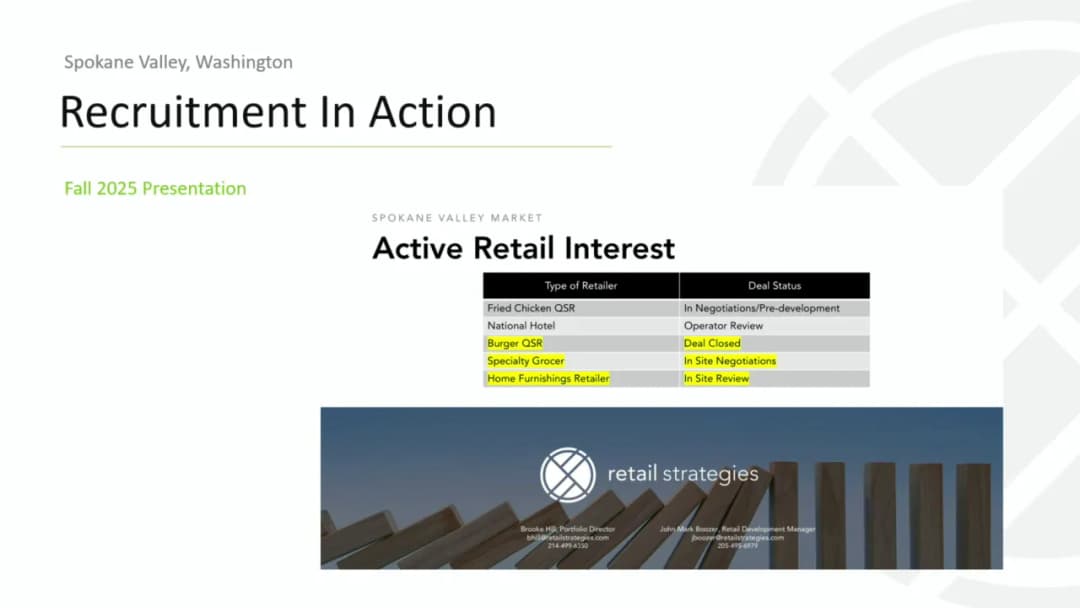
The Spokane Valley City Council met on Tuesday, September 29, 2026, at 6:00 p.m. at City Hall to consider a property acquisition related to a terminated affordable housing grant, receive updates on retail recruitment and economic trends, and review state-mandated development regulation changes. The council unanimously approved two motions related to property transfer and maintenance funding, and discussed participation in a regional homeless grant RFP. Public Comments & Testimony - No public comments were offered during either of the two public comment opportunities. Property Acquisition and Fund Allocation - Staff presented background on a 2023 ARPA-funded grant of $1.46 million to Reclaim for affordable housing and homeless services. The project stalled, and the city reimbursed $960,000 in allowable costs. A deed of trust secured $600,000 of that amount; the remaining $360,000 covered community benefits provided during program startup. - Through a settlement, Reclaim will deed the property at 10619 E Sprague Avenue back to the city in lieu of foreclosure. The property was originally purchased for approximately $525,000; current assessed value is about $475,000. - Motion 1: Authorized the city manager to finalize documents for the property transfer. Passed unanimously. - Motion 2: Allocated up to $30,000 from the originally committed Clifford ARPA funds to cover closing costs ($6,500) and security/maintenance (estimated $20,000–$25,000) through the end of 2026, pending council decision on future use of the property. Councilmember Kelly noted the need to prevent illegal camping. Passed unanimously. - Staff noted the city could later issue an RFP for affordable housing/homeless services that includes a property transfer, similar to a prior Habitat for Humanity project, allowing conditions like community engagement and safety measures. Retail Strategies Presentation - Economic Development Specialist Kyle Knutsen introduced Brooke Hill and John Mark Boozer of Retail Strategies, the city’s retail recruitment consultant since 2017. - Active retail interests include a fried chicken QSR in negotiations, a fast-casual Asian restaurant reviewing sites, a national hotel reviewing sites, an outdoor recreation retailer expressing interest, and a second fried chicken QSR in negotiations. - Previous recruitment wins: Chipotle, Burlington, Ulta, Maverick, Dave & Busters, Five Below, the recently opened McDonald’s, and pending specialty grocer and home furnishings retailer. Combined average annual sales of these nine stores is approximately $74 million; estimated annual sales tax revenue of $634,695 from all nine. - The firm conducts site analysis, attends ICSC trade shows, and maintains “pleasant persistence” with retailers. Challenges include limited available sites and deal feasibility. The northeast corner of Sprague and Pines remains difficult due to property ownership issues; a Circle K is pre-permitting but not confirmed. - Councilmembers requested recruitment targets such as Buckee’s, In-N-Out, Aldi, and a Disney store. EWU Economic Trends Update - Dr. Patrick Jones and Dr. Kelly Cullen of EWU’s Institute for Public Policy presented quarterly data. - Population: Spokane Valley added 600 new residents between April 1, 2025, and April 1, 2026, with net migration accounting for an estimated 540 of those. County growth was 4,600, 90% from net migration. - Labor Market: Civilian labor force grew 3%, employment rose 2.4%, and the July 2026 unemployment rate was 3.3% (below the state’s 4.5% and national 4.1%). This low rate may limit future growth. - Sectors: Healthcare dominates (20% of county workforce); retail and manufacturing employment have not grown. School districts drove government growth. - Housing: Single-family permits increased in Q2 2026 (58 units, above the eight-quarter average of 42). Multifamily permitting remained steady. Permitted values declined slightly, indicating more affordable construction. The median home resale price held at $435,000. Affordability indices improved for buyers and renters in recent quarters. - Retail Sales: Q4 2025 saw a 7.8% year-over-year increase; quarterly retail taxable sales exceeded $1 billion for the first time. For 2025, Spokane Valley outperformed both the county (5% vs. 2.2%) and the state (5% vs. 3.2%). Retail sales per capita reached $35,000, the highest in the county. - Outlook: Personal income is forecast to grow 6% in 2027. The state’s September forecast revised income growth upward. Development Regulations Overview - Community and Economic Development Director Mike Basinger and consultant Ethan Spoo (DOWL) outlined state-mandated changes to the municipal code to address the housing crisis. The city is taking a conservative approach, preserving existing flexible zoning like corridor mixed-use and transitional provisions. - Key requirements: - Accessory Dwelling Units (ADUs): Must allow two per lot where single-family is permitted, no owner-occupancy requirement, minimum size 1,000 sq ft, impact fees capped at 50%. - Middle Housing: Must allow at least six of nine types (plexes, townhouses, etc.); up to 4-6 units per lot depending on affordability or transit proximity. - Co-Living Housing: Allow where six multifamily units are permitted; each sleeping unit counted as 1/4 dwelling unit for density. - STEP Housing (Shelter, Transitional, Emergency, Permanent Supportive): Cannot prohibit where residential uses/hotels are allowed; city may impose design and permitting requirements but not barriers. City can enter health and safety agreements with providers within 500 feet. - Parking Caps: For single-family, 1 space; multifamily, 0.5 spaces; zero for units under 1,200 sq ft or affordable/senior housing; for ADUs/middle housing, 1-2 spaces depending on lot size; for conversions, no additional spaces; for non-residential uses, reduced ratios. A city-commissioned parking study may allow higher limits if approved by the state. - Child Care: Family daycares (≤12 children) allowed in all residential dwellings; child daycares allowed in all zones except industrial and open space. - Land Divisions: Must allow administrative lot splits (with minimum lot sizes) and unit lot subdivisions. - Permit Timelines: City maintains 60-120 day review periods; new legislation requires a responsible official for residential projects. - Councilmembers expressed concerns about parking impacts, emergency access, senior housing, and state overreach. Staff noted they excluded courtyard apartments and stacked flats from middle housing options to better fit the valley’s character. The draft code will be presented on October 20. Council and City Manager Comments - Councilmembers reported on the Valley Fest parade, the successful Bob Furman International Cross Country event at Cross Course (3,200 runners from 115 schools across 10 states and Canada), and state legislative updates from AWC meetings. - City Manager John Holman and City Services Administrator Gloria Mance updated on the regional homeless grant process. The City of Spokane and Spokane County are issuing a joint RFP for approximately $40 million in homeless funds (state and local), with a target release of November 2, 2026. Spokane Valley was asked to participate by including its local recording fees ($600,000–$700,000 over two years) into the regional pool, foregoing geographic restrictions. The city’s homeless outreach contract ($300,000/year) could be at risk if not prioritized. Council expressed strong concerns about alignment with Spokane’s approach (preferred providers, focus on emergency shelters) and lack of influence with only one seat on the scoring committee. Councilmember Wick suggested a letter from the mayor to other jurisdictions advocating for outreach as a foundational service. Council reached consensus to explore that approach before deciding on participation. - The city manager also thanked Congressman Baumgartner and Senator Murray for securing $5 million for the Pines grade separation project, which is progressing rapidly. Key Outcomes - Motion 1 (Property Transfer): Unanimously approved to authorize the city manager to finalize documents for the property deed back to the city. - Motion 2 (Maintenance Allocation): Unanimously approved to allocate up to $30,000 from Clifford ARPA funds for closing costs and property security/maintenance. - Retail Strategies Update: Received; no formal action. - EWU Economic Trends Update: Received; no formal action. - Development Regulations Overview: Received; council will review draft code on October 20, 2026. - Regional Homeless Grant Participation: Council directed staff to explore a letter to other jurisdictions emphasizing outreach as a foundational element before a final decision on joining the joint RFP.
The Spokane Valley City Council held a special meeting on Tuesday, September 29, 2026, at 5:15 PM at City Hall. The meeting was called solely for the purpose of convening an executive session to discuss potential litigation. No formal public comments or testimony were accepted. Roll Call and Attendance - Deputy Mayor Hattenberg, Councilmembers Yeager, Kelly, Wick, and Haley were present. - Councilmember Merkel was excused by a unanimous vote. Executive Session - The council voted unanimously to adjourn into executive session for approximately 30 minutes to discuss potential litigation under RCW 42.30.110(1)(i), with no action to be taken upon return to open session. Key Outcomes - Councilmember Merkel was excused (motion carried with all in favor, none opposed). - Council entered executive session at 5:16 PM.
The Spokane Valley Planning Commission held a regular meeting on Thursday, September 24, 2026, at 6:00 p.m. in Council Chambers at City Hall, 10210 E Sprague Avenue. The meeting focused on a study session on proposed development regulation updates, including state-mandated housing changes, cannabis retailer relocation, battery energy storage, and other code amendments. Public comments were heard, and commissioners discussed next steps for the October 8 study session and October 22 public hearing. Consent Calendar - Approval of Agenda: Motion approved unanimously (7-0). - Approval of Minutes (September 10, 2026): Motion approved unanimously (7-0). Public Comments & Testimony - Tyler (Treehouse Club Manager): Representing one of three existing cannabis retailers, requested the city allow relocation of existing retailers (not additional stores) under reasonable zoning and siting standards. Argued that preventing relocation unfairly ties businesses to specific properties and that the city's comprehensive plan emphasizes flexibility and stability. - Christy (Treehouse Club Manager): Echoed Tyler's request, citing the draft comprehensive plan's principles (EDG6, ED P3, EDP9-11, LU G4, LU P1) and noting that without a relocation path, existing businesses have 'no possible location to comply.' Asked for a predictable relocation process while preserving the cap on the number of retailers. - Kara Hamidi (R3 zone near Argon Road): Expressed concern about accessory structure size limits (Section 19.65.130), particularly the 10% coverage limit for lots over 10,000 square feet. Requested combining footprint limits for attached and detached structures to allow larger workshops or storage on large lots. - Deputy Fire Marshal (Spokane Valley Fire Department): Presented written street standards to improve emergency access, noting issues with cul-de-sacs, inadequate street widths for snow conditions, and missing signs. Proposed adopting standards similar to Cheney's post-2008/2009 snowstorms. Also urged consideration of firewise landscaping in code updates. - Written comments: Three sets indicated from Jupiter Power, Kara Hamidi, and Treehouse Club. Discussion Items - Administrative Report (Steve Robers): Outlined schedule: October 8 study session (flexible), October 20 community conversations and council introduction, October 22 public hearing, October 29 potential extra meeting, November 12 recommendation, mid-December council adoption. Noted 200 pages of code to review. - Development Regulation Updates (Ethan Spoo, DOWL): Presented state-mandated changes including: - Accessory Dwelling Units (ADUs): Allow two ADUs per lot (up from one) to meet state requirements; added MFR zone as allowed location. - Middle Housing: Allow all nine state-defined types; four or six dwelling units per lot on residential lots; increased building height to 40 feet; removed special 14,500 sq ft lot requirement for duplexes. - Co-Living Housing: Sleeping units counted as 1/4 dwelling unit for density and 1/2 for sewer fees; parking at one space per four sleeping rooms. Commissioner voiced that parking is inadequate and should be one per bedroom. - Affordable Housing: New density bonuses for religious organizations (20% over base) with mandatory affordability requirements; repurposing existing buildings for housing with up to 50% density increase. - STEP Housing: Change from Type 2 to Type 1 site plan review (no public notice) to align with multifamily treatment; no location changes. - Family Daycares: New regulations limiting city restrictions to specific items (12 children max, drop-off area, operating hours 6 a.m.-8 p.m., etc.). - Unit Lot Subdivisions & Administrative Lot Splits: Required to allow; no further splits after administrative split; displacement mitigation strategy required. - Permit Review Process: New procedural completeness standard; introduced administrative lot splits (60-day review); tracking permit times. - Critical Areas Ordinance: Updated to match Ecology's wetland rating manual; preservation as mitigation; riparian buffers changing (some decrease on Chester Creek, others increase). - Battery Energy Storage (BES): Proposed continuation of outright prohibition; commissioners questioned the 2 MWh threshold, lack of path for exceptions, safety concerns, and future grid needs. Commissioner Pockell suggested further study. - Cannabis Retail: Proposed regulation makes existing three retailers legal non-conforming, prohibiting relocation. Commissioners discussed economic impact, loss of tax revenue, and whether city should allow relocation under standards. - Religious Organization Shelters: Code section mirroring state law allowing emergency shelters/housing with conditions, including MOU with city. - Noticing Requirements: Commissioner questioned 400-foot mailing radius and potential issues with large property owners; staff agreed to review. - Final Plat Review: Commissioner noted final plat listed as Type 3 (public hearing) but believed it should be administrative; staff said they would check. - Mobile Home Standards: Question about age restrictions on relocated mobile homes; staff agreed to verify against state definitions. - Setback Walkways/Driveways: Removal of specific allowance clarified as not prohibiting them elsewhere. - Stormwater Updates: Required changes to MS4 permit, including PCB assessment for buildings built 1950-1980. - Other Changes: Removal of 5-copy paper requirement for plats; recognition of churches in industrial zone; other housekeeping. Key Outcomes - No formal votes on development regulations; study session only. - Direction for Next Meeting: Commissioners will submit specific topics (e.g., BES, cannabis relocation, accessory structures) to staff by Monday; staff will bring all received written comments and comp plan questions to October 8 study session. - Schedule Confirmed: October 22 public hearing; November 12 recommendation; December council adoption. - Staff Action Items: Follow up on final plat type, mobile home age restrictions, noticing maximums, cannabis relocation feasibility, BES research. - Public Hearing Notice: Public testimony will be taken on October 22.
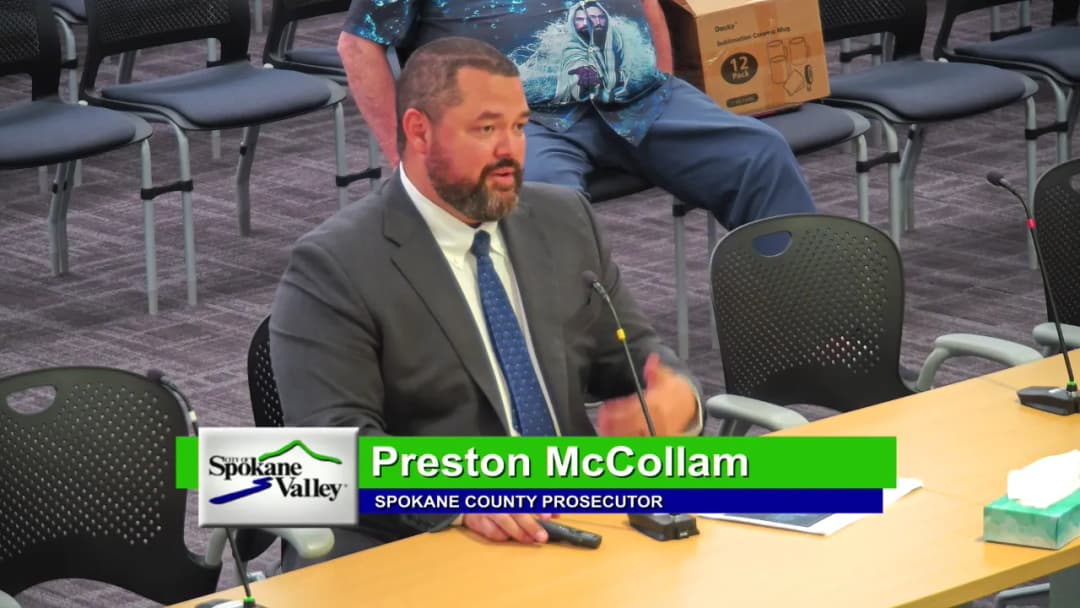
The Spokane Valley City Council held a regular meeting on Tuesday, September 22, 2026, at 6:00 p.m. at City Hall. The meeting included proclamations, public comments, consent agenda items, action items, administrative reports, a presentation from the Spokane County Prosecutor, and advance agenda discussions. Key decisions included approval of a 30-year easement for Flora Park, adoption of lodging tax goals and priorities for 2027, and approval of a Justice Assistance Grant for a police motorcycle purchase. The council also heard detailed updates on property taxes, police department operations, and the county prosecutor's office challenges. Consent Calendar - Approved claim vouchers for April 28, 2026 totaling $5,971,437.61. - Approved payroll for the pay period ending September 15, 2026 in the amount of $781,676.82. - Set a public hearing date for the 2027 Budget (date to be determined). - Item c (TPA Opportunity Fund Application) was removed for separate discussion and subsequently approved (see Discussion Items). Public Comments & Testimony - Glenn Stockwell (Ritzville, WA) urged the council to write a bipartisan letter of support to U.S. Senators Patty Murray and Mike Baumgartner, Governor Bob Ferguson, and President Trump for a large economic development project in Washington state. He expressed frustration with perceived inaction by political leaders. - Keith and Shelley Clark reported on volunteer service projects organized by The Church of Jesus Christ of Latter-day Saints, including spreading 30 yards of bark at Terrace View Park (84 volunteers in 40 minutes), clearing debris at Chester Cemetery (134 volunteers), and cleaning headstones at Micah Cemetery (167 volunteers). They also highlighted interfaith Habitat for Humanity builds and a Long Table meeting with local nonprofits. - Debbie Schrock (Spokane Valley) thanked the council for their continued work and noted visible growth in the community after a summer absence. Discussion Items Proclamations - Good Neighbor Day: Proclaimed September 28, 2026 as National Good Neighbor Day in Spokane Valley. The proclamation was presented by Councilmember Jessica Yeager. A representative from a local church spoke about expanding community outreach efforts. - Valleyfest: Proclaimed September 25–27, 2026 as Valleyfest weekend. Councilmember Mike Kelly read the proclamation noting over 35,000 attendees, 10,000 parade-goers, and 74 parade entries. Executive Director Peggy Dewar invited the community to the festival. TPA Opportunity Fund Application (Consent Agenda Item Removed) - Councilmember Wick requested separate discussion. The application from Spokane Sports requests $134,000 from the $170,000 Tourism Promotion Area (TPA) Opportunity Fund for transportation and parking improvements for the cross-country course at Flora Park, including a shuttle service and site preparation for the 2026 season (12–13 events, including two Nike events). - Councilmember Merkel expressed concerns about the application’s cost assessment, procurement process, and language suggesting events might be canceled without funding. City Manager Homan clarified that the TPA Commission approved the application; council could only veto by majority. He noted the fund is intended for new event support and that lessons learned would inform future use. - Councilmember Wick said the language in the application was “unfortunate” and not consistent with expectations. Councilmember Haley supported the application, emphasizing the economic benefit of bringing 10,000+ visitors. The motion to approve passed (vote not recorded numerically but approved). Motion: State Parks 30-Year Easement for Flora Park - John Bottelli (Parks Director) presented a 30-year easement agreement with Washington State Parks for 16 acres adjacent to Flora Park. The easement would allow forest health work, wildfire reduction, and a pedestrian trail with river viewpoints. Estimated annual maintenance costs are $20,000–$30,000. - Councilmember Merkel opposed, citing that the $600,000 state grant for improvements is not yet secured, leaving the city with potential maintenance obligations. Councilmember Wick supported, noting the easement locks in state approval and provides future flexibility. The motion passed (vote: ayes and nays not counted, but passed). Motion: LTAC Approval of Goals & Priorities for 2027 Lodging Tax Revenues - Sarah Farr (Finance) presented the goals and priorities recommended by the Lodging Tax Advisory Committee (LTAC). The document includes a preference for “legacy organizations” that have consistently delivered tourism benefits. - Councilmember Merkel opposed the legacy preference, arguing it discourages new applicants. Councilmember Yeager supported continuing with established partners. Councilmember Wick expressed concern that reduced available funds ($250,000) could hurt local fairs, festivals, and museums. Councilmember Haley emphasized that lodging tax must be used for tourism promotion and marketing as per state law. The motion passed 5–2. Motion: Justice Assistance Grant Approval - Erik Lamb (Deputy City Manager) and Chief Dave Ellis presented a request to apply for $31,000 in JAG funds, supplemented by $12,500 from the police department’s DUI restitution fund, to purchase a motorcycle ($43,470 total). The motorcycle was identified as a high-priority need for traffic enforcement. - Councilmember Merkel supported the purchase, noting the motorcycle’s utility for nimble patrols. The motion passed unanimously. Admin Report: Proposed Ordinance Adopting 2027 Property Taxes - Chelsie Walls (Finance Director) outlined the property tax levy process. The city is proposing to collect approximately $14.5 million in 2027, with a levy rate of about $0.79 per $1,000 assessed value (based on preliminary assessment of $18.4 billion). The city has not taken the 1% increase allowed by state law since 2011, resulting in an estimated $11 million in forgone revenue over that period. - Councilmember Merkel proposed a 10% reduction in the levy (approx. $1.4 million) to ease taxpayer burden. Councilmember Yeager and Deputy Mayor Hattenberg opposed, noting the city’s long history of not increasing taxes and the need to fund public safety and infrastructure. Councilmember Kelly said it was premature to consider cuts before the budget is finalized. No consensus was reached; the item will return for first reading on October 6. Special Guest: Spokane County Prosecutor Preston McCollam - Prosecutor McCollam provided an extensive update on the county prosecutor’s office, highlighting staffing shortages (47.5 criminal prosecutors for a county of 500,000+), increasing caseloads, and unfunded state mandates. Key statistics: - 2025: 4,600 district court filings; 2026 on track to exceed that. - 3,200+ felony filings in 2025 handled by 26 felony attorneys. - Spokane Valley Police Department contributed 24% of district court cases and 25% of criminal traffic cases. - Proposed budget cuts could eliminate 9 attorney positions, leading to 800–1,000 unprocessed felony cases annually. - He discussed the impact of new state Supreme Court rules (14-day arraignment reduced to 3 days), the reduction in domestic violence prosecutions (declination rate of 13% vs. 40% in King County), and the need for more judges. He urged the council to engage with state legislators on criminal justice funding. Admin Report: Spokane Valley Police Department Update - Chief Dave Ellis reported on crime trends and community engagement. Highlights: - 2025 Group A offenses decreased 4.9% from 2024 (8,945 to 8,505). - Year-to-date 2026: continued decreases in vehicle prowls, burglaries, and theft; slight increases in robbery and aggravated assault but below five-year averages. - Retail theft emphasis (Aug. 6, 2026) resulted in 6 arrests, 3 warrants cleared, 23 grams of methamphetamine seized, and 3 stolen credit cards recovered. - Community feedback via Axon’s My90 survey: 82% of respondents rated interactions positive/very positive; 94% felt treated with respect; top community priority is drug use (48% requested increased patrol visibility). - Operation Stampede (partnership with U.S. Marshals): 293 fugitives arrested, 336 warrants cleared, 55 firearms seized, 455 pounds of narcotics seized. - Community events: Coffee with a Cop, Cops & Kids Car Show (5,000 attendees, 300+ cars), Shop with a Cop (3 events). Key Outcomes - Consent Agenda approved (except TPA item discussed separately). - TPA Opportunity Fund Application approved (motion to approve carried after discussion; veto motion failed). - 30-year Easement for Flora Park approved. - LTAC Goals & Priorities for 2027 approved (5–2 vote). - Justice Assistance Grant approved (unanimous). - Property Tax Ordinance will be presented for first reading on October 6, 2026; second reading on October 20, 2026. No consensus on proposed 10% reduction. - Advanced Agenda Items: Councilmember Merkel’s proposal for a five-year moratorium on data centers was not supported (failed). His proposal to invite Life Services for a presentation was debated; no consensus reached. The meeting adjourned on a motion (passed with show of hands, 4–3).
The Spokane Valley Tourism Promotion Area (TPA) Commission met on September 17, 2026, at approximately 10:00 a.m. Commissioners present included Chair Cameron, Commissioner Gwynn (absent on vacation), Commissioner Stripe, and Commissioner Hoffert (joined later). The meeting covered the financial report, administrative updates, an action item for an opportunity fund application from Spokane Sports, and a detailed marketing report from agency 116 & West. No public comments were received. Financial Report - The commission reviewed financial performance, noting that year-to-date revenues remain up approximately 7.9% year-over-year and month-over-month. - Occupancy was reported to be up about one-tenth of a percent (0.1%), while the average daily rate (ADR) is down 2% for the year. - Revenues from the TPA (lodging tax) are described as "pretty even" year-to-date, with no significant change. Commissioners noted that the decline in ADR does not directly impact TPA dollars but asked staff to monitor the trend. Admin Report - Discover the Valley Analytics: The packet included Placer AI data highlighting visitor origins, with Seattle leading at 233,000 trips. - CoStar Data: Occupancy steady at 64.5%; ADR declined from $108 to $107 per day, down 2% for the year. - Opportunity Fund Update: - August 20: Received application from Spokane Sports for $134,000 (reviewed later as action item). - September 8: Received another application from Spokane Sports, requiring a special meeting to avoid conflict with the October budget meeting. - The commission agreed to hold a special meeting on September 24, 2026, at the usual Thursday time. - Commissioner Hoffert noted a question about Placer AI data: whether Los Angeles appeared as a default location. Staff confirmed they would ask Placer in their bi-weekly meeting. Discussion Items Action Item: Opportunity Fund Application TPAOF 2026-001 (Spokane Sports – $134,000) - Ashley Blake, CEO of Spokane Sports, presented the application for transportation and parking solutions for eight tourism events at the Spokane Valley Cross Country Course in 2026. - Key details: - Primary parking at the Tisherly lot (Spokane County) with bus loops every 5 minutes; secondary shuttle from Mirabeau Park transit center every 20 minutes for high-profile Nike events. - The funding is necessary due to unexpected attendance growth (from projected 900 to 21,000 for cross-country running alone). - The events were relocated from Boise; competition for retention is intense. - Consultants identified transportation as a critical pain point for attendee experience and future event retention. - Commissioner Stripe stated the request "falls squarely in the intent of an opportunity fund" and noted the city would otherwise have to address parking. - Commissioner Cameron asked whether the funding is for recruitment or ongoing operations; Ms. Blake indicated it would be used this year and potentially ongoing until a permanent solution is found. - Motion: "I move to recommend the proposed opportunity fund application TPAOF 206-001 request for $134,000 to move this forward to the city council for their approval." Seconded. Vote: unanimous (3 ayes, none opposed). - The item will appear on the City Council's consent agenda the following Tuesday. Non-Action Item: Marketing Report from 116 & West - Jessica, agency representative, presented a comprehensive update on year four of the five-year marketing plan. - Key points: - The brand (Discover Spokane Valley) is focusing on intentional evolution using performance data. - Paid media campaigns (Spring 2026) on TikTok (1M+ impressions, 5,200 clicks) and Meta (1.3M impressions, 19,800 clicks). - Shifted paid media traffic from the "places to stay" page to the "things to do" page, resulting in a 561% increase in sessions (Q2 vs Q1). - Audience insights: Multi-adult travelers (couples, singles) are a new target beyond families; new creative assets are being developed. - Hotel promotion via Expedia: $50k investment from April–August generated 346,500 in gross bookings; after Expedia's 20% commission and media cost, net hotel revenue attributed was $22,700. Performance improved after optimization in July ($66k net) and August ($50k net). - Course marketing: Still in foundational phase; paid media dollars originally allocated for the course are being redirected to new photo/video assets that can be used across tourism marketing in 2027. - Coordination with Spokane Sports: The agency uses Spokane Sports' event list for geo-targeting; goal is to extend one-night stays to two-night stays by promoting regional experiences to spectators. - No formal action taken on this item; the presentation was informational. Key Outcomes - Unanimous approval of Opportunity Fund Application TPAOF 2026-001 ($134,000) for Spokane Sports, recommended to City Council for final approval (appears on consent agenda). - Special meeting scheduled for September 24, 2026, at the usual time to review a second application from Spokane Sports. - Meeting adjourned after the marketing report.
The Spokane Valley City Council held a regular meeting on September 15, 2026, at City Hall. The meeting included a proclamation for Constitution Week, a public hearing on the 2027 budget, and administrative reports on right-of-way vegetation control, lodging tax advisory committee (LTAC) goals, a Justice Assistance Grant (JAG), and the draft comprehensive plan. Council also received public comments on neighborhood councils, data centers, public records, and state water projects. Public Comments & Testimony - Susan DeLucke and Linda Tesh advocated for the establishment of neighborhood councils to improve citizen participation and communication, citing low voter turnout (less than 25% in the last election) and frustration with the current system. They provided written materials for council review. - Glenn Stockwell (Ritzville) urged the council to write a letter to Senator Patty Murray and President Trump requesting funding to complete the Columbia Basin Project, emphasizing bipartisan collaboration and noting a $1.2 trillion opportunity. - Aubreyana Anderson raised alarm about a proposed large-load data center in Spokane County, citing concerns over water usage (millions of gallons per year on a closed-loop system), lack of transparency from county officials, and potential risks. She noted that Spokane City has a nine-month pause on data centers and that county records requests reveal direct communication between public officials and the data center proponent. - Ben Lund (34-year resident) questioned Councilmember Merkel about public record access under the Washington Public Records Act, specifically regarding records on private devices or social media. He also asked for an update on a motion by Councilmember Yeager to recover costs related to past public records disputes, noting approximately $600,000 in taxpayer costs discussed at the June 30 meeting. Discussion Items - Public Hearing 1 – 2027 Budget Revenues: Finance Director Chelsie Walls presented the draft budget. Total estimated revenues across all 31 funds are $148 million. General fund recurring revenues are estimated at $71.8 million (up 5%), with property taxes at $14.5 million (excluding the 1% increase and $1.4 million in bank capacity) and sales tax at $37 million (up 9.6%). General fund expenditures remain unknown due to pending law enforcement contract costs. The city aims to have recurring revenues exceed recurring expenditures and maintain a fund balance at least 50% of recurring expenditures. No public comments were made on the budget. - Right-of-Way Vegetation Control: Public Works Director Robert Blegen reported on the city’s vegetation management program. The city manages 111 acres of dryland grass mowing (goal of 2-3 times/year), tree removal/trimming, and weed spraying. Costs have increased due to higher labor rates and fewer contractors (only two main contractors currently). The city also maintains 23 acres of WSDOT property (e.g., the Argonne interchange) to a higher standard. Council discussed potential cost savings through converting to lower-growing bunchgrass over a three-year period, and the impact of losing Geiger work crews due to county corrections staffing shortages. - LTAC Goals & Priorities: Chelsie Walls reviewed the lodging tax structure (3.3% total) and the 2027 outlook. Only $250,000 is available from the 2% fund (due to a $600,000 multi-year award to the ICE sports facility), and the capital fund (1.3%) has an expected balance of $530,000 at end of 2027, so staff recommended not opening applications for capital projects. Suggested goals prioritize funding for projects aligned with the tourism strategic plan, especially established facilities like the cross-course and ice arena. Council discussed whether to exclude for-profit entities from LTAC grants and encourage them to use the opportunity fund instead, but no consensus was reached on that change. Council did reach consensus to proceed with the proposed goals and priorities. - Justice Assistance Grant (JAG): Deputy City Manager Eric Lamb and Assistant Police Chief Jared Keene proposed using approximately $31,000 in JAG funds plus $12,500 from DUI restitution to purchase an eighth police motorcycle (estimated total $43,470). The new unit would support the traffic unit and allow a high-mileage motorcycle (38,000 miles) to shift to a training role. Council expressed support and gave consensus to move forward with the application. - Draft Comprehensive Plan: Community Director Mike Basinger and Planning Manager Steve Roberge presented the updated draft plan, noting it maintains the readable format from 2016. Key changes include a new climate/resiliency element and mandated housing provisions for middle housing and all income levels. The plan aims for adoption by mid-December 2026. A future meeting on September 29 will cover development regulation changes from state law. Key Outcomes - The agenda was approved unanimously (Councilmember Yeager excused, Councilmember Kelly present via Zoom). - Council reached consensus to apply for the JAG grant for a new police motorcycle. - Council reached consensus to proceed with the proposed LTAC goals and priorities for 2027. - Councilmember Merkel announced future agenda items: a five-year moratorium on data centers, inviting Life Services to speak about alternatives to termination, and exploring stop-arm cameras for school buses due to increased violations (15-20 per day vs. 2-3 ten years ago). - Mayor Patton commented on Constitution Week, emphasizing the importance of correctly invoking the Constitution and criticizing what she described as false allegations of constitutional violations by a council member regarding freedom of speech and the Sixth Amendment. - City Manager updates: Spokane Regional Stormwater Manual update (due June 2027), Flock camera removal notice issued (30-day notice started September 1), Cops & Kids car show had 5,000 attendees and 300 cars, and a sculpture dedication by Fritz and Jeannie Wolfe. - The meeting adjourned.
The Spokane Valley Planning Commission held a regular meeting on September 10, 2026, at 6:00 PM in City Hall. The primary focus was a study session on the Draft Comprehensive Plan Update, presented by Steve Roberge. Commissioners approved the agenda and minutes, excused absent members, and discussed the timeline for the plan’s adoption, including upcoming meetings on development regulations and public hearings. Approvals - Commissioners McKinley and Jorgensen were excused from the meeting by a unanimous vote of 4-0. - The agenda and the minutes from August 27, 2026, were approved by a vote of 4-0. Public Comments & Testimony - No public comments were offered either in person or via Zoom. Discussion Items - Study Session: Draft Comprehensive Plan Update – Steve Roberge presented the current draft of the comprehensive plan, noting significant edits since earlier drafts. He reviewed the Growth Management Act (GMA) requirements, the periodic update timeline (due December 31, 2026), and the eight required elements plus a natural resources element. He summarized past public engagement and outlined next steps: a September 24 meeting on draft development regulations, an October 8 study session to review plan elements, an October 20 community conversation, an October 22 public hearing, and a possible extra meeting on October 29, with final deliberation and recommendation to council on November 12. - Commissioners discussed the format for the October 8 session and agreed to review each element of the comprehensive plan in detail, as recommended by Commissioner Robertson to ensure thorough understanding and address any remaining issues. Commissioner Winkler expressed concern that the transportation element required adequate review, emphasizing its critical role in achieving the city’s vision. Commissioner Weatherman praised recent walkability and safety improvements on Pines Road as an example of plan implementation. Commissioner Dingus (Chairman) reminded the commission about the upcoming Interstate Fair. Key Outcomes - The commission decided to hold an element-by-element review of the comprehensive plan during the October 8 study session. - The next regular meeting on September 24 will focus on draft development regulations. - A public hearing on the comprehensive plan and development regulations is scheduled for October 22. - The commission will forward its final recommendation to the City Council on November 12.