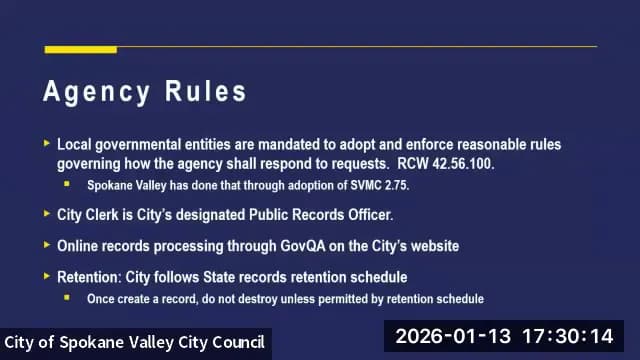
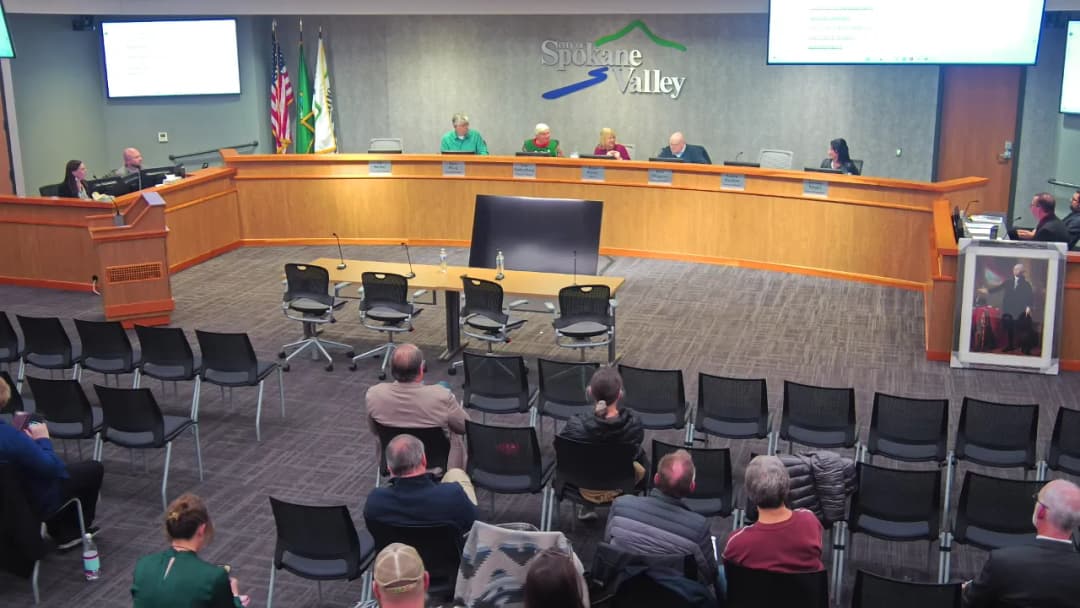
This special meeting of the Spokane Valley City Council convened at 5:15 p.m. on January 13, 2026, with Mayor Patton presiding. The sole agenda item was a non‑action training session conducted by City Attorney Kelly Konkright covering the Washington State Public Records Act (PRA) and the Open Public Meetings Act (OPMA). No formal public comments were accepted, and no votes or decisions were taken. Discussion Items Public Records Act (PRA) Training - City Attorney Konkright explained the PRA’s scope, including definitions of public records, the requirement to disclose records (not information), and the obligation to preserve records on personal devices if they relate to city business. - He emphasized that text messages, social media posts, and emails on personal devices discussing city business are public records and must be retained. - Best practices were outlined: avoid using personal devices for city business; if unavoidable, retain records; use official council social media accounts for city business (per Appendix H of the governance manual). - The city’s PRA response process was described: the city clerk is the records officer; requests can be verbal; a response is due within five days; exemptions (e.g., attorney‑client privilege, personal identifying information) are common. - Penalties for violations were discussed: one‑way attorney fees for prevailing requesters, daily per‑page penalties, with mitigating (good faith) and aggravating (reckless) factors. Open Public Meetings Act (OPMA) Training - Konkright defined a “meeting” as any gathering of a quorum (four or more council members) where action (including discussion) on city business occurs. Serial meetings among fewer members can also violate the OPMA. - He cautioned against replying to all on council‑wide emails and against discussing city business at social gatherings with three or more council members. - Meetings must be noticed and open to the public; secret ballots are prohibited; attendees cannot be forced to provide names to attend, but may be required to speak. - Executive sessions are allowed for specific purposes (e.g., personnel, litigation) but no final action may be taken in closed session. - Penalties include invalidation of actions taken in violation. Councilmember Merkel’s Questions - Councilmember Merkel questioned the attorney’s reference to a city policy on providing information when known or accessible. Attorney Konkright stated he would check and could not immediately cite a specific policy number. - Merkel also asked why the PRA training did not address campaigning as a non‑public record. The attorney declined to answer, citing pending litigation between Merkel and the city. - Merkel disputed a statement he attributed to the attorney about not being able to conduct city business without a quorum; the attorney denied making that statement and suggested Merkel’s quote was incorrect. Key Outcomes - No decisions, votes, or directives were made. The meeting was purely informational and adjourned after the training. - Councilmembers were reminded to comply with the PRA and OPMA, and to use official channels for city business.
Public Meetings - Spokane Valley, Washington
Public Meetings - Spokane Valley, WashingtonThe Spokane Valley City Council held its regular meeting on Tuesday, January 6, 2026, at 6:00 p.m. at City Hall. The meeting included the election of a new Mayor and Deputy Mayor, a public comment on kratom regulation, and a discussion of a telecommunications franchise ordinance. The council also heard staff reports and council comments highlighting 2025 accomplishments and 2026 priorities. Public Comments & Testimony - Spencer Coffin (Spokane resident, self-identified progressive and daily kratom user) spoke during the first general public comment period. He opposed a blanket city ban on kratom, arguing it would displace demand rather than reduce harm, especially for low-income residents. He urged the council to focus restrictions on high-potency synthetic 7-OH mitragynine products and to include baseline data and scheduled reviews if regulating kratom. He also noted that Spokane’s planned blanket ban would push pressure onto Spokane Valley. Action Item: Council Officer Selections - Mayor Election: Nominations were opened for Councilmembers Laura Patton, Pam Haley, and Tim Wick. After balloting, Councilmember Laura Patton received four votes (from Yeager, Patton, Kelly, and Merkel) achieving a majority. Patton was declared Mayor. - Deputy Mayor Election: Nominations were opened for Councilmembers Rod Hattenberg and Tim Wick. Councilmember Rod Hattenberg received five votes (from Patton, Yeager, Kelly, Haley, and Hattenberg) and was elected Deputy Mayor. Discussion Items - Ordinance 26-001 – Franchise Forged Fiber 37, LLC: Tony Beattie presented the franchise request from Forged Fiber 37, a subsidiary of AT&T (formerly Lumen), to install telecommunications fiber in city rights-of-way. Key points included: - The company does not intend to serve residential neighborhoods; no additional fiber capacity is currently needed. - Standard franchise terms include a $25,000 performance bond, a 3‑5 year warranty on pavement cuts (under the regional utility cut policy), and a $2 million commercial general liability policy naming the city as an additional insured. - State law prohibits the city from requiring franchise fees, but the city may increase the bond for larger projects and routinely inspects pavement cuts. - Councilmember Merkel asked about raising the standing $25,000 performance bond and extending the warranty to a flat five years. City Manager Holman and staff explained that the regional pavement cut policy sets the warranty, failures typically appear early, and the bond can be supplemented for specific projects. Consensus was reached to bring the ordinance forward for further action. Key Outcomes - Elected Mayor: Laura Patton (effective immediately). - Elected Deputy Mayor: Rod Hattenberg (effective immediately). - Ordinance 26-001: Council consensus to advance the franchise agreement with Forged Fiber 37, LLC to a future reading; staff will consider potential bond amount increases and may review the utility cut policy at its annual meeting. - 2025 Workload Statistics (reported by City Manager): 44 regular meetings, 6 workshops/special meetings, 18 resolutions, 17 ordinances, 162 action items, 129 administrative reports, 8 community conversations, 14 proclamations, 6 URC community recognitions. - Upcoming: Council flyover to Olympia on January 28–29, 2026; next regular council meeting on January 20, 2026 (Councilmember Wick to attend virtually from AWC conference).
This meeting was held on December 30, 2025. No agenda, minutes, or transcript were available for this meeting record. Consent Calendar - No consent calendar items were provided. Public Comments & Testimony - No public comments or testimony were recorded. Discussion Items - No discussion items were presented for this meeting. Key Outcomes - No votes, decisions, or directives were recorded due to the absence of meeting content.
The Spokane Valley City Council held its regular meeting on Tuesday, December 23, 2025, at 6:00 p.m. at City Hall (10210 E Sprague Ave). Mayor Haley presided; Councilmembers Wick, Higgins, Yeager, and Deputy Mayor Hattenberg were present. Councilmembers Merkel and Padden were excused by unanimous vote. The meeting included approval of the agenda, a motion to grant employees a full day off on Christmas Eve, public comments, approval of the consent agenda, adoption of the 2026 Master Fee Schedule, authorization of a change order for City Hall repairs, a non‑action kratom discussion, setting of the advance agenda, and councilmember reports. Consent Calendar - Unanimously approved claim vouchers for December 23, 2025 ($1,507,125.44) and payroll for the period ending December 15, 2025 ($731,880.58).. Public Comments & Testimony - John Robertson thanked the Council for supporting police patrols that reduced shoplifting and expressed appreciation for Councilmember Higgins’ service. - Darrell Williams urged caution regarding drunk driving during the holidays, noted the “Don’t Drrink and Drive” signs, and invited public input to WSDOT. - Deb Schrock wished everyone a Merry Christmas and thanked the Council for their work over the past year. - Donna Shepard (emailed) expressed concern that the Garco change order includes new construction (e.g., the IT office) rather than pure repairs and urged the city to follow competitive bidding procedures. - Ben Lund expressed trust in the staff and Garco, supporting the change order as the most cost‑effective approach to fix the building. Discussion Items - Employee Christmas Eve Leave: Councilmember Wick moved to give all city employees a full day off on Christmas Eve (December 24, 2025) in line with federal and county practices (current policy was a half day). The motion passed unanimously. - Resolution 25‑013 – 2026 Master Fee Schedule: Accounting Manager Dan Domrese presented the resolution repealing Resolution 25‑006 and adopting the 2026 fee schedule. Previous council consensus on permit fees (October 21), course‑related fees (November 25), and the overall schedule (December 9) were noted. The resolution passed unanimously. - Garco Change Order 12 – City Hall Repairs: City Manager John Holman and Project Manager Glenn Ritter (Garco) presented the third phase of City Hall remediation. Work includes replacing five multi‑story storefronts with curtain wall systems, repairing 13 glue‑lamb beams (drilling and epoxy injection rather than replacement), re‑caulking 120 window systems and repairing 40 operable vents, repairing two small metal roofs, installing security glazing (shatter‑proof film) on lower‑level windows, adding access control to restrooms and a second‑floor secure door, building a new IT manager office, and reconstructing the permit counter with a glass barrier for employee safety. The total cost is approximately $2 million with a 20% contingency. Staff explained the progressive design‑build contract with Garco was procured through an open RFQ process and that continuing with Garco is more efficient and cost‑effective than separate bidding. Upoon questioning, staff stated the building has been thoroughly studied and is structurally sound. A public commenter raised process concerns, but councilmembers defended the procurement method and noted Garco was competitively selected. The motion to authorize the city manager to execute the change order passed unanimously. - Kratom Discussion (Non‑Action): Lieutenant Rob Satake and Deputy City Attorney Caitlin Prunty presented an overview of kratom—a plant‑based substance with opioid‑like effects sold in convenience stores and cannabis shops—noting two local deaths (with kratom along with other substances in June/July 2025), no state or federal regulation, and that Cle Elum and Spokane are considering bans. Regulatory options discussed include an outright prohibition (civil infraction or misdemeanor) or limiting sales to minors. Councilmembers expressed support for an outright ban enforced via civil infractions and business license revocation. Consensus was reached to bring a draft ordinance to a future agenda. Key Outcomes - Unanimously approved: Agenda, consent agenda, excusal of Councilmembers Merkel and Padden. - Granted: All city employees a full day off on Christmas Eve (December 24, 2025). - Adopted: Resolution 25‑013 setting the 2026 Master Fee Schedule (unanimous).- Auth orized: The city manager to execute Change Order 12 with Garco Construction for City Hall repairs, including up to 20% contingency (unanimous).- Consensed: To place a future ordinance banning kratom sales in Spokane Valley on a future agenda, with staff directed to draft an ordinance. - Drected: Staff to begin reviewing the public safety contract with Spokane County and bring options for more local control to Council for discussion. - Adanced Agenda decisions: Removed the SCRAPS contract re‑opening from the advance agenda (retaining advisory committee discussion) and added a future study session on the public safety contract.
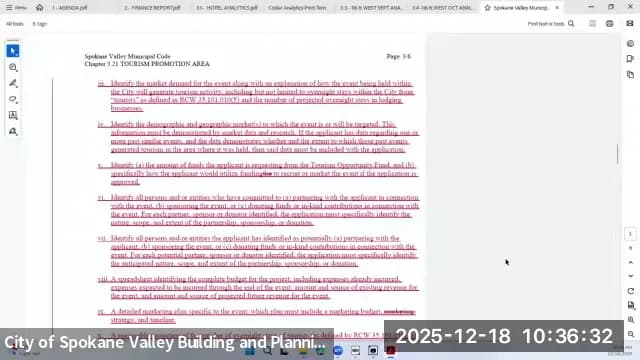
The Spokane Valley Tourism Promotion Area (TPA) Commission held a regular meeting on December 22, 2025, at City Hall. The meeting covered the financial and administrative reports for the final month of 2025, and featured an in-depth discussion on proposed amendments to the city’s municipal code to establish a Tourism Opportunity Fund. Commissioners voted to adjourn after giving direction on the code amendments, with a revised draft expected before the next meeting. Financial Report - Lesli Brassfield presented October revenues, which were down about 4% overall for the year. She noted that the same trend is seen in the lodging tax but does not anticipate a significant budget adjustment. November and December data will follow. Administrative Report - Lesli Brassfield provided an update on lodging analytics from CoStar for October: occupancy was 66.4% (up 1.7% year-over-year) with an average daily rate (ADR) of $102. In comparison, Spokane occupancy was 67% (up 1%) with an ADR of $145. - The city expanded digital marketing back into the Canadian market, resulting in Canadian cities again appearing among the top 10 most visited markets for September and October (data from 116 & West). - Progress on the 2026 TPA budget: the commission previously recommended $875,000 to 116 & West, $700,000 to Spokane Sports, $170,000 for an opportunity fund, and up to $30,000 for technology services. City council approved the funding after a technical glitch was corrected on November 18. - The Course at Spokane Valley hosted two collegiate championship events in early November, which ran smoothly. A larger public ceremony will be planned for 2026. - The additional TPA charge of up to $3 per overnight stay sunsets in 2027 unless the legislature renews it. A statewide impact report is being coordinated by Uncommon Bridges; data is being collected from 2019 onward. - Three commission positions are open, with applications due December 23. Discussion Items - The main item was a Non-Action Item: Opportunity Fund Code Text Update presented by City Attorney Kelly Konkright. The proposed amendments to Spokane Valley Municipal Code Section 3.21 would establish the Tourism Opportunity Fund, define its purpose, create an application process, and set criteria for awarding funds. - Commissioners went through each of the 12 proposed application requirements (items B.2.a–l) and provided feedback: - Items 1–2 (applicant info, event description) were accepted without issue. - Item 3 (market demand and projected overnight stays) was debated. Commissioners emphasized that overnight stays must be required. Kelly agreed to clarify language that “including but not limited to” does not allow zero room nights. It will be combined with Item 10. - Item 4 (demographic/geographic markets) was considered standard and acceptable. - Item 5 (how funds will be used) needs to be broadened to allow for various uses (e.g., travel, shipping). Will be combined with Item 9 (marketing plan). - Items 6 (committed partners/sponsors) and 7 (potential partners/sponsors) were struck as not required and potentially harmful to relationships with event organizers. - Item 8 (detailed budget) was struck as intrusive and not legally required; commissioners noted that asking for a budget from large events is impractical and could deter them. - Item 9 (detailed marketing plan) to be combined with Item 5, with simplified language. - Item 10 (projected overnight stays within and outside the city) to be folded into Item 3. - Item 11 (expected economic investment based on ADR) was struck because ADR is not tracked by event organizers and can be sourced from CoStar. - Item 12 (post-event measurement methods) will be reworded to ask for the methods the applicant will use to measure room nights and economic impact before and after the event. Commissioners noted that some tracking will be the city’s responsibility, but applicants must provide data such as attendance and registrations. - The commission also reviewed the funding criteria (Section 070 C.1–4) and agreed they were appropriate: applicant must be a venue owner/operator or event organizer; funds must be used for approved TPA purposes; the event must be a convention, sports event, or similar generating tourism; the event must not violate law or city values; and the commission may deny or partially fund based on return on investment. - The commission confirmed that complete applications will go directly to the TPA Commission, not filtered by staff. - A change to the work plan submission date from September 30 to November 15 was supported to streamline the budget process. Key Outcomes - Commissioners directed Kelly Konkright to produce a revised draft of the code amendments reflecting the discussed changes (removal of items 6,7,8,11; combination of 3/10 and 5/9; rewording of 12; and other clarifications). The draft is to be completed by the end of 2025 and distributed to commissioners at least two weeks before the next meeting. - The next meeting is tentatively scheduled for January 15, 2026, but may be moved to February 19 if consultants’ materials are not ready. - Motion to adjourn was made, seconded, and passed unanimously.
The Spokane Valley City Council met in regular session on Tuesday, December 16, 2025, at 6:00 p.m. at City Hall. The meeting included general public comments, seven action items, two administrative reports, and council comments. The meeting was extended multiple times, running past 9:45 p.m. to complete the agenda. General Public Comments - Sue De Lucci and Linda Clesh provided updates on an upcoming neighborhood meeting on January 8th regarding a proposed development and monitoring of stormwater ponds near their area. - Ben Lund, a 38-year resident and small business owner, spoke against changing council meeting structure to accommodate Muslim prayer times, arguing that civic traditions should be preserved and that America’s founding documents are shaped by Christian principles. - Joe Ader, CEO of Family Promise Spokane, reported that over 1,200 homeless students were identified in Spokane Valley schools this school year, with his organization serving 843 of those children from 314 families. He advocated for continued support and noted growing homelessness in East Valley and Central Valley school zones. Action Items Ordinance 25-018 – School Speed Camera Program (Second Read) - The ordinance would adopt chapter 9.60 of the Spokane Valley Municipal Code to establish an automated traffic safety camera program for school zones. - Councilmember Merkel moved to postpone the vote until January, but the motion died for lack of a second. - Staff reported that, statewide, once cameras are installed, speed violations drop by about 50% as soon as cameras are present, and 90% of people cited do not receive a second ticket. They also noted over 40% of drivers in measured school zones were driving over the citation threshold. - Councilmember Wick opposed the program, citing privacy concerns and potential liability from camera footage; Councilmembers Merkel and Yeager expressed conditional support with calls for close monitoring. - Public comments were mixed: Mike Kelly urged caution about surveillance and future use of cameras, while Manrique Rojas supported the program for child safety. The ordinance passed. Ordinance 25-019 – Wireless Communication Tower Height Amendment (First Read) - Council voted to waive the rules and adopt the ordinance, which amends municipal code to allow increased height for communication towers used for first responder communications. - Councilmember Merkel opposed, noting the Planning Commission had previously concluded the change was unneeded. The ordinance passed with opposition. Resolution 25-018 – Legal Newspaper of Record - The resolution designates the Spokesman Review as the city’s official newspaper, replacing the Spokane Valley News Herald. - Roger Harnack, owner of the Valley News Herald, disputed staff presentations, stating his paper was never asked for a proposal and that Spokesman Review circulation is about 15,000, not 45,000. He said the city had been paying multiple papers unnecessarily and suggested a competitive bid process. - Councilmember Merkel moved to require an RFP process, but the motion failed for lack of a second. - Councilmembers Patton and Merkel opposed the change; Councilmembers Wick and Hattenberg supported it for broader reach and efficiency. The resolution passed 5–2. 2026 Lodging Tax Grant Allocations - Three motions were considered: (1) allocations including up to $260,811 for the Cross Course, $145,000 for Spokane Valley Hub, $50,000 for the Washington State Quilters quilt show, and $27,189 for Spokane County Fair marketing, with $477,000 transferred to the capital fund; (2) allocation of $2 million from lodging tax funds for infrastructure improvements for an ice sports facility, contingent on a ground lease with Anovia; and (3) operational support of up to $600,000 annually for 2027–28 and $550,000 annually for 2029–31 for the ice facility. - The second motion was amended, per staff request, to add a condition that all lodging tax advisory committee recommendations for operational support are met, including no hotel on the site while lodging tax funds support operations. - Councilmember Merkel objected to spending lodging tax funds on what he called “money-losing operations” and questioned the process; a call for the question was voted down, then the motions passed. Five-Year Plan to Prevent & Address Homelessness - The council adopted the 2025–2030 regional continuum of care plan, as recommended by the city’s Homeless and Housing Task Force. - Staff explained that the plan is required to receive state and federal funds and that the city’s recording fee revenue is estimated at $365,000 for 2026. - Councilmember Merkel opposed, arguing the plan’s performance metrics were unrealistic and that the city should develop its own plan. Councilmembers Yeager and Patton supported the regional plan, emphasizing that regional collaboration is necessary and that the plan allows local prioritization. - The motion passed. K-9 Patrol Deputy - The council approved converting an existing patrol position to a canine position, with no increase in FTE count. - The new K-9 will be funded by a $15,000 donation from a deceased community member’s estate, with one-time kennel costs of about $5,000 and annual recurring costs of $5,200. A DOJ COPS grant will offset the ongoing costs. - Councilmembers praised the donation and the safety benefits of canines. The motion passed unanimously. Sullivan/Trent Preferred Alternative - The council approved advancing the revised “jug handle” interchange concept to final design and authorized a consultant agreement not to exceed $4.1 million with KPFF Consulting Engineers. - Staff explained that the previous peanut-style diamond interchange grew too costly and complex; the jug handle reduces bridge square footage, shortens construction time from over two years to about 19 months, and reduces lane restrictions from 26 months to about nine months. - Councilmember Merkel voted no, citing concerns about roundabout performance and project priority. The motion passed. Administrative Reports Signal Cabinet Wrap Discussion - Spokane Arts Executive Director Skylar Oberst proposed partnering with the city to wrap 12 traffic signal cabinets with art, funded by an STCU grant; there would be no cost to the city for printing or installation. - The wraps are expected to deter graffiti and last three to five years. Locations would be selected based on visibility, graffiti history, and city ownership. - Council expressed consensus to participate and to appoint the 2026 mayor and deputy mayor to the selection committee. Comprehensive Plan Discussion - Consultant Elliot Weiss of Community Attributes presented three preliminary land use scenarios for the comprehensive plan update: no action, a limited rezone/upzone, and an upzone-only approach. - The city must accommodate a 20-year housing unit allocation of more than 16,000 units across income bands, including low-income bands that are difficult to serve without subsidies. - Councilmembers raised questions about tax impacts, commercial displacement, and density distribution; the discussion will continue at future meetings. Council, Mayor, and City Manager Comments - Councilmember Merkel criticized several decisions made during the meeting, including the newspaper change, tower height amendment, lodging tax allocations, and the homelessness plan, and announced she would not vote for the current mayor or deputy mayor. - City Manager Holman reported on storm preparedness for a forecast wind event, praised a joint police operation with the U.S. Marshals Service that arrested 15 individuals, and responded to concerns about SCRAPS code changes, calling it a minor administrative matter. Key Outcomes - Passed Ordinance 25-018 (speed cameras), Ordinance 25-019 (tower heights), Resolution 25-018 (newspaper of record, 5–2), three lodging tax motions, the five-year homelessness plan, K-9 deputy conversion, and Sullivan/Trent design advancement. - The meeting adjourned after several extensions.
The Spokane Valley Planning Commission held a regular meeting on Thursday, December 11, 2025, at 6:00 p.m. in Council Chambers at City Hall. The agenda stated there would be no public comment opportunity. The meeting featured a round-table study session on draft land use scenarios designed to satisfy state-mandated housing allocations, with discussion of trade-offs, infrastructure concerns, and community character. Routine Approvals - Excused absences were granted for Commissioners Robertson and Weatherman by unanimous vote. - The meeting agenda was approved unanimously. - Minutes from the November 13, 2025 special meeting and regular meeting were each approved unanimously. Commission and Administrative Reports - Commissioner Wilson reported attending the city's Christmas tree lighting ceremony, estimating at least 1,500 attendees and calling it a great community event. - Staff reminded the commission that there will be no second meeting in December and no first meeting in January; the next meeting will be the second meeting in January 2026. - Two Planning Commission positions are open; applications are due December 19, 2025. Study Session: Land Use Scenarios Steve Roberge presented the scenarios, with context provided by Mike Bessinger, Community and Economic Development Director. - The city must plan for approximately 16,600 housing units over the next 20 years. The allocation is broken into income brackets based on Area Median Income, roughly $100,000 for a family of four in the Spokane Valley area. - State law requires at least six of nine defined middle housing types to be allowed in all predominantly residential zones. The state also mandates allowing up to four units per parcel, potentially six near transit. - No Action Alternative: If the city makes no changes, preemptive state bills would still impose middle housing and ADU mandates. This scenario is non-compliant with state housing requirements, risking loss of grants and other penalties. Chairman McKinley noted that 71% of the city's capital budget comes from grants and awards. - Scenario A (Limited Rezone/Up Zone): This scenario includes rezone of R4 land north of Sprague Avenue between Valleyway and the corridor mixed-use zone to residential multifamily, plus higher densities in commercial/multifamily zones up to about 32 units per acre (with R4 up to 41 units/acre). - Scenario B (No Rezone, Stronger Up Zone): This scenario keeps current zoning but increases densities in multifamily and commercial zones to about 40 units per acre. - Staff stated that expanding the Urban Growth Area would be very difficult to justify under state criteria. Annexing existing UGA areas would add additional housing allocation, and past analysis found most areas would be a net financial drain. Commissioner Positions and Discussion - Several commissioners expressed concern that state mandates reduce local control and could degrade quality of life by straining roads, utilities, schools, public safety, and other infrastructure. - Commissioner Wilson emphasized the importance of homeownership, architecture that blends with neighborhoods, and addressing infrastructure capacity. He also announced he will step down from the commission in January. - Commissioner Meyer supported embracing change and providing more affordable and diverse housing options within existing neighborhoods, saying the city should attract young families. Several commissioners discussed the potential for mixed-use redevelopment of underutilized commercial corridors like the auto row area along Sprague. - Mike Bessinger explained that the current land use map reflects years of community input, and staff tried to incorporate state mandates while preserving neighborhood character. He noted that unlimited density in corridor mixed-use zones has not produced high-rises because the market does not support them. Key Outcomes - No formal decisions or votes were taken on the land use scenarios; the session was intended for discussion. - Staff asked commissioners to reflect on the scenarios and on which middle housing typologies best fit Spokane Valley. - New commissioners will be oriented before the next business meeting. - The meeting adjourned with farewells to outgoing commissioners, including Commissioner Wilson and Commissioner Kelly, who is moving to the city council.
The Spokane Valley City Council met on Tuesday, December 9, 2025, at 6:00 p.m. at City Hall. The meeting included approval of consent agenda, action on two budget ordinances, non-action reports on fees, lodging tax recommendations, and a wireless tower code amendment. A significant portion of the meeting was dedicated to councilmember comments regarding a social media post by Councilmember Yeager, which drew public comments and internal debate. Consent Calendar - Approved unanimously: claim vouchers ($2,578,644.70), payroll for pay period ending November 30, 2025 ($753,527.46), and minutes of October 28, 2025. Public Comments & Testimony - First Public Comment Period: - A community member (identified as Nagmana Ahmed Shirazi) spoke about the five pillars of Islam and urged council to overcome misconceptions and hatred. - Reverend Jen Haywood (Airedale United Church of Christ) thanked Councilmember Yeager for meeting with Dr. Shoshani and encouraged further dialogue and an apology. - Reverend Mark Finney (Thrive International) spoke on behalf of Muslim friends, urging an inclusive and welcoming community, and noted his Christian faith compels him to advocate for the marginalized. - A resident raised questions about the 2026 budget, including costs for the Barker roundabout, ice rink, street maintenance, employee raises, investigation costs, and statues across the street. - Second Public Comment Period: No speakers. Discussion Items - Ordinance 25-015 (2025 Budget Amendment): Finance Director Chelsie Walls presented. The amendment affects 14 funds with revenue decreases of $7.8 million and expenditure decreases of $17.7 million. Councilmember Merkel questioned $100,000 for bridge inspection and indicated he would vote no. Motion passed with Merkel opposed. - Ordinance 25-017 (2026 Budget): Walls noted total appropriations of $148.4 million, general fund of $70 million, and 118.25 FTEs. Merkel again objected, citing lack of transparency and underfunding of police (10 officers short). Councilmember Wick detailed budget items (Barker roundabout, ice rink, street maintenance, cross-country course, investigations, statues). Merkel noted a 62% fund reserve rather than 50%. Motion passed with Merkel opposed. - 2026 Fee Resolution (Non-Action): Dan Dumries presented the proposed master fee schedule, including a 2.64% CPI increase for fees $20 or more and changes to permit and park fees. No further input from contractors. Council reached consensus to place on December 23 agenda. - LTAC Recommendations (Non-Action): Sarah Farr reported on the Lodging Tax Advisory Committee's second round recommendations. LTAC recommended operational support for the proposed ice sports facility (up to $600,000/year for 2027-2028, then $550,000/year for 2029-2031) and $2 million in capital infrastructure, both contingent on no hotel development on the site and land lease execution. Councilmembers Merkel and Wick expressed concerns about the condition and the shift from a self-sustaining model. City Manager Holman clarified the city did not propose the hotel; the condition came from hoteliers to speed up the project. Council reached consensus to bring forward a motion, with reservation noted. - CTA-2025-0002 Wireless Communication Tower Height (Non-Action): Mike Basinger and Steve Roberge presented. ShREC (Spokane Regional Emergency Communications) needs a 100-foot tower (plus 20 feet antennas) for a new call center. Planning commission did not recommend permanent code changes, but staff cited risks if the interim ordinance lapses. Council consensus to move forward with a code amendment to allow towers up to 120 feet in commercial zones, with Councilmember Wick's suggestion to include "regional or local" emergency services. Councilmember Comments (Agenda Amended) - Councilmember Yeager stated her social media post was meant to highlight violence against innocent people, and she denied it was about Muslims, expressing commitment to unity and peace. - Councilmembers Padden, Higgins, Wick, Merkel, Mayor Haley, and Deputy Mayor Hattenberg spoke. Padden acknowledged the detrimental impact and praised the coffee meeting between Yeager and Dr. Shoshani. Wick emphasized an inclusive and safe community for all. Merkel expressed disappointment, stating he did not hear an apology and accused Yeager of doubling down; he apologized for the council's inability to take deeper action. - City Attorney Kelly Conkrite opined that the post, made on personal social media and not discussing city business, did not violate council conduct standards under the governance manual. Key Outcomes - Ordinance 25-015 (2025 budget amendment) passed 6-1 (Merkel opposed). - Ordinance 25-017 (2026 budget) passed 6-1 (Merkel opposed). - Fee Resolution will be placed on the December 23, 2025 council agenda for action. - LTAC recommendations will be brought forward for a motion on December 16, 2025. - Wireless tower code amendment will proceed to a first reading, including language to allow regional or local first responder communication facilities. - Executive session was held for approximately 60 minutes to review a public employee (RCW 42.30.110(1)(g)), with no action taken upon return. - Advance Agenda: Council agreed to add a future discussion on addressing Crigton (sp?) substance abuse, and to pursue an open application process for the Center for Quality Communities scholarship program. - City Manager Comments: Updated on Pines Grade separation (BNSF work ongoing), Sullivan Park water line completed under budget, and receipt of over $3.86 million in state grants for Barker Road projects. Christmas tree lighting event was thanked.
The agenda, minutes, and transcript for this meeting were not provided. Therefore, no summary of discussions, decisions, or public comments can be generated.
The Spokane Valley City Council met on Tuesday, November 25, 2025, at 6:00 p.m. at City Hall. The meeting featured a proclamation for Small Business Saturday, a public hearing on the final 2026 budget, action on a homeless outreach contract amendment and a retail theft emphasis, and a non-action report on course fees for the new cross-country course. The meeting was dominated by public comment regarding controversial social media posts by Councilmember Yeager, prompting the mayor to read a 2017 inclusivity resolution. The council later voted to extend the meeting for public comment and adjourned after a contentious attempt to censure Councilmember Yeager. Proclamation & Mayor's Statement - Mayor Pam Haley read a proclamation declaring Saturday, November 29, 2025, as Small Business Saturday, citing statistics: 34.7 million small businesses in the U.S., 99.7% of firms with paid employees, 61.1% of net new jobs since 1995, and 45.9% of private-sector employees. Lance Beck, CEO of the Greater Spokane Valley Chamber, accepted the proclamation. - Before public comment, Mayor Haley addressed Councilmember Yeager's personal Facebook post, stating it "does not represent the values or views of myself, the city, or this council." She read the full text of Resolution 17-008 (2017), reaffirming the city as an inclusive city where discrimination is not tolerated. Councilmembers were asked to reaffirm the resolution by consensus; all raised their hands. Public Comments & Testimony - First Public Comment Period (reduced to 2 minutes per speaker due to high turnout): Over 30 speakers addressed the council, with the vast majority condemning Councilmember Yeager's post and calling for an apology, resignation, or action. Speakers included Muslim residents, interfaith leaders, members of the Party for Socialism and Liberation, and community members. Key points: - Zayn (via Zoom): Called for a public apology, quoting the Quran. - Magmana Shirazi (faith leader): Requested a council statement affirming Muslim neighbors, an apology, and monthly Muslim invocations for six months. - Several speakers cited a 400% increase in anti-Muslim bias incidents (CAIR Washington) and reported harassment at the Islamic Center (bacon strung through the gate). - A few speakers (e.g., Chris Pure) expressed support for the retail theft emphasis. - Two speakers (Sue Holman, Linda Klesh) addressed stormwater pond and road issues in Ridgemont/Terrace View. - Second Public Comment Period: Speakers again addressed the Yeager controversy, with some defending her (Jeff Brooks, Brett Howell). Consent Calendar - The consent agenda was approved unanimously after Councilmember Merkel requested removal of the October 28 regular meeting minutes (item I) for separate consideration due to omissions. The minutes were approved after discussion, with Merkel's concerns noted. Action Items Public Hearing 3: Final 2026 Budget - Finance Director Chelsie Walls presented highlights: total appropriations of $148.4 million, general fund $70.6 million, capital expenditures $47.9 million (71.25% grant-financed). Recurring revenues exceed expenditures by $119,000; ending fund balance projected at $36.6 million (53% of recurring expenditures). - Public comment: Michael (Holman) questioned transparency and cited a $6.3 million shortfall across funds, urging the council not to pass the budget. - Councilmember Merkel stated he would vote against the budget due to unexplained numbers and lack of cuts. Councilmember Wick expressed support, noting the budget had been reviewed over seven discussions. - The public hearing was closed; the budget ordinance will return for a second reading on December 9. Motion: Homeless Outreach Contract Amendment - Motion to approve a $50,000 amendment to the contract with Frontier Behavioral Health for pet boarding ($20,000) and housing-related costs ($30,000) passed (vote: 6-1, with Merkel opposed). - Discussion: Gloria Mantz reported the program housed 57 individuals and provided substance use disorder services to 28 in the past year. The pet boarding partnership with SpokAnimal Guardian Angels would extend shelter from 14 to 30 days. Councilmember Merkel wanted measurable objectives upfront; the city manager argued the funds provide tools and that results can be reported later. Councilmember Yeager supported the pet program. Motion: Retail Theft Emphasis - Motion to authorize an additional $20,000 for focused retail theft enforcement through the holiday season passed unanimously. - Chief Dave Ellis reported a recent 4-hour blitz resulted in 9 arrests, with charges including trafficking stolen property, organized retail theft, and weapons possession. Two more blitzes are already planned. The additional $20,000 would fund two more events. Councilmembers Wick, Yeager, and Padden supported the investment, citing deterrent effect and economic impact. Non-Action Items Safe & Healthy Spokane Regional Task Force Update - Deputy City Manager Eric Lamb reported on the task force, which aims to address behavioral health and justice system issues. A consultant (Leafman Group) led a two-day assessment, identifying 17 immediate priorities. Four subcommittees will be formed, with Spokane Valley staff participating. An example of a quick fix: judges agreed to stop releasing individuals with severe behavioral health issues from jail in the middle of the night without case manager notification. The task force will present recommendations to governing bodies in June 2026. The Course Fees Discussion - Parks Director John Bottelli presented a proposed hybrid pricing model for the new cross-country course at Flora Park: a daily rental fee of $1,500 plus per-athlete fees ($1.25–$2.50). Based on market analysis, the model could generate about $75,000 in rental revenue annually from confirmed events. Potential economic impact of 15 events in 2026 could reach $10 million. Additional considerations included local discounts (10–30% off for pre-approved schools/nonprofits), team practice fees (per athlete), portable restroom fees, and a 15% ticket revenue share. Council consensus was to bring the fees forward in the December fee resolution. Key Outcomes - Small Business Saturday was proclaimed. - The 2017 inclusivity resolution was reaffirmed by consensus. - Consent agenda approved (with one item separately considered). - Budget public hearing held; second reading scheduled for December 9. - Homeless outreach contract amendment approved (6-1). - Retail theft emphasis funded with $20,000 (unanimous). - Council expressed consensus to include course fees in the December fee resolution. - The meeting was extended twice (10 minutes and 20 minutes) to accommodate public comment. - Councilmember Merkel attempted to advance a censure motion against Councilmember Yeager, citing governance manual violations. The city attorney ruled the proper process is through the chapter five complaint procedure. After procedural debate, a motion to adjourn was made and passed (vote not recorded), ending the meeting.