Browse by city
Date range
Search help

Search titles, summaries, topics and stored transcripts together. Keywords may match separately; put the whole query in double quotes for a phrase. Matching follows word analysis, so punctuation is not exact. Both dates are included. Documents are not searched.

SHOWING 61–70 ENTRIES
61
APR 28, 2026 · SPOKANE VALLEY, WASHINGTON · CITY COUNCIL & COMMISSIONS
Spokane Valley City Council Meeting – April 28, 2026

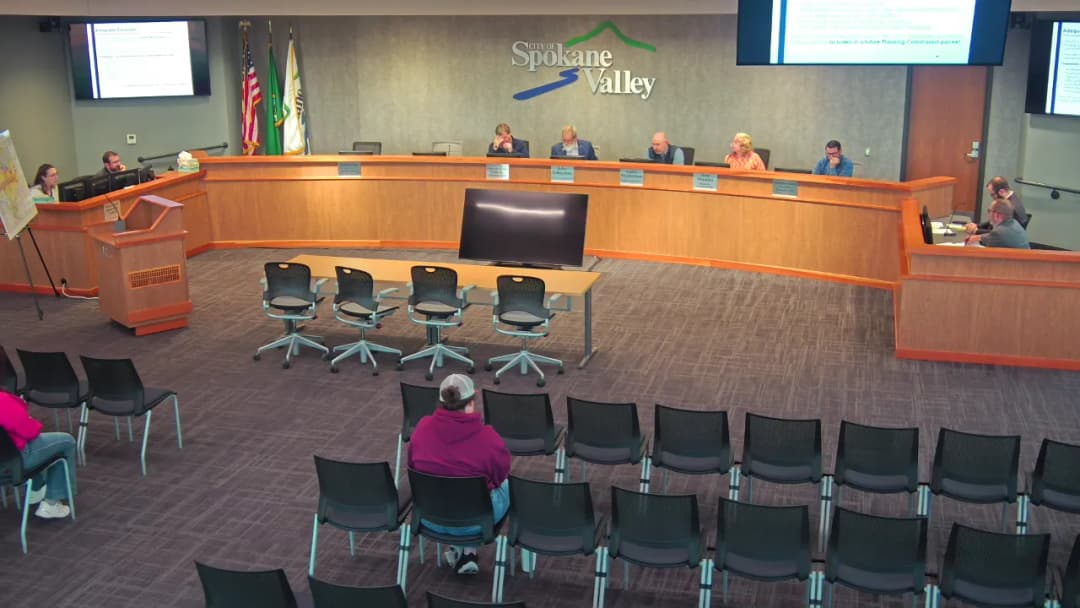
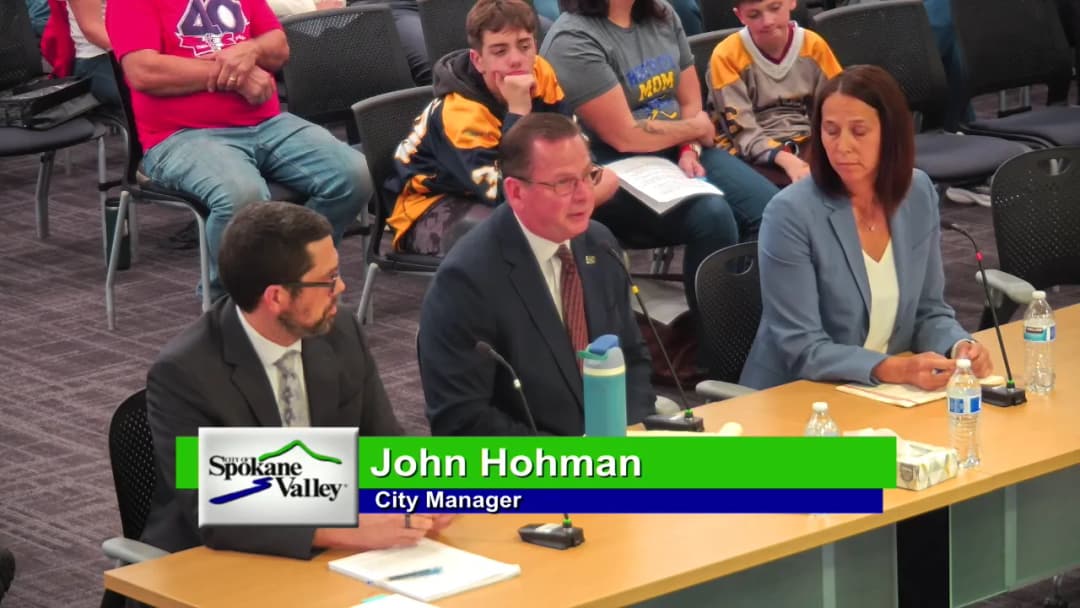
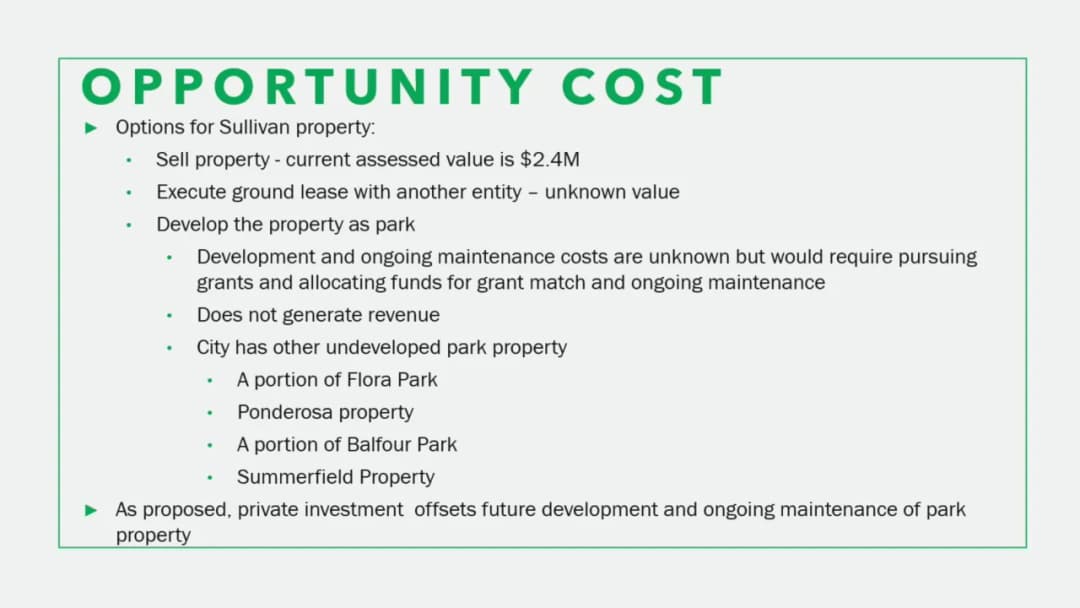
The council convened at 6:00 p.m. on April 28, 2026, to consider a ground lease for a proposed ice sports facility, a first reading of an ordinance establishing a tourism opportunity fund, and a briefing on opportunity zone applications. After extensive public testimony and council debate, the ice sports lease was approved 6–1, and the opportunity fund ordinance passed unanimously. The meeting also included consent agenda approvals, discussion of an opportunity zone nomination, and councilmember reports. Consent Calendar - Approved claim vouchers totaling $2,641,981.34, payroll for two periods ($843,346.25 and $758,296.32), and meeting minutes from February 10, February 24, March 3, March 10, March 17, and March 31, 2026. Councilmember Merkel noted a misspelling of “Muslim” in the March 31 minutes, which was acknowledged. Public Comments & Testimony - Linda Clush (Spokane Valley): Expressed concern about council decorum, stating that council members appeared to pre‑decide votes and displayed disrespect during prior discussions. Urged better listening and transparency. - Sue Deluki (Spokane Valley): Criticized the citizen engagement process for the 2046 comprehensive plan update, noting less than 1% of the population participated. She emphasized the need for broader public input. - Rod Higgins (Spokane Valley): Supported the ice facility ground lease, arguing the city must make infrastructure improvements anyway and that the risk is minimal. He also criticized questioning of the donor’s motives. - Mo Herr (Spokane): Representing Spokane Figure Skating Club, supported the project as a way to increase scarce ice time and reduce costs for skaters, highlighting the region’s need. - Sarah Bassetta (Spokane Valley): A teacher and hockey parent, spoke about the severe shortage of ice time, with late‑night practices and teams sharing ice. She argued the facility would create opportunities for youth and economic benefits. - Maivoo Toole (figure skater, young speaker): Expressed need for more ice time to accommodate her training schedule. - Ben Lund (Spokane Valley resident, 26‑year business owner): Supported the project as a positive platform for youth, citing discipline, teamwork, and community benefit at low cost to the city. - Tyler Prasani (Spokane Valley): Small business owner and hockey parent, emphasized the region’s ice shortage and the project’s potential to inspire youth and generate tourism revenue. Noted that other ice arenas (e.g., Kraken Community Iceplex) have grown participation. - Kay Fuerseek (Spokane Valley): Supported the facility but urged the city to address homelessness in the park and ensure proper traffic infrastructure on Sullivan Road. - Mike Dolan (Spokane Valley): Stated he is not anti‑ice rink but criticized lack of transparency, the city’s budget situation, and the donor’s relationship with the city manager. Questioned how the 500 free hours would be implemented. - Rochelle Miller (Liberty Lake): A social worker and hockey family member, argued the rink builds community, provides belonging for youth, and generates economic benefits. She urged approval. - Matt Alman (Spokane): President of Inland Northwest Curling Club, described the severe ice shortage affecting curling, noting the club is at capacity. Supported the project as a way to expand all ice sports. - Unnamed speaker (from written notes): Raised concern that $1‑per‑year lease is a public giveaway, arguing market value lease could generate $415,000 annually for the city. - John Sister (Spokane Valley): Recalled past opposition to Browns Park volleyball courts that now are heavily used, urging the council to approve the rink. - Matt Howell (Spokane Valley): Expressed legal concerns about prevailing wage and compliance, suggesting the city should delay for legal review. City attorney responded that Pacifica Law Group and staff confirmed compliance. - Denny LaRue (Spokane): Supported the project, noting that existing ice user groups (Eagles, Frontier) have not opposed it and that it would expand hockey, figure skating, sledge hockey, and girls’ hockey. - Ryan Miller (Liberty Lake): A hockey coach and parent, reiterated ice time shortage and the need for the facility to allow better scheduling. - Kurt Lucas (Pasco): Representing Tri‑City Amateur Hockey Association, supported the project as a regional benefit. - Kendall LeClair (Spokane): Figure skating coach, described how her theater on ice program struggles with only 30 minutes of ice time in February. The facility would enable more training and community access. - Luke Damscove (Spokane): President of Spokane Junior Chiefs, thanked staff and urged approval, noting sledge hockey growth. - Sue Deluki (second public comment): Reiterated concerns about process and parkland conversion, stating the city has only 37% of the national average for parks and that the project should not be rushed. Discussion Items Ice Sports Facility Ground Lease (Action Item 2) - City Manager John Hohman presented the proposal: a 75‑year initial ground lease (extendable to 99 years) at $1/year for a 12‑acre parcel north of Sullivan Park. The lessee (Anovia Foundation/donor) will finance, construct (80,000 sq ft, two sheets of ice), operate, and maintain the ice sports facility at no cost to the city. The city is responsible for approximately $3.1 million in infrastructure (signal improvements, road access, sewer lift station, and park enhancements). The lease requires at least 500 hours per year of free or discounted ice time for economically disadvantaged individuals. Lessee may develop two commercial parcels to generate revenue to support operations. City has a right of first refusal and an option to purchase improvements for $9.4 million once debt falls to that level. City has no debt exposure; lender recourse is only against lessee. - City Attorney Kelly Konkright detailed default scenarios: if facility is not built or is abandoned, city owns improvements and is not obligated to operate. LLCs are joint tenants; both are independently liable. He distinguished this from the performing arts center bond request. - Shelley O’Quinn (Anovia Foundation) highlighted the donor’s intent to give back, Anovia’s 52‑year history, and that the LLC is a nonprofit entity. She noted the donor is funding construction and initial operating losses. - Councilmembers asked about lease duration (common for such investments), determination of 500 hours (negotiated based on community need and feasibility), and city’s liability (no debt, no operating costs). The city would maintain the sewer lift station and plow snow, costing $7,000/year. - Concerns raised by Councilmember Merkel about lack of financial analysis of LLCs, assignment risks, and opportunity cost. City manager responded that in worst case, city retains improved land. Ordinance 26‑006: Opportunity Fund CTA (Action Item 3) - Mike Basinger explained the fund ($170,000 initially) to attract tourism‑driven events. Applications reviewed by staff and hotel commission; council approves through consent agenda. Attorneys noted strict criteria and reimbursement‑based grants. - Councilmembers supported the streamlined process and requested clear labeling on future consent agendas. Opportunity Zone Application (Non‑Action Item) - Teri Stripes briefed on federal opportunity zone program, now permanent. The city proposes nominating census tract 123 (Trentwood area) for a 10‑year designation. The tract meets criteria: low income, food desert, available land, alignment with comprehensive plan, and existing incentives (SEPA planned action). Applications to state due May 28, 2026. - Council expressed interest in incentivizing workforce housing rather than multifamily rentals. Staff will bring a resolution and letter of support next meeting. Key Outcomes - Ice Sports Facility Ground Lease: Approved 6‑1 (Councilmember Merkel opposed). The city manager was authorized to execute the lease and include park improvements. - Ordinance 26‑006 (Opportunity Fund): Passed unanimously on first reading; second reading and adoption scheduled for a future meeting. - Opportunity Zone Nomination: Consensus obtained to proceed with submitting census tract 123; a formal resolution and letter of support will be presented at the next council meeting. - Advance Agenda: Council agreed to schedule future discussions on: the Good Samaritan development (blasting complaints), public safety contract negotiations, ambulance cost reduction (with Fire District 9), historic preservation strategies, federal forest management for wildfire risk reduction, and a police report on license plate readers and potential impacts of FIFA World Cup events.
ECONOMIC DEVELOPMENT 31% · PARKS AND RECREATION 24% · YOUTH PROGRAMS 13% · PROCEDURAL 8%
62
APR 28, 2026 · SPOKANE VALLEY, WASHINGTON · CITY COUNCIL & COMMISSIONS
Spokane Valley City Council Special Council Meeting - April 28, 2026

The Spokane Valley City Council held a special meeting on Tuesday, April 28, 2026, at 5:00 PM at City Hall. The sole purpose of the meeting was to adjourn into executive session to discuss potential litigation under RCW 42.30.110(1)(i). No public comments were accepted, and no other business was conducted. Key Outcomes - Councilmember Wick moved to adjourn into executive session for approximately 45 minutes to discuss potential litigation, with no action to be taken upon return to open session. The motion was seconded and passed unanimously by a voice vote (all ayes, no nays). - The meeting then adjourned to executive session at 5:00 PM.

PROCEDURAL 100%
63
APR 21, 2026 · SPOKANE VALLEY, WASHINGTON · CITY COUNCIL & COMMISSIONS
Spokane Valley City Council Regular Meeting - April 21, 2026

The Spokane Valley City Council held its regular meeting on Tuesday, April 21, 2026, at 6:00 p.m. at City Hall. The meeting included proclamations, public comments, three action items, and two administrative reports. Key topics included an indigent defense caseload standards resolution, a new catering contract for CenterPlace, participation in an opioid settlement, an economic forecast, and a proposed ice sports facility ground lease. Special Guests & Presentations - UROC Award: Elsa, a junior at University High School, was recognized for her extensive volunteer work including 50 community service hours with organizations such as Feast World Kitchen, Toys for Tots, and Second Harvest, and her leadership in Launch Northwest Youth Council and Key Club. - Arbor Day Proclamation: Mayor Padden proclaimed Friday, April 24, 2026, as Arbor Day. Garth Davis from the conservation district highlighted partnerships that planted over 500 trees on city property in the last two years and the Cool Canopy program offering free trees to citizens. Public Comments & Testimony - Donna Shepard (resident): Questioned the ice rink lease terms, specifically the $1/year rent and the city paying for sewer lift maintenance, arguing it doesn't make business sense and requesting clarification on several lease sections. She noted the lease includes a $1/year rent with city-funded sewer lift maintenance but not grease separators, and pointed out ambiguities about road and parking lot maintenance. - Mike Dolan (resident): Expressed opposition to the ice rink project, citing financial risks, lack of recourse if the lessor fails, and concerns about the city's role. He referenced independent research and FOIA requests, and alleged weaponized code enforcement by the city manager. - Jody Bueller (resident): Questioned Anovia's involvement given a previous theater project collapse, and argued the city should require the developer to buy the property outright rather than a $1 lease with city-funded infrastructure. He referenced pages 119-120 of the proposal, noting the lease is for 99 years. - Jason Greenwell (Eagles Ice Arena GM): Supported the ice rink, stating Eagles is at capacity, with 70-80 kids in learn-to-play programs and tournaments sold out. He emphasized the need for additional ice to host events and reduce travel for youth. - Grant Gwynn (hotel owner, LTAC committee member): Supported the rink, noting it would produce 6,000 to 10,000 room nights annually, benefiting hotels and employees. He stated the LTAC committee (five largest hotels) unanimously recommended $2M in infrastructure funding and up to $600K/year operational support. - Luke Damsgove (Spokane Junior Chiefs president): Advocated for the rink citing high demand, safety concerns with travel, and inability to grow girls' hockey due to capacity constraints. He noted a child died in a travel accident two years ago. - Shelly (Anovia, via Zoom): Clarified Anovia was not involved in the failed theater project, expressed confidence in the donor and lease negotiations, and looked forward to answering questions next week. - Additional public comments addressed stormwater issues, ecological concerns at the old Good Samaritan hospital, and general dissatisfaction with citizen participation processes. Action Items 1. Resolution 26-005: Indigent Defense Caseload Standards - Senior Deputy City Attorney Tony Beattie presented the resolution adopting new standards that reduce misdemeanor case credits from 300 to 120 over 10 years, per Washington Supreme Court order. The city contracts with Spokane County for these services. - Councilmember Merkel asked about budgetary impact; none yet identified for this year. Councilmember Yeager expressed concern for victims. Councilmember Wick noted the judicial branch setting standards for the legislative branch. - Vote: Unanimously approved (7-0). 2. CenterPlace Catering Contract - Deputy City Manager Erik Lamb presented the award of a food and beverage service contract to Inland Northwest Catering for a one-year term with four optional renewals, featuring tiered commission rates (21%-23.5%), integrated billing, and an equipment reserve fund. The RFP process included written submissions, interviews, and tastings. The contract requires a minimum 20% commission. - Councilmember Kelly requested written clarification on revenue recognition timing for events crossing fiscal years; staff committed to providing written agreement. Councilmember Yeager asked about canceled event food; Nicole Ulmer (CenterPlace coordinator) explained food would be donated to Feed Spokane. - Vote: Unanimously approved (7-0). 3. Opioid Settlement Agreement - Sixth Remnant Defendants - Tony Beattie explained the city would receive $1,500 from a $97 million national settlement, with funds already allocated to the Spokane County Regional Stabilization Center expansion and opioid dashboard. The city was not a party to the lawsuit; participation is required to release claims. - Councilmember Merkel called the amount "patently absurd" and questioned attorney fees. Councilmember Wick noted the city often gets a "short stick" in regional funding, citing COVID relief. City Attorney Kelly Conkright clarified the city could pursue individual litigation but it would be cost-prohibitive. - Vote: Unanimously approved (7-0). Discussion Items 4. Economic Forecast - Dr. Grant Forsyth - Dr. Forsyth, chief economist for Avista, presented on U.S. GDP growth (2%), regional employment (weak, propped up by healthcare), population growth (1% in Spokane Valley, driven by in-migration), inflation (expected 3-3.5% due to energy tariffs and Iran), fuel prices (highest in West, exacerbated by Climate Commitment Act), interest rates (unlikely to decrease soon), and wage growth (4% but purchasing power stagnant). - Key statistics: Spokane Valley's retail sales per capita outperformed Spokane; taxable retail sales reached $1 billion per quarter in 2025. The probability of a U.S. recession increased from 32% in March to 35% in April 2026. Employment growth in the Spokane metro was 0.6% in 2024, 0.3% in 2025, and 0.6% in January 2026. Without healthcare, it would be negative. 5. Ice Sports Facility Ground Lease - City Manager John Holman, Deputy City Manager Erik Lamb, City Services Administrator Gloria Mance, and City Attorney Kelly Conkright presented the lease proposal with Anovia Foundation and donor. - Proposal: Private donor funds $40-50M ice facility (two sheets, 80,000 sq ft) on city-owned Sullivan property; city provides $3.03M for infrastructure (sewer lift station, signal improvements, access) funded by $1M from Fund 312 and $2M from lodging tax; 75-year initial lease term (with potential extensions to 99 years) at $1/year; two commercial pad sites whose revenues support ice rink operations; 500 hours/year of free/reduced ice time for economically disadvantaged; option for city to purchase for $9.4M when debt below that; right of first refusal. - LTAC recommendation: Up to $600K/year for operations (2027-2028) and $550K for 2029-2031, contingent on no hotel on pads while receiving LTAC funds. - Public benefits: Tourism (6,000-10,000 room nights/year), youth access, and community vitality. Staff noted the property would require similar infrastructure for any development. - Councilmembers Merkel and Kelly raised concerns about LLC structure (no business history), debt, and process. Councilmember Merkel suggested selling the property instead. Councilmember Haley and others defended the donor's reputation and the project's merits. - Consensus vote: 5-2 to bring a motion for lease approval to the April 28 meeting (Mayor Padden, Deputy Mayor Hattenberg, Councilmembers Haley, Wick, Yeager in favor; Councilmembers Merkel and Kelly opposed). Key Outcomes - Resolution 26-005 adopted unanimously. - CenterPlace catering contract awarded to Inland Northwest Catering unanimously. - Opioid settlement agreement approved unanimously. - Ice rink ground lease advanced to formal consideration on April 28, 2026, by a 5-2 vote. - Council gave consensus for Mayor to sign a letter of support to rename the Four Lakes Overpass in memory of Sergeant Kenneth Salais, who was killed in a traffic accident on I-90 in 2025. The meeting adjourned after council comments.

ECONOMIC DEVELOPMENT 34% · YOUTH PROGRAMS 9% · PUBLIC ENGAGEMENT 9% · TOURISM DEVELOPMENT 9%
64
APR 16, 2026 · SPOKANE VALLEY, WASHINGTON · CITY COUNCIL & COMMISSIONS
Spokane Valley TPA Commission Regular Meeting - April 16, 2026

The Spokane Valley Tourism Promotion Area Commission held a regular meeting on April 16, 2026, at 10:00 a.m. at Spokane Valley City Hall. The meeting included an administrative report, financial update, and two presentations: a Q1 update from Spokane Sports on the cross-country course and a marketing update from agency 116 & West. No public comments were received. Public Comments & Testimony - No members of the public signed up to comment via Zoom or provided in-person comments. Administrative Report – Mike Basinger - Mike Basinger, Community and Economic Development Director, reported that Leslie (former TPA staff lead) had retired. He noted that revenue collections for January and February 2026 are down compared to the prior year, despite a 1.1% increase in hotel occupancy. The average daily room rate dropped to approximately $88 per night, reducing total revenue even with more guests. - The city’s periodic comprehensive plan update has delayed a council vote on the Opportunity Fund changes, but a first reading is scheduled for April 28 and a second for May 5. If approved, online applications for funding could begin in June. - Basinger warned that the $3 per room night fee sunsets unless renewed by the state legislature during the long session; failure to renew could potentially cut TPA revenue in half (from $1.3 million to $650,000). He expressed confidence the fee would be reinstated but urged attention during budget planning. Financial Report – Sarah Farr - Sarah Farr, Accounting and Finance Program Manager, confirmed that early-year revenue is slightly down but stated it is too early to project annual totals. She noted that the TPA flat fee (not a percentage of room rate) should not be affected by lower ADR, suggesting occupancy or timing may account for the dip. - Commissioner Grant raised a question about a discrepancy: TPA collections appeared down while occupancy was up slightly. Sarah and Mike agreed to investigate by comparing TPA collections with the separate lodging tax fund to identify timing issues. Commission Business Non-Action Item: Sports Recruitment and Marketing Update – Spokane Sports - Ashley Blake, CEO of Spokane Sports, and Ruth Fitzgerald, Hotel Relations lead, presented a Q1 update. The TPA Commission allocated $700,000 for 2026: event delivery costs and positioning/growth efforts. - Key statistics: - Four major events confirmed for the new cross-country course in 2026, representing approximately 5,200 hotel room nights and 21,000 unique attendees. - This far exceeds the Johnson Consulting feasibility study’s year-one benchmark of 900 attendees. - All events were secured before the facility opened, leveraging existing relationships with rights holders (e.g., Nike events in September and November). - Ruth reported that for middle school basketball (boys and girls) alone, Valley hotels generated 1,508 room nights and $327,000 in revenue at an average gross rate of $215. - Commissioner Grant asked about the earlier mention of 12–16 events for 2026; Ashley explained that those events were contingent on the full $900,000 request and had to be cut when funding was reduced to $700,000. - Discussion included the need for a field house (estimated $2.5 million), a cyclocross expansion, and a transportation plan for large events. Basinger added that the city is pursuing a Riverview Trail project (14-foot path) and working on naming rights validation. - No action was taken; the item was informational. Non-Action Item: Marketing Update – 116 & West - Jessica McDonnell presented the Q1 marketing performance. The 2026 budget allocates $220,000 to hotel promotion paid media (March–December), $50,000 to course marketing, and $50,000 to the Discover the Valley tourism brand. - Early results from campaigns launched in March/April: 15,800 impressions, 2,036 clicks, yielding a click-through rate of nearly 13% (double the prior year and 3% above benchmark). Cost per click remains below benchmark. - Course marketing is in the activation phase: a strategy playbook completed, organic social media set up, paid media plan in development. - The tourism brand paid social (TikTok, Instagram, Facebook) is approved and set to launch May 15. - Commissioner Grant inquired about continued use of data tools (Placer AI, CoStar); Basinger confirmed the city will maintain access and noted a replacement for Leslie is being hired. Key Outcomes - No formal votes were taken. The meeting concluded with a motion to adjourn, seconded, and approved unanimously. - The next steps include: monitoring TPA revenue trends, council adoption of Opportunity Fund changes (April 28/May 5), further transportation and course infrastructure planning, and continued marketing optimization.

TOURISM DEVELOPMENT 75% · ENGINEERING AND INFRASTRUCTURE 7% · ECONOMIC DEVELOPMENT 4% · TECHNOLOGY AND INNOVATION 4%
65
APR 14, 2026 · SPOKANE VALLEY, WASHINGTON · CITY COUNCIL & COMMISSIONS
Spokane Valley City Council Special Meeting – Comprehensive Plan Update – April 14, 2026

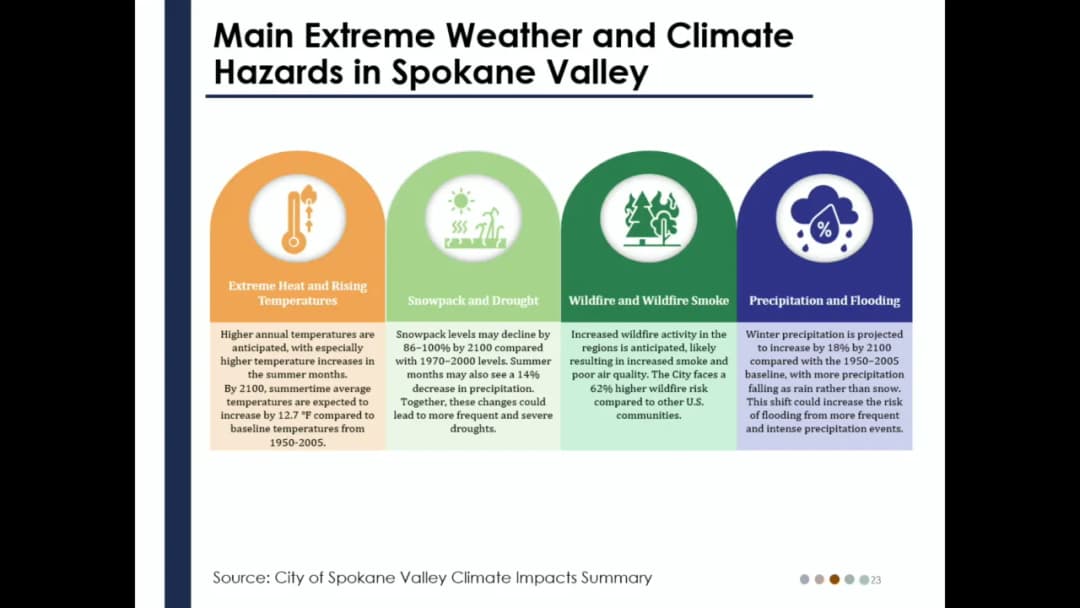
The Spokane Valley City Council held a special meeting on April 14, 2026, at 5:00 PM to review the Comprehensive Plan Update, including the housing, utilities, and climate elements. The meeting featured presentations from city staff and three consulting firms. Councilmembers discussed compliance with state mandates, land use scenarios, and community values. No formal public comments were taken, and the meeting concluded with a consensus on moving forward with Scenario A for the land use map. Discussion Items - Housing Element (Elliot, consultant): Presenter emphasized managing growth through intentional land use, focusing on the Sprague corridor, corridor mixed-use zoning, and infrastructure. Key state requirements include House Bill 1220 (disaggregated housing unit allocation by income), House Bill 1110 (middle housing in single-family zones), and House Bill 1337 (accessory dwelling units). A racially disparate impacts analysis (RDIA) found that 15% of residents identify as BIPOC, with higher housing cost burdens and lower homeownership rates among these groups. Councilmember Merkel questioned the statement that “current policies” contribute to disparate impacts, noting no specific policies were identified. Staff agreed to review and clarify language. Adequate provisions to address barriers to affordable housing were discussed, including multifamily tax exemption, incentive zoning, and permit streamlining. Councilmember Kelly raised concerns about a statement on page 20 of the RDIA referencing “past and current policies” and a discrepancy in BIPOC percentages (15% vs. 23% in different parts of the document). Staff will follow up on consistency. - Utilities Element (Bill Grimes, SCJ Alliance): Focused on private utilities (energy, natural gas, telecommunications) and coordination with providers. Councilmember Merkel raised concerns about predatory solar marketing and battery storage (BESS). Councilmember Wick suggested right-sizing utility corridors to free developable land. Councilmember Haley noted the importance of hydropower and natural gas. Staff acknowledged these points and will consider edits. - Climate and Resiliency Element (Nicole Gutierrez, Cascadia Consulting): Required by House Bill 1181, includes greenhouse gas (GHG) reduction and resilience sub-elements. Priority hazards identified: extreme heat (average summer temperatures projected to rise 13°F by 2100), snowpack decline (86-100%), wildfire risk (62% higher than U.S. average), and increased precipitation (18% by 2100). GHG inventory shows 63% from transportation, 24% from buildings. Councilmember Merkel criticized the exercise as unrealistic, noting that state targets (95% below 1990 levels by 2050) are unattainable. Councilmember Wick asked for goals to support industrial and business sectors. Councilmember Yeager questioned the definition of “community health” in land use patterns. Councilmember Kelly requested removal of goal CE-G8 (expand EV infrastructure) to avoid financial obligation. Mayor and staff noted that the city must have a compliant climate element but can tailor policies. Staff will work with consultants to refine language. - Land Use Map Scenarios: Staff presented two scenarios (A and B) for accommodating housing unit allocations. Scenario A involves rezoning to lower densities (32 du/ac in multifamily zones) and Scenario B maintains current densities (40 du/ac) without rezone. Councilmember Merkel expressed concern about preserving Auto Row, but staff noted state law prohibits restricting multifamily in commercial zones. After discussion, the council reached consensus (4 votes in favor) on Scenario A, with the understanding that development regulations will be crafted to encourage homeownership and creative housing types (e.g., cottages, townhomes). Future meetings with developer Jim Frank of Greenstone were announced to explore alternatives. Key Outcomes - Consensus on Scenario A for the land use map (4 votes in favor, with Councilmembers Merkel, Wick, Haley, and Yeager supporting; Councilmember Kelly and Deputy Mayor Hattenberg (excused) did not vote). - Directives: Staff will review and revise language in the RDIA to clarify that no current policies create racially disparate impacts, and will ensure consistency in BIPOC percentages. - Future Meetings: A presentation by Jim Frank on vertical mixed-use and affordable housing options will be scheduled. The next comprehensive plan workshop is expected in approximately six weeks (early June 2026) to review remaining elements. - Compliance Path: The city will submit draft elements to the Washington Department of Commerce by June 12, 2026, to meet grant obligations. The full plan must be adopted by the end of 2026. - Informal Comments: Councilmembers emphasized the importance of homeownership, economic development, and practical, community-specific language in the plan. Staff will continue to work with consultants to refine goals and policies.

ENVIRONMENTAL PROTECTION 33% · AFFORDABLE HOUSING 27% · LAND USE PLANNING 7% · ECONOMIC DEVELOPMENT 6%
66
APR 7, 2026 · SPOKANE VALLEY, WASHINGTON · CITY COUNCIL & COMMISSIONS
Spokane Valley City Council Regular Meeting – April 7, 2026

The Spokane Valley City Council met in regular session on Tuesday, April 7, 2026, at 6:00 p.m. at City Hall. The meeting included a proclamation for National Public Health Week, action on virtual currency kiosks, a sports court bid award, a grant opportunity for the Barker I-90 interchange, and reports on a Treatment First MOU and a CenterPlace catering contract. All votes were unanimous except where noted. Proclamations - Public Health Week (April 6–12, 2026): Mayor Laura Patton proclaimed the week as National Public Health Week. Dr. Velasquez of the Spokane Regional Health District accepted and highlighted collaborative public health achievements, including a decline in childhood mortality from 13.8 deaths per 1,000 live births in 1994 to 5.4 in 2024, and a drop in adult smoking rates from 25.5% to 11.4%. Action Items 1. First Read: Ordinance 26-005 – Virtual Currency Kiosks - Presentation: Assistant Chief Jared Keene, Sgt. Patrick Bloomer, and Deputy City Attorney Caitlin Prunty presented. Sgt. Bloomer noted a 99% increase in crypto-related complaints in 2023 and a 31% increase in losses nationally, with the over-60 age group most victimized (average loss $62,000). Local impacts include a $1.8 million cold wallet that cannot be recovered. - Discussion: Councilmember Merkel clarified the ordinance exempts standard business payment systems. Councilmember Kelly expressed general support despite libertarian leanings due to the severity of fraud. Councilmember Wick supported the definitions. - Vote: Motion to advance ordinance to second reading passed unanimously (6-0, with Councilmember Yeager excused). 2. Motion: Balfour Park Sports Courts Bid Award - Presentation: Parks Director John Bottelli and Senior Engineer Glenn Ritter reported that five bids were received. The lowest responsive bidder, Liberty Landworks, offered $473,254.81 (base bid plus alternates one and two), which is 14% under the engineer's estimate of $551,000. Separately, the city will procure sports lighting ($157,000), sound system ($25,000), and site furnishings ($12,000). Construction is targeted for May with completion in July/August 2026. - Vote: Motion to award to Liberty Landworks and authorize the city manager to execute the contract passed unanimously. 2A. Motion: Potential Grant Opportunity – National Highway Freight Program (NHFP) for Barker I-90 Interchange - Presentation: City Services Administrator Gloria Mance explained that the city applied for $2 million for the design phase of the Barker I-90 project. WSDOT asked for confirmation of full funding of the $4 million design phase. The city has allocated $400,000 from fund 312; the gap is $1.6 million. Staff requested authorization to commit up to $1.6 million from future REIT funds (2026–2027) if needed, noting that this would make the project more competitive for other grants. - Discussion: Councilmember Kelly sought clarification on timing and funding sources. Councilmember Merkel questioned the availability of REIT funds. City Manager Mike Jackson and Finance Director Chelsea Bullock confirmed REIT projections show sufficient capacity. After a point of order and an appeal that lacked a second, Mayor Patton called for a vote. - Vote: Motion passed unanimously (6-0). Non-Action Items 3. Admin Report: MOU Treatment First - Presentation: Chud Wendle (Chamber of Commerce, Safe & Healthy Task Force) presented a regional Memorandum of Understanding (MOU) in response to the Trump administration's executive order on homelessness. The MOU signals support for shifting federal HUD funds from a 90% housing-first model to a more balanced approach (30% housing, 30% mental health, 30% addiction treatment). As of the meeting, five municipalities (Deer Park, Liberty Lake, Medical Lake, Millwood, and Spangle) have signed; Spokane County is hung up on wording; City of Spokane has not yet signed. - Discussion: Deputy Mayor Hattenberg clarified the MOU does not eliminate housing support. Councilmember Merkel asked for more concrete steps; Chud noted the Safe & Healthy Task Force will deliver recommendations in mid-May. City Manager Jackson emphasized the MOU is aspirational and does not approve HUD's change (which is in court). Council gave consensus to move the MOU forward. 4. Admin Report: CenterPlace Catering Contract - Presentation: John Bottelli presented a new catering agreement with Inland Northwest Catering, selected through an RFP process that included a tasting and interview. The contract features a tiered commission structure: 21% on food and alcohol sales up to $750,000, escalating to 23.5% above $950,000. The city collects all payments and passes the caterer's share. The contract term is one year with four optional one-year renewals. City can terminate with 30 days' notice. - Discussion: Councilmember Merkel praised the process. Councilmember Kelly questioned revenue recognition timing (clarified as event-based). Councilmember Wick asked about a $4,500 kitchen equipment reserve fund (adjusted annually by CPI). A question about LeCatering (previous contractor) was deferred to the city attorney. Consensus was given to return on April 21 with a formal motion. Council Comments - Councilmember Merkel: Raised concerns about housing allocation numbers from the County and noted future plans to invite a presentation on the theater. - Councilmember Wick: Announced appointment to the Association of Cities legislative priorities committee (first meeting May 1). - Councilmember Kelly: Reported attending the Council of Governments meeting and praised Spokane Valley's hosting. - Deputy Mayor Hattenberg: Confirmed the S.CO committee is working on the growth management numbers, which must be finalized by year-end. - Mayor Patton: Shared reflections from a trip to a 800-year-old German village, noting parallels to Spokane Valley's community identity and fiscal responsibility. City Manager Comments - City Manager Mike Jackson addressed a letter from Winston Cashay (representing Greenstone developer Jim Frank) regarding housing allocation numbers. Community & Economic Development Director Mike Basinger explained that the county adopted a resolution with an incorrect attachment; corrected modeling shows Spokane Valley's allocation at over 16,000 units, not 15,713. The city's housing element accounts for 4,000 units built since 2020, leaving 12,000 future units needed. Current zoning can accommodate 6,000 units, requiring changes to meet the full allocation. The matter will be discussed at the steering committee of elected officials on April 29. Staff has reached out to Mr. Frank. Key Outcomes - Ordinance 26-005 (Virtual Currency Kiosks): Advanced to second reading (unanimous). - Balfour Park Sports Courts: Contract awarded to Liberty Landworks for $473,254.81 plus tax (unanimous). - Barker I-90 Grant: Council authorized up to $1.6 million commitment from REIT funds if needed (unanimous). - Treatment First MOU: Consensus to move forward. - CenterPlace Catering: Consensus to return with a motion on April 21. - Next Meeting: Special meeting on April 14 at 5:00 p.m. to discuss the comprehensive plan.

PARKS AND RECREATION 18% · PUBLIC SAFETY 12% · ENGINEERING AND INFRASTRUCTURE 12% · PROCEDURAL 9%
67
APR 2, 2026 · SPOKANE VALLEY, WASHINGTON · CITY COUNCIL & COMMISSIONS
Spokane Valley Planning Commission Special Meeting – April 2, 2026

The Spokane Valley Planning Commission held a special meeting on April 2, 2026, at 6:00 p.m. in Council Chambers to conduct a study session on three draft Comprehensive Plan elements: Housing (Chapter 5), Utilities (Chapter 8), and Climate (Chapter 11), including a Racially Disparate Impacts Analysis. The meeting included public comments, commission reports, and a detailed review of proposed changes to the draft elements. Consent Calendar - The agenda was approved by a 4-0 vote. - The minutes from the March 26, 2026, meeting were approved by a 4-0 vote. - An excused absence was granted for Vice Chairman McKinley, who was unable to attend. Public Comments & Testimony - Jim Frank (former Greenstone Corporation employee, now focused on affordable housing) presented a detailed analysis of housing costs and subsidy requirements. He emphasized that for lower-income bands (below 50% of median income), only subsidized housing is feasible. He argued that the PTAC allocation method increased the city's obligation for very low-income housing from 55% to 70% of the total housing units, while shifting units to rural Spokane County (from 3,000 to 6,000 units), contrary to Growth Management Act principles. He urged the commission to use the Board of County Commissioners' allocation instead of the PTAC recommendation. - Elizabeth Tellison (working with Mr. Frank) supported his comments and encouraged the commission to ensure their housing allocation numbers align with countywide policy. She noted that the city's current total of 12,866 units does not clearly match either the Board of County Commissioners' adoption or the PTAC recommendation. Discussion Items - Utility Element (Chapter 8): Staff presented updated strikeout/underline versions reflecting changes requested at the previous meeting. Commissioners praised the new sections on battery storage and Vera Water and Power, but noted that the cell tower map was incomplete (staff confirmed it is being updated). Commissioner Dingus requested time to review the updates before finalization. - Housing Element (Chapter 5): - Exhibit 3 (Income Distribution): Staff confirmed the numbers are inflation-adjusted. Commissioners expressed confusion about the data showing a large increase in affluent households and a decrease in low-income households over 10 years, which seemed inconsistent with the housing need projections. Staff agreed to double-check the numbers and add a footnote clarifying inflation adjustment. - Age-Income Correlation: Commissioners requested a graph correlating age with income to better understand which demographic groups drive housing demand, especially for lower-income brackets. Staff will ask consultants to provide this data. - Adequate Provisions (Policies HP6 and HP8): Staff described six proposed tools (multifamily tax exemption, incentive zoning, opportunity zones, affordable housing tax credit, land dedication, partnerships with housing providers). Commissioner Weatherman raised concerns about the impact of tax exemptions on existing homeowners, fearing that increased property values could lead to higher taxes for residents on fixed incomes. Staff clarified that the Multifamily Tax Exemption applies only to improvements, not land value, and that the city can structure the program to mitigate shifts in tax burden. - Racially Disparate Impacts Analysis: Staff reported that data on cost burden by age is only available for homeowners, not renters, making a direct comparison impossible. Therefore, they recommended not adding age as a factor. - Climate Element (Chapter 11): - Pre-2022 Emissions Data: Staff explained that obtaining greenhouse gas (GHG) inventory data prior to 2022 would require a significant new analysis with uncertain comparability. Commissioners requested a broader context (state/national comparisons) to understand Spokane Valley's relative contribution. Staff will consult with the consultant for available data. - Vulnerability Assessment: Staff noted the vulnerability impact assessment is being updated and will be sent to commissioners by April 6, 2026. Key Outcomes - Staff will add a note to Exhibit 3 (Housing Element) confirming numbers are inflation-adjusted. - Staff will explore creating a graph showing age versus income to help correlate housing demand. - Staff will send updated chapters (Utility, Housing, Climate) in strikeout/underline format to all commissioners. - The commission will not meet on April 9 or April 23, but will hold a special meeting on April 30, 2026, to continue the study session. - The next regular meeting (May 14, 2026) will focus on Parks, Capital Facilities, and Transportation elements. - The meeting adjourned at approximately 7:30 p.m.

AFFORDABLE HOUSING 32% · PROCEDURAL 30% · LAND USE PLANNING 10% · CLIMATE CHANGE MITIGATION 9%
68
MAR 31, 2026 · SPOKANE VALLEY, WASHINGTON · CITY COUNCIL & COMMISSIONS
Spokane Valley City Council Regular Meeting - March 31, 2026

The Spokane Valley City Council held its regular meeting on Tuesday, March 31, 2026, at 6:00 p.m. at City Hall. The meeting included routine approvals, action items, administrative reports, and public comment. Key topics included grant applications for pedestrian and bicycle infrastructure, an opioid settlement interlocal agreement, updates from the Safe and Healthy Spokane Regional Task Force, an economic trends presentation, discussion of HCDAC grant applications for homeless services, and a drug overdose report from the police department. Consent Calendar - Claim Vouchers (March 31, 2026): $4,956,997.75 approved. - Payroll for Pay Period ending February 15, 2026: $694,516.03 approved. - Payroll for Pay Period ending February 28, 2026: $766,178.68 approved. - Payroll for Pay Period ending March 15, 2026: $716,532.07 approved. - Council Meeting Minutes: Approved for February 3, 10, 17, 17 (duplicate), and 19, 2026. Public Comments & Testimony - First Public Comment Period: One speaker addressed the council. The speaker expressed support for the city's transparent process regarding a previously discussed performing arts proposal, noting that a $28 million taxpayer risk was too high but that the project could return with stronger private backing. The speaker also advocated for a disc golf course in Spokane Valley, citing the existing cross-country course and the low-cost opportunity to attract visitors. No speakers used Zoom. - Second Public Comment Period: No speakers signed up or appeared. Discussion Items - Potential Grant Opportunity: Pedestrian/Bicycle Program and Safe Routes to Schools (Action Item 2): Adam Jackson presented four proposed applications for the state Pedestrian and Bicycle Program ($50 million available) and Safe Routes to Schools ($5.7 million available). Projects include the Barker Appleway Roundabout, Appleway Crossings, arterial crossing improvements, and a planning grant for Sprague Avenue. The Safe Routes to Schools project was expanded to include speed feedback signs ($175,000-$200,000 addition). No match required. Council authorized the application. - Opioid Interlocal Agreement with Spokane County (Action Item 3): Tony Beattie presented an interlocal agreement to use opioid settlement funds. The city expects approximately $360,000 total through 2038. Funds will be allocated to: (1) the Spokane Regional Health District for an expanded opioid dashboard and needs assessment (approx. $57,000), and (2) Spokane County's Spokane Regional Stabilization Center (SRSC) expansion—$51,000 for capital and remaining funds for operations annually through 2038. Council approved the agreement. - Administrative Report: Safe & Healthy Spokane Task Force Update: Erik Lamb (Deputy City Manager), Lance Beck (GSI), and Zeke Smith (Waters Meet) provided an update. The task force, convened after the failed Measure 1 in 2023, includes 43 members and has held seven of eight planned meetings. The Leifman Group conducted an asset assessment with over 100 participants. Key findings: significant community assets exist but need better coordination; need for a stronger crisis response system; housing shortages; workforce capacity issues; and improved data sharing. Advisory committees have prioritized 11–15 recommendations based on impact, opportunity, and funding needs. The final report is due in early May 2026. The task force is not directly recommending a specific sales tax measure but is informing potential future county proposals. Councilmember Haley praised the diversity and effort. - Administrative Report: Economic Trends Report: Teri Stripes, Dr. Cullen, and Dr. Jones from EWU's Institute for Public Policy and Economic Analysis presented highlights from a 41-slide dashboard. Key data: Civilian labor force rebounded in 2025 but remains slightly below 2023. Unemployment in Spokane Valley ended 2025 at 5.1%, matching the county and U.S. average. Single-family home permits averaged 42 per quarter; median permitted value plateaued at $408,000. Multifamily permits saw a second-quarter surge but a third-quarter zero. Housing affordability for median homebuyers tilted upward; median renter affordability index at 143.1, but 30% of low-income renters spend over 50% of income on shelter (extreme burden). Retail sales per capita in Spokane Valley reached $33,000 in 2024, the highest among Spokane, Spokane County, and Valley. The city is a shopping Mecca, importing sales tax revenue. The forecast predicts 4.7% income growth in 2026 and 5.6% in 2027. Councilmember Kelly asked about cost parity with Seattle (same for goods, lower for services) and clarified that the renter affordability index reflects median renters while the 30% burden applies to lower-income renters. - Administrative Report: HCDAC Grant Application Discussion, Round Two: Gloria Mantz and Eric Robison presented the Spokane County Housing and Community Development Advisory Committee (HCDAC) grant applications. Total available funding is limited; requested amounts far exceed available funds (e.g., $1 million available for emergency shelter vs. $2.2 million requested). Applications include shelters for families, youth, domestic violence survivors, and sobriety-based programs. Councilmembers (Wick, Hattenberg, Kelly) serve on the committee. They discussed prioritization, noting the need to support unique services (e.g., only sobriety-based shelter, only youth shelters). One-third obligation for the Way Out shelter was noted. Council provided input on which projects to recommend. - Administrative Report: Drug Overdose Report: Chief Ellis and analyst Mark Boytlander presented data on overdose deaths in Spokane County. In 2025, monthly deaths dropped from 42 in January to 4 in December—the lowest recorded. The four-year average remains 263 deaths per year; 2025 saw 271 deaths. Polydrug deaths (fentanyl + methamphetamine) are increasing. Fentanyl purity declined from over 11% to under 9% in late 2025, coinciding with increased naloxone availability and reduced deaths. The southern border closure decreased fentanyl supply, increasing prices 20–30%. Emerging threats include carfentanyl (first confirmed buy in Eastern Washington) and non-scheduled substances like Kratom. Spokane Valley is a major transshipment hub for drugs, but specific Valley death numbers were not provided. Councilmembers asked about demographics (average age 44, youngest 15) and supply-side enforcement. Key Outcomes - Consent Agenda approved unanimously. - Motion to apply for Pedestrian/Bicycle and Safe Routes to Schools grants passed unanimously. - Motion to approve the Opioid Interlocal Agreement with Spokane County passed unanimously. - The Safe & Healthy Task Force will deliver its final report in early May 2026. - Council provided input on HCDAC grant applications; the HCDAC will make recommendations on April 9, 2026, with County Board decision in mid-May. - No formal actions taken on the Drug Overdose Report; information was received with appreciation. - Council comments included recognition of retiring staff, community events, and a request to discuss the upcoming STA ballot measure. - The meeting adjourned at approximately 8:30 p.m. after a short break.

PUBLIC SAFETY 26% · HOMELESSNESS 15% · ECONOMIC DEVELOPMENT 13% · OPIOID CRISIS 12%
69
MAR 26, 2026 · SPOKANE VALLEY, WASHINGTON · CITY COUNCIL & COMMISSIONS
Spokane Valley Planning Commission Meeting - March 26, 2026

The Spokane Valley Planning Commission met on Thursday, March 26, 2026, at 6:00 p.m. in City Hall. Commissioners unanimously approved the agenda and the minutes from the February 26, 2026 meeting. The primary business was a presentation from consultants on three draft elements of the Comprehensive Plan: Housing (including the Racially Disparate Impacts Analysis), Utilities, and Climate & Resiliency. The commission discussed policy language, data accuracy, and alignment with state mandates. Public comment addressed cannabis equity licensing. Commission Reports & Administrative Update - Commissioner Winkler reported that the city approved funding for a parking study (requested earlier) and thanked staff. He noted public support via Facebook. - Mr. Raver (staff) provided an administrative update: City Council expressed appreciation for the Comprehensive Plan approach, did not request modifications to policies, and identified Scenario A (which includes a rezone between Valleyway and Sprague) as their preferred land use alternative. Council also supported the parking study by consensus, with a likely budget amendment. - The schedule was revised: next meeting on April 2 (roundtable), then cancel April 9 and April 23, hold a special meeting on April 30, and resume regular meetings on May 14. Commissioner Winkler noted he cannot attend the April 30 meeting. Public Comments & Testimony - Victoria Raminson spoke in support of allowing one additional social equity cannabis retailer in the city, citing state programs to increase minority-owned businesses and tax revenue. She suggested locating it in a light industrial zone and noted the city currently has only three cannabis stores while alcohol is widely available. - A written comment from Justice Bryant was received and will be included in the minutes. Discussion Items 1. Housing Element & Racially Disparate Impacts Analysis - Elliot Weiss (Community Attributes) presented key themes: accommodating housing growth per state allocation, aligning with HB 1220 (affordability segments), HB 1110 (middle housing), and HB 1337 (accessory dwelling units). The Racially Disparate Impacts Analysis found that 15% of residents identify as BIPOC, with higher housing cost burdens and lower homeownership rates among BIPOC populations, and increased displacement risk in higher-concentration neighborhoods. - Commission Discussion: - Commissioner Winkler noted that policy H8 (page 28) is too vague ("work with service providers to bring additional resources to valley residents") and needs more specificity. Chairman confirmed consensus to revise. - Commissioner Dingus raised concerns that policy HP6 (preserve and enhance established single-family neighborhoods by minimizing impacts of denser housing) conflicts with state requirements for middle housing. Elliot explained it was carried forward from the 2016 plan and agreed to reevaluate. Commissioner Weatherman defended the policy, noting many residents value neighborhood character. After discussion, consensus emerged to refine the language to clarify intent. - Commissioner Dingus also noted that Exhibit 3 (income distribution) appears to compare 2015 and 2024 dollars without inflation adjustment, making it misleading. Consultants agreed to verify and adjust if needed. - Commissioner Dingus suggested adding age demographics to the disparate impacts analysis to capture fixed-income residents. Consultants agreed if the commission desires; they noted it is not state-required but data is available. - Commissioner Dingus and others noted the Sprague corridor is not pedestrian-friendly and that the plan should address walkability. Staff acknowledged this is a cross-cutting issue that could be taken up in the Capital Facilities element. - Chairman asked for consensus on modifications: (1) revise H8 for specificity, (2) reevaluate HP6 language, (3) adjust Exhibit 3, (4) consider adding age demographics. Commissioners voiced general agreement. 2. Utilities Element - Jen Dial (SCJ Alliance) presented an inventory update for electricity, natural gas, telecommunications, and broadband. Water, sewer, and stormwater are covered in a separate Capital Facilities element. Maps of cell towers and utility providers were included. New goals emphasize coordination with utility purveyors and utility corridor planning. - Commission Discussion: - Commissioner Dingus noted that language about "neighborhood character" in the utilities chapter (pages 10-11) could be more specific to avoid pitting neighborhoods against each other; suggested referencing existing code for siting utility infrastructure. Jen agreed to revise. - Commissioner Weatherman pointed out that the scope description on page 2 includes water, sewer, and stormwater, but that information is not in this chapter. Jen agreed to remove that reference and add a hyperlink to the Capital Facilities element. - Commissioner Winkler noted that Figure 2 (cell tower map) shows no towers in Spokane Valley, which appears incorrect. She also flagged a paragraph about Vera Water and Power’s solar project that implies only 65 customers signed up; she stated the program is fully utilized with thousands of customers but limited capacity. Jen agreed to correct both items. - Commissioner asked about grid-scale power storage as an emerging trend; Jen agreed to add it. - No concerns about capacity to meet future demand. 3. Climate & Resiliency Element - Nicole Gutierrez and Megan Horst (Cascadia Consulting) presented the two sub-elements: greenhouse gas (GHG) emissions reduction and resilience. Key climate hazards for Spokane Valley by 2100 include a 13°F increase in average summer temperature, 86-100% decline in snowpack, 14% decrease in summer precipitation, increased wildfire risk (62% higher than U.S. average), and 18% increase in winter precipitation with more rain than snow. Emissions targets: 30% reduction by 2030, 70% by 2040, net zero by 2050 (from a 2022 baseline of 766,700 metric tons). Largest emissions sources: on-road vehicles (63%), natural gas buildings (24%). The vulnerability assessment highlighted low tree canopy in areas with vulnerable populations and older housing stock lacking energy efficiency. - Commission Discussion: - Commissioner Dingus observed potential conflicts: the plan promotes diversity and income equity, but climate policies (e.g., requiring electric vehicles) may be economically infeasible for low-income residents. Staff noted they are cross-referencing elements. - Commissioner asked for clarification on policy CE-P27 (incentive-based commute trip reduction). Nicole explained it would expand current city employee programs to support local businesses in promoting carpooling, telework, etc. - Commissioner Winkler requested access to the greenhouse gas inventory report and climate vulnerability assessment. Consultants said they will provide updated copies to staff for distribution. - Commissioner Winkler expressed concern about tree canopy loss in older neighborhoods (south of I-90) and encouraged incentives for tree replacement. She noted the tree canopy map (Figure 3) shows areas where vulnerable populations coincide with low canopy. - Commissioner Winkler also asked about historical emissions data; consultants stated no prior inventory exists for Spokane Valley. - Commissioner asked how to reduce waste-related emissions; Nicole cited diversion and recycling policies in the element. Key Outcomes - Consensus decisions on Housing Element modifications: - Revise policy H8 for greater specificity. - Reevaluate policy HP6 (preserve neighborhood character) to align with state middle housing mandates. - Adjust Exhibit 3 income distribution data for inflation. - Consider adding age demographics to the disparate impacts analysis (to be confirmed at next meeting). - Utilities Element revisions requested: - Refine neighborhood character language. - Remove scope reference to water/sewer/stormwater (redirect to Capital Facilities). - Correct cell tower map and Vera solar project description. - Add grid-scale power storage as an emerging trend. - Climate Element: No formal votes; commissioners requested access to technical reports and noted need to ensure equity across elements. Staff and consultants will incorporate feedback and return with updated drafts at the next meeting (April 2, 2026). - Next steps: The commission will hold a roundtable discussion on the same elements on April 2, followed by cancellations on April 9 and 23, a special meeting on April 30, and resumption on May 14. Ongoing public input is encouraged via the city website.

AFFORDABLE HOUSING 21% · ENVIRONMENTAL PROTECTION 20% · UTILITIES AND INFRASTRUCTURE 14% · PROCEDURAL 10%
70
MAR 17, 2026 · SPOKANE VALLEY, WASHINGTON · CITY COUNCIL & COMMISSIONS
Spokane Valley City Council Regular Meeting - March 17, 2026

The Spokane Valley City Council held its regular meeting on Tuesday, March 17, 2026, starting at 6:00 p.m. and adjourning after 9:30 p.m. The meeting included recognition of community volunteers, presentations on police contract costs, public hearings on interim ordinances for battery energy storage systems and marijuana retail sales, updates on the North Spokane Corridor and homelessness data, and a discussion on a proposed performing arts center bond. Special Guests & Presentations - Mike and Vicki Frucci received the "You Rock" (UROC) award for decades of service through WSDOT, Kiwanis, and community volunteerism. Speakers highlighted their 51 combined years of Kiwanis service, distribution of over 250,000 children's books, and leadership in youth programs. - Spokane County Sheriff John Nowels and Commissioner Mary Brooks presented on Spokane Valley Police Department budget trends. The Sheriff detailed cost drivers: training mandates (e.g., 40-hour LETCSA training, model use-of-force policy), technology upgrades (Axon body cameras, digital evidence management, laptops), wage increases from binding arbitration (deputy COLA of 10% in 2025), and staffing expansion (over 40 new commissioned positions since 2019). Training overtime increased 111.9% from 2019-2025. The Axon contract cost is $1.23 million in 2026, rising to $1.45 million from 2027-2031. The Sheriff expressed support for continued partnership but noted challenges in controlling costs. Commissioner Brooks affirmed the county's commitment to the contract and openness to improving communication. Public Comments & Testimony - Performing Arts Center Support: Several speakers (Andrea Olson, David Baker, Yvonne Johnson, Ray Alvarado, a resident) spoke in favor of a municipal bond for the Spokane Valley Summer Theater performing arts center. They emphasized that the bond would be repaid through operations, grants, and naming rights, and that the community has already raised $18.3 million. They argued the project would boost economic activity and provide year-round arts programming. - Marijuana Retail (Treehouse Club): Steven Burks (owner), Tyler (manager), and another employee spoke against Interim Ordinance 26-004, which prohibits relocation of existing marijuana retailers. They argued the ordinance freezes businesses, ignores that correlation does not equal causation in studies, and noted Treehouse Club has paid approximately $1.9 million in taxes to the city and is the only medically certified cannabis store in Spokane Valley. - Battery Energy Storage: Rick Freyer (former fire investigator) expressed support for a pause but not a permanent ban on battery energy storage systems, citing fire risks from thermal runaway. - Other: Tyler Zeif (real estate agent) requested assistance with a sidewalk regulatory hurdle for a proposed coffee shop/restaurant at a Rancho Viejo property. Brad Hone submitted a document requesting transparency on the ice rink project. Discussion Items - Public Hearing: Emergency Interim Ordinance 26-002 (Battery Energy Storage Systems): City Attorney Kelly Konkright presented the interim ban on new battery energy storage systems to allow study of safety risks (thermal runaway, toxic fumes). The ordinance was adopted February 3, 2026, and this hearing was required by RCW. Councilmember Merkel questioned the emergency nature and urged a sunset clause. The public hearing was opened and closed with one comment. - Resolution 26-003: Reaffirming Findings for Ordinance 26-002: The resolution memorialized the hearing and reaffirmed findings. Councilmember Merkel expressed concerns about broad findings but was assured it does not tie the planning commission's hands. The resolution passed 6-1. - Public Hearing: Emergency Interim Ordinance 26-004 (Marijuana Retail Sales): Senior Deputy City Attorney Tony Beattie explained the interim ordinance prohibits existing marijuana retailers from relocating, classifying them as legal non-conforming uses. The hearing included testimony from Treehouse Club representatives opposing the freeze. Councilmember Yeager argued the timeline (March 2025 contact to January 2026 council action) did not constitute an emergency, and noted a desire to amend buffer distances in future code. - Resolution 26-004: Reaffirming Findings for Ordinance 26-004: Similar process as above. Councilmember Merkel proposed an amendment to remove certain whereas clauses but withdrew after legal advice. The resolution passed 5-2, with Yeager and Merkel opposed. - North Spokane Corridor Update: Public Works Director Robert Blegen and WSDOT Project Engineer Alex Proszek presented the final projects completing the corridor. The I-90 Freya to Appleway project (entering Spokane Valley) includes a new Havana Bridge raising I-90 5.5 feet, a pedestrian bridge at Carnahan with a green roof, and community-selected art. The project is at 60% design with an advertisement date in spring 2027. Council questions touched on cost growth (from $50 million to over $1 billion since 1950) and maintenance concerns for the roofed bridge. - Homeless Management Information System (HMIS) Report: Gloria Mantz, Ariel Anderson, and Amanda Martinez presented the Longitudinal Systems Analysis for 2025. Key indicators: individuals served decreased 11%, exits to permanent housing increased 31% (to 29%), emergency shelter exits to permanent housing increased 85% (from 7% to 13%), and retention rate in permanent housing was 96%. Average time to return to homelessness was 130 days. The report covers 6,430 people in 5,000 households. - Council Discussion on Performing Arts Center Bond Request: City Manager Holman reported that the performing arts center seeks $28 million in city-issued bonds. He recommended spending $96,000 for independent financial and bond counsel review. Council members expressed concerns about precedent, risk to taxpayers, cost overruns, and the city's ownership requirement. After debate, consensus was reached (6-1) not to spend the $96,000 and to not move forward with the bond request. Key Outcomes - Resolution 26-003 (Battery Storage): Approved 6-1 (Merkel opposed). - Resolution 26-004 (Marijuana Retail): Approved 5-2 (Yeager, Merkel opposed). - Performing Arts Center Bond Feasibility Study: Council consensus (6-1) not to fund the $96,000 consultant review, effectively ending city consideration of the bond request. - Letter of Support for Centennial Trail Gap: Council unanimously agreed to provide a letter supporting Spokane County's $2 million CDS grant application to fill a gap from Boulder Beach to Donkey Island trailheads. - Letter to Governor for TMC Funding: Council unanimously agreed to send a letter urging the governor to sign the budget including full funding for the Spokane Regional Transportation Management Center. - Executive Session: Council moved into executive session for 20 minutes to discuss pending litigation, with no action expected upon return.

PUBLIC SAFETY 15% · CANNABIS REGULATION 12% · PROCEDURAL 8% · TRANSPORTATION SAFETY 7%
OPENPUBLICA · PUBLIC MEETING INDEXUPDATED DAILY · openpublica.com