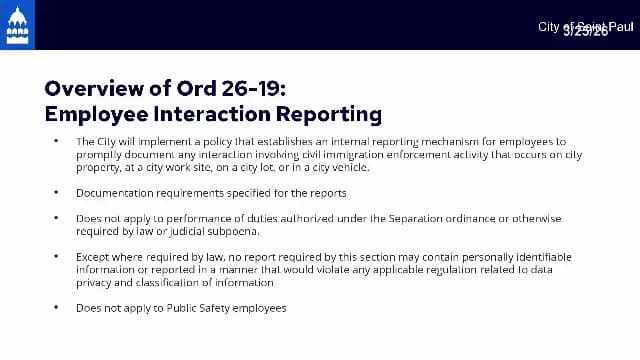
The St. Paul City Council met on March 25, 2026, at 3:30 PM in Council Chambers. The meeting included the adoption of a consent agenda, appointment of a new city clerk, recognitions, several ordinance readings and adoptions, public hearings, and legislative hearing consent agenda items. Key actions included extending the pre-eviction notice period from 30 to 60 days, introducing a new ordinance on immigration enforcement training and reporting, and adopting a resolution to impose penalties on a tobacco license holder. Consent Agenda - Items 5 through 13 were approved unanimously (7-0) with no separate discussion. These included approving clean-up and snow removal assessments, authorizing police grant applications for auto theft prevention and crisis response, approving a liquor license transfer, settling a lawsuit, accepting travel expenses for the city engineer, accepting a grant for the Pathways to Policing program, and adjusting the pay rate for the Assessment Supervisor classification. Public Comments & Testimony - No public testimony was offered on any of the public hearing items (21-24) or the legislative hearing consent agenda items (25-31). The council was not aware of anyone present to testify on those items. Discussion Items - Appointment of City Clerk: The council suspended rules to consider Resolution 26-522, appointing Nicole Tillander as City Clerk. Council President Noecker noted this brings the city council department to full staffing capacity. The resolution was adopted unanimously (7-0). - Recognition of Xia Xoua Vang: Vice President Yang introduced Resolution 26-502 recognizing Xia Xoua Vang, a Hmong veteran who served with the CIA during the Secret War in Laos and later resettled in St. Paul. The resolution was adopted unanimously (7-0). - Recognition of Jack Byers: Vice President Yang introduced Resolution 26-503 recognizing District 5 Payne-Phalen Community Council Executive Director Jack Byers for his service and declaring Sunday, March 29, 2026, as Jack Byers Day in St. Paul. Councilmembers Johnson, Kim, Jost, and Noecker offered remarks thanking Byers for his community work. The resolution was adopted unanimously (7-0). - Tobacco License Penalty: Resolution 26-412 concerned findings from an administrative law judge regarding White Bear Tobacco Market Place Inc. d/b/a White Bear Tobacco (1662 White Bear Avenue North). Assistant City Attorney Monica Schaefer presented the case, noting the store sold tobacco to an underage buyer for the second time in two years. The city attorney recommended a $1,000 matrix penalty and imposition of hearing fees. The licensee did not appear to testify. The council adopted the resolution unanimously (7-0). - Fire Chief Minimum Qualifications (Ord 26-17): The ordinance was before the council for final adoption. Councilmember Coleman moved an amended version (version 2) that allows work experience to substitute for a bachelor's degree requirement on a year-for-year basis, and adds preferences for experience in high-volume EMS systems, unionized environments, and labor relations. The amendment was adopted unanimously (7-0), and the public hearing was reopened and continued to April 1, 2026, for final adoption. - Pre-Eviction Notice Extension (Ord 26-18): Councilmember Kim moved an amendment (version 3) to exempt public housing agency (PHA) owned and managed properties from the 60-day pre-eviction notice requirement. Councilmember Johnson, Bowie, Kim, and Yang spoke against the exemption, citing concerns about protecting tenants and the risk of evictions for small amounts. Jost and Noecker voted in favor. The amendment failed (2-5). The original ordinance extending the pre-eviction notice from 30 to 60 days was then adopted unanimously (7-0). - Immigration Enforcement Training and Reporting (Ord 26-19): Chief Policy Officer Tim Greenfield presented the first reading of an ordinance adding Chapter 44A to the Administrative Code. The ordinance requires training for general service and public safety employees on the city's separation ordinance, establishes reporting mechanisms for employee interactions with ICE, a public reporting system for alleged violations, and quarterly reporting to the council. Councilmember Coleman spoke on the need for transparency and preparedness. The ordinance was laid over to April 1, 2026, for a public hearing. - Rental Application Fees (Ord 26-20): Lynn Burkenhoff from DSI presented the first reading of an ordinance deleting Chapter 54 of the Legislative Code, noting it is a housekeeping item since the scope is now covered by the tenant protections ordinance. Laid over to April 1, 2026, for a public hearing. - Department of Safety and Inspections Updates (Ord 26-21): First reading of an ordinance updating Chapter 13 of the Administrative Code to authorize DSI to manage and enforce tenant protection laws. Laid over to April 1, 2026, for a public hearing. - Public Hearings: The council conducted four public hearings and unanimously adopted the following items (all 7-0): additional funding for the Hayden Heights Library renovation (RES PH 26-68), sound level variances for White Squirrel Bar (RES PH 26-70), acceptance of a $500,000 donation from Como Friends for Como Zoo and Conservatory (RES PH 26-72), and acceptance of a $490,000 grant from the Charles Stewart Mott Foundation for the Office of Financial Empowerment (RES PH 26-73). Key Outcomes - Consent Agenda (Items 5-13): Adopted unanimously. - City Clerk Appointment (RES 26-522): Adopted unanimously (7-0). - Recognition of Xia Xoua Vang (RES 26-502): Adopted unanimously (7-0). - Recognition of Jack Byers (RES 26-503): Adopted unanimously (7-0). - Tobacco License Penalty (RES 26-412): Adopted unanimously (7-0); $1,000 penalty and hearing costs imposed. - Fire Chief Qualifications (Ord 26-17): Amendment adopted (7-0); public hearing continued to April 1, 2026. - Pre-Eviction Notice Extension (Ord 26-18): Amendment to exempt PHA housing failed (2-5); original ordinance adopted (7-0). - Immigration Enforcement Training (Ord 26-19): Laid over to April 1, 2026, for public hearing. - Rental Application Fees (Ord 26-20): Laid over to April 1, 2026. - DSI Updates (Ord 26-21): Laid over to April 1, 2026. - Public Hearings (RES PH 26-68, 26-70, 26-72, 26-73): All adopted unanimously. - Legislative Hearing Consent Agenda (Items 25-31): Adopted as amended with no separate discussion. The meeting adjourned at 5:19 PM.
Public Meetings - St Paul, Minnesota
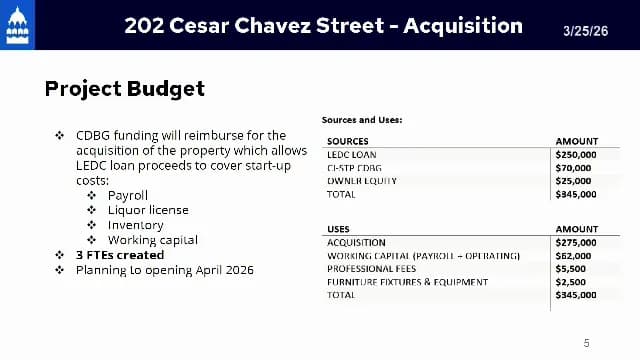
Public Meetings - St Paul, MinnesotaThe Housing & Redevelopment Authority Board of Commissioners met on March 25, 2026, from 2:06 p.m. to 2:43 p.m. to adopt updated guidelines for three major funding programs and to receive staff reports on a CDBG loan for a new bar and restaurant and on the proposed designation of a developer for the Fox Lot affordable housing project. All seven commissioners were present. Discussion Items RES 26-405 – Commercial Corridor Program Guidelines, Citywide Chair Cheniqua Johnson thanked staff and commissioners for extensive discussions. Commissioner Nelsie Yang expressed support for Version 2, noting that the only change was shifting the Rice Street Alliance host organization to the North End Neighborhood Organization. Commissioner Rebecca Noecker highlighted that the program is providing $1.4 million citywide for the second consecutive year and was “wildly successful” in its first year. The resolution was adopted as amended by a 7–0 vote. RES 26-407 – Downpayment Assistance (DPA) Program Guidelines, Citywide Chair Johnson recognized the housing team and commissioners for robust conversation, particularly on renter inclusion and displacement language. Commissioner Anika Bowie moved Version 2, which expands eligibility to renters and adds three urban renewal project areas (Western Reconstruction Area, Central Village, and College of St. Paul) to the Rondo Inheritance Fund. Commissioner Bowie noted advocacy from Rondo descendants and elder Frank White. Commissioner Noecker stated she supports moving forward but wants future action to address West Side Flats displacement timing. The resolution was adopted as amended by a 7–0 vote. RES 26-409 – HRA Business Assistance Fund Guidelines, Citywide Commissioner Noecker moved approval, noting the $5 million investment in downtown St. Paul: $3 million for converting underutilized office space and $2 million for activating vacant retail storefronts. Chair Johnson remarked on the urgency given that 49% of downtown properties are tax-exempt, citing a recent Ramsey County presentation. The resolution was adopted by a 7–0 vote. SR 26-54 – Staff Report on CDBG Loan Agreement for 202 Cesar Chavez Street, Ward 2 Interim Executive Director Melanie McMahon introduced Senior Project Manager Nicholas Wolff, who presented a $70,000 CDBG loan to Judy Lopez for the acquisition of a building at 202 Cesar Chavez Street to open La Oficina, a Mexican dive bar. The project will create and maintain three full-time jobs. Commissioner Noecker questioned due diligence after the previous business (Papa Legba) closed shortly after opening with HRA support. Wolff explained that the new concept is better capitalized and targets a different audience. The item will return for a vote at the next meeting. The report was received and filed. SR 26-51 – Staff Report on Designating Reuter Walton Development, LLC as Tentative Developer of the Fox Lot, Ward 2 Principal Project Manager Hannah Chong presented a proposal to develop two HRA-owned parcels (the Fox Lot) plus adjacent private land into “The Livingston,” two five-story buildings with 300 affordable housing units (81 two-bedroom, 157 three-bedroom, 62 four-bedroom). 10% of units will be affordable at 30% of area median income (AMI), and the rest at 60% AMI. The estimated total development cost is $117 million. Commissioner Noecker expressed support but urged attention to building design. Reuter Walton Vice President Paul Keenan noted the design is preliminary and the timeline is about 12 months to groundbreaking, pending environmental and easement work. The item will return for a vote at the next meeting. The report was received and filed. Key Outcomes - RES 26-405 (Commercial Corridor Program Guidelines V2) adopted 7–0. - RES 26-407 (Downpayment Assistance Program Guidelines V2) adopted 7–0. - RES 26-409 (HRA Business Assistance Fund Guidelines) adopted 7–0. - Staff Reports 26-54 and 26-51 were received and filed; both will be voted on at the next HRA meeting.
The St. Paul City Council met on March 18, 2026, to discuss two main topics: the methodology for calculating special assessments for street maintenance and reconstruction projects, and the licensing and contracting processes for solid waste haulers. The meeting featured presentations from city staff, a third-party appraiser, and discussions on policy amendments and transparency. Special Assessment Methodology Discussion - Council President noted the topic has been discussed frequently and aims to provide evergreen information for constituents. - Bruce Engelbrecht, manager of the real estate section, presented the history and theory of special assessments, distinguishing them from taxes by the requirement of special benefit to specific properties. - The city has faced lawsuits from churches (2011) and property owners, leading to shifts in costs to the general fund and the use of third-party appraisers to calculate special benefit. - John Barclay of Hosh Appraisal described his firm's market-based approach to determining the maximum supportable special benefit for property classifications. The analysis uses sales data, neighborhood trends, and assessor's values, but does not typically account for negative impacts (e.g., tree removal) unless they significantly offset benefits across the entire project. - Councilmembers asked about the impact of bike lanes, sidewalks, and tree removal. Barclay noted that negative factors are not typically included unless they result in a net zero benefit, but individual property appeals could consider such specifics. - The city currently assesses 25% of project costs (after adjustments) for street reconstruction and mill-and-overlay projects. The special benefit cap often reduces the actual assessment to 15-20% of project costs, with the remainder funded by other sources (e.g., bonds, gas tax, general fund). - Policy amendments proposed: 1. Clarify the difference between city cost (general public benefit) and assessable cost, excluding sewer/water main replacements from the assessable base. 2. Limit the corner property benefit (capping assessments at the highest of two bordering projects) to residential properties with 1-4 units, reversing a prior expansion to commercial/institutional properties. - The net fiscal impact is expected to be near neutral, with annual assessment revenues averaging $5 million. Solid Waste Licensing and Contracting - Director Weesie presented an overview of solid waste licenses, which are class R (administratively approved) or class N (council-approved with public hearing). There are 38 active solid waste hauler licenses; 26% are sited in St. Paul. - Class N licenses (e.g., gas stations, liquor stores) are subject to more oversight due to police calls and neighborhood impact. The council discussed whether solid waste haulers should be reclassified to class N for greater accountability. - The city's $44 million, seven-year solid waste contract with FCC (one-to-four-unit garbage) was awarded via RFP in 2023 without council approval. Only lobbying and fundraising contracts require council approval per current code. - Councilmembers expressed concern about transparency for large contracts that affect all residents, though they acknowledged the need for efficient procurement. Some members suggested formalizing council briefing or approval for such major agreements. - The recycling contract with Eureka (five-year, $61 million) and multi-unit recycling contract with FCC (seven-year, $30 million) also do not require council approval. Key Outcomes - The council heard the special assessment policy proposal and will consider formal amendments in the near future (timeline flexible). Councilmember Bowie expressed interest in engaging constituents. - For solid waste, the council will continue discussions on whether to change the licensing class for waste haulers or alter the contract approval process. A procurement code change would require legal advice. - No formal votes were taken; the meeting was informational.
The Saint Paul City Council met on March 18, 2026, at 3:31 PM in the Council Chambers. The meeting covered consent agenda items, discussion items, ordinance final adoptions, public hearings, and legislative hearing items. Key topics included a resolution recognizing Eid al-Fitr, an ordinance extending the pre-eviction notice period from 30 to 60 days (with a proposed exemption for the St. Paul Public Housing Agency), establishing minimum qualifications for the next Fire Chief, approving a sound level variance for Allianz Field summer concerts, and a public hearing on federal immigration grievances. Consent Calendar - Adopted unanimously (5-0) on the consent agenda, with Councilmembers Bowie and Johnson absent. Items included approvals of costs for securing/boarding structures, demolitions, cooperative agreements, sponsorships, gifts, special counsel appointments, easements for Osborn Plaza renovation, and pay classification changes (one item laid over). Public Comments & Testimony - Fire Chief Minimum Qualifications (Item 19): Sarah Gartner (Ward 7 resident) testified against requiring a bachelor's degree without substitution for experience, arguing it could be exclusionary and inequitable, filtering out highly qualified candidates from working-class backgrounds or communities facing systemic barriers to higher education. She urged valuing lived experience and community trust equally with formal education. Discussion Items - Recognition of Eid al-Fitr (Item 16): Councilmember Kim introduced Resolution 26-461, recognizing the 2026 Eid al-Fitr (observed Friday, March 20, 2026) and all Saint Paul residents celebrating the holiday. Kim noted the difficult national climate for Muslim communities and expressed thanks to legislative aide Abdi Hamid. Council President Noecker and Councilmember Johnson spoke in support, emphasizing community connection, continued normalization of honoring religious holidays, and the positive role of local Muslim groups. - Pre-Eviction Notice Period Extension (Item 18): Councilmember Kim proposed an amendment to exempt St. Paul Public Housing Agency (PHA) properties from the temporary 60-day pre-eviction notice period (ordinance 26-18). Karina Serrano, PHA Housing Choice Programs Director, explained that PHA already uses a 30-day notice; extending to 60 days could increase unpaid rent balances, risking federal capital fund eligibility. Discussion included: PHA's tenant accounts receivable rose from $90,000/month (2021) to $400,000/month after adopting 30-day notices; FY2024 saw 271 eviction filings (48 executions), FY2025 saw 393 filings (66 executions), current FY: 191 filings (43 executions, 23% execution rate). Councilmember Johnson expressed concern about exempting the city's largest landlord from tenant protections. Councilmember Kim questioned whether the risk of funding loss outweighed benefits. Councilmember Bowie noted high density of public housing in Ward 1. Councilmember Jost supported the exemption due to federal funding concerns. The council voted unanimously (7-0) to lay the ordinance over to March 25, 2026 for further information. - Fire Chief Minimum Qualifications (Item 19): Chrissy Hauge (HR Consulting Services Manager) presented proposed changes: requiring a bachelor’s degree (no substitution for experience), modernizing command experience language, and eliminating out-of-title experience credit. The council and public discussed equity concerns about the degree requirement. The public hearing was closed, and the matter laid over to March 25, 2026 for final adoption. - Allianz Field Sound Level Variance (Item 20): Zachariah Lutzel Swob (Sr. Director of Event Operations, Minnesota United) presented a request for a series sound level variance for five Friday concerts (May 29, July 24, July 31, August 14, September 18, 2026). Council President Noecker noted the process improvement from single-event variances to series variances. The resolution was adopted unanimously (7-0). - Public Hearing on Immigration Operations (Item 22): No public testimony was offered. Councilmembers acknowledged the value of having held multiple weeks of hearings, encouraging continued community input via email and phone. The public hearing was closed unanimously (7-0). Key Outcomes - Consent Agenda: Adopted (5-0) except Item 9 (RES 26-421) laid over to March 25, 2026. - Resolution 26-461 (Eid al-Fitr): Adopted (7-0). - Ordinance 26-18 (Pre-Eviction Notice Extension): Laid over to March 25, 2026 (7-0) for follow-up on PHA funding risk and data. - Ordinance 26-17 (Fire Chief Minimum Qualifications): Public hearing closed, laid over to March 25, 2026 for final adoption (7-0). - Resolution PH 26-66 (Allianz Field Sound Variance): Adopted (7-0). - Resolution PH 26-67 (Police Grant): Adopted (7-0). - Public Hearing PH 26-4 (Immigration Grievances): Closed (7-0). - Legislative Hearing Consent Agenda (Items 23-31): Adopted as amended (7-0). - Ordinance 26-16 (Xcel Energy Rezoning): Adopted finally (7-0). - Adjournment: 4:52 PM.
The Audit Committee of Saint Paul convened on March 17, 2026, at City Hall. The meeting included introductions of new committee members, a mid-point update on the data practices performance audit, a report on community engagement efforts, and a debrief of a meeting with Mayor Her regarding future audit topics. All agenda items were received and filed. Introductions and Committee Overview - The committee welcomed two new community advisors: Dillon Donnelly (background in manufacturing and workforce development) and Noah McVay (substitute teacher and public administration student). Existing members and staff re-introduced themselves. Chair Rebecca Noecker provided an overview of the committee's typical audit cycle, noting that the current timeline had shifted due to the new administration and delays in the ongoing audit. Data Practices Study Update - Dr. Heather Britt from Wilder Research presented the mid-point update on the performance audit of the city's data practices request process, GovQA system, and user experience. The audit addresses five key question areas: GovQA capabilities and internal use, reporting and data trends, the resident-facing portal, policies and training compliance, and benchmarking with other jurisdictions (Hennepin, Ramsey, Minneapolis, Bloomington, Duluth). - Data collection is largely complete for the document/system review (approximately 75%) and literature/benchmarking (nearly complete). Stakeholder engagement—including surveys of internal department leads and external requesters, and interviews with other jurisdictions—has faced delays due to external challenges in the Twin Cities. Surveys are set to launch this week, initially targeting approximately 700 St. Paul requesters with email addresses; expansion to statewide may follow if response rates are low. Interviews with other jurisdictions are being arranged with assistance from the League of Minnesota Cities. - Timeline: draft report expected in May, final report in June. - Committee members asked about survey methodology (deduplication, inclusion criteria) and specific contacts. Jeremy Lostetter requested confirmation of the Hennepin County contact. The committee expressed appreciation for the team's work despite challenges. Community Engagement Update - Community Advisor Noah McVay reported on outreach to the city's district councils: he has met with 8 of 10 councils (two rescheduled due to weather and scheduling conflicts). Feedback has been positive, and councils expressed strong interest in the committee's work. McVay compiled a list of potential audit topics from council members and staff, spanning public safety, housing, environmental issues, business regulation, and cybersecurity (the latter mentioned in about a quarter of interactions, referencing a summer 2025 cybersecurity incident). - McVay proposed several initiatives to improve visibility: creating a directory of city programs and services for residents (to be completed by August 2026), publishing short autobiographies of committee members on the website, developing a periodic blog or listserv update, and providing physical mailing materials for district councils. The committee discussed these suggestions, leaning toward digital communication (e.g., email summaries) to minimize costs and staff burden. Members also supported the directory idea, with Jeremy Lostetter suggesting linking it to audit history. - Since outreach resumed, the committee's online topic idea survey has received 15 new submissions, up from a quiet period since 2023. - Councilmember Cheniqua Johnson offered to help boost awareness in her ward, noting that east side residents are less familiar with the committee. Chair Noecker and Vice Chair Molly Coleman have accompanied McVay to some district council meetings. Debrief with Mayor Her and Topic Selection Discussion - The committee debriefed about a meeting with Mayor Her and four assistant mayors, which members described as a significant show of respect and a positive sign of the administration's embrace of performance audits. The mayor specifically mentioned College Bound St. Paul as a potential audit topic. Members noted that this program represents a "sweet spot" for audit due to mayoral ownership and its operational maturity. - The committee agreed to gather additional input: staff will follow up with the mayor's office for any further topic suggestions; members will review McVay's compiled list, the 15 survey submissions, and notes from the mayor meeting. The topic selection process—including risk analysis and staff consultation—will be revisited at the next meeting, with a target to choose the next audit topic by July, following the conclusion of the current audit (final report in June). Key Outcomes - All items on the consent agenda (introductions, data practices update, community engagement update, debrief with mayor) were received and filed. - Directed staff to request additional audit topic ideas from Mayor Her's office. - Committee members to review topic lists and prepare for discussion at the next meeting. - Noah McVay will complete a draft directory of city programs by August 2026. - Next meeting tentatively scheduled for April 21, 2026 at 4:00 PM (to be confirmed via email). - Meeting concluded after approximately one hour.
Note: The meeting transcript states the meeting occurred on Friday, March 20, 2026, but the assigned date is March 13, 2026. This summary uses the assigned date. The St. Paul Planning Commission convened on March 13, 2026, to approve prior minutes, conduct a public hearing on a proposed green roof incentives text amendment, initiate a study on a salt storage ordinance, review the 2025 annual report, and receive updates on site plan review items. All actions were routine and unanimous. Consent Calendar - Approval of March 6, 2026, Meeting Minutes: Motion by Commissioner Starling, seconded by Commissioner Holtz, passed unanimously by voice vote. Public Comments & Testimony - Public Hearing on Green Roof Incentives (Section 669.31 F): No members of the public testified. The hearing was closed with a motion to keep the record open for written testimony until 4:30 p.m. on Monday, March 23, 2026. The motion passed unanimously. Discussion Items - Salt Storage Ordinance Study Initiation: Staff presented a proposal to adopt new ordinance language regarding salt storage, required by the city's MS4 Phase I permit under the Clean Water Act. The language is based on a model from the Minnesota Pollution Control Agency. Commissioners discussed applicability to other public entities (e.g., Metro Transit, MNDOT) and enforcement mechanisms. The commission initiated the study and set a public hearing for May 1, 2026, via a motion that passed unanimously. - 2025 Planning Commission Annual Report: Staff presented the report, summarizing zoning applications by type and ward, with notable cases. Commissioners suggested adding comparative data (e.g., zoning cases vs. building permits), updates on past major projects, and statistics on projects that did not proceed. No action was taken; the report will return for final review. - Site Plan Review Committee Report: Staff reported on items reviewed on March 17, 2026 (2200 Idaho Avenue East – new park at The Heights; 2004 Randolph Avenue – St. Catherine University access) and upcoming items for March 24, 2026 (101 Empire Drive – HEO Sandbox site; 345 Smith Avenue North – St. Paul ED remodel and entrance expansion). Key Outcomes - Motion to Initiate Salt Storage Ordinance Study and Set Public Hearing: Passed unanimously. The public hearing is scheduled for May 1, 2026. - Public Hearing on Green Roof Incentives: Closed, with the record open for written testimony until March 23, 2026. - Announcement: The acting director noted that the City Council approved the 325 Commercial rezoning (from residential to industrial for an Xcel Energy substation expansion) earlier in the week.
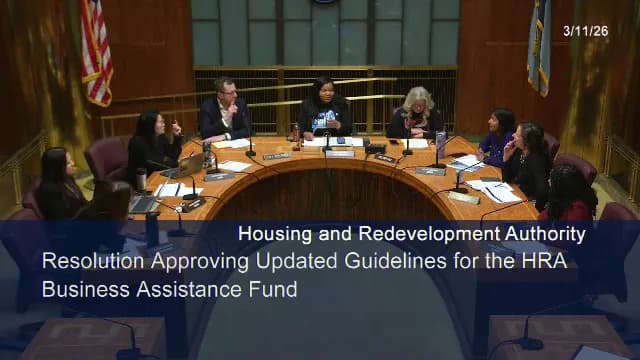
The Housing & Redevelopment Authority (HRA) Board of Commissioners met on Wednesday, March 11, 2026, at 2:00 p.m. in Council Chambers, City Hall. All seven commissioners were present. The board discussed four guideline amendments—three of which were laid over for two weeks—adopted one, received an update on the Familiar Families Pilot, and withdrew a staff report on LAHA funding. The meeting adjourned at 3:21 p.m. Consent Calendar - No consent calendar items were listed. Public Comments & Testimony - No public comments were made or recorded. Discussion Items 1. RES 26-405: Approving the Commercial Corridor Program Guidelines (Citywide) - Chair Johnson opened discussion on five funding allocation scenarios for the program, which invests in commercial corridors across the city. Scenarios varied by whether the downtown corridor would be included or removed and whether areas of concentrated poverty (ACP) or qualified census tracts (QCT) designations would be used. - Commissioner Noecker expressed opposition to removing any corridor, including downtown, arguing that downtown needs every possible investment given its impact on the city's tax base. She supported using the index score to allocate more to higher-need corridors but was flexible on ACP vs. QCT. - Commissioner Yang stated she was comfortable removing downtown for the current year due to the new $5 million Downtown Vitality Fund, and requested quarterly reports on corridor spending and downtown vitality fund expenditures. - Commissioner Jost supported keeping downtown in the program, noting that downtown generates significant property taxes and that the program is funded by sales taxes; she was hesitant to make major changes without tracking outcomes. - Commissioner Bowie expressed being undecided, raising concerns about equitable distribution of resources, noting that some corridors have more capacity and experience applying for funds. - Commissioner Kim emphasized the need to look at equitable distribution of city resources across wards and asked for data on how much investment each ward receives. - Commissioner Coleman supported keeping downtown included, using a metaphor about needing to take all available measures to support downtown's revival, and argued for maintaining the 2026 index score with downtown. - Outcome: Commissioner Noecker moved to lay over the resolution for two weeks to allow further consideration and to gather information on 2025 budget-to-actual spending per corridor and maps of ACP vs. QCT boundaries. The motion carried 7-0. The item will return on March 25, 2026. 2. RES 26-407: Amending the Downpayment Assistance (DPA) Program Guidelines (Citywide) - Commissioner Bowie requested a change to the Rondo Inheritance Fund eligibility from "loss of property" to "displacement," which would include renters displaced during I-94 construction. She noted that the current requirement to prove ownership is a barrier for many descendants. - Staff (Christian Ruy) recommended passing the current guidelines and then exploring the change within six to eight months, citing capacity constraints. - Commissioner Noecker expressed concern that the issue has been discussed for over a year and wanted a timeline for resolution. Staff committed to providing a timeline by the end of the week. - Outcome: Chair Johnson moved to lay over the resolution to March 25, 2026, pending a staff timeline for exploring the eligibility change. The motion carried 7-0. 3. RES 26-408: Amending the Emergency Rental Assistance / Eviction Prevention Program (ERA) Guidelines (Citywide) - No discussion was held. - Outcome: Commissioner Kim moved to adopt the resolution. The motion carried 7-0. The guidelines were adopted. 4. RES 26-409: Approving Updated Guidelines for the HRA Business Assistance Fund (Downtown Vitality Fund) - Commissioner Noecker, the sponsor, expressed comfort with the guidelines as proposed, including nonprofit eligibility, after clarifying that reimbursements ensure fiscal integrity. - Commissioner Bowie raised concerns about nonprofit eligibility, arguing that the funds should be focused on for-profit businesses and development corporations that directly generate economic activity and tax base. She proposed an amendment to limit eligibility to for-profit businesses and development corporations. - Commissioner Kim asked for clarification on whether development corporations could be nonprofits; most community development corporations (CDCs) are nonprofits. - Commissioner Coleman noted that under current guidelines, government entities and schools might be eligible as nonprofits, which was not the intent. - Chair Johnson accepted Commissioner Bowie's amendment as friendly but clarified that the text needed to be drafted and approved. - Outcome: Commissioner Noecker withdrew her initial motion to approve and moved to lay over the resolution for two weeks to allow drafting of amended language excluding general nonprofits but including development corporations. The motion carried 7-0. The item will return on March 25, 2026. 5. SR 26-38: Update on Familiar Families Pilot - Director of the Office of Neighborhood Safety Cedrick Baker presented an update. The pilot is a $500,000 grant from HRA to Ramsey County to support up to five families experiencing homelessness with complex needs. The grant agreement was approved by Ramsey County on March 10, 2026. An RFP for wraparound services will be issued, with the program expected to start in June 2026. Chair Johnson noted the collaborative effort. - Outcome: The item was received and filed. 6. SR 26-39: Update on LAHA Funding for Emergency Shelter Providers - Outcome: Chair Johnson moved to withdraw the item. The motion carried 7-0. Key Outcomes - Adopted: RES 26-408 (ERA Program Guidelines) – unanimous. - Laid Over (to March 25, 2026): RES 26-405 (Commercial Corridor Guidelines), RES 26-407 (DPA Program Guidelines), RES 26-409 (Downtown Vitality Fund Guidelines) – all unanimous. - Received and Filed: SR 26-38 (Familiar Families Pilot update). - Withdrawn: SR 26-39 (LAHA update). - Next Meeting: March 25, 2026, at 2:00 p.m.
The Saint Paul City Council met on March 11, 2026, from 3:32 PM to 4:55 PM in Council Chambers. The meeting covered a consent agenda, several ordinances, public hearings, and an appeal. Key actions included the withdrawal of a police staffing cost write-off, a temporary extension of the pre-eviction notice period, and granting of a variance appeal for a hotel at United Village. Consent Calendar - Items 2 through 15 were adopted unanimously via consent agenda. These included approvals for tree removal assessments, garbage and yard waste delinquent bills, settlement claims ($16,000 for Jarell Heads and $25,000 for Jacob Olmstead), a water utility easement release, a fire department lease with Dell Financial Services, an appointment of Dillon Donnelly to the Audit Committee, and collective bargaining agreements with AFSCME Council 5 (Clerical Local 2508 and Technical Local 1842) for 2026-2028. - Item 3 (RES 26-364, establishing rate of pay for Water Control Systems Information Analyst) was laid over to March 18, 2026. Public Comments & Testimony - Pre-eviction notice extension (Ord 26-18): The public hearing drew numerous speakers. Supporters included Katie Royce (Frogtown Neighborhood Association), Dante (Twin Cities United Performers), Regan Reek (Home Line), Lisa Nelson (Hamlin Midway Coalition), Jessica Shaminski (Housing Justice Center), Steve Tuckner, James Dirks, Tony Arts, Sarah Mullins, and Autumn Vigel (Twin Cities United Performers). They argued that the 60-day notice is needed to give renters time to access rental assistance and avoid homelessness, especially following Operation Metro Surge. Regan Reek noted a 71% increase in renters seeking help paying rent compared to last year, and that Home Line advised nearly 2,900 St. Paul households in the past year. Opponents included Laura Russ (AON affordable housing provider), Kathy Bennett (Twin Cities Housing Alliance), Ben Helvick Anderson (Beacon Interfaith Housing Collaborative), Nancy McMurray (Project for Pride and Living), and Malik (a small landlord). They argued that extending the notice period would lead to larger unpaid balances, higher eviction rates, and financial strain on landlords, especially small property owners. Malik stated that an eviction process already takes nearly four months. - Hotel variance appeal (ABZA 26-3): Mike Hamm (advisor to United Village) and Mark Morrill (co-chair of Union Park District Council) testified in support of the variance. Morrill explained that the hotel’s first-floor layout (luggage, check-in, restrooms) makes extensive windows impractical and that the design already includes a restaurant and other public amenities. - Immigration operations public hearing (PH 26-4): No one testified at this hearing. It was continued to March 18, 2026, with Vice President Yang noting that next week will be the last public hearing on this topic. Discussion Items - Withdrawal of RES PH 26-59 (Police staffing cost write-off for festivals): Councilmember Bowie moved to withdraw the item, stating that the Mayor’s office and the Saint Paul and Minnesota Foundation are willing to administer a grant program to support qualifying festivals. Councilmembers Johnson and Yang praised the collaborative process and the outcome. The item was withdrawn. - Pre-eviction notice extension (Ord 26-18): Councilmember Kim introduced a version 2 of the ordinance to clarify that the temporary extension from 30 to 60 days takes effect on May 14, 2026 (the same date as the broader tenant protections ordinance) and runs through December 31, 2026. The amendment was adopted unanimously. The public hearing then occurred, after which the ordinance was laid over to March 18 for final adoption. - Hotel variance appeal (ABZA 26-3): Staff presented the history of the project, noting that the Board of Zoning Appeals denied the variance due to a tie vote (one member contested finding 3 on practical difficulty). The council heard testimony and then voted to grant the appeal, allowing the hotel to proceed with 43.1% window/door openings (6.9% variance) and 23.3% area (6.7% variance) on the north facade. Key Outcomes - Consent agenda adopted (7-0). - RES PH 26-59 withdrawn without opposition. - Ord 26-18 (pre-eviction notice extension) amended and laid over to March 18, 2026, for final adoption (7-0). - Ord 26-16 (rezoning 325 Commercial St) laid over to March 18 for final adoption (7-0). - RES PH 26-56 (sound level variance for Mightyssippi 10 Mile) adopted (7-0). - RES PH 26-65 (budget amendments) adopted (7-0). - ABZA 26-3 (hotel variance appeal) granted (7-0). - PH 26-4 (immigration grievances) continued to March 18, 2026 (7-0). - Legislative hearing consent agenda (items 24-26) adopted (7-0). - The meeting concluded with greetings from Girl Scouts from Groveland Elementary and a recognition of Vice President Yang’s birthday and Councilmember Johnson’s return from maternity leave.
This summary is based solely on the agenda provided. The user indicated the meeting occurred on March 9, 2026 at 10:30 AM, but the agenda lists the meeting as Monday, March 16, 2026, 4:30–6:00 PM. No minutes or transcript are available to resolve this discrepancy. The following items were scheduled on the agenda. Agenda Items - Larpenteur Avenue MCARE Project – Presented by Alan Maxwell (Ramsey County). No further details are available. - Payne Avenue Pedestrian Intersection Improvements – Presented by Laura Krause (Saint Paul Public Works). No further details are available. Key Outcomes No decisions, votes, or directives are recorded due to the absence of minutes and a transcript. The meeting may have been cancelled or rescheduled, but no confirmation is available.
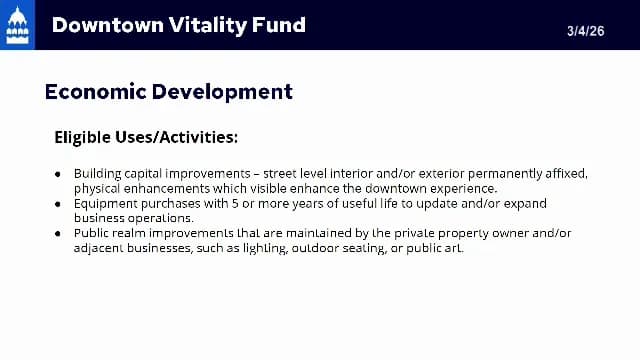
The St. Paul Housing and Redevelopment Authority (HRA) met on March 4, 2026, to discuss updates to the Commercial Corridors program guidelines and the new Downtown Vitality Fund (DVF). The meeting included presentations from staff, extensive commissioner discussion, and a commitment to vote on both items at the next meeting. One commissioner was absent (Commissioner Kim); six were present. Consent Calendar - Approval of Minutes (MIN 26-10) – The February 2026 HRA meeting minutes were approved unanimously (6-0). Discussion Items - Commercial Corridors Program Guideline Updates (SR26-33) – Daniela Lorenz, Economic Development Supervisor, presented proposed changes including: (1) geographic expansions of four corridors (East Seventh Street, Ford Parkway, Como Dale, and Cesar Chavez/Wabasha) and removal of the Smith Corridor; (2) a new award size index using density of businesses, employees, commercial land use, and vacant buildings; (3) replacement of the area-of-concentrated-poverty (ACP) measure with qualified census tracts (QCT); and (4) eligibility for operational subgrants during substantial corridor disruptions (e.g., construction). Commissioners raised concerns and questions: - Commissioner Kim noted that business density metrics could disadvantage corridors like Rice Street with many small, immigrant‑owned businesses and questioned the inclusion of HRA‑owned vacant properties in the index. - Commissioner Yang expressed strong support for retaining the ACP component, citing the need to uplift marginalized communities, and requested a scenario analysis combining ACP with QCT. - Several commissioners (Naker, Johnson, Coleman) discussed the operational expense language, suggesting striking the word "unique" to avoid confusion and ensuring it covers widespread disruptions like Operation Metro Surge. - Staff clarified that QCTs measure the same socioeconomic factors as ACPs, and that removal of ACP only affected the Snelling‑Selby corridor. Director McMahon noted that the index was designed to balance current activity with redevelopment potential. - Downtown Vitality Fund Presentation (SR26-34) – Director McMahon, Housing Director Jules Atanda, and Economic Development Director Jimmy Lloyd presented the $5 million DVF, split into a housing component ($3M in Laha dollars) and an economic development component ($2M in Business Assistance Fund dollars). Key points: - Housing: Funds for rental or homeownership projects affordable at ≤80% AMI rental or ≤150% AMI homeownership. Rolling application via a short interest form; projects ready to close in 2026 and with greatest unit count prioritized. - Economic Development: Eligible uses include capital improvements, equipment purchases, and public realm improvements. For projects ≤$100,000: reimbursement grant; for $100,000: deferred forgivable loan with 4‑year term. Priority given to projects activating ≥5,000 sq ft of vacant space, with employees in office ≥50% of time, or businesses relocating primary operations downtown. - Commissioners raised several issues: - Commissioner Naker questioned the rolling application process, preferring application windows to allow competition; staff noted the housing component uses existing Laha processes and that few large projects are expected. - Commissioner Bowie emphasized the need to measure success and noted that downtown already receives significant funding (STAR grants, Port Authority, Bush Foundation, legislative tax credits). She preferred restricting DVF to for‑profit businesses to boost the tax base. - Commissioner Yang and Chair Johnson questioned whether downtown should still receive $90,000 from the Commercial Corridors program given the new DVF; Chair Johnson suggested a conversation about reallocating that to other corridors. - Chair Johnson and Commissioner Naker debated reimbursement vs. upfront grant; staff defended reimbursement as best practice for stewardship. - Procedural Discussion – Chair Johnson offered to postpone the vote on guideline updates if any commissioner needed more time, while Commissioner Naker strongly preferred to vote the next week (March 11). Chair Johnson asked commissioners to communicate their wish by the end of the meeting day. Director McMahon clarified that the action items next week would be: (1) Commercial Corridors guideline update, and (2) Business Assistance Fund guidelines update (for the DVF economic development component). Key Outcomes - The February 2026 HRA minutes were approved (6‑0). - No formal votes were taken on the Commercial Corridors guideline changes or the Downtown Vitality Fund guidelines; both will be brought back for a vote at the March 11, 2026 HRA meeting. - Staff will prepare a scenario analysis combining ACP and QCT for Commissioner Yang, and will provide one‑on‑one briefings on the index formula for Commissioners Kim and Yang. - The operational expense language will be revised per commissioner feedback (e.g., potential removal of "unique"). - The DVF website and interest forms are ready to launch on March 12 if approved. - Chair Johnson will determine whether to keep both items on the March 11 agenda or postpone based on commissioner input received that day.