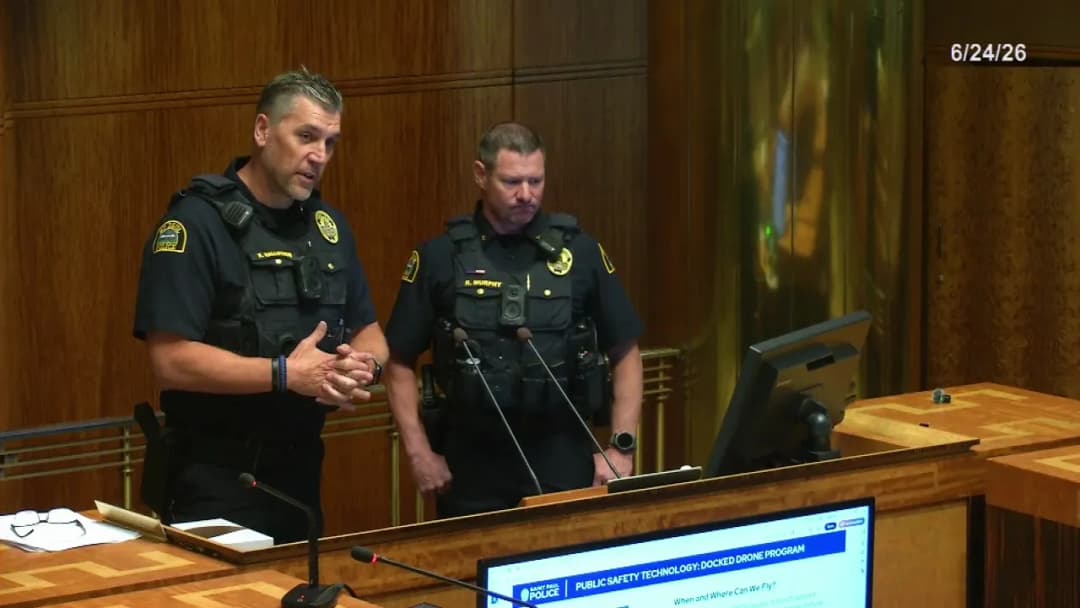
The City Council’s Committee on Public Safety Technology convened on June 24, 2026, to discuss two agenda items related to evolving technology in public safety: the St. Paul Police Department’s (SPPD) use of drones, automated license plate readers (ALPRs), and a real-time information center; and a presentation by the ACLU of Minnesota on municipal regulations for ALPRs. The meeting featured presentations from Deputy Chief Kurt Holstrom and Senior Commander Murphy of SPPD, and John Baylor, Policy Director of the ACLU of Minnesota. No votes were taken; the committee agreed to send follow-up written questions to SPPD, the ACLU, and the Ramsey County Sheriff’s Office (which declined to attend). Discussion Items - SPPD Presentation on Public Safety Technology (SR 26-132) - Deputy Chief Holstrom outlined SPPD’s technology framework, emphasizing constitutional policing, lawful purpose, limited use, trained operators, documented actions, auditability, transparency, and corrective action. Technologies discussed include: - Dock Drone Program: Launched May 30, 2026, with three drones on rooftops (one per district), each with a 2-mile radius and 20-30 minute battery life. Drones are not used for general surveillance; cameras point to horizon during transit. As of the meeting, nearly 500 flights had been completed, with drones arriving on scene before squad cars 51% of the time. Response time is 60-90 seconds for drones vs. 7-10 minutes for squad cars. Drones are deployed only under 11 warrant exceptions in state statute. No internal affairs complaints have been filed regarding drone operators in three years. - License Plate Readers (LPR): SPPD uses ALPRs in squad cars and two fixed Flock cameras (at Kellogg and Smith). Data retention: 60 days for squad-car LPR data (per state statute), 30 days for Flock data. Data is not shared outside Minnesota or with federal agencies. Queries require a case number and criminal investigation reason. A biannual third-party audit (conducted October 2025 by Logis) found SPPD in compliance with state law. - Real-Time Information Center (Arctic): Also launched May 30, 2026, staffed by trained officers and analysts to provide real-time situational awareness to officers in the field. Operates under the same legal and policy constraints. - Council members asked about: - Data sharing with the BCA (state Bureau of Criminal Apprehension) and Minnesota Fusion Center: SPPD confirmed BCA has access, but no out-of-state sharing. - Distinguishing drone response times from officer response times: SPPD agreed to provide disaggregated data. - Video retention for active investigations: Video becomes public after case closure; if another jurisdiction has an active investigation, SPPD may share. - Potential use of drone footage to review officer conduct: Confirmed that such footage would be retained as part of any misconduct investigation. - ACLU of Minnesota Presentation on ALPRs and Municipal Regulations (SR 26-133) - John Baylor provided context on Flock cameras, noting that Flock is a data company. SPPD’s two fixed cameras generate about 5,000 searches per month (January data). Baylor recommended: - Implementing a public-facing transparency portal (as used by Roseville and St. Louis Park) to show aggregate search statistics. - Restricting access from agencies with 287(g) agreements (federal immigration enforcement cooperation). SPPD already restricts out-of-state access, but in-state agencies with 287(g) agreements—such as Mille Lacs, Crow Wing, Itasca, and others—have run searches on St. Paul’s cameras for civil immigration enforcement (based on search logs from other cities). Baylor clarified that 287(g) agreements do not override state privacy law. - Increasing the frequency of internal audits (beyond the biannual third-party requirement). - Baylor raised concerns about potential misuse of drone capabilities (e.g., facial recognition, carrying devices like stingrays), but noted SPPD’s program appears to use drones only for situational awareness. He emphasized ongoing public engagement to avoid over-policing minority neighborhoods. - Council members discussed the county’s 11 LPR cameras (operated by Ramsey County) and the lack of coordination. Questions were raised about St. Paul’s ability to control data once shared with in-state agencies, even if those agencies are bound by state law. Key Outcomes - No formal votes or resolutions were adopted. - The Committee will compile follow-up written questions for SPPD, the ACLU, and the Ramsey County Sheriff’s Office. Questions will cover: - SPPD’s response to ACLU concerns about redacted search reasons in audit logs. - SPPD’s collaboration with Ramsey County on LPR placement and data sharing. - The Ramsey County Sheriff’s Office (invited but declined) will respond in writing. - The chair noted that presentations and the ACLU’s paper on drone limits will be distributed to council members.
Public Meetings - St Paul, Minnesota
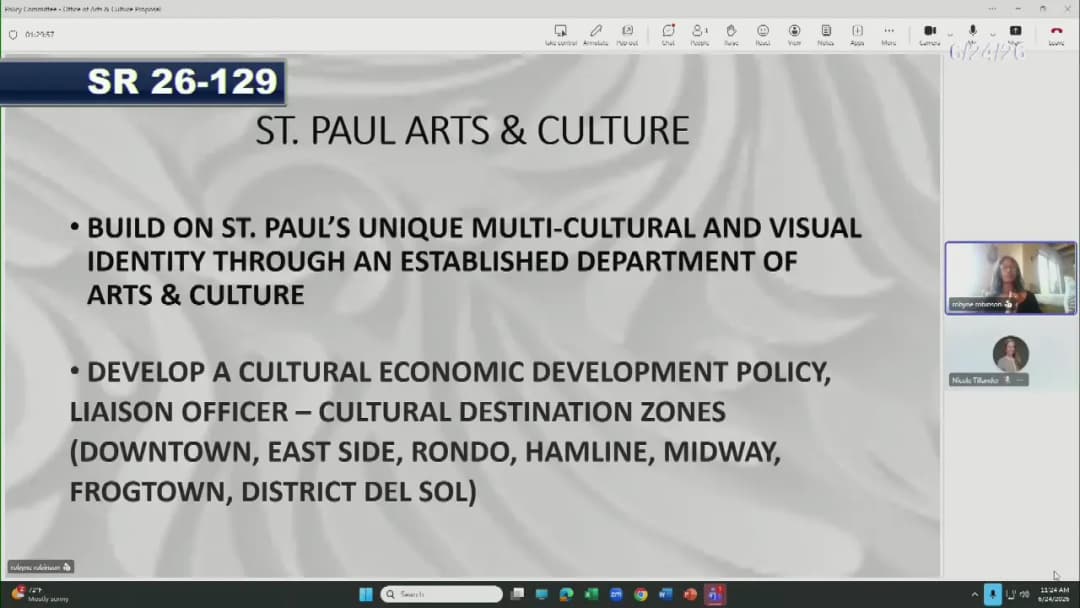
Public Meetings - St Paul, MinnesotaThe St. Paul City Council Policy Committee met on June 24, 2026, at 10:03 AM in Council Chambers. The meeting covered three substantive topics: a proposal to transition council member positions to full-time with salary adjustments, a study on cultural destination areas, and a proposal to reinstate an Office of Arts and Culture. Due to time constraints, each topic received limited discussion. All items were received and filed for further consideration. Discussion Items - Full-Time Councilmember Presentation (SR 26-128): Councilmember Nelsie Yang introduced the proposal to change council member roles from part-time to full-time and adjust salaries. Jay Wilms, Director of Council Operations, presented the rationale, legal constraints (special law, charter, administrative code), and pathways forward. The proposal would remove the part-time designation, increase council member salary to 70% of the mayor's salary (approximately $111,000 for FY26), and add supplemental pay for the council president and vice president ($116,000 and $113,000 respectively). The effective date under current law would be January 1, 2029, but Councilmember Yang expressed a desire for it to apply to the current council. No vote was taken. - Cultural Destination Area Study Executive Summary (SR 26-131): Lynn Pingle of Mackie Company presented findings from a study on St. Paul's cultural destination areas (CDAs). The study identified eight CDAs (District del Sol, Downtown, Eastside St. Paul, Little Africa, Little Mekong, Rondo, West Seventh/Shepard, Westside St. Paul) and categorized them as nodes, corridors, or districts. Key findings included that one in three businesses in St. Paul is immigrant-owned, and CDAs are economic drivers. Recommendations included codifying CDAs, creating an arts/cultural liaison, developing wayfinding, and investing $756,000 in programs like a "Buy Local St. Paul" sticker campaign and walking tours. Councilmember Bowie thanked the presenters and noted the study's alignment with budget discussions. No vote was taken. - Office of Arts and Culture Proposal (SR 26-129): Robyne Robinson of Five x Five Public Art Consultants presented a proposal to reinstate an Arts and Culture Director position in St. Paul, which had been vacant since Joe Spencer's departure. Robinson highlighted her experience in arts programming, public art, and community engagement, including work at MSP Airport and with the Minnesota Museum of American Art. Recommendations included embedding artists with municipal agencies, dedicating 1–1.5% of capital improvement budgets to public art, creating partnerships with tourism and business groups, and establishing a formal arts and culture department. Councilmember Bowie sponsored the item. No vote was taken. Key Outcomes - All three items were received and filed (per the meeting minutes). - No formal votes or decisions were made. - Further discussions on each topic were encouraged among councilmembers and with relevant staff, with Councilmember Yang and Councilmember Bowie serving as leads for their respective items. - The committee acknowledged the need for more time for substantive discussion in future meetings.
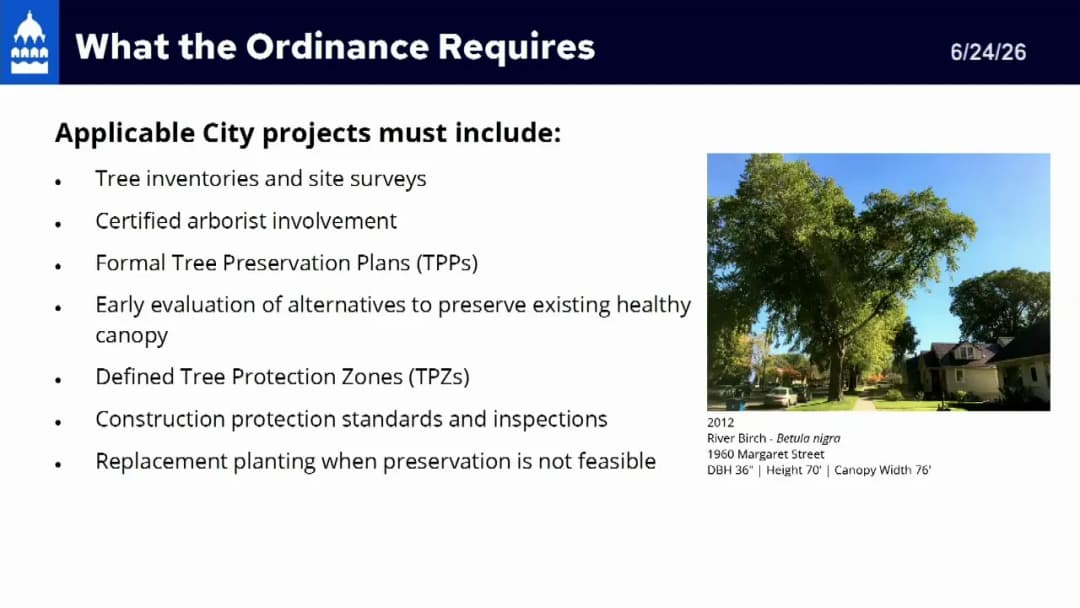
The Saint Paul City Council met on Wednesday, June 24, 2026, at 3:31 PM in Council Chambers at City Hall. Council President Rebecca Noecker presided, with six members present (Noecker, Yang, Kim, Jost, Johnson, Coleman) and Councilmember Anika Bowie absent. The meeting adjourned at 4:36 PM. The council adopted a consent agenda (with one item removed for separate consideration), passed several resolutions honoring community members and events, and received a staff report on a proposed tree preservation ordinance. Consent Calendar - Items 4–12: Approved as a consent agenda, including: - RES 26-724: Assessments for emergency sewer repairs (April 2026). - RES 26-865: Budget amendment for a fleet technician ($120,677). - RES 26-894: Lease agreement with Board of Water Commissioners for police communications equipment at Highland Water Tower. - RES 26-966: Hardship declaration for vacation of right-of-way at 779 Lexington Parkway South. - RES 26-969: GIS Supervisor pay rate – laid over to July 8, 2026. - RES 26-973: Acceptance of $50,000 MPCA grant (with $25,000 city match) for energy efficiency upgrades. - RES 26-991: License extension for Dilla Sport Bar and Restaurant at 1625 University Ave W. - RES 26-1027: Grant funds for PRP Works Inc. signage renewal (Ward 6 Neighborhood Star program). - Item 11 (RES 26-1011) was pulled for separate amendment; adopted as amended. Public Comments & Testimony - No members of the public testified on any of the three public hearing items (17–19) or on the legislative hearing consent item (20). - After the legislative hearing, a speaker (affiliated with the Capital Region Watershed District) gave an unprompted presentation on the Adopt-a-Drain program, noting that 15,000 people participate and 800,000 pounds of debris have been removed from Minnesota waterways. The council president acknowledged the comments but no formal action was taken. Discussion Items - Item 13 – RES 26-1028 (Honoring Lt. Col. Dr. Kou Bliaxa Vang): Councilmember Yang presented the resolution honoring the life and legacy of Dr. Vang, a dentist, Air National Guard veteran, and community leader who passed away on April 15, 2026. Family members attended, and Dr. Vang’s son Pete spoke, inviting the public to the funeral July 11–13, 2026, at Aldrich Arena. The resolution proclaimed those dates as Memorial Days in Saint Paul. Adopted 6-0. - Item 14 – RES 26-1010 (Dalai Lama’s 91st Birthday and Tibetan Community): Councilmember Jost introduced the resolution designating July 6, 2026 as “Day of Compassion.” Representatives from the Voluntary Tibet Advocacy Group and the Tibetan American Foundation of Minnesota spoke about the local Tibetan community (5,000 in Minnesota) and the Dalai Lama’s teachings. Councilmember Kim highlighted ties to other struggles. Adopted 6-0. - Item 15 – RES 26-1022 (LGBTQIA2S+ Pride Month): Councilmember Kim read the resolution recognizing June 2026 as Pride Month, citing historical and current challenges. Kat Rohn (Executive Director, Outfront Minnesota) and Megan Peterson (Executive Director, Gender Justice) testified, emphasizing the need for continued advocacy and noting the recent murder of a community member, Gabrielle Arezola Perez. The resolution encourages city departments to strengthen engagement and ensure inclusive facilities. Adopted 6-0. - Item 16 – Ordinance 25-4 (Tree Preservation for City-Sponsored Construction Projects): This was the first reading (with a staff report presented as if essentially new after 18 months of revisions). Parks Director Andy Rodriguez, Operations Manager Tom Hagel, and Public Works Operations Manager Sean Kershaw outlined the ordinance’s purpose: to protect trees during city construction, requiring tree inventories, certified arborists, formal preservation plans, protection zones, and restitution for damage. Four standard operating procedures were described. Councilmembers Johnson and Jost raised questions about costs and feasibility (e.g., single urban forester currently, cost absorption by projects). Council President Noecker noted that an annual review is built in, and the ordinance would return for a public hearing on July 8, 2026. Laid over. Key Outcomes - Consent Agenda: Adopted as amended (6-0). Item 11 (Opportunity Zones resolution) amended and adopted. - RES 26-1028 (Vang Memorial Days): Adopted 6-0. Proclaimed July 11–13, 2026 as Memorial Days. - RES 26-1010 (Dalai Lama / Day of Compassion): Adopted 6-0. Designated July 6, 2026 as Day of Compassion. - RES 26-1022 (Pride Month): Adopted 6-0. Recognized June 2026 as Pride Month; encourages city departments to enhance engagement with LGBTQIA2S+ residents. - RES PH 26-141 (District Energy Sound Variance): Adopted 6-0. Approved sound level variance for boiler testing June 29–July 3 and July 6–10, 2026 (potential extension to July 11–17). - RES PH 26-142 (Police Grant Fund Amendment): Adopted 6-0. Authorized amendment of financing and spending plans in police grant fund. - RES PH 26-143 (Rondo Days Sound Variance): Adopted 6-0. Approved amplified sound for Rondo Days Festival on July 18, 2026 at 271 North Mackubin Street. - RLH RR 26-2 (799 University Ave W): Referred to September 15, 2026 Legislative Hearing (6-0). - Ordinance 25-4 (Tree Preservation): Laid over to July 8, 2026 for second reading and public hearing. Staff directed to return with further cost analysis and implementation details. - Communications (CO 26-27, AO 26-34, AO 26-37): Received and filed.
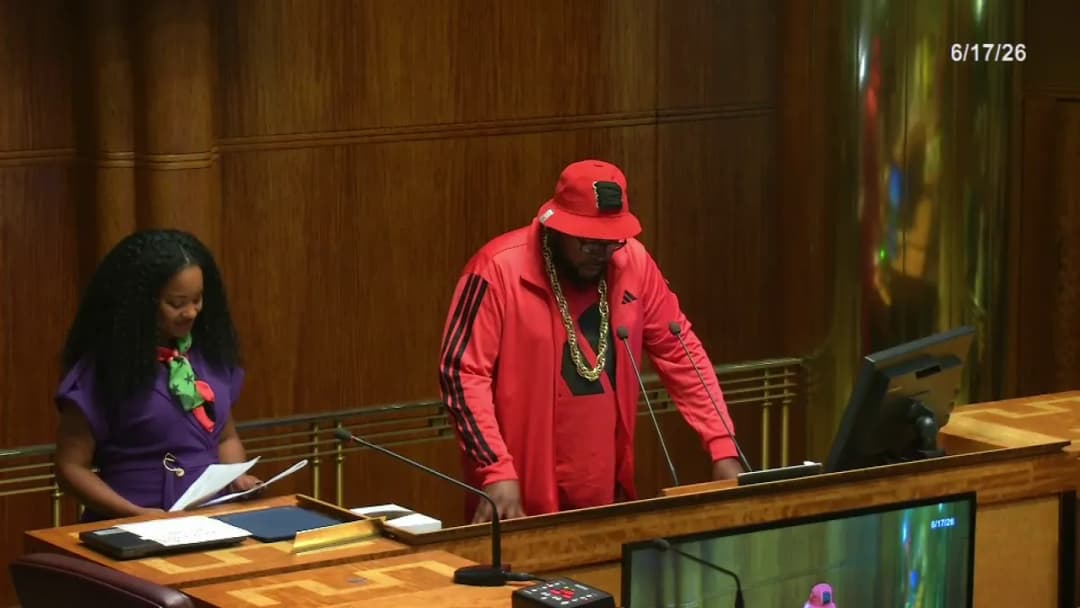
Note: The official minutes and transcript indicate this meeting took place on Wednesday, June 17, 2026, at 4:30 PM. The instruction to use June 18, 2026, is noted but contradicts the source material. This special meeting of the Saint Paul City Council was held to recognize June 2026 as Black Music Month and to honor eight individuals and organizations through seven award categories. The meeting featured presentations from the city's "Get Down" youth music program, remarks from council members, and acceptance speeches from honorees. The council unanimously adopted Resolution RES 26-996, proclaiming Black Music Month and honoring the recipients. Discussion Items - Opening and Video: The meeting began with a performance video by Sounds of Blackness featuring students from the High School for Recording Arts. - Councilmember Remarks: Councilmember Anika Bowie, the lead sponsor, emphasized the importance of Black music as American music, linked the recognition to Juneteenth and the nation's 250th anniversary, and spoke about using love to combat hate. She introduced the seven award categories: Next Verse, Vibe Alchemist, Stage Builder, Community Harmony, 651 Sound, Rhythm and Roots, and Living Legacy. - Get Down Program Presentation: Shana Abraham (Rec Services Manager, St. Paul Parks and Recreation) and Andy Rockwood (facilitator) described the Get Down, a youth-focused hip-hop mentorship and concert series now entering its third year. Upcoming 2026 shows were listed: July 9 at Arlington Hills, July 30 at Dayton's Bluff Recreation Center, August 4 at MLK, and August 29 at Raspberry Island. - Award Recognitions: - Next Verse Award: Yevra Brantley, an emerging hip-hop/trap/R&B artist. He spoke about art as education and quoted Erykah Badu. - Vibe Alchemist Award: DJ Mickey Breeze, a DJ/producer/educator with over 15 years of experience. He spoke about authenticity and community support. - Stage Builder Award: Marina "Trinity C" (Trinity C Productions), a longtime event producer and promoter of Afro-Caribbean culture. She thanked her family and invited attendees to Rondo Days (July 18) and Carrie Fest (July 25). - Community Harmony Award: Georgia Ford and Power 104.7 FM, a community radio station. Ford and Vice President Harry Colbert highlighted their mission to center Black music and community news, and announced the 7th Street Live festival on August 9, 2026, and a journalism cohort starting July 6. - 651 Sound Award: Alan Kingdom, a three-time Grammy-nominated rapper/singer/producer. He spoke about receiving hometown recognition and his work with Ujama Place, Walker West Music Academy, and his nonprofit Yebo Life. - Rhythm and Roots Award: Elder Mahmoud El Khatib, a professor and author (accepted by Sister Rickette of In Black Inc.). She read a statement from Frederick Douglass about Black Americans' rootedness in the U.S. - Living Legacy Award: David T. C. Ellis, founder of the High School for Recording Arts (HSRA) and Diverse Media Institute (DMI) (accepted by a representative who read his remarks). Ellis was unable to attend due to attending a conference with DMI graduates. - Council Discussion: Vice President Nelsie Yang, Councilmember Cheniqua Johnson, and Council President Rebecca Noecker praised the honorees and the event. Johnson specifically thanked Georgia Ford and Power 104.7 FM for their work on the East Side. Key Outcomes - Resolution Adopted: RES 26-996 (Proclaiming June 2026 as Black Music Month and honoring the third annual Black Music Month honorees) was adopted unanimously, 7-0. - The council encouraged continued community participation in the Get Down program, Rondo Days, Carrie Fest, and Power 104.7 FM events. - No other business was conducted.
Note: The raw transcript indicates the meeting was called for June 26, 2026, but the provided instructions specify the meeting date as June 18, 2026. This summary follows the instructed date, with the discrepancy noted. The meeting was called to order with roll call. Commissioners present: Grill, Hackey, Holtz, Johnson Becker, Martinson, Presley, Riley, Starling, Taggyov, Thomas. The minutes from May 29, 2026 were approved unanimously. No public hearings were held. Consent Calendar - Approval of the May 29, 2026 Planning Commission meeting minutes. Motion by Commissioner Holtz, seconded by Commissioner Taggyov. Passed unanimously. Discussion Items - Planning Commission Bylaws Update (Old Business): Chris Hong presented formatting and substantive changes to the bylaws since the February 20 vote. Key proposed changes include removal of the second vice chair position (due to reduction to seven commissioners), removal of specific meeting date/time from the bylaws, removal of the March 15 annual report deadline, quorum language adjustments, and updates to absence and roll-call vote provisions. - Commissioners raised concerns: - Commissioner Taggyov questioned whether the special meeting notice requirement (three days) conflicts with state open meeting law and recommended aligning language. - Commissioner Starling proposed that amendment notification should include public posting, not just email/mail to commissioners. - Commissioner Holtz suggested a two-step amendment process (first reading, then vote at next meeting) and a two-thirds supermajority for bylaw changes. - Commissioner Martinson proposed broader changes: including commissioner numbers and alternates in Article I, allowing any commissioner to place items on the agenda, defining removal-for-cause standards (beyond just absences), codifying public participation procedures, and requiring a two-thirds vote for bylaw amendments. - Commissioner Riley noted that commissioner numbers are set by city code and removal authority rests with the mayor. She also requested inclusion of relevant city code and charter references, as well as the League of Minnesota Cities handbook for planning commissioners. - Staff agreed to research and bring back options. A motion to lay over the item until staff can propose amendments in response to the discussion was made by Commissioner Taggyov, seconded by Commissioner Riley. The motion passed. - Golf Course Zoning Text Amendments (Recommendation to City Council): Nelly Jerome presented proposed amendments to Chapter 65.230, initiated by city council upon request from Parks and Rec for the Highland Golf Course driving range. The amendments: (C) remove restriction on mini golf (pitch and putt); (D) replace “prohibits lighting for night use” with “golf courses that are equipped with lighting for night use shall not operate after 10 p.m.” An alternative version proposed by the city attorney added “outdoor activities” to clarify. - Discussion centered on the scope of (D): concerns about limiting indoor uses (e.g., clubhouse), applicability to non-lighted courses, and consistency with other park facilities. Commissioner Holtz noted that unlighted courses would have no restriction, creating inequity. Commissioner Riley suggested allowing lights but limiting outdoor activities. Commissioner Starling proposed striking (D) entirely, arguing that lighting and noise are already regulated by city codes and zoning should treat golf courses like other recreational facilities. - A letter from the Highland District Council was acknowledged; it supported the original proposal including (D). - Motion by Commissioner Starling, seconded by Commissioner Riley, to recommend approval of the amendments but to delete subsection (D) entirely. After debate, the motion passed (voice vote; no abstentions noted). The recommendation will be forwarded to city council with a summary of the commission’s reasoning. Key Outcomes - Bylaws Update: Laid over for further staff research and presentation at a future meeting. No vote on final language. - Golf Course Text Amendments: Commission voted to recommend approval with subsection (D) struck. The recommendation will go to city council with an explanatory memo. - Site Plan Review: The June 23, 2026 committee meeting was canceled; items for June 30 include 2400 Childs Road (addition/expansion/demolition) and 209 Page Street West (restroom/storage facility). - Announcements: None.
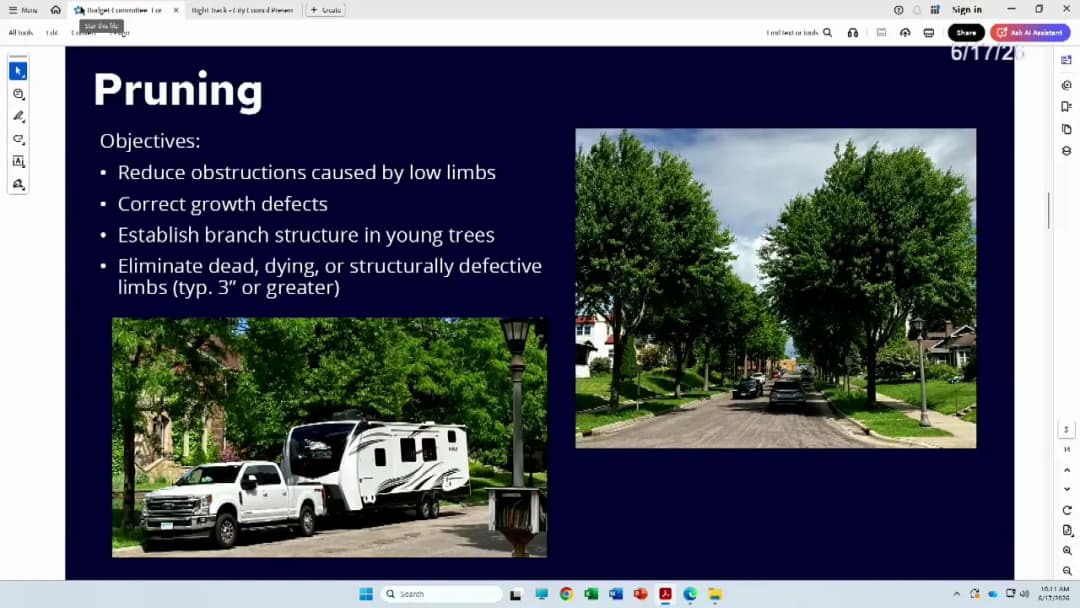
The City Council Budget Committee heard two presentations on June 17, 2026: the Forestry Division's tree canopy and care budget, and the Right Track youth employment program. Council members asked detailed questions about staffing, backlogs, funding sustainability, and program impacts. No formal votes were taken; follow-up questions will be submitted. Forestry Presentation - John Ward (forester) presented an overview of the Forestry Division's budget, covering pruning, tree planting, stump removal, storm response, and staffing. The division currently has 42–43 staff members. - The city's first routine pruning cycle was established in 2024, dividing the city into 50 zones of 2,500 trees each, aiming for a 10-year cycle. However, because the cycle started in 2024, some trees may wait 14–15 years for pruning. Young trees (tens of thousands) also need structural pruning within the first 10 years. - Tree planting: the city has reduced its backlog of vacant sites from 10,000 to 4,300, but current funding would allow only about 2,000 trees planted in 2027 (compared to an average of 4,700 in 2023–25). Optimal funding would sustain a three-year replanting cycle. - Stump removal: after catching up on backlogs in 2025, the program aims to stay current with contractor support. Without additional funds, stump backlogs would resume by 2029. - Storm response is unbudgeted; last year a single storm generated 1,000 calls. Additional $1M annually is requested for storm contingency. - Budget needs identified: $3.7M/year for pruning contracts (to reduce cycle to 7 years, include parks and young tree pruning), $1.5M increase in Capital Improvement Budget (CIB) for planting, and $0.5M for stump grinding. - Council questions touched on staff turnover, equity of pruning zones, tree canopy assessment (last done in 2010), and potential renewal of the Port Authority partnership for capital work. Right Track Program Presentation - Nardos and Carlo presented the city's youth employment and training program. In 2025, the program served 1,024 youth (1,138 internship experiences) with 144 employers, earning $2.3 million in wages and stipends. - The total budget is approximately $2.9 million: 12% from city general fund, 80% from other government sources (including ARPA and state grants), and 7% from foundations. 59% of spending goes directly to youth wages. - Challenges: declining funding – $100,000 less in DNR work, ARPA ending (leaving 6.3 full-time positions unfunded after 2026), and rising minimum wage costs. Decisions made for 2026 include ending school-year programming a month early, reducing weekly hours, eliminating the 2026-27 school-year program, and not offering a 2026 EMS program. Overall, 300 fewer experiences will be available for St. Paul youth. - Comparisons: Boston serves 10,000 youth with $33M budget (nearly $24M from city general fund); Minneapolis serves 659 traditional interns plus 700 paid training slots. - Right Track uses a training wage (not the 30-day youth wage) because internships are designed as learning experiences with mentorship and training. - Strategies for sustainability: increase public sector engagement (all city departments hosting interns), develop a sponsorship model for employers, and diversify funding sources to reduce reliance on temporary grants. - Council president requested clearer financial breakdowns in dollar amounts, especially regarding the impact of funding cuts and what would be needed to sustain current service levels. Key Outcomes - No votes or formal decisions were taken during the presentations. - Council members will submit follow-up questions to both departments regarding staffing, storm planning, tree canopy assessment, and detailed budget numbers for Right Track. - The Forestry Division will provide additional data on complaint volumes and staff capacity. - Right Track will provide dollar amounts for reductions and a breakdown of funding sources and expirations.
The Saint Paul City Council met on Wednesday, June 17, 2026, at 3:31 PM in Council Chambers. The meeting included a regular business session and a special meeting honoring Black Music Month. All votes were unanimous (7-0) unless noted. Consent Calendar - Items 2 through 27 were approved as a block without discussion. These included: a driveway easement agreement with Rail Transfer, Inc.; agreements with MnDOT for Trunk Highway 5 and Grand/Snelling Intersection projects; approval of securing/boarding assessments for multiple months; grant applications for street sweeping, bridge replacement, solar installation, and fire department grants (AFG $2,000,000, SAFER $8,449,689.78, prevention $600,000); license changes for tobacco, liquor, and entertainment; zoning text amendments for Highland National Golf Course; ARP budget reclassification; asset disposal agreements; and a pay rate classification. Public Comments & Testimony - John Dreeland (homeowner since 1976, Ward 7) testified on Item 30 (sanitary sewer repair assessment). He stated that a city-planted tree over his sewer line caused roots to grow into it, costing $10,000 to repair. He expressed that the city should use technology to avoid planting trees on sewer lines and noted that the offered low-interest loan at 6% is not truly low. He asked for policy changes rather than relief on his assessment. Council President Noecker acknowledged his concern and linked it to an upcoming tree planting ordinance; Councilmember Johnson offered to follow up. Discussion Items - Juneteenth 2026 Resolution (RES 26-997) – Councilmember Johnson presented the resolution honoring Juneteenth as an annual celebration of Black freedom, liberation, and resilience. Speakers included Vanessa Young (co-founder, 30,000 Feet), Angel Jones (founder, Miss Juneteenth Minnesota State Pageant), and Assistant Mayor Cedric Baker, who read a proclamation from the mayor declaring June 17, 2026 as Miss Juneteenth State Pageant Day. Councilmembers Bowie and Yang spoke in support. The resolution was adopted unanimously. - Suspension Items – Two items were considered under suspension of rules: - RES 26-1014: Approved use of Neighborhood Star Grant funds for Cook St. Paul LLC, allowing the owner to begin construction before an international trip. (7-0) - RES 26-1005: Commemorated the 30th Annual Community Peace Celebration and declared a Day of Peace and Unity, with the event scheduled for June 20, 2026 at People’s Park. (7-0) - Ordinance 26-28 (Final Adoption) – Rezoning of 213 Bates Avenue from H2 Residential to T1 Traditional Neighborhood. Approved unanimously after two prior readings. - Public Hearings – Items 30-34 were each opened for public testimony; only Item 30 received testimony (see above). All were closed and approved unanimously: - 30: Ratifying sanitary sewer repair assessment. - 31: Subdivision for Highland Bridge at 2200 Ford Parkway. - 32: Final plat for Highland Bridge Rowhomes 8th Addition. - 33: Sound level variance for Minnesota Country Club event (July 10-11). - 34: Sound level variance for Minnesota Yacht Club event (July 17-19). - Legislative Hearing Consent Agenda – Items 35-57 were considered. Two items were amended: - Item 53 (RLH AR 26-37): 865 Dealton Street referred to legislative hearing on July 21, 2026. - Item 55 (RLH AR 26-39): 860 Rose Avenue East referred to legislative hearing on July 21, 2026. The remaining legislative hearing items were adopted as amended by the legislative hearing officer. Key Outcomes - All resolutions and ordinances were adopted unanimously (7-0). - Two properties (865 Dealton Street and 860 Rose Avenue East) were removed from assessment rolls for further legislative hearing. - Councilmember Johnson announced upcoming budget engagement events: June 22 at Sunray Library (Ward 7), June 26 at Arlington Hills Community Center (Ward 6), and July 1 at Neighborhood House (Ward 2), all 4:00-5:30 PM. Special Meeting: Black Music Month 2026 Immediately after the regular meeting, the Council convened a special meeting to recognize June as Black Music Month and honor seven awardees. Councilmember Bowie led the proceedings. A video from the Get Down program (St. Paul Parks and Recreation) was shown, featuring youth mentorship in hip hop. The following awards were presented: - Next Verse Award (emerging youth artist): Yevrah Brantley - Vibe Alchemist Award (musician/producer/DJ): DJ Mickey Breeze - Stage Builder Award (curator/venue/promoter): Trinity King (Marina King) - Community Harmony Award (using music to heal): Georgia Ford and Power 104.7 FM - 651 Sound Award (artist representing St. Paul): Alan Kingdom - Rhythm and Roots Award (educator/culture keeper): Elder Mahmoud El Kati (accepted by Sister Riquette) - Living Legacy Award (lifetime contributions): David T.C. Ellis (founder, High School for Recording Arts; accepted by Mama Shy) Each honoree or representative spoke. The resolution recognizing Black Music Month and the honorees was adopted unanimously.
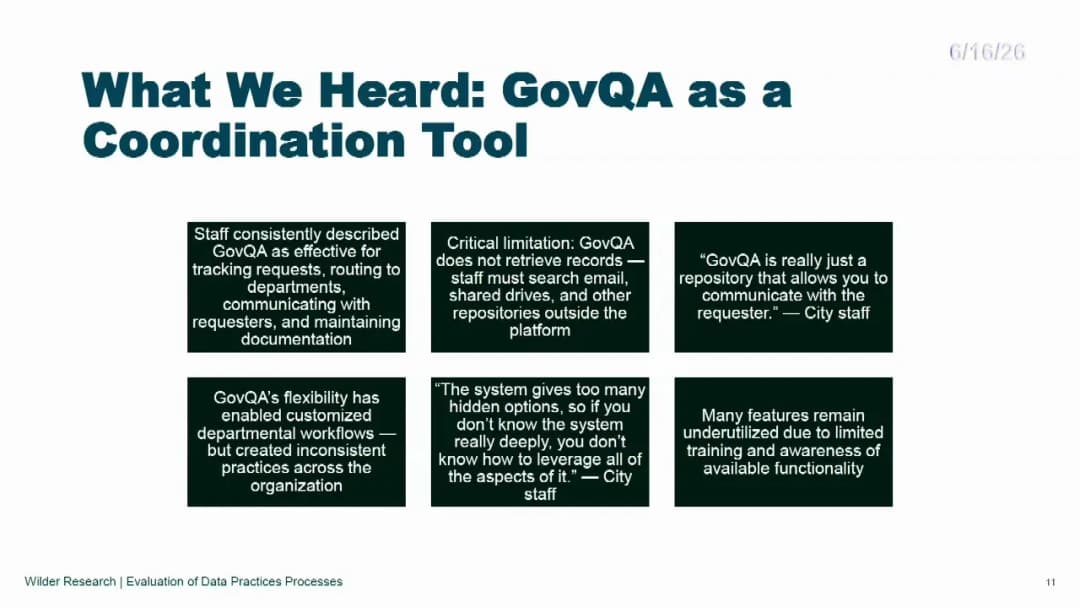
The Audit Committee met on Tuesday, June 16, 2026, at 4:00 PM in City Hall, 3rd Floor. The meeting included a presentation of the Data Practices Study report by Dr. Heather Britt of Wilder Research and a review of potential future audit topics by community advisors. The committee received and filed both agenda items and agreed to further consultations before finalizing the selection of three audit topics for the City Council. Consent Calendar - SR 26-122: Data Practices Study Report and Presentation - Dr. Heather Britt, Wilder Research. Received and filed. - SR 26-123: Topics Review - Community Advisors Jeremy Lostetter, Stephanie Dilworth, and Noah McVay. Received and filed. Discussion Items - Data Practices Study Report: Dr. Britt presented findings from a comprehensive study of the city's public data request process. Key points included: 75,000+ requests from 2022-2025, with year-over-year growth; average close time improved from 20 days to 12 days, but with wide variation (median 4 days); 95% of requests are for the Police Department; recommendations include better use of the GovQA platform, structured intake processes, citywide procedures, staff training, proactive data disclosure, and periodic technology review. Dr. Britt noted that the city's challenges are consistent with peer jurisdictions. Feedback on the draft report is due by June 19, 2026, with a final version expected June 30. - Topic Selection for Future Audits: Community advisors presented a rubric-based ranking of five potential audit topics: (1) Business Licensing and Building Code Operations (combined, due to both being in DSI), (2) College Savings Accounts, (3) District Council Reform, (4) Street Maintenance and Potholes. The subcommittee recommended combining the two DSI topics and proposed three slots for audits in late 2026 and 2027. Discussion ensued about the merits of each topic. Members expressed strong support for DSI and potholes audits as core city functions. District Council Reform was seen as responsive to district council requests and important for understanding their operations. College Savings Accounts raised questions about scope and whether it might be better addressed through a departmental self-assessment or informal review rather than a full audit. The committee debated whether to finalize the three topics at this meeting or gather more information from department directors and Dr. Britt on feasibility and timelines. Councilmember Noecker suggested postponing the final decision to the July meeting after conducting those consultations. The committee also discussed the possibility of requesting a self-assessment from the Office of Financial Empowerment for the College Savings Accounts program if that topic is not selected for audit. Key Outcomes - Both agenda items (SR 26-122 and SR 26-123) were received and filed by unanimous consent. - The committee did not make a final decision on the three audit topics to recommend to the City Council. Instead, it agreed to: - Conduct follow-up consultations with relevant department directors (e.g., DSI, Public Works) and Dr. Heather Britt to assess the scope and timeline of each proposed audit. - Explore the possibility of a self-assessment by departments for some topics (e.g., College Savings Accounts) as an alternative to a full audit. - Return in July 2026 with a finalized list of three recommended topics for council approval.
The Saint Paul Housing and Redevelopment Authority (HRA) Board met on June 10, 2026, at 2:00 PM in City Hall Council Chambers. The meeting covered several items including the acquisition of property at 259 University Avenue W, an update on the Inspiring Communities program for a duplex development at 1087 Ross Avenue, an update on the Emergency Rental Assistance Program, an introduction to reservations of funds for projects applying to Minnesota Housing Finance Agency (MHFA), and later reconvened after the City Council meeting to approve the Galtier Plaza Tax Increment Financing (TIF) District. All resolutions were adopted unanimously. Commissioner Anika Bowie arrived late at 2:02 PM. Discussion Items - Resolution 26-941 – Acquisition of 259 University Avenue W: The Board approved the acquisition of real property located at 259 University Avenue W, District 7, Ward 1. Chair Cheniqua Johnson noted that this acquisition complements existing HRA-owned parcels on the site and expressed hope for future redevelopment. Commissioner Bowie highlighted community engagement and support, including work with district councils and community partners like NDC. The resolution passed 7-0. - Staff Report 26-117 – Inspiring Communities (1087 Ross Avenue): Senior Project Manager Claire Pettry presented a proposal from M&M Real Estate LLC (developer Mohamoud Mire) to develop a duplex on vacant HRA-owned land at 1087 Ross Avenue. The three-bedroom, two-bath units would be sold separately to families earning up to 120% AMI, with an estimated sale price of $235,000 per unit. The total development cost is $906,800, with a per-unit subsidy of $195,900 (total gap $391,800). The developer is a recent participant in Ramsey County’s Emerging and Diverse Developer program. The Board will consider final approval at the June 24 meeting. - Staff Report 26-118 – Emergency Rental Assistance Program Updates: Housing Supervisor Christina Bridston provided an update on the rental assistance program, which provides up to $3,500 per household to halt evictions. In April and May 2026, 257 applications were received, 47 were processed (selected via random lottery), and 31 were approved and paid totaling $87,226. Average payment was $2,766. Staffing is currently at 0.5 FTE; hiring for 2.5 FTE is underway with interviews scheduled, aiming for full staffing by August. The Board discussed the lottery system, AI-generated fraudulent applications, and geographic distribution of applications via heat maps. The program will aim to process 50 applications per month starting June. No action was taken. - Staff Report 26-119 – Reservation of Funds for MHFA Projects: Housing Supervisor Sarah Zorn presented an informational overview of six projects seeking reservation of funds (totaling approximately $15.95 million) to secure points in MHFA’s Consolidated RFP. Projects include Hams West End Apartments (70 units), Gloryville (69 units + grocery), Face to Face (24 units supportive housing), Westminster Vista (147 units), Aragon (53 units), and Ramsey Hill (54 units). The reservations are non-binding; final funding decisions will occur after MHFA’s December board decision. The Board will vote on the reservations at the June 24 meeting. - Resolution 26-926 – Galtier Plaza Tax Increment Financing District: After recessing to the City Council meeting for a public hearing, the HRA reconvened and adopted Resolution 26-926, approving the establishment of the Galtier Plaza TIF District, an amendment to the Minnesota Event TIF Plan, an HRA budget amendment, and related documents including a TIF note and forgivable loan. The resolution passed 7-0. The meeting minutes note that public comments in opposition were submitted by Robert Muschewske and Gerald Mischke, and letters of support were submitted by SPDA & SPDDC and Bill Hanley (via St. Paul Business Times). Key Outcomes - Approved acquisition of 259 University Avenue W (Resolution 26-941) – vote: 7-0. - Approved Galtier Plaza TIF District and related actions (Resolution 26-926) – vote: 7-0. - Received and filed staff reports 26-117, 26-118, and 26-119. - Next HRA meeting scheduled for June 24, 2026, where the Board will consider the Inspiring Communities duplex sale and the MHFA funding reservations. Note: The meeting began at 2:00 PM and recessed after staff reports; reconvened after the City Council public hearing on item 5. Final adjournment time not specified.
The St. Paul City Council Policy Committee met on June 10, 2026, for a two-part meeting. The first segment (30 minutes) focused on a presentation from the End Slavery Minnesota Coalition regarding a constitutional loophole that allows slavery as punishment for crime and efforts to end it. The second segment (one hour) featured a presentation from Urban 3 on land use economics and property tax revenue generation. Consent Calendar - No consent calendar items were discussed. Public Comments & Testimony - No public comments were taken from non-presenters. Discussion Items - Ending Slavery and Expanding Civil Protections Review – Chantel Allen (Executive Director, Indian Slavery Coalition), along with outreach coordinators Max and Josh, presented on the Minnesota Constitution's exception allowing involuntary servitude as punishment for crime. They noted that eight states have removed this exception. The presenters described the exploitation of incarcerated workers paid 25 cents per hour, with an annual income of approximately $580, and the financial strain on families (one in six children in Minnesota experience parental incarceration). They advocated for a constitutional amendment (to be on the 2028 ballot) and a bill reclassifying incarcerated workers as employees entitled to minimum wage, child support payments, and savings upon release (currently capped at $500). Councilmembers expressed strong support, noting personal connections and the need for restorative practices. Councilmember Bowie highlighted the link to mass incarceration and proposed making justice-impacted individuals a protected class. The presenters urged the city to review procurement contracts for prison labor and support the legislative agenda. - Economic Development and Vitality – Ms. Worthington (COO/Principal, Urban 3) presented a land use efficiency analysis for Ramsey County, with emphasis on St. Paul. Key findings: only 43% of St. Paul's land area is taxable; downtown has 33% exempt property and 38% right-of-way, one of the highest rates seen nationally. Downtown taxable value per acre decreased from 13.2 times the county average (2020) to 8.3 times (2025) due to increases in exempt properties. Highly productive examples include the Patagonia-to-Fratellone block on Grand Avenue (highest revenue per acre in the county) and mixed-use infill like Golden Time. Recommendations: replicate successful compact developments, regulate by right (e.g., via zoning), reduce parking minimums, leverage public assets and transit investments (Green Line, Snelling BRT). Councilmember Naker asked how to replicate success when proposals are ad hoc; Ms. Worthington suggested regulating in advance and reducing entitlement timelines. Councilmember Bowie noted the role of community planning (Rondo COT) in enabling density on Selby and Grand. Key Outcomes - No formal votes were taken; the meeting was informational. - Councilmembers expressed strong support for the constitutional amendment and legislative bills to end slavery exception and raise prison wages. - Councilmember Bowie announced intention to bring forward a resolution supporting the campaign. - Several councilmembers requested follow-up meetings with the presenters. - For economic development, councilmembers committed to examining zoning, parking, and procurement policies to encourage productive land use and avoid prison labor contracts.