The meeting was called to order at 6:32 PM by Chair Rep. Tom Bouchard. After attendance and quorum, Lou DeRubis, Director of Public Safety, Health and Welfare, recognized the recent accreditation of the Stanford Health Department. The committee then heard two presentations: an overview of Health and Human Services by Director Jody Bishop-Pullen, and an overview of the Stanford Emergency Communications Center (911) by Director Brian Fonan. The meeting adjourned at 7:52 PM. Discussion Items - Health and Human Services Overview (Item PS32.002): Director Jody Bishop-Pullen presented the department's structure, staffing (88-90 employees), divisions (administrative, environmental health, school nursing, community nursing, housing services, emergency response, health promotion, and grants). Key statistics: 481 flu shots given, 4,000 more medications administered in schools, housing violations doubled, fair rent complaints more than doubled, 66% increase in community events attended. The department achieved national accreditation on February 12, 2026, after a multi-year process involving 140 measures and 203 documents. The community health needs assessment identified behavioral health, access to care, and housing as top issues. Questions from Rep. Blank about reaccreditation (every 5 years with annual reports) and air quality data (available on public safety dashboard). Rep. Diddle asked about most common reasons for representatives to contact health department (housing complaints, encampments, etc.). - Emergency Communications Center Overview (Item PS32.003): Director Brian Fonan presented the 911 center's operations. Staffing: 29 dispatchers goal, currently 26, with 5 civilian supervisors. Center has undergone renovations, added a training room, and implemented RapidSOS Unite software for improved location and translation services (72 dialects, only 4 bilingual dispatchers). Key performance metrics: call answer time under 10 seconds improved from 91.39% in 2024 to 94.47% in 2025, with recent data at 97.2%. Abandoned calls reduced from 211 (10-20 sec) and 760 (20-30 sec) to 66 and 120 respectively. End-of-life Motorola radio equipment (2032) and 25-year-old consoles are concerns. The center operates a drone first responder (DFR) program for situational awareness. Questions from Rep. Adams about drone privacy and legal aspects (directed to Lou DeRubis), Rep. Blank about future move to new public safety building and radio system upgrade, Rep. Diddle about interoperability, Rep. Graham about data storage and third-party access. Key Outcomes - No formal votes or resolutions were taken. The committee received informational presentations. - A motion to adjourn was made and seconded, and the meeting ended at 7:52 PM.
Public Meetings - Stamford, Connecticut
Public Meetings - Stamford, ConnecticutThe Appointments Committee of the Stamford Board of Representatives met on February 25, 2026, at 5:30 PM to interview candidates for reappointment or new appointment to various city boards and commissions. The meeting lasted over four hours and included nine agenda items, followed by votes on each. Discussion Items 1. Golf Commission – Michael Briscoe (Reappointment) Michael Briscoe, current golf commissioner, discussed the recent course redesign at Hubbard Heights, which reoriented holes to improve safety (e.g., redirecting balls away from parking lots). He noted the irrigation system needs upgrading, with a preliminary cost estimate of $1.6 million. Briscoe highlighted his background in civil engineering as an asset for overseeing that project. He also mentioned a growing junior program that is turning away children and proposed a club donation initiative to reduce equipment costs for new golfers. He expressed strong support for making golf more accessible to inner-city youth. 2. Golf Commission – Susan Flynn (New Applicant) Susan Flynn, a golfer and former COO of the Boys & Girls Club of Greenwich, shared her vision for improving facilities at the course, particularly locker rooms and check-in areas. She committed to starting a club giveaway program and developing collaborations with private clubs to provide access for underprivileged youth and adults. She emphasized the importance of workforce housing for city employees and expressed a desire to see more affordable units. 3. Stamford Golf Authority – Gina White (New Applicant) Gina White, a 25-year resident and member of women's golf associations at both Sterling Farms and Hubbard Heights, applied for the Golf Authority. She cited a passion for the sport and a desire to give back to the community. Her priorities include improving tee time access (noting high demand), upgrading women's bathrooms, and increasing youth participation. She acknowledged she needs to learn the specific role of the Authority versus the Commission. 4. Zoning Board of Appeals – George Dallas (Reappointment) George Dallas discussed the quasi-judicial nature of the ZBA, emphasizing that variances are evaluated based on strict regulations and neighbor input. He cited a case involving a Dunkin' Donuts drive-through where the board decided that a previous bank's drive-through approval did not transfer to the new use. He noted that a variance is a variance regardless of commercial or residential context, and that the board looks for alternatives before granting relief. He shared that the board has a diverse membership and takes neighbor opposition seriously. 5. Board of Assessment Appeals – Daniel Axe (Reappointment) Daniel Axe, a real estate investor and licensed agent for 20 years, explained that the board deals with property valuation appeals, mostly during revaluation periods. He described how technology (e.g., Vision databases) has reduced disputes over property characteristics, but revaluations still generate many appeals. He highlighted that comparable sales must be local, and that board members often visit properties personally to assess conditions. He touched on the need for public education about the appeals process and the possibility of delaying revaluation if overwhelming appeals are filed. 6. Board of Ethics – Dennis Torres (Reappointment) Dennis Torres, who teaches ethics at the university level, discussed the board's role in providing advisory opinions and investigating potential code violations. He noted that the code of ethics is not about morals but about applying rules to specific facts. He emphasized that the board has rebuilt trust after a contentious period, and that most people seek guidance to avoid unintentional violations. He acknowledged the code is primarily financial but also covers influence. He saw increasing requests for opinions as a sign of growing confidence. 7. Zoning Board – Roseanne McManus (Reappointment) Roseanne McManus, a longtime zoning board member, touched on many issues: the board's need to approve projects that meet regulations even if unpopular; the value of fee-in-lieu contributions for affordable housing (though she prefers on-site BMRs); the importance of preserving historic buildings; and the need for more trees and green space. She discussed the 2035 comprehensive plan's environmental goals and advocated for stricter tree preservation ordinances. On affordable housing, she noted that the board increased inclusionary zoning requirements in the South End to 12–14%. She also mentioned that most new apartment buildings generate few schoolchildren. 8. Zoning Board – David Stein (Reappointment) David Stein, chair of the zoning board, provided encyclopedic knowledge on zoning regulations. He discussed inclusionary zoning, the affordable housing trust fund, and the balance between on-site BMR units and fee-in-lieu payments. He expressed support for workforce housing (housing affordable to teachers, firefighters, etc.) but noted legal barriers to restricting units to city employees only. He detailed recent environmental initiatives: street tree requirements, electric vehicle charging spaces, publicly accessible amenity spaces (including trails), and a sustainability scorecard for buildings. He also addressed the possibility of rezoning mixed-use areas to reduce commercial impacts on residents, though cautioned against making properties non-conforming. He responded to questions about cluster homes, clarifying that they do not allow denser development than underlying zoning. 9. Zoning Board Alternate – Peter Rustin (New Applicant) Peter Rustin, an attorney with 44 years of experience, including real property litigation, applied for an alternate member position. He acknowledged he has much to learn but cited his legal training in applying rules to facts as relevant. He expressed support for historic preservation and deeply affordable housing, and stated his desire to contribute to the community. Key Outcomes All appointments were approved by the committee with the following votes: - Michael Briscoe (Golf Commission): Approved unanimously (voice vote, no opposition recorded). - Susan Flynn (Golf Commission): Approved unanimously. - Gina White (Golf Authority): Approved 8–1. - George Dallas (Zoning Board of Appeals): Approved unanimously. - Daniel Axe (Board of Assessment Appeals): Approved unanimously. - Dennis Torres (Board of Ethics): Approved 8–1. - Roseanne McManus (Zoning Board): Approved 8–0–1 (one abstention). - David Stein (Zoning Board): Approved 7–0–2 (two abstentions). - Peter Rustin (Zoning Board Alternate): Approved 9–0. The abstentions and no votes were based on concerns expressed by committee members about workforce housing definitions and the need for further discussion with the nominees. All approved appointments will be forwarded to the full Board of Representatives for final confirmation.
This meeting of the Stamford Planning Board took place on Tuesday, February 25, 2026. The board convened with three members present and addressed a capital budget addition, multiple zoning board of appeals (ZBA) referrals, and routine approvals. Key actions included unanimous approval of a capital budget item for bridge replacement and split recommendations on several variance applications. Consent Calendar - Approval of February 10, 2026 Minutes: The board unanimously approved the minutes from the prior meeting. Discussion Items - Capital Budget Addition – Mill Road over Brookbridge (Project CP 4000, Bridge 13508): The mayor requested adding $1 million (split 50/50 between bonds and a state grant) to replace a structurally deficient bridge built in 1960. The project is currently partially closed. Board members discussed the process (supplementary appropriation vs. capital budget), and the item was approved unanimously (moved by Ravi, seconded, all in favor). The board noted the $500,000 bond impact but confirmed the addition is at the mayor's level and does not affect the board's own budget. - ZBA Application 010-26 – M. Rachim at 0 Fairfield Avenue (Lot 1): Applicant proposes a two-family dwelling on a 4,972 sq ft lot (R-5 zone requires 6,000 sq ft for a two-family). The lot is vacant and has been used for dumping. Applicant provided 4 parking spaces (including two for an adjacent lot they own) and an open greenway. Board members expressed concern about setting a precedent for a significant lot size variance (about 17% below minimum). The board recommended denial (unanimous), citing no hardship and the need for uniform zoning changes rather than spot variances. - ZBA Application 011-26 – Paul Publis at 36 Congress Street: Applicant seeks a front yard setback variance of 5.1 ft (required 25 ft) on Keith Street for an addition. The property is in the R-2 zone, and the existing dwelling is legally non-conforming due to the corner lot definition. Board recommended approval (unanimous). - ZBA Application 012-26 – William Hayed for Sharon Axe at 41 Idlewood Place: Applicant requests a rear yard setback variance of 24.6 ft (required 30 ft) to expand a sunroom/enclosed space. The property is in R-2 zone. Board recommended approval (unanimous). - ZBA Application 013-26 – Anna and Cliff Blaze at 75 C Beach Drive: Applicant proposes a first-floor bedroom and bathroom addition for elderly parents (ages 83 and 87) and a second-story addition. The variance requested is for lot coverage: 51.6% (proposed) vs. 20% maximum, with 49.5% existing. The building coverage remains under 20%. The property is in R-1 zone and near Long Island Sound. Board members acknowledged the compelling personal hardship but noted the small increase (2.1%) and encouraged runoff mitigation. Recommended approval (unanimous) with a note to consider reducing impervious surface impacts. - Variance Not on Agenda – Family Centers at 986 Bedford Street: A sign variance was not referred to the Planning Board because it does not affect density, bulk, or parking. The item was pulled from the agenda. Key Outcomes - Capital Budget Addition: Approved unanimously for Mill Road bridge replacement. - ZBA Application 010-26 (0 Fairfield Avenue): Recommended denial (unanimous) – lot size variance deemed too large to set precedent; board suggested comprehensive zoning review instead. - ZBA Application 011-26 (36 Congress Street): Recommended approval (unanimous). - ZBA Application 012-26 (41 Idlewood Place): Recommended approval (unanimous). - ZBA Application 013-26 (75 C Beach Drive): Recommended approval (unanimous) with encouragement to address stormwater runoff. - Next Meetings: March 10, March 24, and April 14, 2026 (confirmed no conflict with spring break). Note: The meeting date from the transcript is February 24, but the user specified February 25, 2026. The summary uses the specified date.
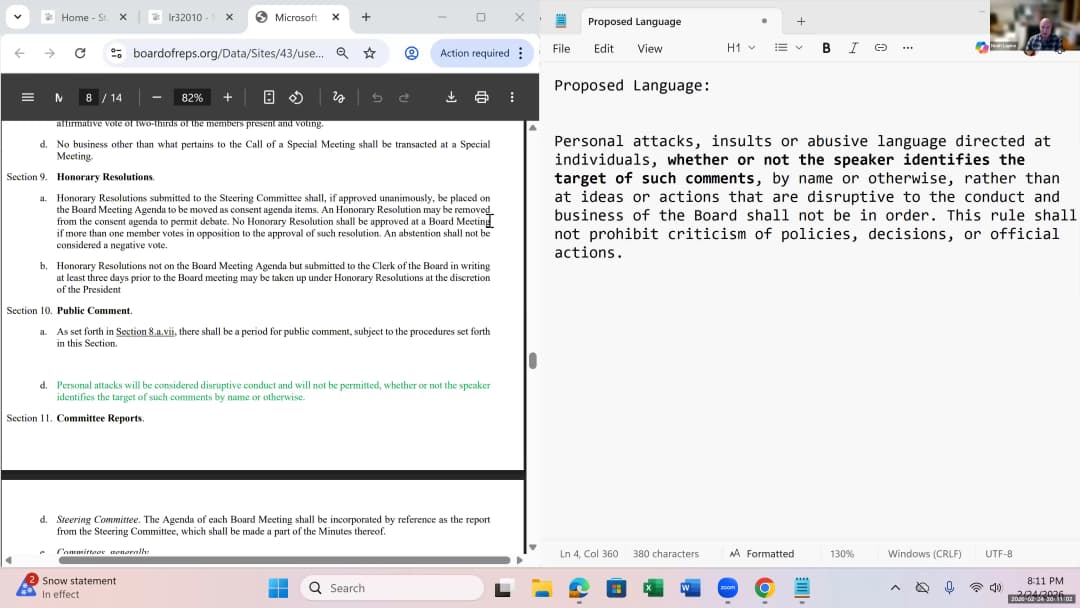
The Legislative and Rules Committee of the Stamford Board of Representatives met on February 25, 2026, at 7:00 p.m. (the meeting was called to order on February 24, 2026, but the official date per agenda is February 25, 2026). The committee considered three agenda items: a proposed ordinance to lower the signature threshold for private road acceptance, a contract for liability claims administration, and an amendment to the board’s rules of order concerning public comment decorum. The meeting adjourned at 8:45 p.m. Public Hearing on Private Road Acceptance (LR 32.004) - A public hearing was held on an ordinance to amend Section 214-32 of the city code to reduce the required petition signature threshold from 100% to two-thirds of property owners for the city to accept a private road. - Three residents spoke in favor: Kathy Hay (Pembroke Drive resident) noted that the current 100% requirement prevented residents from obtaining cost estimates from city engineering; Adam Mann and Christine Johnson also expressed support, citing difficulty in achieving unanimous consent. - One resident, Dave Adams, opposed, arguing that property owners on private roads intentionally chose that status and that lowering the threshold could infringe on property rights. - After the hearing, the committee voted unanimously to approve the ordinance. Discussion and Approval of Liability Claims Administration Contract (LR 32.013) - David Villava, city risk manager, presented a proposed contract with Corvell Enterprise Inc. for third-party liability claims administration. The contract is estimated at $161,363 for year one, $120,806 for year two, $124,478 for year three, with two optional one-year extensions at approximately 3% increases. The contract covers claims from auto accidents, slip-and-falls, wrongful termination, etc. - Representatives asked about the increase over previous contracts (now exceeding $100,000 triggering board approval) and whether the pricing represented the best final offer. Mr. Villava confirmed that the costs had crept up and that Corvell provided a best and final offer after also being awarded the workers’ comp administration contract. - One representative inquired about a large incurred loss of $6.2 million in commercial auto for fiscal year 2023; Mr. Villava attributed it to a single claim with the police department. - The committee voted unanimously to approve the contract. Debate on Amendment to Board Rules of Order (LR 32.015) - The committee considered an amendment to the board’s rules of order to insert new subsections in Section 10 regarding public comment decorum. The original proposal from Representative Pelicia sought to prohibit “personal attacks, insults, or abusive language directed at individuals” and to clarify that criticism of policies, decisions, or official actions is not prohibited. - Representative Pelicia explained his legal research, citing two court cases: White v. City of Norwalk (9th Cir.) upholding rules limiting comment to agenda items, and Bessler v. Board of Education (N.J.) finding a First Amendment violation when a speaker was cut off for critical but non-disruptive remarks. - The committee debated several amendments. Representative Weinberg proposed adding “whether or not the speaker identifies the target of such comments by name or otherwise” after “individuals.” That amendment failed on a 4-4-1 vote. - The main amendment (the right-side language) was then adopted by a 7-2 vote. - When the main motion (approval of the amended rules) came to a vote, it failed 2-7. Several representatives argued that the existing rules already provide sufficient protections and that the amendment was unnecessary or could create free speech issues. - President Shaw, who was present, stated she would prefer to handle decorum on a case-by-case basis. Key Outcomes - LR 32.004 (Private Road Acceptance): Approved unanimously. - LR 32.013 (Liability Claims Contract): Approved unanimously. - LR 32.015 (Rules Amendment): The amendment to the rules was adopted (7-2), but the main motion to approve the amended rules failed (2-7). No change to the rules of order.
The Fiscal Committee met on Monday, February 23, 2026 at 7:01 PM (note: the provided meeting date is February 24, 2026, but the transcript indicates February 23; this discrepancy is unresolved). The committee considered ten items, including appropriations for law department wage settlements, snow removal salt, the West Hill High School replacement project, and several grants. All items were approved unanimously except the first item, which was recommitted to the Steering Committee. Consent Calendar - Item 1 (F32.043) – Additional appropriation for law department wage settlements ($50,945) – Recommended to recommit; see discussion. - Item 2 (F32.044) – Additional appropriation for snow removal salt ($650,000) – Approved unanimously. - Items 3-10 – All approved unanimously. Public Comments & Testimony - No public comments were recorded. Discussion Items - Item 1: Law Department Wage Settlement Appropriation – Representative Dela Cruz questioned whether this was the same tentative agreement rejected by the Personnel Committee due to a negative opinion from the Board of Finance. Chair Morrison noted the Board of Finance had issued a negative opinion but passed the financing 4-2-0. Dela Cruz expressed concern about passing the appropriation before the exact settlement amount was known. After discussion, a motion to recommit the item to the Steering Committee was made, seconded, and passed unanimously. The committee acknowledged that if the full board later approves the settlement, the appropriation would stand but could not be spent until arbitration determined the final amount. - Item 2: Snow Removal Salt Appropriation – Road Maintenance Division Manager Tom Turk testified that the winter has been exceptionally severe, with plow crews working 31 hours straight. He stated that all salt funds had been spent and the $650,000 is needed to maintain safe salt levels for the remainder of the season. Representatives thanked Turk and his crew. Director Kinonis urged maintaining the salt budget in future years. The item was approved unanimously. - Items 3 & 4: West Hill High School Replacement Project – Director of School Construction Catherine Labalbo presented the project history, noting that the total project budget increased from $301 million to $446 million due to post-COVID escalation. The state authorized 80% reimbursement, leaving the city’s share at 20%. The additional appropriation of $144,686,112 is needed to match the state authorization. Item 4 authorized $36,171,528 in general obligation bonds, with the remainder covered by grants. Representatives asked about bond interest rates (estimated around 3-3.25% for 20-year maturity) and whether the school replacement was linked to mold remediation (Labalbo explained it was part of a long-term facilities plan). Both items were approved unanimously. - Items 5 & 6: DRE Instructor Grant – Grants Officer Anita Carpenter explained that the $41,107 grant from NHTSA funds a Stamford police officer to provide statewide drug recognition training. The resolution authorizes the mayor to sign the agreement. Both items approved unanimously. - Items 7 & 8: Heat and Air Quality Preparedness Plan Grant – Representative Dela Cruz raised concerns about fragmented air quality efforts, questioning how this $24,500 grant fits with other monitoring initiatives. Carpenter stated it is coordinated through the Health Director and focuses on vehicle-related emissions. Dela Cruz indicated he would submit a request to the Public Health and Safety Committee for a holistic understanding. Both items approved unanimously. - Items 9: Youth Services Internship Program – $25,000 grant for a seasonal hire and administrative support, funded by internal transfers. Approved unanimously. - Item 10: Hatchfield Park Improvements – Resolution authorizing agreement with DEEP. No match required. Approved unanimously. Key Outcomes - Item 1 (F32.043) – Motion to recommit to Steering Committee passed unanimously. - Items 2-10 – All approved unanimously. - The meeting adjourned at 7:38 PM.
The Operations, Parks, and Recreation Committee met on February 20, 2026, at 7:00 PM, with Chair Sanford presiding. The committee suspended the rules to take up agenda items out of order, hearing first from Director Matt Canonez and Corporation Counsel Dana Lee. Two items were considered: an ordinance amending Chapter 214 of the city code concerning excavation permits, enforcement, administrative fees, and cost recovery (OPR 32.003), and a resolution to reduce building permit fees for commercial projects exceeding $1 million (OPR 32.002). Both items were approved on voice votes and will proceed to the full board for public hearings and final adoption. Excavation Permit Ordinance (OPR 32.003) - Director Canonez and Attorney Lee presented a package of three ordinances (214‑29, 214‑30, 214‑31) that: - Transfer enforcement and permit decision authority from the city engineer to the Director of Operations or designee, allowing flexibility and consolidation within the newly organized transportation department. - Set civil fines at the maximum allowed by state law (currently $250) to remedy a potential illegality from a previous formula tied to permit fees. - Introduce administrative fees for permitting, inspection, and enforcement costs. - Establish cost recovery for city labor (direct and indirect) when the city performs restoration due to non‑compliance. - Create tiered permit denial actions (90 days, 1 year, permanent) for violations. - Representative Finkel inquired about applicability to the planned EverSource underground transmission line project. Attorney Lee confirmed that existing permits retain original terms, but future permits and violations will fall under the new ordinance; Director Canonez estimated 90‑95% of the project would be covered. - Representative Finkel also asked about timelines for temporary versus permanent repairs. Director Canonez responded that timelines are established per permit, and the ordinance strengthens enforcement to prevent extended temporary patches. - The committee approved all three ordinances by voice vote. Building Permit Fee Reduction (OPR 32.002) - A resolution proposed reducing the building permit fee for commercial projects exceeding $1 million from $35 per $1,000 to $25.26 per $1,000 of estimated cost, aligning the threshold with existing ordinances at $1.3 million. - Committee members expressed various positions: - Representative Finkel supported the reduction, noting the building official’s agreement and that most permits are for mid‑range values. - Representative Hughes (co‑sponsor) argued lower upfront costs encourage housing and mixed‑use development, addressing the housing crisis. - Representatives Gardiner, Didalow, and Zachary supported the reduction, stating fees should cover costs, not generate surplus, and that costs are passed to renters and businesses. - Representative Camporelli opposed, citing lower fees than other municipalities and requesting data showing fee revenues cover costs to protect taxpayers. - Representative Didalow referenced New Rochelle, NY, where lower fees ($16 per $1,000) correlated with decreased rents. - A motion to further reduce the fee to $16 per $1,000 failed for lack of a second. - The resolution was approved by voice vote (apparently unanimous). Key Outcomes - OPR 32.003 (Excavation permit ordinance): Approved Ordinances 214‑29, 214‑30, and 214‑31 by voice vote. Next steps: public hearing before the full board, followed by final adoption. - OPR 32.002 (Building permit fee reduction): Approved resolution to set fee at $25.26 per $1,000 for commercial projects over $1.3 million. Next steps: full board consideration and public hearing. - Chair Sanford committed to obtaining a written clarification from the law department on whether building permit fees are deposited into the general fund and their relationship to the Affordable Housing Trust Fund. - Representative Camporelli requested a report showing whether fee collections have covered city costs over the past three to four years.
The Land Use and Urban Redevelopment Committee met on February 19, 2026, at 7:01 PM to consider two items: the acceptance of a newly constructed road as a city street and a review of a home rehabilitation assistance program. The meeting was chaired by Rep Hughes and included members Reps Price, Politia, Finkel (arrived late), Roudreaux, Gardner, Adams, Walston, Camparelli, and Beckham. The meeting adjourned at 7:50 PM. Discussion Items Item LU32.004 – Resolution Accepting Newly Constructed Northridge Road as a City Street - City Engineer Lou Chancellor presented an overview of the project. Northridge Drive, located off High Ridge and Cascade Road in North Stamford, was approved by the Planning Board in 2017 as a public road. Construction was completed and certified by the Engineering Department as meeting city standards. A two-year maintenance bond (15% of the performance bond) is required from the developer. Attorney John Leiden formally petitioned for acceptance. Rep Adams asked clarifying questions about city ownership and maintenance responsibility. Chancellor confirmed that once accepted, the road becomes a city asset, with the maintenance bond covering repairs during the first two years. The committee voted 7-0 in favor of the resolution, accepting the road as a city street. Rep Finkel arrived after the vote and was not permitted to vote on this item. Item LU32.005 – Review of Owner Occupied Home Rehabilitation Assistance Program - Moira Sauch, CDBG Administrator, presented the program, which provides forgivable loans of up to $10,000 to low-income homeowners for quality-of-life and urgent repairs (e.g., roof, windows, hot water heaters, accessibility ramps). The program is funded by $100,000 from Community Development Block Grant (CDBG) funds and $50,000 from a blight remediation fund, totaling $150,000. Homeowners must meet HUD income guidelines (approx. $79,000 for single person, $113,000 for family of four), have lived in the home for at least 18 months, and maintain insurance. Contractors must be pre-approved and registered in SAM.gov. The city will pay contractors directly after homeowner approval and any required building permits (fees waived). Loans are forgiven after five years of continued occupancy. The blight fund can be used for exterior repairs (e.g., broken windows, damaged siding). Rep Adams, Rep Walston, Rep Price, Rep Boudreau, and Rep Politia asked questions about income limits, contractor bidding, payment timing, and blight enforcement. Rep Walston suggested moving oversight to the housing committee, but Sauch clarified the program remains under community development. No vote was taken; the item was for review and discussion. Key Outcomes - Item LU32.004: Resolution passed unanimously (7-0). Northridge Road is accepted as a city street, with a two-year maintenance bond required from the developer. - Item LU32.005: No action taken; the program was presented for committee review and feedback. The soft launch is scheduled for the upcoming housing fair at Wright Tech.
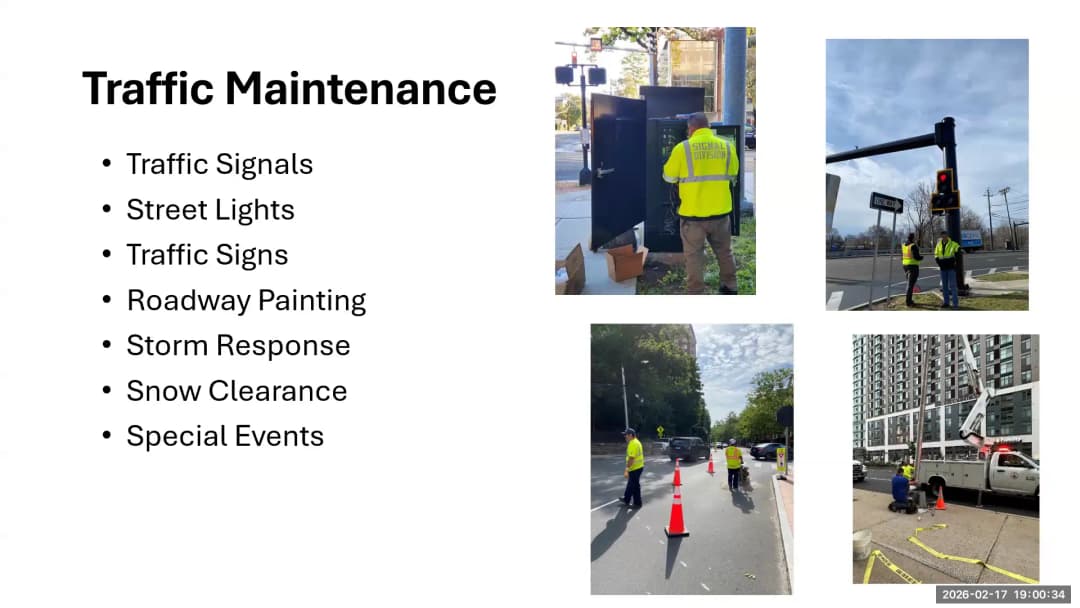
Note: The meeting transcript indicates the meeting occurred on February 17 at 6:31 p.m., while the provided date for this summary is February 18, 2026. This discrepancy is noted. The Transportation Committee convened to receive an overview of the newly consolidated Transportation Department. Director Kionis (who joined late), Thomas Turk (Director of Transportation), and Luke Buttonweiser (Senior Transportation Planner) presented the reorganization, which merges road maintenance, traffic maintenance, transportation planning, and parking under one umbrella. The committee discussed operations, snow response, parking enforcement, the Fix It system, and addressed constituent concerns. Discussion Items - Department Reorganization: Thomas Turk explained that the former Bureau Chief of Transportation position was eliminated, and he was promoted from Road Maintenance Manager to Director of Transportation. The new structure consolidates previously siloed departments: Road Maintenance (managed by Doug Hoyt), Transportation Planning (led by Luke Buttonweiser), Traffic Maintenance (signals, signs, lines, managed by Steve Fritz), and Parking. The reorganization is cost-neutral and aims to improve efficiency and communication. - Snow Operations & Seasonal Constraints: Turk detailed that the department has faced an unusually harsh winter with 14 storms, depleting salt supplies. The city maintains three salt domes with a total capacity of 13,000 tons and started the season full, which was critical. Salt delivery delays occurred due to barges being locked in ice. The department prioritizes proactive salting before storms. Leaf pickup (November–January) and snow operations (November–April) delay other maintenance like pothole repairs. Committee members were encouraged to educate constituents about these seasonal limitations. - Sidewalk Snow Removal: Turk explained that the city cannot clear all sidewalks; it relies on property owners per ordinance. Enforcement and education are increasing, but the city lacks the resources to assist all residents. Crosswalks and curb ramps are a gray area; the department is considering ordinance updates. Volunteer groups are welcome to help without city permission. - Parking Enforcement: Director Kionis and Turk discussed parking rules. Out-of-state plates are not automatically violations; the 120-hour rule applies to abandoned vehicles. Commercial vehicles (e.g., dump trucks) parking on residential streets overnight may be a parking violation based on size and plate type, but vans or pickup trucks with company logos are generally allowed. Parking enforcement includes booting for three or more unpaid tickets. Representative Walston raised concerns about work trucks parking on Connecticut Avenue, and Kionis offered to have parking enforcement follow up. - Fix It System: Director Kionis described the Fix It system as the primary way for residents to report issues. Tickets are reviewed by the citizen service department and routed to the appropriate department. Response times vary; seasonal issues like snow and leaf pickup generate high volumes. The department holds monthly synchronization meetings to improve responses. Streetlight and zoning enforcement responses have improved; long-term items like sidewalk repairs depend on budget. - Traffic Signal Issue: Representative Adams reported a sensor problem at the intersection of Letlow and Pacific, where the light takes over two minutes to change. He had submitted Fix It tickets without resolution. Turk and Buttonweiser said they would follow up. Key Outcomes - The committee received the presentation and discussed the reorganization in detail. No vote was taken as the item was for review only. - Director Kionis committed to sending an email to committee members with names and contact information of department managers. - The city anticipates proposing ordinance changes to the committee in the coming months, including potential updates to sidewalk snow removal rules. - The meeting adjourned without a motion, as noted by the chair.
The Personnel Committee of the Board of Representatives met on February 17, 2026, at 7:12 PM (local time) to consider two agenda items: a rejection vote on the tentative collective bargaining agreement for the Assistant Corporation Counsel Union, and an educational presentation on the city's pay plan and classification system for non-union appointed and elected officials. The meeting was chaired by Representative Weinberg, with HR Director Dr. Russell presenting. Discussion Items 1. Rejection of Assistant Corporation Counsel Union Labor Settlement (P32.008) Dr. Russell presented the terms of the tentative agreement (TA) for the Assistant Corporation Counsel Union, covering July 1, 2025 through June 30, 2029. The proposed general wage increases were: 3% retroactive July 1, 2025; 3.25% July 1, 2026; 3% July 1, 2027; and 3% July 1, 2028. Health insurance employee contributions would increase to 17% on July 1, 2025, then 18.5% for the remainder of the term. The agreement included two pension options for exchanging unused sick and vacation days at retirement (Option A: additional pension credit capped at 4%; Option B: one-time lump sum payout), with costs borne by the SERF plan. The union also agreed to permit the city to implement performance reviews after negotiation of impacts. Committee members expressed concerns about the wage increases being higher than some peer settlements, the precedent for future negotiations, the lack of an outside attorney on the city's negotiating team, and the negative opinion from the Board of Finance. Representative Pavia (also referred to as Virgil) moved to reject the agreement, citing fiscal concerns and the Board of Finance's negative opinion. The motion was seconded. 2. Review of City HR Policies and Pay Plan (P32.003) Dr. Russell delivered a presentation on the city's pay plan for non-union appointed and elected officials. The plan is designed to maintain internal equity, market competitiveness, and transparency. It applies to non-union positions, assigns salary grades with four steps, and includes guardrails for appointments, promotions, step increases, and reallocations. Annual market adjustments are based on the World at Work executive compensation index (2.2% for July 1, 2025). A recent compensation study (January 2026) found that many pay plan roles fall below the municipal market average (around 33rd percentile) and identified salary compression. The study did not replace the pay plan but informed policy discussions. Compensation for elected officials is formula-driven, tied to Step 3 of Grade 8, with the mayor at 115%, town clerk at 80%, and registrars at 60% of that grade. The city is developing a formal performance management system expected within six months, which will strengthen the link between step increases and performance. Key Outcomes - Rejection of Assistant Corporation Counsel Union Labor Settlement: The committee voted on the rejection item (P32.008). A yes vote was a vote to reject the agreement. The roll call resulted in 5 yes votes (Weinberg, Pavia, De La Cruz, Gross, Sally) and 0 no votes. The motion to reject passed, and the matter will proceed to the full Board of Representatives for a final decision. If the board rejects the TA, the city and union may either reach a new settlement or proceed to arbitration. - No action taken on the HR policies presentation (P32.003): The presentation was informational; no vote was required.
The Stamford Planning Board met on February 11, 2026, to consider several agenda items including approval of a form lease for the Lathan Wider Community Center, a senior living development, and multiple zoning text and map changes. All votes were unanimous. The meeting lasted from approximately 7:00 PM to 8:16 PM. Consent Calendar - Approval of the February 3, 2026, planning board minutes was moved and seconded, passing unanimously. Discussion Items - Lease Agreement for Lathan Wider Community Center: The board reviewed a proposed form lease to be used with tenants at the Lathan Wider Community Center (34 Woodland Avenue). The building closed in January 2025 due to a water main break and is now reopening with up to eight nonprofit tenants. City representatives Bridget Fox and Chris Delasalva presented. Questions focused on liability protections, insurance requirements, and tenant modifications to the space. The board approved the form lease unanimously. - Subdivision 4058 – 248 Hunting Ridge Road: The board granted a 90-day extension to file the final map, with a new expiration date of May 12, 2026. Approved without discussion. - Senior Living Community at 35 Terrace Avenue (ZB226-01): Applicant Lenny Brayman presented a proposal to consolidate properties and redevelop a six-unit independent senior living facility (deed-restricted for seniors and people with disabilities). The plan includes three units with one-car garages and three with two-car garages. Discussion covered parking ratios, garage arrangements, tree conservation, and consistency with the comprehensive plan. The board voted unanimously to recommend approval to the Zoning Board. - Text Change for CL (Commercial Large Format Retail) District (ZB225-47): Ralph from Land Use presented updates to add design standards, buffers when abutting residential districts, lot coverage limits, drive-through regulations, and a definition for arterial streets. The board approved the text change unanimously. - Map Change for McKeethan Park and Vacant Parcel (CP226-02): The board approved rezoning two city-owned parcels (McKeethan Park and a vacant lot on Maitland Road/Judy Lane) from residential to park district to protect open space. Approved unanimously. - Omnibus Text Change (ZB226-03): A collection of minor updates including definitions (bus shelters, smoke shop cap of one per 15,000 residents), BMR fee increases, publicly accessible amenity space signage, and street tree provisions. Approved unanimously. - Text Change for R6 District (ZB226-04): Revised side yard requirements to encourage parking in the side yard instead of the front yard, reducing front setback from 25 to 15 feet and increasing rear setback. Approved unanimously. - Text Change for Special Permit Uses in Single-Family Districts (ZB226-05): Introduced lot coverage maximums for houses of worship, daycare centers, and similar uses. Added a definition for physical culture establishment. Approved unanimously. Key Outcomes - All listed items were approved unanimously by the board. - The board noted that the next regularly scheduled meetings are February 24, March 10, and March 24, 2026. - No public comment was received.