The Stamford Planning Board held a special meeting on July 23, 2026, at 2:30 PM to consider a supplemental capital appropriation for the Yearwood Center Renovations Project and to approve the closeout of multiple capital projects. The meeting was called to address the time-sensitive nature of ARP fund expenditure before the December 31, 2026 deadline. The board approved the appropriation and closeouts. Consent Calendar - Minutes of June 23, 2026: Approved unanimously. Motion by Jeremy, second by Chet. Discussion Items - Yearwood Center Renovations Project (CP9238): The project involves interior renovations, including mechanical, electrical, and plumbing upgrades. The total request is $2,262,233. The project had an initial $1.9 million authorized, and design estimates were $4.2 million. The lowest construction bid came in at $3.5 million (later corrected to $3.8 million). The additional authorization of $2.2 million will bring the total to $3.8 million, funded by: $1.2 million in ARPA funds, $1.1 million in disaster recovery proceeds (FEMA funds from projects over 10 years ago), and $750,000 in private contributions (old community development funds). The project was not in the 2026-27 capital budget, but became urgent due to significant asbestos discovered during design, requiring relocation of the Boys & Girls Club and other tenants. The board discussed the provenance of the disaster recovery and private funds, confirming they are unrestricted and can be repurposed. The board questioned the decision to prioritize this project over other capital needs. Staff explained the displacement of children and the community impact justified the urgency. - Capital Closeout Recommendations: Pursuant to Stamford City Code Section 8-2, partial closeouts of 10 capital projects were recommended to free up ARP funds totaling $330,238. These funds will be transferred to the Yearwood project. Projects included: Citywide Storm Drains ($1,656.97), Environmental Compliance ($35,435), Government Center Renovations ($2,013.17), and others. The closeouts represent balances remaining from completed projects. Key Outcomes - Motion to approve the supplemental capital appropriation for Yearwood Center Renovations (CP9238): Approved by a show of hands. (Motion by Robbie, second by Ashley). - Motion to approve the capital closeout recommendations: Approved by a show of hands. (Motion by Chet, second by Jeremy). - The board adjourned, with next regular meetings scheduled for August 11 and August 25, 2026, and September 8, 2026.
Public Meetings - Stamford, Connecticut
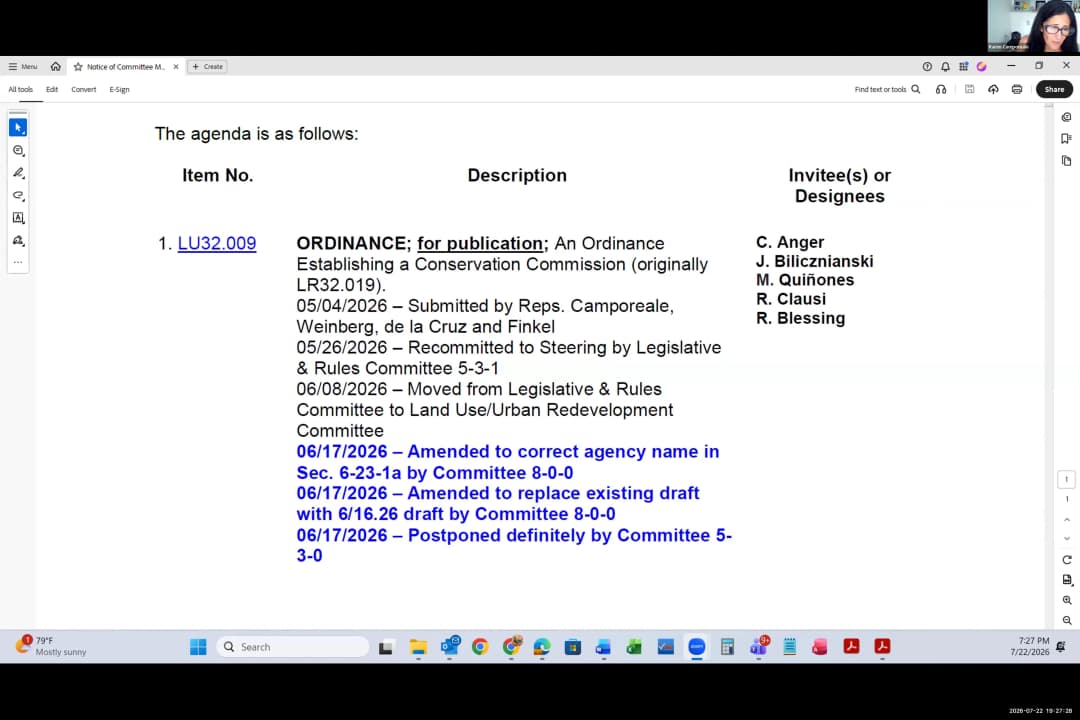
Public Meetings - Stamford, ConnecticutNote on date: The transcript and minutes indicate the meeting occurred on July 22, 2026, but the provided instructions specify the meeting date as July 23, 2026. This summary uses the instructed date but notes the discrepancy. The Land Use-Urban Redevelopment Committee of the Stamford Board of Representatives met remotely to consider a single agenda item: Ordinance LU32.009, which would establish a Conservation Commission. After extensive debate, multiple amendment attempts, and procedural votes, the committee approved the ordinance as written and advanced it to a public hearing before the full Board of Representatives. Public Comments & Testimony - Richard Freedman (Board of Finance member and President of Garden Homes Management) expressed strong opposition to the ordinance as written, arguing that even an advisory commission could be weaponized to delay housing development. He proposed two specific restrictions: (1) the commission shall not make recommendations to zoning, planning, or wetlands agencies on proposed land use changes; and (2) the commission shall not review land use or building permit applications of any type. He stated that because Stamford plays a singular role in constructing housing for the state, different safeguards are warranted. - Ralph Blessing (Land Use Bureau Chief) and Eleanor Blomstrom (Environmental Sustainability Coordinator) spoke in support of the ordinance, emphasizing that the commission would focus on big-picture conservation policy, grant applications, and studies—not individual project review. Blessing noted that current staff lack bandwidth for open space planning and coastal resiliency work. - Robert Clausi (Director of the Environmental Protection Board) supported the split, explaining that the EPB is overwhelmed with wetlands permitting and cannot dedicate time to conservation work. - Cynthia Anger (Assistant Corporation Counsel) provided legal opinions throughout the meeting, stating that the amendments proposed by Freedman and others likely exceed what state statute authorizes and could create legal ambiguity. Discussion Items - Presentation by Rep. Camporeale (sponsor): She explained that the Conservation Commission is authorized under Connecticut General Statute §7-131a, is purely advisory, does not issue permits, enforce regulations, or make binding decisions. The ordinance simply separates existing conservation functions from the EPB’s regulatory duties. She argued that the commission would help the city apply for grants, study natural resources, and provide science-based advice—without impacting housing development. - Rep. Field’s motion to approve as written (seconded): He argued that all questions had been answered by city professionals, other towns haven’t added restrictions, and the commission structurally cannot stop projects. He urged sending the ordinance to a public hearing immediately. - Co-Chair Hughes’ concerns: He questioned the origin of the ordinance (asserting it was requested by a private citizen, not the EPB) and expressed concern about potential misuse. He proposed an amendment to restrict the commission from acquiring land or easements and to limit acceptance of gifts. He also noted that any addition of a commission means more referral letters and steps in the development process. - Rep. Boudreau’s initial amendment (failed for lack of second): Would have given the mayor veto power over land acquisitions approved by the Board of Representatives. He withdrew after no second. - Rep. Gardner’s amendment to Hughes’ amendment: Incorporated Freedman’s language (no recommendations on land use changes and no review of land use/building permits). The amendment was read into the record. Corporation Counsel opined it was likely unlawful. The amendment failed 3-4-2 (Hughes, Adams, Gardner in favor; Price, Beckham, Field, Finkel against; Boudreau, Pelliccia abstained). - Co-Chair Hughes’ amendment (as originally proposed): After Gardner’s amendment failed, the committee voted on Hughes’ original amendment (restricting land acquisition and easements). It failed 4-5-0 (Hughes, Adams, Gardner, Pelliccia in favor; Price, Beckham, Boudreau, Field, Finkel against). Key Outcomes - Main Motion to Approve Ordinance for Public Hearing passed 6-2-1 (Price, Adams, Beckham, Boudreau, Field, Finkel in favor; Hughes, Gardner against; Pelliccia abstained). The ordinance will now proceed to the full Board of Representatives for a public hearing. - Meeting adjourned at 8:57 PM.
The CHESS Committee met on Tuesday, July 21, 2026 at 6:31 p.m. in the Democratic Caucus Room and via Zoom. Co-Chairs Maureen Pollack and Stephanie Sylvestre presided, with members Reps. Goldberg, Gross, McKeown, Price, Walston, Wirz, and Yaeger present. The committee considered two items proposing to reject allocations from the Affordable Housing Trust Fund; both rejections failed unanimously, thereby approving the funds. Discussion Items - CHESS32.019: Rejection of $500,000 to Pacific House, Inc. for 15 units of affordable housing at 66 Stillwater Avenue. Land Use Bureau Chief Ralph Blessing explained that the project previously received a $750,000 allocation. Additional funds are needed due to increased construction costs and changes in federal policy. The units will be deeply affordable: seven units for households earning 0-30% of area median income, the rest under 50%. Total project cost is approximately $10 million. Committee members expressed support; Rep. Gross clarified the voting procedure (vote "no" on rejection to approve). The motion to reject failed 0-9-0. - CHESS32.020: Rejection of $150,000 to Charter Oak Communities for security deposits for up to 60 new Housing Choice Voucher (Section 8) recipient households. Blessing and Housing Director Emily Gordon explained that Section 8 vouchers cover rent but not security deposits. Charter Oak contributed $100,000; returned deposits can be reused. This is the Trust Fund's first programmatic (non-brick-and-mortar) allocation. Rep. Wirz noted that typical security deposits are two months' rent, making this assistance critical. Rep. Gross confirmed the federal government does not provide deposit assistance. The motion to reject failed 0-9-0. Key Outcomes - Both rejection motions (CHESS32.019 and CHESS32.020) failed by identical votes of 0-9-0, meaning the $500,000 and $150,000 allocations are approved. - The meeting adjourned at 6:48 p.m.
The Transportation Committee met at 6:33 PM on July 20, 2026, with Chair presiding. Members present: Stephen Shore, Dan Sanford, Scott Stone, John Polliccia, Kara Gilbride, Ryan Hughes, and Terry Adams. Candace Weathers was absent. Staff Luke and Chris Delasov attended. The sole agenda item was T32, an RFP (2025.0147) for design services on Washington Boulevard safety improvements, submitted by the mayor on June 8, approved by the Board of Finance on July 9. Discussion Items - Project Overview: Luke explained that Washington Boulevard is a state-owned, high-crash corridor with recent pedestrian fatalities. A road safety audit was conducted in 2023 with the state, producing a detailed report with community input. The city allocated $450,000 in the prior capital budget for design. The RFP received two bids; Stantec was selected for $403,245. The contract covers creation of construction documents for safety improvements such as raised crosswalks, speed humps, protected bicycle lanes, and intersection modifications. The design process would take about 2–2.5 years, with public meetings at each stage. Construction funding is not yet secured but could begin in 2027 (for separate projects) or 2029 for this corridor-wide design. - Document Access Concerns: The Board of Reps website had been down for several days. Chair apologized, noting the agenda and documents were emailed to the full board that morning. Representative Stephen Shore stated he had not reviewed the RFP proposal or vendor documents and moved to postpone the item until the next regular meeting. Other members (Dan Sanford, Kara Gilbride, Ryan Hughes) noted the documents were attached to the morning email and expressed support for immediate approval, citing urgent safety needs and community demand. Key Outcomes - Motion to Postpone: Representative Shore moved to postpone to the next meeting. The motion lacked a second and failed. - Motion to Approve: Representative Terry Adams moved to approve the contract with Stantec for $403,245. The motion was seconded. The vote was 7-1-0, with Representative Shore voting nay and no abstentions. Candace Weathers was absent. - Next Steps: The contract proceeds to the full Board of Representatives for final approval. Following that, design work will begin with survey and public engagement.
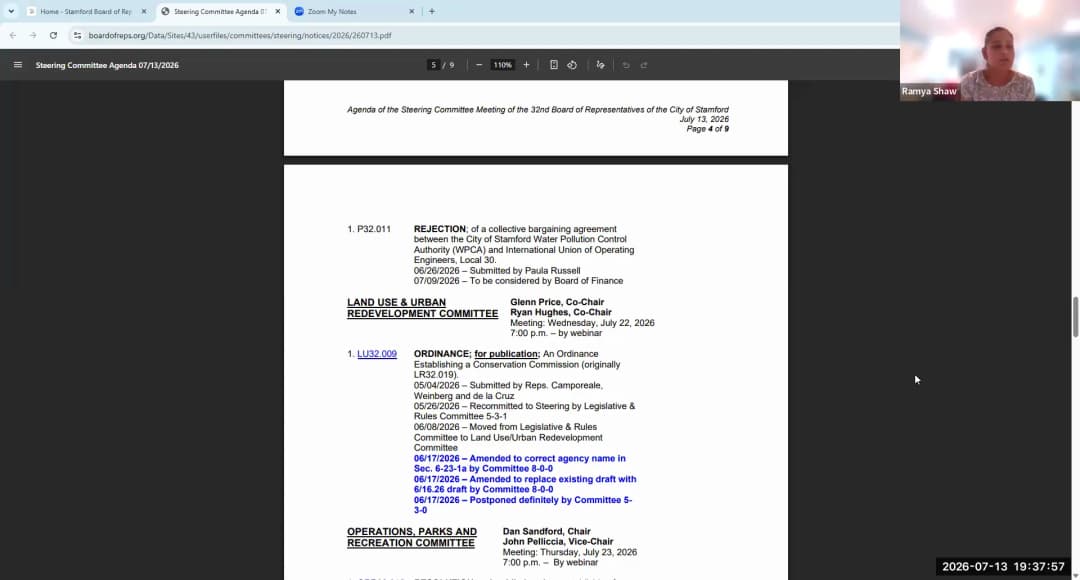
The Steering Committee of the 32nd Board of Representatives of the City of Stamford met remotely on Monday, July 13, 2026, at 7:01 p.m. President Shaw presided. The primary purpose was to set the agenda for the August 3, 2026, regular board meeting by considering items from each standing committee. A significant debate occurred over the Land Use & Urban Redevelopment Committee's decision to hold or postpone its July meeting regarding the Conservation Commission ordinance. All other committee items were moved to the August agenda by unanimous voice votes. Discussion Items - Land Use & Urban Redevelopment Committee – Conservation Commission Ordinance (LU32.009): Co-Chair Price initially indicated he would not hold the July 22 committee meeting, effectively postponing the ordinance until August. Rep. Camporeale, the ordinance sponsor, argued that no further work was needed—legal counsel had addressed Rep. Hughes' concerns, stating the ordinance already accomplished what he wanted and that his proposed amendments would create bad law. Rep. Hughes countered that his concerns had not been addressed. President Shaw clarified that because the item had been postponed definitely from June, it would automatically appear on the next committee agenda, but the chair had discretion to cancel the meeting. After discussion, Co-Chair Price agreed to hold the July 22 meeting as scheduled, allowing for legal counsel testimony and further deliberation. Rep. Morrison urged members to get questions answered ahead of the meeting. - Personnel Committee – WPCA Collective Bargaining Rejection (P32.011): Acting Chair Pavia (substituting for absent Chair Weinberg) moved the item to the August agenda. The meeting schedule was confirmed for Thursday, July 30, 2026, at 7:00 p.m. (changed from a tentative special meeting). - All Other Committees: Each chair moved their respective items to the August agenda without dissent. The committees and their items were: Appointments (9 nominations); Fiscal (items F32.091–F32.095, renumbered); Legislative & Rules (LR32.020, plus LR32.017 automatically on agenda); Operations, Parks & Recreation (OPR32.012–OPR32.016, with OPR32.017 moved to pending agenda); Public Safety & Health (PS32.010); CHESS (CHESS32.019–CHESS32.020); Transportation (T32.005). Meeting minutes from July 6, 2026, were also placed on the August agenda. Key Outcomes - Land Use Committee Meeting to Proceed: Co-Chair Price reversed his initial decision and will hold the July 22 meeting as scheduled to discuss the Conservation Commission ordinance, with legal counsel available. - Unanimous Voice Votes: All other items presented for the August agenda were approved by unanimous voice votes (with President Shaw, Vice-Chair Morson, and all present committee members voting aye). - Pending Agenda Unchanged: President Shaw called for any committee chairs to move items from the pending agenda to the August agenda; none did. The pending agenda remains as previously listed. - Adjournment: The meeting adjourned at 7:46 p.m.
The Stamford Board of Representatives met on July 7, 2026, at 6:30 PM, recessed, and reconvened at 8:00 PM. The meeting featured the Mayor's State of the City address, public comments, and action on several committee reports. Key outcomes included the advancement of an ordinance to establish information reporting requirements for the Mayor's Office (LR32.017) to a public hearing, and approval of a consent agenda covering multiple appointments, appropriations, and fee schedules. Consent Calendar - Appointments Committee (Items 2–10): Approved unanimously. Appointments to the Environmental Protection Board, Parking Violation Hearing Officers, Fire Commission, and others. Representative Didiow abstained from items 6–10. - Fiscal Committee (Items 1–2): Approved unanimously. Included an additional appropriation of $324,646 for the Stanford Police Department Behavioral Health Unit (SAMHSA funds) and $62,566 for the grant office LGPQE program. - Personnel Committee (Item P32.009): Approved unanimously. Employment contract for Diversity, Equity, and Inclusion Officer Janine Freeman. - Operations, Parks & Recreation Committee (Items 1–2): Approved unanimously. Fee schedules for E. Gaynor Brennan Golf Course and Terry Connors Ice Rink. Public Comments & Testimony - Kieran Edmondson (Wallest Sign neighborhood resident) expressed support for additional funding for the Stanford Police Department's Behavioral Health Unit through the Recovery Network Programs, urging the board to approve the related appropriation. - Mr. Papa (resident) criticized the city's focus on new construction over maintenance, citing failures in planning and upkeep. He also noted he changed his party registration from Democratic to Republican. - Don Mays (former District 19 representative) highlighted neglect of road maintenance in North Stamford, including overgrowth, broken curbs, lack of street sweeping, and dangerous conditions. He requested a joint review by the Operations and Public Safety Committee and proposed amending Chapter 214 of city ordinances to clarify city responsibility for right-of-way maintenance. Discussion Items - Mayor's State of the City Address (2026): The mayor presented an overview of the city's vision, budget, and progress on priorities. Key points: - Stanford population: 140,000; commercial vacancy rate decreased from 28% to 23%; apartment occupancy 94%. - FY2627 budget: $726 million, with half to Board of Education. City maintains AAA bond rating; pension obligations 87% funded. - Affordable housing: Over 700 affordable units completed or in pipeline (goal of 1,000). Increased below-market rate requirements from 10% to 14% in some districts. - Infrastructure: Groundbreaking for West Hill High School ($425M, 80% state reimbursement); progress on Stanford Transportation Center rebuild; solar installations, EV chargers, LED streetlights, tree planting, and food scraps recycling program (330,000+ pounds diverted). - Public safety: AI translation for 911 calls; 95% of calls answered within 10 seconds; drone as first responder program (response time under 90 seconds). - Transportation: StamForward microtransit completed 128,000 total rides; new SeaStreak ferry to Citi Field. - Other: FixIt Stamford system (9,700 requests, 7,800 completed); new ADA and Disability Resource Center; Husky D coverage task force. - Legislative & Rules Committee – LR32.017: Ordinance to establish information reporting requirements for the Mayor's Office regarding applicants and appointees to city boards and commissions. The committee voted to send it to a public hearing. Debate ensued: - Representative Weinberg opposed, arguing the ordinance is unnecessary, burdensome, and may focus on the wrong issues (mayoral decisions rather than root causes of membership disparities). He suggested a one-time data request instead. - Chair McEwen supported the ordinance, stating the data is aggregate and anonymous, and that a consistent reporting cadence is less burdensome than ad hoc requests. - The motion to approve the public hearing passed with a roll call vote: 35 yes, 2 no (Representatives Gilbride and Weinberg). Key Outcomes - LR32.017 advanced to a public hearing (35-2). - All consent items approved unanimously (with noted abstentions). - The June 1, 2026 regular board meeting minutes were approved. - Meeting adjourned at approximately 8:30 PM. Committee Reports (No Action Required) - BOE Liaison: Welcomed new superintendent Dr. Adrian Talley; noted search for CFO and resignation of assistant superintendent Matthew Leskowski; administrative changes at several schools. - Public Safety & Health Committee: Received overviews on personal watercraft regulations and park police enforcement of quality-of-life issues (e-bikes, loud music/cars). - Land Use & Urban Redevelopment Committee: Postponed indefinitely an ordinance to establish a Conservation Commission (LU32.009). - Other committees (Transportation, Community Development) reported no meetings.
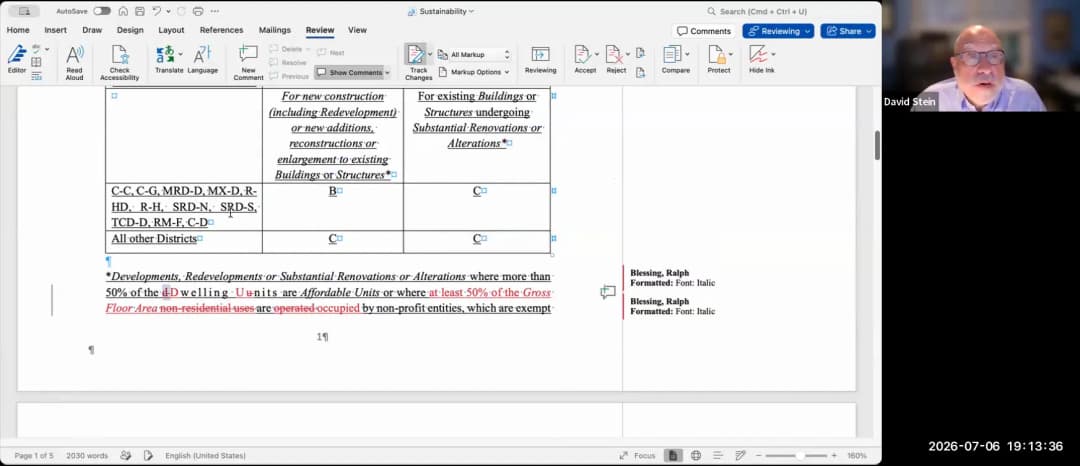
Chair David Stein called the regular meeting to order at 12:30 PM via Zoom. Present were board members Bill Morris, Roseanne McManus, Jerry Bozak, and Keith Walker, along with staff Ralph Blessing and Vanita Mater. The meeting was recorded. After approving the minutes from June 22, 2026, the board considered the sole agenda item: Application 226-08, a zoning text amendment to strengthen sustainability regulations by requiring a sustainability scorecard for certain developments, solar panels or green roofs on larger new roofs, and tree protection standards for zoning board applications. The board engaged in extensive discussion and made several amendments before voting unanimously to approve as amended. Consent Calendar - Minutes approval (June 22, 2026): Moved by Bill Morris, seconded. Approved unanimously. Public Comments & Testimony - No public comments were made or noted. Discussion Items - Tree protection amendment: Board member Bill Morris raised concern that without a look-back provision, developers could clear-cut trees before applying. The board discussed requiring applicants to certify on surveys any trees removed in the prior 24 months. After review, staff inserted language requiring disclosure of trees removed within 24 months prior to filing. The board supported this addition. - Affordable housing carve-out for sustainability scorecard: Keith Walker questioned exemptions for affordable and non-profit developments, fearing legal challenges. Staff explained that affordable housing projects have tighter finances and that the exemption avoids blocking projects. The board agreed to modify the carve-out to require a minimum score of C (instead of full exemption) for affordable developments where more than 50% of units are affordable or non-profit uses occupy at least 50% of floor area. This change was added to all districts. - Green/solar roof exemption for affordable housing: A proposed exemption allowing affordable housing developments to reduce green or solar roof coverage to 25% subject to special permit was debated. Keith Walker expressed concern about inconsistency with city sustainability goals. Staff argued it balances affordability and environmental objectives. The board kept the provision as is, noting it provides flexibility via special permit. - Solar canopy height: Public comments suggested 15 feet was too low for vehicles. The board increased the maximum height from 15 to 20 feet, agreeing that 20 feet accommodates typical vehicles without unduly restricting design. - Usable open space interaction: Discussion centered on whether roof amenity space should exempt solar/green roof requirements. The board decided that if more than 30% of a roof is used for usable open space, the requirement can be reduced to 25% subject to special permit approval. This replaces an earlier blanket exemption for amenity space, giving the board more control. Key Outcomes - Application 226-08 approved with the following amendments: 1. Added requirement for applicants to certify on surveys any trees with DBH ≥4 inches removed within 24 months prior to application filing. 2. For affordable housing/non-profit developments (≥50% affordable units or ≥50% floor area by non-profits), sustainability scorecard minimum reduced from B to C, applicable in all districts. 3. Solar canopy maximum height increased from 15 to 20 feet. 4. Green or solar roof coverage may be reduced to 25% for affordable housing developments (≥50% affordable units) subject to special permit. 5. Where more than 30% of roof area is used as usable open space, green/solar roof requirement may be reduced to 25% subject to special permit. - Vote: All five board members present (Stein, Morris, McManus, Bozak, Walker) voted in favor. None opposed or abstained. - Next steps: Staff will incorporate amendments into final text; the regulation will be posted and effective per city procedures.
The Stamford Zoning Board held a special regular meeting on July 2, 2026 at 10:02 AM via Zoom. The sole agenda item was consideration of a petition to appeal the board's approval of application 226-07 to the Board of Representatives. After reviewing a memorandum from the Land Use Bureau concluding the petition lacked sufficient signatures, the board unanimously voted to deny the referral. Discussion Items - Chair David Stein read a resolution denying the petition to appeal. The resolution noted that the Land Use Bureau's memorandum (dated June 29, 2026) concluded the petition did not receive the required number of signatures under Charter Section C6-40-5. The board independently reviewed the memorandum and supporting materials. - Board member Peter Rustin made a motion to approve the resolution, which was seconded by another member. - During discussion, a board member asked how many signatures were required and how many were received. Ralph Blessing, Land Use Bureau Chief, explained that the charter requires either (a) signatures from at least 20% of the owners within the rezoning area, or (b) owners of at least 20% of the land within 500 feet of the rezoning area. No owner within the rezoning area signed. For the 500-foot area, valid signatures represented only a little over 4% of the land area (calculated using GIS to account for partial lots and excluding streets), far short of the 20% threshold. Key Outcomes - The board voted unanimously (all present in favor, no opposed or abstentions) to approve the resolution denying the referral of the petition to the Board of Representatives, effectively upholding the original zoning approval of application 226-07. - The meeting adjourned after the vote; the next regular meeting was scheduled for Monday evening (July 6, 2026, inferred).
The Public Safety & Health Committee of the Stamford Board of Representatives met remotely on Thursday, June 25, 2026, at 6:31 p.m., chaired by Rep. Tom Bouchard. Vice Chair Terry Adams and members Reps. Didelot, Field, Graham, Morson, and Walston were present. The committee reviewed two agenda items: an overview of personal watercraft regulations and enforcement (PS32.008), and an overview of Stamford Park Police enforcement of quality-of-life issues in parks (PS32.009). Invited guests included Kevin Murray (Parks & Recreation), Kevin Fitzgibbons (Police Harbor Unit), Peter Gould (Park Police Coordinator), Christopher Baker (Police Captain), and Evan Weiss (Vincent Island Stamford LLC). PS32.008: Personal Watercraft Regulations and Enforcement - Evan Weiss presented a three-part safety proposal for Westcott Cove: marking two unmarked submerged hazards (GPS coordinates provided), improving signage at West Beach boat ramp with clear maps and rules, and redefining slow/no-wake zones to reduce ambiguity and enhance safety. He noted that personal watercraft (PWCs) can reach 75 mph and that noise levels comparable to leaf blowers impact nearby residents. - Sgt. Kevin Fitzgibbons described enforcement practices: daily patrols, checking registrations and safety equipment at the ramp, issuing $150 tickets for speed violations, and educating operators using pamphlets. He explained that 90% of Long Island fatalities involve paddlecraft, not PWCs, and many PWC operators are legal. - Committee members asked about expanding no-wake zones. Sgt. Fitzgibbons noted that changes require approval from the U.S. Coast Guard and NOAA, a time-consuming process. Rep. Shore inquired about marking the 200-foot no-wake boundary on the eastern side; Fitzgibbons clarified that any official marking must go through state and federal processes. - Weiss also raised the idea of requiring insurance for ramp permits (as Greenwich does) to protect the city from liability in case of accidents. - Discussion highlighted that the West Beach ramp is the busiest and that enforcement focuses on education and engineering before enforcement. PS32.009: Park Police and Quality-of-Life Enforcement - Park Police Coordinator Peter Gould reported that the department has shrunk from 31 officers in 1979 to currently two (one full-time, one part-time), with a third expected in December. Quality-of-life complaints center on amplified music, unregistered dirt bikes/ATVs, e-bikes, and loud cars. He described two city ordinances (for external speakers and motorized recreational vehicles) that allow seizure and potential destruction of equipment, but enforcement has been hampered by a lack of hearing officers. - Capt. Chris Baker confirmed that three appeal hearing officers were approved the previous night, enabling the ordinances to be fully implemented. - Committee members discussed specific incidents: loud music at Mill River Park on Father’s Day weekend (a New York crowd, complaints from miles away), and the proliferation of e-bikes and ATVs citywide. Rep. Field raised concerns about inconsistent enforcement and the need for a uniform decibel limit on all permits, including for Mill River Collaborative events. Rep. Walston echoed the call for consistency. - Gould explained that for city-sanctioned events (like Alive at Five), the police do not enforce noise limits because it is an administrative matter between the city and the vendor. Mill River Park regulations are set by the Mill River Collaborative, creating a bifurcated system. Lou DeRubeis (Director of Public Safety, Health and Welfare) acknowledged the city is working to bring Mill River events under the same permitting process. - Current penalties: $120-$150 for unregistered vehicle; under the new ordinance, first offense for external speakers is $1,000, second $1,500, third $2,000, plus confiscation. The department focuses on education but will escalate for repeat or egregious violators. - Challenges in pursuing fleeing ATVs/off-road vehicles were noted; police use intelligence and preventive strategies rather than dangerous pursuits. Key Outcomes - No votes were taken; both items were received as reports. - Three appeal hearing officers were approved the night before the meeting, enabling full enforcement of the seizure ordinances for amplified speakers and motorized recreational vehicles. - Chair Bouchard committed to working with the administration and the committee to address noise ordinance consistency across all city parks, including Mill River Collaborative events. A future discussion on decibel limits in permits was suggested. - The meeting was adjourned at 7:45 p.m.
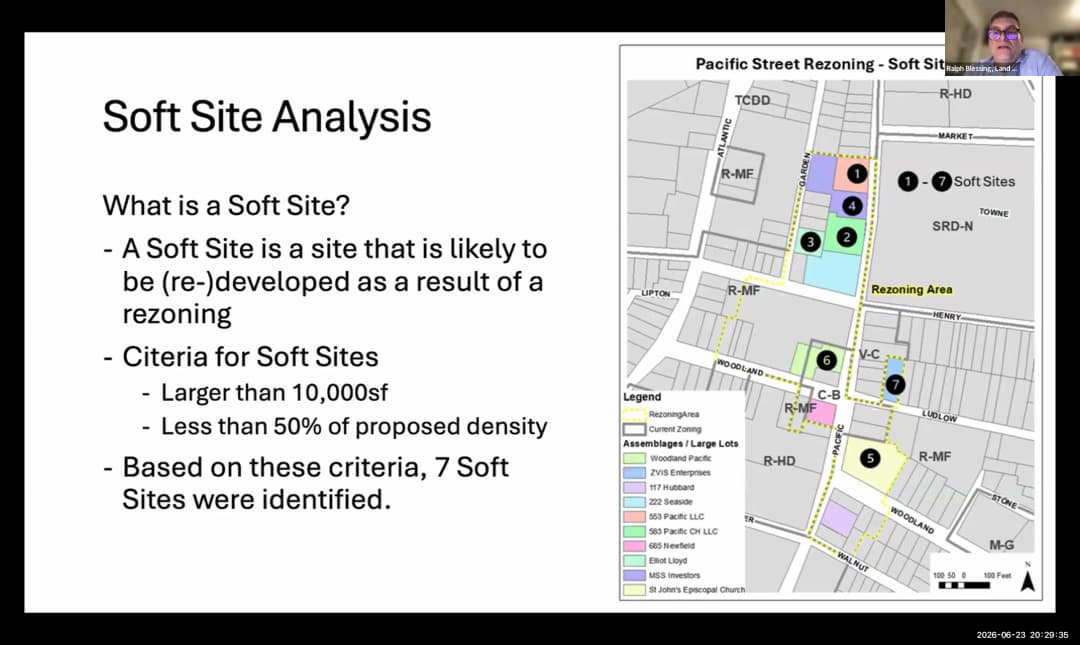
The Stanford Planning Board held a regular meeting and public hearing on June 24, 2026, convened at 6:30 PM by Vice Chairman Jeremy Linder. Members present: Jeremy Linder (Vice Chair), Chet Sallett, and alternate Ashley Lai (voting member). The meeting covered two subdivision applications, a public hearing, and two zoning board referrals. Key actions included tabling a subdivision modification, approving a two-lot subdivision, approving a five-lot subdivision after public comment, and forwarding recommendations on a zoning map change and text amendment. Consent Calendar - Minutes from June 9, 2026: Approved unanimously without comment or question. Public Comments & Testimony - Subdivision 4062 (20 West Haviland Lane): Several neighbors spoke during the public hearing: - Mike Miller (90 West Haviland Lane) expressed support but questioned fire protection (no cistern/hydrant shown) and the private right-of-way crossing a seasonal stream. - Lawrence Cryer (adjacent neighbor) asked about driveway widening and runoff protection for the adjacent stream. - Lauren Fredet (130 West Haviland Lane) supported the project but asked about visibility of proposed homes from West Haviland Lane backyards. - Andrew Chuckas (48 West Haviland Lane) asked about changes to the entrance and runoff management. - Edward Hannigan (148 West Haviland Lane) supported beautification and asked if the proposed sport court would be used for pickleball (noise concern). - Jeff Cohen (neighbor) asked if the development would be gated and if dog walking would be allowed. All commenters expressed general support for redeveloping the blighted former Twin Lakes Swim Club site but raised specific design and safety questions. Discussion Items - Subdivision 3098 (South Lake Drive) – Modification: The applicant requested a table to August 11, 2026, to correct noticing issues (needed two separate subdivision modifications). Board unanimously tabled. - Subdivision 4063 (13 Watermill Road) – Two Lots: Leonard D'Andrea presented a proposal to subdivide a 31,158 sq ft parcel into two lots (Lot 44: 10,127 sq ft; Lot 45: 21,092 sq ft) in the R-10 zone. Both lots exceed minimum size and frontage. A conservation easement (11.2% of site) is proposed on east and south lines. Existing dwelling on Lot 45 will be retained temporarily. Staff comments were addressed. Board approved unanimously. - Subdivision 4062 (20 West Haviland Lane) – Five Lots: John Leyden presented a proposal to subdivide 14 acres (former Twin Lakes Swim Club) into five lots averaging 2.8 acres in RA-1 zone. The plan is nearly identical to a 2015 approval that was never built. A slight modification to the conservation easement (adding net area) and correction of a lot line to avoid creating a non-conformity. Existing buildings will be demolished; roadway will be private (20 ft wide); drainage improvements include retention under cul-de-sac. Following public comments, the board discussed fire protection (no cistern needed per updated fire marshal standards), concerns about losing historic character, and the balance between lot count and preserving natural features. The board noted the site could have accommodated one or two more lots but appreciated the quality-over-quantity approach. Unanimously approved. - Zoning Board Referral ZB 226-12 – Map Change to VC2 (Pacific Street): Ralph Blessing (City Planning) presented a proposal to rezone 8 blocks along Pacific Street from R-MF and C-B to Village Commercial-2 (VC-2). Goal: revitalize Pacific Street as a neighborhood main street with ground-floor retail and apartments, while maintaining low-rise scale (max 5 stories on commercial streets, 4 on side streets). The analysis identified seven “soft sites” likely to redevelop, which could yield up to 345 residential units vs. 114 under current zoning. A soft site is a parcel ≥10,000 sq ft with ≤50% of proposed density built. Discussion focused on potential impact on historic residential structures on Garden and Henry Streets (currently in historic district). Vice Chairman Linder expressed concern that redeveloping whole blocks could lead to demolition of historic homes. Blessing noted that VC-2 allows commercial uses only on designated commercial streets (Pacific), and side streets remain residential in character; additionally, VC-2 requires site plan review (architectural control) unlike as-of-right R-MF. He suggested the board could recommend excluding Garden and Henry from the rezoning. The board moved to approve the recommendation to the Zoning Board with a suggestion to consider modifying the boundary to keep historic residential lots on Garden and Henry in the R-MF district. - Zoning Board Referral ZB 226-13 – Text Change (Commercial Street Designation): This companion application designates Pacific Street between Atlantic and Dock Streets as a commercial street, allowing ground-floor commercial uses and increased building height (up to 5 stories with setbacks). Discussion clarified that commercial uses may wrap corners but cannot extend more than 125 ft from the street. The board unanimously approved the recommendation. Key Outcomes - Subdivision 3098: Tabled to August 11, 2026 (unanimous). - Subdivision 4063: Approved unanimously. - Subdivision 4062: Approved unanimously after public hearing closed. - ZB 226-12 (Map Change): Motion to recommend approval with a note that the Zoning Board consider excluding Garden and Henry Streets from the rezoning (unanimous). - ZB 226-13 (Text Change): Recommended approval unanimously. - Next Meeting: Next regular meeting scheduled for August 11, 2026 (no July meeting).