Browse by city
Date range
Search help

Search titles, summaries, topics and stored transcripts together. Keywords may match separately; put the whole query in double quotes for a phrase. Matching follows word analysis, so punctuation is not exact. Both dates are included. Documents are not searched.

SHOWING 151–160 ENTRIES
151
MAR 25, 2026 · WASHINGTON, DISTRICT OF COLUMBIA · COUNCIL OF THE DISTRICT OF COLUMBIA
Public Hearing on Theatrical Wrestling Regulation Amendment Act – March 25, 2026

Councilmember Zachary Parker, Chair of the Committee on Youth Affairs, called the hearing to order at 3:00 PM on Wednesday, March 25, 2026. The hearing examined legislation to create a new regulatory category for theatrical (independent professional) wrestling, distinct from competitive combat sports. The bill defines theatrical wrestling as scripted, choreographed entertainment in venues with fewer than 2,000 attendees or as part of festivals. Councilmember Nadeau, a co-introducer, delivered opening remarks. Public witnesses testified in strong support, describing regulatory burdens and mistreatment by Commission staff. Government witness Chairman Andrew Huff of the DC Combat Sports Commission supported the bill’s intent but raised concerns about health, safety, consumer protections, and terminology. The committee will work toward a compromise, including a possible local promoter's incentive fund. Public Comments & Testimony - Billy Dixon (Kyle) – A black queer professional wrestler from the South Bronx, New York, with 10 years of experience. He testified that the DC Combat Sports Commission has been dismissive, disrespectful, and unprofessional. He recounted being body-shamed by a Commission doctor, witnessing sexual objectification of female performers, and seeing Commission staff under the influence of alcohol. He argued that independent wrestling is a low-earning art form and that current regulations are oppressive, pricing out local communities. He expressed full support for the bill as a necessary compromise. - Michael Hairson (Mike) – A career nightlife worker, not a wrestler. He argued that theatrical wrestling is fundamentally different from combat sports because performers actively avoid injury and outcomes are predetermined. He noted that similar risks exist in other entertainment forms (e.g., theater with trapdoors) and that overregulation chokes out cultural opportunities. He supported the bill. - Brandon Skull – Owner of DC Brau Brewing Company. He testified that he previously hosted independent wrestling events that were highly successful but ultimately unsustainable due to Commission requirements. He described a last-minute demand for a $1,200 insurance policy from a Texas vendor, bizarre requests for blank checks, and a general lack of professionalism. He called the regulatory framework “coercive” and stated that the talent pool refused to continue because of disrespect from Commission officials. He strongly supported the bill and said these events brought meaningful post-COVID revenue and community building. Government Witness Testimony - Andrew Huff, Chairman of the DC Combat Sports Commission – The Commission supports the intent to reduce barriers but opposes the specific language of the bill. Key concerns: (1) Creating a separate “theatrical wrestling” category would be inconsistent with Maryland and Virginia, which use “professional wrestling,” potentially hindering license reciprocity. (2) Venue size does not eliminate health and safety risks; independent wrestlers often lack traveling medical staff. (3) Consumer protections (e.g., ticket information) would be weakened for smaller events. (4) The festival exemption is unnecessary because the Commission recently updated rules to allow wrestling at festivals with only a wrestler’s license (no promoter’s license). Huff noted that the Commission has already reduced professional wrestler license fees from $200 to $25 and promoter license fees to $130, and extended medical exam periods from six months to one year. He acknowledged the problematic behavior described by public witnesses and said the former staffer involved is no longer employed. He highlighted the Commission’s role in protecting participants and attendees, and offered to explore a local promoter’s incentive fund as an alternative to deregulation. Discussion Items - Chairperson Parker questioned Chairman Huff on the alleged mistreatment and unprofessionalism. Huff admitted the blank check request was inappropriate and said the commission has not received formal complaints but learned of issues through an article and “rumor mill.” He explained that insurance requirements are not vendor-specific, but the former staffer offered a personal contact. Parker pressed for a complaint process; Huff indicated complaints would go to DLCP’s investigative unit. Parker recommended the Commission develop an internal feedback mechanism (e.g., anonymous tip box or survey). - Parker and Huff discussed venue availability and costs as a major barrier. Huff agreed that DC’s high venue rental costs (not under Commission purview) drive promoters to Virginia and Maryland. Parker noted that the current system results in few to no independent wrestling events in DC (nearly zero licensed events under 2,000 seats in recent years). - Parker raised the possibility of allowing existing business insurance to satisfy the $10,000 minimum event insurance requirement. Huff said the Commission is already discussing this with DLCP and general counsel. - The committee explored the definitions: Huff argued that “theatrical wrestling” is simply another name for professional wrestling, and that the bill’s use of “amateur” (based on pay) is confusing, as independent wrestlers are paid. Huff stated that the bill would exempt professional wrestling if labeled “theatrical,” but the Commission believes it should remain under oversight for safety. Key Outcomes - Chairperson Parker will follow up with Chairman Huff on the specific instances of mistreatment (Dixon and Skull will provide documentation offline). - Parker instructed Huff to provide formal data on the number of licensed professional wrestling events with fewer than 2,000 attendees over the past five years, the cost of Commission staff payments, and the ticket tax rate. - The committee will work with Councilmember Nadeau and Chairman Huff to find a compromise, potentially via budget provisions for a “local promoter’s incentive fund” to offset commission-related costs (e.g., EMS, insurance). - No vote was taken; the hearing was informational. Written testimony may be submitted until April 8, 2026, at 5:30 PM via the council’s hearing management system. - The hearing adjourned at 4:21 PM.
BUSINESS AND ECONOMIC DEVELOPMENT 36% · CANNABIS REGULATION 33% · PROCEDURAL 20% · PUBLIC ENGAGEMENT 6%
152
MAR 25, 2026 · WASHINGTON, DISTRICT OF COLUMBIA · COUNCIL OF THE DISTRICT OF COLUMBIA
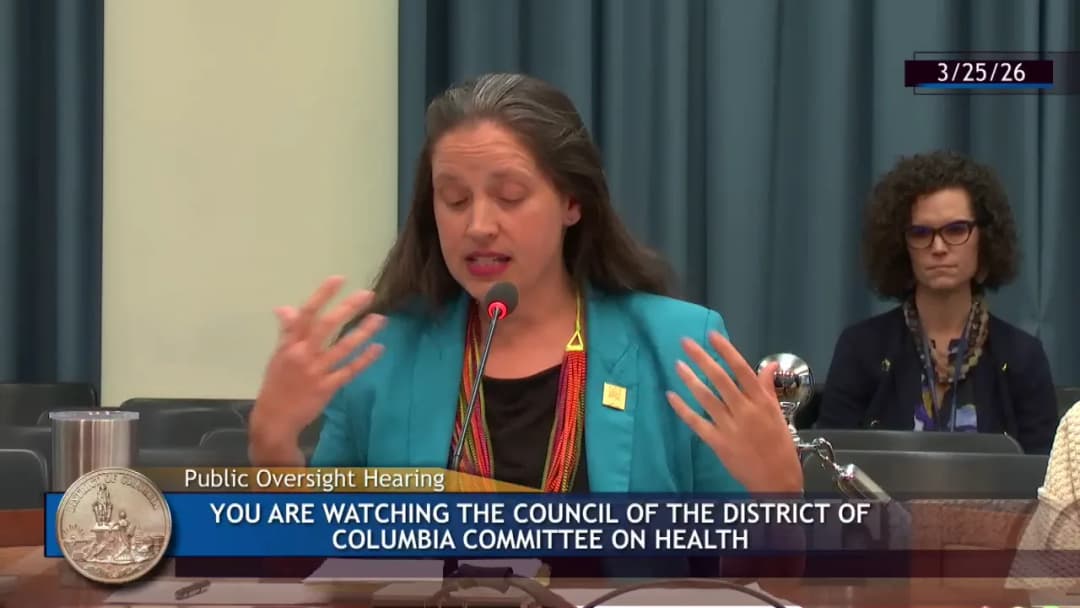
Public Hearing on Medicaid Credentialing, Prescription Drug Costs, and Food Procurement - March 25, 2026

The Committee on Health, chaired by Councilmember Christina Henderson, held a hybrid public hearing on Wednesday, March 25, 2026, from 9:31 a.m. to 12:31 p.m. in Room 412 of the John A. Wilson Building. The hearing considered three bills: Bill 26-523 (Streamlining Medicaid Credentialing Amendment Act of 2025), Bill 26-593 (Lowering the Cost of Prescription Drugs Act of 2026), and the Food Policy Council Procurement Amendment Act of 2025. Public witnesses and government officials testified. Public Comments & Testimony On Bill 26-523 (Medicaid Credentialing): Multiple health care providers and advocates expressed strong support for the legislation, which would create a single application process for credentialing with Medicaid managed care organizations (MCOs). They cited excessive delays and duplication. Anita Butani, founder of Bright Day Pediatric Therapies, described MCO credentialing as an "administrative dumpster fire" and argued the current system allows MCOs to profit by delaying care. She noted one MCO took over 120 days to issue a contract and an additional 180 days to countersign. The DC Primary Care Association (DCPCA) recommended including delegated credentialing agreements. Crystal Jackson, a Medicaid doula provider, asked that the bill's language be expanded to include certification in addition to licensure, noting doulas are certified rather than licensed. Community of Hope testified that credentialing can take up to 90 days per MCO, causing financial strain and delayed patient access. The DC Hospital Association supported the bill, noting successful centralized credentialing in Ohio and Nevada. On Bill 26-593 (Prescription Drug Costs): Heidi Murphy, Operations Manager for ArrayRX (Oregon Health Authority), reported that Connecticut residents saved $2,860,141 from October 2023 to December 2025, with an average savings of $260 per claim. Oregon residents saved $2,904,730 over the same period (average $214 per claim). ArrayRX represented over $1.34 billion in annual pharmacy purchases across five states. The program charges a small administrative fee at point of sale to cover staffing and legal costs. DC Health supported the bill but noted it does not fully address drivers of drug costs and emphasized the need to protect independent pharmacies, which make up 53% of pharmacies in Ward 8. On the Food Policy Council Procurement Act: A large coalition of witnesses urged passage, highlighting that the District spends over $62 million annually on food across agencies but lacks centralized oversight. Rachel Clark (co-chair of Food Policy Council's Sustainable Supply Chain Working Group) described a 2025 report identifying barriers to values-based procurement. Alex Moore (DC Central Kitchen) strongly supported the bill and called for transparency in emergency food contracts. Daniel Rosen, a return citizen and coordinator of the DC Jail Food Working Group, testified that DOC food is of poor quality (spoiled, moldy) and that the current lowest-cost contract with a Pennsylvania-based corporation fails DC values. Tom McDougall (4P Foods) and Amelia Keeler (Center for Science in the Public Interest) supported the bill and urged incorporating the Good Food Purchasing Program (GFPP) as the district's framework. Molly Reardon, former Good Food Purchasing Coordinator for Philadelphia, emphasized the need for a dedicated staff role. Multiple witnesses recommended requiring agencies to submit procurement data to the Office of Food Policy and creating a public dashboard. A local farmer testified about the positive impact of local purchasing on small farms and community health. Discussion Items Councilmember Henderson engaged witnesses in detailed discussion. With DHCF officials, she questioned the need for redundant site visits and paperwork between DC Health licensing, DHCF enrollment, and MCO credentialing. She noted that providers often submit the same information multiple times and that the 120-day timeline is too long. DHCF expressed concerns about implementing centralized credentialing by January 1, 2027, citing federal requirements and the need for a third-party vendor. They suggested alternatives like expedited credentialing across MCOs. Henderson also discussed with DC Health the implementation timeline for the prescription drug discount card program, noting that aggressive marketing would be needed to achieve uptake (estimated 10% enrollment, 10% of those using it annually). With the Office of Planning, she explored the challenges of fragmented food procurement, lack of data sharing, and the need for cost analysis. Food Policy Director Caroline Howe testified that a dedicated procurement analyst (funded by a federal grant that ends in 11 months) has already achieved wins, such as shared warehouse storage and cost analysis for central food processing. Henderson emphasized that without a centralized system, the District cannot evaluate whether it is getting value for its $62 million food spending. Key Outcomes No votes were taken. The hearing record will remain open until 5:00 p.m. on Wednesday, April 8, 2026, for written testimony. The committee is expected to continue refining the bills based on testimony. The next Committee on Health meeting is scheduled for Thursday, April 2, 2026, for a public roundtable on Board of Nursing and Board of Funeral Directors nominations.

FOOD POLICY 43% · PUBLIC HEALTH 37% · PROCEDURAL 6% · MEDICAID CREDENTIALING 6%
153
MAR 24, 2026 · WASHINGTON, DISTRICT OF COLUMBIA · COUNCIL OF THE DISTRICT OF COLUMBIA
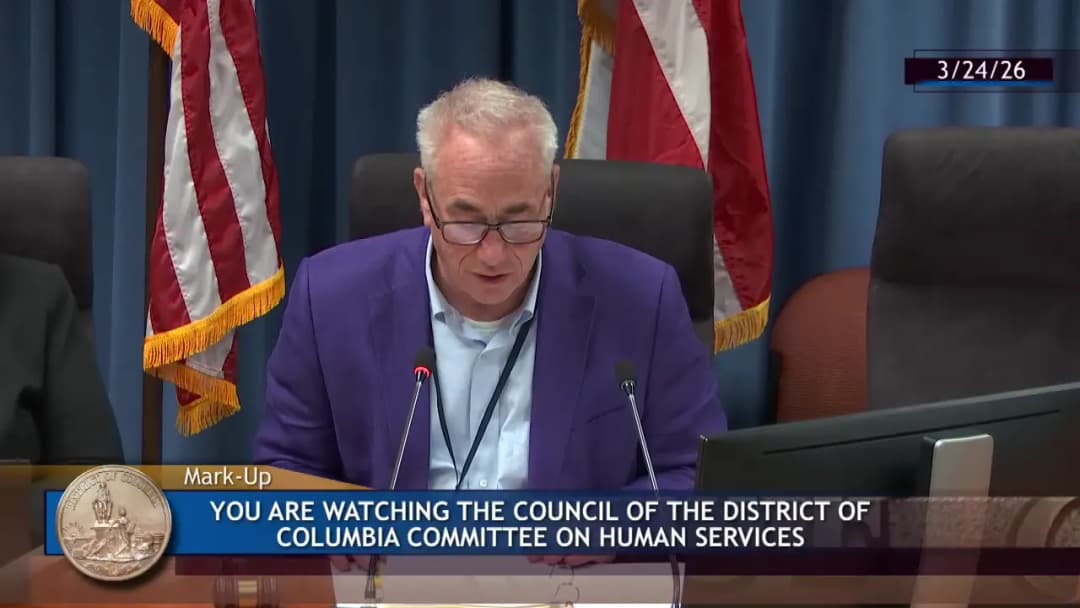
Committee on Human Services Meeting - March 24, 2026: Library Ebook Licensing, Langston-Slater Disposition, Library Trustees

Councilmember Matt Freuman (Ward 3) chaired the meeting, with a quorum of Councilmembers Henderson and Robert White (via Zoom). The agenda included two permanent bills and three confirmation resolutions. All items were moved and passed unanimously without discussion. The meeting adjourned at 3:50 p.m. Consent Calendar - B26-0490 – Library Ebook Licensing Fairness Amendment Act of 2026: Prohibits the District of Columbia Public Library (DCPL) from entering or renewing licensing agreements with e-book publishers that contain terms restricting public access to electronic literary materials. Publishers charge libraries 3–5 times more for e-book and audiobook licenses than for physical books, and impose limits on lending, loan duration, and disclosure of purchase terms. The bill only takes effect after at least 10 other jurisdictions with a combined population of at least 50 million enact similar laws, making D.C. part of a national strategy. The committee print amended the pricing provision to give the library more flexibility. The bill was moved and passed unanimously. - B26-0157 – Langston Slater Surplus Declaration and Disposition Approval Act of 2025/2026: Declares surplus and authorizes disposition of district-owned property at 33–45 Pea Street NW (Lot 0826, Square 0615) in the Truxton Circle neighborhood. The property includes two historic former elementary schools (Slater, built 1891; Langston, built 1902), both vacant. The planned development would adaptively reuse the buildings to create 40 mixed-income rental units (60% affordable) and a new infill building with 12 mixed-income homeownership units (58% affordable). This is the first project awarded through an equity RFP to increase access for socially disadvantaged populations. The referral history contained a date discrepancy (March 4, 2025 vs. March 3, 2026), which the chair acknowledged. The bill was moved and passed unanimously. - Confirmation Resolutions for Board of Library Trustees: Three nominees were confirmed on a single motion: - PR26-0488 – Danella Brockington (Ward 5), second term; currently chairs the board's finance and budget committee; background includes corporate vice president roles at Lockheed Martin, Xerox, and Conduit. - PR26-0565 – Holly Flood, first term; founder of an organization providing medical respite care for homeless individuals; former USAID and Peace Corps roles. - PR26-0566 – Christy C. Whitfield (Ward 5), first full term; former director of the Department of Small and Local Business Development (DSLBD); now Chief Impact Officer at Nathan Cummings Foundation. All three were confirmed by voice vote. Key Outcomes - All motions passed unanimously, with leave for staff to make technical and conforming changes. The committee adjourned at 3:50 p.m.

MISCELLANEOUS 30% · LAND USE PLANNING 26% · PROCEDURAL 23% · AFFORDABLE HOUSING 21%
154
MAR 24, 2026 · WASHINGTON, DISTRICT OF COLUMBIA · COUNCIL OF THE DISTRICT OF COLUMBIA
Transportation & Environment Committee Confirmation Hearing - March 24, 2026

The Committee on Transportation and the Environment, chaired by Councilmember Charles Allen (Ward 6), held an additional meeting on Tuesday, March 24, 2026 at 10:49 AM in Room 120 of the John A. Wilson Building and via Zoom. The committee considered and voted on four reappointment resolutions for the Green Finance Authority Board and the DC Water Board. Discussion Items - The committee reviewed PR 26-42 and PR 26-483, two resolutions to reappoint Monica Warren Jones and Anthony Washington to the Green Finance Authority Board of Directors for terms ending July 9, 2029. Both nominees have extensive experience in affordable housing and community development finance. Anthony Washington has over 25 years in commercial lending, financing over $1 billion in multifamily transactions across Fannie Mae, Freddie Mac, and FHA platforms. Monica Warren Jones has generated over $500 million in lending and investment activity, creating or preserving over 5,000 units of housing. Councilmember Allen expressed support for both nominations. - The committee also considered PR 26-485 and PR 26-487, resolutions to reappoint Roshna Bouti Bhutani Bot and Dr. Jimmy Ortiz to the District of Columbia Water and Sewer Authority (DC Water) Board of Directors as principal and alternate members, respectively, for terms ending September 12, 2030. Roshna Bot has overseen a portfolio exceeding $200 million in construction projects and currently chairs the retail water and sewer rates committee. Dr. Jimmy Ortiz is a Ward 6 resident. Key Outcomes - The committee voted unanimously (all members present in favor, no opposed) to approve all four resolutions: PR 26-42, PR 26-483, PR 26-485, and PR 26-487. Staff were granted leave to make technical and editorial changes. The nominations will proceed to the full Council for consideration.

PROCEDURAL 52% · GREEN FINANCE AUTHORITY 48%
155
MAR 23, 2026 · WASHINGTON, DISTRICT OF COLUMBIA · COUNCIL OF THE DISTRICT OF COLUMBIA
DC Council Round Table on Barbara Jones’ Confirmation to Athletics Commission – March 23, 2026

On March 23, 2026, the Council of the District of Columbia, sitting as the Committee as a Whole, held a public round table to consider PR 25-549, the confirmation resolution for Barbara Jones to the D.C. State Athletics Commission. Chair Phil Mendelson presided. The hearing lasted from 3:19 p.m. to 3:28 p.m. in Room 412 of the John A. Wilson Building. The record remains open until 5:00 p.m. on Monday, March 30, 2026. Public Comments & Testimony - No public comments were offered by members of the public regarding the nominee's fitness. Nominee Testimony - Barbara Jones testified in support of her nomination. She described how youth sports transformed her from a shy child into a confident student-athlete, crediting participation in track, volleyball, and college athletics with teaching her teamwork, discipline, time management, and communication. She holds a B.S. in Biology, a B.S. in Public Health Administration, and a Master's in Science in Counseling, plus an honorary Ph.D. in Humanities from St. Michael's Christian School in Atlanta, Georgia. She also reported receiving the Community and Pack Award for 2026 and having an outdoor theater named after her at a D.C. prep school. - In response to questions from Chair Mendelson, Jones stated she has no outstanding tax liabilities or unpaid fees owed to the District, federal, or other state governments. She identified no potential conflicts of interest but pledged to recuse herself or notify the commission if any arose. She confirmed she can meet the time commitments required for service. Discussion Items - Chair Phil Mendelson outlined the purpose of the round table: to receive public input on Barbara Jones’ fitness for the commission and to hear from the nominee directly. After Jones’ testimony, the Chair clarified that she holds two undergraduate degrees (not one) and a master’s degree. He joked about whether to call her “Doctor” after the honorary degree, but did not press the matter. - The Chair noted that the expedited timeline (record closes March 30, council vote possible March 31) is intended to move the nomination quickly. Key Outcomes - No formal vote was taken during this round table. The confirmation will proceed to the full Council for a vote, likely on Tuesday, March 31, 2026. The public record will remain open until 5:00 p.m. on March 30, 2026, to receive written comments.

YOUTH PROGRAMS 86% · PROCEDURAL 14%
156
MAR 23, 2026 · WASHINGTON, DISTRICT OF COLUMBIA · COUNCIL OF THE DISTRICT OF COLUMBIA
Public Hearing on Health Data Privacy, Funeral Directors Licensing, and Green Death Care – March 23, 2026

On Monday, March 23, 2026, at 12:30 PM, the Committee on Health, chaired by Councilmember Christina Henderson, held a public hearing in Room 500 of the John A. Wilson Building. The hearing considered three bills: Bill 26-525 (Personal Health Data Security Amendment Act), Bill 26-47 (Funeral Directors Licensing Reform Amendment Act), and Bill 26-547 (Green Death Care Option Amendment Act). The committee also reviewed the fiscal year 2025 performance of the Board of Funeral Directors. The hearing was hybrid, with public witnesses testifying virtually and in person, and government witnesses in person. Public Comments & Testimony First Panel (Health Data Privacy): - Justin Palmer (DC Hospital Association) supported the intent of Bill 26-525 but requested an explicit exemption for HIPAA-covered entities and their business associates to avoid duplicative and overlapping requirements. - Margaret Durkent (TechNet) expressed concern about the bill's definitions diverging from most state privacy laws, fragmentation without a federal standard, and the immediate effective date. She advocated for an omnibus privacy approach to ensure interoperability. - Melissa Wasser (ACLU of DC) supported the bill with three strengthening recommendations: (1) prohibit geofencing around healthcare facilities, (2) require clear, affirmative, and unambiguous consent before collecting or sharing health data, and (3) reduce the deletion period from 183 days to 45 days, consistent with other states. - Rachel Mackey (licensed funeral director) supported Bill 26-47 but noted that terminology should align with Virginia and Maryland, that current education and examination practices differ from the bill's language, and that the five-year continuous practice requirement for reciprocity would create an unnecessary barrier. Second Panel (Health Data Privacy & Funeral Licensing): - Blair Nelson (Joseph Galler Sons) favored Bill 26-47, suggesting changes to the accreditation language (allow accrediting agencies approved by the U.S. Department of Education) and the examination requirement (national board arts exam instead of state board). He also urged eliminating the five-year continuous practice requirement for reciprocity, citing workforce shortages. - Andrew Kingman (State Privacy and Security Coalition) raised concerns that the definition of personal health data in Bill 26-525 is overly broad, would lead to consent fatigue, and should apply only to District residents to avoid compliance burdens for frequent cross-border traffic. He recommended standardizing definitions with other states. - Zachary Taylor (Consumer Data Industry Association) argued that the bill's broad definition of personal health data could inadvertently restrict information furnished under the Fair Credit Reporting Act and the Gramm-Leach-Bliley Act, harming credit files. He urged clear exemptions for those federal laws. Virtual Witnesses: - Sniati Hubbard (DC Chamber of Commerce) supported the goal of health data protection but stated the bill's broad definitions would capture routine consumer products (e.g., ibuprofen, toilet paper) and impose impractical opt-in requirements. She requested a more targeted approach. - Haley Morris (Earth Funeral) strongly supported the Green Death Care Option Act, emphasizing consumer choice and environmental benefits. She also urged consideration of natural organic reduction (human composting) as a future option. - Amelia Kamala (DC Policy Center) opposed the creation of a separate embalmer's license under Bill 26-47, arguing that licensing requirements raise prices, reduce workforce participation, and disproportionately affect women, Black, and foreign-born Hispanic workers. - Sean Heath (Interra Green Burial) supported alkaline hydrolysis, citing its lower carbon footprint (one-tenth the energy of flame cremation), safety benefits (no explosive devices), and manageable wastewater discharge. He noted that 61% of consumers seek sustainable options. - Sarah Gagan (Electronic Privacy Information Center) strongly supported Bill 26-525, urging the committee to retain the broad definition of health data, keep the geofencing prohibition, and move away from notice-and-choice toward data minimization principles. Discussion Items Bill 26-525 (Personal Health Data Security Amendment Act): Chairperson Henderson questioned witnesses on consent fatigue, the feasibility of unambiguous consent, and the trade-offs between a sectoral health data bill and a comprehensive omnibus privacy bill. She noted that an omnibus approach would require multiple committee referrals and could delay action. The Office of the Attorney General (OAG) recommended moving away from notice-and-consent toward a list of permissible processing activities, providing OAG with quarterly summary reports of deletion requests, and making a violation a per se violation of the Consumer Protection Procedures Act (CPPA) to allow a private right of action. OAG also supported shortening the deletion period to 45 days and tailoring HIPAA exemptions to protected health information, not entire entities. Bill 26-47 (Funeral Directors Licensing Reform Amendment Act): The committee discussed the proposed separation of funeral director and embalmer licenses. The Board of Funeral Directors suggested a three-license model (funeral director, embalmer, and combination license) similar to Virginia and Maryland. Director Tiffany Crow of DLCP recommended retaining the high school diploma or GED requirement, allowing combination license holders to practice both, and replacing the two-report internship requirement with a single final report. The board noted that the current four-year apprenticeship window is rarely extended, and that the 2,000-hour internship aligns with Virginia's requirement. The reciprocity requirement of five years of continuous practice was defended by the board as consistent with neighboring states, but public witnesses argued it would limit the candidate pool. Bill 26-547 (Green Death Care Option Amendment Act): The committee explored the feasibility of alkaline hydrolysis in the District. Witnesses explained that the process uses electricity, emits no harmful pollutants, and the liquid byproduct (fluent) is safely treated by municipal wastewater systems. The District currently has no crematory, and the board noted that zoning restrictions (e.g., 50% neighbor approval within 100 feet) have deterred crematoria. Adding two seats to the Board of Funeral Directors (from five to seven) was discussed, with the board open to expansion but noting the small pool of District-resident funeral directors. The committee will consult with DOEE, DC Water, and DDOT on infrastructure questions. Board of Funeral Directors Performance: Chair McGuire reported that the board meets monthly (except August), issues four license types, and handles complaints through DLCP's consumer protection unit. In FY2025, the board received 11 complaints, with six closed, one referred to OAG, three listed as other, and one under investigation. The board has not coordinated with the FTC on price transparency inspections, though the District led a 2022 coalition urging FTC rule updates. The board has one funeral director vacancy, and the surviving spouse/estate license is considered outdated. Key Outcomes - No votes were taken; the hearing was informational. - The record will remain open until 5:00 PM on Monday, April 6, 2026, for written testimony on all three bills. - The committee will send post-hearing questions to DLCP, DOEE, DC Water, and DDOT regarding the Green Death Care bill. - Chairperson Henderson indicated plans to work with stakeholders on amendments to refine definitions, consent requirements, and exemptions in the health data bill, and to align funeral licensing terminology with neighboring states. - The next Committee on Health hearing is scheduled for Wednesday, March 25, 2026, at 9:30 AM, covering three bills on Medicaid credentialing, prescription drug costs, and the food policy council.

PROCUREMENT 16% · TECHNOLOGY AND INNOVATION 15% · PUBLIC HEALTH 15% · CONSUMER PROTECTION 14%
157
MAR 20, 2026 · WASHINGTON, DISTRICT OF COLUMBIA · COUNCIL OF THE DISTRICT OF COLUMBIA
Committee Roundtable on DC Water Board Nominations (PRs 26-482, 483, 485, 486, 487) – March 20, 2026

On March 20, 2026, the Committee (chaired by Chairperson Allen) held a public roundtable to consider multiple resolutions from the Mayor regarding appointments to the DC Water Board of Directors. The resolutions include the reappointment of Rajna Bhutani Bot as a principal member, the reappointment of Dr. Jimmy Ortiz as an alternate member, and the appointment of Vince McCone as an alternate member. No public witnesses registered to testify, but written testimony will be accepted until March 23, 2026. The nominees testified and answered questions from the committee. Public Comments & Testimony - No public witnesses were registered for the roundtable. The committee will accept written testimony through the Council's hearing management system until close of business on Monday, March 23, 2026. Discussion Items - Potomac Interceptor Break & Environmental Remediation: Chairperson Allen questioned the board's oversight actions. Ms. Bott stated the board initiated an independent third-party investigation separate from DC Water's internal review, with the board chair managing that investigation. Dr. Ortiz emphasized transparency and community communication. Chairperson Allen expressed frustration over unclear communication regarding environmental remediation (e.g., where contaminated material is being taken) and urged DC board members to partner with Montgomery County colleagues to press for answers. Ms. Bott noted that federal agencies (FEMA, EPA) are coordinating remediation, which limits DC Water's direct control, but acknowledged the need for more focus on this area. - Affordability & Rate Setting: Ms. Bott, chair of the retail water and sewer rates committee, discussed the shift to virtual public meetings for rate hearings, which increased engagement. She noted the challenge of balancing infrastructure investment with ratepayer affordability and highlighted that DC Water has the most affordability programs of any water utility in the country. Mr. McCone raised concerns about the impervious surface measurement rollout, which lacked adequate communication, and the impact of cumulative utility cost increases on residents. - Secondary Water Source: All nominees stressed the importance of developing a secondary water source for the region, given the reliance on the Potomac River. Ms. Bott noted that the Potomac Interceptor break has increased public awareness and urgency. Mr. McCone committed to championing this issue and emphasized the need for federal partnership. Ms. Bott also mentioned DC Water's exploration of the potential acquisition of the Washington Aqueduct. - Capital Project Prioritization: Ms. Bott stated that the board is in the middle of a budget cycle and that learnings from the interceptor break investigation will likely lead to reprioritization of capital projects. No decisions have been made yet, but emergency contracts have been initiated. - Community Coordination: Mr. McCone, as an ANC commissioner, shared examples of poor coordination between DC Water projects and other city works (e.g., lead pipe remediation during snow removal, multiple projects on 16th Street). He pledged to use his experience to improve communication and coordination with neighborhoods. - Conflict of Interest: All three nominees confirmed they have no conflicts and understand the recusal process. Ms. Bot noted she has declined business opportunities with DC Water. Mr. McCone and Dr. Ortiz also stated they would recuse themselves if needed. Key Outcomes - The roundtable concluded with no vote on the resolutions. The committee will continue to accept written testimony until March 23, 2026, and will consider the appointments at a later date. - The next scheduled committee meeting is a public hearing on March 26, 2026, covering several water-related bills: Bill 26-105 (improving tenant access to water), Bill 26-124 (utility disconnection protections), Bill 26-595 (transparent rates), and Bill 26-602 (the Grid Act of 2026). - Chairperson Allen expressed appreciation for the nominees' service and commitment, and noted the importance of rigorous oversight, especially regarding environmental remediation and capital planning.

WATER AND WASTEWATER MANAGEMENT 54% · PROCEDURAL 10% · INFRASTRUCTURE 8% · COMMUNITY ENGAGEMENT 7%
158
MAR 19, 2026 · WASHINGTON, DISTRICT OF COLUMBIA · COUNCIL OF THE DISTRICT OF COLUMBIA
Public Hearing on Bill 26-324: Pass-Through Entities Tax Workaround - March 19, 2026

On Thursday, March 19, 2026, at 2:29 PM in Room 500 of the Council Chambers, Chairman Phil Mendelson convened a public hearing of the Committee of the Whole of the Council of the District of Columbia. The subject was Bill 26-324, which aims to allow certain pass-through entities (S corporations and partnerships) to elect entity-level taxation, providing a workaround to the federal cap on state and local tax (SALT) deductions. Similar legislation exists in 36 states, including Maryland and Virginia. The record remains open until 5:00 PM on April 2, 2026. Public Comments & Testimony - Salvador Zambri (Trial Lawyers Association of Metropolitan Washington, D.C.): Expressed strong support for the bill, urging emergency passage. He addressed nine concerns raised by the Office of Tax and Revenue (OTR), arguing they are drafting issues rather than policy problems. He suggested simple language to avoid double taxation, clarify non-resident credits, and allow an annual, irrevocable election. - Chiny Hubbard (President & CEO, D.C. Chamber of Commerce): Voiced strong support, emphasizing competitive disadvantage with Maryland and Virginia. She noted the policy is revenue-neutral for D.C. and urged swift passage. She highlighted the need to conform with D.C.'s existing Unincorporated Business Tax (UBT) and to codify OTR guidance on credits for other states' PTE taxes. - Nicholas Johnson (Senior Fellow, Institute on Taxation and Economic Policy): Supported the intent but criticized the current bill as too complex and possibly losing revenue. He advocated using the existing UBT structure as a starting point, while fixing its built-in inequity (flat 8.25% rate for UB owners regardless of income). He proposed replacing the personal income tax exemption for UB income with a dollar-for-dollar credit to maintain progressivity, which could raise about $14 million annually. - Michael Hilkin (Partner, McDermott Will & Emery): Supported establishing a PTE tax and presented model draft legislation prepared by the late Diane Smith that builds on the existing UBT to simplify implementation and avoid creating a new separate tax. He noted this approach would address issues raised by OTR. - Joe Bishop Henchman (Executive Vice President, National Taxpayers Union Foundation): Endorsed the bill, noting that 36 states and NYC have adopted such workarounds and the IRS has blessed them. He echoed support for leveraging the UBT structure and praised Diane Smith's draft, while also suggesting D.C. consider doubling personal income tax brackets to address a common taxpayer overpayment issue. - Diana Mubarak (Small business owner, board member of Adams Morgan Partnership BID): Testified in strong support as a small business owner harmed by the lack of a PTE election. She urged emergency passage to allow benefits for the current tax year. - John Michael Olson (Assistant General Counsel, Office of Tax and Revenue): Provided government testimony acknowledging the bill's goal but raising administrative challenges. He noted D.C. already has entity-level taxes (UBT and CFT) that provide a similar SALT workaround, so the new tax must be conformed to avoid double taxation. He attached a list of technical issues and recommended a three-year implementation delay (until tax year 2028) citing the need for new forms, system programming, and staff training, as well as concerns about a surge in manual refund reviews based on experiences in Maryland and Virginia. Discussion Items - Chairman Mendelson questioned witnesses about the best approach: modifying the existing UBT versus creating a standalone PTE tax. Most witnesses favored leveraging the UBT for simplicity, though Mr. Zambri offered alternative drafting language. - The Chairman challenged OTR's request for a three-year delay, noting that if the bill passed soon, OTR would have nine months to prepare forms before the proposed 2028 effective date, and that other tax changes (like decoupling from federal law) have been implemented more quickly. He expressed dissatisfaction with the timeline and urged faster implementation. - Chairman also asked about retroactivity to tax year 2024 and potential fiscal impacts; OTR had not yet analyzed the fiscal impact but did not identify specific policy objections to retroactivity beyond implementation challenges. Key Outcomes - No votes were taken. Chairman Mendelson indicated the committee will work with OTR to refine the bill, likely moving away from the Maryland model toward a simpler UBT-based approach. - The record will close on April 2, 2026, and the Chairman noted the upcoming budget process may affect the markup timeline but expressed intent to move forward quickly.

TAX POLICY 98% · BUSINESS AND ECONOMIC DEVELOPMENT 1% · PROCEDURAL 1%
159
MAR 19, 2026 · WASHINGTON, DISTRICT OF COLUMBIA · COUNCIL OF THE DISTRICT OF COLUMBIA
Committee on Facilities Meeting: Langston Slater Surplus Declaration Act - March 19, 2026

The Committee on Facilities, chaired by Councilmember Janice Lewis George, met on March 19, 2026, to consider B26-157, the Langston Slater Surplus Declaration and Disposition Approval Act of 2026. The property at 3345-45 P Street NW in Ward 5 includes two historic former elementary schools and is slated for redevelopment into mixed-income housing. The bill was originally introduced in 2024 and reintroduced without changes. The committee extended the mayor's disposal authority from two to three years at DMPED's request. Discussion Items - Chairperson Lewis George provided an overview of the project: the site consists of two historic schools that served African American students during segregation; the 2020 RFP received 10 responses and was awarded to the Lebanon Village at Langston Slater team (five private entities) in April 2021. The project will create 40 multifamily rental units and 12 for-sale condominium units. 60% of rental units and 58% of condo units will be affordable. The per-unit cost exceeds $500,000 due to historic preservation, requiring additional subsidy and tax relief. Only five units will be deeply affordable, and 22 units will be accessible to households at or below 50% of median family income. - Councilmember Zachary Parker (Ward 5) voiced strong support for the project, highlighting its preservation of historic schools, provision of deeply affordable and accessible housing, and alignment with community desires for quick action. He noted that Ward 5 has exceeded the mayor's affordable housing goals. Key Outcomes - Chairperson Lewis George moved to approve B26-157 with leave for staff to make technical and editorial changes. The motion passed unanimously by voice vote (all ayes). The meeting adjourned at 1:48 PM.

AFFORDABLE HOUSING 65% · PROCEDURAL 20% · HISTORIC PRESERVATION 15%
160
MAR 19, 2026 · WASHINGTON, DISTRICT OF COLUMBIA · COUNCIL OF THE DISTRICT OF COLUMBIA
Committee of the Whole Student Public Hearing on Education - March 19, 2026

On Thursday, March 19, 2026, at 4:05 PM, the Council of the District of Columbia’s Committee of the Whole, chaired by Phil Mendelson, held a public hearing in Room 500 of the John A. Wilson Building. The hearing provided a venue for D.C. students to share their views on public education, including curriculum, school culture, mental health support, enrichment opportunities, and challenges they face. With 185 registered witnesses and a three-minute limit per speaker, Chair Mendelson noted the hearing could run over nine hours and therefore limited follow-up questions. Public Comments & Testimony - Mental Health Resources & Support – Multiple students (Caden Leatham, Navee Williams, Taylor Rideout, Rain Torian, Helen Albert, Serena Lynn, Harmony Kenny, Sophia Argueta, Leah Simmons, Elisabeth Meader) testified that mental health services in schools are insufficient. They cited long waits for counselors, lack of full-time clinicians, and inadequate crisis support. Some noted that 65% of teens surveyed received no mental health support in school (Young Women’s Project survey). Recommendations included hiring more counselors, providing mandatory wellness protocols during testing, and creating designated quiet spaces. - Transportation Barriers – Aidan Bernie (MacArthur HS) described unreliable bus service (D-94 and C-84) and Metrorail delays, requesting collaboration between DC Council and WMATA. Dylan Perry highlighted unsafe walking conditions during winter due to poor snow removal. Several adult learners (Elizabeth Lopez, Ada Ba, Claudia Sosa) asked to increase the adult learner transportation subsidy from $70 to $100 per month. - Charter School Funding Equity – Justin Jimenez, Sariana Taylor, Odu-Akorian Salami-Arije, Violet Zhang Roy, Mason Sims, and others testified that DCPS receives at least $88 million more in non-formula funding (about $1,850 per student) than charter schools, creating a funding gap of up to $5.6 million per school. They urged the council to make charter funding fair. - Academic Pressure & AP/IB Workload – Shaylin Clark (Eastern Senior HS) described overwhelming workloads in AP and IB programs leading to chronic stress, and recommended structured time-management classes. Others (Nora Barongo, Aliyah Payne) echoed the need for balance and better college preparation support. - School Infrastructure & Sanitation – Athena Culver (H.D. Woodson) reported broken bathroom stalls, lack of doors, vermin, and nonfunctional water fountains. Karina Timbu and Rain Torian also raised sanitation issues. Chair Mendelson noted some problems may be management-related and offered to follow up with the Department of General Services. - Phone Ban Policies – Several students (Rebecca Vega, Joseph Mansor, Harmony Kenny, Serena Lynn) argued that strict phone bans hinder communication with families and access to academic tools. They proposed allowing phones in pockets during class, with use restricted to passing periods and emergencies. - Police in Schools & School Safety – Robin Rawlings (Luke C. Moore HS) called for police presence to deter fights and improve safety. However, Tayala Dawson (Anacostia HS) testified that the National Guard and police presence makes students feel criminalized and anxious. - Sexual Health Education – Elisabeth Meader and Chima Ukobasi presented survey data showing only about 13.5% of students received adequate sexual health instruction (6+ hours), while 25% are sexually active but many lack STI testing. They urged requiring comprehensive sexual health classes. - Food and Nutrition – Rohan Young (Banneker) criticized school lunches as incomplete and unpalatable, noting meals often lack protein and vegetables. Salon Rometo requested consistent vegan options for students with religious or dietary restrictions. - Artificial Intelligence – Jalen Stevens and Eleanor Reinstadler discussed AI misuse in schools, suggesting improved detection systems and teacher-supported lesson plans to reduce reliance on AI for cheating. - Adult Education – Several adult learners from Carlos Rosario Public Charter School and The Next Step Public Charter School (Francisco Hernandez, Ada Ba, Jermaine Ramirez, Isaiah Ramirez, Dean Ramirez, Hessler Mendoza) shared personal stories of transformation through adult education, asking for continued funding and increased transit subsidies. - Low-Income and Criminalization – Karina Timbu testified that policies punish students living in poverty, pushing them toward suspension or imprisonment. She called for investment in underfunded communities. Discussion Items - Chair Mendelson commented on several issues: unreliable bus routes (suggesting school principal advocacy), poor snow removal (acknowledging enforcement challenges), and the need for better funding for out-of-school time programs (noting the council funds the program but the Deputy Mayor for Education administers grants). He also discussed school lunch quality and mental health training for teachers. - Councilmember Lewis George asked students about positive after-school activities. Tayala Dawson and others suggested keeping recreation centers open later, providing more youth jobs, and reviving a Youth Advisory Council. Key Outcomes - Chair Mendelson committed to raising sexual health education gaps with the DCPS chancellor at their monthly meeting. - He promised to follow up with the Department of General Services regarding broken water fountains and other infrastructure issues at H.D. Woodson High School. - The committee will review testimony as part of its oversight of education agencies and budget formulation. The official hearing record will remain open until 5:00 PM on Thursday, April 2, 2026.

PUBLIC EDUCATION 28% · MENTAL HEALTH AWARENESS 15% · YOUTH PROGRAMS 13% · ADULT EDUCATION 11%
OPENPUBLICA · PUBLIC MEETING INDEXUPDATED DAILY · openpublica.com