Browse by city
Date range
Search help

Search titles, summaries, topics and stored transcripts together. Keywords may match separately; put the whole query in double quotes for a phrase. Matching follows word analysis, so punctuation is not exact. Both dates are included. Documents are not searched.

SHOWING 91–100 ENTRIES
91
JAN 21, 2026 · ALAMEDA, CALIFORNIA · CITY COUNCIL
Alameda Social Service Human Relations Board Meeting – January 21, 2026

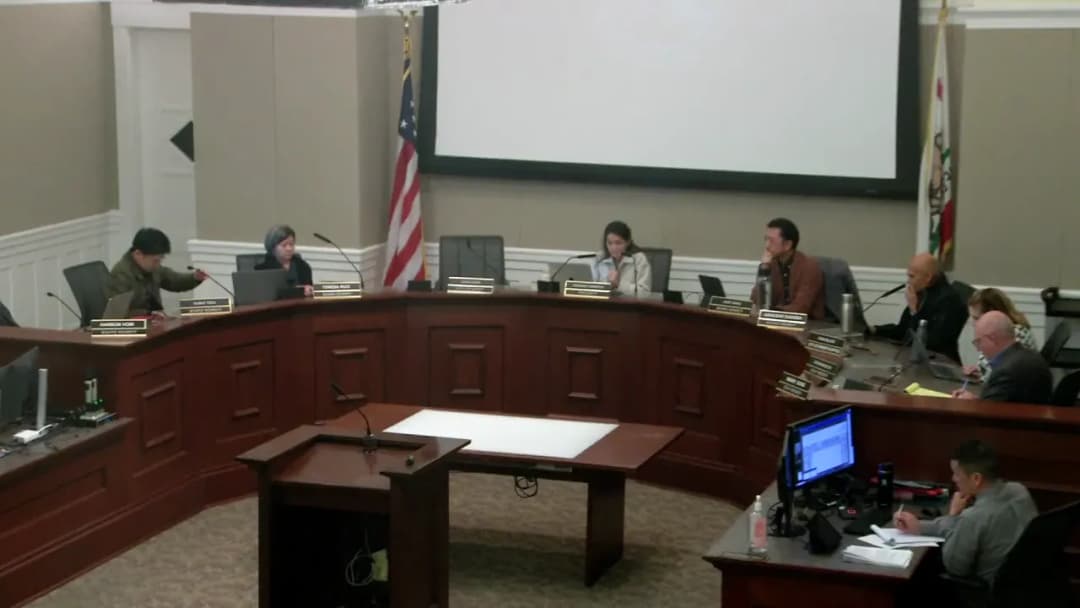
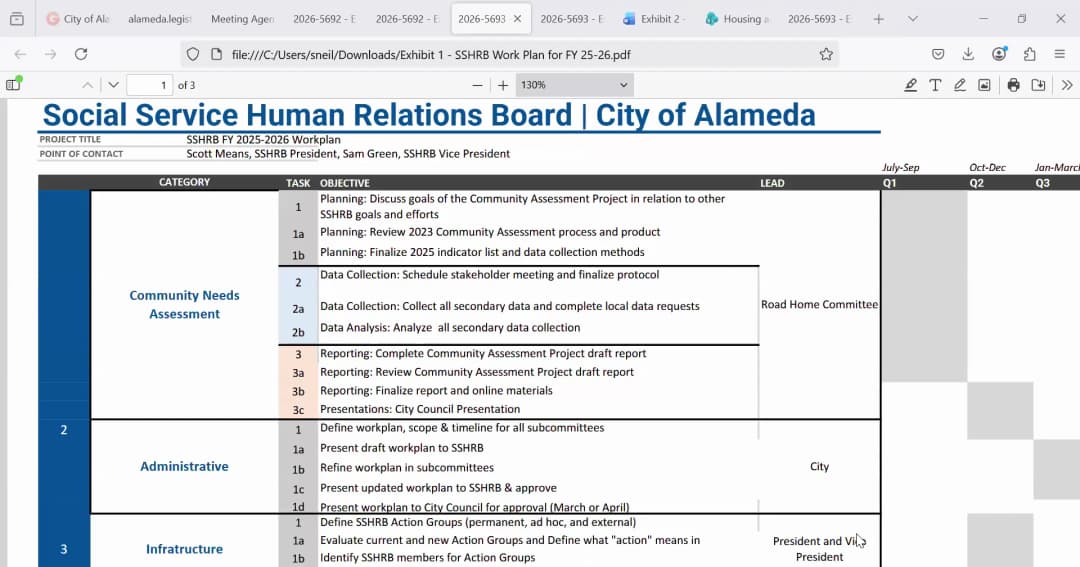
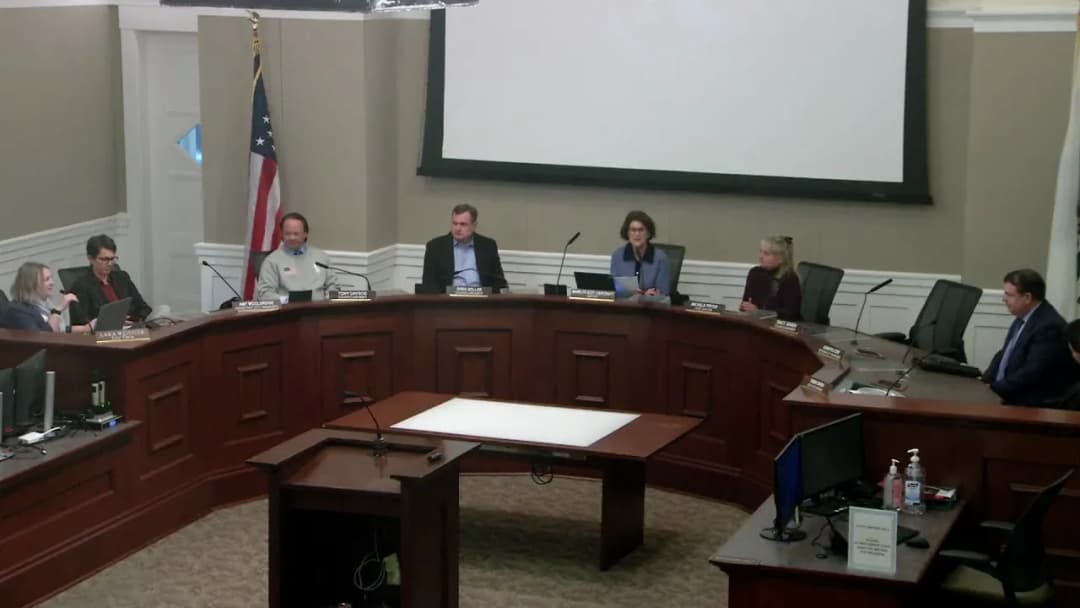
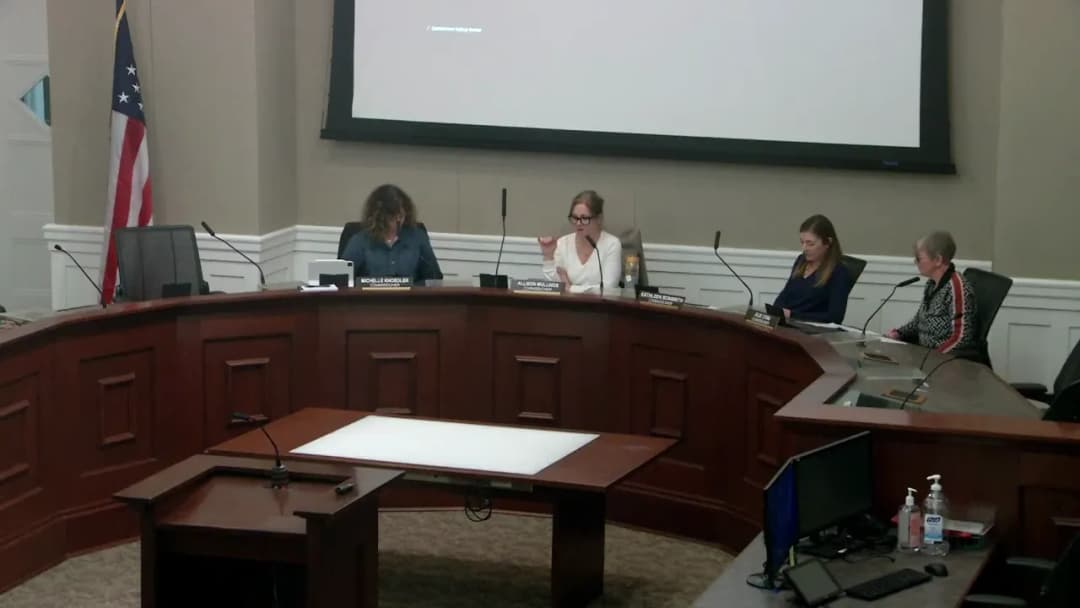
The Social Service Human Relations Board (SSHRB) met on January 21, 2026, to discuss collaboration on a Season for Nonviolence event, review progress on the annual work plan, receive a presentation on the upcoming Point-in-Time homeless count, and handle routine business. The meeting was called to order at 7:04 p.m. and adjourned at 8:35 p.m. Board member Robbie Kreitz was absent; board member Chantel Carter was also absent but will join next month. Staff present included Gracia (Program Manager), Shelby Neal (Administrative Specialist), and Camille Rodriguez (Homeless Services Manager, joining virtually partway). Public Comments & Testimony - Harin Hershenbaum spoke during non-agenda public comments, expressing deep disappointment and concern about the board's treatment of public testimony. He stated that at a prior meeting, after using his allotted three minutes to raise issues about homeless services, the Village of Blood, and unaccounted public funds, no board member asked questions or followed up, and his comments were omitted from the official meeting minutes. He argued this violates the California Brown Act and suppresses the public record. He urged the board to examine uncomfortable information rather than dismiss it. The board chair thanked him and cut him off after three minutes. A second speaker then made a brief, dismissive comment about the board and the mayor. Consent Calendar - Approval of Minutes (December 1, 2025): The board initially tabled the minutes because Michelle Buckholz, who attended the December meeting, was absent. Later in the meeting after Michelle arrived, the board revisited the item. A motion to approve was made and seconded, and the minutes were approved unanimously. Discussion Items - Season for Nonviolence Partnership: Board member Gerald Bryant led a discussion on collaborating with the Alameda Collaborative for Children, Youth and Their Families (ACCYF) and the Youth Advisory Committee (YAC) for an event commemorating the Season for Nonviolence (January 30 – April 4). The event is planned for the last week of March 2026. The youth advisory committee wants a Wednesday (early release day) starting at 4 p.m., and have proposed an open-mic format with tabling by various clubs, possibly at the Healing Garden. Board members offered to serve as judges and help promote the event. Gerald noted the need to reach out to WABA (owners of the Healing Garden) for permission. The board expressed enthusiasm and committed to supporting the youth. - Review of 2025-26 SSHRB Work Plan Progress: Staff member Gracia facilitated a mid-year evaluation. The board discussed each objective: - Community Needs Assessment: Staff is now leading this effort, with three stakeholder sessions planned. The board will participate as stakeholders and provide feedback on a draft. Board members raised questions about data scope (e.g., including domestic violence indicators for CDBG funding) and ensuring the assessment captures broader community needs. Staff confirmed that data from HMIS and surveys will be used, and the board will have checkpoints to address gaps. - Infrastructure, CDG (completed), Road Home, and Domestic Violence committees: Board members reported on their work. The United Against Hate (AUAH) committee (chaired by Gerald) noted progress on resolutions but still needs to engage with local student unions, LGBTQ community, and the City of Davis for best practices. A pivot to a book club with authors was suggested. The Domestic Violence committee (chaired by Bernie) focuses on task force meetings, with a February 2 meeting featuring the city attorney and victim advocate. The Road Home committee (chaired by Scott and Sam) discussed the upcoming Point-in-Time count and a potential shift to outreach around the data. - New business: Board member Sam Green proposed focusing on overdose prevention and Narcan distribution, including training YAC members and city seasonal staff. The board agreed to explore partnerships with schools and parks. - Point-in-Time Count Presentation: Camille Rodriguez presented on the January 22, 2026 Point-in-Time count of unsheltered homeless individuals. She reported that about 50 volunteers have registered and more are needed to cover all census tracts. Volunteers will meet at 4:30 a.m., walk assigned tracts, and administer surveys via the Counting Us app. Incentives include gift cards and care packages from Girl Scouts and a local baseball team. The count helps secure federal funding. Board members asked about known locations and data methodology; Camille explained that locations are based on observations and may include duplicates. The board discussed sending thank-you notes to volunteers. - Staff Communications: Gracia provided updates: - Day center relocation: Contractor Marcon Builders selected; construction to be completed late summer/early fall. - Federally funded social service provider contracts executed after a long delay. - Five-year progress report presented to city council and accepted on January 6. - Stakeholder sessions for needs assessment begin this month. - New interim city manager appointed: Mr. Adam Pollitzer (experience: 35 years in local government). - 17 below-market-rate homes sold to low-to-moderate income households from September to December. - Board Communications: Board member Gerald reported an email from Diane at the Free Library requesting co-sponsorship for a Black History Month book event featuring a pioneer NAACP recruiter. The board agreed to follow up and potentially partner. Key Outcomes - Minutes approved (December 1, 2025) after Michelle Buckholz arrived. - Season for Nonviolence event: Board will provide judges and promote the event. Staff will coordinate with ACCYF and WABA on logistics. - Work plan revisions: The board will explore overdose prevention initiatives, including Narcan training and distribution. The Road Home and AUAH committees will adjust focus based on new priorities. - Point-in-Time count: Board encouraged to volunteer. Staff will send thank-you notes to volunteers. - Black History Month co-sponsorship: Board to follow up with Diane and library staff. - Board member assignments: New members will be placed on AUAH and Domestic Violence committees; Robbie Kreitz expressed interest in Domestic Violence.
HOMELESSNESS 33% · COMMUNITY ENGAGEMENT 25% · PROCEDURAL 10% · YOUTH PROGRAMS 10%
92
JAN 20, 2026 · ALAMEDA, CALIFORNIA · CITY COUNCIL
Alameda City Council Special and Regular Meeting – January 20, 2026

This meeting, held on Tuesday, January 20, 2026, began with a special closed session at 5:00 PM and transitioned into the regular council meeting. The agenda included items on closed session negotiations, oral communications from residents (many youth advocating for safer streets), a contentious discussion regarding the McCartney Road restriping project, adoption of the 2025 Zero Waste Implementation Plan, a workshop on Alameda Point disposition strategy, and approval of multiple leases. The council also appointed a new golf commissioner and heard city manager and councilmember reports. Consent Calendar - Closed Session Consent Calendar: Approved unanimously (4-0) to designate negotiators for the NL terminals real property negotiation. - Regular Consent Calendar: Approved unanimously (5-0) after discussion of items 5H (final passage of CSI mini storage ordinance) and 5D (surplus lands act properties). On 5D, staff explained that recent changes to the Surplus Lands Act necessitated council declaration of exempt surplus before negotiations, and the California Environmental Quality Act (CEQA) review will occur later when concrete projects are proposed. Public Comments & Testimony - Oral Communications (Non-Agenda): Seven speakers addressed the council. Several youth (Cora Piper, Jacob Moore Mortice, Lisa Roach, Josephina Renon) expressed concerns about bike and pedestrian safety, requesting safer crossings, slower speeds in school zones, and resurfacing of the bumpy wooden bridge. Alan Tubbs (volunteer at Alameda Naval Air Museum) requested financial relief and lease assistance, citing rising insurance costs and building maintenance issues. Josh Altieri (Housing Authority City of Alameda) highlighted partnerships with city departments and announced upcoming waitlists for two affordable housing properties. - Item 10A – McCartney Road Restriping: Thirteen speakers provided public comment. The majority, including residents and parents with children, supported the lane reduction and safety improvements, citing slower traffic and safer crossings. A few speakers (e.g., William Pye, Rayla Graeber, Maureen Craw) opposed the changes, arguing insufficient community engagement and questioning the process. - Item 7B – Zero Waste Implementation Plan: One speaker, Ruth Abbey (Community Action for Sustainable Alameda), supported adoption and urged full funding. - Item 7C – Alameda Point Disposition: One remote speaker, Paul Eustarian, supported selling more property to reduce the city's landlord burden and generate infrastructure funding. Discussion Items - Item 10A – McCartney Road Restriping (Council Referral by Councilmember Desog): The council considered a referral to halt the recently completed restriping of McCartney Road from four lanes to two lanes (with buffered bike lanes) between Fortman Way and Island Drive. City Engineer Scott Wickstrom explained the changes were based on Vision Zero policy, Active Transportation Plan goals, and traffic analysis showing minimal impact on capacity (e.g., afternoon backup at Island Drive increased from 80 to 130 feet). He acknowledged outreach could have been better but defended the technical decision as safer. Councilmember Desog argued that staff overstepped authority, especially given opposition from the Harbor Bay Isle Homeowners Association. After extensive debate (including a failed motion to direct staff to review policies and municipal code for future projects), the council did not take action to halt the project. The interim city manager and city attorney committed to bringing back a policy on public engagement and staff delegation for infrastructure projects. - Item 7B – 2025 Zero Waste Implementation Plan Update: Public Works Coordinator Liza Cord presented the plan, which replaces the 2020 goal with ongoing strategies to increase diversion from 81% toward 89%. The plan includes 12 programs, with four priority programs: enhancing multifamily bulky collection, enforcing illegal dumping, and piloting resources for low-income and unhoused communities (e.g., Cash for Trash). Funding requests will come in future budget cycles. - Item 7C – Workshop on Disposition Strategy for Alameda Point: Base Reuse and Economic Development Director Abby Thorne Lyman reported that the Master Infrastructure Plan cost has risen to $900 million. The strategy focuses on selling land in the Phase 1 loop area to fund Phase 2 infrastructure (estimated $43 million). She highlighted that land values have not kept pace with inflation and building depreciation, and recommended seeking grants. Specific properties discussed include Building 41 (long-term ground lease), Building 11/412 complex (disposition due to $12 million roof need), and the Bachelor Enlisted Quarters (creative adaptive reuse). No formal action was taken. - Items 7D & 7E – Lease Approvals: - 7D: Ordinance authorizing five-year leases with Chi Concepts LLC for Building 168 (28,000 sq ft interior) and Pier 1 at Alameda Point. Combined monthly base rent $27,150, with 3% annual increase. Approved unanimously. - 7E: Ordinance authorizing a five-year lease at 1001 Marina Village Parkway for fire administration consolidation (6,944 sq ft). Total cost $783,636 over five years, funded within existing budget. Will allow decontamination and wellness improvements at Fire Station 1. Approved unanimously. Key Outcomes - Closed Session Votes: - Labor negotiations (4-1, Councilmember Desog dissenting). - Potential litigation (4-1, Councilmember Jensen dissenting). - Real property negotiation for NL terminals (5-0). - Appointments: Yatin Shastri appointed to Golf Commission (5-0). - Item 10A – McCartney Road: Motion to direct staff to update policies and municipal code for council review of future projects failed (2-2-1: Councilmembers Desog and Bowler in favor; Mayor Ashcraft and Vice Mayor Pryor opposed; Councilmember Jensen abstained). The project will proceed as completed. Staff will independently develop improved outreach and delegation guidelines to present at a future meeting. - Zero Waste Plan: Adopted unanimously (5-0). Priority programs to be funded through future budget requests. - Leases: Both ordinance items (7D and 7E) approved on first reading unanimously. - Council Referrals: No new referrals were introduced. Councilmember Jensen indicated she would bring a future referral on tenant waste sorting requirements. - Councilmember Reports: Vice Mayor Pryor participated in CASA cleanup and point-in-time count training. Councilmember Jensen attended an e-bike regulation webinar and noted leadership on SB 54 implementation. Mayor Ashcraft attended athletic field reopening and Mayor's Conference, highlighting Alameda's sea level rise planning. Councilmember Desog reported on the grand reopening of the school athletic fields.

PROCEDURAL 18% · TRANSPORTATION SAFETY 16% · ECONOMIC DEVELOPMENT 13% · COMMUNITY ENGAGEMENT 11%
93
JAN 14, 2026 · ALAMEDA, CALIFORNIA · CITY COUNCIL
Commission on Persons with Disabilities Meeting - January 14, 2026

The Commission on Persons with Disabilities held its regular meeting on January 14, 2026, to discuss the 2026 planning session, including areas of focus, networking opportunities, possible presentations, and future agenda items. Commissioners also approved the minutes from the November 19, 2025 meeting and received staff updates. Consent Calendar - Approval of Minutes (November 19, 2025): A motion was made and seconded to approve the minutes. The commission voted unanimously (via voice vote: ayes) to approve. Discussion Items - 2026 Planning Session: The main agenda item was an open discussion led by Chair Mullings. Commissioners proposed and explored the following topics: - Emergency Communications and Accessibility: Commissioner Bondsmith raised interest in how emergency and city communications are experienced by residents with different access and processing needs, especially digital accessibility and neurodiversity. Commissioners discussed past work on digital accessibility and the upcoming DOJ rule effective April 2026. Staff (Lillian, ADA Coordinator) noted plans for a virtual website user testing session in February/March to gather community feedback. Commissioner Bondsmith suggested a post-compliance report and testing emergency notifications with neurodiverse users. - Community Outreach and Events: Commissioners Bondsmith and Bieler shared experiences from the Fourth of July parade and advocated for having booths at city-sponsored events to increase visibility and gather community input. Ideas included adapted games, giveaways, and an elevator pitch for the commission. Staff clarified Brown Act compliance for commissioner attendance at events. - Networking with Other Boards and Commissions: The group discussed liaising with other city boards (e.g., Library Board, Recreation and Park Commission, Transportation Commission, Social Service Human Relations Board, Planning Board) and potentially inviting them to present. Staff provided a list of active boards. Commissioner Lyons expressed interest in connecting with Alameda CERT and the golf commission. Commissioners also discussed reviewing agendas of other commissions and attending beat meetings. - Possible Presentations: Suggestions included presentations from AC Transit, the city’s transportation department (on paratransit and ride-share pilots), East Bay Regional Parks, ARPD (on inclusive services), the library (on programs), FAAS (Friends of Alameda Animal Shelter, with potential for therapy animal discussion), and a presentation on the misuse of accessible parking spaces. Commissioner Bieler requested regular updates on Click Fix data. - Disability Pride Month Event: Commissioner Bondsmith proposed hosting a community screening of a film related to disability activism in July, possibly in partnership with ARPD or the library. Commissioners supported the idea. - Other Ideas: Commissioner Bieler suggested a presentation on universal basic income pilots. Commissioner Lyons raised concerns about pesticide use in public landscaping. Commissioner Bondsmith mentioned potential conference attendance (Pacific ADA Network). Key Outcomes - The planning session discussion was concluded via a motion and second, and the item was closed. - Commissioners agreed to revisit networking opportunities and assignments when all commissioners are present. - Staff (Lillian) will follow up on several action items: - Schedule a virtual website user testing session (February/March 2026) and promote it through the Center for Independent Living. - Continue citywide digital accessibility work ahead of the April 2026 DOJ deadline. - Investigate the feasibility of attending city events and coordinate logistics (budget, permits, supplies) with the City Clerk’s office. - Follow up with Fire Captain Andrews regarding emergency operations plan updates and potential community drills. - Contact AC Transit and other presenters from past meetings for updates. - Coordinate with ARPD and the library for a Disability Pride Month event. - Research the misuse of accessible parking spaces and potential reporting mechanisms. - Staff also reminded commissioners of the January 22 Point-in-Time Count for unsheltered homelessness and a donation drive managed by the youth advisory committee.

COMMUNITY ENGAGEMENT 42% · DISABILITY RIGHTS 24% · PROCEDURAL 10% · PUBLIC ENGAGEMENT 10%
94
JAN 6, 2026 · ALAMEDA, CALIFORNIA · CITY COUNCIL
Alameda City Council Meeting – January 6, 2026: Homeless Plan, Sidewalk Policy, and Lease Approval

The Alameda City Council met on Tuesday, January 6, 2026, in regular session after a closed session on labor negotiations. The council approved a consent calendar for closed session, conducted a special successor agency meeting, issued a proclamation for Martin Luther King Jr. Day, heard public comments on non‑agenda items, and addressed several regular agenda items including adoption of the final report on The Road Home homeless plan, amendments to sidewalk repair and collections policies, and approval of a new lease with CSI Mini Storage at Alameda Point. All votes were unanimous except where noted. Closed Session Consent - The council approved a motion to designate negotiators for labor negotiations in closed session. Passed unanimously. Successor Agency (Redevelopment) Consent Calendar - The council approved the minutes and the Recognized Obligation Payment Schedule (ROPS) for the successor agency. Councilmember Daysog thanked staff for clarifying that Independence Plaza affordable housing for seniors will continue receiving operating subsidy through a new HUD‑funded agreement after the ROPS subsidy ends in January 2027. Passed unanimously. Proclamation: Martin Luther King Jr. Day - Mayor Ashcraft read a proclamation declaring January 19, 2026 as Martin Luther King Jr. Day in Alameda, encouraging volunteerism and highlighting Dr. King's legacy. Councilmember Jensen expressed concern that the National Park Service had eliminated free admission on MLK Day, calling it an attack on history. Public Comments & Testimony (Non‑Agenda Items) Six members of the public spoke during oral communications: - Brian Kennedy urged removal of anti‑ICE content from the city website, citing ICE's work against cartels, child sex trafficking, and fentanyl. He referenced the death of Laken Riley. - Jackie Zipkin (Bay Farm resident) requested improved pedestrian crossing safety at Kaufman Parkway adjacent to Tillman Park, noting two recent accidents. - Rayla Graeber opposed the planned lane reduction on McCartney Road, questioned the use of 15 years of accident data, and argued the project lacked council authorization. - Steve Bondi opposed the McCartney Road changes, stating they would increase traffic and danger, and felt Bay Farm's needs were treated as a tax revenue source. - Donna Marie Farrow appealed for community consultation on the McCartney Road repaving and lane changes, emphasizing her family's deep roots on Bay Farm Island and concerns about future development. - William Morrison noted that public participation in city decisions is limited, apologized for not earlier raising concerns about removal of railroad tracks on Fernside, and suggested moving the north‑south greenway from Versailles to Pearl Street. - Maria Piper (Bay Farm resident, PTSA president, Bike Walk Alameda board member) expressed support for the McCartney Road safety changes, citing adopted policies like Vision Zero and the 2023 traffic death. She encouraged the council to station a crossing guard at Oganbah‑McCartney. Regular Consent Calendar Councilmembers asked questions about items 5D (security system RFP) and 5I (South Shore sea level rise planning). Staff clarified selection criteria and funding sources. No items were pulled. The consent calendar was approved on a motion by Vice Mayor Pryor, seconded by Councilmember Jensen, with Councilmember Daysog voting no on items 5F and 5G for consistency with past opposition. Motion carried with two dissenting votes noted. Discussion Items Appointments to Boards and Commissions (7A) The council unanimously approved the appointment of Adrian Sancho to the Public Art Commission and Kevin Scholes to the Mayor's Economic Development Advisory Panel (representing hospitality and food/beverage). Both were sworn in and introduced themselves. The Road Home Homeless Plan Final Report (7B) Staff presented a final report on the five‑year plan to prevent and respond to homelessness (2021–2025). Key accomplishments included: 264 affordable units built (82 ownership, 182 rental), 140 shelter beds by end of 2026, opening of Dignity Village (with 22 transitions to permanent housing in 2025), expanded outreach and case management, and a social worker at the library. Staff noted that a new strategic plan covering the entire Housing and Human Services division is being developed. Public comment: John Brennan (Alameda Warming Shelter) thanked the council and emphasized the need for navigation services and supportive housing. Mitch Ball supported the plan but argued more housing is needed, and suggested a lot‑area parcel tax rather than a floor‑area tax to encourage development. Council discussion: Members asked about point‑in‑time count data, housing‑first approach, and coordination with the Housing Authority. Councilmember Daysog noted philosophical concerns about housing first but supported the overall progress. The council voted unanimously to accept the final report. Sidewalk Repair and Collections Policy (7C) Staff presented proposed ordinances and a collections policy to improve sidewalk repair compliance and recover unpaid receivables ($1.4 million outstanding). The collection policy could recover an estimated $550,000 per year. Staff revised the recommendation to remove provisions for special assessments (liens) on sidewalk repair costs, instead piloting a collections‑only approach for one year and returning with a report. The council would introduce the civil action ordinance (allowing small claims/limited civil actions), adopt the collections policy with revisions, and direct staff to revise the sidewalk ordinance to remove lien authority. Public comment: William Morrison (Fernside Home Association) raised concerns about city‑owned trees causing sidewalk damage and asked that the ordinance not apply to those cases. Mitch Ball supported the improvements but advocated for a parcel tax model like Albany's to fully fund sidewalk repairs. Council discussion: Members expressed support for the revised approach, appreciating transparency and payment plans. The motion (by Councilmember Jensen, seconded by Vice Mayor Pryor) passed unanimously. Lease with CSI Mini Storage (7D) The council authorized a 36‑month lease with Roads Property Holdings LLC (dba CSI Mini Storage) for buildings at Alameda Point, with two three‑year renewal options and a six‑month termination right. The rent increases 9.25% from the prior month‑to‑month rate, generating over $2.6 million over the initial term. Councilmember Daysog noted the early termination clause preserves flexibility for future redevelopment. Passed unanimously. City Manager Communications Interim City Manager Adam Politzer thanked staff for their response to the New Year's Eve and January 4 storm, including king tides and flooding. He recognized Public Works, Fire, and Police departments for preparedness and response. Council Communications Councilmember Jensen reported on a walk to raise awareness about first responder and military suicide risks, and presented data on 2025 collisions between vehicles and pedestrians, bicyclists, and scooters: 72 total (28 bicycle, 7 scooter, 31 pedestrian), with 21% of pedestrian hits occurring in crosswalks. Intersections with multiple collisions included Central & Park, Alpizado Pkwy & Wilmachen Way, and Webster & Lincoln. She urged continued safety efforts. Mayor Ashcraft reported on holiday events (Menorah lighting, Chabad Hanukkah celebration, fire department toy drive) and thanked staff for rapid installation of safety features at new Central Avenue roundabouts before the storms. Mayor's Nomination to Golf Commission Mayor Ashcraft nominated Yatin Shastri to the Golf Commission. The nomination will be voted on at the next meeting. Key Outcomes - Approved closed session consent to designate labor negotiators. - Approved successor agency consent calendar (minutes, ROPS). - Accepted final report on The Road Home homeless plan. - Introduced civil action ordinance for collections; adopted collections policy with revised language removing sidewalk liens; directed staff to revise sidewalk ordinance accordingly (to return later). - Authorized 36‑month lease with CSI Mini Storage at Alameda Point. - All votes unanimous except consent calendar items 5F and 5G (Councilmember Daysog dissenting). - Next steps: staff to continue pilot sidewalk collection program, report back in one year; new strategic homeless plan to be developed; Yatin Shastri nomination to be confirmed.

HOMELESSNESS 27% · ENGINEERING AND INFRASTRUCTURE 14% · PROCEDURAL 13% · FISCAL SUSTAINABILITY 11%
95
DEC 17, 2025 · ALAMEDA, CALIFORNIA · CITY COUNCIL
Alameda Transportation Commission Meeting – December 17, 2025

The Transportation Commission convened on December 17, 2025, to receive updates on staff communications, discuss the Neighborhood Greenway implementation and Pacific Avenue pilot, and approve the 2026 meeting calendar. Commissioners reviewed a pilot project installed a month prior, heard public comments both supportive and critical, and provided feedback on specific traffic calming treatments. Staff Communications - Gibbons High Fernside project: City Council accepted staff recommendations for traffic calming phase one (quick build) and phase two data collection; staff to return with options for future measures, including possible permanent roundabouts. - Upcoming agenda topics: AC Transit signal priority update, Lincoln Ave and Walnut Street planning, February 2025 annual report and 2026 work plan. - Project updates: Water shuttle on winter schedule (6 days, shorter weekends); Oakland Alameda Estuary Bridge study contract approved (completion expected 2027). - Construction updates (Scott Wickstrom): Central Avenue roundabouts at 3rd and 4th Streets complete and open; Pacific/Main roundabout closure expedited, aiming for early spring completion; annual paving on Bay Farm Island nearly done (striping delayed by weather); Cross Alameda Trail fully open from Seaplane Lagoon to Broadway; Tilden Clement work ongoing (lane reductions and closures planned). - Community feedback on Bay Farm Island paving: Concerns about traffic capacity, loss of lanes, and turn restrictions; staff evaluating notification and input processes for future projects. Consent Calendar - Approval of draft minutes (October 22, 2025): Motion carried unanimously with Chair Whitesy and one other commissioner abstaining (Chair recused). Public Comments & Testimony - Jim (non-agenda): Expressed concern about poor lighting and lack of signage at the new Central Avenue roundabouts, stating it felt unsafe at night and asking for improved visibility. - Jay Garfinkel (non-agenda): Criticized the planning process as top-down, argued that residents are not meaningfully involved, and alleged that Bike Walk Alameda exerts undue influence on city projects. - Cindy Johnson (on 6A): Supported the Pacific Avenue pilot, noted speeding still occurs between traffic calming elements, and suggested the city consider 15 mph speed limits on neighborhood streets (citing a UC Berkeley SafeTREC confirmation of legal authority). - Denise Trapigny (Bike Walk Alameda board president): Expressed strong support for neighborhood greenways, urged the commission to prioritize safety and climate goals over parking and driving convenience, and thanked staff for their work despite misinformation from opponents. - Mitch Ball (on 6A): Praised the pilot overall, recommended adding bollards in outbound bulbouts and at traffic circles to prevent vehicles from overrunning them, and provided diagrams. - Jim Straylo (on 6A): Criticized the pilot as a waste of money, stating the traffic circle does not slow cars enough and that cyclists already use other routes. - Catherine Hunch (on 6A): Opposed the traffic circle at Peru and Pacific, presented a petition where 85% of neighbors surveyed were strongly opposed, and requested a four-way stop instead, citing safety concerns for cyclists and pedestrians. Discussion Items - Neighborhood Greenway Implementation and Pacific Avenue Pilot (6A): - Staff (Rochelle Wheeler and Alison Mills) presented an overview of the three-phase Greenway program, focusing on Phase I (Pacific, San Jose, Versailles). The Pacific pilot (Lafayette to Oak) installed in two phases (stop signs in April, rest in November) includes a traffic circle at Chestnut, asphalt speed humps, hardened center lines, painted bulbouts, and other treatments. - Community survey (221 responses, Dec 4-14) showed 52% overall positive, 62% of non-drivers liked it, while 43% of drivers-only reported issues. Free-form comments varied: many supported the traffic circle and speed humps, but some wanted more slowing and clearer signage. - Commissioner discussion explored: - Traffic circle at Chestnut: Commissioner noted predictability versus irregular stop signs on Pacific; staff explained that traffic circles (all-way yield) are preferred over four-way stops for traffic calming and that four-way stops require a warrant analysis. The circle is designed low-profile for large vehicles; some commissioners suggested future design tweaks for visibility. - Hardened center lines: Staff explained they slow turning traffic and improve predictability; commissioners questioned effectiveness due to low profile but acknowledged potential safety benefits. Some suggested exploring vertical elements like flex posts, but staff noted maintenance concerns. - Speed humps: Located based on spacing (300-500 ft) and driveway constraints; no specific outreach to adjacent property owners but no complaints received. - Network connectivity: Commissioner emphasized the need to connect greenways to schools and other destinations; staff showed the 2030 low-stress network map and noted that additional funding is needed for full buildout. - Chair concluded that the commission generally felt the pilot is a good start, safer based on experience and feedback, and provided design critiques for staff to consider. - Approve 2026 Transportation Commission Meeting Calendar (6B): - Staff proposed meetings on Jan 28, Feb 25, Mar 25, May 20 (adjusted for Eid), Jul 22, Sep 23, Nov 18 (avoiding Thanksgiving), plus holding fourth Wednesdays of even months for potential special meetings. - Commissioners noted potential conflicts for January meeting. Motion passed unanimously. Commission Communications - Commissioner shared personal concerns about unregulated e-bikes, noting lack of federal oversight and difficulties for parents; staff provided information on the Police Department's new webpage (AlamedaCA.gov/e-devices) and a recent Facebook post with shopping advice. - Commissioner complimented the quick response from Public Works and Transportation to fix initial traffic issues at the Pacific/Main roundabout closure (signs rearranged within 24 hours). Key Outcomes - Approved: Consent calendar minutes (with abstentions). - Approved: 2026 Transportation Commission meeting calendar (unanimously). - No formal vote on the Neighborhood Greenway pilot; commission provided input as a discussion item. Staff will incorporate feedback into final designs for Phase I implementation by fall 2026. - Next steps: Data collection on the pilot (speed, volume, bike counts) planned one year post-installation; staff will consider creating a two-year paving planning cycle to improve community outreach timing; further study on modal filters for future greenways.

ACTIVE TRANSPORTATION 51% · TRANSPORTATION SAFETY 28% · ENGINEERING AND INFRASTRUCTURE 10% · COMMUNITY ENGAGEMENT 9%
96
DEC 16, 2025 · ALAMEDA, CALIFORNIA · CITY COUNCIL
Alameda City Council Meeting - December 16, 2025: Closed Session, Referrals on Truck Study and Bike Speed Limits

The Alameda City Council held its final meeting of 2025 on Tuesday, December 16, 2025. The meeting began with a closed session covering labor negotiations, potential litigation, and three real property items (Building 525, Alameda Theater, Building 22). The regular meeting followed at approximately 7:10 PM, featuring two council referrals, oral communications, consent calendar approval, and council member reports. The council returned to closed session after the regular agenda to complete the remaining property items. Consent Calendar - The consent calendar, including a public hearing on amendments to the Community Development Block Grant action plans (FY 2019–20 through 2024–25), was approved unanimously by a voice vote of 5 ayes. - Councilmember Jensen expressed support for items 5F and 5G authorizing construction for the relocation of the Alameda Day Center and item 5H extending an agreement with Village of Love for emergency shelter services. Public Comments & Testimony - Oral Communications (Non-Agenda): - Brian Kennedy criticized the city’s sanctuary city policy and an anti-ICE webpage, claiming ICE has rescued 62,000 children from sex trafficking. He used graphic language and was asked to leave after interrupting the mayor. - Matt Riley Mahaney (resident of Kaufman Parkway) urged immediate traffic calming measures near Tillman Park and Bay Farm Elementary, citing a recent crash (December 13, 2025) where a distracted driver flipped a car. He requested speed bumps, high-visibility crosswalks, and enforcement, noting no speed bumps or flashing school zone signs currently exist. - Closed Session Public Comment (Building 525): - Evan Philippi (Pacific Pinball Museum) expressed interest in the building, noting the museum’s 23-year history in Alameda and a $1 million war chest for expansion. He emphasized plans for a world-class museum. - Sadia (owner of Swings and Wings Family of Services) described her six-and-a-half-year-old inclusive play space for children and caregivers, proposing a sensory museum. She highlighted steady revenue growth and community engagement. - Miriam Sultan (volunteer and future occupational therapist) spoke in support of Swings and Wings, citing their impact on families. - Public Comment on Council Referral 10B (Bike Speed Limit): - One speaker opposed a 15 mph limit, arguing ebikes enable car-free commuting and that enforcement should focus on delivery vehicles and cars in bike lanes. - Mitch Ball supported a 15 mph limit on shared-use paths but not on dedicated bike paths (e.g., Cross Alameda Trail), noting his natural speed on a pedal bike reaches 20–25 mph on such paths. - Cindy Johnson (Bike Walk Alameda) reinforced the group’s letter: support for 15 mph on shared paths but opposition on dedicated bike paths. She cited 11 severe/fatal traffic injuries in Alameda last year, none involving bicycle speeding; the primary cause was motorist behavior. She encouraged supporting state legislation to distinguish ebikes from electric mopeds. Discussion Items - Council Referral 10A – I-580 Truck Access Safety Study: Councilmember Jensen presented a referral to expand the Caltrans study area to include Alameda’s northern waterfront, citing public health impacts from I-880 truck traffic. Mayor Ashcraft suggested discussing with Caltrans and deferring to the priority-setting workshop in early 2026 to avoid burdening staff. Councilmember Daysog cautioned against intervening in Oakland affairs. The council agreed to have the mayor and Councilmember Jensen work offline with Caltrans to clarify study boundaries. - Council Referral 10B – 15 mph Speed Limit for Bikes and Ebikes on City Paths/Parks: Councilmember Daysog argued urgency, citing New York Times data showing ebike fatalities (11% chance of death vs. 0.3% for pedal bikes) and observed middle school children speeding on throttled class 2 ebikes at Cruzy Park. He proposed a 15 mph limit, noting East Bay Regional Park District’s similar rule and creating speed zones for enforcement. Councilmembers raised concerns about enforcement, consistency with bike path design, and data. A motion to refer the proposal to the early 2026 priority-setting workshop passed unanimously (5 ayes). Key Outcomes - Consent Calendar: Approved unanimously by voice vote. - Closed Session Directions: Council provided unanimous direction on labor negotiators, potential litigation (Valley Investments matter), real property for Building 525, Alameda Theater, and Building 22 (all 5-0). - Council Referral 10A: No formal vote; council consensus to discuss offline with Caltrans and consider at the priority-setting workshop. - Council Referral 10B: Referred to the priority-setting workshop in early 2026 (unanimous 5-0). - Nominations: Mayor Ashcraft nominated Adrian Sancho for the Public Art Commission and Kevin Scholes (Almanac Beer Company) for the Economic Development Advisory Panel; votes will occur at the next meeting. - Memorial Adjournment: The meeting was adjourned in memory of victims of mass shootings on December 13, 2025 (Brown University) and December 14, 2025 (Sydney, Australia).

PROCEDURAL 25% · ACTIVE TRANSPORTATION 19% · TRANSPORTATION SAFETY 14% · PENDING LITIGATION 10%
97
DEC 11, 2025 · ALAMEDA, CALIFORNIA · CITY COUNCIL
Economic Development Advisory Panel Meeting - December 11, 2025

The Economic Development Advisory Panel (EDAP) met on December 11, 2025, to discuss the Alameda Point Enterprise District, review lessons from the Pacific Fusion proposal, approve the 2026 meeting schedule, and brainstorm future discussion topics. The meeting included updates on infrastructure costs, marketing strategies, and workforce development initiatives. Consent Calendar - The minutes from the previous meeting were approved without opposition. No public comments were received. Public Comments & Testimony - No members of the public spoke. Discussion Items - Alameda Point Enterprise District (APED) Presentation and Lessons Learned - Abby (staff) presented an overview of the APED, a 112-acre parcel at Alameda Point. She recapped the previous discussion in August 2024 and the subsequent negotiation with Pacific Fusion, a fusion energy company that submitted an unsolicited proposal in late 2024. The city negotiated an exclusive negotiating agreement in four weeks, followed by a purchase option agreement and CEQA checklist approval by June 2025. In September 2025, Pacific Fusion terminated the option, choosing instead to locate in Albuquerque, New Mexico, after the state offered $100 million in incentives. The city received all third-party consultant materials upon termination. - The infrastructure package negotiated was valued at $22–24 million, with the total phase one price at $28.9 million for 13 acres. The overall master infrastructure plan cost has been re-estimated at $900 million, up from $700 million, due to sea level rise and adaptation work. Land values have not kept pace, challenging the previous assumption that Alameda Point development would pay for its own infrastructure. - Panel members discussed lessons learned: the need to ask for feedback from Pacific Fusion beyond the monetary offer, the importance of documenting the process for future opportunities, and the value of state-level incentives. They noted that quality of life in Alameda is a key differentiator, especially for attracting talent. - Ideas for next steps included: reaching out to Pacific Fusion for detailed feedback, exploring enhanced infrastructure finance districts (EIFD) or other financing mechanisms, pursuing grants (e.g., Army Corps of Engineers $15M seawall grant), and considering a master developer approach to build infrastructure speculatively rather than waiting for build-to-suit tenants. - The panel emphasized that the city should use the work already completed (environmental analysis, infrastructure studies) as leverage to move faster with future prospects. - Approval of 2026 Meeting Schedule - The panel approved the schedule for 2026: March 4, June 3, September 2, and December 2 (first Wednesdays of those months). Motion carried without opposition. - Future Discussion Topics - Dwayne (staff) presented an overview of the Economic Development Division’s 2026 activities, organized into four categories: large business activities (e.g., At Your Service liaison program, broker engagement, business visitation), small business activities (e.g., vacancy program, SBDC partnership, shop local initiatives), program management (e.g., special events grants, public art, guaranteed basic income, façade improvement grants), and project management (e.g., downtown zoning update, CRM implementation, new websites, Alameda Point signage). - Panelists suggested several topics for future meetings: workforce development (connecting local businesses with College of Alameda training programs and the LMA workforce board), industry-specific marketing (biotech, blue tech, clean tech), retention strategies for existing businesses, and housing/transportation policies that impact the economy. The panel expressed interest in hearing about the upcoming infrastructure bond poll and city policy initiatives that could affect business. - The panel agreed to focus on business attraction and workforce development for the March 2026 meeting, with possible presentations from College of Alameda and others. Key Outcomes - The 2026 meeting schedule was approved (4 dates). - Staff will send out a list of anticipated 2026 policy initiatives for panel feedback. - Staff will contact Pacific Fusion to request detailed feedback on site selection. - The panel will discuss business attraction and workforce development topics at the March 2026 meeting. - No votes were taken on the APED discussion; it was for information and feedback only.

ECONOMIC DEVELOPMENT 54% · ENGINEERING AND INFRASTRUCTURE 18% · PROCEDURAL 6% · WORKFORCE DEVELOPMENT 6%
98
DEC 11, 2025 · ALAMEDA, CALIFORNIA · CITY COUNCIL
Alameda Recreation and Park Commission Meeting - December 11, 2025

The Alameda Recreation and Park Commission met on Thursday, December 11, 2025, at 9:15 AM (although the meeting began in the evening). The agenda included non-agenda public comment, staff communication from Director Justin Long, commissioner communications, approval of minutes from the November 13 meeting, and a workshop on updates to the banner policy, a new memorial amenity donation policy, and a new park storage unit policy. No formal votes were taken on the workshop items. Public Comments & Testimony - Laurel Orduña (public high school teacher) spoke during non-agenda public comment, requesting an indoor roller skating venue in Alameda. She cited inclement weather, high rink costs ($15–$20 for two hours), and a large Bay Area skating community. She asked that the issue be placed on a future agenda and noted she had been in communication with Joey Carroll at Alameda Point Gym but had not received a definitive answer. Discussion Items - Staff Communication – Recreation Parks Director Justin Long: Provided updates on upcoming events (e.g., Coastal Cleanup Dec 13, Winter Light Celebration, Breakfast with Santa, holiday concerts, youth sports programs), park projects (Estuary Park Phase 2 construction began, sports field renovation ongoing, Main Street Linear Park tree planting with 22 donated trees), and operational highlights (Massic Senior Center served over 1,000 lunches with 119 volunteers logging 1,700 hours; recognition of retiree Enrique Balanos with 30 years of service). In response to commissioner questions, Director Long clarified the developer fee process for park improvements, the volunteer-run holiday boutique (donated $6,700 to the Leisure Club), and that pool maintenance at swim centers is a 50/50 split with Alameda Unified School District (AUSD). - Commissioner Communications: Commissioners reported on attending the Turkey Dip Swim (boiler issue limited lap swimming but families enjoyed the event), tree planting at Linear Park with Alameda High School Leadership Club (50–60 students), the tree lighting ceremony, and observed flag football traditions at various parks on Thanksgiving. Vice Chair Schwartz noted the pool heater issue but appreciated coordination with AUSD. Chair Radies reflected on the commission’s recommendation for the 2026 fee schedule, which was partially adopted by City Council (pool fees returned for further study), and urged the commission to strive for more effective policy recommendations. - Workshop: Policy Updates - Banner Policy: Proposed changes include reducing display duration from 60 to 30 days and adding two new allowed locations (Light Ecker along tennis court fence, Longfellow along Lincoln Avenue). Commissioners supported the shorter duration to reduce visual clutter. - Memorial Amenity Donation Policy: Proposed a new comprehensive policy covering benches, picnic tables, and other amenities (renamed from “memorial bench donation”). Key elements: 10-year term with renewal option (approx. $1,000–$1,500 for renewal), grandfathering existing benches, staff review of inscriptions and locations, an 8–16 week installation timeline, and a provision for removal if the donor cannot be contacted at end of term. Commissioners debated pricing structure (whether to charge full cost including maintenance, with Chair Radies favoring a upfront annuity model) and expressed concern about the financial burden on future donors. Commissioner Robbins noted that previously donors were told no maintenance would be provided, but staff confirmed volunteer maintenance is allowed. Commissioners requested a breakdown of annual donation numbers and past maintenance costs, and suggested tying the policy to the fee schedule for regular cost adjustments. - Park Storage Unit Policy: Draft policy sets terms for small to large storage units (fees range from $50–$150/year, as approved in the fee schedule). The policy clarifies location, condition, duration, removal responsibilities, and a late-renewal period of 10 days. Commissioners discussed standardizing aesthetics (e.g., color, condition), late fee amounts, and key management (staff to retain a copy of keys/codes for abandoned units). Some commissioners suggested storage fees are too low compared to market rates. - Follow-up on Public Comment: Chair Radies and Director Long agreed that the indoor roller skating request could likely be addressed under existing policies. Director Long will coordinate with the athletics staff member and report back at the January meeting. Key Outcomes - Approval of Minutes: The commission unanimously approved the minutes from the November 13, 2025 meeting (4–0). - Workshop Next Steps: Staff will incorporate commissioner feedback on the three policies and return in spring 2026 with finalized versions for adoption. Specifically, staff will review past maintenance costs for memorial amenities, consider tying donation costs to the fee schedule for periodic updates, and explore options for affordable sponsor-a-bench programs. - Next Meeting: The next regular meeting is scheduled for January 8, 2026.

PARKS AND RECREATION 88% · FISCAL SUSTAINABILITY 5% · ENGINEERING AND INFRASTRUCTURE 4% · PROCEDURAL 2%
99
DEC 8, 2025 · ALAMEDA, CALIFORNIA · PLANNING BOARD
Alameda Planning Board Meeting - December 8, 2025

The Planning Board met on Monday, December 8, 2025, at 7:00 p.m. to consider two main agenda items: a design review and vesting tentative map for a large residential project (West Midway Phase A, the "Crafted Neighborhood") and a tree removal and replanting plan for the Tilden-Clement roundabout project. The board also approved consent calendar items and received staff updates. Consent Calendar - Approval of November 10, 2025, Meeting Minutes: Motion to approve with a minor correction (abstention record) passed unanimously (4‑0, with one absence). Board member Ruiz was absent. Public Comments & Testimony - Non‑agenda public comment: None. - Consent calendar public comment: None. - Item 5a (West Midway Phase A): No members of the public spoke during the public hearing. Six written comments were submitted; most were in support, one was critical (raising concerns about exceeding the Alameda Point unit cap, historic impacts, and reliance on prior EIRs). Staff addressed these comments, noting the project is outside the historic district and within the approved EIR. - Item 5b (Tree Removal Plan): No public comments. Discussion Items - Item 5a – Design Review & Vesting Tentative Map – West Midway Phase A (Crafted Neighborhood): - Staff (Henry Dong) introduced the project: 62 new buildings with 284 units on 12.4 acres (part of a larger 22.8‑acre master plan). The project includes a mix of duets (2‑ and 3‑story), 3‑story townhomes, and 4‑story condominiums, plus a central greenway, park, and private streets with public access easements. - Project sponsor (Alejandra Dominguez, Brookfield Residential) and design team (David Burton, KTGY; Margaret, Woodley Architects) presented the neighborhood concept and three housing typologies (Artisan, Harmony, Mastery). - Board members asked clarifying questions: - Affordable housing: Phase A includes two moderate‑income units; the remaining 37 affordable units (including workforce housing at 120–180% AMI) are in Phase B. The project is governed by a development agreement and DDA, not the new inclusionary ordinance. - Workforce housing: Not deed‑restricted but initial sale must target 120–180% AMI; market‑rate AMI is 300%. - Universal design waiver: Duets have some universal design units despite the waiver. - Street names: Selected from the existing HAB‑approved list. - Roundabout: Explored but not feasible due to right‑of‑way constraints. - Board members provided design feedback and expressed overall support: - President Cisneros and several members praised the project’s pedestrian orientation, greenway, and contribution to housing goals. - Board Member Sahiba commented on massing consistency, especially with the duets, and suggested stronger continuity in materials and wayfinding. - Board Member Hom appreciated the three different architects and the resulting variety, though noted some odd design elements (e.g., a rear elevation on the duets). - Board Member Sue highlighted the thoroughness of the application. - Board Member Dewees raised safety concerns about the greenway’s connection to Main Street (jaywalking risk) and lighting maintenance on private streets. - Item 5b – Tree Removal and Replanting Plan – Tilden‑Clement Roundabout Project: - Staff (Scott Workstrum, city engineer; Aliha Teffy, public works) presented: 65 trees to be removed (including four Coast Live Oaks, which received Historical Advisory Board approval) and 101 new trees (24‑inch box) to be planted, plus irrigation. The project includes a roundabout, road diet, Clement Avenue extension, trail connections, and a dog park. - Board members asked about: - The supplemental planting exhibit (clarified as a reorganized version). - Replacement tree species selection and compliance with the Street Tree Master Plan. - CEQA coverage: Prior EIR and a categorical exemption were discussed; board agreed to rely on the prior EIR. - Board members expressed strong support for the project’s safety and gateway improvements. - Staff Communications (Item 6): - Update on Harbor Bay Landing shopping center: SB 330 pre‑application withdrawn; applicant continuing discussions with Safeway and landowner. - Commercial zoning review for Park and Webster: Staff seeking two planning board volunteers for a working group to address storefront vacancies; kickoff planned for January 2026. - Acknowledgement of the successful site tour of Alameda Point led by base redevelopment staff. Key Outcomes - Item 5a (West Midway Phase A): Motion to adopt the draft resolution approving the design review and vesting tentative map and recommending city council approval of street names passed 4‑0 (one absent: board member Ruiz). - Item 5b (Tree Removal Plan): Motion to recommend approval of the tree removal and replanting plan passed 4‑0 (one absent). - Staff Communications: Board members volunteered for the commercial zoning working group (Board Members Hom and Sahiba). Staff will return with further details in January. - Meeting adjourned at approximately 9:45 p.m.

AFFORDABLE HOUSING 31% · ENGINEERING AND INFRASTRUCTURE 25% · ENVIRONMENTAL PROTECTION 17% · ECONOMIC DEVELOPMENT 6%
OPENPUBLICA · PUBLIC MEETING INDEXUPDATED DAILY · openpublica.com