The committee received updates on federal and state legislative matters, considered an informational item on AB 96, and voted to support a legislative position on CalFresh priorities. No public comments were made. Federal Legislative Update - Lin Haquez reported on the impact of a snowstorm delaying Congress's return, the upcoming State of the Union address, and ongoing negotiations to reopen the Department of Homeland Security (DHS) after a shutdown. The White House offered to codify some reforms (e.g., body-worn cameras, clear badge policies, dissolution of roving patrols) but not all Democratic demands. - A Supreme Court ruling negated presidential authority to impose tariffs under the IEPA Act; President Trump announced plans to use Section 122 for a 10–15% tariff increase, which requires congressional authorization and expires in 150 days. - The House Farm Bill ("skinny" authorization) was postponed due to weather; key provisions include SNAP oversight and cybersecurity, nutrition incentive program reauthorization, and cost-share waivers for persistent poverty counties. The bill faces partisan opposition over reconciliation package thresholds. - An executive order on election security targets alleged immigrant voter fraud; five cases in Florida were reported. State Legislative Update - Gyal Dentas reported that California's bill introduction deadline (Feb 20) yielded under 1,800 bills, about 33% placeholder measures. SB 1400 (Alameda County-sponsored) was introduced to modernize AHS governance; the bill is in its 30-day in-print period. - The Department of Finance reported personal income tax revenues $4.7 billion above January forecasts; the LAO projected total revenues $8 billion above the governor's January budget, driven by AI sector growth, but cautioned against treating gains as ongoing. - California Attorney General Bonta led a 13-state lawsuit challenging termination of $1.2 billion in federal energy and infrastructure funds. - Governor Newsom signed early action budget bill AB 117, authorizing $590 million in emergency loans for Bay Area transit systems (BART, Muni, Caltrain, AC Transit). - Upcoming budget hearings on CalWORKs, housing, and CalFresh were noted. Discussion Items - AB 96 (Informational): Alameda County Health recommended a support position to remove the high school diploma requirement for peer support workers, expanding availability. Dr. Triple and the Mental Health Directors Association sponsored the bill; a support letter was signed by the department. - Request for Legislative Position on CalFresh Priorities: The County Welfare Directors Association requested the county champion CalFresh eligibility investments and March waiver for the upcoming budget. The Social Services Agency recommended support. Key Outcomes - Motion to Support CalFresh Priorities: Supervisor Fortunatas moved to support the legislative position; Supervisor Town seconded. The motion passed unanimously (2 ayes). No public comment was received. - No action was taken on the federal or state legislative updates or AB 96, as they were informational items.
Public Meetings - Alameda County, California
Public Meetings - Alameda County, CaliforniaThe Health Committee of the Alameda County Board of Supervisors met on February 23, 2026, with Supervisors Cam and Miley present. The meeting focused on public comments regarding the severe impacts of Proposition 1 (transition from MHSA to BHSA) on behavioral health services, followed by presentations on the county's overdose prevention efforts and the opioid settlement funds planning and implementation. Public Comments & Testimony - David Shanner (CEO, The Better Way; President, Alameda County Behavioral Health Collaborative) expressed strong concern about Prop 1 implementation, stating it will cause 15,000 clients to lose critical services and a loss of $27 million in funding in their collaborative alone, with many jobs held by people with lived experience at risk. He urgently requested a hearing to discuss the issue in depth. - Chris Becker (licensed marriage and family therapist, Highland Hospital) provided information about planned closure of two behavioral health programs at Fairmont and Highland by Alameda Health System, serving clients with serious mental illness. Noted that these programs are Medicare-funded and provide unique services including transportation and interpretation. - Jamie Campos (CEO, Horizon Services) spoke about elimination of Lambda Youth Program (serving LGBTQ+ youth aged 12–24) effective July 1 due to BHSA transition. The program was identified as needed because 45% of LGBTQ youth seriously consider suicide. Also noted outdated funding levels for other Horizon programs. - Lynn Rivas (Executive Director, California Association of Mental Health Peer Run Organizations) reported that three peer-run organizations in Alameda County received cuts, with Peers and Peer Wellness Collective receiving dramatic cuts (Peer Wellness Collective 100% cut). Stated viability of these organizations is at risk. - Narges Stollen (Executive Director, Crisis Support Services of Alameda County) described closing of hospital follow-up program and survivors of suicide attempt support group due to Prop 1. Noted a 40% increase in crisis line call volume in the past year. - Sarah Markser (District 3 resident, works at Peers) emphasized that peer-run organizations provide living proof that recovery is possible and that the county cannot afford to lose them. Peers employs 30 people with lived experience. - Katrina Talou (Executive Director, Peer Wellness Collective) described the organization's 25-year history and that 25 staff all have lived experience. Called the cuts devastating and warned of a crisis similar to when state hospitals released individuals without community services. - Giovanni Iglesias (COO, Bay Area Community Services) expressed concerns about BHSA cuts: BACS alone slated to lose services for 4,000 clients across the county, including closure of wellness centers and community-based teams. Asked for a formal hearing and longer off-ramp. - Marcos Gonzalez (Associate Director, BACS) noted that four wellness centers serve unhoused/at-risk individuals with behavioral health concerns. Cuts will eliminate them. - Shemima Abdullah (Program Manager, BACS SAGE program) provided details: SAGE serves 300 clients yearly with weekly wellness checks, support for appointments, Narcan distribution, etc. Cuts would push clients back to emergency rooms. - Jamie Almanza (CEO, BACS for 16 years) stated BACS will close services for 600 individuals (80% African American, 80% unhoused) and all wellness centers. Noted loss of federal match (50 cents on the dollar) for Medi-Cal billable services. Warned of Santa Rita jail becoming the largest mental health institution. Compelled board to enact a special session immediately. Discussion Items Overdose and Poison Prevention Program Update - Dr. Kathleen Clannen introduced the update. Joel Ravier presented data: overdose deaths peaked in 2023 and have decreased significantly over the last two years, but remain the leading cause of death for adults under 55. Disparities persist: 50% of overdose deaths are among people currently or recently homeless (4,300% higher rate than housed). African American/African descent community experienced a 300% increase in overdose mortality over 20 years. - Key interventions highlighted: EMS administering 2,000 doses of naloxone in the field (only 2% lead to treatment); Santa Rita jail is the second largest provider of MAT (medications for addiction treatment) in the county. MAT census increased from 100–200 to 300–500 patients. Opioid overdose and Narcan use decreased: from 18 incidents in January 2024 to 5 in January 2025 to 0 in January 2026 (per medical director comment). Challenges include post-release continuity of care, limited pharmacy availability for long-acting injectables, and funding sustainability. - Dr. Karen Tribble and Kelly Bowers presented the Opioid Settlement Funds update. Total settlement revenue projected at $80 million; $31.7 million received to date. This fiscal year spending $18.7 million. Funds used for MAT at jail, residential treatment expansion (e.g., St. Regis now open, La Familia opened), and $5.5 million in mini-grants through Three Valleys Community Foundation. 22 grants funded out of 41 applications ($10 million in requests). Grants cover prevention, treatment, diversion, naloxone distribution, harm reduction, and serve vulnerable populations including unhoused, at-risk youth, Black men, and justice-involved. - Discussion on sustainability of programs given finite and declining revenue after 2031. Supervisor Tam asked about using settlement funds for CAT (Crisis Assessment and Treatment) program; response noted restrictive nature of opioid abatement activities, but possibility exists if activities directly address opioid use. Supervisor Miley asked about causes of overdose death decline (fentanyl, post-pandemic recovery), reasons for racial and homelessness disparities, and challenges of continuity of care for jail releasees. Key Outcomes - Commitment to hearing on Prop 1 impacts: Supervisor Cam committed to scheduling a hearing at the next Health Committee meeting (March) to further discuss the BHSA transition cuts and possible mitigation. - Measure W allocation: Chair Miley noted the Board already allocated $4 million in Measure W funds in October to anticipate prevention and early intervention cuts. Department heads are reviewing programs for efficiency and backfilling. - Ongoing monitoring: Behavioral Health Department will continue tracking outcomes of opioid settlement investments and report back with metrics and qualitative data. Mini-grant results expected by fall 2026. - Potential funding for jail MAT: The upcoming July 1, 2026 CalAIM provision allowing 90-day Medi-Cal coverage during incarceration may offset some opioid settlement costs for medications at Santa Rita jail. - No formal votes taken; items were informational.
The Sunal Community Advisory Council met on February 19, 2026, to receive updates from law enforcement, fire safety, and downtown revitalization work groups, and to discuss several key items including a proposed fireworks social host ordinance, a feasibility study for a community wastewater system, the Royal Day Laguna Bridge replacement project, and ongoing flooding issues. The council also approved minutes from prior meetings and heard public comments on various topics. Public Comments & Testimony - Bob Frillman raised a concern about a failing culvert at mile post 8.0 on Foothill Road, stating it has undermined and could collapse. He requested the council direct public works to inspect it. The council agreed to respond. - Jim gave a tree report, noting work with the Resource Conservation District to clean up the creek and upcoming volunteer events. He also expressed concern about low community turnout at SAC meetings and called for better outreach and communication to avoid confusion and rumors about the council's function. He stated his full support for the council's work. - During the fireworks item, Ken Horton questioned the fairness of holding property owners liable for fireworks violations committed by tenants. He asked the council to deny moving the ordinance forward until that issue is removed. Bob Frillman echoed this concern, arguing it could penalize innocent owners. Another public speaker, a member of the Fairview community, supported the ordinance, noting that property owners are typically responsible for tenant behavior and that the sheriff's department's approach of first trying to identify the actual violator is a superior step. - Regarding the wastewater system, Bob Frillman asked about assumed participation rates and noted costs would double if only half the parcels join. Ken Horton argued that the proposed system disproportionately benefits a few commercial properties while residential parcel owners bear the cost, and that some residents already have functioning concrete septic tanks and should not be forced to connect. He questioned why the county is not funding the project. Another speaker expressed support for the idea of downtown improvements but stated they would only be supportive if connection is voluntary. Discussion Items - Law Enforcement & Fire Updates: Sgt. McTrini reported 28 calls for service and 20 proactive stops; he noted applying for an off-highway vehicle enforcement grant and that a public announcement is required before March. Chief Terra reported 25 fire-related calls for service, all EMS-related or cancelled in route, with no fire incidents. Rosemary Chang (Fire Safety Work Group) reported that CalFire grant-funded tree removal on Kilcare Road had begun, focusing on diseased trees threatening evacuation routes. She stated that only dangerous trees are removed and that community members will be consulted. Downtown revitalization update: the nonprofit received the check for the wayfinding sign prototype, and construction will begin soon. The sign is a prototype; community feedback is encouraged. - 4A – Fireworks Social Host Ordinance: Sean McMillan presented a draft ordinance that would allow administrative fines ($750 first, $1,500 second, $2,500 third) on property owners or responsible parties when violators cannot be identified or are uncooperative. Discussion centered on whether property owners could be unfairly cited. Council members and the sergeant clarified that the intention is to first find the actual violator; the citation is a last resort and subject to an appeals process through the county's Board of Zoning Adjustments. After public comment, a motion to recommend the ordinance move forward to the Board of Supervisors passed unanimously (5-0). - 4B – Onsite Wastewater Treatment System Alternatives: Lillia Walsh (Quest Engineering) presented seven alternatives ranging from no action (status quo) to comprehensive community systems. Costs ranged from $0 to $7.5 million. Alternative 4 (public restrooms with upgraded leach field allowing parking) was highlighted as a near-term option that could spur downtown revitalization. Council members and public discussed costs, whether participation would be voluntary, and funding sources. No action was taken; the item was informational. - 4C – Royal Day Laguna Bridge Replacement Project: A Caltrans project manager and resident engineer presented the replacement schedule (construction starting April 2026, in-water work from June 1, 2026 through 2028). The project includes a new three-span bridge with two 13-foot lanes, shoulders, and a 17-foot bike/pedestrian path. Lane closures during non-peak hours and possible 55-hour weekend full closures were described. Questions were raised about coordination with school construction, bridge design aesthetics, and the possibility of adding a right-turn lane. Caltrans stated they will communicate via a public information website. - 4D – Flooding Issues: A citizen-led "Journey into Sunol Flood Control" group presented their analysis of flooding from storms in 2022/2023 and called for a coordinated solution involving multiple agencies. They reported 130 years of combined agency experience among their volunteers and have held multi-agency meetings. A council member suggested forming a formal work group, but the presenter expressed a preference to remain independent to avoid Brown Act constraints and maintain freedom to advocate. - 4E – Approval of Minutes: The council approved minutes from November 19, 2025 (4-0), January 15, 2026 (with Council member Conan abstaining as he was not present at that meeting; passed 3-0-1), and January 21, 2026 (4-0). Council member Conan noted a concern about language added by the clerk stating reports required no action, but it did not prevent approval. Key Outcomes - The council passed a motion to forward the fireworks social host ordinance to the Alameda County Board of Supervisors for consideration. - Law enforcement and fire reports were received as informational. - The downtown wayfinding sign prototype funding was secured. - The bridge replacement project timeline was confirmed; construction begins April 2026 with in-water work starting June 1. - The wastewater system study was presented; no action taken, but the council expressed interest in pursuing Alternative 4 (public restrooms and leach field upgrade) and exploring funding for it. - The flooding issues presentation was received; no formal action was taken, but the council acknowledged the volunteer group's work. - Minutes from three prior meetings were approved.
The Alameda County Reparations Commission held a regular meeting on February 17, 2026. The meeting initially lacked a quorum but later achieved it after additional commissioners arrived. Key topics included the unauthorized removal of a historic tree in Russell City, updates on community pop-up sessions, and a proposed timeline for completing the action plan report to the Board of Supervisors by June 23, 2026. Consent Calendar - Approval of November 2025 Minutes: Motion by Commissioner Bazil, seconded. Approved with abstentions from commissioners not present in November (Barry, Burleson, etc.). - Approval of December 2025 Minutes: Motion and second. Approved with a correction (first name spelling). Abstentions as noted. Public Comments & Testimony - Marion Johnson (Russell City family member): Expressed deep distress over the tree being cut down and ground out. The tree was planted by her great-grandfather in 1963 as a marker. She questioned why it was removed despite being healthy and protected by city ordinances. Noted the land was taken via eminent domain but later sold to private owner Cabot & Forbes. - Carolyn Johnson (sister): Described the tree as the last living vestige of Russell City, used by her mother for decades. She alleged the tree was intentionally targeted due to its historical significance. Demanded investigation into policy violations and memorialization. Criticized the use of eminent domain proceeds to expand Santa Rita Prison. - Michael Johnson (brother): Stated the tree was cut to erase history; noted fences went up after the city apology in 2022. Emphasized ongoing harm to the community. - Kristen Johnson (great-grandchild): Mentioned media coverage by ABC's Julian Glover. - CJ (Carolyn’s daughter): Created a petition (262 signatures) corrected to blame private owners. Shared personal frustration as a renter in Hayward. Discussion Items - Russell City Tree Removal (Item 5): - Commissioner Barry reported that the city of Hayward did not cut the tree; it was on private property. City inquiries to the owner are outstanding. Tree removal ordinance was updated in August 2025, but applicability unclear. - Commissioner Gore proposed a special meeting dedicated to this issue, a letter to the Board of Supervisors, and leveraging public pressure. Supervisor Marquez’s office (Rodney LaShea) offered support and confirmed a petition with corrected facts. - Commissioners discussed potential remedies: memorial plaque, replanting, or creating a public easement. Family requested land back and permanent memorial. - Pop-Up Session Updates and Cutoff (Action Item): - Commissioners reported multiple pop-ups in planning: black history month event (Feb 14), Black Joy parade (Feb 22), EOYDC (Jan 28), juvenile hall/Camp Sweeney, Chabot College, and others. - Discussion on setting a hard cutoff for new pop-ups to begin report writing. Proposed dates ranged from March 15 to end of March. No motion passed; deferred to retreat. - Informing Change presented a timeline: draft recommendations due Feb 18 (commissioners) and Feb 27 (final to team), rough draft report by March 18, final report approved May 27, board letter June 2, presentation June 23. - Commissioners expressed concerns about sample size (approx. 120 surveys from listening sessions) and representativeness. Decided to include context of limited resources in the report. - Website Update (Commissioner Barry): - Collective action page completed. Pending commissioner bios and headshots; decision deferred due to lack of interest. - Budget Update (Larry & Aaron): - Food vendor process requires a quote, then separate invoice; cap of $3,000 per vendor per year complicates catering. New vendor for Feb listening session needed. Overall budget healthy ($288K remaining). Swag bags available. - Retreat Planning (January 31, 2026): - Facilitator Amy Coppola-Sickles will lead closed session on group dynamics; three hours dedicated to drafting commissioner recommendations. Key Outcomes - Tree Removal: Directed staff to draft a letter to the Board of Supervisors and city of Hayward requesting investigation, owner identification, policy review, and memorial options. Special meeting to be scheduled. - Pop-Up Cutoff: No formal vote; will be finalized at the retreat on January 31. - Action Plan Timeline: Endorsed in principle; commissioners to submit draft recommendations by Feb 18 using template with UN principles. - Minutes Approved: November and December 2025 minutes approved as amended. - Upcoming Events: - EOYDC pop-up: Jan 28, 5-7 PM (pizza provided). - Newark listening session: Feb 14 (Black History Month event). - Black Joy parade: Feb 22 (tentative booth). - Chabot College pop-up: March 14 or 21 (pending).
The Alameda County Reparations Commission convened on February 13, 2026, at 2:15 PM, with 11 commissioners present and 4 excused (Commissioners Brazil, Barry, Burlington, Triplett). The meeting focused on debriefing the January 31 retreat, adopting subcommittee work plans and timelines, discussing the Russell City willow tree removal, reviewing pop-up events, and finalizing the process for submitting recommendations to the Board of Supervisors by June 23, 2026. Several votes were taken to set deadlines and approve work scopes. Consent Calendar - Approval of Minutes: The minutes from the January 14, 2026 meeting were approved unanimously with one abstention (Commissioner Baden). Public Comments & Testimony - No public comments were received either in the room or online. Discussion Items - New Commissioner Onboarding: Commissioner Dolores D. Johnson was welcomed; onboarding materials provided. - Retreat Debrief (Jan 31, 2026): Natrice from ECC presented a summary and an implementation work plan for February–June. Key discussion points included the need to finalize recommendations by a set deadline, balancing data collection from pop-ups and surveys, and integrating ongoing community feedback. Michael Arnold from Informing Change noted that recommendations submitted by the end of March would allow sufficient time to produce a draft report by May. - Russell City Willow Tree: The commission received an update from the City of Hayward investigation. The tree’s removal was deemed a safety measure after storm damage, not an act of malice. The property owner (Craft Three Habit Boulevard Owner LLC) did not obtain a permit but fell under an exception. The Patterson-Johnson family remains committed to the Russell City Legacy Restoration Plan. Commissioners discussed potential actions including working with the family, calling for a memorial, and advocating for a historic site survey. Two motions passed: (1) to collaborate with the Johnson family on restitution, and (2) to integrate the tree-related recommendations into the commission’s overall report. - Pop‑Up Events: A comprehensive list of upcoming pop‑up events (e.g., Feb 14 at the Black Joy Parade, Feb 17 housing stability, Feb 20 art and soul, Feb 28 with Kingmakers, March 3 with Berkeley Unified School District, March 4 with Live Free USA) was reviewed. Survey distribution efforts were highlighted, with a goal of 400 completed surveys. Current surveys tallied 55 new responses and additional responses from prior forms totaling over 100. - Speaking on Behalf of the Commission: Chair clarified that any request to represent the commission must be brought to the full body; individuals cannot speak on behalf of the commission without authorization due to Brown Act constraints. - Subcommittee Reports and Action Items: - Admin & Budget: Presented projected budget surplus, plans to contract two canvassing groups for survey outreach, and management of vendor payments. The scope of work and timeline were approved. - Community Listening Sessions: Reported on the final official listening session (scheduled for late February) and feedback sessions on recommendations. The subcommittee’s scope of work was approved with a change: the recommendation deadline was moved from February to March (later adjusted to March 18). - Data Collection & Analysis (DAR): Discussed the Google form for collecting individual and committee recommendations. DAR’s timeline was adjusted to reflect the new deadline. The draft report review by the commission will occur March 31, and the report review by community partners by April 30, with final revisions in May. - Decision‑Making Process: The commission discussed using a structured Google form to gather recommendations. After input, two separate forms (one for individuals, one for committees) will be created, and mandatory fields will be reduced by adding an “N/A” option. A motion to adopt this modified form passed. Key Outcomes - Motions Passed: - Collaborating with the Johnson family on willow tree restitution (unanimous). - Integrating the willow tree issue into the commission’s action plan report (unanimous). - Approval of Admin & Budget subcommittee scope of work and timeline (majority). - Approval of Community Listening Sessions subcommittee scope with recommendation deadline moved to March 18 (majority). - Rescheduling the March 11, 2026, commission meeting to March 18, 2026 (majority). - Approval of DAR subcommittee scope and adjusted timeline (majority). - Adoption of the modified Google form (two versions, optional non-mandatory fields) for submitting recommendations (majority). - Next Steps: Subcommittees will meet weekly to develop recommendations. The full commission will meet on February 18 (special meeting?) — actually the next regular meeting is March 18, 2026, where final recommendations will be reviewed and voted on. The final report is due to the Board of Supervisors by June 23, 2026.
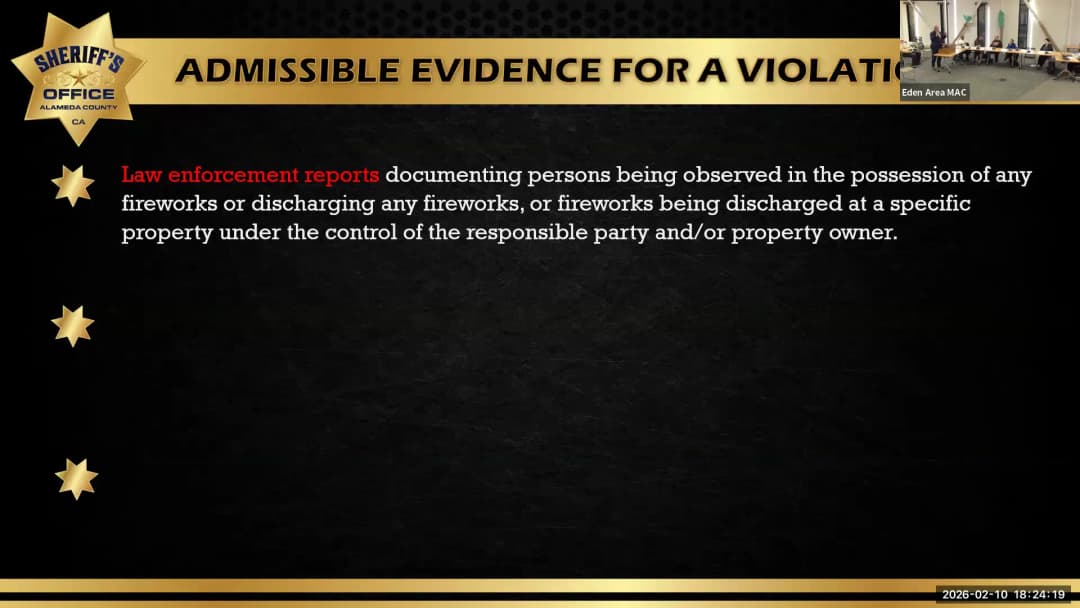
The Eden Area Municipal Advisory Council (MAC) met on February 11, 2026, at 6:05 PM. The meeting included public comments, approval of modified minutes from December 9, 2025, a presentation and recommendation for a new fireworks and social host ordinance banning all fireworks in unincorporated Alameda County, and discussion of language access policies. The meeting adjourned at 7:20 PM. Public Comments & Testimony - Rolando Gonzalez (East Bay MUD): Informed the council about an optional insurance letter being sent to EBMUD customers covering water pipe breakage. He clarified the program is legitimate, optional, and 100% of the stipend goes to customer assistance. No customer data was shared with the insurance company. - Keith Burrows: Spoke regarding environmental health and code enforcement, asking the council to put on a future agenda a report on why open-flame cooking violations have not been stopped for years. Suggested confiscating grills and using fire extinguishers on illegal fires. - Dale Silva: Speaking as an individual, expressed support for the fireworks ordinance. He noted it was easier to identify a property than a perpetrator and encouraged residents to file reports. Thanked Captain McMillan for leadership. - Keith Burrows (second appearance): Commented on the appeals process, noting that when the Board of Zoning Adjustments (BZA) decisions are appealed to the Board of Supervisors, new evidence should be remanded back to BZA (soft remand). - Michael Moore: Asked about enforcement specifics: whether safe-and-sane fireworks (e.g., sparklers) would be violations, whether each child in a picture could be fined, and requested statistics on past investigations and convictions. He expressed concern about enforcement capacity given 644 calls in a month. - Randy Walkie: Expressed support for the ordinance but sadness that safe-and-sane fireworks are also banned. Suggested alternative community events like drone shows. Discussion Items - Approval of Modified Minutes (December 9, 2025): The minutes were presented with modifications: a general Q&A section and a grammar correction. A red-line version was requested for future. Motion to approve as presented passed unanimously (5-0). - Zoning Ordinance Update (Item 1): The presenter had a conflict with the Board of Supervisors meeting, so this item was continued to the March meeting. Council members were asked to keep their notes. - Fireworks and Social Host Ordinance: Captain McMillan and Sergeant Imperial presented the draft ordinance banning all fireworks (including safe-and-sane) in unincorporated areas. Key features: - Allows administrative fines of $750 (first), $1,500 (second), $2,500 (third and subsequent). - Holds property owners, renters, and responsible parties strictly liable for fireworks discharged on their property. - Enforcement includes written warnings, citations, notices, and arrest under criminal law. - Investigations use body cameras, drone footage, and resident-submitted evidence. - Appeals to BZA, then to Board of Supervisors, then to Superior Court. - Fines collected go to a dedicated fund for enforcement and public education. - Goal to have ordinance in effect by July 4, 2026. - Council member questions covered: liability for apartment complexes and public property (e.g., HARD parks), fines per individual vs. per citation, due process for property owners unaware of violations, investigation bandwidth, multiple languages for public education, and proactive enforcement starting in May. - Language Access Update: Staff reported on a Board of Supervisors resolution affirming language access for all residents. A tutorial on using Google Translate for meeting materials will be presented at a future meeting. Key Outcomes - Motion to recommend approval of the fireworks and social host ordinance as presented: Moved by Councilmember Elizabeth Asin Nielsen, seconded by Councilmember Warren Maramahoko. The motion passed unanimously (5-0). Councilmember Asin Nielsen voted aye; Councilmember Maramahoko, yes; Councilmember Roll, yes; Councilmember Stanley, yes; Vice Chair Cushman, yes; Chair Whitler, yes. - Minutes approved as modified: Unanimous. - Future agenda item requested: Environmental health and code enforcement report on open-flame cooking violations. - Action minutes memo pending: Staff advised that all MAC minutes will become action-only minutes, with video serving as the full record. A memo is forthcoming.
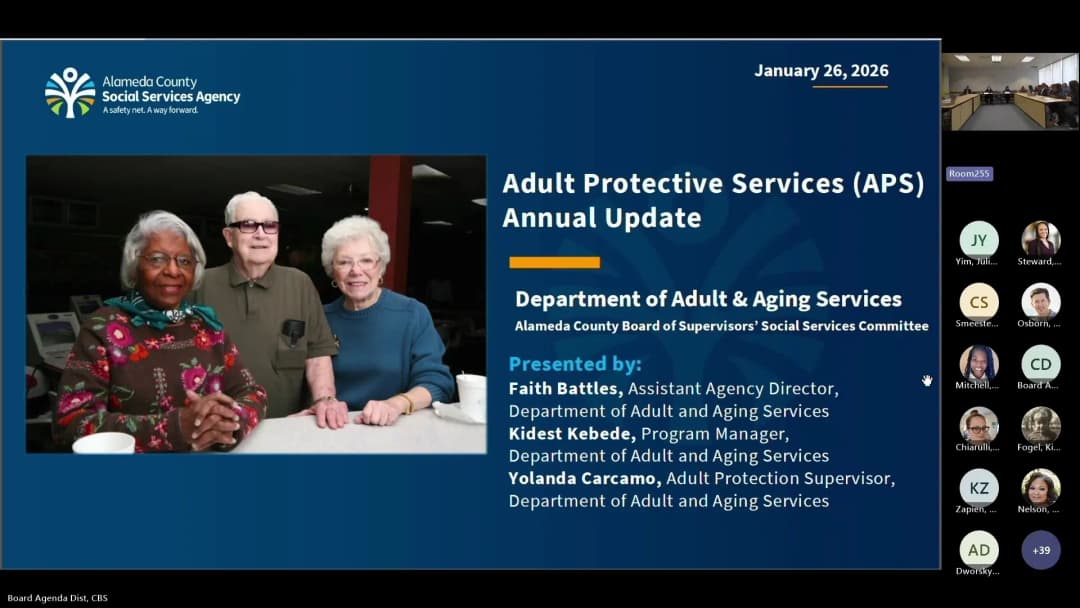
The Alameda County Board of Supervisors Social Services Committee met on February 11, 2026, to receive informational updates on Adult Protective Services (APS), the Net Growth Movement guaranteed income pilot for former foster youth, and the Department of Children and Family Services (DCFS) progress on implementing state audit recommendations. Committee members Supervisor Fortunato Bas and Supervisor Tam presided. Public Comments & Testimony - On the APS update: A social worker from the local public assistance office stated that APS referrals also come from county offices, describing a case of a 90-year-old released from a nursing home without sufficient support. No opposition was expressed. - On the DCFS update: SEIU SSA Chapter President Karina and Vice President Cynthia Landry urged the board to support bargaining proposals addressing workload, retention, recruitment, telework, premium pay for CPS workers, and educational pathways. They stressed that some issues require board-level funding decisions and requested a holistic department presentation to the committee. Discussion Items Adult Protective Services (APS) Annual Update - Presenters: Faith Battles (Assistant Agency Director, Dept. of Adult & Aging Services), Kadess Kabidi (APS Program Manager), Yolanda Carcamo (APS Supervisor). - Key statistics for FY 2024-2025: 9,253 reports received; 6,675 new referrals for 5,892 unduplicated clients; over 10,000 allegations (35% self-neglect, 30% financial exploitation). Oakland accounted for the largest share of cases. 37% of investigations were completed timely (calendar days). - Staffing gap: Alameda County employs 36 APS workers (vs. Santa Clara County’s 52) managing an average caseload of 42 cases per month (recommended 26). To align with best practices, the department stated it needs 13 additional workers (to reach 26/month caseload) or 54 additional workers (to match Santa Clara’s referral volume), plus 2-6 supervisors and 1 program manager. - Home Safe program: $7.9 million invested through FY 2024-2025; 34% direct financial assistance, 41% contracted services. Program extended through FY 2027-2028 after a temporary suspension due to state funding uncertainty. - Future priorities: Secure sustainable funding (Measure W, Medi-Cal claiming, Older Americans Act), expand staffing via MSW intern pipeline (75% success rate), maximize Home Safe funds, expand case management pathways, and host a 2026 hospital forum. - Supervisor questions: Supervisors asked about timeliness standards, demographic breakdowns by city, reasons for dependent adult referrals (ages 18-59), funding sources, and collaboration with the District Attorney’s office on financial exploitation. The DA’s elder abuse team is now prosecuting several cases. APS hotline: 510-577-3500. Net Growth Movement Guaranteed Income Pilot Evaluation - Presenter: Amy Dorski (evaluator). - Pilot details: 67 of 90 eligible former foster youth enrolled; received $1,000/month for 24 months plus optional supportive services via Bay Area Community Services (BACS). - Findings: Participants reported greater financial security, housing stability, and improved mental health during enrollment. After the pilot ended, many experienced increased hardships (food insecurity, housing concerns, lower well-being), though outcomes remained better than pre-pilot. Employment rates rose after the pilot ended, partly because participants took jobs to compensate for lost income. - Implementation challenges: Only 14 of 67 participants engaged monthly with care coordinators; financial literacy workshops had mixed reception; social events were limited by logistics. - Recommendations: Pair guaranteed income with supportive services, require some level of service engagement, and use matching funds to encourage savings. - Supervisor questions: The $1,000/month amount and 24-month duration were deemed appropriate given Bay Area costs. The pilot’s positive effects were seen across all participants, not just those who used support services. Department of Children and Family Services (DCFS) – Status Update on State Auditor’s Report (2024-108) - Presenters: Shale Love (DCFS Director) and Jennifer (Senior Management Analyst). - Progress on recommendations: 15 recommendations from the state audit (originally 10, broken out). Completed: mandatory shadowing for new hires, identifying relatives within 30 days, sibling engagement plan (signed by board 12/16/25), policies for transitional shelter care facilities. In progress: timely supervisory review of emergency response investigations (expected by April 2026), referral status review (October 2026), staff retention survey (October 2026), hiring and recruitment. - Hiring updates: Comcast recruitment ads reached 40% of households in Fremont, Hayward, Oakland. Child Welfare Worker (CWW) I exam yielded 105 applications, 18 passed interviews (offers pending). CWW II exam: 75 applications, 11 accepted offers (68.8% pass rate). Vacancy rate: 26% (73 vacant positions out of 272 authorized). The department aims to continuous hire (monthly exams). - Dashboard: A public-facing audit dashboard is live on the department website, showing metrics on open investigations, timeliness, vacancy rate, and more. Supervisors requested historical data (pre-audit) and additional metrics on closure timeliness and average days to close. - Caseloads: Emergency Response Unit (ERU) guideline is 12 cases per worker (down from 15); current average is about 14, improved from pandemic highs of 30. Staff receive premium pay if over guideline. - Audit Implementation Task Force: Formed by Senator Dr. Aisha Wahab, meets bi-weekly to oversee implementation barriers. Supervisors emphasized collaboration and accurate information sharing to avoid duplication. Key Outcomes - No formal votes or final decisions were taken, as all items were informational. - Directives: - DCFS to expand the dashboard to include data from before the audit (2019 onward) and additional metrics (timely closure rates, average days to close). - DCFS to provide a written response to Senator Wahab’s office summarizing the committee’s discussion and progress for her signature. - The committee will consider agendizing a holistic presentation of the Social Services Agency (including welfare and benefits) in a future meeting, as requested by SEIU. - Next steps: DCFS six-month audit progress report due to the state by March 23, 2026. APS will continue seeking additional staffing funding and report back on budget impacts. A joint Health/Social Services committee meeting is scheduled for February 2026 to discuss federal and state budget impacts (HR1, Medi-Cal, SNAP).
The meeting was scheduled for February 11, 2026, at 12:00 PM UTC. The agenda and minutes were not provided, and the raw transcription contains only the word 'Humor.' Consequently, no detailed reporting on consent calendar items, public testimony, discussion items, or key outcomes is possible. This summary serves as a placeholder due to the absence of substantive content.
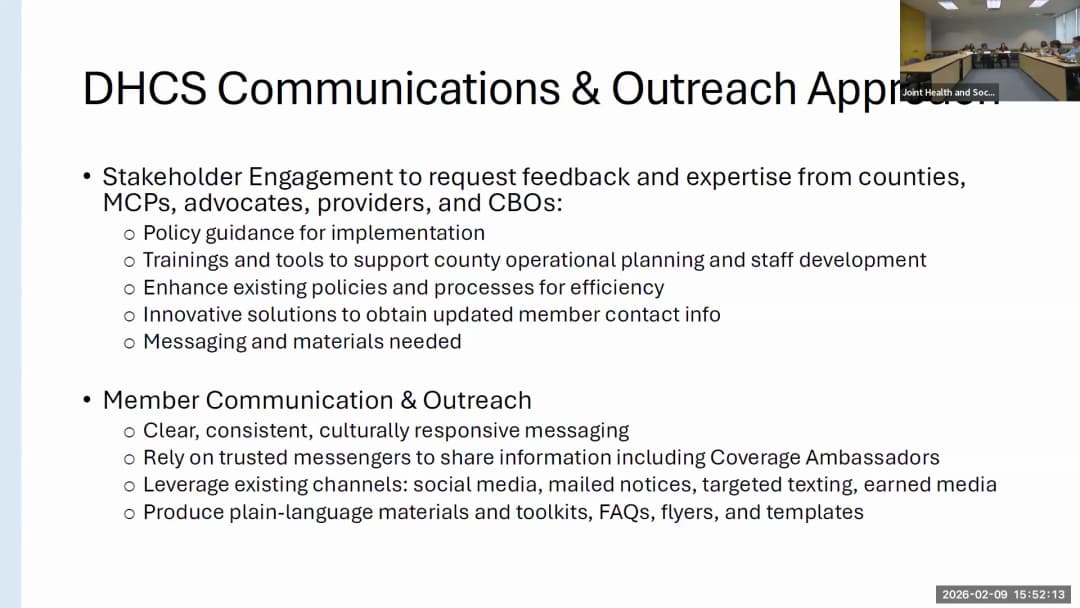
This special joint meeting of the Public Purpose and Health Committee focused on the impacts of the federal HR1 legislation on CalFresh and Medi-Cal programs in Alameda County. Staff from the Social Services Agency (SSA) and Alameda County Health (AC Health) presented detailed data on policy changes, implementation timelines, projected coverage losses, and fiscal implications. No public comments were received on the informational items. CalFresh HR1 Update – Provisions and Impact - Staff outlined several HR1 provisions affecting CalFresh, including limitations on the Standard Utility Allowance (SUA), reevaluation of the Thrifty Food Plan, removal of internet expenses from utility allowances, repeal of SNAP-Ed (CalFresh Healthy Living) funding, and changes to administrative cost sharing and matching funds requirements. - Beginning October 31, 2025, only households with an elderly (60+) or disabled member qualify for the SUA, which generally leads to higher CalFresh benefits. Households not meeting this criterion will be moved to a lower utility allowance, reducing their benefit allotment or potentially losing eligibility. - The Thrifty Food Plan reevaluation will restrict cost-of-living adjustments, likely resulting in minimal benefit increases. Households of 18 or more will face a cap on benefits (currently no such households in Alameda County). - Internet expenses were removed from utility allowance calculations effective October 1, 2025, though California had not yet implemented this change, so no visible impact yet. - CalFresh Healthy Living (SNAP-Ed) lost federal funding; California is using remaining funds to preserve data and research for potential future restart. - Administrative cost sharing changes (effective October 1, 2026) will shift more costs to counties. SSA estimates a $6.7 million increase in county costs for administrative funding based on January 2026 estimates. - A matching funds requirement tied to payment error rate (PER) is slated for federal fiscal year 2028. California’s current PER is 11.01% (over 10%), which would trigger the highest match (15%), estimated at $1.9–$2.1 billion annually for the state if implemented today. The state currently has no legislation to share this cost with counties. ABOD (Able-Bodied Adult Without Dependents) Rules – Changes and Data - Under HR1, ABOD definition expanded: ages 18–64 (previously 18–54), dependent child age lowered to under 14 (previously under 18). Three exemptions eliminated: unhoused, veterans, and former foster youth under 24. New exemption added for Indian/urban Indian/California Indian. State waivers now only allowed if unemployment exceeds 10%; Alameda County does not qualify for a waiver. - ABODs must work 20 hours/week (or 80 hours/month) or meet an exemption. Work can be paid employment, self-employment, in-kind work, or participation in CalFresh Employment & Training, WIOA, Trade Act programs, or community service/volunteering. - As of January 2026, Alameda County has approximately 171,000 CalFresh recipients. Of those, about 40,000 are ABODs: 12,500 exempt and 27,000 non-exempt (at risk of losing benefits after three months if they do not meet work/exemption requirements). - Breakdown of non-exempt ABODs: 43% Black/African American, 20.4% White, 11.9% Other Hispanic, 10.9% Mexican, 9.5% Chinese, 4.2% Vietnamese. 89% speak English, 5% Spanish, 3.6% Mandarin, etc. - Implementation begins June 1, 2026: new applicants subject to ABOD rules; current recipients will be screened at their next recertification (by May 2027). SSA is training staff, updating policies, and planning public outreach (May is CalFresh Awareness Month). Staff anticipate many non-exempt ABODs may qualify for other exemptions (e.g., disability, Social Security) after full screening. Non-Citizen Eligibility Changes - Beginning April 1, 2026, only U.S. citizens, U.S. nationals, lawful permanent residents, COFA agreement individuals, and Cuban/Haitian entrants will retain CalFresh eligibility. Refugees, asylees, parolees (except Cuban/Haitian), victims of trafficking, battered non-citizens, and certain Afghan/Ukrainian parolees will lose eligibility unless they adjust to LPR status. - The California Food Assistance Program (CFAP) will not cover most of these groups except battered non-citizens and parolees (572 parolees, 312 battered non-citizens estimated). No other state-funded food assistance program exists for these populations. - Approximately 5,000 non-citizens in Alameda County are projected to lose CalFresh. Geographic breakdown: District 1: 622, District 2: 962, District 3: 1,703, District 4: 1,607, District 5: 352. Largest ethnic groups: Guatemalan (27%), Mexican (21.4%), Afghan (21.4%). 68% are adults 18–59, 24% children 0–17, 8% seniors 60+. - SSA is preparing system updates, policy handbooks, and community outreach. They have briefed the East Bay Refugee and Immigration Forum and are partnering with CBOs. Legal referrals provided: Central Legal de la Raza, Chinese Progressive Association, California Collaborative for Immigrant Justice. Alameda County Community Food Bank hotline available for all residents regardless of status. Backbone Agencies Update – Medi-Cal and Health Impacts - SSA and AC Health reported on Medi-Cal enrollment trends, work requirements, asset limits, and state implementation plans. Total active Medi-Cal caseload declined from 439,200 in January 2025 to 410,800 in December 2025, with a notable dip between August and September possibly due to HR1 news and chilling effects. - New Medi-Cal enrollments ranged from 5,100 (February 2025) to 7,700 (August 2025). For the MAGI population, new enrollments lowest in February (3,300) and highest in August/October (5,100). - Medi-Cal work and community engagement requirements take effect January 1, 2027. Approximately 151,100 current Medi-Cal members (ages 19–64 in MAGI new adult group) may be subject to requirements. Of these, 39,700 have unsatisfactory immigration status (UIS) and 121,400 have satisfactory status. Qualifying activities: employment earning at least 80x federal minimum wage ($580/month), community service, student half-time or more, or approved work programs. - Asset limits reinstated January 1, 2026 for non-MAGI Medi-Cal (exceptions: PICL, disabled adult children/widows, minor consent). About 49,400 individuals enrolled in non-MAGI between January 2024 and December 2025. Monthly new enrollments increased in 2025 (peak 2,500 in November) compared to 2024 (peak 2,000). - Projected coverage losses due to HR1 and state changes (using Georgetown University Better Government Lab analysis): 31% reduction in UIS enrollment due to freeze, 21% reduction due to work requirements (CY 2027), 20% reduction due to administrative barriers (CY 2026-27). Non-MAGI asset limit impact still being assessed. - HealthPac (indigent care) enrollment declined from 2,900 to 2,661 in 2025. Anticipated increase as people lose Medi-Cal. CSAC estimates statewide cost shift to counties of $6–9.5 billion annually (including public hospital and indigent care impacts). For the 12 public hospital counties (including Alameda), estimated $1.3–$3.3 billion combined. - DHCS released a 38-page implementation plan on January 29, 2026, but it lacks specific federal guidance. State plans to issue guidance to counties, update systems, and streamline processes, but key details remain pending. Advocacy efforts ongoing via CWDA and CSAC. Key Outcomes - No formal votes were taken; the meeting was informational. - Staff committed to providing regular progress updates on ABOD implementation, non-citizen impacts, and Medi-Cal coverage losses at future committee meetings. - SSA will work with the CAO’s office to develop county-specific fiscal estimates for the HR1-related cost shifts, including impacts on eligibility worker needs and indigent care. - The committee expressed serious concern about the magnitude of federal policy changes and emphasized the need to ramp up outreach, staffing, and advocacy. Supervisors thanked staff for their thorough analysis and preparation. - Next steps: Continued monitoring of state budget (May revise), advocacy for state assistance, and development of harm mitigation strategies including expanded use of CalFresh Employment & Training, food bank partnerships, and legal referrals for immigrants.
The committee met to receive updates on federal and state legislation and to vote on a position regarding the governor's proposed budget. The meeting included presentations from lobbyists and staff. Federal Legislative Update - CJ Lake representatives Emily DeSilva and John Assini provided an update on DHS appropriations, health care policy, housing legislation, and the SAVE Act. - DHS funding: The House and Senate have two weeks to avoid a partial shutdown; Democrats demand policy riders (codifying body camera requirements, requiring judicial warrants, and increasing state/local oversight), but the White House opposes restrictions, and negotiations are stalled. - Health care: House committees continue hearings on insurance affordability and prescription drug supply chains; premium tax credit expansion remains stalled. - Housing for the 21st Century Act: A strong bipartisan House bill expected to pass this week (all Democrats on the Financial Services Committee supported it; only Republican Ralph Norman opposed). The Senate has its own broader housing plan. - SAVE Act: The House is expected to pass a bill requiring proof of citizenship to register to vote in federal elections and photo ID for voting (effective 2027). Senate passage is unlikely (filibuster threshold). The legislation would directly conflict with California’s vote-by-mail and voter access laws and would likely face a court challenge. - Supervisor Cam asked about reconciliation with California law; speakers noted that a lawsuit would be required to resolve the conflict. State Legislative Update - Shail Denvers (from film winning strategies) reported that California Attorney General Rob Bonta secured a preliminary injunction blocking the Trump administration’s freeze of $10 billion in federal funding for child care and family assistance programs. - The California Department of Health Care Services held a webinar on HR1 implementation; approximately 2 million Medi-Cal members are at risk of losing coverage due to new federal eligibility and enrollment changes. The department will issue guidance and convene county workgroups. - Budget subcommittees are meeting; Senate Budget Committee will dive into HR1 impacts this week; Assembly budget requests are due March 6. - Updates on pending state bills: Assemblymember Bond’s health care coverage bill (text expected by Feb. 20); Alameda governance bill with Senator Edigin (introduction expected in two weeks); EMS initiative discussions ongoing. Action Item: Position on Governor’s Proposed Budget - Supervisor Cam moved to adopt an opposed position on the proposed changes to community-based mobile crisis services in the governor’s FY 2026-27 January budget (which would make mobile crisis response an option and shift non-federal costs). - Supervisor Bass seconded the motion. - Vote: All aye (Supervisors Fortunato Bass and Camp). Motion carried. Public Comments - No public comments were received on the federal or state legislative updates, nor on non-agendized items. Key Outcomes - The committee unanimously opposed the governor’s proposed changes to mobile crisis services. - No other votes were taken. - The meeting was adjourned.