Browse by city
Date range
Search help

Search titles, summaries, topics and stored transcripts together. Keywords may match separately; put the whole query in double quotes for a phrase. Matching follows word analysis, so punctuation is not exact. Both dates are included. Documents are not searched.

SHOWING 161–170 ENTRIES
161
FEB 10, 2026 · ALAMEDA COUNTY, CALIFORNIA · BOARD OF SUPERVISORS
Alameda County Board of Supervisors Meeting - February 10, 2026

The Alameda County Board of Supervisors met on February 10, 2026, to address a range of items including a controversial contract extension with Flock Safety for automated license plate readers (ALPRs), proclamations for Black History Month, approval of consent calendar items, and public comments on proposed cuts to peer-run mental health services. The meeting featured extensive public testimony on the Flock contract, leading to a motion to table the item to a future set matter. Consent Calendar - The board approved the consent calendar (items 58–69) and a mass motion covering items 2–57 (excluding item 44, which was tabled). Supervisor Tam abstained from item 16. - Minutes from January 13, February 3 (two meetings), and January 27 were approved, with Supervisor Marquez noting a modification to the January 27 minutes regarding a request for GSA to return in three months; those minutes were tabled for correction. Public Comments & Testimony - Item 44 – Flock Safety Contract Extension: Over 30 speakers addressed the board, with strong opposition from residents, advocacy groups (e.g., Secure Justice, Fight for the Future, East Bay Sanctuary Covenant), and community members who argued that Flock cameras enable mass surveillance, violate SB 34 by sharing data with federal agencies, and threaten immigrant communities. Supporters, including some residents and business owners, cited crime reduction benefits and argued the data is controlled locally. Several speakers referenced recent contract cancellations in Mountain View and Santa Cruz due to data-sharing violations. - Public Comment on Non-Agenda Items: Multiple speakers urged the board to reconsider funding cuts to peer-run mental health organizations (Peers, Peer Wellness Collective) under Proposition 1, warning that 100% or 80% funding losses would devastate services for vulnerable populations. One speaker also raised concerns about foreign government targeting of activists in Alameda County. Discussion Items - Item 44 – Flock Safety Contract Extension: Supervisor Marquez moved to table the item to the second regular board meeting in April (April 21, 2026) as a set matter at 3:00 PM, with a full staff report and presentation from the Sheriff's Office. The motion followed concerns about insufficient time for the Sheriff to respond to questions and the need for structured public engagement. Supervisor Miley noted that the cameras are only in unincorporated areas and suggested the Unincorporated Services Committee might have been more appropriate, but supported the set matter approach. Supervisor Fortunato Bass emphasized the need to consider surveillance risks under the current federal administration and explore alternative vendors. The motion passed unanimously. - Black History Month Proclamations: The board recognized February 2026 as Black History Month, honoring Freddie Davis (Hayward South Alameda County NAACP), the Oakland Museum of California, Professor Stephen Cleveland, Robert Phillips (Baywell Health), and Paula Ambrose. Each honoree or representative spoke about their work and legacy. - Closed Session Settlements: County Counsel reported three settlements approved in prior closed sessions: $60,000 (Drake v. County), $850,000 (Roe v. Trapp), and $650,000 plus fees (Loera Jr. v. County). Key Outcomes - Item 44 Tabled: The board voted unanimously to table the Flock Safety contract extension to April 21, 2026, at 3:00 PM as a set matter, requiring a staff report and Sheriff's presentation. - Consent Calendar Approved: All consent items and the mass motion passed, with Supervisor Tam abstaining on item 16. - Minutes Approved: Minutes from January 13, February 3 (two meetings) were approved; January 27 minutes were tabled for correction. - Ordinances Adopted: Second readings of salary ordinance amendments and MOUs with Union of American Physicians and Dentists, Management Employees Association, and green building practices were adopted unanimously. - Public Comment Heard: The board heard extensive public testimony on both the Flock contract and peer support funding cuts, with Supervisor Marquez pledging to work on bridge funding for behavioral health services impacted by Proposition 1.
TECHNOLOGY AND INNOVATION 23% · RACIAL EQUITY 18% · MENTAL HEALTH AWARENESS 17% · PUBLIC SAFETY 17%
162
FEB 10, 2026 · ALAMEDA COUNTY, CALIFORNIA · BOARD OF SUPERVISORS
Special Planning Committee Meeting – February 10, 2026: Arroyo Lago Appeal & Reasonable Accommodation

The Alameda County Board of Supervisors, sitting as the Planning Committee, held a special meeting on February 10, 2026, at 4:00 PM. Supervisors present: Tam, Marquez, Miley, Fornado Bass, and President Halbert. The meeting addressed two major items: an appeal by Zone 7 Water Agency regarding the Arroyo Lago residential development and a reasonable accommodation request for additional front‑yard paving at a home in Ashland. Consent Calendar - Minutes of January 8, 2026 – Approved unanimously. - Consent Calendar Item 3 – Approved unanimously. Public Comments & Testimony - Item 5 (Arroyo Lago Appeal): - Mark Wiley (Truebec Construction) – Expressed full support for the applicant, stating the developer is union‑friendly and a long‑time client. - John Dalrymple (East Bay Residents for Responsible Development) – Urged the board to support Zone 7’s appeal, arguing the Environmental Impact Report (EIR) failed to adequately analyze water quality and public health impacts. - Item 4 (Reasonable Accommodation): - Pei Yi Shaw (property owner) – Requested the board reverse the Planning Director’s denial. Stated the paved area is used daily for medically necessary physical therapy and wheelchair transfer, and that neighbors had no objection. Emphasized that the denial violated the Fair Housing Act’s requirement for an individualized assessment. Discussion Items Item 5 – Arroyo Lago Project Appeal (PLN 2022‑00193, Zone 7 Water Agency) - Staff Presentation (Rodrigo, Rachel Krusinowski): - Project: 190 single‑family homes (48 deed‑restricted ADUs) on 26.6 acres at 3030 Moore Avenue, adjacent to Pleasanton. County staff recommended denying the appeal, certifying the EIR, and approving the vesting tentative tract map. - The project is protected by the Housing Accountability Act (HAA); denial requires a finding of a specific, quantifiable, unavoidable adverse impact on public health or safety, which staff argued cannot be made. - The EIR found significant unavoidable impacts for transportation (VMT and queuing) and greenhouse gas emissions; all other impacts were reduced to less‑than‑significant with mitigation. - The applicant voluntarily added conditions: reducing two‑story homes to one story along the western boundary, relocating the agricultural spray field west of El Charo Road (Condition 71), and requiring notification to buyers about Pleasanton Garbage Service operations. - Staff and the environmental consultant emphasized that the membrane bioreactor (MBR) wastewater treatment plant is state‑of‑the‑art, permitted by the State Water Board, and operated by a certified operator. They noted Zone 7 never proposed alternative mitigations or design revisions. - Appellant (Zone 7 Water Agency – Colleen Winey, Ken Min): - Zone 7 is the groundwater sustainability agency for the Livermore Groundwater Basin and manages Lake Eye, Lake H, and Cope Lake adjacent to the project. - Concerns: The wastewater treatment plant and spray fields are located too close to these recharge lakes; any failure could contaminate the groundwater basin, threatening the water supply for 250,000 residents. - Zone 7 is investing over $60 million to treat PFAS and opposes any additional source of contamination. The MBR technology does not remove PFAS. - The speaker noted that the “environmentally superior alternative” is annexation to the City of Pleasanton, which would eliminate their concerns by connecting to municipal sewer and stormwater systems. - Applicant (Steve, Bert Mahalchik – project owner/consultant): - The applicant argued the facility will not contaminate water; treated effluent meets Title 22 standards and is cleaner than surface runoff. - They highlighted the project’s inclusion in the County’s 6th‑cycle Housing Element (190 units), consistency with the East County Area Plan, and the Planning Commission’s 6‑1 approval. - The City of Pleasanton has begun formal annexation proceedings; the applicant expects city approval by early summer 2026. If annexed, all of Zone 7’s concerns would be moot. - Bert Mahalchik (former DSRSD general manager) testified that the MBR technology is “truly state of the art,” with 178 days of lined storage and automatic shut‑off safeguards, and that the Tennessee study cited by Zone 7 involved rural plants with excessive inflow/infiltration not applicable to this project. - Board Discussion: - Supervisor Tam asked about the statement of overriding considerations; staff confirmed the HAA sets a very high bar for denial and that annexation would resolve the identified impacts. - Supervisor Miley expressed reluctance to grant the appeal, citing litigation risk and the high likelihood that the project would be annexed. He noted the project is needed to meet housing element goals and that the risk of a failure is extremely low. - Supervisor Marquez questioned the zoning incompatibility between the residential project and the adjacent Pleasanton Garbage Service (industrial). Staff noted a condition requiring buyer notification; the garbage service did not object after that condition was added. - Supervisor Fornado Bass sought assurance that if annexation did not occur, the state‑permitted operation would still protect water quality. Staff confirmed the operator certification and regulatory oversight. Item 4 – Reasonable Accommodation Request (16815 Los Reyes Avenue) - Staff Presentation (Rodrigo): - The property owner requested permission to exceed the 50% front‑yard paving limit (530 sq ft) to accommodate a paved area for physical therapy and wheelchair transfer. The existing paving covers about 67% of the front yard (approx. 710 sq ft). - The Planning Director denied the request, citing alternative locations (rear yard, driveway, interior of home) and potential blighting effect. - Staff noted that the pavement was installed before the accommodation was requested and that code enforcement received a complaint. - Board Discussion and Decision: - Supervisor Miley initially questioned whether the accommodation was a “ruse for parking,” but after reading a physician’s letter from Asian Health Services documenting daily physical therapy needs, he became supportive. - Supervisor Tam noted the letter confirmed a medical necessity. Supervisor Marquez raised the possibility of language barriers and suggested offering translation services in future code enforcement interactions. - Supervisor Miley moved to sustain the appeal and allow the paving to remain at the current size (67% of the front yard). Supervisor Tam seconded. Key Outcomes - Item 5 – Arroyo Lago Appeal: - Motion to adopt staff recommendation (deny the appeal, certify the EIR, approve the tentative tract map, and adopt findings) passed 4‑0‑1 (Supervisor Fornado Bass abstaining). The appeal is denied; the project may proceed, subject to existing conditions and eventual annexation to Pleasanton. - Item 4 – Reasonable Accommodation: - Motion to sustain the appeal and allow the existing front‑yard paving passed 5‑0. The Board directed staff to contact the applicant about possible ramp‑related resources through the Healthy Homes program.

WATER AND WASTEWATER MANAGEMENT 52% · DISABILITY RIGHTS 26% · AFFORDABLE HOUSING 11% · ENVIRONMENTAL PROTECTION 8%
163
FEB 9, 2026 · ALAMEDA COUNTY, CALIFORNIA · BOARD OF SUPERVISORS
Alameda County Health Committee: Children's Hospital & Housing Funds, Feb 9, 2026

The Alameda County Board of Supervisors Health Committee (Supervisors Miley and Tam) met on February 9, 2026, to receive an informational update on Measure C pediatric health account spending at UCSF Benioff Children's Hospital Oakland and to act on the Measure W capital funding for affordable housing new construction. The meeting featured extensive public testimony from hospital staff, community advocates, and labor representatives, resulting in a directive for greater transparency and a consensus plan. Public Comments & Testimony - Susan Remold (retired Children's administrator): Expressed concern that Measure C intent was for full spectrum of children's health, not only trauma; requested breakdown of $22M in community benefit. - Martha Cruel (CNA/Labor Council): Warned that UCSF Health cannot be trusted; called for accountability mechanisms and labor-management oversight. - Melanie Davis (community activist): Disappointed that local hiring goals (25% Oakland residents) are too low; asked for 35% and noted lack of West Oakland Job Resource Center representation. - Brianna Wallace (Parent Voices, Measure C advisory council): Stressed that Measure C dollars should keep services local, not shift them to San Francisco. - Umberto Rentana (psychotherapist): Noted that UCSF hiring freeze has reduced frontline mental health staff at Children's, turning away patients. - Ryan Bellorty (laboratory staff): Requested quarterly oversight meetings and a detailed proposal from UCSF on lab testing preservation. - Taisha Allen (parent): Urged keeping the hospital open and transparent community involvement. - Alia Phelps (Parent Voices director): Criticized lack of community outreach; demanded protection of Black maternal and infant health services. - Triceda (infant development specialist, 14 years): Said UCSF’s management has led to loss of early intervention services; felt deceived by Measure C promises. - Marissa Schwaber-Corrin (social worker): Reported that life-saving services like nuclear medicine, image-guided biopsies, and bone marrow transplants have been moved to San Francisco, forcing families to travel. - Diana Katu Arena (PICU nurse case manager, via Julie Evangelista): Described a brain-dead patient whose family had to wait hours because interventional radiology was moved to SF; called for quarterly oversight. - Peggy Busher (retired social worker): Warned that home visiting programs are at risk; urged that Measure C funds support community programs, not just trauma center. - Angelica (child life specialist): Described high patient volume (120-140 children/day) and stressed need for psychosocial support. - BERT clinician (written statement): Said staffing cuts have left one clinician per shift to cover entire hospital, causing gaps and burnout. - Ruby Butler, Stacey Cummins, Libray Gavin, Annie Banks (Parent Voices advocates): Emphasized that moving services harms East Bay families; demanded funds stay in Alameda County. - Ruth Crow (LCSW, 24 years): Said frontline staff were never consulted on Measure C spending; families face 9-10 month waits for audiology; requested quarterly labor-management meetings. Discussion Items Item 1: Measure C Pediatric Health Account – UCSF Benioff Children's Hospital Oakland - Nicholas Holmes (president) and clinical leaders presented the hospital's role as a Level 1 pediatric trauma center, serving 1,400 trauma cases/year, with 66% transferred from other hospitals. They detailed $88M in community benefit annually and a $300M shortfall from public programs. They emphasized the need for Measure C funds ($2.5M/month average) to upgrade equipment (biplanar angiography), expand simulation training, hire wound/ostomy specialists, and fund violence prevention (CalVIP extension). - Supervisor Miley noted a previous understanding that 5% of funds would go to staffing/training, and asked whether mental health safety training for line staff had been addressed. Dr. Holmes said it was forthcoming. - Miley expressed frustration over lack of communication with labor and community, contrary to the board's intent. He stated the item would come back to the full Board on March 3, 2026, and he wanted Children's Hospital to meet with labor and community to produce a consensus plan by then. - Supervisor Tam concurred, adding that the community advisory council process appeared insufficient. Item 2: Measure W Capital Funding for Affordable Housing – Home Together Plan - John Lowe (HCD) presented the RFP results: 20 proposals received, 11 moved to scoring, 10 recommended for funding at $52.95 million total (increased from $40M). An 11th project (430 Broadway) would receive $14M separately. The 10 projects will create 946 affordable units, over 300 for homeless households, leveraging state resources. Geographic distribution includes Oakland, Berkeley, Alameda, Livermore, Newark. - Supervisor Miley asked about incomplete projects and future capital rounds. Staff indicated at least one more round is planned, including acquisition/conversion and small-lot development. - Public speakers from Eden Housing, SAHA, Black Cultural Zone, and the developer of Fijian Legacy Court supported the recommendations. Key Outcomes - Item 1 (Children's Hospital Measure C): No vote; supervisors directed UCSF Benioff Children's Hospital management to meet with labor representatives and community stakeholders before March 3, 2026, to develop a consensus plan on Measure C fund utilization. If no consensus is reached, Supervisor Miley indicated he would recommend withholding all funding at the full Board meeting. - Item 2 (Measure W Capital RFP): The committee voted unanimously (Supervisor Miley moved, Supervisor Tam seconded) to forward the staff recommendation to the full Board of Supervisors for adoption of funding resolutions. The recommended awards total $52.95 million for 10 projects, with an additional $14 million from Measure W for the 430 Broadway project.

COMMUNITY ENGAGEMENT 21% · AFFORDABLE HOUSING 18% · HEALTHCARE SERVICES 14% · PUBLIC HEALTH SERVICES 12%
164
FEB 5, 2026 · ALAMEDA COUNTY, CALIFORNIA · BOARD OF SUPERVISORS
City Meeting Summary - February 5, 2026 - No Substantive Records

No agenda, minutes, or coherent transcript were provided for this meeting. The only available raw transcription consisted of non‑informative text ("Humorseo. Human, so"), which does not allow for any meaningful summary of discussions, decisions, or public testimony. Therefore, no sections on consent calendar, public comments, discussion items, or key outcomes can be generated. This placeholder is provided to indicate the absence of usable source material.

MISCELLANEOUS 100%
165
FEB 4, 2026 · ALAMEDA COUNTY, CALIFORNIA · BOARD OF SUPERVISORS
Fairview MAC Meeting – February 4, 2026: Affordable Housing Policies & Open Space Amendment

The Fairview Municipal Advisory Council (MAC) held a meeting on February 4, 2026, to discuss two major items: the introduction of an affordable housing production policies initiative (inclusionary zoning and ministerial review) and a proposed amendment to the county's Open Space Element to comply with SB 1425. The council also approved minutes, appointed an ad hoc subcommittee for the housing policy work, heard public comments on multiple topics, and received updates on local infrastructure and the fireworks ordinance. Consent Calendar - Minutes of October 7, 2025: Approved with Chair Englin abstaining. No other discussion. - Minutes of November 6, 2025: Approved with Councilmember Philbin abstaining after a minor formatting correction (removal of an extra bullet point under “D street traffic coming measures”). Public Comments & Testimony - Bruce King (Friends of San Lorenzo Creek): Provided updates on multi-use trail projects, including the San Lorenzo Creekway (a $28 million grant from two years ago) and the Foothill Trail. He noted that two quarter‑mile segments are already built and urged attention to habitat restoration alongside development. Later, during the open space item, he criticized the county’s implementation gap between policies and actual land-use decisions, stating that private property zoning often overrides habitat goals. - Chuck Meadows (public): Expressed concerns about the economics of inclusionary zoning (calculating that 60% AMI rental would cost about 40% of after‑tax income), urged integration of affordable units rather than concentration, questioned enforcement of deed restrictions, and highlighted inadequate notification (500‑foot radius) and the need for better parking and evacuation route planning. - Brenda (public, via reopened comment): Asked for an update on the fireworks ordinance, expressing frustration with delays and asking whether obstacles come from the county legal department. - Fran Krug (Amex Court): Recalled that the MAC first requested a comprehensive fireworks ordinance in December 2022, noted that a subcommittee was formed in June 2025 but has reported no progress since July 2025, and urged continued focus. Discussion Items 1. Affordable Housing Production Policies Initiative - Presentation by Angelica Gonzalez (Sr. Planning Supervisor) and Olivia Ortiz (Planner III): Introduced the initiative to develop inclusionary zoning and ministerial review ordinances for unincorporated areas, aiming to comply with MTC’s Transit‑Oriented Communities (TOC) Policy and the county’s Housing Element. The county received a $400,000 MTC grant ($280,000 for this work), and consultants Street Level Advisors have been hired. The timeline runs through early 2027. - Councilmember Higgins asked about deed restrictions, parking adequacy (citing a local example where four parking spaces were provided for a five‑bedroom house with ten cars), and the lack of adequate transit in Fairview. - Councilmember Rhodes voiced concern that ministerial approval would exempt projects from project‑level CEQA review, which could overlook fire evacuation and road safety issues. She cited the D Street development where insufficient water pressure stopped a project and noted that the Fairview Specific Plan’s provisions would be respected under ministerial review. - Councilmember Farmer sought clarification on Fairview’s urban unincorporated areas and the MAC’s role in countywide policy. Staff explained the policy would be adopted by the Board of Supervisors after consultations across all MACs. - Councilmember Higgins also raised issues about enforcement of deed restrictions, inadequate traffic studies, and the value of community input in public hearings. He supported appointing two MAC members to the ad hoc subcommittee. - Outcome: The council voted to create an ad hoc subcommittee for affordable housing production policies and appointed Beth Farmer and Chris Higgins as the two Fairview MAC representatives. 2. General Plan Amendment to Open Space Element (SB 1425 Compliance) - Presentation by Allie Avers (Planning Department): SB 1425 requires cities/counties to update their Open Space Element by January 1, 2026, to address equitable access, climate resilience, and rewilding. Staff conducted a review and found existing general plan policies already satisfy the requirements. The proposed amendment adds Appendix B, a “pivot table” referencing 38 policies for equitable access, 24 for climate resilience, and 48 for rewilding. The amendment is not subject to CEQA (common sense exemption). - Councilmember Rhodes asked whether the policies reflect current climate realities. Staff acknowledged the referenced Climate Action Plan is from 2014; a new CAP is under development (expected adoption mid‑2026) and will later be incorporated. - Councilmember Higgins questioned whether the amendment would help preserve open space (e.g., through land acquisition) and noted that private property rights often override habitat goals. Staff pointed to existing policies and the Altamont Landfill Open Space Fund but conceded the county lacks a parks department. - Councilmember (other) asked about the impact of the recent Dublin CEQA ruling; staff replied that the amended policies have already undergone environmental review. - Outcome: The council voted 5‑0 to forward the proposed Open Space Element amendments and the CEQA notice of exemption to the Planning Commission with a recommendation of adoption by the Board of Supervisors. Key Outcomes - Minutes Approved: October 7 and November 6, 2025, both passed with one abstention each. - Ad Hoc Subcommittee Created: Two members (Beth Farmer and Chris Higgins) appointed to the Affordable Housing Production Policies Subcommittee. - Open Space Amendment Forwarded: Motion passed 5‑0 to send the SB 1425 compliance amendment and CEQA exemption to the Planning Commission. - Fireworks Ordinance Update: Chair reported that a newer draft has been circulated and that the Sheriff’s Department expects progress by early‑to‑mid 2026, with a goal of having an ordinance in place before the 4th of July. - Infrastructure Requests: Councilmembers requested that Public Works provide an overview of projects in Fairview (sidewalks on 2nd Street, D Street improvements) at a future meeting.

AFFORDABLE HOUSING 46% · ENVIRONMENTAL PROTECTION 18% · PUBLIC SAFETY 12% · TRANSPORTATION SAFETY 8%
166
FEB 4, 2026 · ALAMEDA COUNTY, CALIFORNIA · BOARD OF SUPERVISORS
Fairview MAC Meeting – February 4, 2026

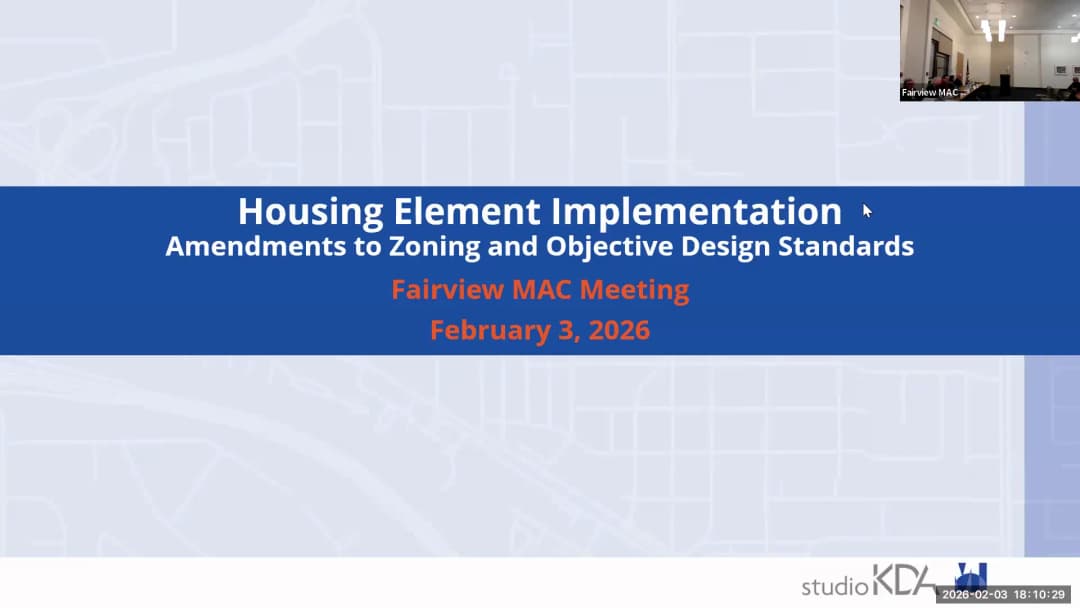
The Fairview Municipal Advisory Council (MAC) met on February 4, 2026, at 14:00. The meeting included a public safety report, approval of minutes, a major zoning ordinance update to implement the state-mandated housing element, a site development review for a single-family home addition, and an update on a proposed fireworks ordinance. The council voted 3-2 to recommend the zoning changes while reiterating its opposition to the underlying density mandates. Consent Calendar - Minutes Approval: The minutes from the December 2, 2025 and January 2, 2026 meetings were approved as amended by unanimous vote (5-0) after brief corrections. Public Comments & Testimony - Housing Element Zoning Update: Kathy Langley spoke in opposition, stating the state’s mandates treat neighborhoods as assets for developers, that the project is not exempt from CEQA as claimed, and urged support for the organization Our Neighborhood Voices to stop the process. - Fireworks Ordinance: Francis (Fran) Krug and Brenda Clark both expressed strong support for the draft ordinance, thanking the subcommittee, sheriff’s department, and county staff for years of work and urging careful review to avoid delays. Discussion Items - Zoning Ordinance and Design Standards Update (PLN 2024-00385): Presenters Rodrigo (planning staff) and Tom Ford (M Group) explained that the amendments to zoning chapter 1731 and residential design standards chapter 8.2 are minor modifications (setbacks, open space, landscaping) to ensure density from the already-adopted housing element can be realized without risking state penalties or builder’s remedy. The changes apply only to designated housing element sites in Fairview (mostly multi-family). Councilmembers expressed frustration with state mandates, lack of infrastructure, and loss of local control. Vice Chair Rhodes questioned the impact on Fairview’s specific plan and emergency access. The council moved to recommend the changes as specified, with an added statement reiterating the board’s opposition to the density ordinance itself. The motion passed 3-2 (Higgins, Rhodes, Anglin in favor; Farmer and Philbin opposed). - Site Development Review (PLN 2025-00195): Michael Fleming presented a proposal to add 50% more floor area to a single-family home at 24532 Fairview Avenue and allow five-foot side yard setbacks where 15 feet are required. The lot was originally built with a five-foot setback; the same variance was granted to a nearby house in 2019. No public opposition was received. The council approved the request unanimously (5-0). - Fireworks Ordinance Update: Vice Chair Rhodes reported that the subcommittee, sheriff’s office, and county staff have completed a draft ordinance banning all fireworks (including safe-and-sane) in unincorporated Alameda County, with social host accountability, progressive fines, and expanded enforcement (deputy training, drones, choppers). The draft will be presented at other MACs in February and March, then to the Board of Supervisors in April/May, with a target effective date of mid-June 2026. The council and public commenters praised the effort. Key Outcomes - Recommendation to Board of Supervisors: The council voted 3-2 to recommend adoption of the zoning and design standard amendments, with the added statement that the board does not support the underlying density ordinance. (Farmer and Philbin dissented.) - Approval of Site Development Review: The council unanimously approved the variance and site development review for 24532 Fairview Avenue, allowing the home addition and reduced setbacks. - Fireworks Ordinance Progress: The draft ordinance will move through the MACs and county committees as scheduled; the public is encouraged to attend and comment at upcoming meetings. - Other: Staff announced that meeting minutes will transition to action-only format, with full video as the official record.

AFFORDABLE HOUSING 43% · PUBLIC SAFETY 15% · ENGINEERING AND INFRASTRUCTURE 15% · COMMUNITY ENGAGEMENT 12%
167
FEB 2, 2026 · ALAMEDA COUNTY, CALIFORNIA · BOARD OF SUPERVISORS
Alameda County Reparations Commission Working Session – February 2, 2026: Timeline, Recommendations, and Subcommittee Updates

This working session of the Alameda County Reparations Commission was held on February 2, 2026, from 12:30 PM onward. Commissioners and staff gathered to review the timeline for producing final recommendations, discuss community engagement strategies, hear subcommittee reports, and reflect on working norms. The meeting featured a gallery walk of prior listening session materials and small-group brainstorming on priority categories for recommendations. No public comments were offered. The commission did not take formal votes but reached consensus on several action items. Public Comments & Testimony - No members of the public spoke during the designated public comment period. Discussion Items - Timeline Feasibility and Extension: Commissioners raised concerns that the proposed timeline (ending June 2026) was too tight given the complexity of developing comprehensive recommendations. Several speakers noted that additional time was needed for community listening sessions, data analysis, and partner reviews. Some argued that a six-month extension would allow deeper engagement with hard-to-reach communities and ensure the report is thorough. Others cautioned that extending the timeline could lead to loss of momentum and that the commission should aim to produce a “first lap” report within the current timeframe, leaving room for future updates. - Survey Collection and Analysis: The Data Analysis and Research (DAR) subcommittee presented a plan to collect 400 completed surveys by February 28, 2026, using both online platforms and in-person outreach at community events (e.g., Tri‑City Summer Celebration). The goal is to phase data collection: Phase 1 ending Feb. 28, with analysis feeding into the draft report, and Phase 2 continuing after that for living data updates. Some commissioners expressed frustration that the survey instrument had not been shared with the full commission for input before launch. Staff committed to establishing a clearer process for subcommittee decisions that affect the commission’s public representation. - Subcommittee Goals and Commitments: - Data, Analysis & Research (DAR): In addition to survey collection, the subcommittee will analyze results and work with community partners to get feedback on draft materials. They plan to meet weekly. - Budget Subcommittee: Chair reported that the budget has surplus in some line items due to venue discounts. They will rebalance funds and continue to support other subcommittees’ spending needs. A key need is for subcommittee chairs to attend Monday budget meetings briefly to communicate funding requests. - Other subcommittees (Education, Housing, Health, Criminal Justice, etc.) are expected to generate specific recommendations within the seven identified pillars (education, economic development, housing, elections, criminal justice, data, health). - Gallery Walk and Recommendation Brainstorming: Commissioners participated in an exercise where they reviewed physical displays of prior listening session outputs and community feedback. They then broke into three color-coded groups (red, green, black) to identify common priorities. Top categories that emerged were housing, criminal justice, and data. The facilitator emphasized that these seven categories should serve as scaffolding for final recommendations. - Working Norms and Communication: A substantial portion of the meeting was devoted to reflecting on what behaviors should continue, start, or stop to improve effectiveness. Specific concerns included: last-minute planning, reliance on a small number of commissioners for event organization, inconsistent communication (e.g., emails unanswered), and lack of clarity around decision-making processes for subcommittees. Proposed improvements: starting communication earlier, sharing documents with full commission before execution, building relationships, and addressing conflict directly. - Library & Staff Update: A staff member from the Alameda County Library noted that the library’s internal survey system is being used for data collection. They also mentioned upcoming deadlines for submitting local stories to the state reparations task force. The library will assist with logistical support. Key Outcomes - Phase 1 survey collection deadline set for February 28, 2026, with a target of 400 responses. Data will be analyzed to inform the draft report. - Seven recommendation pillars confirmed (education, economic development, housing, elections, criminal justice, data, health). Subcommittees will draft specific recommendations within these categories. - No formal vote on timeline extension; consensus was to proceed with the current timeline for a “first draft” report, while allowing the commission to revisit the timeline if needed at a future meeting. - Commitment to improve communication: Commissioners agreed to (a) provide at least 48–72 hours notice for urgent requests, (b) use text messages for time-sensitive communications, and (c) ensure subcommittee chairs attend budget meetings briefly. - Process clarification: A commissioner will draft a formal decision-making flowchart for subcommittees to avoid future misalignment. - Next steps: Subcommittees will continue meeting weekly; the next full commission meeting is scheduled for March 2, 2026, where draft recommendations will be presented.

COMMUNITY ENGAGEMENT 48% · PROCEDURAL 13% · RACIAL EQUITY 13% · PUBLIC ENGAGEMENT 10%
168
FEB 2, 2026 · ALAMEDA COUNTY, CALIFORNIA · BOARD OF SUPERVISORS
Alameda County Transportation and Planning Committee Meeting: Castro Valley Bike Lane Debate and BPAC Update - February 2, 2026

The Alameda County Transportation and Planning Committee (TMP) met on February 2, 2026, to consider a recommendation from the Castro Valley Municipal Advisory Council (MAC) regarding the Castro Valley Boulevard Class II bike lane, and to receive an informational report on the unincorporated county bicycle and pedestrian advisory committee (BPAC). The committee also received a brief update on the battery energy storage and solar project ordinance for East County. After extensive public comment and deliberation, the committee decided not to adopt the MAC recommendation and instead directed staff to gather additional data on parking, safety, and business impacts, with a status report due in approximately one year. Public Comments & Testimony - Supporters of the bike lane (including representatives from Bike East Bay, the BART Bicycle Advisory Task Force, and Castro Valley residents) argued that the bike lane is essential for safety on a high-injury corridor, cited a UC Berkeley study showing 64 bicycle crashes in Castro Valley over five years with 22 on Castro Valley Boulevard, and noted that removing the lane would increase liability. Several speakers noted that 80% of parking was retained and that 556 residents signed a petition supporting the lanes. - Opponents of the bike lane (including business owners and residents) contended that the 35 parking spaces removed (30% of on-street parking) harm businesses, that the process lacked outreach to stakeholders, and that the bike lane usage (22–51 bikes per day) is minuscule compared to 21,000 daily car trips. Some argued that the MAC is unrepresentative of the community and that the county should conduct a poll of business owners. - On the BPAC item, speakers were divided: some supported creating a commission for more independence, while others urged expanding the existing committee or streamlining commissions before adding new ones. Several speakers noted that the BPAC met only twice in 2025 and that its agenda is controlled by staff. Discussion Items 1. Castro Valley Boulevard Bike Lane & MAC Recommendation - Public Works Director Will Dessenberg (Daniel) presented the item. Background: The Class II buffered bike lane was installed as part of the 2019 Bike/Ped Master Plan, removing 12 on-street parking spaces on the north side and 23 on the south side along a half-mile stretch on Castro Valley Boulevard, which carries 21,000 cars per day. A bicycle utilization study (two-week count at eight locations) found a consistent daily range of 22–51 bikes (max 89). Public Works recommended against the MAC’s proposal for shared parking/bike lane use, citing safety risks and liability concerns, and advised ongoing monitoring. - Supervisor Miley expressed concern about the 30% parking removal and asked about time-of-day shared use (e.g., 11am–3pm). Director responded that data show no peak-hour concentration, making such modifications risky and unsupported. Supervisor Miley also noted the need to balance safety, business vitality, and climate goals, and requested input from the Planning Department on the downtown specific plan (expected completion this year). - Supervisor Halbert questioned the legal viability of reverting to shared-lane markings (sharrows) under SB 1216, and asked for a legal opinion. Both supervisors expressed discomfort with acting without more data on business impacts, safety performance, and the law. - The committee decided to not adopt the MAC recommendation and instead directed Public Works, in coordination with the Economic Development Department, to conduct outreach to businesses, gather accident data, and monitor bike usage, with a status report in about one year. The report will first go to the MAC, then back to the TMP committee. 2. Unincorporated County Bicycle and Pedestrian Advisory Committee (BPAC) - Director reviewed the BPAC’s history: created in 2019 as an advisory body to Public Works, with a 13-member stakeholder composition (including BART, AC Transit, school districts, seniors, business interests). The committee meets quarterly (three remote, one hybrid). Current membership has dwindled to 6–7 regular attendees. The BPAC has no independent agenda-setting authority. - Supervisor Miley advocated for eventually creating a board-appointed commission (like an active transportation commission) but noted the need to first streamline the county’s many commissions. Supervisor Halbert agreed, favoring a holistic transportation commission reporting to a future Office of Unincorporated Services. - No action was taken; the item was informational. 3. Battery Energy Storage & Solar Project Ordinance Update - Planning Director Albert Lopez gave a brief update: Draft amendments to the East County Area Plan and zoning ordinance are being prepared. A CEQA document and roadshow (to MACs, including Sunol) will take 4–6 months. Two major projects are pending: one at the California Energy Commission and one (NextEra) awaiting local framework. The committee requested a follow-up in six months. Key Outcomes - Item 1 (Castro Valley bike lane): The committee voted (consensus) to reject the MAC recommendation for shared use. Public Works and Economic Development were directed to collect data on parking demand, business impacts, safety, and legal requirements, and to report back to the TMP committee via the MAC in approximately one year (by early 2027). - Item 2 (BPAC): No action taken. The committee noted interest in a future commission but agreed to address the consolidation of existing boards and commissions first. - Item 3 (Battery/solar ordinance): Informational; staff to return in six months with progress. - Item 4 (public comment on non-agenda items) was continued due to time. The meeting was adjourned after approximately 2.5 hours.

ACTIVE TRANSPORTATION 67% · COMMUNITY ENGAGEMENT 8% · ECONOMIC DEVELOPMENT 7% · TRANSPORTATION SAFETY 4%
169
FEB 2, 2026 · ALAMEDA COUNTY, CALIFORNIA · BOARD OF SUPERVISORS
Alameda County PAL Committee Meeting Summary – February 2, 2026

This meeting covered updates on the federal partial government shutdown, state legislation and budget impacts, and committee votes on federal legislative positions. The committee heard from staff on the status of appropriations, HR1-related challenges, and early budget proposals. No public comments were received. Federal Legislation Update - The federal government entered a partial shutdown on January 31, affecting about 80% of agencies. The Senate passed an amended appropriations package (excluding Homeland Security) and sent it to the House, where the Rules Committee began meeting at 4:00 PM on February 2. A vote in the House could occur as early as February 3. The Department of Homeland Security received a continuing resolution through February 11. - The enhanced Affordable Care Act premium tax credits remain stalled in Senate negotiations, with no agreement expected soon. - Staff noted that a $170 million allocation for immigration enforcement from last year’s “big beautiful bill” is not part of annual appropriations and remains in effect. Legislative Request (Federal) - The committee considered a request to support Senate Bill 3145, the CARE Act of 2025, which would enable testing of Medicare reimbursement for on-site patient treatment (not limited to transport or medical facilities). Both supervisors voiced support and voted unanimously to adopt a support position. - Motion by Supervisor ???, seconded by Supervisor ???, passed with both voting aye. Proposed Rulemaking Dockets (Federal) - The committee reviewed two proposed rulemakings: one prohibiting sex‑rejecting or gender‑affirming procedures for children in hospitals, and another related to federal Medicaid and CHIP coverage for the same procedures. Alameda County Health recommended an opposed position on both. - Both supervisors agreed and voted to adopt an opposed position and to submit a comment letter by the deadline. - Motion by Supervisor ???, seconded by Supervisor ???, passed unanimously (both aye). State Legislative Update - Amy Costa of Full Moon Strategies reported that the legislature has finished sorting two‑year bills; new bills continue to be introduced before the deadline. A budget bill junior, SB-AB 106, was proposed to provide $90 million in one‑time general fund appropriations for reproductive health providers (e.g., Planned Parenthood). - The Governor’s proposed 2026 budget trailer bills were posted, covering topics such as HR1, In‑Home Supportive Services, CalFresh, and Bay Area Transit Assistance. - More than half of California’s Democratic lawmakers have called for blocking federal funding for immigration enforcement after the fatal shooting of a Minnesota nurse by federal agents. New state legislation is planned to increase accountability, including requiring independent investigations of federal agent shootings and barring use of state resources for federal immigration operations. - A January 28 Assembly budget subcommittee hearing reviewed impacts of a federal funding freeze on child care programs ($5.5 billion in child care funding, $2 billion in support services; fraud rate estimated at 1–2%). A freeze could affect up to 3.2 million Californians. - A January 27 Assembly Health Committee hearing estimated that up to 1.4 million Californians could lose coverage due to HR1-related changes; that number could grow to 2 million, with an estimated loss of 200,000 healthcare jobs. The state’s structural deficit makes backfilling these losses extremely difficult. - Legislation for Alameda Health System (EMS and hospital system) has received a request number from Legislative Counsel; a first draft is under review with the author’s office and county counsel. Meetings with committee consultants have begun. The bill may be referred to two or three committees. Key Outcomes - Support for SB 3145 (CARE Act) – Unanimous vote to adopt support position. - Opposition to two federal rulemakings on gender‑affirming care for children – Unanimous vote to adopt opposed position and submit comment letter. - State legislation on Alameda Health System – Moving forward; a first draft has been received, and meetings with the author’s office and committee consultants are ongoing. - No public comments were made on agendized or non‑agendized items. - The meeting adjourned after online participants introduced themselves. Meeting date: Monday, February 2, 2026

HEALTHCARE SERVICES 42% · FISCAL SUSTAINABILITY 37% · PROCEDURAL 14% · CHILD WELFARE SERVICES 7%
170
JAN 27, 2026 · ALAMEDA COUNTY, CALIFORNIA · BOARD OF SUPERVISORS
Alameda County Board of Supervisors Regular Meeting – January 27, 2026

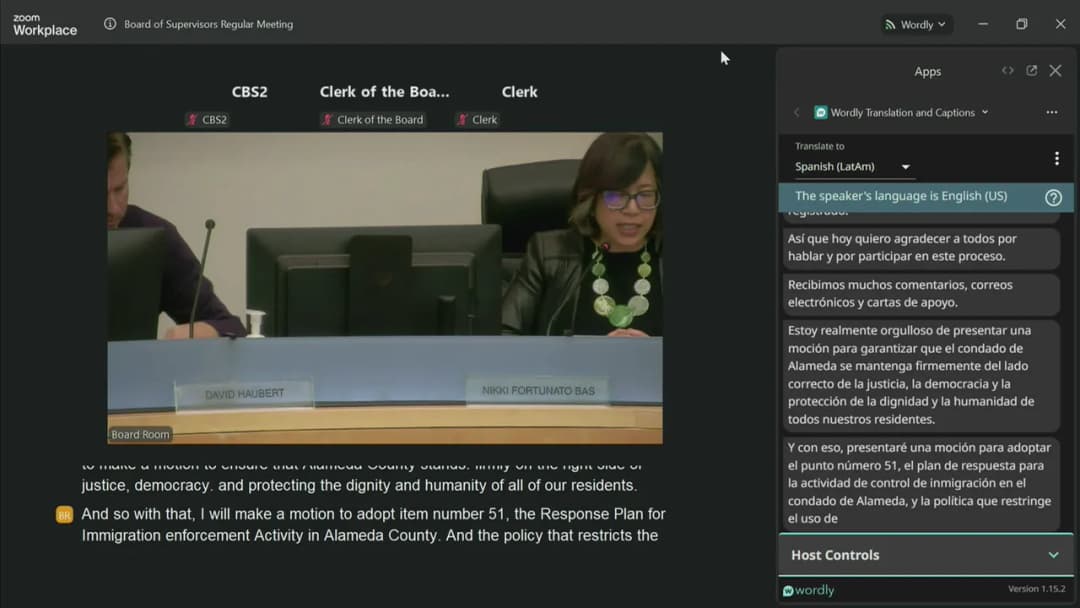
The Alameda County Board of Supervisors held a regular meeting on January 27, 2026, starting at approximately 9:30 AM. Supervisors Marquez, Tam, Fortunato Bas, and President Halbert were present; Supervisor Miley was excused initially but later attended. The meeting included supervisors' remarks, approval of a consent calendar, a mass motion, ordinance readings, and a major set matter (Item 51) regarding immigration enforcement response planning and ICE-free zones. Extensive public comment was heard on Item 51 and other items. The board also adopted proclamations for National Human Trafficking Prevention Month and the 30th anniversary of Alameda Alliance for Health, and reported out a closed session settlement. Consent Calendar - Items 52–55 were approved unanimously via roll call vote. - A mass motion (items 2–13, 16–48, excluding item 14 due to Supervisor Miley's recusal) was approved unanimously after Supervisor Tam moved and Supervisor Marquez seconded. Supervisor Miley spoke in support of item 42 (emergency management agreement). Supervisor Tam noted item 2 provided food services funding for individuals with intellectual/developmental disabilities. - Item 14 (grant from District 5 to United Seniors) was approved 4–0 after Supervisor Miley recused himself as president of the organization. - First readings of ordinances: Item 29 (green building practices), Item 34 (MOU with Union of American Physicians and Dentists), and Item 35 (MOU with Management Employees Association) were each introduced and waived, all approved unanimously. Public Comments & Testimony - Human Trafficking Prevention Month (Item 49): Two public speakers supported the proclamation. Rose McCarr (Justice at Last) noted her organization represented over 2,000 trafficking survivors and provided 2025 statistics (52 victims in court, 64 others supported). Tim Drew (East Bay DSA) supported the proclamation, referencing his sister's experience, and urged adoption of the ethical investment policy. - Alameda Alliance for Health 30th Anniversary (Item 50): No public comment. - HIV Funding (Item 10): Joe Hawkins (Oakland LGBTQ Community Center) urged release of federal HIV funds, noting 100% of new infections are among Black males and rising rates in the Latinx community. Holly Calhoun (Project Open Hand) supported releasing funds, warning of a February 28 deadline to avoid returning funds to the federal government. - Immigration Enforcement Response & ICE-Free Zones (Item 51): Over 50 public speakers, both in person and online, overwhelmingly supported the two proposals. Speakers included clergy, community organizers, elected officials (Oakland Councilmember Noel Gallo), legal organizations, health professionals, and immigrant advocates. Key arguments: ICE actions are unconstitutional and violent; the county must protect residents; similar policies in Santa Clara County and Chicago. Many speakers also urged the board to oppose reopening FCI Dublin as an ICE detention center. One speaker opposed the resolutions, calling sanctuary cities unconstitutional and supporting President Trump's policies. Several speakers requested stronger enforcement, including having sheriff's deputies arrest ICE agents who violate laws. Discussion Items - Supervisors' Remarks: Supervisor Tam requested adjournment in memory of Nellie Wong (poet, activist, died Jan. 2 at 91). Supervisor Marquez and Fortunato Bas thanked AC Health and volunteers for the Point-in-Time count (1,300 registered, goal 1,000); Marquez also asked for a status update on the ethical investment policy RFP in April. Supervisor Fortunato Bas requested adjournment in memory of Renee Good, Keith Porter, and Alex Pready (killed by ICE). President Halbert noted the ad hoc finance committee meeting on the ethical investment policy RFP has been sent to GSA for procurement (4-6 months). - Closed Session Report: County Council reported that on December 16, 2025, the board authorized settlement of case RG21093232 for $60,000 paid to plaintiff, with all supervisors voting yes (Miley excused). No other reportable actions. - Proclamations (Items 49 & 50): Supervisor Tam presented proclamations declaring January 2026 as National Human Trafficking Prevention Month and commending Alameda Alliance for Health for 30 years of service. District Attorney Ursula Jones Dixon spoke about human trafficking prevention efforts, noting 261 survivors served in 2025, 142 first-time services, and partnerships for upcoming Super Bowl, NCAA, and FIFA events. Alliance CEO Matthew Woodrow noted growth from 65,000 to over 400,000 members. - Immigration Enforcement Response Plan & ICE-Free Zones (Item 51): Supervisor Fortunato Bass presented the recommendations: (1) direct the county administrator to develop a comprehensive response plan for immigration enforcement, and (2) adopt a resolution prohibiting use of county-owned/controlled property for federal civil immigration enforcement. She provided context on rising ICE violence (three deaths in January 2026, 32 deaths in ICE custody in 2025), increased ICE funding ($75 billion over 4 years), and similar policies in Santa Clara County, Chicago, San Jose, and Los Angeles. Supervisor Marquez voiced support, emphasizing preparation and coordination. Supervisor Tam raised questions about enforceability; county council and sheriff explained that the policy restricts use of county property for staging/processing but does not prevent ICE from making arrests in public areas, and enforcement includes cease-and-desist letters and potential litigation. Supervisor Miley strongly supported the proposals, citing his oath of office, but cautioned against sheriff deputies confronting ICE directly. Sheriff Sanchez committed to exploring discontinuation of SCAAP funding and emphasized treating all people humanely. The board also discussed signage and training for county staff. Key Outcomes - Item 51 (Immigration Enforcement Response & ICE-Free Zones): Approved unanimously (5-0) on a motion by Supervisor Fortunato Bass, seconded by Supervisor Marquez. Roll call: Marquez aye, Tam aye, Miley aye, Fortunato Bas aye, Halbert aye. - Consent Calendar and Mass Motion: Approved unanimously as noted. - Ordinances (Items 29, 34, 35): First readings introduced and approved unanimously. - Closed Session Settlement: Authorized settlement of $60,000 in case RG21093232. - Proclamations: Adopted for Human Trafficking Prevention Month and Alameda Alliance for Health 30th anniversary. - Adjournments: The board adjourned in memory of Nellie Wong, Alex Pready, Renee Good, and Keith Porter. - Next Steps: The ACT ad hoc committee will receive a status update on the response plan and ICE-free zone implementation at its next meeting (scheduled for February 2026). The ethical investment policy RFP is in procurement (4-6 months).

PUBLIC SAFETY 74% · PROCEDURAL 5% · RACIAL EQUITY 5% · HEALTHCARE SERVICES 4%
OPENPUBLICA · PUBLIC MEETING INDEXUPDATED DAILY · openpublica.com