The Tulsa Development Authority (TDA) met on October 22, 2026, at 17:00 UTC. The board approved a second contract amendment extending the Habitat Housing/Black Wall Street Square redevelopment deadline, heard the monthly budget-to-actuals report, and received staff updates on Moton, a billboard revenue agreement, the Patrick Heights 2B grant, and community projects. All votes were unanimous. Action Item: Habitat Housing Contract Amendment - TDA staff brought forward the second amendment to the contract for sale of land for private redevelopment with Habitat Housing/Boomtown for Black Wall Street Square, covering lots 1 through 12, block 3, Dickison Goodman subdivision. The amendment would revise Section 6 to extend the time for redevelopment. - Staff explained that the existing deadline of March 2026 had been exceeded and that the project needed additional time because of construction constraints, material delays, permitting, and infrastructure development processes. - The requested extension sets the contract completion date at March 2028. Staff stated phase one construction is expected to complete in February 2027, with phase two to begin immediately afterward and finish by March 2028. - Board members asked whether the new timeline was sufficient. Staff responded that major factors that had delayed the project were now resolved, including vertical construction being underway, and that the March 2028 deadline should be achievable. - After a motion and second, the board approved the amendment 3-0, with Call Bracy, Jennifer Graffin, and Ashley Phillipson voting yes. Monthly Budget-to-Actuals Report - Finance staff presented the monthly budget-to-actuals report. A year-to-date net operating surplus was attributed primarily to reimbursements from the TIFIA grant. - Vegetative control spending was described as seasonal and expected to catch up. Land fee centers were routine, with only a few seasonal invoices. - Board members had no questions on the report. Monthly Staff Report - Black Wall Street Square: The contract amendment approved during the meeting extends completion to March 2028. - Moton: Staff received lot configuration feedback from Fabric Design and is reviewing it before sharing it with partners, including the community engagement partner and engineering consultant Wilkins Group. Drafting of the phase one RFP has begun. - Billboards: Staff identified a Lamar billboard located on TDA property north of the IDL. The billboard has been operating under an old arrangement with OSU Tulsa that provided free advertising but no cash rent. Staff found an old file, recontacted Lamar, and expects to bring an agreement to the November meeting that will include annual revenue, retroactive payments back to 2019, and an escalator. - Patrick Heights/2B grant: Engineering analysis is complete, and the consultant team has produced draft development scenarios based on the master plan and infrastructure analysis. A public meeting is scheduled for November 5, 2026. - The scenarios are expected to include a base case, a middle case, and the option most aligned with the original master plan vision. Key differences include relocation of the Salvation Army, realignment of Martin Luther King to a two-way street, and missing-middle housing density. - Staff plan to advertise a joint RFP in January 2027 with the Greenwood Legacy Corporation (GLC) under a cooperative agreement and land conveyance agreement that has been under negotiation for over a year and may be on next month's agenda. A commissioner asked to receive a draft before the vote; GLC was expected to approve its version at its own board meeting, after which TDA counsel would review. - Community Impact Initiative: Four projects are moving forward; the next community engagement event is at South Haven on October 31, 2026. Board Statements and New Business - No future agenda item requests were made. A commissioner thanked TDA staff and said the board is gaining traction in the community despite naysayers. - A board member encouraged the mayor, his staff, and the city council to proceed with confirmation of the newest appointed trustee because the holiday season could create quorum challenges. The nominee was scheduled to appear before the city council the previous day at 2:30, and the speaker saw no barriers to appointment, describing the nominee as a wonderful addition. Key Outcomes - Approved the second amendment to the Habitat Housing/Black Wall Street Square contract, extending the redevelopment deadline to March 2028, by a 3-0 vote. - Received the monthly budget-to-actuals report; no action was taken. - Directed staff to return in November with the billboard agreement and the GLC cooperative agreement/land conveyance agreement. - Announced the November 5, 2026 public meeting and the planned January 2027 RFP for Patrick Heights/master plan implementation. - The board unanimously voted to adjourn.
The Public Meeting Index
The Public Meeting IndexThe Virginia Key Beach Park Trust met on October 22, 2026, to approve the minutes from the previous meeting and to consider a resolution appointing Nancy Nevis as acting executive director. The meeting was brief, with no public comments. Both agenda items were approved unanimously. Discussion Items - Approval of Minutes: The trust voted to approve the minutes of the regular meeting held on October 8, 2026. - Appointment of Acting Executive Director: The trust considered a resolution appointing Nancy Nevis as acting executive director of the trust, subject to city commission approval. The resolution fixed her compensation at her current salary of $97,300 as finance coordinator, with any future increases subject to trust approval after a performance evaluation. The appointment would terminate upon the appointment of a permanent executive director or her earlier removal, after which she would return to her position as finance coordinator, provided she had not been previously removed. Key Outcomes - The motion to approve both the minutes and the resolution passed unanimously. - Nancy Nevis was appointed as acting executive director, pending city commission approval.
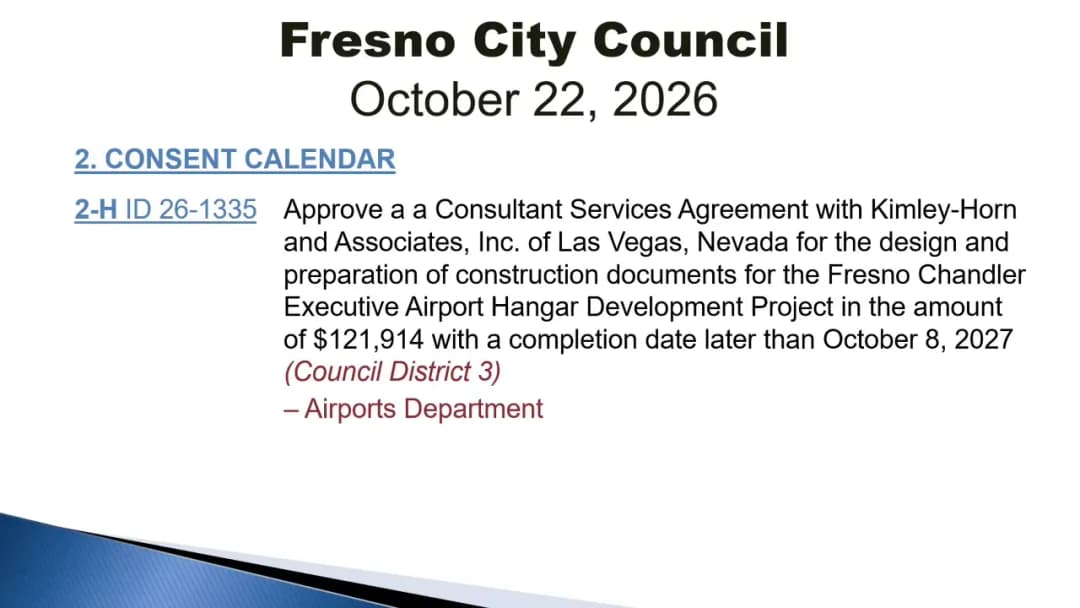
The Fresno City Council convened in regular session on October 22, 2026, immediately followed by a special meeting. With Councilmembers Perea and Vice President Maxwell absent, the body conducted six ceremonial proclamations, approved a large consent calendar, directed the study of a sex offender housing ordinance (SHIELD Act), and established a 90-day safety pilot program for the Tower District. Extensive public comment focused on the re-establishment of the Immigration Legal Defense Fund and the SHIELD Act. Ceremonial Presentations and Council Reports - Scott Mozier Day: The council proclaimed October 22, 2026 as Scott L. Mosier Day, honoring the retiring Public Works Director for 24 years of service. Mayor Dyer and Councilmembers praised his leadership on the $140 million Veterans Boulevard project and his responsiveness to community needs. - Domestic Violence Awareness Month: A proclamation was presented noting over 7,200 domestic violence reports filed with Fresno PD last year and over 7,656 adults and children served by the Marjorie Mason Center, which provided over 76,000 nights of safe shelter. Over 25 domestic-violence-related homicides have occurred in Fresno in the last five years. - Fresno IdeaWorks Day: Councilmember Perea recognized the downtown makerspace, which contributed 4,060 volunteer hours in 2024. - Mobile Food Vendor Association Day: Councilmember Arias detailed the association's origin following the 2021 shooting of a vendor and their ongoing advocacy for safe, licensed street vending. - Greg and Dre Day: Recognized retiring radio hosts Greg Hoffman and Andre Covington for 25 years of broadcasting. - United Against Hate Week: Mayor Dyer and the Community Liaison Office proclaimed the week of October 18–24. - Councilmember Reports: Councilmember Richardson announced a video explainer on state propositions and discussions on winter warming center policies. Mayor Dyer and Councilmember Arias reviewed a four-hour community meeting in the Tower District with over 800 attendees addressing public safety. Consent Calendar - Approved by a vote of 5 to 1, with Councilmember Richardson dissenting primarily over the Immigration Legal Defense Fund (Item 2BB). - Key approvals included: $4.3 million in city funds and a parcel for the Senior Affordable Modular Housing Project; $950,000 for the Fresno Economic Opportunities Commission Advance Peace Program; agreements for airport concessions, police equipment, and the 20th, 21st, and 23rd Appropriation Amendments. - Item 2BB (Immigration Legal Defense Fund): Re-established with an amendment limiting eligibility to Fresno residents without a criminal conviction. The item was placed back on the consent calendar following a procedural motion. Public Comments and Testimony - Immigration Legal Defense Fund (2BB): Supporters included Jesus Martinez (Central Valley Immigrant Integration Collaborative), Marbella Hernandez, Zara Marin (Power California), Shar Thompson (Tenants Together), and Lourdes Medina. They argued the fund is critical for due process and family stability amid federal enforcement surges and that the one million dollars is a necessary step. Neil O'Brien opposed the fund, arguing city funds should benefit all residents equally rather than creating a special benefit for one group. - SHIELD Act (4A): Janice Bellucci (Alliance for Constitutional Sex Offense Laws) and Nicholas Arnolds opposed the directive, arguing it would defy state law, lead to costly litigation, and increase homelessness among registrants. Roger Honeycutt stated that a vast majority of registrants are law-abiding and cited a recidivism rate of less than one percent. A survivor of sexual abuse spoke in favor of tighter regulations, emphasizing the lasting trauma to victims. - Tower District Pilot Program: Lisa Flores questioned the concentration of liquor licenses and the efficacy of passive policing. - Unscheduled Communication: Brandy Vegas requested more predictable meeting schedules for community engagement. Lisa Flores urged the city to prepare warming centers for the anticipated El Niño season. Discussion Items - Habitat for Humanity Disposition (9:05 AM): The council held a joint meeting to approve the transfer of 0.18 acres at 33 East Atchison Street to Habitat for Humanity for affordable housing. Approved unanimously in two votes (6-0). - CFD No. 9 Annexations (9:10 and 9:15 AM): Two hearings to annex territory and levy special taxes for Community Facilities District No. 9 were approved unanimously (6-0). - SHIELD Act Directive (Item 4A): Councilmember Karbassi introduced a resolution to initiate a study of regulations on sex offender housing operators. He argued the city must act against a "cottage industry" importing violent predators with no local ties, citing the case of David Alan Funston. Councilmember Richardson supported the study but warned of strong state preemption under California Health and Safety Code Section 1566.3, which limits local zoning authority over small residential care facilities. Councilmember Perea strongly supported the directive, focusing on the wellbeing of victims. The directive passed 6-0. - Tower District Pilot Program (Special Meeting): The council reviewed a 90-day safety pilot program for the Olive Avenue corridor following three recent shootings. The plan creates a designated vendor market zone, increases street lighting from 38 to 75 watts, and adjusts loading zone enforcement to begin at 10 PM. The resolution passed 6-0. Key Outcomes - Discrepancy Noted: The agenda listed two major land-use hearings (Central Southeast Specific Plan, ID 26-1243, and SW Fresno Rezone, ID 26-1244) as continued to December 3, 2026. However, the City Clerk announced during the meeting that these items were tabled without a return date by Councilmembers Karbassi and Arias. - Consent Calendar adopted (5-1). - SHIELD Act study directive adopted (6-0). - Tower District 90-day pilot program adopted (6-0). - Closed session concluded with no reportable actions.
The Board of County Commissioners convened for its open session on October 22, 2026, at the Carroll County Office Building. The meeting included a morning session starting at 9:00 a.m. and an afternoon session at 1:00 p.m. This summary is based on the published agenda and the transcript of the afternoon bond sale item. No minutes or transcript were provided for the morning items. Morning Session – Scheduled Items (9:00 a.m.) Based on the agenda, the following items were scheduled for discussion and decision. No record of the actual discussion or votes is available. - Item 1: Priority Carroll – No additional details were listed on the agenda. - Item 2: Contract Renewal – Taser Certification and Equipment – Staff recommended approval of an $88,834 renewal with Axon Enterprise Inc. under a competitively bid contract. The amount was budgeted in FY27. - Item 3: Local Care Team (LCT) FY 2026 Annual Report – A briefing on the LCT, which served a record number of families in FY 2026. No decision was required. - Item 4: FY27 MIEMSS Advanced Life Support (ALS) Funding Grant – Staff requested approval to submit an application and accept a $12,000 grant (100% funded, no match) for paramedic continuing education. - Item 5: Revised TrailBlazer Routes – Staff proposed two route changes for Taneytown and North Carroll to improve efficiency and ridership. Staff recommended approval and moving forward with public notice. - Item 6: Carroll Transit System Safety Management Plan – Staff requested approval of an updated Safety Management Plan, required annually under federal regulations. No cost involved. - Item 7: Purchase of Land for Northern Landfill Master Plan – Staff negotiated to purchase 46.328 acres near Reese Road, Westminster, for $3,400,000. Staff recommended approval. Afternoon Session – Bond Sale Award (Item 8, 1:00 p.m.) Commissioners reconvened for the afternoon session. Comptroller Jennifer Hobbs presented the results of the bond sale held earlier that day. The county received ten bids on $19.15 million of tax-exempt General Obligation bonds. All three major credit rating agencies reaffirmed the county’s AAA (or equivalent) ratings. The winning bid came from Robert W. Baird & Co. with a true interest cost of 4.15%, which was below the pre-sale estimate of 4.36%. Bond counsel Emily Fusting (McKennon Shelton & Henn LLP) and financial advisor Jennifer Diercksen (Davenport & Company LLC) confirmed that the rate was competitive, noting that the second-lowest bid was less than one basis point higher and that another comparably rated county received a higher rate earlier in the week. Commissioners asked clarifying questions about the rating scales and number of bidders. The board then voted unanimously to adopt the Bond Sale Award Resolution, authorizing the sale to Baird and empowering the Board President to execute settlement documents. Key Outcomes - Bond Sale Award Resolution – Approved unanimously by voice vote (motion by a commissioner, seconded). - Other Agenda Items – Staff recommendations were presented for Items 2, 4, 5, 6, and 7, but the outcomes of board decisions on these items are not recorded in the provided materials. Public Comments & Testimony No public comments were recorded or transcribed for this meeting based on the available sources.
The Fresno Building Standards Appeals Board met on October 22, 2026, to consider code enforcement continuances, a contested first administrative citation, and an appeal of a building official’s denial of an alternate means and methods request. No public comment speakers came forward, and the board voted on all agenda items before adjourning. No agenda or minutes were available in the source materials; this summary is based on the meeting transcript. Public Comments & Testimony - No speakers came forward under public comments, and no unscheduled oral communications were offered under item 11. Continued Matters - The board was advised that there were no continued matters on the agenda. Discussion Items Item 8A – Code Enforcement Case E25-16660 - Deputy City Attorney Christina Pinya requested a six-month continuance, reporting that the property owner had hired a draftsman and was preparing plans for the entire house. - The board approved the continuance on a motion by Mr. Vincent, seconded by Mr. Ransom. Item 8B – Code Enforcement Case E25-13A3 / 3436 North Virginia Lane - Deputy City Attorney Calvin Massey requested a continuance to December 15, 2026, stating that the appellant and homeowner were present, had consulted with development and planning, and needed to obtain a permit but were making progress. - The board approved the request on a motion by Mr. Ransom, seconded by Mr. Mir. The transcript also refers to this matter as “item 26-1361”; the agenda and minutes were not available to resolve the discrepancy. Item 8C – First Administrative Citation, 220 North Weber Avenue / 1827 West Clinton Avenue (Case E26-04602) - Deputy City Attorney Sarah Papasian presented the city’s case. She said the notice and order had been confirmed by the board in June, a progress hearing in early August found no progress, and fines were doubled. Inspector Amparo then issued a first administrative citation on August 21 for exterior siding replaced without permits. The city argued the violation existed, notice was properly served, and the violation remained after the deadline. - The city reported that 10 permits were later obtained: permit applications were started September 30, four permits issued once balances were paid, and the remaining six issued October 12 after fees were paid. No inspections were scheduled as of the hearing. - Ryan Port, representing appellant BDHOV et al., did not dispute the timeline but disagreed with its characterization. He argued all items in the original notice and order had been corrected by October 12, 2026; five of seven items were corrected within the original compliance period, the hazardous tree took longer because a specialist was needed, and permits were the remaining item. He also cited emails with the city, including an October 15 email from Inspector Jennifer Brown stating no further enforcement would be taken before December 14, 2026, and asked the board to dismiss the citation. - In rebuttal, the city said the notice-and-order arguments were not relevant to the citation hearing, noted a gap in communication from mid-May to late August and no action from mid-May to mid-September, and said the October 15 email anticipated the requested continuation rather than conflicting with it. - A board member observed that both sides were discussing a December 14/15 completion date and that a 60-day continuance would push the matter past the board’s December meeting. The board voted to confirm the first administrative citation and set a progress hearing for December 15, 2026. The motion passed on a unanimous voice vote. Item 8D – Water’s Edge Apartments Alternate Means and Methods Appeal - One board member recused from this item. - Ashley Atkinson, Assistant Director of Planning and Development, presented the staff recommendation. The project is a 72-unit multifamily development at 330 South Clovis Avenue. The applicant had requested permission to install two separate six-inch sanitary sewer lines at a one percent slope instead of the code-compliant eight-inch pipe, with 557 and 612 drainage fixture units on the two lines respectively. The building official denied the request under California Plumbing Code provisions regarding obstruction of flow and maximum loading. Staff recommended upholding the denial. - Ken Vang of Van Consulting Engineers, for the applicant, explained that the existing sewer line in Clovis Avenue is shallow, existing electric and gas utilities prevented installation of a proposed eight-inch line and manhole configuration, and the connection had to be made with a wye, requiring a six-inch line. He said the split system would still have adequate capacity: a six-inch pipe has capacity of about 126,000 gallons per day while the project would generate about 26,000 gallons per day. He argued the city standard manhole design would prevent blockages and that the proposal provided an equal or better solution consistent with alternate means and methods provisions. - The building official, Bill, responded that the City of Fresno sewer master plan does not apply to private property and that the proposal does not meet the California Building Code. - Board members discussed whether the alternate means and methods section of the code allowed approval, whether the proposal was constructible, and whether a requested slope reduction was below code minimums. The appellant’s engineer responded that the code allows alternate means and methods and that the flow calculations were adequate. General contractor Corbin Raven, also a primary owner, stated his support and said the proposed pipes would use only about 20 percent of their capacity. - A motion was made to approve the alternate means and methods request and allow the project to continue. After a request to clarify the record, the board confirmed it was approving the appeal and declining to uphold the building official’s denial. The motion passed on a unanimous voice vote. Reports and Adjournment - The secretary reported no report. - There were no unscheduled oral communications. - The meeting adjourned at approximately 1:48 p.m. Key Outcomes - Item 8A: Continued for six months. - Item 8B: Continued to December 15, 2026. - Item 8C: First administrative citation confirmed; progress hearing set for December 15, 2026. - Item 8D: Appeal granted; building official’s denial overturned; alternate means and methods request approved. - Public comment period closed with no speakers; meeting adjourned.
The Development Planning Sustainability Committee convened on October 22, 2026, to hear the Community Development Department's presentation on the Program Year 2026 budget, the five-year Consolidated Plan (2026–2030), and proposed changes to grant administration. The meeting, chaired by Councilwoman Santana, lasted from approximately 1:00 PM to 4:30 PM. A second day of hearings was scheduled for October 23, 2026, at 9:30 AM. The department is administering approximately $28.1 million in federal HUD grants, including $19.656 million from the Community Development Block Grant (CDBG). The presentation and discussion focused on HUD compliance issues, the need for improved citizen participation, a restructuring of how Council-directed funds are allocated, and ongoing challenges with contract processing and monitoring. Discussion Items - Opening Remarks and Context: Vice Chair (Councilman Harsh) noted that due to federal delays, the city received its CDBG allocation much later than in previous years, compressing the timeline. He acknowledged the department has been understaffed and is rebuilding. - Director’s Presentation: Director Aaron Miller Tate introduced the department’s mission, organizational structure (77 staff, six general-funded positions), and the $28.1 million in federal grants. She outlined three primary HUD compliance challenges: insufficient citizen participation in planning, a backward allocation process that lumps activities together without proper procurement, and unpredictable project initiation cycles. Proposed solutions include holding two citizen workshops (in addition to required public hearings), developing plain-language documents, and creating a more structured project-based approach with earlier identification of projects and outcomes. - Five-Year Consolidated Plan Priorities: The director presented five priority needs: affordable housing (preservation and production), housing stability and homelessness prevention (including rapid rehousing), neighborhood revitalization and reinvestment, access to housing and opportunity (financial empowerment, down payment assistance), and public services/resident capacity building. Grant administration was also noted as a priority due to rising salary costs and the 20% administrative cap. - Council Questions and Concerns: Multiple council members expressed frustration with slow contract processing, lack of transparency, and the impact of funding restrictions on neighborhood development. Councilman Starr asked about the possibility of using CDBG dollars for grocery store development in Ward 5. Councilwoman Hudson questioned the process for determining which projects are taken on by the department versus CDCs. Councilman Jones highlighted the decades-long struggle with funding CDCs and the need for faster payment turnaround. Councilwoman Gray emphasized the need for better CDC accountability and home repair programs. Councilman Shell requested a report card on the 10-Year Housing Equity Plan and a public dashboard to track spending. Councilwoman House Jones advocated for more robust citizen engagement, including using mailers, social media, and existing ward meetings. - Proposed Process Changes: Assistant Director Melissa Levinger detailed the proposed changes for 2027: a collaborative process with Council to identify projects early (by November 2026) to include them in the Annual Action Plan before public comment. The department plans to fully fund CDCs for 2026 and 2027 but will require that all Council-directed projects be clearly described and aligned with the Consolidated Plan. For sub-recipients (e.g., CDCs managing programs), a non-competitive process with an application may be used; for contractors (e.g., service providers), competitive procurement (RFPs) will be required unless a sole-source justification applies. The department also committed to spending down existing NDA balances by March 2027. - Discussion of General Fund Swap: Several council members discussed the possibility of a "swap"—using general fund dollars to support CDCs, freeing CDBG funds for capital projects. The director noted this would change procurement requirements but could allow more flexibility. Councilman Starr emphasized the urgency of moving CDBG dollars into projects like the Auburn Park Plaza grocery store. - Public Dashboard and Monitoring: The director stated that the department is working with Urban AI to create a public-facing Power BI dashboard to track key performance indicators, including units served and geographic breakdowns. The dashboard will be updated regularly. Additionally, a Salesforce system will be used to monitor grant applications and contracts internally. Key Outcomes - The committee did not take any votes. The hearing was informational, with plans to continue on October 23, 2026, at 9:30 AM to review specific programs and housing projects. - The department committed to working with council members individually or through their staff to identify projects for the 2027 Annual Action Plan by November 2026. - The director agreed to provide a report on the 10-Year Housing Equity Plan, though noted it may take time to compile the data. - The department will provide a breakdown of council ward balances and outstanding funds to help prioritize spending. - No formal decision was made on the general fund swap; further discussion is expected.
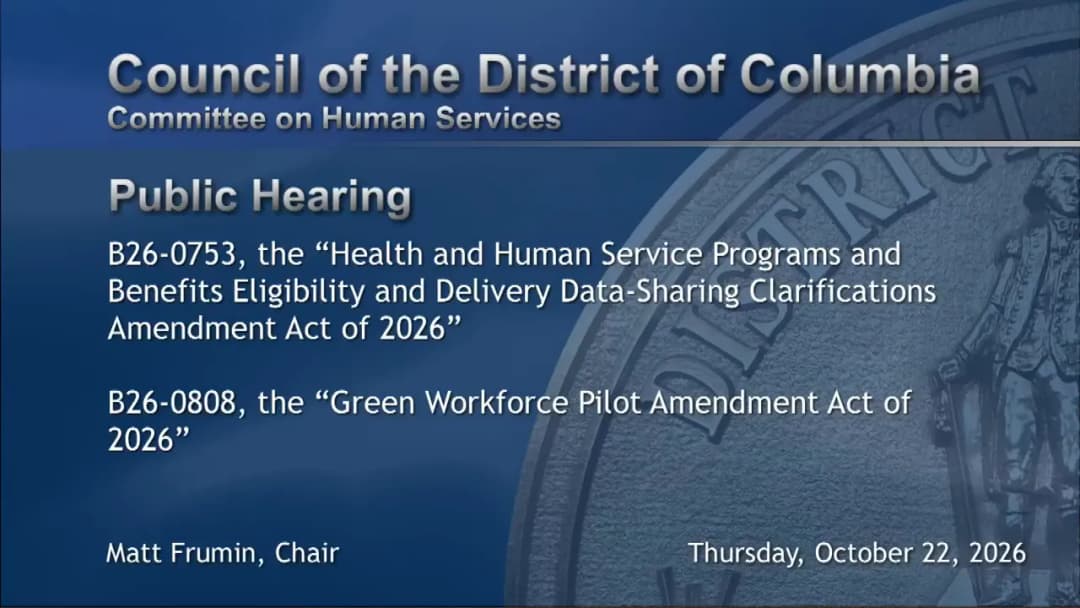
On Thursday, October 22, 2026, the DC Council Committee on Human Services, chaired by Ward 3 Councilmember Matt Freeman, held a public hearing in Room 500 of the John A. Wilson Building and via Zoom. The hearing began at 11:18 a.m. and adjourned at 1:41 p.m. It considered Bill 26-0753, the Health and Human Services Programs and Benefits Eligibility and Delivery Data Sharing Clarifications Amendment Act of 2026, and Bill 26-0808, the Green Workforce Pilot Amendment Act of 2026, both responding to new federal SNAP and Medicaid work requirements under HR 1. No agenda or minutes were available in the source record. Public Comments & Testimony - Jen Jenkins, Senior Policy Attorney at Legal Aid DC, testified in support of the Green Workforce Pilot bill, calling it an important step. She urged the Committee to expand the pilot beyond 250 participants, clarify how DHS would select participants, set a firm launch date, and make participants eligible by October 1, 2027 at the latest. She cited DHS data indicating over 66,000 individuals are subject to ABOD work requirements; the transcript records that 45,000, or 35%, meet an existing exemption; over 16,000 still need screening; and almost 4,000 SNAP recipients are known non-exempt. She also cited about 257,000 Medicaid enrollees, 79,000 subject to work requirements, and 53,000 exemption notices (transcribed as '53 exempt notices') for good cause, leaving 26,000 people potentially subject without an exemption. - Joe Liu, Ward 3 resident and Director of Advocacy and Public Policy at the Capital Area Food Bank, supported both bills. He cited the food bank's hunger report finding 39% of DC residents food insecure in the past year, and its delivery of 10.7 million meals in DC last year. He said HR 1 cut SNAP by $186 billion and USDA data show nearly 10,000 fewer DC residents receiving SNAP since HR 1 was passed, with DC's 6.9% decline lower than the national 13.9% decline. He encouraged focusing the pilot on permanent, higher-wage employment and a whole-of-government response. - LaMonica Jones, Director of DC Hunger Solutions, supported the data-sharing bill. She cited national SNAP declines of approximately 6.3 million since January 2025 and 5.5 million since July 2025, close to 10,000 fewer DC residents, and an estimated 17,000 DC residents at risk of losing food assistance. She noted ABOD work requirements create a three-month time limit and narrow exemptions for parents of teenagers, veterans, people experiencing homelessness, and former foster youth. She urged the Council to pair the legislation with strong oversight, transparent reporting, adequate administrative capacity, and safeguards against preventable losses. - Chair Freeman noted written testimony from the DC Sustainable Energy Organization and praised written testimony from STEMPatise International, without endorsing every word. No other public witnesses appeared. Discussion Items Bill 26-0753 – Data Sharing Clarifications - Chair Freeman explained that B26-0753 was introduced July 9, 2026, with an emergency version passing unanimously July 14, 2026. It clarifies DHS's authority to share data within DHS and with other agencies, including allowing the Homeless Services Department to share data with the public benefits department so residents can automatically qualify for exemptions from new federal work requirements. - DHS Director Rachel Pierre, testifying under oath, said DHS supports the bill. She said the emergency and temporary authority has allowed DHS and DHCF to advance data-sharing agreements, now at their final steps. The bill removes statutory restrictions under the Homeless Services Reform Act, enables FSA-ESA data sharing, prevents eligible residents from accruing countable months, and will be even more important for Medicaid work requirements in January 2027. - In response to questions, DHS said implementation will require privacy-protecting policies, role-based access, and system integration; it was too early to describe day-to-day mechanics. DHS expects to use existing data to automate some exemptions, such as residents in permanent supportive housing who have documented disabilities. DHS also said it is exploring AI for benefits processing to reduce error rates. Chair Freeman said the Committee will ask for implementation and privacy updates in December and during oversight. Bill 26-0808 – Green Workforce Pilot - Chair Freeman introduced the bill as requiring DHS to establish a Green Workforce Pilot Program for public benefits recipients. The bill was introduced September 21, 2026, with Councilmembers Bonds, Lewis George, Allen, and Silverman. DHS estimates 8,500 to 12,900 residents could lose SNAP because of work requirements, and DHCF estimates 56,000 Medicaid beneficiaries will need to demonstrate compliance. - Director Pierre said DHS supports the bill's intent but has concerns: the pilot is not funded in FY26 or FY27; DHS lacks the infrastructure, staffing, and wage-subsidy mechanism to run it; it would duplicate existing environmental workforce programs; and placing it in the TANF employment program would miss ABODs because TANF participants are already exempt from SNAP work requirements. DHS recommended the Department of Employment Services as the better home because it has workforce expertise and wage-subsidy infrastructure. Pierre noted DHS is already restructuring its workforce model, modifying TEP provider contracts on October 1, 2026, and planning a new solicitation with the Deputy Mayor for Education for contracts effective October 1, 2027. - Chair Freeman defended the pilot as a different, temporary tool to provide paid work and job coaching, and said some technical issues—including income multipliers, whether program income would be counted for federal benefits, and the start date—need to be worked out with DHS. Work Requirements, Program Capacity, and Outcomes - DHS provided early data on ABOD implementation: the October SNAP caseload is about 119,000; about 87% of ABODs qualify for an exemption; among screened ABODs, about 3,800 were non-exempt; about 12,000 recipients had not yet been screened, a figure that differs from public witness Jenkins's earlier 16,000; about 20% of ABODs subject to requirements are expected to be noncompliant; and about 1,000 residents, later described as households, lost SNAP between September and October, with most losing benefits being men over 30. DHS cautioned that these data are early. - DHS said SNAP Employment and Training has 1,605 total slots, about 59% used, leaving roughly 600 vacant; the workfare program has 1,850 slots, with early fill counts given as about 50 and later 98 at different points in the hearing. Both are federally funded, and SNAP E&T providers are required to bring a match. - DHS reported 174 SNAP E&T participants gained employment in FY26, about 5% of SNAP E&T participants. Of about 3,800 non-exempt ABODs, 310 were in compliance through work, workfare, or training; DHS could not yet provide the breakdown. DHS does not track EITC filing or receipt, though providers educate clients about the EITC. Key Outcomes - No votes or bill markups occurred during the hearing. - B26-0753 received support from all public witnesses and from DHS. - B26-0808 received support from public witnesses, with requests to expand capacity, move up eligibility, and set a firm start date; DHS gave qualified support and recommended DOES as the implementing agency. - DHS will continue implementation of data sharing and report operational and privacy details to the Committee; the chair said the Committee will follow up in December and through oversight. - Written testimony for the record must be submitted by 5 p.m. Thursday, November 5, 2026, through the Council's online hearing management system.
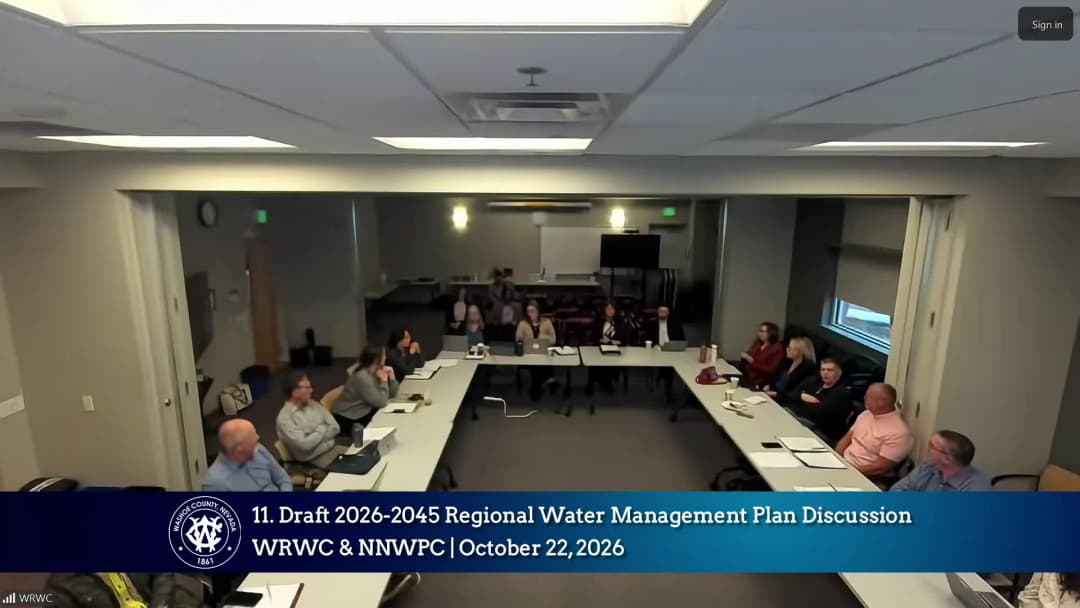
The Western Regional Water Commission (WRWC) and the Northern Nevada Water Planning Commission (NWPC) held a joint meeting on October 22, 2026. Key actions included the unanimous approval of the FY28 priority setting budget, acceptance of the FY26 audited financial statement, and the reappointment of Dr. Mylin Newen to the NWPC. The commissions received a detailed update on the regional wastewater and stormwater feasibility study by Raftelis and an update on the draft Regional Water Management Plan. Outgoing commissioners Naomi Doer and Susan Sievert were honored with resolutions of appreciation. Consent Calendar - Approval of Agendas: The agendas for both the WRWC and NWPC were approved unanimously. - Approval of Minutes: The minutes from the August 19, 2026 WRWC meeting and the October 7, 2026 NWPC meeting were approved unanimously. Public Comments & Testimony - No public comments were made during the designated public comment period. Discussion Items - Reappointment of Dr. Mylin Newen: Staff recommended the reappointment of Dr. Mylin Newen as an NWPC voting public-at-large member. Legal counsel confirmed the act is silent on late reappointments, and reappointing a willing member is standard practice. The reappointment was approved unanimously by both bodies. - FY26 Audited Financial Statement: Seth Macy from Macy & Associates presented the WRWC fiscal year 2026 audit, reporting a clean opinion with no findings. The audit showed the commission's net position increased by $140.2 million, the general fund balance increased by $144,200, and general revenues increased by approximately 43 percent compared to the prior year. The report was accepted unanimously. - Regional Wastewater and Stormwater Feasibility Study (Raftelis Update): Zach Green provided a status update on Phases 1B and 1C. Mr. Green reported that a firm consensus had emerged from stakeholder engagement to study a reorganization under the Truckee Meadows Water Authority (TMWA) for wastewater rather than the status quo. The path for stormwater remains less certain, requiring further study on phasing, governance, and rate structure impact. Commissioners asked about grant funding eligibility and the need for enabling legislation; legal counsel indicated no major new state legislative act would be required to proceed. - FY28 Priority Setting & Draft Budget: Kim Rigdon presented the results of the October 7 NWPC annual priority setting session. Wastewater and effluent management ranked the highest priority. The draft professional services budget for FY28 totals $2.7 million, a decrease from the FY27 budget of $3.1 million. The results and draft budget were accepted unanimously by both commissions. - Regional Water Management Plan Update: An update was given on the public review of the draft plan chapters and a new web-based infographic designed to improve public accessibility. The infographic is coded to be responsive and directly integrated into the WRWC website platform. A commissioner raised a question about language accessibility for the site, which staff agreed to explore further. The plan is scheduled to return to the NWPC in January 2027 for recommendation, followed by a 30-day public comment period and final adoption by the WRWC in March 2027. - Resolutions of Appreciation: Resolutions were adopted unanimously recognizing Commissioner Naomi Doer for 12 years of service representing the City of Reno and Commissioner Susan Sievert for 14 years of service representing the Sun Valley General Improvement District. - Future Meeting Schedule: Staff proposed a new meeting schedule to avoid conflicts. NWPC meetings will be held on the first Monday of each month. WRWC meetings will be held on the second Wednesday, aligned with TMWA. No meetings will be held in June, July, or December. Key Outcomes - Votes and Approvals: - Reappointment of Dr. Mylin Newen (Unanimous) - Acceptance of WRWC FY26 audited financial statement (Unanimous) - Adoption of FY28 priority setting results and draft professional services budget of $2.7 million (Unanimous) - Adoption of Resolution 262 for Naomi Doer and a resolution for Susan Sievert (Unanimous) - Next Steps and Directives: - Raftelis will continue work on Phase 1C of the feasibility study, with an interim report on Phase 1B findings to be issued soon. - The Regional Water Management Plan update is to be presented to the NWPC in January 2027 for recommendation, followed by a 30-day public comment period and final adoption by WRWC in March 2027. - Staff will investigate the feasibility of adding language translation tools to the new water management plan infographic and website. - The new meeting schedule will be adopted, canceling the November and December 2026 meetings for both boards.
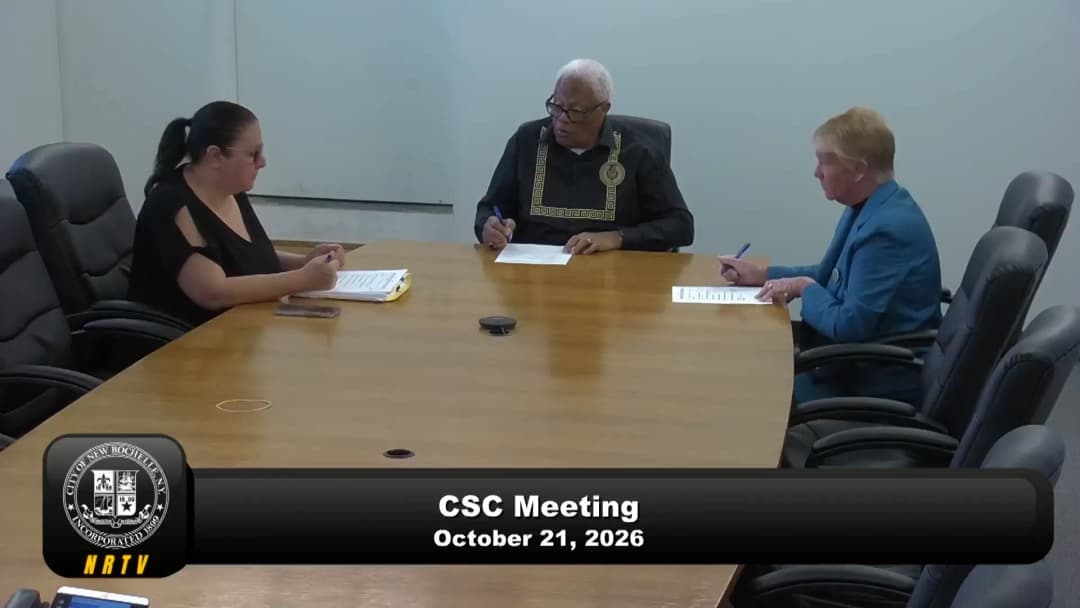
The Municipal Civil Service Commission held a regular meeting on October 22, 2026, at 3:34 PM in the Council Conference Room. Chairman Bishop Fetz and Lee, and Commissioner Margaret Chadwick were present; Commissioner Waterloo Bay was absent. The meeting was adjourned at 3:38 PM. Discussion Items - Approval of Previous Meeting Minutes: The commission approved the minutes from the September 23, 2026, meeting as written, following a motion by Commissioner Chadwick. - Proposed Exam Fee Increase: The commission discussed raising exam fees following a request from budget meetings. Current fees are $50 per candidate for uniformed exams and $30 for all others. The commission noted that half of the fee is retained locally and half goes to the state. It was agreed to gather information on fees charged by other municipalities (e.g., White Plains, Yonkers, Peaks, and More City) before making a decision. The item will be revisited at the next meeting. - Non-Competitive and Provisional Appointments: The commission deferred a report on non-competitive and provisional appointments, as the relevant information was not brought to the meeting. It was noted that one or two probationary items may also exist. The report is expected at the November meeting. - Eligible Lists and Exams: No eligible lists were established or extended at this meeting. There are no pending exams awaiting results, and no exams are scheduled for October. The commission attributed the lull to ongoing changes at the state level and a lack of open exams. Staff will check with the state about upcoming exams and review exams already on order. - Next Meeting: The next regular meeting is scheduled for November 18, 2026, at 3:30 PM. Key Outcomes - Approved the minutes of the September 23, 2026, meeting. - Agreed to research exam fee rates in comparable municipalities before deciding on a potential increase. - Deferred reports on non-competitive appointments and probationary matters to the November meeting. - No exams or eligible list actions were taken; staff will monitor state activity for future exam opportunities.
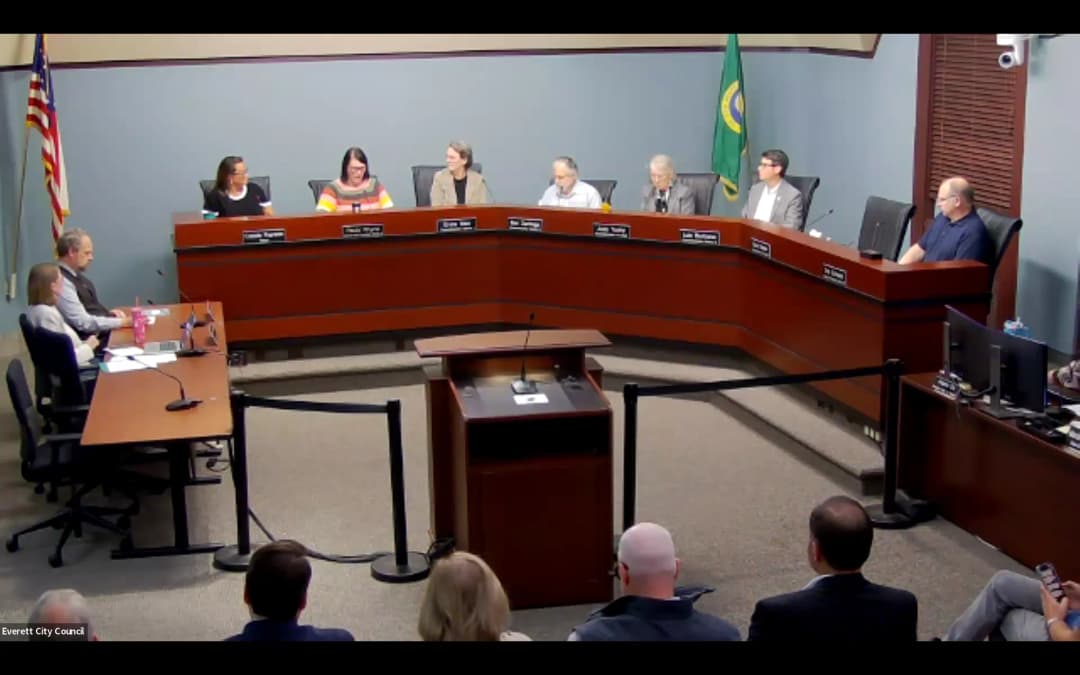
Note: The agenda and transcript identify this meeting as Wednesday, October 21, 2026; the supplied meeting timestamp is 2026-10-22 16:15:00+00:00. This summary uses the requested date in the title. The Everett City Council met with Mayor Franklin and six council members present (Councilmember Bader excused). After the pledge and land acknowledgment, Mayor Franklin presented the proposed 2027 city budget. The council approved the Oct. 14, 2026 minutes, approved the consent calendar, heard public comment, and received the first reading of the ordinance authorizing the Everett Transit/Community Transit annexation interlocal agreement (ILA). Consent Calendar - Approved a resolution authorizing claims against the city in the amount of $3,705,475.79 for Oct. 3-9, 2026. - Approved a resolution authorizing payroll claims of $6,291,854.19 for the period ending Oct. 3, 2026. - Waived public bidding requirements and approved a multiple-year sole-source purchase of Rotork equipment and services from Beaver Equipment, Inc. - Awarded the Lift Station 24 Conveyance Improvements construction contract to Rodarte Construction, Inc. of Auburn, WA for $1,585,398.17. - Authorized the mayor to execute the lease agreement with Expedition Physical Therapy P.L.L.C.; staff noted negotiated changes from the standard lease form. Public Comments & Testimony No written or online comments were read into the record. Pre-action-item public comment: - Janine (Everett) presented data on Everett Police Department calls at Planned Parenthood from 2018 through 2026, said over 95% of calls involved protester activity, and urged the council to establish a buffer zone to protect patient access. - Kathleen Bergler (Everett), a longtime Planned Parenthood patient escort, described a 1986 clinic encounter and a similar incident that day, quoted an officer telling escorts to 'be the grown-ups,' and called for moving protesters across the street. - Sergi (Everett), a small gas station owner at 6901 Broadway, said the city has not issued him a permanent pump permit after installing a new pump three years ago, is fining him $250, and alleged retaliation. - Rosa Riggs (Lake Stevens), an Everett paratransit scheduler, questioned Community Transit's long-term paratransit plan, said the ILA's enforcement provisions are weak, and noted one rider is over 100 years old; she urged council to consider what recourse Everett would have if CT fails to deliver. - June Schober (District 3) supported consolidation, citing at least 50% more buses in a few years and calling it 'better together.' - Jan Moistan (Lake Goodwin area) opposed consolidation, compared CT to 'an amoeba eating us,' cited a senior fare increase from 50 cents to $1.25, and said union and paratransit issues remain unresolved. Public comment on CB 2610-52: - Brock Howell (Everett; Snohomish County Transportation Coalition executive director) supported the merger and said the rethink transit study projected frequent-service stops rising from 29% to 75% by 2036 with consolidation. - Rene Bairo (Everett) opposed the ILA, called it a 'grab and run scheme' and an open subsidy to the county, and said Everett would pay more for the same service. - Daryl Sullivan (Everett; Everett Transit bus driver) opposed the consolidation, called the sales tax increase an unnecessary burden, and said Community Transit cannot replace Everett Transit's local service. - Gordon Arlin (Mukilteo; Everett business owner) raised a separate concern about Broadway lane and parking changes, saying removal of parking in front of his store would close his business. - Kirk Hovencotter (Seattle; Transportation Choices Coalition executive director) voiced strong support, citing 50% more bus service, dignity and fairness, light rail readiness, and the importance of supporting transit workers. - Evan Reid (downtown Everett) said he wants light rail but argued the current ILA is not strong enough; he urged binding contract language for workforce protections, paratransit guarantees, and community engagement programs before asset transfer. Mayor's 2027 Budget Address - Mayor Franklin proposed a full city budget of almost $766 million and said the city faces a recurring structural deficit driven by the 1% property tax levy limit and rising service costs; the city has closed more than $100 million in deficits over recent years. - She highlighted revenue actions taken this year (utility tax alignment, voter-approved EMS levy, B&O tax modernization) and asked council to consider a public safety sales tax of one-tenth of 1% (one cent on a $10 purchase) and transit consolidation. - Public safety proposals include 220 police officers (two per 1,000 residents), a grant for 10 additional officers and a domestic violence victim advocate, two new municipal court positions, and continued EMS/fire investments. EMS calls rose from about 16,000 in 2018 to more than 21,000 in 2025 and are over 80% of fire dispatches. - The CARE alternative response team has served more than 2,200 individuals and handled more than 800 active 911 calls as the primary responder this year; the budget restores human needs funding to $4 per capita, nearly $500,000 for nonprofits. - Housing, South Everett, parks, and libraries are funded, including Edgewater Park, Walter Hall playground, Eclipse Mill Park, and permitting modernization. The mayor announced a coming South Everett directive and continued planning for light rail. - Economic development: more than 1.5 million visitors this year, visitor spending up almost 20%; the B&O tax reform eliminates B&O tax for 6,500 small businesses and reduces taxes 25% for another 2,000 retailers, generating $3.5 million annually; a proposed outdoor event center is projected to drive $85 million in visitor spending and attract nearly 400,000 visitors annually. - The mayor said transit consolidation with Community Transit is necessary to support light rail and avoid major service cuts, and she noted Everett's population could grow from about 114,000 to more than 150,000 through annexation, with another 60,000 over the next 20 years. Discussion: Transit Consolidation ILA (CB 2610-52) - Staff and Community Transit CEO Rick Ilgerfritz presented the proposed annexation of Everett into Community Transit's benefit area, with an effective date of April 1, 2027 if approved. Everett would move to the 1.2% transit sales tax (60 cents per $100 purchase), receive a $54.5 million lump-sum payment, and transfer transit assets plus $16 million in capital reserves to CT. - The ILA would keep existing service on day one, increase service in Everett by approximately 50% through 2031, add a zip microtransit zone, protect existing paratransit service, transition employees with collective bargaining protections, and give Everett representation on the CT board. - Financial discussion: Everett Transit faces a structural deficit; its six-year transit development plan identifies $357 million in capital needs, including a roughly $100 million operations base. With a maximum local sales tax increase, Everett could increase service only about 25% over 20 years, while CT's regional model supports a 50% increase by 2031. - Council questions addressed reserve sufficiency, the timing of tax revenue, employee retention and seniority, paratransit transfers, microtransit design, board representation, and oversight. Ilgerfritz said CT's plan is to integrate Everett's paratransit dispatch, phase out transfer activity over time, honor existing union contracts as the baseline, and create a board oversight structure with periodic population-based reallocation. He did not commit to a specific seniority integration or to a countywide directly operated paratransit model. - Councilmember Ryan asked for case studies of other transit integrations at the next meeting; staff committed to follow up on the Broadway parking concern raised by a business owner. Council Comments and Administrative Updates - Councilmember Ryan voiced support for enhanced protections for patients accessing Planned Parenthood and reported on Naval Station Everett, the Pet Mayor event (almost $19,000 raised), and neighborhood meetings. - Councilmember Weir reported on the Pet Mayor event and corrected his prior comments to thank Councilmember Tui for allocating $25,000 in ARPA funds for the Pacific gateway mural. - Councilmember Zarlingo reported on the Valley View neighborhood meeting and Snohomish County PUD's Peak Assist energy program. - Councilmember Tui reported that the Housing Authority of Snohomish County purchased a 42-unit apartment complex on Casino Road to preserve it as low-income/section 8 housing near future light rail. - Council President Schwab reported on the Everett Library Board and the CARE team's work on library behavioral policies. - Administrative staff noted that consent item 5, the Expedition Physical Therapy lease, included small negotiated changes from the standard lease form. Key Outcomes - Approved the Oct. 14, 2026 council minutes unanimously. - Approved all five consent calendar items unanimously. - Received the first reading of CB 2610-52; no vote was taken on the ordinance. The public hearing is scheduled for Oct. 28, 2026, and the third/final reading is scheduled for Nov. 4, 2026. - Held an executive session under RCW 42.30.110(1)(i) for legal matters; after returning, council approved an auto body claim of $30,532.65. - Next steps include continued budget deliberations, a mayoral directive on South Everett, and Community Transit board consideration of the annexation.