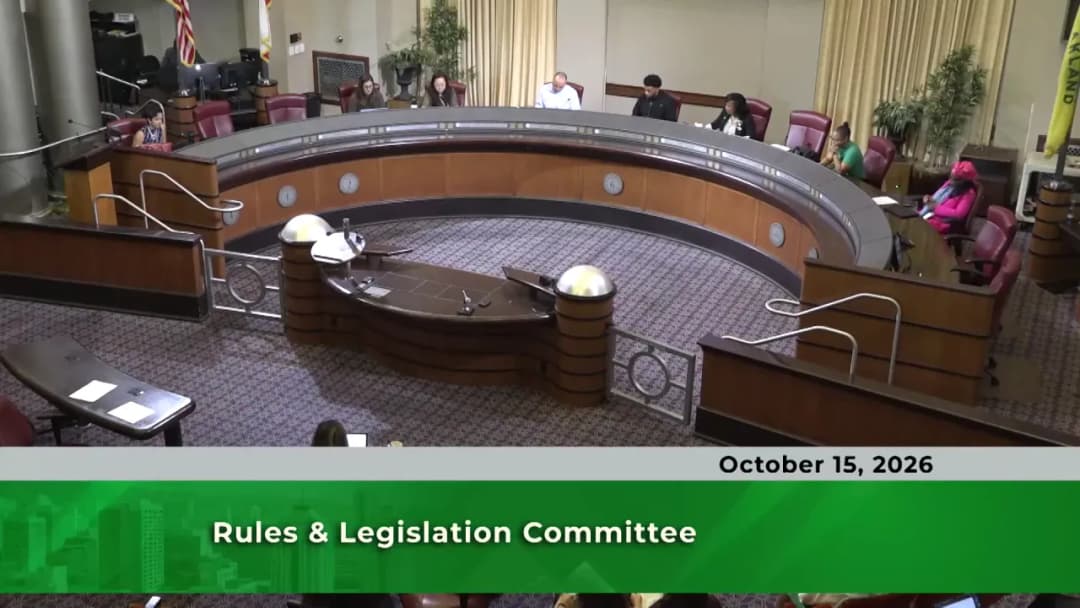
The Rules & Legislation Committee of the Oakland City Council convened on Thursday, October 15, 2026 at 10:30 AM in the City Council Chamber. Council President Kevin Jenkins chaired the meeting. The committee’s primary function was to set the legislative schedule, forwarding items to full council or other committees for further consideration. All committee members were eventually present: Rowena Brown, Carroll Fife, Janani Ramachandran (arrived at 10:35 AM), and Kevin Jenkins. Public Comments & Testimony - Three speakers from One Fair Wage addressed the committee during Open Forum. Tonisha Scott, Micole Edwards, and Oray Amone urged the council to place a certified $30 per hour minimum wage ballot measure on the next available council agenda. They stated that the community had gathered enough signatures to qualify the measure and that state law requires the council to place a properly certified measure on its agenda. The speakers called on the committee to follow the law and allow voters to decide, noting that Alameda County had similarly called for a study before making a decision. Discussion Items - Determination of Schedule of Outstanding Committee Items (Item 2): The committee reviewed and approved the pending list of outstanding committee items with no changes. Motion by Councilmember Fife, seconded by Councilmember Brown, carried 3-0 (Ramachandran excused). - New Scheduling Items (Item 3): The committee considered 27 items (3.1 through 3.27) for scheduling, including new items and recommendations from the October 13 Finance & Management, Public Works & Transportation, Community & Economic Development, and Special Public Safety committees. Key actions included: - 3.1 (SAVE Grant): Scheduled for October 20 City Council consent agenda with a Rule 24 urgency finding due to upcoming El Niño storms. - 3.2 (Baker Tilly Advisory Group): Title change approved; scheduled for October 27 Finance & Management Committee. - 3.3 (Executive Recruitment Agreements): Title change and scheduling for October 27 Finance & Management. - 3.4 (Cannabis Program Report): Title change by Councilmember Gallo’s office; scheduled for November 17 Community & Economic Development Committee. - 3.5 (Sale of Garfield Park to OUSD): Title change and scheduling for October 27 Life Enrichment Committee. - 3.6 (2027 Legislative Calendar): Scheduled for October 29 Rules & Legislation Committee. - 3.7 (Appointment to Rent Board): Scheduled for October 29 Rules & Legislation. - 3.8 (MOU with Piedmont for Firefighter Training): Scheduled for November 10 City Council consent agenda with a Rule 24 urgency finding to align with the November 2026 Fire Academy. - 3.9 (Anti-Displacement Programs Report): Scheduled for November 17 Community & Economic Development. - 3.10 (Vegetation Management Report): Scheduled for November 17 Public Safety; Councilmember Ramachandran added as a co-sponsor. - 3.11 (Violence Reduction through Measure NN): Scheduled for November 30 special joint meeting at 12:30 PM. - 3.12–3.14, 3.15–3.19, 3.20–3.25, 3.27: All forwarded as recommended (mostly on consent) for October 20 City Council agenda, with noted amendments for items 3.13 (parking citation system extension with terms limited to June 30, 2027 and privacy protections), 3.23 (affordable housing funding with conditions on Measure U bonds), 3.24 (trust fund ordinance update), and 3.25 (nuisance penalties amended to include $2,500 and “major” violation language). - 3.26 (CPRA Bi-Annual Report): Continued to October 27 Public Safety Committee. - Review of Draft Agendas (Item 4): The committee reviewed draft agendas for upcoming council and committee meetings. Councilmember Ramachandran announced a special Finance & Management Committee meeting on Tuesday, October 27, 2026 at 9:00 AM (replacing the regular 9:30 AM meeting) to ensure a quorum. Key Outcomes - Item 2 (Pending List): Approved unanimously (3-0, Ramachandran excused). - Item 3 (New Scheduling Items and Committee Recommendations): Approved as amended by a 4-0 vote (Brown, Fife, Ramachandran, Jenkins). All scheduling directions and amendments were adopted. - Item 4 (Draft Agendas): Approved as amended (special Finance & Management Committee on October 27 at 9:00 AM) by a 4-0 vote. - The meeting adjourned at 10:56 AM.
The Public Meeting Index
The Public Meeting IndexThe Assembly Budget and Finance Committee of the Whole met on October 15, 2026, during its noticed 10:00–11:00 a.m. time slot, convening at approximately 10:05 a.m. No agenda or minutes were provided, so this summary is based solely on the raw transcript. The meeting was shortened to accommodate a confirmation/work session at 11:05 a.m. and was briefly paused for a building-wide earthquake drill. The committee received standing reports and a presentation on the budget amendment process. Standing Reports - Budget Advisory Commission (BAC): Chair Mills reported a successful BAC meeting and a District 1 budget town hall with Member Scout and Vice Chair Volland. BAC is drafting a budget resolution for adoption at its November regular meeting and plans to attend and help coordinate the Fiscal Future Summit on Friday, October 30. - MOA Trust Fund: Investment Director Kevin Lu reported mixed September performance after the Federal Open Market Committee raised rates by 0.25% on September 16 to a 3.75–4% range. The trust's market value was $507 million as of September 30, with a monthly return down 1.5% and a positive year-to-date return of 6.5%. A dividend spending policy study is underway, with findings expected by year-end. - Revenue Report: Acting Treasurer Lauren Crawford said revenue is tracking forecasts. Personal property tax billing is about $34 million; bills were about $32 million, plus $3.7 million in prior-year adjustments, putting revenue above the budget target. The alcohol tax was 51.8% of expected year-to-date revenue, about 2% above expectations, though reported two months behind. Marijuana tax revenue is elevated by a $400,000 prior-year expense recovery, not new revenue. - 2026 Budget-to-Actuals: OMB Director Brouse reported that with 74.5% of the fiscal year elapsed, the municipality had spent 72% of its budget through September 30. Labor postings were 75% and non-labor 68%, with non-labor lagging partly because financial transactions such as TANS expense, convention center, and reserves had not yet posted. Some departmental variances, such as PME's high non-labor spend, were tied to an encumbrance issue being cleared; the chief administrative officer runs high due to venue contracts and risk management. - Overtime: OMB noted police, fire, and transit overtime would be examined in tomorrow's budget work session. Member Volland flagged police overtime and the downtown foot patrols as important to downtown businesses and asked whether they would continue. OMB explained the patrols were funded by one-time TIPS money, paid overtime because of a sworn-officer shortage, and that no TIPS appropriation exists in 2027; options include new revenue or a special levy/service-area model. - Travel and Tax Fund Reports: Travel is underspent by about 13%, with 16% spent. Alcohol tax appropriations were 99% spent, mostly on homelessness providers and health department grants; no concerns were raised. Marijuana tax spending is on track and may leave fund balance at year's end. - FEMA/ARPA: OEM is working with the state to close out FEMA earthquake recovery; some projects remain open, but the goal is to close all related emergencies through the 2027 budget process so they no longer require standing reports. Discussion Items - Budget Amendment Process: Assembly budget analyst Molly Rocher introduced the Assembly Budget Amendment Guide and templates. Key points: draft amendments are due to her by November 4; details must be finalized by November 11 so items can be prepared for the clerk. She noted a typo in the guide listing the assembly meeting as November 18; she believed it is November 17, and the due date is unchanged. Five templates are available, including the general operating/government template that also covers alcohol and marijuana tax amendments. An online form will be emailed to members. The guide prompts members to describe service or operational impacts, responsible staff, resource needs, goals, funding sources, net-neutrality, and whether funding is one-time or recurring; one-time funding is removed in the continuation budget unless added back. Best practices include early communication with the analyst and departments, CCing the analyst, obtaining estimates and quotes, and considering IGCs for large operational changes. - Chair's Additional Guidance: The chair encouraged early amendments, especially in a tight budget where most must be net zero; members can bring partially developed ideas to the November 6 work session. Placeholders such as 'unused tax capacity' have been used before. Members were urged to use available staff resources rather than drafting in isolation. Public Comments & Testimony - Jamie Lopez, who described himself as formerly homeless, commented critically on the budget. He joked that cutting a wardrobe budget item would not solve budget problems. He pointed out that People Mover accident insurance claims go to the general fund rather than returning to People Mover. He argued the municipality is using the wrong tools for problems such as homelessness, leading to overtime and lack of success. He questioned a $500,000 outreach/resource navigation center, asking whether it only leases space for people to talk and calling it 'a lot of money.' He noted winter shelter spending was 98% of budget as of September and appeared on track to exceed it, and he asked what it meant that the congregate shelter annual contract had been removed from the budget to zero and whether alternative funding was expected. Key Outcomes - No formal motions or votes were taken. - Budget amendment deadline set: draft amendments due November 4; final details due November 11. - Budget amendment work session scheduled for November 6; the full budget work session is scheduled for October 16, with the chair citing 11 a.m.–4 p.m. Immediately after this meeting, a confirmation/work session begins at 11:05 a.m. - BAC plans to adopt its budget resolution at its November regular meeting. - MOA Trust's dividend spending policy study is expected by year-end. - OMB will present deeper overtime analysis for police, fire, and transit at the October 16 budget work session.
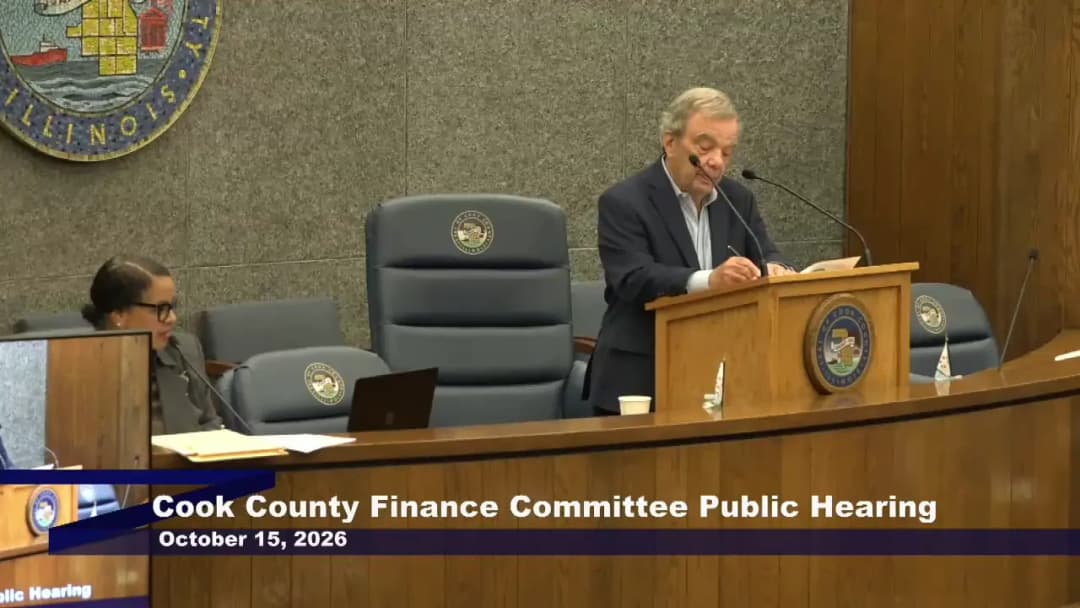
On October 15, 2026, the Cook County Board's recess committee reconvened for a public hearing on the fiscal year 2027 budget. No agenda or minutes were available, so this summary is based solely on the raw transcript. The hearing was held in person and virtually, with American Sign Language and Spanish interpretation available. Members and staff heard testimony from nonprofit leaders, service providers, municipal officials, and residents on proposed funding for health, economic development, public safety, legal aid, housing, transportation, and county programs. No formal votes were taken during the hearing. Public Comments & Testimony - Economic development and small business: Terrence Johnson, executive director at Greenwood Archer Capital, thanked the Bureau of Economic Development for grants to CDFIs that support small businesses in underserved south and west side and southern suburban communities, and urged commissioners to approve additional appropriations. Sam Toy, president and CEO of the Illinois Restaurant Association, urged maintaining strong, consistent funding for the Cook County Small Business Source, citing the industry's support of more than 585,000 Illinois jobs, roughly 10,000 business engagements since July 2021, and nearly 2,000 businesses served in 2026. - Health care, behavioral health, and Cook County Health: Several speakers supported the FY27 Cook County Health budget and community health investments. Dee Atkins of Thresholds cited a 76% reduction in future emergency department visits among participants in an assertive community linkage program, with 70% of participants experiencing homelessness moved into housing. Nathan Calvacoda of A Safe Haven highlighted Stronger Together results over 18 months: 250 clients served, 100 completed paid vocational training, 85 engaged in substance use or mental health treatment, and 50 placed in full-time jobs. Dr. Randy Sadler of UCAN Chicago spoke in strong support of behavioral health funding. A representative of the Chinese American Service League said CASL served more than 660 behavioral health clients last year and voiced concern that the proposed FY27 budget does not explicitly allocate funding for the Stronger Together initiative, whose current grant ends this fall. - 211 and law library: Jackie Rosa of United Way of Metro Chicago asked continued support for 211 Metro Chicago, a free 24/7/365 referral helpline that has fielded more than 700,000 contacts since January 2023. Jessica Wamasi of the Chicago Bar Foundation supported the Cook County Law Library, noting nearly 46,000 annual visitors, nearly half without lawyers, and 5.3% overall visit growth and almost 30% growth in visits from people without lawyers this fiscal year. - Violence prevention and re-entry: Selena Smith of Grow Community thanked the county for a $500,000 Survivor of Gun Violence grant through the South Suburban Justice Advisory Council, reporting 317 individuals served, 174 completions, 124 currently enrolled, and a 90% completion rate. A representative of ZAMPS Hope Community Resource Center supported the Justice Advisory Council's No Place to Stay program, describing it as a 'pre-entry' re-entry program. - Immigration legal defense: Multiple speakers with the Defenders for All Coalition asked the county to expand the Public Defender's immigration division to 25 dedicated attorneys. Reina Toscano (Resurrection Project), Yaire Torduño (PASO West Suburban Action Project), Dahlia Rodeki (Resurrection Project), Jocelyn Crea (PASO), and Esther Martinez (Southwest Organizing Project) shared personal and community stories of detention, deportation, and difficulty finding trustworthy representation. Kelly Fuentes, affiliated with PASO West Suburban Action Project, described lacking economic resources for a private lawyer and long waits for legal assistance. Rodeki described her son-in-law's seven-month detention and eventual self-deportation; Crea said her aunt paid more than $30,000 to an attorney who turned out to be a scammer. Fasika Alam of the United African Organization urged continued and expanded funding, citing recent federal changes affecting refugees and TPS holders. - Veterans Assistance Commission: Michael Tooman, Dutch DeGrout, and Jennifer Glenn urged increased funding for the Veterans Assistance Commission of Cook County. DeGrout said the VACC brought in $16 million in VA compensation—almost five times its budget—and provided 922 emergency financial assistance services in one quarter, among other figures. Glenn described receiving emergency help from the VACC within 24 hours. - Guaranteed income: Taylor Tremil (Workers Center for Racial Justice/Union for Guaranteed Income), Aurora Gonzalez, Jamal Jackson, and Chella Garcia (Union for Guaranteed Income) supported continued and expanded funding for Cook County's permanent guaranteed income program, citing the historic $7.5 million allocation, the need for timely implementation before winter, community transparency, and additional funding. Jackson cited the Cook County Promise pilot: 3,250 households received $500 per month for two years, 75% felt more financially secure, 94% said the money helped with an emergency, 56% reported less stress, and over $8 million went to local businesses. Gonzalez noted the program has not yet reached residents. - Domestic violence services: Kayla Posley of The Network, Katie Brown and Amanda Spannheimer of Crisis Center for South Suburbia, and Elizabeth Grask of Legal Aid Society/Metropolitan Family Services supported the proposed $5 million FY27 commitment to domestic violence services through the Justice Advisory Council. Posley reported nearly 40,000 hotline contacts from Cook County residents, a 30% increase from 2024; Brown noted the Crisis Center's shelter represents 33% of dedicated DV shelter beds in the suburbs and that JAC funding enabled service to more than 1,500 survivors and support to 4,600 through law enforcement outreach. Grask said LAS serves more than 1,100 survivors annually and urged substantial investment. - Workers' rights and Healthy Work Initiative: Tim Bell and Sandra Fernandez (Chicago Workers Collaborative), Marco Seniceros (Warehouse Workers for Justice), Angie (Latino Union of Chicago), Ana Waharda (Centro de Trabajadores Unidos), and Sophia Zaman (Raise the Floor Alliance) urged continued funding for the Healthy Work Initiative. They cited more than 50,000 vulnerable workers assisted over three years; warehouse cases involving wage theft, heat/cold illness, harassment, and discrimination; and Zaman cited COVID-era disparities: Black residents accounted for 36% of COVID-related deaths, Latinx residents' rates rose by nearly 54%, compared with a 10% increase for white residents. Zaman also said the program reached 435,000 individuals, trained 66,000, and tracked over 400 violations. - Transportation and infrastructure: Alex Perez (Active Transportation Alliance) supported continued CCDPH partnership to help 14 suburban communities compete for ITEP funding, noting $157 million in state funding and that pedestrians and cyclists account for 25% of fatal and serious crashes. Melinda Metzger of PACE thanked the county for Invest in Cook grants totaling $180,000 for a Northwest Cook on Demand zone and $176,000 for a transit lane along Surmac Road. Tim Class, Village of Summit engineer, praised Build Up Cook for sewer lining, water audits, and helping secure almost $13 million for lead service replacement. Scott Kinsey of Smart Elevators supported continued elevator, escalator, and ADA lift maintenance. Vicky Pisenko of Evanston Animal Shelter supported Cook County Rabies and Animal Control, mentioning animal intakes and free vaccination and microchipping clinics. - Budget support/residents: Vicky Brown, Dr. Linda Abington, Frank Pabilnik (Mayor of Posen), Christy DeLaurentis (South Suburban Mayors and Managers), Lonnie Swilly (PLCCA), Rabbi Wolf, and Apostle Lawrence Blackfoot spoke in support of the proposed FY27 budget. Brown and Abington praised balancing fiscal responsibility with compassion and no additional taxes; Abington noted no property tax increase and a $550 million gap filled with reserves. Pabilnik thanked the county for infrastructure investments and asked the board to approve the 2027 budget. DeLaurentis, representing 39 south suburban communities, opposed property tax increases and supported the budget. Swilly/PLCCA supported the Cook County Health and County Care budget. Rabbi Wolf praised the Medical Examiner's Office for compassionate service to religious communities. Blackfoot supported affordable housing investments in South Suburban communities. - Concerns/opposition: George Blakemore criticized the hearing, alleging that county funding to nonprofit organizations amounts to vote-buying, questioning how program effectiveness would be measured, and making derogatory comments about immigrants and elected officials. Key Outcomes - No formal votes or decisions were made during this hearing; it was a public testimony session for the FY2027 budget process. - Speakers overwhelmingly urged the board to maintain or increase funding for programs including the Small Business Source, Stronger Together, Healthy Work Initiative, the Public Defender's immigration division, Veterans Assistance Commission, guaranteed income, domestic violence services, and infrastructure programs. - The board received testimony in person and virtually, with translation services available.
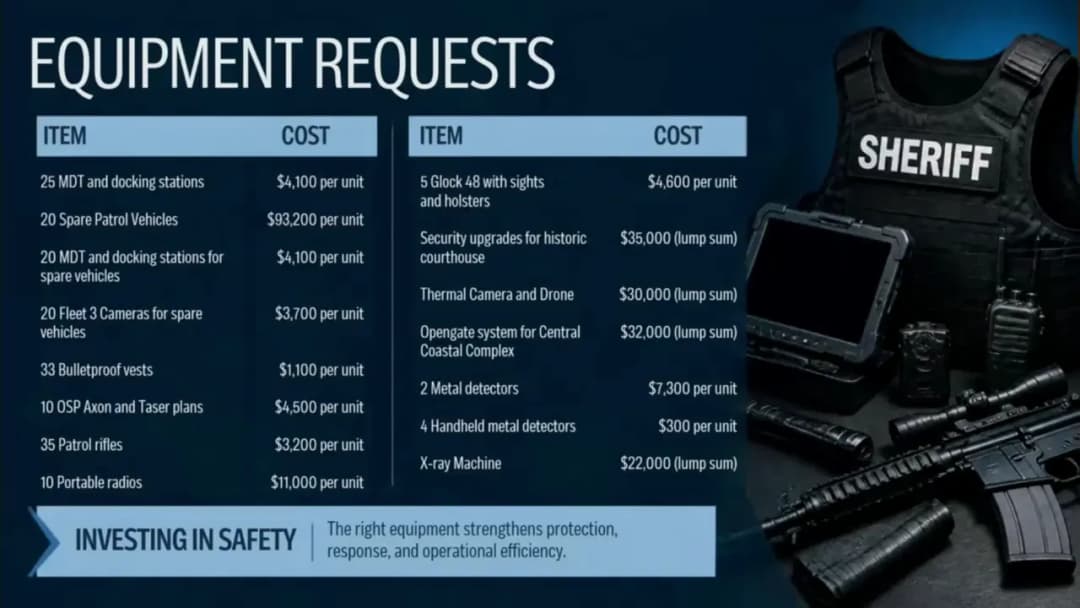
The Horry County Council held a budget workshop on Thursday, October 15, 2026, to hear departmental enhancement requests for the 2028 budget. The meeting began with an invocation and opening remarks from Chairman and Administrator Barry Scott, who highlighted the county's rapid growth (estimated population 440,000, now the second largest county in the state) and the need to respond to increasing demands. Over 20 departments presented their staffing, equipment, and capital needs. No votes or formal decisions were taken; the workshop served as a listening session for council members. The requests will be compiled and reviewed for the fall budget retreat scheduled for November 19, 2026. Discussion Items - County Administrator Overview: Barry Scott emphasized the pressure of growth, the importance of public safety, and the need to watch state legislative changes on property taxes. He noted over $11 million already invested in behavioral services and that opioid settlement funds will taper after 2030. - Information Technology: Justin Swans requested three new full-time positions (M365 Azure Administrator, IT Project Manager, IT Service Desk Supervisor) to better utilize Microsoft 365 and improve help desk efficiency. - Assessor: Requested reclassification of a supervisor position for the new Central Coast Complex and a new customer service representative with GIS skills. Also reported on AI software procurement for reassessment. - Treasurer: Angie Jones stated she could not specify her needs in October due to public-facing demands, but requested two administrative and two revenue collector positions. She also highlighted a backlog of approximately 700 business licenses and called for process streamlining, noting that North Carolina does not require business licenses. - Registration & Elections: Sandy Wartman requested no new staff but asked for increased poll worker pay from an additional $55/$25 to $105/$65 for clerks and workers, totaling up to $38,250 per major election. Equipment also requested. - Veterans Affairs: Requested one additional staff member ($75,212) to manage a caseload that grew from 19,000 in 2015 to 39,811 active files. - Probate Court: Judge Beverly and Judge Rhodes requested three new full-time positions, reclassification of all 23 staff, merit pay, a digital recording system, and furniture. They cited 4,000 monthly phone calls and 6,200 pending cases. - Solicitor: Requested an administrative assistant ($71,928) to speed up discovery and $25,000 increase for expert fees related to an upcoming death penalty case. - Clerk of Court: Darlene Hill requested two additional staff for warrants and passport services, plus technology upgrades for all 11 courtrooms. - Sheriff: Requested three deputies for Central Coast Complex security, four field operations deputies for the Carolina Forest area, two additional security officers, an ICAC investigator, an electronic crime investigator, a bomb dog, and equipment. Vehicle costs noted at $105,000 each including upfitting. - Radio Services: Requested reclassification of a radio system specialist to manager and a new specialist, plus $85,000 for a service monitor replacement. - Detention: Marcus Rowe requested four corporals, four booking officers, one court officer, and moving a peer support specialist from grant to county funding. Also furniture updates. - 911 Communications: Requested three positions (technology specialist, training specialist, frontline personnel) to prepare for future capacity and resilience. - Fire Rescue: Chief Tanner requested multiple positions including an EMS QA officer, quick response vehicles, peer support coordinator, battalion chiefs, firefighters, wildfire technician, and equipment. Noted growing call volume. - Police: Requested 48 sworn positions, seven non-sworn, and 13 reclassifications, focusing on investigations, patrol, and support. - Animal Care Center: Chief Wyatt requested 21 positions including a veterinarian, rescue coordinators, and kennel attendants to address 300% capacity. - Public Works: Requested an HEO2 position, deputy director, and equipment. - Planning & Zoning: Requested three positions (zoning technician, principal planner, zoning inspector) and an incentive program for professional certifications. - Parks and Recreation: Requested staff for new facilities, reclassification, and capital projects including pickleball courts, synthetic turf, and trails. - Stormwater: Requested two positions and equipment including a forklift and mosquito control building. - Fleet: Requested nine positions and $388,550 in capital equipment to support nearly 2,000 county assets. - Building Maintenance: Requested a crew chief custodian, safety/training coordinator, generator, and scissor lift. - Airports: The airport director requested no new positions but presented capital projects (checkpoint expansion, runway rehabilitation). Airport police requested two additional officers due to increased airline service. - Capital Improvement Requests: IT requested $2 million for ERP software, $800,000 for Council Chambers AV system, increases for server/switches, and ServiceNow implementation. Museum requested storage building. Solicitor requested $150,000 for parking lot paving from state funds. Detention requested a medication-assisted treatment program ($500,000). 911 requested equipment for backup capacity and a fund increase. Fire rescue requested apparatus storage, fire boat, and equipment. Engineering requested a bucket truck ($300,000). Public Works requested several projects including walkway, paving, building, wash bay, and winter equipment. Parks requested pickleball courts, synthetic turf, and trails. Stormwater requested mosquito control building and oyster reef restoration. Key Outcomes - No formal votes were taken; the workshop was solely for council to hear department requests. - Finance staff reported total enhancement requests of $43.5 million, with $25 million recurring and 235 positions requested. - Council members emphasized prioritizing public safety, fiscal responsibility, and gradual tax increases (1 to 1.5 mils per year) rather than large hikes. - Chairman noted a goal of reducing red tape and streamlining business processes. - The next step is the fall budget retreat on November 19, 2026, where staff will present a balanced budget and recommendations.
The Wilmington Board of Adjustment met on October 15, 2026, to consider two items: a request to continue a wall sign variance and a variance for reduced setbacks on six Evans Street lots. All votes were unanimous. (Note: The transcript references October 16, 2026, conflicting with the agenda and given date.) Consent Calendar - Approval of Minutes (September 17, 2026): Approved 5-0. Discussion Items - 352 S. College Rd. - Wall Sign Variance: The applicant requested a continuance to the November 19, 2026, meeting due to ownership and representation issues. The board approved the continuance 5-0. - 501-511 Evans Street - Reduced Setbacks Variance: Grace Lamay (staff) presented the variance request for six lots (Lots 29-34) that are narrower than the R5 district standard. The applicant's agent, Graham Renfro, argued that the lots, platted in 1926, should be developed as originally intended. He requested side setbacks of 10% of average lot width (analogous to the rule for properties within the 1945 corporate limits) and a 2-foot minimum side setback for Lot 34. Board members discussed whether approval would set a precedent and whether the unique lot dimensions created an undue hardship. The board concluded the variance met the four statutory findings and approved it unanimously. Key Outcomes - Minutes Approved (5-0). - 352 S. College Rd. Variance Continued to November 19, 2026 (5-0). - Evans Street Variance Approved (5-0): For Lots 29-33, side interior setbacks reduced to 10% of lot width (from 7 feet to 3.3 feet); for Lot 34, side setback reduced to 2 feet (variance of 5 feet from the required 7 feet).
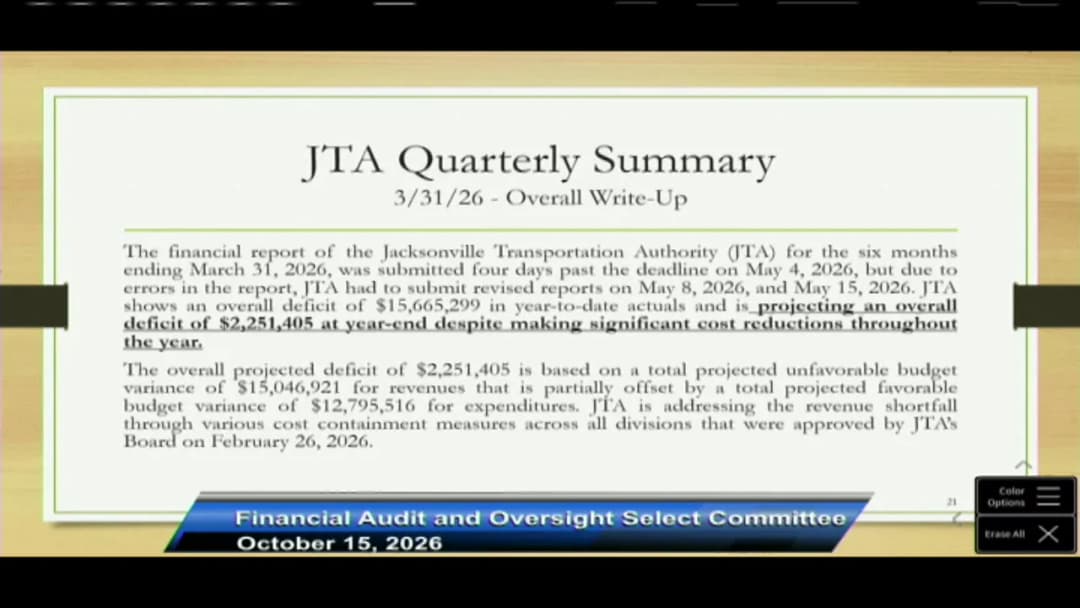
The Financial Audit and Oversight (FAO) Select Committee convened on October 15, 2026 at 9:30 a.m. in Council Chambers to examine the Jackson Transportation Authority (JTA) financial position. The meeting focused on the Council Auditor's presentation detailing how JTA reached its current financial crisis, including revenue shortfalls, expenditure overruns, and budget control failures. The session ran approximately 1.5 hours, concluding at 11:00 a.m. with adjournment before public comments. The next meeting is scheduled for October 23, 2026 at 9:30 a.m. Follow-Up Items from Prior Meeting - Council Member Salem asked about JTA's outside audit; Philip Peterson (Council Auditor) confirmed JTA has an annual audit by Cherry Beckert and is a component unit of the city. - Salem requested information on how COVID-19 funds were received, spent, and whether they delayed recognition of financial troubles. Council will investigate this and other federal grants. - Council Member Miller requested documents on fiduciary responsibility acknowledgments for executives and board members; JTA CFO Randall Barnes committed to provide these. - Miller also asked for details on CFO turnover over the last three to five years, including names, tenure, and reasons for departure. Barnes agreed to provide the information, noting that his finance and technology division has seen 50% reduction in staff over the last year. Council Auditor's Presentation: How JTA Got Here - The presentation covered revenues (primarily half-cent transportation tax) and expenditures from fiscal year 2022 through projected 2026. - Half-cent sales tax represents 60-70% of JTA's budget; while collections grew until late 2025, increases were offset by rising debt service payments for BJP projects (debt rose from $19.7M in FY24 to $36.9M in FY25). - In FY25, the Council reduced JTA's requested sales tax projection by $11.4M after the Auditor's office flagged overestimates. JTA filled the gap with $7M in one-time reserve use and $5M in interest transfers that did not materialize. - Quarterly summaries showed small overages in FY22-24 but a dramatic $18.9M deficit in FY25 (year ending September 30, 2025), driven by $12M bus overspend (linked to NAVI) and $4.1M CTC (connection) overspend. Projections from JTA throughout FY25 were overly optimistic (surplus of $34k then $2.3M then $3.9M) compared to actuals. - For FY26 (ending September 30, 2026), JTA projected a $31.8M deficit: $17M revenue shortfall (sales tax, interest, gas tax, fares) and $14.8M expenditure overrun (CTC contract under-budgeted for full year, fringe benefit errors). - The presentation concluded that problems are isolated to FY25-26, with $26.7M in reserves used in FY25 and approximately $32M projected in FY26. - Recommendations: implement budgetary controls (prevent spending without capacity), monthly forecasting, present forecasts to the board publicly, and continue conservative budgeting for half-cent sales tax. Discussion Items - Pushback on Budget Projections: The Auditor's office described unusual resistance from JTA leadership (CEO, CFO, budget staff) during FY25-26 budget negotiations, where JTA insisted on higher revenue figures despite evidence. Council members questioned whether this pressure indicated management knowingly used unrealistic numbers. - Board Lack of Financial Projections: Randall Barnes confirmed JTA's board received monthly actuals and year-to-date reports but not financial projections. Council members expressed disbelief and anger that board members were not given forward-looking data, preventing them from identifying the crisis earlier. Several members (Salem, Diamond, Carlucci, Lane) stressed the need to review board packets and minutes to determine what was provided. - Need to Hear from Former CEO and Board Chair: Council members Diamond and Salem argued that former CEO Nat Ford and the board chair should testify before the committee to explain decisions and awareness. Chair Miller agreed to request their attendance, with possible use of committee authority if needed. - Charter Authority: Discussed whether Council can mandate reporting from JTA (a state-created agency); Office of General Counsel indicated limited ability but suggested legislative action via local bill or resolution. - Auditor Access: The Auditor's office is working to gain read-only access to JTA's financial systems (expected within a week). Currently they rely on JTA-provided data except for certain city-controlled revenue streams. - Timeliness of Budget Amendments: Council members criticized JTA for late budget amendments (sometimes 12 months after year-end), though recently improved to 3 months. The FY25 actual deficit required immediate attention. - Cash Crisis: Noted that on May 28, 2026, JTA had only $938,000 in operating cash, leading to a line of credit and eventual use of LOGT funds approved last week. Council Member Lane emphasized that balance sheet moves (prepayments, transfers) masked cash problems. Key Outcomes - Directives to Staff: - Council Auditor's office to research COVID-19 and other federal funds received by JTA, how spent, and impact on financial condition. - Council Auditor's office to obtain and review JTA board packets (ongoing) to determine what projections and cash positions were presented to the board. - Council Auditor's office to compare board reporting practices of other independent authorities (JEA, JAA, JPA). - Follow-Up Actions: - JTA CFO to provide documents on fiduciary responsibility acknowledgments and CFO turnover details. - Chair Miller will formally request former CEO Nat Ford and board chairs to appear at future meetings; if uncooperative, committee will consider using rules to compel testimony. - Next meeting scheduled for October 23, 2026 at 9:30 a.m. will include JTA's FY27 projections and further financial discussion. - No formal votes taken; the committee is fact-finding and will issue recommendations later.
The Marion County Community Corrections Advisory Board met on 2026-10-15 (October 15, 2026), with Chair Carlette Duffy presiding. Roll call included representatives from the City-County Council, Marion Superior Court, Corporation Counsel, the Marion County Prosecutor's Office, and the community liaison. The board approved the August 20 and September 17, 2026 meeting minutes and two one-year contracts, discussed the pending fee-elimination budget proposal, and considered rescheduling the November meeting. Minutes Approval - The board approved the August 20, 2026 and September 17, 2026 meeting minutes by motion, second, and voice vote with no opposition. No questions were raised. Contracts - Quality Correctional Care (QCC) medical services: The board approved a one-year contract for $475,263.51 to continue medical services for residents of the Duval Residential Center. Chief Financial Officer J. Garcia explained the county has partnered with QCC since 2017 and completed a new contract in 2025 due to the scale of services. In response to a board member's question, Garcia said earlier nurse-attendance issues had been resolved and there were no current grievances or complaints. - Lane Language Training Center (LTC) language services: The board approved a one-year contract for $40,000 for language services for Marion County Community Corrections clients, including over-the-phone interpretation, virtual interpretation, written translation, and sign language. The state split the language services contract under its QPA, so the county would have needed two vendors. To avoid confusion, LTC agreed to a standalone contract covering all services at the same QPA rate. Current over-the-phone use averages about 5-10 calls per week at roughly 45 cents per minute, and Garcia said she will return to the board if more funds are needed. She also noted she may issue an RFQ next year instead of continuing to follow the state QPA. Agency Updates and Fee-Elimination Budget Proposal - Garcia reported ongoing communication with OFM about the proposed elimination of user fees; OFM requested historical data, the data was provided, and more data was to be submitted later that day. A budget vote was scheduled for the following Monday, but the outcome was still unknown. - Asked whether the proposal included alternative revenue sources, Garcia said it did not as written, but left the door open for grants; outside sources had discussed covering at least the drug-testing component, which is the smallest part of the proposal. A $1.5 million budget request is associated with the proposal. - Asked about Department of Correction (DOC) funding and cuts, Garcia said the user-fee budget is not connected to DOC funding and there have been no discussions with DOC. The user-fee budget historically is $700,000 to $1,000,000, and the $1.5 million figure relates to an outside vendor, Track Group, which also monitors part of the caseload. Next Meeting and Possible Rescheduling - The next meeting was scheduled for Thursday, November 19, 2026, at 12:00 p.m. in Room T-260 of the City-County Building. - At a member's request, the board agreed to look into moving the meeting one week earlier to Thursday, November 12, 2026, because November 19 is close to Thanksgiving. Members will check room availability; if the room cannot be reserved, the meeting may be cancelled instead of rescheduled. - The board noted that the November agenda currently includes one item: a community member petitioning the board with concerns and recommendations based on experiences with the agency. Key Outcomes - Minutes from August 20 and September 17, 2026 were approved. - A one-year QCC medical services contract for $475,263.51 was approved. - A one-year LTC language services contract for $40,000 was approved. - The board will investigate rescheduling the November 19 meeting to November 12, 2026; the meeting location and time remain Room T-260 at 12:00 p.m. unless changed.
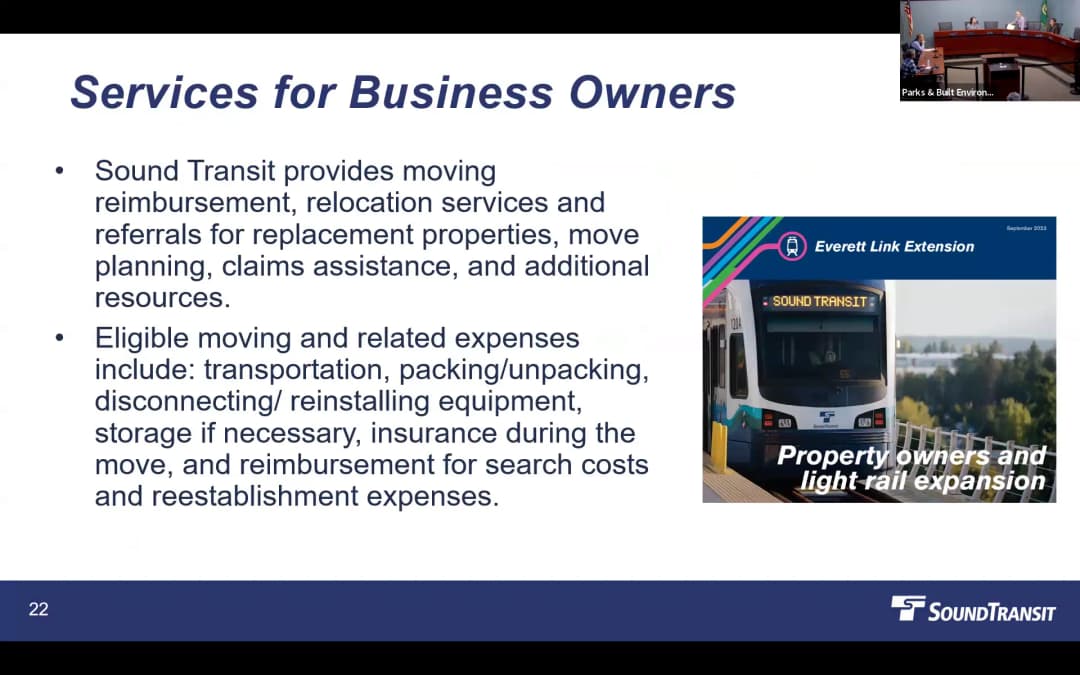
The Parks and Built Environment Council Committee (listed on the published agenda as the "Parks and Quality of Life Council Committee") convened on October 15, 2026. The published agenda listed the meeting at 9:00 AM, while the meeting transcript records a 5:00 PM start time and identifies the date as October 14, 2026, conflicting with the officially provided meeting date of October 15, 2026. Vice President Ryan chaired the meeting (Councilmember Rhyne is listed as chair on the published agenda). Councilmember Zarlingo participated in the discussion. The sole agenda item was a briefing on the Sound Transit Everett Link Extension Draft Environmental Impact Statement (DEIS) given by Galib Khatra, Sound Transit's Corridor Environmental Manager. Consent Calendar No consent calendar was considered. Public Comments & Testimony No public testimony was taken during this committee meeting. Mr. Khatra detailed the ongoing public comment period for the DEIS, which runs until November 2, 2026. Upcoming public meetings were announced, including sessions at the Carl Gibson Center and the Lynnwood Neighborhood Center. Comments are accepted in any language via online form, voicemail, mail, email, or in person. DEIS Overview and Schedule Mr. Khatra explained the 16-mile corridor includes seven new stations (six fully funded, one provisional) and requires an Operations and Maintenance Facility (OMF). The line is planned for a phased opening: to Southwest Everett Industrial Center by 2037 and to downtown Everett by 2041. Following the close of the DEIS public comment period, the Sound Transit Board is scheduled to confirm or modify a preferred alternative early in 2027. Discussion of Segment Alternatives - 526/Evergreen Segment: This segment has no adopted preferred alternative. Option A has fewer business displacements but constrained access for buses and paratransit. Options B and E have fewer residential displacements. A key discussion point was direct vs. indirect displacement. Sound Transit would purchase property and fund relocation for directly displaced entities. For indirect displacement driven by market forces, Sound Transit cannot provide relocation assistance. This analysis resides in the DEIS appendix, not the main document. - Broadway/I-5 Segment: Alternative 1 (along I-5) is the board's preferred alternative due to lower cost and fewer ecosystem impacts. Alternative 2 (along Broadway) has fewer residential displacements. Councilmember Zarlingo asked for clarification, and Mr. Khatra confirmed that the residential displacement figures cited in the presentation represent full building displacements, not partial acquisitions or temporary easements. - Southwest Everett Industrial Center: Options A (preferred), B, and C were discussed. Mr. Khatra clarified that no station could be located directly on airport property due to FAA airspace regulations (Part 77) and constraints on future development at Paine Field. Shuttle space for airport and Boeing employees will be provided at the chosen station. A potential pedestrian bridge by Boeing would be accommodated but not funded by Sound Transit. - Everett Station and Arena Coordination: Of the three station alternatives (A, C, D), C and D are the current preferred alternatives. Mr. Khatra confirmed active coordination with the city regarding the proposed outdoor event center arena. The Sound Transit Board retains the ability to change the preferred alternative in January 2027 if the arena plans necessitate it, as all alternatives have been equally analyzed in the DEIS. Operations and Maintenance Facility (OMF) Mr. Khatra reviewed the three OMF site options (F, E, B), which require a footprint of roughly 65 acres. Site F has the highest residential and historic property impacts. Site E has the most wetland and ecosystem impacts. Site B impacts streams, wetlands, and specialty manufacturing. The board is expected to select a site in January 2027. Property Owner Outreach Letters were sent to all potentially impacted property owners in July 2026, and informational postcards were sent to tenants. Over 20 property owner webinars were conducted. Property acquisition will be handled on a staggered schedule by Sound Transit real estate experts once a specific project alignment is selected. Key Outcomes - The committee received the DEIS briefing and discussed alignment alternatives, displacement impacts, and the interaction with the proposed downtown arena. - No formal votes, motions, or resolutions were passed. - Vice President Ryan canceled the November committee meeting due to the Veterans Day holiday and budget activities. - The next meeting is scheduled for December 2026 and will include the Evergreen Way and Vision Zero Planning Update. - Sound Transit will continue to accept public comments on the DEIS through November 2, 2026, and expects a Board decision on a preferred alternative in January 2027.
The Everett City Council met in regular session. The posted agenda and transcript identify the meeting date as October 14, 2026, while the supplied timestamp records the meeting as 2026-10-15 17:00 UTC. Mayor Franklin participated remotely; President Schwab presided. The council approved minutes, six consent items, two ordinances on final reading, and received a briefing on the Sound Transit Everett Link Extension Draft Environmental Impact Statement (DEIS). Consent Calendar - Approved the October 7, 2026 council minutes; Councilmember Weir abstained. - Authorized claims against the City of Everett totaling $2,974,900.15 for September 26 through October 2, 2026. - Declared a 2008 Ford F-550 CUES Sewer Camera Truck (J0084) surplus and authorized public auction. - Declared a 2018 Ford F-150 Police Responder (P0443) surplus and authorized public auction. - Authorized the Mayor to sign the interagency agreement with the Washington Traffic Safety Commission for the Region 10 Target Zero Task Force traffic safety grant. - Authorized release of RFP 2026-077, the 2026 General RFP for Parks Partnerships. - Authorized release of RFP 2026-078 for the Parks, Recreation and Open Space (PROS) Plan. - The six consent items passed unanimously on a single roll call vote. Public Comments & Testimony - A written comment from John Martin regarding the outdoor event center was entered into the record. - Russell Joe, an online public commenter, supported CB 2608-48, describing it as lot splitting that lowers barriers to housing and promotes homeownership. He encouraged the city to publish simple FAQ or step-by-step guidance for residents. - John Peoples of Everett opposed the land acknowledgment, calling it an unfair charge against residents, and again asked the city to remove Flock surveillance cameras, saying they suppress civil liberties. - William Parents of Silver Lake questioned the proposed surplus and auction of the 2008 Ford F-550 sewer camera truck, noting its 36,000 miles and suggesting it be retained for parks work with a dump bed. - Tom Harrison, a board member of Lift Every Voice Legacy from the Lowell neighborhood, supported the Everett Transit/Community Transit merger and urged using resulting funds to restore services, including a proposed 21st-century community center with a public pool. He cited survey data indicating roughly 75% of youth report high physical inactivity, 30-45% feel disconnected, 65-80% experience mental health impacts from social media, and that drowning is the second leading cause of unintentional death for children ages 5-9. - Rosa Riggs of Lake Stevens, an Everett paratransit scheduler, expressed concern that the proposed interlocal agreement promises 'at least equal' paratransit service without defining it. She asked who would monitor service quality and what remedies the city would have if Community Transit's ADA-minimum service fell short of Everett's current service. - Jan, an Everett Transit driver, opposed the merger, saying 'Please don't sell my job to CT.' Jan cited Community Transit's roughly $200 million reserve and a one-time payment structure, criticized CT leadership and culture, and said the merger would likely harm Everett riders and workers. - Sarge/Sarjitandi of Everett described a professional license issue with the city that has dragged on for more than two years and asked for help; Councilmember Ryan responded that staff had connected with them. - Mason Rutledge of Everett thanked the city for reopening the Grand Avenue Park Bridge elevator and asked the council to align elevator hours with park hours to prevent vandalism. He reported that 70-pound Lime scooters were being thrown from the bridge stairs, breaking a step, and that parks staff repaired it within two working days. Mayor's Comments - Mayor Franklin honored George Perez, who concluded 28 years of service on the Everett Housing Authority board. The mayor noted EHA provides 2,000 housing units and serves nearly 8,000 people through its housing voucher program, and proclaimed October 12 as George Perez Jr. Day. He also encouraged residents to attend the October 15 Sound Transit open house at Carl Gibson Center. Council Comments and Announcements - Councilmember Ryan thanked public speakers, asked that the upcoming Community Transit presentation emphasize paratransit commitments, and summarized an earlier Sound Transit committee briefing, including a possible shift of a station location near 526/Evergreen from the east to the west side of Evergreen and the distinction between direct and indirect displacement. He reminded residents of the October 15 open house, the Great ShakeOut drill, farmers market dates, and other community events. - Councilmember Weir congratulated the Downtown Everett Association on its Washington Main Street Excellence award and noted Everett will host the 2027 Washington Places Conference. He also mentioned cultural commission updates, bridge design workshops, and neighborhood meetings. - Councilmember Zarlingo reported on regional transportation policy discussions, including declining gas tax revenue, rising EV registrations, and possible highway user fees. He attended a housing solutions breakfast and discussed Growth Management Act tensions between state mandates and local control. He voiced strong support for lot splitting as a way to increase fee-simple homeownership in a majority-rental city. - Other councilmembers briefly announced local business openings, community events, and pool-related opportunities. Action Items - CB 2609-51 (B&O tax ordinance): The council approved on third and final reading amendments to City Business and Occupation tax rates, the income threshold for B&O tax applicability, and business license registration fees, amending EMC Chapters 3.24 and 3.19. Councilmember Weir said the rates had been stagnant for 20 years and praised the small-business threshold relief and reinvestment. - CB 2608-48 (land division procedures): Staff presented a final-reading ordinance updating land division procedures and development standards, implementing state lot-splitting legislation, reorganizing four chapters into one, allowing deferred installation of improvements such as access, landscaping, utility stubs, and recreation facilities until building permits are issued, and removing the requirement to resolve gaps and encroachments before sale. Staff proposed reducing standard minimum lot dimensions in neighborhood residential and UR4 zones from 5,000 to 2,000 square feet, lot width from 50 to 25 feet, and lot depth from 80 to 60 feet. Amendment Sheet 1 corrected a code reference; Amendment Sheet 2 changed the minimum lot depth to 55 feet to align with common 120-foot-deep lots. Both amendments and the amended ordinance were approved unanimously. During discussion, staff and council noted the ordinance does not override HOA covenants, and existing lot-coverage bonuses for multiple dwelling units are unchanged. - The council did not take a vote on a Sound Transit comment letter; the item was a briefing. Sound Transit Everett Link Extension Briefing - Sound Transit staff explained that the DEIS provides a data-driven comparison of alternatives, identifies environmental impacts, and outlines mitigation measures. All alternatives remain on the table even though the board previously identified preferred alternatives. - Key dates: the public comment period ends November 2; an in-person open house will be held October 15 at Carl Gibson Center from 5:30 to 8:30 p.m.; the Sound Transit System Expansion Committee will consider the matter in December and January; the full board is expected to select a preferred alternative in February; a final EIS is expected in late 2027; construction is expected in the 2030s, with initial stations opening in 2037 and the Evergreen/Casino and downtown Everett stations in 2041. - City staff said they are developing comments emphasizing on-time and on-budget delivery, minimizing land converted to transportation uses, efficient station footprints, and productive use of land under the elevated guideway. Key Outcomes - Minutes and all six consent items were approved, with Councilmember Weir abstaining only on the minutes. - CB 2609-51 was adopted on final reading. - CB 2608-48 was adopted on final reading as amended by both amendment sheets. - No formal action was taken on the Sound Transit DEIS comment letter; the council received the briefing and public comment opportunities were identified. - Administration corrected that the separate transit public hearing is scheduled for October 28 at 12:30 p.m., with a briefing on October 21.
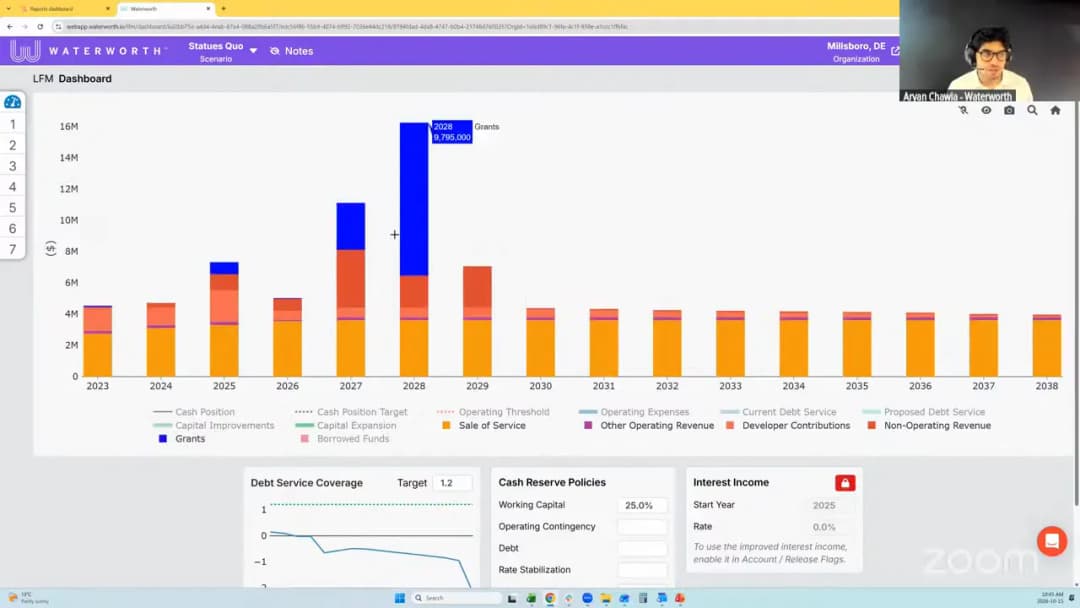
The committee met at 16:55:44 UTC on Thursday, October 15, 2026. It adopted its agenda, approved prior minutes, heard an asset management status update, and received a water and sewer rate presentation from Waterworth. No public comments were made. Consent Calendar - The agenda was adopted by voice vote; no opposition was stated. - The previous committee meeting minutes were approved by motion and second. - Roll call confirmed that Mr. Mason, Mr. Burke, Mr. McKee, Ms. Sounder, and Mr. Plack were present. Public Comments & Testimony - No public comments were offered; none appeared online. Discussion Items Asset Management Update - The committee chair reported on a recent session with public works directors and Town Manager Jamie Burke. All collected asset data has been entered into the system, and the data structure was described as the right approach based on the chair's 30 years of experience. - Staff recommended obtaining outside consulting help to build out preventive maintenance procedures, estimated labor hours, and asset tags; this consulting cost is not yet in next year's budget. - Rich provided iWORKS data as of October 14, 2026: 2,861 work orders had been recorded, with 8 open, 10 in progress, and 2,803 closed. The transcript gives those component numbers as summing to 2,821, not 2,861, so there is an apparent discrepancy. Staff reported a 115% increase in work orders created since the previous asset management meeting. - The transcript states staff are capturing plus percent of man-hours in work orders; the exact figure is not specified. - Asset expansion is focused on the town's water treatment plant, with 29 assets and 56 preventive maintenance schedule activities entered so far. The next focus is the Church Street water treatment plant and other wastewater facilities. - Proposed outside assistance would include standard operating procedures, estimated labor hours, maintenance tasks, and unique asset identifiers such as barcodes or QR codes. Water Fund Financial Model and Rate Scenarios - Waterworth presented a projection of water operating expenses rising about 3% annually after the 2027 budget increase, plus capital projects including about $3 million for Old Landing Road and about $2 million for Morris Street water main replacement. - The status quo baseline assumes no rate changes; the water fund would fall below its operating threshold and below zero by about 2031-2032. The operating threshold is about three months of operating expenses. - The proposed water revenue scenario is a 10% revenue increase in 2028 and 2029, dropping to 7% thereafter. - Rate structure changes would set the in-town base charge by meter size instead of a flat charge, lower the consumption threshold from 7,500 to 7,000 gallons, and adjust tier rates. Example in-town impact: a 5,000-gallon bill would rise about $2.25, or 4.3%; larger users would see larger increases. - Outside-town water bills would increase by higher dollar amounts; examples cited were $4.50 for 5,000 gallons, $11.70 for 7,500 gallons, and $13.20 for 10,000 gallons. Wastewater Financial Model and Rate Scenarios - The wastewater baseline includes the White Farm Southwest project, estimated around $10 million per year in 2027 and 2028, with proposed debt funding of $14 million in 2027, $9 million in 2028, $3.5 million in 2029, and about $9 million in grant funding in 2028. - With no rate changes, the wastewater fund would reach zero by about 2030 and fall below the operating threshold. - The proposed wastewater scenario assumes a one-time 70% revenue increase in 2028, followed by 7% increases. - The in-town sewer minimum charge would rise from about $104 to $173, the above-threshold per-100-gallon rate from about $1.39 to $2.32, and the threshold would drop from 7,500 to 7,000 gallons. Outside-town sewer rates would also rise 70%, with higher dollar amounts. Debt and Rate Policy Questions - Committee members questioned whether refinancing existing low-interest debt could reduce costs. Staff noted that the town refinanced USDA and SRF loans in 2021 and saved an estimated $1-2 million over the life of the debt, but current higher interest rates make another refinance unattractive. - USDA loans are generally 40-year terms and SRF loans 30-year terms; the town has no fixed policy on loan length. Members asked staff to provide a full loan schedule with balances, interest rates, and years remaining, and to avoid presenting only annual debt service. - Waterworth was asked to compare the proposed rates with similar communities among its nearly 500 municipal clients. - Members discussed charging water-only irrigation meters at a different rate, possibly as a luxury-type rate, and billing them quarterly instead of annually to avoid bill shock. - Members discussed whether commercial sewer customers should pay higher rates than residential customers because of stronger wastewater; a commercial classification list would be feasible to develop. The town has preliminary industrial pre-treatment authority, but staff said a full program is not ready due to staffing. - A committee member raised concerns about fixed-income seniors; staff noted there are local assistance referrals and no income-based utility rate is currently contemplated. Budget Process Timing - Staff explained that department heads generally submit their spending needs before revenue is finalized, and that revenue and rate proposals are built from those submitted needs. - The committee agreed on the goal of establishing a budget timeline and completing most of the budget work in committee before taking it to the full council, in order to avoid a last-minute budget crunch. Key Outcomes - No rate increase was adopted. No formal vote was taken on rate changes. - The committee directed Waterworth and staff to refine the water and sewer scenarios, provide irrigation meter data separated by water-only and combined bills, and return with comparable rate data. - Staff will prepare a full loan schedule showing balances, rates, and remaining terms. - The committee plans to bring the presentation to the full council in November for public education and discussion. - A resident notification, such as a mailer, was discussed before any rate increase; council will decide the effective date, with January 2027 discussed as the earliest practical timing. - The committee agreed to meet again in November, likely the second Thursday (November 12), to review updated rate information and begin work on a budget timeline.