The Active Transportation Advisory Committee (ATAC) held its regular meeting on October 29, 2026, at 5:30 PM (per agenda, though transcript indicates start time), in City Hall Conference Room 2165, with remote participation via Zoom. The meeting covered a presentation from the Central Valley Health Equity, Access & Longevity (HEAL) Coalition, appointment of an ATAC representative to the coalition, approval of letters of support for a Highway Safety Improvement Program (HSIP) grant, adoption of the 2027 meeting schedule, establishment of two task forces, updates on Palm and Belmont, and reports from existing task forces. Committee members also gave district reports and discussed citywide active transportation issues, including safety, equity, and infrastructure gaps. Consent Calendar - Unanimously approved the agenda and the minutes from the September 23, 2026 meeting (Item 2 & 3.A). Public Comments & Testimony - Tony Molina (Fresno County Bicycle Coalition) commented on the HEAL Coalition presentation, asking about funding sources and the coalition's founding date. He also noted that he had attended the coalition's first meeting. Later, during Member Reports, he suggested tying the Protected Bicycle Parking Task Force to Bike Month. Discussion Items - Presentation by Central Valley HEAL Coalition (Item 5.A): Mohammed from the United Services and Equity Foundation (UCEF) presented the HEAL Coalition, focusing on chronic disease prevention and access to care for immigrant and refugee families in Fresno County. He highlighted that transportation barriers (lack of cars, unsafe walking/biking routes) prevent families from reaching clinics, jobs, and schools. ATAC members expressed interest, noting the coalition's work aligns with equity goals and invited the coalition to participate in ATAC meetings. Committee members asked about geographic distribution of need (zip codes south of Shaw, near Tower District) and the coalition's monthly meeting commitment. - Appointment of ATAC Representative to HEAL Coalition (Item 5.B): After discussion, the committee voted to appoint an ATAC representative (or representatives) to the HEAL Coalition. Multiple members volunteered, including representatives from Districts 3 and 1. The motion passed without objection. - Approval of Letters of Support for HSIP Grant (Item 5.C): Cheryl Burns, grants development manager, presented a request for letters of support for the City's applications to the California Department of Transportation's Highway Safety Improvement Program (HSIP) Cycle 13. Projects include retro-reflective backplates, high-visibility crosswalks, RRFBs, and other safety improvements. Total project cost for one signal retrofit is $3,543,700. Committee members questioned whether projects were primarily roadway or pedestrian safety oriented. The committee approved the letters of support with one abstention (Jacob Bailey), citing lack of time for review and revision before the November 2 deadline. - Adoption of 2027 Meeting Schedule (Item 5.D): The committee approved the calendar year 2027 meeting schedule without discussion. - Establishment of Biannual Report 2026 Task Force (Item 5.E): A hearing was held to adopt a resolution establishing this task force. Jacob Bailey was nominated again to lead the report, building on the previous format but incorporating key concerns (e.g., Vision Zero, pedestrian/bicyclist fatalities). The committee approved establishing the task force, with final report expected in January 2027. - Establishment of Bike Month 2027 Task Force (Item 5.F): The committee established a task force for Bike Month 2027. Members discussed incorporating the event into larger community activities (e.g., Porch Fest) to increase visibility. Volunteers included several committee members. Motion passed. - Updates on Palm and Belmont Memo (Item 5.G): Staff (Song) reported that more time is needed to study feasibility and costs for proposed low-cost safety improvements at the Palm and Belmont corridor. No new timeline was provided. - Protected Bicycle Parking Task Force (Item 6.A): The task force discussed identifying high-visibility, secure bike parking locations (e.g., near shopping centers, libraries). Members agreed to combine efforts with Bike Month events (e.g., Porch Fest) to promote practical demos. No budget identified yet. - World Day of Remembrance 2026 Task Force (Item 6.B): The task force reported that the event is set for November [date unclear] at Woodward Park, with speakers including a family member of a bicyclist killed in a collision and first responders. A City Council proclamation is scheduled for November 12. Committee members encouraged attendance. - Safe Routes to School Task Force (Item 6.C): The task force reported on initial brainstorming: flagship events (Bike to School Day in fall and spring), safety education curriculum, a driver's license-style bicycle education concept, and compiling best practices for bicycle buses. Members suggested linking with Bike Month and Porch Fest. - Member Reports and Comments: Members from each district reported on local active transportation projects and concerns. Highlights include: District 1 (April Henry) – bike rack designs for schools, bike safety camps, and step grant outreach; District 2 (Laura Gromis) – attendance at Clean Mobility Forum in Sacramento, shared mobility hubs, and equity issues for seniors and youth; District 3 (Aric Mine) – disparities in tree maintenance on commercial properties, sidewalk and bike lane parking enforcement, and frustration with short notice for grant approvals; District 4 (Mohammad Shaikh) – meeting with council member on Vision Zero and Fresno State transportation committee; District 5 (Paul Marquez, absent) – no report; District 6 (Diana Durham) – paving projects and design of parking lot near Fryant intersection. Jacob Bailey (Chair) reported on Bike to School Day and upcoming trauma center data updates. - Staff Reports (Item 8): - Capital Projects (Item 8.A): No new updates; staff asked for any additional project requests. - October's Traffic Collision Report (Item 8.B): Data from January to September 2026 compared to same period 2025: pedestrian collisions decreased from 186 to 164; bicyclist collisions increased from 126 to 146. Pedestrian fatalities decreased from 20 to 11; bicyclist fatalities stayed the same (number not specified), with one e-bike fatality added. Data covers January 1 to September 30. Key Outcomes - Appointed ATAC representative(s) to the HEAL Coalition (approved). - Approved letters of support for HSIP grant applications (passed with one abstention). - Adopted 2027 meeting schedule (approved). - Established Biannual Report 2026 Task Force (approved, Jacob Bailey as lead). - Established Bike Month 2027 Task Force (approved, with multiple volunteers). - Task forces for Protected Bicycle Parking, World Day of Remembrance, and Safe Routes to School continued work with specific action items. - Staff directed to provide more information on Bullock Avenue sidewalks/suite guides and Polk/Gettysburg reconstruction for walking community. - Next regular meeting: December 9, 2026.
The Public Meeting Index
The Public Meeting IndexThis summary is based on the meeting transcript; agenda and minutes were not available. The Queen Creek Planning Commission met in an afternoon work session on October 29, 2026, to review community outreach findings and draft goals and policies for the town’s General Plan update. Principal Planner Les Johnson and Robbie Aaron of Michael Baker International led the discussion. No formal votes were taken. Discussion Items - General Plan Update Outreach Summary: Les Johnson reported that the town is well into the General Plan update outreach/engagement stage. Outreach so far has included two community workshops, citizen focus group meetings, presentations to boards and commissions, social media, a project website with virtual activities, and attendance at public events. Johnson summarized community feedback: residents are proud of Queen Creek’s people, public events, parks and open spaces, trail system, schools, agritainment areas, and small-town feel. Desired future priorities include protecting rural/agricultural areas, improving road safety and congestion, completing the trail loop system, supporting small/local businesses, expanding public facilities such as the post office and library, promoting office development, and creating more gathering places. - Commissioner Feedback on What Feels Accurate: Commissioner Baldwin identified road work and traffic as the issue that resonates most, noting construction affects Queen Creek residents even when it occurs outside town limits. Another commissioner praised Queen Creek schools based on her children’s experiences. Several commissioners highlighted the small-town feel and the trail system, with suggestions for better trail signage, bike lane connections, e-bike parking, and bike racks near downtown. One commissioner mentioned the farmers market as a popular small-business and community amenity. Commissioner Borders, drawing on school district experience, suggested weekly social media quick facts and virtual town halls to broaden public engagement. Commissioner Hale raised concerns about water prices essentially doubling and the resulting impact on park maintenance budgets; staff responded that future park design may use less turf in passive areas while preserving active-use fields. - Commissioner Feedback on What Is Missing: Commissioners said communication about town projects and the General Plan website could be more accessible because many residents rely on social media. A commissioner noted the town already posts information but it is not always easy for residents to find. Another commissioner said the town should counter lingering misconceptions about Queen Creek water shortages; Les Johnson responded that water is sufficient for planned growth and that the town is working to communicate that message. Staff also mentioned an undeveloped 40-50 acre passive park site north of the Olive Mill and a 30-acre park site across the street. - Commissioner Priorities: Commissioner Baldwin said transportation and traffic are the most important issues to address so development is not limited by congestion concerns. Another commissioner observed that the draft plan includes a diverse housing portfolio, but community opposition sometimes makes it hard to realize housing options for different income levels and life stages. Commissioners expressed support for maintaining the small-town feel through events, parks, and connected community experiences while accommodating growth. - Draft Goals and Policies Review: Robbie Aaron walked through the draft goals and policies, organized under four themes aligned with the Town Council’s strategic plan: Quality Lifestyle, Superior Infrastructure, Secure Future, and Safe Community/Effective Government. All state-required General Plan elements are folded under these themes. He reviewed goals covering community identity, balanced residential and non-residential land uses, employment diversity, regional coordination, housing diversity, growth areas, agritainment, trails and outdoor recreation, economic development, redevelopment, and neighborhood preservation. Aaron noted that housing is a new state-required element and that the plan addresses housing for all income levels and life stages. On infrastructure, he described alignment with the recently adopted transportation master plan, limited mention of transit because the community is not currently seeking it, expansion of parks and recreation, water conservation and reclaimed water, energy resiliency, and infrastructure financing. He also outlined public safety coordination with police and fire departments and hazard mitigation. An implementation action matrix with short-, mid-, and long-term actions and an annual reporting process will accompany the plan. - Next Steps: Johnson announced the next community workshop is scheduled for December 14. The draft General Plan is expected to be completed in December, followed by a 60-day review period. Public hearings before the Planning Commission and Town Council are expected in spring. Commissioners can continue submitting comments to staff, and virtual engagement remains open on the project website. Key Outcomes - No formal motions, resolutions, or votes were taken; the session was for discussion and feedback. - Commissioner comments on roads/trails, parks, housing, water messaging, and communication will be considered in the draft General Plan. - The next community workshop is scheduled for December 14, 2026. - The draft General Plan is expected in December 2026, with a 60-day review period and spring public hearings to follow.
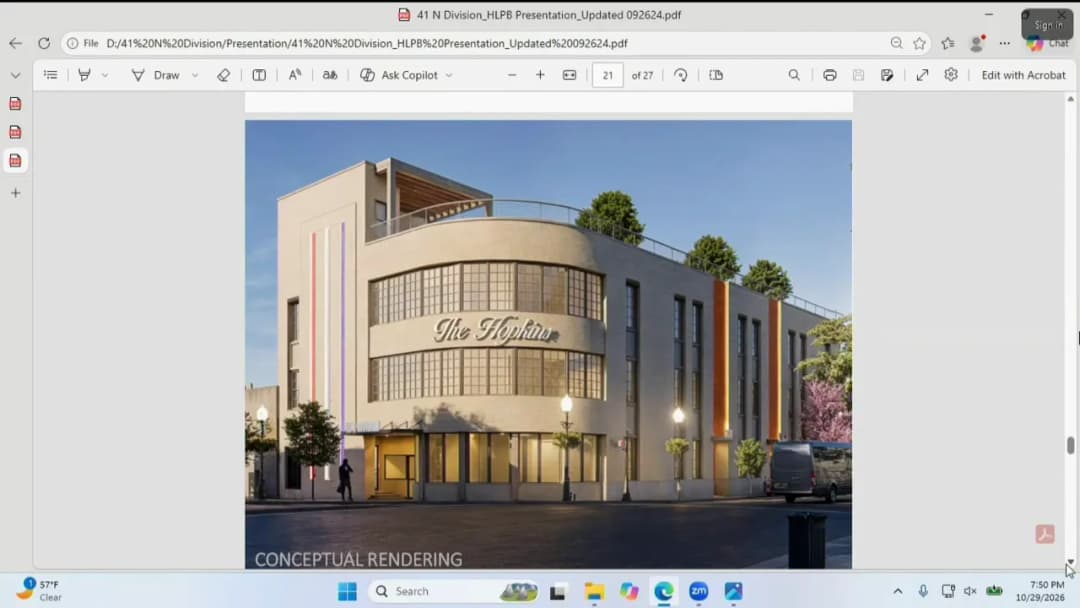
The Historic & Landmarks Preservation Board met Thursday, October 29, 2026, at 7:30 p.m. in the Common Council Chamber. The board approved the September 24, 2026 meeting minutes, adjusted the agenda to hear 38 North Division Street first, reviewed two Certificate of Appropriateness applications, and held over remaining business until December 3. Discussion Items - September 24 meeting minutes: A motion to approve the minutes passed by voice vote; one board member abstained because they were not present at that meeting. - 38 North Division Street – Applicant Patrick Neville / Owner 38 ND LLC: The board considered a request to replace deteriorated aluminum replacement windows on the 1893 building with black, four-over-one energy-efficient windows intended to match nearby historic and recent projects. Mr. Neville explained the work is part of a larger state-approved DRI grant project and that the window replacement is the necessary first step before stucco, roofing, and rear-yard improvements. Board members found the existing conditions “alarming” and supported the window replacement. The board noted that the stucco repair/grinding work on the second and third floors is not covered by this approval; the applicant must submit an amended or new application with an updated narrative and color sample for staff-level approval. - 41 North Division Street – Applicant Joseph Thompson / Owner North Division-Main LLC: The architect returned to renew a lapsed COA and adopt a reduced scope required by SHPO/NPS as part of a Part II Historic Tax Credit review. The project is a mixed-use adaptive reuse: ground-floor commercial, upper-floor residential, and rooftop amenities. The Peekskill library was recently approved to relocate into the ground floor, eliminating the need for two new Main Street entrances. The building has been vacant for close to 15 years, and the ground floor alone is over 7,000 square feet. Bids for the project came in 30 to 50 percent above initial budget, making the tax credits a critical part of the capital stack. Mr. Thompson explained that SHPO/NPS prohibited third-floor window enlargement, parapet reductions, and removal of original brick for vertical banding, while preserving masonry restoration, second-floor egress window enlargements, and front-entry restoration/recladding. The board discussed the benefit of a committed ground-floor tenant and the project’s aggressive energy retrofit, including all-electric conversion, roof insulation, rooftop photovoltaics, high-efficiency HVAC, and proposed triple-pane composite windows with the same exterior appearance as the previously approved aluminum-clad wood windows. Key Outcomes - Approved the September 24, 2026 minutes, with one abstention. - Approved the COA for 38 North Division Street windows as presented by voice vote, with no opposition noted. Stucco repair was not included and will require a separate or amended application and staff review of color. - Approved a revised COA for 41 North Division Street incorporating the SHPO/NPS tax-credit changes and the triple-pane window substitution, by voice vote with no opposition noted. - Agenda item 2 (13 South Division Street – Fern Tree) was not heard; the board held over and adjourned to the next meeting on December 3.
The Syracuse Landmark Preservation Board met on October 29, 2026 (provided transcript timestamp: 12:33:05 UTC). No agenda or minutes were available, and no start/end times are recorded. The board held applications open, approved two certificates of appropriateness, and discussed a proposed bridge demolition and replacement. Public Comments & Testimony - For CA-26-25 (923-27 Comstock Avenue), the board received a letter from a group of neighbors raising concerns about the proposed project's impacts; the letter was placed in the record. - No public speakers came forward in favor of or against CA-26-27 (101 Hampshire Road) or CA-26-28 (113 Berkeley Drive). - Public comments on the 500 Plum Street bridge proposal, noted by the board, said the proposed design was inappropriate for the location and neighborhood. Discussion Items Unspecified first item: The transcript opens with the board agreeing to hold an application open until the next board meeting without taking a vote; the application number is not identified. CA-26-25 — 923-27 Comstock Avenue (mosque addition): The applicants asked to hold the application open pending design revisions and additional public interaction. The board agreed and moved the matter to the next meeting. CA-26-27 — 101 Hampshire Road (balcony railing and foundation work): Owner William Apolito, 101 Hampshire Road, presented plans in the Sedgwick-Highland-James Preservation District. The vestibule floor has a five-degree slope (almost nine percent) and has been sinking since 1927 because the original footing was not deep enough. The plan is to jack the floor, install a 48-inch footing, and reset the original brick so the exterior looks the same while preserving mosaic tile. He also proposed replacing a deteriorating plastic second-floor porch railing with a steel, powder-coated black railing matching an original 1927 railing from the house. Board members asked about the railing height and materials; the railing will be 36 inches high to meet current code and is being fabricated by Iron Hill Fabrication LLC. No public speakers appeared. The board approved the project as submitted. CA-26-28 — 113 Berkeley Drive (front step repair and partial replacement): The applicant described work in the Berkeley Park Preservation District. After demolition, the steps' substructure was found to be compromised, so the work became a structural repair: all treads and the landing were replaced with bluestone, the substructure was rebuilt, one cheek wall was rebuilt, and the original stone on the cheek walls was retained. Striated brick was used to match the existing historic brick. No public speakers appeared. The board approved the project as submitted with the condition that the applicant send the selected railing design to staff. Minor Site Plan Review: 500 Plum Street Bridge 2026-166 — 500 Plum Street (former New Process Gear factory number two): Applicant representative Dave Chavez of Plan Air Companies presented a proposal to demolish and replace the condemned bridge. The building is now fully occupied by office uses; the bridge was originally built to carry equipment and vehicles. Replacing the bridge as-is would cost almost $2 million, and the project is privately funded. The proposed replacement is a smaller steel-railed bridge intended to blend into the neighborhood, with smaller piers and slightly higher clearance to increase floodway capacity on Onondaga Creek; the tenants on the opposite side are within a tenth of an inch of the floodplain. The applicant noted New Process left in 1961 for DeWitt, and that the bridge is eligible for but not listed on the National Register. The applicant also said the state historic preservation office was clear that tax credits go to buildings, not appendages. Board members strongly opposed the design. One absent board member's written comment said the design does not respond to the massing, character, or industrial architectural language of the existing bridge or its sister structures. Board members called the bridge an iconic Franklin Square/New Process Gear structure, characterized the proposed design as "slim, sleek, and minuscule," and said it was totally inappropriate. One board member, Doug Sutherland, agreed the proposed design was an "abomination." The board suggested a smaller trellis design more consistent with adjacent bridges and recommended community outreach with residents. It cited Secretary of the Interior Standard Six: deteriorated historic features should be repaired rather than replaced, and replacements should match the old in design, color, texture, and where possible materials. Board members also noted the adjacent bridge to the southwest was extensively restored several years ago. The applicant said a demolition permit was already in hand and demolition could occur quickly. Board members questioned how that permit was issued and asked staff to follow up with the zoning department. They also requested extensive documentation of the bridge before any demolition. The board's comments were to be sent back to zoning; no site plan approval was granted. Administrative Items and Board Training The board discussed next year's meeting calendar beginning January 24, upcoming training, and a walking tour of Syracuse's architectural history. Members expressed interest in mid-century and later architecture and planned a Thursday morning walking tour within the next two weeks. Key Outcomes - The unspecified application at the start of the transcript was held open to the next board meeting. - CA-26-25 was held open to the next board meeting pending revisions and public interaction. - CA-26-27 was approved as submitted; motion carried with no recorded opposition. - CA-26-28 was approved as submitted, with the condition that the railing design be submitted to staff; motion carried with no recorded opposition. - The 500 Plum Street bridge replacement received no approval; comments were referred to zoning, the demolition permit process was to be investigated, and documentation was requested before demolition. - The meeting adjourned by voice vote.
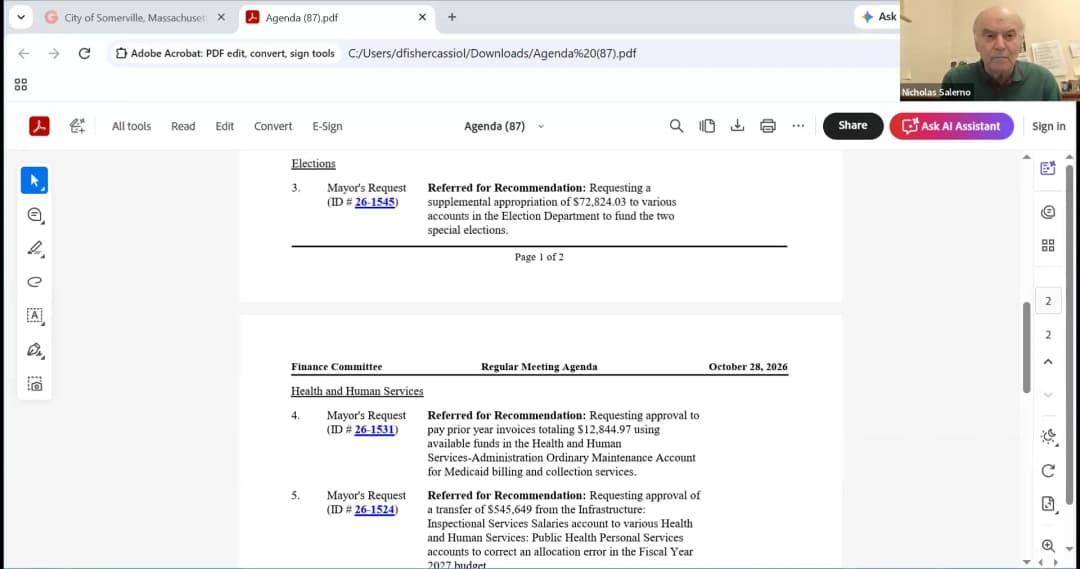
Note on date: The transcript of the meeting indicates Wednesday, October 28, 2026, but the user-provided metadata specifies the meeting took place on October 29, 2026. This summary uses the latter date as instructed. The Finance Committee of the Somerville City Council met remotely on October 29, 2026, at 6:00 p.m. with Chair Ben Wheeler presiding. All five committee members (Councilors Link, Strezzo, Hart, Scott, and Wheeler) were present, establishing a quorum. The committee considered seven agenda items, including appropriations, transfers, contract approvals, and a communication. After discussion, all actionable items were unanimously recommended for approval to the full City Council, and the meeting adjourned at 7:22 p.m. Consent Calendar - Item 1 (26-1578): Approval of minutes from the October 20, 2026 Finance Committee meeting. Laid on the table. - Item 2 (26-1514): Request to appropriate $100,000 from the Encore Artist and Cultural Support Stabilization Fund for local cultural council grants. Laid on the table. - Item 3 (26-1545): Supplemental appropriation of $72,824.03 for special elections in Wards 2 and 3 (preliminary February 2, 2027; final March 24, 2027). Laid on the table. - Item 4 (26-1531): Approval to pay prior-year invoices totaling $12,844.97 for Medicaid billing and collection services from Public Consulting Group. Laid on the table after extended discussion. - Item 5 (26-1524): Transfer of $545,649 from Infrastructure Inspectional Services Salaries to Health and Human Services Public Health Personal Services to correct an allocation error in the FY2027 budget. Laid on the table. - Item 6 (26-1539): Approval of a 60-month, $34 million contract with Boston Carting Services LLC for hauling municipal solid waste, recycling, and yard waste. Laid on the table. Public Comments & Testimony - No public comments were made during the meeting. Discussion Items - Item 2 (Arts & Culture Grant): Acting Arts and Culture Director Rachel Strutt (later referred to as Cultural Director) described the local cultural council (LCC) grant program, which redistributes Massachusetts Cultural Council funds and has been augmented by $100,000 annually from the Encore community benefits agreement since 2022. She noted that 179 applications requested a total of $659,000, making the process highly competitive. Councilor Link expressed strong support but requested more supporting documents in the future. Councilor Hart asked about the Encore fund, and Director Strutt explained it stems from a community benefits agreement providing $600,000 total, with $100,000 earmarked for LCC grants since 2022. Councilor Scott praised the program as a bright spot in city government for efficient spending. Councilor Strezzo emphasized prioritizing Somerville artists and residents, and Director Strutt confirmed that fellowship grants require Somerville residency, while project grants must serve the Somerville community and take place in Somerville. Chair Wheeler noted the ongoing strike by Unite Here Local 26 and Teamsters Local 25 at Encore and expressed hope for a resolution. - Item 3 (Special Elections): Commissioner of Elections Nicolas Salerno explained that the supplemental appropriation covers costs for poll workers, advertising, machine programming, and maintenance for the two special elections. Director of Intergovernmental Affairs Amanda Nadine Williams confirmed the funding comes from the tax levy using higher-than-projected revenue, avoiding free cash. No objections were raised. - Item 4 (Medicaid Billing Prior-Year Invoices): Health and Human Services Finance Manager Anuk Malik stated the invoice is the final FY2026 payment to Public Consulting Group for Medicaid billing and collection services, which arrived late due to reconciliation issues. He explained the contract runs through September 2027 and that the city receives reimbursements for services like nursing, occupational therapy, and speech therapy. Councilor Strezzo requested holding the item in committee to get answers about whether the work could be done in-house and about data privacy (HIPAA). Budget Director Mike Mastrobone clarified that Medicaid billing is a highly specialized field and not caused by staffing shortages; the city has used consultants for a long time. Chair Wheeler, supported by Councilor Scott, argued the invoice is for services already rendered and should be approved, with a commitment to provide written responses to questions before the next meeting. Councilor Strezzo ultimately agreed, and the item was laid on the table for approval. - Item 5 (Budget Correction Transfer): Budget Director Mike Mastrobone explained that after splitting Inspectional Services into Infrastructure and Health and Human Services, six positions (code enforcement inspectors, safety inspectors) were inadvertently budgeted in Infrastructure instead of Public Health. The transfer corrects this to avoid a deficit and align city records. Councilor Link asked about preventing future errors; Mastrobone noted they are implementing position control systems. The item was supported without further discussion. - Item 6 (Boston Carting Contract): Commissioner of Public Works Eric Wiseman presented a 60-month, $34 million contract with Boston Carting Services (recently acquired by Casella Waste Systems) for hauling residential solid waste, recycling, yard waste, mattresses, and white goods. Highlights include no rate increases for the first two years, 4% escalation thereafter, $2.3 million in projected savings, strengthened school zone safety provisions, and enhanced liquidated damages for missed pickups. Wiseman clarified that this is a hauling contract (collection and transport), separate from tipping (disposal) contracts. He noted Boston Carting's workforce is represented by Teamsters Local 25, with a collective bargaining agreement expiring June 30, 2028. Councilor Scott praised the presentation and noted the contract includes side guards for trucks (page 71) and wage details (pages 53-55). Councilor Link asked about potential strikes; Wiseman said Boston Carting has a strong relationship with the Teamsters and no disruptions occurred during recent labor unrest at other companies. Councilor Strezzo inquired about collection start times (7 a.m. as per contract, page 14) and school zone safety. Wiseman showed school-specific collection restrictions (page 45) to avoid conflicts with drop-off times. All councilors expressed support. - Item 7 (UASI Plan Communication): Chair Wheeler explained he filed a public records request with the City of Boston to obtain the Metro Boston Homeland Security Region's Urban Area Security Initiative (UASI) FY2024 plan and allocations, as these documents are not publicly available. The region includes Somerville, Cambridge, Boston, and other municipalities. Redacted versions were provided by the Massachusetts Office of Grants and Research, citing security concerns. The unredacted portions clarify compliance requirements for grants previously accepted by the council. Wheeler shared the documents for transparency. No questions were raised, and the item was marked work completed. Key Outcomes - Approvals: All six actionable items (Items 1–6) were laid on the table and later unanimously recommended for approval by a roll call vote: Councilors Link, Strezzo, Hart, Scott, and Wheeler all voted yes. The motion also included adjournment. - Directives: For Item 4, staff committed to providing written responses to Councilor Strezzo's questions about the Medicaid billing contract (including whether in-house alternatives exist and data privacy) before the next full council meeting on November 11 or 12, 2026. - Next Steps: The full City Council will consider the committee's recommendations at its next regular meeting. Item 7 (communication) required no further action.
The Hooksett Budget Committee met on October 29, 2026, to review the Town Council's recommended FY 2028 municipal budgets and discuss draft committee rules. Presentations covered the Town Clerk, Tax Collector, Family Services, Finance, Debt/TIF, Budget Committee, Cemetery, and Conservation Commission budgets. Wastewater review was deferred, and the committee began discussing the new default budget process. All figures are Town Council recommendations under review, not final appropriations. Consent Calendar - Minutes of the previous meeting were approved by voice vote; no opposition was heard. Public Comments & Testimony - No public comments were offered during the public input period. Town Clerk and Elections Budget - The Town Clerk was absent; the Town Administrator presented the FY 2028 recommended budget of $99,989, an increase of $3,528, or 3.66%, over FY 2027. - An $11,669 town-wide increase from the MRI non-union salary study addressed underfunded part-time positions, including one in the Town Clerk's office. The public official stipend is proposed to rise from $4,700 to $8,500 to be more comparable with other towns. - A $4,035 benefit line was identified as needing to be moved into the taxes line. Professional services decrease for elections, while equipment maintenance increases to cover possible polling machine failures. - Polling pads were discussed as a warrant article; associated paper and printing costs would not be in the current operating budget but would affect the FY 2029 budget if approved. Tax Collector Budget - The recommended FY 2028 Tax Collector budget is $382,277, up $16,890, or 4.62%, from FY 2027. The department has four employees; health insurance was bookmarked at 12%, but actual rates are lower and will reduce the final figure. - E-certified mail was described as a new one-part electronic certified mail program that saves about $1.32 per letter and reduces time spent tracking returned slips; the office is still adding it to the postage machine. - The tax rate has not yet been set; the town is waiting in the Department of Revenue Administration queue. Family Services Budget - The FY 2028 recommended Family Services budget is $134,708, an increase of $1,087, or 0.81%, over FY 2027. The department has two part-time positions plus seasonal help. - The welfare line is proposed at $50,000, an $8,000 reduction. Programs include Community Action Program $10,000, visiting nurses $2,400, home health and hospice $1,000, and bus transportation $15,180, with ridership increasing. - In response to a question about lower shelter spending, the director explained that clients are referred to other agencies for longer-term assistance and town welfare is meant to be temporary and urgent. Finance Department and Assistant Finance Director - The FY 2028 recommended Finance budget is $395,641, up $70,212, or 21.58%, from FY 2027. The main driver is a proposed part-time assistant finance director at $60,000, 30 hours per week for 50 weeks, with no benefits, requiring a bachelor's degree in accounting. - Finance Director Christine Tuxberry said the position follows two unsuccessful full-time warrant articles and would provide redundancy, reduce risk, and maintain continuity. Committee members expressed support, though one asked whether a full-time position split across departments could work; the director responded that the office has enough work for 30 hours and no current staff has the accounting capacity. - Other Finance line items include training $840, banking services $6,500, GASB compliance $1,000, audit services $24,635, equipment maintenance $270, telephone $768, printing $1,000, and office supplies $625, with no new equipment. Debt, TIF, and Budget Committee Budgets - Debt service covers two notes: the safety center/fire engine note, in year 8 of 10 and paid from tax dollars, and the TIF district note, in year 6 of 9 and paid from TIF funds. The TIF note decreased by $4,845 for FY 2028. - Proposed debt payments were listed as $102,267.50 for the safety center/fire engine note and $248,660 for the TIF note. Principal balances as of June 30 were reported as $285,000 and $870,000. - One committee member suggested paying off the TIF note early and described himself as very anti-TIF, but it was noted that prepayment is likely not permitted because the notes are through the bond bank. - The Budget Committee's own recommended budget is $6,976, a decrease of $256 because no longevity payment is budgeted; it includes $150 for advertising and $1 for postage. Cemetery and Conservation Commission Budgets - The Cemetery Commission budget is recommended at $1,402, an increase of $434, or 46.59%, over FY 2027. Labor is provided by DPW; the increase includes $1,000 in professional services to prepare for a paid sexton if the current volunteer sexton stops, plus $200 for ground maintenance. - The Conservation Commission budget was presented as $1,905 and described as unchanged from FY 2027. A typo in the summary was noted, with the detailed page referenced for accurate line items. Training funds support New Hampshire Municipal Association workshops and conservation expertise used by land-use boards. Budget Committee Rules, Procedures, and Default Budget - Leanne presented a draft rules and procedures document covering membership composition, vacancies, attendance, quorum, voting rules, Robert's Rules, budget preparation and review, public hearings, warrant article recommendations, and default budget responsibilities. The draft states that ex officio members do not count for quorum and requires members to be physically present to vote unless compliant with electronic meeting law. - Members discussed adding a 'what to expect' process manual for new members and possibly creating a subcommittee to draft it; the rules document will be revised and discussed again next week. - Finance Director Christine Tuxberry explained that the default budget starts from the Department of Revenue Administration's operating budget, includes items approved by voters or mandated by law, and does not include contracts such as tipping fees unless voters directly approved them. The committee planned to continue default budget discussions at the next meeting. Key Outcomes - No votes were taken on the FY 2028 budget figures; the meeting was a review session. - The committee voted to approve the minutes and later adjourned by voice vote. - Wastewater and the default budget are scheduled for continued discussion next week, and the Town Council is expected to act on health insurance costs, with a revised council budget anticipated afterward. - The Conservation Commission budget typo and the draft rules/procedures document will be corrected and revised for future discussion.
The North Kingstown Planning Commission met at 6:30 PM on Thursday, October 29, 2026, at Town Hall, 80 Boston Neck Road, North Kingstown, RI. Under RIGL 42-46-6(c), notice was posted on the Secretary of State's website. The commission set a special meeting, certified a CDBG application, held a combined public hearing on the Greene Farm LLC development at 84 & 100 Pleasant Valley Road, and approved prior meeting minutes. The public hearing was continued to November 12, 2026. General Business - The commission set a special Planning Commission meeting for November 12, 2026 at 6:30 PM, primarily to review the revised quantity development package amendments. - Community Development Block Grant Program Year 2025: Staff planner Nicole Lafontaine explained that the CDBG federal funding requires the Planning Commission to certify that proposed subrecipient activities are not in conflict with the North Kingstown Comprehensive Plan. Staff identified plan consistency for the four subrecipient requests. Commissioner Joe Donohue agreed, referencing plan element six. The commission unanimously approved the certification on a motion by Tracey McCue, seconded and approved by voice vote. Public Hearing: Greene Farm LLC – 84 & 100 Pleasant Valley Road - The commission held the unified development review public hearing for Greene Farm LLC's combined master and preliminary stage major land development application for 84 & 100 Pleasant Valley Road (Plat 129, Lots 2 and 9), zoned General Business and located in the Groundwater Recharge and Scenic Overlay districts. Attorney John Mancini and engineer Kevin Morin represented the applicant. - Staff described a proposal for indoor and outdoor storage and a sales office for farm materials produced off-site, professional office space, and roadway improvements to Pleasant Valley Road. The two lots had already been administratively merged. Proposed buildings include a roughly 1,600 sq ft retail/sales/yard office, about 5,000 sq ft storage barn, about 4,100 sq ft office, and about 9,700 sq ft covered material storage bins, with total coverage about 20,600 sq ft against roughly 50,000 sq ft allowed. - Staff stated the applicant sought one zoning variance for the dumpster location in the front yard and one landscaping waiver from the 10-foot perimeter buffer along Route 4. No variance was sought for the uses themselves. The applicant said it could relocate the dumpster to eliminate the variance. - Staff and applicant presentations noted an approved on-site wastewater treatment system, nitrogen loading below 5 mg per liter, no wetlands or flood zone on the property, a RIPDES permit, three stormwater infiltration areas, private wells, and a proposed Pleasant Valley Road upgrade with 21 feet of pavement, curb, and guardrail. Public Comments & Testimony - Written correspondence from Michael Lynch, Holly Moran, Caroline Cheshire, Steve Tadino, and Sean Taylor was entered into the record. - Beth Hill Ross asked about changed groundwater mapping and expressed concern that sludge from another project could end up sold at this site; she asked who would monitor and enforce testing. - Mark Slavchev said the same developer is associated with a proposed sludge plant and worried that runoff from storage bins could contaminate local groundwater; he requested public SDS sheets and water monitoring. - Sean Taylor said the plan was strong if it strictly handled clean forestry and traditional farm products, but requested conditions closing a blended-biochar loophole, explicitly excluding sewage sludge, biosolids, and industrial byproducts, requiring indoor storage of such materials, and mandating a fire/hazardous-material plan with closed-loop runoff capture. - A resident from Seagrassway requested SDS data for every ingredient, asked what animal products would be in freezers, and suggested security fencing given the property owner's unpopularity. - Vanessa Mascaro asked that product-line changes require formal approval rather than mere review, asked whether the commission could prohibit sludge-derived biochar, asked about odor mitigation, and sought clarification on excluded and future biochar materials. - Jeffrey Crawford asked about DEM regulation and testing of compost from the Coventry facility, whether materials would be mixed on site or elsewhere, and about the broad state definition of compost. - Richard Welch noted a nearby town well closed due to PFAS, requested baseline groundwater testing now, wanted exact biochar ingredients and a prohibition on pressure-treated lumber, and raised concerns about runoff from paved areas. - Ricky Thompson asked where biochar originates and what ingredients are permitted, urging limits or prohibition beyond wood/plant-based sources. - Elizabeth Stern asked the commission to consider Mount View residents' concerns about water, air, and infrastructure, citing odor from Bitumar. - Nadine Swanson said she smells Bitumar daily, has noticed well-water changes, and believes North Kingstown is expanding too fast, making water protection critical. Commission Discussion and Conditions - Commissioners questioned the applicant about material composition, biochar feedstocks, dust control, winter storage, delivery hours, dumpster relocation, road construction, and possible roof-overhang extensions. Tracey McCue expressed concern about storing materials in the bins during winter in a groundwater recharge area and wanted the materials not proposed list included in conditions. Joe Donohue cautioned against restricting a business's winter operations, but agreed to ask the applicant for winter operating and mitigation information. - The commission discussed amending condition 7 so that any new or changed materials, including changes in constituents of named mixes, require Planning Commission approval. There was consensus to add a condition explicitly excluding sewage-sludge-derived biochar and related biosolids byproducts from the site. - The commission also discussed obtaining additional information from the applicant on odor mitigation, fire department input on fire suppression, more detailed SDS sheets, certifications for soil products, winter operations, and a baseline well test before operations. James Callian confirmed the commission has authority to impose explicit conditions, but noted that a future cease-operations enforcement would likely require a separate legal process. Key Outcomes - The CDBG certification was approved unanimously. - The Greene Farm public hearing was continued to the special meeting on November 12, 2026, with the applicant to provide supplemental information and the hearing to remain open. A further extension may be requested because a decision is not expected before mid-December. - The commission gave staff direction to prepare revised conditions, including strengthened material-list controls, the biochar/sludge exclusion, no floor drains, landscaping/stormwater conditions, and possible winter-storage mitigation details. - The commission approved the minutes of October 20, 2026, and the administrative actions report, which noted the planning director signed final plans for the Dutch Cove small subdivision. - The meeting adjourned.
This meeting was a public notice for the NAACP 107th Anniversary Dinner and Annual Freedom Fund Banquet held on Thursday, October 29, 2026, at 5:30 p.m. at the Barrell House at G5 Brewing, 1895 Gateway Blvd, Beloit, WI. Members of the Beloit City Council were invited to attend. A quorum of councilors may have been present, but no official business was scheduled to occur at the event. No meeting minutes or substantive transcript content were available; the only transcript text was an incomplete utterance. Therefore, no formal discussions, votes, or decisions occurred at this event.
The Bellevue Planning Commission met on Oct. 29, 2026, in hybrid format. The transcript repeatedly refers to the meeting as Oct. 28; per the provided meeting timestamp, this summary uses Oct. 29, 2026. The commission heard public testimony on the Bell Red Look Forward Land Use Code Amendment, held a study session on the Downtown Livability 2.0 Land Use Code Amendment, received a written update on Great Neighborhoods, and approved routine items. Consent Calendar - Agenda approved by voice vote; minutes of Sept. 9 and Sept. 23 approved by voice vote; meeting extended to 10 p.m. by voice vote. Reports and Schedule Updates - Staff liaison Kate noted three meetings remain in 2026; the Nov. 18 meeting will be held in council chambers because of the Veterans Day holiday and a conflict with the Parks Board. - Great Neighborhoods Program Lake Hills and West Lake Sammamish was provided as a written update; outreach/discovery is underway, the resident survey recently closed with a very good response rate, and an update is expected around February/March. Public Comments & Testimony Written Communications Summary - Staff received four additional written comments after the 11 a.m. cutoff: two requested clarification of definitions, two urged protection of affordable housing in Bell Red, and one raised concern about stream impacts. General Oral Communications - Rachel Mazer (Holland Partner Group) requested that the pedestrian bridge code language for the Filament project be included in the Downtown Livability LUCA rather than a separate comprehensive plan amendment; she said the comprehensive plan supports the proposal. - Patrick Hanks (Bellevue Chamber) introduced himself as a new public policy manager; he said the Chamber has identified issues with the Downtown Livability draft and is confident they can be resolved with staff and the commission. - Candice Schwartz requested that the ecological framework/anchor tree provision not be deleted from Downtown Livability, citing residents' desire for trees, wildlife habitat, and ecological balance. - Nicole Myers urged prioritizing trees and greenery, retaining the Compass Plaza anchor tree or a replacement significant tree, and studying reflected heat impacts on downtown residents. - Jesse Clausen encouraged incentivizing rather than simply requiring small business spaces and raised a Grand Connection FAR bonus detail for staff follow-up. - Deborah Mailman, a downtown resident, requested resident parking permit options and partnerships, such as with the downtown library, to make parking workable. - One speaker, Alex Zimmerman, was asked to leave after warnings about off-topic remarks. Bell Red Public Hearing Testimony - Youth speakers from Indian American Community Services (IACS) urged the commission to protect and expand affordable housing, saying essential workers cannot afford to live in Bellevue and that Bellevue is falling behind neighboring cities. - Lalita Upala (IACS / East Side Affordable Housing Coalition) said affordable housing is a must-have, not a nice-to-have, and asked the commission not to sacrifice affordable housing to catalyze development; she urged letting the council pair any incentive with MFTE and require publicly accessible analysis. - Patrick Hanks (Bellevue Chamber) said Bell Red would have the most expensive land use code in Bellevue; by the Chamber's count, 83 parcels are impacted by the street grid, 95 by streams, and 9 by both; a Chamber-commissioned Echo Northwest analysis found rents would need to be 28% higher than the city's own study assumes for a typical project to pencil. He urged removing map streets or using a 1,200-foot block perimeter standard, adopting a catalyst and dollar-for-dollar cost credit, pairing with MFTE, and opening development agreements to sites under four acres. - Brady Nordstrom (Housing Development Consortium / East Side Affordable Housing Coalition) said Bellevue produced about 4,000 units from 2020 to 2026, less than neighboring jurisdictions, and urged treating affordable housing as a must-have; he cautioned against residential catalysts that reduce affordable housing funding and noted the proposed 116th life-science catalyst could forego about $7 million in affordable housing revenue, equivalent to more than 100 affordable units. - Property owners and developers, including Justin Ursus (UDC Properties), Layla Kademi, Eric Holzer (Albertsons), Derek Bottles, Thomas Ambry, Ron Mayers, Chantel Rosori, Jenkins Chan (Sue Development), Felicity Hollenbeck (Columbia Pacific Advisors), Cassandra Courtney (Heidelberg Materials), and Hal Wright, opposed or requested major changes to the street grid, arguing mapped streets, topography, critical areas, and other requirements make many sites economically unviable. Several requested elimination of the grid entirely or specific segments, a constrained-site relief process, and greater flexibility. Some expressed support for a general development catalyst and public-good infrastructure cost credit. - Christian Gunter (Alexandria Real Estate) strongly supported the life science/medical catalyst and asked that it be expanded beyond the 116th corridor to all of Bell Red. - Nick Bratton (King County DNRP) asked that TDR use be open-ended in the new code, noting the previous 75-credit cap was exhausted by one project and limited later use. - Charlie Bauman (Bellevue resident) said his six-acre site has been waiting for this code for four years and eight months; he urged support for the Bell Red Catalyst program and infrastructure cost credit, warning that without it, housing could remain unbuilt for another 17 years. - Hayden Hoppert asked for sequencing language to avoid a high-rise being built at the Bell Red/Redmond edge before surrounding areas develop. Bell Red Look Forward LUCA – Staff Presentation and Commission Discussion - Staff (Christina Gallant and Charlie Engel) presented the proposed LUCA as a large increase in development capacity and flexibility in exchange for public benefits. They reported updates since September: sidewalk minimum on private streets reduced from 10 to 8 feet; development-agreement public benefit contributions changed from three categories to one; on-street parking exception eligibility widened; arts nonprofit affordable commercial space bonus added; critical areas language clarified; and some street grid segments adjusted. - Staff explained TDR history (75 credits exhausted) and the proposed new interlocal agreement, with possible revenue sharing and conservation futures grants. - Staff reviewed catalyst options intended to boost, rather than reduce, affordable housing, and said the Office of Housing will analyze MFTE incentives alongside the LUCA. Staff cautioned against overly broad reductions or waivers of mandatory affordable housing fees. - Commissioner questions focused on the chamber's dollar-for-dollar cost credit, street segment removal, development agreement thresholds, TDR, and how flexibility actually works in development review. Staff said they do not generally support the chamber's full credit proposal, but see potential for credits tied to public streets, stream daylighting, and impact fees; they do not recommend crediting MHA fees or permit review costs. - Several commissioners expressed support for TDR, asked for a prioritization of street grid segments, requested more modest catalyst options, and raised concerns about cumulative burdens on small or highly constrained sites. Vice Chair and other commissioners emphasized the need for certainty and a clear performance-based path for developers, while several commissioners opposed cutting affordable housing requirements. - Chair Lou summarized the commission's requests: a scope of commission vs. council authority; street grid options including segment-level prioritization; catalyst and credit options; TDR options; relief mechanisms for extraordinarily burdened sites; analysis of expanding the life science catalyst beyond 116th; and more information on the development review process. - The commission did not make a recommendation on the Bell Red LUCA at this meeting; staff will return with additional analysis. Downtown Livability 2.0 LUCA – Study Session - Staff (Matthew Menard and Arvin Kopala Krishna) presented the Downtown Livability 2.0 LUCA as a refinement of the 2017 downtown code, not a comprehensive plan amendment. They noted the 171-page strike draft includes about 80 pages of table changes/deletions, and the project has few new requirements. - Outreach included virtual/in-person info sessions, an online survey, tabling at events, and meetings with stakeholders and city departments. The survey received about 92 responses; Arvin said well over 50% were downtown Bellevue residents, and Matthew later said approximately 70% were downtown residents. Respondents generally found downtown welcoming but lacking vibrancy; themes included walking/biking challenges, desire for plazas, greenery, nightlife, third places, affordable dining, and outdoor dining. - Key proposed changes: reduce active-use frontage requirement from 100% to 75% on A/B rights-of-way (keeping 100% on Main Street/Old Bellevue); allow up to 15-foot building setbacks for outdoor dining/seating/entrances; add amenity incentive points for performance spaces and affordable commercial space; require benches and trash cans every 150 feet; clarify ground-floor transparency with visible light transmittance (VLT) standards; widen minimum sidewalks from 12 to 14 feet in certain areas; cap storefront widths at 15 feet on Main Street and ground-floor commercial spaces at 5,000 square feet in Old Bellevue; add FAR exemptions for affordable and small commercial spaces; and make building-design changes such as allowing residential rooftop amenity space, encouraging mass timber, and replacing land use tables with a 'permitted unless prohibited' approach. - Commissioner questions addressed maintenance of rooftop amenities, the resident survey percentage, parking/transportation being outside LUCA scope, definitions of affordable commercial space, construction impacts, the Compass Plaza oak tree deletion, ground-floor office flexibility, and the pedestrian bridge request. Staff opposed including the pedestrian bridge in this LUCA, saying the comp plan first needs amendment. - Commissioner Conloo raised concerns about rooftop greenery dying; staff said mechanical screening by vegetation would be removed and hard-surface screening required, while code compliance applies to bonus-credited green roofs. - Commissioner Geppel asked about affordable commercial standards; staff referred to Wilburton's director's rule capping rent relative to operating costs. - Chair and commissioners asked for additional consideration of shared office space incentives; staff took the comment. Key Outcomes - Routine approvals: agenda, Sept. 9 and Sept. 23 minutes, and meeting extension approved by voice vote. - Bell Red Look Forward LUCA: No recommendation was made to council. The commission asked staff to return with additional analysis and options on street grid prioritization, catalyst/credit mechanisms, TDR, relief for highly constrained sites, life science catalyst expansion, and development review certainty. - Downtown Livability 2.0: The commission directed staff to schedule a public hearing; staff indicated a tentative December hearing and anticipated council adoption in Q2 2027. - The meeting was adjourned after the study session.
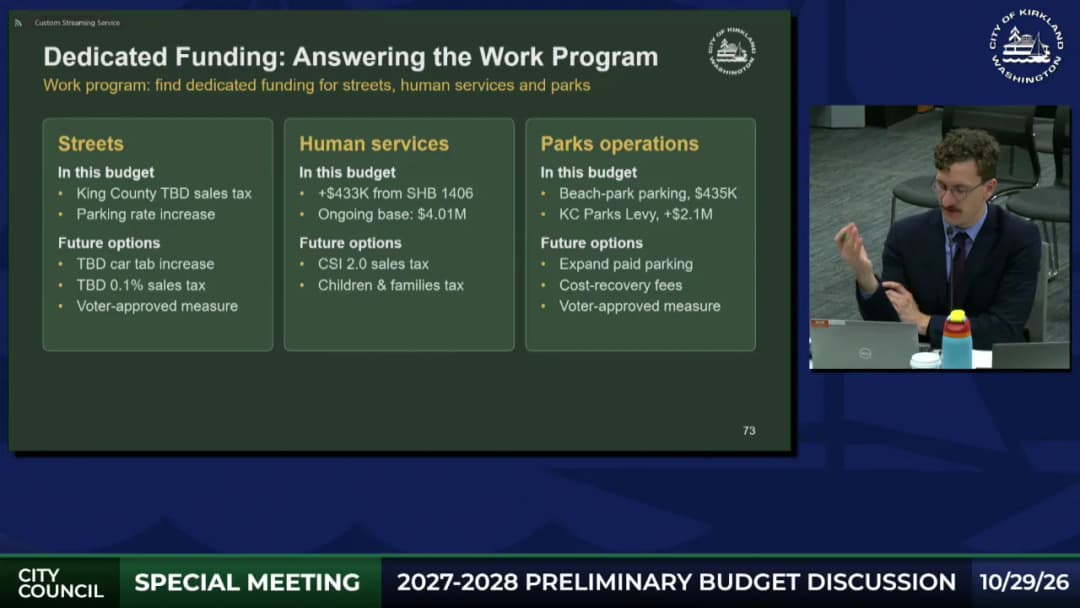
The Kirkland City Council convened a Special Meeting on October 29, 2026, beginning at 3:00 PM, to conduct a comprehensive 6-hour study session on the City Manager's Preliminary 2027-2028 Budget. Led by City Manager Kurt Triplett and Financial Planning Manager Kevin Pelstring, the session presented a $1.15 billion balanced biennial budget (with a $361.9 million General Fund) that relies heavily on one-time fund balance to cover a growing structural deficit. The Council reviewed major budget priorities, discussed new sustainable funding options such as the children and families sales tax and a potential community safety initiative, and provided initial feedback on the draft 2027-2028 City Work Program. Public Comments & Testimony - No public testimony was taken during this study session. The meeting was dedicated entirely to Council and staff deliberation. Public hearings on the budget are scheduled for November 4 and November 17, 2026. Discussion Items Budget Overview and Strategic Anchors - City Manager Triplett framed the budget around three strategic anchors: affordability, sustainability, and responsiveness to the public. He noted the budget is balanced, all general purpose reserves are fully funded, and the city’s triple-A credit rating is maintained. The only significant new investment is the Kraken Iceplex and Kirkland Community Center (KIKCC), which is fully funded. - Kevin Pelstring described the 9-month budget development process. He detailed a $10.6 million structural deficit in the base budget that is closed with one-time fund balance ($14.8 million) derived from conservative budgeting practices in the previous biennium, including salary savings, a two-year sales tax lag, and utility taxes coming in above budget. Budget Priorities - Kraken Iceplex and Kirkland Community Center (KIKCC): Grace Hansen presented the $5.3 million plan for the 12,500 square foot community center opening in January 2028. It is funded by program and rental fees, beach parking fees ($435,000), King County Parks Levy funds, and $1.9 million from the General Fund. Councilmember Prem asked for clarification on the parking lot, clarifying that the city owns and is responsible for the entire north lot. - Human Services: $5.28 million in grant funding was presented, including a $433,000 increase to the ongoing base from HB 1406 funds. Councilmember Falcone explained to viewers that per-capita funding has not increased due to the expiration of one-time federal dollars that previously boosted the budget. - ARCH Contributions: The city is increasing its contribution to the Regional Coalition for Housing (ARCH) to $1.43 million over the biennium, funded by a new fee-in-lieu on homes over 2,000 square feet. Councilmember Arnold stressed the importance of preserving dedicated revenue sources for these ongoing needs rather than using them for one-time costs. - Public Defense: The cost of public defense has approximately doubled (98% increase) due to new Washington State Supreme Court caseload standards, which is a primary driver of the structural deficit. Balancing the Budget and Future Outlook - Structural Deficit Projections: The current structural deficit of $19.7 million in 2027-2028 is projected to grow to $24.3 million in 2029-2030 and $26.9 million in 2031-2032, assuming current service levels and no new revenue sources. This is driven by salary and benefit growth far outpacing the 1% property tax increase limit plus new construction. - On the Radar: Deep dives were presented on several areas: - Health Benefits: Medical claims are up 22% from the 2025-2026 budget. - Street Fund: Hit by a structural deficit due to rising costs (insurance, energy) outpacing growth in the property tax and declining gas tax revenues. Balanced with new King County TBD sales tax revenue and parking fee increases. - Parks Levy Fund: Approaching a structural gap as operating costs rise faster than levy revenues. Councilmember Pascal asked for a historical look at the original levy projections vs. current reality. - Public Records: Costs rising to $1.5 million in response to increased demand, including more complex requests and the emergence of AI. - Kingsgate/Peter Kirk Pool Financing: Staff outlined the closing of the Kingsgate property acquisition and a planned bond issuance to repay interfund loans and fund pool renovations. - Unprogrammed Fund Balance ($616,000): Staff presented initial options for the remaining unprogrammed General Fund balance, including an AI intelligent transportation system pilot ($106,000) and a 4-year citywide speed limit reduction program. Council deferred specific decisions, noting other emergent needs like increased jail medical costs and a lower-than-expected Evergreen Levy contribution. - Children and Families Sales Tax (ESHB 2442): Staff presented a new 0.01% sales tax adopted by King County. By opting in, Kirkland can direct an estimated $665,000 over 2027-2028 to local housing, childcare, and youth services. The Council expressed a strong consensus to opt in. Councilmember Pascal stated the city could spend it more effectively locally. Councilmember Falcone supported using the dollars for the city's own growing needs. Councilmember Black supported it. Councilmember Arnold stated, "I was in support." Councilmember Timchison supported collecting the tax. Councilmember Prem reserved her detailed comments for a later time. - Community Safety Initiative 2.0 (0.1% Sales Tax): Tracy Dotlap introduced this potential sales tax generating $4.2 million per year for a wide range of uses (police, public defense, human services). Council action is required by June 30, 2028, to avoid a public vote. Councilmember Falcone requested information on the impact of this tax on a typical Kirkland family and what purchases it applies to. Deeper discussion was deferred to the November 17 study session. - HB 2015 Grant Award: The city was announced as a recipient of the grant, funding 6 entry-level police officers (with a $75,000 city match), a jail navigator, and an officer wellness program for the grant period. Department Highlights - Police: Mike Liu highlighted the budget for 163 FTEs and the new grant. Councilmember Pascal requested more data on how school zone safety camera locations were determined based on Public Works speed studies and the accounting for the revised state law sharing revenue with the Cooper Jones safety account. - Fire: The budget includes a new fire strategic plan (first since 2012) and continued funding for the Mobile Integrated Health (MIH) team via the Evergreen Levy. Councilmember Arnold requested more information on a decision to move a fourth firefighter from Station 24 to the ladder truck, which was acknowledged as a change from original Prop 1 plans. - Public Works (Transportation and Streets): Veronica Hill presented service packages for parking study implementation (increasing rates at Lake Shore/Lake Street, charging on Sundays, and adding summer beach parking fees). City Manager Triplett acknowledged the budget proposal did not fully align with the Council's recent direction on speed limit reduction implementation and promised a reconciliation at the next meeting with options to fund a faster roll-out. - Parks and Community Services: KIKCC, Kirkland Teen Union Building (KTUB) programming, and new turf fields at Crestwood and 132nd Park were reviewed. Councilmember Falcone requested exploring a partnership with EvergreenHealth for mammogram spots for uninsured residents at the annual health and wellness fair. Councilmember Pascal asked for an evaluation of the newly installed security gates at Juanita and Houghton Parks. - Planning and Building: Adam discussed service packages for affordable housing contributions and an AI permitting tool pilot. He clarified this is a Kirkland-specific initiative distinct from the regional Challenge Seattle or ECD Gov Alliance efforts, focusing on front-end application completeness and planning inquiries. - Other Departments: The supported employment program for individuals with developmental disabilities is being restarted. A new business license enforcement position was noted as net revenue positive for the city. Key Outcomes - Policy Direction: The Council reached a broad consensus to move forward with the adoption of the Children and Families Sales Tax (ESHB 2442) to direct the 0.01% levy revenues locally. Staff will prepare the necessary legislation for consideration during the budget adoption process. - Budget Clarifications Requested: Staff will bring back detailed information at the November 4 and November 17 meetings, including: - Scoped costs and timelines for implementing a faster speed limit reduction program. - The specific impact (e.g., per $100 purchase) of a 0.1% Community Safety Initiative sales tax on a typical household. - More detailed justification for proposed school zone safety camera locations based on speed/safety studies. - Options for an increased frequency of the Kirklander newsletter and potential sponsorships. - City Work Program Feedback: Council provided extensive input for the draft 2027-2028 City Work Program. Additions discussed for potential inclusion were: - Transit-oriented development and Bus Rapid Transit (BRT) readiness at 85th Street. - Setting sustainable, target investment levels for human services and homelessness. - Feasibility study for a community pool at the newly acquired Kingsgate property. - Creating a holistic citywide AI governance and policy framework. - Implementing great ideas identified in the forthcoming transit needs study. - Next Steps: The formal budget adoption process continues with a study session and public hearing scheduled for November 4, followed by another study session and public hearing on November 17. Final adoption of the 2027-2028 budget and the 2027-2032 CIP is scheduled for December 8, 2026.