Browse by city
Date range
Search help

Search titles, summaries, topics and stored transcripts together. Keywords may match separately; put the whole query in double quotes for a phrase. Matching follows word analysis, so punctuation is not exact. Both dates are included. Documents are not searched.

SHOWING 451–460 ENTRIES
451
NEWOCT 29, 2026 · KIRKLAND, WASHINGTON · CITY COUNCIL
2027-2028 Budget Study Session: Kirkland City Council Special Meeting, October 29, 2026

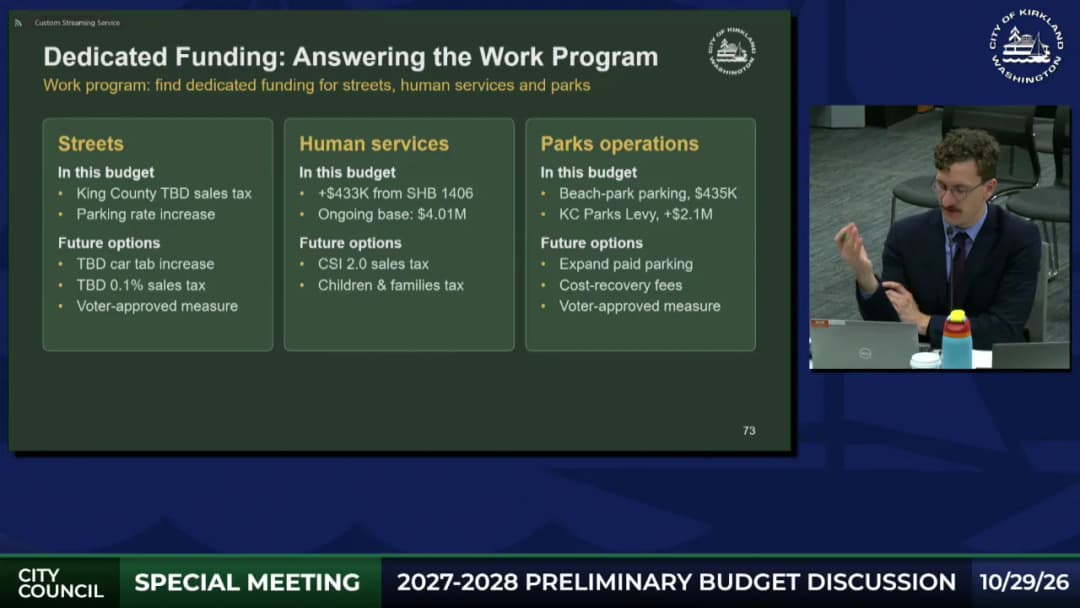
The Kirkland City Council convened a Special Meeting on October 29, 2026, beginning at 3:00 PM, to conduct a comprehensive 6-hour study session on the City Manager's Preliminary 2027-2028 Budget. Led by City Manager Kurt Triplett and Financial Planning Manager Kevin Pelstring, the session presented a $1.15 billion balanced biennial budget (with a $361.9 million General Fund) that relies heavily on one-time fund balance to cover a growing structural deficit. The Council reviewed major budget priorities, discussed new sustainable funding options such as the children and families sales tax and a potential community safety initiative, and provided initial feedback on the draft 2027-2028 City Work Program. Public Comments & Testimony - No public testimony was taken during this study session. The meeting was dedicated entirely to Council and staff deliberation. Public hearings on the budget are scheduled for November 4 and November 17, 2026. Discussion Items Budget Overview and Strategic Anchors - City Manager Triplett framed the budget around three strategic anchors: affordability, sustainability, and responsiveness to the public. He noted the budget is balanced, all general purpose reserves are fully funded, and the city’s triple-A credit rating is maintained. The only significant new investment is the Kraken Iceplex and Kirkland Community Center (KIKCC), which is fully funded. - Kevin Pelstring described the 9-month budget development process. He detailed a $10.6 million structural deficit in the base budget that is closed with one-time fund balance ($14.8 million) derived from conservative budgeting practices in the previous biennium, including salary savings, a two-year sales tax lag, and utility taxes coming in above budget. Budget Priorities - Kraken Iceplex and Kirkland Community Center (KIKCC): Grace Hansen presented the $5.3 million plan for the 12,500 square foot community center opening in January 2028. It is funded by program and rental fees, beach parking fees ($435,000), King County Parks Levy funds, and $1.9 million from the General Fund. Councilmember Prem asked for clarification on the parking lot, clarifying that the city owns and is responsible for the entire north lot. - Human Services: $5.28 million in grant funding was presented, including a $433,000 increase to the ongoing base from HB 1406 funds. Councilmember Falcone explained to viewers that per-capita funding has not increased due to the expiration of one-time federal dollars that previously boosted the budget. - ARCH Contributions: The city is increasing its contribution to the Regional Coalition for Housing (ARCH) to $1.43 million over the biennium, funded by a new fee-in-lieu on homes over 2,000 square feet. Councilmember Arnold stressed the importance of preserving dedicated revenue sources for these ongoing needs rather than using them for one-time costs. - Public Defense: The cost of public defense has approximately doubled (98% increase) due to new Washington State Supreme Court caseload standards, which is a primary driver of the structural deficit. Balancing the Budget and Future Outlook - Structural Deficit Projections: The current structural deficit of $19.7 million in 2027-2028 is projected to grow to $24.3 million in 2029-2030 and $26.9 million in 2031-2032, assuming current service levels and no new revenue sources. This is driven by salary and benefit growth far outpacing the 1% property tax increase limit plus new construction. - On the Radar: Deep dives were presented on several areas: - Health Benefits: Medical claims are up 22% from the 2025-2026 budget. - Street Fund: Hit by a structural deficit due to rising costs (insurance, energy) outpacing growth in the property tax and declining gas tax revenues. Balanced with new King County TBD sales tax revenue and parking fee increases. - Parks Levy Fund: Approaching a structural gap as operating costs rise faster than levy revenues. Councilmember Pascal asked for a historical look at the original levy projections vs. current reality. - Public Records: Costs rising to $1.5 million in response to increased demand, including more complex requests and the emergence of AI. - Kingsgate/Peter Kirk Pool Financing: Staff outlined the closing of the Kingsgate property acquisition and a planned bond issuance to repay interfund loans and fund pool renovations. - Unprogrammed Fund Balance ($616,000): Staff presented initial options for the remaining unprogrammed General Fund balance, including an AI intelligent transportation system pilot ($106,000) and a 4-year citywide speed limit reduction program. Council deferred specific decisions, noting other emergent needs like increased jail medical costs and a lower-than-expected Evergreen Levy contribution. - Children and Families Sales Tax (ESHB 2442): Staff presented a new 0.01% sales tax adopted by King County. By opting in, Kirkland can direct an estimated $665,000 over 2027-2028 to local housing, childcare, and youth services. The Council expressed a strong consensus to opt in. Councilmember Pascal stated the city could spend it more effectively locally. Councilmember Falcone supported using the dollars for the city's own growing needs. Councilmember Black supported it. Councilmember Arnold stated, "I was in support." Councilmember Timchison supported collecting the tax. Councilmember Prem reserved her detailed comments for a later time. - Community Safety Initiative 2.0 (0.1% Sales Tax): Tracy Dotlap introduced this potential sales tax generating $4.2 million per year for a wide range of uses (police, public defense, human services). Council action is required by June 30, 2028, to avoid a public vote. Councilmember Falcone requested information on the impact of this tax on a typical Kirkland family and what purchases it applies to. Deeper discussion was deferred to the November 17 study session. - HB 2015 Grant Award: The city was announced as a recipient of the grant, funding 6 entry-level police officers (with a $75,000 city match), a jail navigator, and an officer wellness program for the grant period. Department Highlights - Police: Mike Liu highlighted the budget for 163 FTEs and the new grant. Councilmember Pascal requested more data on how school zone safety camera locations were determined based on Public Works speed studies and the accounting for the revised state law sharing revenue with the Cooper Jones safety account. - Fire: The budget includes a new fire strategic plan (first since 2012) and continued funding for the Mobile Integrated Health (MIH) team via the Evergreen Levy. Councilmember Arnold requested more information on a decision to move a fourth firefighter from Station 24 to the ladder truck, which was acknowledged as a change from original Prop 1 plans. - Public Works (Transportation and Streets): Veronica Hill presented service packages for parking study implementation (increasing rates at Lake Shore/Lake Street, charging on Sundays, and adding summer beach parking fees). City Manager Triplett acknowledged the budget proposal did not fully align with the Council's recent direction on speed limit reduction implementation and promised a reconciliation at the next meeting with options to fund a faster roll-out. - Parks and Community Services: KIKCC, Kirkland Teen Union Building (KTUB) programming, and new turf fields at Crestwood and 132nd Park were reviewed. Councilmember Falcone requested exploring a partnership with EvergreenHealth for mammogram spots for uninsured residents at the annual health and wellness fair. Councilmember Pascal asked for an evaluation of the newly installed security gates at Juanita and Houghton Parks. - Planning and Building: Adam discussed service packages for affordable housing contributions and an AI permitting tool pilot. He clarified this is a Kirkland-specific initiative distinct from the regional Challenge Seattle or ECD Gov Alliance efforts, focusing on front-end application completeness and planning inquiries. - Other Departments: The supported employment program for individuals with developmental disabilities is being restarted. A new business license enforcement position was noted as net revenue positive for the city. Key Outcomes - Policy Direction: The Council reached a broad consensus to move forward with the adoption of the Children and Families Sales Tax (ESHB 2442) to direct the 0.01% levy revenues locally. Staff will prepare the necessary legislation for consideration during the budget adoption process. - Budget Clarifications Requested: Staff will bring back detailed information at the November 4 and November 17 meetings, including: - Scoped costs and timelines for implementing a faster speed limit reduction program. - The specific impact (e.g., per $100 purchase) of a 0.1% Community Safety Initiative sales tax on a typical household. - More detailed justification for proposed school zone safety camera locations based on speed/safety studies. - Options for an increased frequency of the Kirklander newsletter and potential sponsorships. - City Work Program Feedback: Council provided extensive input for the draft 2027-2028 City Work Program. Additions discussed for potential inclusion were: - Transit-oriented development and Bus Rapid Transit (BRT) readiness at 85th Street. - Setting sustainable, target investment levels for human services and homelessness. - Feasibility study for a community pool at the newly acquired Kingsgate property. - Creating a holistic citywide AI governance and policy framework. - Implementing great ideas identified in the forthcoming transit needs study. - Next Steps: The formal budget adoption process continues with a study session and public hearing scheduled for November 4, followed by another study session and public hearing on November 17. Final adoption of the 2027-2028 budget and the 2027-2032 CIP is scheduled for December 8, 2026.
FISCAL SUSTAINABILITY 23% · BUDGET EQUITY ANALYSIS 14% · PUBLIC ENGAGEMENT 8% · HUMAN SERVICES 7%
452
NEWOCT 29, 2026 · HUNTINGTON, NEW YORK · MEETING PORTAL
Huntington Zoning Board of Appeals Meeting October 29, 2026

The Town of Huntington Zoning Board of Appeals met on October 29, 2026, for a regular evening meeting. The board approved the previous week's minutes, conducted six public hearings, and handled other business including zone change referrals, a consultant resolution, and accessory dwelling unit preliminary approvals. Five of the six applications were granted; one decision was reserved. The meeting adjourned to November 5, 2026. Consent Calendar - Minutes of October 22, 2026, accepted unanimously (motion by McGrath, second by Castagna). - Jurisdiction confirmed for hearings 23784, 23774, and 23786. Public Comments & Testimony - Robert Levignon of 424 Wolf Hill Road, Dix Hills, opposed application 23774 (427 Wolf Hill Road), describing four years of flooding, mud, blocked sewers, construction vibrations, and alleged town enforcement failures. He asked the board to deny the request and review the full scope of development, noting that a neighbor who died that weekend had said the project "was going to kill me." - Neil Arichio, speaking for his fiancée at 6 Ivy Hill Court, Huntington Station, questioned the traffic study for application 23786 (950 East Jericho Turnpike), citing unsafe truck loading in roadways and potential noise from jet skis/ATVs. He urged the board to set a precedent for more aesthetic, compliant development. - No public speakers appeared for the other five hearings. Discussion Items Public Hearing 23747 – 27 Carman Road, Dix Hills - Applicants/owners Yoel Antonio Rojas Ortiz and Felix Martinez requested side yard and combined side yard relief to construct a two-story addition and roof over deck. - The attorney stated the R-40 lot is substandard: 97.9 feet wide where 125 feet are required. The house currently does not meet side yard setbacks; relief was previously granted. The requested variances were 11.58 feet where 25 feet are required, and a combined setback of 36.08 feet where 50 feet are required. The lot has 1.3 acres and three times the required front yard. - No opposition. Board granted the application. Public Hearing 23765 – 9 Montana Street, Huntington - Owner Patricia Franco requested accessory structure and lot area relief to legalize an existing front deck. She stated the deck predated her ownership, no devaluation had occurred, and the community's development pattern was unchanged. - The board recognized the R-40 neighborhood had mostly been built under R-5 zoning, resulting in substandard lots. The deck is 19.2 feet where 50 feet are required. - No opposition. Board granted the application. Public Hearing 23764 – 56 Wintercress Lane, East Northport - Architect Tom Winnis, for applicant Bobby Vaughese and owners Bobby and Betsy Varughese, withdrew the request to construct a two-story addition; that portion would be revised and refiled without needing ZBA approval. - The remaining request was to legalize existing pool equipment set back 2 feet where 5 feet are required. The pool and equipment were installed in 1986. - No opposition. Board granted the application. Public Hearing 23785 – 169 West Pulaski Road, Huntington Station - Owner John Casey sought to rebuild a fire-damaged detached two-car garage on an existing poured foundation, requesting an area variance for 810 square feet where 750 is allowed, and a height variance for 25 feet where 15 feet is allowed. - Casey stated the prior garage had a certificate of occupancy at the same height, and he uses a car lift for rebuilding cars. A neighbor's letter in the record supported the rebuild. - No opposition. Board granted the application. Public Hearing 23784 – 10 Jameson Court, East Northport - Attorney Ryan Brown, for applicant Uygar Konur, sought relief to convert a balcony to living space, add an egress window well, and legalize existing shed, hot tub, and fence. The R-7 corner lot is 8,268 square feet with 50-foot width where 75 feet is required; prior lot width relief was granted in 1983. - Requests included: balcony setback 22.6 feet vs. 25; addition setback 6.8 feet vs. 7; unobstructed side yards 3.66 and 3.5 feet vs. 5; and zero fence setback vs. 2 feet. - No opposition. Board granted the application. Public Hearing 23774 – 427 Wolf Hill Road, Dix Hills - Attorney Ryan Brown, for 427 Wolf Hill Road LLC (Gene French), sought to legalize retaining walls, a sports court with fencing, and a detached covered patio. Requests included: retaining wall facial area 2,510 sq ft vs. 833.54 allowed; retaining wall setbacks 4.4 ft west and 1.4 ft east vs. 10 ft; sports court fence setbacks 9.58 ft west and 9.66 ft east vs. 10 ft; and cumulative accessory structure square footage 2,207 sq ft vs. 1,200 allowed. - Brown explained the slope and a design professional's misinterpretation of tiered retaining wall rules; existing arborvitae screening was noted. - Robert Levignon, the across-the-street neighbor, objected at length, claiming flooding, mud, unauthorized construction, and disproportionate scale. He asked for denial. - The board closed the hearing and reserved decision. Public Hearing 23786 – 950 East Jericho Turnpike, Huntington Station - Attorney Tara Visconti, for Motorrad Realty LLC (Erik Habberstad), sought a special use permit for a motorsports repair, service, and parts facility with outdoor overnight storage of personal watercraft and ATVs in an existing building vacant since 2024. - Variances requested: five parking spaces where eight are required; parking buffers and landscaping; and signage area of 100.5 sq ft where 97.5 sq ft is allowed. - Traffic expert Wayne Muller (RM Engineering) testified parking and traffic impacts would be minimal; real estate expert Michael Lynch testified the use was consistent with the surrounding motor-vehicle corridor and would not harm property values. - Neil Arichio spoke in opposition, citing traffic safety and noise concerns. - The board discussed conditions, including that all repair work would occur inside, only watercraft/ATVs would be stored outside, hours would be Monday–Friday 9–6, Saturday 9–5, closed Sunday, and site plan approval would still be required. - Board granted the application with a negative declaration. Key Outcomes - 23747 (27 Carman Road): Granted. Motion by Basso, second by Castagna. Vote unanimous. - 23765 (9 Montana Street): Granted. Motion by Whalen, second by Cote. Vote unanimous. - 23764 (56 Wintercress Lane): Granted after withdrawal of addition request. Motion by Castagna, second by White. Vote unanimous. - 23785 (169 West Pulaski Road): Granted. Motion by Cote, second by McGrath. Vote unanimous. - 23784 (10 Jameson Court): Granted. Motion by Whalen, second by Castagna. Vote unanimous. - 23774 (427 Wolf Hill Road): Decision reserved; no vote taken. - 23786 (950 East Jericho Turnpike): Granted, with conditions and a negative declaration. Motion by McGrath, second by Whalen. Vote unanimous. - Approved a resolution to retain H2M Architects/Engineers as a consultant for ZBA 23729 (35 Hemingway Drive, Dix Hills) concerning retaining walls, with an initial escrow of $6,100. Motion by Castagna, second by Basso. - Issued preliminary approval letters for accessory dwelling units at 4 Griffin Place (ADU 2284), 8 Basswood Place (ADU 2295), and 3 Greystone Drive (ADU 2297), all subject to building department referral to Suffolk County. - Took no action on zone change referrals 2026-ZM-492 (Railroad Street west of 11th Street) and 2026-ZM-493 (Woodman Road north of Gwyn Road, West Hills), treating them as informational coordination items. - Adjourned to November 5, 2026.

ZONING AND LAND USE 80% · TRANSPORTATION SAFETY 5% · ENGINEERING AND INFRASTRUCTURE 5% · PROCEDURAL 5%
453
NEWOCT 29, 2026 · LOUISVILLE, KENTUCKY · METRO COUNCIL & COMMITTEES
Louisville Metro Council Meeting Summary - October 29, 2026

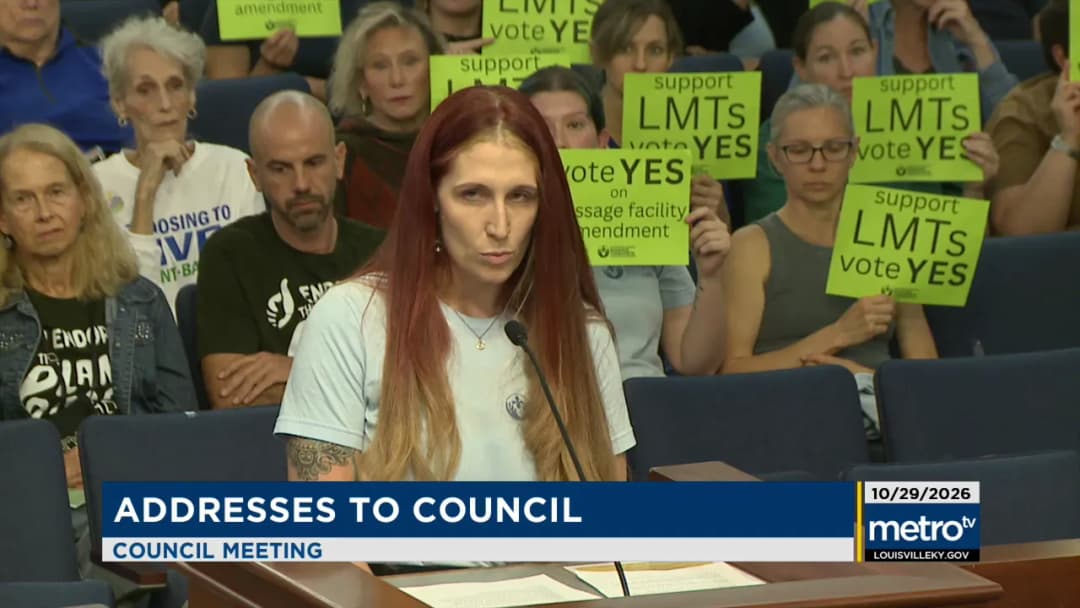
The Louisville Metro Council met on Thursday, October 29, 2026, at 6:00 PM via video teleconference, with President Brent Ackerson presiding. The meeting was called to order at 6:07 PM and adjourned at 7:28 PM. A quorum was established with 25 of 26 members present (Council Member Donna L. Purvis was excused). The council approved a consent calendar, acted on several old business items, heard public testimony, and introduced new legislation. Consent Calendar - Items 18-30 were approved by a 25-0 roll call vote. These included three honorary street sign resolutions (R-146-26 for Harry Johnson Jr., R-147-26 for Kimberly Asa and Lou Fedon, R-150-26 for Rose and Walter Smith); appointments of Cindy Morris (Civilian Review Board) and Scott Davenport (TARC Board); a contract for a laboratory director for Louisville Metro Public Health and Wellness ($102,106.57); authorization of up to $6.2 million in revenue bond anticipation notes for the Wesley Oaks Senior Living Expansion Project; a right-of-way closure near Old Manslick Road; an amendment to Land Development Code Chapter 11 on notice requirements; a resolution requesting review of fencing material regulations; an update to standard design guidelines for landmarks; a FEMA grant acceptance of $74,700 for the fire department; and acceptance of up to $250,000 from the Kentucky Recreational Trails Program. Public Comments & Testimony Seven speakers addressed the council: - Ann Ferree urged council to endorse the Plant-Based Treaty, highlighting health and cost benefits. - Jordan Duvall, a licensed massage therapist (LMT), described how the original massage facility ordinance nearly tripled his break-even revenue and imposed severe financial strain; he asked for support of the amendment. - Samantha Davis, an LMT, thanked council for collaboration and asked for passage of the amendment. - Kim Guenthner, an LMT of 20 years, shared initial feelings of being criminalized and expressed gratitude for the amendment process. - Cathy Hinko criticized Louisville Water Company for high rates and cutoff practices, calling water service disconnection "terrorism." - Dr. Kim Williams, a cardiologist and former president of the American College of Cardiology, advocated for plant-based nutrition to prevent disease and reduce healthcare costs. - Wallace McMullen argued that data center regulations should focus on operational impacts (e.g., electric load, heat, noise) rather than building square footage. Discussion Items Several old business items were debated and voted on: - O-281-26 (Zoning at 211 S. 41st Street): Council Member Owen reported that Council Member Purvis (absent) supported the change to align with existing use. Approved 25-0. (Note: The minutes include a motion to return to table before approval, but the transcript shows a direct vote; outcome unaffected.) - O-293-26 (Zoning at 4107-4111 East Indian Trail): Rezoning from R-4 to C-2, with no anticipated displacement. Approved 25-0. - O-286-26 (Amendments to Massage Facility Ordinance): Council Member Ruhe presented compromise amendments developed over nine months with LMTs, health officials, ABC, and anti-trafficking experts. Changes included ownership transparency, victim-centric trafficking notices, exemptions for solo practitioners, removal of mandatory unlocked doors, and optional cameras. Council Members Piagentini, Owen, and Reno-Weber praised the collaborative process. Approved 25-0. - R-141-26 (Local Incentives for Block by Block): Supported by Council Members Herndon and Piagentini as a local success story. Council Member Lyninger voted no, arguing the work should be done by union employees. Council Member Owen abstained due to his employment with OneLouisville. Passed 23-1-1. - O-290-26 (NDF for Junior Achievement): Amended from $7,250 to $20,000 as 22 council members contributed funds. Approved 25-0. - O-296-26 (NDF for Forest Fest): Amended from $18,250 to $28,750 with contributions from multiple districts. Approved 25-0. - O-299-26 (NDF for Wreaths Across America): Amended from $10,000 to $20,000 to fully fund wreaths at Zachary Taylor National Cemetery. Approved 25-0. Key Outcomes - Consent calendar (Items 18-30) approved 25-0. - Old business items O-281-26, O-293-26, O-286-26 each passed 25-0. - Resolution R-141-26 passed 23-1-1. - Amended NDF appropriations for Junior Achievement ($20,000), Forest Fest ($28,750), and Wreaths Across America ($20,000) each passed 25-0. - New business items (38-51) were read into the record and assigned to committees. - Council Member Parrish-Wright announced a clothing donation drive at City Hall. The next regular meeting is scheduled for Thursday, November 12, 2026 at 6:00 PM.

PROCEDURAL 21% · PUBLIC SAFETY 17% · HUMAN TRAFFICKING PREVENTION 11% · ZONING REGULATION 8%
454
NEWOCT 29, 2026 · ROCHESTER, MINNESOTA · BOARDS AND COMMISSIONS
Rochester Planning Commission Meeting Summary - October 29, 2026

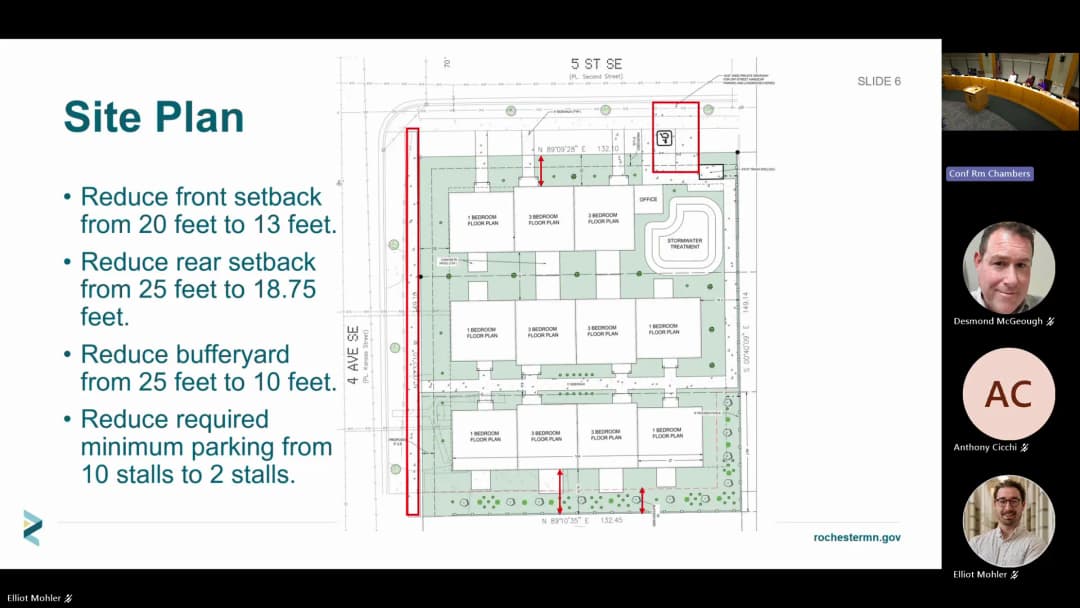
The Planning Commission met on October 29, 2026, to consider two major land use items: a preliminary plat for the Shannon Oaks 8th subdivision and a consolidated public hearing for a travel demand management plan and major modification to support a veteran housing project. The meeting included public comments, staff reports, and commission deliberation. Key votes included approval of the Shannon Oaks plat with conditions (3-2) and approval of the veteran housing parking reduction (4-1) and modification (5-0). Consent Calendar - Approved the September 16, 2026, meeting minutes unanimously. - Approved the order of agenda, combining items 6A and 6B into one public hearing, unanimously. Public Comments & Testimony - Kelly Raykirkpatrick (1107 East Center Street) urged the commission to table the Shannon Oaks 8th plat pending a complete environmental record, including a wetland delineation and verification that grading would not require engineered mitigation. She emphasized the need for adequate technical evidence before approval. - Andrew Inford (resident seven blocks from the veteran housing site) expressed support for the project's mission and infill density goals but raised concerns about parking adequacy given existing traffic and the nearby school. - John Lovald (COO, Minnesota Assistance Council for Veterans) stated the project provides permanent supportive housing for veterans, with 90% of residents at or below 50% AMI and 15% vehicle ownership based on their statewide experience. He emphasized the nonprofit's commitment to maintaining the property and addressing issues. - Ryan Schoenfeller (WSC, consultant) addressed parking concerns, noting availability of on-street parking, future multimodal investments (Link BRT), and a process for permit parking if needed. He explained that reducing parking further would cost housing units. Discussion Items Shannon Oaks 8th Preliminary Plat (Item 5A) - Staff report (Desmond McGill, Community Development) : The 10.73-acre site (zoned R1) would be divided into 25 single-family lots. The wetland delineation from 2015 has expired; a new one is pending with the Soil and Water Conservation District. Staff recommended approval with five conditions, including wetland sequencing approval before final plat. - Applicant (Mark Wells, GCUBE Engineering) : Presented a revised grading plan to reduce infrastructure costs and environmental impact. The wetland delineation was resubmitted; the incidental pond is not a permanent wetland. He confirmed no Decorah Edge features are present. The applicant agreed to the five conditions. - Commission discussion : Concerns were raised about missing wetland documentation, tree removal, and community opposition. Commissioner Ross moved to table for more information, but legal counsel noted the 60-day statutory deadline and availability of an extension. After debate, the commission approved forwarding the plat to city council with the five conditions (vote 3-2: Ayes: Commissioner Ross (recused?), Commissioner Ixon, Commissioner Kroll; Nays: Commissioner Klein, Commissioner Boyham; Commissioner Ahmed abstained/arrived late). Veteran Housing TDM & Major Modification (Items 6A & 6B) - Staff report (Elliott Miller, Community Development) : The project by Lenar/MACV at 5th St SE & 4th Ave SE seeks a travel demand management plan (reducing parking from 10 to 2 stalls) and a major modification (reducing front/rear setbacks and buffer yard). Staff recommended approval for both, citing transit access (frequent bus routes, future Link BRT), limited vehicle ownership among residents, and alignment with comprehensive plan goals. - First vote on parking reduction : Motion to approve 2 stalls failed (2-3). - Amended motion : After discussion of emergency access and precedent, the commission amended the parking reduction from 10 to 4 stalls. The new motion passed 4-1 (Ayes: Commissioners Ixon, Kroll, Boyham, Ahmed; Nay: Commissioner Klein; Commissioner Ross recused). - Major modification vote : Motion to approve with the one condition (buffer yard plantings) passed unanimously (5-0). Key Outcomes - Shannon Oaks 8th Preliminary Plat (CD 2026-026) : Forwarded a recommendation of approval to the City Council with five conditions (wetland sequencing, grading/civil plans, parkland fees, boulevard trees) by a vote of 3-2. - Travel Demand Management Plan (CD 2026-015 CUP) : Approved with a reduction from 10 to 4 parking stalls, tied to the MACV project, by a vote of 4-1. - Major Modification (CD 2026-014 MOD) : Approved with one condition (full buffer yard plantings despite reduced width) by a vote of 5-0. - Next Meeting : November 18, 2026. Adjourned.

PARKING 20% · ZONING REGULATIONS 18% · ENVIRONMENTAL PROTECTION 14% · URBAN DESIGN 9%
455
NEWOCT 29, 2026 · FRESNO, CALIFORNIA · CITY COUNCIL & COMMISSIONS
Fresno City Council Regular and Special Meeting - October 29, 2026

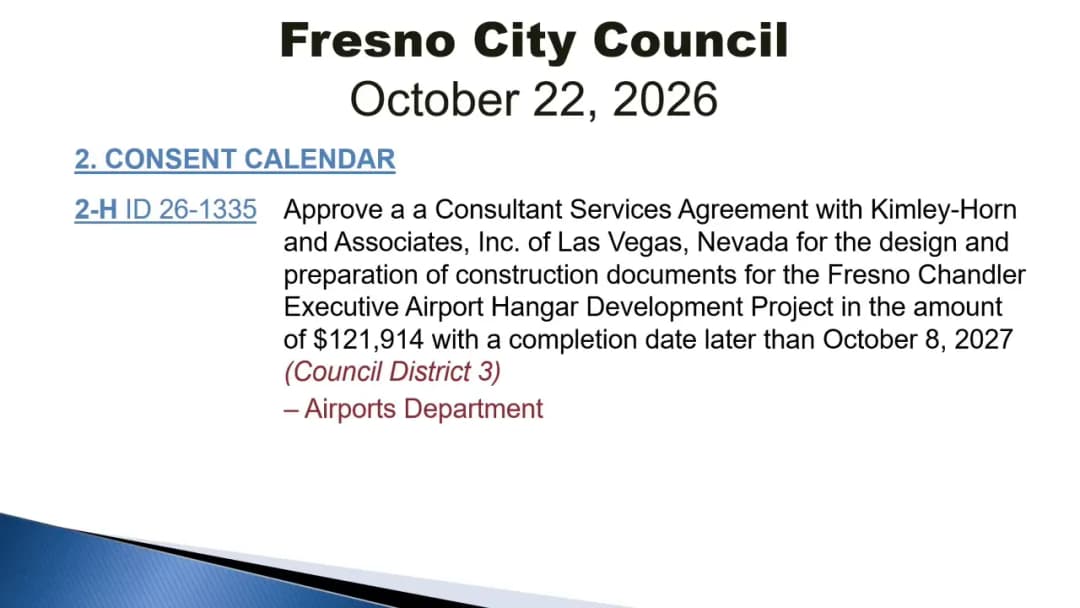
The Fresno City Council convened on October 29, 2026, for a regular meeting and a special meeting. Note: The official published agenda listed the meeting date as October 22, 2026, creating a discrepancy with the transcript metadata. The summary below uses the date provided with the transcript. The session included several ceremonial proclamations, a lengthy consent agenda, a robust debate on the SHIELD Act, and a special meeting to approve a 90-day public safety pilot program for the Tower District. The meeting concluded at 3:32 PM. Ceremonial Presentations Scott Mosier Day: The council honored retiring Public Works Director Scott Mosier for 24 years of service. He was recognized for his role in the $140 million Veterans Boulevard project and his responsiveness to community needs. Mayor Dyer and several council members praised his leadership. Domestic Violence Awareness Month: The council proclaimed October 2026 as Domestic Violence Awareness Month. The Fresno Police Department filed over 7,200 domestic violence reports in the previous year, and the Marjorie Mason Center served over 7,656 adults and children. The proclamation noted over 25 domestic violence-related homicides in the city over the last five years. Other Proclamations: The council proclaimed October 22, 2026 as Fresno Idea Works Day (honoring the downtown makerspace), Mobile Food Vendors Association Day, and Greg and Dre Day (celebrating 25 years of the local radio show). The council also proclaimed the week of October 18–24 as United Against Hate Week. Consent Calendar The consent calendar included a resolution re-establishing the Immigration Legal Defense Fund (Item 2BB), which was amended to limit eligibility to Fresno residents without a criminal conviction. Councilmember Richardson initially pulled it to contested consent, but a motion by Councilmember Arias to place it back on consent was approved 5-1, with Richardson dissenting. Other pulled items included a consultant agreement for Chandler hangars (Item 2H), which was discussed and approved. The consent calendar as a whole was approved 5-1. Public Comments & Testimony Immigration Legal Defense Fund (Item 2BB): Several residents spoke in support, citing a surge in ICE enforcement and the need for legal representation. Jesus Martinez (Central Valley Immigrant Integration Collaborative) and speakers from Power California and other groups urged approval. Neil O'Brien opposed the fund, arguing it creates preferential treatment. SHIELD Act (Item 4A): This item drew significant public comment. Janice Bellucci, an attorney with the Alliance for Constitutional Sex Offense Laws, stated the organization would file a lawsuit against the city, arguing the policy violates state law and could make registrants homeless and harder to monitor. She cited a less than 1% recidivism rate for paroled registrants. Multiple other speakers, including survivors of sexual violence like Dez Martinez, strongly supported the measure, arguing that some offenders cannot be rehabilitated and that protecting children is worth the legal risk. Tower District Pilot Program: A speaker questioned the root cause of the violence, suggesting the high concentration of liquor licenses is a primary factor requiring deeper scrutiny. Discussion Items SHIELD Act (Item 4A): Councilmember Karbassi, the sponsor, argued the city must act against a state system he described as protecting sexual predators and allowing them to be imported into Fresno. He cited the case of David Alan Funston, a convicted child molester with no ties to the city, as a primary example. Councilmember Richardson supported the intent but detailed significant legal barriers in state health and safety codes. Councilmember Perea strongly supported the measure, emphasizing the need to prioritize victims. The resolution passed 6-0. Tower District Public Safety Pilot Program: Councilmembers Perea, Arias, and Esparza, along with Mayor Dyer, presented a 90-day pilot program. The plan consolidates sidewalk vendors into a market zone on Olive and Van Ness to address overcrowding and public safety hazards. It was developed following a 4.5-hour community meeting with over 800 attendees. The pilot includes upgraded street lighting (from 38W to 75W), dedicated police foot patrols, and adjusted enforcement times for parking and street cleaning based on public feedback (loading zone enforcement moved from 6 PM to 10 PM, power washing moved from 2 AM to 3 AM). Key Outcomes Consent Calendar: Approved 5-1. Councilmember Richardson cast the dissenting vote. SHIELD Act Resolution (4A): Approved 6-0. The City Attorney is directed to return with a draft ordinance by the end of 2026. Tower District Pilot Program (Special Meeting): Approved 6-0. A 90-day pilot program establishing a vendor market zone and enhanced safety protocols. Chandler Hangars (Item 2H): Approved without opposition. Hangars will be replaced without increasing space or rates to allow for a future Fresno Unified project. Community Facilities Districts (CFD 9): Two separate items to annex territory and levy special taxes were approved unanimously (6-0). Closed Session: The council met in closed session for legal consultations. No reportable actions were taken.

PROCEDURAL 43% · PUBLIC SAFETY 15% · COMMUNITY ENGAGEMENT 8% · IMMIGRATION POLICY 8%
456
NEWOCT 29, 2026 · ALLEGHENY COUNTY, PENNSYLVANIA · COUNTY COUNCIL
Allegheny County Public Hearing on 2027 Proposed Budget – October 29, 2026

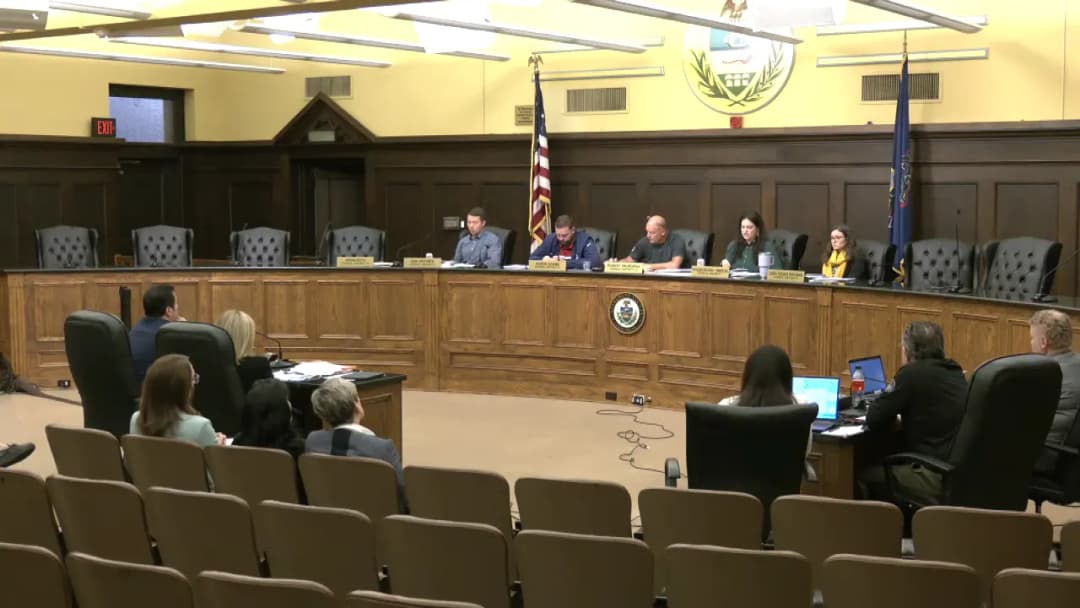
The Allegheny County Council held a public hearing on the 2027 proposed budget, hearing presentations from the Sheriff's Office, Treasurer's Office, the Court of Common Pleas, and Pittsburgh Regional Transit (PRT). The meeting began with public comment from three registered speakers, followed by departmental presentations and council questions. Public Comments & Testimony - John Stonecypher (resident of Manchester): Questioned budget assumptions, asking if spending and collection numbers hold up. Noted sheriff's net increase of 2% and expenditure recoveries rising over 8%, wondering what supports collecting the additional $2.1 million from reimbursement. For the treasurer, he said the $422,000 reduction comes from increased turnover savings, questioning whether less staff is wise given future pension work. Pointed out criminal court stationary and office supplies budget is negative $22,000, asking what credit or accounting adjustment justifies that. Noted court software licenses fall by $708,000, questioning if costs are shifted to the capital plan. Stated election operating expenses moved into grants budget, asking about a fiscal cliff when funding ends. For PRT, noted a $6.3 million draw from reserves and $9.5 million transfer out, while June fund balance was negative, calling for understanding year-end reconciliation. - John Kensowitz: Advocated for training five correctional officers in the "Healing the Hero" PTSD treatment at a cost under $10,000. Cited studies showing correctional officers have higher PTSD rates than military and police. Noted the treatment focuses on dissociative and reframing techniques, does not require clinical background, and peer relationships help reduce stigma. Presented survey results: officers reported less anger, triggers removed, feeling soul and life vitality back, and improved responses. Called it a game changer for morale, retention, and job performance. - Benjamin Chizzar (spelling unclear): Rose in opposition to the budget. Criticized lack of transparency, saying budgets reflect priorities and must not be an exercise in maintenance of status quo. Argued council is siloed from county government (Allegheny County Airport Authority, RAD, PRT, bonding authorities). Stated he could not account for even $30 million of the $135 million RAD budget. Suggested taxing all sales activity (approximately $71 billion) at 2% to bring in $1.4 billion, with $280 million for RAD. Asked why the county could not find $100 million for pensions. Called for current accurate property evaluations and lower millage rates. Discussion Items - Sheriff's Office (Sheriff Krause and Chief Deputy Manning): Presented a 2027 budget of $25.5 million, a 2% increase, manageable with cost recovery. Noted 16 additional positions contingent on agreement with county administration. Overtime rose 35% to $3.5 million, driven by extended hospital watches (80% straight overtime, non-reimbursed) and juvenile transports across the state. Highlighted efficiencies: reduced CISP program detail from 5 deputies to 3, saving $150,000 annually. Cited challenges with lack of juvenile detention beds (Schumann Center) increasing mileage and travel costs. Also mentioned canine unit (5 teams, self-funded), community outreach programs, and satellite license-to-carry events. Council members asked for specific measurable goals and breakdown of overtime costs. Sheriff assured he would not hold the county hostage over budget negotiations. - Treasurer's Office (Treasurer Eric Brussels): Proposed 2027 budget of $8.58 million, a reduction of $422,000 (4.7%). Net cost to county decreases 6.7% to $5.59 million. Savings came from strategic staffing (not filling vacancies automatically). Investment return through September 2026 was 3.83%, beating the federal funds rate benchmark of 3.65%. Outlined modernization: new real estate tax mailing solution reduced postage, streamlined volunteer service tax credit (firefighter) got payments out months earlier, and new website launching November 10, 2026. Expanded satellite offices to all council districts. Connected nearly 300 residents with $250,000 in unclaimed property. In 2027, plans to increase online special tax payments from 50% to 70%, introduce taxpayer bill of rights, and continue cybersecurity improvements. Responded to questions about pension funding: said statutory contributions are made, and additional funding requires state law changes and broad-based revenue solutions. - Court of Common Pleas (President Judge Susan Avachevich and District Court Administrator Joe Story): Reported criminal division disposed of 10,048 cases in last reporting period. Case time to disposition increased from 289 to 291 days, attributed to discovery delays (body cam, dash cam, cell phone data) that require redaction. Noted public defender's budget increased 40% since 2004, but the office conflicts out on many cases (1,095 at magisterial level year to date), shifting costs to court budget for conflict counsel. Family division collected over $103 million in child support, ranked 1 urban jurisdiction nationally. Highlighted alternative sentencing: electronic monitoring saved 282,783 adult jail days; DUI alternative to jail saved 1,256 days. However, juvenile electronic monitoring had high abscond rates: 181 of 683 juveniles absconded, 27 went AWOL multiple times, 11 were connected and reconnected over 3 times. Gave examples: a juvenile released due to lack of beds was later shot and killed; a juvenile released after assaulting an officer later stabbed someone at the NFL draft. Currently, 12 individuals under 18 are in Allegheny County Jail, charged with violent felonies. Criticized delays in opening Schumann Center detention facility: original contract promised 12 beds by February 2024 and full 60 beds within 18 months, but redesign (skylights, gardens, hot plates, no control center) has stalled progress. Only 12 beds are available; 24 more expected by end of 2027, full opening not until 2029. Also noted DHS pretrial diversion program fails because less than 1% of treatment plans are provided to judges due to public defender objections. - Pittsburgh Regional Transit (PRT): Presented budget overview, noting use of $106 million one-time capital waiver in 2025 to fill budget gap, leading to lean project years ahead. Human capital costs dominate (85% union workforce). Discussed Bus Line Refresh project (rebranded from Bus Line Redesign) which will maintain service within quarter mile for 99.4% of current riders, expand access to jobs by over 20%, and restore some direct routes (e.g., North Hills to Oakland). Acknowledged service discontinuation areas have per-passenger costs over $70 (seven times higher than standard). Updated on Wabash Tunnel: estimated $30 million needed for exhaust fan and lighting upgrades, but no partner agency has stepped up. Silver Line rail is the worst route by cost per rider; bringing it to modern standards would cost $500 million. Council members noted transit-oriented development and zoning issues in municipalities like Bethel Park and South Park. Key Outcomes - No votes were taken during this public hearing; it was solely for discussion and testimony. - Council members indicated they would set up follow-up meetings with the court and PRT to address specific issues. - The meeting adjourned after the PRT presentation.

PUBLIC SAFETY 28% · CRIMINAL JUSTICE REFORM 18% · BUDGET 17% · PUBLIC TRANSIT 9%
457
NEWOCT 29, 2026 · EVANSVILLE, INDIANA · CITY COUNCIL
Evansville Licensing Board Approves Construction, HVAC, and Electrical Applicants – October 29, 2026

On October 29, 2026, at approximately 09:45 UTC, the Evansville licensing board convened with no minutes from the previous meeting. The board approved a large slate of construction, roofing, HVAC, and electrical license applicants based on exam scores, voted unanimously to impose a three-year license suspension, and discussed updates to the residential contract exam. Consent Calendar The following applicants were approved by voice vote after motions and seconds: Construction and Roofing: - Andre Diaz – drywall partition, 84% - Jacob Williams – commercial construction parts 1 and 2, 74% and 74% - Leo Post – commercial construction parts 1 and 2, 78% and 78% - Richard Riggs – commercial construction parts 1 and 2, 74% and 74% - Richard Williams – commercial construction parts 1 and 2, 72% and 84% - Stephen White Jr. – brick and masonry, 72% - Aaron Waddell – residential construction parts 1 and 2, 80% and 72% - Chad Alstock – commercial construction parts 1 and 2, 70% and 74% - Christina Gray – unlimited concrete, 70% - Charles Reeves – fire sprinkler, 72% - Cody Sunderhouse – commercial construction parts 1 and 2, 74% and 70% - Deborah Bieber – excavating, 76% - Deborah Bieber – underground utilities, 72% - Daniel Wagner – underground utilities, 80% - Joshua Colbert – unlimited roofing (transcript initially said 'underground roofing'), no exam score stated - Jordan Funk – residential contractor parts 1 and 2, 76% and 80% - Jason Gaddis – building installation, 72% - John Gibson – commercial construction parts 1 and 2, 76% and 76% - Peyton O'Brien – residential contractor parts 1 and 2, 72% and 76% - Tyson Martin – residential contractor parts 1 and 2, 80% and 76% HVAC: - Sean Bean – HVAC, 72% - Austin Oglesby – HVAC journeyman, 70% - Braden Whitfield – HVAC journeyman (transcript shows 'HBAC'), 72% - Kelly Copeland – HVAC journeyman, 80% Electrical: - Jacob Elleman – journeyman electrician, 71% - Luke Castle – journeyman electrician, 75% - Cameron Bland – journeyman electrician, 80% - Rory Bain – journeyman electrician, 84% - Jose Chavez Carlos – journeyman electrician, 84% Discussion Items - Old business: The board took up a single item of old news, a proposed three-year suspension of Jacob Key's license. - New business: The SIBA residential contract exam has experienced glitches and is not currently available to applicants. A member reported that Bill Petby took the test and it appeared to be working, so the board should begin using it. - Exam cycle update: The board currently uses the 2023 exam. The first meeting with the exam body (transcribed as 'NASCAR') is scheduled for the following day, and they are targeting implementation of the 2026 exam by May 2027, following a three-year cycle. This timeline is not yet official. Key Outcomes - All listed applicants were approved unanimously by voice vote. - The board voted unanimously to suspend Jacob Key's license for three years. - The board intends to start using the SIBA residential contract exam after a satisfactory test by Bill Petby. - The exam update to the 2026 version is targeted for May 2027, pending official confirmation. - The meeting adjourned by voice vote.

LICENSING 87% · DATA CENTER INFRASTRUCTURE 13%
458
NEWOCT 29, 2026 · MONTGOMERY COUNTY, MARYLAND · COUNTY COUNCIL & COMMITTEES
Montgomery County HHS Committee Reviews Uninsured Care and H.R.1 Impacts on Oct 29, 2026

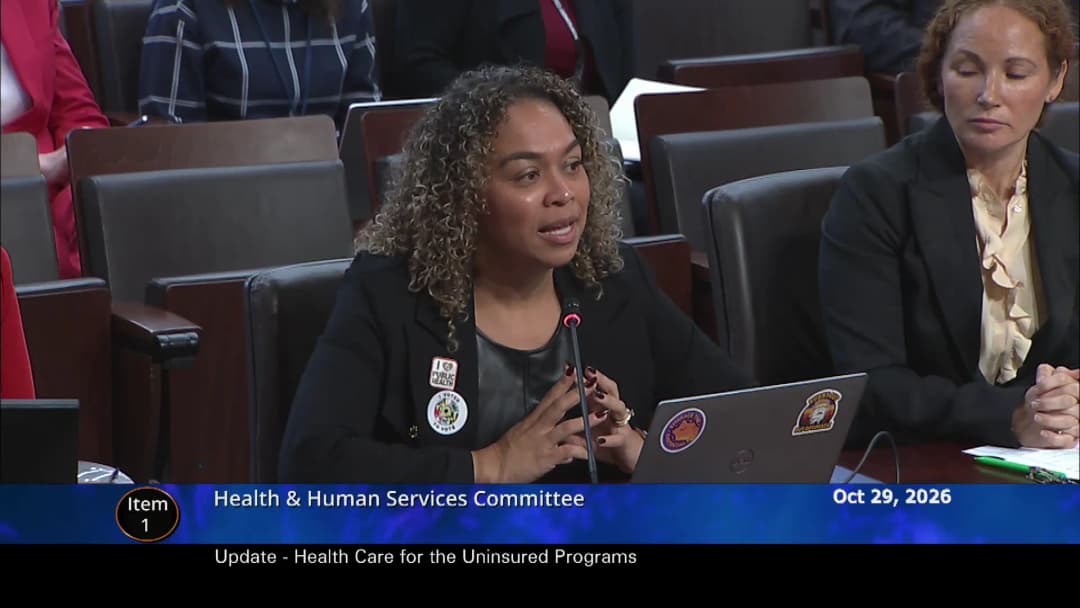
The Health and Human Services (HHS) Committee of the Montgomery County Council met on October 29, 2026, from 2:00 p.m. to 4:30 p.m. to review updates on health care programs for the uninsured and the implementation of H.R.1, focusing on October Medicaid eligibility changes. Chair Laurie-Anne Sayles led the session, with Councilmembers Andrew Friedson and Dawn Luedtke participating. Staff from the Department of Health and Human Services (DHHS) and the Primary Care Coalition (PCC) presented data and fielded questions. No formal votes were taken; the committee instead identified follow-up actions and priorities. Health Care for the Uninsured Programs - Dr. Nina Ashford, Chief of Public Health Services, presented an overview of three programs: Montgomery Cares (adults), Care for Kids (children), and the Montgomery Perinatal Program (formerly Maternity Partnership). The programs are funded by Montgomery County and administered by PCC, except the perinatal program, which is county-run. - Dr. Veronica Vella, Senior Director of Healthcare Access at PCC, provided utilization data: - Montgomery Cares encounters increased from 61,000 in FY23 to 82,000 in FY26. The county pays a rate of $130.82 per encounter in FY27. - Care for Kids enrollment declined from 3,928 to approximately 3,000 between 2025 and 2026. Dr. Vella attributed this to parents' fear of visiting government offices due to the political climate and the loss of a community health worker program (Point of Entry) that helped enroll children during school registration. - Average appointment wait time across the network is 10.5 days, ranging from 1 to 21 days; the longest waits are at Federally Qualified Health Centers (FQHCs). Wait times have been consistent over the past few years. - Quality metrics show high performance in hypertension control (99.7%) and diabetes A1C testing (90.4%), but lower rates for breast cancer screening (only women 45+ are covered) and diabetic retinal exams. PCC recently added retinopathy screening at two practices. - Behavioral health services, funded by a supplemental appropriation, served over 2,000 patients, including case consultations for 475 and social needs support for over 400. - The Montgomery Perinatal Program served 1,870 clients in FY26, a 20% increase from 1,500 in FY25. The first quarter of FY27 was strong with 480 clients. The program is transitioning to an integrated “One MCH” model to align with the 2025 OLO report on racial disparities. - Councilmembers raised concerns about declining enrollment in Care for Kids and the impact of clinic access barriers. Dr. Vella noted clinics have adapted by rearranging wait areas and increasing telehealth use. Councilmember Friedson requested comparison data on FQHC wait times versus national standards, and asked whether wait times are business or calendar days. - Councilmember Sayles asked about outreach and coordination with community partners such as VITA and libraries. Staff committed to sharing the new client guide and to reach out to VITA. H.R.1 Implementation - Tara Clemons Johnson, Council staff, reviewed the policy changes. State data indicates 1,082 Montgomery County residents have lost Medicaid eligibility due to H.R.1 changes, down from earlier estimates of 4,000. The county estimates 700–1,200 may be affected. County-wide, an estimated 33,000 Temporary Protected Status (TPS) holders will lose ACA subsidy eligibility beginning January 2027, with most residing in Montgomery and Prince George's counties. - Sean Gibson, Health Insurance Manager at OESS, described mitigation efforts: referral to Montgomery Cares, Care for Kids, and Qualified Health Plans (QHP) during open enrollment (November 1 through January 15). He highlighted the new rule eliminating the cap on advanced premium tax credit repayments, which could cause large tax bills. Refugee medical assistance will expand from 8 to 12 months in January. SSI recipients will face new immigration-related eligibility requirements starting January. - Dr. Patrice McGee, Chief of Aging and Disability Services, reported nine county residents lost Medicaid waiver services (emergency Medicaid waivers) as of October 1, affecting their home-based care and residential support. She noted DDA has not provided continuity plans or funding; county providers are trying to fill gaps, but a supplemental appropriation is being requested. - Yvonne Iskandry of OESS discussed SNAP changes: work requirement age range expanded from 18–54 to 18–64, and veterans and foster youth under 24 are no longer automatically exempt. The county is helping recipients comply, and so far few have lost benefits in October. - Councilmember Luedtke expressed concern about the lack of proactive planning by DDA, and questioned the adequacy of work requirement exemptions for people with disabilities. Staff affirmed that individuals with disabilities may be exempt if they provide medical documentation. Key Outcomes - Staff agreed to provide follow-up data comparing the county's 10.5-day average appointment wait time with state and national benchmarks for FQHCs and other systems, and to clarify whether the wait time is in business or calendar days. - The committee will receive updates on the supplemental appropriation requests, including those for the Montgomery Perinatal Program (nurse and health educator positions) and support for individuals who lost waiver services. These supplementals are scheduled for committee consideration on November 18. - Councilmembers requested continued coordination with community partners, including VITA and libraries, to disseminate information about coverage options and safety net programs. - Future reports will include outcomes of the new reproductive health services program and further analysis of Care for Kids enrollment trends.

HEALTHCARE ACCESS 52% · PUBLIC HEALTH 35% · FOOD SECURITY 11% · YOUTH PROGRAMS 1%
459
NEWOCT 29, 2026 · WASHINGTON, DISTRICT OF COLUMBIA · COUNCIL OF THE DISTRICT OF COLUMBIA
Committee on Human Services Hearing on Library Trustees Amendment Act (October 29, 2026)

The Committee on Human Services, chaired by Ward Three Council Member Matt Freuman, held a public hearing on Thursday, October 29, 2026, to consider B26-0816, the Board of Library Trustees Technical Amendment Act of 2026. The hearing began at 12:00 PM and concluded at 4:25 PM. No public witnesses testified. Director of the District of Columbia Public Library, Richard Rez Gavilon, provided testimony on the bill alongside Chief of Staff Joy Mex. Public Comments & Testimony - No public witnesses appeared to testify before the committee. Discussion Items - Director Gavilon presented the four key components of the technical amendments: - Officer Election Cycle: Amends the statutory requirement for an annual election of the Board president to allow for greater leadership continuity, a practice the board has followed since January 2021. - Senior Leadership Title: Updates the statutory title from "librarian" to "chief librarian" or "executive director" to align with DCPL's modern organizational structure. - Annual Reporting: Replaces the statutory February 1 annual report requirement with alignment to the Council's already-established annual performance oversight process, eliminating duplicative reporting. Director Gavilon confirmed this process has been in place for at least 18 years. - Third-Party Revenue Activities: Clarifies code governing revenue-generating activities on library property by replacing the term "permit" with "fee-based use permit," authorizing the board to issue them, allowing fees to be set by a board-approved schedule, and permitting fee waivers for public interest or undue hardship. - Chairperson Freuman inquired about the impetus for the changes. Director Gavilon stated the amendments were a matter of good governance, intended to align the board's bylaws and the D.C. Code with practices that have been standard for years. - Regarding the fee schedule, Director Gavilon stated it is posted on the library's website. The fee-based permit has been exercised once. Fees range from $30 for nonprofits to $500 for for-profit entities. The revenue generated is deposited into a special purpose fund for library cultural programs. - Director Gavilon provided an example of a fee waiver: a partnership with a small independent bookstore for an author event, where the fee is waived to avoid an undue hardship on the partner. Key Outcomes - No vote was taken during the public hearing. - The public record for the hearing will remain open until the close of business on Thursday, November 5, 2026, for submission of written testimony.

LIBRARIES 91% · PROCEDURAL 9%
OPENPUBLICA · PUBLIC MEETING INDEXUPDATED DAILY · openpublica.com