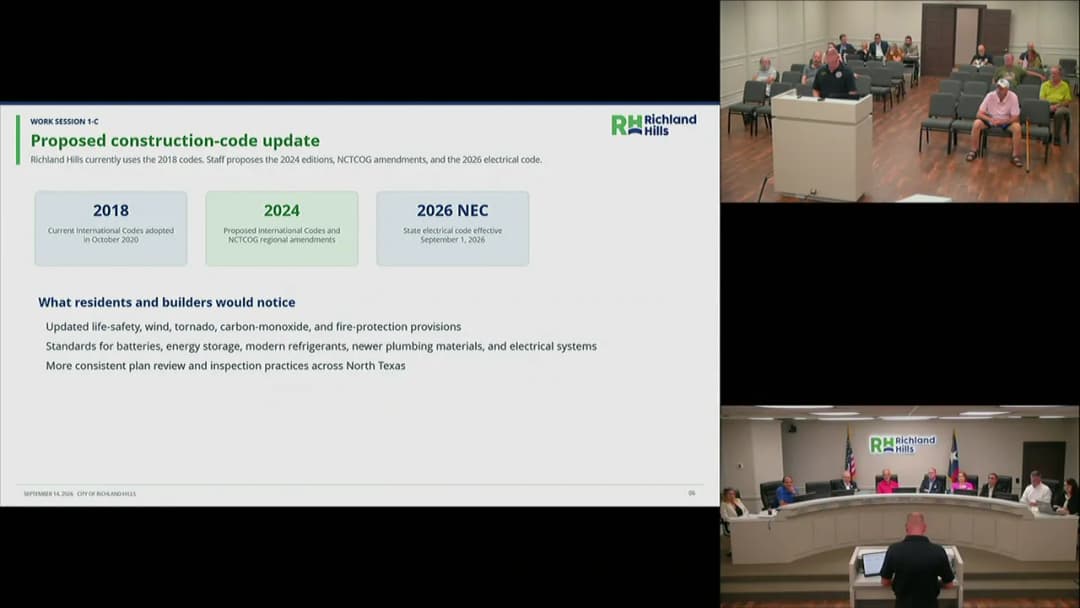
The Richland Hills City Council held a work session and regular meeting on September 14, 2026. The work session covered accessory structure amendments, international code updates, the municipal judge appointment process, utility rate and fee schedule amendments, and the fiscal year 2026 budget timeline. The regular session included citizen comments, an update on the Flash Vote survey, and the FY27 mill and overlay schedule. An executive session for economic development project 26-02 resulted in no action. Consent Calendar - Item 10A & 10B: Unanimously approved. These included the minutes from the August 24, 2026 city council meeting, and the appointment of Kelly Morris (voting) and Eric Valdez (alternate) to the Fort Worth Wholesale Water and Wastewater Customer Advisory Committee for FY2027. Public Comments & Testimony - Jenny Clark (6973 Hardesty Street): Questioned the validity of the FY2027 budget, arguing that if a council member's actions were ruled invalid under parliamentary procedure at a prior meeting, the subsequent vote on the budget could be voidable. She requested clarification from the council. - Jim Shabble: Recommended the city update its FEMA flood zone reports via representative Angela Davidson to address inaccurate flood insurance costs for residents. He advocated for improving drainage infrastructure by reclaiming land from a drainage trough. He also expressed support for amending city rules to allow shipping containers as accessory structures when placed behind fences. He announced his intention to run for city council. Discussion Items - Accessory Structure Amendments (Item 1B): Staff presented proposed revisions to accessory structure regulations, introducing a tiered system where taller structures require larger setbacks. The goal is to provide predictable height limitations tied to lot size and zoning, addressing issues raised by previous projects. Staff will return in October with a final draft ordinance for a joint work session with the Planning and Zoning Commission. - International Code Adoption (Item 1C): Staff recommended adopting the 2024 International Codes and the 2026 National Electrical Code. Chief Rhodes reported that failing to update could cost the city its elite ISO 2 fire rating, potentially increasing residential insurance premiums by approximately $75 annually and commercial premiums by hundreds to thousands of dollars. The new codes also provide critical standards for lithium-ion battery storage and mandatory carbon monoxide detection. Council was generally supportive. - Municipal Judge Appointment Process (Item 1D): Council favored a joint solicitation process with the cities of North Richland Hills and Watauga to appoint a new presiding municipal judge to replace Judge Bass. Staff will coordinate with the other cities over the next 60 days. - Utility & Court Fine Write-Offs (Item 1E): Staff presented aging reports showing over $4.6 million in outstanding court citations and $856,000 in old utility balances over three years. Council agreed that an initial significant write-off should come before the council as a body, with future annual write-offs delegated to staff as part of the audit process. - Proposed Citizen Civic Academy – RH 101 (Item 1F): A proposed pilot 8-session citizen academy was discussed, set to begin in October. The program aims to educate residents on city operations, budgeting, and public safety. Council supported the program, suggesting it target active residents and those with questions about city services. - Utility Rate Updates for FY27 (Item 1G): Staff proposed a water and sewer rate adjustment to address wholesale cost increases from Fort Worth (10.68% water, 18% sewer) and TRA (3.5% sewer). The proposed increase for a typical residential customer is approximately $6.95 per month (roughly 7%). Without any rate adjustments, the utility fund balance is projected to hit zero by 2031. A full presentation by the WaterWorth modeling tool was postponed to the October 12th meeting. - Draft Fee Schedule Amendments (Item 1H): Staff proposed updating various fees to cover actual costs, including increases to utility deposits, building permit fees, and code enforcement abatement fees. Council directed staff to research and prepare a credit card convenience fee across all city departments to offset processing costs. - FY27 Mill & Overlay Schedule (Item 9B): Kelly from Public Works reported that Tarrant County Precinct 3 recommends full-depth reclamation over standard mill and overlay for most of the 9 identified roadways, offering a 15-20 year lifespan. The county's cost estimate is $1.33 million. Staff will meet with the Infrastructure Committee to finalize road selections and develop interlocal agreements. Construction is anticipated for late spring or early summer 2027. - Flash Vote Update (Item 9A): Currently 160 residents are enrolled in the Flash Vote survey platform, short of the 200 needed for statistical significance. Staff will heavily promote sign-ups at the upcoming National Night Out event on October 6th. Key Outcomes - No Action Taken: Executive session for Economic Development Project 26-02 concluded with no action taken or requested. - Pending Actions: Staff will bring forward formal ordinances for the adoption of new international codes, utility rate adjustments, and fee schedule amendments for a vote in October. - Write-Off Approval: Staff will prepare a formal resolution for the initial write-off of uncollectible court and utility balances for council consideration. - Marketing Directed: Staff instructed to create promotional materials for the Flash Vote survey and the RH 101 Citizen Academy. - Credit Card Fees: Staff directed to develop a resolution implementing a credit card convenience fee.
The Public Meeting Index
The Public Meeting IndexThe Watauga City Council held a workshop meeting on Monday, September 14, 2026, beginning at 5:30 PM in the City Hall Council Chamber at 7105 Whitley Road. All council members and the mayor were present. No members of the public spoke during the public comment period. The meeting was informational, with presentations on municipal court fines/fees and proposed personnel policy updates. The meeting adjourned at 6:33 PM, and the regular council meeting was scheduled to begin at 6:45 PM. Municipal Court Fines and Fees Presentation - Jennifer Dorsett presented an overview of Municipal Court revenue. She explained that defendants often assume the city keeps all fines, but the city remits a significant portion to the State of Texas each quarter. - For a sample speeding citation (41 mph in a 25 mph zone) paid at the window, the total payment is $214; the city retains $85 in unrestricted funds, and the state receives $112 (52%). In a defensive driving example, the defendant pays the city $144, with $115 (80%) going to the state, $15 to city unrestricted funds, and $14 to restricted funds. - Restricted funds include court security/technology, a local truancy prevention fund (used for juvenile case manager and teen court), and a municipal jury fund. Court security/technology and other restricted funds are audited by the state controller's office. - Councilman Mark Taylor asked about state remittances. The presenter estimated quarterly remittances of $50,000 to $60,000, on average. She said state-consolidated fees fund items such as police officer training and crime victims compensation, among 20-25 different funds. - Councilman Taylor and Councilman Dunn criticized state-imposed, unfunded mandates and argued that cities function as collection agencies for the state. The presenter noted that the Texas Municipal League revenue manual describes the city as a collection agency for the state. Dunn also mentioned a 2011 effort to require state reimbursement for unfunded mandates, which he said went nowhere. - Councilman Andrew Neal asked whether state fees set a floor for fines. The presenter responded that fines have statutory minimums and maximums set by the judge, but state court costs are set by the legislature and must be collected; judges can waive fines and costs for indigent defendants. - Councilman Can Hill asked whether court revenue covers court operations. The presenter said it is close, but if officer time writing citations is counted, the city is in the hole. - Police Chief Barkley addressed the idea that the recent speed limit reduction to 25 mph was for revenue. He reported that traffic stops were nearly identical in the four months before and after the change (3,304 before vs. 3,303 after). Citations dropped from 627 to 508, and warnings rose from 488 to 719. He noted that speeding is a factor in 29% of traffic fatalities and 8-18% of crashes, depending on data. Proposed Personnel Policy Updates - Juliet Rodriguez, Human Resources and Civil Service Director, presented proposed personnel policy revisions intended to take effect October 1, 2026. She said the changes respond to updated guidelines, employee retention needs, and requests made during meet-and-confer negotiations with the Watauga Police Officers Association. - ADA policy (2.02): Expand policy statement to cover Title I and Title II obligations; update definitions of disability and essential job function; expand procedures to include citizens and patrons; add employee ADA accommodation request steps, interactive process, verification of disability, and confidentiality/responsibility updates. - Performance evaluation policy: Encourage supervisors to meet with staff more than once a year, align the policy with evaluation form scoring, and clarify that appeals are placed in personnel files. - Classification and compensation policy (6.04): Allow cost-of-living adjustments at an alternate date rather than only at the beginning of the fiscal year; add monthly field training officer pay for police officers training new officers/cadets; create a one-time cost savings incentive of up to $1,500, subject to department head verification and city manager approval, split among teams if applicable. Rodriguez noted the slide incorrectly listed the policy number as 6.06. - Workers' compensation policy: Remove the five-day election window for salary continuation so injured employees are not blocked if the need for leave is discovered later. - Vacation leave policy: Allow employees at the maximum accrual (240 hours for 8/10-hour employees; 360 hours for 12/24-hour shift personnel) to accrue up to 60 or 80 additional hours until the last pay period in September, with balances then reduced back to the cap. This addresses staffing-related difficulty taking leave and does not increase year-end leave liability. The policy also adds pay period accrual amounts and allows the city manager to withhold vacation payout for employees appealing indefinite suspension until the appeal is resolved. - Sick leave policy: Clarify misuse of sick leave; update definitions of spouse, child, and parent; require employees to report absences before shift start, with family members allowed to report for them; add pay period accruals; allow withholding sick leave payout for appealing civil service employees; clarify that department heads must request sick leave donations; and update the well pay conversion form to include shift personnel. - Artificial intelligence policy (14.05): New policy covering city officials, employees, contractors, temporary staff, and volunteers; includes permitted/restricted uses, prior IT approval for new AI tools, data security, human verification of AI output, transparency/disclosure for public-facing AI-generated materials, ethical responsibility, mandatory compliance training, and retention under the Public Information Act. An approved-tools sample list from IT is included. - Employee safety policy (16.01): Update objectives and responsibilities, clarify immediate injury reporting, add hazard reporting, revise PPE language, and add a safety recognition section. - Inclement weather policy (18.01): Clarify guidelines; add an option for the city manager to grant special weather compensatory time for employees working on inclement weather days, with no payout at separation; add payroll reporting and accrual process language. - Rodriguez said the travel and reimbursement policy listed on the consent item was pulled and will come forward later after additional edits. Council Discussion on Personnel Policies - Councilman Taylor questioned why periodic performance discussions are only highly encouraged rather than required. Rodriguez cited time constraints, about 14 city vacancies, and recent supervisor training; Taylor maintained that periodic reviews should be required. - Taylor also questioned the cost savings incentive, asking whether a small saving would trigger a $1,500 award. Rodriguez clarified the policy allows up to $1,500 and requires department head and city manager approval. - Taylor raised concerns about vacation accrual, saying vacation is important for stress reduction and warning against allowing employees to bank leave when time off is available. He also asked if the city had considered a combined PTO system; Rodriguez said it had been researched previously and was not a fit, partly because Watauga is a civil service city. Mayor Artline noted that the prior leave liability was significant but not to the point of bankrupting the city. - Councilwoman Hale described a prior city's experience with sick leave donation abuse, where donations switched to vacation time and abuse declined. Rodriguez said Watauga sick leave donations are uncommon and unused donations are returned. - Councilman Neal supported keeping separate sick leave and vacation pools rather than combined PTO, noting that combined PTO can hurt employees who get sick. He asked about reporting mechanisms for questionable AI-generated output; Rodriguez and Chief Barkley said employees should escalate concerns through their chain of command and supervisors. - Councilman Welch suggested requiring employees to project their leave use so supervisors can manage balances and prevent employees from losing leave. Key Outcomes - No formal votes were taken during the workshop. - The Municipal Court presentation and traffic stop data were informational; no action was requested. - Personnel policy revisions were presented for council feedback; no formal adoption occurred, with proposed changes expected to be effective October 1, 2026, if approved later. - The travel and reimbursement policy was pulled from the consent item and will return at a later date. - The meeting adjourned at 6:33 PM; the regular council meeting was scheduled to start at 6:45 PM.
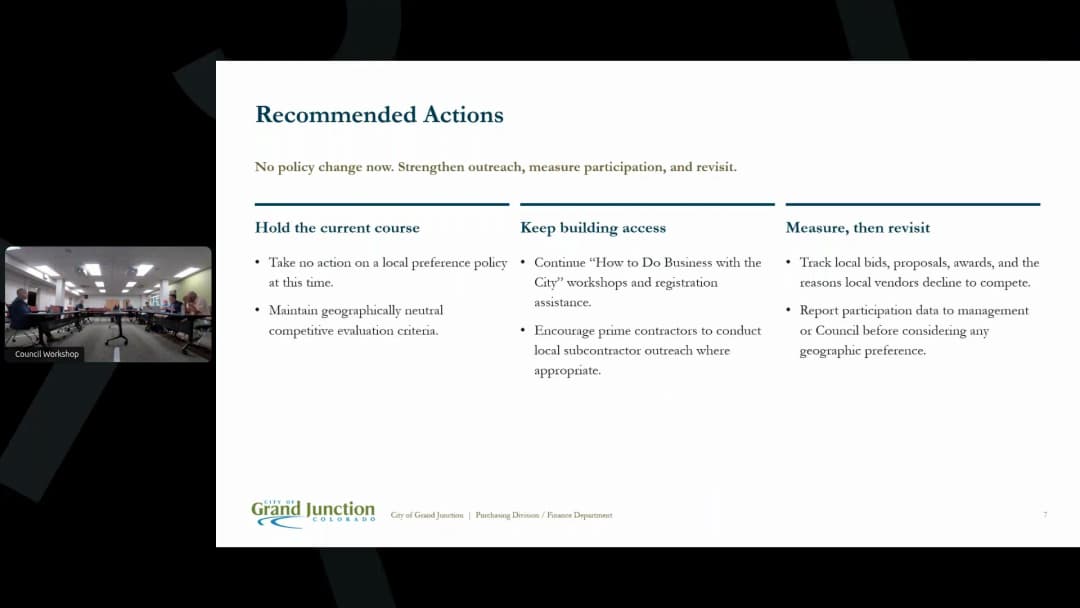
September 14, 2026 | 5:30 p.m. – 6:56 p.m. The Grand Junction City Council held a workshop on September 14, 2026, at the Fire Department Training Room. The meeting focused on three major discussion topics: a new Water Supply Element required by state law, a proposed temporary moratorium on data centers, and a potential local preference policy for city procurements. Council also discussed upcoming budget workshops, a resolution supporting Mountain Rail passenger service, and a request to join the Mayor's Alliance to End Childhood Hunger. No formal votes were taken; the workshop served as a forum for information and direction setting. Water Supply Element – Comprehensive Plan Amendment - Staff presented the Water Supply Element required by Colorado Senate Bill 24-174, which must be adopted by the Planning Commission by December 31, 2026. - The element draws from existing regional water-efficiency and drought-response plans and aligns with the Colorado Water Plan. - Staff reported that current water supplies meet current and projected future needs, and conservation efforts have extended the supply-demand nexus from 2039 to approximately 2049 without significant infrastructure investments. - Council discussed the effects of population growth, demographic shifts, and increasing aridity. Councilmember Scott Beilfuss noted that the outlook improvement is partly due to declining water use per tap and the trend toward an older population. - Staff will consult with local water providers and irrigation districts, incorporate feedback, and then forward the amendment to the Planning Commission. Temporary Moratorium on Data Centers - Staff proposed a temporary moratorium of up to 365 days on large data centers while the City develops appropriate land-use regulations. The current code does not specifically address data centers, creating uncertainty for evaluation. - No applications are pending, but the City has received inquiries. - Council emphasized the need to coordinate with Mesa County, neighboring jurisdictions, and water and energy providers, as a data center outside city limits could still have regional infrastructure impacts. - Council also suggested expanding the review to include other high-water or high-energy industrial uses, such as water bottling or chip manufacturing. - Staff will refine the draft moratorium ordinance and use the moratorium period to evaluate best practices and potential development standards. The moratorium would expire upon council adoption of code amendments or after 365 days, whichever comes first. Local Preference for Procurements - Staff reviewed options for giving local businesses an advantage in city procurement, citing examples from Longmont, Thornton, and Garfield County. Concerns raised included higher costs, reduced competition, administrative complexity, and conflicts with federal grant requirements. - Councilmembers expressed differing perspectives. Councilmember Cody Kennedy noted frustration with local firms losing contracts to out-of-state companies and cited examples of other Western Slope communities with local preference policies. Councilmembers Ben Van Dyke and Jason Nguyen expressed concerns about reduced competition and potential negative impacts on bid quality and taxpayer value. - Councilmember Nguyen suggested exploring a Colorado-based preference rather than strictly local, but the interim city attorney noted potential interstate commerce and constitutional issues. - Council agreed to begin tracking local versus non-local participation and contract awards, bid-price differences, and reasons local businesses may not bid. Staff will also continue outreach and education on how local businesses can compete for city contracts. Council Communication - Councilmember Scott Beilfuss shared information from the Colorado Basin Roundtable regarding statewide water conservation efforts. - Staff clarified that regular meetings among local domestic water-provider managers address operational issues, regulations, supply, and short-term planning. - Council revisited drought-related water rates; staff indicated proposed 2027 rates will address rate structure and potential drought-rate adjustments. - Council discussed supporting additional Mountain Rail passenger service to Grand Junction. A resolution demonstrating support, without committing funding, will be placed on the September 16, 2026, regular council agenda for consideration. Next Workshop Topics - City Manager Mike Bennett confirmed that the next three workshops will focus heavily on the city budget. October workshops will be held on October 5 and October 26 at 4:00 p.m. (instead of the usual first and third Monday). - Staff is preparing a comprehensive review of boards and commissions, including voting structures, bylaws, ordinances, charter provisions, and roles of council and staff liaisons. - Council's norms of conduct will return for discussion following the budget process. Other Business – Mayor's Alliance to End Childhood Hunger - Council reviewed an invitation for Mayor Laurel Lutz to join the Mayor's Alliance to End Childhood Hunger, which involves a pledge to work toward ending childhood hunger. Several councilmembers expressed caution about signing on without understanding specific commitments, noting that Mesa County and School District 51 already lead such efforts locally. - Mayor Lutz decided to hold off on signing and conduct further research before bringing the matter back to council. Key Outcomes - Water Supply Element: Staff will consult with water providers and then submit the amendment to the Planning Commission for adoption by December 31, 2026. - Data Center Moratorium: Staff will refine the draft moratorium ordinance and present it for first and second readings at a future council meeting. - Local Preference: Staff will begin quarterly tracking of local versus non-local procurement data and continue outreach. No policy change was adopted. - Mountain Rail: A resolution of support will be placed on the September 16, 2026, regular council agenda. - Budget Workshops: October 5 and 26 at 4:00 p.m. are confirmed. - Childhood Hunger Alliance: Mayor will research further before deciding to sign.
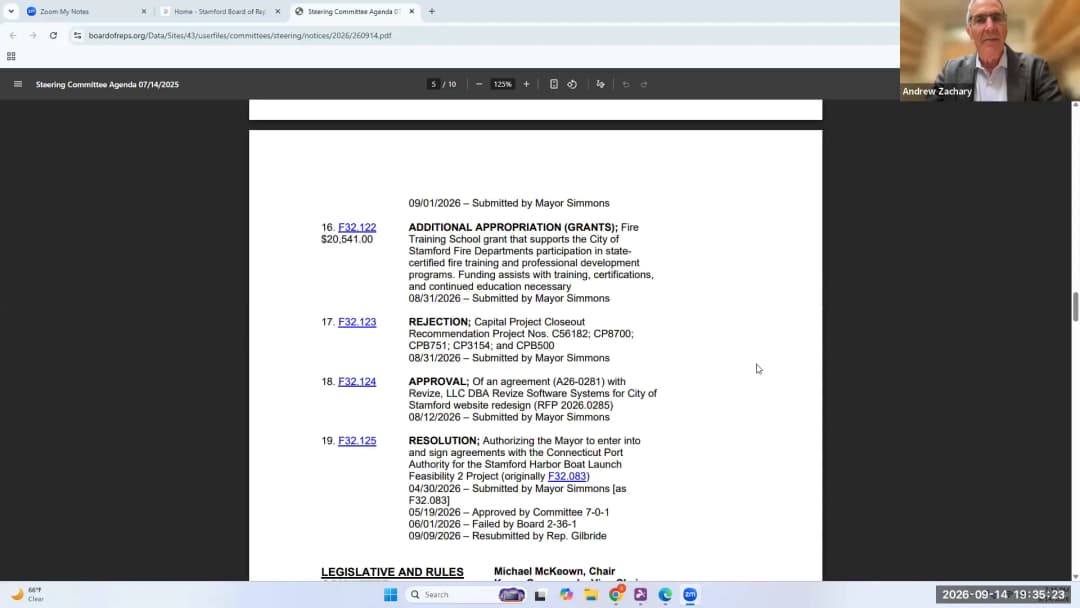
The Steering Committee of the 32nd Board of Representatives met remotely on Monday, September 14, 2026, at 7:01 p.m. (adjourned at 8:19 p.m.) to set the agenda for the October 2026 committee meetings. Members reviewed and voted on dozens of items, including appointments, fiscal appropriations, legislative proposals, and review requests. A key debate centered on whether to add two review items concerning public safety incidents, one of which was defeated in a roll-call vote. Consent Calendar - Appointments Committee (5 items): Unanimously placed on the October agenda, including appointments to the Citation Officer, Environmental Protection Board, Patriotic and Special Events Commission, Zoning Board, and Planning Board. - Fiscal Committee (19 items): All 19 items, including agreements with Graviton Consulting, grants for police patrols and LifeVac kits, capital projects for street resurfacing, fire apparatus replacement, Lione Park, Scalzi Park tennis courts, Cove Island tennis courts, Glenbrook Community Center flood repairs, indoor air quality, fire training, capital project closeouts, website redesign, and the Stamford Harbor Boat Launch Feasibility Project, were unanimously moved to the October agenda. - Legislative & Rules Committee (3 of 4 items): Items LR32.021 (window safety legislation), LR32.023 (urban grocery store district ordinance), and LR32.024 (lease with Domus Kids for Glenbrook Community Center) were unanimously placed on the agenda. Item LR32.022 (FOIA procedures review) was not moved after extensive discussion. - Personnel Committee: No items submitted; committee will not meet in October. - Land Use & Urban Redevelopment Committee: No items submitted; committee will not meet in October. - Operations, Parks & Recreation Committee (2 items): Resolutions approving cost-recovery fee models for electric vehicle chargers at Bell Street Garage and Government Center Garage were unanimously placed on the agenda. - Public Safety & Health Committee: Items PS32.010 (blighted property procedures) and PS32.011 (police community engagement overview) were unanimously placed on the agenda. Items PS32.012 (pedestrian fatality review) and PS32.013 (Rippowam Park fires review) were debated separately. - Community Development, Housing, Education, Social Services, State & Commerce (CHESS) Committee (2 items): A review of Stamford’s non-compliance with CDBG expenditure requirements (CHESS32.021) and an ordinance amending the Stamford Housing Affordable Trust Fund (CHESS32.024) were unanimously placed on the agenda. - Transportation Committee: No items submitted; committee will not meet in October. - Approval of September 8, 2026 Regular Board Meeting Minutes: Unanimously placed on the October agenda. Discussion Items - LR32.022 – FOIA Procedures Review (Legislative & Rules): Representative Pavia submitted a review item to clarify procedures for elected and appointed officials upon receiving a public records request. Several representatives, including Majority Leader Morson and Reps. Weinberg, Wirz, and Sandford, argued that FOIA training had already been provided at the start of the term and that individual questions should be directed to legal counsel or the Board office. President Shaw concurred, noting that the request lacked prior outreach to department heads. No motion to move the item to the agenda was made; it was placed on the pending agenda by default. - PS32.012 – Pedestrian Fatality at Progress Drive & Stillwater Avenue (Public Safety & Health): Chair Bouchard initially included this item in his motion but removed it after learning that an arrest had been made and an investigation is ongoing. Rep. Walston, the submitter, clarified she wanted a review of the crosswalk’s safety, not the fatality itself. Despite this, the committee did not advance the item. - PS32.013 – Fires at Rippowam Park Apartments (Public Safety & Health): Chair Bouchard moved the item for discussion. Rep. Walston explained that constituents are afraid and want assurance about fire safety upgrades. Reps. Weinberg, Wirz, and Sanford expressed concerns about ongoing investigations and potential litigation. Majority Leader Morson warned that review items could compromise legal cases. Rep. Camporeale supported the item, noting that review items serve an important investigative function and that constituents’ concerns merit public discussion. After extended debate, a motion to move the item to the October agenda was made and seconded. Key Outcomes - All consent calendar items were approved by unanimous voice votes, placing them on the respective committee agendas for October 2026. - LR32.022 (FOIA review) was not placed on the agenda; it will remain on the pending agenda by default. - PS32.012 (pedestrian fatality) was not moved; it will be placed on the pending agenda. - PS32.013 (Rippowam Park fires) was defeated in a roll-call vote of 5.5 yes – 8.5 no – 0 abstentions. The motion failed, and the item was placed on the pending agenda. Members who voted yes: Adams, Bouchard, Camporeale, Gardner (1/2), Hughes (1/2), Shore, Sylvestre. Members who voted no: President Shaw, McKeown, Morson, Pollack, Price (1/2), Sandford, Weinberg, Wirz, Zachary. - Procedure for review items was emphasized: Chair Bouchard and President Shaw agreed to circulate clearer guidelines for submitting review items, including prior consultation with relevant department heads and confirmation that subject matter experts are prepared to present.
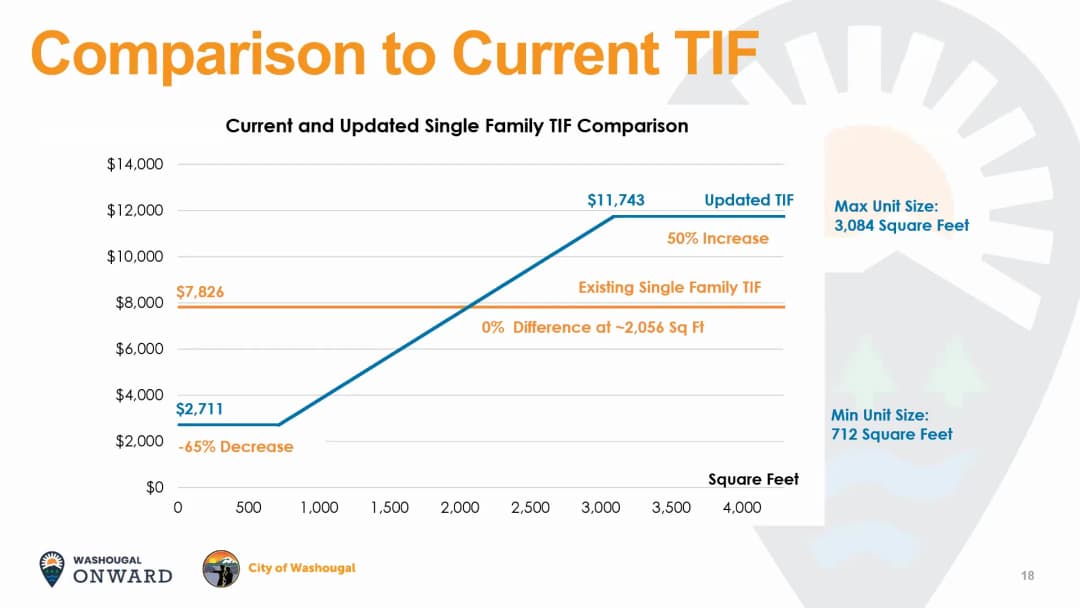
The City of Washougal City Council held a workshop on Monday, September 14, 2026, from 5:00 PM to 6:52 PM. Mayor David Stuebe presided. Present were Councilmembers Tia Robertson (arrived at 5:02 PM), Ernie Suggs, Michelle Wagner, Marty Swofford, and David Szyplinski; Student Representative Jake Larzalere was also present. Mayor Pro Tem David Fritz was absent. Staff presentations covered updated park and transportation impact fees, the first-half 2026 financial report, and the six-year Transportation Improvement Program. No formal council votes were taken; direction and next steps were discussed. Public Comments & Testimony - Port Commissioner Larry Keister reported that he and Cassie would attend the Washington Public Ports Environmental Seminar in Seattle and tour the Port of Seattle to learn about successful initiatives. He said topics would include industrial symbiosis related to the Port's 41st Street development, alternative power options, electric truck charging, and examples such as data center heat reuse in Finland. He expressed commitment to working with the city on these efforts. Discussion Items - Community Development: Park & Transportation Impact Fees Updates — Mitch Kneipp, Jessica Herceg (DOWL), and Michaela Jellicoe (CAI) presented. The presentation covered impact fee background, 2026 data updates, methodology changes required by state law, and implementation considerations. - Under the updated data alone, the transportation impact fee cost per trip would rise from $860.93 to $889.58, an increase of $28.65 (3.3%); the park impact fee cost per person would rise from $2,577.75 to $2,582.75, an increase of $5 (0.2%). The park figure was corrected during the meeting from the slide. - The Washington State Legislature's amended RCW requires impact fee schedules to reflect the proportionate impact of housing units based on square footage, bedrooms, or trips generated, producing proportionately lower fees for smaller units. Adoption is required within six months of the comprehensive plan update. - Using state Commerce guidance and American Housing Survey data for the Portland-Vancouver MSA (2019), staff derived 2.81 average persons per dwelling unit, 2,001 sq ft average unit size, a 712 sq ft statistical minimum, and a 3,084 sq ft statistical maximum. - Maximum allowable park fee proposed: $3.63 per sq ft, with a minimum fee of $2,582.75 for units 712 sq ft or smaller and a maximum of $11,187.91 for units 3,084 sq ft or larger. For transportation: $3.81 per sq ft, with a minimum of $2,710.89 and a maximum of $11,743. - Council discussed that this approach incentivizes smaller units and multifamily housing. Some members expressed concern that larger homes would see higher fees passed on to buyers; others noted the change is required by state law. - For ADUs, state law caps impact fees at 50% of the primary dwelling unit's fee. Washougal currently charges 35% of the single-family rate. Staff recommended keeping an adopted reduction approach, and the planning commission was reported to favor retaining the 35% reduction. An example showed that a 525 sq ft ADU with a 2,150 sq ft primary unit would pay $903.96 under the park fee at the 35% reduction, while the alternative calculation would be compliant at the $2,582.75 minimum because it is below the 50% threshold of $3,902.25. - The council discussed exemptions for replacements, alterations/expansions, ADUs, and additions. Because the new fee is based on square footage, staff sought direction on when additions should trigger fees. Planning commission had discussed 25%; council members suggested zero, 20%, 25%, or a "500 sq ft or 25%, whichever is greater" approach. Staff agreed to return in a few weeks with examples showing fee impacts on different home sizes. - Finance: Q1 & Q2 Financial Report — Finance Director/City Clerk Daniel Layer presented key economic indicators and first-half financial results. - U.S. real GDP grew at about 1.5% annualized in Q2 2026; unemployment averaged 4.3% in the first half; PCE inflation was 3.7% annually (3.34% excluding food and energy); the Fed held rates between 3.5% and 3.75% since December. - Washington State had the best GDP growth in the nation in Q1 2026 at 4.5%; state unemployment averaged 5.13%; CPI rose 2.9% from June to June. Clark County unemployment averaged 4.93%, with about 1,100 jobs added over the year, mostly in private education and health services. - As of June 30, general fund revenues were 48.4% of the amended budget, down 14.7% from the same point in 2025. Utility taxes/franchise fees were down 18% due to the milder winter; licenses/permits and subdivision/zoning/planning fees were down 77.8% due to one-time high-point building permits in 2025; retail sales tax collections were up 23% due to waterfront construction. - General fund expenditures were 43.9% of budget, down 20.3% from 2025, partly due to the prior year's approximately $1 million fire truck purchase. Fire/EMS and police together account for about 50% of the general fund budget. Layer also noted the Regional Fire Authority transition will remove about $5.2 million from the city budget, making police the largest cost center starting in 2027. - Water and sewer revenues were 44% of budget, up 2%; stormwater revenues were 47.3%, up 7.1%. A $2.2 million debt service payment was made at the end of August. - The city's overall opening balance increased from $52.6 million to an estimated $54.3 million. About $2.5 million in federal grant reimbursements was still pending. The transportation fund was temporarily supported by the transportation impact fee balance of more than $4.5 million. - Investments: $12.7 million in LGIP earning about 3.7%; $7.8 million in Riverview R&T earning about 3.25%; bonds/treasury notes maturing quarterly with returns ranging from about 1-2% to 4.5%. - Council asked about TIFF balance/cash flow risk and investment limits; Layer said the city tracks revenue sources carefully and public funds investment options are risk-limited. - Public Works: 6-Year Transportation Improvement Program — Jonathan Boehme presented the state-required, annually updated six-year plan. It includes 22 projects aligned with the Transportation Capital Facilities Plan and comprehensive plan update. The plan distinguishes funded, partially funded, and unfunded projects; unfunded projects remain listed because grants often require projects to be on the TIP. - Spotlight projects: 32nd Street sidewalk (Safe Routes to School, entering design); Shepherd Road pedestrian connection (TIB-funded, in design toward 60%); systemic stop improvements (100% federally funded, 10 intersections); and ADA curb ramp upgrades (new project, $100,000 per year, supporting the ADA transition plan). - A council question clarified that a grant listed for Crown Road was a planned funding source, not a secured grant. Another question clarified that Shepherd Road would use a mix of typical sections A, B, and C along the corridor. - Staff recommended scheduling a public hearing for September 28, 2026, to consider adoption. Key Outcomes - No formal votes or ordinances were adopted at the workshop. - Council gave informal direction on impact fees: continue with the square-foot methodology, retain the ADU reduction approach at 35%, and consider an addition exemption threshold such as 25% or a "500 sq ft or 25%, whichever is greater" option. Staff will bring examples and code language back in a few weeks. - Staff was directed to schedule a public hearing for the six-year Transportation Improvement Program at the September 28, 2026 council meeting. - City Manager, Mayor, and Council reports were deferred; the meeting adjourned at 6:52 PM.
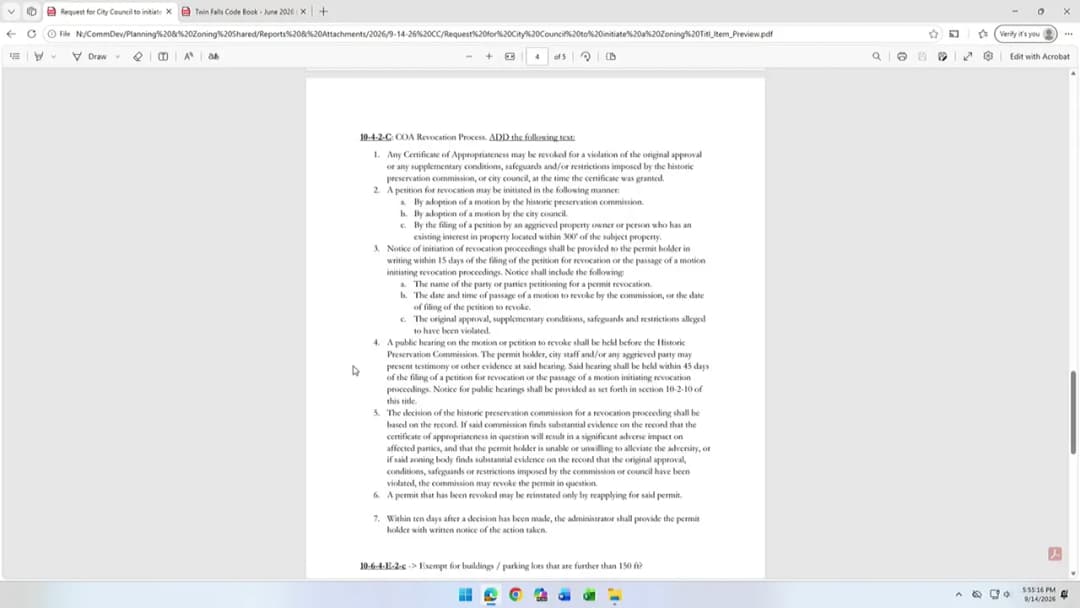
The Twin Falls City Council met on Monday, September 14, 2026 at 5:00 PM in Council Chambers. Mayor Jason Brown presided. All seven council members were present: Vice Mayor Craig Hawkins and Council Members Christopher Reid, Grayson Stone, Cherie Vollmer, Ruth Pierce, and Nathan Murray. The meeting opened with the Pledge of Allegiance and two proclamations, followed by approval of the consent calendar, discussion and action on several items, general public input, advisory board announcements, a public hearing on the budget, and an executive session. All votes on action items were unanimous (7-0). Proclamations - National Adult Education & Family Literacy Week: The mayor read a proclamation recognizing the week. Key statistics noted include over 4,000 unemployed adults in the area, graduates earning an average of $10,000 more per year, and the city receiving a tax revenue boost of over $6,000 per graduate. - Falls Prevention Awareness Month: The proclamation highlighted that 33.6% of Idahoans aged 65 and older fall each year (above the national average), one in five falls results in serious injury, and Idaho incurs $164 million annually in fall-related costs (average medical cost $38,373 per fall). Consent Calendar The council approved the consent calendar 7-0, including: - Minutes of August 31, 2026. - Accounts payable for August 27 through September 9, 2026. - Travel requests for September 9, 2026. - Findings of fact for PUD Amendment PZ6-0077. - Special event permit for the Rock Paper Scissors Tournament of Champions. - Addendum from Flock Safety for Automated License Plate Reader services. Items of Consideration Canyon Rim Drop Line Project – Final Design Contract Environmental Manager Nathan Erickson requested use of FY2026 wastewater budgeted funds not exceeding $557,255 for the final design contract with Hazen and Sawyer. The line carries about half of the city’s wastewater and is critical due to elevation constraints. The preferred alignment follows a walking path to avoid complications at the existing site. Council Member Reid asked why not reuse the same alignment; Erickson explained the new route avoids poor conditions at the top and aligns with an open connection point at the bottom. Motion to approve carried 7-0. Residential Curbside Recycling Citizen Survey Utility Billing Supervisor Chelsea Ross presented a draft survey to gather public input on the future of curbside recycling. The survey asks about current usage, satisfaction, willingness to pay, and preferences if recycling is not continued. Discussion covered duplicate responses (City Manager Rothweiler noted IP checks), clarifying the residency question (to map responses by area for better analysis), and specifying the types of plastics that would be included. The council also discussed a chart of service options from prior meetings; staff confirmed the survey focuses on whether to keep recycling or not, and the contract is structured for either decision. Council gave direction on survey content; no formal vote was taken. Zoning Title Amendment – Initiation Senior Planner William Klaver and Planning & Zoning Director Jonathan Spendlove presented proposed corrections and updates to Title 10. Major changes include: allowing nonconforming building expansions up to code without a hearing (but a hearing if extending the nonconformity); adjusting alley setbacks for non-garage accessory buildings; adding health fitness facilities (occupant load ≤49) as a special use to professional office overlays; adding data centers as a special use in industrial zones with specific criteria; allowing hotels/motels at the airport as a special use; revising the community market uses (minor event centers and fuel stations discussed); exempting Rock Creek from the Canyon Rim Overlay setback (council expressed preference to retain protection); adding sign regulations in the Canyon Rim Overlay; and other corrections. Council provided direction and initiated the amendment. Motion to initiate carried 7-0. 2026 National Citizen Survey – Customized Questions Assistant to the City Manager Mandi Thompson reviewed the history of asking residents about a local option sales tax. The council discussed whether to continue gathering data. City Manager Rothweiler noted the importance of being prepared with data if the state considers eliminating property taxes or expanding local option taxes. Council Members Vollmer, Pierce, and Hawkins agreed to continue the question to maintain awareness and support property tax relief narratives. No vote was taken, but the council directed staff to retain the local option sales tax questions. General Public Input Four residents addressed the council: - Maria Hernandez praised a free mental health seminar ("Living Free with Intention") co-sponsored by St. Luke’s and CSI, and stressed the need for youth belonging and suicide prevention. - Lucy Wills expressed support for the continued use of Flock cameras, arguing that surveillance is common in many public spaces and that opponents may not represent the majority. - Dan King, Communications Chair for The Church of Jesus Christ of Latter-day Saints, distributed personal invitations to the Salt Lake Temple open house (April 5 – October 3, 2027). - Noah Heck asked the council to consider directing RITFT to offer free fares on Election Day (November 3, 2026) to ensure voting access amid uncertainty over mail-in ballots due to legal challenges to a federal executive order. Advisory Board Reports and Announcements - Council Member Stone Resignation: Grayson Stone announced his resignation effective September 15, 2026, having won the Republican primary for Idaho House District 25A. Mayor Brown accepted and stated he would outline the replacement process at the next meeting, possibly combining seats from the upcoming general election. - Council Member Murray reported that the library is seeking additional staff training on accessibility and responding to sensory needs. Public Hearing: Budget Amendment FY 25-26 Budget Coordinator Mathew Farnes presented Ordinance 2026-009, an amendment appropriating an additional $18,475,812 for the fiscal year ending September 30, 2026. Major projects include Eastland Drive reconstruction (street fund), pool remodel (capital improvement fund), Vista Bonita Park (SLFRF grant), Canyon Trail Junction (impact fees), city gym legal offices, fire engine and bucket truck, Rock Creek Restoration (USDA/RCS grant), police admin lift and brush truck, Eastern Sun neighborhood park land (impact fees), airport construction (federal grants), and Hanson Street Plaza playground (CDBG). The public hearing was opened and closed with no testimony. Council then moved to waive rules and read the ordinance by title only. Ordinance 2026-009 approved 7-0. Executive Session The council voted 7-0 to adjourn into executive session under Idaho Code §74-206(1)(c) to discuss acquiring an interest in real property not owned by the city. The regular meeting was adjourned into executive session at 6:38 PM; the regular meeting formally concluded at 6:50 PM.
The Red Wing City Council held an informational workshop on September 14, 2026, to receive an update on the proposed new Law Enforcement Center (LEC). Police Chief Nick Sather led the presentation alongside representatives Michael Healy and Paul Mitchell from BKV Group. Council Administrator Chris Heineman, Assistant Finance Director Tony Schultz, and other city staff were present to answer questions. Council President Janie Farrar convened the workshop at 5:00 PM, and no formal decisions or votes were taken. Discussion Items - Need for a New Facility: Chief Sather outlined the inadequacies of the current space, including outgrown capacity, lack of secure separation between staff and the public, poor victim privacy in the lobby, no secure indoor fleet parking (citing $100,000 in recent hail damage to squad cars), exhausted storage, and the inability to place city signage on the current county-owned building. - Site Selection: Chief Sather explained that the Technology Drive site was selected as the top choice out of nine sites using a 31-criteria weighted scoring matrix. The city-owned site scored 178 points. A potential burial mound was noted as an area of concern, but the current building plan avoids that area. - Building Options and Costs (BKV): BKV presented three 20-year planning options: - Core: 30,506 sq ft, estimated $19M – $21.8M. - Enhanced: 35,000 sq ft, estimated $21M – $24.6M. (Chief Sather recommended using this as a baseline starting point). - Optimal: 43,000 sq ft, estimated $26M – $29M (includes an indoor firing range and a larger 25-stall garage). - Annual construction cost escalation was cited at roughly 5%. - Operational and Maintenance Costs: BKV estimated annual utility costs for a new facility at roughly $42,000. Kraus Anderson projected deferred maintenance over a 20-year period between $5.6M and $6M. - Financing Options: - Option A (Bond All): Bond for the full $23.196M (Enhanced baseline), resulting in a 20-year total cost of $34.9M ($1.745M annual payment). - Option B (Use Reserves): Utilize $7.1M from the Police Pera Fund, half of the Public Safety Aid, and $457,000 in capital reserves to reduce the bonding to $15.2M, resulting in a 20-year total of $22.88M ($1.14M annual payment). Assistant Finance Director Schultz noted that using the Pera Fund would eliminate the interest income currently used for squad car replacement ($150k/year). - Staffing Projections: Chief Sather projected modest growth over 20 years, citing town growth and technology demands. This includes 2-4 additional patrol officers, plus potential new roles for a School Resource Officer, a crime analyst, an investigator, and a Community Service Officer. - Community Engagement: Chief Sather summarized feedback from two public forums held in February 2025. Attendance was low (approximately 17 and 25 people). Feedback was mixed, with support for improved victim-centered design and privacy, but concerns raised about tax impacts and the loss of commercial land for the proposed site. - Future Presentation: Chief Sather confirmed a second workshop is planned. It will feature a parallel analysis from TSP on renovating and expanding the current LEC, allowing the council to make a direct cost comparison between the two options. - Council Inquiries: - Council Member Snyder inquired about the specific legal restrictions and historical use of the Police Pera Fund. - Council Member Norton requested a detailed cost comparison of building maintenance versus renting, an estimate of escalation costs if the project is phased (e.g., building the garage later), and an update on Xcel Energy's IRP and NRC licensure process. Council Administrator Heineman replied that there is no current information from the NRC process. Key Outcomes - The workshop was strictly informational; no formal decisions or votes were made by the council. - Staff will research the legal stipulations of using the Police Pera Fund for construction. - The next step is a follow-up workshop featuring a comparative presentation between the new construction (BKV) and the LEC renovation/expansion options (TSP), including a cost and rent analysis. - The workshop adjourned at 5:51 PM.
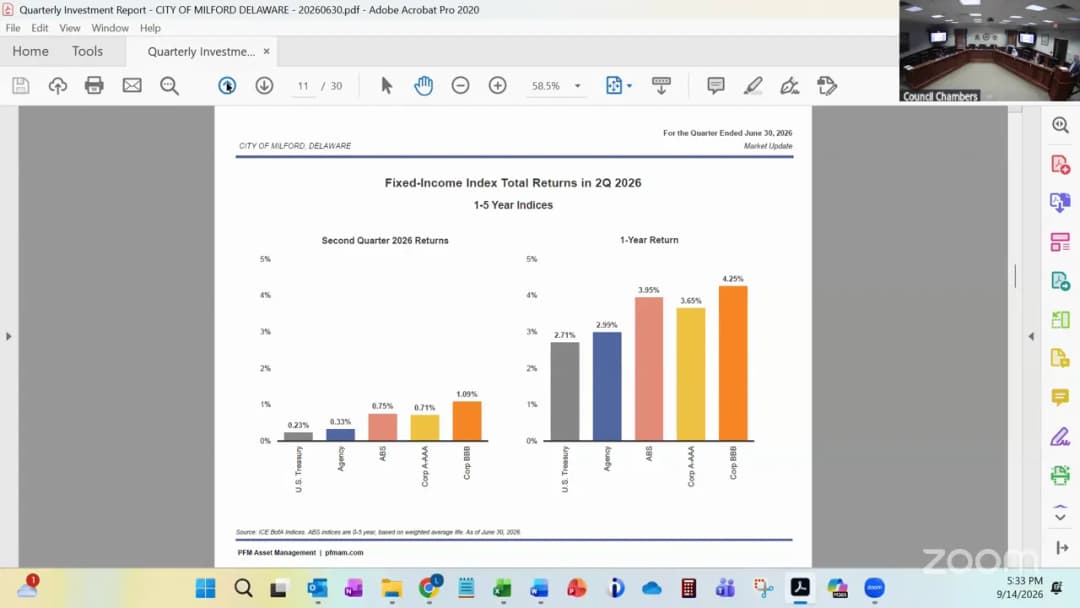
The Milford Finance and Audit Committee met on September 14, 2026, to receive the quarterly investment performance review for the quarter ended June 30, 2026, and the annual Investment Policy Statement (IPS) review. A fiscal 2025 audit update was also on the agenda, but the available transcript does not show it being presented before adjournment. No agenda or minutes were provided; this summary is based solely on the raw transcript. Public Comments & Testimony - A 15-minute public comment period was opened (three minutes per person). No members of the public appeared in the audience or online, and the period was closed without testimony. Investment Policy Statement Annual Review - Finance Director Lou Vitola reported that PFM led the required annual IPS review and recommended no changes; staff reviewed and concurred. - Vitola said he will update the IPS headers to note the review at the start of fiscal 2027 and recirculate the statement; any future issues would be brought to the committee. - Jeff Facino of PFM Asset Management said last year's minor sector-allocation tweaks (such as increasing asset-backed securities) were sufficient and the policy is in good shape for the coming year. Quarterly Investment Performance Review (Quarter Ended June 30, 2026) - Jeff Facino presented the market outlook and portfolio results. - Market context: The economy remained resilient despite geopolitical noise (including the Strait of Hormuz); the Fed held its policy rate at 3.5%–3.75% during the quarter. Treasury yields rose, especially at the front end, and the 10-year Treasury was at 4.99% around the meeting date. Energy prices rose dramatically, keeping inflation elevated, while the labor market stayed strong; earlier expectations of rate cuts were reversed. - Fed outlook: PFM expected a quarter-point rate hike at the Fed's meeting that week, possibly another later in the year, and then a wait-and-see period. - AI spending: A council member cited Anthropic's warning to the AI industry and asked whether slowing AI-related capital spending could lead to additional unemployment. Facino agreed a slowdown would come at some point but said AI-driven efficiencies could still benefit other sectors. - Volatility protection: A councilwoman asked what Milford is doing to protect the portfolio, citing an equity market concentrated in a few companies and international bond-market shifts. Facino replied that the city holds no equities and no international debt; the portfolio consists of high-quality U.S. bonds, with liquidity and safety prioritized ahead of yield. - Portfolio composition: Total portfolio just over $35 million; AA credit quality; diversified across U.S. treasuries, agencies, commercial paper, corporations, and asset-backed securities (ABS at 4.8% of the portfolio, representing equipment leases, auto loans, and high-quality collateral). The 43% corporate allocation consists of high-quality senior debt vetted by PFM's corporate credit research team. - Sector changes: Commercial paper declined from 5% to 1%, reflecting the $4 million withdrawal during the quarter; other sector changes mostly reflected that withdrawal. - Performance: The portfolio outperformed its benchmark for the quarter, one-year, and since-inception periods. Councilman Mariabella (transcribed variously as 'Mara Pela' and 'Bell') asked how much was withdrawn and what portion represented profit; Vitola said $4 million was withdrawn, the portfolio's net value declined by $3.6 million for the quarter (with earnings covering the difference), and over the trailing 12 months the portfolio was down $2 million after the $4 million withdrawal – roughly $2 million of positive performance – exceeding the city's conservative budget expectation of about $1 million. - Duration and policy: Vitola explained that securities purchased at par and held to maturity return the stated yield, and unrealized losses from rising rates erode to zero as interest is collected. Yield ranks third behind safety and liquidity; the IPS governs all decisions, and a future withdrawal would be sourced across sectors proportionally to remain policy-compliant. - Upcoming cash needs: Vitola said additional withdrawals are expected this quarter for the Milford Corporate Center, including water and sewer reserves to pay contractor George & Lynch. The segment tied to the 2016 general obligation bonds is about $3 million-plus, with draws planned over the roughly six years remaining. Presentation Format - The committee was asked to evaluate the new slide format (pages 1–16 before the account summary on page 17). Members said the more visual, easier-to-digest layout was a plus; one member with computer trouble still praised it. Key Outcomes - No formal votes were taken. The committee received the quarterly investment report and accepted PFM's recommendation of no IPS changes; Vitola will update the IPS headers and recirculate the statement. - Councilman Mariabella said he was glad the portfolio is conservative; Councilman Bell later concurred that 'it's not our money' and praised the decision to engage PFM about three to four years ago. - The chair emphasized safety, liquidity, and yield, stated the city is 'not gamblers' with taxpayer dollars, and credited the investment program with helping Milford avoid tax increases. - The city manager thanked the committee for its questions, and the meeting adjourned. - The fiscal 2025 audit update was listed on the agenda and mentioned by the Finance Director, but it does not appear in the transcript before adjournment; this may reflect an incomplete transcript.
The City of Jacksonville Rules Committee met on Monday, September 14, 2026, at 9:00 AM in the Council Chamber at City Hall. The meeting was chaired by Mike Gay and adjourned at 12:01 PM. The committee addressed 46 agenda items, including numerous deferrals, approvals, withdrawals, and two notable failed votes. Key debates centered on electric bicycle regulations, economic development incentives, grant programs, and direct contracting for nonprofit services. Public Comments & Testimony - Carnell Oliver spoke on item 2026-0672 (Property donation for affordable housing in District 10). He expressed support for affordable housing but urged the city to apply the 1866 Civil Rights Act to build wealth and opportunity for American freedmen, stating the city has not been in compliance with certain laws. He raised the possibility of a class action lawsuit. Discussion Items - Item 7 – 2026-0570: Electric Bicycle Regulations – Council Member Boylan presented a substitute bill to regulate e-bikes, including a definition consistent with state law, a 15 MPH speed limit on sidewalks and shared-use paths (up from the original 10 MPH), helmet requirements for operators under 16, a ban on careless/unsafe/reckless operation, and an educational component requiring retailers to post signage. The committee heard from Chief LeDew (Traffic Engineering) on signage costs ($5,000–$10,000 for border signs), JSO Chief Stronko who expressed concerns about enforceability without more signage, and Matt Fall (Transportation Planning) on educational materials. Council Members Lahnen and Salem opposed, citing enforcement challenges. The substitute was approved 5-2 (Gay, Amaro, Boylan, Pittman, Clark-Murray in favor; Lahnen, Salem against). - Item 8 – 2026-0588: 8000 Arlington Expressway Redevelopment – The committee considered an ordinance authorizing a 10-year, 75% REV grant not to exceed $1,000,000 for converting a vacant office building into 95 market-rate housing units with a $20 million capital investment. Council Member Amaro offered a floor amendment to increase the grant to $1,500,000, extend the term to 11 years, and raise the capital investment to $28.5 million. The amendment was approved unanimously after discussion about the project's ROI (revised from 2.01 to approximately 1.34:1 per Ed Randolph of OED) and the developer's prior investment. The bill as amended passed 7-0. - Item 9 – 2026-0624: PSG Micro-Grant Program – The committee debated a bill creating a micro-grant program ($10,000–$20,000 per grant) with a waiver allowing 100% advanced funding. Auditor Trista Carraher expressed concern about clawback risk. Council Member Salem proposed an amendment to limit initial advances to 50%, with the remaining 50% provided upon documentation approval. Maribel Figueroa (Grants and Contract Compliance) supported the amendment, noting the need for a full-year contract (with carryover already authorized). The amendment passed unanimously, and the bill as amended was approved 7-0. - Item 16 – 2026-0673: Exchange Club Family Center Funding – The committee considered appropriating $204,000 from debt interest savings for the Exchange Parent Aide Program, an evidence-based child abuse prevention program. Council Members Salem and Lahnen opposed, arguing the organization should have used the Public Service Grant (PSG) process and that the funding should have been included in the budget. Council Members Amaro, Pittman, and Clark-Murray supported it, citing the program's merit. The bill failed 3-4 (Amaro, Pittman, Clark-Murray in favor; Gay, Boylan, Lahnen, Salem against). - Item 30 – 2026-0719: Ritz Chamber Players Funding – Council Member Johnson brought an emergency appropriation of $50,310.25 (sourced from debt savings and unspent funds) for a direct contract with Ritz Chamber Music Society. Council Member Boylan opposed the use of debt savings for direct contracts; Council Member Salem opposed using debt savings for recurring expenses. Council Member Lahnen asked about previous CSG funding. The emergency and bill passed 5-1 (Boylan opposed), with the understanding it was a one-time expense. - Item 31 – 2026-0721: Jax Yacht Charter Economic Development Grant – The committee considered an emergency bill authorizing a $70,000 reimbursement grant for U.S. Coast Guard-required repairs to the Royal Princess vessel. Discussion included the lack of a completed ROI calculation, the use of out-of-state repairs (Savannah, GA), and the precedent for future funding. Council Members Amaro, Boylan, and Pittman supported; Gay, Lahnen, Salem, and Clark-Murray opposed. The bill failed 3-4. - Item 29 – 2026-0714: Downtown Public Space Maintenance – An emergency bill appropriating $717,482 for a full-time project manager and a services agreement with Downtown Vision, Inc. was approved 6-0 after an amendment revising the funding source to General Fund debt service savings. Key Outcomes - Item 7 (E-Bikes): Substitute approved 5-2; bill as substituted passed. - Item 8 (8000 Arlington): Amended and approved 7-0 (grant increased to $1.5M, term 11 years, capital investment $28.5M). - Item 9 (PSG Micro-Grants): Amended (50% upfront) and approved 7-0. - Item 10 (Eastside Grants): Amended and approved 7-0. - Item 12 (Title Loan Lenders): Withdrawn 7-0. - Item 13 (Salvation Army): Withdrawn 7-0. - Item 14 (Minds of the Future): Approved 7-0. - Item 16 (Exchange Club): Failed 3-4. - Item 17 (Property donation for affordable housing): Amended and approved 7-0. - Items 19, 20, 21 (Appointments): Approved 6-0 each. - Item 24 (Hospital assessments emergency): Emergency approved; bill approved 7-0. - Item 29 (Downtown maintenance): Emergency approved; amended and approved 6-0. - Item 30 (Ritz Chamber Players): Emergency approved; bill approved 5-1 (Boylan opposed). - Item 31 (Jax Yacht Charter): Failed 3-4. - Items 42–46 (Resolutions recognizing heritage months, Dolly Parton Day): All approved 7-0. - Numerous items were deferred or read a second time and re-referred without vote.
The Property Owners Appeal Board of Fort Smith, Arkansas, held a regular meeting on September 14, 2026, at 11:00 AM at the Blue Lion facility, 101 North 2nd Street, Room B. The board considered one variance request and unanimously approved it. Consent Calendar - Approval of Minutes (July 13, 2026): The board voted unanimously to approve the minutes from the July 13, 2026 meeting as presented. Discussion Items - Variance No. 26-0002 – 6916 Alianna Way: Applicant Nicholas Griffin requested a variance from Section 14-52(c)(5) of the Fort Smith Municipal Code, which limits improved surface area for parking vehicles in the front yard to 50% of the gross front yard area for lots on a cul-de-sac. The property is located in the Alianna at the Hub Planned Zoning District (PZD), a private gated community with small lots. Lot 6 is only 16 feet wide at the front, has a multi-use trail along one side, and the house design was pushed forward to minimize driveway length, resulting in over 60 feet from garage to roadway. Griffin stated the lot’s narrowness and the trail make it impossible to meet the 50% requirement while providing a serviceable driveway. Staff from the Neighborhood Services Division (including Director Shawn Gard and Building Official Jesse Bennett) recommended approval, noting the lot’s exceptional narrowness and that the variance would not be detrimental to the public interest. Board members expressed support, noting the unique lot shape and that the proposal did not stand out from the neighborhood. Key Outcomes - Motion and Unanimous Approval: Member Pete Hanham made a motion to approve Variance No. 26-0002, seconded by Randy Hall. The board voted unanimously (4-0) in favor. The variance allows the applicant to exceed the 50% improved surface area limit for the front yard on the cul-de-sac lot. - Adjournment: The meeting adjourned after the vote.