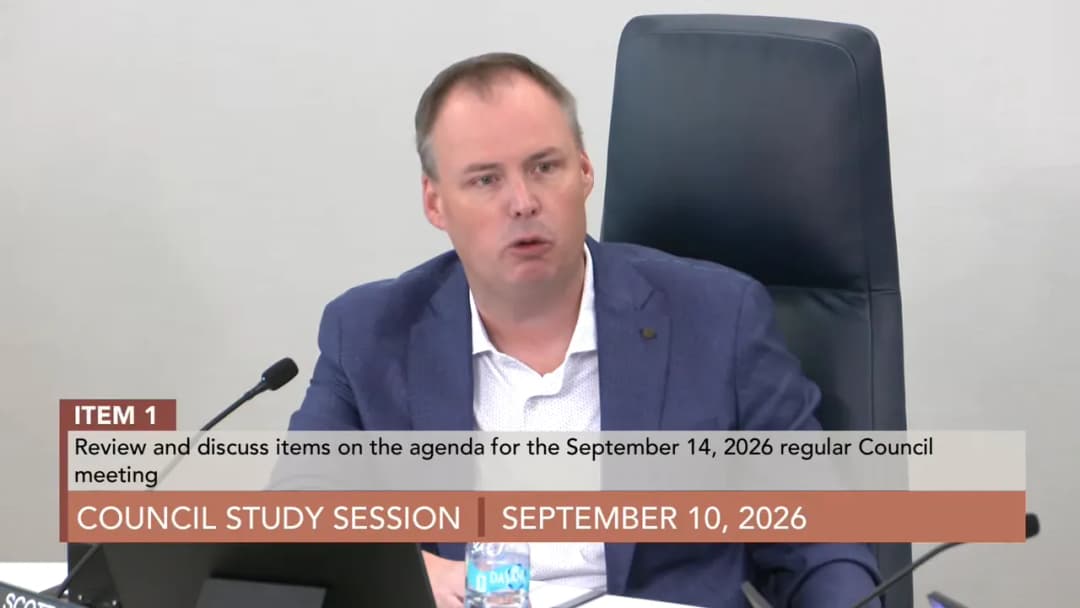
The Mesa City Council held a study session on September 10, 2026, primarily focused on the proposed Legacy Park and Gateway Crossing development, a major public-private partnership. The council also reviewed several agenda items for the upcoming Monday council meeting, including temporary staffing contracts and a dark fiber license. No public comments were heard. Consent Calendar - Council unanimously acknowledged receipt of board minutes and approved the consent calendar. Discussion Items Legacy Park & Gateway Crossing Development (Agenda Item 7) - Presentation by City Manager Scott Butler and staff: The project aims to capture sales tax leakage, create a hospitality and retail destination, and generate significant economic impact. Key statistics: - Minimum build-out: $7.4 billion economic impact, $545 million tax revenue, 1,687 permanent jobs over 30 years. - Full build-out: $58.8 billion economic impact, $1.4 billion tax revenue, 13,500 jobs. - Reimbursement for public infrastructure (e.g., park, lake, pedestrian tunnel, road improvements) capped at $76.4 million plus finance costs, funded from 45% of on-site sales tax and a portion of transient lodging tax. City retains 55% during reimbursement period, then 100% after. - Developer required to build minimum: 500-room luxury hotel (STR luxury brand), 225,000 sq ft retail, 120,000 sq ft office, 300 multifamily units, 10-acre community lake, and pedestrian tunnel linking to Arizona Athletic Grounds. - Water for lake and landscaping from privately acquired type2 groundwater rights, not from city supply. Developer responsible for all water costs and well construction. - Maintenance of public improvements (lake, park, landscaping) in perpetuity by developer at no cost to city. - Quality benchmarks: retail and hotel must equal or exceed standards of specified benchmark centers (Keirland Commons, Scottsdale Quarter, etc.) for at least 15 years to qualify for reimbursement. - Developer statements (David Larcher, Ryan Ash, Vestar): Expressed commitment to creating a "generational project" and "crown jewel of the East Valley." Phase 1 groundbreaking targeted January 2028 with grand opening October 2029. They emphasized underpromising and overdelivering, and assured council that their internal standards exceed city minimums on shading, landscaping, and pedestrian experience. - Council member comments: - Councilmember Duff advocated for higher development standards (e.g., 75% minimum shade factor) and submitted written concerns. Developer noted their plans already meet or exceed such standards. - Councilmember Taylor stressed architectural aesthetics, warning against "boxes" and urging quality design. - Councilmember Heredia questioned traffic impacts and coordination with ADOT on SR24 expansion (scheduled for completion 2029) and Crisman Road improvements. - Vice Mayor praised the partnership and staff's work on the agreement. - Councilmember Summers asked about public improvements (Williamsfield Road, access to AAG) and the pedestrian tunnel. Other Agenda Items - Item 3A – Temporary Staffing for IT/Communications: $99,000 increase to $500,000 contract with Insight Global for temporary staffing in emerging technologies department. Justified by need to fill critical gaps during a hiring freeze pending organizational effectiveness review. Councilmember Taylor questioned the need; staff explained it avoids permanent hires during review and supports TRWC (public safety radio system) needs. - Item 3B – Temporary Staffing for Police Video Redaction: Contract transition from Axon to Insight Global using existing lifecycle funds. Assistant Chief Dom Sterling and manager Liz Will Trout explained the need to reduce backlog on body-worn camera video redactions. Current turnaround times: simple reports 6-8 weeks, complex video 7 months (down from 36 months). Temporary staffing contributed to significant improvement. - Item 4A – Dark Fiber License (MMR Fiber): License for a new fiber route in Southeast Mesa terminating at Elliott Tech Corridor. Discussion on "fiber fatigue" from repeated construction. Council expressed frustration with delays and disruption. City Attorney Jim explained legal obligations to provide non-discriminatory licenses. Transportation Director Lance discussed improving permit enforcement and exploring a small business assistance program for impacted businesses. Council suggested early completion incentives and penalties. Key Outcomes - The study session was informational; formal action on Legacy Park (annexation, community plan, development agreement, theme park district) is scheduled for the September 14 council meeting. - Council directed staff to continue improving right-of-way permitting and enforcement, and to develop a small business assistance program for construction impacts. - Temporary staffing contracts (3A, 3B) and the dark fiber license (4A) are on the consent agenda for Monday, with plans to discuss further if needed. - Council members expressed overall support for the Legacy Park project, with some requesting additional time to review documents (noted that materials were uploaded less than 12 hours before the session).
The Public Meeting Index
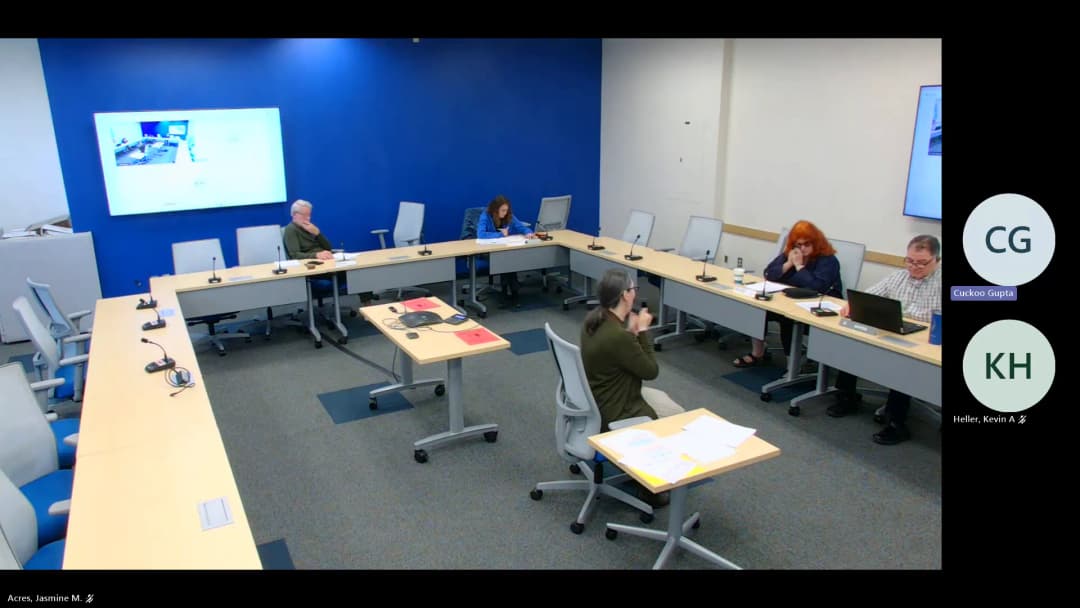
The Public Meeting IndexThe Anchorage Public Naming Commission met on September 10, 2026, to consider several naming proposals, approve meeting minutes and a process flowchart, and discuss the application of the 36-month posthumous naming rule. The meeting included a land acknowledgement, public hearings on three naming proposals, and a review of commission membership. Consent Calendar - The June 2026 meeting minutes were approved unanimously. - The August 2026 meeting minutes were approved as amended to reflect that no quorum was present and the meeting was a work session. - A flowchart outlining the public naming and renaming process was approved unanimously. Public Comments & Testimony - Pipples Field Park (Eagle River): The proposer, representing the Eagle River Parks and Recreation Board, spoke in favor of naming the park after pioneers of the Eagle River area. They noted that the Eagle River Parks and Recreation Board had passed a resolution of approval, but the GDA Community Council had not yet submitted a written resolution due to the summer hiatus. The commission continued the public hearing to October 14, 2026, to allow time for advisory opinions from the Board of Supervisors. - Girdwood Lions Club Shelter Naming (John Troutner): No public testimony was given. Staff confirmed that the Girdwood Board of Supervisors (which also serves as the community council) had provided a resolution strongly supporting the naming. The commission voted to recommend approval to the assembly. - Northeast Connector Trail Naming (Karen Bronga): Several individuals testified in support, including: - Jennifer (Parks and Recreation representative) – explained the trail was a project Karen Bronga championed. - State Senator Forrest Dunbar – spoke in his personal capacity, noting the trail would not exist without the Brongas, that Karen Bronga’s death galvanized the community, and that the trail addresses a dangerous road section. He supported naming without waiting 36 months. - Tom Bronga (Karen’s husband) – described Karen as a lifelong trail maker and noted the bridge is already called “Karen’s Bridge” colloquially. - A community member (name not stated) – voiced support, noting the trail is used daily. - Jim (last name not given) – spoke in favor. - Chair of the Clip (unclear affiliation) – spoke in favor. Commissioner Heller expressed nervousness about bypassing the 36-month posthumous requirement, worrying about setting a precedent for comparison. Staff explained that the assembly can waive the requirement by ordinance, and the commission can include a detailed rationale for departure from policy. The public hearing was continued to October 14, 2026, to obtain an advisory opinion from the Parks and Recreation Commission. Discussion Items - Agenda Reordering: The commission voted to reorder the agenda to start with new business (public hearings) before approving minutes and unfinished business. - Review of Public Naming Process: The commission discussed a minor edit to the flowchart regarding application submission. Staff clarified that a community council may submit either an application or a resolution. The flowchart was approved as presented. - 36-Month Posthumous Rule: Extensive discussion occurred regarding the 36-month posthumous naming requirement in the code. Commissioner Heller asked for context on the rule’s origin and expressed concern about making exceptions. Staff (Dean) noted that the code allows departure with a detailed rationale. Commissioner Gupta suggested creating guidelines for exceptional circumstances, but others noted each case is nuanced. The commission discussed potentially recommending a shorter timeline to the assembly in the future. - New Commission Members: Staff reported that at least one new applicant (Hillary Morgan) is on the next assembly agenda, and another applicant from Girdwood had an interview scheduled. One commissioner announced plans to resign at year-end and had suggested a replacement applicant. Key Outcomes - Approved: June 2026 meeting minutes. - Approved: August 2026 meeting minutes as amended. - Approved: Public naming/renaming process flowchart. - Approved Recommendation: The commission voted to recommend naming the shelter in Girdwood Lions Park after the late John Troutner. (Motion by Member Gupta, second by Commissioner Gilbert; no opposition.) - Continued: Public hearing for Pipples Field Park naming to October 14, 2026, to receive advisory opinions from the Eagle River Board of Supervisors and the GDA Community Council. - Continued: Public hearing for the Karen Bronga Northeast Connector Trail naming to October 14, 2026, to allow the Parks and Recreation Commission to provide an advisory opinion. - Adjourned: Meeting adjourned on a motion by Commissioner Gilbert, seconded by Commissioner Heller.
The Albany Common Council held its regular meeting on Thursday, September 10, 2026, beginning at approximately 22:38 UTC. The meeting included public comments on multiple issues, passage of several ordinances and resolutions, committee reports, and councilmember discussion on data centers, surveillance cameras, speed cameras, and the city budget. A total of 14 councilmembers were present at the time of votes. Public Comments & Testimony - Ukraine Solidarity: Multiple speakers (Susan DuBois, Ulina Lake, Peter Warren, Lawrence Whitner, Irina Holden) urged the Council to support a proclamation condemning Russia's war in Ukraine and affirming support for Ukrainian democracy. Speakers emphasized the ongoing humanitarian crisis, the need for grassroots solidarity, and the importance of local government statements. Lawrence Whitner noted that the UN General Assembly voted 141-5 to demand Russian withdrawal, and that Vladimir Putin has been indicted by the International Criminal Court for child deportation. - Data Center Opposition (Kenwood Tech Center): Several residents (Alex Gable, Hilary Justinous, Jacob Feinland, James Giacologie, Michael Bronstein, Liz Espinoza) spoke against the proposed data center at the Kenwood Commons site. Alex Gable highlighted that the site would need rezoning and that the governor's executive order does not cover facilities primarily used for manufacturing or medical care. Hilary Justinous cited asthma hospitalization rates in the South End in the 99th percentile for New York State and 38% higher than in other historically redlined neighborhoods like Arbor Hill. Jacob Feinland, a computer scientist, argued that AI adoption is being artificially inflated and that data centers would increase energy bills. James Giacologie of the Capital District Democratic Socialists of America called for a categorical ban, citing risks of AI misuse. Michael Bronstein said it would be "sadistic" to force residents to live near noise, heat, and electromagnetic pollution. Liz Espinoza, a clinical social worker, described the health burdens already faced by South End families. - Flock/Surveillance Cameras: Multiple speakers (Merrill Sunderland, Mariana Ashelug) condemned the use of Flock automated license plate readers, citing a recent Times Union report of a senior investigator conducting over 3,000 unauthorized searches. They called for termination of the contract. Mariana Ashelug, from Indivisible Albany, also criticized the Council for not moving forward with a moratorium on data centers and for inaction on ranked-choice voting. - Speed Camera Complaint: Almika Cobb complained about a speed camera at a school zone near the former St. Mary's School, stating it is a "money grab" and that no children cross at that point. He requested help moving the camera. Councilmember Keegan responded by saying the Council worked to get state law changed to protect pedestrians, and that drivers must exceed 30 mph to get a ticket. Councilmember Johnson defended the speaker's right to voice concerns, and Councilmember Robinson apologized on behalf of his colleague for belittling the speaker. Councilmember Howie suggested bringing in traffic engineering to discuss the camera's location. - Other: Wendy Dwyer supported Ukraine and opposed Flock cameras and data centers, emphasizing environmental concerns and civil liberties. Discussion Items - Data Center and AI Risks: Councilmember Ballarin spoke at length about the need for government to safeguard against unchecked technology, citing a CNN article about a 10% chance AI could wipe out humanity and the rapid pace of technological advancement. He stated that the first question to any developer should be, "Would you put this in your neighborhood?" Councilmember Johnson noted that media reports have created confusion, as no council member has expressed support for the data center. - Flock Cameras: Councilmember Howie, chair of public safety, announced that a public safety committee meeting will be held with Police Chief Cox and possibly the sheriff's department to discuss Flock cameras and recent misuse reports. He acknowledged data security risks but argued that similar risks exist with other technologies. - Budget Deficit: Councilmember Keegan reported from the finance committee that the city is projected to spend approximately $249 million against a $228 million cap, and will need a revenue anticipation note to cover payroll, meaning deficit spending will begin in January 2027. - Appointments: The Council discussed appointments to boards and commissions. Justin She-will-been (name unclear) was announced as the new water commissioner pending approval, and John Riley Jr. as Corporation Counsel. Resolutions for their confirmation will be taken up within 45 days. - Street Renaming: Council President announced a street renaming ceremony for Helen and Helen Tory on October 10 at 1:00 PM. - Moment of Silence: Councilmember Howie asked for a moment of silence for victims of the September 11, 2001 attacks, and Councilmember Johnson specifically remembered Stephen Mulderry. Key Outcomes - Minutes Approved: The August 17, 2026 meeting minutes were approved unanimously by voice vote. - Ordinance 158126 (Domestic Partnership Fees): Passed 14-0. The ordinance amends Article 5 of Chapter 245 of the City Code to increase the domestic partnership fee from $35 to $40 (matching marriage license fees) and updates documentation requirements. In 2025, 68 domestic partnerships were processed; 38 have been processed so far in 2026. - Resolution 959126R (Labor Day): Passed unanimously (voice vote). Recognizes September 7, 2026 as Labor Day; all councilmembers were co-sponsors. - Resolution 969126R (Hispanic Heritage Month): Passed unanimously. Recognizes Hispanic Heritage Month (September 15 to October 15) and celebrates Latino contributions. - Resolution 979126R (Suicide Awareness Month): Passed unanimously. Recognizes September as Suicide Awareness Month and promotes the 988 Lifeline. - Resolution 888126R (Chester Bennett to Parking Authority): Passed 14-0. Consents to the appointment of Chester Bennett to the Albany Parking Authority Board of Directors. - Resolution 908226R (Jonathan Nix to Monuments Commission): Passed 14-0. Reappoints Jonathan Nix to the Commission on Monuments and Public Art. - Resolution 91826R (Judy Duchette to Assessment Review): Passed 14-0. Reappoints Judy Duchette to the Board of Assessment Review. - Amendment to Local Law R: Passed unanimously. The specific content of the amendment was not detailed in the transcript. - Future Actions: A public safety committee meeting on Flock cameras will be scheduled. The Council will take up confirmations for the new water commissioner and corporation counsel within 45 days. The Council will continue to discuss data center concerns and a possible moratorium.
The Southern Nevada Enterprise Community Board convened on September 10, 2026, with Chair Neal presiding. A quorum was present. The board unanimously approved the minutes from May 28, 2026. No public comments were offered. Consent Calendar - Unanimously approved the minutes from May 28, 2026. Public Comments & Testimony - No members of the public spoke. Discussion Items - Marble Manor Redevelopment Initiative (Item 5): A team from the Southern Nevada Regional Housing Authority (SNRHA) gave a comprehensive update on the $400 million project, seeded by a $50 million HUD Choice Neighborhood Initiative grant. Chief Housing Officer Kathy Thomas explained that 235 families have been temporarily relocated with options to return or take vouchers. Phased redevelopment will include units at various income levels (30% to 80% AMI plus market rate). Demolition is nearly complete; grading and utilities are underway. - Subcontractor and Workforce Outreach: Raven McSwain (Some New Marketing) described a two-track system for contractors: a fast track for those ready to contract and a development track for those needing technical assistance (licensing, bonding, etc.). Two solicitation events were held in August and September 2026, with 60 and 30 attendees respectively. The goal is to ensure local businesses can participate and sustain beyond the project. - Section 3 and Davis Bacon: Frank Stafford, SNRHA Director of Modernization, outlined federal requirements: Davis Bacon prevailing wages must be paid to all workers, and certified payroll will be tracked. Section 3 mandates that 25% of total labor hours be performed by Section 3 workers, with 5% from targeted Section 3 workers (public housing or voucher residents). Businesses may qualify as Section 3 if 51% owned by low-income individuals or public housing residents. - FLEX Program (Jobs Plus): Shahara McGee, FLEX Program Manager, presented the $3 million federal grant serving 640 workable-age adults across five properties (including Marble Manor and others on the historic west side). The program (rebranded as FLEX – Fostering Lasting Employment Experiences) started in 2025 and runs through 2029. As of August 2026, 263 participants were enrolled (exceeding the year-two target of 256), 74 were employed, and 16 were in training. The program provides intensive case management, a transportation van, Uber accounts, peer mentors, and financial incentives – participants' rents do not increase as their earned income rises, with the grant covering the difference. EmployNV has a seated career coach; 28 referrals have been made, with 4 completing training and employed at livable wage. A partnership with CSN will launch an apprenticeship-ready program in December 2026. The program also coordinates with Section 3 goals to connect residents to construction jobs on the Marble Manor project. - Capital Stack: The financing for Phase 2A/2B (223 units) includes approximately 10% from HUD Choice Neighborhood funds, 82% from private sources (low-income housing tax credits, state tax credits, mortgage bonds, developer fees, seller financing), and 6.7% from public funds (city/county HOME funds, city green space funds, and state gap funds). - Board Questions and Discussion: Board members, including Vice Chair Armstrong, Member Brooks, and Assemblywoman Monroe Moreno, asked detailed questions about construction training timelines, subcontractor turnout, and the FLEX program's funding and outcomes. Chairwoman (who also spoke extensively) raised concerns about workforce coordination, noting that other agencies (EmployNV, Workforce Connections) have existing funds for on-the-job training and WIOA that could be better leveraged instead of using FLEX grant dollars for the same purpose. She suggested a potential Bill Draft Request (BDR) for the 2027 Nevada Legislature to reform workforce funding and ensure it reaches target populations effectively. The board also discussed Opportunity Zone 2.0, with a public comment deadline of September 12, 2026, and the possibility of including the Marble Manor census tract. Kathy Thomas explained that the state's GOED is accepting comments, and SNRHA is advocating for census tracts that require coordinated investment. Key Outcomes - The board unanimously approved the May 28, 2026, meeting minutes. - The presentation was received and discussed; no formal action was taken on the Marble Manor project. - Future agenda items will focus on crafting BDRs related to workforce development and the Opportunity Zone 2.0 designation. The board agreed to consider scheduling an October meeting to allow timely input before the final OZ deadline (September 28, 2026) and to begin BDR drafting.
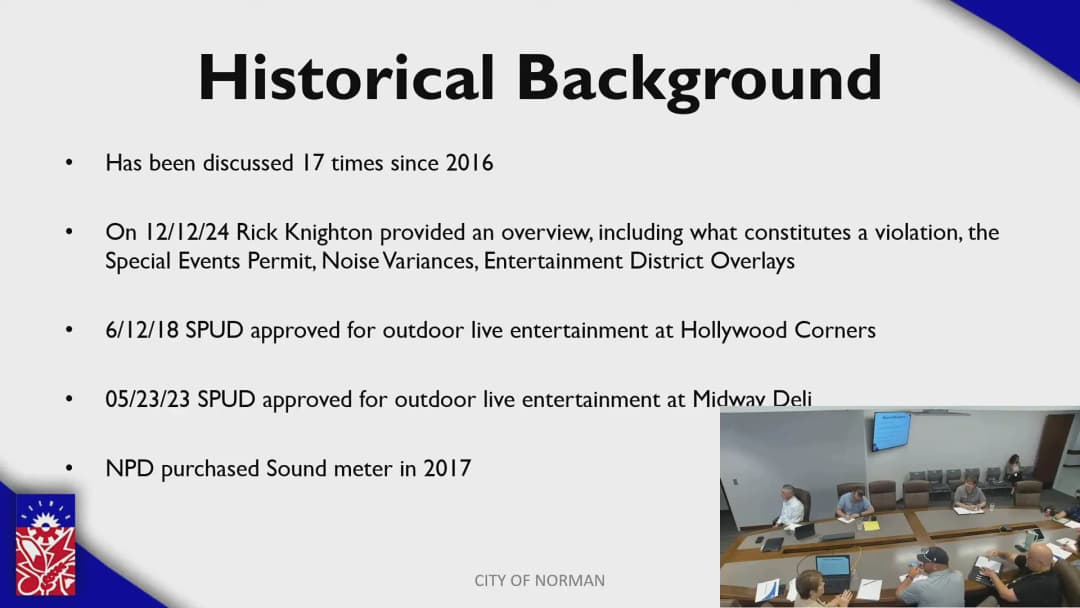
The Norman Planning Commission met on September 10, 2026 at 5:30 PM. The meeting included a consent docket, public comment on a preliminary plat, discussion and votes on zoning and plat items, and a postponement request. The commission also received a staff update on the upcoming code assessment release. Consent Calendar - Item 1: Approval of the planning commission meeting minutes from August 13, 2026. Motion to approve, seconded, and passed unanimously. - Item 2 (PP-2627-4): Preliminary plat for 108th Avenue Business Edition was pulled from the consent docket for separate discussion. Public Comments & Testimony - James Maxwell (property owner at 2601 120th Avenue SE, adjacent to the proposed Dollar General project): Expressed opposition to the preliminary plat due to concerns about the proposed aerobic sprinkler system (15–20 feet from his property line), potential sprayback and watershed onto his agricultural property, potential chemical treatment mishandling by Dollar General employees, impact on his use of the land (mulch, compost, wood, walnuts, acorns), and proximity to the Lake Thunderbird watershed (WQPZ). He also cited increased crime associated with Dollar General stores and noted that other jurisdictions require produce sections to mitigate crime. He requested the commission consider these issues. Discussion Items - Item 2 (PP-2627-4): Commissioners discussed the distance from the proposed wastewater discharge to the WQPZ and a private well. Staff noted a 300-foot requirement from DEQ and a possible 200-foot requirement from city ordinance (section on water pollution hazard). The exact distance on the site plan was unclear regarding the adjacent property lines. Commissioner Steve raised the need to verify compliance. A motion was made to postpone the item to obtain accurate measurements and ensure all guidelines are met. Motion seconded and passed 6-0. - Items 3 & 4: Consideration of ordinance 0-2526-65 (rezoning from A2, PL, PUD to R1) and preliminary plat PP-2627-3 for Cedar Lane Edition. Staff and applicant presented. The project would add approximately 129 homes on one portion and 23 on another, with a total of 412 single-family homes and one commercial lot on 116.55 acres. A lift station would serve the area. Discussion included a commissioner questioning why the development is at lower density despite the AIM Norman plan designating the area as urban high (due to anticipated commuter rail stop). The commissioner voted no, citing the need for higher density to meet housing goals. The motion to approve passed 5-1. - Item 5 (0-2627-1): Rezoning for 201 West Apache Ward 4. Applicant requested postponement to the October 8, 2026 planning commission meeting. Motion passed 6-0. Key Outcomes - Item 2: Postponed to a future meeting pending verification of WQPZ and well setback distances (motion carried 6-0). - Items 3 & 4: Approved (5-1) with recommendation to city council, noting that preliminary plats do go to council (clarified by staff later). - Item 5: Postponed to October 8, 2026 (6-0). - Staff Announcements: The upcoming code assessment (90-page document) will be released within the next week on NormanDevCode.com for public comment. A joint council and planning commission meeting is scheduled for October 6, 2026 at 5:30 PM in the executive conference room to review the assessment. Note: The meeting adjourned without further discussion.
No agenda, minutes, or transcript were provided for this meeting. As a result, no discussion items, public comments, or decisions can be summarized. The meeting date is confirmed as September 10, 2026, but no content is available.
The Assembly Rules Committee met on Thursday, September 10, 2026, from 1:00 to 3:15 PM. The meeting covered a wide range of topics including the mayor's report on infrastructure and housing, updates on the ombudsman's office, a presentation on the division of power between the assembly and school board, proposals for youth representative voting procedures, and reorganization of assembly committees. The meeting also included one public comment. Consent Calendar - No consent calendar items were presented. Public Comments & Testimony - Jamie Lopez, formerly homeless, praised the ombudsman's office presentation and advocated for better pay for the ombudsman. He expressed concern about punitive approaches to homelessness, citing a 6.6% acceptance rate for services attached to police, and urged the assembly to establish an independent community-driven police oversight commission. Discussion Items - Mayor's Report (Suzanne Fleet Green, Chief of Staff): - The Port of Alaska modernization program (PAMP) benefits from a $200 million MARAD settlement, reducing the projected cargo surcharge for 2028 from $31 to $24 per ton compared to April 2026 estimates. - A nuisance property on Thompson Avenue was demolished; downtown library construction is underway with a February opening expected. - Midtown 42nd Avenue reconstruction is complete. - Shelter capacity is being increased for winter, with the surge likely to reach full capacity by November, earlier than last year. - NSTAR has issued curtailment notices to large commercial customers; the administration is monitoring natural gas supply hearings. - Discussions with the school district on school closures (Abbot Loop, Campbell STEM) and potential sale of West Park property to support school funding. - Chair's Report (Anna Brawley): - Three youth representatives were appointed: Rikik Ellie, Rebecca McCullough, and Malachi Cochrane; they will be sworn in on September 15. - The branch budget for 2027 includes a $400,000 provision for a potential mayoral runoff election; funds may be reallocated after the April election if no runoff occurs. - Ongoing projects: social media policy review, recognition resolutions for former members, quasi-judicial procedure (AO 2026-107) returning October 6, and an auditor's request for ISA expenditure records. - Work sessions planned on assembly role in labor agreements, Board of Equalization annual report, and short-term rental registration data review. - A fiscal future summit is scheduled for October 30 at UAA Student Union. - Ombudsman's Report (Daryl Hess & Drew): - The office received its 900th complaint of 2026, with 224 open cases; emphasis on timely closure. - A contract with Agnew Beck (valued at $5,000, sole source) began for the first strategic plan of the ombudsman's office; concerns about conflict of interest were addressed by legal counsel citing ethics opinion 2024-02 and the separation of branches. - Staff attended professional development conferences at their own expense; the 2027 budget requests increased training funds. - The office highlighted systemic resource constraints: the Health Department child care licensing has 8 staff down from 12; land use enforcement officers average 250 open cases; code abatement officers average over 100; APD response times are impacted by staffing shortages; property appraisal handled 2,000 appeals. - The annual report (2025) included a new mission statement: "To impartially promote fairness, transparency, and accountability between the local government and constituents." - Assembly & School Board Role Presentation (Kate Bogle, Senior Counsel): - The state legislature has a non-delegable duty for public schools; the school board manages schools, the assembly sets the total budget within state parameters (minimum required local contribution and a cap). - The assembly can increase or decrease the total amount but cannot line-item the school budget; if the assembly does not act in 30 days, the school board's budget is automatically approved. - School closure decisions rest with the school board; disposal of property involves the assembly and mayor, especially for Heritage Land Bank lands. - The administration is proposing a resolution related to West Park property (a potential housing development) with proceeds possibly going to the school district; legal questions exist about compensation and the required local contribution cap. - Youth Representative Voting Procedure Proposal (Donald Handlin & Sydney): - Proposed changing the advisory vote order so youth representatives vote before the assembly, consistent with best practices from other Alaska boards. The current code is silent; the proposal is a procedural change, not a code amendment. The chair expressed openness and suggested starting with the new cohort on September 15. - Committee Reorganization: - Proposed committee name changes: adding "Energy" to Enterprise, Utilities, and Infrastructure; renaming Health and Public Safety to Health and Homelessness and adding "Housing" to Economic and Community Development. - Schedule adjustments: committees moved to noon or later to avoid conflicts with assembly meetings; public safety and health committees may stay at 11 AM per feedback. - Assembly member Cameron proposed a year-long ad hoc committee for APD policy oversight, in coordination with the municipal attorney and police chief. - Members were asked to formally opt-in to committee memberships via the clerk. Key Outcomes - Youth Representatives: Appointed and will start September 15; preferential voting procedure to be tested at the first meeting. - Branch Budget: Approved as proposed with $400,000 for potential runoff; the chair noted funds could be reallocated later. - Recall Petition: Received for the mayor; legal sufficiency review underway; state law prohibits receiving the petition within 180 days of the term's end (less than 30 days away). - Ombudsman Strategic Plan: Contract with Agnew Beck commenced; next steps include quarterly reports to the assembly. - Fiscal Future Summit: Scheduled for October 30, 2026, at UAA. - Committee Schedules: Finalized by chair by September 11; new schedule effective by end of September/early October. - Ad Hoc APD Committee: Under consideration; chair and Cameron to discuss further. - School Proposals: Resolution on West Park property expected soon; administration to bring forward legislation on Abbot Loop and Campbell STEM closures. - Governance Discussion: Deferred to a future meeting; discussion guide provided but not deliberated.
The Omni Community Redevelopment Agency (CRA) met on September 10, 2026, at 20:45 UTC. The board approved the minutes from the July 23, 2026 meeting and passed all five resolutions on the agenda unanimously (4-0). No public comments were made. Consent Calendar - Approval of Minutes: The minutes from the July 23, 2026 Omni CRA meeting were approved unanimously (4-0). - Resolution 1: Adoption of the CRA's general operating budget and tax increment fund budget for FY 2026-2027 in the amount of $220,622,862. - Resolution 2: Authorization of a grant not to exceed $10 million to the City of Miami from the Omni CRA redevelopment revenue bond series 2026 proceeds for Phase 1 of the Margaret Pays Park Improvement Project. - Resolution 3: Establishment of a public art mural and creative placemaking program with $300,000 in funding. - Resolution 4: Approval of a sub-lease agreement with Amuna Concierge Mental Health for approximately 1,635 square feet at the Windows Works property at a rent not to exceed $8,000 per month through April 24, 2031. - Resolution 5: Authorization of a revocable license agreement with 14th Street Development for temporary use of the second floor of the CRA's former office facility at 1401 North Miami Avenue as a project management office. Public Comments & Testimony - No public comments were received. Discussion Items - No discussion occurred among board members regarding the resolutions. Key Outcomes - All five resolutions were passed unanimously (4-0) by the board.
The Public Works and Infrastructure Committee met on September 10, 2026, to discuss industrial pretreatment and sewer capacity for large industrial users, particularly data centers, and to consider several consent agenda items. The meeting featured presentations from the Department of Watershed Management on regulatory compliance, water supply modeling, and sewer capacity under the consent decree. Commissioners asked questions about enforcement, monitoring frequency, job impacts, and opportunities for on-site water reuse. Consent Calendar - 2026-1287: Minutes of the August 18, 2026 Public Works and Infrastructure Committee meeting (all districts). Approved unanimously. - 2026-1298: Minutes of the August 24, 2026 special called Public Works and Infrastructure Committee meeting (all districts). Approved unanimously. Discussion: Industrial Pretreatment and Sewer Capacity for Large Industrial Users The committee heard a multi-part presentation on how DeKalb County regulates non-domestic discharges and manages sewer capacity for large users, including data centers. Industrial Pretreatment Program (IPP) - The IPP is federally and state mandated. DeKalb County is the control authority over all industries discharging to its sewer system. - Significant industrial users (SIUs) are defined by EPA categories (e.g., metal, textile, pharmaceutical) or non-categorical users discharging 25,000 gallons per day or with organic loading 5% of plant capacity. - Approximately 69–70 IPP permits are active countywide. - Enforcement includes notice of violation, corrective action plan (15-day response), and ultimately discontinuation of service for chronic non-compliance. - The county conducts annual inspections; unannounced visits are possible except at secured facilities like the CDC. - Commissioner Terry suggested enhanced monitoring (e.g., quarterly checks) and on-site treatment/reuse for large users to reduce sewer loading. Director Wells noted that technology allows flexibility and that on-site reuse (gray water) is a beneficial approach. - Commissioner Davis Johnson expressed concern about job displacement from data centers and AI, while Commissioner Terry noted that water and sewer jobs could be affected if users build their own treatment plants. Water Supply Review - Kerry Williams, Deputy of Engineering, explained that the county uses a calibrated hydraulic model to assess water system pressure (minimum 40 PSI for fire flow). - Large developments, including data centers, are modeled to determine impact. If the model shows pressure drop, the developer must fund system upgrades. - New infrastructure is paid for by the developer; a one-year warranty bond is required. - Gray water systems (e.g., Emory Water Hub) can be modeled and reduce demand on the drinking water system. Sewer Capacity Assurance Program (CAP) - Director Houser presented the consent decree-required CAP. The program has seven hydraulic models for different sewer sheds. - If a user’s flow exceeds 50% of the pipe’s capacity, the pipe must be upsized by the developer. - If the hydraulic model fails (flow depth within 2 feet of manhole top), capacity credits must be generated through INI removal. The board has approved several capacity agreements. - Large users are defined as 10,000–40,000 gallons per day, varying by sewer shed. - To date, 19 miles of sewer pipes have been rehabilitated jointly with developers. - Additional requirements in capacity-limited areas include low-flow fixtures, no fats/oil/grease, caps on cleanouts, and maintenance of private sewer lines. - A one-year surety bond is required for infrastructure; discussion occurred about possibly extending to two years for large users. - Commissioner Terry requested that the committee work with the law department on legislation requiring private sewer lateral inspection and repair upon property sale to reduce infiltration/inflow (currently 50% of volume). Key Outcomes - 2026-0949: Substitute approved for Michelle Obama Trail Extension design services (Kimley Horn and Associates, $4,402,022, with $3.6M in federal funds). Typographical corrections noted. - 2026-1165: Substitute approved for asphalt concrete pavement repair contract (ANS Paving and AutoCode Development, $23,850,000 over 3 years, countywide). The amount increased due to anticipated use and rising asphalt costs. - 2026-0952: Approved award to AECOM for design of North Druid Hills Road Bridge replacement at CSX ($951,005, with $720,000 federal aid). - 2026-1250: Approved sole source contract with Fairbanks Scales for truck scale maintenance and repair ($380,000, all districts). - 2026-1320: Approved Recycle DeKalb Compost Beta Program (Compost Cowboys LLC, $325,000) for weekly food scrap collection and education for 500 unincorporated households over 40 weeks in 2027. - 2026-1244: Authorized acceptance of GEFA loan ($17,887,000) for Shoal Creek Trunk Sewer Improvement Project at 4.03% during construction and 2.03% thereafter (20-year term). - 2026-1183: Approved USGS five-year agreement ($6 million) for water monitoring, with direction to explore reinstating a monitoring station on Intrenchment Creek. Committee granted flexibility to modify the contract if USGS agrees. - 2026-1066: Held in audit; no action taken. The meeting adjourned after the final vote.
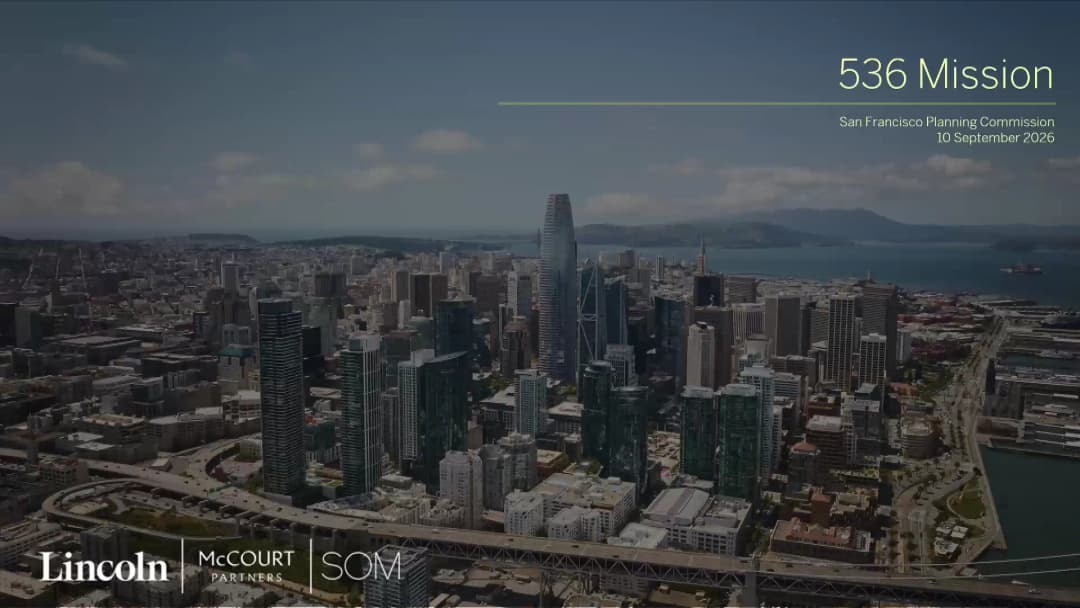
The San Francisco Planning Commission met on Thursday, September 10, 2026, to consider several items, including a planning code amendment to align mezzanine definitions between the planning and building codes, and a major downtown project at 536 Mission Street involving a new tower with office, laboratory, or residential uses. The Commission also heard general public comment and received updates on tenant protection policies. Director's Announcements - Planning Director Sarah Dennis Phillips announced a package of tenant protection measures proposed by the mayor's office and several supervisors, including tenant right to counsel, increased Ellis Act payments, and a "know your rights" campaign. Public Comments & Testimony - General Public Comment: Georgia Shudish spoke about 525 28th Street, a project approved in 2012 that she argued should have been reviewed as a demolition under Section 317. She showed photos and price history, and urged closer coordination between Planning and DBI to catch such scope-of-work issues at intake. - Item 5 (536 Mission Street): - Eddie Reyes, President of Iron Workers Local 377, expressed strong support for the project, citing its concentration of development near transit, commitment to local registered apprentices and union trades, and potential for retail and housing. He urged approval with conditions. - Adam Van Water, Executive Director of the Transbay Joint Powers Authority, supported the project as a key part of the Transit Center District Plan, noting it would contribute to the community facilities district and help bring Caltrain and high-speed rail to Salesforce Transit Center. - Taylor Jance, CFO of Golden Gate University, expressed support, explaining that selling the site allowed GGU to right-size its footprint and invest in modern education delivery. He supported allocating the full available office allocation. Discussion Items Item 4: Story Count and Mezzanines - Planning Code Amendment (File No. 260709) - Rainell Cooper, legislative aide for Supervisor Mahmood, introduced the ordinance to align the planning code's mezzanine definition (currently 33.3% floor area threshold) with the building code (50% threshold under certain conditions like sprinklers). This would resolve inconsistencies causing delays and confusion. - Staff planner Tate Hanna recommended approval with modifications to reference building code exemptions, ensuring alignment in all cases. He noted potential minor impacts on ground-floor retail in neighborhood commercial districts. - Commissioners praised the coordination between Planning and DBI. Commissioner Sow asked about PDR districts and live-work uses; staff confirmed the change could apply there as well. Item 5: 536 Mission Street - Downtown Project Authorization, Office Development Authorization, and Shadow Findings - Staff planner Rebecca Salgado presented the project: demolition of existing Golden Gate University buildings and construction of a 46-story tower with two variants: (1) a commercial variant (700 ft, 1.22 million sq ft) with office and lab space, and (2) an office/residential variant (649 ft, 992,000 sq ft) with 385 residential units. Both include ground-floor retail, POPOS (privately owned public open space) on Ecker Street, and improvements to Jesse Street. The department recommended approval with conditions and an office allocation of 555,390 sq ft. - Project sponsor Brandon Wong (Lincoln Property Company) emphasized the need for the full available office allocation of 813,214 sq ft to give confidence to invest tens of millions in design and pre-construction. He stated the all-office variant is the focus due to higher office rents and lower construction costs; the mixed-use variant does not pencil today. - Architect Mark Schwettman (SOM) detailed the design: a tapered tower with a 40-foot-high base, cantilevered canopy, and extensive public realm improvements. Ecker Street would be pedestrianized and maintained as POPOS for the life of the project. - A key debate centered on office allocation. Staff explained that granting the full 813,214 sq ft would exhaust the current Prop M office allocation bank, potentially blocking other projects like 50 Main Street (seeking 350,000 sq ft) and limiting future allocations due to debt payments. The October 2026 net new allocation was projected at only about 20,000 sq ft after prior commitments. The director reminded commissioners of their July policy prioritizing projects that include residential. - Commissioner Coppel moved to approve with the full 813,214 sq ft allocation; the motion failed 2-4 (Commissioners Coppel and McGarry in favor; Chen, McDonald, Sow, and President Campbell against). - Commissioner Chen then moved to approve the staff recommendation of 555,390 sq ft; the motion passed unanimously 6-0. Key Outcomes - Item 4 (Mezzanine Code Amendment): Approved unanimously (6-0) with staff modifications to reference building code exemptions. The ordinance will align planning and building code mezzanine definitions. - Item 5 (536 Mission Street): Approved unanimously (6-0) with the staff-recommended office allocation of 555,390 sq ft. The Commission approved both variants (commercial and office/residential) with conditions, allowing the project sponsor to seek additional Prop M allocation in the future when available. Shadow findings were also approved, as previously recommended by the Recreation and Park Commission. - Item 6 (288 Pacheco Street – Discretionary Review): Withdrawn prior to the meeting.